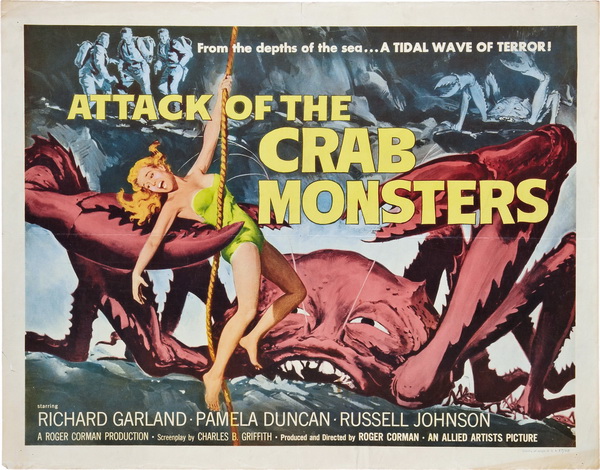
Monster Matinee – Attack of the Crab Monsters

I’m working my way through the public domain sci-fi/horror movies on Pub-D-Hub, and last night I took in Roger Corman’s Attack of the Crab Monsters (1957).

Spoilers are a comin’, so be warned.

The combination of “Corman” and “Crab Monsters” doesn’t fill a person with much hope. The monsters, I assumed, would either be men in rubber suits or green-screened crabs made to look giant harassing a bunch of strangers, etc. I have to say I was pleasantly surprised. It is a movie in the sub-genre of “group of people menaced by monsters, dying one by one”, but had some pretty clever details – oh, and one of the characters is played by Russell Johnson, better known as the Professor on Giligan’s Island!

Still trying to get a transmitter to work, and not a coconut in sight

The “crab monsters” in the title weren’t what I expected. They were giant crabs altered by atomic tests on an island. As it was described in the movie, they weren’t just enlarged crabs. Their atoms had been detached from one another in such a manner that they were in a semi-liquid state – liquid given a permanent shape. Their weird atomic structure has given them additional abilities. When the crabs consume people, their atoms simply join the crab’s atoms, making them a sentient part of the crab. Several people’s minds and memories can exist within the crab simultaneously, and though they retain their memories, their personalities change. They now seek the continued survival of the crab, even if that means killing former friends. The crab’s are also capable of transmitting telepathic messages via bits of metal, these messages being in the voice of the people that have absorbed. The crabs can regenerate body parts and generate significant amounts of heat, but electricity turns them quickly to dust.

The giant crabs, there are two in the film initially, are intent on destroying their island to keep people from discovering their existence. One of them is “with child”, and once the crabs have increased their numbers under the waves, they plan on expanding their dominion. They are destroying the island using dynamite they have captured from the various groups of soldiers and scientists that have come to investigate an aircraft that crashed near the island.

Naturally, a monster this creative needs some game stats!

Crab Monster (Blood & Treasure)
Large Magical Beast, Neutral, Average Intelligence; Cast (1d6)

HD 6; AC 14; Atk 2 claws (2d6 + grapple); Speed 30 (Swim 20); Save F6, R7, W10; XP 600; Special: Immune to fire, generate heat, resistance to physical weapons, vulnerable to electricity, consume memories, telepathy 300-ft. (transmits through metal).

Crab monsters can generate heat in a radius of 30 feet. This can be done three times per day and 10 minutes at a time, and all in the radius suffer 1d4 points of damage per round. Metal in the area of effect is affected as per the heat metal spell.

Crab Monster (Mystery Men!)

Level 6; Physique 5; Mentality 5; DC 16; SPD 2; XP 2800; ATK 2 claws (2d6); POW consume memories*, correspond, energy burst (fire), energy immunity (fire, lasers), energy vulnerability (electricity), half damage from physical attacks

When a crab monster consumes a person, they add their mind to their own. These minds remain independent, but are now part of the crab and work for the crab’s survival and interests, even turning on former allies. The crab can correspond telepathically using the voices of the people it has consumed. Increase the crab’s Mentality score to that of the highest Intelligence it has consumed. Any psychic powers possessed by a person consumed by the crab monster are now possessed by the crab monster.

Crab Monster (Space Princess)

HD 6 | DEF 19 | FIGHT 12 (2d6) | SHOOT 11 | MOVE N | STR 6 | DEX 5 | MEN 4 | KNO 4 | DL 9

Crab monsters are immune to fire and heat, and suffer only half damage from lasers and ray guns and from physical attacks. Electricity attacks inflict double damage on them. Crab monsters absorb the KNO and MEN of people they consume, increasing their values to the highest value they have consumed. They also absorb the psychic powers and knowledge-based skills of people they consume, though they might not be able to use these skills due to physical limitations. Crab monsters communicate telepathically using the voices of the people they have absorbed. This telepathy can only be heard through metal.

The Queens of Elemental Earth

This idea popped into my head today, so I explored it a bit.

The primal earth has produced many wonders, but none so lovely (and few so powerful) as the so-called Queens of Elemental Earth. These five sisters are worshipped as goddesses by many of the folk who dwell beneath the earth and are honored by all elemental earth creatures.

The queens look like astoundingly beautiful statues of women in their natural state. They are translucent and gleam with an inner light that produces a magical aura. Within their eyes dance shimmering motes of light that affect all upon which they train their gaze. They dwell in luxurious palaces beneath the ground, served by lesser elementals and fey creatures.

While the queens are ground in neutrality, with some preference for order (i.e. Law), they are, as one might expect, possessed of a very keen appreciation for the wonder that is them. They do not like to be disobeyed or their intentions and desires frustrated, and they have no qualms about destroying lesser creatures that get in their way.

All of the queens can move through rock, stone and soil as easily as a human moves through the air. They suffer half damage from all attacks from manufactured and natural weapons.

Adamantia
Adamantia is Queen Diamond. She has a smooth body of translucent crystal with inner reflections of pink. Adamantia is the strongest and most durable of the five sisters, and she is unforgiving in her disdain of imperfection and muddled thinking. She is always under the effect of a true seeing spell and a zone of truth. She is worshipped as a goddess of clarity, truth and perfection. Her stronghold is a fortress of gleaming adamant, with every surface stark white and lit by a soft, pinkish-white glow. Her court includes elemental earth creatures as well as entities of Law and a host of human paladins that have declared her the focus of their courtly, chaste love.

Adamantia produces an aura of truth (see zone of truth above) that also acts a protection aura against chaotic creatures (per protection from evil, 10-ft. radius). Her gaze acts as a hold monster spell.

Adamantia can cast the following spells as innate abilities: At will – charm person; 3/day – break enchantment, charm monster, cure disease, dispel magic, haste (self), invisibility; 1/day – dimension door, ray of enfeeblement, strength, suggestion, wave of exhaustion. She can also cast spells as a 10th level cleric.

Adamantia: HD 21; AC -7 [26]; Atk 2 strikes (4d6); Move 36; Save 3; CL/XP 30/7400; Special: +2 or better weapon to hit, aura, gaze, earth glide, half damage from all weapons, suffers double damage from sonic attacks, immune to fire, resistance to cold (50%), magic resistance (65%), regenerate 3 hp/round.

Rubinia
Queen Ruby, Rubinia, is composed of a translucent red substance. Her hair (though it is merely sculpted on her head) appears wild and unkempt and her eyes gleam with power. She is worshipped as a goddess of fire and passion and strength. Her court includes elemental earth creatures as well as exiled or rebellious elemental fire creatures. Her stronghold is enclosed in a ruby sphere with spherical chambers that look like bubbles within the sphere and connected by curving tunnels that radiate out from her central court. Gravity is completely relative within the sphere, with people able to walk on all surfaces.

Rubinia produces an aura of weakness (10-ft. radius) that forces people to pass a saving throw or be affected per a ray of enfeeblement. Her gaze forces people to pass a saving throw or be enraged (per the emotion or rage spell, depending on which version of the grand old game you play). Enraged folk never turn their anger upon Rubinia or her servants. Her touch ages people as the touch of a ghost.

Rubinia can cast the following spells as innate abilities: At will – augury; 3/day – charm person, divination, dispel magic, haste (self), invisibility; 1/day – dimension door, flame strike, heal, heat metal. She can also cast spells as a 10th level magic-user.

Rubinia: HD 21; AC -6 [25]; Atk 2 strikes (4d6); Move 36; Save 3; CL/XP 30/7400; Special: +2 or better weapon to hit, aura, gaze, earth glide, half damage from all weapons, suffers double damage from sonic attacks, immune to fire, resistance to cold (50%), magic resistance (55%), regenerate 3 hp/round.

Esmeraude
Esmeraude, Queen Emerald, is the most sensuous and beautiful of the sisters, possessed of a green, healthy glow and a warm, though unyielding, touch. Her stronghold is a paen to love and romance, being a series of limestone caverns with jade pools, rushing streams, laughing waterfalls and gardens of flowering trees, ferns and flowers. Her court consists of elemental earth creatures, nymphs and dryads.

Esmeraude radiates an aura of blinding beauty (per a nymph) and her gaze stuns creatures for 2d4 rounds. Her kiss can grant magic-user’s the effects of a mnemonic enhancement for 24 hours, but also imbues upon them a geas that they must visit her once per year and serve her faithfully for one week.

Esmeraude can cast the following spells as innate abilities: At will – cause blindness; 3/day – cure blindness, cause fear, dispel magic, haste (self), invisibility; 1/day – charm monster, dimension door, entangle, plant growth, suggestion. She can also cast spells as a 12th level druid.

Esmeraude: HD 21; AC -5 [24]; Atk 2 strikes (4d6); Move 36; Save 3; CL/XP 30/7400; Special: +2 or better weapon to hit, aura, gaze, earth glide, half damage from all weapons, suffers double damage from sonic attacks, resistance to cold and fire (50%), magic resistance (55%), regenerate 3 hp/round.

Amethysta
Queen Amethyst appears as a woman of translucent purple crystal accompanied always by three legendary panthers with purple-black fur. She is a queen of dreams who commands a court of elemental earth creatures, succubi and illusionists. Her court is held in a palace of mottled purple walls set in a maze-like layout, with many secret chambers where visitors can rest themselves on comfortable beds stuffed with celestial goose down and sleep under silk and satin, perhaps never to wake again.

Amethysta produces a purple aura of slumber (as the daze spell) and her gaze causes confusion. Those struck by her, even lightly, must pass a saving throw or fall into a deep sleep. She can deliver a kiss that drains levels per a succubus.

Amethysta can cast the following spells as innate abilities: At will – sleep; 3/day – cause fear, dispel magic, haste (self), invisibility; 1/day – dimension door, dream, nightmare, phantasmal killer, poison. She also casts spells as a 10th level illusionist.

Amethysta: HD 21; AC -5 [24]; Atk 2 strikes (4d6); Move 36; Save 3; CL/XP 31/7700; Special: +2 or better weapon to hit, aura, gaze, earth glide, half damage from all weapons, suffers double damage from sonic attacks, resistance to cold and fire (50%), magic resistance (45%), regenerate 3 hp/round, life drain.

Zaffira
Zaffira is a bubbly, almost giddy queen of sapphires. She appears as a beautiful, young woman with translucent blue skin, her eyes like star sapphires and her hair tumbling like cascades of water down her back to her ankles. She dwells in a floating palace of sapphire walls and misty, damp halls occupied by elemental earth creatures as well as sylphs and other exiled air creatures and giant eagles. Zaffira is worshipped as a goddess of innocence, truth and courage.

Zaffira produces an aura of euphoria. Folk who enter it must pass a saving throw or be calmed, losing all desire to commit violence or even engage in argument. Her gaze causes people to break into uncontrollable laughter (per the spell).

Zaffira can cast the following spells as innate abilities: At will – hold person; 3/day – cause fear, discern lies, dispel magic, haste (self), invisibility; 1/day – globe of invulnerability, mark of justice, ray of enfeeblement, resilient sphere, strength. She also casts spells as a 12th level cleric.

Zaffira: HD 21; AC -6 [25]; Atk 2 strikes (4d6); Move 36; Save 3; CL/XP 23/5300; Special: +2 or better weapon to hit, aura, gaze, earth glide, half damage from all weapons, suffers double damage from sonic attacks, resistance to fire and cold (50%), magic resistance (65%), regenerate 3 hp/round.

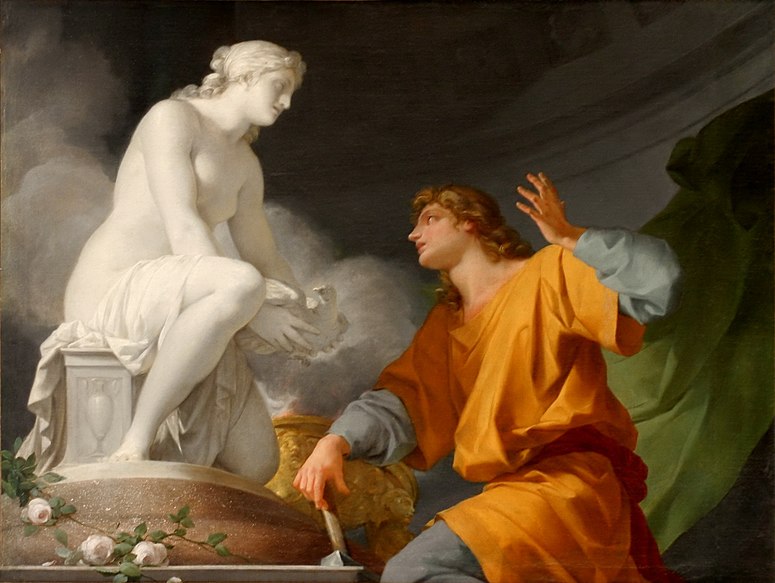
Image found HERE. Painted by Jean-Baptiste Regnault (1786).

Titans: What Are They Good For?

Orcus and Demogorgon, solars and planetars, but whence the titans? These big guys and gals seem to be on a pretty even footing with the demon lords and archangels (depending on which version of the game you adhere to), but they don’t get much love or use. I think this is a shame. To my way of thinking, titans represent a third way when it comes to the solars and the demon princes and dukes of Hell – neutral powers that can stand with the powers of Law and Chaos.

Perhaps the titans are the children of minor gods and goddesses. I’m talking Alala and Eleos, here, not Zeus and Aphrodite. Their parentage is divine and immortal, but they’re not. Well, maybe they are immortal in terms of aging, but they are creatures of the Material Plane and thus mortal in terms of “can be killed”. Where demon lords and solars hang out in the outer planes, titans live in the Material Plane, lording it over lesser beings as kings and queens by dent of their divine birth and tremendous power. How much more interesting to discover that the city-state you just wandered into is ruled by King Criomenos, the son of Moros, demi-god of impending doom and Eunomia, demi-goddess of law and legislation. You walk into this court to announce yourselves as great heroes, and find not a little man with a long, white beard, but a titan, head wreathed in gold, hand resting atop a golden sceptre as tall as your paladin and eyes that have seen centuries.

With that in mind, I decided that any titan that shows up in Nod is going to have a name, a heritage and powers commensurate with that heritage. According to S-n-W, the primary power of titans is spells – two spells of first to seventh level from both the magic-user and cleric lists, for a total of 28 spells. I decided to alter that a bit. Drawing on the old d20 SRD, I decided to instead give them all the spells (level 1 to 9) from the two cleric domains that most befit their parents. Since that gives them only 18 spells (still probably plenty), I decided to make up for it with a special defense (see below) and with the ability to commune with mommy and daddy once per day.

To determine the titan’s parentage, I decided to just make a random table of the cleric domains, rolling once for mom and once for dad. I listed some potential parents from Greek mythology behind each domain.

Roll D30 – Parent

1. Air – Aello (F), Aeolus (M), Aura (F)
2. Animal – Britomartis (F), Ichnaea (F), Krotos (M), Priapus (M)
3. Artifice – Acmon (M), Aristaeus (M), Hecaterus (M), Philomelus (M), Rhapso (F)
4. Chaos/Evil – Adikia (F), Eris (F), Dysnomia (F), Kakia (F), Kydoimos (M)
5. Charm – Eros (M), Hedone (F), Iynx (F), Peitho (F)
6. Community – Eunomia (F), Harmonia (F), Hymenaios (M), Nomos (M), Praxidike (F)
7. Creation – Euporie (F), Othorsie (F), Porus (M)
8. Darkness – Charon (M), Erebos (M), Nyx (F), Tartarus (M)
9. Death – Macaria (F), Melinoe (F), Thanatos (M)
10. Destruction – Alecto (F), Enyo (F), Moros (M), Nemesis (F)
11. Earth – Chrysus (M), Plutus (M)
12. Fire – Phlegethon (M)
13. Glory – Agon (M) , Eucleia (F), Kalokagathia (F), Nike (F), Pheme (F)
14. Good/Law – Arete (F), Astraea (F), Dike (F), Eunomia (F), Nomos (M), Peitharch (F)
15. Healing – Aceso (F), Eirene (F), Eleos (M), Eupraxia (F), Panacea (F), Philophrosyne (F)
16. Knowledge – Polymatheia (F)
17. Liberation – Momus (M)
18. Luck – Tyeche (F)
19. Madness – Deimos (M), Lyssa (F), Epiales (M)
20. Magic – Astraios (M), Circe (F), Despoina (F), Telete (F), Zagreus (M)
21. Nobility – Kalokagathia (F)
22. Plant – Amphictyonis (F), Carmanor (M), Chloris (F), Karpo (F), Silenus (M), Thallo (F)
23. Protection – Soter (M)
24. Strength – Bia (F), Kratos (M), Ponos (M)
25. Sun – Alectrona (F), Eos (F), Helios (M), Hemera (F)
26. Travel – Angelia (F), Arke (M), Ioke (F), Iris (F)
27. Trickery – Apate (F), Ate (F), Dolos (M)
28. War – Alala (F), Enyalius (M), Homandos (M), Polemos (M)
29. Water – Amphitrite (F), Galene (F), Glaucus (M), Proteus (M), Thetis (F), Thalassa (F)
30. Weather – Briareus (M), Chione (F), Tethys (F), Typhon (M)

A few of the categories are pretty sparse when it comes to divine representation, but what can you do.

You can find the various domains HERE and HERE. The spells that don’t show up in your favorite version of the game are easy enough to convert. If you don’t like conversions, use another spell that fits. Personally, I like the idea of a titan throwing down a spell the party clerics and magic-users have never heard of – maybe if they make a good impression and grovel a bit, the titan will teach them the secret!

Special Defenses
Special defenses should relate to the parentage, and the Ref might want to give them more than one special defense. Defenses for the titan might include:

+5 to save vs. poison or disease
Cannot be attacked by different kinds of creatures like reptiles, birds or plant creatures
Cannot be surprised
Immune to energy drain or falling damage
Immune to a class of spells – i.e. illusions, death spells or mind control
Magic resistance (maybe 15% for the least titans, with a 5% bump per additional hit dice)
Only harmed by +1 weapons
Resistance (half damage) from iron weapons or missile weapons, etc.
Resistance (half damage) to cold, fire, electricity, acid, etc.

You can probably think of others.

Using the example above, King Criomenos might have the following stats:

KING CRIOMENOS, Titan: HD 20 (109 hp); AC –1 [20]; Atk 1 sceptre (2d8) or javelin (2d6); Move 21; Save 3; CL/XP 22/5100; Special: Immune to death spells, spells (bless, cause disease, cause critical wounds, cause light wounds, disintegrate, earthquake, greater status, harm, heroes’ feast, implosion, mass cause light wounds, mass heal, prayer, refuge, shatter, status, sympathy, telepathic bond), commune with Eunomia and Moros.

Shades of Black

The last color dragon to be given the shade treatment, though not the last article in this series. Shades of black really turned into shades of dark gray, but hopefully you’ll find these reptilian horrors useful.

ARSENIC DRAGON: The arsenic dragon is small and serpentine, with small, clawed legs that allow it to scamper and climb. Frills run along its sides that allow it to glide at a speed of 18 for a distance equal to 3 x the height at which is begins its flight. Arsenic dragons can always speak, and are quite talkative. They never cast spells because they are immune to magic. They dwell in small places, being able to curl up into a surprising small ball (3-ft in diameter) and stash their treasure all over their territory in tiny parcels usually wrapped in animal skins. An arsenic dragon’s bite is poisonous, forcing folk to pass a save or suffer one of the following effects: Fail by 1 to 3 points – fall asleep for 1d3 turns; fail by 4-6 points – paralyzed for 1d3 rounds; fail by 7+ points – suffer damage equal to normal breath weapon damage.

ARSENIC DRAGON: HD 6; AC 2 [17]; Atk 2 claws (1d4), bite (3d6 + poison); Move 9 (F18); Save 11; CL/XP 10/1400; Special: Poisonous bite, immune to magic.

BISTRE DRAGON: These large dragons dwell in large rivers and occupy a niche similar to whales. They are quite graceful when swimming, but become lumbering brutes on land. One often finds them floating on their backs in the midst of a river, seemingly immune to the current and snoozing or daydreaming. Bistre dragons are sagacious and have acerbic personalities – they are not as thoroughly evil as black dragons, but have a general disdain for others only overcome by their need to dominate them intellectually. Bistre dragons have a 90% chance to speak, and those who can speak have a 25% chance to cast 1d4 first level magic-user spells and 1d3 second level magic-user spells. A bistre dragon’s acidic spit does not affect flesh, but corrodes, tarnishes and rusts all forms of metal as the touch of a rust monster destroys iron. Creatures that are spat at must pass a saving throw or lose one random piece of metal equipment.

BISTRE DRAGON: HD 8; AC 2 [17]; Atk 2 claws (1d4), bite (3d6); Move 6 (S24); Save 8; CL/XP 10/1400; Special: Corrosive breath.

CHARCOAL DRAGON: These medium-sized dragons despise life. They dwell alone, rarely interacting with other dragons and often turning chance meetings into fights to the death. They are surrounded by a miasma of fumes that burn the eyes and throat and can vomit an acidic tar that sticks to flesh, clothes, etc and deals 1d6 points of damage until it can be scraped or peeled away (one can do nothing else, and must pass an open doors check to rid themselves of the tar). Charcoal dragons have the normal chance to speak and cast spells. They dwell in burrows.

CHARCOAL DRAGON: HD 7; AC 2 [17]; Atk 2 claws (1d4), bite (3d6); Move 9 (B6, F24); Save 9; CL/XP 9/1100; Special: Acidic tar.

LIVER DRAGON: Liver dragons are tall beasts with a body shaped reminiscent of a reptilian, winged giraffe. They are quick runners, with over-large heads, downward curving horns and saucer-like eyes that never seem to close. Liver dragons despise pretense and have a puritanical love of severity and honesty. They can see through all illusions and have the normal chance for a black dragon to speak and use magic. Their breath weapon is a cone of black energy that strips people of their lies and pretenses. Those struck are incapable of lying and deceiving in any way for 24 hours; they must also pass a saving throw or have their appearance altered to represent their inner selves (up to the player and Referee how this works out). This change in appearance is permanent unless one can be polymorphed or otherwise magically altered.

LIVER DRAGON: HD 8; AC 2 [17]; Atk 2 claws (1d4), bite (3d6); Move 12 (F18); Save 8; CL/XP 10/1400; Special: Immune to illusions, strip away pretense.

TAUPE DRAGON: Taupe dragons are small, quick and persistent dragons. They ooze acid from their teeth, claws and scales and are thus a blight on any landscape. Taupe dragons are territorial, marking their territory by rubbing their acidic bodies against trees and eating away the bark. Pools they visit frequently are often mildly acidic. Taupe dragons are more obsessed with treasure than most black dragons, using the precious metals as bedding, for precious metals are immune to their acidic bodies. Victims of the dragon’s claw and bite attacks may make a saving throw to avoid the extra acid damage. Touching a taupe dragon’s body causes 1d4 points of acid damage, and normal weapons used against a taupe dragon might be eaten away. Each time a hit is scored on a taupe dragon, a saving throw must be made. If failed, the weapon’s damage dice is reduced by one dice size (i.e. 1d6 to 1d4 or 1d4 to 1d3). A weapon reduced to 0 damage is useless. Weapons can be repaired, but will only regain one dice size at a maximum. Magical weapons need not make this saving throw. Each time a victim suffers acid damage from a taupe dragon, their armor’s armor bonus is reduced by one (no save). Again, magical armor is unaffected. Taupe dragons have a 25% chance of speech and the normal chance for black dragons for casting spells.

TAUPE DRAGON: HD 6; AC 2 [17]; Atk 2 claws (1d4 + 1d4 acid), bite (3d6 + 1d6 acid); Move 12 (F24); Save 11; CL/XP 8/800; Special: Acidic body and bite.

ONYX DRAGON: Onyx dragons have glistening black scales, short, thick necks, faces reminiscent of pit bulls with a double pair of horns, one curving upward, the other downward. They are stocky, with long, powerful tails that they make use of in combat to knock their opponents off balance. Each round in melee combat, those who fail to hit the dragon must pass a saving throw or be knocked off balance, suffering a 1d4 point penalty to AC for that round. Onyx dragons are lazy, physically and mentally, but no less arrogant for it. They consider themselves the most intelligent of creatures, when in fact their ignorance is monumental. When forced into discourse, they prattle on about this and that, vomiting streams of jargon and referencing obscure texts but never really proving anything. The acidic breath of an onyx dragon seeps into one’s bloodstream and affects the mind. Those hit by the breath must pass a saving throw or suffer one of the following hallucinogenic effects: Fail save by 1-3 = confusion for 1d6 turns; fail save by 4-6 = waking nightmare (per the spell); fail save by 7-9 = phantasmal killer effect (as the spell). Onyx dragons have a 65% chance of speaking, and those with speech can use telepathy out to 120 feet. They have a 15% chance of using 1d6 first level magic-user spells as psychic powers (i.e. they need not speak or move to engage them).

ONYX DRAGON: HD 7; AC 2 [17]; Atk 2 claws (1d4), bite (3d6); Move 9 (F24); Save 9; CL/XP 10/1400; Special: Hallucinogenic breath, tail slap.

Illustration from Karen’s Whimsey

Monsters of Space Princess

Here are a few sample monsters – “aliens”, in fact, from the Space Princess game. The game is coming along pretty well – just a bit more writing to do and then some artwork and she’s ready for testing!

Devil Girl
Devil girls come from a female dominated society with a declining male population. Devil girls are undeniably attractive, but merciless in their treatment of others. They wear uniforms of a black, vinyl-like substance that is a surprisingly good armor. Devil girls suffer only half damage from cold, electricity and fire and they can blanket a 60-ft radius area around themselves in complete darkness once per day for 10 minutes. Devil girls are capable of seeing in this weird darkness, but other creatures are not, giving the devil girls a +5 bonus and the others a -5 penalty to attack.

DEVIL GIRL: HD 4; DEFENSE 12; FIGHT 9 (strike +1); SHOOT 9 (ray gun +5); MOVE N; STR 13; DEX 13; MEN 9; KNO 12; DL 5; Special: Darkness, resistance to damage.

Space Amazon
Space amazons are women of tremendous strength and dexterity who are sometimes hired as elite guards in a space fortress, or perhaps were captured and subsequently escaped, living as outlaws in the fortress’s myriad tunnels and chambers. Space amazons stand about 8 feet tall and have green skin, white hair, and long antennae. Large groups of space amazons are commanded by a myrmidia. Each myrmidia has a 5% chance of secretly falling in love with a male star warrior and betraying her sisters on his behalf. If spurned by him, her berserk fury is doubled against him.

SPACE AMAZON: HD 4; DEFENSE 8; FIGHT 10 (axe +2); SHOOT 8 (ray gun +5); MOVE N; STR 15; DEX 12; MEN 12; KNO 10; DL 5; Special: Berserk Fury (+2 FIGHT and +2 damage vs. males).

MYRMIDIA: HD 6; DEFENSE 10; FIGHT 13 (axe +2); SHOOT 10 (ray gun +5); MOVE N; STR 16; DEX 13; MEN 13; KNO 11; DL 5; Special: Berserk Fury (+2 FIGHT and +2 damage vs. males), chance to fall in love, double fury when spurned.

Trilodite
Trilodites are protoplasmic aliens consisting of a ooze-like interior and a pink, rubbery exterior. Trilodites “stand” about three feet tall, usually on three pseudopods. They often have three additional pseudopods emerging from higher on their bodies that they use as arms. Trilodites can use these pseudopods to manipulate small objects as a human uses hands, and can retract or grow additional pseudopods as they like, though eight seems to be their useful limit. Trilodites have a high sensory awareness, and are thus rarely surprised. Because of their alien structures and minds, they enjoy a +2 bonus on tests to resist psychic powers that attempt to control or influence them. Their elastic forms give them a +2 bonus to DEFENSE to resist attempts to grab or hold them.

TRILODITE: HD 2; DEFENSE 8; FIGHT 7 (weapon +2); SHOOT 5 (ray gun +5); MOVE S; STR 14; DEX 8; MEN 10; KNO 10; DL 2; Special: Resist psychic powers, hard to hold.

Voltan
Voltans are a humanoid species with slightly pointed ears and bald heads covered with peaked ridges. They are quite strong and very intelligent. Some voltans have red skin, while others have blue skin. The red voltans tend towards contemplation and a love of logic, while the blue voltans are emotional, over-bearing and militant. Blue voltans arm themselves with jagged blades and ray guns and wear steel mesh tunics. Red voltans do not wear armor or carry hand weapons, but do use ray guns.

BLUE VOLTAN: HD 3; DEFENSE 9; FIGHT 9 (weapon +2); SHOOT 7 (ray gun +5); MOVE N; STR 16; DEX 10; MEN 14; KNO 14; DL 3; Special: Immune to fear.

RED VOLTAN: HD 1; DEFENSE 5; FIGHT 7 (open hand +1); SHOOT 5 (ray gun +5); MOVE N; STR 16; DEX 10; MEN 14; KNO 14; DL 3; Special: ESP, stunning grasp, immune to fear.

Shades of White

And so we come to the trickier dragons – black and white. That means, to some extent, shades of light gray and shades of dark gray. Still – let’s see what we come up with for the white dragon’s kin.

Achromatic Dragon: The small, feral cousins of the white dragon are covered in spiked hide reminiscent of a rhinoceros’, with swept back antlers on its head and cruel, gnashing teeth in its long snout. Achromatic dragons hunt in the manner of crocodiles, lurking beneath the snow and then lunging out at victims. Achromatic dragons never speak or use spells, but they are capable of breathing a swirling vortex of snow that acts as an 8 HD air elemental’s whirlwind ability and inflicts 1d6 points of cold damage each round for ten rounds.

ACHROMATIC DRAGON: HD 5; AC 2 [17]; Atk 2 claws (1d4) and bite (2d8); Move 9 (F24); Save 12; CL/XP 7/600; Special: Breathes blizzards.

Cinereous Dragon: Also called the ashen dragon, the cinereous is a small white dragon with an especially vicious streak. More intelligent than most white dragons, they have a 65% chance of speaking, and those who speak have a 15% chance of casting spells. Cinereous dragons cast spells as an anti-cleric and have three 1st level spells, two 2nd level spells and one 3rd level spell. A  cinereous dragon has an ash gray hide, black eyes, a purple tongue and mouth and hundreds of jagged teeth in its long snout. Atop its head are two long, black horns – like those of a Texas longhorn – and a cluster of black, horn-like spikes tips its thick tail. Cinereous dragons have no breath weapon. Rather, their presence seems to steal all the warmth and kindness from the area. All creatures within 20 feet of the beast must save each round or suffer 1d6 points of cold damage. All creatures within 50 feet of the beast must pass a saving throw any time they wish to do something unselfish or kind – i.e. a cleric using a cure spell on someone other than themselves.

CINEREOUS DRAGON: HD 5; AC 2 [17]; Atk 2 claws (1d4), bite (2d8), gore (1d6), tail spikes (1d4); Move 9 (F24); Save 12; CL/XP 8/800; Special: Steal warmth and kindness, anti-cleric spells.

Ghastly Dragon: The ghastly dragon dwells on abandoned battlefields of the frozen north, where man has spilled the blood of man. It feeds on corpses, like a raven and can whip up the echoes of the spiritual agony of men who have died in battle. These echoes appear as swirling maelstroms of screaming spirits that cover an area 60-ft in diameter around the dragon and force people within the maelstrom to save (once) or lose 1d6 points of wisdom. Ghastly dragons have scales the color of dead, human flesh, with blotches reminiscent of decay. They have stubby spikes that run from their heads to their tails and bloated bodies that waddle about on four stubby legs. Ghastly dragons have a 15% chance of speech, and those who speak have a 15% chance of casting the following spells: Phantasmal force, cause fear and animate dead.

GHASTLY DRAGON: HD 6; AC 2 [17]; Atk 2 claws (1d4) and bite (2d8); Move 6 (F18); Save 11; CL/XP 9/1100; Special: Maelstrom of agonized spirits, spells.

Isabelline Dragon: Isabelline dragons are large and regal, with dull, delicate scales and long, swan-like neck. Isabelline dragons have petite heads, large, sapphire eyes and swirling horns reminiscent of unicorns. Isabelline dragons dwell in vaults beneath snowy mountains. They are capable, while holding their breaths, of passing through earth as easily as air, giving them an effective burrowing speed equal to their flying speed for up to 5 rounds. Their palaces are wondrous and luxurious, with all of the dragon’s riches being spent on creature comforts and art – isabelline dragons have one-tenth the normal coins in their horde and triple the art objects/jewelry. Isabelline dragons always speak and have a 45% chance of casting 1d4 first level and 1d3 2nd level magic-user spells. In place of a breath weapon (how crude and vulgar!) they can sap the color from themselves and their surroundings (but not living creatures) in a diameter of 300 feet. Everything becomes stark white, granting the dragon the equivalent of improved invisibility and forcing those who linger in this area for more than 3 rounds to pass a saving throw or suffer from the equivalent of snow blindness (lasts for 1d3 hours).

ISABELLINE DRAGON: HD 7; AC 2 [17]; Atk 2 claws (1d4) and bite (2d8); Move 9 (F24); Save 9; CL/XP 10/1400; Special: Drain color, spells.

Ivory Dragon: Ivory dragons dwell in cold woodlands in icy caves obscured by the boughs of pine trees. It is said they even smell like pine, making detecting them difficult even for creatures with a powerful sense of smell. They have ivory colored scales of varying sizes, with two ridges of bony, fan-shaped protrusions running down their backs (in the style of a stegosaurus), long necks, small, quick heads (they enjoy a +1 bonus to initiative rolls) and whip-like tails. Two long, ivory tusks jut out of their mouths, giving them a powerful bite attack. Ivory dragons are collectors, eschewing treasure for collections of books, armor, weapons, jewels, hour glasses or some other such nonsense. Their ill-tempers often drive them to scatter treasures of coins atop mountains just to keep them from the hands of folk who do value such objects. An ivory dragon’s breath weapon is a cone, like that of a typical white dragon, but instead of cold damage, it has a hold monster effect (save negates) that lasts for 1 hour, as the spell. While held, a creature’s skin takes on an ivory sheen, making them look like a statue. Ivory dragons have a 20% chance of speech, but never cast spells.

IVORY DRAGON: HD 6; AC 2 [17]; Atk 2 claws (1d4) and bite (3d8); Move 9 (F24); Save 11; CL/XP 8/800; Special: Breath weapon (hold monster).

Pearl Dragon: Pearl dragons dwell in arctic oceans, swimming with the monsters of the deep and surfacing only to torment humanoids and demand tribute from them. Pearl dragons have bodies like elasmosauruses, with sleek heads. Their hemispherical scales gleam like pearls and their eyes shine with malevolence. Pearl dragons never speak, but can communicate telepathically up to 1 mile. They can use this telepathy to summon a pod of 1d6 orcas with a 50% chance of success once per day. Pearl dragons can cast spells as psychic powers, having 1d6 first level, 1d4 second level and 1d2 third level magic-user spells at their disposal. In place of a breath weapon, they can implant a phobia inside a person’s mind. People fighting a pearl dragon must pass a saving throw or suffer from one of the following fears:

1. Fear of boats or ships
2. Fear of pain
3. Fear of open spaces
4. Fear of wind
5. Fear of water
6. Fear of magic

The fear lasts for 1 hour, with a 1% chance of it becoming permanent. When presented with the phobia, a character must pass a saving throw or go into a panic attack, losing their turn, breathing heavily and attempting to flee from the source of the phobia. If they cannot flee from the source of the phobia, they become catatonic until the phobia disappears from their mind.

PEARL DRAGON: HD 7; AC 2 [17]; Atk 1 bite (3d6); Move 6 (S30); Save 9; CL/XP 10/1400; Special: Summon orcas, spells, zone of fear.

Image from CLKER

Shades of Red

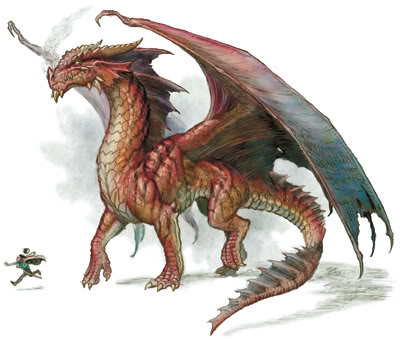
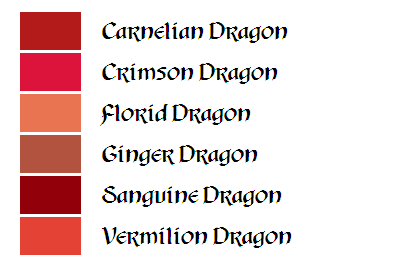
Yeah, yeah – the mighty red dragon, paragon of scaled evil and terror in the game. But where’s the subtlety, the range? Leave your players guessing with the following six sub-species of the venerable red dragon. The remainder of this post is declared Open Game Content.

Carnelian Dragon: The carnelian dragon is medium-sized for a red dragon (i.e. 10 HD) and always intelligent, though never capable of speech. Carnelian dragons always possess the following spells: Detect evil (3/day), ESP (3/day), Legend Lore (1/day), Suggestion (1/day). They communicate telepathically in a screeching voice that raises the hairs on the nape of the neck. A carnelian dragon replaces the red dragon’s cone of fire breath with a psychic pulse that disrupts the synapses of the brain. All within 30 feet must pass a saving throw or be affected. For the next 6 rounds, the person must pass a saving throw whenever they want to perform an action other than running away or dodging blows (but without the benefit of a shield, which requires active thinking). Any other act – attacking, spell casting, talking, tap dancing, playing checkers – requires a successful save.

| Carnelian Dragon: HD 10; AC 2 [17]; Atk 2 claws (1d8), 1 bite (3d10); Move 9 (F24); Save 5; CL/XP 12/2000; Special: Spells, psychic pulse.

Crimson Dragon: The crimson dragon is a large, ponderous beast with a shortened snout and heavy eyes. Crimson dragon’s never speak and are relatively un-intelligent. They relish the infliction of distress and pain, and are as often on the move as in their lairs. In place of fire breath, a crimson dragon can breath a blast of wind – hot as a desert wind – that destroys water (reduces all water stores by half), withers plant life (normal dragon breath weapon damage to plant creatures) and sucks the moisture from other living creatures (half normal dragon breath weapon damage to non-plant creatures of flesh and blood).

| Crimson Dragon: HD 11; AC 2 [17]; Atk 2 claws (1d8), 1 bite (3d10); Move 6 (F15); Save 4; CL/XP 13/2300; Special: Drought breath.

Florid Dragon: The florid dragon is an ill-tempered brute of medium size (i.e. 10 HD). They have shinier scales than most red dragons, and smaller, saw-like teeth in their mouths. A florid dragon has the normal chances for speech and magic use. In place of fire breath, it simply radiates a wave of punishing heat from its body. The heat causes 1d6 points of damage per round to creatures within 10-ft of the dragon, 1d4 points to creatures from 10 to 20 feet away from the dragon and 1 point of damage per round to creatures within 20 to 40 feet of the dragon. Wearing metal armor increases this damage to 1d8/1d6/1d4 respectively. The florid dragon can maintain this heat for 10 minutes per day.

| Florid Dragon: HD 10; AC 2 [17]; Atk 2 claws (1d8), 1 bite (2d10); Move 9 (F24); Save 5; CL/XP 12/2000; Special: Radiate heat.

Ginger Dragon: The ginger dragon is a smaller, less wicked cousin of the red dragon. Lonely and somewhat sensitive, its evil nature usually manifests in flashes of murderous rage when rejected or criticized. When not murderously angry, though, it is a welcoming companion, even generous to adventurers. Where the florid dragon radiates intense heat, the ginger dragon absorbs heat, making the area around him very cool, and thus his warm presence (think of him as a radiator with a 5-ft radius range) all the more pleasant. Within 100 feet of the dragon, the air is absolutely frigid, and people unprotected from the cold suffer 1d6 points of damage per turn from the frost. Within 1 mile of the dragon, things are notably cold, though not damaging. Ginger dragons are always capable of speech and have the normal chance for magic use. Their claws are overly long and razor sharp.

| Ginger Dragon: HD 9; AC 2 [17]; Atk 2 claws (1d8+1), 1 bite (3d10); Move 12 (F24); Save 6; CL/XP 11/1700; Special: Absorb heat, immune to fire.

Sanguine Dragon: These infernal brutes are ever in league with the dark powers of Hell, acting as their messengers and assassins in the world of mortals. They are small for red dragons and possessed of black, branching antlers that are lovely to behold if they aren’t gouging out your eye or spleen. Sanguine dragons can always speak and cast spells, and choose their spells from the anti-cleric’s spell list. They replace the red dragon’s cone of fire with a cone of spiritual hellfire, which numbs the soul and robs one of their common decency. Those hit must pass a save or be drained of one level. Those drained of a level must pass a second saving throw or have their alignment move from Lawful to Neutral or Neutral to Chaotic for the span of one month.

| Sanguine Dragon: HD 9; AC 2 [17]; Atk 2 claws (1d8), 1 bite (3d10), 1 gore (1d8); Move 9 (F24); Save 6; CL/XP 12/2000; Special: Hellfire, anti-cleric spells.

Vermilion Dragon: The noble vermilion dragon replaces the fury of the red dragon with a sense of superiority and mild disdain for lesser creatures. Nevertheless, they are as close as a red dragon can get to benevolence, and officially have a Neutral alignment (with benevolent tendencies). Vermilion dragons, like actors, love nothing more than to talk about themselves and hear others talk about them, especially in glowing terms. They are large, with refined features and have a lust for gold (especially in the form of crowns and other regalia) that borders on the obsessive. A vermilion dragon’s cone of fire causes full damage on neutral creatures, 150% normal damage on chaotic creatures, and only half damage on Lawful creatures. Lawful creatures struck by the breath also have all curses and diseases removed from their person and any drained level has a 50% chance of being restored if drained in the last year. Vermilion dragons can always speak, and have the normal chance for magic use.

| Vermilion Dragon: HD 11; AC 2 [17]; Atk 2 claws (1d8), 1 bite (3d10); Move 9 (F24); Save 4; CL/XP 13/2300; Special: Cleansing fire.

Mu-Pan – Flock of Cheonma

Short encounters tonight, so I’ll post two …

1025. A flock of seven cheonma have made an aerie for themselves on the high peaks here and are under attack by a pack of five griffons. The cheonma are hard pressed and they have already lost two foals to the depredations of the griffons.

| Cheonma: HD 4; AC 6 [13]; Atk 2 hooves (1d8); Move 24 (F48); Save 13; CL/XP 4/120; Special: Flight. Cheonma are Mu-Panese pegasi. They are eight-legged horses with wings on their feet.

| Griffon: HD 7; AC 3 [16]; Atk 2 claws (1d4) and bite (2d8); Move 12 (F27); Save 9; CL/XP 8/800; Special: Flight.

1027. A gang of 20 gyres is occupying a cave here, using it as a base of operations as they raid down the river into Yun territory. The leader of the gyres has a single white eye and particularly long canine teeth. He wears a golden ring on one of those teeth (worth 15 gp) and can cast 1d6 levels of sohei spells per day. The gyres wear coats of leather scales and wield masakaris and kamas. If encountered in their lair, there is a 2 in 6 chance they are drunk on plum wine. Their treasure consists of 340 sp and 1,130 gp in leather sacks. The stripped bones of two unlucky farmers are piled in the back of the cave.

| Gyre: HD 2; AC 4 [15]; Atk 1 bite (1d3) and 2 claws (1d4) or weapon (1d6); Move 15; Save 16; CL/XP 3/60; Special: Frenzy (2 attacks per round for 3 rounds, then fall unconscious).

Mu-Pan – One-Eyed Boys

One more before I post the update to Megacrawl 3000 …

0443. Three one-eyed boys (hitotsumi-kozo) dwell in this hex in a cave studded with sapphires (worth 100 gp each, a total of 23 are present). The cave is set in the side of a long hill, the base of which is cluttered with goji berry bushes. The one-eyed boys gather the goji berries and mash them into juice that they ferment in clay pots buried in the floor of their cave.

Although removal of the sapphires is very tempting, it is a dangerous thing to do. If a sapphire is plucked from the wall of the cave, a blue ray erupts from the wall and strikes the person holding the sapphire (no roll needed). The ray always strikes the person in the forehead and sets up a communication between the thief and something from beyond the void (per the contact other plane spell). The experience leaves most people a bit jumbled (1d8 points of ability damage spread between intelligene, wisdom and charisma as the player prefers). This damage can be healed with magic (restoration), but will not heal naturally.

If all of the sapphires are stolen from the cave, the rays create a portal through which 1d6+4 star warriors emerge. The star warriors are hairless humanoids with translucent, sapphire skin and eyes and wearing long, metallic coats of miniature scales (the material is aluminum – light weight and quite strong) and carrying two war hammers each. The star warriors track down the sapphire thieves and return them (the sapphires) to the cave. The thieves are either killed or they are taken back to the cave and taken through the portal.

| Hitotsumi-Kozo: HD 3; AC 6 [13]; Atk 1 weapon (1d4); Move 9; Save 14; CL/XP 7/600; Special: Bad luck, frightful appearance, ray of enfeeblement, silence, true seeing.

| Star Warrior: HD 5; AC 1 [18]; Atk 2 hammers (1d6); Move 12; Save 12; CL/XP 5/240; Special: Track sapphires unerringly, immunity to cold, ESP at will.

Also – to avoid confusion when talking about the Cloud Dragon, Gold Dragon etc kingdoms and the monsters of the same names, I’ve given the kingdoms alternate names:

Jin – Gold Dragon Kingdom
Meng – Mist Dragon Kingdom
Ying – Shadow Dragon Kingdom
Yun – Cloud Dragon Kingdom

Of the kingdoms, Meng no longer exists (at least, not in a normal way), its citizens now serving as the empire’s merchant class based in the coastal cities.

Mu-Pan – Red Goblins

0421. An army of 270 oni-aka (red goblins) raiders has encamped in this hex. The army is preparing to sack the city-state of Pantung [0322]. The raiders are working on behalf of a cabal of villains (an ogre magi, sorcerer ox and evil naga, themselves the puppets of an oni. The raiders are under the command of the hobgoblin marshal Valtrahar. Valtrahar rides atop a palanquin carried by four ogres. He wears a black bronze jingasa with a porcelain mask that bears starched whiskers. He is accompanied by a hired shugenja called Imyneda, a melancholy woman with fulvous skin, gray-green eyes and dark brown hair in braids. Imyneda has a large woman with a round, bland face who complains incessantly as she rides along on her yak. The army has three trebuchet pulled by teams of yaks.

| Valtrahar: HD 6 (34 hp); AC -1 [20]; Atk 1 weapon (1d6+1); Move 9; Save 11; CL/XP 6/400. O-yoroi, no-dachi, tanto.

| Imyneda, Shugenja Lvl 5: HP 13 [20]; AC 9 [10]; Save 11 (9 vs magic); CL/XP 4/120; Special: Spells (3rd). Bo staff, tanto, spellbook.

Picture found HERE.