Dragon by Dragon – September 1977 (9)

Let’s get right into it, shall we? Because the first page we see past the cover is this …

Let the edition wars begin, I guess. Note the “For 3 or more adult players” [emphasis mine]. TSR would learn a little something about the purchasing power of the younger set in a few years.

The second page is an ad for 25 mm Minifigs D&D miniatures, which such evocative names as “5 Different Hobgoblins” and “10 Kobolds”. You can see some painted versions HERE, HERE (didn’t know hobgoblins were so randy) and HERE.

OK – to the meat of the issue. Our first offering is from Gygax, and is entitled Varied Player Character and Non-Player Character Alignment in the Dungeons & Dragons Campaign. The article is about the problems that alignment presents to DM’s. The line that caught my attention early in the article was:

“The most common problem area seems to lie in established campaigns with a co-operating block of players, all of whom are of like alignment. These higher level player characters force new entrants into the same alignment, and if the newcomers fail to conform they dispatch them.”

Nice to know that DM’s used to have help from the players in terms of managing alignment. It sounds like players with high-level characters could be real dicks back in the day.

Also interesting was this, about Gary’s Greyhawk Campaign:

“The Greyhawk Campaign is built around the precept that “good” is the desired end sought by the majority of humanity and its allied races (gnomes, elves, et al.). I have this preference because the general aim is such that more than self-interest (or mental abberation) motivates the alignment. This is not to say that a war of lawful good against chaotic good is precluded, either or both opponents being allied with evil beings of lawful or chaotic alignment. What is said is that most planned actions which are written into the campaign are based on a threat to the overall good by the forces of evil.”

Probably sounds a bit rail-roady to some of the old schoolers out there. If I’m honest, the article somewhat meanders a bit and didn’t really teach me much on its professed subject, other than to conclude that a variety of alignments is a good thing in a campaign. So that’s settled.

Next up is the continuation of The Finzer Family, the longest damn story I think I ever saw in a Dragon Magazine. I’m going to skip the continuation, just as I skipped the first part, but I will draw notice to this:

The gaming world is taking shape!

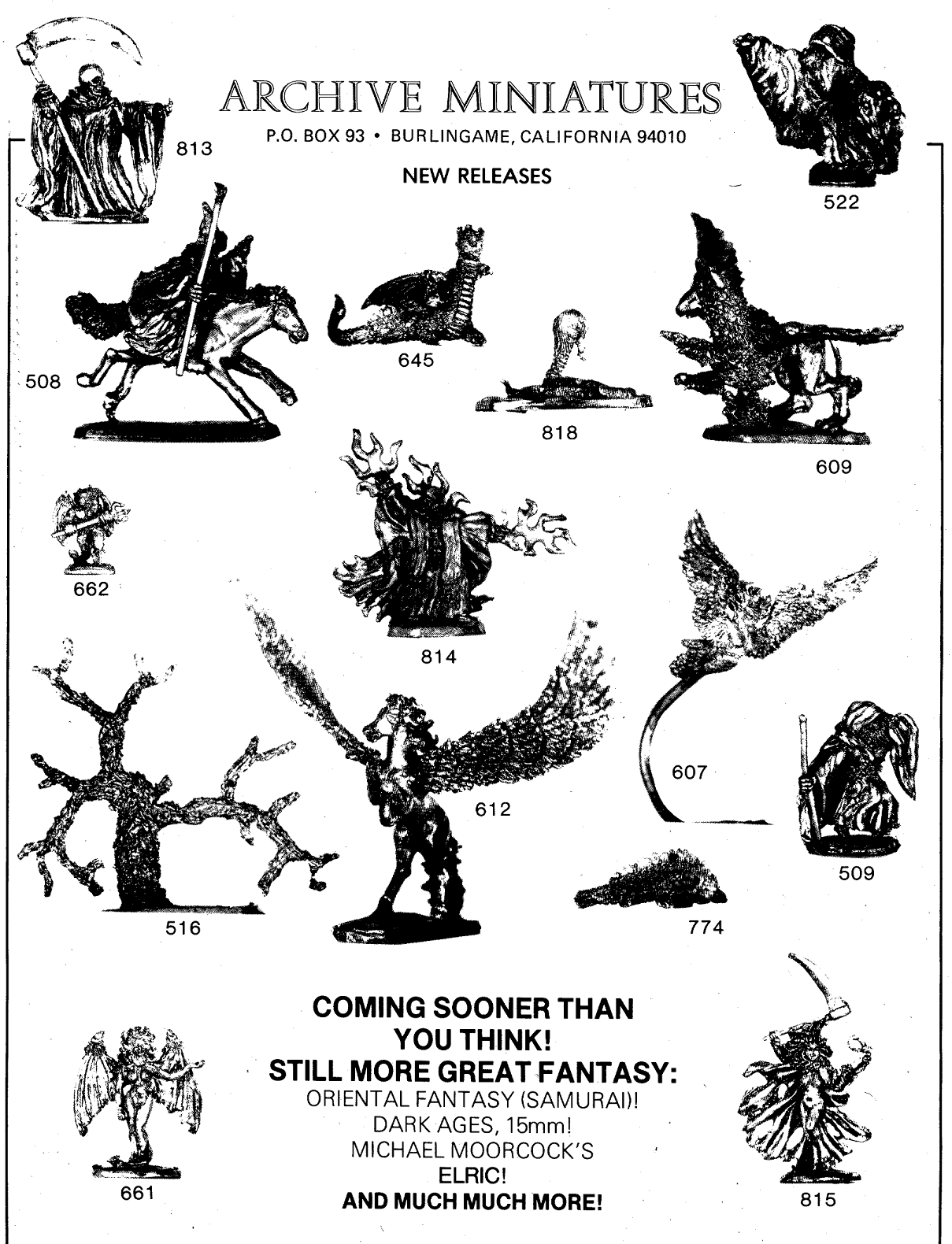
I’m going to post this next ad for miniatures because, frankly, they’re pretty dang nice. I tried to find some painted samples online, but came up short.
Almost 20 pages later, we’re finally done with the Finzer Family, and onto an article by MAR Barker entitled Seal of the Imperium. The article is designed to answer reader questions, but the first declaration of Prof. Barker is an interesting one regarding the difference between “real” Tekumel and the “game” Tekumel:

“Just to point up the contrasts, let me cite some differences: (a) “real” Tékumel has a lot less magic and magical paraphernalia lying about than one picks up in the game — with all the Thoroughly Useful Eyes and spells of revivification possible in the game, no citizen of Tsolyánu would ever have to die! — and there would be heaps of treasure and goodies for all”

The eternal problem with D&D. As Prof. Barker explains:

“All of these things, plus the ever-useful Divine Intervention, make it a LOT easier to succeed in the game than in “real” Tsolyánu. The same is true of “Monopoly” or “Alexander the Great”; games abstract, simplify, and simulate only those parts of “reality” which the designer feels are crucial.”

In other words – “Don’t sweat it, it’s just a game”. Good advice, then and now.

Brian Blume now rides in with The Fastest Guns that Never Lived (Part II), a list of actors from old westerns, along with their stats for Boot Hill. You have no idea how much this makes me wish I had the Boot Hill rules, just for the chance to put the Cisco Kid and Poncho on the trail of Lee Van Cleef.

James M. Ward now presents Tombs & Crypts. It’s a neat little graph for randomly generating the contents of a tomb or crypt. The table allows one to roll a d12 to get a set of modifiers for several other tables that determine the treasure in the crypt (gold pieces, gems, jewelry, misc. magic items, special items and artifacts) as well as the guardian and structure of the tomb. I’ll reproduce those last two tables:

Guardian
01-30: None
31-50: Magic spell (wizard lock, curse, etc.)
51-80: Invisible stalkers (1d4)
81-99: Creature from the 6th level monster chart
100: A stronger monster + roll again for another guardian

Tomb Itself
01-40: 1 room/cave/mound of dirt
41-50: Hall with spring trap of some type and a secret door at the end of it
51-60: A 2-6 room/cave complex with many doors leading to other areas trying to lure the robbers away
61-80: 1-10 rooms/caves with a secret door to the tomb and 1-10 traps in the rooms
81-90: 1-10 rooms with 1-20 corridors, with 2-20 traps guarding the rooms and tombs and a secret door
91-99: 1-10 connecting rooms with traps, secret doors, and magical guard spells (wizard locks, symbols, etc.) guarding the way
100: 1-20 rooms with traps, secret doors, and a being guard. It requires a special word to open the final door to the tomb. The word should not be found in the tomb.

Next cool ad:


I found a shot of a painted one HERE.

Almost to the end, and I discover another famous first for Dragon …
When you combine Basic D&D, White Dwarf, Wormy and a long article about alignments, I think you might be able to peg September 1977 as the beginning of the modern era of D&D.

See you next week, when I give the Blood & Treasure mass combat rules a whirl with the Battle of Gaudin’s Ford, pitting a moot of halflings against a rampaging orc tribe.

Oh yeah – the cover – no room for it up above, but it is pretty groovy …
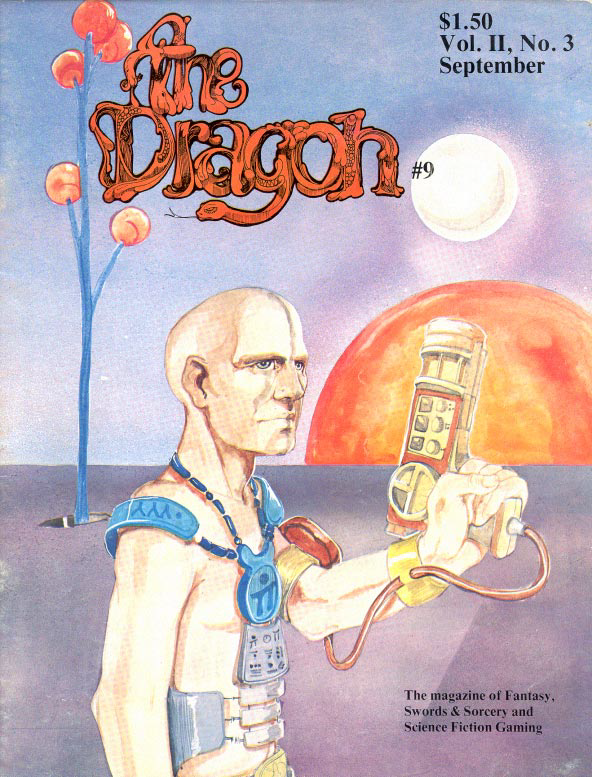
New game – stat the cover.

HORST HAMMERFIST, 5th level fighting-man with psionic powers, an amulet of advanced mathematics and a +2 ray gun of lightning.

Friday Grab Bag

A grab bag of digital flotsam and jetsam that has floated past my perch on the cliffs that overlook the vastness of the World Wide Web …

Pirates + Goofy Headgear = Pirates in Goofy Headgear

The Victual Brothers were Baltic pirates who, frankly, would be much less groovy if they called themselves “The Baltic Pirates”. Likewise, every D&D party should have a name, awesome, goofy or otherwise. Thanks to that rule of my game, I can now tell tales of the Tender Blades and Wyld Stallyns and their adventures in Nod.

I think every good sword school needs to be named after a saint who, technically, should have been opposed to violence. And speaking of kickass names, these lads were officially known as the Brotherhood of Our dear lady and pure Virgin Mary and the Holy and warlike heavenly prince Saint Mark. “Holy and warlike heavenly prince” – eat your heart out Cuthbert!

I’m listening to these guys at the moment. I officially endorse them as my favorite depression-era swing quintet ever!

Pole arms kick ass.

I’m color blind. Just discovered, via my daughter, that Batgirl’s costume is purple. My love of her (my daughter and Batgirl) has increased immeasurably because of this.

If you thought Carrie Keagan made a spectacular Power Girl (she does), she’s also easy on the eyes as Princess Allura. And if you don’t know who Carrie Keagan is, then your life has been misspent (and not in the good way).

That’s all for today! Over and Out!

Let’s Get Grimm … Nursery Rhyme Monsters III

Yeah, I know, this is taking forever. What can I say?

Nixie: Nixies dwell in the rivers and streams of Fairyland, and are more apt to be seductive and cruel than playful and kind. They are aligned with Hearts, and are wicked 75% of the time.

Ogre: Ogres in Fairyland come in two varieties, the traditional man-eating lout who carries a club and takes great delight in frightening people with their fangs, and the spellcasting ogre mages who cultivate a veneer of civilization (though they remain just as thoroughly wicked and hungry for human beings), like the one who appears in Puss-in-Boots. Either way, they conform to the ogre and ogre mage stats in traditional D&D. Ogres are aligned with Clubs (wicked) and ogre mages with Diamonds (wicked).

Pixie: Pixies (or sprites) are the most numerous of the fairy folk. They dwell in meadows and glades and disguise their villages with cunning illusions. Many become attendants of fairy knights.

Rat Swarm: We all remember the tale of the Pied Piper, and thus know that great swarms of rats have a definite place in Fairyland. Many fairy tales were born during the plague years of Europe, and thus rat swarms in Fairyland always carry that disease with their bite.

Rat Swarm: HD 4; AC 5; Atk 1; Dmg 1d6 + save vs. disease; Move 150; Save as Ftr 4

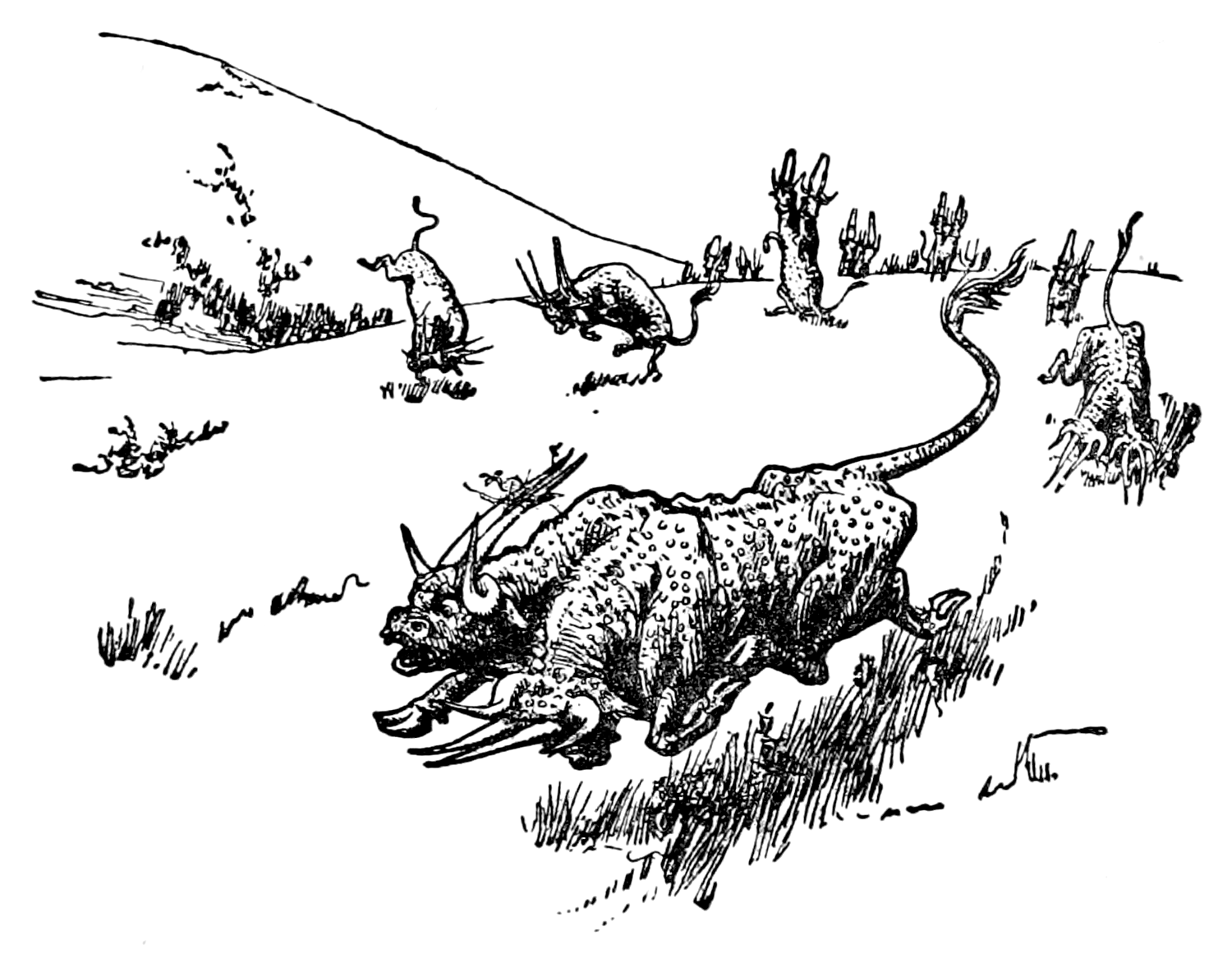
Red Bull: Red bulls are two-headed, fire-breathing bulls that can be treated as chimeras without the wings, sans the dragon and lion bite attacks, but with two butt/gore attacks. They are aligned with Clubs (wicked)

Revenant: Zombies in MG&G are called revenants. They differ from traditional D&D zombies by retaining their intelligence and memories (and alignment), though they are always twisted and wicked in their dealings with the living. It is not uncommon to find them traveling with their coffins upon their backs.

Robber: Robbers are the bandits of MG&G, and conform to the stats for bandits or brigands. They may form small gangs (3d6 individuals) who waylay travelers through woodlands, or they might form larger bodies (up to 40!) who have their lairs in secret caves and attack entire villages for the purpose of plunder.

Roc: The mighty roc makes an appearance now and again in Fairyland, swooping in from balmy seas beyond the mountains of Jinnistan on its way to visit the east wind. They are aligned with nothing and nobody.

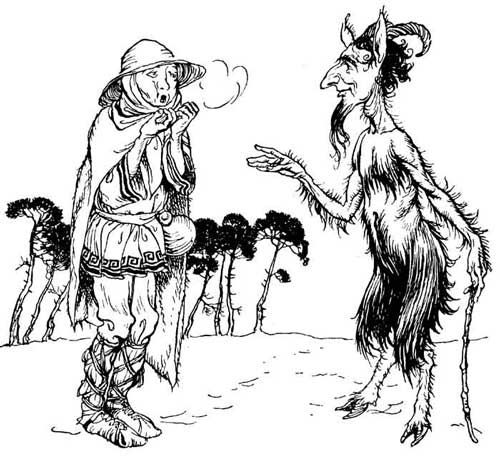
Satyr: Satyrs in MG&G are the same as in D&D, save they are a bit hornier and more frightening. Satyrs are aligned with Hearts, and though not completely wicked, they definitely push the boundaries of polite behavior and have significant difficulties in restraining themselves around females (save vs. spells).

Sorcerer: Sorcerers are men who practice the magical arts, and are thus capable of casting spells as fairy godmothers (roll level on 2d4). Sorcerers may be aligned with any of the factions, but 5 in 6 are thoroughly wicked and corrupt due to their willingness to deal with demons. 1 in 6 sorcerers is a white magician.

Sphinx: Sphinxes are not common in Fairyland, but they do exist. All sphinxes in Fairyland are gynosphinxes, and they are typically aligned with Clubs (wicked), as they enjoy throttling travelers who cannot answer their riddles.

Treant: The treants of Fairyland are pretty similar to those of traditional D&D, save they are usually incapable of moving around. A treant that isn’t talking is only recognized as a treant on a roll of 1 on 1d6 (or 1-3 on 1d6 for dwarves and fairy knights and other fairy folk). Treants do not get on well with woodsmen. Treants are often aligned with Hearts, but some trees are aligned with Clubs.

Troll: Trolls adhere to the same rules as in traditional D&D, with the exception that some of them turn to stone in the light of the sun (either permanently, or only until nightfall). All trolls must save vs. spells or run in terror when they hear the peeling of church bells.

Wicked Witch: Hags in MG&G are known as wicked witches. They are not, of course, old misunderstood women, but evil fairies who seek out the helpless and innocent to consume. Just use the various hag stats in D&D, but give them the ability to cast spells as fairy godmothers. Wicked witches are aligned with Clubs (wicked).

Law vs. Chaos, the William Blake Way

The internet is wonderful for stream of consciousness discovery. Last night, I was writing a bit about orcs for Blood & Treasure – specifically creating a table of military units – and in the process found a reference to the very interesting mythology created by William Blake in the last decades of the 18th century. Just like that, I had the perfect pantheon for Dweomer Bay, Nod’s nod to Colonial America.

If you don’t know about this little gem of creativity (I’m not going to pass judgment on is validity), I’ll do my best to present the basics, which, frankly, is all you really need for a fantasy RPG that has warrior-priests who mostly concern  themselves with exploring dungeons. If you’re looking for a stand-in for Christianity, it should work rather well.

In essence, Blake’s mythology would be one in which Chaos (or Chaotic Good, in 9-fold alignment terms) is “good”, and Law (or Lawful Neutral) is “not good”. It has a central figure, the giant/man/land of Albion, who is divided into four Zoas:

Tharmas: Tharmas is the primordial man, who represents instinct and strength. If I had to choose an alignment, I’d go Neutral.

Urizen: Urizen is reason and tradition; a cruel god of Law. Probably Lawful Neutral. He was the primeval priest, who separated from the other Eternals to build his own alienating and enslaving realm of religious dogma – a fallen universe – in which Los and Enitharmon enter to give birth to their son, Luvah/Orc, the spirit of revolution and freedom.

Luvah (Orc): Luvah represents love, passion and emotive faculties. He is known as Orc in his most amorous and rebellious form. Luvah is probably Chaotic Neutral. He is the embodiment of the American Colonies, which Blake apparently imagined would be a new utopia. Orc provokes the Angel of Boston to rebellion against the Angel of Albion, who considers Orc the anti-Christ. Orc considers the Angel of Albion to be the anti-Christ.

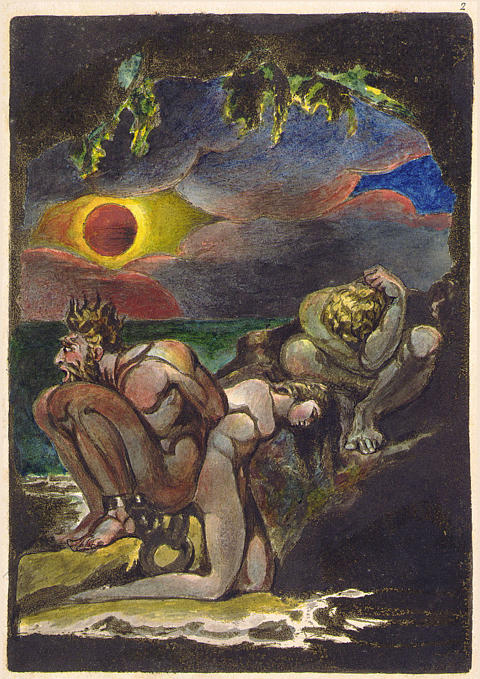
Urthona (Los): Urthona is also known as Los, and represents inspiration and imagination. This guy is Chaotic Good. He is commonly depicted with a hammer, and is the father of Luvah/Orc. Urthona is the redeemer of the fallen universe created by the rebel Urizen. Los himself fell and took on human form, and then went to work binding Urizen to a human form, a “Human illusion, in darkness and deep clouds involvd”.

Urthona (Los), Enitharmon and Luvah (Orc)

Each of these four Zoas has a feminine “emanation”:

Enion: Enion is maternal, and is paired with Tharmas.

Ahania: Ahania is celestial, and is paired with Urizen. She is discarded by Urizen.

Vala: Vala is seductive and shadowy, and is paired with Lovah/Orc. Her daughters are death and love human sacrifice, and must be confronted and defeated by Jerusalem to bring the Zoas back together as a single divine body.

Enitharmon: Enitharmon is musical, and is paired with Urthona/Los.

There are other “divinities” as well:

Rintrah represents “revolutionary wrath” (the fact that the American Revolution has an impact on Blake’s mythology makes it perfect for Dweomer Bay). His brothers are Palamabron (pity), Bromion (scientific thought – also the passionate man) and Theotormon (desire/jealousy – also the chaste man). They are the sons of Los. Bromion is loud and lustful, and eventually rapes Oothoon (the soft spirit of America, or female sexuality), symbolizing an America trapped by the the science of Newton and the philosophy of Locke.

Bromion, Oothoon and Theotormon

Urizen’s sons are Thiriel (Air), Utha (Water), Grodna (Earth) and Fuzon (Fire). Fuzon rebels against Urizen, attacking him with fire and then declaring himself God. This leads to Urizen accidentally creating the tree of mystery and nailing Fuzon’s body to it.

Los entering the grave

Cocytus, Hell’s Frozen Heart – Hunters and Titans

Finally. The last of the nine circles. Here are a few previews of the things to see in the final bit of the Hellcrawl, due for publishing in a couple weeks. It includes two of the key components to this circle – the elder titans imprisoned here after the titanomachy and gigantomachy, and one of the four angelic watchtowers meant to provide a last bit of help for those who wish to escape Hell and return to the surface of Nod.

57.52 Hunters: A pack of 13 winter wolves patrol this hex constantly in search of a golden elk that roams Cocytus, a glimmer of hope in an otherwise hopeless place. Adventurers can try their luck as well – the elk is capable of casting the following spells, each once per day: Heal, cure disease, neutralize poison and restoration. The wolves are encountered on a roll of 1-4 on 1d6.

58.50 Clytius: Clytius, the elder titan, was immolated by torches conjured Hecate, and he burns to this day. He is chained to the walls of Cocytus here with adamant links, sending flickering shadows over the frozen hills and moaning in agony. Salamanders caper about him, basking in the warmth and sampling the flesh of the shades roasting in his fires while skewered on pikes. Magical shields and armor tempered in Clytius’ flames grant their wielders immunity to fire for a temporary amount of time. Each day, there is a 1 in 20 chance that the armor or shield loses this new magical property.

CLYTIUS: HD 35 (180 hp); AC -8 [27]; Atk 2 slams (3d6 + 1d12 fire); Move 15; Save 3; CL/XP 40/10400; Special: Flaming aura (60 ft. radius, 1d6 points of damage per round), immune to fire damage, spells as 20th level magic-user and cleric plus at will—change self, commune with nature, cure serious wounds, eyebite, free action, fly, fog cloud, monster summoning VI, produce flame, protection from fire, read magic, remove curse, speak with animals, soften earth and stone, speak with plants, teleport without error, wind wall; 3/day—antilife shell, astral projection, contact other plane, dispel magic, invisibility purge, plane shift.

60.53 Watchtower of the West: Though Cocytus is the very heart of Hell, it is not without angelic influence. The gods of Law, cognizant that the only way for mortals to escape Hell is by being of a non-Chaotic alignment, and knowing how they do the way Hell can prey on a person’s soul and by degrees turn them from the path of Law (or even Neutrality), they established four watchtowers staffed by powerful champions of Law. These angels are in Hell to provide atonement and succor to Lawful and Neutral souls in Hell.

The watchtower is composed of brilliant white quartz and takes the form of a grand tower keep, about 100 feet tall, with pearescent battlements and golden spires that give off a warm, inviting glow. The battlements are guarded by three companies of luminous aasimar, who wear white tunics (no armor) and carry white heavy crossbows, silver glaive-guisarmes and daggers and quivers of twenty +1 crossbow bolts.

Araqiel is the angel of judgment for clerics, and this is his watchtower. Here, Chaotic clerics can turn from the path of wickedness and atone for their past sins, and neutral druids can prepare themselves for the ordeals ahead. Clerics in need of atonement must fast for one week and cast aside their armor, relying until they escape Hell on nothing but their spells.

Dragon by Dragon – July 1977 (8)

Vincent Price?

And so we come to #8, which kicks off with an article on The Planes from Gary Gygax, subtitled “The Concepts of Spatial, Temporal and Physical Relations in D&D”. I guess this has to be considered a pretty important article, as it sets up the famous “Wheel” cosmology that will come to be a basis of AD&D (both editions) and achieve its full flowering in the Planescape setting. I personally don’t use it these days, but I think you have to admit it was a clever way of setting up a cosmos and finding a place for all the various gods and goddesses.

Tony Watson now offers a more practical article: The Development of Towns in D&D. The advice in the article is quite sound, from what I can tell. I like his advice for inns and their patrons, to whit:

Falgrave’s – where non-humans frequent and and stay when in town. Falgrave is a dwarf himself and up on non-human gossip. 3-18 patrons, 2/3 of which shall be non-human and ½ will be warriors; the rest will be townspeople, nonhumans of other classes. 1-4 will be non-human wayfarers or merchants.

Simple and seems like it would work well. For populating the town, he suggests rolling up dozens of characters and then assigning them, based on their ability scores, to different jobs … or you could just fake it. He divides them into Warriors, Magic-Users, Clerics, Townspeople and Specialists (referring to the “myriad of new characters types that have lately appeared”, which I assume means new classes from The Dragon). He suggests rolling 3d4 for the ability scores of the townspeople or 2d6 for women rolling Str and Con (he apologizes to liberated women reading the article) and children rolling scores. Watson then provides a small chart for determining alignment, age, personality, loyalty, initiative and level. Initiative, in this case, does not mean combat initiative order, but how bright and energetic an NPC is.

Up next is a story by Harry O. Fischer: The Finzer Family – A Tale of Modern Magic.

There have also been wicked magicians, but they only last a short time and are soon taken care of by the public or by other magicians. The evil ones are generally weak and unsuccessful people with little powerful magic. This is fortunate for all of us. Once in a while a powerful and good magician may go mad and do considerable damage before he is controlled or eliminated, but these cases are very rare. So any magicians you are likely to meet or to know, or to perhaps discover, are almost sure to be honorable, peaceful, and wise people — like the Finzers . . .

No offense, but this one went on so long I got bored skipping through it.

Next we have a sneak preview of Introduction to: Gamma World. It begins:

Man, from Australopithecus africanus and homo erectus erectus to homo sapiens recens, has existed on earth for hundreds of thousands, perhaps millions of years. During this time, one skill, one particular talent has set him apart from every other creature — his ability to conceive and create tools. Indeed, man has been defined as “the toolmaking animal.”

Next to an ad for Archive Miniatures (that includes pictures of a Wind Child, Dragon Newts and Dracula & Vampire Women) is an article by Rob Kuntz on gems and jewelry that is essentially a collection of useful tables for determining first the carats of the gem, then the value and then the type based on the value. My only disagreement is that it uses gems like “idicolite” and “tanzanite” that just don’t seem very romantic.

Brian Blume asks, So You Want Realism in D&D? It’s a bit of a jab at people that have written to complain about the lack of … well, you know.

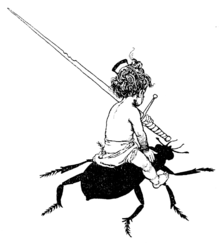
The next page shows off several miniatures, including Rhino Riders from Dragontooth Miniatures. I’ve admitted before that I’m a sucker for fantasy characters riding on inappropriate mounts, so this one is right up my alley. I found a picture online …

Given the size of the rider compared to the rhino, it almost has to be a giant of some sort.

Featured Creature this time presents a kick-ass piece of art by Erol Otus and asks people to name it and give it some stats. Let’s do the same thing here in the comments!

James Ward provides Still More Additions to MA, a list of new monsters that includes Jawed Lilly Pads (awesome), radiation vines, poison thorn grass, tigeroids, bulleroids (no hemorrhoids), rabners, gygarants and sotherlan.

And so ends issue #8! Not bad, but the one story was waaaaaay too long (and is only part 1!!!). What relevant stuff was there was pretty decent.

More Blood and Treasure Monster Previews – With Art!!!

I thought I’d show a few more of the monster stats from B&T. The project is dangerously close to being finished! It’s also a chance to show off some of the art I’ve commissioned for the project from Jon Kaufman. Check it out, ladies and gents.

BAT MONSTER
Large Monstrous Humanoid, Chaotic (CE), Low Intelligence; Solitary

HD: 8
AC: 13
ATK: 2 claws (1d6), bite (2d8)
MV: 10 (Fly 50)
SV: F 10, R 9, W 10
XP: 800 (CL 9)

These creatures look like large, furry humanoids with bat wings that end in clawed hands and bat heads. They are twice the size of a man, with a 12 to 15 foot wingspan. Fearful peasants might even mistake them for small dragons when they fly by night. They can attack without penalty even when they have been blinded.

Special Qualities: Echolocation, vulnerable to sonic damage

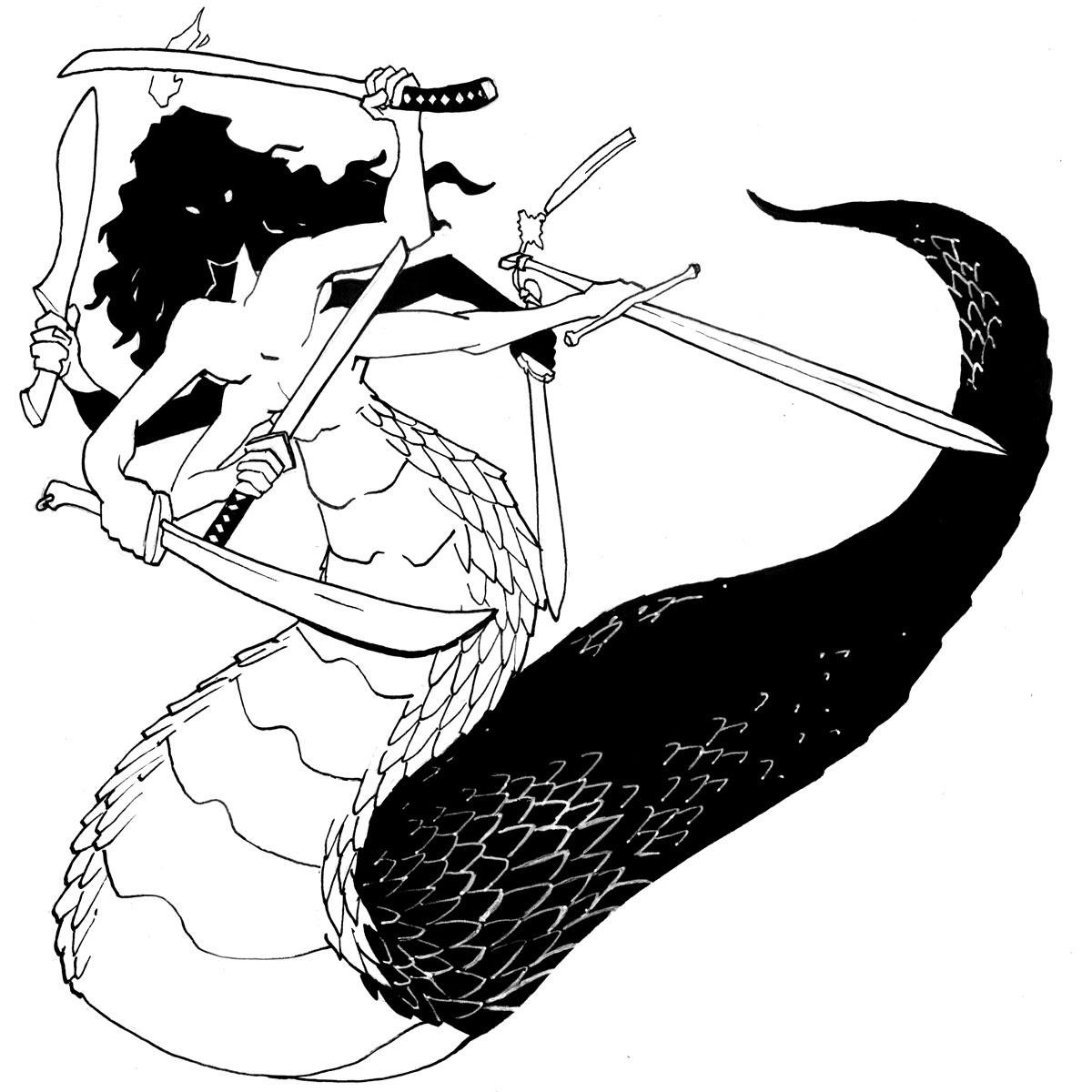
DEMON – MARILITH (CLASS V)
Large Outsider, Chaotic (CE), High Intelligence; Solitary or Pair

HD: 8
AC: 24 [+2]
ATK: 6 swords (2d10), tail (4d6 + constrict)
MV: 40
SV: F 8, R 9, W 8
XP: 2,000 (CL 10)

Mariliths are six armed female demons with the lower body of a snake. In each hand they wield a longsword and they adorn themselves with jewelry. A marilith is 9 feet tall and measures 20 feet from head to tail. They weigh 2 tons.

Though mariliths thrive on the grand strategy of war, they love physical combat and never pass up an opportunity to fight. Each of a marilith’s six arms can wield a weapon. There is a 5% chance per arm that it wields a random magic sword). Mariliths seldom rush headlong into battle, preferring to hang back and size up the situation first. They always seek to gain the best possible advantage from the terrain, obstacles and any weakness in their opponents.
A marilith can attempt to summon another of its kind once per day, with a 20% chance of success.

Special Qualities: Immune to electricity and poison, magic resistance 40%

Spells: At will—blade barrier, detect invisibility, magic weapon, project image, telekinesis, teleport without error (self plus 50 lb), unholy aura

LOCATHAH (FISH MEN)
Medium Humanoid, Neutral (N), Average Intelligence; Patrol (1d20)

HD 2
AC 14
ATK Spear (1d6) or light crossbow (80 ft., 1d8)
MV 10 (Swim 60)
SV F 12, R 15, W 15
XP 100 (CL 2)

Locathah are humanoid in shape, but have the scaled skin of fish and the heads of fish. The average locathah stands 5 feet tall and weighs 175 pounds. Females and males look very much alike, although the former can be recognized by the two ochre stripes marking their egg sacs. Locathahs speak their own language. Locathahs lack teeth, claws, and other natural weapons, so they are not especially dangerous if unarmed.

Locathah gather in tribes of 1d10 x 10 warriors and non-warriors equal to 100% of the warriors. They are ruled by chiefs and sub-chiefs, and typically live a hunter-gatherer existence with supplementary kelp gardening and fish herding. For every ten warrior in a tribe, there is a 3% chance that the tribe has an adept to provide spellcasting.

Locathah units in mass combat are as likely to be defending their tribal lands as they are to be mercenary units. Locathah squadrons are led by sub-chiefs with 3 HD. Locathah tribes are led by chiefs with 1d4+6 HD. If you wish, roll d% to randomly determine the type of locathah units present. Chiefs are always accompanied by a squadron of armored crab-warriors.

D% UNIT
01-10 Squid-Warriors: Dagger (1d4), net (entangle)
11-75 Shark-Warriors: Spear (1d6), light crossbow (1d8), 20 bolts
76-00 Crab-Warriors: Trident (1d8), shellycoat* and shield (+3 AC)

* Shellycoat armor is manufactured by several undersea folks, and consists of a hundreds of shells woven onto a backing of shagreen in the manner of scale mail. Shellycoat increases AC by 1 point.

Moving Feasts and Undead Assembly Lines – A Glimpse at Malebolge

I’m finishing up my rough draft of Malebolge tonight, and starting Cocytus tomorrow. Here are three encounters from Malebolge, a land of volcanic mountains and hidden valley kingdoms of demon lords and arch-devils.

55.58 The Moving Feast: Terraced, ashen hillsides here are connected by broad, stone steps carved by ancient duergar slaves. The heads of the slaves are preserved here in wax, and are affixed to iron stakes that line the stairs. The stairs lead up to a platform that bears the bloody remnants of some great feast; it is a terrible carnage of humanoid and animal bones, flesh and sinew, that rises up in a distorted parody of life to attack those who approach. The basalt wall behind then feast is an illusion; behind it, one finds the temple-fortress of a giant god of carnage and death.

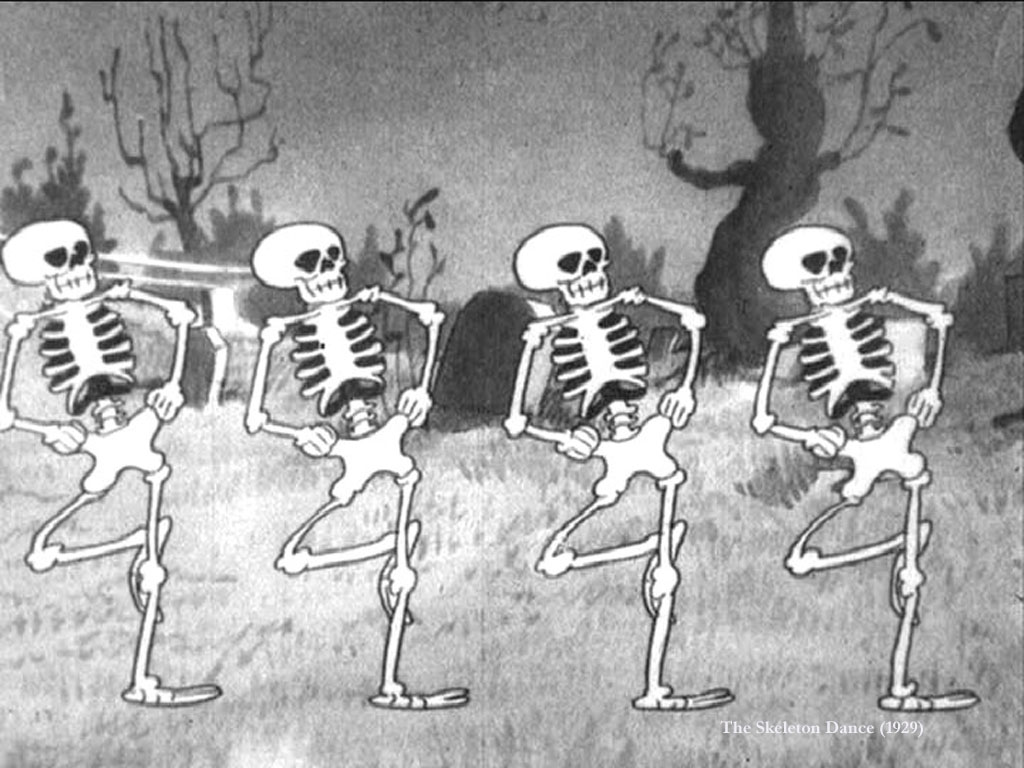
56.48 Undead Assembly Line: Fiery crabmen are roasting corpses over long trenches of flaming blue gas, part of a process of turning zombies into exploding bones (a type of animated skeleton). A long procession of the revenants are marching into the flames; while standing in line, they receive glyphs on their shoulders, hands, foreheads, feet and small of back (like evil tramp stamps!) from a gaggle of lesser necromancers (level 1d3+3). When they emerge from the fires, they look like brightly painted skeletons (not unlike those seen in Mexico’s Day of the Dead celebration) and are marched to the palace of Orobas where they are used as an outer picket of suicide guards.

59.62 City of Ten Thousand Devils: The owl-headed arch-devil Andras dwells here in his grand city of monasteries. The city has grand walls of dark granite that form a wide circle (3 miles in diameter) and are lined by leering gargoyles (some are monsters, some statues). The city has three gates, each one in the shape of a pentagram and alive with dazzling lights. A causeway passes up and through the star, subjecting travelers to a cascade of colors that affect them per a color spray unless they curtain has been deactivated by one of the guardians of these gates, a shining child surrounded in a 60-ft radius aura of blinding light (save or blindness for 1 hour).

Let’s Get Grimm … Nursery Rhyme Monsters II

Sorry for the delay in getting this baby out – work has been crazy busy for the past couple weeks (in a good way, but tiring nonetheless).

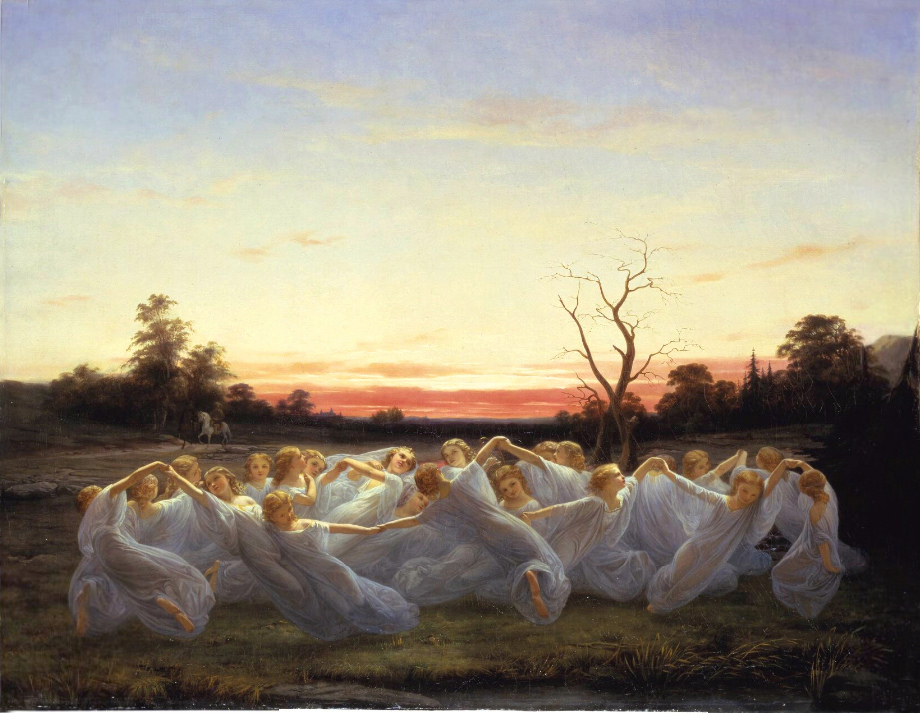
Fairy: Fairy is, of course, a blanket term for all the fair folk (including sprites, brownies, leprechauns, goblins, etc.), but for us, it refers to the beautiful, elfin women of fairy tales. Fairies conform to the stats for nymphs, but gain the ability to fly with gossamer wings, and the ability to cast magic spells as a fairy godmother. Among the more famous of fairies is the Fairy with Turquoise Hair (who serves the court of Hearts), Morgan Le Fey (who serves the court of Spades) and Titania (who serves the court of Diamonds).

Ghost: Ghosts are thick in fairy tales, and can be modeled after the incorporeal undead of D&D, such as the wraith and spectre. They need not be wicked, of course, nor intent on draining energy, though they oft times find mischief irresistible.

Giant Animals: Though not all animals in fairy tales are giant (in fact, few are), giant animals still make excellent monsters in fairy tale games. Naturally, they are all at least dimly intelligent and capable of speech. Giant eagles, goats, owls, snakes and spiders all play their part in a game of Mother Goose & Goblins.

Giants: The most appropriate races of giants for fairy tale gaming are, of course, the infamous cloud giant (sniffer of the blood of Englishmen) and the loutish hill giant. Some fairy tale hill giants can grow exceptionally large (although they are rarely seen), and can, to keep things simple, be referred to as mountain giants (double or triple the size and hit dice of a hill giant, add one dice of damage for double-sized giants and two for triple-sized giants. Cloud giants are not especially brilliant, but they are all magic-users of some renown, but hill and mountain giants are utter dopes.

A variation on the hill giant is the green giant, who has extraordinary intelligence and wondrous powers of illusion. These fellows dress in the manner of knights, and enjoy sending princes on quests.

The ettin, more commonly referred to as a two-headed giant, is also a frequent visitor to Fairyland, as is his cousin, the three-headed giant (+1 HD).

Giants usually serve the court of clubs (evil).

Goblin: Goblins are as thick as flies on the borders of Fairyland, and loom large in many legends. As in D&D, they are ne’er-do-wells who delight in torment and trouble, and generally conform to the normal rules for goblins (or even kobolds). When encountered in their lair, there is a 1 in 20 chance that adventurers will have stumbled upon a goblin market, where fey of all stripes trade wondrous goods and might even trade with the adventurers, if they dare. Goblins either serve the court of clubs (evil) or diamonds (evil).

Griffon: Griffons reside in the mountains of Fairyland, preening their feathers and grooming their tawny fur in the sun. They are creatures of terrible nobility, and are not to be trifled with by inexperienced adventurers. The greatest princes might make them their mounts, if they can be subdued (per the rule for dragons). Griffons serve the court of diamonds, and are always prideful.

Hobyah: Hobyahs are just hobgoblins by another name – and might also be called hobs. They are not always as wicked as their counterparts in D&D, and some serve in the manors of less savory princes as foresters and rat catchers. They have warty hides, bulbous noses and grim expressions. Hobyahs serve the court of spades.

Hydra: The hydra, or three-/five-/or seven-headed dragon as it is more often labeled, appears in a few fairy tales, filling the same basic role as the dragon. Pyrohydras are not uncommon in Fairyland. Hydras, like dragons, serve the court of diamonds (evil).

Leprechaun: Leprechauns are fairy cobblers, and members of the fey proletariat, as it were. As in popular myth, they hide their gold in pots that can only be found by following rainbows, but those who steal a leprechaun treasure will find themselves hunted for all their days by the vengeful fey and their kin. Unfortunately, 1 in 20 pots of gold actually contains brightly dyed foodstuffs. Leprechauns can be found in the AD&D Monster Manual, but might also be modeled after halfling who must grant three wishes to those who catch them. If this be used, allow the leprechaun to roll their initiative on 2d4, and double their movement rate. Leprechauns serve the court of spades.

Merchant: Human merchants loom large in many fairy tales, and can be modeled after the trader of D&D or the merchants of AD&D. They are usually encountered with a wagon of goods, or with a pack mule, and often have a beautiful and innocent daughter they’ve left at home with her stepmother. Merchants can sometimes (1 in 6) speak the language of the fey, as such merchants have had truck with those folk, and know some of their secrets. Merchants serve the court of diamonds.

Dragon by Dragon – June 1977 (7)

Happy birthday The Dragon! June 1977 marked the beginning of the second year of the magazine’s publication. Kask starts off by bragging on the improvement in the art and the 300% growth in circulation in a year (which could mean they went from selling 1 copy a month to selling 3 … but I think they were doing better than that). Kask goes on to say that, despite the increase in readership and the magazine now being published 8 times a year (they had NOD beat – 6 is almost more than I can manage), he remains the only staff member. He gives thanks to the help provided by Gary Jaquet, but explains that he can only do so much because he lives 4 HOURS away. Boy, have things changed for the better. The editor for Blood & Treasure lives across the continent from me, and he might as well be in the next room.

The other big announcement from Kask …  PUBLICATION BY THE DRAGON DOES NOT BESTOW ANY SANCTION OR APPROVAL TO ANY VARIANTS, VARIATIONS OR RULES INTERPRETATION.

Anyhow … what has the birthday boy in store for us today?

First up, we see an advert for the Third Annual SC Awards for Creativity in Wargaming. Some of the things that didn’t make the ballot include Bunnies and Burrows (for best game) and Jim Dunnigan (for design of Russian Civil War … you might want to check out his Strategy Page site for information on everything going on in the world of conflict). Lankhmar and Metamorphosis Alpha were up for Outstanding Game of 1976, Gygax’s Swords & Spells was up for Outstanding Miniatures Rules of 1976 and Grenadier’s wonderfully named Wizzards & Warriors was up for Outstanding Miniatures Series of 1976. They also list a Fantasy Gaming Hall of Fame, which includes Lord Dunsanay, C.S. Lewis, A. Merritt, Fletcher Pratt, Clark Ashton Smith, Poul Anderson, M.A.R. Barker, Lin Carter, L. Sprague DeCamp, Gardner Fox, Katherine Kurtz, Fritz Leiber, Michael Moorcock, Andre Norton, Jack Vance and Roger Zelazny – and I just cannot argue with such a list. Spot on for 1977.

Omar Kwalish (didn’t he invent some sort of apparatus?) presents tips on what to do when “… Calamity Befalls You Twenty Minutes Before the Game Club Gets To your Place”. In essence, the article shows how you can generate percentages with two standard D6, and other ways of dealing with being without dice – chits in a jar, random numbers generated on high-tech calculators (such as the TI-SR51-A), cutting cards (roll 1d4 with the suits, etc.), using a watch with a second hand, spinners, coin flips (an obscure study financed by government grant proved that the dime was the ideal coin to flip), phonebook and blindfold, etc.

Gary Gygax uses the Designer’s Forum to tell of the origins of the game, in which he writes, “Although D&D was not Dave’s game system by any form or measure, he was given co-billing as author for his valuable idea kernels.” Let the lawsuits begin.

Lynn Harpold describes Mystery Hill, America’s Stonehenge. A very ’70s article, if you remember that time period, and things like In Search Of.

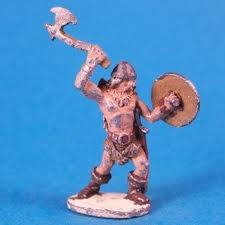
One of Ral Partha’s new releases is “Foregum” Super Hero (Bare-Chested) – no picture, but he is now my favorite miniature of all time. Luckily, I found an image …

And a copy of Ral Partha’s 1981 Catalog. CHECK IT.

Great illustration by Morno on page 11, to go with his story The Journey Most Alone. Again – new rule of Dragon by Dragon is to post a random paragraph from the story, so …

“There he paused in wonder.”

Okay, that was a bit cheap, how about the next paragraph as well …

“Before him he saw the vistas of a wide universe from the height of a splendid cliff. Awaiting him was a massive throne of silver and of tortoiseshell, metalwork twining like vinery around the dark surfaces of the seat. Leaf and stem of silver entwined in ecstatic embrace, and here, upon the highlights, and there, among the shadows, gleamed jet and onyx, lapis and obsidian, nested like gleaming grapes in beds of many other stones. From this pinnacle Visaque beheld the five extremities of his cosmos and the many marvels therein; beheld amber castles and perilous beasts, paradise and power to his world’s edge. At the foot of the throne knelt spirits of the four elements and one awaiting his ascension. Tiny heralds on elven birds trumpeted a fanfare at his coming.”

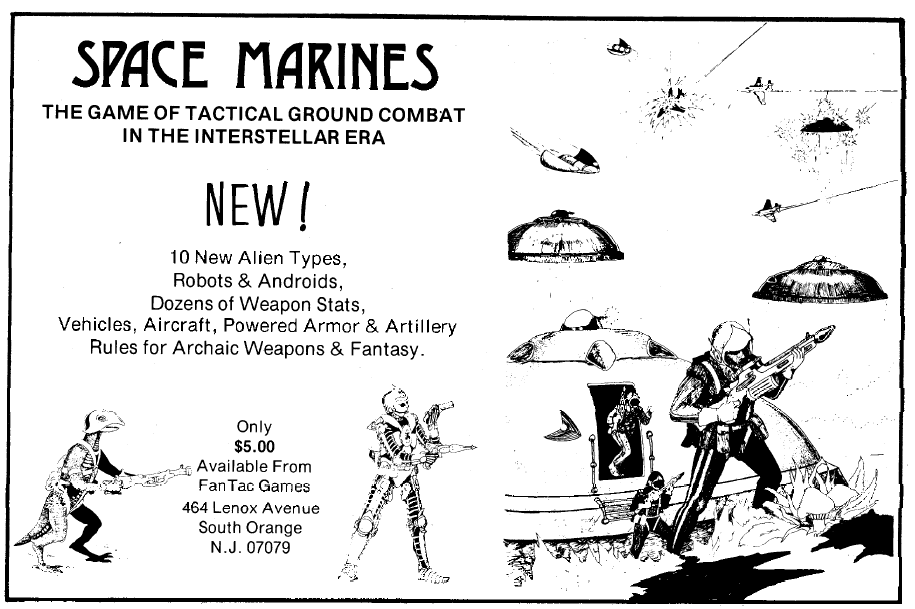
In the middle of the story there is an ad by FanTac Games in South Orange, NJ for a new game called “Space Marines”. Looks like they beat the Brits to the punch.

I wonder what 464 Lenox Avenue looks like now …

M.A.R. Barker has a new article on Military Formations of the Nations of the Universe, recounting military formations of … well, you get the idea. The universe, in this case, is confined to Tekumel.

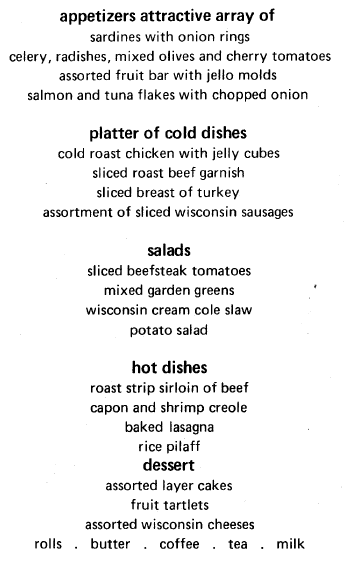
I cannot go further without printing the following menu in an ad for the Third Annual Strategists Club Awards Banquet at Playboy Resort …

Honestly, they had me at sardines and onion rings.

The Featured Creature this month is the Prowler. Its B&T stats would be:

Prowler: HD 14; AC 18; Atk Bite (1d8) and constriction (4d12 per turn); MV 30; SV 10; CL/XP 15/1400; SP – Gaze (save vs. magic or mind blanked and become a zombei [sic] under the prowler’s control; can only be restored by having 3 patriarchs cast dispel magic at the same time), inject eggs (with brown tentacles around mouth, injects into zombeis, eggs hatch in 2d4 days and eat the zombei).

Tough monster, and a nice bit of art to go with it.

Fineous Fingers tries to rob a guy from TSR and ends up skewered, while the kid he was training gets a 1,000 gp reward for tipping off his target.

In the Editor’s Library, Metagaming Concepts (makers of Stellar Quest, the first “good, playable space game”) announce their new micro-game … OGRE! I doubt it went anywhere.

Mcewan Miniatures has a sweet little ad for their new figures …

I’d like to think all of those fellows would fit in nicely in a Space Princess game somewhere. Maybe the Terrellians are a species that has built their culture around the worship of this guy …

But that’s just me. (And yeah, that would probably make them Chaotic).

Mystery author Garrison Ernst (just can’t figure out who this guy could be) presents another installment of the Gnome Cache.

“A column of dark smoke announced that they were approaching the castlewick of Blackmoor. It was the morning of an otherwise bright day not long since the slaughter took place on the narrow road to Weal. The two had traveled fast. Several times they had quickly left the lance for the safety of the surrounding wood as a band of Nehronland foot or a rare body of horse passed northwards laden with plunder and marching with much jesting and laughter. Each time Mellerd would salute their passing with various rude gestures, for he daily came to hate all Nehronlanders more passionately as he missed the Kimbri Vardobothet whose death came at their hands. There was now a particularly thorny problem facing them. They could not, of course, proceed directly through the place ahead, for it was obviously swarming with enemy soldiers. To the east was a jumble of broken terrain stretching away for endless leagues towards the sea. Worse, it was the home of many of the various bands of Nehron, so passage through that place would be nearly as dangerous as going straight along the road through Blackmoor. But to the west was a trackless forest which led to the slopes of the Senescent Hills, most inhospitable and the dwelling place of creatures who did not welcome men intruding upon their domain. The trick would be to swing wide enough to bypass the fortress unseen by any of the numerous warriors thereabouts, and then come back onto a route south again. If they went east they would eventually make the road to Rheyton as they circled back. In the other direction they would strike the passage to the free city of Humpbridge which bent from southwest to south across the base of the Senescent range. Dunstan was faced with making a decision from what he remembered of maps and his experiences on the trek which brought them to these straits originally.”

The emphasis is mine. Humpbridge!

And so ends the seventh issue of The Dragon. If I’m honest, the ads were the best part of this issue – pretty weak on game content, and Barker’s article on military formations seemed endless. What I have learned, though, in reading these is that I need to start using multiple pseudonyms when writing NOD. Fake names, anagrams and bad puns are as much a part of the D&D experience as Armor Class and hit points, and I’ve been missing out!