Mu-Pan – Encounter XVII

One more from Mu-Pan …

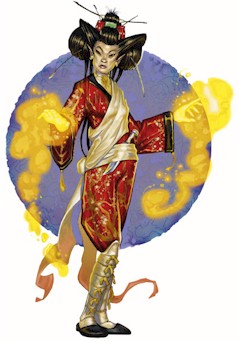
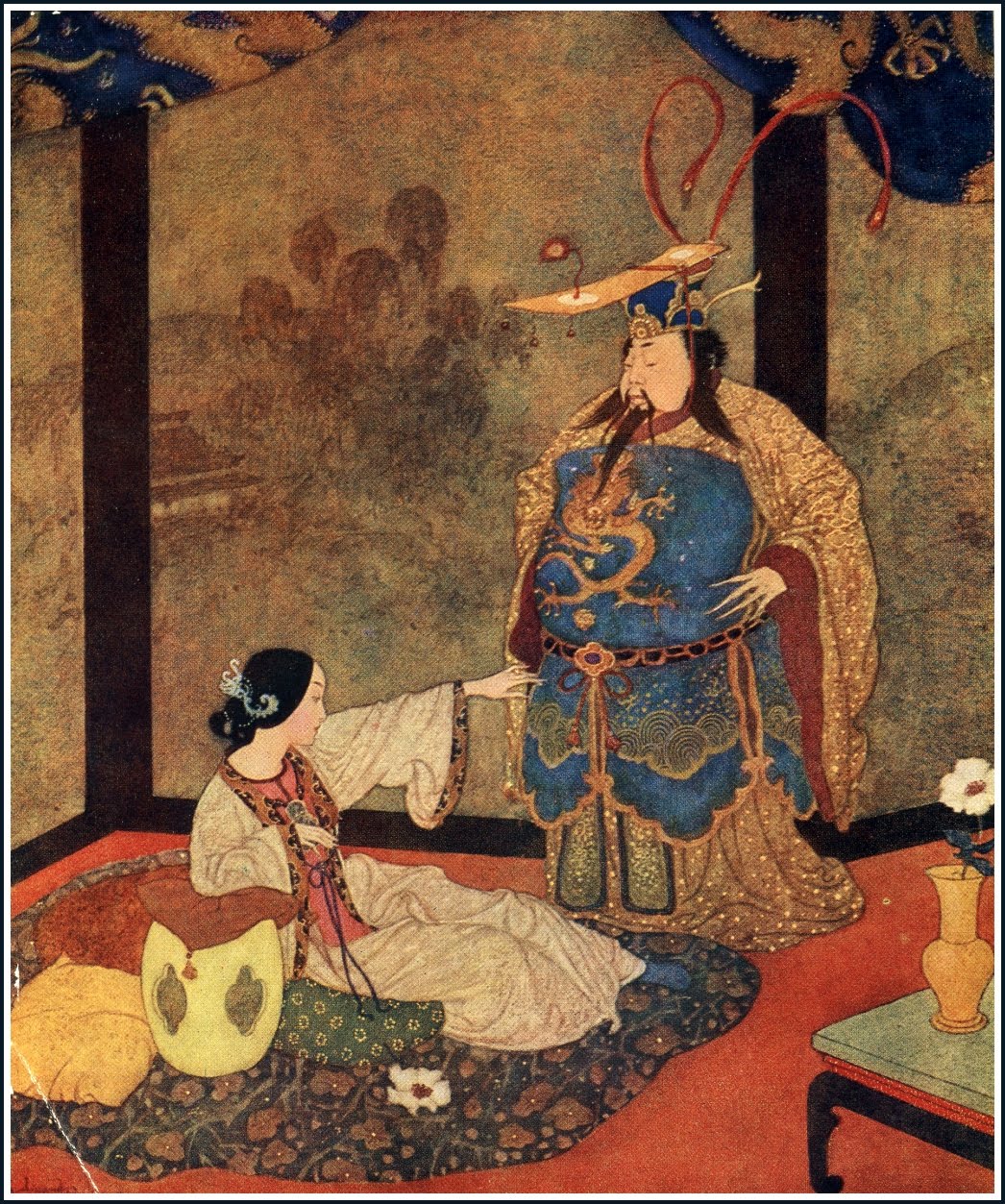
1409. The city-state of Zi’asssazus is home to the sparkling court of pious Prince Zilewei, a sagacious enchanter who commands two companies of warriors (one of archers, the other of light infantry). The town is defended by four tall watchtowers.

The city-state has aging walls covered in many coats of whitewash. A visitor can tell that Zi’asssazus is constructed on the disintegrating corpse of an older city. In fact, it was once the site of an ophidian city-state. The shamshir do not have the architectural ability of their forebears, so their wattle and daub patches and additions to the ancient buildings are noticeably more crude.

Zilewei’s palace is a modest castle of somber hues and noble, stuffy guards swathed in silks and carrying two nagamaki and a brace of five shuriken. The palace contains a shrine dedicated to Nassi’a, the Moth Goddess. The walls of the shrine are hung with dozens of bronze moths with lacquered wings. It is staffed at all times by a sacred drummer who maintains a steady rhythm.

The palace is constructed at the top of a wooded hill. Two ancient stone reservoirs are located beneath the palace, and the rest of the city-state below them. Gravity brings water from the reservoirs through clay pipes to intricately carved and ancient fountains. The fountains’ spouts are bronze cobras. The city-state is known for its moneychangers (scrupulously honest, with very safe vaults), its guides (many of them former soldiers) and its unique taverns. The shamshir combine their taverns with their baths. The shamshir of both sexes luxuriate on heated slabs in the steam, sipping tea or quaffing heady liqueurs from silver flutes. The people enjoy cockfighting, which they do in the alleys off the main streets, with betting a must.

The land around Zi’asssazus is a lightly wooded grassland surrounded by a thicker woodland inhabited by giant mantises. The farmers of the city-state raise ducks in ponds, grow hemp and rye and keep goats and cattle.

| Zilewei, Shamshir Shugenja Lvl 5: HP 14 [16]; AC 9 [10]; Save 11 (9 vs magic); CL/XP 4/120; Special: Spells (3rd). Heavy robes decorated with slips of golden hair in clasps of silver, spellbook.

A Bevy of Bujin

As regular readers know, my Mu-Pan hexcrawl is based on Mike Davison’s excellent Ruins and Ronin ruleset (and by reading this sentence, you are now contractually obligated to go buy it – sorry, the law’s the law).

R-n-R is, in turn, based on Swords and Wizardry White Box, so it keeps things simple. There are four classes – Bujin (fighting-man), Sohei (cleric), Shugenja (magic-user) and Half-Ogre. In addition, Mike has released the Ninja, Kensai, Headhunter and Henyeyokai classes on his blog. The bujin is, essentially, a samurai that can make use of the heaviest armor in the game and any weapon.

Unfortunately, Mu-Pan is based as much on China as Japan, and that leaves a few gaps where fighting-men are concerned, primarily in the form of the shaolin monk. Of course, there’s a perfectly good monk in NOD 1 and S-n-W Complete, but I decided I wanted to minimize reliance on other rulebooks when writing Mu-Pan. Besides which, there are some important differences in terms of Hit Dice between White Box, Core and Complete. To that end, I came up with this little system for modifying the existing bujin to model different kinds of Asian warriors, from wandering swordsmen to fighting monks to members of dart bureaus.

Keep in mind, this is a rough draft. I’d love to hear comments on the concept.

The bujin as written is designed to be a heavily armored warrior, serving on the front lines of an adventuring band, his o-yoroi armor deflecting deadly blows while his flashing katanas cut down foe after foe. This is a fine archetype of Asian fighting prowess, but it stands at almost the opposite end of the spectrum from Asia’s other great fighting archetype – the unarmed martial artist. To model your bujin as something other than a samurai, this houserule permits you to reduce your allowable armor in return for a special ability. The less armor you are permitted (and thus the more damage you’re likely to take in combat), the more special abilities you can have.

Maximum Armor Bonus | Special Abilities
+0 | 4
+2 | 3
+4 | 2
+6 | 1

Special Abilities

Combat Sense – You are normally surprised on a roll of 1 on 1d8 and can make a saving throw to avoid back stabs from ninjas and thieves.

Deflect Missiles – Once per round, you can make a saving throw to avoid an otherwise successful missile attack.

Estimate Foe – For each round you do not attack your opponent, you gain a +1 bonus to hit, Armor Class and damage for the remainder of the combat against that opponent.

Headlong Charge – You run at an opponent or ride at an opponent and attempt a single attack at a +2 bonus to hit along the way. You must run at least 20 feet to use this ability, and you suffer a -2 penalty to your AC during any round in which you make a headlong charge.

Fists of Iron – Your unarmed attacks do 1d6-1 (1d4) points of damage.

Flurry of Blows – You can make one attack against a secondary opponent every other round.

Iron Hold – With a successful attack you wrap your opponent up using your arms and even legs; equivalent of a hold person spell until your opponent makes a successful saving throw (penalty equal to difference between your strength and their strength). If your attack fails, you suffer a 1 point penalty to Armor Class until your next turn.

Ki Shout – You harness all your power and put it into a single melee attack, gaining a +2 bonus to damage if you hit. You can unleash a ki shout only once per day.

Mighty Leap – You can make a 6 foot horizontal and 3 foot vertical leap if heavy encumbered, 8 foot / 4 foot leaps if lightly encumbered and 10 foot / 5 foot leaps if unencumbered.

Mounted Archery – You suffer no penalties to firing a bow from an unsteady platform, like a boat, horse, flying carpet, etc.

Parry Blows – You can trade an attack during a round for a +1 bonus to your AC or the AC of a creature or object no more than 3 feet away from you.

Parry Death Blow – Once per combat you can make a saving throw to retain 1 hp when a successful blow would otherwise have killed you.

Swift Motion – You roll a separate initiative from your group, and may take whichever initiative roll is better. Your movement rate is also increased by three.

Image by Wayne Reynolds via Paizo. I’m a WAR junkie, so when I saw this image pop up today on their blog, I had to appropriate it.

Mu-Pan – Encounter XVI

Had some homework to do with my daughter tonight (designing a Harry Potter game for school), so no Megacrawl today – hopefully tomorrow. In the meantime, enjoy another Mu-Pan encounter …

1425. A pagoda has been constructed here from round, pearly stones that don’t appear to be held together by any sort of mortar. The pagoda’s roofs are made of a bronze-colored wood that shimmers in the daytime. Inside the pagoda there is a pit that burns with purple-black fire. The flames rise to about 10 feet, but flare when living creatures approach. At night, the pagoda gives off a glassy, purple glow to a distance of about 100 feet (double that when living creatures are nearby). At night, encounters with undead monstrosities occur on the roll of 1 on 1d6 made every hour. Use the following table to determine what dark pilgrim visits the pagoda.

Roll | Monster
1-2  | Zombies (1d6+6)
3-4  | Jikininki (1d3+3)
5-6  | Ghouls (1d3+1)
7     | Gashadokoru (1d3; see monsters)
8     | Kyonshi – Hopping Vampire (1d2)
9     | Shikki-Gaki (1)
10   | Jiki-Ketsu-Gaki (1)

__

Image by Edmond Dulac

Mu-Pan – Encounter XV

A wizard’s tower high in the mountains …

1244. The top of a mountain has been carved, or possibly molded, into a slim tower that overlooks its surroundings for 18 miles (3 hexes). The master of this house is Zabrasha, an elementalist and sworn enemy of the men of Tsanjan. Her presence here has long been a thorn in their side, but as yet they have mounted no serious attack on her citadel.

The citadel looks like a needle of gray stone piercing the heavens. In fact, the “needle” is about 200 feet in diameter and 300 feet tall. Nestled in this massive citadel are 99 chambers, each decorated in a different color (some repeat) and each holding a small shrine to an elemental spirit. Zabrasha’s servants, about 20 kobolds with gleaming scales and five apprentices, keep incense burning at the shrines and make daily chants before them. The entrance to the tower is gained by climbing a long, winding stair about 500 feet up the side of the windy mountain. The stairs end in a 20-ft long tunnel that opens into an enclosed courtyard with three bronze doors. The side doors lead spartan quarters that the Gray Lady makes available to petitioner and travelers. These rooms contain bronze braziers for warmth, sleeping mats and pegs for hanging belongings, but nothing else. The other door is guarded by two ishidzukui-shishi (HD 5+2; 19, 16 hp).

The base of the tower’s mountain is covered in a thick woodland of stunted poplars, birches, walnuts and wild cherry trees. The area is rich in game animals (deer, mountain pigs, shaggy hares) that the kobolds trap and the apprentices prepare. Both apprentices and kobolds wear conical hats made of rabbit hide. A neglected town hides in those woodlands. It is inhabited by two dozen hunters and their families and holds only one building of note, a crumbling tower that holds an ancient altar dedicated to the Panda Emperor.

Zabrasha is an elderly woman with gray hair, gray eyes and tawny skin. She has a delicate build and a deeply creased, though still attractive face. While kindly at heart, she is always on guard for her enemies and she is a harsh mistress with her apprentices, believing that tough love will save them in the future as they attempt to deal with elementals and other extra-planar creatures of great power. An old romantic, she falls in love easily, especially with older bujin that remind her of her first husband and partner in adventuring.

Zabrasha’s treasure consists of 950 sp, 770 gp and a diamond worth 800 gp.

| Apprentice, Elementalist Lvl 1: HP 1d6; AC 9 [10]; Save 15; CL/XP B/10; Special: Command spirits (4/day), turn elementals. Equipment, grimoire, tools.

| Zabrasha, the Gray Lady, Elementalist Lvl 10: HP 27 [31]; AC 9 [10]; Save 8; CL/XP 12/2000; Special: Command spirits (8/day), turn elementals. Equipment, grimoire, tools.

Note: If you do not wish to use the elementalist class from NOD 3, substitute with the shugenja.

Image from Wizards of the Coast website.

Mu-Pan – Encounter XIV

Do you like crane maidens?

Well, probably not these crane maidens …

1226. Warm springs flow from the mountains here, a cluster of largely dormant volcanoes. The gorges that lead into the wooded valley are crusted with mineral salts, but the go uncollected, for the gorges are sacred to the demon god Chiyou and visitors are not permitted in the valley.

At the heights, there is a large pool of warm water surrounded by junipers and dusty purple thistles. The pool is inhabited by 1d6+4 vapor cranes. In the center of the pool there is an ancient marble cistern filled with warmer water and five crane maidens, sisters and daughters of Chiyou. The crane maidens are not physically very powerful, but they have two unique powers. When their eyes grow scarlet, they cause the water to boil (1d6 damage per round). When they glow purple, the water becomes as solid as concrete for 3 rounds.

| Vapor Crane: HD 5; AC 4 [15]; Atk 1 bite (1d4+5); Move 6 (F12); Save 12; CL/XP 6/400; Special: Scalding to touch, steam cloud (1d6+5) in cone or 15-ft radius.

| Crane Maiden: HD 2; AC 5 [14]; Atk 1 strike (1d4); Move 15 (F30); Save 16; CL/XP 4/240; Special: Magic powers, change into crane (heals all damage, 2/day), magic resistance (30%).

Image by Hsu Roh Ling

Mu-Pan – Flock of Cheonma

Short encounters tonight, so I’ll post two …

1025. A flock of seven cheonma have made an aerie for themselves on the high peaks here and are under attack by a pack of five griffons. The cheonma are hard pressed and they have already lost two foals to the depredations of the griffons.

| Cheonma: HD 4; AC 6 [13]; Atk 2 hooves (1d8); Move 24 (F48); Save 13; CL/XP 4/120; Special: Flight. Cheonma are Mu-Panese pegasi. They are eight-legged horses with wings on their feet.

| Griffon: HD 7; AC 3 [16]; Atk 2 claws (1d4) and bite (2d8); Move 12 (F27); Save 9; CL/XP 8/800; Special: Flight.

1027. A gang of 20 gyres is occupying a cave here, using it as a base of operations as they raid down the river into Yun territory. The leader of the gyres has a single white eye and particularly long canine teeth. He wears a golden ring on one of those teeth (worth 15 gp) and can cast 1d6 levels of sohei spells per day. The gyres wear coats of leather scales and wield masakaris and kamas. If encountered in their lair, there is a 2 in 6 chance they are drunk on plum wine. Their treasure consists of 340 sp and 1,130 gp in leather sacks. The stripped bones of two unlucky farmers are piled in the back of the cave.

| Gyre: HD 2; AC 4 [15]; Atk 1 bite (1d3) and 2 claws (1d4) or weapon (1d6); Move 15; Save 16; CL/XP 3/60; Special: Frenzy (2 attacks per round for 3 rounds, then fall unconscious).

Mu-Pan – Hermit of Yarni-Zai

Man I love writing this stuff – just letting my mind wander, maybe feeding it with a few random seeds. Here’s another one from the mountains around Tsanjan …

0937. A small village of fishermen live in this hex in a gorge with steep, 90-foot tall sides. A river moves slowly through the hex on its way to the Tsanjani Plateau. The fishermen dwell in something that resembles a Chinese lantern composed of rattan and attached to the walls of the gorge with iron spikes. Each lantern-house measures about 6 to 9 feet in diameter and houses three or four villagers. The fishermen can be seen at odd intervals dangling their feet out their front doors casting long lines into the river below. Hatches in the tops of the lantern-houses lead to ladders composed of iron spikes, allowing the villagers to climb to other lantern-houses or to the top of the gorge.

Below the lantern-houses an idol of Yarni-Zai has been carved into the gorge wall. The grave creator of beasts and men broods over the slow river, which the villagers believe was originally a beautiful maiden that won the heart of the deity but refused him. A hermit priest sits in the lap of the graven image, meditating, answering the questions of the villagers and curing their ills as best he can. The hermit has no name, and asks nothing but an offering of rice or fish in his begging bowl.

The villagers are armed with yami and haikyu, though their lack of money keeps the bandits away and their somber attitude and resignation to the indignities of the world make them unlikely targets even for chaotic adventurers.

| Hermit, Druid Lvl 6: HP 12 [23]; AC 9 [10]; Save 9; CL/XP 7/600; Special: Spells (3rd), speak to animals, plants and monsters, shapechange. Begging bowl, prayer beads.

Image from HERE.

Mu-Pan – Wang Liang

0824. A stone tower made of golden bricks leans over dangerously from the side of a low mountain covered in a tangle of brambles. The tower is the lair of a wang liang and his foot soldiers, 40 oni-yama. The wang liang owns an enviable library of bamboo scrolls on every imaginable subject, though every single one of them is filled with nothing but lies and half-truths. One of the scrolls contains a number of spells that appear to be one thing but are in fact another: Charm person (actually light), invisibility (actually levitate) and alter time (actually lightning bolt).

Mu-Pan – Clockwork Monastery

Another one from Mu-Pan. You’ll notice I haven’t done the treasure yet. I use an excel document to randomize treasure. The tables are based on those from Swords and Wizardry, and yesterday I was too lazy to open it up and generate the goods, mostly because Open Office doesn’t handle it as well as excel does and I usually work on my laptop. I know – who cares. Anyhow …

0718. A cliffside monastery in this hex was abandoned about 30 years ago when the monks were masacred in an attack by oni-aka goblins. Twenty of the goblins still dwell in the place, though they avoid the shrine. The goblins are led by Iki-Urha, an ogre with rust-colored, heavily creased skin and a bulbous nose.

The monastery shrine was dedicated to the concept of Law. The rear wall of the shrine, which measures 15 feet by 15 feet, is covered with bronze clockworks that approximate the movements of the cosmos – at least those of Nod and the planets Luna, Mercurii, Veneris, Martis and the Solar Sphere. The shrine is protected by four giant, clockwork owls perched on bronze bars that run the length of the shrine.

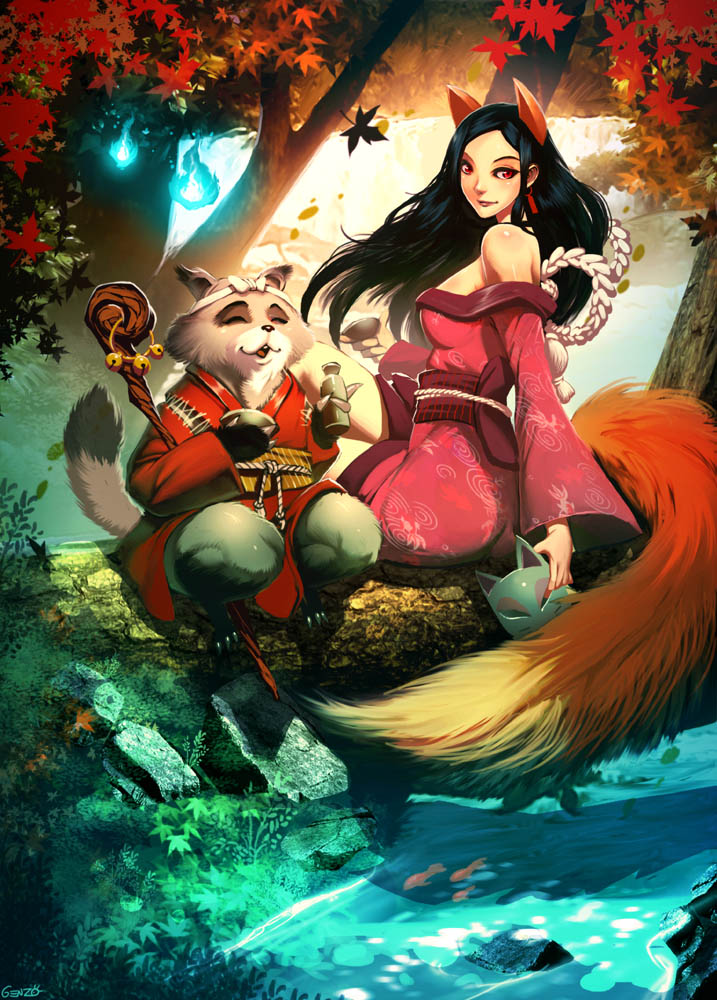
The goblins and ogre have desecrated the remainder of the monastery. The ogre has a single prisoner, a musician named Zeaho. Zeaho is the last survivor of a party of adventurers that sought out the monastery under the direction of their lawful sohei. Zeaho is a hengeyokai that can assume the form of a hare.

The ogres and oni-aka have a treasure of XXX in a large, locked chest.

| Oni-Aka (20): HD 1; AC 6 [13]; Atk 1 weapon (1d6); Move 9; Save 17; CL/XP 1/15; Special: Resistance to fire (50%).

| Clockwork Owls (4): HD 4+1 (19, 15, 14, 9 hp); AC 2 [17]; Atk 2 talons (1d6), bite (1d6+1); Move 6 (F30); Save 13; CL/XP 5/240; Special: Immune to sleep and charm, resistance to cold and fire (50%).

| Zeaho, Hengeyokai Bujin Lvl 4: HP 14 [22]; AC 9 [10]; Save 13 (12 vs death & poison); CL/XP 4/120; Special: Follow through. Pipe (a lute).

| Iki-Urha, Ogre: HD 4+1 (17 hp); AC 5 [14]; Atk 1 tetsubo (1d6+3); Move 9; Save 13; CL/XP 4/120. Tetsubo, nine-ring broadsword (belonged to Zeaho).

Image of bakeneko and tanuki by GENZOMAN at DeviantArt. Much to see in his gallery.

Mu-Pan – One-Eyed Boys

One more before I post the update to Megacrawl 3000 …

0443. Three one-eyed boys (hitotsumi-kozo) dwell in this hex in a cave studded with sapphires (worth 100 gp each, a total of 23 are present). The cave is set in the side of a long hill, the base of which is cluttered with goji berry bushes. The one-eyed boys gather the goji berries and mash them into juice that they ferment in clay pots buried in the floor of their cave.

Although removal of the sapphires is very tempting, it is a dangerous thing to do. If a sapphire is plucked from the wall of the cave, a blue ray erupts from the wall and strikes the person holding the sapphire (no roll needed). The ray always strikes the person in the forehead and sets up a communication between the thief and something from beyond the void (per the contact other plane spell). The experience leaves most people a bit jumbled (1d8 points of ability damage spread between intelligene, wisdom and charisma as the player prefers). This damage can be healed with magic (restoration), but will not heal naturally.

If all of the sapphires are stolen from the cave, the rays create a portal through which 1d6+4 star warriors emerge. The star warriors are hairless humanoids with translucent, sapphire skin and eyes and wearing long, metallic coats of miniature scales (the material is aluminum – light weight and quite strong) and carrying two war hammers each. The star warriors track down the sapphire thieves and return them (the sapphires) to the cave. The thieves are either killed or they are taken back to the cave and taken through the portal.

| Hitotsumi-Kozo: HD 3; AC 6 [13]; Atk 1 weapon (1d4); Move 9; Save 14; CL/XP 7/600; Special: Bad luck, frightful appearance, ray of enfeeblement, silence, true seeing.

| Star Warrior: HD 5; AC 1 [18]; Atk 2 hammers (1d6); Move 12; Save 12; CL/XP 5/240; Special: Track sapphires unerringly, immunity to cold, ESP at will.

Also – to avoid confusion when talking about the Cloud Dragon, Gold Dragon etc kingdoms and the monsters of the same names, I’ve given the kingdoms alternate names:

Jin – Gold Dragon Kingdom
Meng – Mist Dragon Kingdom
Ying – Shadow Dragon Kingdom
Yun – Cloud Dragon Kingdom

Of the kingdoms, Meng no longer exists (at least, not in a normal way), its citizens now serving as the empire’s merchant class based in the coastal cities.