What Gave the Magic-User a Headache?

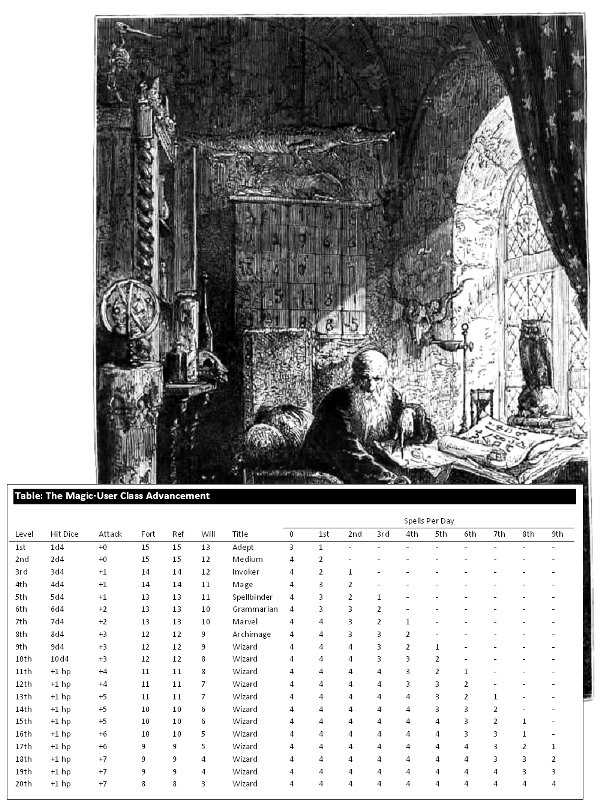
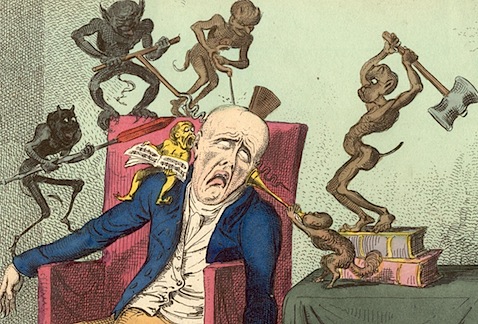
Magic-users are brain guys, and since they use their brains so much (and use them in such odd ways), they’re prone to frequent headaches. It’s not that different from swimmer’s suffering from swimmer’s ear or tennis players suffering from tennis elbow.

In play, whenever a random encounter roll is made and a “3” is rolled, there is a chance of the magic-user coming down with an aching  head. Let the magic-user roll a reverse saving throw (i.e. they need to fail the save to avoid the headache) – since the higher level a magic-user is, the more stress they put on the old grey matter. If a headache is indicated, roll d% on the following Random Magic-User Headache Table and inflict some agony.

01-04. Spell Residue: When a spell is imprinted on a magic-user’s brain and then unleashed, it often leaves behind a bit of itself – a spell residue, so to speak. This leads to a throbbing of the temporal lobe. The headache lasts until the magic-user unleashes all of his spells and then goes 24 hours without preparing any new spells OR until the magic-user can pass a once daily saving throw (as above). While suffering the headache, the magic-user suffers a 5% chance of spell failure and -2 penalty to all saving throws or skill throws involving concentration.

05-14. Dehydrated: Absent-minded as they are, magic-users often forget things like basic maintenance. The magic-user has become dehydrated, and this has started a headache. While suffering, the magic-user suffers a -1 penalty to all d20 rolls until he spends a day drinking a double ration of water.

15-16. Cerebral Parasite: The magic-user has picked up a cerebral parasite. The parasite lowers his intelligence score by 1d4 points (roll randomly each day) until removed with a cure disease spell.

17-19. Withdrawal Symptoms: Sometimes, a magic-user develops an addiction to a spell he or she has impressed on their minds. Randomly determine (or choose) a spell that the magic-user has memorized in the past, but which they do not have memorized now. Until the magic-user memorizes that spell and casts it for three days in a row, they suffer from a headache that gives them a 10% spell failure chance. If they go more than two days with this headache, they develop a nauseous stomach. If they go a week without memorizing the spell, they beat the addiction and are fine. If they eliminate the headache by memorizing the spell, they feed the addiction, and thereafter must memorize and cast the spell at least once per week or suffer from the withdrawal symptoms again.

20-35. Slept Funny: The magic-user must have slept funny, giving them a stiff neck and sore head. They suffer a -2 penalty to reflex saves (save vs. dragon breath, traps) and a -1 penalty to will saves (i.e. saves vs magic).

36-40. Tension – Fear: The magic-user has developed a headache from the stress and tension involved in dungeon delving. They must go 24 hours without encountering a monster or trap to remove the headache; otherwise, they suffer a -1 penalty to all will saves (save vs. magic) and a -3 penalty to all saves vs. fear.

41-45. Tension – Greed: The magic-user has developed an obsession with some piece of wealth owned by another character. Until they steal this item, they suffer a -1 penalty to all will saves (save vs. magic) and suffer a 15% spell failure chance any time they cast a spell that would be beneficial to the owner of the object of their desire.

46-50. Tension – Lust: The magic-user has developed an obsession with a fellow party member – one they would normally find attractive. Until they admit their feelings, they suffer from a -2 penalty to all will saves (saves vs. magic).

51-55. Allergies – Creature: The magic-user has developed an allergy to an animal owned by themselves or another party member, to a monster often encountered in the dungeon they are exploring (i.e. one of the monsters on the random encounter chart) or to another member of the party. When they get within 10 feet of this allergen, they suffer a headache that imposes a 5% spell failure chance and a -2 penalty to all will saves (saves vs. magic).

56-60. Allergies – Iron Rations: As above. The magic-user suffers the symptoms for 1d6 hours after consuming iron rations.

61-65. Allergies – Rope: As above. The magic-user suffers the symptoms for 1d6 hours after touching hempen rope.

66-70. Allergies – Magic Item: As above, but the allergy is to a particular magic item the magic-user recently came into possession of. The symptoms are suffered while the item is in his possession.

71-78. Pressure: The headache is caused by being more than 2 “levels” underground. The magic-user must either ascend to a higher level of the dungeon or suffer through the symptoms for 1d4+1 hours. While suffering, the magic-user suffers a 5% spell failure chance per dungeon level below 2 and a penalty to will saves (saves vs. magic) equal to the dungeon level they are on -2.

79-88. Light: Having spent so much time underground, the magic-user’s eyes are sensitive to light. They can stand torchlight, but must be at least 10 feet away from the torch. Anything else causes them to suffer a -2 penalty to all d20 rolls. This lasts until they have been exposed to pain-causing light for at least 4 hours.

89-99 Eye Strain: The eye strain caused by reading spell books, scrolls and ancient chaos carvings has caused a headache. The magic-user suffers a -1 penalty to all will saves (saves vs. magic) and a 5% spell failure chance until they rest their eyes for 48 hours.

100. Headache Demons: The magic-user is beset by 1d6 invisible headache demons:

Headache Demon, Tiny Outsider: HD 1; AC 14; ATK 1 implement of torture (1d4 + headache); MV 30 (Fly 40); F16 R13 W12; AL Chaotic (CE); XP 100; Special: Natural invisibility (per improved invisibility spell), yhose hit by the implements of torture must pass a will save or suffer a throbbing headache (-1 to all will saves, 5% spell failure chance; duration 1 hour) – additional spell failures increase the duration by one hour; three failed saves results in 1d4 points of intelligence, wisdom or charisma damage.

Raiders of Lost Tombs

I love new classes for games – anyone who reads the blog knows this, but I have to qualify that statement. I love new classes that excite the imagination. Not because they have kickass new powers – though sometimes because somebody finds a clever way to spin an old rule or concept – but because they scratch a certain itch for some archetype – and maybe even an archetype I didn’t know I wanted to play. I’m a big fan of basing a new class on a character, rather than a general occupational concept, much as the AD&D ranger is really just an Aragorn (and I wish they could have called it that – far cooler to say “I’m a chaotic good 8th level Aragorn”).

I’ve done this several times now – the she-devil is Red Sonja, the puritan is Solomon Kane and the beastmaster is Tarzan – using the character as a basis for the class (and throwing in some weird specifics, to me, is fun – i.e. the way rangers can use crystal balls), but going a bit further afield when necessary. With this in mind, I present …

The Tomb Raider
Tomb raiders distinguish themselves from common thieves and plunderers by their mental faculties. In many ways, they are sages who have abandoned the staid and safe halls of learning for the field, venturing out into the wilderness to discover firsthand the secrets of the ancients.

Requirements: Dexterity and Intelligence 13+

Hit Dice: d6 to 10th level, +2 hit points per level thereafter

Armor Permitted: Leather armor, no shields or bucklers

Weapons Permitted: Club, crossbow (hand or light), dagger, dart, light mace, light pick, pistol, quarterstaff, short sword, whip

Skills: Break Down Doors, Decipher Codes, Escape Bonds, Find Secret Doors, Find Traps, Jump, Open Locks, Remove Traps

Tomb raiders are well-educated men and women, and are capable of using the same legend lore ability that bards possess.

Although they are not as practiced as thieves with robbing the living, they do have a great deal of experience at avoiding traps left to guard the dead, and enjoy a +2 bonus to save against the effects of traps, mundane and magical.

Tomb raiders have learned from experience the value of two particular weapon/tools to their chosen profession – the whip and the quarterstaff. When employing these weapons, a tomb raider enjoys not only a +1 bonus to attack, but also a +2 bonus on task checks when using those weapons, such as attempting to vault over a chasm using a quarterstaff or slam a door closed using a whip to grab the handle, and with special maneuvers when using the weapon.

Tomb raiders have to finance their activities, but they shy away from pawning objects of historical value. Such items, they believe, belong in libraries, museums or universities. A tomb raider that allows such an important item to be sold or kept for private use is immediately cursed by a quest spell to retrieve that item and see it placed in the hands of the proper academic authorities.

Note: If you don’t name your tomb raider after one of the nations or city-states in your campaign, i.e. Greyhawk Jones or Waterdeep Smith, you really aren’t getting the full experience this class provides.

The She-Devil

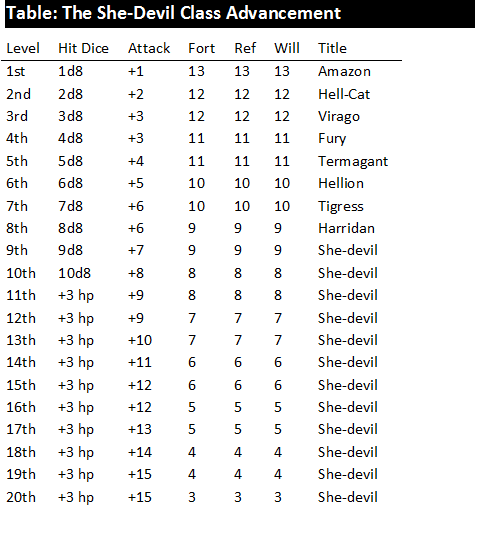
She-devils are females possessed not only of a righteous rage towards oppressors – especially male oppressors – but also the gift of puissance at arms from the goddess Scathach (or whatever war goddess best fits your milieu). Although she-devils often look the part of barbarians for their lack of armor (it is considered cowardly) and lack of covering (they have no shame in showing their feminine strength), they should not be confused for simple berserkers. She-devils are peerless swordswomen who draw their power from their vows of purity and dedication.

She-devils advance using the paladin XP scheme (see Blood & Treasure Players Tome).

Requirements: Strength and wisdom 11+, dexterity and charisma 14+

Hit Dice: d8 to 10th level, +3 hit points per level thereafter

Armor Allowed: Mail shirts (or shirts of leather, scale or ringmail*), shields and bucklers

Weapons Allowed: Any

Skills: Bend bars, break down doors, riding

She-devils must make a vow of chastity that can only be broken for a lover who has first defeated them in combat. If this vow is not upheld, the she-devil loses her special abilities. Her attack bonuses are reduced to that of a thief of the same level. She must atone to regain her abilities and must kill the person for whom she broker her vow. In addition, she-devils may not hire male henchmen, though they may use male hirelings and may adventure with male characters.

A she-devil enjoys a blanket +2 bonus to Armor Class due to her fluid fighting style and the blessings of Scathach. She-devils armed with a medium or larger weapon can deflect missiles, as a monk.

Although they balk at intimate human contact, a she-devil has a particular ability to affect the emotions of men. Once per day per level, a she-devil can exude an aura (30-ft. radius) that affects all men within the aura as either a crushing despair or cause fear spell. They can alternatively use this aura to inspire women as though using either the good hope or rage spell.

A she-devil can fly into a righteous rage under the following conditions: If she sees the weak being threatened or harmed by the powerful, if she sees a female humanoid being threatened or harmed, or if she is reduced to less than half her normal hit point total by a male humanoid (or monstrous humanoid). A raging she-devil enjoys a bonus to all saving throws, Armor Class and attack rolls equal to her charisma modifier. This rage lasts for 6 rounds. When it is over, the she-devil is fatigued (see conditions) for 1 hour. A she-devil can fly into this rage no more than three times per day.

A 6th level she-devil (hellion) may attack twice per round with a melee weapon.

A 9th level she-devil may establish a stronghold. She attracts a sisterhood of 2d6 amazons (of an alignment comparable to her own) and 4d6 commoners, all women and children, seeking shelter and safety.

A 12th level she-devil may invoke her righteous rage against male (or masculine) outsiders. In addition, the she-devil generates an effect equivalent to the protection from evil spell against these outsiders. 

* A shirt of armor grants a bonus to Armor Class one lower than a full suit – thus, a ringmail shirt grants an AC bonus of +2 instead of the +3 granted by a full suit of ringmail.

As the Cleric Turns

Quick post this morning, with something that’s probably already been done. So – clerics can turn the undead (i.e. scare them away), but what if they can do a bit more than that. Why not different turning effects, with easier or more difficult turning rolls to go with them?
With all of these effects, assume that a “T” on the Turn Undead chart counts as a “3” and a “D” counts as a “2” in terms of rolling the dice.

Daze: To daze undead, the cleric makes a turning roll at +2. The affected undead lose their turn that round and suffer a -2 penalty to AC and saving throws.
Cow: To cow the undead, the cleric makes a turning roll at +1. The affected undead are cowed for as long as they remain in the presence of the cleric, and for as long as the cleric forcefully presents his holy symbol. The cowed undead fall to their knees and avert their eyes. If attacked while cowed, the effect ends and they may act normally.
Light Damage: To lightly damage undead, the cleric makes a turning roll at -1. If successful, all undead within 30 feet suffer 1d4+1 points of damage.
Stun: To stun the undead, the cleric makes a turning roll at -2. If successful, all undead are stunned (per dazed above) for 1d4+1 rounds.
Moderate Damage: To moderately damage undead, the cleric makes a turning roll at -3. If successful, all undead within 30 feet suffer 2d4+2 points of damage.
Blind: To blind undead with divine radiance, the cleric makes a turning roll at -3. The undead are blinded (per the spell blindness) for 1d4+1 rounds.
Lull: To lull the undead into a sleep-like torpor, the cleric makes a turning roll at -3. The undead fall into the equivalent of sleep for 1d4+1 rounds.
Confuse: To confuse the undead (per the confusion spell), the cleric makes a turning roll at -4. All undead within 30 feet are confused for 1d4+1 rounds.
Charm: To charm the undead (per the charm monster spell), the cleric makes a turning roll at -4. All undead within 30 feet act as the cleric’s erstwhile allies for 1d4+1 rounds.
Serious Damage: To seriously damage undead, the cleric makes a turning roll at -5. If successful, all undead within 30 feet suffer 3d4+3 points of damage.
Destroy: To destroy the undead, turning them into ash, the cleric makes a turning roll at -6. All undead within 30 feet must pass a saving throw (Fort, vs. death, etc.) or be completely destroyed. Those who succeed at the saving throw still suffer 3d6 points of damage.
A failed turn undead roll while using any of these effects means that the undead in question are immune to all turn attempts (and effects) from that cleric for the remainder of the battle (or 24 hours – whatever you prefer). If successful with one of these effects, the cleric may attempt to employ another later (i.e. he could daze them, and then later in the battle attempt to damage them). As soon as a turn attempt fails, though, all further attempts automatically fail for the remainder of the battle (or 24 hours).

Three Bad Bishops, You Know So Well

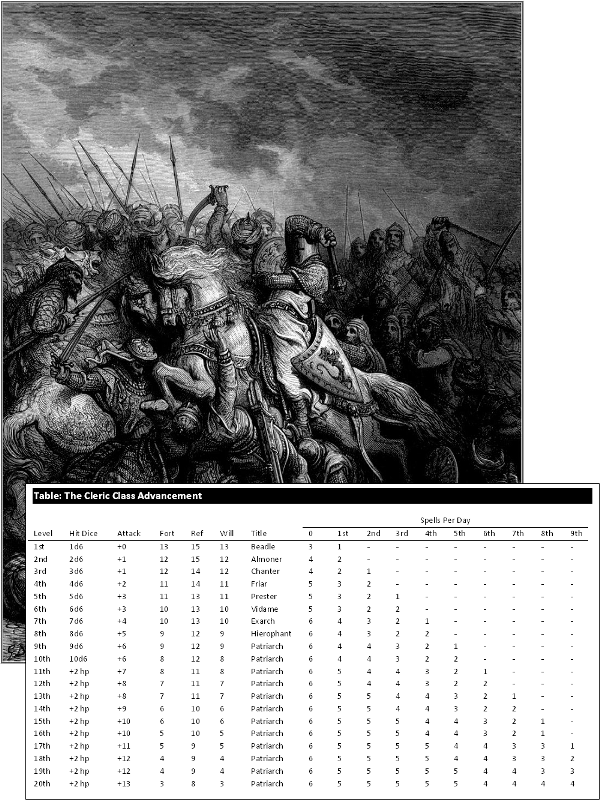
Let’s review, for a moment, the cleric.

The cleric was the original middle child of D&D – stuck square between the magic-user and fighter in terms of spell use and fighting ability – and the first class born from play, rather than the Chainmail rulebook. Legend has it that Sir Fang, a vampire character (yes, monster characters are as D&D as apple pie is American), was proving troublesome, so somebody decided they needed a Van Helsing* to deal with the rapscallion.

* Side Note: If you want to thoroughly understand the undead of D&D, you need to watch the Universal and Hammer horror films. Never understood the whole “vampire energy drain touch” thing? Watch Captain Kronos. You’ll understand. Plus Caroline Munro

So, the cleric, as it was introduced into the rules, became a mix of Van Helsing vampire hunter and medieval bishop-of-war, with the stylistic emphasis on the latter rather than the former. Who were these battling bishops of the Middle Ages, you ask? Read on …

ADHEMAR OF LE PUY, BISHOP OF PUY-EN-VELAY

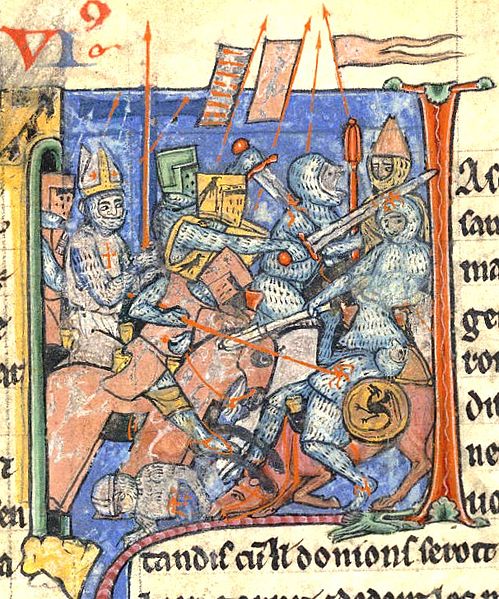
Adhemar (totally made up name, right?) hailed from France, and he plays an important part in the First Crusade. You can see him to the right, wearing the mitre*

* Side Note: If your 9th level cleric doesn’t enter dungeon fully armored and wearing a mitre, he should be stripped of his clerical powers and forever consigned to being a second-rate fighter. No Lawful or Chaotic deity worth his salt should forgive the sin of “awesome headgear aversion” in his followers.

He was paired up on the crusade with a bunch of stupid fighting-men who quarreled all the time over leadership, but managed to keep things focused with his spiritual leadership throughout the ordeal. When he died (probably of disease*), some claimed that he pulled the old Obi Wan trick (remember, Star Wars was a “long time ago”, so it technically occurred before the First Crusade) and returned as a ghost to cheer the foot soldiers on.

BISHOP ADHEMAR, LAWFUL CLERIC 9: HP 24; AC 15; ATK 1 longsword +6 (1d8); MV 30; SV F 10, R 12, W 8; Special: Turn undead, cleric spells (6/5/4/3/2/1); Gear: Chainmail, longsword, mitre, holy symbol, warhorse; Abilities: STR 12; INT 13; WIS 15; DEX 12; CON 8; CHA 14.

* Side Note: Died of disease? Hello! Cure disease – low level spell – what’s the deal? Well, it turns out that many of these bishops, uninformed of the D&D rules, used edged weapons and thus were unable to cast spells. Fortunately, fighting bishops of the future will be forewarned.

ODO, EARL OF KENT, BISHOP OF BAYEUX

Half-brother to William the Conqueror (a 9th or 10th level fighting man in his own right), Odo has one of the great names in the history of names (but far behind this guy). In fact, whenever I’m writing high-level clerics in a medieval milieu, it’s all I can do to avoid naming all of them Odo.

Odo is a little more “traditional D&D cleric” than the others, or at least pretended to be. Apparently, the Bayeux Tapestry (according to that shining light of accuracy Wikipedia) belabors the fact that he did not actually shed blood during the battle, and he is pictured armed with a club rather than an edged weapon urging the soldiers to battle – perhaps with a bless spell.

Odo also, apparently, gained his fortune by killing things (well, people) and taking their stuff, which I think cements him as a true D&D cleric, albeit a chaotic one. He joined the First Crusade (see above), but died before he actually got there, thus robbing the crusaders of some very useful cure (or cause) wounds spells.

BISHOP ODO, CHAOTIC CLERIC 9: HP 35; AC 15; ATK 1 club +7 (1d4+1); MV 30; SV F 9, R 12, W 9; Special: Rebuke undead, cleric spells (6/5/4/3/2/1); Gear: Chainmail, club, holy symbol, warhorse; Abilities: STR 14; INT 12; WIS 9; DEX 9; CON 12; CHA 12.

TURPIN, ARCHBISHOP OF REIMS

Turpin is no mere bishop. He’s an archbishop (so, 12th level, I guess). Turpin lived a few centuries before the other two in this post, and he was one of the Twelve Peers of Charlemagne and a pal of Roland. Some of the legends of Turpin might be confused with his predecessor, Milo, a “warrior clerk” (i.e. cleric).

In any event, Turpin was a bad-ass, and he wielded a magic sword called Almace (“Almighty”) that may have been forged by Wayland (the god-smith, not the puppeteer). A comparison of the three magic swords of the romances of Roland declared Kurt the least, Almace the second and Durendal the finest, so naturally I’ll assume Kurt is a +1 sword, Almace +2 and Durendal +3 (it’s science, dude).

ARCHBISHOP TURPIN, LAWFUL CLERIC 12: HP 34; AC 16; ATK Almace +11 (1d8+3); MV 20; SV F 7, R 11, W 7; Special: Turn undead, cleric spells (6/6/5/4/3/2/2); Gear: Banded mail, Almace (+2 longsword), holy symbol, warhorse; Abilities: STR 13; INT 11; WIS 16; DEX 9; CON 10; CHA 14.

Dragon by Dragon – August 1976 (2)

August of 1976 – A month after the bicentennial, and Marvelites were grooving to such titles as Planet of the Apes, The Champions and Black Goliath, the Seattle Seahawks were playing their first game, Big Ben breaks down in London, Viking 2 enters orbit around Mars, the Ramones make their first appearance at CBGB, and The Dragon’s second issue hits the stands. So what did the gaming geek of 1976 get for his money?

John M. Seaton devises a procedure for “monkish” promotional combat (i.e. knock off the master to assume his level). I love this kind of thing, and given the recent popularity of FlailSnails Jousting, I wonder if there isn’t a market for FlailSnails Monkish Combat.

The procedure would be similar – write up 6 rounds of combat, denoting your strike, kick, block or other maneuvers, and then we see where it goes.


Lots of fiction in this issue.

The second installment of Gygax’s Gnome Cache is in this issue. I’ll freely admit this here – I almost never read the fiction in Dragon. I probably missed out on something.

Speaking of fiction, Jake Jaquet gives us the conclusion to “Search for the Forbidden Chamber”. Didn’t read this either.

Gardner Fox (you might have heard of him) has a short story in this issue called Shadow of a Demon which is covered very capably at Grognardia.

Another installment of “Mapping the Dungeons”, wherein DM’s of the 1970’s try to hook up with players via The Dragon. St. Louis appears to have had a surplus of DM’s looking for players – 8 of them in this issue.

Some dude named Paul Jaquays was running the Spring Arbor College Dungeoning Society in Spring Arbor MI. Wonder if he ever amounted to anything.

Through the magic of Google, I found the following DM’s online:

Keith Abbott of Muskegon MI

Michael Dutton of Mountain View CA might have done some art for WOTC – could be a different guy

Bill Fawcett of Schofield WI kinda founded Mayfair Games

Karl Jones – could be this guy?

Drew Neumann – maybe a composer of film and television scores – he was at Wylie E. Groves High School in Detroit at the right time (Class of ’77). Could have known Ellen Sandweiss, who was in Evil Dead. Did music for Aeon Flux

Scott Rosenberg of Jamaica NY – has a couple issues of The Pocket Armenian floating around online.

Ed Whitchurch has achieved some level of DM’ing fame

Joe Fischer gives us more tips for D&D Judges. He covers interesting entrances for dungeons (i.e. under stuff you don’t expect them to be under) and “friendly” traps that aren’t necessarily harmful. He also provides a random table for treasure chests that are, 50% of the time, trapped thus …

D% Trap
0-30 – 1d4 spring-loaded daggers fire when chest is opened
31-50 – Same as above, but daggers are poisoned
51-65 – Poisoned gas released when chest is opened
66-75 – When opened, chest acts as mirror of life trapping
76-85 – When opened, chest explodes for 1d6+1 dice of damage (wow!)
86-90 – When opened, an enraged spectre comes out [which can be read a couple ways, either of them endlessly entertaining]
91-95 – All characters within 5 feet lose one level [after the first use of this trap, I guarantee everyone will give the thief plenty of space when opening chests]
96-98 – All characters within 5 feet lose one magic item
99-00 – Intelligent chest with abilities of 2nd – 9th level magic-user [nice!]

He also mentions intelligent gold pieces that scream when removed from a room, or replacing real gold pieces in a dragon’s horde with chocolate coins (though as valuable as chocolate was in the “olden days”, that might actually be a step up). He also brings up the idea of creatures with odd alignments (chaotic dwarves, for example).

A couple more spotlights (Joe Fischer rocks!)

Monster Gems are 500 gp gems that can be commanded to turn into monsters (per rolling a wandering monster) for one week – when the week is up, or they are killed, the gem is destroyed as well. It might be fun to rule that every gem worth 500 gp (exactly) is a monster gem.

Hobbit’s Pipe (by Marc Kurowski) – Clay pipe, when smoked, gives ability to blow multi-colored smoke rings (4 per turn, moving at 4” (40’) per turn – love the specificity). The pipe can be smoked 3/day. He also offers up five magic pipeweeds, a bag of infinite wealth, helm of forgetfulness, and ring of infravision.

Lynn Harpold give a long account of Quetzalcoatl and his cult in Central America.

Creature Features gives us the remorhaz. Love the “stat block”:

Move: 12”
Hit Dice: 6/10/14 (8 sided) dice
% in Lair: 20%
Type Treasure: F
Bite for 3-36 points
Breath for 3, 5, or 7 dice of fire damage
Magical Resistance: 75%
Low Intelligence
Neutral
Number Appearing: 1 (1-4 if in lair)
Description: 30’ long. Blue Hued underneath, wings & head backed with red.
Armor Class: Underside: 4. Back: 0 plus special. Head: 2.

Apparently, the standardization bug had not yet bitten.

Jon Pickens presents the Alchemist, a new D&D class. They don’t label this one as an “NPC Class”, so I guess it is fair game for all you D&D-ers out there. I’ll roll one up quickly for FlailSnails:

Xander Wort, Neutral 1st level Alchemist (Student)
Str: 5; Int: 13; Wis: 16; Dex: 16; Con: 7; Cha: 10
HP: 2; Attack: As Cleric; Save: As Fighter (+2 vs. poison and non-magic paralyzation)

Special:
Max. AC is 5
Can use one-handed weapons (excluding magic swords)
Use poisons and magic items usable by all classes
Psionic ability as fighters (replace Body Weaponry with Molecular Agitation)

Special Abilities:
Detect Poison 20%
Neutralize Poison 10%
Neutralize Paralyzation 15%
Identify Potion 5%
Read Languages 80% (one attempt per week)
Prepare poisons (strength level equal to their level; costs 50 gp and 1 day per level) and drugs (as poisons, but knocks unconscious for 4 hours)
Prepare a potion of delusion

Potions:
None – until 3rd level (Scribe)

His bit on poison is pretty cool. If the HD of the poisoner or level of poison is equal to or greater than the victim’s HD, they must save or die. If at least half their HD, they are slowed until a constitution check is passed, trying once per hour. If less than half, there is no effect, but the poison accumulates in the blood until it’s enough to slow or kill the person. A very nice system!

This is actually a very groovy class. The hit points are low, so I don’t know how long Xander would have to live, but he can wear some decent armor and load up on poisoned darts and a poisoned long sword and might just make it to 2nd level.

Jon Pickens also presents optional weapon damage, allowing fighters and thieves to gain mastery in different weapons, increasing the damage they deal with them (except with dwarf hammers, military picks, pikes, pole arms and arrows). Fighters master one weapon per three levels, thieves one weapon per four (and are limited to sword, dagger and sling). Those with a Dex of 13 or better can gain mastery with a combination of two weapons, gaining the ability to strike with both weapons per round or with one weapon and treat the other as a shield. Sword and sword or flail and morningstar combos require a Dex of 16 or better.

Another good system – very clean and simple to use.

All in all, a pretty good issue. Lots of neat rules ideas and some good pulp literature.

Every Fool Has His Day!

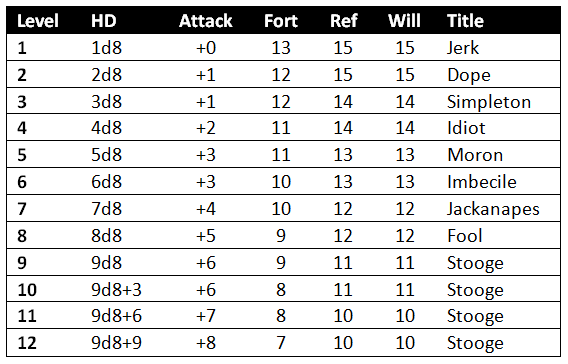
While watching a Stooges marathon on Antenna TV today, I was kissed by the muse (or maybe bonked by the muse, considering the source). Enjoy a class in a class of it own.

The Stooge

Stooges seem to coast through life, blissful in their ignorance and always coming through in the end.

Requirements: Stooges must have a constitution of at least 15. Their intelligence score can be no higher than 7, and their combined intelligence, wisdom and charisma scores can be no higher than 30.

Hit Dice: d8 (+3 per level after 9th)

Armor: Any

Weapons: Any (but see below)

Skills: None

Advance As: Fighter (in whatever system you play)

Class Features

Stooges can’t do much, but they can sure take a punch. A stooge ignores the 1 point of damage every time he or she takes damage. This increases to 2 points at 4th level, 3 points at 8th level and tops out at 4 points at 12th level. Any blow that should kill a stooge often only knocks them for a loop. The stooge may attempt a Fortitude save and, if successul, is only stunned for 1d4 rounds.

As tough as stooges are, you can’t call them brave. Stooges suffer a -2 penalty to save vs. fear. On the other hand, their heads are tough to crack. Spell casters who attempt to read their minds must pass a Will save or be struck with confusion for 1d4 rounds.

A stooge can fascinate people with his antics, whether he is tangling with another stooge or with a stubborn inanimate object, just as a bard of equal level. Stooges do not gain a bard’s suggestion ability.

When the going gets tough, the stooge gets going. Once per day, they can act as though under the effects of the expeditious retreat spell.

Stooges are masters of unorthodox unarmed combat. Their unarmed attacks inflict 1d4 points of damage at 1st level, 1d6 points of damage at 5th level and 1d8 points of damage at 10th level. Once per day per three levels they can attempt a stunning attack (if they hit, the victim must pass a Fortitude save or be stunned for 1d4+1 rounds). If a stooge is facing three adjacent opponents, they can do a triple slap, rolling once to attack and applying that roll to hit all three of them. Unfortunately, whenever up to three stooges are adjacent to an enemy, it gains the ability to make the same unarmed attack against them.


Stabbing You With Their Minds

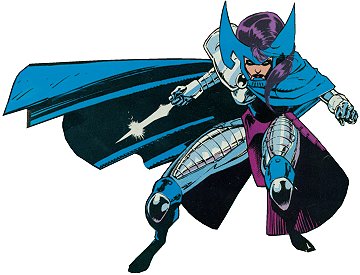
The last of the three “lost classes” of Blood & Treasure is the soulknife. The soulknife is certainly more gonzo than the classic fantasy archetypes, but they have some cool precedents in sci-fi entertainment, specifically in the form of the ubiquitous light saber and in the redesigned Psylocke (kinda miss the old one, to be honest) and her mind blades. The overall concept is pretty decent, and it was a close one to make it into the final game. I especially liked the idea of illustrating it (or having it illustrated for me, to be precise) as an Indian warrior with glowing katars. So … the soulknife for Blood & Treasure (which is about a month away from being finished, FYI).

SOULKNIFE

Soulknives are men and women with a natural surplus of psychic energy but no ability to manifest it in the form of psychic powers. Instead, they learn, through rigorous training and meditation, to unlock their chakras and focus their psychic energy into a blade-shaped construct. Soulknives follow a strict warrior code – the Kshatriya Dharma. This states, “Stand straight and never bow down, for this alone is manliness. Rather break at the knots than bend!”

Requirements: Soulknives must have a dexterity and wisdom score of 13 or higher.

Hit Dice: d8 (+3 hit points per level from 10th to 20th).

Armor: Padded, leather, ring mail, studded leather and all shields.

Weapons: Club, crossbows (any), dagger, dart, javelin, mace, morningstar, punching dagger, quarterstaff, rapier, sap, shortbow, short sword, sickle, sling and spear.

Skills: Climb, Find Secret Doors, Hide, Jump, Listen at Doors and Move Silently.

CLASS FEATURES

A soulknife can create a semisolid blade composed of psychic energy distilled from his own mind. The blade is identical in all ways (except visually) to a short sword (for medium-sized soulknives), dagger (for small-sized soulknives) or longsword (for large soulknives). The wielder of a mind blade gains the usual modifiers to his attack roll and damage roll from their strength score.

The blade can be broken (it has an AC 15 and 10 hit points); however, a soulknife can simply create another on his next turn. The moment he relinquishes his grip on his blade, it dissipates (unless he intends to throw it; see below). A mind blade is considered a magic weapon for the purpose of hitting monsters only hit by magic weapons.
A soulknife’s mind blade improves as the character gains higher levels.

A soul knife of 2nd level or higher can throw his mind blade as a ranged weapon with a range increment of 30 feet. Whether or not the attack hits, a thrown mind blade then dissipates. A soulknife of 3rd level or higher can make a psychic strike (see below) with a thrown mind blade and can use the blade in conjunction with other special abilities.

A soulknife of 3rd level or higher can spend one round of combat to imbue his mind blade with destructive psychic energy. This effect deals an extra 1d6 points of damage to the next living, non-mindless target he successfully hits with a melee attack (or ranged attack, if he is using the throw mind blade ability). Creatures immune to mind-affecting effects are immune to psychic strike damage.

A mind blade deals this extra damage only once when this ability is called upon, but a soulknife can imbue his mind blade with psychic energy again by taking another round to imbue it with destructive psychic energy.

Once a soulknife has prepared his blade for a psychic strike, it holds the extra energy until it is used. Even if the soulknife drops the mind blade (or it otherwise dissipates, such as when it is thrown and misses), it is still imbued with psychic energy when the soulknife next materializes it.

At every four levels beyond 3rd (7th, 11th, 15th, and 19th), the extra damage from a soulknife’s psychic strike increases by 1d6.

At 5th level, a soulknife gains the ability to change the form of his mind blade. This one full round; he can change his mind blade to replicate a blade one size larger (i.e. dagger to short sword, short sword to longsword or longsword to bastard sword) or smaller. Alternatively, a soulknife can split his mind blade into two identical blades, suitable for fighting with a weapon in each hand.

At 6th level, a soulknife gains the ability to enhance his mind blade. He can add any one of the Class A weapon special abilities on the table below. At 10th level the soulknife can add a Class B ability to his mindblade. At 14th level, the soulknife can add Class C abilities to his mindblade. At 18th level, the soulknife can add two Class B abilities or three Class A abilities to hit mindblade.

Special Abilities
Class A: Defending, keen, lucky, mighty cleaving, psychokinetic, sundering, vicious
Class B: Collision, mindcrusher, psychokinetic burst, suppression, wounding
Class C: Bodyfeeder, soulbreaker

Bodyfeeder: Weapon grants the wielder temporary hit points equal to the damage inflicted on a natural attack roll of ‘20’.

Collision: Weapon increases own mass at end of swing, dealing 5 extra points of damage.

Lucky: Once per day, the wielder can re-roll a missed attack.

Mindcrusher: Spellcasting or spell-using creatures hit by this weapon lose a random ability or spell slot. They must also pass a Will saving throw or lose 1d2 points of wisdom.

Psychokinetic: Weapon deals +1d4 points of ectoplasmic damage to those it hits.

Psychokinetic Burst: As psychokinetic, plus, on a natural attack roll of ‘20’ it deals an additional 1d6 points of damage.

Soulbreaker: On a natural attack roll of ‘20’, the victim loses one level (per a life drain). One day after losing the level, the victim can attempt a Fortitude saving throw to regain the lost level.

Sundering: Weapon provides a +2 bonus to sundering attacks.

Suppression: Creatures hit by this weapon suffer from a targeted dispel magic effect. The wielder makes a dispel check (i.e. Will save with a penalty equal to the level of the spell to be dispelled).

The weapon ability or abilities remain the same every time the soulknife materializes his mind blade (unless he decides to reassign its abilities; see below). The ability or abilities apply to any form the mind blade takes, including the use of the shape mind blade or bladewind class abilities. A soulknife can reassign the ability or abilities he has added to his mind blade. To do so, he must first spend 8 hours in concentration. After that period, the mind blade materializes with the new ability or abilities selected by the soulknife.

Beginning at 13th level, when a soulknife executes a psychic strike, he can choose to substitute intelligence, wisdom or charisma damage for extra dice of damage. For each die of extra damage he gives up, he deals 1 point of damage to the ability score he chooses.

The Wizard’s Brain …

The Dead Wizard’s Brain …

… has unraveled and now looks like a squishy pink snake; it casts what spells it has left as auras and vibration fields such that all spells have an area of effect of 10-ft. per magic-user level

… is kept in a jar of preservative reagents, plotting and cursing and waiting for the day of rebirth

… was merged with his or her pointy hat and now allows the wizard to control those who wear the hat

… is hidden inside a puzzle box and does not want its revery disturbed by the senses

… was turned to crystal and now sends out thought rays that allow it to cast spells through anyone struck by such a beam

… is nestled in the head of a flesh golem (or any other flavor of golem) and is completely insane though no less potent for it

… is a cloud of mystic ash that haunts the corridors of its old tower, attempting to enter people through the nose and mouth

… is a shimmering cascade of energy that runs along the cracks and crevices of walls and which, sometimes, can animate those walls (per mid-range earth elemental with magic-user spells)

… was powdered and stirred into your drink; it will turn your tongue bright purple and give you the ability to cast one spell that was stored in it when he died one time only

… is preserved within the body of a gelatinous cube, casting spells despite the lack of vocal cords or digits

… has become a viscous goo that lurks on ceilings, dropping on the unwary

… floats in astral space, sending out tendrils of quintessence into Astral, Ethereal and Material Planes to search for a new host

… has been imprinted in a glyph etched in gold that covers a vast chamber – people in contact with the gold get an electric shock (per shocking grasp) and become conduits for his spell casting and speech; they must pass a Bend Bars check to pull away from the electrified gold

The Living Wizard’s Brain …

… has become a mirror image of itself, its owner now speaking in reverse, walking in reverse and casting spells in reverse (i.e. they either have the reverse effect, or they are backward in time, the effect occurring before the casting)

… has a 1 in 100 chance per day of collapsing in on itself and becoming a black hole that sucks him and everything else into an alternate dimension

… is in constant contact with the divine via a contact higher plane effect; only he can hear these divine voices, and he is often heard saying “no, I wasn’t talking to you Thor, I was talking to somebody here” – he still doesn’t get the true benefit of the spell more than once per day

… demands chocolate at any price

… is a clockwork device that needs winding once per day – this involves sticking a crank in his ear; on the plus side, he’s immune to all traditional mind-altering spells and effects

… is split into two personalities; one is obvious and in control of the body, the other is subtle and acts via telekinesis

… is convinced that wall wasn’t there before … or was it?

… is slowly crystallizing, losing the ability to cast low level spells, but increasing the number of higher level spells each day (i.e. one day one, the magic-user can no longer cast first level spells, but he gains one additional spell per day of his highest level spells) until he can only cast his highest level spells – at this point, the inside of his head looks like a geode

… wants to be relieved of conscious thought as much as possible; each drink or drag of something alcoholic or narcotic gives him a 1 in 12 chance of going astral (per astral spell) and journeying to a higher plane

… suffers cleric envy

… sends out etheric vibrations that impose any condition it is experiencing on everyone else within 1 mile per the magic-user’s level (save allowed, of course)

… is three seconds ahead or behind everyone else in time- very disorienting