Get Bleeped

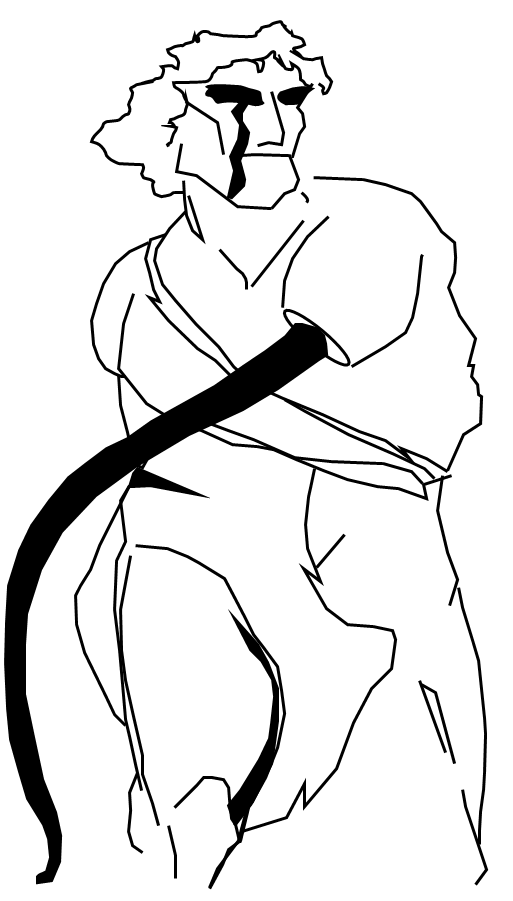
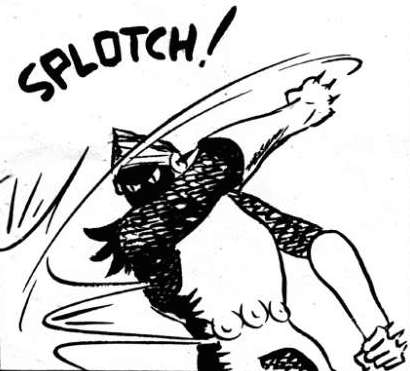
Monsters can come from the unlikeliest places, but this one came from a doodle (see below) on a scratchpad while I was on a conference call.

Bleep

Never had an art lesson – can you believe it? *

Type: Construct
Size: Small
Hit Dice: 3+1
Armor Class: 16 (20 vs. metal)
Move: Fly 60′
Attack: Zap (5′/1d6 electricity) or slam (1d4 + 1d6 electricity)
Save: 15
Intelligence: Average
Alignment: Neutral (LN)
No. Appearing: 1d4
XP/CL: 300/4

SD—Resistance (acid, fire), immunity (electricity, mind effects)

SP—See below

Bleeps are constructs that hail from the Astral Plane. They materialize on other planes to learn about their ecosystems, recording data and testing inhabitants, before returning from whence they came (wherever that may be). Whether they are in control of themselves, or serve another species, is unknown. Bleeps communicate in a stilted, robotic voice. Due to their time on a given plane recording information, they have a 75% chance to speak the language of any creature they encounter.

Bleeps are surrounded by an electromagnetic field, which gives them an AC 20 against metal objects. Against spells that involve metal hurlants, they enjoy a +3 bonus to saving throws. This also allows them to zap creatures up to five feet away with electricity and their touch is also electrifying.

The bleep’s main weapon, though, is its ability to conjure replicas of creatures using pure energy. This acts as the different “summon monster” spells, I through IX. They can use one spell at a time, and while they use that spell, they lose a number of hit points equal to the level of the spell. Thus, a bleep using summon monster IX loses 9 hit points while the spell is active. When the spell is deactivated, the hit points return. If a bleep is destroyed while conjuring a monster, the monster disappears and the bleep, reduced to 0 hit points, does not suddenly pop back to life.

The interior of the construct is something like a geode, being a composition of weird crystals covering the interior of the metal shell. A sphere of ethereal nth metal floats in the center of this metal shell while the monster is functional, held in place by an inner electromagnetic field. When the monster is no longer fuctional, and if it is opened, the nth metal quickly floats upward at a rate of 30 feet per round, probably to never be seen again unless someone has a handy silver net with which to catch it.


* This is a lie – I took an art class in high school. I just suck at drawing.

Secret Ability Scores

Of course he has an 18 charisma – just ask Juanita and Thelma Lou

I was recently thinking about self-awareness. How many people have you known who were not nearly as charismatic or intelligent as they thought they were? Their failings seem obvious, but are blissfully unaware of them. I thought that this might offer a fun and interesting way for veteran players to liven up their old games.

In most fantasy games, characters have ability scores. These scores are rolled by the player and known to the player. This knowledge plays a role in the player’s choice of their character’s class or career, and it influences their actions in the game.

But what if players did not know their character’s ability scores? Might make for an interesting game, no?

(Or maybe a complete disaster)

It all hinges, to use Blood & Treasure as an example, on wisdom. Wisdom deals with awareness, not only of one’s surroundings, but of oneself. A character with even average wisdom should be able to gauge how intelligent and charismatic they are … and how wise they are. The wise man knows what he knows not, so to speak. Characters with low wisdom, on the other hand, assume natural abilities they do not actually have. If wisdom is low enough, they may even be unaware of their physical limitations. A foolish man can talk himself into anything, after all.

Here’s the idea – a player rolls his or her ability scores with their eyes closed. The GM writes them down. If you’re rolling ability scores in order, all the better. If not, the player can decide which score gets the highest roll, then the next highest, and so on. There will be some clues if you’re doing it this way, but no system is perfect.

In all cases, the player does not know his or her character’s wisdom score unless it is 13 or higher. If lower than 13, roll a dice – on a 1-3 they think it’s average and on a 4-6 they think it is high.

If the character’s Wisdom score is 13 or higher, the player gets to know all of her ability scores.

If the character’s Wisdom score is 9 or higher, the player gets to know his physical ability scores and either his intelligence or charisma score (his choice). The mystery score is believed to be high.

If the character’s Wisdom score is 6 to 8, they get to know their physical ability scores, but not their mental scores. You just tell them that their intelligence and charisma are high and leave it at that, regardless of the actual score.

If the character’s Wisdom score is 3 to 5, they don’t know any of their ability scores, but are simply told that they are all high, again, regardless of the actual scores.

Now, this creates a certain difficulty, as classes often have ability score requirements for entry. You could tell the player that their character, who they think has a high intelligence, cannot cut it as a magic-user, of course, but then the player should know they have an intelligence lower than 9.

I can think of a couple ways to go with this:

1) If they pick a class for which they cannot qualify, they instead become a wash-out and end up as a fighter or thief (assuming they can qualify for those classes). They might still act like a wizard or priest, but they won’t be and they’ll know it and probably resent the hell out of those who actually did enter the class of their choice.

2) Another way to go is to permit them entry into the class with lower scores, and apply an XP penalty to their advancement. Maybe a -10% for every score that isn’t up to muster. These are characters who try really hard, but it takes them forever to get the hang of things.

The idea here is to produce Barney Fifes in your game – characters who have to get in over their heads a few times before they slowly figure out their limitations. Characters who insist they should try to decipher the magic rune because they have the highest intelligence, even though their intelligence is actually a ‘6’. Characters who bumble and stumble a bit, just like we do in real life.

Dragon by Dragon – August 1981 (52)

With the 2nd edition of Blood & Treasure essentially done (well, almost done), I can get back on track with these Dragon reviews. Number 52 is from August of 1981, and features a Boris Vallejo cover of a butterfly-winged dragon and beautiful naked woman … which of course is a rarity for a Boris painting. Boris gets a little full article inside the magazine as well.

So – I’ve got Mystery Science Theater 3000 on the television and a gin gimlet in my belly, and I’m ready to show off the bits and pieces that I found useful and/or inspirational in #52 …

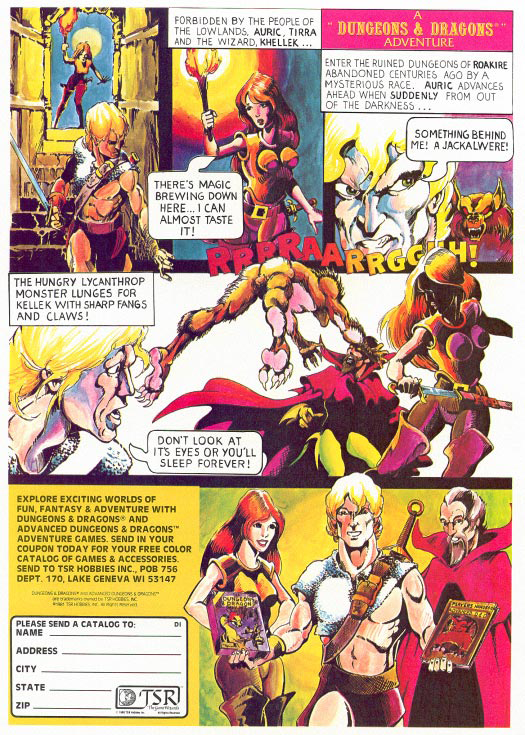
First and foremost, a nice piece of comic/advertising work by Bill Willingham, one of my favorites from the olden days.

This involves the adventurers Auric, Tirra and the wizard Khellek (who does not appear to be this guy – scroll down a bit). Auric is an ill-armored fighter, Tirra could be a thief or fighter and Khellek is a wizard. They tangle briefly with a jackalwere and then … to be continued.

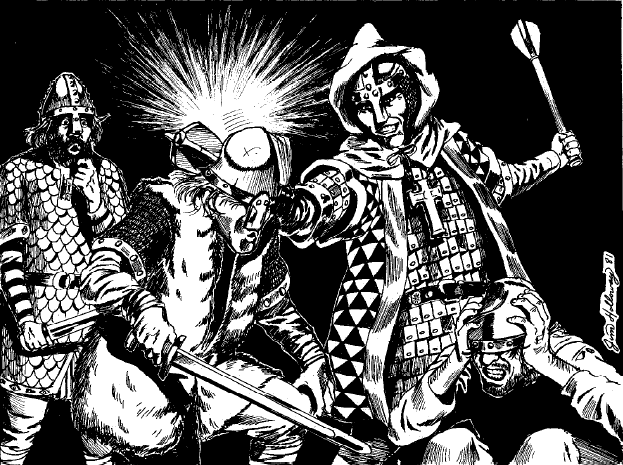
The first real article is dedicated to the much maligned cleric class. “The Role of the Cleric – Warriors with Wisdom” is by Robert Plamondon, and it does a nice job of explaining the class, some of its inspirations and ways to play it well. If the image below, by Jim Holloway, doesn’t make you want to play the class, I don’t know what will …

The article has a few nice bits that might stir the creative juices of players and GM’s out there, such as a list of acts of worship, in order of potency:

1. Thinking religious thoughts.
2. Formal prayer.
3. Attending rites or church services.
4. Feasts, festivals, fasts, self-punishment, vigils- as part of religious rites.
5. Sacrifice of valuables.
6. Dying in a holy conflict.
7. Killing an enemy in a holy conflict.
8. Sacrifice of an unbeliever.
9. Sacrifice of an unwilling believer.
10. Sacrifice of a willing believer.

#10 seems like a dicey prospect for Lawful clerics.

Douglas Loss adds a bit more with his article “The Land is My Land …”, including this bit about clerics and swords, including this from The Song of Roland

Turpin of Rheims, finding himself o’erset,
With four sharp lance-heads stuck fast within his breast,
Quickly leaps up, brave lord, and stands erect.
He looks on Roland and runs to him and says
Only one word: “I am not beaten yet!
True man never failed while life was in him left!”
He draws Almace, his steel-bright brand keen-edged;
A thousand strokes he strikes into the press.
Soon Charles shall see he spared no foe he met,
For all about him he’ll find four hundred men,
Some wounded, some clean through the body cleft,
And some of them made shorter by a head.
— The Song of Roland, Laisse 155

So Turpin got to swing a sword, why doesn’t your cleric? Well, to start off with, Turpin also doesn’t get to cast spells or turn undead. Douglas thinks the rule should be thrown out, because its not “realistic” and because in AD&D the mace is as good as sword. I disagree – swords are more than just a damage range, but the “no sharp weapons” rule also takes many magic weapons out of a cleric’s hands, thus helping the old fighter stay relevant.

Douglas Loss is back with “The Sense of Sacrifices”, and this is a neat one about the chances of deities granting clerics spells they aren’t high enough in level to cast. It all hinges on sacrifices of inanimate objects (valuable or symbolic, of course), animals and sentient creatures of a wildly different alignment than the cleric. To boil it down – 2% per 100 gp value of inanimate objects, symbol items 5%, animals 2% (or 3% if it is favored by the deity) and 5% for sentient beings. The chance shouldn’t be higher than 50%, and each subsequent miracle should have a 5% penalty applied if the cleric tries this too often.

Sage Advice is cleric-centered as well. I enjoyed how this answer began:

Q: What happens when a Resurrection or a Raise Dead is cast on an undead?

A: Hmmm. It stands to reason …

In other words – crap, we hadn’t thought of that.

For lovers of the old school, the cleric stuff is followed by two articles concerning the new Basic D&D set. The first is written by J. Eric Holmes, author of the first edition, and the second by Tom Moldvay himself. Holmes has the longer article, and it explains the hows and whys of Basic D&D. Holmes fans have probably already read it, but if they haven’t, I would highly suggest it.

For modern gamers, Paul Montgomery Crabaugh’s “The Undercover Job Guide” can be useful … especially if they’re setting a game in 1981. Written for TOP SECRET, it covers a number of jobs and gives you some ideas on their access to travel and their salaries. Here are a couple of items:

Home Economics: travel potential moderate to high; starting salary $20,000/year (variable); almost no connection with what the field is normally thought of to include: agents in this field will very likely be chefs, or connected with the creation of fashion or decoration: female agents have a good chance of being models (salary quite variable).

Physical Education: travel potential high; starting salary quite variable; almost certainly an agent will be an athlete in this AOK: by preference, one in a sport played throughout much of the world. Tennis is an excellent choice; golf, soccer and track & field are also good.

Yeah, a pair of spies who work in a high school would be pretty fun.

This issue’s Giants in the Earth by Katharine Brahtin Kerr covers Prospero (Lawful Good 14th level magic-user), his pals Ariel (a neutral “high-grade” air elemental – I would have gone sylph, mostly because Ariel is a sylph) and Caliban the chaotic evil half-orc, and Circe (chaotic neutral 18th level magic-user). Here’s a nice bit …

The best way to get the upper hand over Circe is to possess the strange herb known as moly. The god Hermes gave Ulysses some of this herb, said to grow only in Olympus. With it, Ulysses mastered Circe’s magic and made her turn his crew back into men from swine. If the DM wants moly available in the campaign, it should either be fantastically expensive or else a gift to a cleric from his or her god.

If a character wears moly, all of Circe’s polymorph spells will fail against that character, and the power of her other spells against that character will be weakened considerably; the character should get a +2 on all saving throws against her magic. Circe cannot touch this herb to steal it away, nor can her maidservants.

For more information on moly, click HERE.

We also learn Circe’s spell list: 1st-charm person, comprehend languages, friends, read magic, sleep; 2nd-detect invisibility, ESP, forget, ray of enfeeblement, web; 3rd-fly, hold person, dispel magic, slow, suggestion; 4th-charm monster, confusion, fear, polymorph other, massmorph; 5th-animal growth, feeblemind, hold monster, passwall, transmute rock to mud; 6th-control weather, enchant an item, legend lore; 7th-charm plants, mass invisibility, vanish; 8th-mass charm, polymorph any object; 9th-imprisonment.

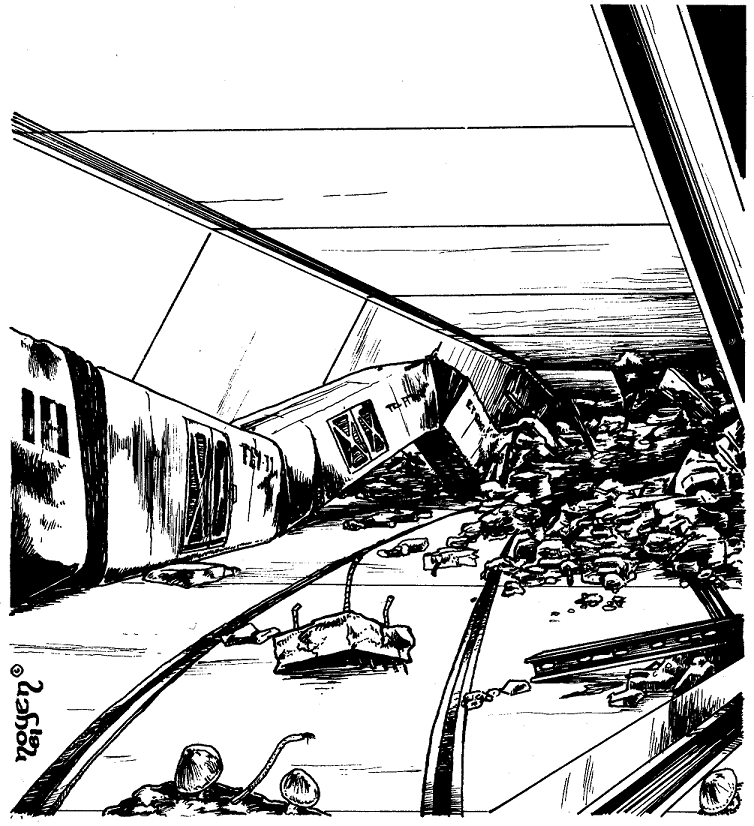
Dragon #52 also has a groovy little Gamma World adventure by Gary Jaquet called “Cavern of the Sub-Train”. This might sound like a subway romp in the ruins of New York, but it’s actually a romp through something more like Elon Musk’s hyperloop. This network spanned the entire North American continent.

The adventure is left open-ended, so should come in handy to folks playing post-apoc games.

Victor Selby and Ed Greenwood introduce the Rhaumbusun in Dragon’s Bestiary. Here’s a quick B&T-style statblock:

Rhaumbusun, Small Monster: HD 1+2; AC 13; ATK 1 bite (1d3); MV 20′; SV 16; Int Low; AL Neutral (N); NA 1d2; XP/CL 100/2; Special-Gaze attack (40′ range; paralyze for 3d4 turns)

Lewis Pulsipher has some interesting, peaceful gas-filled beasts called pelins. Not much for a fight, but they’re semi-intelligent, so maybe they could be helpful in completing a quest if the players are smart enough to be nice to them and attempt communication.

Michael Kluever gives a nice history of siege warfare in “Knock, Knock!”. Worth a read for people new to the subject.

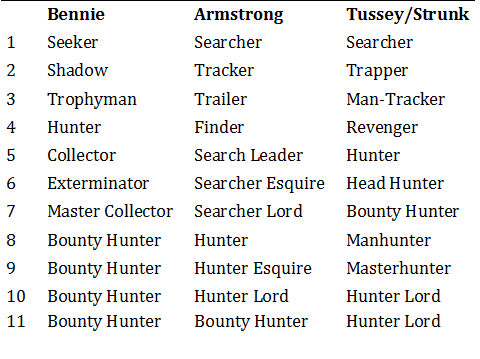
Up next are three – count ’em three – takes on the bounty hunter class by Scott Bennie, Tom Armstrong, and Robert L Tussey and Kenneth Strunk. Lets judge them by the most relevant part of the class – the class titles!

The use of revenger, head hunter and manhunter are nice, but the inclusion of esquire by Armstrong wins the competition. Anything that can bring Bill & Ted into the conversation can only be good for a D&D game.

Hey – what the heck is this?

A Google search brings up a computer game designed for use with the Fantasy Trip. Pretty cool!

There are reviews of some cool miniatures from Ral Partha (hill giant, storm giant, cold drake), Heritage USA (hill giant and beholder and superheroes and supervillains), Castle Creations (condor and skull splitter giant), Penn-Hurst/Greenfield (a plastic castle), Citadel (ogre, giant spider) and Grenadier (the dragon’s lair), as well as Basic Role-Playing, TIMELAG and Dungeon Tiles.

Not a bad issue – more advice-centric than number-y, but you get bounty hunters and a paralyzing lizard, so what the hey!

I leave you as always with Tramp

Remember – never trust gamers discovered in the wild!!!

Blood & Treasure Going Hard (Cover)

Hey boys and girls, I finally have the Blood & Treasure 2nd Edition Rulebook up for sale as a hard cover book! The book runs $24.99, and as always if you buy the hard cover book and email me with your Lulu receipt and I’ll send you a link for the PDF.

My next steps are as follows:

* Get Blood & Treasure 2nd Edition Monster book up for sale as a PDF (this week)

* Get Blood & Treasure 2nd Edition Rulebook up for sale as a paperback (next week)

* Get NOD 30 up for sale as a PDF (next week)

* Get Blood & Treasure 2nd Edition Monster book up for sale as a hard cover and paperback (two to three weeks from now)

* Get NOD 30 up for sale as a paperback (two to three weeks from now)

Then I get the chance to work on some mini-games and figure out how to do a B&T TK Screen!

And now, since you’ve suffered through the commercial, here are a couple spells to play with:

Footfalls (Divination)
Level: Cleric 1, Magic-User 2
Range: 300 feet
Duration: 1 round per level

This spell permits the caster to hear all movement on the ground within 300 feet, even if that ground is separated from the caster by thick walls, etc. The caster knows the general direction of the footfalls, the size of what is moving and the general number (single creature, small group, large group, etc.)

Wildfire (Transmutation)
Level: Magic-user 5
Range: 30 feet
Duration: See below

This spell turns a fire or portion of fire (campfire size minimum) into a swarm of tiny fire elementals who run wild and cause as much havoc as they can before they’re destroyed. The swarm has the following statistics:

Wildfire Swarm (Tiny Elemental): HD 4; AC 14 [+1]; ATK Swarm (1d4 fire); MV 30 feet; SV 15; INT Low; AL N; NA 1; XP/CL 1,200/6; SP-Immunity (fire), vulnerable to cold.

The swarm moves and attacks as a single creature. It covers a 10′ x 10′ area, with all creatures in that area suffering an attack from the creature, and all inflammable items in the area forced to make an item saving throw or catch fire.

The Animorph, an Animal for All Seasons

How the time does fly, and the world robbed of my nonsense for a couple weeks while I prepared nonsense of another sort.

Here’s a quick rundown – finished editing the B&T Monster book – yay! – so I should get it up for sale soon. Just need to work in the changes, fix some images, etc. This could be a rough week for my mom, so I have no idea how much RPG work I can get done, but the last weekend was productive, so we’ll see. I’m also about half-way there on NOD 30. I’ve been so into writing rulebooks the last few months I’m really missing writing the fun stuff.

In the meantime, here’s a little half-baked idea for gaming fun …

The Animorph

The animorph can change into an animal.

Skills
Animorphs are skilled at handling animals and riding (which they can do with no riding equipment at no penalty).

Abilities
An animorph can shift shape once per day per level (and shifting shape means from one form to another, but not back – that counts as a different shift), can only take the form of natural animals, and cannot take an animal form with more Hit Dice than they have levels. While in animal form they retain their own mentality (though not the ability to speak) and current hit points, but make attacks as though they were that animal (i.e. as a monster, with no bonuses for Strength or Dexterity, multiple attacks if the animal has them, special abilities if the animal has them, etc.) rather than as a character.

Animorphs gain an additional +1 bonus to save vs. polymorph and other transformations. They are immune to lycanthropy.

3rd level animorphs can speak to animals (non-magically). 6th level animorphs can also take the shape of giant insects, provided they do not normally have greater than animal intelligence.

Animorphs can deal damage to monsters only hit by silver or magic weapons if they have more levels than the monster has Hit Dice.

At 9th level, animorphs begin attracting animal friends. At each level from 9th to 12th level, an animorph attracts a number of HD of animals equal to their level (thus 9 HD of animals at 9th level, another 10 HD of animals at 10th level, etc.) These animals serve faithfully, but if killed are not replaced. The animorph can add these animals all at once, or over time, and they can only add animals native to the environment in which they currently reside.
Animorphs are wanderers – they cannot construct a stronghold of their own, though they can reside for up to a month at the stronghold of an ally, or in a village (but never a town or city).

Other Info:

RQ Wisdom 13+, Cha 11+
HD d6 (+2 hp per level after 10th)
W/A Can use light weapons, can wear up to leather armor (but must remove it to take animal shape)
ATK As druid
SV As druid
XP As fighter

Edit: Added a bit about hit points and such – nothing major

Three New Monsters

Boy, have I been on a roller coaster ride lately. Work continues on the Blood & Treasure Second Edition Monster book, but has been slow due to some medical issues. Amidst the stress and activity, I’m still editing and working on some one-page dungeons that will be included in the book. Hopefully won’t take too much longer, but you can’t rush these things, and medical issues certainly have to take precedence over make-believe.

In the meantime, I managed to cobble together a few new monsters for your edification and enjoyment over lunch. The artwork is my half-assed sketch of a brazen godling …

Parrot Man

Type: Humanoid
Size: Medium
Hit Dice: 1
Armor Class: 12 + armor
Move: 30′
Attack: Bite (1d3) or by weapon
Save: 16; 20 vs. mental control
Intelligence: Average
Alignment: Varies
No. Appearing: 1d10
XP/CL: 50/1

Parrot men look very much like human beings, except for their parrot’s beak and their brilliantly hued skin, often spotted in place or marked with whorls or jagged stripes, especially on the arms and legs. They are garbed in looks tunics, perhaps to better show off their skins with which they take a terribly amount of pride, and they rarely carry more than staff slings and truncheons to defend themselves. Warriors are almost unknown among them, though some become thieves (up to 9th level) or magic-users (up to 6th level).

Parrot men are noted for a singular lack of original thinking. What they read or hear they believe and repeat until they’ve heard something new. This makes their alignments highly variable (exposure to a new alignment has a 3 in 6 chance of persuading the parrot man to adopt it), yet always lacking in conviction.

Brazen Godling

Type: Outsider
Size: Large
Hit Dice: 9+3
Armor Class: 17
Move: 40′
Attack: 2 slams (2d6)
Save: 12; 9 vs. mental effects; MR 25%
Intelligence: Low
Alignment: Chaotic (CE)
No. Appearing: 1
XP/CL: 4,500/11

SD-Immunity (disease, poison), resistance (electricity, fire)

Brazen godlings are formed from the heroic frustrations of the weak and cowardly, becoming encased with demon stuff on the Astral Plane and then deposited in a sheath of bronzed flesh in the wastelands of the Material Plane. They are universally handsome and mad.

Brazen godlings attack with their fists or, when they have lost them, the black tentacles that lie beneath their flesh, for every brazen godling is really a black, tentacled demon heart encased in a tall, strong humanoid body. Attacks against the brazen godling that deal damage have a chance on a d20 equal to that damage of tearing away a bit of the monster’s outer flesh. Roll on the table below to discover what it has shed.

D12 Body Part
1. Leg, left lower
2. Hand, left
3. Posterior
4. Arm, right lower
5. Leg, right thigh
6. Arm, right, upper
7. Leg, left thigh
8. Arm, left lower
9. Hand, right
10. Leg, right lower
11. Arm, left upper
12. Head (reveals tentacle, giving an extra attack each round)

When head and limbs have been removed, the next attack destroys the torso and permits the demon within to be attacked directly. It has 30 hit points and the same stats presented above, save it can only be damaged by magic weapons of +1 or better. The demon heart has five black tentacles (one hidden in each limb, and one curled up in the head), which continue to ooze the creature’s black tears (see below).

A brazen godling, while it retains its head, cries tears of black ichor that have the same properties as unholy water. In melee, these tears may land on attackers, forcing them to save or fall into a terrible despair (-2 to attack and save) for 24 hours. When the being’s flesh is removed, the demon heart continues to secrete this ichor in battle.

Laserhawk

Type: Monster
Size: Small
Hit Dice: 1
Armor Class: 13
Move: 20′ (Fly 150′)
Attack: Talons and bite (1d4) or laser rays (2d6 fire)
Save: 16
Intelligence: Animal
Alignment: Neutral (N)
No. Appearing: 1d4
XP/CL: 100/2

Laserhawks are large birds of prey with scaled skin and golden feathers. They can emit laser rays from their eyes, both directed at the same target. The rays permit a saving throw, and if that is failed deal 2d6 points of fire damage to their target.

Laserhawk blood can be used to make an unguent that provides complete immunity to fire, but at the cost of one’s eyesight. Both effects last for 24 hours, even if the unguent is washed off.

Ch Ch Ch Ch Changes – First to Second Edition

I have a few minutes today, so I want to get a post out on the changes from the first to the second edition of Blood & Treasure. I won’t swear that this is exhaustive, but it’s pretty close to it.

Messed with multi-classing a little on races, tried to relate them a bit more closely to their original incarnations

Classes each have their own XP chart now, and some were re-calibrated

Assassins don’t cast spells anymore, but can cast spells from scrolls at high levels

Got rid of bard, paladin and ranger spell lists – they now cast off the magic-user, cleric and druid lists respectively

Added some abilities to classes around 6th level to make the game a bit more distinctive and to hit some fantasy tropes missing in the original:

Assassins can brew their own poisons

Bards can carouse their way to valuable rumors … but may end up in the stocks or making enemies

Clerics can temporarily convert sentient creatures to their own alignment – not always easy, and doesn’t necessarily last long, but I thought it might be a fun non-combat way to get through encounters

Druids can harness greater bits of power by sacrificing the despoilers of the natural world

Fighters can subdue monsters and use them as mounts (as in every cool 70s rock album cover and van art ever produced)

Magic-users get access to little bits of arcane knowledge, ranging from something as simple as making phosphorous to making hot air balloons or understanding the healing arts

Paladins gain chivalric badges that give them access to royal and ecclesiastic courts and tournaments (a minor bonus, but the paladin already has some pretty cool abilities)

Rangers can pick up a loyal hunting beast (again, inspired by many pieces of fantasy art – particularly this one

Thieves can assemble teams of rogues for capers – bypasses the normal henchman rules … but can the thief trust these guys?

Changed the way a fighter’s multiple attacks worked, since lots of folks thought it was too powerful; also beefed up the barbarian a bit, as well as the sorcerer (see below)

Got rid of the basic/advanced/expanded concept to make B&T more its own game than a reference to old games, but I did keep the idea of basic and advanced spells; to learn or prepare advanced spells classes have to make a quick roll under their Int or Wis minus the spell level; specialists get free access to certain advanced spells, but treat others as though they were a higher level

Made some big changes to the sorcerer to keep it from being just a variant magic-user – they can now sense magic and do impromptu casting of spells they don’t know (with dire circumstances for failure); they might also choose bloodlines, and might be related to other magical creatures (got this idea from Bewitched I’m proud to say)

Changed some of the class variants, added a few – the monk has a ninja and ronin variant for example

Tweaked the equipment charts – more weapons because I like cool weapon names, got rid of some 3E alchemy I never liked

Worked on the adept spell list to better reflect its origins

Tried to streamline rules wherever I could; fixed errors in time and movement, changed reaction rolls a bit (simpler, based on alignment), made task checks easier (roll 1d20, 18 or over to succeed, add bonuses, add level if “skilled”)

Changed saving throws so that it’s now just one number, but you get a bonus to save vs. stuff that takes your character out of play (death, paralyzation, polymorph), magic from magic items (wands, etc.) and spellcasters get a bonus vs. spells – so a little like the old D&D saving throw categories, but streamlined

Different disease system – I think better – focused on the effects and overcoming them

Added a table of the mass of different materials – helps when adventurers want to pick up a golden idol and carry out of a dungeon and you need to figure out how heavy it is

Got rid of a few spells (not many) and streamlined the rest when possible; I also got rid of 0-level spells, bumping them up to 1st level (sometimes with modification) – I never liked the 0-level thing

Redid the treasure tables (I’m still not satisfied completely – I think I’ll add some alternate scheme in Esoterica Exhumed)

Streamlined the magic items, especially weapons and armor, and added some items that might be familiar from movies and cartoons; also added some sci-fi items as optional magic items for those who enjoy that – includes a mutation chart (for the mutagen capsules)

The appendices cover inspirations, conversions (other systems, and notes like these for 1st to 2nd edition, though not super extensive), a couple additional “specialty mages” to show how one can devise their own lists of advanced spells, did some racial classes for folks who like them, made a list of all the spell components and foci for quick reference, and then made a quick reference chart of common dice rolls in the game

That’s all that comes immediately to mind. I’m working diligently on the Monsters book now. Stay tuned, true believers!

Blood and Treasure 2nd Edition Rulebook is Released!

Just a quick one today, boys and girls – the Blood & Treasure 2nd Edition Rulebook is up for sale as a PDF on RPGNow.com and Lulu.com. $9.99. I’ll get the hard cover and paperback version up ASAP – just need to get a review copy first.

This is a combination of player’s book and referee’s book, with all the classes, races, spells, rules, magic items and info on making dungeons, wilderness, settlements and other planes.

The monsters will be in a second book called, appropriately I think, Blood & Treasure 2nd Edition Monsters. I’m shooting for getting that one up for sale in 1 or 2 weeks – there’s some editing to do, and I want to include some mini-dungeons as well.

Anyhow – here’s the ad copy for the Rulebook …

Blood & Treasure is the fantasy role-playing game for people who want to spend less time arguing over rules and more time playing, and the new 2nd Edition continues this tradition.

Compatible with old school games, it strives to be rules lite and options heavy.

You get …

Thirteen character classes, as well as suggested variations on the existing classes

The classic fantasy races

A streamlined and easy optional feats system

Hundreds of spells and magic items – you can run games for years without running out of new things to try

Optional scientific treasures for those who like science-fantasy

Quick and easy rules for exploration, combat, mass combat, naval combat, strongholds and domains and a simple task resolution system

Guidance on designing dungeons, wilderness, settlements and even the cosmos

Suggestions on converting to other old school systems and changes between the first and second edition

Blood & Treasure 2nd Edition is designed to give you years of enjoyment in just two volumes, this book and the forthcoming Blood & Treasure 2nd Edition Monster book, which features over 600 monsters to challenge players.

Blood & Treasure doesn’t want to tell you what kind of fantasy game you should enjoy, it just wants to put all the tools in your hands and let you play YOUR GAME, YOUR WAY

Once the Monster book is finished, I’ll jump into updating the NOD Companion, which will be retitled Esoterica Exhumed (and have a few new bits as well) and the Monster Tome, which will be retitled Monsters II. After that, whew – I’ll rest.

Then I’ll get busy on finishing up the next issue of NOD and writing some shorter books and some blog posts.

Random Berserking

Going berserk in combat is such a chaotic thing (small “c” chaotic, of course) that it seems like a perfect place to stick in a random table.

I thought about making a random berserking table for the barbarians in Blood & Treasure Second Edition, but space constraints and a desire to avoid excess dice rolling (I know, for some there cannot be enough) I didn’t. Still, I wrote it, so I might as well get it out there!

Berserkergang

Roll 1d10 and add your barbarian level (or half your fighter level, if your GM swings that way). You may roll once for the combat, or roll each round, with the effect lasting for that round and then ending.
d10
Effect
1-6
+1 to attack, +2 to damage; +1d6 damage vs. non-humanoids
5-11
+1 to AC, +2 to all saving throws
12-15
Two attacks each round
16-18
+2 to attack, +4 to damage; +2d6 damage vs. non-humanoids
19-20
Immune to fear and spells of 2nd level or lower; +1d6 damage to spell casters
21
Opponents must save or be frightened
22
Continue fighting after reaching 0 hit points; save vs. death at end of combat or die
23
Immune to spells of 5th level or lower; +2d6 damage to spell casters
24
Three attacks each round
25
Roll twice, combine results
While berserk, you cannot cast spells, make ranged attacks (other than throwing things), retreat from combat, make or follow complex plans, stop attacking a foe until you or it are dead, and when you kill one foe you must move on to the next closest foe.

The Guardian – Over-Powered or Not?

A few magazine reviews ago, I came across Lewis Pulsipher’s description of an over-powered character class. It goes thusly:

“A party of ninth and tenth level magic-users, clerics, and fighters hunts for a lich. Among them is an eighth level ‘Guardian’ character, a class devised by the DM and used by the players. They come to a door. The guardian listens – he hears something. Then he looks through the door with his X-ray vision. Telling the others it’s too dangerous for them in there, he turns ethereal and walks through the door. Five minutes later, he opens it. ‘It’s OK now. It was just 10 mind flayers, and when they attacked me psionically my mental boomerang defence scrambled their brains.’ The party shake their heads and look for spoils.” – Lewis Pulsipher, White Dwarf 25

Overpowered?

Maybe not.

First, the guardian in the example is 8th level. He’s a bit behind the others in level (as would be a paladin), but not dramatically so. The 9th or 10th level magic-users he’s adventuring with can do some pretty spectacular stuff with their spells, and the magic items the other characters have could well duplicate many of the guardian’s abilities.

Second, there seems to be an unwritten assumption that the things this “guardian” does are the tip of the iceberg. Maybe they are. But if they aren’t – if that’s it – then maybe he’s not so powerful.

“Ah,” you say, “but he took out a whole room of mind flayers!”

Well, actually, the room of mind flayers took out the room of mind flayers – the guardian just had the ability to turn mental attacks back on the attacker.

With that in mind, I have decided to rehabilitate the mythical guardian class, and give it a proper write-up to see just how over powered it really would be. So, with no further ado …

THE GUARDIAN

Image from HERE – just because I like it

Day in and day out, brave men and women descend into the depths of the earth in search of treasure. Along the way, they hunt down and destroy all manner of terrible evils, and for that, the world must be grateful. It so happened that one day, many years ago, a band of Lawful monasteries decided they must do more than they had done to encourage this behavior. The masters of the monasteries developed a new, powerful training regimen, and recruited from among their ranks their most promising students. They put these students through this regimen, and found the vast majority of them not up to the challenge. Those few who did succeed became known as guardians.

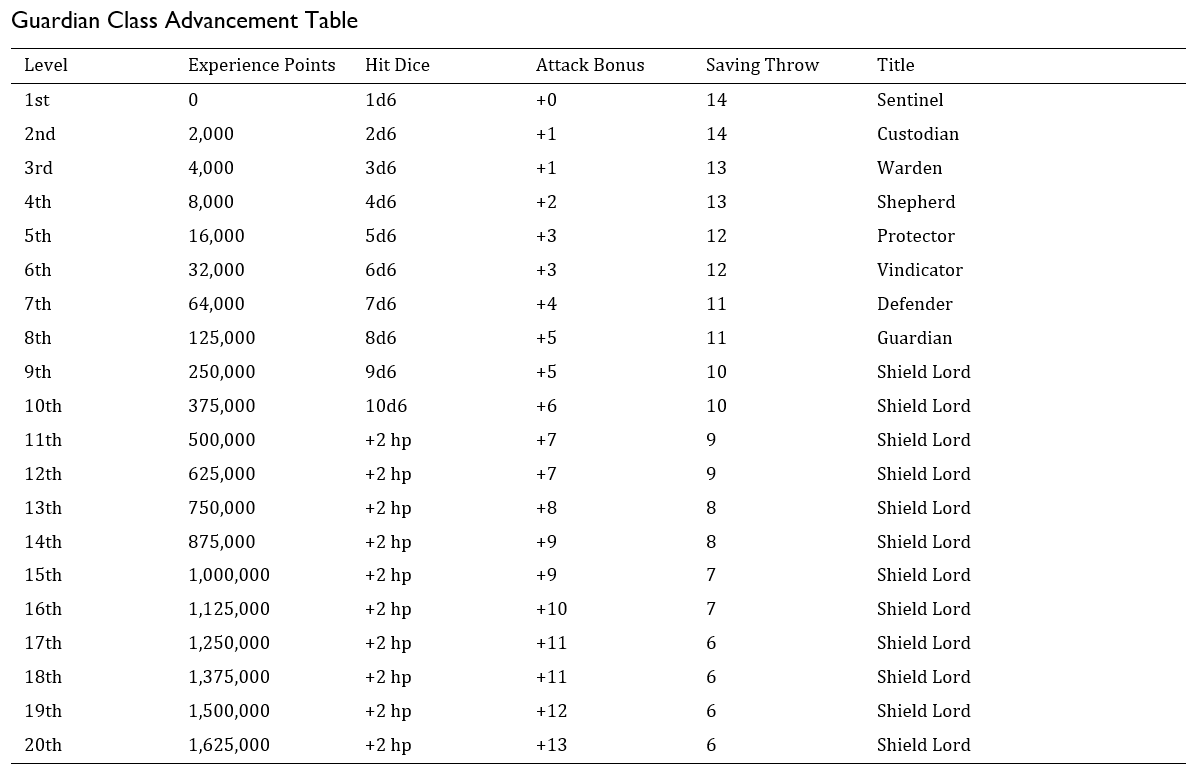
Guardians are always on the lookout for danger, and have potent abilities to survive it and even turn attacks back on attackers. They are mediocre warriors, it is true, but are proficient with armor and thus difficult to injure. A guardian may not turn the tide of battle by her presence, but she can serve as the impenetrable rock on which the tide of battle breaks.

Requirements and Restrictions: Guardians must have a minimum scores of 9 in Strength, 11 in Constitution and 13 in Wisdom. They must also be Lawful in alignment. They may wear any armor and use shields, and can fight with any weapon.

Guardian Skills

Find Secret Doors—Guardians have a 2 in 6 chance to note the presence of secret or concealed doors.

Find Traps—Guardians can attempt a task check to discover traps in a room or on an object. Alas, they have no special skill at removing traps once found.

Listen at Door—Guardians can attempt a task check to hear faint noises through doors or in other circumstances.

Guardian Abilities

Guardians are only surprised on a roll of 1 on 1d6. They can extend this protection to up to one comrade per three levels. Thus, if all in a party of adventurers except the 4th level guardian are surprised on a roll of “2”, the guardian can allow one additional comrade to avoid that surprise.

2nd level guardians learn the secret of phasing through matter (but not energy). A guardian can walk through up to 2 inches of matter per level per day. Thus, a 6th level guardian could walk through up to 12 inches of matter, total, during the course of a single day. This could amount to walking through a single 1-ft thick wall, or four 3-inch thick doors.

A 4th level guardian gains the ability to peer through matter, as though wearing a ring of x-ray vision. She can do this once per day per four levels (i.e. 1/day from 1st to 4th level, 2/day from 5th to 8th level, etc.)

A 6th level guardian can attune themselves to one form of energy (acid, cold, fire, electricity or sonic) per day, gaining the ability to ignore hit point damage from that energy. The guardian can ignore 1 point of damage from that energy per level over the course of the day. Thus, a 9th level guardian who attuned herself to fire could ignore up to 9 points of fire damage during the course of the day.

Guardians maintain a shield around their minds. At 1st level, this blocks all spells and abilities that read or detect their minds. They can also choose to block out telepathic communication. By 3rd level, this protection extends to a +4 bonus to saving throws against illusions and mental attacks, such as confusion, fear, feeblemind, ego whip, id insinuation, phantasmal killer and the mind blast of the pernicious thelids. When a guardian of 6th level or higher passes a saving throw against a mental attack, she reflects that attack back on the attacker, who must pass their own saving throw to avoid the attack.

Stronghold

A 9th level guardian can establish a stronghold in the wilderness. The stronghold must be placed in such a place to resist attacks from the wilderness, for example between mountains inhabited by ogres and giants and a human or demi-human settlement. Once constructed, the guardian attracts …