NOD 6 – Ready for Sale … Finally

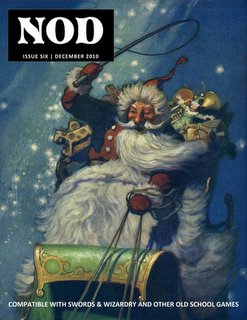
Well, NOD #6 put up a terrific struggle, but I’ve finally put it into print. You can download it HERE for free, or purchase for $11 HERE. 136 pages, it includes …

Western Venatia hexcrawl

Level 3 of the Pleasure Palace of Izrigul – an odd level both figuratively and literally

The Traveler class

Holiday Magic

Gods of the Motherlands

Another installment of Phantastes

Merry Christmas and enjoy!

NOD #6 Now Available to Download

Rant begins now …

Yes – NOD 6 is ready to download, but not to purchase in print. Yet. I’m telling you what – I’m so frustrated right now, I don’t know what to do with myself. Just one problem after another. I put all my documents together in Word and then convert to PDF. This is a major pain in the butt, but I’m not exactly running a business here, and Word is what I’ve got, so Word is what I use. Anyways – there are so many hassles involved with going Word to PDF – you have to physically (digitally?) embed all the fonts, many of which are “hidden”, so I have to add invisible characters to a document so I can find them and embed them, PNGs look like crap when you convert to PDF, so I have to use BMP and JPG, and this time around they look like crap as well, which in itself is immensely annoying when you work your butt off to create a nice looking document. So I do my conversions after hours at work because I have the full Adobe suite there, get home to make the actual Print-On-Demand thing at Lulu and discover that the document has an un-embedded font in it – Arial Bold Italic. Yes, the arial and times new roman fonts, which do not actually appear in the document (well, arial does in the OGL) will not self embed – pretty much every other font will, but not the TWO MOST BASIC FONTS KNOWN TO MANKIND!!! Aaaahhhhh!!! So, long story short – nothing to purchase tonight, but the e-book for NOD 6 is a free download as my holiday gift to the gaming community that has helped make my dream of being a writer/publisher come true. So, while I go outside and punch a tree for a couple hours, please enjoy the fruits of my labors in their slightly mangled form courtesy of Adobe and Microsoft, my two best friends and two worst enemies tonight.

End of ranting

NOD in 2011
Well, my fervent hope is that I can sell some ad space in the magazine next year and make the PDF downloads free. I’m charging $2 for quarter page ads, $4 for half page ads and $8 for full page ads. My last free issue, NOD 1, has been downloaded between 750 and 800 times, so the exposure to the old school community should be pretty good for the money you spend. My email address is in my profile, so send me an email if you’re interested. If there isn’t enough interest in ad space, I’ll just keeping doing like I’ve been doing – around $10 for print, $3.50 for e-books.

NOD 7 in February will feature three city-states – Lyonesse, Antigoon and Blackpoort – in the same format I’ve done with Ibis and Ophir. Knights and dames and merchant princes and thieves and assassins and troll bridges, pigeon pie – something for everybody!

NOD 8 in April is slated to feature JD JarvisMutantFront. First guest contributor, and I’m very excited to see what he comes up with. Art will be commissioned for this one, and it will be chock full of mutated Great War goodness! Check out Aeons & Auguries for more MutantFront goodness.

NOD 9 in June will launch some coverage of Mu-Pan, the realms of the Dragon Kings. I’ve been done some pseudo-European and pseudo-Arabian material with Venatia and the Wyvern Coast/Nabu material, and now I feel like dipping my toes into Asian myth and folklore. It’s also a great excuse to use some of great material in Ruins & Ronin, Mike Davison’s take on Asian adventures for Swords & Wizardry. NOD 10 in August will continue with Mu-Pan.

NOD 11 in October is slated to feature another guest contributor – my good friend Luke DeGraw. Luke worked up some conversions of Castles & Crusades for playing Robotech, and he’s going to put together something that involves no challenges to legal copyrights or intellectual property, but does involve old school rules and giant freakin’ robots. Should be awesome.

And back to December and NOD 12, where I’ll feature a city of Mu-Pan and God only knows what else. Hey – I’m amazed I’ve thought this far ahead! Hopefully I’ll throw some support for PARS FORTUNA and Mystery Men! in there along the way, and if anyone else wants to contribute something, let me know! Oh – and look for Hexcrawl Classics from Frog God Games – I wrote ’em. They’re hexcrawls (yes, not just a clever name) without a setting, though I’m kinda sorta inventing one as I go. The maps are based on locations in North America, so Huzzah!s will be awarded if you can guess the locations.

So, until tomorrow when I’ve had time to fix my #$%@#$@ PDF and post NOD 6 for sale – enjoy the free download and keep on gaming!

Retro-Engineering: Creature Catalog

Every so often I wander over to the Creature Catalog to see what they’re up to. Besides being the source of the very excellent Tome of Horrors (without which NOD would be much less interesting), the CC has converted hundreds of old school creatures for use in 3rd edition games. Many years after 3rd edition going out of print and the end to the first phase of the d20 revolution, CC is still cranking out these conversions, often of monsters I had never even heard of. Here’s their ten latest conversions retro-engineered into a more old school format.

Tirichik
Tirichiks look like a hybrid of white dragon and centipede, with two tentacles tipped by sharp spikes. Tirichiks are an apex predator of the tundra. They attack from ambush, hiding in snowdrifts or crevasses and then springing out at their prey. They can momentarily detach their skull from their spinal column, allowing them to make quick strikes from 10 ft away. These quick strikes score double damage if they hit, but attempting them lowers the tirichik’s AC by 2. Sensory organs on the beast’s tentacles give it a heightened ability to detect foes, lowering its chances to be surprised to 1 in 1d8. Tentacles can be attacked separately from the body, having an AC of 0 [19] and 2d6 hit points. They are severed when reduced to 0 hp, though severed tentacles are regrown in 2d10+10 days. Tirichiks are immune to cold and can walk on ice with no penalties to movement.

Tirichik: HD 13; AC 1 [18]; Atk 1 bite (3d6), 2 tentacles (1d6); Move 12 (B6); Save 3; CL/XP 14/2600; Special: Elongate neck, ice-walking, immune to cold.

Copyright 1992 Wizards of the Coast, Inc.
Originally found in FR 14 – The Great Glacier

Shee (Banshee Rider)
Shee look like eyeless fey maidens with long, white hair. They wear highly ornamented plate armor and ride long-maned, eyeless horses. Shee always carry long, insubstantial lances composed of shadow-stuff. Shee are undead creature. Although they appear to be a rider and mount, they are in fact a single creature, inseparable without the use of a sharp axe backed up by mighty thews. Shee can ride over any surface, including water, without penalty. Shee exist to destroy – even attacking other undead when there is nothing else to slay. A turned undead will not flee, but only turn its attention to a different creature. A shee that is struck in combat utters a terrible scream that kills the four nearest creatures unless they pass a saving throw. The scream can only be uttered once every 1d4 rounds and no more than 3 times per day. After screaming, the shee vanishes, moving magically to a distant place. Creatures that are struck by a shee and survive are treated as being blessed, but only against other undead. This effect is permanent, although it can be removed with a wish spell. A shee’s shadow lance ignores non-magical armor and, in addition to normal damage, inflicts 1d3 points of strength damage. If separated from the shee, the lance disappears and reforms in the shee’s hand the next round.

Shee: HD 9; AC -2 [21]; Atk 1 lance (1d10 + Strength drain) or 2 hooves (1d6); Move 24 (F20); Save 6; CL/XP 13/2300; Special: Death wail, shadowlance, vanish.

Copyright 1990 Wizards of the Coast, Inc.
Originally found in FA1 – Halls of the High King

Opinicus

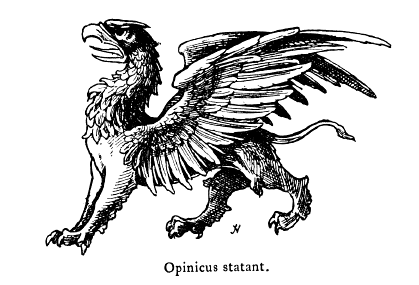
An opinicus is a griffin with the head and wings of an eagle, the body of a lion and the tail of a camel. They wander alone or in pairs in desert wastelands and are champions of They can use the following psychic powers as a 7th level psychic: Astral projection, id insinuation, mind thrust and telekinesis. They can also cast spells and turn undead as a 7th level cleric. The gaze of an opinicus flames with divine fire; all wicked creatures within 30 feet who meet this gaze suffer 2d6 damage and are blinded for 1 round (save negates blindness). The opinicus can use its gaze once every 1d4+1 rounds.

Opinicus: HD 7; AC 2 [17]; Atk 2 claws (1d6), beak (1d4); Move 20 (F30); Save 9 (8 vs. mental effects); CL/XP 10/1400; Special: Psychic powers, spells, sun sparkles, turn undead.

Copyright 1983 Wizards of the Coast, Inc.
Originally found in Monster Manual II

Netherbird
Netherbirds are the black, grotesque carion crows of Hell, serving devils and demons as messengers. They dwell on craggy moors in flocks of 3d10 birds. Their eggs are black and leathery and hatch unattended, being warmed by an inner hellfire. Netherbirds are 3 feet long and have wingspans of 6 to 7 feet. They are intelligent and can speak.

Netherbird: HD 2; AC 7 [12]; Atk 2 claws (1d4), bite (1d3); Move 6 (F24); Save 16; CL/XP 2/30; Special: Immune to fire.

Copyright 1989 Wizards of the Coast, Inc.
Originally found in FRE1 – Shadowdale

Kupuk
Kupuks look like large dogs (6′ long, 3′ tall at shoulder) with walrus-like hides, grey or yellowish fur and spiked tails.The people of the tundra and taiga use them as pack animals, for they are very loyal companions. Kupuk’s are egg-layers, like the platypus. When defending its eggs or pups, the kupuk gains a +1 bonus to hit and damage. Training a kupuk is fairly easy, taking about six weeks to teach them a trick. Kupuk young are worth 1,000 gp, and professional animal trainers charge 500 gp to train them. Kupuks can carry up to 200 pounds without losing any speed.

Kupuk: HD 5; AC 3 [16]; Atk 2 claws (1d4), bite (1d8), tail (1d12); Move 9 (S18); Save 12; CL/XP 5/240; Special: Frenzy, immune to cold.

Copyright 1992 Wizards of the Coast, Inc.
Originally found in FR 14 – The Great Glacier

Gorse
A gorse looks like a 3″ tall elf child with delicate wings. They carry small bows and swords and quivers of tiny arrows. They live under gorse bushes, and although secretive, they are friendly towards folk who bring them fruit, bread or milk. Gorse are fond of magic potions, and usually have 1d3 in their lair. Gorse have several magical abilities they can use once per day: They can create magical distractions (save or look away); magically exterminate small vermin within 20 feet (save or die); cast Mirror Image and cause thorn bushes within a 5-ft square area grow rapidly. These thorn bushes slow people moving through them to one half-speed and cause 1d3 points of damage. Gorse tip their arrows with a poison that causes confusion for 1d4 rounds unless a saving throw is passed. All gorse can cast the spell Mirror Image once per day. Once

Gorse: HD 1d2; AC 3 [16]; Atk 1 sword or bow (1 dmg); Move 3 (F12); Save 18 (16 vs. spells); CL/XP 1/15; Special: Poison, sprout, exterminate.

Copyright 1992 Wizards of the Coast, Inc.
Originally found in Dragon Magazine #180

Bramble
Brambles resemble tiny (3″ tall) elves with swarthy, wrinkled skin and long nails on its hands and feet. They wear plate armor, the back of which is covered in a brace of spines. They are among the most vicious and aggressive of the fair folk, taking delight in hunting pixies and sprites and other small fey. They can charm small animals into serving as their mounts. Brambles are fierce warriors, and charging bramble scores an additional 3 points of damage with its attacks. A brambles spines inject a poison that causes a sickened condition (-1 to all rolls) for 2d4 rounds (save applies). Once per day, they can target the wings of a small creature with a net of entangling thorns. With a successful ranged attack, the creature’s wings are bound and useless for 6d6 rounds.

Bramble: HD 1d3; AC 3 [16] or 1 2 [17] in plate armor; Atk 1 lance (1 dmg) or spines (1 dmg + poison); Move 3 (F12); Save 18 (16 vs. magic); CL/XP 1/15; Special: Poison, charm mount, spines.

Copyright 1994 Wizards of the Coast, Inc.
Originally found in Dragon Magazine #206

Behemoth (Giant Hippopotamus)
Behemoths are massive hippos (12′ long, 3 tons), capable of overturning good-sized boats. They are as aggressive and territorial as their smaller cousins.

Behemoth: HD 10; AC 3 [16]; Atk 1 bite (3d6); Move 9 (S15); Save 5; CL/XP 10/1400; Special: None.

Copyright 1983 Wizards of the Coast, Inc.
Originally found in Monster Manual II

Pseudo-undead (Template)

Pseudo-undead are living humanoids who resemble specific types of undead creatures. You can turn any humanoid into a pseudo-undead by altering its stats as follows:

– A pseudo-undead gains any claw and bite attacks of the undead creature is resembles, dealing 1d4 points of damage with its claws and 1d6 points of damage with its bite.

– Pseudo-undead can see in the dark.

– Pseudo-ghouls have a paralyzing touch (save or paralyzed for 1d3 rounds).

– Pseudo-ghasts have a paralyzing touch (see above) and are surrounded by an overwhelming stench; creatures within 10 feet must pass a saving throw or be sickened (-1 to all rolls) for 1d6+4 rounds.

-Pseudo-wights spread a disease with their touch. This fever deals 1d4 dexterity and constitution damage each day until the afflicted succeeds at a saving throw vs. disease at a -5 penalty.

– Pseudo-wraiths have physical forms, but always wear wispy shrouds or robes to obscure their bodies. They walk so lightly as to leave no trace. Their claw attacks are poisonous, causing 2d4 points of damage on a failed save.

– Pseudo-spectres have physical forms surrounded by a faint luminosity. Their claw attacks are poisonous, the poison weakening (-2 to hit and damage) a person for 1 day.

– Pseudo-vampires are like feral savages clad in the silk finery of civilization. They usually wear armor and fight with weapons. They have claw and bite attacks. Their bites cause persistent bleeding that saps a person of 1 hit point per round until staunched or magically healed. Their claws spread the “red ache”, a disease that robs a person of 1d6 points of strength each day until they succeed at a saving throw vs. disease at a -6 penalty.

Copyright 1983 Wizards of the Coast, Inc.
Originally found in Monster Manual II

Some Holiday Magic for the Season

Here’s a little preview of an article appearing in NOD #6 (any time now – almost there).

Bag of Goodies
The bag of goodies works in much the same manner as a bag of tricks, save instead of producing small animals (other than kittens and puppies), it produces small, simple toys. The prospective recipient of a gift must reach into the bag while making a wish, pulling out either a small toy made of wood or tin or, if they are chaotic or evil, a lump of coal. Wishes for swords will produce wooden swords, which can be used as clubs in combat. The bag operates once per year per person.

Chimney Charm (Spell, MU Level 2)
By touching one’s finger to one’s nose (but not placing it inside – different charm), they ascend through any chimney-like tube or hole, regardless of size and unharmed no matter what other material (smoke, water, acid) might be coursing through said concourse.

Dreidel of Fortune
This clay top can only be made by a lawful cleric of at least 3rd level. The dreidel is inscribed with the glyphs that mean “Nothing”, “Half”, “All” and “Put In”. When a gold piece is offered (it disappears when the top is spun) and the top is spun while chanting a charming ditty, the dreidel has the following effects (roll 1d4):

1. Nothing – Nothing happens to the spinner
2. Half – All spells and powers used by the spinner work at 50% efficacy for the next 24 hours
3. All – All spells and powers used by the spinner work at double efficacy for the next 24 hours
4. Put In – The spinner loses 1d6 x 100 XP to the top

And a petty god for the season …

Saint Nick (Demigod)
Saint Nick is the fey demigod of just desserts. He appears as a jolly gnome, dwarf or human (as he chooses) with white hair, a long white mustache and beard, a large, red nose and twinkling eyes, dressed in red robes and wearing a pointed red cap. Saint Nick carries a large, green bag from which he can pull any desire of a good creature who petitions him with a sacrifice of milk and cookies (per limited wish), but for wicked creatures he instead pulls out a large whipping stick and beats them to within an inch of their life (i.e. 1 hit point). Saint Nick is as strong as a frost giant and as nimble as a sprite. He can use the following spells at will: Animal Summoning (8 reindeer), Charm Monster, Chimney Charm, Detect Evil, ESP, Know Alignment, Magic Snow Ball and Uncontrollable Laughter.

Saint Nick’s clerics dress like their patron, with red robes over their armor and a whipping stick at the ready. They can learn the spells Chimney Charm and Magic Snow Ball when they learn to cast cleric spells of the equivalent level. Saint Nick’s clerics must pass on 50% of all treasure they collect to the poor and needy. At 9th level, they build fortified orphanages and hospices, conducting waifs and the sick from cities via caravan to their palaces of generosity.

Coming Up For Air …

It’s been a busy weekend – daughter’s birthday party (’80s theme, because, you know, the ’80s was a looong time ago – feeling elderly now) and working on getting NOD #6 out. In the process, I made a quick index to some of the monsters, races, classes and spells that have appeared in the series so far. You can find it on Google Docs HERE if you’re interested. I think there’s supposed to be some way I can embed it in Blogger, but I haven’t figured it out yet. When I do, I’ll just make a new page on this blog with the index. So – hopefully by the 14th (late) or 15th (early) I can have the last issue of 2010 published, and then get to work on Mystery Men!, Hexcrawl Classics #3 and NOD #7. Like anyone in real estate will tell you, it’s a good thing to be busy!

Cheers!

Oh – current line-up for NOD #6: Western Venatia, Gods of the Motherlands, The Traveler PC Class, Random Owlbear Tables, Holiday Magic, Phantastes, Pleasure Palace of Izrigul (3rd Level).

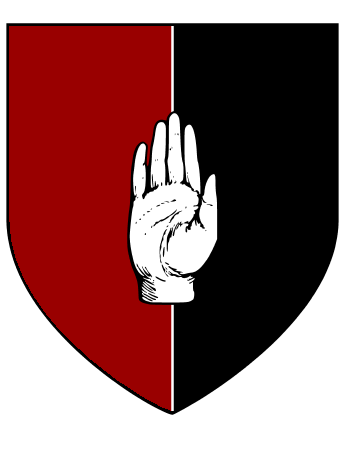
Pictured – The coat of arms of Antigoon, City of the Sun made with Inkwell Idea’s Coat of Arms Design Studio.

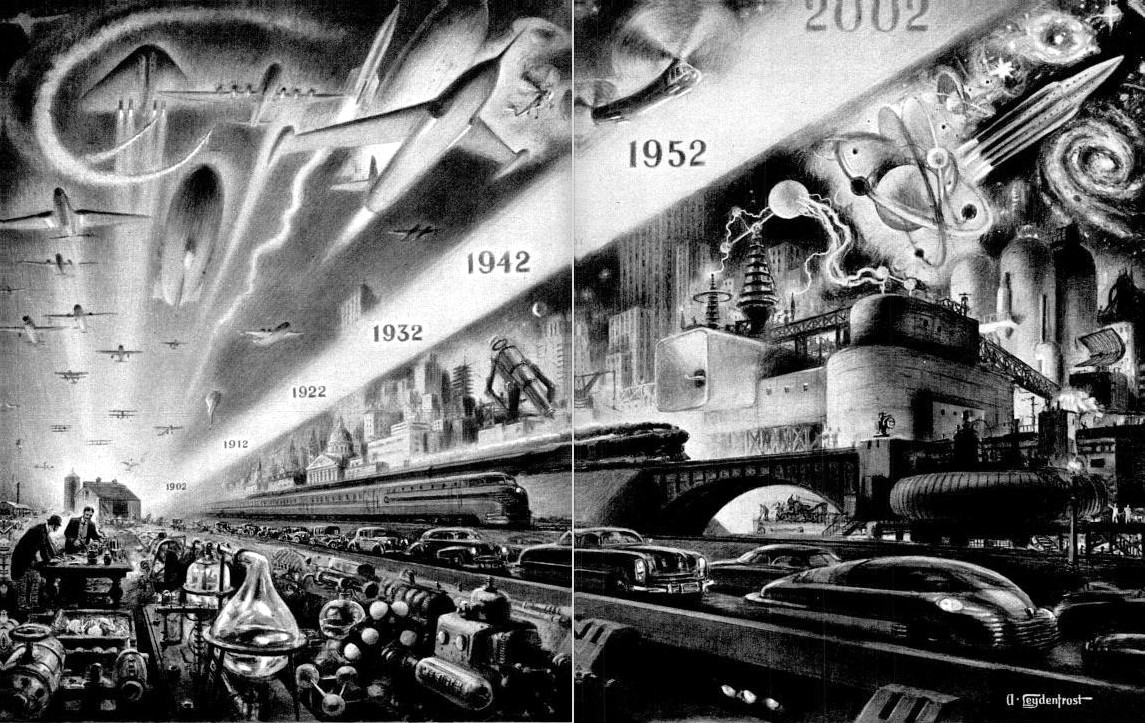
Random Musing – The March of Progress in a Campaign World

This notion just struck me a few moments ago, so I figured I’d put it down on pixel while it was fresh in my mind. I was thinking about the transition of a medieval-style fantasy campaign world, my own in fact, to a Renaissance level of technology and society – nation states, masses of firearm-armed men-at-arms, printing presses – and then to higher levels of advancement – the Victorian Age, etc. Invention in most fantasy game rules, at least in terms of invention by PCs,  is relegated to the creation of new spells. Naturally, a Referee’s NPCs can invent anything they want, but if we assume that everybody in the world uses the same spell creation rules, the more high level magic-users there are, the more spells will be invented. In my own world, I have the Scientist class, so the same concept would hold in NOD for pseudo-scientific inventions.

Therefore, while invention in our world has generally relied on the strength of civilizations and their ability to share information and amass resources, the march of progress in a fantasy world would rely on the existence of powerful monsters and hidden treasures – the very things that provide experience points for adventuring magic-users and scientists. Now, again, I know that NPCs aren’t shackled by the same rules as PCs in most old school fantasy, but bear with me – this is just a matter of a guy following an idea around to see where it goes. So, if we take the necessity of powerful monsters as the basis for invention, as a campaign world’s PCs gradually whittle down the powerful adversaries, the pace of new inventions should slow down. As civilization expands in a campaign world, invention slows down – an interesting concept.

It also occurs to me that as all those high level and mid-level monsters – the more unique sorts that don’t multiply like rabbits (or goblins) – are killed off and as large treasures are discovered, the ability of any PC to advance in level becomes restricted. Once you get past the lower levels, not being able to take out mid-level monsters means getting through those mid-levels becomes much harder, and it makes those few powerful monsters that avoided the old high-level PCs more secure. Maybe the natural evolution of a fantasy world would be:

1. Small civilizations, lots of wilderness, many monsters, high potential for high level advancement.

2. Mid-sized civilizations, less wilderness, fewer powerful monsters, less potential for high level advancement.

3. Large civilizations, very little wilderness, very few powerful monsters, almost no potential for high level advancement.

Once you enter stage 3, the likelihood of powerful monsters laying waste to civilization might be pretty high, sending the fantasy world back to stage one and setting the scene for all these old school campaigns where low-tech civilizations always seem to be built on the ruins of ancient high-tech civilizations.

Illustration by Alexander Leydenfrost

Deviant Friday – Dave Johnson Edition

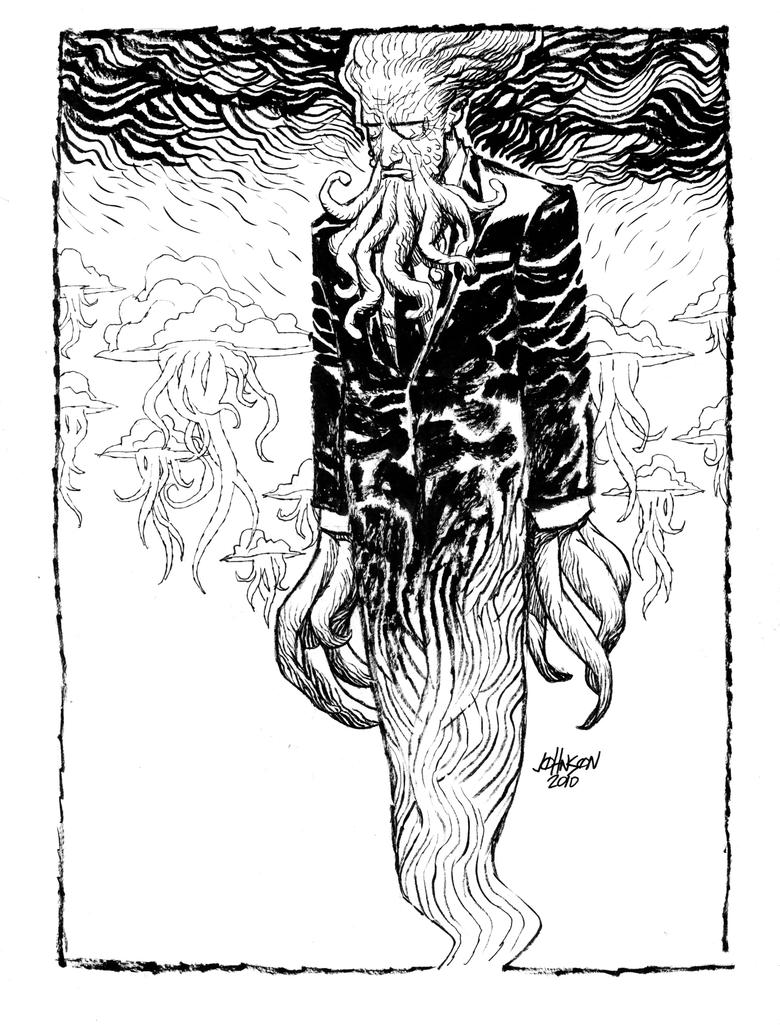
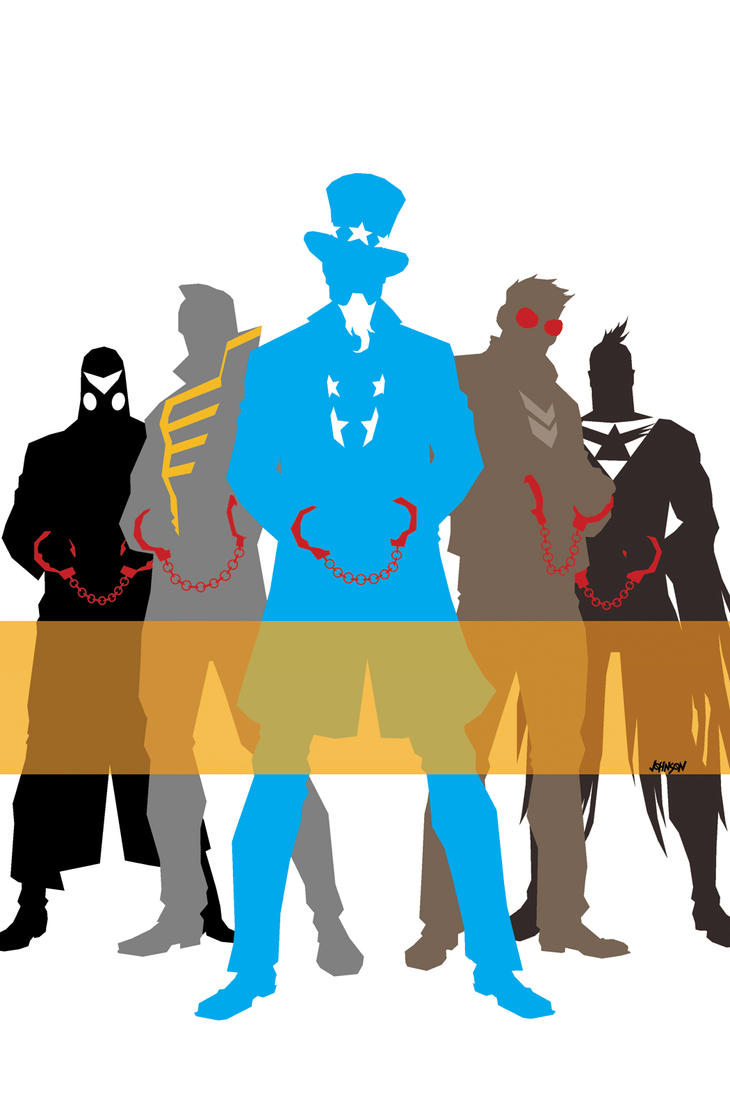
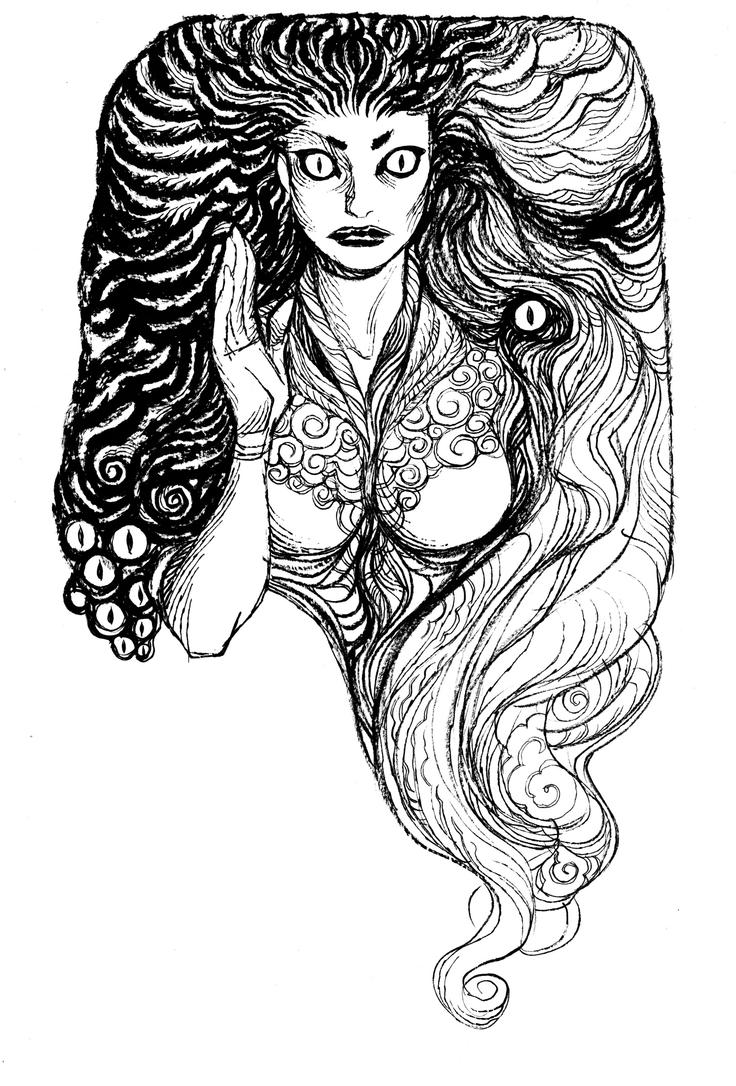
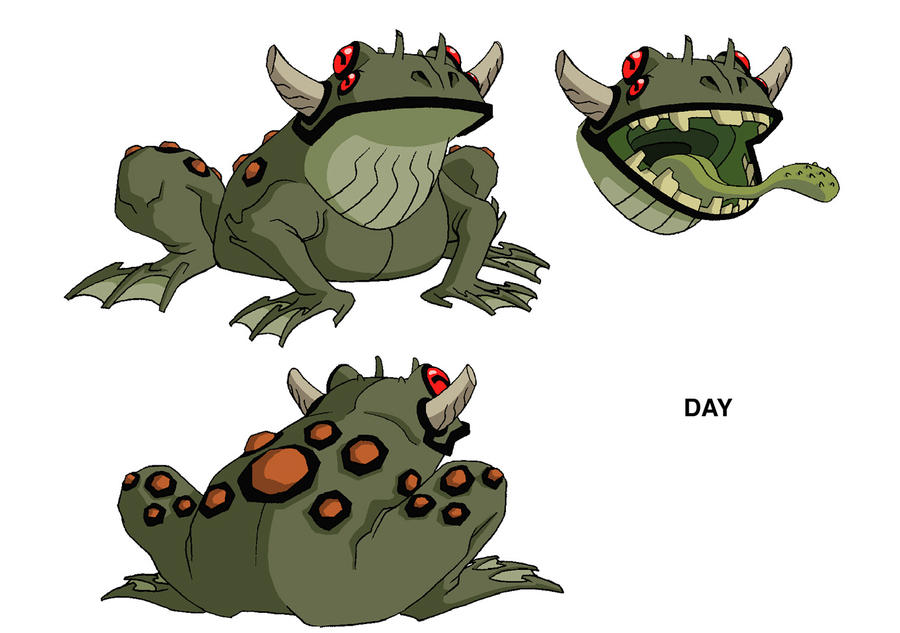
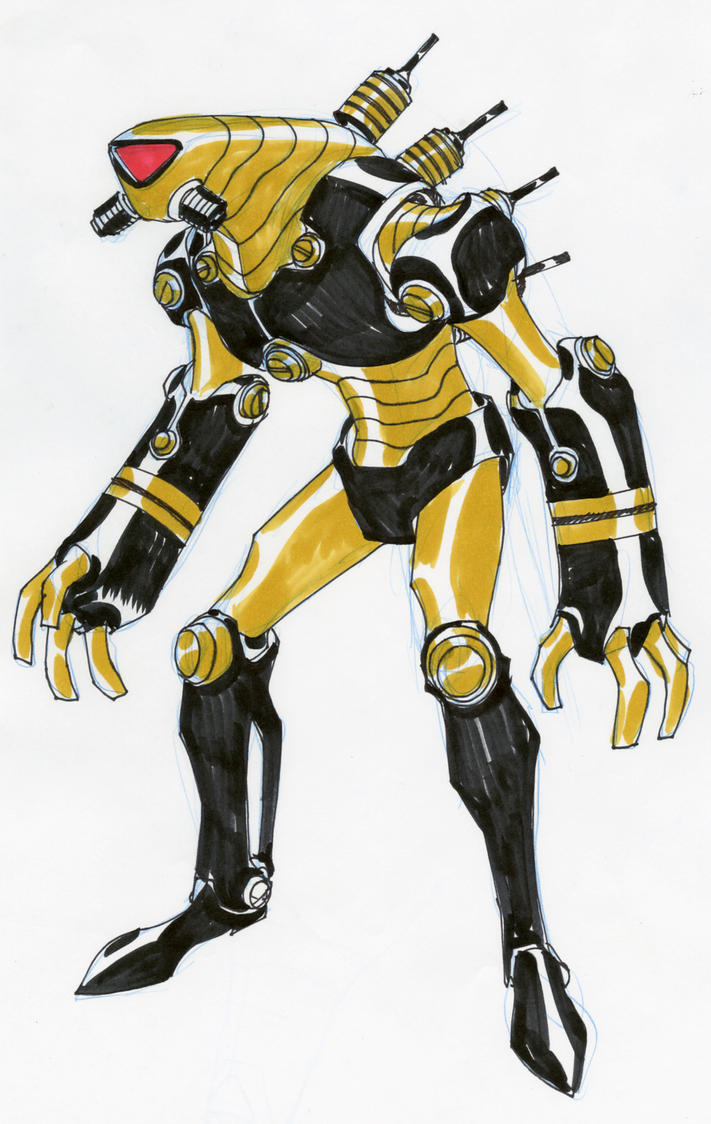
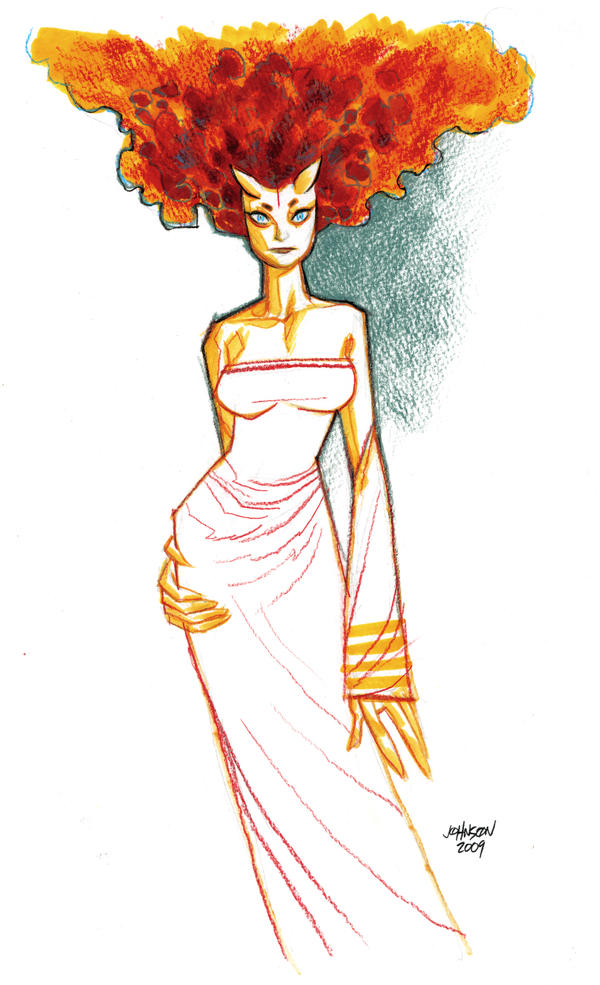
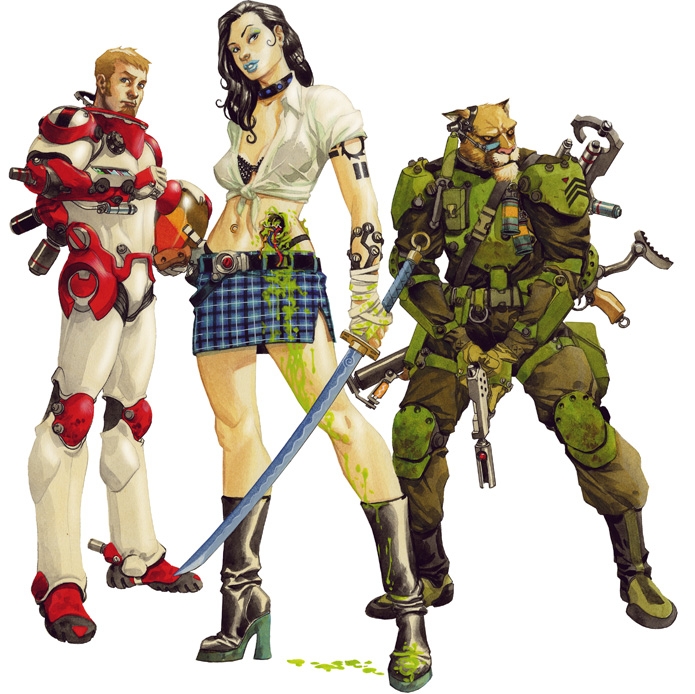
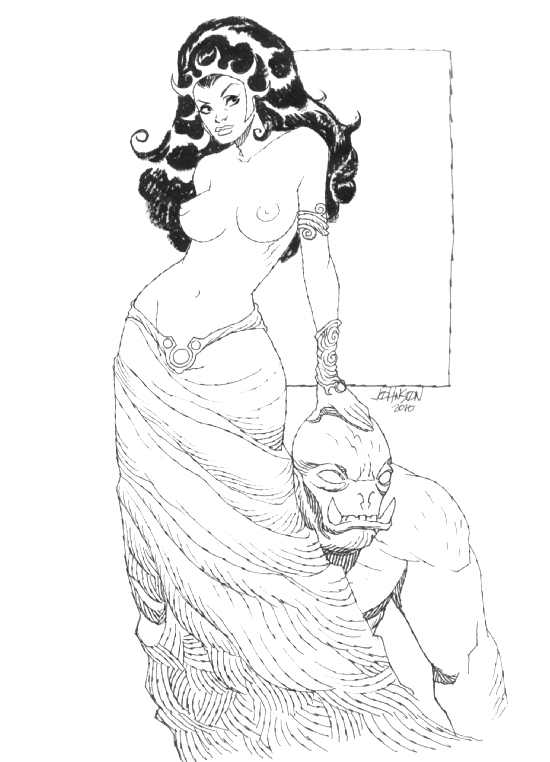
Dave Johnson (Devilpig) has quite a resume – work for Marvel and D.C., a couple d20 Modern covers, some stuff for Ben10 – comics, cartoons and RPGs, all fodder for a blog like mine. He has a style that takes a pat subject and veers off at the last moment to make it interesting, and he creates from very stylish covers for comic books. Enjoy.


These guys recently showed up on a great episode of Batman: Brave and the Bold


This one is my favorite – looks like an illustration that would have appeared in an old pulp magazine of the 1930’s.


It’s not froghemoth, but still nothing to sneeze at …


Cover to d20 Modern, I think. I’ll probably do something with d20 Modern in my retro-engineering series one of these days.

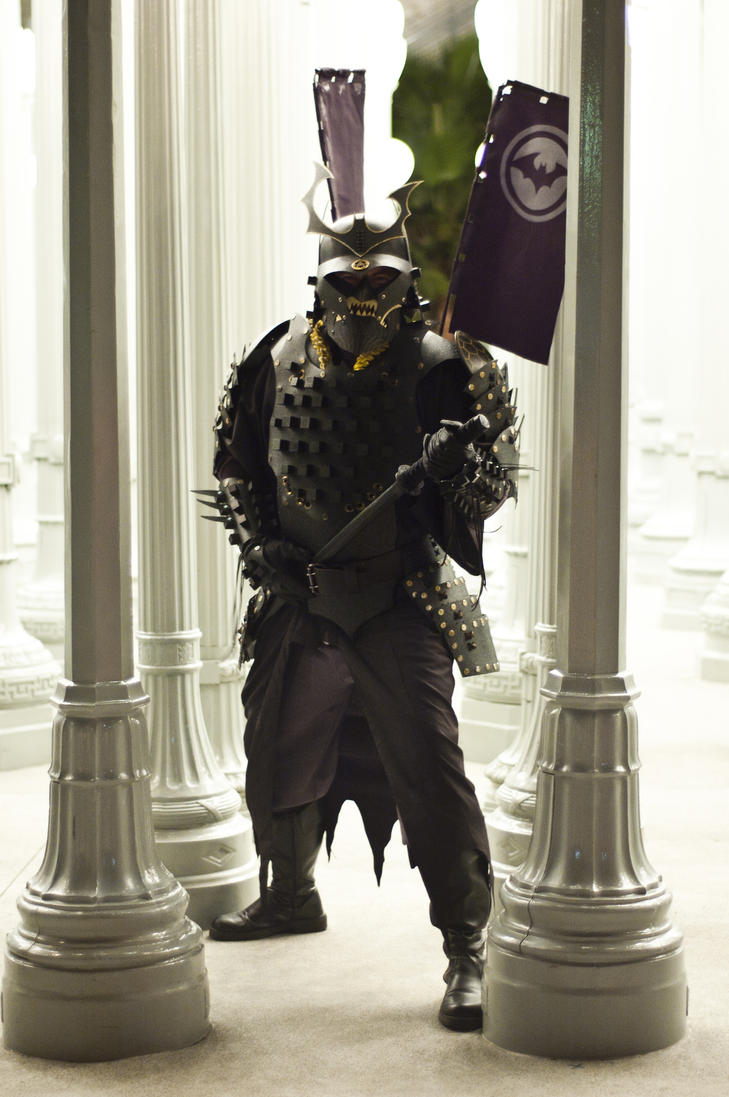
Homemade costume – nice job.


Managed to get Dejah in this time, but not Red.

Venatia – Alien Mazes, Tranquil Ponds and the Castle of the Beast

NOD #6 is written – it will probably be around 100 pages. Now I just need to edit and illuminate, fix some maps (it’s always something with the dang maps) and get this puppy out there. If anyone out there would like to advertise something in this issue (gratis), let me know. I can’t promise to accommodate everything (nor can I expect to get anything), but contact me and I’ll see what I can work out. My goal is to publish by the 14th, so consider the 12th a hard deadline.

Now – time for the final Western Venatia preview …

2846. Sometime in the mists of antiquity, the alien tsalakians, for reasons known only to them, constructed a vast maze of corridors, tunnels and vaults plucked from the sea floor beneath the waves. As the waters of Nod receeded, this maze came closer to the surface, so close in fact that it now lurks just beneath the calm surface of the Tepid Sea. The maze is difficult to spot, and many a ship has been dashed against its walls, the inhabitants of the dungeon’s upper levels preying on the shipwrecked sailors. Denizens of the maze include aquatic ogres and trolls, sharks, a team of squid-man adventurers and a veritable zoo of alien aquatic predators.

3023. There is a tranquil pond here filled with lily pads and surrounded by tiny cottages woven from grass, leaves, twigs and reeds. A village of 200 of frog fairies is situated around the pond. The frog fairies are ruled by Queen Anabeth. Although they are not welcoming of most strangers, those of lawful alignment will be allowed to rest and refresh themselves and give tribute to the queen. Besides its warriors, the village is protected by a dozen giant frogs.

| Queen Anabeth, Illusionist Lvl 8: HP 24; AC 3 [16]; Save 8 (6 vs. illusions); CL/XP 8/800; Special: Spells known (4th), spell points 28, silver tongue, +3 to hit with darts, magic resistance 20%, frog fairy spells.

| Frog Fairy (100): HD 1; AC 3 [16]; Atk 2 darts (1d3) or 1 dagger (1d4); Move 9; Save 14; CL/XP 1/15; Special: +3 to hit with darts, magic resistance 20%, cast hold person, invisibility and pyrotechnics.

| Giant Frog: HD 1; AC 7 [12]; Atk 1 bite (1d3); Move 3 (or 150’ leap); Save 17; CL/XP 1/15; Special: Leap.

3106. In the southern reaches of the forest, not far from the banks of the Danu, lies the infamous Castle of the Beast. The castle’s inhabitants were cursed years ago, its master twisted into the form of a beast (treat as a werewolf in hybrid form but without lycanthropy) and the souls of his servants trapped inside objects, unable to speak but still capable of carrying out their duties. Here, the beast broods and hunts and prays that someday the curse will be lifted.

The castle has a sinister cast to it. It is surrounded by well-tended gardens and vineyards, but the fields surrounding the castle are fallow and wild pigs and cattle can be found in the surrounding woods. There is a dilapidated landing and boat house on the Danu about 1 mile away from the castle. The landing is connected to the castle with an overgrown stone path. Warnings have been carved on the boathouse walls by the claws of the Beast himself.

Those who would storm the castle for its treasures will be sorely disappointed, for though the castle holds many valuable items (see below), those who possess them for more than a day have their souls trapped within them (per Magic Jar spell) until the curse is removed by a cleric of at least 10th level.

Treasure: The Beast’s treasure is in multiple trapped chests. It consists of 11,000 gold pieces. There is a winter wolf rug worth 1,000 gp stretched in front of the hearth of his great hall. The Beast wears an ivory broach carved in the image of his mother (worth 500 gp) and a weapon belt held with a silver belt buckle (worth 250 gp). Above his torn and tattered bed hangs a now-inverted holy symbol made of silver and platinum worth 750 gp.

| The Beast: HD 4 (26 hp); AC 3 [16]; Atk 1 bite (2d4); Move 15; Save 13; CL/XP 4/120.

| Animated Object (Small): HD 1; AC 5 [14]; Atk 1 slam (1d3); Move 15; Save 17; CL/XP 1/15.

| Animated Object (Medium): HD 2; AC 5 [14]; Atk 1 slam (1d6); Move 12; Save 16; CL/XP 2/30.

| Animated Object (Large): HD 4; AC 5 [14]; Atk 1 slam (1d8); Move 9; Save 13; CL/XP 4/120.

3211. A deep, natural trench in this hex holds thousands of writhing man-sized giant centipedes, attracted, apparently, to a magic helm at the bottom of the trench. The helm is made of gold, and thus heavy and offering little protection. It is shaped like a skull-cap with a nasal guard and a crest composed of a number of rounded nubs. Wearing the helm makes it possible for you to communicate with vermin and for them to communicate with you. In addition, you gain the ability to “turn” vermin and oozes as a 3rd level cleric, but at the cost of 1d6 points of temporary wisdom damage.

3310. A seemingly abandoned village in this hex contains a remarkable sight – dozens of villagers and twenty ogres frozen into statues of quartz by some unknown agency. Some searching will reveal one robed individual, on hands and knees in a doorway looking out at the slaughter, hand raised as though in the process of casting a spell. In fact, the wizard is responsible for the spell and the attack. The ogres had been tracking him for several days, he being injured in a previous encounter and seeking healing. The villagers took him in, and he rested for a few days before the ogres arrived. The quartz effect is merely an optical illusion of people frozen in time until some other equally powerful wizard (Morthern is a level 9 wizard) can undo the incantation (known colloquially as Morthern’s Moment in Time).

Illustration by N. C. Wyeth

Two Bad Brothers That We Know So Well

One of my favorite game mechanicians of the d20 era was Erica Balsley. She was a monster gal – did some great stuff for the Tome of Horrors and Creature Catalog and did some neat conversions for Bard Games’ old Atlantis setting. Years ago, I came across a template she wrote for the “Mephit Lord”. The mephit lord template was applied to mephits to make high-powered elemental baddies like the Steam Lord, Smoke Lord, etc. All mephit lords had an attack called a “clutch”, which tipped off their origins …

Now, I’ve long since lost track of that original template – it was on some message board somewhere – but it eventually showed up in the Book of Templates Deluxe Edition. I still have the stats for Heat Lord and Snow Lord, though, and here they are in Swords & Wizardry format.

Fire Lord: HD 12; AC -3 [22]; Atk 2 claw (1d6+4) or 1 clutch (4d6); Move 15 (Fly 24); Save 3; CL/XP 18/3800; Special: Fire mephit abilities + breath weapon (4d4), clutch, regenerate 4 hp/round, only harmed by +2 or better magic weapons.


The clutch of the Heat Lord deals 4d6 points of fire damage to living opponents, and instantly melts or incinerates any non-living, non-magical matter of man-size or smaller. Magic items are allowed a saving throw to resist this effect.
Ice Lord: HD 12; AC -3 [22]; Atk 2 claw (1d6+4) or 1 clutch (4d6); Move 15 (Fly 24); Save 3; CL/XP 18/3800; Special: Ice mephit abilities + breath weapon (4d4), clutch, regenerate 4 hp/round, only harmed by +2 or better magic weapons.
The clutch of the Snow Lord deals 4d6 points of cold damage to living opponents and instantly freezes and shatters any non-living, non-magical matter of man-size or smaller. Magic items are allowed a saving throw to resist this effect.
Mephit Lords are always accompanied by 2d6 mephits of the appropriate type. They can summon 1d6 mephits with a 75% chance of success.
The relevant mephit stats are:
Fire Mephit

A fire mephit breathes a 15-foot cone of fire that deals 1d8 damage (saving throw for half). Once per hour it can cast burning hands, and once per day it can heat metal. A fire mephit regenerates if it is touching a flame at least as large as a torch.

• Fire Mephit: HD 3; AC 2 [17]; Atk 2 claw (1d6); Move 12 (Fly 21); Save 14; CL/XP 5/240; Special: Harmed by magic weapons, breath weapon, burning hands, heat metal, regenerate, summoning.

Ice Mephit

Ice mephits breathe a 10-foot cone of ice shards that deals 1d4 damage (saving throw for half) and imposes a -2 penalty to AC and attack rolls. Once per hour an ice mephit can cast magic missile and once per day they can chill metal. An ice mephit regenerates if touching a piece of ice of or if the ambient temperature is 32°F. or below.

• Ice Mephit: HD 3; AC 1 [18]; Atk 2 claw (1d6); Move 12 (Fly 21); Save 14; CL/XP 5/240; Special: Harmed by magic weapons, breath weapon, chill metal, magic missile, regenerate, summoning.

And if you use these guys against your players, make sure you have them do the song and dance first – it will make the TPK that much more satisfying. Nobody likes to get their butt kicked by a song and dance man.

Image from Patrick Owlsley – check out his blog if you love old cartoons!

Venatia – Gnomes, Bugbears and Invisible Men

Done Done Done! Finally done writing the text for the Western Venatia hexcrawl. All I need to finish now for NOD #6 is another dungeon level for Izrigul’s Pleasure Palace, and hot diggity that magazine is ready to go. So, probably one more Western Venatia preview after this one. Here goes …

2235. The hither gnome village of Borbet overlooks the sea. Its inhabitants make their living by fishing, keeping guinea fowl, and growing vegetables in well-tended gardens. The village’s population stands at 150 gnome-wives, 80 gnomelings and 230 gnomes. They dwell in several dozen stone cottages built around a central square that contains a stone well. A low stone wall surrounds the village. It has two gates on the east and west sides of the village, each overlooked by a tall wooden tower. The walls and towers are covered by creeping, flowered vines.

Borbet is known for its fine, pale ale and its smith-work. The smiths of Borbet maintain a forge in a sea cave, allowing them to harness the elemental power of wind and wave when manufacturing their magical weapons and shields.

The village milita consists of 115 gnome warriors under the command of Nereva. The village is governed by a warlock called Kindle.

Treasure: The town treasury holds 4,085 sp, 2,860 gp, a hematite worth 65 gp, a bronze statue of Mercurius worth 3 gp and 3 sq. yd. of linen worth 12 gp. It is locked in an iron chest with a complicated lock in the cellar of the mayor and guarded by a bull mastiff.

| Kindle, Gnome Magic-User Lvl 9: HP 20; AC 9 [10]; Save 7 (5 vs. spells); CL/XP 11/1700; Special: Spells (5th), phantsmal force 1/day. Golden amulet of office worth 1,000 gp, beechwood staff carved with gnome faces, silver dagger, money pouch stuffed in right boot containing 30 gp.

| Nereva, Gnome Fighter Lvl 5: HP 19; AC 4 [15]; Save 10; CL/XP 5/240; Special: Phantasmal force 1/day. Chainmail, shield, boots of elvenkind, short sword, short bow, dagger.

2337. On a granite promontory that juts into the sea there is an ancient, weathered stone chair. Legends say that those who spend the night of a full moon sitting in the chair will learn the secret of their doom and how to avoid it. In truth, they will probably be killed by the enormous black pudding that lives inside the promontory and seeps out the cracks to engulf the chair each night.

| Black Pudding: HD 10 (60 hp); AC 6 [13]; Atk 1 attack (3d8); Move 6; Save 5; CL/XP 11/1700; Special: Acidic surface, immune to cold, divides when hit by lightning.

2410. The Blood Hawks are the most northerly of the orc clans and the weakest, having recently been decimated by the adventuring company from Blackpoort. The Blood Hawks have 100 warriors. They are ruled by Nar, who is assisted by Zhor, a shaman of the Gods of the Lake (see Blackmere Lake). The Blood Hawks dwell in a cavern lair set amidst rugged cliffs. They fletch their arrows with blood hawk feathers and paint the birds on their shields.

| Nar: HD 5 (21 hp); AC 4 [15]; Atk 1 battle axe (1d8); Move 9; Save 12; CL/XP 5/240; Special: None. Chainmail, shield, battle axe.

| Zhor, Orc Adept Lvl 3: HP 10; AC 7 [12]; Save 13; CL/XP 4/120; Special: Spells (1st), alchemist (brews poisons).

| Blood Hawk Orc: HD 1; AC 6 [13]; Atk 1 spear (1d6) or short bow (1d6 + poison); Move 9; Save 17; CL/XP 2/30; Special: Poison on arrows causes paralysis for 1d3 rounds.

2516. In a dry gulch called the Valley of the Angel there is a small village of folk who make their living collecting the valuable resins from the acacia trees that grow therein. The valley is named for a rock formation that looks vaguely like a winged creature bent down on one knee. The village is built around the base of this natural monument and consists of small hovels woven from the branches of the acacia. It is protected by a dry moat and a low wall of stacked stones. The village is ruled by Baron Nestor the Mad, an outcase of Antigoon who seized control of the village with his hired goons as a young man and has ruled it ever since. He is now pushing 60, not long for the world and fretting over the fate of his only child, Krapahild, now 30 and unwed. Krapahild, of course, is not in the least worried. She longs for freedom from her impetuous, often schizophrenic father, and enjoys a fine reputation among the villagers, who often seek her wise council and will almost certainly accept her as their new baroness on the passing of her father. The 20 warriors of the village wear ring armor and dashing white capes and wield shield and longsword. They are commanded by Morward, a man of 50 years who has served the baron since before his exile. Morward is an unassuming man, grey-haired and slight of build, who happens to be a very skilled assassin. Morward is quite a bit less excited about Krapahild assuming command of the village, and would gladly marry her or kill her to remain in power.

Treasure: 1,800 sp, 102 gp and a hematite arrow worth 105 gp.

| Morward, Assassin Lvl 6: HP 25; AC 7 [12]; Save 10 (9 vs. death); CL/XP 6/400; Special: Decipher script, disguise, sneak attack x3, skullduggery, poison. Leather armor, buckler, long sword, several daggers and poisoned darts hidden on his person.

2710. A small band of bugbears is traveling to join the hobgoblin army in [2505] before they cease being. The bugbears travel only at night, and are a strange band indeed. The leader of the band is Zorion, a yawahu bugbear, albino sorcerers akin to ogre magi. His comrades are the product of his dealings with demons, mutants possessed of extraordinary powers.

Treasure: 100 gp each.

| Zorion, Elder Yawahu: HD 6 (36 hp); AC 5 [14]; Atk 1 spear (1d6+1) or 1 shortbow (1d6); Move 12; Save 11; CL/XP 7/600; Special: Spells – charm person, magic missile, cause blindness, invisibility, weakness (rev. of strength) and rope trick. Wears a cloak of elvenkind he stole from a hapless adventurer on the way.

| Zunx, Undead Charred Skeletal Bugbear: HD 3+3 (22 hp); AC 5 [14]; Atk 1 bite (1d8+1); Move 9; Save 14; CL/XP 7/600; Special: Surprise on 1-3 on 1d6, surrounded by cloud of ash (10’ radius, save or cough and choke, suffer 1d3 damage, -5 to hit from obscurement), touch causes metal to heat (per heat metal spell), rebuke undead as lvl 3 cleric, only harmed by magic weapons, at 0 hp explodes into 3 dice fireball.

| Nobbit, Tenebrous Bugbear: HD 3+1 (20 hp); AC 2 [17]; Atk 1 bite (1d10+1 + 1d6 acid); Move 9; Save 14; CL/XP 4/120; Special: Surprise on 1-3 on 1d6, acidic bite, filiments on head inject poison into unarmed attackers (paralysis 1d4 rounds).

| Unog, Demonic Bugbear: HD 3+1; AC 4 [15]; Atk 2 claw (1d6), bite (1d8+1); Move 9 (F9); Save 14; CL/XP 7/600; Special: Surprise on 1-3 on 1d6, immune to poison, half damage from acid, cold, electricity and fire, only harmed by magic weapons, magic resistance 15%, cast darkness 15’ radius and inflict light wounds 1/day. Unog is a distant relation to Melchom, Paymaster of Hell.

| Tmor, Blink Bugbear: HD 3+3 (16 hp); AC 5 [14]; Atk 1 bite (1d8+1); Move 9; Save 14; CL/XP 4/120; Special: Surprise on 1-3 on 1d6, cast dimension door, blink as blink dog.

| Gux, Undead Bloody Bugbear: HD 3+3 (21 hp); AC 2 [17]; Atk 1 bite (1d8+1); Move 9; Save 14; CL/XP 6/400; Special: Surprise on 1-3 on 1d6, damage from bite adds to its own hit point (up to 27), creatures killed by it become zombie spawn, magic resistance 15%, only harmed by magic weapons.

| Zbugod, Giant Bugbear: HD 4+1; AC 3 [16]; Atk 1 bite (1d10+1); Move 12; Save 13; CL/XP 4/120; Special: Surprise on 1-3 on 1d6, throw boulders (40’ range, 1d10 damage).

[This was me playing with some old d20 templates, I guess they’re like the X-Bugbears]

2735. The sea dragon Zavicus makes its lair here in the submerged dome of some ancient sea fortress. Zavicus is a small dragon, about the size of a horse, with smooth, black skin and markings reminiscent of an orca. He is highly intelligent, but unable to speak or cast magical spells. Zavicus keeps its treasure in a large, round pit in the center of its lair. Seven mer-maids of exquisite beauty are kept there as the dragon’s prisoners, all chained to metal hoops that circle the treasure pit.

| Zavicus: HD 9 (36 hp); AC 4 [15]; Atk 2 claws (1d6), bite (1d8); Move 12 (S24); Save 6; CL/XP 12/2000; Special: Only harmed by magic weapons, can emit a cone of sound (30’ long, 20’ at base, 9d8 damage and deafness, save for half damage and to negate deafness), claws are so sharp one must save against them or begin bleeding (1d4 damage per round until cured by magic or staunched by normal means).

3427. Loquash, the mythic “Invisible City” is situated near the banks of the Vrusk River. The city and its inhabitants are only visible in the moonlight, becoming completely visible during the full moon and otherwise existing in an invisible, quasi-real state the rest of the time. The Loquashi have ophidian blood flowing through their veins, and their time under the curse has diminished them, making them about 5-ft tall on average. Their skin glistens like thousands of pink and yellow diamonds, their features would be elven save for the fact that their arms are more swept back and their torsos are a bit longer. They are terribly graceful, and sneak through the world, collecting secrets and knowledge and stealing precious articles, leaving clues to the location of the Invisible City to lure those from whom they have stolen to them during the full moon. These intrepid investigators are greeted warmly, their property returned to them, and they are permitted to feast on delicacies, the food being poisoned to turn the guests into Loquashi themselves.

Loquash has walls of pearly stone that gleam and shimmer in the moonlight, and thirty tall towers of dark, polished wood that rise 30-ft above the 30-ft stone walls. The city’s gates are polished steel and decorated with whimsical arabesques. The buildings within the city walls are graceful, most in the style of slim towers that taper gently from base to peak. They are topped with observation decks to permit the inhabitants to gaze at the stars. The streets of the city that are paved are paved with grey cobblestones. The city’s primary industries are the exchange of secrets and knowledge (their invisible lurkings around the world have brought them much knowledge) and the catching of fish in the Vrusk River using nets that, for most of the year, are completely invisible. The lands around Loquash appear to be barren under the light of day, but the moon reveals them to be lush croplands of beets, dates and pears and durum. Goats are kept for their milk, but they are never killed.

Loquash, in the days of the Lizard Kings when it was a normal city-state, was known for its fine metalwork, and in fact is still produces exceptional work. The city is also known for its lush parklands and its race track, where the locals watch the newt derbies.

Loquash once had a ruling monarch, but it was the king’s sinful ways that brought the curse of the gods down on the people’s heads. Since then, the palace has been allowed to sit empty, a monument to vice, and the priesthood has ruled the city with a gentle hand. The Loquashi, most of whom are not born, but rather made, have few family ties. Instead, people are stratified by classes based on their skills. The wise make up the ruling class of priests, while the dextrous and intelligent make up the middle class of artisans, sages, mages and thieves. The strong and tough make up the lower class of warriors, servants and laborers, while the charismatic make up the slave class of jugglers, actors, poets and storytellers.

The Loquashi worship the old gods of the ophidians, from whom they received their curse and to whom they beg for forgiveness. The two main deities of Loquash are Saclist, the goddess of virtue (which the ophidians define as loyalty and dilligence) and Phu’abbo, the lustful god of dreams. Minor divinities include Latha, god of craftsmen, Azol, goddess of wealth and Phothar, goddess of winter and dreaded hibernation. The days of the full moon are grand celebrations in Loquash in which the people travel a cirrcuit around the city to each temple, reciting prayers and leaving offerings of flowers and prayer scrolls scribed in their own blood. During the full moon, the taboo on physical contact is lifted and much revelry ensues. It is also during this festival that most outsiders come to Loquash and are tricked into consuming the city’s accursed food. The priests of the city-state wear bronze masks and go everywhere carrying censers burning sweet resins.

The soldiers of Loquash are apathetic and poorly trained. They wield morninstars and light crossbows, and primarily fight in the hopes of taking slaves. The army numbers 350 men-at-arms (HD 1d6), 20 sergeants (HD 3d6) and 2 captains (HD 5d6).

The Hanged Man is the finest tavern in Loquash. Located in the center of the city, it features service and fare fit for a lord (and priced for a lord as well). The tavern has two medium-sized rooms for rent, though they are occupied about 50% of the time. The Hanged Man is always loud and bustling, with dozens of tables featuring card games. They serve fermented goat milk and curds of goat cheese as well as many fine raw fish dishes.

Some of the more interesting people of Loquash include Shollo, a member of the old royal family who has suffered many financial setbacks since the overthrow (and who insists he has amble gold in his old apartment in the royal palace, if only someone would retrieve it); a seductive mage named Zhaua who is toiling under the threat of blackmail; Thath, a wealthy garrison commander whose schemes go far beyond Loquash and Thigomin, a wealthy courtesan who has dabbled with many powerful priests and who spends money very freely.

Loquashi Characters: The fact that the Loquashi spend most of their time invisible makes them problematic as player characters, but excellent foils with which to challenge the player characters.

Treat the Loquashi as elves with a +2 bonus to save against poison instead of an immunity to Charm Person and Sleep. In addition, their “class versatility” ability replaces Fighting-Man with Thief (the one published in NOD #2 or any other version you favor).

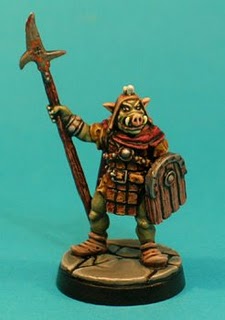
Miniature from Otherworld Miniatures, painted by Richard Scott.