Venatia – the Bell Tower

And another six to whet the appetite.

Part One | Part Two | Part Three | Part Four | Part Five

1006. Luinel is a mid-sized village of about 40 thatched huts surrounded by a picket of pointy sticks and a tangled thicket. The villagers mostly work as woodsmen, but they also keep a few goats, sheep and swine. They are best known, though, for their oxen – powerful beasts with red coats and horns that stretch 4-ft from one tip to the other. These colossal beasts are capable of hauling twice that of normal oxen. The village is governed by a mayor elected by a council of elders and important men and women.

Of particular note is a tall, conical structure in the center of the village. This particular hut is surrounded by a low wall of bright red bricks, with a single opening that is always guarded by an armored man with a masked helm and a stout spear. Inside the hut there is a strange statue, abstract and wretched and hurtful to the eye and soul. The villagers do not allow people to enter the central hut, and when questioned they say only “It is the heart of the village. Can you not hear it beating?” with wide eyes and a look of eerie calm.

While adventurers are welcomed into the village, there is no inn, so they will have to sleep with different families. If they show too much interest in the idol and are of a lawful bent, the families will murder them in their sleep and drag their corpses to the hut, where they will have disappeared by the next morning. The villagers have the abilities of 3rd level assassins when given a mission by their idol. It is said that when a body is given over to “the heart”, that a new red ox appears in the communal pen.

1025. A small family of four hill giants scrapes out a living in the surrounding hills by hunting big game. The cavern holds a towering kiln that the giants use as a hearth for roasting meat. Tucked into the ashes of the kiln there is a sinister magic dagger called the Tooth of Vexus. The Tooth of Vexus is a +2 dagger. Vexus was a potent wizard in these hills some 300 years ago, but not many folks now remember him, primarily because he died in the process of creating a powerful spell to wipe away memories. C’est la vie! Once per day, the holder of the dagger can cast a spell that automatically nullifies saving throws against it.

| Hill Giants: HD 8+2 (42, 40, 36, 30 hp); AC 4 [15]; Atk 1 weapon (2d8); Move 12; Save 8; CL/XP 9/1100; Special: Throw boulders.

1032. There is a bell tower here constructed of dingy, yellow-brown stone. The tower is set on a grassy sward grazed by wild ponies and appears to be abandoned. Careful observers might note that the floor of the bell tower is a spiral of narrow stones. The bell has no rope, but if one manages to ring it, they will cause the spiral floor to turn into a winding spiral stair that leads down to a hexagonal room. Three walls of the room hold a mirror and are painted in a primary color (red, blue or yellow), as opposed to the other walls which are painted black. The mirrors appear to be normal, but if touched prove to have no substance to them. They are, naturally, portals. Each one has a frame of gold set with gems – one with topaz, one with aquamarine and the third with tiger’s eye. Should any of the mirrors be touched, a magic mouth will appear on one wall and say “I shouldn’t do that until you have heard the riddle” in a somber, throaty bass.

At this, a second mouth appears on a different wall and, in a crisp, clear soprano, says, “Choose the picture fair, of fire and light, always bright, small as a snail but containing all there is to see.”

If one answers “The Eye”, a third mouth appears and says, in a soft, quiet voice, “Then what are you waiting for, the master awaits!”

Naturally, the tiger’s eye mirror leads to the under-ground stronghold of Mikelroy the Irregulous, a wizened old sorcerer who specializes in spells of transportation. The aquamarine mirror is one way, and leads to the Land of the Dead. The topaz mirror is also one way, and leads to an alley in Antigoon.

Mikelroy the Irregulous’ home is a round chamber 500-ft in diameter divided by dozens of arches hung with thick, white curtains. Within are living chambers, a library of invisible books (seven volumes, mostly concerning the magic of teleportation, but also a few travelogues of the dimensions) and a laboratory. Several rooms hold bizarre, alien animals in cages – mostly avians of many kinds, including a fairly enraged mi-go in temporal stasis.

Mikelroy has one apprentice, a bestial young woman with a flat nose and flared nostrils, a beetling brow, large, brown eyes, floppy, pointed ears and vestigial horns. Mikelroy will introduce her as Pencella, whom he rescued from a labyrinth.

Mikelroy is a pleasant sort, but distant and overly flashy. He is especially interested in finding a way into the dungeon in [1339].

| Mikelroy, Magic-User Lvl 12: HP 29; AC 9 [10]; Save 5 (3 vs. spells); CL/XP 14/2600; Special: Spells (6th). Silver dagger. Old man with sharp, blue eyes and long, silky hair of grey. He is graceful in build and manner, and wears a flowing white robe that trails several feet behind him and is held aloft by three brass, mechanical crabs.

| Pencella, Beastman Magic-User Lvl 2: HP 2; AC 8 [11]; Save 15 (13 vs. spells); CL/XP 2/30; Special: Spells (1st). Dagger.

1041. A pleasant shoal of white sand stretches almost a mile into the sea here. Though often submerged, at low tide it can be traversed, and one might spot a gleaming statue at its furthest point. The statue is studded with glistening white shells, and appears to be a woman, her arms thrown back, her shoulders forward, her eyes fixed on the horizon. The statue was constructed at some point in time by sea folk, and is an idol of Calypso, a nereid and minor goddess of death. By night, the waters around the idol are thick with enticing asrai.

1105. A wily old kelp dragon, the remains of the honorable Yostifrix, haunts these waters, always on the prowl for a wayward barge of revelers to be overturned and devoured. The dragon’s bed contains three large, rusty chests containing 2,470 sp, 1,200 gp and a large, jagged sard worth 10,000 gp.

| Yostifrix: HD 10 (42 hp); AC 1 [18]; Atk 1 bite (2d6); Move 12; Save 5; CL/XP 14/2600; Special: Breath weapon, level drain, squeeze.

1118. The orc warlord Gorthruk has established a permanent camp here. The camp is built atop a tall, flat hill and consists of a wooden palisade and two tall, wooden watch towers. Gorthruk has worked for the hobgoblins of the Klarkash Mountains in the past, but now has set his sights on conquering Blackpoort. Gorthruk controls 700 orcs and has sent emissaries to the orcs of the central hills to secure an alliance. His warbands patrol the area around this hex constantly, and are encountered on a roll of 1-3 on 1d6.

Treasure: 900 gp, a platinum music box encrusted with gems (5,000 gp, mechanism needs repair) and a gold medallion (1,000 gp).

| Gorthruk: HD 8 (40 hp); AC 4 [15]; Atk 1 battle axe (1d8); Move 9; Save 8; CL/XP 8/800; Special: None. Chainmail hauberk, battle axe, dagger, the Eye of Balor. The Eye of Balor is a pendant worn around Gorthruk’s neck. It allows him to bestow a curse once per day as a 10th level magic-user.

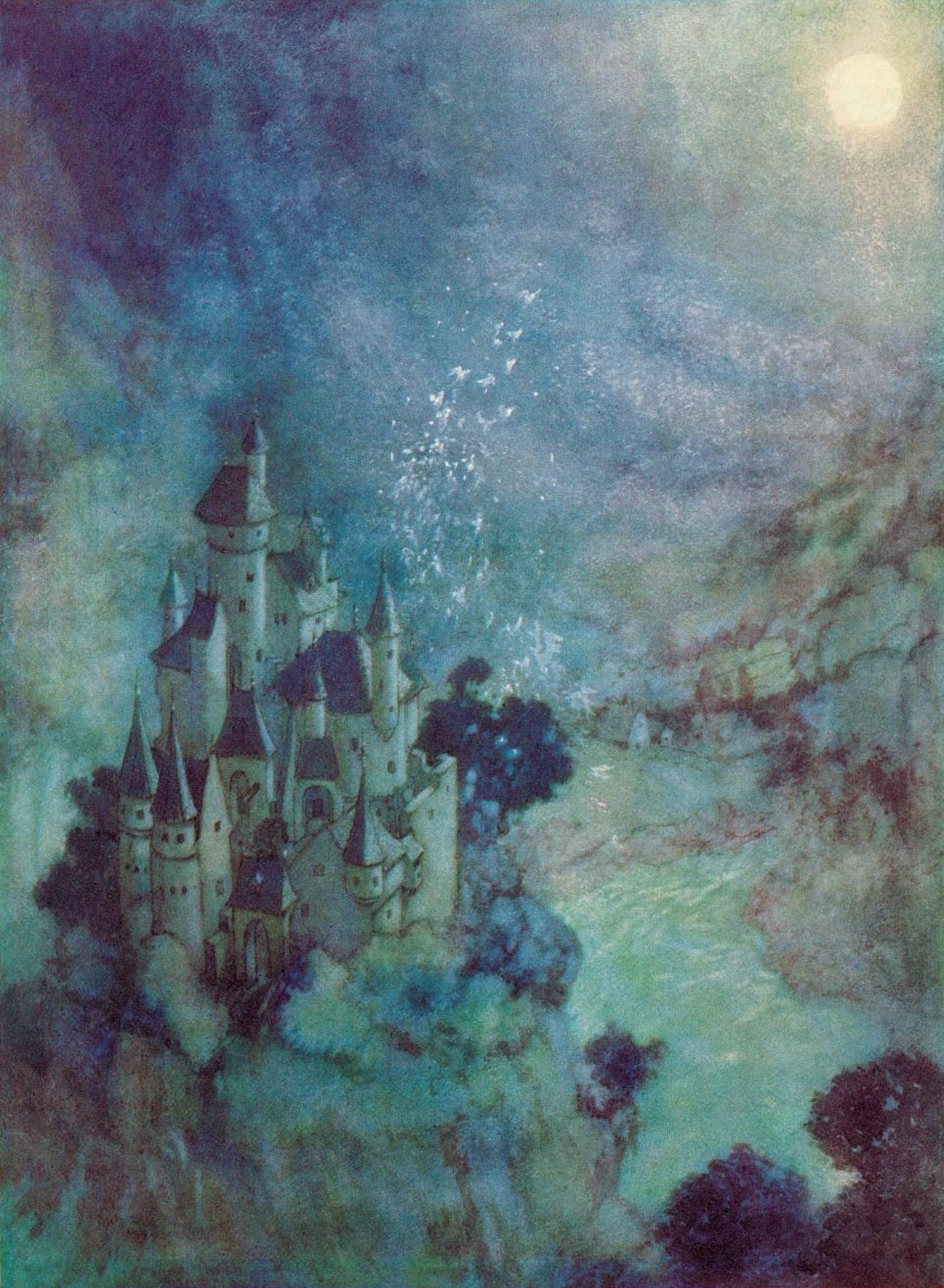
Illustration by Edmund Dulac, via Golden Age Comic Book Stories.

Venatia – Raldo’s Head and Terribles Visages

Six more wilderness encounters for you to enjoy. Also – if you’ll peruse the Sept 30 news at Frog God Games, you will see that yours truly has been tasked with writing some hexcrawl modules. The modules are not set in Nod, and are meant to be usable in just about any fantasy campaign. The first module is written, and is now in the process of illumination and editing.

Part One | Part Two | Part Three | Part Four

0603. Here lies the head of Raldo. Raldo’s head measures 8 feet in diameter. It lies in a gully thick with ferns and rotting vegetation and itself is in a state of advanced decay. Despite the presence of dozens of giant centipedes consuming the head and crawling through it, Raldo thinks and speaks and can be consulted as though a sage. Raldo does seem to feel pain, but it doesn’t appear to consume him.

0620. A pack of four dragonnes roams these valleys, preying on the pale, gibbering things that scurry from boulder to boulder and cave to cave. Encounters with them occur on a roll of 1-3 on 1d6.

0628. A terrible image is carved into a mountain here. It depicts a squatting, vaguely humanoid shape. The thing’s head is a mass of tentacles that spread out over the mountain side and its stunted arms end in taloned hands. From beneath the squatting horror, which is at least 100-ft in height, a stream of water rushes out of the side of the mountain to fall into a deep, dark pool. The water has an oily sheen, and smells foul, but is otherwise safe enough to drink. The ground around the pool is often visited, and at night, random encounters with hags occur on a roll of 1-3.

0638. On a pleasant hill overlooking the river valley the gnomes of the hills have constructed a small, stone chapel dedicated to the goddess Minerva in her aspect as the goddess of crafts. The chapel is overseen by a lone priestess, a woman named Kothilda. Kothilda is a woman deformed by disease and abandoned as a child on the coast. Discovered by gnomes, she was raised among them and showed an astounding capacity at their crafts. As she grew to womanhood, they constructed this chapel and dedicated it to the human goddess they believed had blessed the child with her skill at woodworking. She now lives here along, often entertaining the good folk of the forest. The chapel has a single room furnished with an ornate kneeling bench and idol of Minerva that were carved by Kothilda’s own hands, and a simple wooden bowl for donations (she prefers items rather than coins, and people who leave items they have crafted themselves are Blessed by Minerva for 24 hours. Behind the chapel is a gnome-style burrow built on a human scale. This is where Kothilda lives her simple life. It is equipped with a hearth, woven rugs, comfortable chairs and has a small bedroom and a root cellar.

| Kothilda, Cleric Lvl 10: HP 47; AC 9 [10]; Save 6 (4 vs. paralysis and poison); CL/XP 13/2300; Special: Cleric spells (5th), turn undead.

0707. This hex is notable for its large, rolling meadow of tender grass and fragrant blooms. A large fairy circle is evident on the meadow, and it is visited on each full moon by a gaggle (4d6) dancing, fiddling grigs and other fey creatures. In the daytime, it is thick with game and the occasional hunting party of centaurs.

0809. A retired trader from Pfeife has repaired and rebuilt an old stone fort here and turned it into a coaching inn. The inn has a 15-ft tall curtain wall surrounding an oval courtyard with a well. Blending into the wall is a three-story tall round tower topped with crenelations and a tall, conical bell tower. The trader, Androse, lives with his wife and three children on the top floor, beneath the belfry. The second level is a common room for sleeping and the ground floor is a taproom in the day and common room at night. The taproom has two curtained booths which turn into semi-private sleeping berths at night. Androse and his goodwife put out a bountiful spread for their customers, with steaming trays of spiced meats (mutton and game mostly), crocks of soft cheese, wheels of sharp cheddar, round loaves of black bread and fruit cake and leather mugs of pale, sweet ale. Expensive wines are available on request. All of the food is stored in the cellar, which used to hold instruments of torture but now has cages full of wine casks and barrels of flour.

Illustration by Sidney Sime

Venatia – Seaxel, Nimroth and Walgirth

Six more encounters from Western Venatia.

Part One | Part Two | Part Three

0432. The river here meets strong, ancient rocks and divides into hundreds of little waterfalls, playful streams and pleasant pools before re-combining into the river that flows into [0333]. Ample evidence around these pools suggests that the area was once visited often by the ancient elves and gnomes – wooden gazebos so delicately carved that they could only have come from a fey hand, discarded goblets, tattered scarves of spider silk, etc. The area is now infested by giant water wasps, who perhaps caused the olden folk to quit the area in the first place. Encounters with water wasps occur with groups of 1d6 insects on a roll of 1-4 on 1d6.

| Giant Wasp: HD 4; AC 4 [15]; Atk 1 sting (1d4 + poison), bite (1d6); Move 1 (Swim 12, Fly 20); Save 13; CL/XP 6/400; Special: Paralyzing poison, larvae.

0433. Seaxel is a small farming village on the banks of the river. Its sister village and rival, Nimroth, is on the other bank in [0434]. The Seaxels and Nimroths are descended from the serfs who served the elven families of the same names, families that despised one another and competed in all things for the attention of the Emperor Finrix. Whether hunting, racing, poetry or war, the Seaxels and Nimroths were always out to best one another. The lords of the manors, who only took residence in them when the Emperor was summering in Amvianda, accompanied Finrix to his war in the west and were never heard from again. With the emperor gone and the great families gradually dispossessed, the serfs eventually came to rule them-selves, putting decisions to a vote or following the wise counsel of one or another elder. But even though they were rid of their masters, the old enmity has gone on unabated. The Seaxels raise gourds, grapes and fields of barley. The 15 soldiers of the village dress in old-fashioned mail hauberks and carry the tall, Norman-style shields of the old elven legions. They arm themselves with spears and thick daggers.

0439. Nimroth is a small village of woodsmen, lusty rascals with a mean streak when gold and silver are up for grabs. They loath the people of Seaxel (see 0433 above). Nimroth’s warriors wear leather armor and carry long bows and battle axes. They have the services of a healing woman called Hallya, a freckled woman of thirty-three summers.

0502. A misplaced foot might send a character (1 in 6 chance) through a 20-ft deep hole into ancient elfen catacombs. The catacombs are crudely fashioned, and in fact any dwarf will declare them to be the work of goblins, the usage by elfs coming sometime after they were first dug. Within the maze-like catacombs are dozens of bricked up alcoves containing the remains of elf and human legionnaires from Nomo. While three of the alcoves contain but a single elf corpse, the others are stacked high with human skulls. Apparently, the catacombs were a goblin redoubt taken with much loss of life. The three elf burials are as follows:

Walgirth, an elf baronet interred with his family armor (mail hauberk, winged nasal helm, Norman-style shield) and his long sword (+1 weapon, growls in the presence of goblins and forces the owner to pass a saving throw in the presence of goblins, hobgoblins and bugbears or attack until he or the goblins all lie dead). Walgirth’s alcove is trapped with a flurry of darts (2d6 damage, save for half).

Inidubrid, a warrior-maiden (possibly a paladin) interred in her gleaming plate armor (un-rusted) and her crescent shield bearing intertwined doves. Her spear is a +2 weapon and is lodged through her rib cage and can only be drawn from the stone by a chivalrous character. The spear is haunted by her spirit, and will scold the bearer of the spear with electrical shocks (1d6 damage) when they behave un-chivalrously. Despoilers of this tomb will be marked for destruction by servants of Law until they make penance at the temple of a high priest of Law.

Galaddus, captain of archers. Galaddus was a drinking man in life, and in death he still holds court with a dozen shades of his former comrades. Galaddus’ mouldering corpse, still wearing the remains of his ring armor, his yew longbow close at hand, sits atop a barrel of spirits, shadows flitting about him, their umbral goblets raised to receive a splash of “the wine of ages” from a dusty bottle. Visitors are invited to have a drink, or chased away if troublesome.

0531. The burnt remnants of a stockade lie here, about one mile east of the river. Broken hobgoblin arrows are plentiful, but not a single body remains in the place. The walls of the stockade are in good enough shape that, if the gate is repaired, it can provide a fairly safe camp.

0539. A tiny cave overlooking the river serves as the sepulcher of a small gnome child, perhaps a prince. The cave is natural save for a single circle on one wall that has been ground smooth and painted with loving portrait of the large-eyed child. A small, soapstone altar rests beneath this portrait, covered by the stubs of candles and dried flowers. There is no treasure here, and the body is well buried, but the sepulcher remains a holy spot and a refuge from evil. Characters of a wicked bent find themselves unwilling to enter into the place without first throwing themselves to their knees and shedding a tear of remorse.

Venatia – Ubues and Allips

Six more encounters from Western Venatia.

Part One | Part Two

0303. A clan of fourteen ubue dwell here herding ill-tempered sheep with onyx horns. The ubue dwell in a large, dry cavern, trapping the entrance with falling stones (save or 3d6 damage). The ubue sleep with their sheep in the main cavern, with a smaller, higher cavern serving as the lair of their chief, a robust figure of abject savagery called Kin-Toka-Rok. The ubue have visited the Gallery of Bones in [0308], losing two of their number there and re-sealing the cave.

Treasure: 1,600 sp, 1,350 gp, a brass locket worth 100 gp (hold a rolled up piece of paper with the word “ZAMAX” written in elven) and 2 casks of olive oil (12 gal., 100 lb each, worth 60 gp each).

| Ubue: HD 3; AC 6 [13]; Atk 3 slams (1d6); Move 9; Save 14; CL/XP 3/60; Special: Argue.

| Kin-Toka-Rok: HD 5; AC 5 [14]; Atk 3 slams (1d8); Move 9; Save 12; CL/XP 5/240; Special: Argue.

0308. The Gallery of Bones is a large, low-ceilinged cavern sealed by massive boulders. Centuries ago, when the legions of Nomo were marching into the Rooky Wood, they encountered a plague that there physics and priests could not counter. As company after company of men succumbed, their commander, Valbestos, made a decision. He gathered the afflicted in this cavern and sealed it with a landslide as he listened to the dying men screaming for mercy. The cavern is now filled with bones, old military equipment (shorts swords, darts, spears, shields, chainmail and leather armor) and four allips, the tormented, undead souls of the lead legionnaires.

| Allip: HD 4 (20, 20, 18, 16 hp); AC 5 [14]; Atk 1 strike (no damage, 1d4 points of wisdom lost); Move Fly 6; Save 13; CL/XP 7/600; Special: Drains wisdom, hypnosis.

0313. Ystam is a tiny village of trappers constructed atop a granite dun at the intersection of two rushing streams flanked by wolfberry bushes. The trappers have carved a rugged little stair from their village to the canyons below. The village is surrounded by a little stone wall patrolled by a garrison of elves from the tower of Elbernulph [0113]. The garrison numbers 20 elf warriors in chainmail and armed with claymores. The village is ruled by Elbernulph’s reeve Cirioch. The villagers are supported by a blue eyed armorer named Arthaa. Cirioch dwells in a short, stone tower attached to a more traditional wattle-and-daub, two-story cottage. His house is protected by ten skeletons that he controls using a gold medallion. The villagers live in little huts and are often visited by a druid called Talotam, who leads them in secret worship of Diana. The Chimereans demand the worship of Vulcanus of the Mailed Fist, the patron deity of Galardis. A work gang of Azer are presently constructing a fortified chapel of Vulcanus. The villagers resent the elves and the arrival of their “foreign” deity.

| Cirioch, Elf Lvl 2: HP 12/7; AC 4 [15]; Save 13/14; CL/XP 3/60; Special: Elven chainmail, two-handed sword, dagger, spellbook, medallion allows him to command undead.

0326. A carcolh dwells in a lofty cave in this hex, sending its tendrils far into the countryside in search of prey. The carcohl is described in more detail in NOD #4 or on the Land of Nod blog. Treasure is pushed to the fringes of the cave, the refuse of past meals.

Treasure: 310 ep, 430 gp, a little limestone idol of the arch-demon Furfur worth 165 gp, a brass urn worth 1,000 gp and dust of sneezing and choking in a leather pouch.

| Carcolh: HD 9 (49 hp); AC 4 [15]; Atk 1 or more tentacles (1d4 + grapple) or 1 bite (2d6); Move 9; Save 6; CL/XP 11/1700; Special: Tentacles, swallow whole.

0335. A waterfall of reddish water pours from a cliff into a wide, shallow pool. The pool is inhabited by a fossergrim, the spirit of the waterfall. Behind the waterfall is a large, conical cave that leads into a damp, slimy tunnel (saving throw to avoid falling and sliding down the tunnel). This tunnel empties into a muddy cave with two exits. The left-hand exit leads upward to a series of caverns that eventually open to the top of the cliff above, and show signs of having once been well traveled by animal caravans. The right-hand exit leads to a winding tunnel and the cavern of Harzh, a youngish green dragon just beginning to build her horde and roosting on three large, beryl eggs. Harzh can neither speak or cast spells.

Treasure: 2,820 gp, a large rock crystal worth 900 gp and 3 pounds of zedoary in a wooden box (worth 320 gp per pound).

| Harzh: HD 8 (32 hp); AC 2 [17]; Atk 2 claws (1d6), bite (2d10); Move 9 (Fly 24); Save 8; CL/XP 10/1400; Special: Breathes poison.

0346. A cove here holds a pool of water. A rusty iron door blocks access to another cavern holding the remains of Grindir, a pirate lord from Tremayne who passed away almost 80 years ago. The door is trapped but not locked, and is cold to the touch. If opened, three spears in a triangular formation springing up from the ground to skewer thieves. The skeleton of a thief lies before the door. The actual tomb holds the body of Grindir in a black, silk coat and still adorned with jewelry. The corpse and most of the cavern are covered in yellow mold. A moonstone worth 35 gp is lodged in the corpse’s eye socket.

Treasure: 2,000 sp, 640 ep, 640 gp and a turquoise worth 155 gp.

| Yellow Mold: HD n/a; AC n/a; Atk 1d6 damage + spore cloud; Move 0; Save n/a; CL/XP 3/60; Special: Poisonous spore cloud, killed by fire.

Venatia – Cavemen and Blink Dogs

Here are six encounters for Western Venatia – hot off the presses – and the accompanying map.

0110. A crooked little stream flows from a high cave, forming a noisy little waterfall. The banks of the stream are bare of life because the stream is quite poisonous. The stream flows from a grotto, the walls and ceilings of which drip with poison. Well worn steps in the living stone protected by a large cave eel lead from the grotto to a little cavern, wherein dwells Eiois. Eiois is a bitter elven woman with eyes that stare like death and a once-pretty mouth whose corners have become down-turned. Eiois is a priestess of Eris, goddess of discord. Eiois worships at a jade altar that holds a crystal ball, through which she randomly curses powerful men in the region. She recently became infatuated with Fortunato, the Prince of Antigoon, and her fascination has caused her to plot against his enemies. She is now in a rage since the ball was stolen by a sneak thief (now deceased), who dropped his treasure in [0122].

Treasure: 2,000 sp, 230 gp, banded agate worth 900 gp and jasper worth 800 gp.

| Eiois, Cleric Lvl 6. HP 21; AC 9 [10]; Save 10 (8); CL/XP 8/800; Special: Spells (4th), rebuke undead. Threadbare silk gown, silver dagger, crooked wand that poisons with a touch. Eiois has an aquiline nose and noble bearing, deepy bitter.

0138. Vhalla is a small village of common farmers living in wattle & daub cottages surrounded by a bulwark of packed earth. Four wooden watch towers overlook the fields as far as the woods. The farmers are thickset, with nut-brown skin and aquiline noses. The men of Vhalla keep nimble forest cattle and grow cabbages and chanterelle mushrooms. They are an athletic people, holding games each summer to honor the gods, and are fine archers. Vhalla is ruled by the Lady Reana, who traces her line back to the elfs of old. Vhalla has the services of Ancho the Bowyer. The villages militia are armed with farm implements, and Reana employs four ogres from the mountains as her personal guard. In their off hours, the ogres challenge all comers to fights in a deep, brick pit near the village square and in sight of the gallows.
| Reana: HD 5 (19 hp); AC 3 [16] armored; Atk 1 sword (1d8); Move 12; Save 12; CL/XP 5/240. Elven chainmail, shield, longsword. Sharp featured but less so due to her girth, pallid skin, black hair and amber eyes. Precise mind, but a tad eccentric. Fancies herself a natural philosopher.

0147. A herd of 20 hippocampi graze the seaweed here. The leader of the herd is a stallion that once served as a paladin’s steed. Though his master is dead, the stallion still serves the cause of chivalry.

0233. One might find an ancient plaza here, now overgrown with saplings and ferns. In the center if the plaza is a large, malachite fountain decorated with tarnished brass hinds. The fountain is cracked and dry, and all that remains of the ruined town surrounding the fountain and plaza are crumbling foundations, a few shards of pottery and rusted utensils and tools. Should someone polish the brass sculptures and whisper a prayer to Diana, the fountain will come alive and a large falcon will soon appear in the sky, spiraling down until it lands on the edge of the fountain. This wise bird will answer a three questions (per Contact Other Plane) for the person who prayed.

0301. Cavemen of the lion clan live here in a large complex of caves. The 70 cavemen and their families are exceedingly primitive, arming themselves with clubs. Their lair contains a crude idol of a cave lion adorned with a cave lion pelt worth 150 gp. The cavemen are led by a boisterous man called Yok and his four brothers, Pudo, Kord, Gontor and Joro.

| Yok, Barbarian Lvl 5: HP 30; AC 7 [12]; Save 11; CL/XP 5/240; Wears a gold ring worth 1,000 gp given to him by Cadfani to seal a pact of friendship.

| Yok’s Brothers: HD 3 (17, 12, 8, 5); AC 7 [12]; Atk 1 club (1d6); Move 12; Save 14; CL/XP 3/60.

0339. A pack of 10 blink dogs hunts these woods. They detect the presence of intruders into their territory on a roll of 1-4 on 1d6, and will track intruders to make sure they mean no harm.

Venatia – Introduction

I’m juggling four projects right now, but I finally finished the intro to Western Venatia, the sandbox slated for NOD #6 in December.

I. Overview
Venatia is a region of woodlands and hills nestled between the Klarkash Mountains in the west and the Great Yamas in the east. Once dominated by the Nomo Empire, it is now home to several competing city-states, the largest being Lyonesse of the Gleaming Towers, heir apparent to Nomo. Other city-states in the region include Antigoon, heart of a mercantile network that stretches across NOD, and Blackpoort, a city of ne’er-do-wells on the shores of Blackmere.

Pandiluvian Age
During the Pandiluvian Age, Blackmere was connected to the Tepid Sea via a narrow, rocky channel. The Klarkash Mountains constituted the major landmass of the region and supported dozens of ophidian citadels, while the remainder of Western Venatia consisted of swampy, mosquito-ridden islands. The elder races constructed cities beneath the Tepid Sea while one tribe of aboleth constructed a maze-like fortress in the depths of Blackmere.

When the waters receded from the landscape, Western Venatia took on its modern appearance. The aboleth were trapped in Blackmere and very few still survive, while the heights of many a submerged city in the Tepid Sea were exposed. Lizard men moved into the swampy valleys and canyons and constructed cliff cities and magnificent ziggurats to Tiamat, the Mother of Monsters. Unlike the eastern lizard men, who formed the kingdom of Karzak, the western lizard men maintained small, feudal towns that warred incessantly. The ophidians were forced to seek shelter deep beneath the earth near volcanic vents as the Klarkash Mountains cooled.

Golden Age
As in Eastern Venatia (see NOD #4), the human slaves of the lizard men rose up and destroyed their masters, founding a number of farming and fishing villages. Where the lizard men preferred the valleys, the humans constructed their lairs on hilltops and worshiped the sky (i.e. Jove) rather than the sea. Many humans lived in the woodlands as hunter-gatherers, and persist to this day as wild men of the woods.

The human villages never amounted to much, and thus dozens of humanoid tribes (orcs, gnolls, goblins and hobgoblins) were able to establish themselves in Western Venatia.

Modern Age
The Modern Age was initiated with the coming of the legions of Nomo. Legion XXXI descended into the Rooky Wood from Chimeria in the Klarkash Mountains and established the forts that would become Morrow and Pfeife. Legion XXXI became bogged down fighting the goblins and spiders of the woods, and went no further. In the meantime, Legion XIV arrived from the south (after securing Brigandy’s tribute via a marriage between the son of Corundus, legion commander and the niece of Queen Gloriana, who reigns to this day), constructing the old fort at Antigoon and then moving up the Swiven River. Legion XIV would found Blackpoort and Lyonesse on their way to carving out what become known as the Westerling Empire, subservient to Nomo but always threatening revolt.

With the fall of Nomo, the city-states of Western Venatia enjoy independence. Tristram, the king of Lyonesse, fancies himself a contender for the imperial crown, and would very much like his agents to find the lost relic that he may claim the title. Antigoon and Blackpoort, meanwhile, arm themselves for the eventual struggle with Lyonesse, for they wish to remain independent.

II. Regions

Blackmere
Blackmere is a large, fresh water lake that empties into the Tepid Sea via the Swiven River. Blackmere is a shallow lake with crystal clear water; passing ships have no trouble spotting the ruins that lie beneath the water, though the predators of the lake have adapted camouflage in the form of black skin or scales. The eastern shore of Blackmere is treeless and interrupted by rocky gullies the pour in frothing, freezing water that originates in the Klarkash Mountains and rushes through the wooded canyons of the Rooky Wood. The western shore is choked with massive, black oaks and willows. The bottom of the lake is covered in smooth, black stones and large forests of bright, green kelp that hide the stone houses of the lake goblins.

Dreadful Forest
The Dreadful Forest is thick and dark, consisting mostly of evergreens (spruce, pine) and brambles. More information on the Dreadful Forest can be found in NOD #4.

Forest Perilous
The Forest Perilous is an ancient woodland of oaks, hawthorns, and willows. The trees here are gnarled and twisted and prove very difficult to traverse. Many small, quick streams flow through the woodland. Forest paths are almost always twisted and useless; most end in traps set by ogres or pixies. Light in the woodland is never better than twilight.

The Forest Perlous surrounds the city-state of Lyonesse. Some suggest that only the devotion of the Lyones to Ceres keeps the forest monsters at bay.

Gaestly Hills
The Gaestly Hills are an expanse of rough highlands studded with ancient barrows and burial chambers. Most of these burial sites were cleared by adventurers over the last 100 years, their treasures plundered and their secrets revealed, but a few remain untouched. The Gaestly Hills are rich with iron and silver deposits. They also support a good deal of game, and make adequate pasture for sheep and goats.

The hills are dominated (if anything can be said to dominate the bleak, mossy landscape) by the city-state of Blackpoort. Blackpoort is the main southern port on Blackmere, and handles goods coming from exotic Mu-Pan by the Jade Road via the Venatian League in the north.

Grete Myre
The Grete Myre is a thick, wooded swamp stalked by reptilian savages. A few bold human renegades dwell in the swamp, often hiding from the authorities of Antigoon. These “myrefolk” supply the alchemists of Antigoon with rare herbs and animal specimens.

The myre is bordered to the north by the Gaestly Hills, to the east by the Dreadful Forest, to the west by the Nybling Hills and the the south by Biscotti Bay, an arm of the Tepid Sea. The principal settlement of the Grete Myre is Antigoon, which dominated the moors that rise on the border between the myre and the hills.

Klarkash Mountains
Ancient and wicked, the Klarkash Mountains separate Venatia from Umbriago, the cradle of Nomo. The mountains are tall and have molded by the wind into great lumps of limestone divided by deep, lightless canyons. These canyons are home to fungal horrors and depraved fairy folk, as well as a few rugged clans of wild men and several hordes of hobgoblins.

The western mountains that border Venatia are a bit less severe than the eastern reaches, and even support stands of silvery beeches and coppery grass on their ledges.

Nybling Hills
The Nyblings are wooded hills that extend from the Tepid Sea to the Klarkash Mts. They have a pleasant climate and are mostly covered with oak trees. The local “barbarians” include gnomes, kobolds, svarts and bugbears. The northern portion of the hills is settled by Antigooners and has many trails connecting manors and strongholds. The remainder of the woodland is quite wild, with the southern reaches dominated by trolls.

The hills were once the hunting preserve of the Nomo’s Emperor and his clan. He constructed his summer palace, Amvianda, in the hills and each year hosted a glorious bardic college. Amvianda is now a lonely beacon of civilization in the midst of the wilds. Patrols of rangers do their best to keep the town safe and maintain communication with the outside world, but they are hard pressed. Since the fall of the Emperor, the chamberlain of the palace has been the defacto ruler of Amvianda, and he has proven to be less than capable in the role.

Rooky Wood
The Rooky Wood was the last portion of Venatia brought under (loose) control by the legions of Nomo. It consists of a number of narrow, winding canyons shot through by fast, icy streams that empty into Blackmere. The badlands support hardy, evergreen trees and brambles and are haunted by arachnids and goblins. The forest was once home to demon worshipers, who summoned many fiends in the days of old. Shrines to demon princes can be found in the woods, and often they bear signs of recent use.

Tepid SeaThe Tepid Sea is thoroughly described in NOD #1. We will note here that it is a shallow, blue-green sea and home to mermaids, sahuagin, tritons and undines. A good deal of commerce goes through the Tepid Sea to Mother Ocean, much of it to or from the city-state of Antigoon. The two other major ports on the Tepid Sea are Tremayne and Ophir (which appears in NOD #2).

III. Random EncountersRandom encounters should be diced for twice each day, once in the daytime and once at night, with dangerous encounters occurring on the roll of 1 on 1d6 and traveler encounters on the roll of a 6 (see below).

Travelers
1-2 Men-at-Arms (6d6)
3 Pilgrims (3d6)
4 Refugees (9d6)
5-6 Traders (2d6)

Blackmere
1 Aquatic Hobgoblins (6d6)
2 Aboleth Thralls (6d6)
3 Nixie (6d6)
4 Privateer (6d6)
5 Raven, Giant (3d6)
6 Kelpie (2d6)
7 Cathbad (1d8)
8 Scrag (1d8)
9 Ghost (1d4)
10 Afanc (1)

Dreadful Forest
1 Carnivorous Flying Squirrel (6d6)
2 Wild Man (6d6)
3 Lizardman (5d6)
4 Giant Lizard (4d6)
5 Black Bear (3d6)
6 Noroob (3d6)
7 Ogre (3d6)
8 Baccae (2d6)
9 Firedrake (2d6)
10 Pseudo-Dragon (2d6)
11 Woodwose (1d8)
12 Hill Giant (1d6)

Forest Perilous
1 Brownie (6d6)
2 Elf (6d6)
3 Wolf (5d6)
4 Ogre (3d6)
5 Dryad (2d6) or Nymph (2d6)
6 Satyr (2d6)
7 Wraith (2d6)
8 Actaeon (1d8)
9 Treant – 7 HD (1d8)
10 Dragon – Green, Adult, 7 HD (1d6)
11 Leopard (1d6, attack with surprise)
12 Unicorn (1d6)

Gaestly Hills
1 Bandit (6d6)
2 Orc (6d6)
3 Wolf (5d6)
4 Ghoul (4d6) or Ghast (2d6) or Ghost (1d6)
5 Falcon, Giant (3d6)
6 Lycanthrope – Were-rat (3d6)
7 Ogre (3d6)
8 Vierd (3d6) or Wight (2d6)
9 Bat, Giant (2d6)
10 Owlbear (2d6)
11 Cockatrice (1d8)
12 Hill Giant (1d6)

Grete Myre
1 Giant Leech (5d6)
2 Lizardman (5d6)
3 Thugtoad (5d6)
4 Crocodile (4d6)
5 Zombie, Leper (4d6)
6 Giant Frog – Large (3d6)
7 Harpy (3d6)
8 Noroob (3d6)
9 Giant Dragonfly (1d6)
10 Hydra (1d4; roll heads randomly for each)
11 Shambling Mound – 9 HD (1d3)
12 Froghemoth (1)

Nybling Hills
1 Badger – Giant (4d6)
2 Black Bear (3d6)
3 Bugbear (4d6)
4 Bulette (1d4)
5 Giant Owl (2d6)
6 Giant Weasel (2d6) or Wereweasel (2d6)
7 Gnome (6d6)
8 Highwayman (3d6)
9 Kill-Bunny (5d6)
10 Kobold (6d6)
11 Troll (1d8)
12 Wolf (5d6)

Rooky Wood
1 Aranea (1d8)
2 Bugbear (4d6)
3 Cave Bear (1d8)
4 Drider (1d6)
5 Ettercap (2d6)
6 Forlarren (2d6)
7 Forester’s Bane (2d6)
8 Giant Spider – 4 ft (2d6) or Phase Spider (2d6)
9 Goblin (6d6)
10 Hobgoblin (6d6)
11 Imp (1d8) or Quasit (1d8)
12 Quickling (1d8)

Tepid Sea
1 Locathah (6d6)
2 Pirate (6d6)
3 Mermaid (3d6)
4 Scrag (2d6)
5 Harpy (1d6)
6 Sea Serpent – Gilded (1d6)
7 Shark, Large (1d6)
8 Sea Serpent – Fanged (1d4)
9 Giant Octopus (1d3)
10 Roc (1d3)
11 Sea Serpent – Briny (1d3) or Spitting (1d3)
12 Aspidochelone (1)

NOD Sandbox Format

I’ve posted about this kind of thing before, but now I’m starting to visualize how I want to format my sandboxes in future issues of NOD and future blog previews. My main concern is making the information 1) useful for a Referee during actual play and 2) flavorful and unique enough to keep players interested or fire the imagination of the Referee so he or she can keep players interested. With that in mind, here’s how I might format future sandbox presentations …

REGION NAME
• Description of the area; where does it fit in with other maps
• History of the area – very basic
o Pandiluvian Period
o Golden Age
o Modern Age
• [Basic map showing the regions and naming them, along with stars for city-states and dots for towns]
• [Smaller map showing where this region fits into the larger world map]
• [Welcome to NOD sidebar – quick description of the campaign world and what has appeared before]

Sub-regions

Sub-region 1
• Description – landscape, flora, fauna, minerals; hex movement in the region
• List city-states, major towns, monster tribes and strongholds and their interactions (if any); include mini armorials

• List major dungeons, along with rumors regarding those dungeons

Sub-region 2
• Description – landscape, flora, fauna, minerals; hex movement in the region
• List city-states, major towns, monster tribes and strongholds and their interactions (if any); include mini armorials

• List major dungeons, along with rumors regarding those dungeons

Dangers
• Random encounter tables for the different regions – one table using 1d12; go from weak to strong, so when the Ref rolls a “12” he knows he should chuckle wickedly
• Discuss No. Appearing formula, when to roll, how often to roll, etc.

Tribes
• Picture (head shot – maybe no picture, see how this one goes) of major humanoid types (including berserkers, men-at-arms typical for the region); for each a brief societal description (mostly as pertains to game play), armor and weapons; show hexes where they appear; give tribal treasure guides – coins, art, livestock, magic – main idea is to help make the goblins of Region X distinct (at least a little bit) from the goblins of Region Y
o Give stats for sub-chiefs/sergeants (+2 HD) and chiefs/captains (+4 HD) along with stats for the basic monster type
• Discuss concept of tribal spell-casters (with a basic statblock for level 3, level 5 and level 7)
• Note – Humanoid leaders and spell-casters that have class levels are described in detail in the text
• Give three map templates for different types of lairs – these will change from issue to issue, but always remain basic; label the chambers rather than number them
o Cave Lairs
o Village/Forts
o Camps

Keyed Encounters
• List all of the keyed encounter areas:
o Set-Up (describe the place, the people, etc)
o Twist (why should anyone care)
o Reward (not just treasure, also information, captives to free, XP for discovering)
• For towns and city-states, do sidebars like I do for official city-state write-ups
o Include a little map, very basic, with maybe 3 locations that are quickly described or maybe just given descriptive names
• For “dungeons”, have a black and white map with chambers that are described on the map (“Orc guards with flame throwers”, “slime lake”, maybe a little drawing for fun) and leave rest to the Referee to flesh out [I might not go with this idea – I need to test it out]

Walled village of 100 cantankerous diamond miners ruled by Bob, a flatulent mayor with red hair and green eyes and five lovely daughters. The village has a popular roadhouse run by Beth, a swarthy beauty with a missing eye, that rents private rooms for 5 gp a night and serves an excellent brandy and robust camel stew. The village is defended by 12 men-at-arms in chainmail carrying leaden clubs and darts. The villagers have 300 gp worth of diamonds and mining tools, and keep trained crysmals that they use to find new veins of diamond.

Cave lair of 200 gnolls with a chief called Gronk and 20 sub-chiefs. The gnolls carry battered shields, barbed spears and short bows. They worship an idol of Demogorgon and have a high priestess called Zima. The gnolls have a cursed crystal ball they stole from a traveling magician and know about the secret entrance to the Dungeon of Doom [Hex No.]. The gnolls are allied with the ogres in [Hex No.].

Monastery of Mercurius, the God of Merchants and Travelers. It houses 20 acolytes and adepts and its abbot is Father Frink. The abbey is constructed of purple stone and has numerous towers topped by conical, silver roofs. Its sits on a hill covered with sunflowers and badger burrows. The monastery has a vault containing the shin-bone of St. Blabus which, if kissed, cures disease about 2 out of 6 times (if it doesn’t work, its assumed you’re a creep and you’re beaten soundly and sent on your way). The monastery’s village consists of blah blah blah.

A magical spear is lodged in a crooked oak tree here. The spear has a red shaft and a bronze head and answers to the name ‘Longfellow’. It hums in the presence of warriors with more skill than its owner, and will do its best to get its owner killed so that the more powerful warrior can claim it.

New Monsters
• List all of the new monsters that appear in the text that aren’t easily found elsewhere.
• [Sidebar of new monsters that appear here that first appeared in another issue of NOD]

Pre-generated Characters
• Six (or more?) pre-gens that can be used as a rival party or whatever; use any new races/humanoids unique to the area and classes that mesh with the area, should reflect the region; no levels so they can be scaled as a Referee needs them to be for his game.

Art by Arthur Rackham, 1921

Animal Movement Rates – the British Way!

I was just reading Al Nofi’s CIC at Strategypage, and he showed some information on animal movement rates from Sir Garnet Wolseley’s The Soldier’s Pocket-book for Field Service. Sir Garnet was apparently the inspiration for Gilbert & Sullivan’s “Modern Major General”. I thought these figures might be useful for RPG’ers, at least as a comparison to the overland rates given in our favorite RPG’s. All of the following is drawn from Nofi’s post …


Animal Speed Pack Load Draught Load Work Day
Ass * 4.0 mph 150-175 pds 900 pds 15-16 miles
Camel 2.5 300-600 1000 20
Dog * 6.5 na 160 60 by sleigh
Elephant 3.5 800-1200 8000 15-20
Horse 4.0 250-400 350 15-16
Human 2.5 40-80 120-150 4-8
Llama * 2.5 65-125 na 12-18
Mule 4.0 150-300 500 15-16
Ox 2.2 160-200 300-500 4-6
Reindeer 18 na 300 50-100 by sleigh

Note: Since Sir Garnet didn’t campaign in places where some types of beasts of burden were in common use, we’ve added a few of these, as indicated by an asterisk. Pack Load includes weight of the pack; Draught Load includes that of the vehicle; na, not applicable for military usage.

Thought I add to this – the work days, in NOD hexes, would work out to …

Ass: 2 to 3
Camel: 3
Dog: 10 (by sleigh – impressive)
Elephant: 3
Horse: 2 or 3
Human: 1
Llama: 2 or 3
Mule: 2 or 3
Ox: 1
Reindeer: 8 to 16 (again, by sleigh wow!)

The sleigh pulling animals are quick – could be a good magic item – a sleigh that makes its own snow. We usually went by the rule of thumb of 1 hex on foot, 2 by mount, which isn’t too far off, though maybe 1 hex on foot, 3 by mount is better.

Wilderness Adventures in Literature

I’ve been listening to H. R. Haggard’s King Solomon’s Mines the last couple days while processing data at work. I highly recommend it to Referees whose players are about to embark on a wilderness trek. You can also read it here.

After we get some introductions out of the way, you get to see the process of hiring a wagon, team of oxen and henchmen, and choosing what arms to take along – not to mention an old map that came from a dying Portuguese adventurer.

Once they get moving, you have random encounters with lions and elephants and the problems of food and water while traveling through the desert and mountains.

All good stuff – check it out.

Venatia – Bodbertus and Argis

Okay – probably the last preview of Venatia’s eastern half. Today, I’m covering five city-states located in (or near) the Golden Coast. Now, when I create these sandboxes, the first thing I do is randomly generate the contents of the hexes using a huge excel document I created. Based on the terrain of each hex, the excel document randomly fills it with a monster lair, natural feature, village, stronghold or, very rarely, a city. Well, when I generated Venatia, I got five cities in the northeast quadrant of the map, not including Ibis, which I had pre-placed myself – all part of the fun of random tables.

4223 Bodbertus: Bodbertus is a river port city of 5,000 people. The Bodberters, as they are colloquially called, are related to the chalkeions of the Golden Coast. They have reddish brown skin, broad, round faces with brown, grey or blue eyes and thick, straight hair of pale blond to auburn that they wear braided. They tend to be tall, averaging 6 feet in height.

Bodbertus is constructed in the lush valley of the River Vusk, which eventually flows through the Grete Myre and finally empties into the Tepid Sea. The valley is well cultivated and dotted with manorial villages. The economy is based on mining in the mountains. The city-state’s currency is the wose, minted in gold, silver and copper. The patron deity of Bodbertus is Eris, goddess of strife, contention, rivalry and war.

The city itself has an outer wall consisting of thick earthen ramparts topped with wooden spikes and patrolled by groups of 2d6 militiamen in leather armor and carrying bill hooks, short bows and long knives. There is also an inner wall measuring 60 feet tall composed of granite blocks and strong towers. The inner wall has three gates of thick, laminated pine reinforced with iron. The inner wall is patrolled by men-at-arms wearing chainmail and carrying pole axe, short sword and light crossbow (see below).

The buildings within the city are tall and narrow and constructed of white granite with sharply peaked roofs of green copper or tarred pine. Bodbertus is notable for its lush gardens, graceful architecture, expansive markets (there is a corn market, livestock market, metal market, cloth market and gem market), local fencing schools and dozens of eccentric hedgemages. In fact, there are so many mages in Bodbertus that each city guardsman is equipped with three +1 crossbow bolts, and each sergeant of the guard is equipped with three +1 bolts that cause 1d4 points of lightning damage when they hit.

The city streets follow a radial pattern, and are narrow and twisty. The most celebrated construction within the city-state is its museum of ancient treasures, an octagonal building with thick, granite walls. It contains, behind four permanent walls of force, a collection of royal regalia dating to the ancient and warlike Venatian chieftains of the woods, from whom the Countess traces her descent.

Bodbertus is ruled by a triumvirate of elected prefects, one elected by the guilds, one by the peasantry and one by the nobility. All three prefects are quite corrupt. The prefects are under the control of the Ophelia, Countess of Bodbertus, who rules the city-state’s domain and from whom the triumverate and the city’s guilds gained their charters. Ophelia has a measure of storm giant blood in her veins, making her a sorceress of no mean ability.

Bodbertus’ domain is populated by 45,000 people. The nobility consists of 25 baronets. There are also eight ecclesiastical manors. The country is divided into two shires, each patrolled by a sheriff – Jeovald north of the river and Guennock south of the river. The two men despise each other and vye for the hand of the Countess Ophelia. The city watch consists of 50 men-at-arms and the city-state’s standing army consists of 300 militia, 20 knights and 19 sergeants-at-arms.

• Ophelia, Magic-User Lvl 7; HP 24; AC 9 [10]; Save 9; Special: Spells (4th); Crimson robes, golden coronet, thin, twisty pine wand that can cause one subject to dance.

• Guennock, Aristocrat: HD 3 (19 hp); AC 2 [17]; Atk 1 weapon (1d8); Move 12 (9 in armor); Save 14; CL/XP 3/60; Special: Soldiers are +1 to damage; Platemail, battle axe, dagger.

• Jeovald, Aristocrat: HD 3 (9 hp); AC 1 [18]; Atk 1 weapon (1d8); Move 12 (9 in armor); Save 14; CL/XP 3/60; Special: Soldiers are +1 to hit; Platemail, shield, long sword, dagger.

5013 Argis: Argis is a fading city of the chalkeions. The city is constructed on a low rocky plateau with steep sides overlooking the Dinar River, with a system of pulleys and a fortified mule trail linking the city proper to its docks. The city has thick walls of stone, a number of small gates of beaten bronze and tall watch towers manned by expert crossbowmen. Argis is dominated by is ancient citadel and known for the three mighty aqueducts that bring fresh water into the city from the Sturmdrangs. Argis’ patron deity is Kubeleya, the great goddess of the Golden Sea pantheon.

The streets of Argis are narrow and maze-like, and almost impossible for outsiders to navigate what with the propensity of the locals to set up temporary booths and carts to sell their goods. Almost 7,500 chalkeions are packed into Argis’ tall, narrow, tower-like buildings. The buildings of Argis are made of fired red brick with dome-like bronze roofs. The city-state is built around a number of medicinal hot springs, and features a multitude of baths.

Argis is also known for its well-stocked shops (and outrageous prices), medicinal gardens, its brotherhood of druids and rangers that comb the hills for monsters and the fact that almost every surface of every wall and building is covered with mosaics or grotesque terracotta sculpture.

The streets are patrolled by a total of 75 hoplites in archaic armor (treat as chainmail) carrying long spears with black shafts, short swords and crossbows.

Argis has a massive temple dedicated to Kubeleya and her consort, the fertility god Atys. As one of the last cities of the chalkeions, it supports temples to Kotys, goddess of the moon, lust, revelry and the hunt, Sabazios, the cthonic horseman, Zalmoxis, the thunder god worshiped by berserkers, Dionysus (who the Motherlanders call Bacchus), Men, the little god of the moon, and the deities of medicinal springs, Vidasus and Thana.

Argis is surrounded by a domain of 67,500 peasants in 50 manorial villages and mines, mostly goat and sheep herds, but also farmers and miners of gold, copper and silver. The metals trade dominates the economy, and has prompted dozens of foreign merchant companies to construct factories in Argis. Argis has an army of 460 light footmen (mostly spearmen, slingers and archers) and a corps of 30 hoplites in platemail with shield, spear and sword.

Argis is ruled by King Thrasophon and his queen, Hyperne. The royal family also includes princes Phomachus and Hierophius and princesses Thrasoipa, Isaphraste and Lysiela. The king never appears in public without his fire drake-skin cloak (+2 save vs. fire) and his golden scepter and spiky crown.

• Chalkeion Hoplite: HD 5; AC 2 [17]; Atk 2 weapons (1d6); Move 12; Save 12; CL/XP 5/240; Special: None.

• Chalkeion Sergeant: HD 6; AC 2 [17]; Atk 2 weapons (1d6); Move 12; Save 11; CL/XP 6/400; Special: None.

• Princes: HD 7; AC 2 [17]; Atk 2 weapons (1d6); Move 12; Save 9; CL/XP 7/600; Special: None.

• King Thrasophon: HD 11 (59 hp); AC 2 [17]; Atk 2 weapons (1d6); Move 12; Save 4; CL/XP 11/1700; Special: None.

6503 Utya: Utya is a city-state of 12,500 men and women that originated as a military fortress of the ancient Nabu Empire. It is constructed on the banks of the Oeagrus River within view of the blasted remains of an ancient chalkeion citadel.

The people of Utya have coarse, fleecy hair of dark brown and eyes of brown, green or hazel that they highlight with kohl (men and women). They are magnificent physical specimens, standing 6 ½ to 7 ½ feet in height with muscular builds, angular faces and light, creamy skin.

Utya is surrounded by a triple wall of wooden palisades and thick earthworks. It has four stone gatehouses (the River Gate, Mountain Gate, Gate of the Blue Men – see [7502] for more information – and Leopard Gate or Gate of Victory) with steel-reinforced doors operated by stone golems. Within the walls are narrow, stinking, muddy streets and rows of squat, flat-topped buildings constructed of grayish-green brick. The city is built on a grid, but the “suburbs” are less ordered than the city center, which is dominated by a Moon Temple dedicated to Khonsu, the Nabu moon god, and the nomarch’s palace, a vast conglomeration of gardens, brick courtyards and square pavilions. The streets are patrolled by men wearing ring mail and carrying shields, throwing axes and curved short swords.

Utya is known for its many religious idols, which seem to glare at visitors from above every arch and around every corner, as well as its wandering gangs of priests who sing psalms (loudly and badly) for alms. Visitors to Utya usually come for its courtesans, men and women wrapped in gauzy robes of pink or midnight blue and carrying blue lanterns, even in the daytime, or the city’s infamous school of wizardry.

Utya’s economy is based on the fruit trade, with the fields around the city producing an especially tasty golden grape that is turned into a sparkling wine, and the many almond and fig orchards. The economy has been weak of late, but the people have remained cheerful through the hard times.

Utya is ruled by a nomarch (the feudal governors of ancient Nabu) named Haspedth. While the nomarch would have been appointed in the days of the empire, they are now elected by the people, with each hopeful nomarch-to-be minting tin coins in his image and people voting by dropping these coins through the front gates of the palace under the watchful eyes of the high priest of Khonsu, Tebet. The night before each election, the candidates are tested in the arena of combat with light, wooden swords, with the winner of the combat usually chosen nomarch the next day.

7215 Lithr: Lithr is an ancient city of 1,000 stone giants built at the mouth of the Oeagrus River. The city has mammoth walls of granite 150 ft tall and four mighty stone towers, each equipped with a ballista that the stone giant use as a heavy crossbow and dozens of throwing stones. The stone giants of Lithr are tall and angular in body, with pale gray skin and not a sign of body hair. They generally dress in greens and grays, usually in light tunics with sandals and, when the weather turns chilly, cloaks.

The buildings of Lithr are pyramidal stone structures, with wide streets and patrols of 1d3 stone giants (always female) each leading a black bear on a chain. Lithr is known for its lush vines of figs, its orchards of apples and the copious quantities of cider it presses each autumn. The stone giants are peaceful by nature, and welcome traders of the small folk so long as they behave. All small folk are kept at a large inn called the Pudding Pot that is run by Porogan, a swarthy Ibisian with a flair for cookery. The inn’s second story is ringed by a gallery where traders can meet with potential giant trading partners, the arrangement being easier for both small and tall. The stone giants mostly trade via barter, but will accept bars of precious metals and large gems.

Besides their apples and cider, the Lithr are known for their massive ziggurat dedicated to Ymir, the progenitor of all giants, and its corps of rangers, stone giants armed with colossal longbows (1d12 damage) and trained giant hunting owls. The temple is overseen by Wall, who has the abilities of a 6th level druid, and the rangers lead by Peorn, who has the abilities of a 3rd level ranger. Lithr’s queen is the stoic and often cruel Sikn.

7502 Palah: Palah is a city of blue-skinned men and women with golden hair and eyes of the lightest gray and blue-green. The palahi are believed to be colonists from another dimension or world – they aren’t telling – by those sages who have managed to visit them. All palahi have the ability to control people’s minds (per the charm person spell, usable at will).

Palah has a population of 17,500, making it the second largest city in the region after Ibis. The hills and valleys around the city have sewn with salt by the palahi to support their soul source of nourishment, a creeping lavender vine that produces bunches of small, purple crystalline berries that taste of salt and lime. Humans can live on the berries for a few weeks before the very high salt intake begins to take a toll on their health. The many acres of lavender vines are cultivated by over 150,000 peasants, who trill strange songs with their throats while they work, using tame giant snails to pull their plows and fertilize the fields with their trails of slime. Palahiland, as it has been termed by sages, is composed of three districts, each ruled by a zim (roughly equivalent to a count). At the extreme western end of the domain there is a small trading town called Zibbul, where outsiders trade exotic goods for mineral salts and smelted metals.

The city boasts an army of over 1,000 footmen armed with repeating crossbows (3 shots per round) and large cleavers with hooks jutting out from the back of their heads. The army also has 74 knights wearing chainmail and carrying shields, lances and cleavers mounted on what appear to mechanical armadillos.

The city-state itself is constructed on a large, flat island in the midst of a shallow acid lake. A long bridge of spun glass spans the lake, but those crossing the bridge at less than a trot must pass a saving throw or be overcome by the acrid fumes and become nauseous for a few rounds and then die choking on blood. The palahi make a living dredging weird salts and metals from the shores of the lake, the workers wearing respirators and using thick, long-handled glass scoops.

The palahi are cheerful, friendly folk. Their city has smoothly cobbled twisty streets (paved in brilliant azure stones) and spacious, multi-storied buildings built in a rococo style. The streets are patrolled by watchmen in chainmail and shield wielding cleaver, man-catcher (one per team) and longbow, and often assisted by thick, white eyeless worms that they have trained like guard animals. The city has 175 watchmen, each deadly in the extreme with their longbows – in fact, it is the fortunate thief indeed who is placed in the city stocks rather than spitted by a barbed arrow.

Palah is home to numerous little museums in the ground floor of noble homes, each a showcase of the odd collections of its owner. It is governed by King Jespers, a monarch elected by the noble families of Palah. The king, in turn, appoints dozens of nobles to his privy council and to oversee the plantations.

The palahi worship an alien god they call Vinin. Vinin’s idols, which are numerous and placed throughout the city, depict a short palahi man with a graceful build and wearing a pointed, onion-shaped red helm. He carries a thick cutlass in one hand and a skull in the other and is apparently a god of killing placated by the sacrifice of young men, who throw themselves from the glass bridge under the fourth full moon of each year in frenzied adulation.

So, the five city-states of eastern Venatia. Over the next week, I’m going to work on the Gods of the Golden Sea, maybe preview a couple other articles I’ve written, and then get to work on the city-state of Ibis.

[Edit – Wow – many spelling errors. Can you tell I posted this at 11 at night?]