Cush – Soggy Goddesses, Mighty Baobabs and Ghostly Apes

A few more previews from Cush – I’ve been remiss about posting these lately. NOD 16 should be out by the end of the month – I’m just putting on the finishing touches now.

09.21 Goddess: A 20 ft. tall statue of a Hindi-style goddess lies belly-up in the river here. The statue is tilted, so that its face peers out at the north bank of the river. 1d8 crocodiles sun themselves on the statue, which is missing its arms and legs and looks to be very ancient. A secret door in the statue’s navel can be unscrewed, leading to a crawlspace that ends in the statues head. Inside the head there is a golden orb studded with gems (5,000 gp). The statue is all that remains of a stone golem destroyed a milennia ago during a war between Kolos and distant city-states of Ende.

11.04 Mufo: Mufo is a large town (pop. 4500) that receives some caravan traffic between Ophir and the Carnelian Coast, and also acts as a trade center for the local region. The city is surrounded by walls of reddish stone that are studded with bronze spikes. The front gates are thick, dark oak, heavily glazed, that are bound in bronze. The walls are anchored by five stout towers, about 30 feet tall. The walls and towers are patrolled by the town’s 45 guardsmen (men-at-arms; leather armor, shield, spear, light crossbow). The town is known for its green tile roofs, that sparkle like emeralds in the sun and help to camouflage the town from above, hemmed in as it is by the surrounding jungle.

Mufo is governed by a council of wealthy men and women, the head of which is Kanda, a rather famous merchant who once adventured throughout Cush, Pwenet and the Carnelian Coast and who now commands several caravans who ply the same area. Other members of the council are the monster trainer Mbando and the infamous duelist Muamba the Snake, who runs a a fencing academy.

Mufo has two ghettos, one of Ophirian traders, craftsmen (especially weavers) and adventurers who traveled down with the caravans from Ophir, the other of gnomes who have quit their traditional forest home and now make a living as wood-carvers and fortune tellers. The Ophirians of Mufu number about 250, the gnomes about 180. Both are treated reasonably well, though the gnomes are considered dishonest schemers by the locals, and the Ophirians are considered to be greedy.

11.27 Baobab the Mighty: A baobab tree that covers much of this hex has lived long enough that it has achieved sentience and a sort of godhood among plants. The forest creatures of bow to it as they pass along their way, and the beasts that dwell within its branches serve as a sort of priesthood. Key among them are a tribe of 30 monkeys who gather the sap (which can apparently neutralize poison, who knew?) and allow it to ferment, making a crude spirit that grants them low intelligence for the period of 1 month, before they must drink of the sap once again. The tree desires nothing but peace and tranquility in its domain, and a complete absence of fire.

12.36 Nettles: This hex is filled with many large patches of grass topped with tiny, stinging nettles. There is a 4 in 6 chance of any given adventurer being painfully stung and suffering a -1 penalty to all rolls for 1d4 days or until the bathing in urine.

14.30 Ghost Apes: Ghostly white apes crawl through the trees of this hex, leaving icy finger and foot prints whereever they go. The apes are true ghosts (treat as spectres), and their haunting howls and calls put people at ill ease and force animals to pass a saving throw each hour or flee in fear. The ghost apes only rarely attack travelers, having a 20% chance of attacking (in a group of 1d6+1), the chance increasing to 35% if there are spell casters present, and 55% if they are divine spell casters.

Cush – Quicksand, Evil Gnomes and Pearl Trees

03.31 Quicksand: Adventurers moving through this hex have a 2 in 6 chance of stepping into a pit filled with quicksand. The trees surrounding the quicksand are inhabited by a race of talking monkeys, who will cast bets (using cowrie shells) on whether the unfortunates will live or die. They will not render aid unless they are somehow tricked into it. If attacked, they flee into the forest; from that point on, random monster encounters occur on the roll of 1-2 on 1d6.

[Because a jungle without quicksand is just bogus]

05.13 Gingi Tribe: The Gingi are a tribe of lizardmen (pop. 331) descended from the lizard kings of old. They have faces that resemble the gallimimus and green scales with yellow stripes. The tribe has 200 spear-armed warriors. Their village is surrounded by a ditch and palisade. The ditch is filled with humanoid and animal bones, and skulls are attached to the tops of the walls by leather thongs. The wall is guarded by 8 elite warriors (3 HD) armed with blowguns and poisoned (sleep) darts. Water for the village is drawn from a deep well.

The village consists of huts made of woven vines covered in dried mud and a large, octagonal wooden house. The house is occupied by the tribe’s chief Jumbaba, his harem of six females and his fifteen hatchlings. The tribe’s treasure consists of 4,000 gp taken from an exhausted (and heavily laden) party of adventurers two months ago.

06.34 Pearl Tree: A large tree resembling a baobab grows here. In the late summer the tree will be filled with large, prickly, yellow fruits with delicious pink flesh. There is a 1% chance that those someone eating a fruit (roll once for the entire party) will find a perfect, pinkish pearl (100 gp) at the center instead of a pit. Fruit that is opened up but not consumed will cause the person wasting it to be cursed by the tree’s guardian spirit. The pits can be used to make fire seeds (as the druid spell) by knowledgable wise women.

08.03 Gingdaja Village: The small village of Gingdaja (pop. 300) is inhabited by a clan of wicked gnomes led by a council of elders that consists of Zangdok, Pukulga and Jajujh. The village is surrounded by a short picket of sharpened stakes, all of them meticulously carved into whimsical animal shapes. The people live in clusters of huts surrounding a wooden shrine.

The gnomes of Gingdaja were created by Azba, their patron deity. They are lithe and agile, and their scholars are well versed in elemental magic. In place of a normal gnome’s innate spells, the Gingdajans can cast create water, endure elements and magic stone each once per day.

Gingdaja has a small tavern run by Momwi, a retired slinger. The tavern is a long, narrow lean-to that serves a light, frothy ale made from roots and a powerful liquor made from tree fungus, as well as a hearty mushroom stew. The village also has a blacksmith named Pukdaja, a healer named Zuljujh and a monkey-trainer named Keshu. The village’s temple is a one-room, wooden structure surrounded by a yard edged by white stones. The shrine is tended by Zagu, a priest of Azba.

Azba is a goddess of chance and gambling. She appears as a tall crone with lemon-yellow skin and large, round, red eyes. She carries a simple hammer that randomly blesses or curses those it strikes in combat. The gnomes believe that Azba embodies the vital forces of the universe (i.e. chaos). They also believe that she dwells in the cave in [0802]. They throw their old and infirm in the cave as sacrifices to Azba.

08.27 Ape Boy: A cave system here is inhabited by a clan of thirty carnivorous apes and an adopted human boy they call Gargan. The apes are led by a massive male called Jorak (30 hp). In the deepest cavern of their lair, secreted there by an unknown party, there is a treasure. It consists of 80,000 cp in a dozen small chests, a golden yellow topaz (700 gp), a white pearl that has been delicately carved to hold the silhouette of a woman (80 gp) a cylindrical chunk of polished coral (60 gp) and a vial of phosphorescent liquid in a pewter flask. The liquid removes paralysis but causes intense hunger (double ration consumption for 1d6 days; -1 penalty to all rolls on less than double rations due to hunger pangs).

Cush – Six-Armed Villagers, Glowing Tubes, Evil Shrines and Galmim

Here are a few early previews of Cush, starting in the west where the trees are as thick as thieves …

01.29: You see a small village (population 90) surrounded by a ditch and wooden palisade by a lazy stream. Within the palisade there are ten buildings constructed from woven branches and thatch. The oviparous humanoids of Obaala are tall, statuesque and have white skin, fair hair, dark eyes and six arms placed evenly around their bodies. Each of their bee-hive shaped houses contains a nest tended by the male of the species. The obaala are matriarchical, with the most aggressive females leading the others. They are known for their sense of humor and their skill at assassination (surprise on a 1-2 on 1d6, double damage from surprise attacks).

The obaala enjoy the services of Zemmu the blacksmith and Yazur the healer. The largest building in the village is a temple dedicated to Gwardaja, their goddess of knowledge. She is served by the priestess Kasbaba who dresses in pale yellow robes that at once clutch at her body desperately and mingle with the breeze.

Gwardaja appears as a tall, obaala female with eyes the clor of roe and a serene expression. She is dressed in a yellow toga hung with amber beards and carries palm fronds in three of her hands and clay pitchers in the others.

OBAALA: N Medium Humanoid; HD 1+1; AC 13; Atk 2 weapons; Move 30; Save F13 R15 W15; XP 100/CL 2; Special: None. Gear: Hand axes (2), beaded armor (+2 AC), shield.

02.14: Lord Galmim is a Zinji adventurer who established a small, walled castle here 12 years ago and instantly set about annoying his neighbors. The castle is built of adobe brick and the walls are topped with sharp wooden spikes. Galmim employs a 50 archers (padded armor, shortbow, short sword) and rules over 44 peasant families who dwell in thatched huts within a log wall about 15 feet all. Galmim’s arms are a yellow doe rampant on a field of purple.

GALMIM: CE Fighter 12; HP 87; AC 19; Atk 3 weapon attacks; Move 30; Save F7 R11 W11; XP 600/CL 12; Special: +1 to hit with spear; Gear: Spear (cold iron tip, painted with spirals of charcoal and red; 1d6+3), light mace (head shaped like a spiked cylinder, haft wrapped in blue crocodile hide; 1d4+4), chainmail, shield, potion of extra healing (thick, ruby colored); Abilities: Str 18, Int 12, Wis 10, Dex 16, Con 16, Cha 15.

03.22: A small shrine of ancient Kolos stands here, choked with jungle vines. Inside there is an idol of Charon, the Stygian boatman. The idol looks like a gaunt figure in black robes. Where the idol’s face should be there is a merely an empty socket that probably once held a large gemstone. The shrine is now inhabited by a family of five pot-bellied ghouls, the largest having been the shrines keeper hundreds of years ago. The ghouls have 3 pp and 70 gp (in the ancient coinage of Kolos) lodged in clear view in the gaps between the stones.

04.20: A tube of metal 4 ft. in diameter sticks 12 ft. out of the ground at a slant. It is rusted and empty. The jungle around the tube is blighted. People touching the tube or spending the night near it must save vs. disease or develop painful blisters on the skin, losing 1 point of dexterity and constitution and glowing for 1d4 days. Glowing adventurers attract monster encounters on a roll of 1-2 on 1d6.

Cush – Introduction

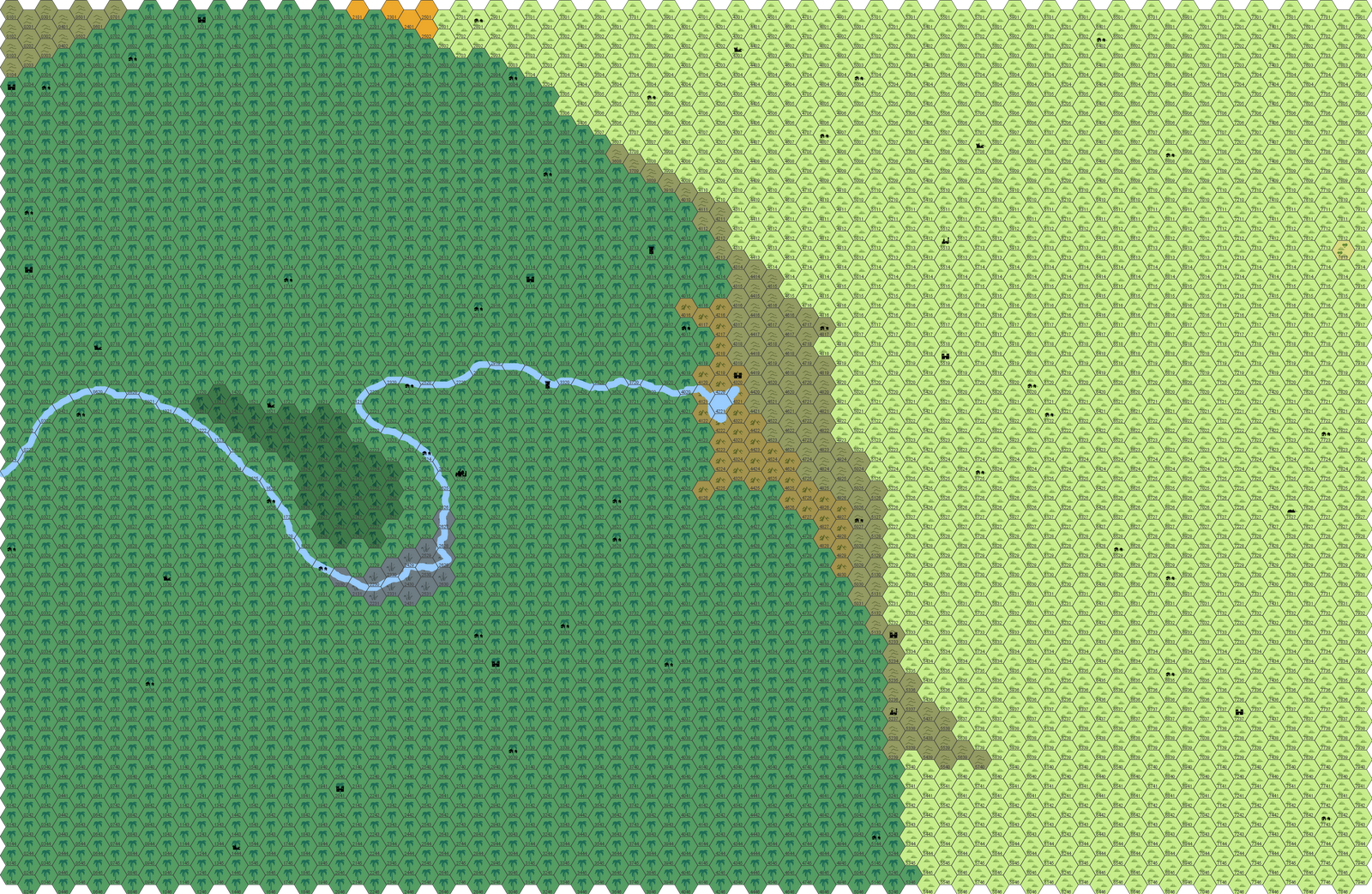
Okay, I haven’t officially published the last piece of the Hellcrawl (about 1 more week and it’s live), but I’ve already moved on to … Cush! The next hexcrawl project is Cush and Pwenet, pieces of an Africa-themed chunk of Nod. I’m quite excited about this one – probably a good bit of art to commission (which means I’m losing money on this baby), but there isn’t much Africa-themed RPG stuff out there, and it’s a pretty rich vein to mine for adventure. Anyhow – what follows is a quick look at the different geographical regions to be covered and the full Map J12 – the eastern half will be covered in NOD 16, the western half in NOD 18, and NOD 17 will cover the city-state of Ixum. Enjoy!

Click to enlarge – or don’t, it’s up to you

HISTORY
During the Pandiluvian Age, the jungle portions of Map J12 were under water, while the Jamba Highlands constituted a chain of islands the connected to the large archipelago of the modern Wyvern Coast. The savanna of Pwenet was a land of salt marshes and grassland. The so-called elder things built small fortresses in these shallow waters to protect their larger cities in the depths. These fortresses were built with a cyclopean, luminous green stones that were fitted without mortar. Although they were hunted for sport, some mermaids established themselves in sea caves and placid island lagoons.

When the waters receeded, the swampy grasslands became a savanna and the Cush basin became a dismal, tropical swamp. It was here that the lizard men, former servants of the elder things, established themselves in walled city-states, often surrounding the citadels of their former masters. Humans from the highlands were enslaved and put to work building defenses, for the lizard kings were constantly at war with one another, their society on its inevitable march to savagery.

As the waters continued to recede and Cush became a rain forest. The savage lizard men were eventually defeated by the more numerous and clever humans and driven into the coastal swamps or into the underworld. Freed from slavery, the humans established themselves in the homes of their former masters and took up where they left off. But unlike the lizard kings, who spent centuries locked in a stalemate, one human city-state, Kolos, soon brought the others to ruin.

Kolos was ruled by an exiled Atlantean who became fascinated with the alien gods of the lizard men, especially the one they called Mictlantecuhtli. Mictlantecuhtli called out to the Atlantean from the Abyss and bound him to his service with dark, unspeakable pacts. In time, the Atlantean, now known as Kolos, would destroy his city-state in a bid for godhood.

With Kolos fallen and soon swallowed by the jungles, its tributary port, Zinj, assumed the mantle of leadership in the region. But Zinj was tiny compared to the Kolos, and its interest lied in sea trade, not the fetid jungles. Except for a brief period as a subject of the zebra-striped people of the Zebrides, Zinj has remained an independent kingdom for centuries, even briefly lording it over the purple kings of Ophir after they lost their key trade partner in the invoked destruction of the Nabu.

The tribesmen of the savanna land called Pwenet also flourished during the Silver Age. They built villages and towns of adobe and kept massive herds of cattle. They even swept over the Nabu empire and held it for a few decades before decadence and in-fighting aided the Nabu in reclaiming their sovereignty.

GEOGRAPHY
Map J12 is dominated by a hot, steamy jungle in the west and the rolling grasslands of Pwenet in the east. These two regions are divided by the Jamba Highlands, a small mountain range that feeds the Jamba River. The Adze Marsh runs for many miles along the Jamba River.

A powerful necromantic kingdom called Kolos once dominated Cush and made war with the Nabu Empire to the north. While the fall of the Nabu Empire is well documented, the disappearance of Kolos is far more mysterious, and many adventurers have entered the jungles intent on finding that lost city-state and plundering its vaults. To date, none have succeeded in returning to civilization with their lives, let alone any riches.

Map J12 has no city-states of its own. The nearest city-states are Zinj (Map I12) and Ophir (Map J11), both coastal ports. It does have a multitude of villages and supports many sentient cultures, including human tribesmen, pygmys, lizardmen and gnolls.

Adze Marsh & Jamba River
The Adze Marsh, named for one of its more dangerous inhabitants is a vast wetland composed of flat lands, lagoons and copses of trees. The area floods in the Spring, hiding much of the flat land and making the entire swamp a virtual lake.

Cush
The jungle of Cush consists of a gently sloping plain between the Tonaduhna and Jamba Rivers. It is a traditional rain forest. The trees are thick and grow close enough together to blot out the sun. Beneath the canopy live a myriad of insects and reptilian carnivores as well as pygmy deer, elephant, and the dreaded leopard. Cush is valued for its exotic hardwoods (teak, mahogany, ebony and darkwood), orchids and fauna.

AMAZONS: The amazons of Cush are related to their more northern cousins. Like their cousins, they live in a matriarchical society. Unlike their cousins, they allow their menfolk to live in their villages and work as craftsmen, farmers and fishermen. Men and amazons live in separate halves of the village.

The amazons of Cush wear little or no armor, with the heaviest armored warriors (the nobility and their elites) wearing leather armor cured from the hides of mystical beasts (5% chance of dragonhide leather armor). Cushite amazon warriors carry spears, throwing irons and shields.

BERSERKERS: The berserkers of the jungle are cannibals. They appear as normal humans, but with teeth sharpened to points and hungry, feral looks in their eyes. The cannibals of Cush live in small hunting groups of 10 to 20 warriors led by a 3rd to 6th level chief and two 2nd level sub-chiefs. They wear no armor, but 50% of the berserkers carry a shield. Cannibals are armed with nets, battle axes, hand axes or short swords.

GHOULS: The ancient city-state of Kolos fell in a cataclysm of dark sorcery, tainting the surrounding land with necromantic energies. Over the next few months the peasants and knights of Kolos, deprived of their city-state, perished. Those who survived did so on the flesh of their fallen neighbors, and thus became ghouls. These ghouls, known for their dull black skin and pot bellies, still haunt the ruins of the jungle basin. They are extremely aggressive (as they’ve been starving for centuries) and are quite resistant to turning (turn as 4 HD undead). About 1% of ruins contain a ghoul able to summon a vrock demon (25% chance of success).

TRIBESMEN: The tribesmen of Cush know the secret of working iron and mine and smelt surface deposits from sacred out-croppings guarded by traps and summoned cacodaemons. Their witchdoctors are expert brewers of poison, so most warriors go into combat with poisoned darts (poison I) fired from blowguns.

The tribesmen are also privy, it is said, to the location of ancient gold mines secreted deep in the jungle and guarded by forgotten curses and fell magical beasts.

Each tribe consists of 3d10 x 10 warriors and additional non-combatants equal to 5 times the number of warriors. For every ten warriors in the tribe there is one “Big Man” with 1d4 character levels, usually in the fighter class. The tribe is ruled by a 6th to 10th level chief and witchdoctor (usually an adept, but 10% chance of being a 4th to 7th level druid or cleric). The chief is accompanied by 1d6+6 2nd level fighter bodyguards.

All tribesmen have a very fluid fighting style, giving them a base AC of 11. Tribesmen typically wield spears and blowguns, but might also carry hand axes, short swords, daggers and short bows. Leader types might carry battle axes or long swords.

VEGEPYGMIES: These strange plant beings are approximately 3 feet in height with rust-colored skin. They are primitive in nature with a chittering language incompre-hensible to non-plant men. Vegepygmies are usually encountered in small hunting bands. Vegepygmy tribes number from 1d4 x 30.
Vegepygmy warriors usually carry spears and throwing darts covered with a rust-colored mold. The mold deals no extra damage, but does begin to grow on the flesh of those hit by the darts who fail a saving throw. After the first day, the mold begins dealing 1 point of constitution damage each day as it produces enzymes which begin liquifying the host’s body. When the host is reduced to 0 constitution, he is little more than a pile of mush, upon which several “infant” mold men begin to grow. Once the mold begins to grow, it can only be destroyed with fire or a remove disease spell.

Jamba Highlands
The Jamba Highlands are a group of snow-capped mountains and their foothills that rise above the jungle of Cush and the grasslands of Pwenet. The tribesmen believe they are the abode of their gods. This belief is bolstered by the strange, white gorillas that seem to guard the passes that lead through the mountains.

The highlands feature a plethora of simians and avians. Old stories claim that the mountains are rich in precious stones and metals, but they are far enough away from civilization that nobody has made a serious attempt to mine them.

Pwenet Grasslands
Pwenet is a land of rolling hills with scattered copses of aromatic trees and a few rocky outcroppings. Large herds of ruminants travel from watering hole to watering hole while being stalked by giant centaurs, lions and even more fantastic predators. Pwenet is said to hold both a fountain of youth and the source of the River Ish, thus making it a popular destination for explorers.

A few merchant-adventurers from Ibis travel to Pwenet once a year to trade manufactured goods for aromatic resins, ivory, darkwood and wild animals. Otherwise, the region is untouched by the people of Lemuria and the Motherlands.

Though not the most numerous, the giant centaurs of Pwenet are the region’s most prominent folk of the hills. Pwenet is also home to many tribes of gnolls and humans. The largest tribes, human and gnoll both, provide most of the region’s drama as chiefs and witch-doctors jockey for power and recognition.

Oft told tales tell of when the tribes of Pwenet united under Jobo the Great and conquered the cities of Nabu. The people of Pwenet believe that history is a cycle and that they will once again conquer the outside world when a great leader united them.

CENTAURS: The centaurs of Pwenet look like a cross between humans and giraffes rather than humans and horses. Pwenet’s centaurs are larger and stronger than normal centaurs, but also more calm and level-headed. They carry large shields and pikes.

DWARFS: The dwarfs of Pwenet are only distantly related to the dwarfs of Antilia and Thule. They have pitch-black skin and eyes and small beards of wiry, black hair. Like other dwarfs, they dwell under-ground in burrows protected by all manner of traps. The natives of Pwenet call them the utu.

The utu have different abilities than other dwarves. Their eyes allow them to see in the brightest light and blackest darkness, including magical darkness. Their skin is as hard as granite and provides them a natural armor class of 14. Utu characters have a +1 bonus to constitution and a -1 penalty to intelligence. The utu carry shields and swords made of darkwood studded with shards of jade.

Utu dwarves worship Khnum, the divine potter, creator of the universe. Khnum’s clerics are curious about the universe and spend most of their time recording their observations on clay tablets. Where other dwarfs are expert at the forge, the utu are experts working with wood and clay. Their pottery is valued by the people of Ibis.

The utu are learned in the art of conjuring spirits, from whom they obtain most of their knowledge. All non-player character utu clerics can use the spell contact other plane once per month, when the stars are aligned.

Once every century a lucky cleric is able to make contact with Khnum himself to deliver a great prophecy to all the peoples of Pwenet. On these occaisions the dwarves sound their drums and blow long horns made from hollowed darkwood trees to call all the tribes to hear the prophecy. All the great chiefs of Pwenet heed this call and travel to the appointed place with their retinues, sworn by tradition to observe a full week of peace while the ceremonial dances are performed, lineages are recited and finally the prophecy is pronounced. The coming of the current princess of the Quiet Folk, avatar of the great earth mother, was pronounced at the last convocation, and the next prophecy is due to come in the very near future.
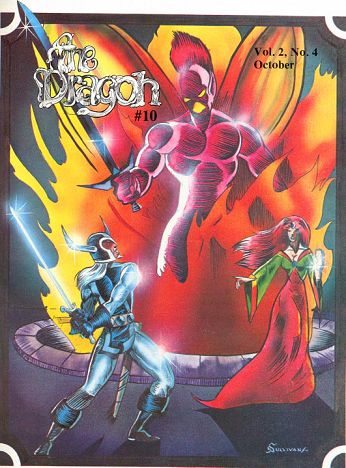
Dragon by Dragon – October 1977 (10)

Can you feel the chill in the air – that crisp chill of Autumn? Well, of course not. It’s July in the here and now, and just reading a magazine from October isn’t going to change that unless you have a rather powerful imagination or have been dipping into the pseudo-pharmaceuticals. Let’s see what Gygax & Co. had in store for us 35 years, when the leaves of Lake Geneva were beginning to change*

October 1977 starts off with a firecracker (mixing my seasons again), as Jon Pickens presents D&D Option: Orgies, Inc. The Mule Abides has already brought this article to prominence in the OSR, but I think it’s worth mulling over again.

The article posits the problem of too much wealth in the game. To this end, Pickens decided that treasure should only be translated into XP when it was spent. Since you can only have so many suits of platemail, 10-ft. poles and weeks of iron rations, players need something else for which to spend their gold. Pickens provides the following avenues of expenditure:

1. Sacrifices: Gold given directly to gods or demons; any character can do this
2. Philanthropy: Lawful’s can give gold to charity – but not to hirelings or fellow PC’s, of course
3. Research: This is for magic-users and alchemists.
4. Clan Hoards: Dwarves and other clannish folk can give their money to their clan.
5. Orgies: Fighters (not paladins or rangers), bards, thieves and all chaotics (except monks) can spend their money on wine, women and song

There are, of course, additional guidelines to these expenditures (i.e. how much can be spent in a night or week, etc.), but I love the idea and the restrictions. Even better, he has two appendices to the article – one on gambling and one on the effects of orgies on psionics (and in my opinion, the mere existence of this appendix should make you want to include both orgies and psionics in your next campaign).

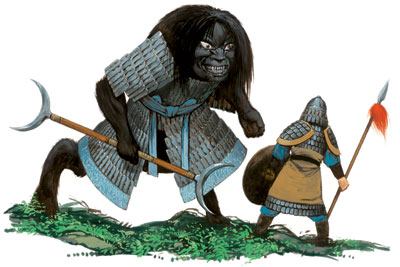
Izzat what a female goblin looks like?

Daniel Clifton has the task of following up on Orgies, Inc., and does so with Designing for Unique Wilderness Encounters. It’s a nice little article, containing random tables for determining what the terrain looks like when a few pesky wandering monsters show up in the wilderness. The tables generate the vegetation, slope, etc., but don’t provide any guidance for how this terrain impacts the battle, which is probably a good thing.

Paul Montgomery Crabaugh presents Random Monsters – by which he means monsters generated randomly, not random wandering monsters. Naturally, I need to generate at least one (which I suppose I really should include in Blood & Treasure):

Intelligence: Highly intelligent (I have a budding genius on my hands here!)
Alignment: Chaos
Type: Mammal (which means it might be a ninja)
Speed: 12
Armor Class: 7 (would have been a 6 if it was a reptile; for B&T it’s a 12)
Hit Dice: Level -2 (level being the level of the dungeon … hmm let’s pretend we’re on the 9th level of our dungeon, so 7 HD)
Hit Dice Modifier: +0 (so, 7 HD … odd that I need to roll for the HD and then roll to modify it)
Damage: 1d8

Now I need to roll for special characteristics, which is an odd percentile table. For a 7 HD monster, I’m going to assume it works as follows:

01-39 – none
40-74 – one
75-89 – two
90-100 – three

I roll a “92” (no, really, I swear it) and thus my monster has three special characteristics. I need to roll d24 for these (if you don’t know how to roll d24, I just feel bad for you) and come up with the following:

1. Hostile to clerics
2. Has anti-magic shell
3. Hostile to magic-users

I have a very hostile monster, apparently. But he doesn’t hate cans … he hates spellcasters. This makes his anti-magic shell make pretty good sense (ah, the wisdom of dice!)

I now roll another D% to see if it has “other characteristics”, and a roll of “61” tells me it does not (otherwise, it could have some insect characteristics).

Last batch of rolls determine the physical description:

Size: Medium (6 feet)
Limbs: 2 legs, 3 arms
Exterior: Feathers
Coloring: Spotted white and grey

So, what do we end up with?

ALMESITH
Medium Magical Beast, Chaotic (CE), High Intelligence; Gang (1d4)

Hit Dice: 7
Armor Class: 12 [7 for Swords & Wizardry]
Attacks: 3 claws (1d8)
Move: 30 [12 for Swords & Wizardry]
Saves: F 10, R 10, W 11 [9 for Swords & Wizardry]
XP: 700 (CL 8)

Almesiths are strange beasts that are spawned from the residual energies of powerful spellcasting, living embodiments of nature’s abhorrence of magic. They are most often encountered in the deeper levels of dungeons, and seek out spellcasters for destruction. Almesiths look something like owlbears, and can be mistaken for those sorcerous creations. They differ in size, being no taller than a man, coloration, being covered in dark grey feathers on their arms, legs and backs and softer, white and grey spotted down on their bellies, and in two additional curiosities: They lack mouths, having instead a stirge-like tubular beak that juts 3 feet from their faces, and in that they have a third arm that juts from their chest. Almesiths attack with their large, hooked claws, and generate a natural anti-magic field (as a 7th level caster) in a 60-ft. radius. In combat, they always focus their attacks on spellcasters (clerics, druids, magic-users and sorcerers first, bards second, assassins, paladins and rangers third), ignoring attacks by non-spellcasters even when it threatens to kill them.

In the Design Forum, Richard Gilbert presents Let There Be Method To Your Madness. This is another in the series of “dungeons should usually make some rational sense” articles; the attempt to bring the retro-stupid branch of the RPG world to heel that persists to this day. I think these two camps can best be described as Phoebe vs. Rachel.

Next up is a mini-game … Snit Smashing, in which a Bolotomus waits to smash the Snits that run from the ocean so they can plant their snotch in a Snandergrab. If the Snit player manages to multiply more rapidly than the Bolotomus player can smash them, he or she wins. For the Bolotomus to win, he or she must destroy all of the Snits.

When you’re through smashing snits, you can proceed to P. M. Crabaugh‘s next article, entitled Weights & Measures, Physical Appearance and Why Males are Stronger than Females; in D&D (weird use of a semicolon). If the feminists in the audience are getting their hackles up, they might want to read the article first, they might want to read the article first. The article posits an additional 3d6 stat – Size – which can translate into bonus hit points and a modifier to carrying capacity. Yeah, males get some extra carrying capacity … and females get a +2 bonus to Con and a +1 bonus to Dex, and men get called “thick-fingered clods with facial hair”. The old “trash men to keep the feminists from calling you insensitive names” ploy. A classic.

Beyond the ability modifiers, the article has a mess of random tables for generating a random appearance (did you know males have a 30% chance of having facial hair). I don’t know that I’d use this for generating a PC, but it could be useful for generating general ethnic physical and cultural characteristics, if you want to get away from “these people look like Vikings, and these people look like East Asians and these people look like …” trend in campaigns.

The next article is Gaining a New Experience Level by Tom Holsinger. He explains that what D&D and EPT really need is some sort of dangerous ritual for characters to undertake when they have enough XP to advance in level. To which I reply, “Huh?” Favorite line in the article:

“The sacrifice of humans is generally forbidden in a populated area because too many people get upset.”

The article is actually pretty tongue-in-cheek, and would make for an interesting campaign. Essentially, it creates a sub-game that involves getting the gods’ attention with sacrifices or sacrilege, then assuming the “proper physical and psychic attitude, i.e. complete exhaustion”, which, Holsinger assures us, can only reliably be done by becoming thoroughly inebriated, during which the Emissaries of the Gods, the Great Pink Elephants, come to the character and imbue them with their new Hit Dice and special abilities. The level limits for elves, dwarves and halflings are, he tells us, because they have a harder time getting drunk. It is also why high level characters move out of town and build castles – with more hit points, they have to get super shit-faced to attract the attention of the gods, and that might mean burning things down and causing other massive disruptions to the lives of the common citizenry. This article actually dovetails nicely with Orgies, Inc. and together they could make for one hell of a fun campaign.

Next up, Edward C. Cooper‘s The Tactics of Diplomacy in Stellar Conquest. Honestly, I don’t know the game and so I’m not going to comment on the article.

In Wormy, the eponymous dragon is contemplating stumping some angry dwarves with a riddle. They’re angry because Wormy stole their bowling balls to use on his pool table. Meanwhile, Fineous Fingers is under attack by a whole guild of murderous hobbits.

And that’s it for October 1977. Good issue, I think. I have to run and set up an inflatable pool now, but I have a couple neat ideas in store for next week. Oh, and I finished writing Blood & Treasure yesterday …

Would they be changing in October? I’ve lived in Las Vegas my entire life – Summer temperatures only finally end around the last week of October, and the leaves may not change here until well into December. Basically, I have no idea how seasons are supposed to work.

Mu-Pan – Natural Bridges and Soot Fairies

A couple more Mu-Pan encounters.

4043. Natural Bridge: The mountains give way to a deep gorge here. Terrible, ghostly cries emanate from the bottom of the gorge – actually just wind drafts – which lies 300 feet below. A natural bridge crosses the 80-ft wide gorge, but lies 60 feet below the lip. One can get to the bridge (without the use of the rope – watch those crosswinds) by locating the entrance to a cave about 30 feet behind the lip of the gorge.

The cave entrance is really just a hole in the ground, but the hole can easily be climbed and leads to a small tunnel decorated with friezes of dancing saints. The tunnel leads to the bridge, which is about 4-ft wide with slightly rounded sides. The other side of the bridge has a similar tunnel arrangement.

The bridge is meant only for the righteous (i.e. Lawful). The friezes come alive and attack chaotics and neutrals that enter the tunnels. The friezes from the other side of the bridge join in on this attack.

4101. Soot Fairies: An ancient foundry rests here, surrounded by crumbling black walls with tall smokestacks still reaching for the sky. The old building is surrounded by piles of slag and overgrown with sunflowers. The foundry is inhabited by thirty tiny fairy creatures that look as though they were made of blackened, shriveled matchsticks, with bulbous heads and ugly faces. The mere touch of these creatures causes flammables to ignite and skin to blister. The creatures hide a treasure of thirty large jaspers (worth a total of 500 gp) hidden beneath a pile of ash, along with 100 gp worth of iron ingots (weighs about 1,000 pounds).

| Soot Fairies: HD 1d4; AC 3 [16]; Atk 1 touch (1d6); Move 6 (F15); Save 18 (15 vs. magic); CL/XP 2/30; Special: Touch ignites flammables, cough clouds of burning ash (per spell incendiary cloud) once per day.


Image from HERE.

Mu-Pan – Flock of Cheonma

Short encounters tonight, so I’ll post two …

1025. A flock of seven cheonma have made an aerie for themselves on the high peaks here and are under attack by a pack of five griffons. The cheonma are hard pressed and they have already lost two foals to the depredations of the griffons.

| Cheonma: HD 4; AC 6 [13]; Atk 2 hooves (1d8); Move 24 (F48); Save 13; CL/XP 4/120; Special: Flight. Cheonma are Mu-Panese pegasi. They are eight-legged horses with wings on their feet.

| Griffon: HD 7; AC 3 [16]; Atk 2 claws (1d4) and bite (2d8); Move 12 (F27); Save 9; CL/XP 8/800; Special: Flight.

1027. A gang of 20 gyres is occupying a cave here, using it as a base of operations as they raid down the river into Yun territory. The leader of the gyres has a single white eye and particularly long canine teeth. He wears a golden ring on one of those teeth (worth 15 gp) and can cast 1d6 levels of sohei spells per day. The gyres wear coats of leather scales and wield masakaris and kamas. If encountered in their lair, there is a 2 in 6 chance they are drunk on plum wine. Their treasure consists of 340 sp and 1,130 gp in leather sacks. The stripped bones of two unlucky farmers are piled in the back of the cave.

| Gyre: HD 2; AC 4 [15]; Atk 1 bite (1d3) and 2 claws (1d4) or weapon (1d6); Move 15; Save 16; CL/XP 3/60; Special: Frenzy (2 attacks per round for 3 rounds, then fall unconscious).

Mu-Pan – Hermit of Yarni-Zai

Man I love writing this stuff – just letting my mind wander, maybe feeding it with a few random seeds. Here’s another one from the mountains around Tsanjan …

0937. A small village of fishermen live in this hex in a gorge with steep, 90-foot tall sides. A river moves slowly through the hex on its way to the Tsanjani Plateau. The fishermen dwell in something that resembles a Chinese lantern composed of rattan and attached to the walls of the gorge with iron spikes. Each lantern-house measures about 6 to 9 feet in diameter and houses three or four villagers. The fishermen can be seen at odd intervals dangling their feet out their front doors casting long lines into the river below. Hatches in the tops of the lantern-houses lead to ladders composed of iron spikes, allowing the villagers to climb to other lantern-houses or to the top of the gorge.

Below the lantern-houses an idol of Yarni-Zai has been carved into the gorge wall. The grave creator of beasts and men broods over the slow river, which the villagers believe was originally a beautiful maiden that won the heart of the deity but refused him. A hermit priest sits in the lap of the graven image, meditating, answering the questions of the villagers and curing their ills as best he can. The hermit has no name, and asks nothing but an offering of rice or fish in his begging bowl.

The villagers are armed with yami and haikyu, though their lack of money keeps the bandits away and their somber attitude and resignation to the indignities of the world make them unlikely targets even for chaotic adventurers.

| Hermit, Druid Lvl 6: HP 12 [23]; AC 9 [10]; Save 9; CL/XP 7/600; Special: Spells (3rd), speak to animals, plants and monsters, shapechange. Begging bowl, prayer beads.

Image from HERE.

Mu-Pan – Wang Liang

0824. A stone tower made of golden bricks leans over dangerously from the side of a low mountain covered in a tangle of brambles. The tower is the lair of a wang liang and his foot soldiers, 40 oni-yama. The wang liang owns an enviable library of bamboo scrolls on every imaginable subject, though every single one of them is filled with nothing but lies and half-truths. One of the scrolls contains a number of spells that appear to be one thing but are in fact another: Charm person (actually light), invisibility (actually levitate) and alter time (actually lightning bolt).

Mu-Pan – Clockwork Monastery

Another one from Mu-Pan. You’ll notice I haven’t done the treasure yet. I use an excel document to randomize treasure. The tables are based on those from Swords and Wizardry, and yesterday I was too lazy to open it up and generate the goods, mostly because Open Office doesn’t handle it as well as excel does and I usually work on my laptop. I know – who cares. Anyhow …

0718. A cliffside monastery in this hex was abandoned about 30 years ago when the monks were masacred in an attack by oni-aka goblins. Twenty of the goblins still dwell in the place, though they avoid the shrine. The goblins are led by Iki-Urha, an ogre with rust-colored, heavily creased skin and a bulbous nose.

The monastery shrine was dedicated to the concept of Law. The rear wall of the shrine, which measures 15 feet by 15 feet, is covered with bronze clockworks that approximate the movements of the cosmos – at least those of Nod and the planets Luna, Mercurii, Veneris, Martis and the Solar Sphere. The shrine is protected by four giant, clockwork owls perched on bronze bars that run the length of the shrine.

The goblins and ogre have desecrated the remainder of the monastery. The ogre has a single prisoner, a musician named Zeaho. Zeaho is the last survivor of a party of adventurers that sought out the monastery under the direction of their lawful sohei. Zeaho is a hengeyokai that can assume the form of a hare.

The ogres and oni-aka have a treasure of XXX in a large, locked chest.

| Oni-Aka (20): HD 1; AC 6 [13]; Atk 1 weapon (1d6); Move 9; Save 17; CL/XP 1/15; Special: Resistance to fire (50%).

| Clockwork Owls (4): HD 4+1 (19, 15, 14, 9 hp); AC 2 [17]; Atk 2 talons (1d6), bite (1d6+1); Move 6 (F30); Save 13; CL/XP 5/240; Special: Immune to sleep and charm, resistance to cold and fire (50%).

| Zeaho, Hengeyokai Bujin Lvl 4: HP 14 [22]; AC 9 [10]; Save 13 (12 vs death & poison); CL/XP 4/120; Special: Follow through. Pipe (a lute).

| Iki-Urha, Ogre: HD 4+1 (17 hp); AC 5 [14]; Atk 1 tetsubo (1d6+3); Move 9; Save 13; CL/XP 4/120. Tetsubo, nine-ring broadsword (belonged to Zeaho).

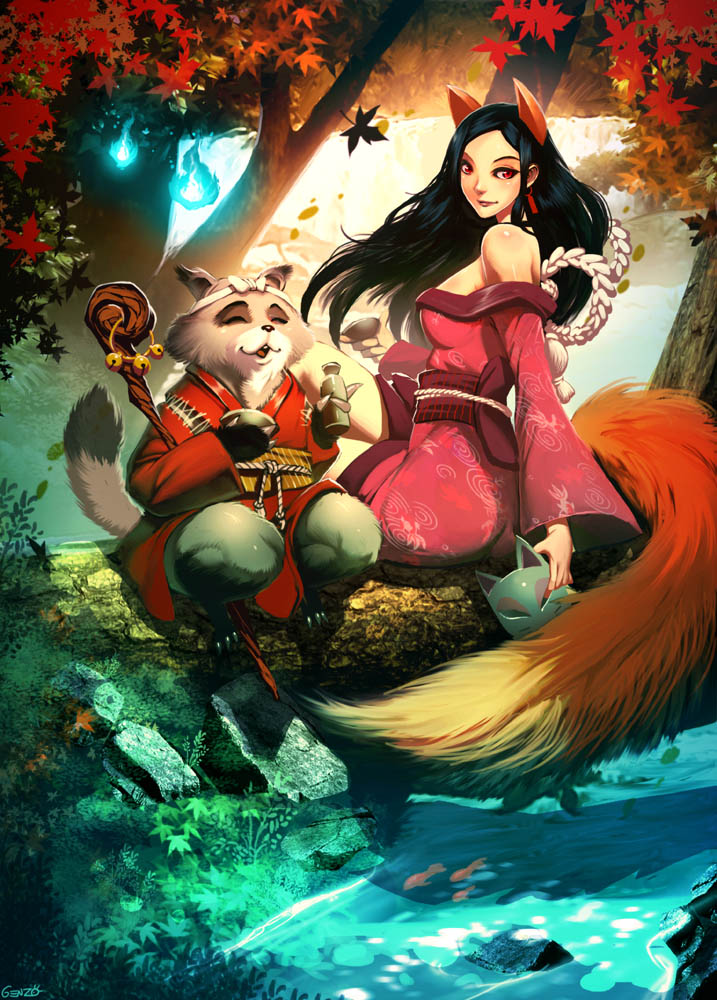
Image of bakeneko and tanuki by GENZOMAN at DeviantArt. Much to see in his gallery.