Gads of Goblin Goodies

Goblinoids, especially the lesser versions of kobolds, goblins, orcs and hobgoblins, are crawling all over the average fantasy world. They make great opponents to low-level parties, and in large masses are pretty good against mid-level parties. Eventually, though, their usefulness either runs out, or you and your players just get plain sick and tired of them.

So, how about 100 little modifications you can use to spice up these well-worn monsters?

You can use these to change entire tribes or war bands, or just to spice up individual goblins to make them a bit more distinct and to play up their ties to Chaos.

Enjoy!

Mutations

1. Acid spit – resistance to acid, bite attack +1d6 acid, +1 to sunder items
2. Ape arms – move faster on all fours
3. Bat ears – huge, flapping ears allow fly speed (slow)
4. Big lungs – hold breath longer, +1 save vs. exhaustion
5. Black skin – +1 to hide and surprise in dark areas
6. Boar tusks – gore attack (1d4)
7. Bouncy – jump
8. Cat’s Eyes – +1 to reflex saves, +1 to missile attacks
9. Croc tail – tail attack, save vs. trip
10. Crusty – +1 AC
11. Death saliva – poisonous bite, +1d6 poison damage, can spit 10 feet
12. Dynamo – shocking grasp once per three rounds
13. Evil eye – bestow curse with gaze attack
14. Extra brain – higher intelligence level, +2 to will saves
15. Extra heart – +1 hit point per hit dice, +1 save vs. exhaustion
16. Four arms – extra attack and shield
17. Frog tongue – 10-ft ranged attack to grab items
18. Fullback – +2 to bull rush attacks
19. Gnarled – +2 AC
20. Goblin-queen – remarkably attractive … but no less evil
21. Goliath – one size category larger, but one intelligence level lower
22. Greasy – can slide at double speed down grades, +2 save vs. grapple
23. Green skin – +1 to hide and surprise in woodland environments
24. Hairy – +1 AC, resistance to cold, +1 damage per die from fire
25. Halitosis – breath weapon – 5-ft cone – every three rounds – save vs. nausea
26. Hammer fists – increased unarmed damage and grapple attack
27. Head ridges – head butt attack
28. Hook claws – claw attack, +1 to disarm and grapple attacks
29. Horns – gore attack (1d6)
30. Hound dog – knack for tracking
31. Iron stomach – +1 save vs. poison
32. Lantern-eyes – beams of light can blind
33. Monkey tail – prehensile
34. Nose spike – gore attack (1d3)
35. Pitch-skin – flammable skin, immune to fire
36. Puffer – can blow up, knocking people back, no damage from bludgeoning weapons, piercing weapons can puncture
37. Radioactive – all within 10 feet much pass a fort save or be nauseated; miss by 5 or more energy damage
38. Razor teeth – bite attack, and save or grappled
39. Rooky – crow wings to fly, crow beak to peck
40. Runt – one size category smaller, but one intelligence level higher, chance of spells
41. Scaled – +3 AC
42. Speed demon – +10 speed
43. Spikey – damage from grapple, or when struck by natural weapons
44. Spy – passes for human
45. Stinker – troglodyte stench ability
46. Third eye – immune to illusions
47. Translucent – big bonus to hide and surprise
48. Troll-blood – regenerate 1 hit point per round
49. Wall crawler – climb speed
50. Weird – first level psychic power (offensive, of course)
51. White skin – +1 to hide and surprise in arctic environments
52. Wolf ears – +2 to listen at doors, surprised on d8
53. Wormy – gnaw through stone (burrow 10)

Professions

54. Acrobatic – +2 to reflex saves, slow fall as monk
55. Backstabber – attack, hit points and abilities of first level assassin, one vial of poison
56. Berserker – 2 attacks per round
57. Black knight – weird sense of honor, warhorse, lance, platemail, pennons, squires from lesser goblin race
58. Brigands – brigandine armor (studded leather), longbows, surprise in woods
59. Bushwhacker – attack, hit points and abilities of first level scout, longbow
60. Dark Lord’s man – +1 to hit, upgrade armor and weapons
61. Desert Rat – unaffected by heat and sand movement, +1 bonus vs. fire
62. Evil High Priest’s man – +1 bonus to save vs. cleric spells, chance of 0-level orison
63. Hexenhammer – +2 save vs. spells, 1d6 bolts with silence cast on them, light crossbow, warhammer
64. Hoary – extra hit dice, +1 to will saves
65. Ice Demon – unaffected by cold and ice movement, +1 bonus vs. cold
66. Necromancer’s man – +1 bonus to save vs. magic-user spells
67. Pickin’ and Grinnin’ – attack, hit points and abilities of first level bard, banjo
68. Pilferer – attack, hit points and abilities of first level thief, thieves’ tools
69. Psycho – 2 attacks per round, immune to fear, max hit points, immune to confusion
70. Savage – attack, hit points and abilities of first level barbarian, greataxe
71. Sea Wolf – swim speed, hold breath like lizard man
72. Thugee – attack, hit points and abilities of first level assassin plus four 0-level cleric spells
73. Veteran – attack, hit points and abilities of first level fighter, platemail
74. Warrior princess – females, studded leather, falchions, chakram, ululating battle cries (save vs. fear)

Equipment

75. Amazon – female, longbow, short sword, breastplate
76. Boar rider – rides a battle boar
77. Blitzkrieg – chainmail, spiked tower shield, short sword
78. Cannonball – small cannon – spiked platemail – launches self into battle, 10% chance of living through the experience with 1 hp
79. Canter – 1d6 magic-user scrolls (can cast them), robes, curvy dagger (+1 damage)
80. Costermonger – looks like ugly old man or woman, sells poisonous or magic apples
81. Dashing – leather armor, rapier, ruffles and bows and feathers in wide-brimmed hat, leering eye
82. Fire-breather – petrol, torch, resistance to fire, once per round 5-ft cone of fire (1d6), or 10-ft cone every other round
83. Fire bug – 1d6 alchemist’s fire, leather armor
84. Flailer – great flail (double damage) – attack by hurling self 10 feet, once every two rounds
85. Hacker – black hood, great axe or executioner’s sword (+1 damage), leather armor, dagger
86. Hammerer – great hammer (higher damage) – hurl up to 20 feet once every two rounds
87. Infiltrator – padded armor, silk slippers (+1 to move silently), three daggers, hand crossbow
88. Kamikaze – bat-winged glider, goggles, devil-may care attitude, catapult launch (if necessary), dagger
89. Magic hat – can produce a spell effect from hat, must make Will save to make it work, 10% chance of random spell of level 1d4
90. Plunderer – light warhorse, leather armor, composite bow, short sword, knack for riding
91. Porcupine – spiked scale mail, spiked club, spiked gauntlets
92. Rhino rider – rides a battle rhino
93. Ronin – splint mail, grotesque mask and great helm, scimitar and dagger
94. Sapper – heavy pick, mining helmet, leather armor, dagger, 1d6 bombs, goggles
95. Sea dog – blunderbuss, leather armor, hook hand, dagger in teeth
96. Slimer – 1d6 glass spheres of green slime, +1 bonus to save vs. acid and slimes
97. Tinker – armorer’s tools, portable anvil
98. Twister – two chains, chainmail, chain letter tucked into belt
99. Swineherd – two boars on a chain
100. Wolf pack – two wolves on a chain
Two New Products and a New Notion

Hey folks. Three items today …

ITEM ONE – BLOODY BASIC IN SOFT COVER

Bloody Basic – Classic Edition is now up for sale as a soft-cover book. A game with characters levels 1 to 6, with elves, dwarves, halflings, fighters, clerics, magic-users, thieves and all the rest of the classic fantasy elements, for $8.99. I’m working on getting the Contemporary Edition out pretty soon as a PDF, and then a hard copy, and then the other editions will follow – Fairy Tale, Chaos, Apocalypse, Jules Verne, etc.

ITEM TWO – BLOOD & TREASURE MONSTER TOME PDF

The PDF of the Monster Tome is now available for download for $6.99. It includes 172 pages of monsters, with 258 monster entries. I hope to have the softcover and hardcover books up for sale in two or three weeks. As I often do, I’ll be offering a free PDF to those who buy the hard cover edition of the Monster Tome, so if you’re planning on buying the hard cover later, you’ll probably not want to buy the PDF now.

Monster Tome II will have to wait for 2015.

ITEM THREE – STRANGE TWIST OF FATE

Just so this isn’t a completely commercial post, here’s a little notion for using a fate mechanic in your adventures.

When you delve back into heroic fiction, back to the days of the Greeks, Romans and Norsemen, it’s hard to avoid the concept of fate. The Fates and Norns measured out the days of a man or woman’s life and cut the string when it was time for them to die.

If you’re running a game set in these times, or any time if you like it, you might want to inject a little fate into the game. You could also inject Doctor Fate into your game, but that’s a matter for another post.

Obviously, you don’t want to use fate as a way of arbitrarily cutting a character’s life short. You can, however, use it as a way to determine whether character’s are beloved or cursed by “the gods”.

You could do this in one of two ways.

The first is to randomly determine a person’s fate for each adventure, every adventure. First, determine which deities are looking down on the player characters by rolling D10.

1. Lawful Good
2. Neutral Good
3. Chaotic Good
4. Lawful Neutral
5-6. Neutral
7. Chaotic Neutral
8. Chaotic Evil
9. Neutral Evil
10. Lawful Evil

If you use the three-tier alignment, roll D6.

1-2. Lawful
3-4. Neutral
5-6. Chaotic

Next, determine the character’s fate for that adventure by rolling 3d6. If the character is the same alignment as the deity, they enjoy a +2 bonus to their roll. If they are the opposite alignment, they suffer a -2 penalty to their roll.

1-2. You are loathed by the gods – subtract -2 from all d20 rolls during this adventure
3-6. You are cursed by the gods – subtract -1 from all d20 rolls during this adventure
7-12. The gods are disinterested – your fate is in your hands
13-16. The gods favor you – add +1 to all d20 rolls during this adventure
17-18. You are beloved by the gods – add +1 to all d20 rolls during this adventure, and re-roll one failed saving throw.

An interested god will be watching over the adventure. Whenever an accursed or loathed character performs an action in accordance with the deity’s alignment (or any element of their alignment), they are permitted to re-roll their fate. Whenever a favored character does something in opposition to the deity’s alignment (or any element of their alignment), they likewise must re-roll their fate.

If you are using this system, you might want to add a couple spells to your game.

Tell Fortune – 1st level spell for clerics, druids and magic-users; it literally tells the character’s fortune (i.e. loathed, cursed, favored, beloved).

Read Signs – 1st level spell for clerics, druids and magic-users; tells you the alignment of the deity watching over the characters during this adventure.

The other way you can use a system like this is to put the characters’ fates into their own hands. Instead of always rolling to determine a character’s fate for an adventure, the player’s instead offer themselves up for judgment. The system works the same way, it just puts the decision in the hands of the players.


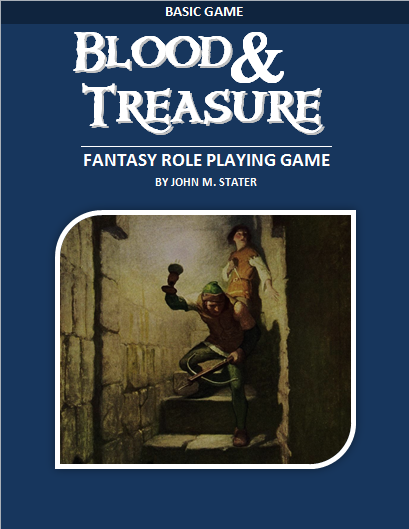
Blood & Treasure Basic

Yes, Blood & Treasure Basic. For now – I might change the name.

I took the last week off of work, and in between hiking, grilling ribs and a much needed massage, I found time to write Blood & Treasure Basic, as well as finish up NOD 23 (should publish by Monday).

What is B&T-B?

Ultimately, it’s that project I mentioned a post or so back in which I pondered doing different editions of a basic game using different public domain artists. While I thought of that, a couple ideas for simplifying B&T came to mind, so I started making notes, and notes led to writing, and a week later I had a game …

B&T Basic is kind of the same game as B&T, but also kind of a different game. One could easily make the jump from one to the other, but Basic isn’t just B&T with a bunch of material chopped off.

B&T Basic has the six traditional ability scores, with just a +1 or -1 modifier for high or low scores.

It has humans, elves, dwarves and halflings, with some multi-classing and level limits.

It fighters, magic-users, clerics and thieves, with some sub-classes that work like the variant classes in B&T – barbarian, paladin, ranger, assassin, bard, druid and cultist (the chaotic version of the cleric). Levels go from one to six.

The cleric and magic-user have spells from level 1 to 3, with the fewer spells than in Blood & Treasure (of course).

It has the basic equipment lists, the basic rules for dungeoneering (light, movement, tasks, combat, how to draw a dungeon, wilderness travel, settlements), all as simple as I can make them.

For monsters, you get all the basic monster types, with stats based on size and examples of monsters to make them more interesting. Why? I thought it would make it easy for TK’s to invent new monsters if they could just label something a Medium Aberration to get their basic stats, and then drop in an AC, attacks and special abilities.

For treasures, I keep it simple so you get the coins, the gems, the objects and the magic items.

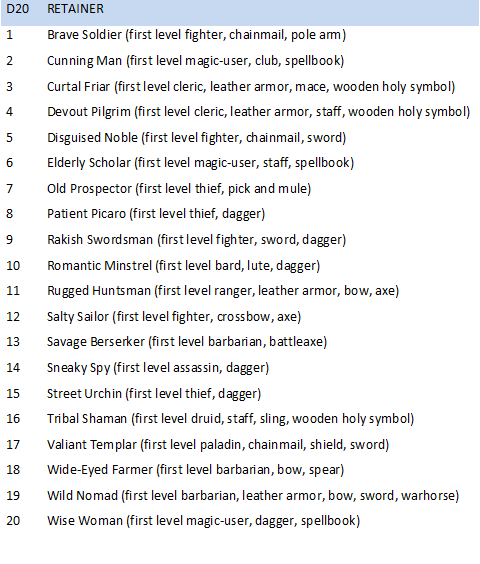
I wanted to get a couple new things in the game, so I came up with a retainers system and super simple encumbrance. Since the levels only go to six so there are no rules for strongholds. In exchange, I decided that sixth level characters get a retainer, or sidekick. I also decided to roll them randomly, since I love random stuff! The retainer is a 1st level comrade for the adventurer, with whom they share some experience points. Honestly – I have no idea how well this will work. Maybe they should be higher level? Maybe second?

Anyhow – here’s the table …

At this point, the game runs about 30 pages without art – I figure when I add a title page, contents, index, and illustrations it will be around 35 to 40 pages, so not too shabby.

Who’s Under that Mask?

You’ve fought your way into the evil lord’s citadel or the inner sanctum of the chaos cult. You’ve eliminated the guards. You are locked in battle with the masked overlord of all evil and in a brief pause in the fighting reach out and snatch away their mask. You gasp as you see …

1-2. The Archduke or Archduchess

3-4. Your doppelganger (literally, a doppelganger in your form)

5-6. A faceless horror, or something with tentacles so the party can say, “Seriously, more Lovecraft?”

7-8. A goblin (he’s standing on another goblin’s shoulders)

9-10. Your old teacher

11-12. Your ex-lover or ex-mate or ex-best friend who always secretly resented you

13-14. Your mom!

15-16. The captain of the guard

17-18. The sergeant of the guard

19-20. Second man-at-arms from the left at the front gate who, now that you think of it, was giving you a funny look when you entered the city

21-22. The hunchbacked hedge wizard who hawks magic charms in the town square – turns out he’s a 15th level magic-user

23-24. The high priest of the local Law Cult

25-26. The pirate lord of the western seas

27-28. The queen of the gypsies

29-30. A sleestak

31-32. A mannequin [gasp]

33-34. The mummified face of some the ancient pharaoh on display in the museum

35-36. Nosferatu!

37-38. The princess royal

39-40. A ghoul [chomp]

41-42. Your evil twin brother or sister who was thought to have died in the barn fire

43-44. The head of the local merchant company

45-46. The local guildmaster of thieves

47-48. A bearded devil

49-50. A polymorphed fire giant, and that mask was what kept the spell in play

51-52. A brilliant light (choose a color) in place of a head that messes with your mind

53-54. A succubus – pucker up!

55-56. A tangle of vines and two emerald orbs for eyes

57-58. An elf lady knight from the far woodlands

59-60. A flesh golem with a psychic’s disembodied brain sutured to its head

61-62. A serpent man with a cobra’s ability to spit

63-64. The undying caveman

65-66. A grey alien with a headband of pain of dominance

67-68. A 15th level amazon

69-70. The wizened old magic-user you thought was your greatest ally

71-72. The dark pope of the holy assassins

73-74. A demi-god or goddess

75-76. A quasi-god or goddess

77-78. A primordial ooze thing that collapses into a blob of destruction

79-80. That dummy used by the seemingly harmless bard in the local tavern

81-82. A super-intelligent gorilla

83-84. A really stupid and confused gorilla

85-86. A heavily scarred visage

87-88. The twisted face of a maniac

89-90. A 15th level duelist who is actually left-handed

91-92. The emperor everyone thought was lost

93-94. The mad genius that designed the automaton palace guards

95-96. An astral deva that has taken Lawful Good to an unhealthy level

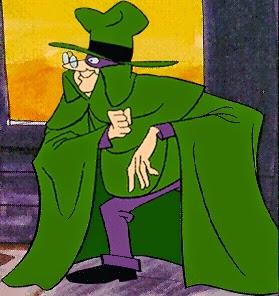
97-98. The Riddler (unfortunately played here by John Astin, not Frank Gorshin*)

99-100. The robe collapses, because the meme has been revealed

* Look, I love Astin, but just not as the Riddler

Adventurers Face Death, Yes, But Also Taxes

Image found HERE – Click through for more info on medieval taxes

We all know the formula. Start in town, buy equipment, journey into the unknown, hopefully find lots of money, come back to town, buy more and better equipment (and maybe healing), rinse and repeat.

I have found that in practice, there are three ways this can go. The first, of course, is perfectly. More often, adventurers either come back without enough to support themselves in the hyper-inflationary economy they’re all creating in town, or they come back with more dough than they can spend (assuming they’re like mine and stubbornly refuse to hire men-at-arms).

It seems like the latter might have been more of a problem than the former in the old days. In AD&D, Gygax introduced “training costs” to, as I understand, siphon money away from successful mid- to high-level adventurers.

Another option is the bane of man’s existence from the earliest days of civilization … The Taxman!

Folks who regularly read the blog will know I was recently delving into the pages of Adam Smith’s Wealth of Nations. He does a long chapter on taxes, and as I was reading about the myriad forms of taxation that existed in the 18th century, it occurred to me that a random taxation table could be fun, with adventurers never sure just how the local prince was going to steal their money.

The idea here, of course, is not to make life needlessly difficult for adventurers. If they’re relatively poor, the taxes will be relatively light, and an inability to pay them will result in being impressed into doing work for the sovereign, which can be used as a way to introduce new adventures and even entire campaigns (Robin Hood, anyone?). Adventurers tend to be outsiders and ne’er-do-wells anyways (why else are they delving in dungeons instead of holding down respectable jobs?), so another reason to bristle at authority should help to keep them on the adventuring path.

To get this rolling, we need to determine how heavy the taxation is in the locality, who is collecting it, and what the actual taxes are.

HOW HEAVY ARE THE TAXES?

Different kingdoms/city-states/whatever have different expenses, and folks who spend tax money tend to overspend rather than underspend.

Each community will impose 1d4+1 taxes (see below) on adventurers.

THE TAXMAN

The tax collector is usually a normal human, but might also be a captain (5 HD) or an aristocrat (3 HD). In rare cases (1%) he is a fighter or thief of 4th to 7th level.

The tax collector is not a popular fellow, so he is always accompanied by 1d6+4 men-at-arms (light infantry usually).

Not all tax collectors are created equally, of course, so we will differ them by their alignments. Roll as follows:

LAW vs. CHAOS (D6)

1-2. Lawful = Cannot be bribed or frightened easily from his appointed duties

3-4. Neutral = Can be bribed (Charisma check, -2 penalty) with an amount of money equal to half the taxes owed; can be frightened, but will return with triple the number of men-at-arms

5-6. Chaotic = Can be bribed (Charisma check) as above, but there is a 1 in 6 chance he will return later and pretend no taxes were ever collected; can be frightened, but will hire 1d6 assassins or thieves to get revenge.

GOOD vs. EVIL (D6)

Note, if you use the three-fold alignment system, consider Good to be implicit in Law above and Evil to be implicit in Chaos above.

1-2. Good = Is willing to fudge the tax bill down a bit (maybe 10%) if people look hard on their luck.

3-4. Neutral =No special behavior.

5-6. Evil = Will overestimate taxes by at least 10% if one is not very careful.

Where’s the Taxman?

The taxman is usually stationed at the front gate of a stronghold, village, town or city, but may be encountered as a random encounter outside of town, but rarely in the wilderness.

THE TAXES

1. Tax on coins: A tax of 1d4 x 5% on all coinage carried is assessed.

2. Tax on cargo: A tax of 1d6 cp is assessed for every 20 pounds of goods, above and beyond one’s own clothing, they carry into the settlement. If the goods are “valuable”, this is increased to 1d6 cp per pound.

3. Tax on arrows and bolts (and quarrels): The arrow tax is 1d6 cp per arrow, bolt or quarrel. There is a 1 in 6 chance they will also assess a 1d6 cp tax per foot length of bows and crossbows. This protects the local bowyers and fletchers.

4. Tax on iron and steel: A surtax of 1d6 cp is assessed for every pound of objects composed mostly of iron or steel. This protects the local iron industry.

5. Tax on copper: A surtax of 1d4 cp per pound of copper (including coins), bronze and brass carried into the settlement.

6. Tax on silver: A surtax of 1d4 sp per pound of silver (including coins) and electrum carried into the settlement.

7. Tax on gold: A surtax of 1d4 gp per pound of gold (including coins) and platinum carried into the settlement.

8. Tax on gemstones: A tax of 1d4 x 5% of the value of gemstones carried into the town; those who cannot pay have their stones confiscated until they can pay, but must pay an additional 10% fee for failure to pay and for storage.

9. Tax on magic items: Obviously, this requires the presence of a person in the tax collector’s retinue who can cast detect magic, or obviously magical items. A premium of 10 gp per item is collected, and items of a demonic or diabolic nature will be confiscated by local church authorities, with 10% of the item’s value (determined by the church authorities) to be paid to the original owners, unless they are determined to be Chaotic (Evil), in which case they are clapped in irons and sent straight to the dungeon.

10. Tax on magic-users: Those who appear to be magic-users (the spellbook is a dead giveaway) must spend 1d6 nights patrolling with the night watch, or else must buy out of this duty at a rate of 1d10 sp per night.

11. Tax on holy symbols: Foreign holy symbols are assessed a blasphemy tax of 10 sp (wooden or stone or common metal holy symbols) or 10 gp (precious metal holy symbols). Each healing spell cast in court on behalf of the king/mayor/prince/etc. is the equivalent of 5 sp of the assessed tax.

12. Tax on strength: Settlements always have hard work that needs doing on civic projects. Characters who look sturdy (i.e. Strength of 10 or higher) are impressed into a work gang for 1d6 days, or else must buy out of this duty at a rate of 1d10 cp per day for able-bodied folk, 1d10 sp per day for muscular folk (i.e. Strength of 13-15), and 1d10 gp per day for the truly mighty (i.e. Strength of 16+). If a creature does not look as strong as he or she is, use your best judgment as  TK as to whether this applies to them.

13. Tax on beauty: The local ruler has an eye for beauty; those with Charisma scores of 13 or higher are tasked with attending court in their finery (or finery will be provided) for 1d6 days while in the settlement to impress visitors, or else must buy out of this duty at a rate of 1d10 sp per day.

14. Tax on feet: A tax of 1 cp per unshod foot/hoof, 1 sp per sandaled or shoed foot or shoed hoof or 1 gp per booted foot is assessed. If your game includes centipede men, they’re going to hate this!

15. Tax on wheels: A tax of 1d6 sp per wheel is assessed.

16. Tax on beards: The locals have had trouble with dwarves, and so they assess a tax of 1 gp per inch of beard length on all (not just dwarves) who enter town. If you don’t know how long a character’s beard is, guess or roll randomly. If the dwarf’s player has ever mentioned looking like “the dudes from ZZ Top”, he’s going to regret it.

17. Tax on warriors: The locals need strong warriors to deal with the humanoids and monsters of the wilderness. Anyone who looks the part of a warrior (leather armor or more) is impressed into patrol duty for 1d6 days, or else must buy out of this duty at a rate of 1d10 sp per day.

18. Tax on finery: Jewelry, silks, mithral, adamantine, cloth-of-gold and the like are assessed a tax equal to 1d4 x 5% of their value.

19. Tax on hides and pelts: Hides and pelts are assessed a tax of 1d10 sp for animal skins, 1d10 gp for magical beast skins (and similar) and 1d10 pp for dragon skins. If the tax cannot be paid, the hides are confiscated into the treasury of the settlement or king.

20. Tax on retinues: In order to support the local labor market, a tax of 1 sp per hireling or man-at-arms is assessed.

You’ll note that there is no tax on thieves’ tools – that’s because they’ll probably just arrest a person who has them or toss them out of town.

If taxes cannot be paid, the offenders are either barred entry to the settlement and its environs (i.e. sent back into the wilderness under armed guard) and threatened with being declared outlaws if they again return without their assessed taxes, or is taken into custody until they can work their bill off (i.e. a great adventure hook!).

Giants Modified

I love D&D and its tropes, if for no other reason than that they give players a frame of reference that you can shatter by taking the “mundane” and making alterations to it. Take the giants, for example – six varieties that can be modified in wonderful ways to stump those veteran “know-it-alls” that tromp through your campaigns with a copy of the Monster Manual in their brains.

Some of the modifications refer to Blood & Treasure, which is awesome and you should own (and the complete game, e-book, is now on sale at rpgnow.com / drivethrurpg.com – eventually I’ll have all my material up for sale there as pdf’s and hard copies).

GIANT VARIATIONS

(Apply One or More; use a d30 if you’d like)

1. Armored: Giant has a turtle shell, chitin or skin of metal or stone – boost AC accordingly, and add spikes (+2 damage) if you like.

2. Artillerist: Giant carries a cannon or ballista as his personal ranged weapon (just use damage equal to stone throwing damage if you want to keep it simple and just use the weapon for a dash of flavor).

3. Beauteous: The giant is gorgeous, and gains the nymph’s blinding beauty and charm abilities. In terms of giantesses, imagine hill giantesses like junoesque shepherd women, stone giantesses like living, regal sculptures, frost giantesses with cool, calculating beauty, fire giantesses like giant-sized Sophia Lorens, etc.

4. Bellowing Roar/Piercing Scream: The giant has quite a pair of lungs – once per day it can holler/scream/shriek/roar per the dragonne special ability.

5. Bestial: The giant has bestial characteristics (use the hybrid template in B&T). Combine hill giants with giant boars, stone giants with cave bears, frost giants with worgs, fire giants with giant lizards, cloud giants with giant eagles and storm giants with giant rams – or use whatever animals you think are most appropriate (elephants and tigers offer great possibilities).

6. Bigger & Dumber: Why do things get dumber when they get bigger? I’d probably know if I was smaller. For this one, just use the “giant” template in B&T and knock the intelligence down a notch. If the giant should have spell-like abilities, nix them. Huge giants get a trample attack (damage equal to strike damage) and giants that go from huge to huger gain a stomp attack (per the stomp spell).

7. Builder: Giant has the abilities of an NPC engineer, as well as the tools and a giant ox or draft horse to help him work.

8. Breath Weapon: The giant can exhale an appropriate breath weapon in a 20-ft. cone. Frost giants exhale cold (3d6 cold damage), fire giants fire (3d6 fire damage), storm giants and cloud giants spit lightning (4d6 electricity damage) and the rest just blow a gust of wind (per the spell).

9. Centaur: Giant has an animal body (see bestial above), gaining any appropriate attacks (claws, for example) and the trample ability.

10. Chariot: Giant drives a giant chariot drawn by appropriate animals (see bestial above for ideas).

11. Class: Giant has the abilities of a PC class with a level equal to half its hit dice. Hill giants make good barbarians, stone giants rangers (yes, because of Wormy), frost giants bards, fire giants fighters, cloud giants magic-users and storm giants druids – but any will do.

12. Claws: Giant gains 2 claw attacks (2d4 damage for large, 2d6 for huge)

13. Drunk: Giant is drunk 90% of the time. He loses 2 points of AC and suffers a -2 penalty to hit in combat, but ignores half of all physical damage inflicted on him. When he misses in melee combat, he must pass a Reflex save or fall prone – anyone who might be flattened must pass their own Reflex save or suffer 2d6 points of damage.

14. Elemental: The giant is kin to the earth elementals; use the elemental template in B&T.

15. Evil Eye: Giant can curse with its gaze (per bestow curse)

16. Godson/Goddaughter: Giant has the half-fiend or half-celestial template from B&T – mommy or daddy is divine!

17. Hideously Ugly: Giant is so ugly, those who see it must pass a Will save or be frightened.

18. Knightly: Like the giant Russian knights of old, the giant is not only in platemail and carries a giant sword and lance, but also rides upon a warhorse sized for him or her. Giant knights might have the abilities of a chevalier (see NOD Companion) of a level equal to half their hit dice, if the referee so desires. Giant will definitely be more civilized than most of its kin.

19. Magic Resistance: Giant enjoys magic resistance equal to half their Hit Dice x 5%.

20. Man-Eater: Giant gains the swallow whole ability against creatures two sizes (or more) smaller.

21. Pet-Lover: Giant is accompanied by a dragon or magical beast (or dinosaur?) appropriate to his environment.

22. Primitive: Giant is more primitive than its kin; it can wear nothing more than leather armor and carries nothing more than a giant club, but it’s strength gives it a +2 bonus to damage. Note that hill giants aren’t too swift to begin with, so primitive hill giants wear no armor and fight with their fists.

23. Sage: Giant is old and wise, and has the abilities of an NPC sage.

24. Size-Changer: Giant can change size once per day, per the shrink or enlarge spells.

25. Shape-Changer: Giant can polymorph self once per day.

26. Smoker: Giant smokes a large clay pipe, and can exhale the equivalent of a fog cloud once per day. Creatures in the smoke must pass a Fortitude save (vs. poison) or start choking (tactical disadvantage).

27. Sun-Hater: Giant turns to stone in daylight, but regenerates as a troll (though the damage they are vulnerable to might be different than fire and acid).

28. Trickster: Like old Utgard-Loki, the giant has natural illusionist abilities. Allow them to cast spells as an illusionist (specialist magic-user) with a level equal to half their hit dice, and knock their intelligence up a category.

29. Two-Headed: Per the ettin.

30. Tusks or Horns: Giant has a gore attack (2d6 damage for large, 2d8 for huge).

Okay, a few more ideas:

31. Field Marshall: Giant is an exile who has taken up with lesser humanoids, becoming their de factor leader. Scale the humanoids to the giant: Hill giant with kobolds, stone giant with goblins, fire giant with orcs, frost giant with hobgoblins, cloud giant with gnolls and storm giant with bugbears.

32.  Undead: Combine the giant hierarchy with the sentient undead hierarchy, thus barrow giants (hill giant + wight), shadow giants (stone giant + wraith), smoke giants (fire giant + spectre), ice giants (frost giant + mummy – I’m thinking about the ice mummies here), mist giant (cloud giant + vampire) and tomb giant (storm giant + lich).

33. Friendly: Giants can be friendly, of course, but you don’t want to ruin the rep of the traditional giants. So – hybridize them with some of the friendly demi-human species. Combine hill giants with gnomes for forest giants, stone giants with dwarves for rock giants or fire giants with dwarves for iron giants, frost giants with elves for taiga giants, etc.

Horses Are Sooooo 1978

Or whenever the paladin was first published. I wanted to be clever with the title, but not to the degree that I was going to do five seconds of research with Google.

Paladins, at 5th level, can undertake a quest to obtain a very intelligent mount. Depending on the edition you play, this mount either hangs out with you all the time and sorta requires you to hire a groom or page or whatever to look out for it when you’re in a dungeon, or it just pops into existence whenever it is convenient. You can probably guess which concept I like better.

But what if … what if there were more options than that super-clever wonder horse? Well, how about these …

(Use as inspiration, or roll randomly with a D12)

1. Mechanical Warhorse – requires a quest to settle a grudge for the Dwarf King, who forged the horse in his own workshop. Just combine an automaton and a heavy warhorse to get the stats. For anti-paladins, the mechanical warhorse is grey and spiky.

2. Putti – I think I did stats for these fellows once (you know, the chubby, winged babies people mistakenly call cherubs or cupids), if not, just make them Lawful (LG) imps. For anti-paladins, just use an imp.

3. Unicorn – but only if the paladin is female. For anti-paladins … not sure.

4. Aasimar Squire – 4 HD, of course. For anti-paladins, a tiefling picaroon.

5. Blink Dog – maybe the quest involves rescuing it from a giant’s kennels. For anti-paladins, a shadow mastiffs.

6. Halo – actually a lantern archon with 4 HD that oftens hangs out around the paladin’s noggin. For anti-paladins, just craft a red-hued evil version of the lantern archon.

7. Relic – the relic is the skull of a cleric which the paladin can communicate with telepathically, and which can cast spells as a 4th level cleric (though not touch spells, obviously).

8. Choir – a choir of four 1 HD lay priests who can chant (as the spell) and inspire (as bards). For anti-paladins, four 1 HD flaggelants with scourges who do the same.

9. Gold Wyrmling – precocious, of course. For anti-paladins, a red wyrmling.

10. Brownie Knight – gained by embarking on a quest for the Fairy Queen, a bit of a curmudgeon. For anti-paladins, a spriggan thug of the Unseelie Court.

11. Elven Sage – an old codger with silver hair who can cast spells as an adept (venerable master). For anti-paladins, a drow alchemist who may or may not be trying to poison their master.

12. Reformed Prostitute – a prostitute who has seen the light and can cast spells as an adept (venerable master; note, the prostitute is not venerable in terms of age, but in terms of the blessings bestowed upon him or her). For anti-paladins, a fallen, alcoholic friar or nun.

On Almanacs and Thin Ice

Once upon a time, I was suffering through an earache and a bit of a cold. I had an earache as a baby, and the doctor told my mother I would be susceptible to them for the rest of my life, and he wasn’t wrong. I’d usually get once about once a year, and they’d last about a week.

Anyhow – the ear pain would spike in the evening, and I’d seen some goofy commercial on TV about home cures that included using a hair drier to dull the pain of an earache. So there I was, lying on the couch, aiming a hair drier at my ear (it worked, by the way, and still does) and reading a book I’d picked up at the grocery store earlier that day on a whim – The Old Farmer’s Almanac. It was chock full of interesting things to read, and I’ve been a subscriber for many years, the book becoming more valuable once I started growing vegetable gardens.

Believe it or not, The OFA isn’t a bad book to have around if you’re a gamer. The back section of the book is full of interesting tidbits about the natural world, and as a subscriber, I also get a reprint of the OFA from 100 years ago and 200 years ago – right now, I’m looking through the 2014, 1914 and 1814 OFA’s. If you’re running a game set in the early 19th century in the United States, those 19th century Alamanacs could come in quite handy.

One interesting thing I found in the almanac tonight was a bit on ice thickness – in particular, how much weight, in general terms, ice could hold based on its thickness. This brought to mind the usefulness of a random ice thickness table for referees running games set in the frozen north, or in more temperate climes under the grip of Old Man Winter.

ROLL D10

1. Thin ice – breaks on contact
2. Deceptive ice – breaks when one has walked 1d6 paces
3. 3 inches – enough to hold a single humanoid (medium) on foot
4. 4 inches – enough to hold a group of humanoids in single file or a single ogre or frost giant
5. 7 inches – enough to hold 2 tons (a horse, ox or large giant or iron golem or cloud giant)
6. 10 inches – enough to hold 3.5 tons (a fire giant)
7. 12 inches – enough to hold 8 tons (an elephant or storm giant or titan)
8. 15 inches – enough to hold 10 tons (a triceratops)
9. 20 inches – enough to hold 25 tons (a brontosaurus or elder earth elemental)
10. 30 inches – enough to hold 70 tons (half a tarasque?)

Building Better Henchmen

Do you like random tables? I do.

Do you like henchmen? I do.

Do you like random henchmen? I hope so …

The following tables can be used to make more interesting, if not useful, henchmen for your classic fantasy game. I think I might adapt these to ACTION X and use them as the default for minions.

Note – for those who don’t play Blood & Treasure (yes, I’m aware that’s 99.99999999% of all gamers), treat a “knack” as succeeding on a roll of 1-2 on 1d6, or as a flat +3 bonus to skill checks

TABLE THE FIRST – HENCHMAN PERSONALITY

1. Sniveling coward – has move of 40 and must check morale before each fight

2. Greedy bastard – tries to steal treasure at every turn

3. Junior paladin – braver and more heroic than he/she should be, but also a Lawful (Good) moralist about things

4. Dastardly spy – working for an opposing group of adventurers, making a map and reporting back

5. Secret cultist – member of a secret chaos cult, will betray the party if possible

6. Sword-for-hire – has to be paid (1×6 x 5 gp) for sticking his neck out, but +1 to hit with swords

7. Old veteran – a bit slower (move 20), but good at solving puzzles

8. Pack mule – can carry 150% normal weight, tends to be quiet and dull

9. Rebellious princess – (or prince) a rich brat who wants adventure but is still in the aristocratic mindset, has a tendency to complain and command

10. Rugged he-man – or she-woman; strong, brave and competent and a bit arrogant

11. Mother hen – very concerned about the adventurers and their health and well-being

12. Hyper-active – gets bored easily, often moves off on his own (especially when carrying something important)

13. Lucky duck – +2 bonus on all saving throws; lucky and knows it

14. Rakish devil – hits on the opposite sex, makes lascivious innuendos at the drop of a hat, has an over-fondness for booze

15. Death magnet – 1 in 6 chance that any random bad thing happens to this poor slob, but they enjoy a +2 bonus to all saving throws

16. Terrible jinx – increases chance of random monster encounters by 1 (or 5%), imposes a -1 penalty to saving throws for all in the party by their mere presence

17. Lazy complainer – move rate of 20, like to rest once per hour, complains about physical exertion, eats double rations

18. Delusions of grandeur – claims skills he or she does not have

19-20. Mundane henchmen – nothing special at all about this henchman

TABLE THE SECOND – HENCHMEN SKILLS

1. Academic – knack at deciphering and appraising the value of goods

2. Acolyte – can cast 1d4 zero-level cleric spells, each once per day; charges double

3. Acrobat – knack for jumping and ???

4. Animal Handler – knack for riding and taming animals

5. Apprentice – can cast 1d4 zero-level magic-user spells, each once per day; charges double

6. Athlete – knack at climbing walls and swimming

7. Deceiver – knack at forgery and disguise

8. Investigator – knack and finding traps and discerning alignment

9. Negotiator – +2 bonus to reaction checks if does the talking and knack for discerning alignment

10. Pick Pocket – knack at move silently and pick pockets

11. Rogue – can backstab for x2 damage once per day, knack at thief skills; charges double

12. Savage – berserker in combat, knack at barbarian skills, comes with loincloth, shield and spear; charges double

13. Sentinel – knack for finding secret doors and listening at doors

14. Shadow – knack for move silently and hide in shadows

15. Spelunker – darkvision to a range of 30 feet, dwarf knacks

16. Survivor – knack at survival and climbing walls

17. Swordsman – has one combat feat of the TK’s choice and comes with chainmail, shield and hand weapon; charges double

18. Thugee – can backstab for +2 damage and use poison safely, knack at assassin skills, comes with black leather armor and two daggers; charges double

19. Whirling Dervish – can attack twice per round with melee weapons, comes with leather armor, short sword and dagger; charges double

20. Woodsman – +1 to hit animals, knack at ranger skills, comes with leather armor, longbow and short sword; charges double

PAY SCALE

Just thought of this. What if the henchman’s pay scale determines what they’ll do …

Copper a day – will carry torches and bags, but will not fight

Silver a day – as above, plus will fight in second rank

Gold a day – as above, plus will fight in front rank

Platinum a day – as above, plus will check for traps and go into rooms first

You Pull the Lever and …

1. It electrifies just enough to hold your hand tight and inflict 1 point of electricity damage per round.

2. Your hand sticks to it … you just grabbed a mimic, buddy.

3. It comes out of the wall with a shower of sparks.

4. Your fingers tingle and then begin changing to stone (save vs. petrification); if this save fails, it begins to affect your arm (another save), etc.

5. Loud bells begin ringing, shaking dust from the ceiling and alerting all monsters on the level to your presence; some come running for a free-for-all, while others begin setting traps.

6. The floor opens beneath you (10-ft. pit; 50% chance of spikes; 25% chance of water; 10% chance of a crocodile; 5% chance of 4 skeletons; 1% chance of a magic item).

7. The floor opens beneath you (chute down to next dungeon level).

8. The ceiling opens above you, water pours down (1d4 damage).

9. The ceiling opens above you, green slime pours down.

10. The wall falls down, revealing a treasure room.

11. The wall falls down, revealing a clutch of rust monsters.

12. The walls falls down … on you (save or crushed for 2d10 damage).

13. Iron walls rise from the floor to block all exits, poisonous gas begins filling room.

14. You teleport to a random location on this dungeon level.

15. You teleport to a random location on a lower dungeon level.

16. You teleport back to the surface.

17. The room makes a 180-degree turn (save or knocked prone on floor); you are now in a mirror universe.

18. You gain the ability to use one random 1st level magic-user spell, one time. On a second pull, you gain a spell, but only if it can be plucked from the mind of a comrade. On a third try, you lose any spells you had memorized/prepared. On a fourth try, you summon a marilith demon, because seriously, how many damn times are you going to pull this lever?

19. You change into a random animal with as many hit dice as you have levels; your own mind is submerged beneath the psyche of the beast; this change lasts for 10 minutes.

20. You turn off all lights in the room (torches, light spells, etc.) off; pulling again reverses this.


I know, been a while. Very busy at work, also busy writing NOD Companion and Action X – which don’t lend themselves to excerpts just yet. I have a few posts planned for this week, though, so hang in there with me.