Let’s Get Grimm … Nursery Rhyme Monsters III

Yeah, I know, this is taking forever. What can I say?

Nixie: Nixies dwell in the rivers and streams of Fairyland, and are more apt to be seductive and cruel than playful and kind. They are aligned with Hearts, and are wicked 75% of the time.

Ogre: Ogres in Fairyland come in two varieties, the traditional man-eating lout who carries a club and takes great delight in frightening people with their fangs, and the spellcasting ogre mages who cultivate a veneer of civilization (though they remain just as thoroughly wicked and hungry for human beings), like the one who appears in Puss-in-Boots. Either way, they conform to the ogre and ogre mage stats in traditional D&D. Ogres are aligned with Clubs (wicked) and ogre mages with Diamonds (wicked).
Pixie: Pixies (or sprites) are the most numerous of the fairy folk. They dwell in meadows and glades and disguise their villages with cunning illusions. Many become attendants of fairy knights.

Rat Swarm: We all remember the tale of the Pied Piper, and thus know that great swarms of rats have a definite place in Fairyland. Many fairy tales were born during the plague years of Europe, and thus rat swarms in Fairyland always carry that disease with their bite.

Rat Swarm: HD 4; AC 5; Atk 1; Dmg 1d6 + save vs. disease; Move 150; Save as Ftr 4
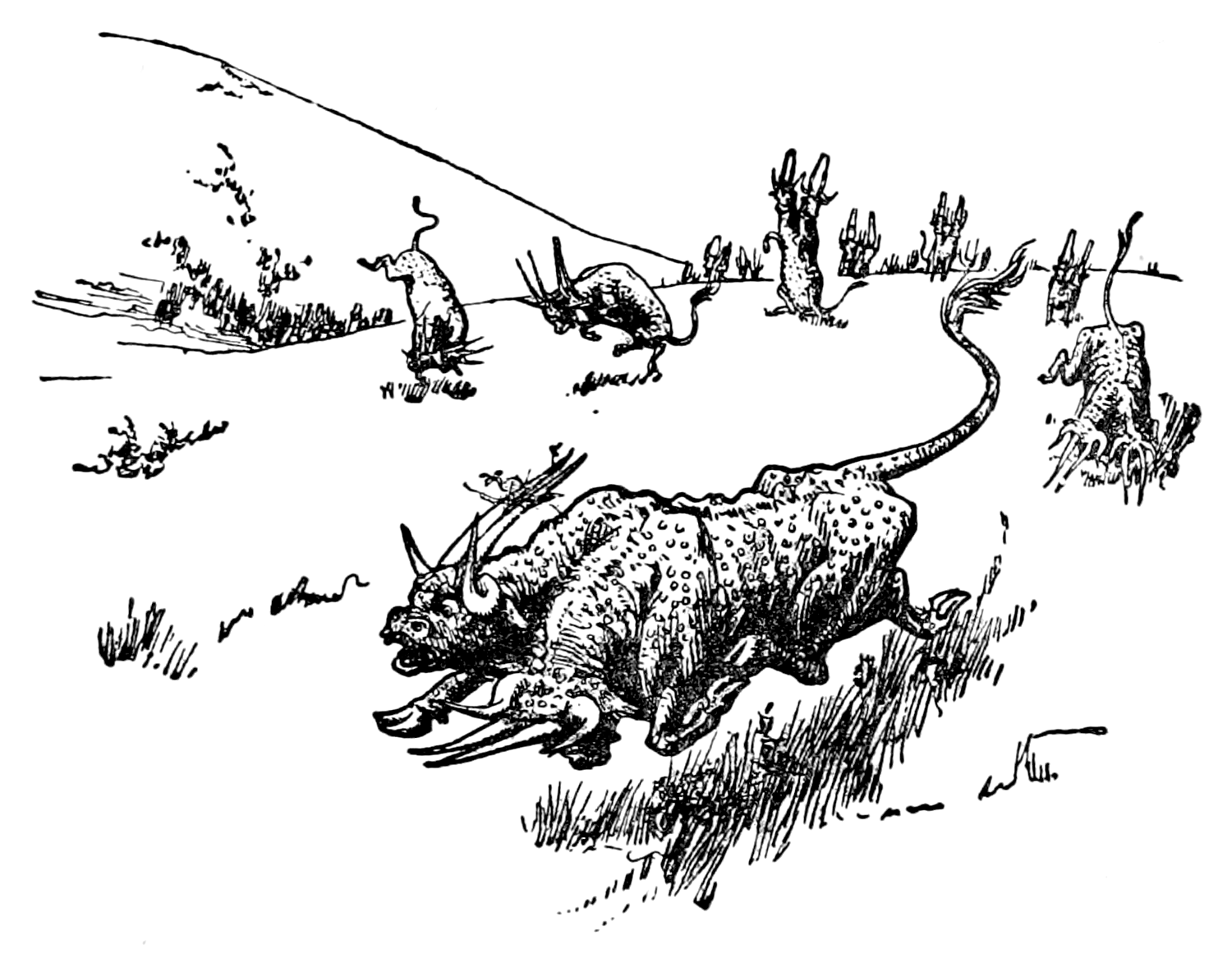
Red Bull: Red bulls are two-headed, fire-breathing bulls that can be treated as chimeras without the wings, sans the dragon and lion bite attacks, but with two butt/gore attacks. They are aligned with Clubs (wicked)

Revenant: Zombies in MG&G are called revenants. They differ from traditional D&D zombies by retaining their intelligence and memories (and alignment), though they are always twisted and wicked in their dealings with the living. It is not uncommon to find them traveling with their coffins upon their backs.

Robber: Robbers are the bandits of MG&G, and conform to the stats for bandits or brigands. They may form small gangs (3d6 individuals) who waylay travelers through woodlands, or they might form larger bodies (up to 40!) who have their lairs in secret caves and attack entire villages for the purpose of plunder.

Roc: The mighty roc makes an appearance now and again in Fairyland, swooping in from balmy seas beyond the mountains of Jinnistan on its way to visit the east wind. They are aligned with nothing and nobody.
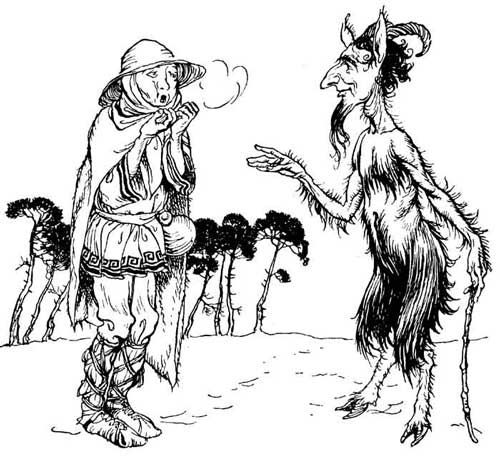
Satyr: Satyrs in MG&G are the same as in D&D, save they are a bit hornier and more frightening. Satyrs are aligned with Hearts, and though not completely wicked, they definitely push the boundaries of polite behavior and have significant difficulties in restraining themselves around females (save vs. spells).

Sorcerer: Sorcerers are men who practice the magical arts, and are thus capable of casting spells as fairy godmothers (roll level on 2d4). Sorcerers may be aligned with any of the factions, but 5 in 6 are thoroughly wicked and corrupt due to their willingness to deal with demons. 1 in 6 sorcerers is a white magician.

Sphinx: Sphinxes are not common in Fairyland, but they do exist. All sphinxes in Fairyland are gynosphinxes, and they are typically aligned with Clubs (wicked), as they enjoy throttling travelers who cannot answer their riddles.

Treant: The treants of Fairyland are pretty similar to those of traditional D&D, save they are usually incapable of moving around. A treant that isn’t talking is only recognized as a treant on a roll of 1 on 1d6 (or 1-3 on 1d6 for dwarves and fairy knights and other fairy folk). Treants do not get on well with woodsmen. Treants are often aligned with Hearts, but some trees are aligned with Clubs.

Troll: Trolls adhere to the same rules as in traditional D&D, with the exception that some of them turn to stone in the light of the sun (either permanently, or only until nightfall). All trolls must save vs. spells or run in terror when they hear the peeling of church bells.

Wicked Witch: Hags in MG&G are known as wicked witches. They are not, of course, old misunderstood women, but evil fairies who seek out the helpless and innocent to consume. Just use the various hag stats in D&D, but give them the ability to cast spells as fairy godmothers. Wicked witches are aligned with Clubs (wicked).
Let’s Get Grimm … Nursery Rhyme Monsters II

Sorry for the delay in getting this baby out – work has been crazy busy for the past couple weeks (in a good way, but tiring nonetheless).

Fairy: Fairy is, of course, a blanket term for all the fair folk (including sprites, brownies, leprechauns, goblins, etc.), but for us, it refers to the beautiful, elfin women of fairy tales. Fairies conform to the stats for nymphs, but gain the ability to fly with gossamer wings, and the ability to cast magic spells as a fairy godmother. Among the more famous of fairies is the Fairy with Turquoise Hair (who serves the court of Hearts), Morgan Le Fey (who serves the court of Spades) and Titania (who serves the court of Diamonds).

Ghost: Ghosts are thick in fairy tales, and can be modeled after the incorporeal undead of D&D, such as the wraith and spectre. They need not be wicked, of course, nor intent on draining energy, though they oft times find mischief irresistible.

Giant Animals: Though not all animals in fairy tales are giant (in fact, few are), giant animals still make excellent monsters in fairy tale games. Naturally, they are all at least dimly intelligent and capable of speech. Giant eagles, goats, owls, snakes and spiders all play their part in a game of Mother Goose & Goblins.

Giants: The most appropriate races of giants for fairy tale gaming are, of course, the infamous cloud giant (sniffer of the blood of Englishmen) and the loutish hill giant. Some fairy tale hill giants can grow exceptionally large (although they are rarely seen), and can, to keep things simple, be referred to as mountain giants (double or triple the size and hit dice of a hill giant, add one dice of damage for double-sized giants and two for triple-sized giants. Cloud giants are not especially brilliant, but they are all magic-users of some renown, but hill and mountain giants are utter dopes.

A variation on the hill giant is the green giant, who has extraordinary intelligence and wondrous powers of illusion. These fellows dress in the manner of knights, and enjoy sending princes on quests.

The ettin, more commonly referred to as a two-headed giant, is also a frequent visitor to Fairyland, as is his cousin, the three-headed giant (+1 HD).

Giants usually serve the court of clubs (evil).

Goblin: Goblins are as thick as flies on the borders of Fairyland, and loom large in many legends. As in D&D, they are ne’er-do-wells who delight in torment and trouble, and generally conform to the normal rules for goblins (or even kobolds). When encountered in their lair, there is a 1 in 20 chance that adventurers will have stumbled upon a goblin market, where fey of all stripes trade wondrous goods and might even trade with the adventurers, if they dare. Goblins either serve the court of clubs (evil) or diamonds (evil).

Griffon: Griffons reside in the mountains of Fairyland, preening their feathers and grooming their tawny fur in the sun. They are creatures of terrible nobility, and are not to be trifled with by inexperienced adventurers. The greatest princes might make them their mounts, if they can be subdued (per the rule for dragons). Griffons serve the court of diamonds, and are always prideful.

Hobyah: Hobyahs are just hobgoblins by another name – and might also be called hobs. They are not always as wicked as their counterparts in D&D, and some serve in the manors of less savory princes as foresters and rat catchers. They have warty hides, bulbous noses and grim expressions. Hobyahs serve the court of spades.

Hydra: The hydra, or three-/five-/or seven-headed dragon as it is more often labeled, appears in a few fairy tales, filling the same basic role as the dragon. Pyrohydras are not uncommon in Fairyland. Hydras, like dragons, serve the court of diamonds (evil).

Leprechaun: Leprechauns are fairy cobblers, and members of the fey proletariat, as it were. As in popular myth, they hide their gold in pots that can only be found by following rainbows, but those who steal a leprechaun treasure will find themselves hunted for all their days by the vengeful fey and their kin. Unfortunately, 1 in 20 pots of gold actually contains brightly dyed foodstuffs. Leprechauns can be found in the AD&D Monster Manual, but might also be modeled after halfling who must grant three wishes to those who catch them. If this be used, allow the leprechaun to roll their initiative on 2d4, and double their movement rate. Leprechauns serve the court of spades.

Merchant: Human merchants loom large in many fairy tales, and can be modeled after the trader of D&D or the merchants of AD&D. They are usually encountered with a wagon of goods, or with a pack mule, and often have a beautiful and innocent daughter they’ve left at home with her stepmother. Merchants can sometimes (1 in 6) speak the language of the fey, as such merchants have had truck with those folk, and know some of their secrets. Merchants serve the court of diamonds.

Dragon by Dragon – June 1977 (7)

Happy birthday The Dragon! June 1977 marked the beginning of the second year of the magazine’s publication. Kask starts off by bragging on the improvement in the art and the 300% growth in circulation in a year (which could mean they went from selling 1 copy a month to selling 3 … but I think they were doing better than that). Kask goes on to say that, despite the increase in readership and the magazine now being published 8 times a year (they had NOD beat – 6 is almost more than I can manage), he remains the only staff member. He gives thanks to the help provided by Gary Jaquet, but explains that he can only do so much because he lives 4 HOURS away. Boy, have things changed for the better. The editor for Blood & Treasure lives across the continent from me, and he might as well be in the next room.

The other big announcement from Kask …  PUBLICATION BY THE DRAGON DOES NOT BESTOW ANY SANCTION OR APPROVAL TO ANY VARIANTS, VARIATIONS OR RULES INTERPRETATION.

Anyhow … what has the birthday boy in store for us today?

First up, we see an advert for the Third Annual SC Awards for Creativity in Wargaming. Some of the things that didn’t make the ballot include Bunnies and Burrows (for best game) and Jim Dunnigan (for design of Russian Civil War … you might want to check out his Strategy Page site for information on everything going on in the world of conflict). Lankhmar and Metamorphosis Alpha were up for Outstanding Game of 1976, Gygax’s Swords & Spells was up for Outstanding Miniatures Rules of 1976 and Grenadier’s wonderfully named Wizzards & Warriors was up for Outstanding Miniatures Series of 1976. They also list a Fantasy Gaming Hall of Fame, which includes Lord Dunsanay, C.S. Lewis, A. Merritt, Fletcher Pratt, Clark Ashton Smith, Poul Anderson, M.A.R. Barker, Lin Carter, L. Sprague DeCamp, Gardner Fox, Katherine Kurtz, Fritz Leiber, Michael Moorcock, Andre Norton, Jack Vance and Roger Zelazny – and I just cannot argue with such a list. Spot on for 1977.

Omar Kwalish (didn’t he invent some sort of apparatus?) presents tips on what to do when “… Calamity Befalls You Twenty Minutes Before the Game Club Gets To your Place”. In essence, the article shows how you can generate percentages with two standard D6, and other ways of dealing with being without dice – chits in a jar, random numbers generated on high-tech calculators (such as the TI-SR51-A), cutting cards (roll 1d4 with the suits, etc.), using a watch with a second hand, spinners, coin flips (an obscure study financed by government grant proved that the dime was the ideal coin to flip), phonebook and blindfold, etc.

Gary Gygax uses the Designer’s Forum to tell of the origins of the game, in which he writes, “Although D&D was not Dave’s game system by any form or measure, he was given co-billing as author for his valuable idea kernels.” Let the lawsuits begin.

Lynn Harpold describes Mystery Hill, America’s Stonehenge. A very ’70s article, if you remember that time period, and things like In Search Of.

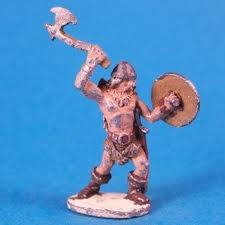
One of Ral Partha’s new releases is “Foregum” Super Hero (Bare-Chested) – no picture, but he is now my favorite miniature of all time. Luckily, I found an image …

And a copy of Ral Partha’s 1981 Catalog. CHECK IT.

Great illustration by Morno on page 11, to go with his story The Journey Most Alone. Again – new rule of Dragon by Dragon is to post a random paragraph from the story, so …

“There he paused in wonder.”

Okay, that was a bit cheap, how about the next paragraph as well …

“Before him he saw the vistas of a wide universe from the height of a splendid cliff. Awaiting him was a massive throne of silver and of tortoiseshell, metalwork twining like vinery around the dark surfaces of the seat. Leaf and stem of silver entwined in ecstatic embrace, and here, upon the highlights, and there, among the shadows, gleamed jet and onyx, lapis and obsidian, nested like gleaming grapes in beds of many other stones. From this pinnacle Visaque beheld the five extremities of his cosmos and the many marvels therein; beheld amber castles and perilous beasts, paradise and power to his world’s edge. At the foot of the throne knelt spirits of the four elements and one awaiting his ascension. Tiny heralds on elven birds trumpeted a fanfare at his coming.”

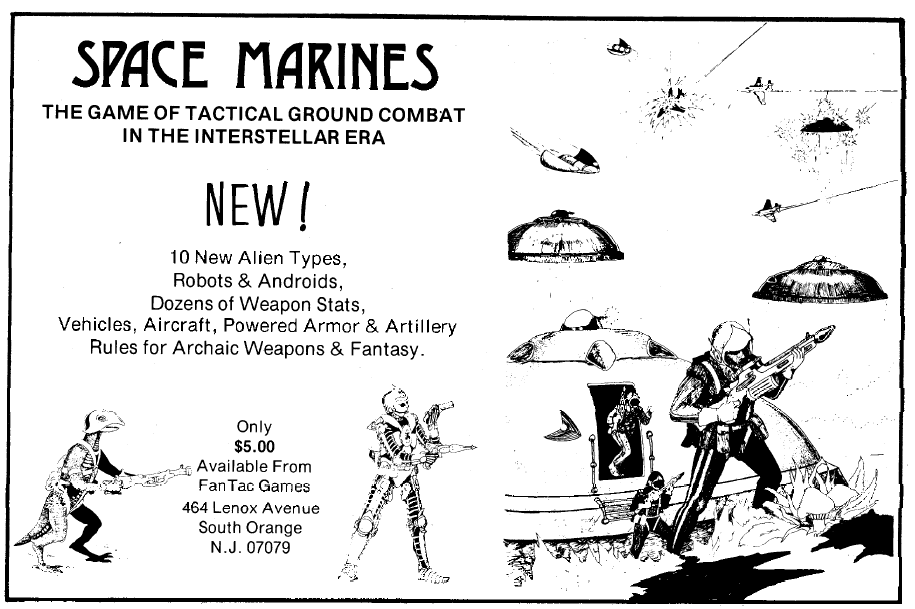
In the middle of the story there is an ad by FanTac Games in South Orange, NJ for a new game called “Space Marines”. Looks like they beat the Brits to the punch.

I wonder what 464 Lenox Avenue looks like now …

M.A.R. Barker has a new article on Military Formations of the Nations of the Universe, recounting military formations of … well, you get the idea. The universe, in this case, is confined to Tekumel.

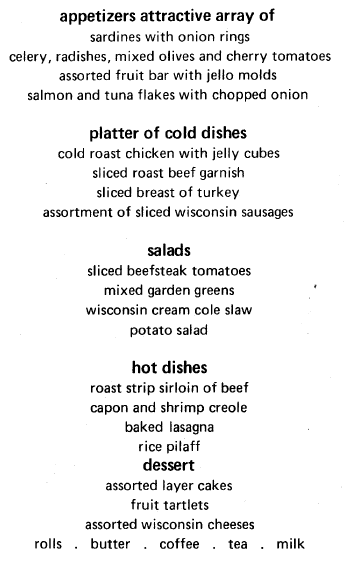
I cannot go further without printing the following menu in an ad for the Third Annual Strategists Club Awards Banquet at Playboy Resort …

Honestly, they had me at sardines and onion rings.

The Featured Creature this month is the Prowler. Its B&T stats would be:

Prowler: HD 14; AC 18; Atk Bite (1d8) and constriction (4d12 per turn); MV 30; SV 10; CL/XP 15/1400; SP – Gaze (save vs. magic or mind blanked and become a zombei [sic] under the prowler’s control; can only be restored by having 3 patriarchs cast dispel magic at the same time), inject eggs (with brown tentacles around mouth, injects into zombeis, eggs hatch in 2d4 days and eat the zombei).

Tough monster, and a nice bit of art to go with it.

Fineous Fingers tries to rob a guy from TSR and ends up skewered, while the kid he was training gets a 1,000 gp reward for tipping off his target.

In the Editor’s Library, Metagaming Concepts (makers of Stellar Quest, the first “good, playable space game”) announce their new micro-game … OGRE! I doubt it went anywhere.

Mcewan Miniatures has a sweet little ad for their new figures …

I’d like to think all of those fellows would fit in nicely in a Space Princess game somewhere. Maybe the Terrellians are a species that has built their culture around the worship of this guy …

But that’s just me. (And yeah, that would probably make them Chaotic).

Mystery author Garrison Ernst (just can’t figure out who this guy could be) presents another installment of the Gnome Cache.

“A column of dark smoke announced that they were approaching the castlewick of Blackmoor. It was the morning of an otherwise bright day not long since the slaughter took place on the narrow road to Weal. The two had traveled fast. Several times they had quickly left the lance for the safety of the surrounding wood as a band of Nehronland foot or a rare body of horse passed northwards laden with plunder and marching with much jesting and laughter. Each time Mellerd would salute their passing with various rude gestures, for he daily came to hate all Nehronlanders more passionately as he missed the Kimbri Vardobothet whose death came at their hands. There was now a particularly thorny problem facing them. They could not, of course, proceed directly through the place ahead, for it was obviously swarming with enemy soldiers. To the east was a jumble of broken terrain stretching away for endless leagues towards the sea. Worse, it was the home of many of the various bands of Nehron, so passage through that place would be nearly as dangerous as going straight along the road through Blackmoor. But to the west was a trackless forest which led to the slopes of the Senescent Hills, most inhospitable and the dwelling place of creatures who did not welcome men intruding upon their domain. The trick would be to swing wide enough to bypass the fortress unseen by any of the numerous warriors thereabouts, and then come back onto a route south again. If they went east they would eventually make the road to Rheyton as they circled back. In the other direction they would strike the passage to the free city of Humpbridge which bent from southwest to south across the base of the Senescent range. Dunstan was faced with making a decision from what he remembered of maps and his experiences on the trek which brought them to these straits originally.”

The emphasis is mine. Humpbridge!

And so ends the seventh issue of The Dragon. If I’m honest, the ads were the best part of this issue – pretty weak on game content, and Barker’s article on military formations seemed endless. What I have learned, though, in reading these is that I need to start using multiple pseudonyms when writing NOD. Fake names, anagrams and bad puns are as much a part of the D&D experience as Armor Class and hit points, and I’ve been missing out!

Let’s Get Grimm … Nursery Rhyme Monsters I

Animals
Just about any animal belongs in a fairy tale world, but some animals are more prominent than others, including bears, foxes, leopards, lions, owls, pussy cats and wolves. Just use the normal stats for these “monsters”.

About 1 in 6 animals is a talking animal. Larger talking animals conform to the normal stats, save they are intelligent and can speak. Smaller talking animals (and some of the larger predators) are more anthropomorphized. Pussy cats are clever and often quite magical (spells as a 1st to 4th level magic-user) and have a knack for the fiddle, bears live in comfortable houses and dine on porridge, foxes are able rogues (as a 1st to 4th level thief), etc

Animated Silverwear

When animals aren’t talking in Fairy Tale Land, dishes and spoons are running away with one another.  One can imagine the surprise of a party when it wanders into an “empty” dining room, only to be set upon by the fine china. Also – note that most animated forks, knives and spoons are made of silver.

Animated Silverwear: HD 0 (1d4 hp); AC 5; Atk 1 slap, poke or stab (1 point of damage); Move 120; Save as 0-level human; Aligned with Clubs; Special: None.

Big Bad Wolf
Big Bad Wolves have a bad reputation in Fairy Tale Land, and a well deserved one. They are a particular menace to little pigs and knaves in red cloaks, but are happy to attack anything they think they can make a meal of.

Big Bad Wolf: HD 4; AC 3; Atk 1 bite (1d6); Move 120; Save as Fighter 4; Aligned with Clubs (Evil); Special: Small creatures who are bitten for max damage must make a save vs. death or be swallowed whole.

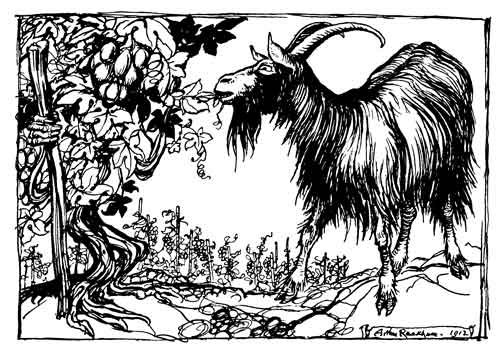
Billy Goat Gruff

Billy goats gruff are large specimens of intelligent goat. They are neither wicked nor kind; just don’t attempt to bar their way.

Billy Goat Gruff: HD 3; AC 7; Atk 1 gore (2d6); Move 180; Save as Fighter 3; Aligned with Spades; Special: +4 damage on charge.

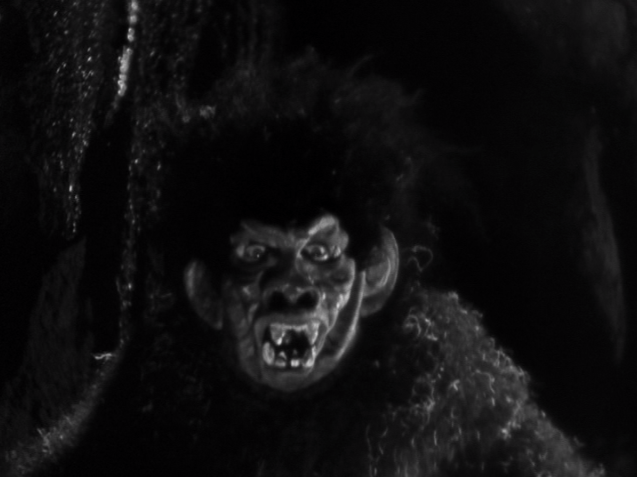
Bogeyman
Bogeymen are savage looking humanoids that gather in Bogeyland, but sometimes make incursions into happier places. They often fight with firebrands (1d4 points of damage, save vs. petrification or catch on fire). Bogeymen use the stats for gnolls. Aligned with Clubs (Evil).

Bugaboo
Bugaboos, or bugbears, conform to their normal D&D stats. They look like creepy bears, who lurk in the woods and frighten travelers. Aligned with Clubs (Evil).

Changeling
Changelings are the issue of wicked fairies. When a fairy steals a human child to raise (these children grow up to become fairy knights), they leave a changeling in its place. Changelings are wicked and ill-mannered, and grow up to become spies and assassins. Changelings conform to the stats for doppelgangers. Aligned with Clubs (Evil).

Construct – Gingerbread Man
Gingerbread men are sometimes concocted by wicked witches, and sometimes created accidentally by bakers. They are quick and enjoy taunting others, but sometimes laid low by their over-confidence, and the fact that having a head made of dough doesn’t lend itself to great intelligence.

Gingerbread Man: HD 0 (1d4 hp); AC 4; Atk 1 strike (1d4-1); Move 180; Save as Thief 2; Aligned with Clubs; Special: None.

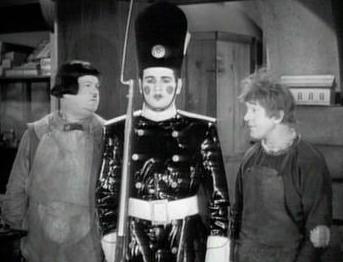
Construct – Wooden Soldier

Wooden soldiers are built by tinker elves and animated by martial spirits. They look like 6-foot tall soldiers carved of wood and painted in gay colors. Wooden soldiers carry wooden weapons. They are immune to most magic spells, but sticks to snakes cancels their magic immunity for 1d6 rounds. Patrols of wooden soldiers are sometimes led by Nutcracker Princes (8 HD, AC 2, Save as Fighter 8).

Wooden Soldier: HD 2; AC 4; Atk 1 wooden weapon (1d6); Move 120; Save as Fighter 2; Aligned with Spades; Special: Spell immunity, immune to fear and other mind effects.

Devil

Devils are foul creatures from the Netherworld who pop into the Fairy Tale Land to tempt the foolish. They appear either as beautiful temptresses (perhaps with vestigial fangs) or as thin, sophisticated men with red skin, pointed black beards, small horns and a tail that ends with a point. Although they often appear unarmed, a devil can summon a trident to hit or her hand instantly when threatened. They can also unfurl bat wings when they find flight a necessity. Aligned with Spades (Evil).

Devil: HD 6; AC 0; Atk 1 trident (1d8) and tail (1d4 + poison); Move 120 (Fly 240); Save as Cleric 6; Special: Poison tail (save or paralyzed for 4 rounds), teleport (in a puff of sulfurous smoke), only harmed by magic weapons.

Dragon
Dragons in Fairy Tale Land are of the fire breathing variety, though in coloration they are usually green. They have the normal stats for a red dragon, and the normal chance to speak and use magic.

Dwarf, Yellow
The yellow dwarves are cruel tricksters who often fall in love with princesses, doing their utmost to force them into marriage. They are dogged and determined, and never let a slight go unrevenged. Yellow dwarves have sallow skin and stringly, orange-yellow hair. They are usually armed with short swords or hand axes.

Yellow Dwarf: HD 1; AC 6; Atk 1 weapon; Move 90; Save as Dwarf 1; Aligned with Diamonds (Evil); Special: Growth (double in size, fight as 4 HD monster, weapon deals double damage) once per day for 10 rounds or invisibility (once per day).

Dragon by Dragon … April 1977 (6)

Ah – spring of 1977. I’m sure after the big Bucharest earthquake and the discovery of rings around Uranus, people were almost too worn out to delve into another issue of The Dragon, but delve they did!

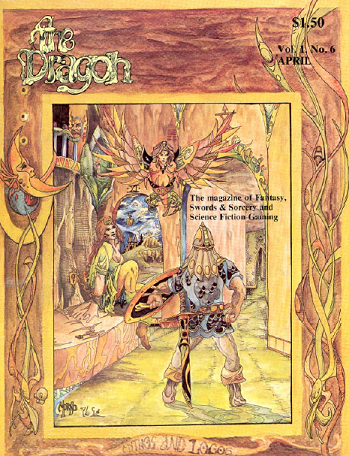
The cover for this issue was by “Morno”, AKA Brad Schenck, who you can find at deviantART. He’s mostly known for his contributions to Arduin and computer gaming, and he has lots of nice retro sci-fi material in his gallery. Check it out.

First article is by Guy W. McLimore, Jr.An Alternate Beginning Sequence For Metamorphosis: Alpha. Article begins with a neat little graphic of old pseudo-computer code … takes me back to programming BASIC on my old Vic-20. Good times. The article takes a while to get to the point, describing a clone bank on the Warden. [Hey – just got it – James Ward – Warden – damn I’m slow]. The meat of the article is a little d% table to determine whether you are human, a latent mutant or a true mutant and how many mutations and defects you have. Do the new versions of WOTC Gamma World delve into defects at all? I dig that defects are just part of character creation back in the day … you play the cards the dice deal you.

The article continues with many more tables, including more detail for latent mutants and the number of programmed ship skills one might have, including some special psychic skills for humans only.

The author would go on to be a part of the Doctor Who RPG, Mekton Empires and a host of products for Star Trek and Starfleet Command.

Ronald C. Spencer, Jr. (another junior … I smell conspiracy) presents Sea Trade in D&D Campaigns. This one springs from a campaign being played on the ballistic missile sub USS Benjamin Franklin … I love the stuff that comes from actual play. In this case, a fighting-man wanted to set up a shipping business on the side – smart guy!

D&D produces two wonderful sorts of rules. On the one hand, you have the super simple, elegant rule – like shields will be splintered – and on the other hand, the baroque set of charts that put a warm glow into the hearts of people like me, even if we never plan on actually using them. This one has a single chart and a few assumptions – one page to cover the whole concept. I like it.

The basics of the system are set up as a number of assumptions. To be brief … (1) Cargo is not specified; (2) small merchant ships can carry a max value of 10,000 gp, large merchants 50,000 gp; (3) ships have to pay a pilot fee of 500 gp for small ships, 2,500 gp for large ships and a 5% import tax based on the value of the cargo; (4) profit/loss is determined with a dice roll (i.e. the neat little chart) and is based on the number of ports the ship bypasses (i.e. the further you go, the more you make, but the more likely you are to lose a ship to storms or pirates).

The ship owner invests in a cargo and then gives sailing orders to hit ship – where to go, which ports to bypass, how much profit/loss to accept (if a port is bypassed to avoid a loss, it counts as a bypassed port – I suppose this involves ignoring a bad roll and trying again). Ultimately, the DM (or D/M as he writes it – love this period when things were not yet settled and official) makes the percentile roll and money is either lost or made.

Ships are delayed 1d4 weeks at ports other than their home port, and when ships are lost at sea the owner is notified 1d6+2 weeks later. Neat system, which I’ll happily use in my Blood & Treasure campaign, assuming anyone goes to the trouble of buying a ship or investing in one.

M.A.R. Barker now chimes in with a painting guide for Legions of the Petal Throne. I can’t imagine how anyone in the hobby back in the day could have resisted buying the Tekumel material … very evocative. Love the art.

Morno (Brad Schenck) now provides some fiction in the form of The Forest of Flame. From now on, I will present one random paragraph from each bit of fiction …

Some obsure glory, had thought Visaque, must belong to one who unlocked the musty secrets of the tome; the dream was even now fresh on him. Weeks, then months of spare hours were spent in the attempt of understanding the mysterious text. By the time its crabbed script was half-deciphered the task became somewhat simpler, and often he read in the small hours its forgotten tales by candlelight. He read of the Elder Days and the Days To Come: of heroes, mages, and of strange devices . . . of Crowyn the Worme’s Bane and of his star-crossed blade; Of the strange curse of Vyckar the Grim; Akor the Valkrian, Nokra Negreth, the Red Branch heroes . . . all the warriors and their impeccable deeds. And then, the mages: Bran-Herla whose soul was lost by the wide waters; Vergil Magus; Garanyr the Heart-Misled; of Myrddin, of Verbius, Therion, and the loremaster Isaac Decapole D’alsace . . . and in an indefinite reference on a faded page, was inscribed the name of Vishre Vishran. When Visaque first read that name it struck an eerie chord within him, as if of a misplaced memory. Even now the name was uncomfortably close to an identity. Yet for contemplation there was, today, no time. That the mage was called an Ipsissimus, he knew, but knew not the rank so named. For all his study (so unclear in the remembering . . .) all Visaque had learned was that Vishran dwelt in the Castle Arestel, atop the mountains eastward. (Arestel . . .)

In the Designer’s Forum (that’s a neat idea … a place where game designers can just add a few bits and pieces and corrections to their games – if any designers out there want to talk about their stuff in NOD, let me know).

This forum is by James Ward, with Further Rules, Modifications and Clarifications for Metamorphosis Alpha. He goes into mutations for taller mutants (roll 1d20 for additional height, add one “striking die” for each four feet above normal height – you can get some tall freaking mutants in MA!), shorter mutants, additional body parts, wings and some psychic powers.

Next, there’s an add for D&D miniatures. They guarantee satisfaction. Fantasy Forge has some neat Tekumel miniatures (I wonder how many are still out there, painted and waiting to be used), followed by an ad for Space Gamer out of Austin, TX.

After the adverts, we get chapter 6 of the Gnome Cache. I quote from the summary …

Unable to resist the wanderlust any longer, Dunstan has robbed his father’s strongbox and set forth on his quest for adventure and glory.

In his naivete, Dunstan casts his lot in with a band of scurrilous cutthroats, believing them to be adventurers sharing his noble pursuits.

Our hero learns the true nature of his erstwhile companions, and his pockets are the poorer for it. Dunstan parts company from the band, narrowly escaping apprehension by the Warders. In the confusion, he ‘liberates’ a horse, and sets off for Huddlefoot, there to spend the night in the stables.

Our would-be knight acquires a would-be squire, and strikes a bargain with Evan to travel with his caravan to Rheyton and Nehron. This arranged, he takes care of the incriminating horse, spinning a tall tale of being on official business. This done, they await departure . . .

David W. Miller presents: D&D Option: Determination of Psionic Abilities, giving some additional ways people could pick up psionics in the game. I kinda dig the baroque nature of psionics in old D&D, though I don’t remember if we ever used them or not. Maybe one or two characters were lucky enough to develop them.

Jim Hayes and Bill Gilbert cover Morale in D&D – an important system when you consider the game’s wargaming roots and the importance of wandering dungeons with large bodies of men-at-arms and torch bearers. This one has a couple charts, lots of modifiers and … honestly, I’d rather just roll 2d6 and be done with it.

In Fineous Fingers, we get a visit from Bored-Flak, the Bolt Lobber, who has a firing sight on his finger. He saves the party’s bacon and then disappears into the dungeon.

The Featured Creature is the Death Angel by John Sullivan. Not the toughest monster in the world – 7 Hit Dice (d8’s, it notes) and AC 4 (or 15, in modern games), but it does a death scythe that forces people to make a save vs. death at -3 (and you lose a point of constitution if you fail). If you can take this sucker on at range, you’re okay … except it can teleport at will. They also have 95% magic resistance. Fortunately, they only attack their intended victim – essentially somebody who has pissed off a god or demi-god. The take away here … leave those gemstone eyes in the idol alone!

Next (and final) add is for the old dungeon geomorphs – only $2.99.

All in all, a decent issue, but not spectacular.

Dragon by Dragon – December 1976 (4)

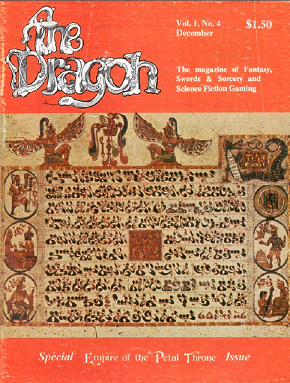
The Dragon closed out 1976 with an issue dedicated to The Empire of the Petal Throne – they even added 4 pages to the magazine to handle all the goodness.

Full disclosure … as long as I’ve been playing D&D and learning about it, I still know relatively little about MAR Barker’s baby. I know the basics and the general history, but it’s always seemed like a setting that required immersion to really grok.

The December issue kicks off with what we would now refer to as a campaign log by the man himself, MAR Barker, updating folks on the going’s-on of Tekumel (really a follow-up to a similar article published in the final issue of “The Strategic Review”. I mostly found this one interesting because it serves as a glimpse into another style of campaign play. Early in the aricle, Barker explains the need (or at least desire) to coordinate the various campaigns in Tekumel to avoid “parallel universe” development. Each DM back in the day really WAS his or her campaign. When you played with a DM, you visited his little universe. I think you’ll find a similar sentiment in the FLAILSNAILs concept.

Next up – James M. Ward provides some notes on Androids on the starship Warden. The androids, it seems, play the role of doppelgangers, taking positions of power among the human tribes and keeping them in conflict with the mutants so that the androids are free to continue their drive for power.  I dig that he refers to them as the “chemical men”. I also dig that the “history” of the androids was supplied by “Emaj the fat mutant philosopher as translated by Yra the Wise.” Honestly, if your not making weird plays on your name and inserting them liberally into your campaign, you just ain’t doin’ it Old School.

Steven Klein provides a random encounter table for the foreign quarter of Jakalla, a city of Tekumel. In essence, this isn’t much different from Gary’s city encounter table in the old DMG. Watch out for the priests of the Goddess of the Pale Bone!

MAR Barker now chimes in again with notes on war gaming in Tekumel. Like Gygax and Arneson, Barker was a war gamer, and here he gives a report on the Battle of the Temple of Chanis: 2020 A.S. as a way of introducing people to the military thinking on Tekumel. He introduces the idea of “Little War” battles that are like duel battles and “Great War” battles that involve hundreds and thousands of troops. The idea of battles that mostly revolve around challenges between individuals in the two forces reminds me of stories from Celtic antiquity, and it’s not a bad way to handle some mass battles in your game without having to deal with actual war games. The length of the invented history of this battle (well, probably play report from his game) suggests how immersed people were in the game … it’s a long article to read just to learn about something that never actually handled.

The Creature Feature presents two creatures from Tekumel, the Mihalli and Vriyagga, both getting some nice color art. In S&W terms, they would have the following stats:

Mihalli: HD 3; AC 1 [18]; Atk1 weapon; Move 15; Save 14; CL/XP 5/240; Special: Magic spells, shape-change, magic items.

The Mihalli were non-humans that had subterranean spy facilities that were wiped out with nuclear fission bombs. Only a few now persist. They are hermaphroditic humanoids with skin that ranges from dull green to coppery brown that signify their class – green for lower, coppery brown for upper. They are shape-changers who are sometimes given away (20%) by their opalescent red eyes. All are magic-users and most have magic items, including the wonderfully named Ball of Immediate Eventuation, which can fire energy bolts, create defense shields against non-magical projectiles (I think we call it shield these days), cause their users to become invisible and produce clouds of poisonous gas. They come in various strengths, indicated by their colors.

Vriyagga, Small: HD 10; AC 1 [19]; Atk 4 tentacles (2d6 + constrict) and bite (1d6 + poison); Move 8; Save 5; CL/XP 12/2000; Special: Tentacles up to 10 feet long.

Vriyagga, Medium: HD 15; AC 1 [19]; Atk 4 tentacles (4d6 + constrict) and bite (1d8 + poison); Move 12; Save 3; CL/XP 17/3500; Special: Tentacles up to 20 feet long.

Vriyagga, Large: HD 25; AC 1 [19]; Atk 4 tentacles (6d6 + constrict) and bite (1d10 + poison); Move 15; Save 3; CL/XP 27/6500; Special: Tentacles up to 40 feet long.

These babies are excellent – two giant wheels with knotted muscles around a central spoke, brain pans hanging from that with weird faces from which extend four tentacles covered in suckers and a mouth lined with poisonous, purple feelers. They have ebon eyes that can see in the dark. The tentacles are very tough (AC 2 [17] to sever). Vriyagga enjoy the taste of juicy humans over the pale shrimp-things who they normally dine on.

Gary Jaquet now gives us “Miscellaneous Treasure, Magic, Weapons, Artifacts and Monsters – Additions, Deletions, Omissions, Corrections, Changes, Variations and Otherwise Confusing Alterations” etc.  This is a comedy bit with things like Creeping Crud (resembles cigarette butts, crushed Fritos, spilled Dr. Pepper, sweat from players’ foreheads and referees’ dice rolling arm, pencil shavings and old character cards), dice lice, etc.

Jerry Westergaard presents some fiction – “Roads from Jakalla”. This, along with the other articles by Barker, do a good job of presenting the setting.

Another side bar presents the old “Generals can do X, Colonels can do Y … Privates can do everything” bit, only starting with 22nd level wizards and working down to Referees.

Wargaming World – no author credit – examines the new miniature lines for EPT and D&D. The reproductions of the miniatures are almost impossible to see, so, not much help really.

Page 29 does have an interesting bit – maybe the first appearance of Appendix N. Titled “Fantasy/Swords & Sorcery: Recommended Reading From Gary Gygax”. It goes from Poul Anderson’s Three Hearts and Three Lions to Roger Zelazny’s Jack of Shadows (etal), Lord of Light and Nine Princes of Amber series.

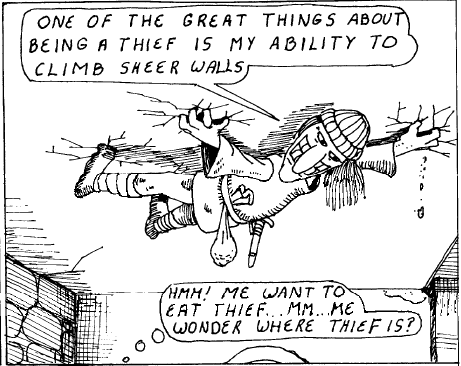
Fineous Fingers gives a nice demonstration of “climbing sheer walls” for thieves.

Page 31 gives the percentile chance for obtaining an “Eye” as treasure in EPT, and the issue then ends with some pictures (boy were they hard to reproduce back in the day) of a scale model of the Temple of Vimuhla.

Not a bad issue if you want to wade into Tekumel and test the waters, and if you can’t find something to do with the Vriyagga, you just aren’t trying.

Amazons, Archons and Azers

I’m now working my through the monster chapter doing a first pass on editing before it goes to Tanner for a more thorough look, and I decided “Why not preview a few monsters on the blog”. (i.e. I needed a quick and easy post for the day because I’m busy as spit).

I figure this can give folks an idea about the format (different than in earlier previews – a format I liked but just became too difficult to layout effectively and make the info easy for the TK to access during play) and maybe preview a few of the new monsters in the game.

AMAZON
Medium Humanoid, Alignment Varies, Average Intelligence; Company (1d20)

HD: 1 + 1
AC: 16 (chainmail and shield)
ATK: Longsword (1d8+1) or longbow (100 ft., 1d8+1)
MV: 30
SV: F 15, R 13, W 15
XP: 100 (CL 2)

Amazons are humanoid females who are expert warriors. All amazons are uncommonly tall and handsome. They come in three varieties, named after the color of their skin; the blue amazons, green amazons and red amazons. All amazons eschew accepting males into their society, but do require them for mating. Male humans are often taken by them in raids, mated with, and then sent on their way. Boys born onto the island are given to mercenary bands composed of the sons of amazons. These men, who lack the special abilities of their mothers, are called myrmidons. They look like their fathers, but their eye color and personality matches their mother.

Blue amazons are Lawful (LG) and worship the goddess of wisdom and war. Their skin is deep azure and they have hair that shines like silver. They are the wisest of the amazons, and enjoy a magic resistance of 10% and immunity to surprise. Blue amazons fight in close-knit ranks with spears and shields and they wear platemail (AC 19). They are usually led by clerics or paladins.

Green amazons are Neutral (N) and worship the goddess of the hunt. Their skin is jade green and their hair dark, forest green. Green amazons dwell in the woodlands, spending their days hunting. They can survive and track as well as rangers and can attack twice per round with their longbows. They are usually led by druids or rangers.

Red amazons are Chaotic (CE) and worship the goddess of black magic. Their skin is vivid crimson and their hair jet black. Red amazons fight as berserkers, attacking twice per round with their long swords, and they are immune to fear. They are usually led by chaos clerics or warlocks.

Organization: Band of 80 warriors plus 50% non-combatants plus leader of 4th to 7th level (1d4+3).

ARCHON
Archons are celestials that are not unlike angels, but of an inferior class. Archons speak Celestial, Infernal, and Draconic, but can speak with almost any creature using tongues.

A righteous aura surrounds archons that fight or get angry. Any hostile creature within a 20-foot radius of an archon must succeed on a Will save to resist its effects. Those who fail take a –2 penalty on attacks, AC, and saves for 24 hours or until they successfully hit the archon.

Spells: Continuous—magic circle against evil, tongues; At will—teleport

HOUND ARCHON
Medium Outsider, Lawful (LG), Average Intelligence; Pack (1d6)

HD: 6
AC: 19 [+1]
ATK: Bite (1d8) and slam (1d4) or +1 greatsword (2d6) and bite (1d8)
MV: 40
SV: F 10, R 10, W 10; +4 save vs. poison
XP: 3,000 (CL 8)

Hound archons look like well-muscled humans with canine heads. Hound archons prefer to attack with their natural weapons but occasionally use +1 greatswords.

A hound archon can assume any canine form of small to large size. While in canine form, the hound archon loses its bite, slam, and greatsword attacks, but gains the bite attack of the form it chooses.

Once per day, a hound archon can attempt to smite a Chaotic creature, doing double damage if it hits.

Special Qualities: Immune to electricity and petrification, magic resistance 15%

Spells: Continuous—magic circle against evil, tongues; At will—aid, continual flame, detect evil, message, teleport

LANTERN ARCHON
Small Outsider, Lawful (LG), Low Intelligence; Gleam (1d6)

HD: 1
AC: 15 [+1]
ATK: 2 light rays (30 ft., 1d6)
MV: Fly 60
SV: F 14, R 12, W 14; +4 save vs. poison
XP: 250 (CL 3)

Lantern archons appear as floating balls of light that glow about as brightly as a torch. Only their destruction can extinguish the glow, though they can try to hide it. A lantern archon has little reason to get within melee range. It usually hovers just close enough to bring the enemy within its aura of menace and then blasts away with its light rays. Lantern archons prefer to concentrate on a single opponent, seeking to reduce enemy numbers quickly.

Special Qualities: Immune to electricity and petrification

Spells: Continuous—magic circle against evil, tongues; At will— aid, detect evil, continual flame

TRUMPET ARCHON
Medium Outsider, Lawful (LG), High Intelligence; Blast (1d6)

HD: 12
AC: 23 [+1]
ATK: +2 greatsword (3d6)
MV: 40 (Fly 90)
SV: F 7, R 7, W 6; +4 save vs. poison
XP: 3,000 (CL 14)

Trumpet archons are angelic humanoids that carry long, silver trumpets. If forced into an extended battle, the archon sounds its trumpet and attacks with a vengeance. An archon’s trumpet produces music of utter clarity, piercing beauty, and, if the trumpet archon wills it, paralyzing awe. All creatures except archons within 100 feet of the blast must succeed on a Fortitude saving throw or be paralyzed for 1d4 rounds. The archon can also command its trumpet to become a +2 greatsword. If a trumpet is stolen, it becomes a chunk of useless metal until the owner can recover it. Woe betides the thief caught with one.

Special Qualities: Immune to electricity and petrification, magic resistance 30%

Spells: Continuous—magic circle against evil, tongues; At will—detect evil, continual flame, message

AZER
Medium Outsider (Fire), Lawful (LN), Average Intelligence; Squad (1d6)

HD: 2
AC: 21 (Scale, shield)
ATK: Battleaxe (1d8 + 1 fire)
MV: 30
SV: F 12, R 12, W 12
XP: 200 (CL 3)

Azers are dwarf-like beings native to the Elemental Plane of Fire. They wear kilts of brass, bronze, or copper and speak Fire Elemental and Dwarf (50% chance). Although unfriendly and taciturn, azers rarely provoke a fight except to relieve a foe of gems, which they love. Azers wield broad-headed spears or well-crafted hammers. An azer’s body is intensely hot, so its unarmed attacks and metal weapons deal extra fire damage.

Special Qualities: Immune to fire, magic resistance 5%, vulnerable to cold

Organization: Clan of 100 azer plus 50% non-combatants plus 7 HD leader

AZERS AS CHARACTERS
Azer characters modify their starting ability scores as follows: Str +1, Int +1, Cha -2. They have darkvision to a range of 60 and retain the special abilities of normal azer. Azer speak Fire Elemental, and may also speak the other elemental tongues and Celestial, Dwarf and Infernal. Azer can multi-class as cleric/fighters, fighter/magic-users and fighter/ thieves. Whatever their class, they can only advance to a max of 6th level.

Dragon by Dragon – August 1976 (2)

August of 1976 – A month after the bicentennial, and Marvelites were grooving to such titles as Planet of the Apes, The Champions and Black Goliath, the Seattle Seahawks were playing their first game, Big Ben breaks down in London, Viking 2 enters orbit around Mars, the Ramones make their first appearance at CBGB, and The Dragon’s second issue hits the stands. So what did the gaming geek of 1976 get for his money?

John M. Seaton devises a procedure for “monkish” promotional combat (i.e. knock off the master to assume his level). I love this kind of thing, and given the recent popularity of FlailSnails Jousting, I wonder if there isn’t a market for FlailSnails Monkish Combat.

The procedure would be similar – write up 6 rounds of combat, denoting your strike, kick, block or other maneuvers, and then we see where it goes.


Lots of fiction in this issue.

The second installment of Gygax’s Gnome Cache is in this issue. I’ll freely admit this here – I almost never read the fiction in Dragon. I probably missed out on something.

Speaking of fiction, Jake Jaquet gives us the conclusion to “Search for the Forbidden Chamber”. Didn’t read this either.

Gardner Fox (you might have heard of him) has a short story in this issue called Shadow of a Demon which is covered very capably at Grognardia.

Another installment of “Mapping the Dungeons”, wherein DM’s of the 1970’s try to hook up with players via The Dragon. St. Louis appears to have had a surplus of DM’s looking for players – 8 of them in this issue.

Some dude named Paul Jaquays was running the Spring Arbor College Dungeoning Society in Spring Arbor MI. Wonder if he ever amounted to anything.

Through the magic of Google, I found the following DM’s online:

Keith Abbott of Muskegon MI

Michael Dutton of Mountain View CA might have done some art for WOTC – could be a different guy

Bill Fawcett of Schofield WI kinda founded Mayfair Games

Karl Jones – could be this guy?

Drew Neumann – maybe a composer of film and television scores – he was at Wylie E. Groves High School in Detroit at the right time (Class of ’77). Could have known Ellen Sandweiss, who was in Evil Dead. Did music for Aeon Flux

Scott Rosenberg of Jamaica NY – has a couple issues of The Pocket Armenian floating around online.

Ed Whitchurch has achieved some level of DM’ing fame

Joe Fischer gives us more tips for D&D Judges. He covers interesting entrances for dungeons (i.e. under stuff you don’t expect them to be under) and “friendly” traps that aren’t necessarily harmful. He also provides a random table for treasure chests that are, 50% of the time, trapped thus …

D% Trap
0-30 – 1d4 spring-loaded daggers fire when chest is opened
31-50 – Same as above, but daggers are poisoned
51-65 – Poisoned gas released when chest is opened
66-75 – When opened, chest acts as mirror of life trapping
76-85 – When opened, chest explodes for 1d6+1 dice of damage (wow!)
86-90 – When opened, an enraged spectre comes out [which can be read a couple ways, either of them endlessly entertaining]
91-95 – All characters within 5 feet lose one level [after the first use of this trap, I guarantee everyone will give the thief plenty of space when opening chests]
96-98 – All characters within 5 feet lose one magic item
99-00 – Intelligent chest with abilities of 2nd – 9th level magic-user [nice!]

He also mentions intelligent gold pieces that scream when removed from a room, or replacing real gold pieces in a dragon’s horde with chocolate coins (though as valuable as chocolate was in the “olden days”, that might actually be a step up). He also brings up the idea of creatures with odd alignments (chaotic dwarves, for example).

A couple more spotlights (Joe Fischer rocks!)

Monster Gems are 500 gp gems that can be commanded to turn into monsters (per rolling a wandering monster) for one week – when the week is up, or they are killed, the gem is destroyed as well. It might be fun to rule that every gem worth 500 gp (exactly) is a monster gem.

Hobbit’s Pipe (by Marc Kurowski) – Clay pipe, when smoked, gives ability to blow multi-colored smoke rings (4 per turn, moving at 4” (40’) per turn – love the specificity). The pipe can be smoked 3/day. He also offers up five magic pipeweeds, a bag of infinite wealth, helm of forgetfulness, and ring of infravision.

Lynn Harpold give a long account of Quetzalcoatl and his cult in Central America.

Creature Features gives us the remorhaz. Love the “stat block”:

Move: 12”
Hit Dice: 6/10/14 (8 sided) dice
% in Lair: 20%
Type Treasure: F
Bite for 3-36 points
Breath for 3, 5, or 7 dice of fire damage
Magical Resistance: 75%
Low Intelligence
Neutral
Number Appearing: 1 (1-4 if in lair)
Description: 30’ long. Blue Hued underneath, wings & head backed with red.
Armor Class: Underside: 4. Back: 0 plus special. Head: 2.

Apparently, the standardization bug had not yet bitten.

Jon Pickens presents the Alchemist, a new D&D class. They don’t label this one as an “NPC Class”, so I guess it is fair game for all you D&D-ers out there. I’ll roll one up quickly for FlailSnails:

Xander Wort, Neutral 1st level Alchemist (Student)
Str: 5; Int: 13; Wis: 16; Dex: 16; Con: 7; Cha: 10
HP: 2; Attack: As Cleric; Save: As Fighter (+2 vs. poison and non-magic paralyzation)

Special:
Max. AC is 5
Can use one-handed weapons (excluding magic swords)
Use poisons and magic items usable by all classes
Psionic ability as fighters (replace Body Weaponry with Molecular Agitation)

Special Abilities:
Detect Poison 20%
Neutralize Poison 10%
Neutralize Paralyzation 15%
Identify Potion 5%
Read Languages 80% (one attempt per week)
Prepare poisons (strength level equal to their level; costs 50 gp and 1 day per level) and drugs (as poisons, but knocks unconscious for 4 hours)
Prepare a potion of delusion

Potions:
None – until 3rd level (Scribe)

His bit on poison is pretty cool. If the HD of the poisoner or level of poison is equal to or greater than the victim’s HD, they must save or die. If at least half their HD, they are slowed until a constitution check is passed, trying once per hour. If less than half, there is no effect, but the poison accumulates in the blood until it’s enough to slow or kill the person. A very nice system!

This is actually a very groovy class. The hit points are low, so I don’t know how long Xander would have to live, but he can wear some decent armor and load up on poisoned darts and a poisoned long sword and might just make it to 2nd level.

Jon Pickens also presents optional weapon damage, allowing fighters and thieves to gain mastery in different weapons, increasing the damage they deal with them (except with dwarf hammers, military picks, pikes, pole arms and arrows). Fighters master one weapon per three levels, thieves one weapon per four (and are limited to sword, dagger and sling). Those with a Dex of 13 or better can gain mastery with a combination of two weapons, gaining the ability to strike with both weapons per round or with one weapon and treat the other as a shield. Sword and sword or flail and morningstar combos require a Dex of 16 or better.

Another good system – very clean and simple to use.

All in all, a pretty good issue. Lots of neat rules ideas and some good pulp literature.

Antikytheres

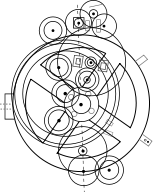
During the best.monster.ever discussion there was a request for clockwork horrors. Here’s my version of the, sort of the fantasy version of self-replicating machines that just don’t know when to stop.

ANTIKYTHERES

Antikytheres are clockwork creations of magic-users designed to retrieve rare earths, metals or gemstones for their alchemical work. They look like scarabs fashioned from precious metals and their dim programming sometimes blossoms into true intelligence, allowing them to reproduce and form hordes. These hordes can descend on a region and strip it bare of mineral resources, all for the purpose of making additional antikytheres. It is not for nothing that dwarves and gnomes attack them on site and then pursue their creator with a rare determination.

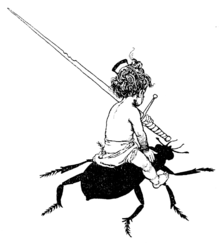
Antikytheres are small creatures that look like scarabs with six jointed legs ending in spikes, mandibles capable of chewing through stone and wing flaps that can open to release razor-sharp chakrams. An antikythere holds six of these missiles.

The bronze antikytheres are the basic models. Silver antikytheres are more intelligent than bronze antikytheres and are also immune to acids. Through a nozzle in their mouths they can spit acid once every three rounds. The acid emerges in a 10-ft line and otherwise conforms to the acid arrow spell. Gold antikytheres are the most intelligent form of the construct. They are also immune to fire and, in instead of spitting acid every three rounds can spray a 15-ft. cone of alchemist’s fire once per day.

Although terrifying enough alone, when five antikytheres work together they can set up vibrations that can cause a small earthquake (per the spell). Each round, there is a 5% chance per antikythere involved (remember, there must be at least five) of causing the earthquake effect. Other antikythere in the area of effect have a +3 bonus to save vs. the earthquake due to their knowledge of it coming and their ability to clamp their spiked legs into the ground for stability.

Bronze Antikythere, Small Construct, Neutral, Non-Intelligent: HD 2; AC 17; Atk 1 bite (1d6) or chakram (1d4); MV 30 (Burrow 15); Save F 16, R 15, W 15; XP 200; Special: Immune to electricity, paralyzed by dispel magic, vulnerable to sonic attacks.

Silver Antikythere, Small Construct, Neutral, Animal Intelligence: HD 4; AC 16; Atk 1 bite (1d6) or 2 chakram (1d4); MV 30 (Burrow 15); Save F 15, R 14, W 15; XP 300; Special: Spit acid, immune to acid and electricity, paralyzed by dispel magic, vulnerable to sonic attacks.

Gold Antikythere, Small Construct, Neutral, Low Intelligence: HD 6; AC 15; Atk 1 bite (1d6) or 2 chakram (1d4); MV 30 (Burrow 15); Save F 13, R 12, W 13; XP 300; Special: Spray alchemist’s fire, immune to acid, electricity and fire, paralyzed by dispel magic, vulnerable to sonic attacks.


Beware the Genomes!

Can stats for Spaceman Spiff be far behind?

Genomes are small humanoid aliens with highly variable features (highly variable!) because of their penchant for body modification. I’m not talking about tattoos and piercings, folks. I’m talking about genetic engineering, mutagenic gases and the grafting of flesh onto flesh.

The standard stock for these genetic whiz-kids is that of a small humanoid, about 3 to 4 feet tall, with slightly hunched shoulders, a large, sensitive nose (per super scent), skin ranging from nut-brown to creamy white and very bright, clear eyes that pierce the darkness per infra-vision. Due to the aforementioned body modifications, most have 1d3 different “mutations” in play. These mutations mimic the different special abilities of alien characters.

MUTATION
1 Increase random ability score by +1
2 Bulk
3 Climbing
4 Electrical Field
5 Leap
6 Multiple Arms
7 Multiple Legs
8 Stunning Grasp
9 Super Hearing
10 Super Vision

Genomes operate in bands of 2d4 individuals, always looking to harvest genetic material for their experiments. They are as capable as scientists in terms of identifying and operating super scientific devices, and always carry medi-kits and mutation-rays. Creatures struck by a mutation ray suffer 1d3 points of damage to a random ability score (1 = Str, 2 = Dex, 3 = Men, 4 = Kno) and must pass a Strength test (DC 10) or be transmogrified into a random monster under the control of the genome for 10 minutes. At the end of 10 minutes, the character can make a Mentality test (using their normal MEN score). If they succeed, they change back to normal. If not, they remain in their monster form, but are no longer under the control of the genome. If captured, the creature can be changed back to normal provided his or her comrades have captured a mutation ray gun (and figured out how to use it) or they have a scientist capable of designing a mutation ray gun (super science DC 25).

RANDOM MONSTER
1 Ankheg
2 Baric
3 Flail Snail
4 Gelatinous Cube
5 Giant Beetle
6 Giant Lizard
7 Giant Spider
8 Great Horned Ape
9 Killer Shrew
10 Random Alien Animal

GENOME: HD 1; DEF 15; FIGHT 4 (vibro-pick 1d8); SHOOT 6 (mutation ray); MOVE N; STR 3; DEX 5; MEN 4; KNO 8; DL 3; Special: Infra-vision, super scent, 1d3 mutations, mutation ray.