The Glooms – Dungeons and Mines

7.91 Adalark’s Tomb: A tall cenotaph of black marble stands 20 feet tall here. On the top there is a sculpture of a giant serpent, mouth open and fangs bared.

The serpent is the entrance to a small tomb complex located about forty feet below the ground. One cannot fit in the serpent’s mouth, of course, but by reaching deep into its mouth (unfortunately impossible for halflings or gnomes) and touching a stone lodged therein, a person is teleported beneath the ground.

[A] The entry chamber into the tomb is a square room with black marble walls and a 30 foot high ceiling. Against one wall there is a copper plaque bearing the following inscription: “Adalark | Called Great | Was Great | He cannot blame lesser thieves for following in his steps.”

There is a terracotta statue here of a weeping woman looking at the plaque, on hand reaching toward it. Approaching any of the walls in the room causes a sub-section (10’ wide by 10’ tall) of that wall to move backward – apparently one cannot step closer than five feet toward a wall. The walls extend back ten feet, at which point a metal portcullis descends from the ceiling, locking them in. The walls then slowly begin to crawl back to their original position to crush the intruder. The section of the wall with the plaque does the same as the others.

If all four walls are forced back at the same time, the wall with the plaque disappears completely and reveals a second chamber, and the other three traps do not spring.

[B] The trapped chamber opens here onto a balcony overlooking a square room about 10 feet below. In the room below there is gathered the treasure of Adalark the master thief, which consists of three gold ingots (3 lb each), a brass icon of a winged woman (worth 1,000 gp), a cape of deep red velvet (100 gp), six silver shields (250 gp each), thirty pairs of chartreuse gloves (they were Adalark’s trademark), a suit of halfling-sized platemail and 8,000 gp. The interior of the platemail is coated with platinum (2,000 gp worth).

Extending from the balcony there is a wall of force that does not allow one access to the treasures below. The treasure chamber is actually an optical trick called “Pepper’s Ghost”. The treasure is actually located in a room beneath the balcony. A large pane of glass slanted across the open area reflects the treasure, which is illuminated from below using a continual light spell. The most likely way of dropping into the treasure chamber is to use dispel magic to remove the wall of force. Any who then drop into the chamber without being very careful may drop through the glass into a pool of acid below (inflicts 3d6 points of damage from the fall and 1d6 points of damage each round from the acid).

14.87 Boring Wreck: A large earth borer made of steel with brass highlights has been abandoned here by the Master’s synthoids after the drill bit broke. The Master was already on to other projects and never reclaimed it. Eight were-weasels have now adopted it as a lair, and keep 60 cp, 170 gp, fifteen wolf skins (worth 8 gp each) and a small pearl worth 3 gp hidden inside.

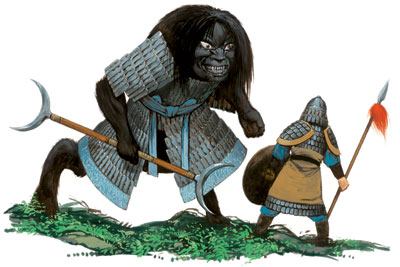
20.92 Iromir Mine: Iromir is a natural alloy of iron and mithral. A very deep mine here, run by kobolds (who took it from a clan of svirfneblin), produced a good amount of the material, which the drow favor for their weapons and armor when they cannot find pure mithral. The shipments recently stopped. When a band of orog from the village in [32.98] appeared to investigate, they discovered the mine (it has seven levels) crawling with kobold zombies. There are now fifty orogs camped outside the mine and making some shallow forays into the place.

Image is copyright Wizards of the Coast.

The Glooms – Mechanical Men, Drow and Worm Food

After taking two days off from writing about Hell (well, a week actually – it was two days between finishing NOD 11 and starting NOD 12), here is the first peek at the southern portion of the Glooms.

2.58 Mechanical Misfits: A little tribe of mechanical men, refugees from the experiments of the Master [4.105], dwell in a ruined kobold fortress. The fortress is carved into the wall and consists of a guarded, fortified entry chamber (locked portcullis, the ledge in front of it is trapped to collapse, sending people 50 feet to the cavern floor). Beyond the entry chamber there are about twenty chambers, mostly small, inhabited by the mechanical men. The mechanical men number 40 individuals built of scrap. Most are about 3 to 4 feet in height. They are sneaky little devils, scavenging far and wide for replacement parts and metal that they can melt down and forge into new parts. They have a working forge and a fine crucible and are open to trade, but find it difficult to resist the temptation presented by adventurers toting metal.

2.106 Troupe: A troupe consisting of five drow overseers and their master, Qodvigo, a drow warrior-mage, and thirteen enslaved ophidian dancing girls. The troupe is gradually picking their way through the ooze-filled tunnel using picturesque wagons painted with phosphorescent paint (skeletons, owls, the words “Master Q’s Traveling Show”) and supported on four spindly legs, like those of an elephant only longer and thinner.

There are three wagons in all, each one carrying three or four ophidians huddled around a coal-burning stove, a driver and a guard. The ophidians wear torqs that have a permanent charm monster effect cast on them and tied to Qodvigo. Qodvigo’s wagon is the largest and contains a separate, raised chamber (about 6 feet long and 4 feet wide) containing his ritual objects and spellbook.

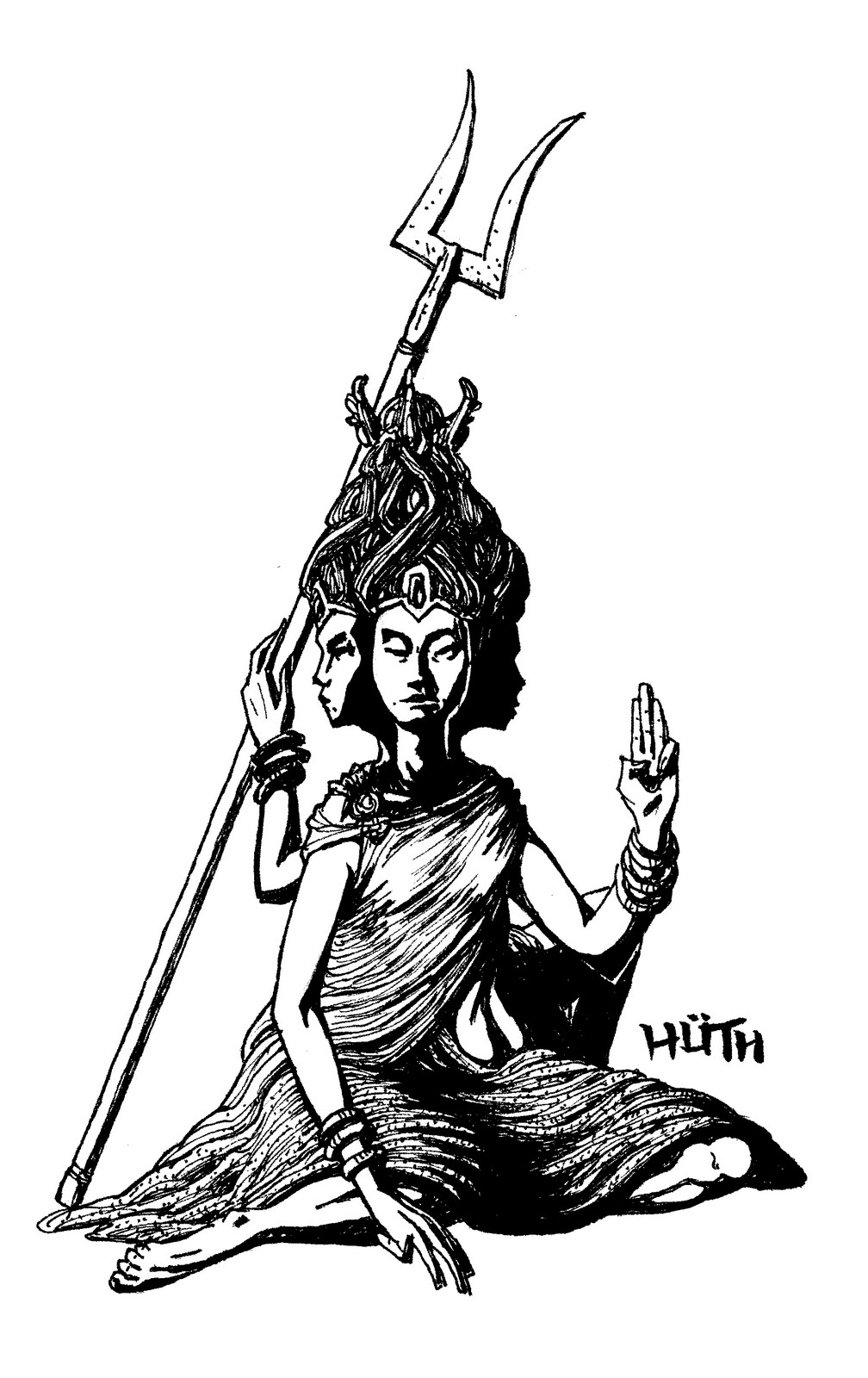
3.66 Worm Food: A tunnel in the wall here features a series of stairs downward leading to a branch of three tunnels. In the nexus there is a brass idol of Tricrucia, the petty goddess of forks in underground tunnels. The three-faced, three-legged, three-armed idol has all three arms pointing down towards the three different passages. One of the passages has an “X” carved above the cave entrance, the second a short series of three white marble steps down and the third the smell of rotting vegetation. The third tunnel is the safe one, the other two containing great lantern worms. At the end of the stinky tunnel there is a small shrine to Tricrucia containing sacred coins (5,100 sp, 710 ep, 5,400 gp) in bronze pots. If any of these are stolen, the thieves suffer a divine curse that keeps them from ever knowing their way under-ground, at least until the treasures are restored.

Image of Tricrucia by Chris Huth from Petty Gods – can’t wait for that release!

Asphodel, First Circle of Hell

Rather than post some locations, I thought I’d post the draft for my description of the first circle of Hell, Asphodel.

Asphodel
The First Circle of Hell

Once one has crossed the Acheron, they see looming above them a wall greater and more hopeless than any other in the cosmos. Hell, you will remember, is a prison and the demons and devils within Hell prisoners. The walls are composed of impossibly thick stones, and thus for all intents and purposes impossible to bore through or knock down. The walls are also proof against ethereal creatures and the passwall spell. Within Hell, it is impossible to teleport or open dimension doors or gates to anywhere outside of the confines of Hell.

Hell’s ramparts from the outside are a sheer face of dark gray stone about 500 feet high. The battlements are not unlike those of a mortal fortification, being crenellated and manned by barbed devils. The walls are 80 feet wide at the bottom and about 40 feet wide at the top, providing ample space for the terrible bronze guns of Hell – massive cannon 30 feet long and 6 feet in diameter that launch exploding cannon balls that inflict 12d6 points of damage in a 10-ft radius, 9d6 in a radius from 11 to 30 feet, 6d6 in a radius from 31 to 60 feet, 3d6 points of damage in a radius from 61 to 90 feet and 1d6 points of damage in a radius from 91 to 120 feet. Folks within 60 feet of the impact must pass a saving throw or be permanently deafened. The cannon have a range of 600 feet and the shells can explode in mid-air at a range chosen by the firer. These shells leave massive craters, many of which are in evidence on the gray-green plains of Asphodel just beyond the walls.

The key point about the cannons is that they point inward, not outward. Likewise, the demons on the parapets do not resist people flying into Hell – only people trying to fly out. For those attempting an escape, assume that every mile of the wall is patrolled by 1d4 squads of barbed devils (i.e. 1d4 x 10 barbed devils) and one cannon. When one section of the wall is “attacked”, barbed devils from nearby sections quickly join the fight. Fortunately, the barbed devils that guard the walls of Hell are prisoners themselves, and thus cannot go beyond the walls to chase down escapees. The gods of Law and the masters of Hell use other resources to deal escaped shades.

Most escape attempts are aimed at the Hellmouth, or Gates of Hell. The gate is unimpressive on the exterior wall – an arched portal 40 feet tall and 25 feet wide barred by a portcullis that, like the walls, is proof against ethereal creatures. The bars are 6 inches thick and made of adamant, and thus quite difficult to bend. The 80 foot tunnel beyond the front portcullis has another adamant portcullis located every 20 feet. All of these are operated by barbed demons looking down from chambers constructed around the tunnel via arrow slits. Murder holes abound, through which the demons pour such things as molten lead, acid and boiling oil. Arrow slits located about 20 feet above the floor allow them to rain arrows on those who are attempting to force their way through.

On the interior wall of Hell, the gate is more heavily defended, situated as it is between two 500-ft tall towers pierced by numerous arrow slits. Each tower is manned by three companies of barbed devils. The terrible hound Cerberus stands guard just outside the inner portcullis.

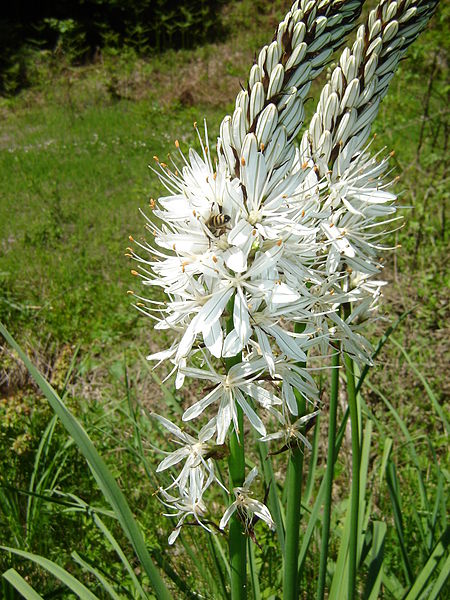
Beyond the walls of Hell, Asphodel is a wide-open, undulating savannah of long, gray-green grasses, thorny, twisted trees and tiny white flowers called asphodels, the circle’s namesake. The plains are roamed by a variety of demonic humanoids and animals in a sort of parody of Africa’s savannah. Many fortresses and even cities dot the savannah, where the lords and dukes of Hell hold court.

There is no Sun in Hell, of course, but the whole of Asphodel is swathed in a twilight gloaming, allowing creatures to see about 1 mile away, double for creatures with “darkvision”. The air of Asphodel is unnaturally still and almost suffocating in its stillness. There is no wind to move the grasses or bend the boughs of the prickly trees, and the range of wind-related magic on Asphodel is cut in half. Storms cannot be raised here nor lightning called.

Races of Asphodel
Asphodel, like most of the other circles of Hell, is not only inhabited by pitchfork-carrying devils and their victims. Four races known to people of the surface world dwell in Asphodel, though these races have been changed by their habitation in Hell.

Asphodelian Gnoll: The gnolls of Asphodel are tall and thin, with greenish hair spotted with black and glaring white eyes. They arm themselves with spears, ring armor and large, round shields. The Asphodelian gnoll utters an insane, demonic laughter while fighting, forcing people to pass a saving throw after three rounds of combat or become so unnerved that they suffer a -2 penalty to fight.

GNOLLS: HD 2; AC 4 [15]; Atk 1 bite (2d4) or weapon (1d10); Move 9; Save 16; CL/XP 3/60; Special: Unnerving laughter.

Asphodelian Goblin: The goblins of Asphodel have rear legs like those of a grasshopper. They have mottled blue skin and long fangs jutting down from behind their upper lips. These goblins carry spiked maces and wear leather armor. Their touch causes people to revert in age by one year unless they pass a saving throw.

GOBLINS: HD 1d6 hp; AC 5 [14]; Atk 1 weapon (1d6); Move 9; Save 18; CL/XP B/10; Special: -1 to hit in sunlight, touch de-ages people.

Asphodelian Halfling: Asphodelian halflings are willowy and relatively tall for their race. They have spidery arms and legs and droopy eyes, like those of opium eaters, on small heads with beetle-brows and pronounced overbites. The halflings are bald and have four gleaming white eyes spaced evenly around their heads, making it impossible to surprise them. They arm themselves with barbed nets and whips, dropping from trees to capture travelers.

HALFLINGS: HD 1d6 hp; AC 5 [14]; Atk 1 weapon (1d6); Move 9; Save 18; CL/XP B/10; Special: -1 to hit in sunlight, cannot be surprised.

Asphodelian Hobgoblin: Asphodelian hobgoblins are squat, apelike creatures always encased in black lacquered platemail and gripping their beloved axes and blunderbusses. They are deeply paranoid creatures, positive that everyone and everything is out to get them, and this makes them even more militant than usual for hobgoblins.

HOBGOBLINS: HD 2+2; AC 1 [18]; Atk 1 weapon (1d8+2); Move 9; Save 16; CL/XP 2/30; Special: Magic resistance (10%).

The Glooms – Caged Imps, Forlorn Golems and Shadowy Theatres

Three more from the Ante-Hell. Perdition awaits …

110.5. Imp-N-Cage: Somewhere in this hex of magma pools and basalt landforms, hanging from a chain beneath a natural land bridge that spans a flow of magma, there is an imp inside a cage constructed of logical fallacies. The cage is too convoluted for the imp, but perhaps a character with high intelligence could solve it. To simulate this, the Referee can prepare three riddles. If a player can answer all three of them, they succeed in freeing the imp, which will swear eternal loyalty (ha!) to its rescuer and even become their familiar if they are a magic-user. Each riddle that is answer incorrectly, however, costs the character one point of their intelligence score, permanently, as they find themselves trapped in logical fallacies. Of course, as difficult as answering the riddles is, the swarm of adamantine wasps that guards the bridge is even worse.

ADAMANTINE WASP SWARM: HD 15 (76 hp); AC 0 [19]; Atk 1 sting (3d6+poison); Move 5 (F14); Save 4; CL/XP; 16/3200; Special: Poison (harden into ice, 1d6 damage per round, shatter when dead), magic resistance (12%).

IMP: HD 2; AC 2 [17]; Atk 1 sting (1d4 + poison); Move 6 (F16); Save 16; CL/XP 6/400; Special: Poison tail, polymorph, regenerate, immune to fire.

110.29. Forlorn Golem: A stone golem sits on the banks of the Acheron, its feet in the black waters, chin on hands, elbows resting on knees. The golem was created by a mad wizard to besiege Hell, the wizard miscalculating the width and depth of the Acheron. Abandoning the concept, the wizard moved on and left his creation by the river to await new orders. He sits there to this day.

STONE GOLEM: HD 15 (60hp); AC 5 [14]; Atk 1 fist (3d8); Move 6; Save 3; CL/XP 16/3200; Special: +1 or better magic weapon to hit, immune to most magic.

118.51. Natural Amphitheatre: There is a natural amphitheater located in this hex. The amphitheater has been accentuated with seating carved into the reddish-brown rock. Against the back of the amphitheater there is what appears to be a bas-relief (deep relief) of a warrior in Greek armor, spear and shield in hand. He appears to be fighting, with his back against the wall. The statue is actually a warrior who was turned to stone while fighting the guardians of this shrine, for the amphitheater is a shrine dedicated to the Tenebrae, the daughters of Nyx and Eerebus. It is guarded by eight sisters, medusas with black-bronze skin and cool, green eyes. Each of these medusas, as a priestess of the Tenebrae, can cast three cleric spells, one of first, second and third level, each.

The statue is still inhabited by the warrior’s spirit, now an ethereal shade. The shade appears when people walk on the “stage” and attempts to force a female adventurer touch his statue body. Doing this releases him from the curse, in which case the restored warrior can introduce himself as Damali, a crusader from ancient days. Damali is a 10th level paladin.

ETHEREAL SHADE: HD 8; AC 1 [18]; Atk Icy touch (2d6) or special ability; Move 9; Save 8; CL/XP 10/1400; Special: Hard to see, immune to non-magic weapons, befuddlement.

Image from HERE.

The Glooms – Landsharks!

Still working diligently on Hell. Almost finished with the north half of the first ring, and then I need to sprint in October to finish the north half of the next few rings. Should fill quite a few pages. I’m also working on a Demonologist class based on the Elementalist I published a few months back and a class that will present a few underground creatures as playable races, for those who want to run a campaign set entirely in the underworld. I’ve commissioned some art from Jon Kaufman, who did the race images for PARS FORTUNA and requested an old-style bugbear (a’la DCS), orc (pig-nosed of course), goblin (a’la DAT), kobold (scaled dog dude), hobgoblin (samurai armor wearing), svirfneblin (a’la Russ), drow (a’la Willingham), duergar (a’la Holloway) and a new critter. I can’t wait to see what he comes up with.

I should also mention – if these encounters sound tough, they’re meant to be. Most Land of Nod hex crawls are designed with characters in the fourth to eighth level in mind. These are meant to challenge characters who have gone past 12th level and want to invade Hell instead of settling down and playing the end game (stronghold, armies, etc). For example, Cocytus, the lowest plane of Hell, will be geared towards challenging a party of 30th level characters.

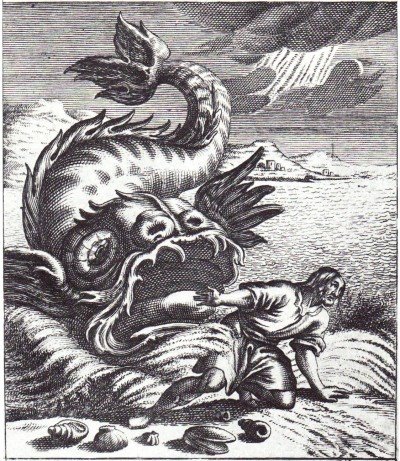
66.4. Fishing Trolls: A tribe of trolls (50 males, 50 females and 60 young) dwell here on the banks of the Acheron. The trolls are whalers. They sail a boat made from the ribs and hardened skin of abyssal whales. They head out into the Acheron each day seeking abyssal whales to harpoon and pull out of the water. The whales are then processed, producing black ambergris that is highly valued (1,000 gp per pound; the trolls usually have 2d10 pounds on hand).

The trolls dwell in a white mount that abuts the river, in caves chewed out of the chalky stone. These caves wind through the white stone like a maze, but the trolls always know their way, especially the secret doors and passages.

The trolls are led by a jarl called Svalmad and his five brothers, who serve as his huscarls. The tribe also includes a shaman called Bearlang, who prays to Hel and Angrboda and has been given a nidhund by those demons for his loyal worship. The trolls of White Mountain have oddly elongated arms, giving them a +1 bonus to hit in melee combat. They wear bits and pieces of leather and metal armor (equivalent of ring mail) and carry axes and harpoons. Svalmad is growing old for a troll, and his brothers know it. They plot against him with Bearlang.

Besides the aforementioned ambergris and a fair amount of scrimshaw art (maybe 1d4 x 100 gp worth), the trolls have a treasure of 3,500 ep, 45,400 gp, 520 pp, a silver idol of Hel (800 gp), an emerald (4,000 gp), an aventurine (1,250 gp) and eight casks of fine wine (12 gal./100 lb. each, worth 600 gp/gal.)

TROLLS: HD 6+3; AC 4 [15]; Atk 2 claws (1d4), 1 bite (1d8); Move 12; Save 11; CL/XP 8/800; Special: Regenerate 3hp/round, +1 to hit.

NIDHUND: HD 4; AC 5 [14]; Atk 1 bite (1d6) and 2 claws (1d6); Move 21; Save 13; CL/XP 7/600; Special: Immune to cold and poison, rake with claws, magic resistance (10%).

HUSCARLS: HD 7+3; AC 4 [15]; Atk 2 claws (1d4), 1 bite (1d8); Move 12; Save 9; CL/XP 9/1100; Special: Regenerate 3 hp/round, +1 to hit.

BEARLANG: HD 6+3 (38 hp); AC 4 [15]; Atk 2 claws (1d4), 1 bite (1d8); Move 12; Save 11; CL/XP 8/800; Special: Regenerate 3hp/round, cast spells as a 3rd level anti-cleric, +1 to hit due to elongated arms.

SVALMAD: HD 9+3 (33 hp); AC 4 [15]; Atk 2 claws (1d4), 1 bite (1d8); Move 12; Save 9; CL/XP 9/1100; Special: Regenerate 1 hp/round, +1 to hit due to elongated arms.

90.11. Igho-Kih: Igho-Kih is a dready city of 12,500 grimlocks and their thelidu masters. The city is hewn from the very stone of the underworld in a lopsided radial pattern – meaning circles off-set from one another in such a way that they intersect at weird angles. The city-state is surrounded by a tall karst wall that looks like a picket of giant stalactites. These walls have been carved into battlements and towers at places, and form a massive fortress. Each buttressed balcony is patrolled by 1d4 grimlocks who carry spears and wear chainmail. Within the city-state there are tall towers that rise above the canyon-like streets. These black, 3-story towers contain acid that can be released into the streets like a flood at the direction of the city’s masters, a council of thirteen thelidu, squid-headed humanoids with tremendous powers.

These thelidu dwell in a domed palace in the center of the city-state. The palace and city are ensorcelled to be completely dark. Even magical light can only penetrate about 5 feet into the darkness, and even then only with the brightness of twilight. Within the domed palace there is a series of pits and tower platforms. There is no way to move between them other than magic or difficult climbing. At the center of the dome there is a deep pit lined with mirrors that scry into the worlds beyond Nod (i.e. Mercurius, Veneris, Martis, etc).

The thelidu plot the downfall of all creation, though they are so plodding and intellectual they’ll probably never get around to actually doing anything grandiose and meaningful. In the meantime, the grimlocks raise worms and fungus. They live in warrior bands under violent chiefs and enslave their (and other races’) women to use as domestic servants and for mating. The council watches all and knows all, and rewards or punishes the chiefs as they see fit.

109.7. Rats & Sharks: There is an old stone fortress here, probably built by the drow ages ago. The fortress has a courtyard and three towers. The two smaller towers have tumble at some time in the past and now exist as a ruin. The larger tower, though shabby, is still strong and is inhabited by a gang of 20 ratling reavers. Ratlings are, of course, little threat to the denizens of Nifol, but these ratlings are smart and they control five landwalking sharks, which they use in the manner of war elephants. The sharks are kept chained in the courtyard. The ratlings must use extreme caution when mounting them, jumping on the large leather and wood harnesses affixed to their backs from above and then guiding them with gibbets of meat tied with sinew to long sticks or bones. Patrols of three of these war sharks are constantly active in these tunnels, and may be encountered randomly (see above).

The tower of the ratlings contains a shrine to their goddess, the Mouse Lord. Here, they keep a silver idol with ruby eyes and the living manifestation of their goddess (or so they think), a wererat named Tefnuin who wandered into Nifol as an adventurer and managed to hook up with the ratlings after her partners were killed. Tefnuin dwells in luxury, her every need catered to. She wears silk veils that accentuate her semi-humanoid curves, enticing perfume (well, enticing to a ratling) and carries a poisoned dagger. Her soldiers are armed with crossbows with poisoned bolts, short swords and, when on their landwalking sharks, harpoons that are used to reel in prey.

The ratlings have a treasure of 9,790 gp, 860 pp and a lapis lazuli charm worth 200 gp.

LANDWALKING SHARK: HD 13; AC 5 [14]; Atk 1 bite (1d10+8); Move 9 (S18); Save 4; CL/XP 13/2300; Special: Amphibious, feeding frenzy.

RATLING: HD 1; AC 9 [10]; Atk 1 bite (1d6+poison) or weapon; Save 17; Move 12; CL/XP 2/30; Special: Diseased bite.

TEFNUIN, WERERAT: HD 9; AC 6[13]; Atk 1 bite (1d3), 1 weapon (1d6); Move 12; Save 7; CL/XP 10/1400; Special: Lycanthropy, control rats, surprise (4 in 6).

Going to Hell!!

Here’s a first glimpse at my Hell hex crawl. Came out a little lopsided, but hey – nobody is perfect. The uppermost layer is Ante-Hell – essentially a 9th level dungeon level writ large. It is divided from Asphodel – a twilight land of rolling meadows grazed on by stench kows and populated by shades – by the river Acheron. The hexes on this one are 12-mile rather than 6-mile. It is designed to force adventurers to circumnavigate each layer to go from “entrance” to “exit”. So, roll up some paladins and clerics and you can send them on the ultimate hex crawl, beginning in a couple months!

Mu-Pan – Natural Bridges and Soot Fairies

A couple more Mu-Pan encounters.

4043. Natural Bridge: The mountains give way to a deep gorge here. Terrible, ghostly cries emanate from the bottom of the gorge – actually just wind drafts – which lies 300 feet below. A natural bridge crosses the 80-ft wide gorge, but lies 60 feet below the lip. One can get to the bridge (without the use of the rope – watch those crosswinds) by locating the entrance to a cave about 30 feet behind the lip of the gorge.

The cave entrance is really just a hole in the ground, but the hole can easily be climbed and leads to a small tunnel decorated with friezes of dancing saints. The tunnel leads to the bridge, which is about 4-ft wide with slightly rounded sides. The other side of the bridge has a similar tunnel arrangement.

The bridge is meant only for the righteous (i.e. Lawful). The friezes come alive and attack chaotics and neutrals that enter the tunnels. The friezes from the other side of the bridge join in on this attack.

4101. Soot Fairies: An ancient foundry rests here, surrounded by crumbling black walls with tall smokestacks still reaching for the sky. The old building is surrounded by piles of slag and overgrown with sunflowers. The foundry is inhabited by thirty tiny fairy creatures that look as though they were made of blackened, shriveled matchsticks, with bulbous heads and ugly faces. The mere touch of these creatures causes flammables to ignite and skin to blister. The creatures hide a treasure of thirty large jaspers (worth a total of 500 gp) hidden beneath a pile of ash, along with 100 gp worth of iron ingots (weighs about 1,000 pounds).

| Soot Fairies: HD 1d4; AC 3 [16]; Atk 1 touch (1d6); Move 6 (F15); Save 18 (15 vs. magic); CL/XP 2/30; Special: Touch ignites flammables, cough clouds of burning ash (per spell incendiary cloud) once per day.


Image from HERE.

Mu-Pan – Flock of Cheonma

Short encounters tonight, so I’ll post two …

1025. A flock of seven cheonma have made an aerie for themselves on the high peaks here and are under attack by a pack of five griffons. The cheonma are hard pressed and they have already lost two foals to the depredations of the griffons.

| Cheonma: HD 4; AC 6 [13]; Atk 2 hooves (1d8); Move 24 (F48); Save 13; CL/XP 4/120; Special: Flight. Cheonma are Mu-Panese pegasi. They are eight-legged horses with wings on their feet.

| Griffon: HD 7; AC 3 [16]; Atk 2 claws (1d4) and bite (2d8); Move 12 (F27); Save 9; CL/XP 8/800; Special: Flight.

1027. A gang of 20 gyres is occupying a cave here, using it as a base of operations as they raid down the river into Yun territory. The leader of the gyres has a single white eye and particularly long canine teeth. He wears a golden ring on one of those teeth (worth 15 gp) and can cast 1d6 levels of sohei spells per day. The gyres wear coats of leather scales and wield masakaris and kamas. If encountered in their lair, there is a 2 in 6 chance they are drunk on plum wine. Their treasure consists of 340 sp and 1,130 gp in leather sacks. The stripped bones of two unlucky farmers are piled in the back of the cave.

| Gyre: HD 2; AC 4 [15]; Atk 1 bite (1d3) and 2 claws (1d4) or weapon (1d6); Move 15; Save 16; CL/XP 3/60; Special: Frenzy (2 attacks per round for 3 rounds, then fall unconscious).

Mu-Pan – Hermit of Yarni-Zai

Man I love writing this stuff – just letting my mind wander, maybe feeding it with a few random seeds. Here’s another one from the mountains around Tsanjan …

0937. A small village of fishermen live in this hex in a gorge with steep, 90-foot tall sides. A river moves slowly through the hex on its way to the Tsanjani Plateau. The fishermen dwell in something that resembles a Chinese lantern composed of rattan and attached to the walls of the gorge with iron spikes. Each lantern-house measures about 6 to 9 feet in diameter and houses three or four villagers. The fishermen can be seen at odd intervals dangling their feet out their front doors casting long lines into the river below. Hatches in the tops of the lantern-houses lead to ladders composed of iron spikes, allowing the villagers to climb to other lantern-houses or to the top of the gorge.

Below the lantern-houses an idol of Yarni-Zai has been carved into the gorge wall. The grave creator of beasts and men broods over the slow river, which the villagers believe was originally a beautiful maiden that won the heart of the deity but refused him. A hermit priest sits in the lap of the graven image, meditating, answering the questions of the villagers and curing their ills as best he can. The hermit has no name, and asks nothing but an offering of rice or fish in his begging bowl.

The villagers are armed with yami and haikyu, though their lack of money keeps the bandits away and their somber attitude and resignation to the indignities of the world make them unlikely targets even for chaotic adventurers.

| Hermit, Druid Lvl 6: HP 12 [23]; AC 9 [10]; Save 9; CL/XP 7/600; Special: Spells (3rd), speak to animals, plants and monsters, shapechange. Begging bowl, prayer beads.

Image from HERE.

Mu-Pan – Wang Liang

0824. A stone tower made of golden bricks leans over dangerously from the side of a low mountain covered in a tangle of brambles. The tower is the lair of a wang liang and his foot soldiers, 40 oni-yama. The wang liang owns an enviable library of bamboo scrolls on every imaginable subject, though every single one of them is filled with nothing but lies and half-truths. One of the scrolls contains a number of spells that appear to be one thing but are in fact another: Charm person (actually light), invisibility (actually levitate) and alter time (actually lightning bolt).