NOD Sandbox Format

I’ve posted about this kind of thing before, but now I’m starting to visualize how I want to format my sandboxes in future issues of NOD and future blog previews. My main concern is making the information 1) useful for a Referee during actual play and 2) flavorful and unique enough to keep players interested or fire the imagination of the Referee so he or she can keep players interested. With that in mind, here’s how I might format future sandbox presentations …

REGION NAME
• Description of the area; where does it fit in with other maps
• History of the area – very basic
o Pandiluvian Period
o Golden Age
o Modern Age
• [Basic map showing the regions and naming them, along with stars for city-states and dots for towns]
• [Smaller map showing where this region fits into the larger world map]
• [Welcome to NOD sidebar – quick description of the campaign world and what has appeared before]

Sub-regions

Sub-region 1
• Description – landscape, flora, fauna, minerals; hex movement in the region
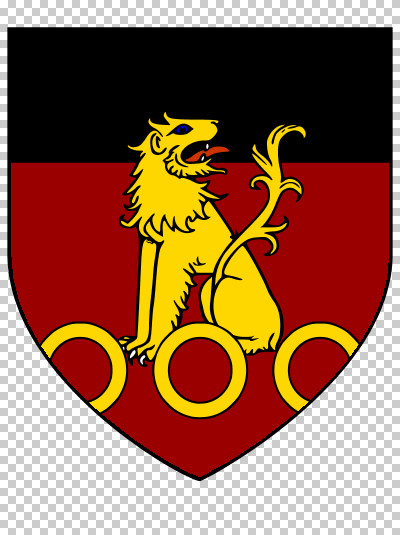
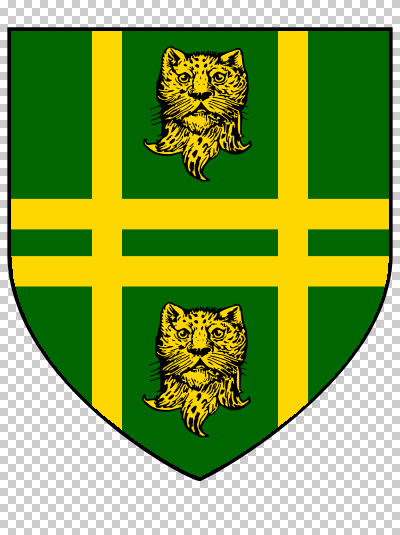
• List city-states, major towns, monster tribes and strongholds and their interactions (if any); include mini armorials

• List major dungeons, along with rumors regarding those dungeons

Sub-region 2
• Description – landscape, flora, fauna, minerals; hex movement in the region
• List city-states, major towns, monster tribes and strongholds and their interactions (if any); include mini armorials

• List major dungeons, along with rumors regarding those dungeons

Dangers
• Random encounter tables for the different regions – one table using 1d12; go from weak to strong, so when the Ref rolls a “12” he knows he should chuckle wickedly
• Discuss No. Appearing formula, when to roll, how often to roll, etc.

Tribes
• Picture (head shot – maybe no picture, see how this one goes) of major humanoid types (including berserkers, men-at-arms typical for the region); for each a brief societal description (mostly as pertains to game play), armor and weapons; show hexes where they appear; give tribal treasure guides – coins, art, livestock, magic – main idea is to help make the goblins of Region X distinct (at least a little bit) from the goblins of Region Y
o Give stats for sub-chiefs/sergeants (+2 HD) and chiefs/captains (+4 HD) along with stats for the basic monster type
• Discuss concept of tribal spell-casters (with a basic statblock for level 3, level 5 and level 7)
• Note – Humanoid leaders and spell-casters that have class levels are described in detail in the text
• Give three map templates for different types of lairs – these will change from issue to issue, but always remain basic; label the chambers rather than number them
o Cave Lairs
o Village/Forts
o Camps

Keyed Encounters
• List all of the keyed encounter areas:
o Set-Up (describe the place, the people, etc)
o Twist (why should anyone care)
o Reward (not just treasure, also information, captives to free, XP for discovering)
• For towns and city-states, do sidebars like I do for official city-state write-ups
o Include a little map, very basic, with maybe 3 locations that are quickly described or maybe just given descriptive names
• For “dungeons”, have a black and white map with chambers that are described on the map (“Orc guards with flame throwers”, “slime lake”, maybe a little drawing for fun) and leave rest to the Referee to flesh out [I might not go with this idea – I need to test it out]

Walled village of 100 cantankerous diamond miners ruled by Bob, a flatulent mayor with red hair and green eyes and five lovely daughters. The village has a popular roadhouse run by Beth, a swarthy beauty with a missing eye, that rents private rooms for 5 gp a night and serves an excellent brandy and robust camel stew. The village is defended by 12 men-at-arms in chainmail carrying leaden clubs and darts. The villagers have 300 gp worth of diamonds and mining tools, and keep trained crysmals that they use to find new veins of diamond.

Cave lair of 200 gnolls with a chief called Gronk and 20 sub-chiefs. The gnolls carry battered shields, barbed spears and short bows. They worship an idol of Demogorgon and have a high priestess called Zima. The gnolls have a cursed crystal ball they stole from a traveling magician and know about the secret entrance to the Dungeon of Doom [Hex No.]. The gnolls are allied with the ogres in [Hex No.].

Monastery of Mercurius, the God of Merchants and Travelers. It houses 20 acolytes and adepts and its abbot is Father Frink. The abbey is constructed of purple stone and has numerous towers topped by conical, silver roofs. Its sits on a hill covered with sunflowers and badger burrows. The monastery has a vault containing the shin-bone of St. Blabus which, if kissed, cures disease about 2 out of 6 times (if it doesn’t work, its assumed you’re a creep and you’re beaten soundly and sent on your way). The monastery’s village consists of blah blah blah.

A magical spear is lodged in a crooked oak tree here. The spear has a red shaft and a bronze head and answers to the name ‘Longfellow’. It hums in the presence of warriors with more skill than its owner, and will do its best to get its owner killed so that the more powerful warrior can claim it.

New Monsters
• List all of the new monsters that appear in the text that aren’t easily found elsewhere.
• [Sidebar of new monsters that appear here that first appeared in another issue of NOD]

Pre-generated Characters
• Six (or more?) pre-gens that can be used as a rival party or whatever; use any new races/humanoids unique to the area and classes that mesh with the area, should reflect the region; no levels so they can be scaled as a Referee needs them to be for his game.

Art by Arthur Rackham, 1921

On Ibis, City of Sorcerers – The Souk

This continues the preview of Ibis, City of Sorcerers.

Part One (with map), Part Two

C. The Souk
The Souk is both a street and a market that stretches across the enter of Ibis, beginning in the accom-panying map, and extending well to the east. Along the souk are factories, dozens of markets (i.e. armor market, animal market, cooper’s market, etc) and a few counting houses, not to mention a large guard tower with its own dungeon. The road is paved with limestone from start to finish.

Crowds: The Souk is always crowded with people. At any given time, most of the citizens of Ibis, at least those without servants, end up on the Souk shopping for necessities and luxuries. Water bearers are common, as are peddlers selling honey cakes, boiled eels, salted dates, candied scarabs and other delicacies. Entertainers perform with pipes or juggle or do bits of acrobatic daring in the middle of the street for copper scruples. Guardsmen are ever present, clad in ring mail and carrying light crossbows and pole arms and usually accompanied by a sergeant in a dashing yellow turban with an ostrich feather.

Random Encounters
1 Adventurers (see end of article for sample NPCs)
2 Guardsmen (1d6 + sergeant)
3 Mages (two, preparing to duel)
4 Pick Pocket (save or lose a wallet ot purse)
5 Noble Retinue (Aristocrat with bodyguards and slaves)
6 Priests (1d6+6 carrying an idol and chanting)

Guard Tower: The guard tower is a remnant of one of the gatehouses that guarded the entrance to the old city. In fact, it still has a gate, though it is always left open for the old wall has since been torn down and recycled into building material for newer buildings.

The guard tower consists of an east and west tower, both rising four stories in height and being 20-ft in length and width. The west tower has a cellar that is used as a temporary dungeon – a few manacles on the walls and a hot poker for troublesome prisoners. The top story of the west tower serves as an office of sorts for the captain of the guard, Khnemu, a surly old gentleman missing an eye and most of his teeth.

Khnemu can be seen from time to time passing from tower to tower (they connect on the third story, over the portcullis) or wandering the souk inspecting the activities of his men. He wears a shiny cuirasse over a scaret tunic and baggy pants of white or grey and carries a light mace and dagger. In tow is a taller man with narrow eyes and a long, waxed mustache. This is Khnemu’s lieutenant, Zahur, a fair man with an eye for the fairer sex and a plan to outlive his captain and eventually ascend to his vacant position.

The remainder of the towers is given over to basic supplies, weapons (light crossbows, bolts, pole arms) and barracks for the fifty men assigned to the Souk and the surrounding streets and alleys.

Merchant Stalls: There are nine merchant stalls on the portion of the Souk that appears on this map. It is rare that one is closed during the day (1 in 20 chance). In general, assume that a merchant has what a player is looking for on a roll of 1-4 on 1d6.

C1. Jamila (3 hp) runs a stall selling hot drinks (tea, from a rusty samovar) and rolls spiced with cinnamon. The quality is poor, but the food is cheap and thus the stall always attracts a large crowd, mostly of laborers and bearers. The men and women chatter away at the stall and a person who spends a little time a few coins will usually (90%) pick up a rumor or two. Jamila (2 hp) is an elderly woman with reddish-brown skin and thick, silver hair that hangs down to her waist and is usually clasped back in copper bands. She is helpful enough, but move slowly, so most of her regular customers help themselves.

C2. Nexu (5 hp) is a clumsy oaf who runs a fruit stand, selling dates, figs and almonds. He currently has a croopy cough, turning often from negotiation (he loves to barter) to cough into his sleeve.

C3. Nit (4 hp) is a painfully thin woman with yellowish, leathery skin and limp, black hair. She always wears a tattered black robe and sells religious scrolls (hymns, not spells) and incense. Her work is of low quality and her prices very cheap. Nit (3 hp) treats haggling with contempt, for she considers her wares to be sacred and, thus, worth every scruple she asks. Most folk find her unpleasant to deal with – her eyes are always flitting about nervously, and she never smiles.

C4. Serq the bubasti (a cat-woman, see NOD #3 for more information) runs a fragrant booth selling bottles of scent. Her perfumes are excellent, and she is capable of concocting scents to attract and repel all sorts of natural (and monstrous) creatures. The centerpiece of her stall is a wooden idol of Bast, the cat goddess of the Nabu, and her own three black cats. Serq is cheerful and mischievious, but a bit on the covetous side, especially when a handsome stranger is nearby. She enjoys chit-chat, and it can be difficult to get a word in edgewise once she starts gossiping.

C5. Ubad is a nervous man in thick blue robes and a blue veil. He explains his veil by claiming to be a nomad from the vast desert of Nabu, but a true nomad could see through this easily for his accent is wrong and his slang is gibberish. Ubad speaks with a hollow, raspy voice. He serves watery soups with bits of unidentifiable meat floating in it, and cold, sweet tea that he keeps packed in wet towels. While his drinks seem popular with customers, few eat the soup because they suspect that Ubad is a ghoul.

C6. Funsani (3 hp) is a mournful, sickly widower who sells fish pies and other pastries. His stall consists of three of four wicker chairs beneath a shade and a wooden cabinet (that he carries on his back when coming and going) containing his wares, which he bakes fresh each morning. Funsani is a soft-hearted man and very sentimental (he has a locket with a lock of his dead wife’s hair in it).

C7. Hathor (1 hp) is a middle-aged woman who sells robes, tunics and other bits of clothing, all of the finest quality and intended as formal wear. While she often has one or two objects pre-made (or never purchased by the person who ordered them), she makes most items from scratch, and can usually be found in her booth sitting cross-legged on a woven mat, sewing or embroidering. She keeps two or three bolts of cloth in her stand, but has more cloth in her home. She is a devout worshiper of her namesake and attends prayers daily.

C8. Sabola (6 hp) is sadistic old bastard who runs a booth selling talismans, herbs and holy water, all of it authentic and of high quality. His talismans have a 1 in 6 chance of granting a +1 luck bonus to any roll, but will only do this once. Sabola has six children who help in his booth and who often receive a sound cuffing from their father when they are lax in their duties. He gets his wares from a holy woman who lives on the outskirts of town, and who can perform faith healings for a price.

C9. Moswen (6 hp) is a callous and barbaric woman, a true chaotic with a cynical sense of humor. She is tall and broad shouldered, and most suspect (correctly) that she has ogre blood flowing in her veins. That said, Moswen is married to a (corrupt) guardsman and has born him five atheltic children, two or three of which are usually helping at her booth. She sells maps to the various ruins and sites in the Nabu Desert (with about a 15% accuracy rate) and also deals in poisons, but only with folk who speak the cant and know a pass-word they can get from the local thieves’ den.

On Ibis, City of Sorcerers – the Street of Kings

This post details the River of Death (area A) and the Street of Kings (area B), along with some of the booths on the Street of Kings. Part One is here.

A. River of Death
By the time the River of Death flows into the marshes, it divides into numerous channels both big and small. Ibis is built on the banks of the largest channel at a place where the land rises about 15 feet above the surface of the river. The river here is black with sediment and its banks are choked with papyrus reeds and inhabited by crocodiles and hippos. An ancient nixie dwells in the river, seducing men and then drowning them when they attempt to embrace her.

Crowds: During the day, the river is always busy with mercantile barges and fishermen. At night, the river is largely empty.

Random Encounters
1 Crocodile (3d6)
2 Hippopotamus (2d6)
3 Nixie (max hit points)
4 Royal Barge (Nobles, bodyguards)
5 Smuggler (Thief Lvl 3 with 3-6 underlings)
6 Specter

A1. Smuggler’s Tunnel: A tunnel here is obscured by reeds and barred by a locked grate. The tunnel allows enough room for a man in a rowboat or on a raft to pass through without scraping his head. The tunnel leads to a small loading dock with a locked door. The door opens into a secret room in the cellar of the House of Three Leopards [1].

B. Road of Kings
The Road of Kings extends from the northern gate (the Thoeris Gate, named for the giant statues of the hippo-headed goddess that flank it) to the Gate of the Moon that opens to the west. Along most of its length it is paved in dingy limestone and cut by wheel ruts. In several places (such as [13] on the map) it is marked by a deep, open sewer with small drainage tunnels that lead to the River of Death and are known to harbor the city-state’s ghouls.

To the north on our map, the Road of Kings passes by the Nomarch’s Palace, a large fortress and the city’s treasury. To the west, it leads to an industrial area of tanners, phosphorous makers, smiths, dye shops, shipyards, stone cutters and an orichalcum foundry.

Crowds: During the day, the Road of Kings is crowded with artisans, beggars, townswomen and other folk just going about their business.

Random Encounters
1 Adventurer (see end of article for sample NPCs)
2 Caravan (1d6 traders with 2 camels each)
3 Guard (1d6 + sergeant)
4 Mage (two, preparing to duel)
5 Noble Retinue (Aristocrat with bodyguards and slaves)
6 Priest (1d6+6 carrying an idol and chanting)

Nomarch’s Palace: The nomarch’s palace is a sprawling complex of dozens of buildings (guest houses, barracks for the Mameluke guards), mostly faced by white marble, and gardens (kitchen, medicinal, orchards and pleasure gardens). The entire complex is surrounded by a 20-ft tall wall patrolled (inside and out) by Mamelukes (see below) who are sometimes accompanied by chained leopards. A small portion of the gardens appears on the map [20].

The main structure of the palace is a three story rectangular building comprising over 200 chambers, including a shrine of Bast, guest rooms, a massive throne room, chambers for the nomarch and her ladies in waiting. major domo and other servants.

• Besheva, Gynosphinx: HD 8 (47 hp); AC 1 [18]; Atk 2 claws (1d8); Move 18 (Fly 24); Save 8; CL/XP 9/1100; Special: Divination, dispel.

• Faki, Major Domo, Magic-User Lvl 7: HP 26; AC 9 [10]; Save 9; Special: Spells (4th); Black robes, long, pointed shoes tipped with golden horns, a polished ebony staff of divination tipped with a ruby worth 1,000 gp, silver dagger, scroll of protection from evil. Mature aristocrat with tanned skin, black hair and long beard, brown eyes, heavy-set. He is mean with money, but virtuous. Keeps a harem.

• Mameluke: HD 3; AC 3 [16]; Atk 1 weapon (1d10); Move 12; Save 14 (12 vs. spells); CL/XP 3/60; Special: Adept spells (1st). Chainmail, shield, curved long sword, jezzail (treat as heavy crossbow). The Mamelukes are slave soldiers raised as warrior-mages loyal to the nomarch.

• Mameluke Captain: HD 5; AC 3 [16]; Atk 1 weapon (1d10); Move 12; Save 12 (10 vs. spells); CL/XP 3/60; Special: Adept spells (2nd). Chainmail, shield, curved long sword, pistol (treat as light crossbow).

Merchant Stalls: There are 16 merchant stalls on the portion of the Road of Kings on this map. It is rare that one is closed during the day (1 in 20 chance). In general, assume that a merchant has what a player is looking for on a roll of 1-4 on 1d6.

B1. Bes the Spice Merchant (2 hp) offers a small variety of spices. He charges double the normal price for his spices, but they are of the best quality and are double-wrapped in cheese cloth. Bes is a drowsy man (his wife keeps him awake all night with her snoring) with very dark skin and a bald head.

B2. Mukamutara (4 hp) is a grouchy old woman with beady eyes and a perpetual sneer. She always has a bright green parrot on her shoulder. Mukamutara is a witch of some minor ability, and sells magical charms and protective amulets. Her charms are of very high quality (10% chance of actually working) and go for 10 gp for a basic love charm to 100 gp for an amulet that protects one from possession by evil spirits. Mukamutara has a problem with men, and charges them triple what she charges women.

B3. Astennu (2 hp) is a nervous, chubby little man who designs and sells a wide variety of turbans and hats. His hats are mediocre, but his prices are a bit steep. Astennu keeps five ostrich feathers (worth 5 sp per feather) under his counter. He also sells a balm made from beeswax and other secret ingredients that he claims cures the gout (or any other complaint a customer might have, including mummy rot! Of course, it has no curative abilities).

B4. Tumaini is a retired adventurer who sells adventuring supplies (rope, torches, 10-ft poles) and maps (he has one that he claims leads to Necropolis, and another to the ruins of Timulus). His prices are quite reasonable and of good quality. Tumaini has a booming voice and is tall and muscular. He would be quite handsome if not for the gaping scar across his face and his glass eye (which always seems a bit off-kilter) received in battle with a wyvern.

• Tumaini, Fighting-Man Lvl 3: HP 14; AC 8 [11]; Save 14. Keeps a shield and curved short sword handy, and a dagger on his belt. Nervous around mages.

B5. Raziya (2 hp) is a trader who once plied the length and breadth of Nabu, Pwenet and the Wyven Coast. She is now too old to run a caravan, but her three sons have taken over the business and keep her supplied with a miscellany of armor and weapons. Currently, she is hawking a set of polished bronze greaves, a suit of armor made from bulette hide and a suit of full plate mail that bears the mark of Guelph and is thus of the highest quality (though it smells like something died in it – which is accurate). Raziya is quite greedy, but has a soft spot for a handsome man. She wears loose silk pantaloons of blue and yellow, a purple bodice set with tiny pearls (really alabaster) and a billowy chemise of peach and green.

B6. Nassor (3 hp) is a dour man with a booming voice who calls out “Bows – Bows – Finest on two continents!” as he works on a short bow of laminated horn. He currently has three short bows and two long bows ready to go, along with two dozen arrows of various weights and lengths and a few bow strings. Nassor’s bows look good, but are not of the highest quality (-1 to hit), though they are sold at half-price. He likes to gossip, and seems distressed (he owes money to the local thieves’ den).

B7. Gahiji is a pleasant little man with a round belly and several jiggling chins. He dresses in a simple white robe and adorns himself only with a band of iron on his left pinky. Gahiji has a sallow complexion and dirty blond hair. He is a necromancer of middling abilities who sells minor enchanted items (potions, scrolls, maybe a magical dagger or amulet) taken from tombs and burial sites by the city-state’s ghouls. Roll three minor magical treasures for Gahiji’s stand, and allow for a 10% chance that he has a medium magic item and a 1% chance of a major magic item. Minor items usually sell for around 1,000 gp, medium for 5,000 gp and major items for 10,000 gp.

• Gahiji, Magic-User Lvl 3: HP 5; AC 8 [11]; Save 13; Special: Spells (2nd). Wears a ring of protection +1.

B8. Nuru (1 hp) is a stone carver who produces little idols of Bes from soapstone and (1% chance) more valuable materials like turquoise, lapis lazuli or alabaster. Her partner, Shabat (COM 3 hp), is an excellent cook who sells humus and cold vegetable soups from the same booth. While Shabat is rather petite and plain, Nuru is more heavy-set and a bit androgynous with her short hair and baggy clothes. Her idols are of average quality, but she sells them at a dear price. Bartering annoys her.

B9. This raucous booth is filled with a dozen squawking birds (parrots and a macaw) and a few yapping little dogs. The animals are trained by Zesiro, a loud, obnoxious woman who loves to haggle.

B10. Kamilah is a rather mannish-looking woman (maybe an exiled amazon?) who runs a booth selling crossbows of excellent quality and, for those who know the thieves’ cant, concealable weapons like spring-loaded daggers and slim swords hidden in walking sticks. Kamilah is cheerful and loves to barter. Those who get the best of her are usually invited to the Spotted Sphinx for a drinking bout that might last long into the night.

• Kamilah, Fighting-Woman Lvl 1: HP 6; AC 9 [10]; Save 16. Owns leather armor, a shield, heavy crossbow (+1 to hit), short sword and dagger. Usually just keeps a dagger handy.

Animal Movement Rates – the British Way!

I was just reading Al Nofi’s CIC at Strategypage, and he showed some information on animal movement rates from Sir Garnet Wolseley’s The Soldier’s Pocket-book for Field Service. Sir Garnet was apparently the inspiration for Gilbert & Sullivan’s “Modern Major General”. I thought these figures might be useful for RPG’ers, at least as a comparison to the overland rates given in our favorite RPG’s. All of the following is drawn from Nofi’s post …


Animal Speed Pack Load Draught Load Work Day
Ass * 4.0 mph 150-175 pds 900 pds 15-16 miles
Camel 2.5 300-600 1000 20
Dog * 6.5 na 160 60 by sleigh
Elephant 3.5 800-1200 8000 15-20
Horse 4.0 250-400 350 15-16
Human 2.5 40-80 120-150 4-8
Llama * 2.5 65-125 na 12-18
Mule 4.0 150-300 500 15-16
Ox 2.2 160-200 300-500 4-6
Reindeer 18 na 300 50-100 by sleigh

Note: Since Sir Garnet didn’t campaign in places where some types of beasts of burden were in common use, we’ve added a few of these, as indicated by an asterisk. Pack Load includes weight of the pack; Draught Load includes that of the vehicle; na, not applicable for military usage.

Thought I add to this – the work days, in NOD hexes, would work out to …

Ass: 2 to 3
Camel: 3
Dog: 10 (by sleigh – impressive)
Elephant: 3
Horse: 2 or 3
Human: 1
Llama: 2 or 3
Mule: 2 or 3
Ox: 1
Reindeer: 8 to 16 (again, by sleigh wow!)

The sleigh pulling animals are quick – could be a good magic item – a sleigh that makes its own snow. We usually went by the rule of thumb of 1 hex on foot, 2 by mount, which isn’t too far off, though maybe 1 hex on foot, 3 by mount is better.

Ibis, City of Sorcerers – Introduction

Ibis is a city-state dominated by magic-users and illusionists. Mages hold most political power and form the bulwark of the city-state’s defenses. It is situated on the delta of the River of Death, a landscape of lush hills, sparkling lakes and reed-choked river banks. In ancient times, it was the major sea port of the Nabu Empire, which occupied a savanna that stretched from the shores of the Golden Sea to the rain forests of Cush. Nabu was ruled by an aristocracy of pale skinned wizard kings and queens called pharoahs. These men and women plumbed the depths of knowledge arcane and scientific, and in their quest to bring the world under their yoke destroyed themselves, turning their lush parklands into a terrible wasteland. Ibis alone among the great city-states of Nabu was spared.

In the intervening centuries, Ibis managed to survive and then thrive. For a short period after the collapse of the Nabu Empire, it fell under the domination of the Purple Kings of Ophir (see NOD #2), but that was short lived. Only 200 years ago it was the eastern jewel of the Empire of Nomo, which itself fell due a cataclysm not of its own making. During the Nomo domination, its old university flourished and the city-state began to attract philosophers, sages and sorcerers to delve into what knowledge of ancient Nabu was saved and to quest into the desert to find lost lore. Ibis is again a free state, ruled by a secretive nomarch and beginning to look across the Golden Sea with hungry eyes.

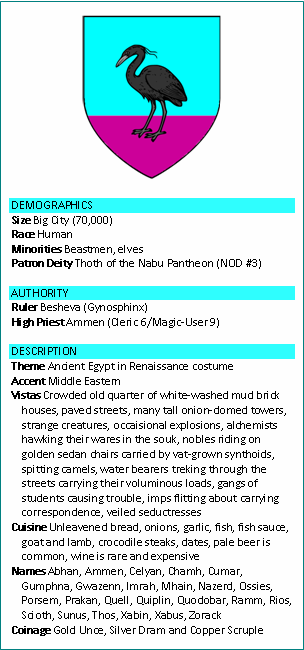
Ibis is ruled by the Nomarch Besheva, a gynosphinx of great antiquity, she having siezed power after the end of Nomoan rule. Besheva is assisted in her rule by a privy council of great sorcerers, warlocks and witches and by a council of commons consisting of the heads of the city-state’s noble families. Besheva dwells in the Old Palace, a sprawling estate of gardens, courtyards, barracks for the pastoral guard and slave-soldiers (see below), a shrine of Bast, guest houses and a manor containing a throne room, living chambers for the nomarch, her ladies in waiting, her major domo and hundreds servants.

The city-state’s high priest is a member of the privy council as well as heading the city-state’s college of priests, the Grand Temple of Thoth and the Eldritch Order of the All-Seeing Eye, a brotherhood of magic-users.

The jewel of Ibis, though, is its University. While small by modern comparisons, it is one of the larger such institutions in (or near) the Motherlands, and over the years has attracted many of the finest young men and women from families noble and mercantyl. While many think of it as a school for sorcery, this is quite incorrect. The university at Ibis teaches rhetoric, history, geometry and mathematics, above all else. Several of its faculty, however, are magic-users of some minor ability and sages who have picked up a spell or two in their day, and these individuals have several apprentices to whom they pass on the lost arts of ancient Nabu – think of them as teacher’s aides who can throw a spell or two but still have to attend Master Hahmet’s lecture on the ninteenth dynasty.

Because the city-state has attracted so many magic-users in its day, it has acquired a reputation for wizardry, and in truth has more alchemists, wand carvers and cauldron makers than the average city. In addition, magical items are more common in Ibis than in other city-states and may be available for trade.

Ibis’ magic-users, like their kind everywhere, are an eccentric lot. Because of their political power, they tend to be more arrogant and overbearing than elsewhere. Those who go to far are punished for the hubris by a clandestine band of assassins.

All of the divinities of the Nabu pantheon (NOD #3) have temples and shrines in Ibis, with the largest temples being dedicated to Thoth, Isis (and her trinity) and Anubis. Foreign deities such as Hecate, Sabazios and Mercurius are represented on the college of priests, and there are also dozens of obscure cults dedicated to saints, archangels, chaos lords, archdevils and demon princes.

Most crime in Ibis involves the black market for magical items and rare spell components, which are supposed to move through the temple of Thoth. Thoth’s diviners spend most of their time trying to suss out smugglers.

The Citizenry
Nabu’s human population is made up of a core of true natives who can trace their families back to the days of the Nabu Empire, the descendants of more recent immigrants (mostly from Nomo and the Golden Coast) and old noble families who, again, can trace their bloodlines back to the empire.

The true natives have dusky, reddish skin and black hair, with green eyes predominating. The noble families have pale, milky white skin that becomes a mousy gray as they age. Their hair is as black as night when they are young, but in their old age becomes whispy and silver. Nobles have large, almond-shaped eyes that range from hazel to a dark brown that is almost black.

Most Ibisians dress in long caftans of bright, cheery colors and wrapped turbans, usually of black or white. Others wear baggy trousers and loose shifts with ruffled collars and long, sleeved robes. Feathers are a common adornment in turbans. Ibisian women of the noble caste wear more form-fitting gowns of silk and adorn themselves with jewelry, especially head bands of cloth-of-gold. They carry ostrich-feather fans to shade themselves from the sun and the eyes of common onlookers.

The people of Ibis speak a dialect of the ancient language of Nabu. It is a poetic language, soft and pleasant to the ear. Almost all Ibisians speak (or at least understand) the common tongue of the Mother-lands, and usually speak it in the dialect of Nomo, as that empire conquered Ibis and ruled it for two hundred years. Educated Ibisians speak elven, and it is the principal language spoken at the University.

Ibisians are an independent bunch. The non-magical folk are hard-working and not entirely enamored with mages and their followers. The common people tend to rally around Isis and her priesthood, while the artisans favor Hathor.

For entertainment, Ibisians prefer dice games, wrestling, and horse and chariot races. Magic-users favor more lofty diversions, such as dragon chess and cockatrice fights. Magical duels are officially illegal, but occur regularly nonetheless.

Ibis is built on the Ishka Delta, where the Ishka River meets the Golden Sea. This is a very fertile area, and the entire delta is under the domain of Ibis. Beyond the delta and river is the demon-haunted desert, which hides ancient ruins and royal crypts.

Ibis’ economy is based on agriculture, fishing, paper-making and alchemical manufactures. Precious metals from the surrounding wastelands and highlands flow into the city-state via miners and is minted into gold, silver and copper coins. Gems are rarely traded in Ibis, as they are too valuable as alchemical components.

Exotic Customs
Animals are sacred in Ibis and not to be harmed or killed except by specially sanctioned priests who perform killing in hidden rituals and only outside the city-state. This makes meat somewhat more rare and expensive (double price) in Ibis than in other places. Fish are not included in this prohibition of harming animals, and thus feature prominently in the local diet. The penalty for harming or killing an animal is several months in the Nomarch’s dungeon and a thorough lashing, with repeat offenses resulting in the loss of a hand and then an eye. Attacks on cats or the sacred ibis is punishable by mutilation or death.

Locals do not speak of the dead without casting their eyes to the heavens and then dropping a coin (usually copper) on the ground. These coins are usually picked up by beggars, who are permitted to do so, but are considered unlucky for others (5% chance of the perpetrator suffering a -1 penalty on all rolls while the coin is in his or her possession).

Foreigners are scanned for magical auras. Each magical aura on the person costs them a gold coin (two if they are using foreign coinage). Naturally, this means that there are moneychangers set up along the road leading to Ibis.

Organizing My Thoughts on Sandboxes

From issue to issue, I’m trying to improve my sandbox hexcrawl designs. I don’t know if I always succeed, but I’m definitely trying. The first one, the Wyvern Coast, was really just a matter of trying to be original and interesting and, honestly, just seeing if I could put together a product and put it in front of people. With Nabu, I tried to produce some little dungeons to explore – so, less a description of what a place could have, and more an inventory of what the place actually had in it. I see sandboxes as tool-boxes – the writer is supplying readers with ideas that they can use to build fun sessions with their friends. With the next one, I want to take things up a notch, which means spit-balling some ideas.

1. I’ve sketched connections between named NPCs before (X hates Y, Y loves Z), but I think I need to go a bit further on this count. Each named NPC (including the monsters) should have some connection to two or three other NPCs – a history, motivation, emotion, alliance/enmity, relationship, etc – something to drive explorers from one person to the next so that the hex crawl is not only a matter of “what direction do you want to go today” (but, of course, can be exactly “what direction do you want to go today” if that makes the players happy)

2. Some NPCs should hold “pieces to the puzzle” – important rumors, knowledge about a dungeon or another NPC or a lost secret (magic item, spell, way to kill a powerful monster)

3. I should sketch out one big dungeon for each ½ region (i.e. what I publish in a given issue of NOD) and detail the intro level. The big dungeon should probably be well hidden, thus necessitating exploration and interaction for the players to find it. The big dungeon should hold a powerful MacGuffin that ties the region together – maybe an artifact, or a secret, or the catalyst of an important event

4. Each ½ region should also have at least 5 smaller dungeons – a few basic dungeons (for levels 1 to 3), and a few expert dungeons (for levels 4 to 8). What gets turned into a dungeon?

a. A monster lair
b. A tomb or mystic place
c. A stronghold
d. A village
e. A city-state, etc.

One advantage to sticking to this formula is that players will eventually pick up on it, but they won’t necessarily know which stronghold in the region has the dungeon underneath it. This gives them a reason to visit and interact and, hopefully, cause trouble.

5. The dungeons should have connections between them – clues, maps, portals, etc. and should have a connection to the big dungeon

6. I need to do more with the city-states – I’ll always try to detail at least one city-state in each ½ region like I did with Ophir in NOD #2 – Ibis, City of Sorcerers, will be the next. But for the others, I’d like to spread around some interesting, important NPCs that players will probably want to meet, or will want to avoid

a. A master artisan who can craft magical things (nothing too powerful, but useful and maybe vital to the big dungeon)
b. A demon cultist of terrible power
c. A mystic who can tell the future / heal wounds / etc for a price
d. A master rogue/bard/merchant who knows everything and can find anything – again for a price
e. A fierce fighting-man/woman who commands a company of unique mercenaries and can be a great friend or awful rival (or both)
f. A famous inn with important secrets
g. An awesome tavern – the nexus of all adventurers and no-good-niks in the region
h. A monster prince – vampire, ogre mage, etc – something powerful who can drive adventures more than be a simple target for killing and plunder
i. A sage with vital information and his own agenda
j. A valiant noble
k. A villainous noble
l. A monster who is more than it appears and holds a key that cannot easily be claimed with violence (or perhaps a “good” monster that can only provide the key if killed)
m. A demi-god in the flesh – perhaps Hercules is touring the region, or a massive, deified purple worm roosts below a city taking sacrifices from the “innocent” citizens
n. An animal trainer/beast master with wondrous mounts/pets [I’m shaky on this one, but I’m trying to think of the different hirelings that fit into the game and that players might want to visit]
o. A mysterious faction/brotherhood/sisterhood that can be a persistent thorn in the players’ sides

I guess the main thing is that I want to create an environment in which (A) There is a reason to play a game in this region vs. any other region I might invent and (B) the adventurers will have reasons beyond simple wandering to travel hither and yon as they interact with the region. I don’t, however, want to create a narrative that people are bound to follow – rather, I want gentle, passive clues that people can pick up on or ignore, but that nevertheless exist beneath the surface of the sandbox for those who wish to dig into things and occupy the space rather than just visit.

So – any thoughts from the community?

Artwork by Damascus5

Venatia – Bodbertus and Argis

Okay – probably the last preview of Venatia’s eastern half. Today, I’m covering five city-states located in (or near) the Golden Coast. Now, when I create these sandboxes, the first thing I do is randomly generate the contents of the hexes using a huge excel document I created. Based on the terrain of each hex, the excel document randomly fills it with a monster lair, natural feature, village, stronghold or, very rarely, a city. Well, when I generated Venatia, I got five cities in the northeast quadrant of the map, not including Ibis, which I had pre-placed myself – all part of the fun of random tables.

4223 Bodbertus: Bodbertus is a river port city of 5,000 people. The Bodberters, as they are colloquially called, are related to the chalkeions of the Golden Coast. They have reddish brown skin, broad, round faces with brown, grey or blue eyes and thick, straight hair of pale blond to auburn that they wear braided. They tend to be tall, averaging 6 feet in height.

Bodbertus is constructed in the lush valley of the River Vusk, which eventually flows through the Grete Myre and finally empties into the Tepid Sea. The valley is well cultivated and dotted with manorial villages. The economy is based on mining in the mountains. The city-state’s currency is the wose, minted in gold, silver and copper. The patron deity of Bodbertus is Eris, goddess of strife, contention, rivalry and war.

The city itself has an outer wall consisting of thick earthen ramparts topped with wooden spikes and patrolled by groups of 2d6 militiamen in leather armor and carrying bill hooks, short bows and long knives. There is also an inner wall measuring 60 feet tall composed of granite blocks and strong towers. The inner wall has three gates of thick, laminated pine reinforced with iron. The inner wall is patrolled by men-at-arms wearing chainmail and carrying pole axe, short sword and light crossbow (see below).

The buildings within the city are tall and narrow and constructed of white granite with sharply peaked roofs of green copper or tarred pine. Bodbertus is notable for its lush gardens, graceful architecture, expansive markets (there is a corn market, livestock market, metal market, cloth market and gem market), local fencing schools and dozens of eccentric hedgemages. In fact, there are so many mages in Bodbertus that each city guardsman is equipped with three +1 crossbow bolts, and each sergeant of the guard is equipped with three +1 bolts that cause 1d4 points of lightning damage when they hit.

The city streets follow a radial pattern, and are narrow and twisty. The most celebrated construction within the city-state is its museum of ancient treasures, an octagonal building with thick, granite walls. It contains, behind four permanent walls of force, a collection of royal regalia dating to the ancient and warlike Venatian chieftains of the woods, from whom the Countess traces her descent.

Bodbertus is ruled by a triumvirate of elected prefects, one elected by the guilds, one by the peasantry and one by the nobility. All three prefects are quite corrupt. The prefects are under the control of the Ophelia, Countess of Bodbertus, who rules the city-state’s domain and from whom the triumverate and the city’s guilds gained their charters. Ophelia has a measure of storm giant blood in her veins, making her a sorceress of no mean ability.

Bodbertus’ domain is populated by 45,000 people. The nobility consists of 25 baronets. There are also eight ecclesiastical manors. The country is divided into two shires, each patrolled by a sheriff – Jeovald north of the river and Guennock south of the river. The two men despise each other and vye for the hand of the Countess Ophelia. The city watch consists of 50 men-at-arms and the city-state’s standing army consists of 300 militia, 20 knights and 19 sergeants-at-arms.

• Ophelia, Magic-User Lvl 7; HP 24; AC 9 [10]; Save 9; Special: Spells (4th); Crimson robes, golden coronet, thin, twisty pine wand that can cause one subject to dance.

• Guennock, Aristocrat: HD 3 (19 hp); AC 2 [17]; Atk 1 weapon (1d8); Move 12 (9 in armor); Save 14; CL/XP 3/60; Special: Soldiers are +1 to damage; Platemail, battle axe, dagger.

• Jeovald, Aristocrat: HD 3 (9 hp); AC 1 [18]; Atk 1 weapon (1d8); Move 12 (9 in armor); Save 14; CL/XP 3/60; Special: Soldiers are +1 to hit; Platemail, shield, long sword, dagger.

5013 Argis: Argis is a fading city of the chalkeions. The city is constructed on a low rocky plateau with steep sides overlooking the Dinar River, with a system of pulleys and a fortified mule trail linking the city proper to its docks. The city has thick walls of stone, a number of small gates of beaten bronze and tall watch towers manned by expert crossbowmen. Argis is dominated by is ancient citadel and known for the three mighty aqueducts that bring fresh water into the city from the Sturmdrangs. Argis’ patron deity is Kubeleya, the great goddess of the Golden Sea pantheon.

The streets of Argis are narrow and maze-like, and almost impossible for outsiders to navigate what with the propensity of the locals to set up temporary booths and carts to sell their goods. Almost 7,500 chalkeions are packed into Argis’ tall, narrow, tower-like buildings. The buildings of Argis are made of fired red brick with dome-like bronze roofs. The city-state is built around a number of medicinal hot springs, and features a multitude of baths.

Argis is also known for its well-stocked shops (and outrageous prices), medicinal gardens, its brotherhood of druids and rangers that comb the hills for monsters and the fact that almost every surface of every wall and building is covered with mosaics or grotesque terracotta sculpture.

The streets are patrolled by a total of 75 hoplites in archaic armor (treat as chainmail) carrying long spears with black shafts, short swords and crossbows.

Argis has a massive temple dedicated to Kubeleya and her consort, the fertility god Atys. As one of the last cities of the chalkeions, it supports temples to Kotys, goddess of the moon, lust, revelry and the hunt, Sabazios, the cthonic horseman, Zalmoxis, the thunder god worshiped by berserkers, Dionysus (who the Motherlanders call Bacchus), Men, the little god of the moon, and the deities of medicinal springs, Vidasus and Thana.

Argis is surrounded by a domain of 67,500 peasants in 50 manorial villages and mines, mostly goat and sheep herds, but also farmers and miners of gold, copper and silver. The metals trade dominates the economy, and has prompted dozens of foreign merchant companies to construct factories in Argis. Argis has an army of 460 light footmen (mostly spearmen, slingers and archers) and a corps of 30 hoplites in platemail with shield, spear and sword.

Argis is ruled by King Thrasophon and his queen, Hyperne. The royal family also includes princes Phomachus and Hierophius and princesses Thrasoipa, Isaphraste and Lysiela. The king never appears in public without his fire drake-skin cloak (+2 save vs. fire) and his golden scepter and spiky crown.

• Chalkeion Hoplite: HD 5; AC 2 [17]; Atk 2 weapons (1d6); Move 12; Save 12; CL/XP 5/240; Special: None.

• Chalkeion Sergeant: HD 6; AC 2 [17]; Atk 2 weapons (1d6); Move 12; Save 11; CL/XP 6/400; Special: None.

• Princes: HD 7; AC 2 [17]; Atk 2 weapons (1d6); Move 12; Save 9; CL/XP 7/600; Special: None.

• King Thrasophon: HD 11 (59 hp); AC 2 [17]; Atk 2 weapons (1d6); Move 12; Save 4; CL/XP 11/1700; Special: None.

6503 Utya: Utya is a city-state of 12,500 men and women that originated as a military fortress of the ancient Nabu Empire. It is constructed on the banks of the Oeagrus River within view of the blasted remains of an ancient chalkeion citadel.

The people of Utya have coarse, fleecy hair of dark brown and eyes of brown, green or hazel that they highlight with kohl (men and women). They are magnificent physical specimens, standing 6 ½ to 7 ½ feet in height with muscular builds, angular faces and light, creamy skin.

Utya is surrounded by a triple wall of wooden palisades and thick earthworks. It has four stone gatehouses (the River Gate, Mountain Gate, Gate of the Blue Men – see [7502] for more information – and Leopard Gate or Gate of Victory) with steel-reinforced doors operated by stone golems. Within the walls are narrow, stinking, muddy streets and rows of squat, flat-topped buildings constructed of grayish-green brick. The city is built on a grid, but the “suburbs” are less ordered than the city center, which is dominated by a Moon Temple dedicated to Khonsu, the Nabu moon god, and the nomarch’s palace, a vast conglomeration of gardens, brick courtyards and square pavilions. The streets are patrolled by men wearing ring mail and carrying shields, throwing axes and curved short swords.

Utya is known for its many religious idols, which seem to glare at visitors from above every arch and around every corner, as well as its wandering gangs of priests who sing psalms (loudly and badly) for alms. Visitors to Utya usually come for its courtesans, men and women wrapped in gauzy robes of pink or midnight blue and carrying blue lanterns, even in the daytime, or the city’s infamous school of wizardry.

Utya’s economy is based on the fruit trade, with the fields around the city producing an especially tasty golden grape that is turned into a sparkling wine, and the many almond and fig orchards. The economy has been weak of late, but the people have remained cheerful through the hard times.

Utya is ruled by a nomarch (the feudal governors of ancient Nabu) named Haspedth. While the nomarch would have been appointed in the days of the empire, they are now elected by the people, with each hopeful nomarch-to-be minting tin coins in his image and people voting by dropping these coins through the front gates of the palace under the watchful eyes of the high priest of Khonsu, Tebet. The night before each election, the candidates are tested in the arena of combat with light, wooden swords, with the winner of the combat usually chosen nomarch the next day.

7215 Lithr: Lithr is an ancient city of 1,000 stone giants built at the mouth of the Oeagrus River. The city has mammoth walls of granite 150 ft tall and four mighty stone towers, each equipped with a ballista that the stone giant use as a heavy crossbow and dozens of throwing stones. The stone giants of Lithr are tall and angular in body, with pale gray skin and not a sign of body hair. They generally dress in greens and grays, usually in light tunics with sandals and, when the weather turns chilly, cloaks.

The buildings of Lithr are pyramidal stone structures, with wide streets and patrols of 1d3 stone giants (always female) each leading a black bear on a chain. Lithr is known for its lush vines of figs, its orchards of apples and the copious quantities of cider it presses each autumn. The stone giants are peaceful by nature, and welcome traders of the small folk so long as they behave. All small folk are kept at a large inn called the Pudding Pot that is run by Porogan, a swarthy Ibisian with a flair for cookery. The inn’s second story is ringed by a gallery where traders can meet with potential giant trading partners, the arrangement being easier for both small and tall. The stone giants mostly trade via barter, but will accept bars of precious metals and large gems.

Besides their apples and cider, the Lithr are known for their massive ziggurat dedicated to Ymir, the progenitor of all giants, and its corps of rangers, stone giants armed with colossal longbows (1d12 damage) and trained giant hunting owls. The temple is overseen by Wall, who has the abilities of a 6th level druid, and the rangers lead by Peorn, who has the abilities of a 3rd level ranger. Lithr’s queen is the stoic and often cruel Sikn.

7502 Palah: Palah is a city of blue-skinned men and women with golden hair and eyes of the lightest gray and blue-green. The palahi are believed to be colonists from another dimension or world – they aren’t telling – by those sages who have managed to visit them. All palahi have the ability to control people’s minds (per the charm person spell, usable at will).

Palah has a population of 17,500, making it the second largest city in the region after Ibis. The hills and valleys around the city have sewn with salt by the palahi to support their soul source of nourishment, a creeping lavender vine that produces bunches of small, purple crystalline berries that taste of salt and lime. Humans can live on the berries for a few weeks before the very high salt intake begins to take a toll on their health. The many acres of lavender vines are cultivated by over 150,000 peasants, who trill strange songs with their throats while they work, using tame giant snails to pull their plows and fertilize the fields with their trails of slime. Palahiland, as it has been termed by sages, is composed of three districts, each ruled by a zim (roughly equivalent to a count). At the extreme western end of the domain there is a small trading town called Zibbul, where outsiders trade exotic goods for mineral salts and smelted metals.

The city boasts an army of over 1,000 footmen armed with repeating crossbows (3 shots per round) and large cleavers with hooks jutting out from the back of their heads. The army also has 74 knights wearing chainmail and carrying shields, lances and cleavers mounted on what appear to mechanical armadillos.

The city-state itself is constructed on a large, flat island in the midst of a shallow acid lake. A long bridge of spun glass spans the lake, but those crossing the bridge at less than a trot must pass a saving throw or be overcome by the acrid fumes and become nauseous for a few rounds and then die choking on blood. The palahi make a living dredging weird salts and metals from the shores of the lake, the workers wearing respirators and using thick, long-handled glass scoops.

The palahi are cheerful, friendly folk. Their city has smoothly cobbled twisty streets (paved in brilliant azure stones) and spacious, multi-storied buildings built in a rococo style. The streets are patrolled by watchmen in chainmail and shield wielding cleaver, man-catcher (one per team) and longbow, and often assisted by thick, white eyeless worms that they have trained like guard animals. The city has 175 watchmen, each deadly in the extreme with their longbows – in fact, it is the fortunate thief indeed who is placed in the city stocks rather than spitted by a barbed arrow.

Palah is home to numerous little museums in the ground floor of noble homes, each a showcase of the odd collections of its owner. It is governed by King Jespers, a monarch elected by the noble families of Palah. The king, in turn, appoints dozens of nobles to his privy council and to oversee the plantations.

The palahi worship an alien god they call Vinin. Vinin’s idols, which are numerous and placed throughout the city, depict a short palahi man with a graceful build and wearing a pointed, onion-shaped red helm. He carries a thick cutlass in one hand and a skull in the other and is apparently a god of killing placated by the sacrifice of young men, who throw themselves from the glass bridge under the fourth full moon of each year in frenzied adulation.

So, the five city-states of eastern Venatia. Over the next week, I’m going to work on the Gods of the Golden Sea, maybe preview a couple other articles I’ve written, and then get to work on the city-state of Ibis.

[Edit – Wow – many spelling errors. Can you tell I posted this at 11 at night?]

Venatia – The Rotting Circus and Azure Road

4718 Sacellum of Mitra: Nomer, a powerful priest of Mitra has established a fortified abbey in a pleasant valley ringed by wooded ridges and sparkling rills. Nomer’s abbey is constructed in the Roman style prevalent in the grand city-state of Nomo, the place of Nomer’s nativity. The principal stone used in construction is limestone, supplemented with marble columns and lintels and gleaming brass ornaments. The abbey houses ten lesser clerics and their warhorses. The abbey sits atop a small rise next to the stream that flows through the valley. It consists of a large chapel to Mitra in which services for the priests and villagers are held each Sunday, storage rooms and simple living cells for the priests, including Nomer. The abbey also has a man-made grotto constructed beneath it in which private rituals are held for the priests. The ultimate goal of the Mitra-ites is to clear the woodlands of monsters and bring Mitra’s light to the villagers of the coast.

The abbey is surrounded by a village of 400 pious yeomen farmers, all free men and women which is defended by a wooden palisade with a moat and three wooden towers. The yeomen farmers live in timber longhouses built atop columns of bricks, for the valley is prone to violent weather and the stream often floods. They raise crops of barley and turnips, and the clerics maintain a vineyard and produce a middling wine. The village is protected by a force of 60 archers (leather armor, short bow, spear) commanded by 4 sergeants and 20 horsemen (chainmail, shield, horseman’s mace, light lance) commanded by 3 sergeants.

A treasure of 3,015 cp, 239 sp, 250 ep, 486 gp and 198 pounds of barley corn (worth 1 gp/lb) is kept in the village. The priests possess 1,147 sp, 2,061 gp, two hyacinths (gemstones worth 1,250 gp each) and ten coconuts given to them by a South Seas trader who sought curative magic. The coconuts are worth 10 gp each.

• Nomer, Cleric Lvl 12: HP 45; AC 1 [18]; Save 4; Special: Spells (6th); Platemail, shield, mace, holy symbol. Muscular and bitter, his love was spurned by a highborn lady of Nomo – this rejection spurred him to become an adventurer, and though he is dedicated to Mitra, his feelings sometimes bubble to the surface, especially around petit brunettes.

• Cleric of Mitra: HD 2; AC 1 [18]; Atk 1 weapon (1d6); Move 9; Save 15; CL/XP 3/60; Special: One 1st level cleric spell; Platemail, shield, mace, holy symbol, blue mantle, white surcoat emblazoned with a blue bull.

4909 Bear Totem: A very shallow cave in the side of a mountain overlooking a rushing stream of white water holds the skeleton of a large cave bear. The skeleton is a mere pile of bones with the skull sitting atop the pile, and it has been decorated with smears of blue paint and eagle feathers. The walls of the cave are decorated with cave paintings of bears and hunters. The skeleton is an idol of Arcturus, the Lord of Bears, and must be propiated with offerings of meat. If such offerings are not made, adventurers passing through the mountains have a 1 in 6 chance each hour of encountering 1d3 cave bears, who will attempt to kill one person and drag their remains back to the idol as an offering.

4921 Rotting Circus: A caravan of brightly colored wagons is circled on a pleasant meadow overlooking a rushing stream. As one approaches, it becomes evident that the wagons are in terrible disrepair and that there doesn’t seem to be any movement around the wagons, although there is a flickering fire. The traveling entertainers, some months back, took a fortune teller named Morcerth into their ranks. Unfortunately, Morcerth turned out to be a necromancer, and in short order the entertainers had been murdered and raised as leper zombies. Morcerth is using them as his guardians while he searches for an entrance to the Netherworld that he believes lies hidden in the Forest of Dread. Morcerth’s treasure consists of 6,219 gp, 29 pp, a terracotta lamp he claims once held a genie and a cursed -1 dagger that he will offer in exchange for his safety, if hard pressed.

• Leper Zombies (19): HD 1; AC 6 [13]; Atk 1 claw or bite (1d6); Move 9; Save 17; CL/XP 3/60; Special: Disease, those slain animate as leper zombies.

• Morcerth, Magic-User Lvl 7: HP 22; AC 9 [10]; Save 9; Special: Spells (4th); Velvet robes of crimson, mauve and saffron, over-large golden turban with pearls (fake) and ostrich plumes, gnarled black wand.

5109 Azure Road: The hills here are divided by a winding avenue of gleaming blue stone that almost looks like a river. Large burrows at the start of the road are home to five giant owls who, if communicated with, will warn people to stay away from the road, for it leads only to their doom. The road extends into the center of the hex, so for about 3 miles as the crow flies, though its winding way actually totals about 5 miles. While walking on the road, there is a 1 in 6 chance each mile of an encounter with 2d6 blue flagstone spiders. The road eventually leads to a dark, wet cave choked with grey moss and hanging vines of a sickly yellow (a yellow musk creeper). The creepers control ten yellow musk zombies. The caverns beyond are said to lead, eventually, to the gates of the Underworld.

• Flagstone Spider: HD 1d4 hp, AC 3 [16]; Atk 2 claws (1d2), bite (0 hp + poison); Move 15; Save 18; CL/XP 1/15; Special: Poison (+4 save or die), surprise on 1-3 on 1d6.

• Yellow Musk Creeper: HD 3; AC 6 [13]; Atk 1 dust burst (2d6 + hypnosis); Move 0; Save 14; CL/XP 5/240; Special: Hypnotic dust, intelligence drain.

• Yellow Musk Zombies: HD 2 (12, 12, 12, 11, 11, 10, 9, 8, 8, 7 hp); AC 4 [15]; Atk 1 slam (1d6); Move 12; Save 16; CL/XP 2/30; Special: Immune to mind affects.

5112 Poisonous Meadow: Towards the center of this hex the hills flatten and become a large meadow. The meadow is lousy with deadly nightshade and holds the lair of seven chaotic pixies with poisonous personalities. Encounters with the pixies are a certainty, for they love to harass travelers. Encounters with giant centipedes occur on a roll of 1-3 on 1d6, night and day.

• Pixie: HD 1 (7, 7, 6, 6, 5, 5, 3); AC 5 [14]; Atk 1 dagger (1d4 + poison) or arrow; Move 6 (Fly 15); Save 17; CL/XP 5/240; Special: Arrows (cause amnesia), magic resistance 25%, spells (polymorph self, invisibility, dancing lights, dispel magic 1/day, permanent confusion 1/day with successful hit and negated by a saving throw).

5317 Retired Veteran: A craggy old borc (a centaur that is half orc and half boar) has retired in this hex to a cave overlooking a stream that flows into a pond. The area has ample game, and the borc has set the surrounding area with a variety of traps. The borc is still rowdy in his old age, and is willing to train fighting-men (especially barbarians) for a jug of wine, ale or spirits and a chance to tell war stories. His treasure, buried in a terracotta pot, consists of 9,814 cp, 1,265 ep, 405 gp, a terracotta statuette of Orcus worth 4 gp and 16 golden wolf skins worth 8 gp each.

• Borc: HD 4 (21 hp); AC 2 [17]; Atk 1 halberd (1d10) or 1 longbow (1d8); Move 15; Save 13; CL/XP 6/400; Special: Berserker (+2 to hit), can fight to -6 hit points.

5503 Boiling Pool: A boiling pool of water sits amidst the ruins of an ancient temple built by the lizard kings to what appears to have been a six-legged crocodilian creature with a single giant, saucer-like eye. The pool is inhabited by vapor cranes, 4 large adults, 8 small adults and 4 fledglings. The bird’s boiling bodies can be deadly to touch. One standing wall of the temple has a secret cache that holds a golden face mask of the crocodilian god worth 100 gp.

• Large Adult Vapor Crane: HD 5; AC 4 [15]; Atk 1 bite (1d4+5); Move 5 (Fly 12); Save 12; CL/XP 6/400; Special: Scalding to touch, steam cloud (1d6+5) in cone or 15-ft radius.

• Small Adult Vapor Crane: HD 2; AC 4 [15]; Atk 1 bite (1d4+2); Move 5 (Fly 12); Save 16; CL/XP 3/60; Special: Scalding to touch, steam cloud (1d6+2) in cone or 15-ft radius.

• Fledgling Crane: HD 1; AC 4 [15]; Atk 1 bite (1d4+1); Move 5 (Fly 12); Save 12; CL/XP 2/30; Special: Scalding to touch, steam cloud (1d6+1) in cone or 15-ft radius.

Venatia – Amazons and Goddesses

3902 Rhodia: Rhodia is a citadel of 65 amazon warriors and 20 maidens. The citadel is constructed atop a rocky outcropping that has a commanding view of the woods in this hex. The citadel, which appears to predate the amazon habitation, is built of massive limestone blocks covered with shiny red tiles. The citadel sports six tall towers, several courtyards and a fortified palace wherein resides Vierna, a full-figured amazon with ash-blond hair and cool, deep-set gray eyes in a toga of charcoal. Vierna is protected by two bodyguards, Phyta and Minephe. She is never without her silver scepter (treat as a light mace) and steel shield. The palace contains a chapel dedicated to Minerva and tended by Xanaide and her three acolytes. The amazons work their own fields, which dot little clearings that surround the citadel. They mine iron, copper and tin from the surrounding hills with the help of three dozen kobold slaves, and trade finished weapons and armor for supplies with traders from Antigoon. Amazon patrols, consisting of a dozen warriors wearing chainmail and carrying shields, spears and long bows, are common in this hex and usually mounted on tough mountain ponies and accompanied by one of Xanaide’s acolytes bearing a brass owl standard that grants the amazons a +1 bonus to save vs. fear. Beneath the citadel there is a spider-infested dungeon in which the amazons have hidden the mythic Girdle of Hippolyta (treat as a belt of giant strength). Vierna owns a tame fire drake that she uses as a mount in times of dire emergency. It otherwise resides in the entrance to the aforementioned dungeon.

• Amazon: HD 2+1; AC 1 [18]; Atk 1 sword (1d8+1) or 1 bow (1d8+1); Move 15; Save 16; CL/XP 2/30; Special: +1 to hit and damage with sword and bow.

• Vierna, Amazon Fighting-Woman Lvl 10: HP 60; AC 1 [18]; Platemail, shield, long sword, 6 darts. Eccentric and aggressive.

• Xanaide, Amazon Cleric Lvl 7: HP 36; AC 1 [18]; Save 8; Special: Spells (3rd), turn undead; Platemail, shield, warhammer, holy symbol. Large blue eyes, golden hair in a long ponytail, high forehead, somber and severe.

• Phyta, Amazon Fighting-Woman Lvl 4: HP 25; AC 1 [18]; Save 13; Platemail, shield, long sword.

• Minephe, Amazon Fighting-Woman Lvl 3: HP 19; AC 1 [18]; Save 14; Platemail, shield, long sword.

3922 Goddess of the Tree: Lodged in the hollow of a dead tree is a 2-ft tall soapstone idol of a voluptuous women with the head of a gorilla sitting cross-legged with a illegible tablet in her lap. Anyone who argues with the holder of this idol is polymorphed into a toad.

4211 Dangerous Bridge: This hex is trisected by an extremely deep chasm, the lowest reaches of which are filled with a black, murky lake inhabited by sapphire-skinned mountain squid and a dizzying array of shellfish. At approximately the center of this hex, a bridge of three massive bronze spans and mica tiles crosses the chasm from west to southeast and northwest. Three massive gnasher lizards are sunning themselves on the bridge and, though reluctant to move as a rule, will happily charge any prey foolish enough to wander onto their bridge.

• Gnasher Lizard: HD 9 (53, 46, 41 hp); AC 4 [15]; Atk 1 bite (2d6); Move 12; Save 6; CL/XP 12/2000; Special: Behead on natural ‘20’, bite victims must save or br swallowed whole (2d6 acid damage each round).

4308 Stone Forest: A petrified forest fills a magically silent valley in this hex. Even the animals of the forest have been petrified, but their ghosts haunt the dead woods. A partially tumbled tower in the middle of the forest is home to a dragon and a magic sword.

4413 Abandoned Forge: Volcanus and his cyclopean assistants one forged powerful weapons and armor in this volcano, which has now cooled considerably and has thus been abandoned. The forge is located in a giant, vaulted cavern that has been scrupulously carved into palatial splendor. Connected to the forge room are dozens of storage chambers, now all empty save for a few bars of steel and other odds and ends. The center of the main cavern is dominated by a fire pit 30 ft in diameter. The forge’s bellows are still operated by a giant brass chimpanzee, an automaton created by Volcanus himself and abandoned when the forge was abandoned. The chimpanzee keeps the fire pit filled with coal and hot – hot enough that nine fire snakes have made it their lair. They ignore the chimpanzee, and the chimpanzee ignores them. The coal is dug and delivered by five small bronze moles with ruby eyes (worth 50 gp each).

• Brass Chimpanzee: HD 4+1 (18 hp); AC 2 [17]; Atk 1 weapon (1d8+1); Move 12; Save 13; CL/XP 5/240; Special: None.

• Bronze Mole: HD 1+1; AC 4 [15]; Atk 2 claws (1d6+1); Move 6; Save 17; CL/XP 2/30; Special: None.

• Fire Snake: HD 2 (12, 11, 10, 10, 9, 8, 5, 5, 4 hp); AC 5 [14]; Atk 1 bire (1d4); Move 6; Save 16; CL/XP 4/120; Special: Poison, immune to fire, surprise.

4508 Fountain of the Gods: Actually, a fountain of the storm giants, in a great vaulted cavern that connected (via a winding stair) to a palace long since razed to the ground. The cavern walls are mottled with shades of magenta, blue and greenish-yellow and measures 300 ft in diameter and 60 ft from floor to ceiling. The fountain is stark, white marble ornamented with gold filigree (long since stolen) and a center piece with four giant brass heads with spouts in their open mouths. The water flows from the fountain in a such a large quantity that it overflows and in fact form the head waters of two mighty rivers that emerge from caves (which form the principal entrances, north and south, to the cavern). The bottom of the fountain is covered in 2 inches of gold dust that is claimed by the storm giants and thus carries a terrible curse. Anyone attempting to steal the gold will discover their flesh slowly transform into the sparkling metal, starting with their fingers and toes and moving inward a couple inches each day. Just inside the northern cave entrance, in a small alcove of sorts, lies the skeleton of one unlucky robber; three quarters of the woman’s skin was turned to gold and now lies an empty shell but for her dry bones.

Venatia – Flamin’ Lizards and Three-Headed Idols

The first 6 sample encounters for the NE portion of the Venatia map.

5604 Flamin’ Lizards: This hex is home to dozens of nests of igniguanas. The beasts seem to come here to spawn, probably because of the rivers of magma that flow and pool hundreds of feet below the surface. Since igniguanas can move through solid rock as easily as you or I move through the air, there are not tunnels or burrows in evidence. Encounters with the creatures occur on a roll of 1-3 on 1d6, and the chance of surprise is also 1-3 on 1d6. The nests, should one manage to burrow down to one (assume they are 1d6 x 30 feet beneath the surface) are made near the pools of magma or near eddies in the rivers of magma, and consist of piles of crude gemstones, worth about 500-700 gp per nest.

5701 Yellow Caverns: There is a great rend in the side of the tallest mountain in this hex. It is marked with deposits of chalk and from it flows a tiny trickle of water, colored a dull yellow. The cavern has a sulferous smell and the interior is cluttered with a magnificent array of rock formations, all tinged with yellows, oranges and reds and making the cavern look like it is aflame. Winding through these formations is the aforementioned brooklet of yellow water which, if followed, leads to a little waterfall spilling over several terraces of rock. A sharp eye will notice handholds spaced for a tall humanoid. These hand holds lead up to a narrowed cavern with a higher ceiling and more flowstone than stalagmites and stalagtites. The brooklet forms many interlocking pools here, and appears to support a crusty form of yellow crab apparently immune to the poisonous water. More than a dozen tunnels of various sizes converge in this cavern – some leading deeper into the mountain, others leading toward the peak. A variety of odd beasts dwell in these caverns, but the most dangerous is surely a cabal of yawahu bugbears.

The yawahu are to normal bugbears what ogre magi are to normal ogres. Five yawahu dwell in this cavern, at least from time to time for their machinations and explorations into black lore often carry them to far away locales. They have white fur tinged yellow from their environment, and frightful faces of the deepest blue and green, with yellowing fangs and rather long, dropping ears. The foremost of the yawahu is Grifnarg Hells-Paw, a servant of the nether powers. His fellows are Drask Arch-Draconic, Borzog the Beast, Gozr of the Mangled Claw and Zukasm Friend-of-Jellies. Collectively, they have amassed 10,000 cp, 1,000 sp, 1,000 ep, 600 gp, 10 pp and a flake of obsidian worth 3 gp and used by them as a sacrificial knife (it retains the psychic impressions of a dozen victims that can be read with the Speak with Dead spell).

• Yawahu Bugbear: HD 3 (15, 14, 14, 11, 11 hp); AC 5 [14]; Atk 1 spear (1d6+1) or 1 shortbow (1d6); Move 12; Save 14; CL/XP 4/120; Special: Change self, burning hands, cause blindness (1/day), invisibility (1/day), ray of enfeeblement (1/day) and tiny hut (1/day).

5813 Neldor: The woods in this hex thin out some, leaving room for several meadows broken up by little limestone crags. The meadows are covered in carpets of wild thyme, sweet woodruff and greenish-blue grasses that are grazed upon by wild goats and a variety of small game. A village of 300 huntsmen is nestled by a stream in a rocky valley that cuts across the hex. The village, Neldor, is composed of 60 or so timber huts built in the shape of tall beehives surrounded by a wall of stacked limestone about 10 feet tall. Situated as it is on a natural trail across the hex, Neldor boasts a cozy roadhouse (constructed like the timber huts writ large) that serves sweet berry wine and an astounding array of roasted game and the rabbit sausages that are its house specialty. The Neldorians have thick, wavy black hair and pale skin made tan by the sun. They are short and thin and have narrow faces that bring to mind hawks. The Neldorians dress in exagerated clothing in bright colors with bouffant skirts for the women and tall collars for the men. The village is defended by 20 men-at-arms wearing leather armor and carrying spears and short bows. The village is ruled by a mayor named Thoith, an overly-officious little pain in the neck. The roadhouse is run by Galin, and absent-minded fellow with an unreasonable fear of dwarfs (especially of their stubby fingers, which remind him of grubs).

5916 Gulon: This hex is the hunting ground of a gulon, a strange hybrid of cat and fox that devours its prey whole, stuffing itself so full that it must force itself to vomit its meal so that it can continue its gluttonous feast. The gulon dwells in a shallow cave near a tall oak that was split some decades back by an errant bolt of lightning. The beast is currently nursing a litter of six cubs, making it especially rapacious.

• Gulon: HD 3 (13 hp); AC 3 [16]; Atk 1 bite (2d4); Move 15; Save 14; CL/XP 3/60; Special: Devour corpse.

6123 Three-Headed Idol: A three-headed idol of Hecate stands on a hilltop in this hex overlooking the bay. The idol is constructed of limestone blocks stained with salt and stands 40 feet tall. It is quite weathered, but still recognizable as the goddess of witches, having the head of a she-hound, a vulture and a beautiful, severe woman. The statue holds a writhing serpent in an outstretched hand and a torch in the other. Those who touch the idol without first kneeling and offering a small sacrifice feel themselves become faint and suffer 1d6 points of constitution damage.

6402 Ettins: A family of five ettins has made a lair here in a large cavern. The ettins keep a herd of 15 giant goats with long, black coats and gleaming white horns. The goats give copious amounts of milk which the ettins turn into an excellent goat cheese that they trade to passers-by for tools and baubles (unless of course they decide to eat the passers-by and steal their stuff, which is often the case with adventurers). The head of the family is Arnon-Torri and his wife is called Brigga-Nimayne. The ettins cave is cramped and reeks of sour milk and body odor. At any one time is contains a dozen large, terracotta bowls filled with fermenting goat milk and twice as many bundles of cloth holding curds in various states of cheesehood. Besides their cheese (assume 1d6 x 100 gp worth), the ettins have amassed a princely treasure of 6,200 gp and a giant terracotta flask decorated with images of rampaging hecatonchires worth 800 gp.

• Ettin: HD 10 (58, 54, 50, 44, 44 hp); AC 3 [16]; Atk 2 clubs (3d6); Move 12; Save 5; CL/XP 10/1400; Special: None.

• Giant Goat: HD 3; AC 7 [12]; Atk 1 gore (2d6); Move 18; Save 14; CL/XP 3/60; Special: +4 damage with charge.