Dis, Grand City of Hell – Slums

This one took me a while. I couldn’t map it, couldn’t treat it just like any other city (it was too large to do it justice with a few shops and such) and needed to find a reason for characters to wander around a bit. I think (or hope) I finally cracked it.

Dis is like a collection of cities, which will still be represented on cards, that connect with one another – kinda like they predict the great eastern megalopolis of Boston – New York – Philadephia will be one day. Each of these cities/blocks/quarters is ruled by a separate demon or devil lord, and each is like a prison with heavily guarded gates. The only way to get through a gate besides fighting through it is to gain a brass seal from the lord of the place, and that means doing a favor (rolled randomly). This creates a reason to move about and explore – finding the other demon lord that has to be parlayed with / killed / paid tribute to etc.

Escape from one block to another is one thing. How about escape from Dis. The city of Dis just sprawls – it has no beginning and no end. Nobody can simply walk through it and get to the next circle of Hell. To escape, one must summon Geryon for a lift, and to do that, they need a silver seal from one of the more powerful lords of Hell, represented by the Jacks, Queens and Kings of the deck. Getting in to see them requires seals from at least three of the demon lords under them (i.e. of the same suit). The whole point is to draw players into the politics of Hell and, hopefully, produce a fun experience.

With that said, here’s a sample of some of the quarters in the suit of Clubs, the suit of toil and despair.

ACE OF CLUBS

The buildings in this block are tall and irregular, and covered in a greasy sheen that stinks of rotting flesh. Those who enter the block must save as though facing the noxious stink of troglodytes. The streets are narrow and twisted, and every so often empty into vast, circular courts. These courts are flurries of activity, as manes demons scurry about, tossing writhing mortals and shades into a pit, about 30 feet in diameter, of boiling liquid. Bearded devils armed with iron staves push these poor souls back into the pit when they try to escape. Other bearded devils are in charge of ladling off the greasy slime that these people are rendered into, scooping it into large black barrels carried on the backs of manes demons. These barrels are loaded on carts when they are full and delivered to other blocks for processing.

The gates of Borbazu’s block are composed of a vast weave of skeletons. Above the gates, bearded devils man great pots of boiling oil to pour through murder holes that send a great spray down before the gates (all within 30 feet of a gate must pass a saving throw or suffer 3d6 points of damage from the boiling oil). In towers that flank the gates there are 40 manes demons armed with heavy crossbows ready to send a volley of bolts down on invaders. Each gate is under the command of a barbed devil armed with a chain that ends in a three-pronged meat hook. If an attack with a chain beats an opponent’s AC by 5 or more, it hooks into their flesh and holds them until removed with a successful bend bars check (which inflicts an additional 1d6 points of damage). The skeletons of the gates can deliver 1d6 attacks to any within reach, trying to grab and hold intruders rather than kill them.

Borbazu, a minor lord of Dis, rules this block. He takes the form of a towering serpent of pallid flesh (not scales) that dwells beneath the block. He can emerge from any of the flesh pits scattered through the city. Borbazu can also assume the form of a ruddy-skinned, boyish warrior, handsome, but with vestigial horns and a lenonine mane. This form has aquamarine eyes and wears white robes. In this form, Borbazu can form metal objects of up to man-sized with the merest thought.

FOUR OF CLUBS

This block consists of crooked buildings made of pale, sweaty stone. The buildings hang over the streets, making the air close and stifling, though at odd intervals blazing hot winds whip through these corridors. The walls are spiked, and the doors are all clad in green copper. The streets sometimes empty into pit-like courts with ophidian designs carved into the sides, and winding ramps that lead down into the courts.

The gates of Caila’s block are all at the end of cramped streets, and consist of circular doors. The doors are coated in deadly poison, and touching the doors causes the spikes in the nearby buildings to fire (1d6 poisoned dart attacks, 1d6 points of damage from each). The buildings on either side of the street hold a company each of bearded devils. Behind each door, a purple worm lurks, waiting to lurch out and swallow people whole.

One of the courts is entered via a bronze arch hung with crystal beads that cut one’s flesh like razors and whisper portents of doom into their ears. The court’s walls are set with dozens of little windows covered by shutters painted with images of demons or devils, others with shocking scenes of hopelessness and despair. Behind each of these windows is an oracle who can give one piece of information, provided the questioner passes their palm with an equally valuable piece of information written on a parcel of their own flesh. The oracle reaches their hand through the shutter (as in incorporeally) to retrieve their payment and then reaches back out with a tiny scroll containing the desired information.

Within sight of this alley is the jagged red tower of Caila the Judge. The upper portions of the 10-story tower are circled by a guard of young red dragons. The tower’s interior is as red as the exterior, with ornaments of carnelian, ruby and bloodstone. Movement from one level to the other is via teleporting cabinets, though some of the cabinets in the tower instead fill with poison gas or spears that leap up from the floor.

Caila is a short, leggy demoness with blue-black skin that bristles into barbed scales when she is excited. She has almond-shaped eyes of azure. She surrounds herself with artists, who she can inspire with her gaze, replacing a portion of their soul with her own. Caila can summon 1d6 fiendish giant scorpions three times per day and can assume the form of a giant scorpion once per day.

JACK OF CLUBS


Malphas is both a prince of Hell and a grand president, and he is the patron of architects and masons. As one might imaging, his sprawling block is composed entirely of stone buildings, and everyone a piece of art. Cathedrals, strongholds, towers, all ornamented with flying buttresses, fanciful water spouts, bridges, tunnels, fountains, statuary, veritable skyscrapers; amazing and very difficult to navigate, as it is so crowded and the streets so narrow. Construction is constant here, with bits of masonry sent falling to the ground at random intervals (1 in 6 random encounters forces adventurers to pass a saving throw or suffer 4d6 points of damage).

The gates of Malphas’ quarter are great strongholds, ten stories tall, with perfectly straight and smooth walls. They are patrolled by his gargoyles (three companies are assigned to each gate) and barred by wooden portcullises that instantly rust any metal that touches them. Within each gatehouse tunnel, Malphas’ soldiers can pour green slime on invaders and deliver fusillades of poisoned darts.

Malphas occupies the grandest cathedral in his domain, a veritable demon-made mountain of stone, all of it rare and expensive, with spires that defy gravity. Within this monument he houses the remainder of his infernal army and keeps a population of slaves, artisans (he has bargained for the soul of many great artists and can summon them at will) and priests. He sits at the center of a maze of passages, all trapped and well-guarded, for Malphas is paranoid in the extreme.

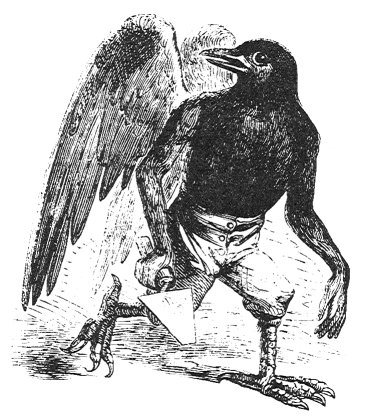
Malphas appears as a crow, but can be induced sometimes to take the form of a handsome humanoid with blue-black skin and curved, golden horns. In either form, he carries a mason’s trowel, which attacks as a +2 battleaxe, can cleave through any stone, cast disintegrate and earthquake once per day and can, at will, transmute rock to mud and mud to rock. Malphas is always at war with one demon lord or another, and is always in the market for spies.
40 Questions about the Wyvern Coast

Since I’m running a game on Google+ now, I thought I’d chime in with answers to these 40 questions that are floating about, along with a couple spell illustrations from Jon Kaufman (commission him – do it now).

FIRST 20

Web

1. Ability scores generation method? 3d6, arrange as you like

2. How are death and dying handled? Dead at 0 hp

3. What about raising the dead? Yes, but you have to find someone high enough level to do it, and they’ll want something in return

4. How are replacement PCs handled? Brought into the game as soon as possible, or one could make one of their retainers their new PC

5. Initiative: individual, group, or something else? Individual, though sometimes group makes more sense if there are too many combatants to allow individual initiative function smoothly

6. Are there critical hits and fumbles? Yeah … kinda … just wrote the rule into the playtest doc … haven’t used it yet; oh – no fumbles though

7. Do I get any benefits for wearing a helmet? Yes, and they are assumed to go with the suits of armor

8. Can I hurt my friends if I fire into melee or do something similarly silly? Yes

9. Will we need to run from some encounters, or will we be able to kill everything? You will need to run from some encounters

10. Level-draining monsters: yes or no? Yes

11. Are there going to be cases where a failed save results in PC death? Yes

12. How strictly are encumbrance & resources tracked? Very closely – logistics is part of the game

13. What’s required when my PC gains a level? Training? Do I get new spells automatically? Can it happen in the middle of an adventure, or do I have to wait for down time? You level up at the end of a session, but spells have to be studied for – they don’t magically pop into your head; other forms of training are assumed to be “on the job”

14. What do I get experience for? Killing monsters, taking stuff, being clever

15. How are traps located? Searching (tell me how) and then maybe rolling dice

16. Are retainers encouraged and how does morale work? Yes; they have a secret morale score and it is rolled on in stressful situations

17. How do I identify magic items? Detect magic, identify, etc, or finding somebody to cast those spells for you, or through experimentation

18. Can I buy magic items? Oh, come on: how about just potions? Some alchemists can prepare a limited number of potions, otherwise no

19. Can I create magic items? When and how? Yes; when depends on what, as does how

20. What about splitting the party? Sure

SECOND 20

Enervation

1. What is the deal with my cleric’s religion? Phoenician deities, such as Kothar-wa-Khasis (god of artisans), Lotan (sea god), Baal-Zebul (evil), Astarte & Adonis (love, fertility), Melkarth (heroes) and Shedu (good); that being said, any deity from mythology is acceptable, any deity from fiction or your own little fevered mind might be acceptable

2. Where can we go to buy standard equipment? Jumda the Trader can supply most goods an adventurer needs

3. Where can we go to get platemail custom fitted for this monster I just befriended? Jamab the Armorer

4. Who is the mightiest wizard in the land? In Ophir, it is Jamala, court wizard of Zargo. Along the Wyvern Coast, probably Gilram of the Mists or Onort

5. Who is the greatest warrior in the land? In Ophir, both Balrah and Alod the Mad claim that they are the mightiest; either would pale in comparison to Holda the Iron Maiden (a dwarf), Sheleik the Berserker, Xaathan or Nemanta of the Black Capos; as for who is truly the greatest – challenge them and find out

6. Who is the richest person in the land? Prince Zargo of Ophir (as far as he knows), but Ephne the Oceanid is probably wealthier

7. Where can we go to get some magical healing? The Temple of Shedu, Astarte/Adonis or Kothar-wa-Khasis is your best bet in Ophir; Zelie, a druid of Zephyrus who dwells off the coast, would be another option

8. Where can we go to get cures for the following conditions: poison, disease, curse, level drain, lycanthropy, polymorph, alignment change, death, undeath? See above; you might also try Nokin the Healer or Lathiq the Barber for non-magical cures

9. Is there a magic guild my MU belongs to or that I can join in order to get more spells? No; you’ll have to worm your way into magic-user society if you want to trade spells

10. Where can I find an alchemist, sage or other expert NPC? Lathba is a well-regarded sage in Ophir, and there is Nabe’ the alchemist

11. Where can I hire mercenaries? Put the word out and let people know where you’re conducting interviews – there are no “mercenary shops”, but the Bloody Bones tavern is a hang-out for many warriors (and the local guard – so be careful)

12. Is there any place on the map where swords are illegal, magic is outlawed or any other notable hassles from Johnny Law? Not in Ophir, though speaking above a whisper at night in the streets is considered taboo and people will regard you as untrustworthy

13. Which way to the nearest tavern? I would suggest one of the two drinking rooms at the Inn of 1000 Delights, but you could also visit the Bloody Bones tavern, Aigo’s Gambling House, Balbee’s Place (a brothel), Ubata’s Bordello or Mulla’s Place

14. What monsters are terrorizing the countryside sufficiently that if I kill them I will become famous? Closest thing would be the corsairs who terrorize the coast; wyverns are always a problem on the Wyvern Coast, of course, and the ophidians beneath the earth are probably planning something nasty for mankind – no one particular baddie – many to choose from

15. Are there any wars brewing I could go fight? Not on the Wyvern Coast. The men of Guelph are locked in never-ending battle (well, they take the winter months off) with the hobgoblins of the Klarkash Mts., the barons up north are always getting into spats, as are the rajs down south; the nomads of the steppe will probably sweep through the Motherlands again soon

16. How about gladiatorial arenas complete with hard-won glory and fabulous cash prizes? Yes – pit fighting at Mulla’s

17. Are there any secret societies with sinister agendas I could join and/or fight? Wouldn’t you like to know … maybe you will

18. What is there to eat around here? Eel stew, lamb kabobs, rice kissed with saffron, braised almonds, pale ales, spiced wines, nut breads …

19. Any legendary lost treasures I could be looking for? Absolutely

20. Where is the nearest dragon or other monster with Type H treasure? The Prince’s palace, or the tower of Kinyoth the Great Hag, or even Ephne’s palace beneath the waves

A few other things …

If you need a patron, try Hogo, Lady Nata, Riyad the Salt Merchant, Ubaha the Slaver, Balyad, Muta, Karma the Gentlewoman or Ubata the Caravan Master

Hoamir is a trader in jewels and gems

Alulla is a moneychanger, and as trustworthy as any of her profession

The Mercantyl Guild might offer a place to store your valuables

Interested?

There may be a couple spots open in a 6th level party now exploring an ancient galley they just found in a dry, dusty cave a few miles from the coast. Just shoot me an email (address is next to my picture above) if you’re interested in my play-by-post Google+ game, or if you’d like an opportunity to bring your FLAILSNAILs character into Nod for a visit.

Xaoc, the Lords of Misrule for Blood & Treasure

XAOC
The xaocs are creatures born from the primordial chaos that existed before the ordered universe was created from its raw materials. The xaocs look something like rubbery, humanoid toads, with large heads that bear wide, toothy grins, bulging eyes that gleam with raw power and clawed hands and feet. Xaocs obey no master other than that creature capable of cowing them at that precise moment. The true lords of the xaoc are feared by them and generally obeyed, even when they are not around to impose their will.

Rubinous Xaoc
Rubinous xaocs are the smallest of the breed, with glistening scarlet skin that steams and pops. They are also the lankiest of the xaocs, with hunched backs and elongated arms and legs that end in webbed hands and feet tipped with searing hot talons. Their eyes are wide and golden, their mouths broad and filled with long, needle-like fangs. The primordial fires of Muspelheim burn in their veins, and drive them to almost constant violence on one another or anyone else within reach.

Rubinous Xaoc, Medium Outsider, Chaotic (CN), Low Intelligence: HD 6; AC 17; Atk 2 claws (1d4 + 1d4 fire + poison), bite (1d6 + 1d6 fire); Move 40; Save F 10, R 10, W 11; XP 3000 (Expert); Special: Immune to fire, magic resistance 15%, breath fire (1/day, 30-ft. cone, 6d6 points of damage), poison (Fortitude saving throw or lose 1d4 points of constitution per day; at 0 HD victim transforms into a random xaoc), spells (At will – detect evil, detect good, detect magic; 1/day – blur, burning hands), summon 1d3 rubinous xaoc once per day with 30% chance of success, vulnerable to cold.

Cerulean Xaoc
Cerulean xaocs are 8-ft. tall humanoid frogs with sparkling blue skin covered in white, crystalline nodules. They have beards of wriggling white tentacles under their chins, white eyes that glow with otherworldly menace, razor sharp fangs and pot bellies. Cerulean xaocs rarely move unless inspired to violence or some other mischief. They are often found sitting on bits of matter floating in the Astral Plane, watching and thinking and pondering their next move.

Cerulean Xaoc, Medium Outsider, Chaotic (CN), Average Intelligence: HD 7; AC 18 [+1]; Atk 2 claws (1d6 + 1d6 cold), bite (1d6 + 1d6 cold), tongue (10 ft., constrict for 1d4 damage, fortitude saving throw or paralyzed for 1d6 rounds); Move 40 (Swim 30); Save F 10, R 10, W 10; XP 3500 (Expert); Special: Immune to cold, magic resistance 15%, frigid aura (15-ft. radius, 2d6 points of cold damage, save for half damage), icy tongue, spells (At will – detect evil, detect good, detect magic, protection from evil, protection from good; 1/day – confusion, dimension door, hold person), summon 1d3 cerulean xaoc once per day with 30% chance of success.

Viridian Xaoc
Viridian xaocs have deep jade flesh that is rubbery and seems to reflect light in strange patterns. Their eyes are narrow and a sulfurous yellow. From their very pores a bilious, acidic vapor seeps, surrounding them in a 10-ft. diameter miasma that causes 1d6 points of acid damage per round and forces people to pass a Fortitude save or suffer blindness for as long as they are in the cloud plus 1d4 rounds. Their slavering jaws drip acid, and their hands and feet leave small holes in whatever they touch. More intelligent than rubinous and cerulean xaocs, they are leaders among their kind, bullying lesser xaocs and in turn toadying to more powerful representatives of their kind.

Viridian Xaoc, Large Outsider, Chaotic (CN), High Intelligence: HD 8; AC 19 [+1]; Atk 2 claws (1d6 + 1d6 acid), bite (1d8 + 1d6 acid); Move 40 (Climb 30); Save F 9, R 9, W 8; XP 4000 (Expert); Special: Immune to acid, magic resistance 20%, acidic cloud, vomit acid (10-ft. cone; 1d6 points of damage, Reflex saving throw for half, if failed the acid sticks, inflicting 1d6 points of damage per round until neutralized with holy water), spells (At will – detect evil, detect good, detect magic, protection from evil, protection from good; 3/day – confusion, dimension door; 1/day – death fog, dispel magic, hold person, hypnotic pattern, ray of exhaustion), summon 1d4 rubinous xaoc or 1d3 cerulean xaoc or 1 viridian xaoc once per day with 30% chance of success.

Aurelian Xaoc
Aurelian xaocs are loners who venture into other planes of reality to spread change and disrupt the status quo. In their normal form, they are golden-skinned xaocs with russet eyes and claws. They are surrounded by an aura like unto the aurora borealis, and their presence causes weakness and sickness. Aurelian xaocs can assume almost any humanoid form.

Aurelian Xaoc, Medium Outsider, Chaotic (CN), High Intelligence: HD 9; AC 19 [+2]; Atk 2 claws (1d8), bite (2d6); Move 60 (Fly 60); Save F 9, R 8, W 8; XP 4500 (Expert); Special: Immune to electricity, negative energy, mind control and hold spells, magic resistance 20%, prismatic aura (20-ft. diameter, Fortitude save or 1d4 points of strength damage), spells (At will – detect evil, detect good, detect magic, dimension door, protection from evil, protection from good; 3/day – alter self, confusion, dispel magic, hold person, minor creation; 1/day – enlarge person, hold monster, plane shift, rage, suggestion, teleport, transmute mud to rock, transmute rock to mud), summon 1d6 rubinous xaoc or 1d4 cerulean xaoc once per day with 40% chance of success.

Achromic Xaoc
Achromic xaocs are quick and powerful, cunning planners who seek to undermine Law and Order anywhere they find it, primarily by manipulating mortals and bribing them with all manner of outlandish promises. They are more toad-like than their kin, but retain the rubbery, ever-moving skin, bulbous eyes, arms with clawed hands and powerful legs. Achromic xaocs have stark white skin that quivers and crawls, sending chills down the spines of those who see it. Their eyes are black orbs that seem to peer into a person’s soul. They can transform their arms into 10-ft. long tentacles that whip or grapple. Their mouths are filled with crackling blue energy, and electricity also dances along their claws.

Achromic Xaoc, Large Outsider, Chaotic (CN), High Intelligence: HD 10; AC 20 [+2]; Atk 2 claws (1d8 + 1d6 electricity), bite (2d6 + 1d6 electricity) or 2 tentacles (1d8 + constrict); Move 50 (Fly 50); Save F 8, R 7, W 7; XP 5000 (Master); Special: Immune to mind control, hold spells and polymorph, resistance to acid, cold, fire and electricity, magic resistance 25%, spit lightning (100-ft. line; 6d6 electricity damage, Reflex saving throw for half), spells (At will – detect evil, detect good, detect magic, dimension door, protection from evil, protection from good; 3/day – confusion, dispel magic, mental barrier; 1/day – charm monster, dream, hold person, phantasmal force, plane shift, psionic blast, suggestion, teleport), summon 1d6 rubinous xaoc or 1d4 cerulean xaoc or 1 achromic xaoc once per day with 50% chance of success.

Lustrous Xaoc
Lustrous xaocs are the most powerful of their kind, with silvery-grey skin that glistens and rolls and eyes that swirl in deep prismatic pools. They have wide mouths and thin lips that are always moving, as though they are constantly whispering to unseen spirits. Their arms and legs end in talons, but also bear bony barbs that help them hold their prey. Lustrous xaocs are agents of madness, who drive powerful lords into the depths of insanity, toppling order from the top down. They can belch forth four tentacles from their mouths that extend up to 20 feet and can grab victims and pull them into their gullet, their mouths and bellies expanding to huge side to accommodate creatures up to medium size.

Lustrous Xaoc, Large Outsider, Chaotic (CN), Super Intelligence: HD 11; AC 22 [+3]; Atk 2 claws (2d6), bite (3d6) or tentacles (2d6 + swallow whole); Move 60 (Fly 60); Save F 8, R 7, W 5; XP 5500 (Master); Special: Immune to mind effects, hold spells and polymorph, resistance to acid, cold, electricity, fire and sonic, magic resistance 30%, croak (30-ft. cone of sound, 6d6 points of sonic damage, Fortitude save for half and Will save or confusion), spells (At will – confusion, detect evil, detect good, detect magic, dimension door, dispel magic, message, protection from evil, protection from good; 3/day – color spray, invisibility, mental barrier, nondetection ; 1/day – bolt of bedevilment, bestow curse, feeblemind, hypnotic pattern, plane shift, prismatic wall, symbol of insanity, suggestion, teleport), summon 1d6 rubinous xaoc or 1d4 cerulean xaoc or 1 aurelian, viridiano or achromic xaoc once per day with 60% chance of success.

Monster Quickie – Beautiful and Deadly

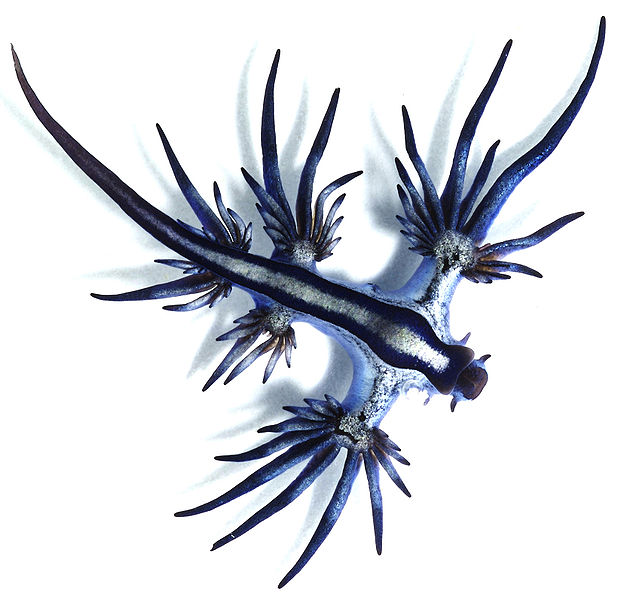
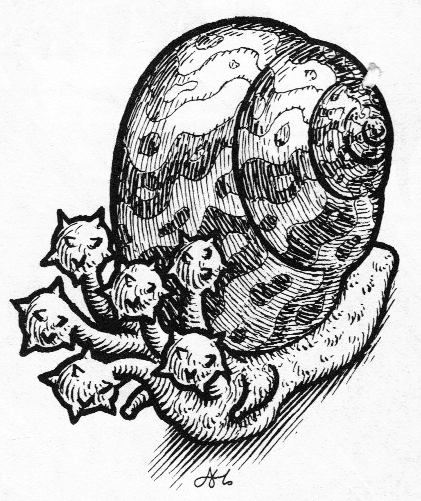
Inspired by a picture of a rather beautiful, if not deadly, sea slug that I saw today.

Giant Sea Slug (Sea Swallow)
Medium Vermin, Neutral, Non-Intelligent; Solitary

Hit Dice: 6
Armor Class: 13 [6]
Attacks: 4 appendages (1d4 + poison), bite (2d4)
Move: 20 [9] (Swim 5 [3])
Saves: Fort 10, Ref 12, Will 12
XP: 600 [Expert]

Giant sea slugs of the sea swallow variety are quite beautiful, but very deadly. They can float upon the surface of the water, upside down, due to gas sacs in their bodies, or crawl on land (though always in damp places … like dungeons, for example). They prey on larger creatures (monstrous jellyfish, giant slugs, pirates) and will prey on one another as well. They store the poison of creatures they eat in their bodies, mixing up powerful toxins that they use to kill their prey.

Giant sea slugs attack with their four appendages. The cerata on their appendages are tipped with toxins that inflict 1d6 points of constitution damage per round until neutralized or until the victim dies. Their mouths are filled with serrated blade-like teeth.

Special Qualities: Blindsight, immune to poison

Camilla, Queen of the Secret Empire

Shouldn’t it be empress?

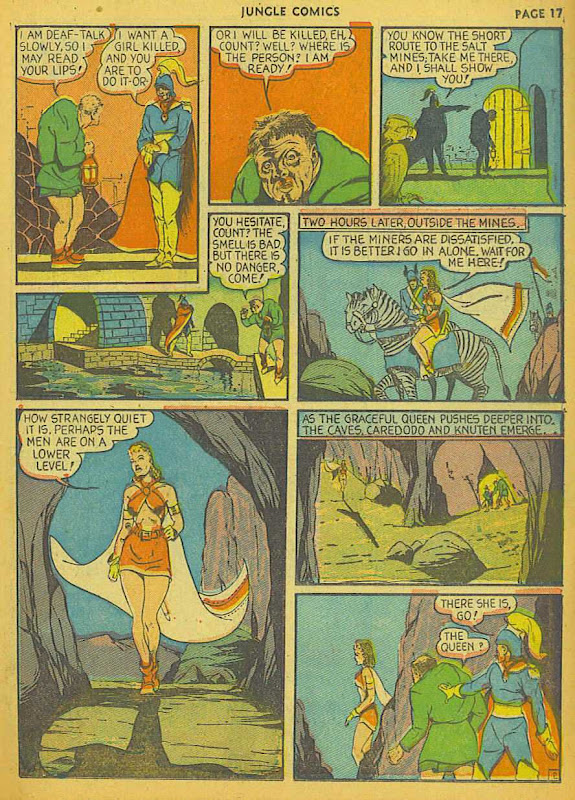
Okay – off to a bad start. Today I’m reviewing Camilla, Queen of the Lost Empire, which I found over at the excellent Comic Book Catacombs.

Knuten and Caredodo – names to conjure with! We have a hunchback living in the sewers (nice sewer entrance, by the way – nothing but class in the lost empire) who’s going to kill Camilla.

Into the salt mines. If you’ve ever checked out some of the ancient salt works that still exist, you’ll find nothing on Earth more like an actual mega-dungeon … you know, except for the monsters and treasure and stuff.

And just like, she has a henchman. If I were statting her up for Blood & Treasure (and I guess I am), I’d probably use the variant bard class in the game – the Aristocrat.

Queen Camilla, 9th level Aristocrat
Str 13, Dex 16, Con 13, Int 10, Wis 11, Cha 14
HP 56, AC 14, MV 30, SAVE Fort 11, Ref 7, Will 9
Special: +1 on reaction checks, legend lore (9), fascinate (4 creatures, 90-ft range), suggestion (one fascinated creature)
Gear: Longsword (+5 attack, 1d8+1), cloak of protection +2

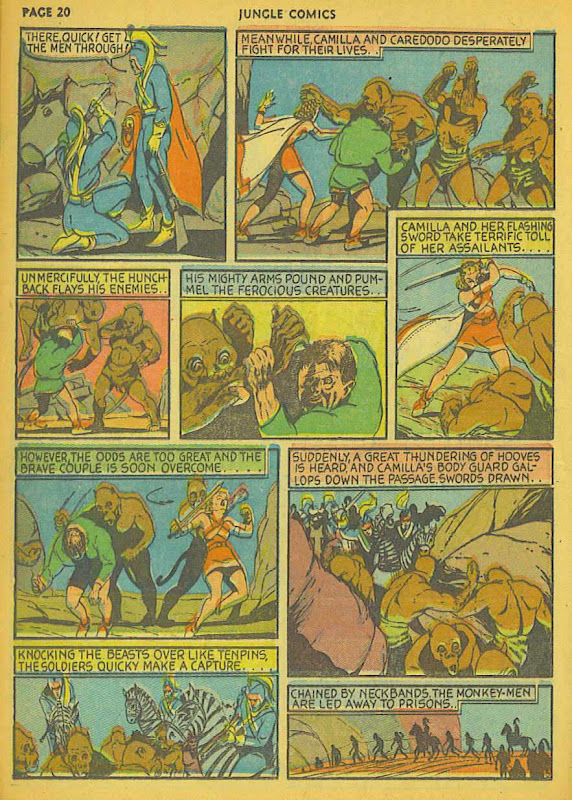
And monkey men! Nice touch.

There’s a bounty of greatness here. First, we see the queen run the monkey man through in one shot – we can guess the monkey men have a single Hit Dice. Love the shot of the dead monkey-man’s feet in the fifth frame – and check out Camilla’s pose. Very cool.

Monkey Man: HD 1; AC 13; ATK 2 slams (1d4); MV 30 (C20); SAVE Fort 13, Ref 15, Will 16; XP 50 (Basic); Special: None.

Then we have some men-at-arms mounted on zebras – always a favorite of mine for some reason. And they have ray guns to boot. Zebra-mounted ray gun troops!

Camilla’s hunchman, I mean henchback, I mean Caredodo ain’t no slouch when it comes to combat. He was hired as an assassin, and the next page features a nice stab in the back. We’ll go assassin for him.

Caredodo, 4th level Assassin
Str 16, Dex 8, Con 14, Int 12, Wis 10, Cha 6
HP 13, AC 10, MV 30, SAVE Fort 13, Ref 12, Will 14
Special: Sneak attack (double damage)
Skills: Climb (12), Decipher Script (10), Escape Bonds (13), Hide (13), Listen at Doors (10), Move Silently (13), Trickery (12)
Gear: Dagger (+4 attack, 1d4+2 damage, double on sneak attack)

The monkey men, I have to admit, seem like half-hearted villains. No ambition – no verve.

Hmmm – the plot thickens. As basic as this story was, I liked it and wouldn’t mind reading the next story. I think when you do introduce plots into role playing games, you might want to focus on keeping them about as simple as these old comic book stories. More complex plots work well in stories, where the old deus ex machine is there to help the investigators, but they can be pretty tricky in tabletop games where the players can’t actually see and hear anything, and only know what they’re told. Something to think about.

Stygian Depths – Moon Pulses, Titanic Towers and Reg

Three more previews of Stygia. I’m writing Dis now and I’m starting to get into the material. Still working on Blood & Treasure, as well, and it’s coming along pretty nicely. I’ll probably do a couple art previews soon. 1800 – American Empires is definitely next on the docket. I might change the focus on that one a bit – make it more of a game in its own right than a simple “trek into the wild” sort of thing. We’ll see – the setting offers lots of opportunity for large scale battles, wilderness adventure, etc. Should be fun.

57.77 Murderous Blade: A gleaming sword of red steel sticks out of the water here, causing the water around it to boil. The sword is known as the King-Slayer (it calls itself Reg, short for Regicide). King-Slayer is a +2 flaming weapon with a powerful Ego that seeks the blood of kings – including infernal kings like Bael. The waters around the sword are rife with giant leeches – 3d6 of them are encountered when one makes a grab for the sword.

64.78 Moon Pulse: A low, hilly island in this hex is crowded with rank trees and noisome undergrowth. Demonic jaguars haunt the trees, waiting for prey to wander their way. Each night, at midnight, a pulse of inchoate energy flows across the island (but not the entire hex) from a blackened silver pillar at the center of the island. Adventurers hit by the pulse must make a saving throw or be transformed, instantly, into a lycanthrope. The exact kind is determined by the character’s highest ability score:

HIGH SCORE = LYCANTHROPE
Strength = Werewolf
Constitution = Wereboar
Dexterity = Wereweasel
Intelligence = Wererat
Wisdom = Wereowl
Charisma = Weretiger

The transformation is immediate, but the adventurer can attempt another saving throw to retain their own mind for one minute, needing additional saving throws each minute to avoid become a chaotic, slavering beastman.

65.32 Tower of Titans: There is a tower here formed from the bodies of three petrified titans, standing up to their knees in the waters of the Styx. One titan is a curvaceous woman with hair like molten copper flowing from her head and eyes like prismatic spheres. The second titan is a graceful young man with fulginous skin and deepset eyes of opal. The third titan is an athletic man with pearly white skin and narrow eyes.

The tower is the home of Soazil, a cambion wizard (Mage 11; 32 hp) with crocodilian skin and close-set, steel-blue eyes. Soazil has five apprentices (Mage 5) and commands a company of crocodile-men.

Soazil is a master of teleportation, but has found no way to escape Hell, despite his vast knowledge. He is also skilled at cloning, and seven clones of himself hidden throughout the tower (and maybe others hidden throughout Hell). Half of his soul is possessed by the succubus Arete, in the form of a silver apple hidden in her chambers in the palace of mighty Bael.

Of Fembots and Bikini Machines

During the 1960’s, beach movies by AIP (American International Pictures) briefly ruled the earth. As unfortunately as they might have been (honestly – I like most of them for exactly the reasons movie critics would tell me I should dislike them), their spawn were even stranger.

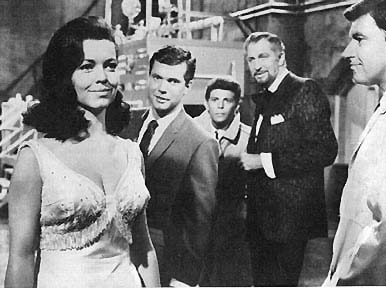
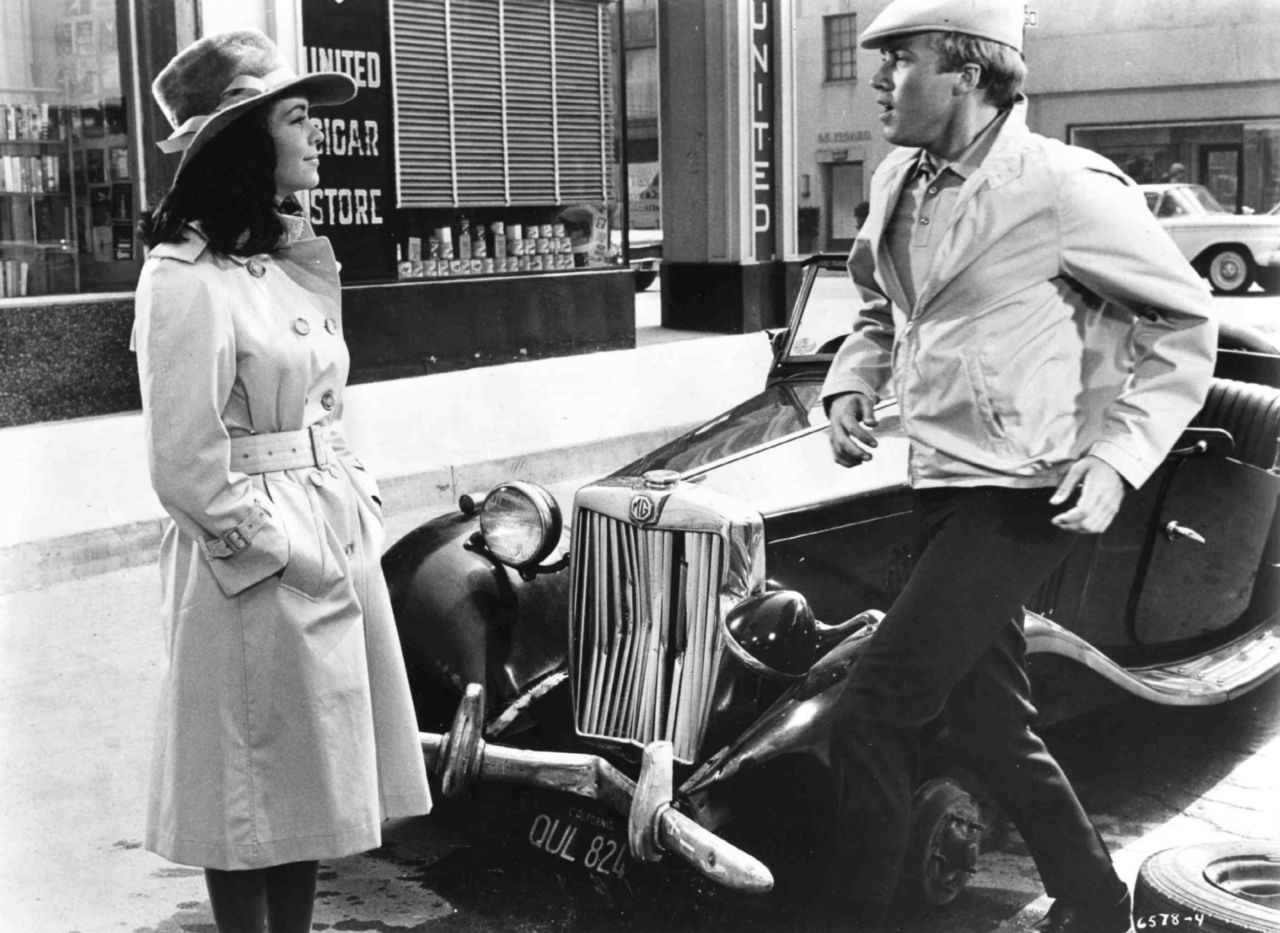
Enter Doctor Goldfoot and the Bikini Machine, a spy movie (kinda sorta) from AIP. Having just watched this movie over the weekend, I can report that is surprisingly high budget (for the time period and the quality of the picture), and even more amazing – not nearly as bad as it should have been. The presence of Vincent Price as Dr. Goldfoot probably has a lot to do with my forming this opinion, because I am an unabashed fan of his work. I also found the female lead, Susan Hart, surprisingly engaging as Diane (i.e. Number 11), the star of this particular blog post.

I’ll freely admit that I’m no expert on the subject of sexy fembots (though writing those words, I now am forced to wonder why not). I think Dr. Goldfoot may be the originator of the swinging, sexy, sixties fembots that plagued Austin Powers, International Man of Mystery. I know – Maria/Futura/Hel/Robotrix in Metropolis – but she didn’t swing like a pendulum do, so I’m not counting her.

In this case, they are gold bikini clad and possibly made from actual body parts filled with robot parts. They are produced by a large computer-ish machine, so maybe the bio-ingredients are rendered down into a paste and sprayed onto the robot chasis. They appear to do their best to avoid going “all the way” (as the kids say), so whether they are physically capable of going all the way is certainly in question. Diane, Number 11, is said by Dr. Goldfoot to be the most perfect of them – though that doesn’t stop him from torturing her with electro-shocks and menial floor scrubbing when she fails in her mission.

Dr. Goldfoot’s plan is simple, and would make a great Mystery Men! adventure. He picks a millionaire out of a magazine, programs his fembot to know what she needs to know to get him, equips the fembots with opera glasses that can jab poison needles into the eyes of their rivals, or lipsticks that shoot laser rays to blow their rivals’ head’s off, and sends them off to get hitched. They then use their feminine wiles to get power of attorney and then hand over the millionaire’s wealth to Dr. Goldfoot. Nice scheme … and it almost works. Or maybe it does. They never actually establish the SIC (Security International Command if my memory serves) completely foils the mad scientist.

Diane (Super Villainess), Adventurer
Number 11, Fembot
STR 7 | DEX 5 | CON 5 | INT 2 | WIL 2 | CHA 7
LVL 6 | HP 50 | DC 11 | ATK+6 | SPD 2| XP 7K

Powers: Charm (with kiss), Invulnerability III, Legend Lore (only very specific subjects that she has been programmed in), Phase (1/day), Super Cha +4, Super Str +4

Gear: Trench coat, fedora, walkie-talkie (implanted in head)

If we’re going to show the creation, we might as well show the creator.

Doctor Goldfoot (Super Villain), Scientist
True name unknown, Mad Scientist and Reanimator
STR 2 | DEX 3 | CON 6 | INT 12 | WIL 9 | CHA 3
LVL 11 | HP 50 | DC 10 | ATK+6 | SPD 2| XP 17.4K

Powers: Science Pool (30,000 XP)

Gear: Gold shoes with bells on the toes, handgun, super science devices


Every Fool Has His Day!

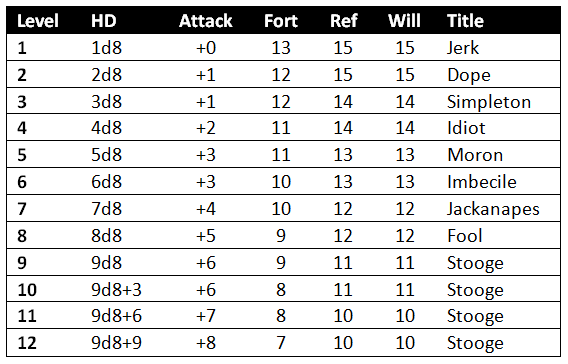
While watching a Stooges marathon on Antenna TV today, I was kissed by the muse (or maybe bonked by the muse, considering the source). Enjoy a class in a class of it own.

The Stooge

Stooges seem to coast through life, blissful in their ignorance and always coming through in the end.

Requirements: Stooges must have a constitution of at least 15. Their intelligence score can be no higher than 7, and their combined intelligence, wisdom and charisma scores can be no higher than 30.

Hit Dice: d8 (+3 per level after 9th)

Armor: Any

Weapons: Any (but see below)

Skills: None

Advance As: Fighter (in whatever system you play)

Class Features

Stooges can’t do much, but they can sure take a punch. A stooge ignores the 1 point of damage every time he or she takes damage. This increases to 2 points at 4th level, 3 points at 8th level and tops out at 4 points at 12th level. Any blow that should kill a stooge often only knocks them for a loop. The stooge may attempt a Fortitude save and, if successul, is only stunned for 1d4 rounds.

As tough as stooges are, you can’t call them brave. Stooges suffer a -2 penalty to save vs. fear. On the other hand, their heads are tough to crack. Spell casters who attempt to read their minds must pass a Will save or be struck with confusion for 1d4 rounds.

A stooge can fascinate people with his antics, whether he is tangling with another stooge or with a stubborn inanimate object, just as a bard of equal level. Stooges do not gain a bard’s suggestion ability.

When the going gets tough, the stooge gets going. Once per day, they can act as though under the effects of the expeditious retreat spell.

Stooges are masters of unorthodox unarmed combat. Their unarmed attacks inflict 1d4 points of damage at 1st level, 1d6 points of damage at 5th level and 1d8 points of damage at 10th level. Once per day per three levels they can attempt a stunning attack (if they hit, the victim must pass a Fortitude save or be stunned for 1d4+1 rounds). If a stooge is facing three adjacent opponents, they can do a triple slap, rolling once to attack and applying that roll to hit all three of them. Unfortunately, whenever up to three stooges are adjacent to an enemy, it gains the ability to make the same unarmed attack against them.


Stabbing You With Their Minds

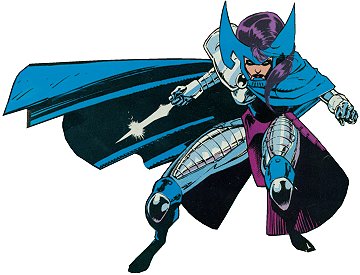
The last of the three “lost classes” of Blood & Treasure is the soulknife. The soulknife is certainly more gonzo than the classic fantasy archetypes, but they have some cool precedents in sci-fi entertainment, specifically in the form of the ubiquitous light saber and in the redesigned Psylocke (kinda miss the old one, to be honest) and her mind blades. The overall concept is pretty decent, and it was a close one to make it into the final game. I especially liked the idea of illustrating it (or having it illustrated for me, to be precise) as an Indian warrior with glowing katars. So … the soulknife for Blood & Treasure (which is about a month away from being finished, FYI).

SOULKNIFE

Soulknives are men and women with a natural surplus of psychic energy but no ability to manifest it in the form of psychic powers. Instead, they learn, through rigorous training and meditation, to unlock their chakras and focus their psychic energy into a blade-shaped construct. Soulknives follow a strict warrior code – the Kshatriya Dharma. This states, “Stand straight and never bow down, for this alone is manliness. Rather break at the knots than bend!”

Requirements: Soulknives must have a dexterity and wisdom score of 13 or higher.

Hit Dice: d8 (+3 hit points per level from 10th to 20th).

Armor: Padded, leather, ring mail, studded leather and all shields.

Weapons: Club, crossbows (any), dagger, dart, javelin, mace, morningstar, punching dagger, quarterstaff, rapier, sap, shortbow, short sword, sickle, sling and spear.

Skills: Climb, Find Secret Doors, Hide, Jump, Listen at Doors and Move Silently.

CLASS FEATURES

A soulknife can create a semisolid blade composed of psychic energy distilled from his own mind. The blade is identical in all ways (except visually) to a short sword (for medium-sized soulknives), dagger (for small-sized soulknives) or longsword (for large soulknives). The wielder of a mind blade gains the usual modifiers to his attack roll and damage roll from their strength score.

The blade can be broken (it has an AC 15 and 10 hit points); however, a soulknife can simply create another on his next turn. The moment he relinquishes his grip on his blade, it dissipates (unless he intends to throw it; see below). A mind blade is considered a magic weapon for the purpose of hitting monsters only hit by magic weapons.
A soulknife’s mind blade improves as the character gains higher levels.

A soul knife of 2nd level or higher can throw his mind blade as a ranged weapon with a range increment of 30 feet. Whether or not the attack hits, a thrown mind blade then dissipates. A soulknife of 3rd level or higher can make a psychic strike (see below) with a thrown mind blade and can use the blade in conjunction with other special abilities.

A soulknife of 3rd level or higher can spend one round of combat to imbue his mind blade with destructive psychic energy. This effect deals an extra 1d6 points of damage to the next living, non-mindless target he successfully hits with a melee attack (or ranged attack, if he is using the throw mind blade ability). Creatures immune to mind-affecting effects are immune to psychic strike damage.

A mind blade deals this extra damage only once when this ability is called upon, but a soulknife can imbue his mind blade with psychic energy again by taking another round to imbue it with destructive psychic energy.

Once a soulknife has prepared his blade for a psychic strike, it holds the extra energy until it is used. Even if the soulknife drops the mind blade (or it otherwise dissipates, such as when it is thrown and misses), it is still imbued with psychic energy when the soulknife next materializes it.

At every four levels beyond 3rd (7th, 11th, 15th, and 19th), the extra damage from a soulknife’s psychic strike increases by 1d6.

At 5th level, a soulknife gains the ability to change the form of his mind blade. This one full round; he can change his mind blade to replicate a blade one size larger (i.e. dagger to short sword, short sword to longsword or longsword to bastard sword) or smaller. Alternatively, a soulknife can split his mind blade into two identical blades, suitable for fighting with a weapon in each hand.

At 6th level, a soulknife gains the ability to enhance his mind blade. He can add any one of the Class A weapon special abilities on the table below. At 10th level the soulknife can add a Class B ability to his mindblade. At 14th level, the soulknife can add Class C abilities to his mindblade. At 18th level, the soulknife can add two Class B abilities or three Class A abilities to hit mindblade.

Special Abilities
Class A: Defending, keen, lucky, mighty cleaving, psychokinetic, sundering, vicious
Class B: Collision, mindcrusher, psychokinetic burst, suppression, wounding
Class C: Bodyfeeder, soulbreaker

Bodyfeeder: Weapon grants the wielder temporary hit points equal to the damage inflicted on a natural attack roll of ‘20’.

Collision: Weapon increases own mass at end of swing, dealing 5 extra points of damage.

Lucky: Once per day, the wielder can re-roll a missed attack.

Mindcrusher: Spellcasting or spell-using creatures hit by this weapon lose a random ability or spell slot. They must also pass a Will saving throw or lose 1d2 points of wisdom.

Psychokinetic: Weapon deals +1d4 points of ectoplasmic damage to those it hits.

Psychokinetic Burst: As psychokinetic, plus, on a natural attack roll of ‘20’ it deals an additional 1d6 points of damage.

Soulbreaker: On a natural attack roll of ‘20’, the victim loses one level (per a life drain). One day after losing the level, the victim can attempt a Fortitude saving throw to regain the lost level.

Sundering: Weapon provides a +2 bonus to sundering attacks.

Suppression: Creatures hit by this weapon suffer from a targeted dispel magic effect. The wielder makes a dispel check (i.e. Will save with a penalty equal to the level of the spell to be dispelled).

The weapon ability or abilities remain the same every time the soulknife materializes his mind blade (unless he decides to reassign its abilities; see below). The ability or abilities apply to any form the mind blade takes, including the use of the shape mind blade or bladewind class abilities. A soulknife can reassign the ability or abilities he has added to his mind blade. To do so, he must first spend 8 hours in concentration. After that period, the mind blade materializes with the new ability or abilities selected by the soulknife.

Beginning at 13th level, when a soulknife executes a psychic strike, he can choose to substitute intelligence, wisdom or charisma damage for extra dice of damage. For each die of extra damage he gives up, he deals 1 point of damage to the ability score he chooses.

Happy Blog-O-Versary to Me! + FLAILSNAILs comes to NOD

Image is property of Wizards of the Coast, the darlings

Four very simple items today.

First – it’s my second blog-o-versary! I’ve had a ball with this blog and, I think, created something useful to the RPG community at large. My sincerest thanks to those who read the blog (especially to anyone out there that uses this material in their games), to those who follow the blog, to those who put me in their blogrolls and to those who have purchased some of my nonsense and made one of my dreams com true (still waiting on the jetpack).

Second – I have two groups working their way through the Land of Nod right now playtesting my Blood & Treasure rules. One just crawled into a strange, abandoned trireme they found buried under a mountain (clearly their lives are not in danger) and the other just came up from a delve into the catacombs of Ophir, the Wickedest Little City on the Tepid Sea.

Most importantly, I have now officially signed on to the FLAILSNAILs Convention, and hereby open the gates of Nod to anyone who wants to poke around in it and cause trouble. Right now, I just do play-by-post gaming on Google+, because I have a day job, a family and I spend a fair amount of time writing RPG stuff (if you hadn’t noticed). If you or a group want to delve into Nod and you’re on Google+, just let me know and we’ll work something out. You can even choose the system we use, assuming I own the rules and have the inclination to use it.

ALARUM: A couple people have dropped out of the Google+ Nod game, so there are slots open on the 3rd level Team Blood and the 6th level Team Treasure, if anyone wants to play. Team blood lost an elf fighter and Team Treasure a human cleric, but you can play something different. Team Blood is currently above ground and resting, so a Team Blood player could jump right in. Team Treasure is in the wilderness, but they’ll be returning to civilization soon to re-supply, so a higher level character might have to wait a bit. 

If you want to join in now, just send me an email (jmstater    AT    yahoo    DOT    com) and we’ll make it happen.

Third – Random Things Found Under Foot in the Dungeon (by command of JOESKY)

1) The shed scales of a large reptile (psst – it’s behind you, and its invisible)

2) A puddle of halfling blood (you can tell from the sugar content)

3) A patch of green slime cunningly masquerading as brown mold (don’t ask me how)

4) Bugbear droppings (where did they find corn 300-ft below ground)

5) A pointy hat, lightly singed

6) A wooden holy symbol, broken in half

7) A tentacle (attached to an angry monster, of course)

8) Footprints in the dust that stop where you’re standing

9) The ashes of a lich

10) A flimsy ceramic tile hiding a caltrop

11) A chainmail bikini (with a broken leather strap!)

12) Shards of glass that sparkle like gems (with the reflection of a yellow-pupiled eye staring back at you in each shard)

13) A copper coin (48% chance of being shiny)

14) A puddle of acid with mind-bending effects for those who touch it

15) An anti-shadow cast by an adventurer from the negative zone

16) A silk scarf that smells of sunflowers, the ends tattered and stained with blood

17) The Magna Carta

18) A patch of ice … evil ice!

19) Tomb dust (hold your breath!)

20) Mummy wrappings (pray the owner doesn’t give a tug)