NOD 14 and Avengers and Rappan Athuk

A few quick notes …

1

NOD 14 has been released as an e-book. Print book will follow after I’ve seen my review copy.


“Issue 14 arrives with two new chapters in the Hellcrawl, sending players through the swamps of Stygia and into the murderous metropolis of Dis. You can also build more notable nobles and set families to feuding with two new random generators. Also – variant white dragons, magic hats and random dungeon chambers!”

Link is over on the right. $3.50 for 100 pages.

2

Saw Avengers last night, and for the first time in a looooooong time, I can honestly say I watched a movie without having any complaints afterward. Most of the “prequels” left me either mostly satisfied or mostly unsatisfied, but the Avengers just freaking works. It was like watching Star Wars for the first time when I was a kid – exciting, fun, etc. I’ll call it the Citizen Kane of superhero movie. Go give it a shot.

3

Almost forgot a third important thing … Rappan Athuk. Hit the Kickstarter and take the record for biggest RPG Kickstarter away from Vampire: The Whatever!

It’s a Dirty Job …

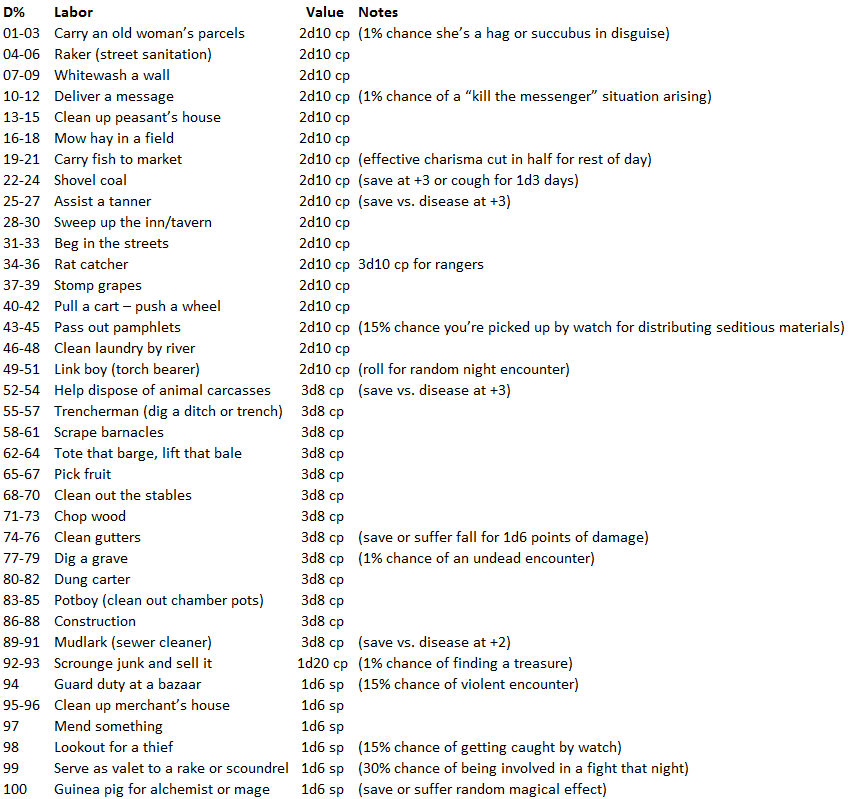
In my Google + Nod game, two characters recently found the need to do some day jobs while the party was resting between dungeon delves. One just didn’t have much coin, and the other decided to take Jeff Rients’ Carousing Table for a spin (and he was a paladin when he did it – the operative word being “was”).

Anyhow, I came up with this table of crappy day jobs, none of which pay much, and some of which carry a little danger.


Dragon by Dragon – August 1976 (2)

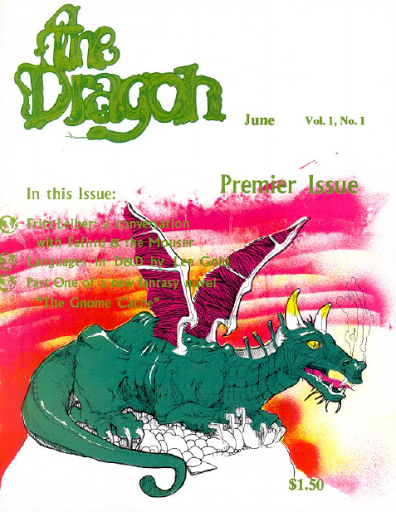
August of 1976 – A month after the bicentennial, and Marvelites were grooving to such titles as Planet of the Apes, The Champions and Black Goliath, the Seattle Seahawks were playing their first game, Big Ben breaks down in London, Viking 2 enters orbit around Mars, the Ramones make their first appearance at CBGB, and The Dragon’s second issue hits the stands. So what did the gaming geek of 1976 get for his money?

John M. Seaton devises a procedure for “monkish” promotional combat (i.e. knock off the master to assume his level). I love this kind of thing, and given the recent popularity of FlailSnails Jousting, I wonder if there isn’t a market for FlailSnails Monkish Combat.

The procedure would be similar – write up 6 rounds of combat, denoting your strike, kick, block or other maneuvers, and then we see where it goes.


Lots of fiction in this issue.

The second installment of Gygax’s Gnome Cache is in this issue. I’ll freely admit this here – I almost never read the fiction in Dragon. I probably missed out on something.

Speaking of fiction, Jake Jaquet gives us the conclusion to “Search for the Forbidden Chamber”. Didn’t read this either.

Gardner Fox (you might have heard of him) has a short story in this issue called Shadow of a Demon which is covered very capably at Grognardia.

Another installment of “Mapping the Dungeons”, wherein DM’s of the 1970’s try to hook up with players via The Dragon. St. Louis appears to have had a surplus of DM’s looking for players – 8 of them in this issue.

Some dude named Paul Jaquays was running the Spring Arbor College Dungeoning Society in Spring Arbor MI. Wonder if he ever amounted to anything.

Through the magic of Google, I found the following DM’s online:

Keith Abbott of Muskegon MI

Michael Dutton of Mountain View CA might have done some art for WOTC – could be a different guy

Bill Fawcett of Schofield WI kinda founded Mayfair Games

Karl Jones – could be this guy?

Drew Neumann – maybe a composer of film and television scores – he was at Wylie E. Groves High School in Detroit at the right time (Class of ’77). Could have known Ellen Sandweiss, who was in Evil Dead. Did music for Aeon Flux

Scott Rosenberg of Jamaica NY – has a couple issues of The Pocket Armenian floating around online.

Ed Whitchurch has achieved some level of DM’ing fame

Joe Fischer gives us more tips for D&D Judges. He covers interesting entrances for dungeons (i.e. under stuff you don’t expect them to be under) and “friendly” traps that aren’t necessarily harmful. He also provides a random table for treasure chests that are, 50% of the time, trapped thus …

D% Trap
0-30 – 1d4 spring-loaded daggers fire when chest is opened
31-50 – Same as above, but daggers are poisoned
51-65 – Poisoned gas released when chest is opened
66-75 – When opened, chest acts as mirror of life trapping
76-85 – When opened, chest explodes for 1d6+1 dice of damage (wow!)
86-90 – When opened, an enraged spectre comes out [which can be read a couple ways, either of them endlessly entertaining]
91-95 – All characters within 5 feet lose one level [after the first use of this trap, I guarantee everyone will give the thief plenty of space when opening chests]
96-98 – All characters within 5 feet lose one magic item
99-00 – Intelligent chest with abilities of 2nd – 9th level magic-user [nice!]

He also mentions intelligent gold pieces that scream when removed from a room, or replacing real gold pieces in a dragon’s horde with chocolate coins (though as valuable as chocolate was in the “olden days”, that might actually be a step up). He also brings up the idea of creatures with odd alignments (chaotic dwarves, for example).

A couple more spotlights (Joe Fischer rocks!)

Monster Gems are 500 gp gems that can be commanded to turn into monsters (per rolling a wandering monster) for one week – when the week is up, or they are killed, the gem is destroyed as well. It might be fun to rule that every gem worth 500 gp (exactly) is a monster gem.

Hobbit’s Pipe (by Marc Kurowski) – Clay pipe, when smoked, gives ability to blow multi-colored smoke rings (4 per turn, moving at 4” (40’) per turn – love the specificity). The pipe can be smoked 3/day. He also offers up five magic pipeweeds, a bag of infinite wealth, helm of forgetfulness, and ring of infravision.

Lynn Harpold give a long account of Quetzalcoatl and his cult in Central America.

Creature Features gives us the remorhaz. Love the “stat block”:

Move: 12”
Hit Dice: 6/10/14 (8 sided) dice
% in Lair: 20%
Type Treasure: F
Bite for 3-36 points
Breath for 3, 5, or 7 dice of fire damage
Magical Resistance: 75%
Low Intelligence
Neutral
Number Appearing: 1 (1-4 if in lair)
Description: 30’ long. Blue Hued underneath, wings & head backed with red.
Armor Class: Underside: 4. Back: 0 plus special. Head: 2.

Apparently, the standardization bug had not yet bitten.

Jon Pickens presents the Alchemist, a new D&D class. They don’t label this one as an “NPC Class”, so I guess it is fair game for all you D&D-ers out there. I’ll roll one up quickly for FlailSnails:

Xander Wort, Neutral 1st level Alchemist (Student)
Str: 5; Int: 13; Wis: 16; Dex: 16; Con: 7; Cha: 10
HP: 2; Attack: As Cleric; Save: As Fighter (+2 vs. poison and non-magic paralyzation)

Special:
Max. AC is 5
Can use one-handed weapons (excluding magic swords)
Use poisons and magic items usable by all classes
Psionic ability as fighters (replace Body Weaponry with Molecular Agitation)

Special Abilities:
Detect Poison 20%
Neutralize Poison 10%
Neutralize Paralyzation 15%
Identify Potion 5%
Read Languages 80% (one attempt per week)
Prepare poisons (strength level equal to their level; costs 50 gp and 1 day per level) and drugs (as poisons, but knocks unconscious for 4 hours)
Prepare a potion of delusion

Potions:
None – until 3rd level (Scribe)

His bit on poison is pretty cool. If the HD of the poisoner or level of poison is equal to or greater than the victim’s HD, they must save or die. If at least half their HD, they are slowed until a constitution check is passed, trying once per hour. If less than half, there is no effect, but the poison accumulates in the blood until it’s enough to slow or kill the person. A very nice system!

This is actually a very groovy class. The hit points are low, so I don’t know how long Xander would have to live, but he can wear some decent armor and load up on poisoned darts and a poisoned long sword and might just make it to 2nd level.

Jon Pickens also presents optional weapon damage, allowing fighters and thieves to gain mastery in different weapons, increasing the damage they deal with them (except with dwarf hammers, military picks, pikes, pole arms and arrows). Fighters master one weapon per three levels, thieves one weapon per four (and are limited to sword, dagger and sling). Those with a Dex of 13 or better can gain mastery with a combination of two weapons, gaining the ability to strike with both weapons per round or with one weapon and treat the other as a shield. Sword and sword or flail and morningstar combos require a Dex of 16 or better.

Another good system – very clean and simple to use.

All in all, a pretty good issue. Lots of neat rules ideas and some good pulp literature.

Crystar for Mystery Men! Swords & Sorcery

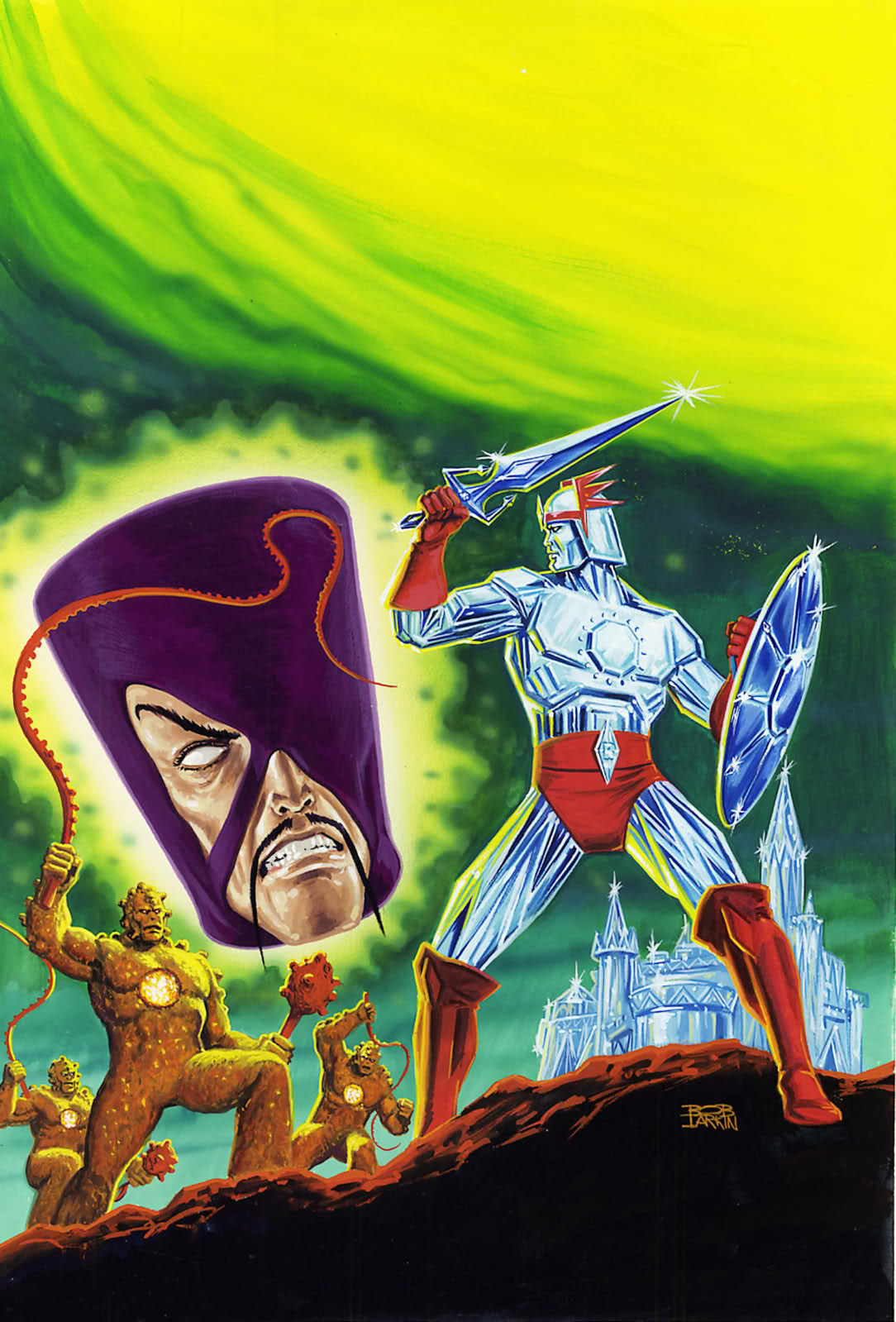
We’ve done the granddaddy of Swords and Sorcery – that Cimmerian guy – and his female counterpart – the red head. I delved into cartoons with She-Ra. Now to go into another character that mixes Swords, Sorcery and Superheroes … Crystar.

Crystar was born when somebody got the idea to use see-through plastic to make toys. In the Saga of Crystar his origin involved demon lords, magic crystals and such. Ultimately, Crystar became a living, fighting gemstone with a sword. Really, the Sage has everything you need for a good S&S game – demon lords, Chaos War, a guy named Feldspar.

CRYSTAR, Adventurer 7 (Prince of Crystallium)
STR 16 (+8) | DEX 4 (+2) | CON 8 (+4) | INT 2 (+1) | WIL 5 (+2) | CHA 8 (+4)
HP 58 | DC 16 | ATK +6 (+14 melee, +8 ranged) | SPD 2 | XP 9,700

Ability Boosts: Str +10, Con +3, Cha +4

Powers: Adapt Body (Fire/Lava), Invulnerability II, Weapon Master (Longsword)

Gear: Longsword (Potent Attack; 1d8+11, can hit ethereal and incorporeal creatures), Shield (Shield)

Since I’ve got Crystar up there, I might as well stat up a couple similarly themed monsters.

MAGMIN
LVL 2 | PH 4 | MN 3 | DC 17 | SPD 2 | XP 3300

Attacks: Burning fist (1d6 + 1d6 fire + save or catch fire)

Powers: Fiery Aura (30 ft. radius; save or 1d6 heat damage), Melt Metal Weapons (save to negate), Immune to Fire

CRYSMAL
LVL 6 | PH 5 | MN 3 | DC 21 | SPD 2 (Burrow) | XP 3700

Attacks: Sting (1d6)

Powers: Immune to Fire and Cold, Resistance to Electricity (50%), Animate Object (1 at a time, stone or crystal only), Energy Cone (Psionic Energy), Dimension Hop)

Dis, Grand City of Hell – Bureaucrats!

I have no idea which preview this is, and yeah, I’m just lazy enough not to look.

Today, we’re looking at Spades.

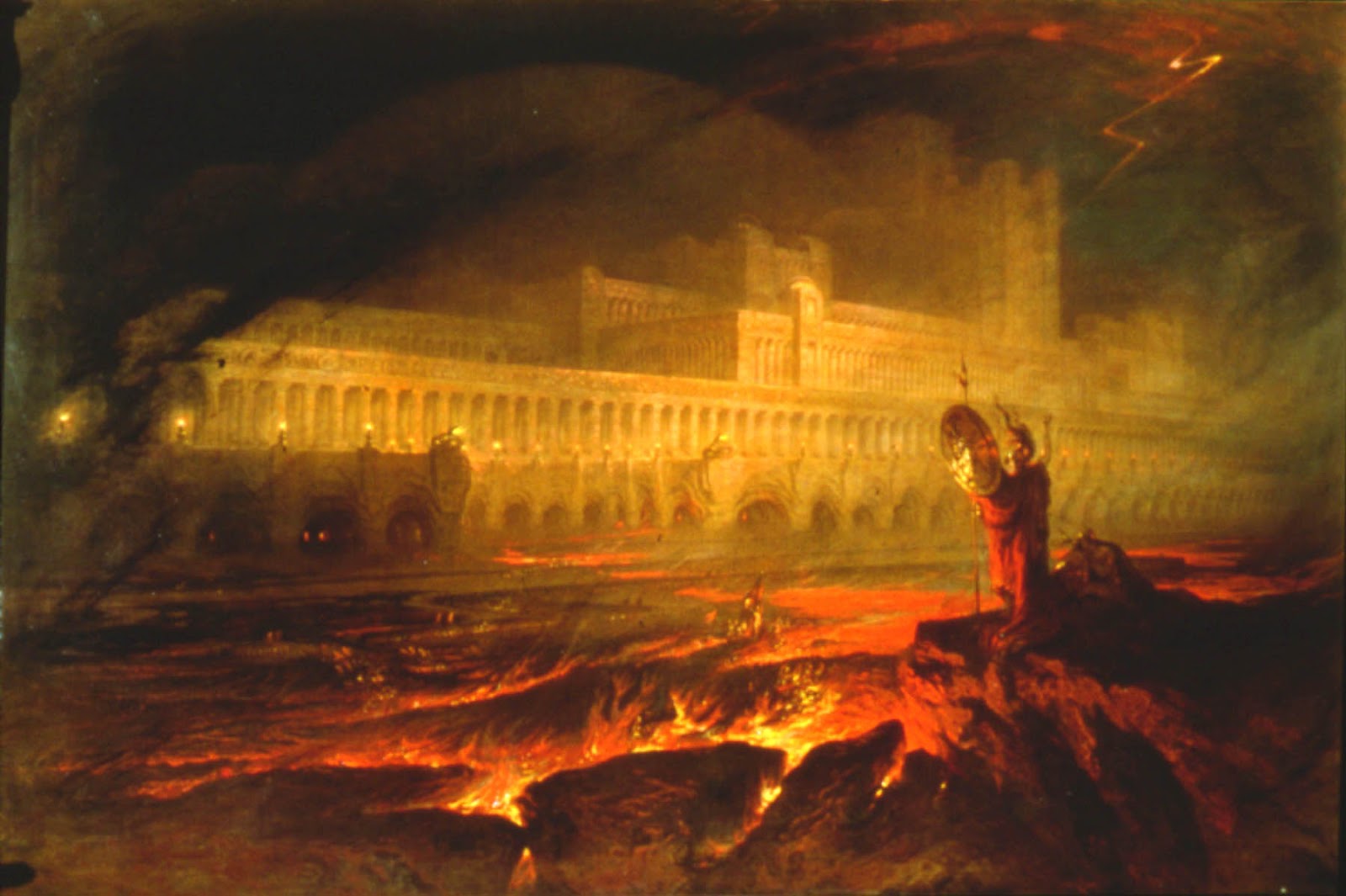
Originally, I had planned on spades being associated with war, but then I realized that Spades was where I had planned to place Pandaemonium, the Parliament of Hell … thus, Spades is the center of Hell’s government … thus Spades is where the most terrifying thing in the universe has to live … BUREAUCRACY!

Within the blocks and quarters represented by the suit of spades are the most terrifying edifices of Hell, where even arch-devils and demon lords fear to tread … the government offices of Dis. Devils are natural bureaucrats, and the city of Dis lays this truth bare to the world. Each block of spades is crammed full of the government offices of one ministry or another. Petitioners find themselves waiting in lines that last for days only to discover they have the wrong paperwork or should be in the adjacent line.

One cannot enter one of these quarters without showing their papers (which they almost certainly will not have). This requires they be guided to a devil that can process their claim for papers, and thus starts the insanity. In essence, the attempt to process any task in one of these quarters is the same as for finding anything in a block of Dis, and the penalty (wisdom damage) is the same.

RANDOM ENCOUNTERS

D6 RANDOM ENCOUNTER
1. Zombie bureaucrats seeking papers (and brains) (4d6)
2. Amaimon tax collectors (1d8)
3. Azizou demons on inspection (1d6)
4. Iron golems (1d8)
5. Bearded devils on patrol (1d8)
6. Random official and retinue

“My symbol for Hell is something like the bureaucracy of a police state or the offices of a thoroughly nasty business concern.” – C. S. Lewis, The Screwtape Letters (1942)

A. Nybbas: Nybbas is the demon lord of jesters and charlatans, and he heads up the Ministry of Food & Drink, which is in charge of tasting the food of archdevils and demon lords (they use shades for that) and in arranging entertainments and diversions for the masses of Hell. Nybbas’ quarter is always in an eternal state of misrule and mayhem, and the people here play rough, seemingly getting their ideas for pranks from old cartoons (you know, the funny ones made by our grandparents’ generation).

The quarter is a carnival of capering buffoons and clowns and mad pranksters parading through blocks that may once have looked like a sinister Paris, though it is now a ruin of broken glass, splintered wood and vandalized buildings. Besides the japing shades (most of them were wicked bards, illusionists and jesters in life), the quarter is inhabited by nupperibos and lemures, who work in the diabolical bureaucracy under the direction of dretches.

Nybbas’ gate is a 10-ft. tall red door with a golden knocker in the shape of grotesque jester’s face. Touching the handle on this door sends a 6 dice electrical shock into the person who touches it. The shock acts like chain lightning. Behind this door there is a 10-ft. long tunnel that ends in a second door colored green. When one enters this door, a gallon of alkahest, the universal solvent falls from the ceiling (save or struck by disintegrate spell). Beyond the green door there is a white door; when opened, the first person who opens it is struck by a scalding hot pie in the face (6d6 points of fire damage, plus 1d6 points of damage per round thereafter until the filling is scraped off). Beyond the white door there is a chamber guarded by 1d4+4 rubber chicken golems … okay, maybe that’s taking it a bit far. Beyond the white door is the final chamber – a seeming dead-end holding a garishly colored statue of a harlequin pointing at the door through which the adventurers entered. Pulling this finger releases a stinking cloud (as the spell) and, 6 rounds later, causes the entry door to become a gate into the next quarter.

In the center of this madhouse is a grand castle reminiscent of Mad King Ludwig’s Neuschwanstein castle, though Nybbas’ looks like it’s been through a tornado. The castle also serves as the ministry headquarters, where 20 companies of nupperibo and lemure bureaucrats do their best to follow the rather chaotic orders of their master. Five companies of red jesters serve as the supervisors of the ministry and Nybbas’ personal guard.

Nybbas appears as a fat man in a comfortable throne flanked by two fiendish giant hyenas. His court is filled with red jesters and shades forced to laugh eternally at stale old jokes and cruel pranks. Everyone entering the room must pass a saving throw each turn or be struck by hideous laughter. Nybbas has a moon-like face, glistening eyes that burn with an infernal passion and thin lips curved into a grotesque smile. He holds a traditional jester’s marotte tipped with a grimacing skull with living eyes.

NYBBAS: HD 15 (80 hp); AC -6 [25]; Atk 1 slam (2d10) or marotte (1d12 + save vs. hideous laughter); Move 6; Save 3; CL/XP 23/5300; Special: +2 or better weapon to hit, magic resistance 76%, immune to fire and poison, spells (dream, nightmare, hideous laughter, stinking cloud), summon 1d6 red jesters 1/day.

4. Chadper: Chadper is the Minister of Internal Revenues and perhaps the only demon in Hell more feared by other demons than by shades and mortal visitors. He and his tormentor demons, with their hell hounds, collect the tributes owed to Lucifer, in soul coinage and shades, by the other demons of Hell, down to the lowliest lemure.

The entire quarter is composed of black streets of smooth obsidian and buildings of the same material – all of it seemingly carved from a great block of the material and smoothed as though by burning sands. The only shades in Chadper’s domain are those collected for Lucifer and meant to be doled back out to the demon lords and arch-devils to reward their loyal service. They might be found in long chain gangs heading into or out of the city, but most often are kept in deep, stifling pits awaiting an accounting. These pits are guarded by squadrons of erinyes, who perch on the buildings above, slinging the odd dart or rebuke into the pits to keep the shades quiet. Chadper detests noise, and demands almost complete silence throughout his domain. All communication is by whisper or hand signal, and those who break this commandment are immediately set upon by a squadron of silenced tormentor devils and summarily executed.

The gates of Chadper’s domain are composed of the same obsidian as the rest of the domain, and consist of long tunnels with low ceilings (10-ft.) upheld by rows of pillars (20) carved into the shape of grotesque minotaurs. The gates are completely silenced, and rarely passed through save by captive shades, tormentors carrying back tributes, or demons and devils (including lords) coming hat in hand to beg forgiveness from Chadper and pay their taxes. The gates are guarded by obsidian golems, who merely masquerade as the grotesque pillars. Folk who enter the gate areas can be teleported by Chadper into his throne room as he desires, once per day.

Chadper’s great chancery is an obsidian cube, unadorned, with tiny doorways marked in silver tracery on the ground level of each face. Within are 1,000 joined courts where the tribute of Hell is counted, re-counted, certified and then, by the direction of Lucifer, doled back out. Chadper has no lair, per se’, but merely travels from court to court, accompanied by a squadron of tormentor devil guards, directing the dretches who serve him. He commands 8 companies of dretches and 20 companies of tormentor devils, making him among the most powerful devils in Hell. He can also sic a dozen hounds of Chronos on those defy him or refuse to submit to his summons.

Chadper appears as a faintly glowing angel with a twisted, atrophied face and two large, saucer-like ears that permit him to hear, per clairaudience, anything said in Hell. He wears black robes and a black breastplate and carries a +3 glaive that opens bleeding wounds (1d6 hit points per round until healed) in its victims. Those who die from these wounds rise up as vampires under his control.

CHADPER: HD 20 (101 hp); AC -5 [24]; Atk 1 glaive (3d4+3 + bleeding wounds); Move 18 (F24); Save 3; CL/XP 31/7700; Special: +2 or better weapon to hit, magic resistance 35%, immune to fire and poison, spells as 15th level cleric, double damage from sonic attacks and saves at -2 vs. sonic effects, control stirges and vampires, change into death fog (double strength) 1/day, summon 2d4 vampires or 1d4 stirge demons 1/day.

9. Leonard: Leonard, or Master Leonard, is also known as the “Black Goat” and serves as the Inspector General of Hell. His quarter appears to be a place of Renaissance splendor – broad avenues of azure stone flanked by white trees and buildings of peuce and tourmaline with ornamental iron work and gold filigree around the doors. Promenading through the streets are shades dressed in finery, with large, ribboned hats on the women and fine, ebony sticks in the hands of the men. All of these shades are mere illusion, and the buildings, though pretty, are all empty.

Underneath the streets the demons of the Inspector General do their work, in labyrinthine dungeon corridors were every torture known to demon is employed to root out opposition to Lucifer. The practitioners of the torture are 16 companies of azizou, who have a special knack for the work, while another 8 companies of barizou skulk about Dis seeking out disloyalty and inefficiency.

The gates of the quarter are located above ground, and are flanked by an honor guard of 60 manes demons in gleaming, golden armor, with hundreds of pretty, fluttering pennons on long pikes, each one topped by a bleeding, moaning head. The gates are curtains of acid (6d6 points of damage when walked through – save for half – and 1d6 points of damage each round thereafter (for 10 rounds) until neutralized with salt – eats flesh, stone and all metals except silver, gold and platinum). The curtains of acid are drawn aside to allow people to pass when Leonard wants them followed by his geruzou demons.

Leonard’s lair is deep within the dungeons under the streets, in a fortress of solid blue jade (3-ft. thick walls) called the Hall of Injustice. The Hall has many pitfalls and is guarded by a company of mehrim (goat demons). Leonard can be found in a scrying chamber, which allows him, via hundreds of floating crystal spheres, to see through the eyes of all of his servants.

LEONARD: HD 17 (101 hp); AC -1 [20]; Atk 1 touch (save or lose half hit points) or rapier (2d4+2 + 1d6 electricity); Move 18; Save 3; CL/XP 26/6200; Special: +2 or better weapon, magic resistance 85%, immune to electricity, petrification, poison and mind effects, cast spells as 11th level cleric and magic-user, teleport with error 3/day, scry (as with crystal ball) 3/day, summon 1d6 mehrim demons 1/day.

Planet Stories … Greatest Covers in Comic History?

Maybe. Maybe not. But this one is a humdinger …

Visit the Comic Book Catacombs and read about Aura, Lord of Jupiter, won’t you?

You couldn’t get this much awesome for 1 slim dime in the modern day, I can assure you.

Princess Vara, despite getting a smaller font than Reef Ryan, appears to get the cover (I can’t imagine why), if in fact those aliens getting slapped around are the Green Legions of Xalan. She’s wearing her gold-plated titanium Venusian lady-parts armor (protection where you need it, when you need it – AC +1) and wielding a short sword while riding something that came out of a random monster generator.

Let’s tick off the alien parts on that beast – lower body of a horse, feet of a camel, talons of an eagle, neck of a hairy lizard, ears of an Elfquest elf, horn of a … I have no idea … and beak of abject, eye-poking horror. It needs some stats (S&W and Space Princess this time):

AREMIHC: HD 4; AC 6 [13]; Atk 2 talons (1d4), beak (1d6) and gore (1d6); Move 18; Save 13; CL/XP 5/240; Special: Run x5, only surprised on 1 on 1d8.

AREMIHC: HD 4; DEF 17; FIGHT 11 (Beak/Gore 1d8, Talons 1d4); MOVE F; STR 7; DEX 5; KNO 0; MEN 3; Special: None.

 The Green Legions are somewhere in the kobold-goblin-orc continuum – I’d go with goblin stats, since they’re clearly pretty easy to pick up and hurl. I dig the polearms and golden shields with the suns. They also have a sweet ride in the background – you can’t beat old school starship design, I always say.

I also dig the “Slaver-Hordes of Neptune” – good name for a Space Princess module – maybe a sci-fi version of the classic Slavers series for AD&D.

Dragon by Dragon – June 1976 (1)

Who drew it? Couldn’t find it in the issue.

Yeah, everyone else does the whole “review every issue” or “review every page” thing, so why the heck can’t I?

Other than Great Britain and Iceland finally ending their codfish war (such a terrible waste), the first issue of The Dragon (formerly The Strategic Review) was probably the big highlight of June, 1976. So what does this little gem contain?

We have an article by Fritz Leiber, the man himself, talking about his wargame Lankhmar and giving a brief tour of Nehwon. Leiber closes this article with a bit on houris. Here’s an adaptation for Blood & Treasure (you know, the game I haven’t actually released yet).

Every hero (4th level fighter) attracts a houri as one of his followers provided he has a charisma of at least 15. The houri requires upkeep to the tune of 100 gp per month. As Leiber explains, a houri is so “slimly beautiful” that she “make all men their helpless slaves and intoxicate even a Hero to madness”. In play, this works as follows:

– Houris have 1d4 hit points (i.e. they can be killed by a dagger). They wear no armor, and may only wield a dagger themselves.

– All 0 or 1 HD male humans, demi-humans and humanoids within 10 feet of a houri must pass a Will saving throw or move directly toward the houri, rapt with fascination and unable to attack her (unless they are attacked by someone else, in which case the spell is broken).

– All higher level male characters within 10 feet of a houri must pass a Will saving throw or have their effective level cut in half.

Sounds like a useful follower to have, but heed the Mouser’s warning – “Women are ever treacherous and complicate any game to the point of sheerest insanity.”

Larry Smith provides a guide to running the Battle of Five Armies using the Chainmail rules.

Wesley D. Ives provides a task resolution system, as he informs us that a “more standardized system is needed” than DM’s just making it up as they go along. New School and Old School were clashing even back in 1976.

The system works by determining randomly a type of dice (by rolling d% and adding the attribute to be tested), from d4 to d12, rolling it and multiplying it by the attribute to be tested to find the percentage chance of success.

So, let’s say I want to jump across a chasm. This involves strength, and my dude has a strength of 13. I roll d% and get a 35. I add 13 to 35 and get 48, which tells me I need to roll a d8. I roll it, get a 5 and multiply that by 13, giving me a 65% chance of success. See – much easier than saying “roll under your strength” or “roll a save vs. paralyzation” or “roll 1d6 – you succeed on a 1 or 2”. Thank goodness for systems.

James M. Ward asks whether Magic and Science are compatible in D&D. Of course, he thinks it is (else it would be a pretty boring article). He introduces a race of people called the Artificers who use a trio of interesting high-tech items.

Lee Gold delves into languages. She notes that humanoids have a 20% chance of speaking Common, which makes much more sense than 3rd edition allowing dang near every sentient creature in the multiverse speaking Common (and thus negating the point of even having languages).

Jake Jaquet tells the tale of “The Search for the Forbidden Chamber”. Check it out for a picture of the infamous “Greyhawk Construction Co. LTD” and a Recyclesaurus.

Len Lakofka presents some miniature rules that were apparently going to be used in a 64-man elimination tournament at GenCon.

The creature feature presents the ever-loving Bulette (pronounced boo-lay, except not really), with an illustration that is really quite good. The reproduction isn’t perfect, but it’s a nice action shot featuring three armored warriors (God, do I prefer realistic armor to some of the fantasy nonsense that seems to predominate these days). The stats note that its mouth has 4-48 pts and its feet 3-18 points – i.e. 4d12 and 3d6. It took me a minute, but I finally realized this was the damage they dealt.

The description notes that it is a hybrid of armadillo and snapping turtle, and that, when full grown, they can dwarf a Percheron (a draft horse that originated in the Perche Valley of northern France of course – man, don’t you guys know anything?)

Mapping the Dungeons is a neat little feature, presenting the names of active DM’s. The FLAILSNAILs of its day, I suppose.

Joe Fischer gives tips on mapping a wilderness. He uses colors for the terrains and simple symbols for features – triangles for hamlets, squares for towns, circles for cities and crosses for fortresses. Circle any of these for ports. Article has a nice Conanesque barbarian illustration as well.

Peter Aronson adds four more levels onto the illusionist, as well as a few extra spells (1st – ventriloquism, mirror image, detect illusion*, color spray*; 2nd – magic mouth, rope trick, dispel illusion*, blur*; 3rd – suggestion, phantasmal killer*, illusionary script*, dispel exhaustion*; 6th – mass suggestion*, permanent/illusion* (no – the slash doesn’t make sense to me either), shadow/monsters III*, programmed/illusion*, conjure animals, true sight*; 7th – astral spell, prismatic wall, maze, vision*, alter reality*, prismatic spray).

The spells marked with an asterisk are detailed in the article, in case you wondered who invented phantasmal killer. Lots of classic spells here. Alter reality apparently works like a limited wish, but you first create an illusion of what you want to happen, and then the … spell description cuts off.

Lin Carter and Scott Bizar present “Royal Armies of the Hyborean Age”, which reminds you of how important wargaming still was to the hobby then. I think wargaming is pretty basic to the experience, really, which is why I threw some basic rules into Blood & Treasure for mass combat. I’m hoping to test them out this weekend with the daughter. She doesn’t know this yet – so keep it under your hat.

Gary Gygax (you might have heard of him) gives rules for hobbits and thieves in DUNGEON!, a game I so completely regret getting rid of I’d like to punch myself in the face.

“Garrison Ernst” (pseudonyms are as much a part of the history of this hobby as dice and beards) presents a chapter of “The Gnome Cache”, in which he gives an introduction to Oerth and its place in the cosmos. Oerth is a parallel Earth with the same basic geography as Earth, it claims, save Asia is a bit smaller and Europe and North America a trifle larger. It is peopled by folks similar to ours, with similar migrations, but it separates from Earth about 2,500 years ago. He also explains the difference in scientific laws (i.e. magic vs. technology) and that nobody knows what lies in the Terra Incognita of Africa and across the Western Ocean.

It might be fun to draw the nations of Oerth on a map of Europe. We’ve all heard that Gygax’s campaign was originally set in a fantasy North America, but here he says Europe, so perhaps Europe it should be.

Larry Smith now chimes in with the three kindreds of the Eldar – the Silvan (or Wood Elves), the Sindar (or Grey Elves) and the Noldor (or Exiles, the greatest of the elves). Apparently they all have a chance each game year of crossing the sea to the land of Valar – that would be a fun house rule to spring on players of elf characters.

“Say Bob, roll d% please”

“Okay … got a 9”

“Sorry Bob, your 6th level wood elf just went to the land of Valar. Roll up a new character.”

The wood elves can advance as fighters as far as they want, but are limited to 2nd level magic-user spells and may not use wands or staffs and have a 10% chance of going to Valar each year. Sindars are the regular D&D elves (and have a 25% chance of going to Valar each year). Noldor are uber elves with no level restrictions and with a 150% bonus to ranges and effects of spells. They have a 5% chance of going to Valar after performing a great deed.

Which begs the question, why would you ever play a non-Noldor elf?

Note: Totally digging the art in this issue.

Not a bad issue. Lots of goodies. I like the houri bit for fighters, the elves going across the sea is fun, and you get some neat hints about Lankhmar and Oerth from the guys who invented them. Worth the read.

Thun’da, King of the Conga/Congo

It’s time for another look into the wonders of old jungle comics with a Thunda story posted at The Comic Book Catacombs (for all your old jungle comic needs, one convenient location on the world wide web).

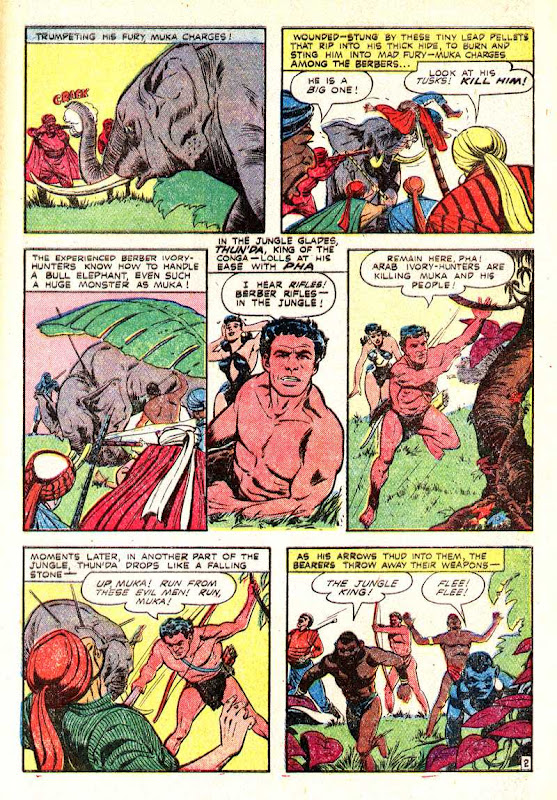
OK, first and foremost, Thun’da is a dude. Name ends with a vowel, immediately I’m thinking a jungle girl, but no, it’s a jungle boy. Naturally, he has a jungle girl (every Tarzan needs a Jane). This episode is about Jungle Killers (i.e. killers in the jungle, as opposed to people who kill jungles).

I wonder what the berber’s “% in Lare” is?

This scene, killing an elephant with one blast of a gun, does bring up a shortcoming of D&D combat, namely that for a single gun shot to take down an 11 HD elephant, it needs to do about 11 dice of damage (or maybe 6, if we’re allowing for double damage on some sort of critical hit). You could make 10d6 damage elephant guns in D&D, but if you let the monsters have them, the players are going to be pissed.

Well, maybe that last elephant just rolled shitty for hit points, because Muka is only annoyed at the little lead pellets, an annoyance he demonstrates by tossing around the Arabs.

What the heck is Pha doing in that middle panel? She’s either distressed at the sound of gunshots or swooning over that dreamy Thun’da, the Frank Sinatra of the Conga.

“Drops like a falling stone” does not really paint Thun’da’s dexterity score in the brightest light.

You know how great it would have been if they misspelled “Flee” in that last panel?

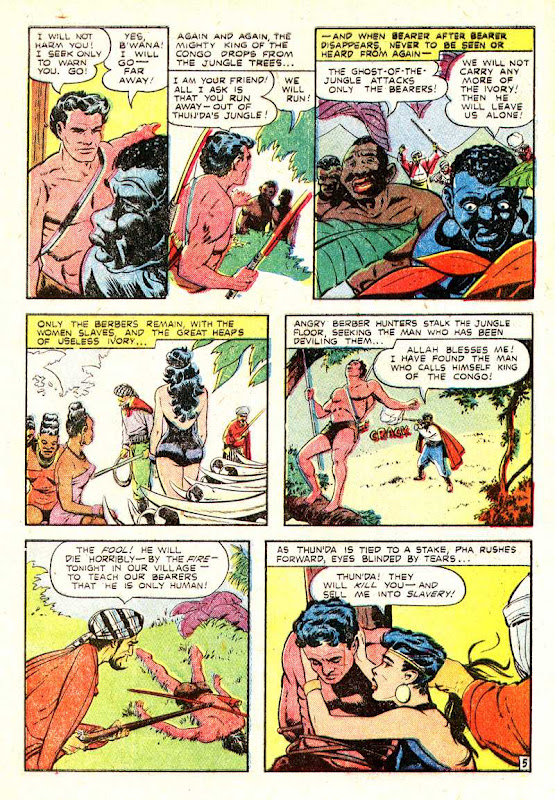
The adventures of Thun’da, Jungle Veterinarian. “That mud will draw out the pain, and introduce a host of bacteria into the wound.”

Meanwhile … Pha Pha Pha Phooom. Thun’da done alright for himself in the jungle. Ain’t it just like a female sidekick, though – you tell them to stay, and they always wander in just in time to be attacked by the one bad guy that got away from you. Sheesh.

Ooo! Ooo! Gold pieces! He said gold pieces! At least we’re dealing with an economy I can understand.

Also … SMATTT? Nice sound effect. Not exactly up to Batman quality.

Hours after days, Thun’da makes his Tracking check and finds the caravan. He then fails his Spot check and is apparently unable to see the guns they’re carrying – those same guns they were carrying on the last page (hours and days ago).

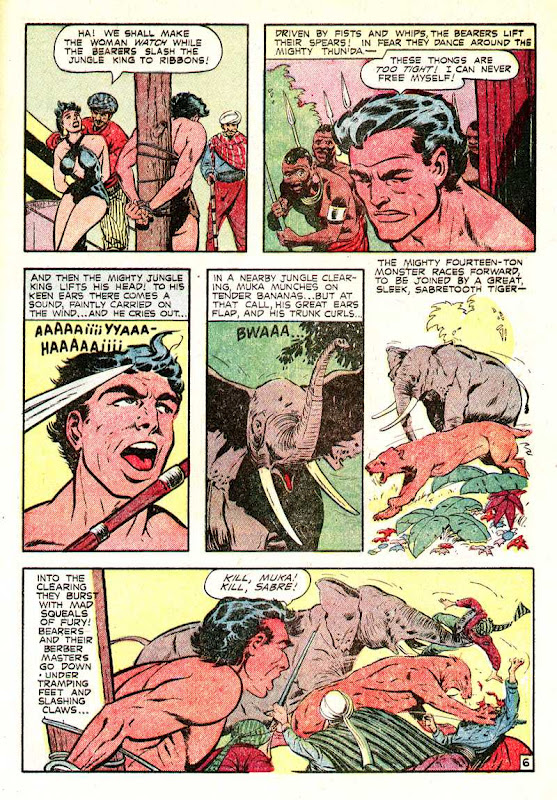
Now Thun’da goes into guerrilla mode – the picture of the impaled dude is actually pretty badass. This brings up a though … how often have your players ever used guerrilla tactics against goblin and orc tribes?

Of course, then Thun’da decides to pick on the African bearers, who are already being whipped and beaten by the Arabs and I lose all respect for the jungle douche.

Oh, I take that back. By jumping on his back from a tree, Thun’da only meant to warn him, not hurt him. It’s like the time a warned a friend about the dangers of bricks by throwing one at his head.

So he gets rid of the bearers, leaving the Arabs with useless ivory (not sure why it’s useless … they may have to carry it themselves, but it will still fetch a pretty penny … er, gold piece … in Djibouti.

Oh, and for those who don’t get the geography involved …

These knuckle heads are traveling 4,300 miles to grab ivory and slaves in the Congo (or Conga, depending on the page) and deliver them to the markets of Djibouti. No, the map’s not perfectly accurate, but close enough for government work. Given the terrain involved, this could be a 2 year trip on foot. Methinks the writer was not acquainted with the immensity of Africa.

I like the last panel. Just in case being shot in the head and tied to a post had taken Thun’da mind off the problem at hand, Pha provides some helpful exposition.

Just when things look their darkest, Thun’da remembers an old trick he learned watching Tarzan movies, and summons his faithful elephant and sabretooth tiger to kill everyone. Which, of course, begs the question … why not summon those two to begin with?

So after saving Muka from the Berbers, he sends Muka to his death against the Berbers. Nice. But it’s not a total loss, as Thun’da finds an alternate route home. You know, for when the jungle is crowded around rush hour. Interesting that the Elephant Graveyard appears to be within sight of the city of Shareen, and yet its existence was a complete surprise to the King of the Congo.

Oh – and love the look on the one guy’s face in the upper right hand panel. Looks like he has a serious noogie coming.

Time for stats!

Thun’da will use have levels in the beastmaster, a variant druid class in Blood & Treasure (yes, I’ll release it pretty soon – give me a break, one guy working on a 400 page RPG book in his spare time). The beastmaster is a druid who loses the shapechange abilities and armor use of a druid, but gains the unarmored AC bonus and speed bonus of a monk and the favored enemy and tracking ability of a ranger. I’m going to be a bit on the brutal side with this guy, given that he’s kind of an ass.

THUN’DA
9th level Beastmaster
Neutral (cause he just ain’t that good)

STR 16 (+2 bonus)
DEX 10 (would have been higher, but the whole “fell like a stone” thing didn’t help him)
CON 16 (+2 bonus)
INT 7 (-1 bonus)
WIS 13 (+1 bonus, and only because he needs it to qualify)
CHA 9

Hit Points: 36 (9d6+18)
Armor Class: 14 (10 + 4 for unarmored AC bonus)
Saving Throws: Fortitude 7, Reflex 12, Will 8

Skills: Survival [8], Tracking [8]

Special Abilities: Druid spells (6/5/4/3/2/1), move through undergrowth (Lvl 2), leaves no trail (Lvl 3), +2 save vs. spells of the fey (Lvl 4), immune to poison (Lvl 9), establish stronghold (Lvl 9; we’ll say his city of Shareen is his stronghold), armor class bonus (+4 at Lvl 9), speed bonus (+20 ft. at Lvl 9), favored enemy (double damage vs. Berbers)

Gear: Short bow, 20 arrows, spear

Henchmen: Sabre (smilodon), Pha (total babe)

Changing Mind on B&T Layout …

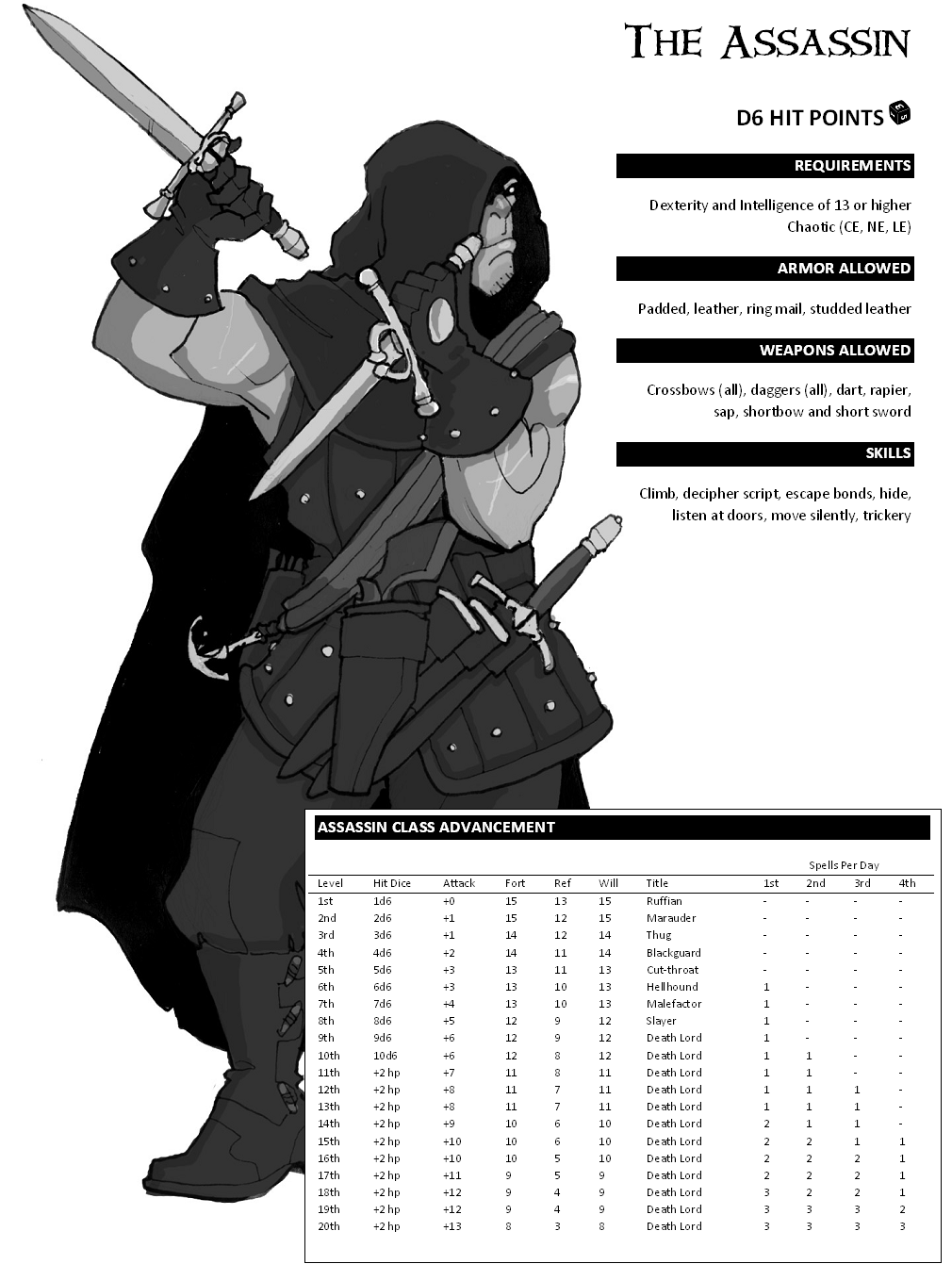
So, a couple days ago I showed off some previews of the class advancement table layout for Blood & Treasure. Then last night, my mind started wandering and … well, what if I did this instead …

The pro here, for me, is that I get to show off Jon Kaufman’s art at the size I had originally intended, plus I throw some class information in for quick reference. I could maybe add on the classes’ special abilities with their associated level in brackets as well.

This way, I don’t have the full page, classic artwork sitting next to the more modern artwork – so less clutter, and I can use those full page bits elsewhere to better effect. By plucking the individual class artwork out of the text, it also makes the text much cleaner and easier on the eyes.