Toxicons

Lately, I’ve been thinking about useful replacements for some of the traditional low-level monsters – the kobold-goblin-orc-hobgoblin-gnoll-bugbear “chain of fiends”. After all, lots of us have played in quite a few of these here dungeons and have faced more than our fair share of these 0 to 3 HD creeps. Something new might be fun. Additionally, that chain of beings may not be as useful for campaigns that are not Tolkien-fantasy based. With that in mind, I offer up these fearsome fellows – The Toxicons!

The Toxicons are for slightly higher than 1st/2nd level parties, owing to the fact that all of them bring poison to the table, and most low-level parties will find poison a very difficult challenge to surmount. They were actually inspired by an episode of Adventure Time, maybe the most inspirational show in history for gonzo role playing.

CREEPERS
Small Humanoid, Chaotic (NE), Low Intelligence; Gang (1d8)

HD 0
AC 13 (leather armor and buckler)
ATK By weapon
MV 20
SV F14 R16 W17
XP 50 (CL 1)

Creepers are gaunt creatures that stand about 3 to 4 feet in height, though their hunched backs make them look shorter. They have dog-like faces, with downward-pointing teeth jutting from their muzzles, brilliant green eyes, greyish skin that looks warty and wrinkled in places, and a single row of bony nodules running from their forehead to the back of their skulls.

Once per day, a creeper can cough up a bluish mist in the face of an opponent. This mist consists of Poison I and forces the adventurer to either hold their breath (treat them as fatigued while holding their breath, which they can do for a number of rounds equal to 3 + their Constitution bonus) or succeed at a Fortitude saving throw to avoid falling asleep.

Creepers generally wear scanty bits of armor, and rarely more than leather. They arm themselves with small weapons and bucklers.

GRAPPLERS
Medium Humanoid, Chaotic (NE), Average Intelligence; Gang (1d6)

HD1
AC 14 (studded leather armor and buckler)
ATK By weapon
MV 30
SV F13 R15 W15
XP 100 (CL 2)

Grapplers are the larger cousins of the creepers. They look like taller creepers, with smaller muzzles, two rows of nodules on their heads, and longer arms that look like a cross between a humanoid arm and a tentacle. Male grapplers have manes of short, brownish fur covering their necks and shoulders.
Grapplers are covered in a thin sheen on contact poison (Poison II). Any creature coming into direct contact with a grappler must pass a Fortitude save to avoid the poison, adding their armor bonus to their saving throw.

CRUSHERS
Medium Humanoid, Chaotic (NE), Low Intelligence; Gang (1d6)*

HD 1+1
AC 16 (chainmail and shield)
ATK By weapon
MV 30
SV F13 R15 W16
XP 100 (CL 2)

Crushers are the largest of the Toxicons, standing a bit taller than a human being. They are rugged and muscular. Their faces have weak chins and down-turned mouths that usually hang open, revealing their sharp teeth. They are hairier than the smaller toxicons, being entirely covered with brownish fur of varying lengths.

Crushers emit a cloud of toxins in a 5-ft radius. Any creature coming into this cloud must hold their breath (see above) or pass a Fortitude save against a weak form of Poison III (1d4 damage). As the shock troops of the Toxicon species, crushers usually wear heavier armor (up to chainmail) and wield heavy bludgeoning weapons and shields.

LORDS

Medium Humanoid, Chaotic (NE), High Intelligence; Gang (1d4)*

HD 2
AC 15 (chainmail and buckler)
ATK By weapon
MV 30
SV F12 R15 W14
XP 200 (CL 3)

The lords of the toxicons are notably smarter than their fellows. They look like grapplers with prominent foreheads and bluish skin and black manes that cover their knobby heads (save for their foreheads) and backs. They are known for the magical powers. Most lords wear chainmail or heavier armor and carry bucklers and piercing weapons (like spears).

Spells: 3/day — poison

Special: Immune to poison

History of Nod, Part II – Elves and Gnomes

Another chunk of Nodian history …

THE ELVES AND GNOMES

The gnomes and elves are offshoots of the fey, the elves being descended from the fey and dragons and the gnomes descending from the brownies, pixies and sprites, probably from congress with more mundane humanoids.

Though the elves are actually a younger race than human beings, they are longer lived, and they fancy themselves the senior partners in the firm – wiser, more beautiful, more graceful, etc. The ancient elves, being only a few generations removed from the Kabir, were virtual demi-gods and terribly powerful. In no time, they spread their influence and their kingdoms across the face of the world, and their general lack of morality and compassion for lesser creatures drove them to enslave other folk. True, their influence did not spread to Mu-Pan, where their dragon sires held sway, but the rest of NOD was theirs to do with as they pleased.

The elves demanded tribute from the dwarves (more on them later) and drove them to construct a network of towering standing stones that formed the natural flow of magic on NOD into a network they could tap to work wonders. This network also denied magical access to most other folks. With this magical power, the elves constructed impossible cities and walked the planes of reality. They were the greatest explorers of their age, mapping the cosmos and making enemies far and wide.

The power of the ancient elves was staggering, but not without limits. Their magic flowed from the Kabir via elven druids, and the dictates of the Kabir irritated the arrogant elves. They raged against their ancestor gods, and in time they were heard by the demons, that still haunted NOD, and the fallen angels who now inhabited Hell at the center of NOD. These agents of Chaos and Evil reached out to the ancient elves with promises of power unlimited, asking nothing in return, for they knew the elves, unhampered by compassion or morality, would do exactly what their new tutors would like to be done to the world.

Tune in next time for the dwarves and the destruction of everything the elves held dear (i.e. their power)

What Alignment is the Universe?

More “History of NOD” coming very soon, but a brief thought on alignment in games today.

Is there a God (or gods) and how does He/She/It/Them want people to behave?

This is the big religious question, of course, and one I don’t want to answer here (or have answered in the comments – hint hint). But it got me thinking about religion/mythology/alignment in game worlds.

In many game worlds, the presence, identity and even ultimate aims of the divine powers is rarely in question. In most campaigns, a list of gods and goddesses is provided, each with a portfolio and an alignment, and players with a cleric pick their favorite and off they go.

What, though, would be result if nobody (no players, anyhow) really knew anything about who ran the universe?

Sure, there might still be pantheons that people worship, but what if those pantheons were just collections of names and mythological stories. What if what actually lay beyond the Material Plane was unknown to 99.9999% of the population, and those who did have some knowledge of it were super high level and thus generally unavailable for consultation? To put it in other terms, what if nobody knew what the universe’s alignment was? Clerics and players would have to creep along, wary of breaking an unwritten divine law and suffering the consequences if they did – loss of spell access, no healing, no resurrection, visits from divine enforcers, general bad luck, etc.

You could still have the different angels/demons/devils/demodands/modrons/etc. – you just don’t know which faction is in charge of the universe and which faction is just pretending to be control of the universe. Imagine too the excitement of stepping into the Outer Planes not knowing what you would find or who’s religion (i.e. alignment) was the One True Alignment. Maybe the Universe is Lawful Neutral, maybe its Neutral Good, maybe its Chaotic Evil, maybe it is completely unaligned. You won’t know unless you ascend to the Outer Planes and knock on some doors. In the meantime, players collect clues and interpret portents in-game and do their best to figure it all out, just as folks do in the real world.

However you structure such a game world, it could be for an interesting place to adventure.

History of Nod, Part I

It’s good to be the God of Nod …

There have been requests, so here it is. It will also appear in the NOD Companion (coming soon … I swear!) I have generally hesitated to get too much into this, since, in my opinion, this is just stuff from my personal campaign. I’d like others to feel free to concoct their own history of NOD if they use it in a campaign. Still, some folks like to get the “official” word on a campaign setting, so I guess this is it.

We begin with the Primordial History of NOD

I first conceived of NOD as a campaign setting about 5 years ago. It had two key sources of inspiration. The first was a map that depicted what some folks believed would be the layout of the continents on Earth millions of years from now. Is NOD meant to be the future of Earth? No. Just liked the map.

The second bit of inspiration came from the fiction of Dunsany and Lovecraft, specifically the Dreamlands. Having grown up on more Tolkienesque fantasy, they were both a revelation and a welcome “shot in the arm” to my imagination. I had created worlds that were little more than fantasy versions of the CIA’s factbook – collections of make-believe countries (mostly based on real world countries) and currencies and languages, etc. Tons of background that would rarely come up when a motley band of tomb robbers, religious zealots, scoundrels and necromancers were descending into the unlit depths of the world in search of fame, fortune and experience points.

NOD, therefore, would be a dream world, one conjured by the dreams, fantasies and mythologies of everyone who ever lived (but mostly dreams, fantasies and mythologies that I made up myself, or that were in the public domain – after all, I live in the real world and don’t fancy getting hit with a lawsuit!)

NOD is composed of dreams. In that regard, it has no geological or cosmological history. It wasn’t, and then it was, and slowly, it got itself crammed with all sorts of fantasy nonsense to entertain and annoy people who like to play fantasy games.

The LAND OF NOD once floated in a great sea of undiluted Chaos. Beset by demons and their ilk, and other things born in nightmares, those organisms that tried to eke out a life on the little planet had a tough time of it. Fortunately, what exists in the Material World has a soul in the Ethereal Plane. Like souls tend to flock together in great eddies in the Ethereal Plane, and these collections of souls, united by common purpose, gain a sort of divine sentience. It was thus that Ka, the first deity, was born.

Ka was composed of the souls or spirits of everything alive, and in fact still is. In those primordial days, though, Ka was mostly composed of the spirits of simple organisms and beasts (as they outnumbered sentient beings by a significant margin), and thus embodied (so to speak) the desire to survive.

Seeing its subjects beset by the creatures of Chaos, Ka injected bits of itself into the Material Plane – like sticking one’s fingers into the bowl of jelly. These protrusions of Ka took material form in the Material Plane, and they are called the Kabir. The Kabir might be considered the first of the fey, though in game terms they would be considered outsiders. Their shapes were variable, but primarily humanoid, for humans, the most advanced animals on NOD, gave them the benefit of their own advanced minds.

The Kabir went to war with the demons and other chaos creatures. In this war, they created soldiers from the stock of creatures already living on NOD, and in this way gave birth to the fey, the giants and the dragons. In time, they achieved a sort of victory, and life flourished on NOD. In time, Ka was shattered, or at least smaller eddies formed within Ka. These were the animal lords, each a collection of animal souls united by the drives of their component species, and more alignment-oriented entities, composed of the souls of sentient beings based on their own dedication to philosophical concepts like Law, Chaos, Good and Evil. These entities could also project pieces of themselves into the Material Plane, appearing not only as the planets that orbit around NOD, but also as the various outsiders (devils, angels, etc.) that plague and aid humans and demi-humans.

The structure of the Nodian cosmos was the product of ZID, the “god” of Reason and the Need for Order and Organization, through the workings of the polyhedroids, who are its manifestations in the Material Plane. They derived the crystal spheres that guide the movement of the planets and constructed from raw chaos the Firmament, which holds the undiluted chaos of the cosmos at bay, the churning of this chaos serving as the motivating force that keeps the Nodian cosmos in motion.

The Kabir eventually retired from the Material Plane to the pocket dimension of Fairyland, leaving their fey children behind to serve as nature’s agents on NOD. Since NOD has no innate physical laws to govern it, all that happens in NOD must happen through an intelligent agent. The polyhedroids are in charge of the big things, like gravity and the conservation of matter and energy, while the natural flourishes like the seasons are overseen by the various fey courts.

Next up … a brief history of the elves and gnomes

Warriors for Hire

Sometimes, you need to hire some muscle to dig into that dungeon. Sometimes, you need a quick, easy blog post that can be written off of a simple illustration. This is that time!

The following warriors correspond to the images above, in order from left to right.

BARL THE BOLD
HUMAN FIGHTER (CHAMPION), LEVEL 3
STR 14 INT 10 WIS 5 DEX 11 CON 13 CHA 11
HP 17 AC 15 ATK +1 FORT 11 REF 14 WILL 16
Dominate 0 HD foes
Bull Rush
Chainmail, Quarterstaff (1d6+1), Short Bow (1d6)

Barl cut his teeth on the field of battle, and fancies himself quite the tactician. Of course, his tactics usually involve rushing the enemy and hacking them to pieces …

AVOMIR THE DARK
HUMAN RANGER (PATHFINDER), LEVEL 2
STR 13 INT 6 WIS 16 DEX 13 CON 10 CHA 5
HP 7 AC 15 ATK +2 FORT 12 REF 11 WILL 13
Sworn enemy (orcs)
Expertise
Chainmail, Short Sword (1d6+1), Longbow (1d8)

Avomir prefers the woodlands and the small villages on its borders to town and city. A lusty rascal, his exploits with the fairer sex are known far and wide.

ASTLEY OF THE BLIGHTED LAND
HUMAN FIGHTER (DUELIST), LEVEL 4
STR 13 INT 8 WIS 11 DEX 11 CON 11 CHA 10
HP 12 AC 00 ATK +4 FORT 11 REF 14 WILL 13
Dominate 0 HD foes
Iron Will, Knack (Hide in Shadows)
Chainmail, Halberd (1d10), Short Sword (1d6)

Astley comes from a far-away kingdom that was laid low by the fires of a red dragon. Speaking little, he prefers to keep to the shadows when not fighting. Astley is a suspicious man, believing there was a traitor involved in the death of his homeland and family.

ORMSBY THE GOOD
HUMAN PALADIN (COMPANION), LEVEL 5
STR 14 INT 5 WIS 15 DEX 13 CON 13 CHA 15
HP 20 AC 19 ATK +4 FORT 9 REF 11 WILL 9
Detect evil, smite chaos (evil) 3/day, lay on hands, immune to fear, turn undead, quest for warhorse
Dodge, Iron Will
Banded Mail, Shield, Spear +1 (1d6+1), Silver Dagger (1d4)

Ormsby is everything a paladin should be, save for his rather conservative approach to fighting evil. Ormsby is a plodding planner, who often takes his comrades to the brink of madness with his hesitancy to move.

CARLOVAN STRONGHANDED
HUMAN BARBARIAN (PLUNDERER), LEVEL 3
STR 15 INT 9 WIS 10 DEX 10 CON 16 CHA 11
HP 20 AC 14 ATK +3 FORT 10 REF 14 WILL 14
Land speed +10, rage 1/day, sixth sense
Cleave, Two Weapon Fighting
Scale Armor, Short Sword (1d6), Hand Axe (1d6)

Despite his prickly exterior, Carlovan is a rather decent man, though with admittedly little patience for the ways of “civilized folk”. If it were not for taverns, he would have no use at all for entering towns and cities.

ZYBOLT WYRM-BANE
HUMAN FIGHTER (FREELANCE), LEVEL 7
STR 14 INT 8 WIS 9 DEX 12 CON 13 CHA 12
HP 31 AC 19 ATK +6 FORT 9 REF 13 WILL 13
Dominate 0 HD foes, two attacks per round
Alertness, Weapon Focus (Longsword)
Platemail, Shield, Longsword +1/+3 vs. Dragons (1d8+1)

Zybolt doesn’t speak much of his history, but he has the acid scars on his back to prove that he once did battle with a green dragon. He offers no proof that he slayed the beast. He is a cunning warrior with a boundless, though wry, wit and a particular love of hard cider.

GEOFF OF THE SHIRE
HUMAN FIGHTER (ARMSMAN), LEVEL 1
STR 17 INT 6 WIS 7 DEX 14 CON 10 CHA 10
HP 6 AC 13 ATK +1 FORT 13 REF 14 WILL 16
None
Toughness
Leather Armor, Pole Axe (1d8+1), Dagger (1d4)

Geoff is a big country boy, earning his armor by fighting orcs on the frontier. A bit naïve, he is nonetheless a brave and patient warrior with a desire to become better.

HAFNAR THE DOUR
HUMAN FIGHTER (GROGNARD), LEVEL 6
STR 14 INT 10 WIS 12 DEX 13 CON 12 CHA 6
HP 21 AC 16 ATK +5 FORT 10 REF 12 WILL 13
Dominate 0 HD foes, two attacks per round
Cleave, Sunder
Chainmail, Short Sword (1d6), Heavy Crossbow (1d6+1)

Even dwarves find Hafnar unpleasant company. He is unrelentingly bleak in his outlook on life, though fortunately he speaks only rarely, preferring instead to spend his downtime smoking his pipe and staring into the fire. Despite his pessimism, he looks forward to one day building a stronghold and governing a barony.

Demigods, the First Adventurers

It would be hard to tell who the first adventurer in literature ever was, but I suppose Gilgamesh might fit the bill. Gilgamesh is the son a human king and the goddess Ninsun, making him a demi-god. In the annals of adventuring, he has good company – Heracles, Achilles, Cuchulainn, Hanuman, Māui, Perseus, Theseus, and many more.

So if demigods can be adventurers in myth and literature, why not in Blood & Treasure?

First things first – we need to define our demigods. If one has some experience in fantasy role playing games, they’ll know that demi-gods are usually depicted as extraordinarily powerful entities. Obviously, characters that powerful would not work well as adventurers, unless one was doing some pretty epic adventuring.

Our demigods are going to be a bit more human (or demi-human), and like other adventurers, are going to become more powerful as they advance in levels. In other words, they’re going to be on par with the other characters – don’t expect them to eclipse the magic-users, thieves and fighters in the party.

REQUIREMENTS
No ability score lower than 10, one ability score higher than 15

ARMOR ALLOWED
Padded, leather, studded leather; bucklers and shields

WEAPONS ALLOWED
Any weapon

SKILLS
Bend Bars, Break Down Doors, Find Secret Doors, Ignore Pain, Jump, Monster Lore

CLASS ABILITIES
At 1st level, a demigod’s player must choose their character’s divine ancestry. Whether a god or goddess, they must choose one of the following domains for their character’s divine parent based on their character’s highest ability score.

  • STR Destruction, Strength, War, Water
  • INT Knowledge, Magic
  • WIS Death, Healing, Sun
  • DEX Air, Fire, Travel
  • CON Animal, Earth, Plant, Protection
  • CHA Love, Luck, Trickery

The demigod gains one power based on his or her parentage, as follows:

  • AIR: Resistance to electricity damage, feather fall at will
  • ANIMAL: Speak with animals at will, charm animal three times per day
  • DEATH: Command undead three times per day
  • DESTRUCTION: Smite opponent once per day (+2 to hit and double damage if you hit)
  • EARTH: Resistance to acid damage, +1 bonus to saving throws while standing on bare earth
  • FIRE: Immune to fire damage
  • HEALING: Laying on of hands ability, per the paladin
  • KNOWLEDGE: Legend lore ability, per the bard
  • LOVE: Charm person once per day, three times per day at 4th level
  • LUCK: Re-roll one saving throw once per day
  • MAGIC: Save vs. magic at +2
  • PLANT: Speak with plants at will, command plants once per day
  • PROTECTION: Barkskin three times per day
  • STRENGTH: Can wield two-handed weapons with one hand
  • SUN: Use light at will, daylight once per day
  • TRAVEL: Haste once per day for one round per level
  • TRICKERY: Trickery as class skill, spell abilities of a gnome
  • WAR: Deals double damage on a charge (if birthed by a war god like Ares) or command double the normal numbers of henchmen (if birthed by a war goddess like Athena)
  • WATER: Resistance to cold damage; cannot sink in water (though can be held under and drowned)

Demigods are supernaturally tough, and gain the Armor Class bonuses as a monk.

Demigods are born to greatness, and are expected to do great things. A 1st level demigod is given an ordained labor by his divine parent. This works as a geas, and requires the demigod to do one of the following by the time he or she reaches 4th level.

  1. Capture a monster* with twice as many Hit Dice (minimum 2 Hit Dice more) as the demigod
  2. Complete a heroic task that would be considered very difficult for the character (the Treasure Keeper has to use his or her best judgment on this one)
  3. Slay a monster* with twice as many Hit Dice (minimum 3 Hit Dice more) as the demigod
  4. Steal a relic (must be worth as many gp as the demigod as XP or be magical)

* Monster in this connotation refers to magical beasts, monstrous humanoids, dragons, prehistoric animals, giants and outsiders

Until the labor is completed, the demigod cannot advance beyond 4th level. A new labor is ordained when the hero reaches 5th level, and must be completed by the time the demigod reaches 8th level. Additional labors must be completed by 12th and 16th level.

  • The first labor completed earns the demigod a one-time use of the restoration spell on him or herself.
  • The second labor completed earns the demigod a one-time use of the raise dead spell on him or herself.
  • The third labor completed earns the demigod a one-time use of the resurrection spell on him or herself.
  • The fourth labor completed earns the demigod the right to ascend into Heaven (or wherever mom or dad are from) when they die.

Demigods are renowned for one of their physical or mental abilities, and this ability grows as their fame grows. A demigod increases his or her highest ability score by one point at 2nd, 4th, 6th, 8th and 10th level.

A 3rd level demigod can make pleas for assistance to his divine parent. Demigods can appeal for 0 to 2nd level spells by passing a Charisma task check with a penalty equal to the level of the spell. At 7th level, the demigod can begin appealing for 3rd to 4th level spells. At 11th level, the demigod can begin appealing for 5th to 6th level spells. Each time an appeal is answered, the demigod must pledge 10% of their earned treasure to the cult of their divine parent (a minimum of 50 gp per spell level).

A 5th level demigod gains magic resistance equal to 1% per level, to a maximum of 10%.

A 9th level demigod may establish a hero cult for themselves. The demigod must construct a temple in his own honor and in the honor of his divine parent. The demigod then attracts 1d6 men-at-arms per level, 1d6 first level clerics or druids and a 4th level cleric or druid to serve as his high priest.


DEMIGOD ADVANCEMENT
LVL
XP
HD
ATK
F
R
W
TITLE
1
0
1d12
+0
13
13
13
Scion
2
2,500
2d12
+1
12
12
12
Exemplar
3
5,000
3d12
+2
12
12
12
Champion
4
10,000
4d12
+3
11
11
11
Hero
5
20,000
5d12
+3
11
11
11
Cynosure
6
40,000
6d12
+4
10
10
10
Archon
7
80,000
7d12
+5
10
10
10
Paragon
8
160,000
8d12
+6
9
9
9
Superhero
9
300,000
9d12
+6
9
9
9
Demigod
10
600,000
10d12
+7
8
8
8
Demigod
11
900,000
+3 hp
+8
8
8
8
Demigod
12
1,100,000
+3 hp
+9
7
7
7
Demigod
13
1,400,000
+3 hp
+9
7
7
7
Demigod
14
1,700,000
+3 hp
+10
6
6
6
Demigod
15
2,000,000
+3 hp
+11
6
6
6
Demigod
16
2,300,000
+3 hp
+12
5
5
5
Demigod
17
2,600,000
+3 hp
+12
5
5
5
Demigod
18
2,900,000
+3 hp
+13
4
4
4
Demigod
19
3,200,000
+3 hp
+14
4
4
4
Demigod
20
3,500,000
+3 hp
+15
3
3
3
Demigod

NOD 21 Hits the Shelves (Electronically Speaking)

I have a few interesting posts a’brewing, but while I’m scratching those out please indulge me this commercial message …
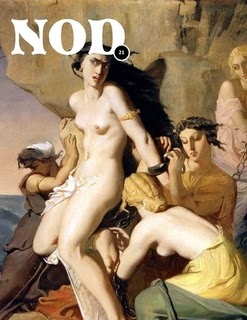
NOD 21 – Finally On Sale!
NOD 21 rolls into town just in time for Halloween with a dozen new spooky monsters, the Damnable Sea hex crawl, random party events, an easy system for randomized overland travel in games, a way to use combat to resolve non-combat tasks, a quartet of automaton races based on Greek myths, and a review of Jeffries’ After London. 64 pages. $3.99 cheap!
I’ll have the print copy up for sale as soon as I see a copy to make sure all is copacetic.
I’m currently finishing up the NOD Companion for Blood & Treasure – a compilation of classes and races from the pages of NOD, updated to Blood & Treasure rules, plus a few extra bits – an old fashioned psionic system, 0-level play for B&T, a few new heroic tasks, a proficiency system for weapons, skills and even spells (well, spell specialization) and the secret history of NOD!
Okay – back to writing. I’ve got scads of fey coming, a random “why hast thou forsaken me” table, the demi-god class (trust me) and a few other things on the way.

Horses Are Sooooo 1978

Or whenever the paladin was first published. I wanted to be clever with the title, but not to the degree that I was going to do five seconds of research with Google.

Paladins, at 5th level, can undertake a quest to obtain a very intelligent mount. Depending on the edition you play, this mount either hangs out with you all the time and sorta requires you to hire a groom or page or whatever to look out for it when you’re in a dungeon, or it just pops into existence whenever it is convenient. You can probably guess which concept I like better.

But what if … what if there were more options than that super-clever wonder horse? Well, how about these …

(Use as inspiration, or roll randomly with a D12)

1. Mechanical Warhorse – requires a quest to settle a grudge for the Dwarf King, who forged the horse in his own workshop. Just combine an automaton and a heavy warhorse to get the stats. For anti-paladins, the mechanical warhorse is grey and spiky.

2. Putti – I think I did stats for these fellows once (you know, the chubby, winged babies people mistakenly call cherubs or cupids), if not, just make them Lawful (LG) imps. For anti-paladins, just use an imp.

3. Unicorn – but only if the paladin is female. For anti-paladins … not sure.

4. Aasimar Squire – 4 HD, of course. For anti-paladins, a tiefling picaroon.

5. Blink Dog – maybe the quest involves rescuing it from a giant’s kennels. For anti-paladins, a shadow mastiffs.

6. Halo – actually a lantern archon with 4 HD that oftens hangs out around the paladin’s noggin. For anti-paladins, just craft a red-hued evil version of the lantern archon.

7. Relic – the relic is the skull of a cleric which the paladin can communicate with telepathically, and which can cast spells as a 4th level cleric (though not touch spells, obviously).

8. Choir – a choir of four 1 HD lay priests who can chant (as the spell) and inspire (as bards). For anti-paladins, four 1 HD flaggelants with scourges who do the same.

9. Gold Wyrmling – precocious, of course. For anti-paladins, a red wyrmling.

10. Brownie Knight – gained by embarking on a quest for the Fairy Queen, a bit of a curmudgeon. For anti-paladins, a spriggan thug of the Unseelie Court.

11. Elven Sage – an old codger with silver hair who can cast spells as an adept (venerable master). For anti-paladins, a drow alchemist who may or may not be trying to poison their master.

12. Reformed Prostitute – a prostitute who has seen the light and can cast spells as an adept (venerable master; note, the prostitute is not venerable in terms of age, but in terms of the blessings bestowed upon him or her). For anti-paladins, a fallen, alcoholic friar or nun.

Establishing a New Dungeon Order with the Masons! [New Class]

Here’s the deal – Freemasonry, whatever you think of it, has some uber-awesome level titles. And level titles, my friend, mean Old School gaming to me. In short – I had no choice but to create this class. I hope it goes without saying that I mean no disrespect to actual Freemasons out there – this is just me having a bit of fun.

Guilds are common among the artisans of NOD, but none have gained such infamy as Fraternity of Stonemasons. Actually many different fraternities organized in lodges, the migratory nature of masonry has led to the formerly autonomous fraternities becoming an international network of lodges, controlled by a Great Lodge, the location and membership of which is a well-kept secret, even from most of the members. Because of the size of this network, and its being spread across many city-states, empires and faiths, there is a vague sense of hostility towards the Fraternity by many rulers and high priests, who question the loyalty of the members.

For their part, the masons are primarily dedicated to their work, traveling from castle to monument to Great Wall to dungeon, cutting and setting stone. The travels of a mason, though, send them through many strange and dangerous lands, making those masons who travel beyond the borders of their home city or town adventurers in their own right. These adventuring masons, or freemasons, make up the elite of the ancient Fraternity, garnering wealth, influence and knowledge for their lodges.

REQUIREMENTS
Intelligence 11+, Strength 9+, Dexterity 13+
Lawful (LG, LN)

ARMOR ALLOWED
Padded armor, leather armor
No shields

WEAPONS ALLOWED
Club, dagger, hammer, handaxe, heavy pick, light crossbow, light mace, light pick, quarterstaff, sap, sling, warhammer

SKILLS
Bend Bars*, Break Down Doors*, Find Secret Doors**, Notice Unusual Stonework***

* Requires mason’s tools; otherwise counts as a knack

** Masons are skilled when looking for secret doors disguised as stone, but only have a knack for finding other secret doors

*** As the dwarf ability, or see New Tasks in this book

CLASS ABILITIES

All masons are capable of cutting stone, earning a wage of 1 silver piece per day for normal masonry and 1 gp a day for ornamental masonry or overseeing up to 10 lower-level masons. Ornamental masonry requires a Reflex task check; naturally, you treat the mason as though he were “skilled” at this task.

In order to earn these wages, the mason must carry a set of mason’s tools. These tools include a pair of wooden compasses, a piece of chalk or charcoal to make marks, chisels of different sizes, a hammer, plumb, a trowel, iron and wooden dowels. These tools are kept in a large canvas or leather bag or backpack, and weigh 20 pounds.

Finally, 1st level masons learn the secret signs, tokens, grips and words of their fraternity. This counts as a secret language, much like the thieves’ cant, that allows masons to identify one another and communicate without others understanding them. Masons can also learn Earth Elemental as one of their starting languages.

A 3rd level mason (master mason) scores double damage against elemental earth creatures and other creatures made entirely or primarily of rock, stone or earth, not including gargoyles, who are just big fakers.

A 6th level mason (master elect) learns the secret rites of the Fraternity, the Rites of Elemental Earth, handed down from the ancient dwarven founders of the Fraternity. These rites permit the mason to cast a small number of spells using the same rules as a magic-user. The mason must carry a special manual filled with his spells, which are recorded in the secret signs of the Fraternity. Other masons can interpret these signs, but must pass a special Decipher Codes check as though they were skilled in the task.

Masons prepare and cast the same number of spells per day as a ranger.

1st level: Elemental weapon (acid only), magic stone, mason mark*, mending**, pass through element**, shatter, soften earth and stone

2nd level: Explosive runes, meld into stone, shockwave***, spike stones, stone shape, summon small earth elemental

3rd level: Move earth, passwall, stoneskin, summon medium earth elemental, transmute mud to rock, transmute rock to mud, wall of stone

4th level: Earthquake, earthwalk, repel stone****, stone of flesh, summon large earth elemental

* As wizard mark

** Affects earth/stone only

*** Mason must strike the ground with a hammer or pick to cast this spell

**** As repel metal or stone, save it only repels stone

In addition, a 6th level mason (master elect) learns to turn elemental earth creatures as a cleric turns undead. The mason turns earth elementals as a cleric five levels lower than his mason level.

A 9th level mason (knight of the sword) earns the right to establish a lodge of the Fraternity in a town or city-state in which no lodge already exists. A mason who becomes a worshipful master attracts 1d6 normal masons (i.e. 0-level artisans) per level, 1d6 first level masons who wish to train under him and one 5th level mason protégé.

A 9th level mason (knight of the sword) also begins to learn to carve powerful runes, as follows:

Knight of the Sword (9th) | Rune of sleep

Knight of the East and West (10th) | Rune of pain

Knight of the Rosy Cross (11th) | Rune of persuasion

Grand Pontiff (12th) | Rune of fear

Master Ad Vitem (13th) | Rune of stunning

Knight of the Royal Axe (14th) | Rune of weakness

Prince of the Tabernacle (15th) | Rune of insanity

Knight of the Brazen Serpent (16th) | Rune of death

Runes work as the symbol spells, but must be carved in stone and are triggered when first looked upon by an intelligent creature. The mason can carve no more than one such rune per day, and can have no more than five runes (of any type) active at any one time.

Upon achieving 12th level (Grand Pontiff), a mason gains command over a Grand Lodge, which simply encompasses all the lodges within a given region (the definition of region here being determined by the Treasure Keeper in regards to his or her own campaign). If there is already a Grand Pontiff in the region, assume that they achieve 13th level and hand down the duties to the new Grand Pontiff. Grand Pontiffs also gain the ability to planeshift into the Elemental Earth Plane (and return to the Material Plane at a time of their choosing) once per day.

Beyond 17th level (knight of the sun), there can be only one mason at each level. A mason cannot rise beyond 17th level without supplanting a higher level mason. This can be done by waiting for them to die (arranging or causing death is not permitted, though of course one can attempt to get away with it if they are bold and stupid enough to forget all those sweet divination spells that can be used to convict them) or challenging them to a contest of masonry. These contests are usually epic in scope, requiring extraordinarily difficult works of masonry that are either decided by a series of task checks, each more difficult than the last, or by judgment from a council of masons that have achieved a minimum of 12th level.

The Grand Inspector Inquisitor (18th) of masonry may issue commands to fellow masons that are the equivalent of a quest spell. The Grand Inspector Inquisitor is the highest level mason whose identity is known to other masons. He knows the identity of the Sublime Prince of the Royal Secret.

The Sublime Prince of the Royal Secret (19th) is capable, once per day, of communing the powers of elemental earth (per the commune with nature or contact higher power spells). He alone knows the identity of the Sovereign Grand Inspector General.

The Sovereign Grand Inspector General (20th) controls the Great Lodge, which consists of all lodges and grand lodges within a single reality. As the leader of all masons, he or she is capable, once per day, of summoning an earth elemental swarm to do his or her bidding.

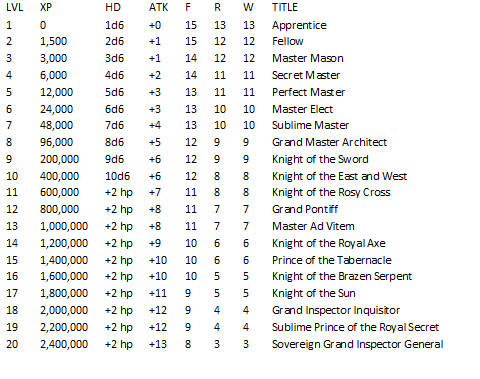
Edit: Crap – forgot the class advancement table with all the kickass level titles …

Three Sad Wizards

Since last week’s showcase of new products out there, I got a request to highlight a new adventure module (I’m old – they’ll always be modules to me) called Three Sad Wizards, by Jasper Polane.

Three Sad Wizards is described thusly:

The wizards in the village of Tealief have horrible problems!

• Terrible carnivorous plants make the garden of Bymen the Botanomancer unsafe.

• Giant insects are running free in the underground laboratory of Ermard the Entomomancer.

• Monstrous birds escaped from the tower of Ostal the Ornithomancer.

Only a group of courageous adventurers can help them. Is your party brave enough?

Three Sad Wizards is an introductory module, designed for characters of 1st and 2nd level. Written for use with old school RPGs, this module can be fitted into almost any campaign or played as a stand-alone adventure.

A good intro adventure is always nice, and this one appears to be a bit different than the classic “Caves of Chaos”-style dungeon romp. It includes three mini-dungeons, each one depicting the lair of a strange wizard, a plant mage, a bug mage and a bird mage. There’s some info on the village of Tealief (and a random table of tea blends), a rumors table, a random mail table, a small wilderness map (with a few monster lairs included), new magic items and new magic spells.

All in all, looks like a great way to begin a campaign – plenty of things for players to explore while they get their brand, spanking new characters off the ground.

You can find the module on sale at LULU – CLICK HERE.