Proving once again my theory that everybody does Star Wars better than its creator.
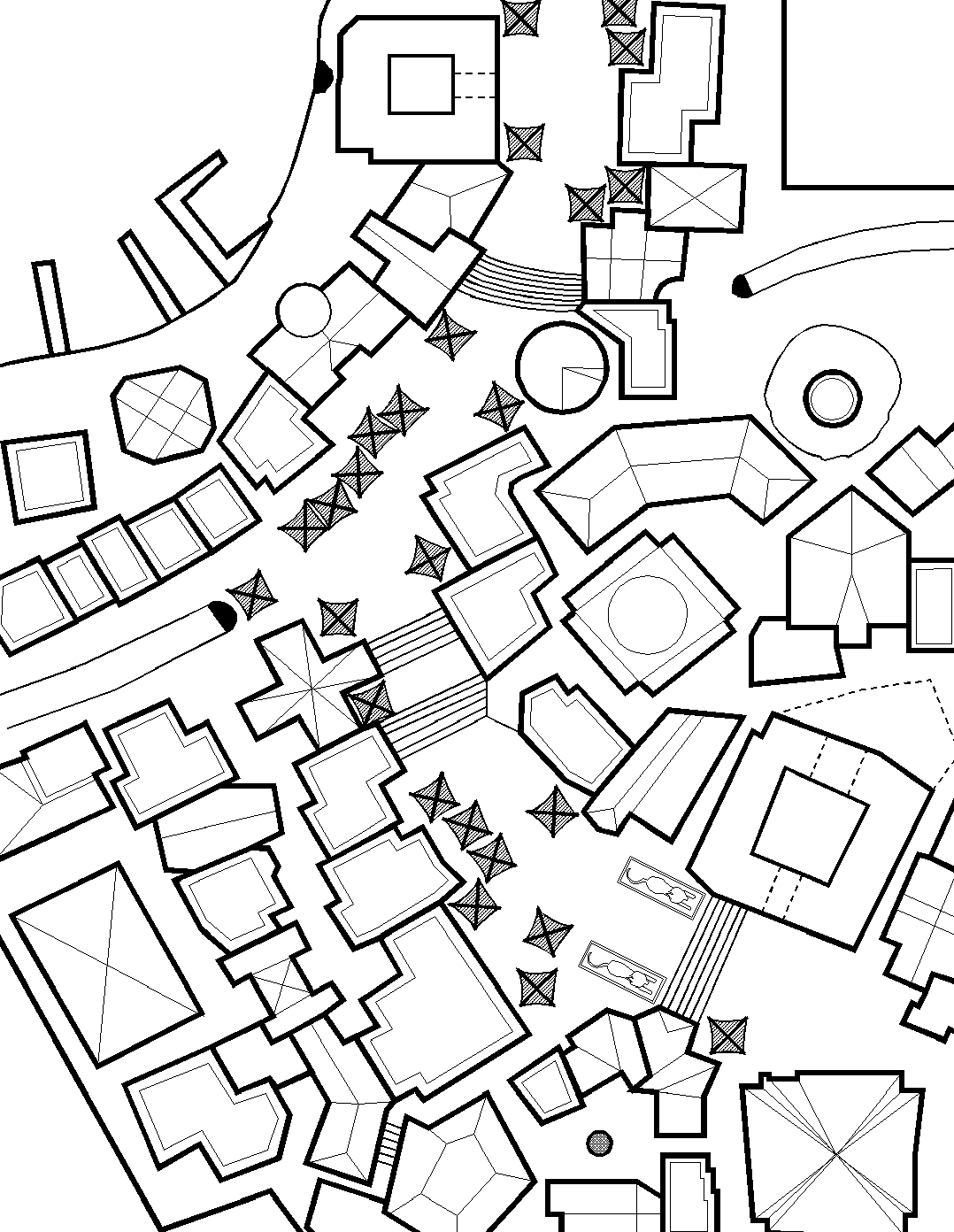
Ibis, City of Sorcerers Map
Here’s my draft map for Ibis, City of Sorcerers, showing the university area (its the collection of large buildings roughly in the center of the map). The upper right-hand corner is a corner of the Nomarch’s estate – the kind of gardens that a brash rogue from Cimmeria might stalk through on his way to liberate a tower from jewels. The lower left-hand corner is occupied by a bit of the grounds of the grand temple of Thoth, the patron deity of Ibis. The upper left-hand corner is taken up by curve in the River of Death and some quays, as well as a little cave that leads to … something.
Mines and Mining – Part One
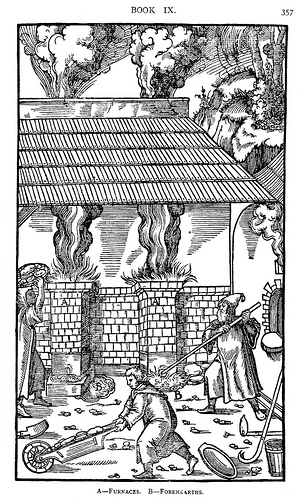
You realize how much you don’t know about the world when you try to build one yourself. The first mine I had to describe made this fact abundantly clear to me – my only experience with mines up till that point was in Temple of Doom (and other shows and movies) and MarioCart. So, I consulted the finest research tool known to man (Wikipedia – hey, I was running a C-n-C game, not shooting for a doctorate) and this is the result …
Mines & Mining
This document will attempt to explain the methods, materials and products of mining during ancient and medieval times. The first section will address how mining was done before steam shovels and dynamite. Each of the following sections will describe a different mineral that was known and used by ancient and medieval people, explaining where it occurred, how it was mined, its value and the things it was used for. In most cases this document will use archaic rather than modern terms. It is not a scholarly document by any means, and will always focus on making the material herein useful in gaming.
History
Mining began during prehistoric times. Primitive man mined flint, greenstone, hematite, obsidian, jade and other minerals, often digging into the earth using antler picks to get to them. Ochre was clay that was turned into body paint. The Picts used it for war paint, some Africans for body paint, and Egyptians as a cosmetic for the eye lids and lips. Flint, obsidian and jade were used to make tools and weapons, as they could be cleaved to form an extremely sharp edge. The Egyptians quarried granite, limestone, marble, diorite, alabaster and basalt. They also mined for copper, tin, turquoise, beryl, amethyst, lapis lazuli and malachite. The patron goddess of Egyptian miners was Hathor. Beyond antiquity, people learned to process the seven classic metals: gold, silver, copper, tin, zinc, iron and mercury, as well as dozens of variety of stones. The Chinese improved smelting with the invention of the blast furnace and the method of puddling iron ore. Medieval Muslim engineers built on the Roman’s use of water mills, creating grist mills, stamp mills and steel mills.
Mining Techniques
Ancient miners used a few main methods to extract minerals from the ground. The most basic involved the collection of minerals from alluvial deposits, which is to say deposits of gravel and stones made by rivers. This was probably the way that primitive man first began using minerals, by picking them up off the ground and gradually discovering their uses. Archaeology has revealed that primitive man used a variety of minerals in his crafts, including (but not limited to) ochre, flint, obsidian, jade, copper, electrum and platinum.
Sometimes, however, the minerals are in plain sight. The Romans used a hydraulic mining to clear soil and get to the bedrock, especially quartz containing gold. Roman engineers would direct multiple aqueducts (presumably smaller ones than those which supplied towns and cities with their drinking water) to a mining site. The aqueducts would be used to fill a number of large tanks. Once they were full, the tanks were opened and the rushing water cleared topsoil from the bedrock. Fire-starting, described below, was then used to get to the gold. The Romans and other cultures also used water to power mills that could pump water out of mines, smash ore, and eventually to power bellows attached to furnaces used for smelting.
Salt was also sometimes mined using water. A salt pit would be filled with water. Once inundated with the salt, the water, now called brine, was scooped up and boiled down until nothing but salt crystals remained. Salt pans, large tubs made of a cheap ceramic material, were also used to boil down seawater.
Once one has collected all the minerals they can the easy way, they must become more inventive. Following a seam or vein of minerals underground could be accomplished in a couple different ways. One ancient method was called fire-setting. In this technique, a large fire is built next to stone, especially limestone. The fire causes the stone to expand and crack. Once cracks appear, miners can pound the stone into chunks using hammers. These chunks of stone are then processed to get to the valuable mineral inside them.
The process of fire-starting would eventually lead miners underground. This could involve open pit mining, which was often used to obtain copper and iron. In pit mining, one merely digs a large pit, processing the ore as they go. Miners also followed veins and seams by digging shafts into the ground in a process called deep mining. Deep mining involved fire-starting as well as picks powered by human muscle. Shafts would be horizontal whenever possible, digging into the side of a hill or mountain. These shafts were called adits, and they provided ventilation and easy way to extract ore. Other times, shafts would be sunk vertically, with hand holds or stairs built into the shaft. Vertical shafts would be connected by horizontal shafts in a complex that mimics the dungeon of classic fantasy role-playing. Salt mines dug in this way often grow to monstrous sizes, as they are usually the remnants of dry sea beds and thus cover a great deal of area. Ancient salt mines in Poland and Iran feature thousands of tunnels and hundreds of chambers, including temples.
In 1627, a new method was devised to replace fire-setting, namely black powder. While this would not be quite as powerful as the dynamite one associates with mining in the Old West, the effect was the same.
Smelting
While stones like granite and marble can be quarried from large pits and dragged away intact, most minerals, especially metals, require some processing. The most basic form of processing is washing the stones off. Washing is a common way of removing gems from ore. Placer mining, often used for gold, involves smashing the ore into dust and then washing it with water using pans. The heavier gold drops to the bottom of the pan while the rest of the material floats away.
When dealing with metals, smelting is the order of the day. Smelting involves smashing the ore into chunks and then using a furnace to melt away the metal, which is collected in some manner of receptacle. Different metals melt at different temperatures, allowing them to be separated from one another as well as from the ore. The oldest ways to smelt ore were open fires powered by the wind and clay ovens. Open fires and clay ovens, however, only get so hot, and thus can only be used for metals that have a low melting point.
Bloomeries were more powerful furnaces used for smelting iron. A bloomery looked something like a chimney, and it was stoked with a bellows operated either by people or with wind or water mills. The bloomery created a slag called a bloom, or sponge iron. The bloom could be further processed into wrought iron. Bloomeries were powered by charcoal, which is to say wood. Bloomeries need a large supply of wood.
Blast furnaces are more powerful than bloomeries. They were invented by the Chinese. Where a bloomery makes sponge iron, a blast furnace makes pig iron, which is further refined in a forge called a finery to make bar iron. The Chinese also invented puddling. Puddling consists of stirring molten metal in the open air to remove carbon and become wrought iron. Wrought iron was then mixed with pig iron to make steel, essentially iron containing a very small amount of carbon. As the Chinese gradually lost their forests to their iron industry, they began using bituminous coal in its place, which saved their forests and produced much hotter fires.
The Minerals
Each mineral entry will include the following information: the ore it comes from and what it looks like, the types of rock the ore is associated with, the methods of mining and smelting the metal from the ore (if applicable), the uses put to the mineral and its general value in a fantasy economy. Legends surrounding the mineral are also addressed, as they are often useful in a fantastic setting.
The value of metals is stated in terms of how many coins (gold pieces, silver pieces, copper pieces, etc) can be rendered from a pound of the material. Precious stones are divided into three categories to determine value. All precious stones are assumed to weigh 4.5 grams, the same as the standard coin (thus 100 stones to the pound).
[Note – I wrote these rules while playing C-n-C. In C-n-C treasure generation, gems are fairly common, and I got tired of writing each gem and what it was worth. So – I decided to have three categories of gems with a base value, and then roll for the actual value (1d6: 1-2 half normal, 6 double normal) when players tried to sell them. I now prefer the S-n-W treasure tables, and have adjusted the text on gems (which follows in parts 2 and 3) to represent the minor, medium and major gemstone categories used in S-n-W]
Minor gems (fancy stones) have a base value of 5 gold pieces (gp). Medium Gems (semi-precious stones) have a base value of 50 gp. Major Gems (jewels) have a base value of 500 gp. Using these three categories saves Referees and players the trouble of keeping track of the individual values of precious stones.
–
Part Two will begin listing different types of minerals and metals. Stay tuned …
The Damager
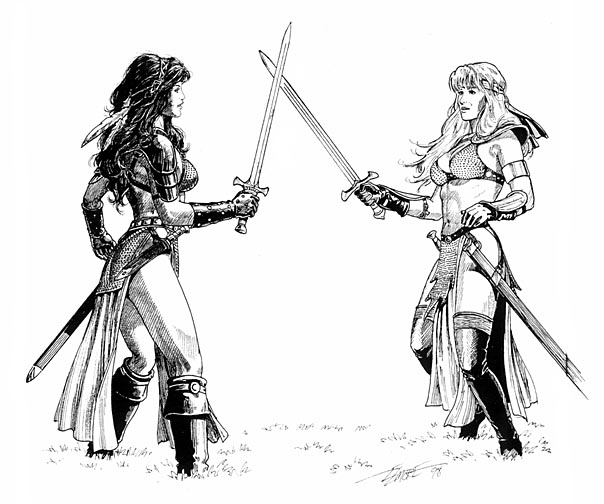
Just discovered this on Chaotic Shiny – a cool little program that generates descriptions of damage taken in games. You simply type in the damage dice and the general type of weapon (slashing, piercing or bludgeoning) and the applicable pronoun, and it does the rest. A sample …
Mace 1d6, bludgeoning damage
– You slam its upper leg. (1 damage)
– You ruin its ankle with an elaborate move. (6 damage)
– You slam its neck. (3 damage)
– You bash its upper arm. (3 damage)
– You bash its body. (2 damage)
Lance 1d8, piercing damage
– You jab her body. (4 damage)
– You gore her torso with a fountain of blood. (6 damage)
– You pierce her shoulder. (2 damage)
– You gore her upper arm with an acrobatic move. (6 damage)
– You strike her forearm in a move that will surely leave a scar and a deadly blow. (8 damage)
Pole Arm 1d10, slashing damage
– You chop his shoulder (5 damage)
– You chop his lower leg (6 damage)
– You gash his foot with astonishing force and a jet of blood (9 damage)
– You gash his forearm with gouts of blood (9 damage)
– You chop his forearm (5 damage)
And I defy you to beat the price!
Deviant Friday – Andy Hep Edition
Wilderness Adventures in Literature

I’ve been listening to H. R. Haggard’s King Solomon’s Mines the last couple days while processing data at work. I highly recommend it to Referees whose players are about to embark on a wilderness trek. You can also read it here.
After we get some introductions out of the way, you get to see the process of hiring a wagon, team of oxen and henchmen, and choosing what arms to take along – not to mention an old map that came from a dying Portuguese adventurer.
Once they get moving, you have random encounters with lions and elephants and the problems of food and water while traveling through the desert and mountains.
All good stuff – check it out.
Spit-Balling Ibis, the City of Sorcerers

I began working on Ibis, the City of Sorcerers today – drawing a thumbnail sketch of a map, shooting around ideas for locations I want to place thereon (is that a word?). Thought I’d share, and ask if anyone has ideas for things they think should be in a pseudo-Egyptian city-state with a bunch of sorcerers residing therein (not that’s a word).
– A bend of the River of Death with quays, crocodiles, a noble barge, maybe a half-submerged grotto filled with things unspeakable.
– An Inn (obviously I’ve put a lot of thought into this one).
– Clock shop – or general place to buy mainsprings and weird bits of mystic engineering.
– Tavern – a beer hall of some sort, lots of students, raucous – no magical stuff allowed, only for the normal folk who put up with enough magic during the day …
– A den of thieves in an old, abandoned granary – stone tower, cylindrical, secret passages to a hidden quay (for smuggling), maybe to the beer hall, maybe into the sewers.
– A souk running through the neighborhood – lots of peddlers in tents/booths.
– Workshops – leatherworker, dry goods, pointy hat shop, fine wands and staves, weapons and armor, a tailor (mystic gowns for men).
– Mausoleum of a Nabu princess/queen.
– Temple of Thoth – big compound.
– Subterranean temple of Seth – hidden under something innocuous, maybe the wine cellar.
– Flophouse, apartments surrounding an open yard filled with weird mushrooms and mushroom fairies.
– Bakery / coffee house.
– A tavern with a wine cellar.
– Gardens of the Nomarch.
– Tower astronomical observatory.
– University – dominates the center of the map – library, lecture hall (old hall, new hall), shrine of scribe goddess, vaults holding magical experiments, manse of the chancellor, laboratories.
– Fortune teller.
– Animal Market – large building, selling camels, horses, maybe more exotic creatures.
– Temple of Hathor – temple whores
– Tavern frequented by mages, maybe with portals to other places and times.
– A pleasant grove.
– Barber/surgeon.
– Tobacconist – herbalist – pipes and other smoking paraphernalia.
– Sewers – open in a few places, tunnels inhabited by ghouls (the Mortuary Society, a recognized guild in Ibis charged with dealing with carrion).
– Guild of Astrologomages, Planet-Masters and Weather-Watchers.
– Orichalcum foundry and jewelers dealing in astrolabes and amulets – maybe a gnome factory.
– Emporium with weird doo-dads – no two of the same thing, nothing overtly magical, owner pays for rarities in coins of rose-gold.
– A mortuary for all of your mummy needs – maybe an adjacent shrine of Anubis.
– Wizard towers like minarets
– A serpentarium, for all of your asp and cobra needs.
– A used chariot shop, because I love the 3 Stooges [okay, maybe I’ll leave this one out].
– Stone carvers – long factory, many monuments half-finished
– Vat and cauldron maker
– Printing shop
– Foreign merchants – true factory
– Industrial area with tanners, phosphorous makers, alchemists, smiths – have a tavern for working joes and host cock fights/bear baiting
– Scriptorium
– A snake charmer
– Physick who doubles as a detective
– Lapidary shop; meeting place for conspirators who want a republic like Antigoon
– Maybe a nice collection of low-level magic-users – diviner, necromancer, conjuror – along with an illusionist and elementalist. These will be spread throughout the aforementioned locations, so as not to make them too obvious – retired adventurers who have sought a safer life of commerce.
– Monsters – were-cobra clutch, vampire and minions, mummy and ghoul attendants, bandit king and men – laying low and recuperating, vaults of synthoids and homunculi, a well of souls
So – anything obvious that I’m missing here. I’ll fill the gaps with other artisans, maybe a set monster encounter or two, but anything else?
Random Beards – I can top that!

With random mustaches, of course! With scant apologies to A&A.
Having compiled this list, I’m now thinking that every dwarf clan I write up will have an official clan mustache and/or beard – maybe the ‘stache and beard are the dwarf version of heraldry? Hell, maybe their need for mustache wax is what drives the little buggers to dig up so much gold. Or maybe the Chandler’s Guild is the power behind most dwarven thrones? Or maybe I should just shut up and post the darn list already …
1. Natural – unshaped, unshaven, drawn by the hand of God, so to speak.
2. Hungarian – big and bushy – the mustache, not the people.
3. Dali – narrow, points are curved steeply upward; favored by surreal artists.
4. English – narrow, whiskers are long and curled up on ends (see photo to right).
5. Imperial – whiskers grow from both the upper lips and cheeks and curled upward.
6. Fu Manchu – long mustache grown only from the upper lip; favored by inscrutable geniuses from the Far East. The Pancho Villa variety is thicker and droopier.
7. Handlebar – like a Fu Manchu that has been trained to sit up (though not speak, although you know some wizard out there has tried).
8. Horseshoe – a bushier version of the Fu Manchu, but with hair growing not just from the upper lip, but also down the sides of the mouth; favored by hulks of the Hogan variety.
9. Pencil – a very thin mustache along the top of the lip – dashing on Errol Flynn, just plain creepy on John Waters (as it should be).
10. Chevron – thick and wide, it covers the entire upper lip – no curling here, mister.
11. Toothbrush – more popularly known as the “Hitler Mustache”, ‘nuff said.
12. Walrus – bushy mustache that completely (or mostly) covers the mouth.
All information drawn from Wikipedia. For random beards, please step this way to Aeons & Auguries.
Speaking of the Hulk …
Which I kinda sorta did a few posts ago … Diversions of the Groovy Kind, my go-to blog for silver age masterpieces, posted some scans from the Rampaging Hulk black and white magazine. I found these two members of the green goliath’s rogues gallery particularly inspiring …
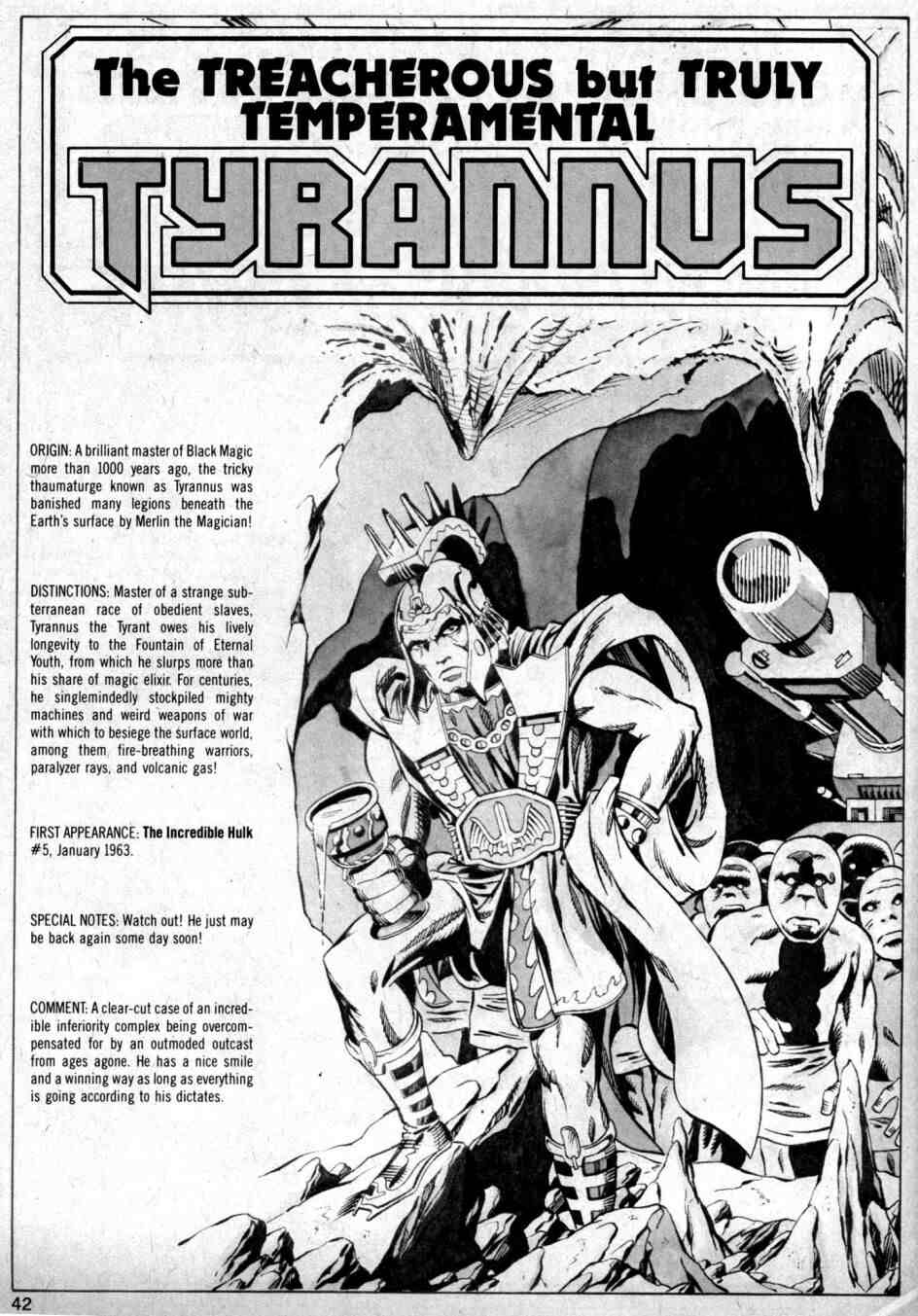
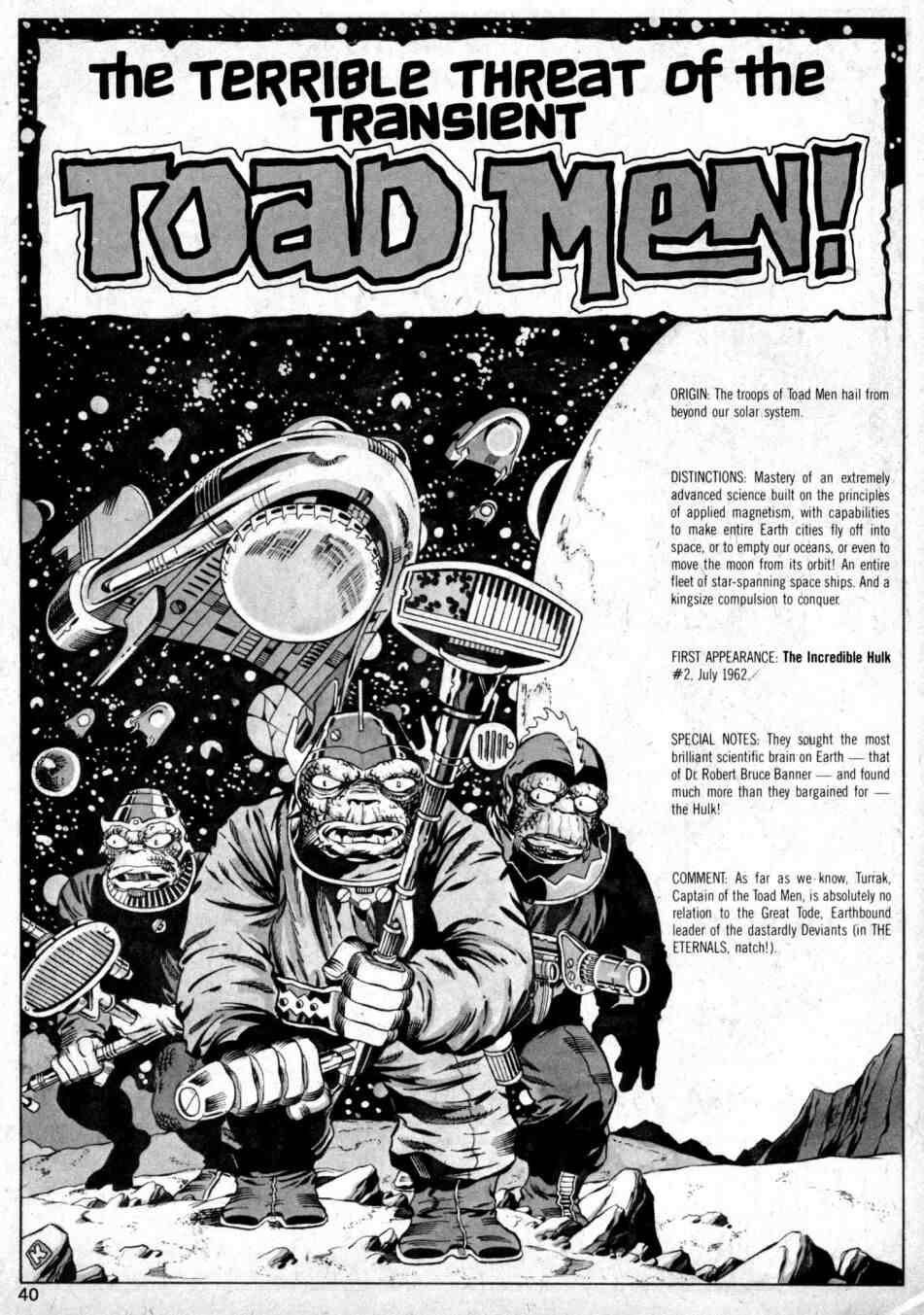
Transient toad men with cosmic vacuum cleaners just plain hits the spot. I mean, if your going to score a TPK, wouldn’t you like to, just once in a while, do it with a monster your players will be truly embarrassed to talk about.
The Gods of the Golden Sea
The native deities of the Golden Sea region are based on the mythologies of the Eastern Mediterranean, especially the Phrygians, Dacians and Thracians. Almost everything that is known of these entities comes to us from the Greeks and later Romans, and is viewed through their lens. Most of these gods and goddesses were adopted by the Greeks into their own pantheon, usually in positions that were no doubt inferior to the positions they held in the estimation of their native worshipers. Because there were many gaps in the knowledge of these divinities, I did my best to fill them in a suitably pulp-fantasy style.
Besides the deities listed here, several of the deities of the Motherlander pantheon (to be published in the near future) originated in this pantheon, including Bacchus (Dionysus), Hecate and possibly Proserpina (Persephone).
Note: The spells below, and only the spells, are designated Open Game Content.

Kubeleya (Cybele)
Also called Great Mother, Mountain Mother
Deity of Nature, Mountains, Caverns
Wields a staff
Served by earth elementals, fairies of a grim humor
Symbolized by the lion, bees
Aligned with Neutrality
Druids can cast Victory Chant (see below)
Kubeleya, also called Cybele and Rhea, is the grim goddess of the mountains and mother of the gods. She appears as a stately woman with a dour expression. She wears a long, belted dress, a high, cylindrical headdress called a polos, and a veil covering her entire body. One of her hands rests on an attendant lion while the other holds an instrument that resembles the tambourine. She is often pictured in a lion throne or a lion-drawn chariot.
Kubeleya’s consort is the demigod Attis. Attis has a bizarre origin. The demon Agdistos was a creature that was half man and half woman. It so terrified the gods that they killed it in a suitably bloody manner, and from its castrated male organ grew and almond tree. The remainder of Agdistos became Kubeleya.
One day, Nana, the daughter of the river god Sangarius, picked an almond and laid it on her breast, where it promptly disappeared and impregnated her. Nana abandoned the infant, who was raised by a he-goat in the hills and later adopted by human parents. As an adult, his beauty was godlike and attracted the attention of Kubeleya. Unfortunately, Attis had already been promised to the daughter of the local king. As the wedding songs were being sung, the jilted Kubeleya appeared in all her transcendent power, causing the wedding-goers, including Attis, to go mad and castrate themselves. Attis died, apparently of blood loss, but Kubeleya relented and resurrected him as a pine tree. This occurred on March 25, and is celebrated in the Hilaria festival, an orgiastic ceremony of wild music, drumming, dancing and drinking.
Kubeleya’s priests are called korybantes. They are male eunuchs (self-castrated, like Attis) who worship the Great Goddess in full armor with rhythmic stomping and the clashing of spear on shield.
VICTORY CHANT (Druid Level 2): The druid, by chanting and stomping, gives his allies a +1 bonus to hit and damage for as long as he keeps it up.
Adrasteia (Nemesis, Invidia, Erinys)
Also called Implacable, One from whom there is no escape
Deity of Protection and Righteousness
Wields a long sword and scourge
Served by inevitables (see NOD #3)
Symbolized by a scourge
Aligned with Law
Clerics can cast Unerring Huntress (see below)
Adrasteia is the goddess of the cosmic sea, dispenser of justice to the wicked and protector of the righteous. In some myths, she is the nursemaid to the infant Jupiter, who grants him a golden ball containing the universe as a toy. In others, she is Nemesis or Invidia, the goddess from which escape is impossible. She appears to her worshipers as a winged maiden with a face unmarred by pity. She might carry the scales of justice, or simply a sword and scourge. Adrasteia is a patron of magistrates and judges, soldiers and gladiators.
UNERRING HUNTRESS (Cleric Level 3): This spell allows the cleric to follow the path of a wanted criminal or blasphemer unerringly for a number of days equal to her level. During this time, she has no need of sleep and feels no hunger. If she has not captured or killed her quarry by the time the spell ends, she collapses into a deep slumber for a full day and cannot be roused.
Kotys (Cottyto, Cottytus)
Deity of the Moon, Caves, Darkness, Lust, Hunting
Wields a spear
Served by bacchae, demons, satyrs
Symbolized by the full moon
Aligned with Chaos
Clerics can cast Benighted Revelry (see below)
Kotys is a lunar goddess of hunting and wild revels. All of her sacred rituals are conducted at night, preferably by the light of the moon. These rites include raucous midnight orgies accompanied by shrill piping, the clashing of brass cymbals and the thunderous roll of drums, and nighttime relay torch-races on horseback.
Kotys appears as a woman wearing a foxskin cap and short chiton, wrapped in a leopard skin and holding a spear in one hand and a torch in the other. She has a hooded mantle on her shoulders fastened with a brooch and high, leather boots.
Kotys’ priests are called baptai due to the purification ritual they undergo to join the priesthood. They are not unlike the baccae who worship Dionysus / Bacchus.
BENIGHTED REVELRY (Cleric Level 3): This spell affects all sentient creatures within sight of the cleric who fail a saving throw. For the duration of the spell (1d6 rounds per person) they will act in one of three ways:
1 – The person enters a drunken stupor, falling over themselves and finding it impossible to do anything.
2 – The person becomes a raving lunatic, attacking whomever the cleric desires with their teeth and claws. The lunatic attacks twice per round but suffers a 2 point penalty to their Armor Class.
3 – The person acts like a love-starved satyr, attempting to grapple the nearest creature they find even remotely attractive and, well, what they do if successful depends on what kind of game you run.
Men (Lunus)
Also called The Lunar Bull
Deity of the Moon
Wields an axe
Served by nocturnal fey
Symbolized by the crescent moon or an ox skull
Aligned with Neutrality
Druids can rebuke/command lycanthropes as a cleric two levels lower than their druid level
Men is the so-called Lunar Bull, a deity presiding over time and the changing seasons. He appears as a rugged man with crescent horns, like those of a bull, atop his head, and sometimes with the head of a bull in the manner of the minotaur. He wears a Phrygian cap and a belted tunic, and is accompanied by white bulls and white lions.
Sabazios (Karabazmos)
Also called Great God, the Horseman
Deity of Health, Vitality, Abundance, the Underworld
Wields a staff or spear
Served by barghests, demons, wraiths
Symbolized by Hand
Aligned with Chaos
Clerics can cast Ghastly Steed (see below)
Sabazios appears as a black-skinned rider on a white horse. He wears a himation and is depicted carrying a staff of power or a spear. Sabazios is the conqueror of the Lunar Bull and the Solar Dragon, and represents male vitality. Games are held in his honor every five years. Sabazios is believed to by the father of Dionysus. Motherlanders associate him with Pluto.
Sabazios rules the Land of the Dead, emerging with a party of cthonic fey and wraiths to conduct hunts on the nights of the new moon. On these nights, villagers stow away their animals and keep indoors, for all night they hear the baying the barghests and the blowing of spectral horns.
Sabazios’ is the patron of horsemen and his priests are all skilled at riding and mounted combat. They blacken their armor and conduct ritual sacrifices of white bulls and ritual hunts of great beasts like chimeras and manticores. Sabazios is also a psycho-pomp, and thus represents the transmigration of the soul after death. This makes him a patron of magic and magic-users. Such scholarly followers honor sabazios by tattooing their right hands with so many sigils and designs that they are nearly black.
GHASTLY STEED (Cleric Level 2): This spell summons a ghostly white steed with the stats of a warhorse with maximum hit points. The steed is tireless, and serves for a number of hours equal to the cleric’s level divided by three. The cleric can exchange one hour of the spell’s duration for one minute of etherealness, but only while mounted on the steed.
Zalmoxis
Deity of Thunder, Strength, War, Incantation
Wields an axe
Served by berserkers, demons
Symbolized by his axe
Aligned with Chaos
Clerics can cast Thunderstruck (see below)
Zalmoxis appears as a handsome man, unclothed, wielding an axe or lightning bolt. He is a sky father and a deity of masculine power, a god of uncontrollable passions that are often unleashed as violence.
Zalmoxis’ most fervent worshipers believe he is the one true god who accepts their souls after death. Because they do not believe they can ever truly die, they fight as berserkers, gaining two attacks per round and suffering a 2 point penalty to their Armor Class. Zalmoxis is also skilled in the arts of incantation and singing, and thus is worshiped by bards.
Zalmoxis’ clerics wear no armor and only a small amount of clothing. They cultivate a wild, feral appearance and are permitted to wield axes and chopping blades in battle. Because they do not use armor, their Hit Dice are increased to 1d6+2 and +3 hp/level after 9th level.
THUNDERSTRUCK (Cleric Level 2): This enchantment is placed on the cleric’s weapon. The next time it hits in battle, it unleashes a terrific peal of thunder. The victim of the hit must pass a saving throw or be stunned for 1 round. Everyone within 20 feet, including the victim of the hit but excluding the cleric, must pass a saving throw or be deafened for 1d6 minutes.
 Land of Nod