Secrets of the Shadowend – A Review

Nathan Irving was kind enough to send me a copy of his new Secrets #1 – Omens & Artifacts to check out, and I was very impressed. It’s a great compilation of spells, monsters, and magic items for Swords & Wizardry (hallowed be its name) that you can fit into your long-running campaign to throw your players a curve, or use to launch a new campaign for old timers who already know the best way to skin a gnoll. Since it’s OSR, of course, you can use the book for just about any OSR style rules you happen to use.

The book is illustrated with public domain art that is well selected to reflect the feel of the material – you can’t go wrong with the likes of Batten and Rackham. The layout is nice and clean – very easy to read and it won’t cost a fortune to print if you opt for the PDF rather than the print version.

Best of all – the book won’t cost you an arm and a leg. You can CLICK HERE to see Nathan’s blog post about the book and learn how to get a copy into your hot little hands.

So, what were my favorite bits?

I dig the Profane Stare spell – awesome opening move for a chaos cultist. The Carpenter’s Rod is like a practical version of the Rod of Lordly Might, and every character intending to delve into a dungeon should be on the lookout for one. The magic cloaks, that give people access to race and class abilities, were nice as well. The cockerel horse (alektrequus) is definitely going to make an appearance in NOD – in the lands of the philosopher kings. The vouivre has an excellent write-up – lots of fodder for adventures.

It’s a great book, and only the first in a series. The next will cover fantasy races. So go order the book already!

The Trophy Case – a Magazine to Check Out

Hey folks,

Busy scribbling away at my monster book (I think I have the layout figured out) and GRIT & VIGOR, and finishing up NOD 23 (Zombies and Apes!), but I wanted to take a couple moments and point people to a gaming zine called The Trophy Case.

Written by Scott Casper, the writer of Hideouts & Hoodlums, a Swords & Wizardry-inspired superhero game, the zine focuses on golden and silver age heroes, with plenty of stats for H&H, comic book reviews and a nice locale for heroic adventures – the Double L Dude Ranch. Volume 2 – Issue 7 also features a very kind review of Mystery Men!

If you have the time and $0.50 (yes folks, just two thin quarters, four bits!) you can visit Scott’s page at Drive Thru RPG or RPGNow.com, and pick up The Trophy Case and get your golden age on.

Now then – back to work!

Three Sad Wizards

Since last week’s showcase of new products out there, I got a request to highlight a new adventure module (I’m old – they’ll always be modules to me) called Three Sad Wizards, by Jasper Polane.

Three Sad Wizards is described thusly:

The wizards in the village of Tealief have horrible problems!

• Terrible carnivorous plants make the garden of Bymen the Botanomancer unsafe.

• Giant insects are running free in the underground laboratory of Ermard the Entomomancer.

• Monstrous birds escaped from the tower of Ostal the Ornithomancer.

Only a group of courageous adventurers can help them. Is your party brave enough?

Three Sad Wizards is an introductory module, designed for characters of 1st and 2nd level. Written for use with old school RPGs, this module can be fitted into almost any campaign or played as a stand-alone adventure.

A good intro adventure is always nice, and this one appears to be a bit different than the classic “Caves of Chaos”-style dungeon romp. It includes three mini-dungeons, each one depicting the lair of a strange wizard, a plant mage, a bug mage and a bird mage. There’s some info on the village of Tealief (and a random table of tea blends), a rumors table, a random mail table, a small wilderness map (with a few monster lairs included), new magic items and new magic spells.

All in all, looks like a great way to begin a campaign – plenty of things for players to explore while they get their brand, spanking new characters off the ground.

You can find the module on sale at LULU – CLICK HERE.

Dragon by Dragon – May 1979 (25)

May 1979 – the author of this post was 7 and about 5 years away from discovering Dungeons & Dragon. Let’s see what I was missing …

First and foremost – awesome cover. Well done!

A Part of Gamma World Revisited by James M. Ward

Not exactly a title one can conjure with, but the article itself is probably useful to most Gamma Worlders. It covers the history behind the Cryptic Alliances, and might be helpful for campaign play. What I found interesting was the geography of the alliances:

Brotherhood of Thought – started at the University of California, but spread up and down the west coast and into the Rockies.

Seekers – The Seekers are Texans

The Knights of Genetic Purity – don’t say

Friends of Entropy – headquartered in Lincoln, Nebraska

The Iron Society – they’re found in all bombed out areas – seems like Pittsburgh would have been a great headquarters

The Zoopremists – started in the mountain range near Torreon, Mexico

The Healers – Duluth, Minnesota

Restorationists – Boston and Providence

Followers of the Voice – their most successful group is in an underground base in the Appalachians south of Charleston and west of Raleigh – they’re led by a bunny-girl (i.e. female hoop)

Ranks of the Fit – began near Memphis, Tennessee by a circus bear who had its mental faculties increased a thousand fold; their civilization has spread as far north as Cincinnati and as far south as Baton Rouge, presumably along the Mississippi River and its tributaries.

The Archivists – mountains between Butte, MT and Billings, SD and Idaho Falls, MT

Radioactivists – based below Atlanta in the flattened peninsula that was Florida

The Created – have surrounded St. Louis with warbots

Judging and You! by James M. Ward

This is a collection of tricks of the game judging trade, especially for Gamma World and Dungeons & Dragons.

The Tug of the Machine by Allen Evans

A bit of fiction. One column’s worth. And I can’t copy paste it. Sorry.

The Armada Disasters

This is a nice history of naval operations and the clash of nations in the 16th century, and most particularly about the Spanish Armada and its disastrous clash with the English.

From the Sorcerer’s Scroll: The Proper Place of Character Social Class in D&D by Gary Gygax

This covers the introduction of social classes to characters in D&D. It mentions that the initial idea came from MAR Barker’s Empire of the Petal Throne. Gygax points out that Tekumel has a well-thought out culture and social structure, and the lack (or possible lack) of such a structure in D&D makes using social class problematic. He suggests a very simple table for determining social class:

01-75 – Common background
76-95 – Aristocratic background
96-00 – Upper class background

He then goes on to question the use of birth tables and social class, and I have to agree. I suppose if a campaign focuses on social class and the interaction within classes and between classes – something like you’d get in Flashing Blades – it makes sense. If you’re doing the whole Conan thing – plundering tombs and such – I don’t see much point to it.

Armies of the Renaissance by Nick Nascati

Part III of this series, this one covers the Condotierre and The Papacy. Great introduction:

“If Woody Allen would ever decide to turn his comedic talents to writing history, the result would very probably read like a history of Italy in the Age of the Condotierre. Few periods in history could possibly be as full of petty squabbles and pointless maneuvering, as this age when greedy, mercenary captains controlled the destiny of the Italian City-States. Warfare was formalized to the point where it almost became a life-size chess match, with few fatalities. However, their military system does assume a certain importance in our study of the period.”

Well worth the read for wargamers doing this period.

Would the Real Orc Please Step Forward? by Lance Harrop

Here’s an interesting article subtitled “Dealing with the Proliferation of Orcish Miniatures”. Interesting for two reasons.

One is that it covers “orc genealogy and taxonomy” – always fun to see somebody dissect make-believe like that. Lance draws a family tree of evil humanoids, putting orcs, ogres, kobolds, hobgoblins and goblins all on branches of that tree, with hobgoblins and goblins forking off from the same branch. Pretty standard idea these days, maybe kinda new in those days. He then lays out some ideas on how to take this system and use it when selecting miniatures, since back in the day miniatures were a bit more generic – i.e. an ugly humanoid miniature could just as easily be used as a kobold as it could for a goblin.

The other interesting thing about this article is that there was a need to deal with the proliferation of orcish miniatures. I’m guessing that nerds in the Middle Ages were worried about similarly silly things – it runs deep in our breed.

He also provides a picture of several of the miniatures of the day …

Finally, he provides this guide to wargaming with orcs:

1. All goblin races dislike the sunlight, so lower their morale in the daytime.

2. Kobolds and Gnomes will almost instantly attack each other, so have them make obedience checks when they are in charging distance. The same with goblins and dwarves and lesser orcs and elves. Great orcs, man orcs, ogres and hobgoblins will not generally disobey.

3. Orcs of different tribes will also attack each other, as will all goblin races, but powerful leaders can keep them in check, so adjust the die roll against the level of the leader.

4. Usually only great orcs and man orcs will fight in formations, the others will fight en masse.

The Traveller Navy Wants to Join You by R. D. Stuart

An article that covers new career opportunities in Traveller. I don’t play Traveller, so I don’t know that I can comment on how well these are written, but I bet it would come in handy if you were doing a Star Trek-esque Traveller campaign.

Gamma World Artifact Use Chart by Gay Jaquet

This article swaps out the artifact use charts in Gamma World for a more complex and abstract system. Personally – I’ll stick with the charts. I think they’re fun.

An Alien in a Strange Land by James M. Ward

Ward wrote quite a bit for this issue, huh?

This is a bit of Gamma World fiction that seems to be taken from actual play:

“Blern had left those mutated fools of Entropy with an organization that should last until the time it decided to return and take over again. Riding off, on a very reluctant Brutorz, had carried with the act a certain satisfaction in a finished job that was well done. The miles were quickly eaten up under the hooves of the Brutorz and soon Blern was in territory that it had never visited or heard about before. Days passed into a sort of boredom that was unusual for the mutant. It got so that it was wishing for an attack by anything, just to break the monotony, and almost with that thought, Blern spotted the group.”

Excerpt from an Interview with an Iron Golem by Michael McCrery

Interview with a Vampire was written in 1976 – I’m wondering if this article was a play on that. Either way, this one reminds me of the skits that appear in the last 15 minutes of Saturday Night Live. Essentially, another piece of fiction drawn (I’m guessing) from actual play.

War of Flowers by William B. Fawcett

Another nice wargaming article, this one on the Aztecs. I like this bit …

“The Aztec “empire” was in fact a conglomeration of city states that formed rather fluid coalitions which were normally centered on the most powerful cities found in the area of present day Mexico City. In these coalitions there were normally one or two major powers who, by their size and military strength, were able to compel the lesser cities to join in their efforts. When a city was ‘conquered’ the result was the imposition of tribute and economic sanctions rather than social or political absorption, as occurred in Europe or China. This tribute was reluctantly paid to the victorious city only until some way to avoid it was found (such as an alliance to an even more powerful city). Any political or military alliance was then ruled entirely by expedience, and quickly and easily dissolved.”

This is pretty much how I envision all the city-states in NOD. Why? Better for game play in my opinion.

Xochiyaoyotl by Neal M. Dorst

This is a concise set of rules for Pre-Hispanic Mexican wargaming.

Varieties of Vampires by R. P. Smith

This article tackles all the various vampire legends from around the world. It suggests using the same basic game stats for all vampires, but then adds different move rates and environments for the different vampire legends, along with descriptions:

Asanbosam (Africa): Men (9 hit dice), women (8 hit dice), or children (7 hit dice) who look normal except for a pair of books instead of feet. They can charm at minus 3, (except against clerics, whom they avoid) and can throw a single sleep spell per night. They can call 3-18 leopards or 2-12 tigers. Only a cleric can kill the asanbosam.

Burcolakas (Greece): It has a swollen, tense, hard skin. It can scream once per night which deafens all in hearing range for 24 hours, no saving throw. It can also kill, not only by draining life levels, but by naming its victim by name and commanding the victim into a fatal action. It can imitate any voice it hears, with as much of a chance of being detected as an assassin has of being discovered in disguise. It controls 10-100 rats, but no wolves. To defeat: cut off and burn its head.

Great idea – wish I’d thought of it. My favorite bit from the article … “Hence, any body left unguarded without a Bless spell from a cleric will become a vampire within seven days.” Use that rule, and I promise the cleric will hold onto those bless spells. Nobody needs that stupid henchmen you used for cannon fodder coming back to haunt you as a vampire.

To Select a Mythos by Bob Bledsaw

This article covers creating a mythos for one’s campaign. I like that he pushes a “screw reality” concept and chooses fun over strict realism.

Arms and Armor of the Conquistadores by Michael H. Kluever

Another article about fighting on Old Mexico. This one gives a history of the Spanish conquest and then describes the weapons and armor of the different troops.

Not a bad issue. Like the vampire article quite a bit, could have done without so much fiction. The “helpful tips” stuff is helpful for folks new to gaming – not so much for an old fart like myself. If I was doing some Aztec vs. Spanish wargaming, this issue would have really been a boon.

Okay folks – see you tomorrow when I have a new goofy character class you might enjoy.

Dragon by Dragon – April 1979 (24)

April of 1979 – those heady days of stuff that was happening and things and stuff. Okay, I’m too lazy at the moment to look up what was happening back then, but hey – who cares, right? We know the Dragon was happening, so let’s focus on that.

What did the Dragon have to offer in 1979? More importantly, can we use any of this stuff now?

Lost Civilizations (A Fantasy Supplement for Source of the Nile) by J. Eric Holmes

When you see Dr. Holmes as the author, you know you’ve got some quality material in your hands. Hell, I’ve never even played Source of the Nile and I know this article has to have something useful in it. The article is all about adding some fantasy to the more realistic game of African exploration, specifically of the sort you might get in an H. Rider Haggard or E. R. Burroughs novel.

First up, I love the list of explorer types used in Source of the Nile: Missionaries, Doctors, Zoologists, Geologists and Adventurers. If you were doing an RPG of Victorian exploration, you have your class list right there.

His idea is that when you enter a completely uninhabited hex, there is a chance of it containing a lost city (a roll of 2-3 on 2d6). If in a desert, the city is uninhabited. Otherwise, it is inhabited by survivors of lost Atlantis. The people use bronze weapons and wear ornaments of gold and gemstones, and then you roll dice to determine the city’s organization. Roll 1d6; on a 1-3 the city is ruled by a warrior-king with 1d6 x 1d6 x 1d6 + 10 warriors; if the roll is 4-6 it is ruled by an evil high priest and a white goddess who command 1d6 x 1d6 x 1d6 + 5 warriors. I include this bit because it could be adapted to almost any hex exploration style fantasy game.

When exploring an uninhabited desert city for treasure, you roll 1d6: 1-2 he discovers that the ancient gods still live, his expedition is destroyed and he escapes completely mad; 3-4 traps kill half his askaris and bearers, but he escapes with a bag of diamonds and rubies worth $500 and the secret passages are closed off forever; 5-6 he loots the city for $1000 worth of gems and $200 worth of gold.

This brings to mind something I once did for a game. I was starting with characters above 1st level, and they were from various places in my campaign world (Nod – you might have heard of it). For each character, I came up with one past adventure for each level, each adventure leading them from where they were born to where the adventure was to start. In this way, I gave each player a bit of knowledge about the campaign world and some cool tidbits about their characters. Something to consider.

Keeping the Magic-User In His Place by Ronald Pehr

A classic of old Dragon (hell, a classic of modern articles as well, in as much as it addresses the idea of “balance” between characters). Ronald includes a few ideas of controlling these damn wizards so they don’t mess up the game. Interesting, because it introduces the idea of forced fairness to the game – i.e. I want the game to go one way, but the rules aren’t allowing that to happen. Think of the article previous – the explorer explores a lost city and you roll a dice and that determines what happens – amazing wealth or complete insanity. That’s it. Why? It’s a game, and those are the rules, and playing the game is more important than winning. Or, to state it another way, winning or losing should be a product of the game experience, not a preconceived idea that the game play must support. Why not have wizards who “ruin” the game with fireballs and charm spells? Let everybody have their time to shine, and play it smart. A fireball is a tricky thing, and over reliance on them might be a wizard’s undoing.

Chinese Dragons by David Sweet

One day, these fine monsters will appear in the Fiend Folio, and they were always pretty cool. In fact, it might be fun to do something similar with occidental dragons, replacing the red-blue-green-etc. dragons with ones based on the famous dragons of European myth.

Another Look at LYCANTHROPY by Jon Mattson

This article throws in the idea of different types of lycanthropes that a bitten character might turn into. They are as follows (in summary):

A. Turns completely into the lycanthrope that bit him; i.e. new alignment, etc.
B. Remains in human form, but takes on the mentality of the lycanthrope.
C. Character takes lycanthrope form, but retains his own mentality.
D. As A, but only changes under a full moon or great stress.
E. As B, but only changes under a full moon or great stress.
F. As C, but only … well, you know.
G. Under full moon or great stress, changes into a hybrid of beast and man.

Under option G, he actually writes, “This may sound something like the “Incredible Hulk,” but that is the general idea.” Love it.

There is also a percentage chance for figuring out the character’s new alignment. The new lycanthrope has half the character’s spells and abilities while in lycanthrope form and some modifiers to his ability scores.

Another great quote:

Note: To many people it may seem strange that a wolfs constitution would be better than that of say a bear, but remember that wolves often survive through incredible hardships such as hunger and cold, and I’ve yet to see a bear do as well.

What the?

Ultimately, this is a pretty cool article as it allows the chance that a PC can remain a PC and an interesting party member even after succumbing to lycanthropy.

Roman Military Organization, A Classic Warfare Update by Gary Gygax

An interesting article on the organization of the Roman army.

A Viking Campaign in the Caspian Sea by James E. Brunner

This is a nice history of an actual (well, I assume actual) Viking foray into the Caspian Sea for plunder. A sample:

“In the tenth century the Caspian Sea lay like a great pearl in an ocean of endless steppes and towering mountains. The prows that cut its placid waters belonged to poor fishermen and merchants from every land. Unlike the Black Sea that lay to the west, no northern pirate fleets had ravaged its shores and carried off its great wealth. To the north and the east lay the powerful Khazar Khanate whose capital, Itil, on the Volga Delta, controlled the major trade route to the north. Any merchant or pirate that sought wealth in the Muslim lands to the south had first to deal with the Khazar Khan, whose greed was legendary.”

Primarily interesting to me as it reminds me of Howard’s Vilayet Sea and the adventures had in and around it. When you find fantasy that interests you, take the time to find the reality that underlies it. You might find it even more inspirational.

The article also includes rules for fighting the Battle of Barda’a using Classic Warfare.

The Melee in D&D by Gary Gygax

Here, Mr. Gygax offers up some thoughts on how melee combat is supposed to work in D&D, specifically it seems to answer the complaints of folks who would like more realism in the system. A few important points:

– The game is mostly about creating fantasy personas and their adventures, and that means more than just fighting

– Hack and slash shouldn’t be the first resort of characters

– The system isn’t too unrealistic – it’s built to ensure relative speed of resolution without bogging the ref down in paperwork or creating a high probability of character death

Here’s a bit I found interesting:

“Don Turnbull stated that he envisioned that three sorts of attacks were continually taking place during melee:

1) attacks which had no chance of hitting, including feints, parries, and the like;

2) attacks which had a chance of doing damage but which missed as indicated by the die roll; and

3) attacks which were telling as indicated by the dice roll and subsequent damage determination.

This is a correct summation of what the D&D melee procedure subsumes. Note that the skill factor of higher level of higher level fighters — as well as natural abilities and/or speed of some monsters — allows more than one opportunity per melee round of scoring a telling attack as they are more able to take advantage of openings left by adversaries during the course of sparring. Similarly, zero level men, and monsters under one full hit die, are considered as being less able to defend; thus, opponents of two of more levels of hit dice are able to get in one telling blow for each such level or hit die.”

An article well worth the read.

DUNGEON – More Variations on the Theme by George Laking

This is a collection of extra rules for the DUNGEON game. Since it’s being published again, this might be a good article for folks who love it.

Armies of the Renaissance by Nick Nascati

This is the second part of an article from last issue (I think – too lazy to look at the moment). It covers The Swiss. I’ve long thought the Swiss would be an excellent folk on which to model dwarf armies.

Narcisstics by Darrel Plant and Jon Pitchford

Some monster humor of the disgruntled geek variety, statting up jocks and their female groupies as monsters. I’d convert them to B&T format, but the format in the article is hard to make out, and frankly they’re not just worth it.

Psionics Revisited by Ronald Pehr

This variant takes some of the random chance out of the powers psychic characters receive, tying them more closely to their professions (or so the article says). It appears to divide the powers into two categories: Cognitive Powers and Kinetic Powers, adding a few new powers to the game.

Disease by Lenny Buettuer

This is a set of tables for determining how long it takes a disease to kill a person, and what symptoms are suffered in the meantime. The fatality interval goes from immediate to 10 months, based on a percentile dice roll. Another table determines how many symptoms are suffered and a third what those symptoms are. Honestly – a great idea and one I wish I’d thought of. After all, why do I care what the disease is called? All I want to know is how long the adventurer has to live (more on this below) and what happens to him until he can receive healing.

The other thing I got from this article is the point of diseases in the game. There are many ways to die in D&D, and each should offer up different challenges to the players. Disease in this case becomes a race to be cured.

Bergenhome ’77: the CAT’s Test of American Armor by Stanley Schriefer

If nothing else, this article presents an interesting moment in the history of the magazine. The article is about how well American armor (as in tanks) did in a NATO competition. No stats here. None. Not tied to any game. Just military news that might be interesting to wargamers.

The Return of Conan Maol by Paul Karlsson Johnstone

Weird little article about bagpipers and such.

Choir Practice at the First Church of Lawful Evil (Orthodox): The Ramifications of Alignment by Lawrence Schick

Another interesting article about the three-tier alignment system and their relationship to gods and the powers of those gods. It also divides the three alignments into several “sects” or versions of each alignment. Lawful, for example, is divided into the following:

(A) Absolute Order (High Law)
(B) Harmony/Goodness
(C) Justice/Vengeance
(D) Knowledge
(E) Evolution (Social Darwinism )
(F) War

It then gives information on each of these versions of alignment – its tenets, its practitioners, it’s prime deity. Here’s one example:

Law: JUSTICE/VENGEANCE (Monks, Paladins, Assassins)

Tenets: Good (Law) must be rewarded and Evil (Chaos) must be punished. All creatures are judged impartially by weighing their “good’ and “evil” deeds. Transgressors will be punished according to the depth of their depravity. Criminals must be diligently pursued until brought to justice. (Examples of this alignment’s enforcers might include Solomon Kane, The Shadow, Mr. A., and Javert.)

Prime Deity: MARLY
AC: -4 HP: 300 MOVE:24”
MAGIC: Standard plus See Past plus Detect Truth/Lie.

Honestly – one of the most usable alignment articles I’ve yet read. A great take on the subject, and quite usable. Bonus: Nice piece of art!

Naming People, Places and Things in Petal Throne by G. Arthur Rahman

This article provides a random table for generating the rather non-European names common to MAR Barker’s campaign world.

Monty Haul and the Best of Freddie by James M. Ward

Another adventure in the annals of Monty Haul. A sample:

“The Bronze Dragon was of tremendous size for its breed, measuring over 80 hands long and able to rear to a height of more than half that. The creature had gleaming claws as sharp and damaging as scimitars; buffed with gold dust. Its fanged jaws were kept sharp by biting heavy platemail vests that were a part of its horde. Its massive scaled body rested regally on an altar made of its own gold and silver. Chalices of platinum and coffers of gems and jewels were all about, arranged to please the delicate sensibilities of the dragon. Its giant eyes, that had been but a moment before closed in dragonslumber, opened, aware of the tread of footsteps down the echoing marble corridor, designed for just that echoing effect.”

In Defense of Extraordinary Characters by Rodford E. Smith

A very quick bit about why high level characters make sense, giving as examples from literature Odysseus, Daedalus, Hercules, John Carter, Conan and “everyone’s favorite Kryptonian.” So there you go.

The Society for Creative Anachronism by Allen Hammack

An overview of the society and their doings. These days, this would be what we term a “web page”.

And there you have the April 1979 issue of The Dragon. Not a bad issue all told, with at least two or three articles that I think most folks would find useful.

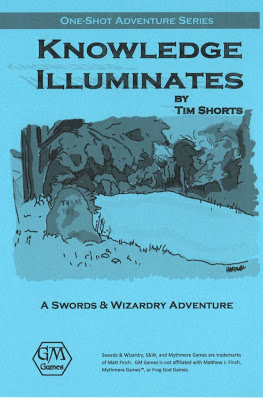
Knowledge Illuminates – A Review

I recently received a copy of Tim Shorts’ new module (yeah, I call them modules) Knowledge Illuminates. Knowledge Illuminates is intended as a one or two session adventure for starting characters (1st level) using the Swords & Wizardry Complete rules. So, what’s it like?

I found it a dandy adventure. It has a wilderness section with interesting encounters and a great map, and an equally enjoyable dungeon component. The encounters made sense, were varied and, best of all, the adventure provides opportunity for moving beyond it. One could even imagine increasing the power of the encounters for a higher level party and using it as the first stage of an adventure that would plunge them into an interesting campaign (I could say more, but I don’t want to dangle any spoilers out there).

Again, the maps are fantastic – clean and easy to read. The art is excellent and provided by Dylan Hartwell of the Digital Orc Blog. The adventure also provides a new undead monster, a new magic item (two, really) and two new spells. It is written with a bit of background in mind, but I think one could easily adapt it to fit their own campaign.

All in all, Knowledge Illuminates definitely gets the Nod seal of approval. Check it out HERE.

Dragon by Dragon – March 1979 (23)

I haven’t delved into an old Dragon for a while, so I thought tonight was as good a night as any to do a new “Dragon by Dragon”. What does March 1979 have in store for us?

I often like to start with an ad, and this one has a dandy for Fourth Dimension, the game of Time and Space. You get to play a Time Lord in this one, with an army of Guardians, Rangers and Warriors. No dice in this game – all about the strategy.

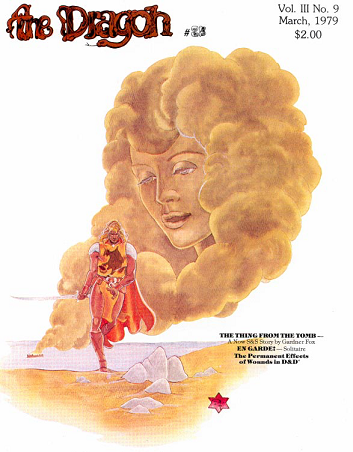
In terms of articles, the first one up is about playing EN GARDE! (love the days of capitalized game names) as a solitaire game. Folks might find a use in the Critical Hits table.

Die Roll. Result (Damage Points)
1-10. Light Leg Wound (Base 20 + 16-sided die roll)
11-20. Light Left Arm Wound (Base 20 + 16-sided die roll)
21-30. Light Right Arm Wound (Base 20 + 16-sided die roll)
31-40. Light Head Wound (Base 20 + 16-sided die roll)
41-50. Light Body Wound (Base 25 + 16-sided die roll)
51-60. Serious Leg Wound (Base 50 + 120-sided die roll)
61-70. Serious Left Arm Wound (Base 50 + 120-sided die roll)
71-80. Serious Right Arm Wound (Base 50 + 120-sided die roll)
81-90. Serious Head Wound (Base 50 + 120-sided die roll)
91-99. Serious Body Wound (Base 100 + 120-sided die roll)
00. DEAD

Love the 16-sided dice and 120-sided dice – not sure how that was accomplished, though I’m sure a dice whiz can inform us in the comments. If modifying for use in “traditional fantasy games”, you could maybe replace “Base 20 + 16-sided die roll” with 6 + 1d6 or something like that.

Next is some fantasy fiction by Gardner F. Fox – “The Thing from the Tomb”. The first paragraph goes thus …

“Niall of the Far Travels reined in his big grey stallion, lifting his right hand to halt the long column of riders who followed him across this corner of the Baklakanian Desert. In front of him, and far away, he could make out a dark blotch on the golden sands toward which he was
moving.”

Jeff P. Swycaffer presents “Mind Wrestling”, a variation on psionic combat. To be honest, I still regret not throwing in a psionics appendix into Blood & Treasure. The idea here is that two people are attempting to push a cloud of power suspended between them into their opponent’s mind. The system uses a double track to represent the “field” of combat. Attackers secretly declare an outside or center attack, defenders secretly divide their Psionic Strength between outside and center defense, and then the attacker’s Psionic Strength (+40 or doubled, whichever is less) is compared to the defender’s strength. If a ratio of 2:1 is achieved, the marker is moved one space. If a ratio of 3:1 is achieved, it is moved two spaces. The attacker then has his psionic strength returned to normal and loses 3 points, and the defender loses twice as many points as his marker was pushed back. Simple system, and would probably be a fun game-within-a-game, especially for psionics-heavy campaigns.

Carl Hursh has rules and guidelines for water adventures on the Starship Warden. Lots of monster stats, including craboids and gupoids.

Michael Mornard presents notes on armor for fantasy games, maybe the first article to talk about how D&D armor and weapons is heavier than real armor and weapons.

Gygax’s Sorcerer’s Scroll presents the random generation of creatures from the lower planes – always a fun one, and I highly suggest people use it when sicing demons of various types on their players. You can either use it to generate additional “types” of demons, or use it to alter the appearance of existing types.

James M. Ward presents an article I’m excited about – Damage Permanency (or How Hrothgar One-Ear Got His Name). This system is used when a person is reduced to 1 or 2 hit points. When this happens, there is a 50% chance of no permanent damage, a 20% chance of needing magical healing to heal properly, and a 10% chance of being maimed unless wish or a 5th level or better clerical healing spell or device is used.

What follows are a number of tables – one to determine the area of the body damaged, and tables for each body location to determine what happens. Head damage, for example, is as follows:

1-12 Hearing Loss
13-24 Sight Loss
25-36 Speech Impaired
37-48 Charisma Impaired
49-60 Intelligence Impaired
61-72 Wisdom Impaired
73-88 Fighting Ability Impaired
89-100 Spell Ability Impaired

Of course, more detail follows. “Spell Ability Impaired” mean that the person loses one level of spell ability – i.e. a 3rd level magic-user would have the spells of a 2nd level magic-user.

The Design Forum features “Dungeons and Prisons” by Mark S. Day. Essentially, it covers the idea that dungeons should have some prison cells, and gives a few notions about how one might use them.

And that does it for Dragon in March 1979 – a useful little issue. One parting shot …

Ah – the good old days were just getting started in 1979!

Soon, I’ll review the latest adventure offering from Tim Shorts – Knowledge Illuminates!

Last of the Mohicans [Quick Review]

I’m on a reading kick lately, specifically delving into about 100 classic books I’ve recently downloaded onto my Kindle from Project Gutenberg. A couple days ago I finished reading James Fenimore Cooper’s Last of the Mohicans – I thought it was a good choice given the fact that I’m writing a colonial North America-themed hex crawl at the moment.

For a book written in 1826, Last of the Mohicans is pretty accessible to the modern reader. Many books of that era make long, wide detours away from the story to touch on matters of history, geography, etc. This isn’t a bad thing in-an-of itself, but it can distract from the matter at hand. Last of the Mohicans stays the course, telling the tale of the white scout Hawkeye (Nathaniel Bumppo) and the Mohicans, Uncas and Chingachgook, as they endeavor first to deliver Cora and Alice, daughters of Col. Munro, and their companions, Major Heyward and the psalmodist David through the wilderness to safety. Ultimately, they fail at this, and must free them from the clutches of the Hurons and their chief, Magua.

Last of the Mohicans is a rousing tale worth reading. For gamers, it’s a good study on the way a wilderness campaign might be conducted. As I read the book, I also got the distinct feeling that it was a major inspiration on Tolkien’s Lord of the Rings. I’m no Tolkien scholar, so I might be completely wrong on this one, but the use of language, the singing of songs, the overall feel of the flight through the wilderness all reminded me of the Fellowship of the Ring. I do know that Tolkien’s rangers were inspired by the real life ranger of North America, so I suppose it’s possible that the professor was a fan of the book.

So – your assignment before tramping through the Virgin Woode is to delve into Cooper’s Last of the Mohicans: A Narrative of 1757.

Click here for Project Gutenberg’s copy

The Man Who Was Thursday – Quick Review

Read it.

Longer review …

I’m three chapters into G. K. Chesterton’s novel The Man Who Was Thursday, and I’m loving it. I was wavering through the first chapter until the last few lines. Now I’m completely hooked. Imagine if you will the turn-of-the-century struggle between the Central Council of Anarchists and the poets-turned-police officers assembled to stop them from destroying the world. If you’re into the weird and absurd, you will probably dig The Man Who Was Thursday.

And since the inspiration has struck, I will be presenting, tomorrow, the anarchist class.

That’s all for today kiddies!

Dragon by Dragon – February 1979 (22)

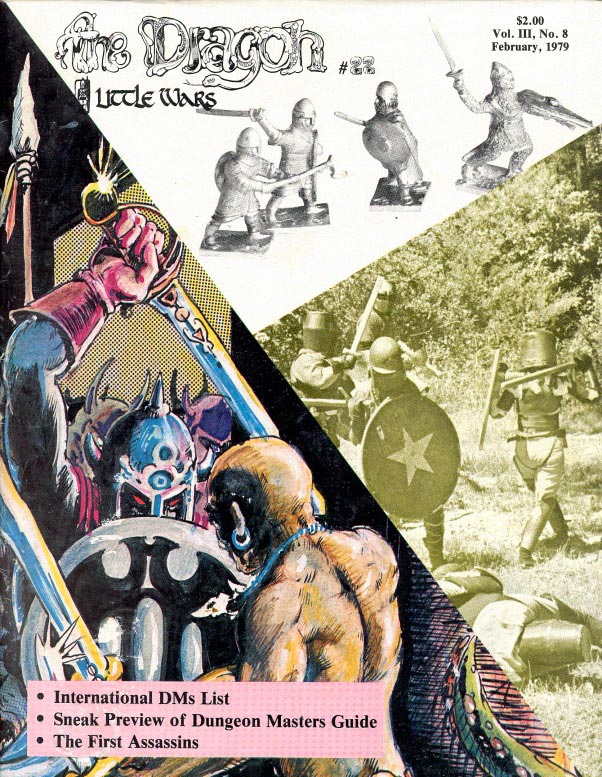
A new year has dawned, and February brings us an interesting cover combining a photo of miniatures, a photo of what I’m guessing are some SCA’ers bludgeoning one another, and an illustration of fantasy swordplay. Given that the byline on the cover is “Little Wars“, one can imagine what lies inside.

As has become a tradition of this series, the first thing I manage to fall in love with is the latest Ral Partha advert. If I’m completely honest, I’m not usually that enthused about their sculptures, but I love the names and notions. In this case, it’s the Army of Mu’ugalavya! I think it would make a good random encounter for any campaign – imagine a plane hopping army of conquerors carving out footholds on a thousand material planes.

When encountered, the army consists of the following:

1d6+1 Heavy Infantry (men-at-arms with platemail and spear)

1d6+2 Medium Infantry (men-at-arms with scale mail, shield and war hammer)

1d6+3 Medium Infantry (men-at-arms with scale mail, shield and barbed spear)

1d6+4 Heavy Infantry (men-at-arms with platemail and battleaxe)

1d6+5 Archers (men-at-arms with leather armor, longbow and dagger)

1d6+6 Slingers (men-at-arms with sling and hand axe)

General – fighter of level 1d6+7 in platemail with shield and longsword

When encountered, roll a reaction check:

Hostile – the army attempts to kill the encountered party to keep them from revealing their presence here

Neutral – the army attempts to capture the party and interrogate them about the surrounding lands

Friendly – the army attempts to recruit the party, promising them a share of any plunder they get

Our first article is The First Assassins by James E. Bruner, a study on the infamous Order of Assassins that once plagued the Middle East. The article gives a history of the organization. It’s really a fascinating story, and if applied to the assassins of AD&D (and its simulacra) would make that class infinitely more interesting. Imagine a world populated not with rangers who were mere fighters of the greenwood and assassins who were mere men-in-black with poisoned knives, but with the Numenoreans of Tolkien and the cultists Hasan Sabbah (or his simulacra) bent on overthrowing the most powerful religious leader in the known world. One should also note that the real assassins had their own level titles: In order from lowest to highest they were Adherents, Companions, Propagandists (remember, they were primarily preachers attempting to undermine the Caliphate that they may replace the Caliph with a member of their own sect), Greater Propagandists and Grand Headmaster of the Order.

The history continues in this issue with Irresistible Force – A Brief Account of the Rise of the Swiss Confederation with Commentary on Their Military Tactics by Gary Gygax (one can imagine from the title how brief the article will end up being). It’s quite an interesting article as well, and contains one of those percentile charts of the Swiss Army that readers of the old Monster Manual will recognize well. An army book like this would have been pretty cool back in the day – sort of a “Monster Manual” of ancient, medieval and renaissance armies. I’d like to produce something similar myself one of these days for Blood & Treasure.

Nick Nascati follows this up with Armies of the Renaissance – Part One. This article gives a brief overview of what is to come, with some history of the period (the great generals of the period, the mercenaries (which seem to be the inspiration for all those bandit troops led by high-level fighters in AD&D) and artillery).

Review time! This issue covers the following games (and I’ll include the concluding paragraph of each review):

Boardgame – Up-Scope!: “Still, you take what you can get. This one isn’t bad. I just wish it were better. Play it, before you buy it, to find whether you’ll love it or hate it. — Dave Minch”

Book – The Face in the Frost: “This well-written novel of strange hauntings, sorcerous conjurations, and outrageous humor can not be recommended too highly! Go out and get a copy right now, but be prepared to spend a long, uninterrupted period of time reading it, for you won’t want to put it away until it is finished once you begin!

(I concur on this one – great book)

Boardgame – Panzerkrieg: “All in all, this is a game which is every bit worth its $12.95 pricetag. Not only is the game colorful and well-done graphically, but it provides excellent play value for the money with its eight scenarios, each one a bit different from the others — and some with the Russians on defense, others with the Russians on the attack. There are some minor flaws, (more playtesting would have helped), but these are far outweighed by the game’s advantages and overall appeal. I recommend this title to anyone who enjoys the Eastern Front, or who simply enjoys a good historical game no matter what the subject. — Mike Carr”

Magazines – Apprentice #2 and Phoenix: “APPRENTICE is certainly bad, but for one dollar it is a value if you appreciate jokes. PHOENIX is worse, and no price is given. If it is free, you might wish to get it. – Gary Gygax”

(Bear in mind, this review came after the magazines in question wrote a bad review of The Dragon)

Up next is a big installment of Mapping the Dungeons, which presents DM’s and gaming groups and their addresses from around the U.S. and beyond. Not much of interest here other than the historical record of early players of role playing games, but I did like the little piece of art at the end by McLean. I love his comic pieces, of course, but I would have liked to have seen more of his serious stuff appear in old TSR publications.

Gary Gygax now chimes in with Dungeons & Dragon – What It Is and Where It Is Going. He mentions that perhaps 150,000 people now play D&D, and gives a brief synopsis of its history and the future he envisioned for it. He brings up AD&D, modules and similar material and … computers! One line I did like was this:

“It is my personal opinion that the game form is a classic which is of the same stamp as chess and MONOPOLY® ; time will be the judge.”

I think he got that one right, though the present copyright holders seem to be bent on proving him wrong.

Up next is an examination of a new game from TSR called 4th Dimension – a game that sounds like a mix of chess and Stratego that involves capturing an opposing Time-Lord on a circular board divided into variably sized spaces. Honestly – never heard of this one, though it sounds pretty cool. Here’s a link to Game Board Geek’s page on the game.

This is followed by a multi-page preview of the AD&D DMG – essentially a few pages from the magic items section and the attack matrices and a few more bits.

If anyone doubts that Gary Gygax did not appreciate negative criticism, one need only pick up this issue of The Dragon. He already savaged a couple fanzines, and now he offers a review of a review of AD&D’s Player’s Handbook in SPI’s house mag, Strategy & Tactics. A sample …

“What is worthy of comment, however, is the source of the critical commentary on AD&D being nothing more than a rewrite of D&D. Coming from an officer of SPI, the past masters of the rehash, artisans of the warmed-over WWII battle game, purveyors of the umpteenth version of the same, tired scenario, it is indeed a wonder that Mr. Berg would bring up such a spectre!”

I have a feeling these snipes probably turned more people away from D&D than the bad reviews.

Stalemate at Kassala is a play report of a war game that re-enacted a battle in 1541, when the Portuguese sent 400 infantry with 1000 stand of firearms and some cannon to aid the Ethiopian emperor Galawedos against an army of invading Egyptians and their Nubian allies. As you can tell from the title, it ended in stalemate.

Finieous Fingers then runs into “Grollem” and buys his precious ring of invisibility off him for 1,000 gp (actually turns out to be a fake sold by a hobbit in a Grollem suit), and then wanders into a dragon horde, where he discovers just how fake the ring is.

Ah – a classic article comes up next – Gygax’s Nomenclature of Pole Arms. I’ll say no more, for the truly initiated of the RPG community know all about it.

That’s it for February 1979! Not a bad issue really, especially because it reinforces the importance of history in D&D – it ain’t just fantasy folks.