Chainmailing It In

A couple weeks back, my daughter and I were chatting about games, and I realized that she hadn’t played a wargame yet. I thought at first about brushing up on the old Warhammer Fantasy Battle rules, but then decided it would be fun to use Gygax’s Chainmail rules. I’d never used them before, so it was an opportunity for my daughter and I to both learn something new.

First step – read the rules. Second step – try to reorganize the rules so I could understand them. What the founders of the hobby had in creativity they made up for with a lack of organization! In the process of learning the rules, I discovered some things about old school D&D while I also gained an appreciation for those rules. What follows are a few takeaways for those who dig the old school, and those who have never read Chainmail. FYI – I’m using the third edition rules, which I found online.

Figures in the game are divided into two sorts, each using a different combat table. The lowliest of the figurines are the regular troops. These fellows use one of two combat tables. If each figurine counts as 10 or 20 warriors, you use the mass combat table. On this table, you roll 1d6 (one dice is easier when rolling lots of dice for lots of figures), and have one of six ratings for attack and defense – light foot, heavy foot, armored foot, light horse, medium horse and heavy horse.

The closest thing in later editions of D&D to these figures is the men-at-arms, bandit (brigands), etc. In the first edition of D&D, though, these fellows show up on the character class combat tables – Men, or Men +1.

If each figure represent a single warrior, you use the man-to-man combat table. On this table you roll 2d6, with your chance of hitting based on the attacker’s weapon and the defender’s armor. This isn’t completely different than the mass combat table, but is more fleshed out – lots of weapon types, lots of armor types.

Beyond these normal warriors, you have the monsters, heroes, super heroes and wizards from the fantasy supplement. Wizards get five “levels” – seer, magician, warlock, sorcerer and wizard. Heroes fight as well as four men, and thus in D&D they are fourth level fighters. Super heroes are eighth level fighters, because they fight as well as eight men. Wizards fight as well as two men. There are special heroes called rangers – who are essentially heroes +1 (which is why AD&D rangers have two hit dice at first level).

The hero-types can attack using the mass combat table or man-to-man table against normal troops, or they can use the fantasy combat table to fight other fantasy figures. Against normal troops, heroes take 4 kills to kill, and super heroes 8.

With hero-types, you also see the origin of saving throws. Several monsters have special abilities that the hero-types can ignore if they roll above a number on 2d6.

On the fantasy table, the chances to kill are based on the type of attacker and type of defender. If a balrog is attacking a dragon, it needs to roll an 11+ on 2d6 to kill it. The dragon needs a 6+ to kill the balrog. Elves and fairies use this table (sort of) if they have a magic sword. This suggests that the inability of some monsters to be damaged by anything other than magic weapons or monsters with lots of Hit Dice originates here.
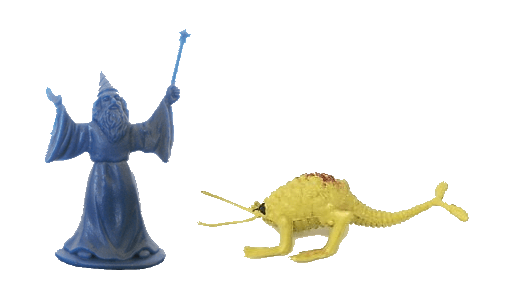
You better leave this one to me guys

OD&D Chainmail Style

If we were to carry these rules over to D&D, we would find some interesting changes. Combat between humanoids would pit weapon versus armor, not attack bonus vs. Armor Class. PC’s above first level would dominate lesser foes by the number of hits it takes to kill them, and by the number of enemies they can attack. This is an important point that often gets  lost in later editions. Melee rounds are one minute long. The number of attacks a figure gets are not a representation of how many times he can swing a sword during the round, but rather an abstraction of the number of potential chances he has to inflict damage on an opponent.

In mass combat, hero-types and monsters can attack multiple targets, but not necessarily make multiple “attacks” against a single target. This is reinforced by the fact that in fantasy combat, pitting heroes and monsters against one another, the entire combat is resolved with a single attack roll by each combatant, and no multiple hits are required to kill – it’s just one and done.

Bringing this concept into D&D could be interesting. A monster with two claw attacks and one bit attack can use them to attack three foes, but can only use any one of these attacks against a single figure.

Levels

The fantasy combat table does include the concept of improved attack ability, even though the mass combat table does not. For example:

Figure Wight Giant Dragon Balrog
Hero 6 11 12 11
Super Hero 4 9 10 9
Wizard 6 11 9 7

This table shows the target number (equal to beat) on 2d6 a figure needs to destroy the listed foes. Comparing the hero to the super hero, you see the super hero effectively gets a +2 bonus on his attacks. This translates into different percentage increases due to the nature of rolling 2d6, as opposed to 1d20. It averages out to a +25% bonus across the board (including monsters not on the table above), or a +5 bonus to hit on 1d20. Interestingly, the wizard attacks wights and giants as well as a hero, but is better than a super hero at defeating dragons and balrogs.

Improvement in “level” is more obvious for wizards in Chainmail than for heroes/super heroes. There are the five levels of magic-user, from seer to wizard. In D&D, seer is a title for 2nd level magic-users, magician for 6th level, warlock for 8th level, sorcerer for 9th and wizard for 10th.

With each level, you gain more spells, a greater range for your spells, and your chance to successfully cast spells increases. Yes – chance to cast spells. Spells come in six compexities, with a target number that must be rolled on 2d6 for the spell to happen immediately. Failure by 1 means the spell goes off in the next round. Failure by more than 1 means the spell casting fails completely.

When Chainmail became Dungeons & Dragons, they combined the idea of improved attack ability from the fantasy combat table with the multiple attacks/kills concept in the form of Hit Dice/hit points. The weapon vs. armor idea survived in AD&D as the weapons vs. Armor Class table that most of us ignored as kids, and as the combat system used in Gamma World.

In retrospect, the introduction of levels (and experience points) was a very cool idea, bringing a facet to the game absent in Chainmail. Rather than just being a “hero” wandering around a dungeon looking for treasure, you got to play out the building of a legend, from humble origins as a man-at-arms to eventual super hero status. That innovation is probably what helped build Dungeons & Dragons itself into a legend.

Doctors and Spies

In the process of plotting out a post about TV and film spies, with stats for the old James Bond RPG, I got to thinking about the succession of actors who played James Bond, which in turn got me thinking about the succession of actors who played the Doctor. I wondered about the timing, so I put together a timeline of the two franchises and found that their classic periods match up almost perfectly.

Please enjoy this little retrospective of Bonds and Doctors, as they regenerated through the years … including a couple who snuck in from alternate timelines!

1962

The film journey of James Bond begins in 1962 … not counting the American Jimmy Bond of the C.I.A. that showed up in the mid-1950’s on American television. Rugged Sean Connery took the role of the super spy, who started life a little bit more grounded, but ended Connery’s reign with the crazy gadgets and super-cars (not to be confused with Super Car) firmly established in the Bond universe. Connery’s Bond is the ruthless assassin of the novels. He appreciates the material pleasures, and keeps an emotional distance from others, as one might expect from a person in his position. Fortunately for Bond, Connery had an undeniable charisma on the screen, so we like the secret agent more than we probably should.

1963

A year later, we get our first glimpse of the wonderful TARDIS and its pilot, the Doctor, played by William Hartnell. Hartnell had a career in crime movies, and so brings a little subtle menace with him to the role of the mysterious Doctor. I remember reading somewhere that the show was intended to teach children about history … and then I found out the Daleks showed up pretty early in the series and realized that any history education kids were going to get was probably incidental.
1965

It’s really early on our journey, but we’ve already reached a fork in the road. In 1965, a non-BBC movie version of the good doctor appeared in the form of Doctor Who and the Daleks, starring Peter Cushing as the Doctor. Well, actually, starring Peter Cushing as Doctor Who, for that is how he was addressed. The movie is not in continuity with the TV series, despite the name and the presence of the Daleks, but it is kinda fun. The sequel was not as good. Still, I love the idea of Peter Cushing as an alternative First Doctor … maybe we should invent an alternative timeline of Doctors regenerating from Cushing?

1966

Hartnell’s time as the Doctor was to last only three years. Here’s where the creative team did something extraordinary. Instead of just replacing the lead actor, they regenerated him into somebody new and also the same. What a concept. Patrick Troughton steps into the roll of the Doctor, and brings with it an irrascible energy and vigor that I personally love. I really wish more of his series survived the BBC’s cost-cutting measures. My daughter and I call him the Angry Doctor (or sometimes Doctor Moe), and we both love him.

1967

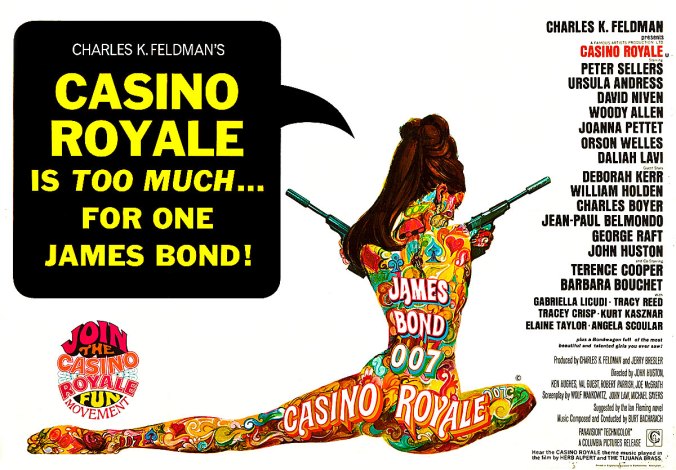
In 1967 we make our second detour from “canon” with Casino Royale, a weird little parody of the series starring Peter Sellers, Woody Allen and, as the real James Bond (I think – it’s an odd film), David Niven. Had the Bond film franchise started in the 1950’s, Niven may well have played the roll. The movie didn’t do much for me, though I always appreciate Niven, and it had both an awesome movie poster by Robert McGinnis and a great theme song.


1969

The Doctor’s first regeneration is followed three years later by Bond’s first regeneration, with George Lazenby taking over for one film to very mixed reviews. Lazenby’s bond was a departure from the formula. Where Connery’s Bond was a more emotionally distant, Lazenby’s Bond gets married in the film to Contessa Teresa di Vicenzo, played by Diana Rigg. This was faithful to the novel, but would not be repeated in the series for many years. Lazenby’s tenure was followed two years later by one more outing for Connery.

1970

The Third Doctor appears three years before the Third Bond, with Jon Pertwee beginning his celebrated tenure as the Doctor. Pertwee’s Doctor struck me as a bit less irrascible than Troughton’s, but still testy. This is also our first Doctor in color … big, bright, beautiful color. There’s so much right about this run. It was the first run of Who that I saw after I started watching the Tom Baker years, and I wasn’t sure at first that I was going to like it, but I really did.

1973

Just as many people associate the classic Doctor with the actor who had the longest tenure in the roll (just wait a minute, he’ll be along any time now), I think my generation probably associates Bond with Roger Moore. Yeah, when we got older, Gen X took the tack that Connery was cooler because he was more serious yadda yadda yadda … but in our hearts we loved Roger Moore. Moore would spend 13 years as James Bond, and though he started off the cold, dashing assassin you would expect, his own more jovial personality ultimately took over. I love camp, so I have no problem with thus, though I totally understand those who don’t like it.

1974

As the longest Bond tenure was gettig started, the longest Doctor tenure arrived a year later. Tom Baker‘s run was similar to Moore’s run as Bond, starting out with a beautiful alien menace and growing more campy as they years went on. Again – no problem for me. I adore Baker’s Doctor, and he is without a doubt my favorite. He also had my favorite companion in the form of Lela. No, not because of her outfit, but because while the Doctor was figuring out a virtuous solution to a problem she was pulling a knife and saying the obvious – let’s just kill the bad guy. That was a great counterpiece for the Doctor.

1981

Roger Moore would survive into the 80’s as Bond, but Baker would hand over the role of the Doctor to Peter Davison. I’ll state it up front – I dig Davison in the role. He had a daunting challenge ahead of him taking over for the beloved Baker. I’ll also state, frankly, that I don’t like most of the serials he played in. The writers didn’t give him as likeable companions (again, this is no slight directed towards the actors, who were great), and the stories didn’t always thrill me. Still, there was some good stuff there, and I think Davison should get more credit than he does. I do think, though, that the franchise at this point was losing steam … the assumptions on which it was built were shifting under its feet; and honestly, the Bond franchise was in the same boat.

1984

The Roger Moore Bond era would be rounded out in the Doctor Who franchise by Colin Baker. Baker’s doctor was a return to the earlier menace of the Doctor’s alien mind, and maybe more so than any other doctor he has a severity that is shocking when compared to the wise fool played by Tom Baker. They say that Colin Baker wanted a more updated look for his Doctor – something not unlike that of the ninth incarnation, but instead the designers tried to catch lightning in a bottle with something more reminiscent of the fourth Doctor.

1987

Roger Moore was 58 years old when he made A View to a Kill, and was ready to retire. The rumors started swirling that Remington Steele’s Pierce Brosnan was going to be Bond. Cool! Loved Remington Steele, and who better to take over for Moore than Brosnan. This is going to be so great, I can’t wait until … Timothy Dalton? Huh?

Well, when Remington Steele’s producers decided on one more season, Brosnan was out, Dalton was in, and I wasn’t sure what to expect. Still, I was the right age for going to the movies with friends, and that poster for The Living Daylight was certainly enticing, so why not. Folks – I loved The Living Daylights, and was totally down with more Dalton as Bond movies. It wasn’t a complete departure from Moore, but a younger Bond was nice, the movie had some great action sequences and it was a nice return to a bit more realism in the films.

The Fourth Bond was going to be okay, but what about the Seventh Doctor? The first time I watched a Sylvester McCoy serial I was still high on watching Tom Baker, and I wasn’t so sure about this guy. When I got the chance to watch more of them on Retro TV, I found that I really liked McCoy in the role. The angry edge was gone, the tone was sometimes lighter and perhaps more manic, and I really looked forward to more. I think McCoy’s run reminds me the most of Tom Baker’s, so I guess it’s no surprise that I like it. But alas, after three years, the magic was fading and there would be no regeneration for the Doctor. He just faded away …

1995/1996

Or did he?

Are the Eighth Doctor and Fifth Bond part of the classic era, or a bridge to the reboots? Hard to say. There was a five year gap between License to Kill and GoldenEye, and a six year gap between McCoy’s final outing as the Doctor and the short-lived attempt to revive the franchise with Paul McGann. New creative teams, a new 90’s attitude (I was there, it sorta sucked – I think I prefered my tenure in the 80’s). Still, there was excitement and hope for the new series, and that’s always good.

Personally, I was super-hyped for Brosnan’s Bond. I’d been waiting for him to take over the roll for a long time, and was really looking forward for a good, old fashioned James Bond spectacular … but I really didn’t care for the movie. It was like they were trying to recreate by committee something that was born organically in the 1960s. The movies were certainly popular, but for me, Bond shifted into something I loved in the past from something I was going to watch in the present.

My experience with Doctor Who was different. As an American kid of the 70s, I’d never heard of the franchise (though I had an aunt who cosplayed at a convention as Lela! – didn’t find that out until just last year). I was too late for the showings of Tom Baker’s Doctor on PBS. I remember seeing pictures of him in Dragon Magazine ads, and being kinda meh about it. It wasn’t until the 2010’s that I finally got to see the series, starting with Tom Baker, and fell in love with it. I still haven’t seen McGann’s Doctor, so I can’t really say how it holds up with the past. Others will have to weigh in on the Eighth Doctor’s place in the classic vs. new debate.

So we reach the end of our journey – 1962 to 1996, more than thirty years for two solid and fun franchises. We all have our favorites – feel free to share yours in the comments … and no, we don’t need to hear about who you hate.

The 90s Syndicate

It was 1987, and I was super excited in the cereal aisle at the grocery store. This was not uncommon in childhood, of course – it just took an awesome prize in a box of sugar goodness – but I was a teenager in ’87 and the excitement was due to an ad for something called Star Trek: The Next Generation on the back of a cereal box. This was my introduction to the show, and I remember telling my dad – the source of my Star Trek love – about how cool it looked, with a new ship, new crew … and that there was going to be a klingon on the Enterprise!

Back in the 80’s, syndicated TV was mostly the domain of game shows like Wheel of Fortune until Star Trek: The Next Generation showed up. I remember that it was a big story when The Next Generation managed to beat Wheel of Fortune’s ratings. Fast forward 30+ years, and though I’m sorry to say the show doesn’t do much for me these days, I am thankful for the syndicated TV goodness it helped spawn.

The syndicated shows of the 90’s almost never had as much budget as they needed, but they were all cool and creative. Because of the time in which they were made, they have a distinct look that I suspect really triggers good vibes for many Gen-X’ers.

Here are a few of my favorites – check them out if they’re new to you, or renew an old friendship if you remember them from way back when:

The Flash (1990-1991)

Not syndicated, but I sorta wish it had been after it was cancelled. We’ve been watching these lately, having scored a super cheap DVD set of the complete series at Zia Records, and I must say I’m enjoying them. The show was far from perfect, but it had some great moments and I genuinely like the people in it. The sad thing about Flash is that it only made it to TV because of the success of 1989’s Batman, and as a result ended up with a Danny Elfwood score and an awkward aesthetic borrowed from Batman and Dick Tracy. The style just seems out of place to me, and though it doesn’t ruin the shows, it doesn’t help them either. On the other hand, it’s full of absolutely beautiful mid-century cars, so that’s pretty cool. The Flash costume was a little jarring as well, but c’est la vie.

We were watching some of the new Flash episodes, but gradually got out of them when they did the stupid time travel bit for the umpteenth time. I really loved see Shipp reprise his role in the series, though.

Oh – and who doesn’t love Amanda Pays? So smart and cool – on Flash as well as Max Headroom. She did a fun guest appearance on Psych as a date for Corbin Bernsen’s character on the series, which is another family favorite.

I think my favorite Flash episode is “Beat the Clock”, which has a pre-What’s Love Got to Do With It Angela Bassett, and good performances by Ken Foree and Thomas Mikal Ford.

Highlander: The Series (1992-1997)

In my normal backwards way, I discovered this show way before I saw the movie … and if I’m honest, when I finally saw the movie I preferred Adrian Paul to Christopher Lambert as the immortal. I think it was that darn overcoat they had him wearing in the movie – looked like it belonged on Harpo Marx. I did enjoy introducing my daughter to the Kurgan, though, and then revealing he was the voice of Mr. Krabs.

Being a history-buff, I loved all the past lives of Duncan McLeod. I think I enjoyed the stuff set in the past more than that set in the modern day. I remember being super-jazzed to see Roland Gift from Fine Young Cannibals and Roger Daltry in some episodes. Highlander really had some legs, but I didn’t stick with it all the way to the end … by 1997 I was married and about a year away from having a kid, so life sort of got in the way. Still, the awesome opening will always stick with me. God bless Freddie Mercury!

Friday the 13th: The Series (1987-1990)

Okay – this series sort of screws up my premise that Next Generation led the way with cool syndicated shows, since it was also first-run syndication and showed up at about the same time. Oh well – it’s my story and I’m sticking to it, facts or no facts!

I don’t have a long-term relationship with the horror genre. I was never into the Friday the 13th movies, or really any contemporary horror movies in my youth. I didn’t grow up with that stuff, so all the blood and guts and shock horror really freaked me out. Classic Universal horror movies I could do … but Leatherface, Jason, Freddie, Michael Myers, flesh-eating zombies, etc. – no sir. Not my cup of tea.

That’s why I don’t know how I ended up watching Friday the 13th: The Series. It has almost nothing to do with the movies – I might remember there being some tiny thread connecting them, but I’m not sure. The premise – which would work beautifully for a horror RPG campaign, is as follows:

Lewis Vendredi made a deal with the devil to sell cursed antiques. But he broke the pact, and it cost him his soul. Now, his niece Micki, and her cousin Ryan have inherited the store… and with it, the curse. Now they must get everything back, and the real terror begins.

It now occurs to me why I started watching it – Louise Robey as Micki. She was pretty darn cute. Still, it was the show’s concept that got me to stick with the show. Each week, a new evil artifact was introduced and off the two leads went, trying to bring it back to the shop to end the curse. It was much more in the vein of Outer Limits than gory 80’s horror movies. I remember it fondly, and should really check back into it.

She-Wolf of London / Love & Curses (1990-1991)

Originally titled She Wolf of London, I caught one or two of the later episodes when it was renamed Love & Curses , and always wanted to see more. A bunch of them are posted on YouTube (how do they not get fined a billion bucks a year for aiding and abetting copyright violations?), but I’m happy to say I picked up the entire series on DVD last week for $12 – sweet price, even I end up not liking them much.

In this series, a woman named Randi Wallace (played by Kate Hodge) who travels to England to study the occult is attacked by a werewolf on the moors and becomes a lycanthrope. Her companion, Professor Ian Matheson (played by Neil Dickson), helps her deal with her curse while they run around encountering all sorts of supernatural evils and stuff. I love good, old fashioned episodic TV with fun characters.

Love & Curses could be a good set-up for a campaign as well, with one PC having a werewolf curse (or something similar) and the others having to survive dangerous adventures AND their dangerous friend.

And yeah, I had a thing for Kate Hodge as well …

So what 80’s/90’s syndicated stuff do you remember loving? Let me know in the comments – remember, sharing is caring!

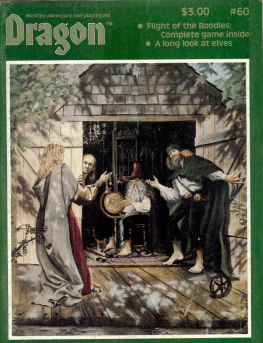
Dragon by Dragon – April 1982 (60)

I don’t know about the rest of you, but things have sure been stressful lately. I’ve been working hard and praying for peace, and trying to relax with old TV shows, old movies and some podcasts about fun things. I will readily admit that my interests tend towards the old – movies from the 30’s and 40’s, TV from the 60’s through 80’s, “bronze age” comics, old games, etc. There’s something about the design and awkward charm that really get me, not to mention nostalgia for places and people I’ll never see again.

To that end, before I present the wonders of Dragon Magazine #60, I must say goodbye to an old family friend. When I went over to my dad’s house to help work on his patio this week, he let me know that the old Panasonic microwave had finally radiated its last cup of tea.

We bought the microwave back in 1980 (two years before this particular Dragon magazine was published), and I still remember where the shop was, though it’s long since been replaced. It was my parents’ first and only microwave oven. I don’t have any deep emotional attachment to the item, really, but I was rooting for it to stay operational forever. Still, 40 years is pretty damn good for an appliance.

So, farewell Panasonic – I learned to cook hot dogs in you, enjoyed chocolate candy my mother made in you, consumed waaay to many Tony’s microwave pizzas heated by you in my formative years (as in “forming a husky body”) and found about 20,000 cups of water placed in you for heating and subsequently forgotten by my dad. Salute!

Now – to Dragon Magazine. This baby was published in 1982 – so it is still prior to me discovering D&D, which would have been 1984. I don’t remember ever checking this one out from the library, so the contents are new to me – and as always, this is less a review than a “here’s what I dug about this issue”.
We start with an ad for a video game called Temple of Apshai. No memory of this one, but I do agree with their sentiment about slaying monsters. It came with a 56-page “book of lore”, which reminds me of the old Ultima and Might & Magic games that I had. Ultima had a cool cloth map (a tapestry, you know), and M&M had a book with all the spells and stuff in it. A little perusal of the interwebs reveals it was part of a trilogy, and that there are many places to download/play it, including the good old Internet Archive.

Nerd alert:

Dear editor:

There are a couple of problems with Robert Barrow’s article, “Aiming for Realism in Archery,” in issue #58 of DRAGON™ Magazine. From my standpoint, it seems that the good author spends too much time with modern archery and has read nothing of medieval history dealing with the subject.

I mean, the writer of that missive is probably correct … but jeez – can’t I just roll 1d20, maybe do some damage, and move on with my life. I’m not sure there’s any real value to re-creating an historical battle, but I’m positive that re-enacting a fictional fight with some orcs is positively goofy, to quote Jan Brady.

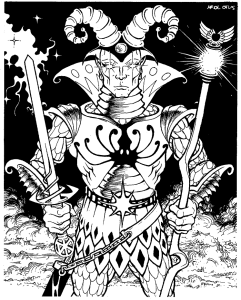
The first big piece in this issue is “All About Elves”. You get Roger E. Moore’s “The Elven Point of View”, with super cool Erol Otus art – the ultimate elven fighter/mage. I really dig the idea that only elves can be fighter/mages. There are, of course, lots of cool ideas in the article – Roger E. Moore is one of my favorites. Roger and Georgia Moore then present the Elven Gods – these are the additions to the pantheon beyond Corellon Larethian in Deities & Demigods. These days, I’m more apt to make up my own, but as a kid, articles like this were eye-openers to me. Notions I didn’t know that I didn’t know.

Speaking of elves – here’s a question from Sage Advice:

Why are elven thieves always children?

Anyone who has a relatively recent edition of the Dungeon Masters Guide will probably think this question doesn’t make sense. The latest edition of the DMG lists 100+5d6 as the starting age for player-character elven thieves (page 12). This puts them into the “young adult” range according to the Age Categories chart (page 13) for high elves — the only kind of elves who can be player characters. However, it wasn’t always so. Earlier editions of the DMG gave 50+5d6 as the starting age, which would indeed mean that all elven thieves would start their adventuring lives as “adolescents” of 55 to 80 years old. Fortunately, this inaccuracy was spotted and corrected in later editions; anyone with an old book can simply make the appropriate change in the text.

Who else likes the idea that only elven teenagers become professional thieves? Sometimes, the “mistakes” are more fun and more inspirational than the corrections.

We also get the “Half-Elven Point of View” by Roger E. Moore to round things out.

Gygax’s “From the Sorcerer’s Scroll” is a big load of cantrips. AD&D cantrips were 0-level spells before later editions pumped them up and made them more useful. I think it would be cool to make these available to non-magic-users on scrolls. Most of these cantrips require the player to really use their imagination and creativity to make them useful in a dungeon adventure – so naturally, I love them.
I’ve mentioned this before, but I absolutely love the illustrations some companies used to illustrate the miniatures they produced. They always look cooler than the actual miniatures, and I just think they’re little works of art.

Ed Greenwood has an article on firearms for D&D which is aptly named “Firearms”. A semi-controversial subject, since Gygax went the direction of “gunpowder doesn’t work in a fantasy world” and many adopted that idea. As with so many articles in these days, it’s pretty thorough, and looks to me like it would blend nicely into the game. Handguns, for example, do 2d3 damage, firing every other round, with a max range of 50 – so they aren’t going to dominate the game. It might be a cool idea to use orcs in the way Tolkien did, as harbingers of the soulless machine age, and arm them with gunpowder weapons, while the heroes use the “elegant weapons of a more civilized age.”

I often include the first paragraph of short stories in Dragon, so here’s a sample of “Wear Wolf” by an unknown author:

The head of the Cheetah seemed to smile mockingly at me. You’ve forgotten something, I could almost hear it say. I resisted the urge to answer back, But I always forget something when I’m late. There are enough aFnimate objects to talk to; talking to inanimate ones is a waste of time.

Dragon #60 includes a complete game – Flight of the Boodles – by Chuck Stoll of Louisville, KY. It recreates the epic journey of the boodles through the “Grumjug-infested passes of the Snagrock Mountains”. The art makes it look like a fun game to me. The map and counters are included – with a little work you could probably recreate them in a cleaner format and print them out to play the game. Each player takes the side of the Boodles or Grumjugs, purchases the pieces they are going to use in their force, and then goes at it, the Boodles trying to break through the mountains and the Grumjugs trying to stop them. Basically – a fun little wargame.

This is an April issue, so April Fools Day jokes was a requirement. In this issue we get one pseudo-joke – the Jester NPC class by Roger E. Moore – who had some thief abilities – climb walls, pick pockets, catch objects – and some jester spells (levels 1 to 8). The spell list is not extensive, but the spells are pretty darn good. I think you could do a great campaign where a hidden evil threatens a kingdom, and the evil in question is a high level jester who wants to sieze the throne for his own, or maybe who is trying to spread chaos for the chaos gods.

Roger Moore also does “Midgets in the Earth” – a comical version of the usual “Giants in the Earth” articles presenting D&D stats for literary characters. This one gives you the likes of Eubeen Hadd, 20th level halfling thief, and Morc the Orc, 12th level snaga orc idiot. The Dragon’s Bestiary follows up with monster stats for Donald Duck by Tom Moldvay (which could work well in RuneQuest-inspired games) or any game where you’d like your PC’s to get whooped by an angry duck, the Tasmanian Devil by Steven Sullivan, the Jolly Green Giant by Michael Nystul (name sounds familiar), Marvin the Martian by David Cook (which one could use as the basis for a whole planet of martians in a cosmic adventure), Baseball Bugbears by Karl Kesel and Tom Richmond (probably a reference to the Bad News Bears) and the Werebeaver by Jeff Goetz (which looks suspiciously like Jerry Mathers). They’re all joke monsters, but all usable as well.

To follow up on the April levity, you get an in-depth article on the Pooka by Michael Fountain. I’ve seen many takes on this monster, which would take some real skill to make work in a game, as there’s such a big emphasis on illusion.

You also get some background stuff for agents in Top Secret, some variant scenarios for Trojan War and a big article on Alignment (since it’s the 80’s and there were many articles on alignment).

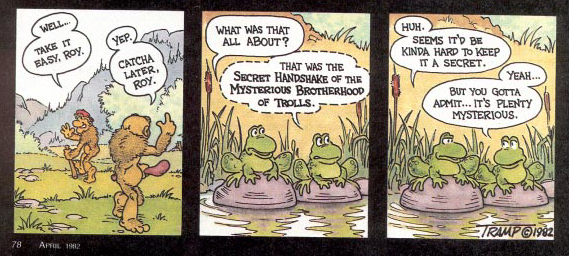
“Wormy” by Dave Trampier presents the secret handshake of trolls … which, of course, I cannot show in all good conscience.

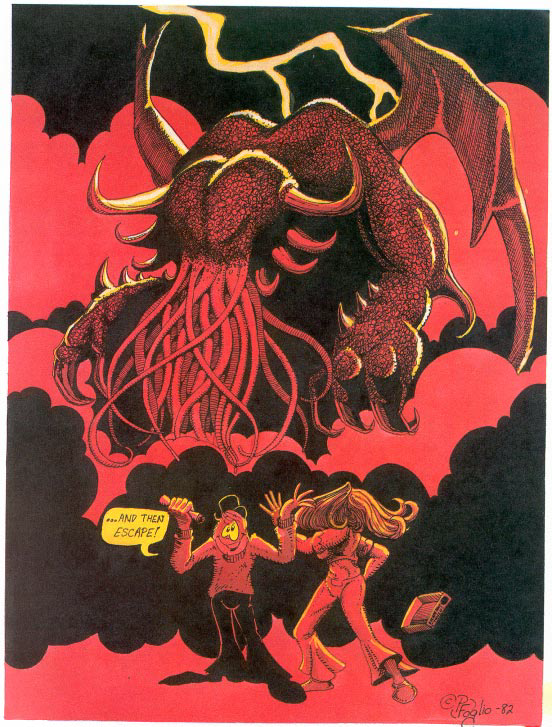
“What’s New with Phil and Dixie” by Phil Foglio looks at minigames, including one called “Escape from Cthulhu” that just includes a short incantation …

And a tall order!

Fare well, lads and lasses, and find some love and happiness amid all the troubles of the world. Better yet – be the love and happiness in a troubled world!

Buried Treasure

In my youth, I thought he really did speak in word bubbles

Folks who regularly read my blog will recall my “timely reviews” of old games. I love old games (which reminds me – review of the Six Million Dollar Man coming soon), sometimes for the nostalgia, sometimes for the design, and sometimes for the discovery value. When it comes to buying old games, there are two different kinds of discovery.

The first, of course, is discovering a new system and new ideas about how to simulate whatever the game is trying to simulate. Even simple games meant for children can have clever ideas in them. The old game I just recently bought does not offer that kind of discovery, because it’s a game I used to own. Well, sorta.

Our old logo was a rip from the NFL Vikings – this is the new one

Back in 9th grade, in which I was technically a freshman at Valley High School (Valley Vikings Rule!), but was still being taught at Cannon Junior High (it was how they did things back then), there was a small corps of gamers (meaning role-playing gamers … everyone played video games back then, so they didn’t get a special designation) at the school, and we all knew each other. I remember a friend named Irfan who carried a briefcase to school so he could screen from the teacher that he was reading the AD&D Monster Manual in class – very smart guy, as well, got way better grades than me – so it was that sort of group.

At some point, a new kid in school discovered that I ran D&D games, and he wondered if I would run a game for him. The kid in question was new to town – I got the feeling that he moved around alot – so he didn’t have any friends in school. He lived close to the school, so I went over to his house one day to see the game he wanted me to run. It was something new.

It turned out to be the Marvel Superheroes RPG. Well, it also turned out that he had a big box full of old Playboys, which is another story, but this MSH game and the Secret Wars module he wanted me to run was the point of the visit and it was intriguing. Beyond the Spider-Man bits on the Electric Company, the Super Friends and Spider-Man and his Amazing Friends, I knew nothing about comic books. I had a few war comics, but that was it. This was all very new to me.
The kid lent me the Secret Wars booklet, and I had my first introduction to the likes of Storm (in her 80’s punk phase, which is still my favorite) and a host of other characters. It got me interested in comic books, and I remember the next time we were at a 7-Eleven I convinced my dad to buy me a comic book – a slugfest between the Avengers and the Hulk, so it had tons of characters in it, and it made me a comic book fan. The same way D&D got me into reading  the Lord of the Rings, the Marvel Superheroes game got me into comic books. I do everything back-assward!

My first ish – Hulk #316

Naturally, along with reading comic books, I also got my own copy of the game – the advanced version! The kid in question moved away before I could even give him back the Secret Wars booklet, so I had that for years in my own advanced game set. Some time in the late 1990’s I gave virtually all my RPG stuff away to some friends. When I got back into gaming later, it turned out they had kept most of it, and I got it back … but not the Marvel game. Somebody claimed that beauty.

Recently, my daughter, who digs the movies and has an interest in the comics, found out about the game and wanted to play it, so I went looking for a copy and … WOW! I made a huge mistake giving that sucker away – copies are so expensive these days! Fortunately, last week I found a copy of the basic game at a reasonable price and snapped it up. It arrived yesterday, and this is where the buried treasure comes in.

As I perused the contents, I found some old character sheets filled out by the previous owners. The first one was for Wolverine, but the next was for an original hero created using the game rules. I love that kind of find. It made me wonder who the old owner of the set was … and a few pages more, I found out. It turns out that the owner not only filled out the application for the RPG Association but never sent it in (me to), but also weote a letter asking some questions about how Wolverine’s powers worked, also never sent, with his name and address on it.

It was fun reading the letter, because it reminded me of myself back in the day – a wide-eyed geek trying to wrap his head around these games and things that were so new to me. Going back in time like this is nice. The times really weren’t any simpler then than now for adults, but my life was much simpler as a kid. I miss the people I’ve loved and have lost – friends and relatives – and although I cannot get them back, looking through old games and books and photographs sparks cherished memories of them and makes me happy … a bittersweet happiness, but happiness just the same.

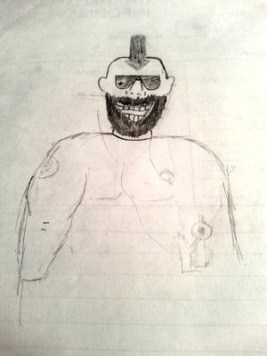
Now, I present a forgotten superhero of the 1980’s, discovered in a beat-up old game box and created by a person whose name I will not reveal (but who I think I found with a search on LinkedIn) … Spazmo Joe! Maybe his creator will come across this, and it will bring back some happy times. I sure hope so!

SPAZMO JOE … of SHIELD!

Fighting: Excellent
Agility: Remarkable
Strength: Remarkable
Endurance: Amazing
Reason: Excellent
Intuition: Remarkable
Psyche: Good

Health: 130
Karma: 30

Known Powers: Extra attacks, Weather control (Amazing)

Talents: First aid, law enforcement, guns, special weapons, martial arts

Special Devices: Plasma gun, 30-cal machine gun, mandarin armor (at least, I think it says mandarin)

And yeah … there was art!

Is that a SHIELD-regulation haircut?

‘Nuff Said!

For Your Viewing Pleasure

Hey folks! I missed the last couple weekends because, frankly, I’ve been busy as a one-armed paperhanger lately. I work in economic research in commercial real estate, so you can imagine that the business closures over the last few weeks have made for a very interesting (to use a very nice word) business environment. We don’t have much economic data to plow through yet, but I’ve been writing numerous articles for my people to help them better understand the situation. As a result, I needed a couple weekends away from  writing.

But now I’m back … with a pretty easy post to write. Today, I’m going to direct your attention to a few old shows I’ve found episodes of on Youtube. You might already have seen them, but they were new to me, and I found them fun. This isn’t a RPG post per se, but half the challenge in running RPGs is finding new sources of inspiration – hopefully this post will give you some ideas you can use, especially for modern games.

Sapphire & Steel

A British sci-fi show that ran from 1979-1982, I can only say that the vibe of the show is a little bit X-Files and a little bit Doctor Who … and that that description is completely worthless in describing this show. It’s really it’s own animal. The show stars David McCallum and Joanna Lumley, and the concept is sort of bizarre. They are agents, who might actually be personified elements, sent to contain weird distortions of time that are trying to force themselves into the normal time stream. I love that they are very circumspect, at least in the first series, of explaining just what the heck is going on, but the show is creepy and wonderful and McCallum and Lumley are excellent in it. I dug the show so much that I hit Zia Records and ordered the complete series. By the by – if you’re looking for cool stuff, sometimes pre-owned, I suggest Zia. I absolutely love going to their stores and browsing, but right now their online ordering is all I can do.

Zodiac

Another British show, Zodiac ran in 1974, and thankfully has nothing to do with the Zodiac Killer. This show stars Anouska Hempel as an astrologist who helps her paramour, a detective inspector played by Anton Rodgers, solve crimes. It’s not a bad mystery show, really, though it’s more in the vein of the shows, like Columbo, that showed you who the villain was at the beginning, rather than letting you figure it out along with the detective. I dig it because it comes from that mid- to late-70s period when things like UFO’s, astrology, psychic powers and big foot gained a weird legitimacy in popular culture – not as elements of speculation, but as things that were on the cusp of being made matters of fact. If you’re my age, you probably remember watching In Search Of, with Leonard Nimoy (I don’t mean watching the show WITH Leonard Nimoy, whic would have been great fun, but rather … oh never mind).  In Search Of was dedicated to pushing pseudo-science over the goal line into the realm of main steam science, and I really love that old vibe. Zodiac does the same, and I’ve had fun watching a few episodes.

Burke’s Law

A wonderfully weird show from 1963-1966. I’ve only seen the early episodes, which follow Captain Amos Burke (Gene Barry) of LAPD homocide and his lieutentant and sergeant solving murders. The twist is that Burke is a millionaire – I think he inherited it – who shows up at the crime scene in a chauffeur-driven silver Rolls Royce, and that the suspects are all pretty eccentric, not unlike the Emma Peel-era episodes of The Avengers. I also love that they re-use actors from episode to episode in different rolls, kind of like using a troupe of favorites. It’s a weird show filled with crazy characters, beautiful women and tangled cases that are fun to solve along with Burke. On a side note, one episode has Barbara Eden in essentially a genie costume showing off her belly button. Apparently just a few years later that was going to be a problem for prime time TV.

So there you go folks. If you were running low on things to watch, now you have some new old shows to check out. Up next, I present some stats on a few heroes of myth and legend – a little preview of my Gods & Heroes book. Have fun!

Welcome to the Jungle

Hey folks, sorry I’m a little late with this post – I managed to finish writing a game yesterday and I’m about 80% through with another one, so I assure you I wasn’t goldbricking.
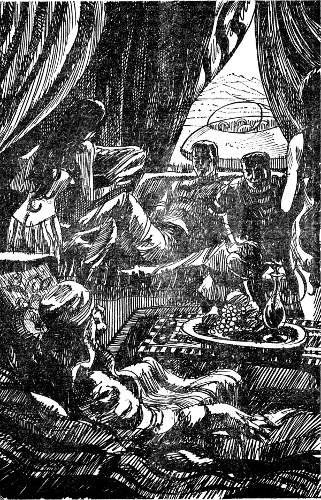
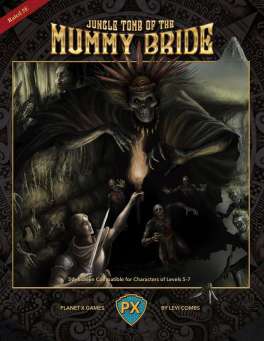
Tonight, I have a review for you of an adventure called Jungle Tomb of the Mummy Bride. It’s a cute little descent into a green hell crawling with the walking dead, written for 5th edition rules but nasty enough to work for all of us old schoolers out there.

The adventure is written by Levi Combs, with art by Adrian Landeros, Karl Stjemberg and John Russell. It is published by Planet X Games – you can find a copy HERE.

The adventure is designed for a party of 5th to 7th level characters, and includes the main adventure book, a book of treasure maps and a player pack. The art and presentation are great, the layout clean and readable and the book is well organized.

While I can’t comment on the adventure from the perspective of the 5th edition rules – as in the encounters being balanced, etc. – I can say that I think the adventure would work well with old school games. You have a nice set of rumors, a wandering monster list, and plenty of monsters and treasure. With a little conversion work, a few clerics and lots of holy water and flaming oil, the adventure should work just fine.

For $11.00, you get three levels of dungeon and a jungle village to explore and pillage. Monsters include bad ass devil frogs, big ole’ snakes, cannibals, giant vampire bats, gouge-eyes, idols of ill-omen, insidious jungle creepers, mushroom men, purple worm hatchlings, pygmy juju zombies, shambling parasitic SOB’s and, of course, Mazaliztli, the Mummy Bride! In the Player’s Pack you get “Twenty Forgotten Demi-Gods, Queer Quasi-Gods and Utterly Terrible Demons”, “7 Eternally Evil Chants and Diabolical Incantations Overheard at a Summoning” and a few other equally wonderful random charts. The character sheet that is included is absolutely wonderful – I wish I had one for OD&D!

Check it out folks … if you dare!

Space Cowboy Diplomacy

Retief and the Aga Kagan by Jack Gaughan

When you’re a pop culture archaeologist – ignoring the new to dig through the old – you often have that moment when you discover something that’s been around for decades, and which many others probably already know about. Still, it’s new to you, and thus a fun revelation you want to share. And so I present my latest old discovery – Jame Retief.

I was thumbing through some old issues of Worlds of IF on Project Gutenberg, and came across a story titled “The Madman from Earth” by Keith Laumer and decided to give it a read. Boy, was it fun. Then I looked at Wikipedia, and thought, “Well, I guess I’m late to this party.”

Mr. Laumer was a former officer in the U.S. Air Force and a diplomat in the American foreign service. Both of these jobs contributed to his satirical take on the exploits of Jame Retief, a rebellious diplomat in the Corps Diplomatique Terrestrienne (CDT), an organizations of bureaucrats and lick-spittles doing everything in their power to sponge off the galactic taxpayer while doing as little work as possible. Puffed up, arrogant and duplicitous, one gets the idea that Laumer wasn’t a huge fan of the diplomats he worked with, and thus invented “regular fella” Jame Retief to settle the score in dozens of short stories and novellas written in the 1960s and 1970s.

Jame Retief is cut from the same cloth as many heroes from the period and from pulp literature. He’s got a powerful punch, an appreciation for the finer things in life (a stiff drink, cigar and beautiful woman topping his list) and a sense of right and wrong that often puts him at odds with the CDT, his bosses therein never quite understanding why he threatens his chances for promotion by constantly going off the diplomatic script.

I’ve had tremendous fun reading about the “new life and new civilizations” that Retief and the CDT interact with, from the insect-ish Groaci who serve as the CDT’s most common competitors in the galaxy (as the Russians were to the Americans in the Cold War) to the expansionist and lobster-like Soetti, the fabulous Yillians and the ray-like Jaq. All of them come combine elements of human culture and something wonderfully alien. Aliens and humans in these stories are not just carbon-copies of a mono-cultural ideal, but given some individuality. An individual alien might be a good Joe or a scum bag in a Retief story, and the hero takes them as he finds them.

His sketches of alien planets are full of inspiration for sci-fi game masters as well. From “Cultural Exchange” (1962), here’s a sketch of the farming planet Lovenbroy, which holds a Terrie (human) colony:

“We’ve got long seasons back home. Five of ’em. Our year’s about eighteen Terry months. Cold as hell in winter; eccentric orbit, you know. Blue-black sky, stars visible all day. We do mostly painting and sculpture in the winter. Then Spring; still plenty cold. Lots of skiing, bob-sledding, ice skating; and it’s the season for woodworkers. Our furniture—All local timbers too. Lots of metals in our soil and those sulphates give the woods some color, I’ll tell you. Then comes the Monsoon. Rain—it comes down in sheets. But the sun’s getting closer. Shines all the time. Ever seen it pouring rain in the sunshine? That’s the music-writing season. Then summer. Summer’s hot. We stay inside in the daytime and have beach parties all night. Lots of beach on Lovenbroy; we’re mostly islands. That’s the drama and symphony time. The theatres are set up on the sand, or anchored off-shore. You have the music and the surf and the bonfires and stars—we’re close to the center of a globular cluster, you know Autumn’s our harvest season. Most years we have just the ordinary crops. Fruit, grain, that kind of thing; getting it in doesn’t take long. We spend most of the time on architecture, getting new places ready for the winter or remodeling the older ones. We spend a lot of time in our houses. We like to have them comfortable. But this year’s different. This is Wine Year.”


Retief and a quornt by Gaughan

I like the way Laumer uses hints and glimmers to build his make-believe world. Things hang together just fine, but without much detail. Rather than spelling out the rules of his creation, you get glimpses. You’re never sure when it is set, but it follows a couple hundred years after a human government called the Concordiat that also featured in a series of stories he wrote about artificially intelligent war machines called Bolos. There is space travel, and it’s faster-than-light, but spaceships still have to follow real physical laws in terms of entering planetary orbit. There’s nothing like the Star Trek transporter, computers presumably exist, but humans and aliens take center stage, people still smoke (cigars, dope-sticks), drink and eat (lots of great descriptions of alien booze and food) and kill each other with power pistols and 2mm needlers.

Now, I like to put something gameable in these posts, and my first inclination was to do some Grit & Vigor stats for Retief and some of these gear in these stories, but then I changed my mind. Making up stats for somebody who is strong, tough, quick, smart, etc. is no big deal, after all. Instead, I got an idea for addressing a common problem in translating fantasy, sci-fi and adventure literature into gaming, namely – a lack of team work.

Some of the best loved characters in fiction are loners – James Bond and Conan come immediately to mind. They sometimes have assistants, and even team-ups, but these characters are often little more than NPC’s. The stories written for them work best with a single protagonist, so translating their adventures into RPG’s meant for a party of three to six characters can be difficult. Thus my latest notion, Group Solo Play.

Group Solo Play

“Well, now what do I do?”

In GSP, a party of players control the actions of one larger-than-life hero. Every player is given the same number of chips – say 10 to start. When the character is presented with a big decision – a plot point, one might say – those players who have an idea of what they want him to do put any number of chips down on the table. For each chip played, the player rolls one dice, totaling them, with the player with the highest total taking over the control of the character. Once a chip is put on the table, win or lose, it is lost. The player in control stays in control until a new “big decision” comes up, when a new bidding war begins. This leaves many players on the sidelines, watching the story unfold as an audience, but with the chance to take the reins when the current controlling player is messing everything up.

The use of the chips means that no one player gets to dominate forever. One person might win a few bidding wars early, but eventually they run low on chips and the other players are going to win control. Ultimately, everyone has to work together to get the character through the adventure successfully, and in doing so competitively maybe gets a chance to appreciate the different methods of their fellow players. When everyone has run out of chips, and if the adventure is still ongoing, just hand out another 10 chips to everyone and keep going until you achieve ultimate success or failure.

The key role here is played by the Game Master, who needs to decide when a bidding war is to take place – you don’t want too many, or too few – and who needs to create a story telling atmosphere to keep the non-controlling players interested in the game while they’re waiting for a chance to take control.

Dragon by Dragon – March 1982 (59)

Well, a day late and a dollar short, but late is better than not at all.
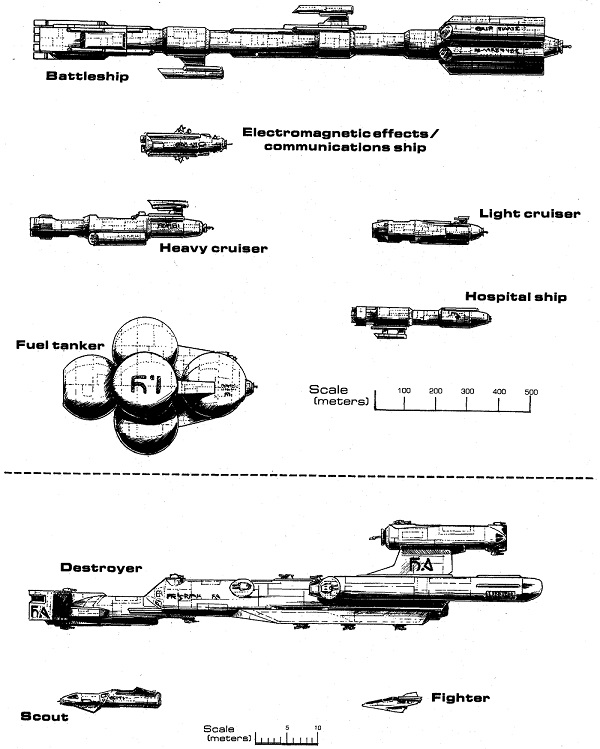
It was in March of 1982 that thousands of people all over the world were unwrapping Dragon #59, with that groovy cover by James Holloway.

So, here’s ten cool things about this issue:

1. The More Things Change …

In “Out on a Limb” we get two arguments/laments/complaints that will feature heavily in RPG discussions for … well, forever probably. First, on over powered PC’s

Ugh! And as if that weren’t enough, when I related this to a friend of mine, he merely sneered derisively and began telling me about what his 50th-level ranger (D:30, S:35) would do to such a wimp. I began to feel dizzy.

And

… I have found that evil characters not only have the most fun, but they add spice and intrigue to the campaign, which helps the other players enjoy it more.

Overpowered characters and evil characters. If you’re dealing with them in your own game, know that you’re not the first, won’t be the last and no, there’s no answer to your problem. Just roll with and try to have a good time.

2. Cantrips

Ah, the introduction of cantrips, or 0-level spells, to AD&D. Now, in 1982 they were something different than they would be later. The 0-level spells were really very simple and not powerful at all, unless somebody knew how to be creative with them. They let you add salt to food or shine up a shield. The bee cantrip was probably the closest you were going to get to an offensive spell, and it’s not detailed in this issue. Still, I remember as a wide-eyed kid thinking that cantrips, like everything else the brain trust at TSR did, were awesome.

3. Giants in the Earth

I always love this feature – stats for literary characters, which also served as a way of introducing little squirts like myself to fantasy literature. This issue has Poul Anderson’s Sir Roger De Tourneville (NG 10th level fighter), a 14th century English warrior who took over an alien spaceship that planned on conquering the Earth. I’ve never read The High Crusade, but I must say I’m intrigued.

It also has stats for L. Sprague de Camp and Fletcher Pratt’s Harold Shea (CG 7th level fighter with special spell abilities). Depending on when you discovered fantasy literature, you might have heard that de Camp and Pratt were tantamount to devils for some of their pastiches of other authors’ works. Again, being an innocent at the time, I took such crimes for granted. Fortunately, I grew up, picked up some paper backs, and found I rather enjoyed some of their original works. Remember kids – don’t take anyone’s word for it when it comes to art – positive or negative – check it out and see what you think.

The article is rounded out with Alexei Panshin’s Anthony Villiers (NG 10th level ranger, 7th level thief) and Clifford D. Simak’s Mark Cornwall (LG 4th level fighter with full sage abilities) and Snively (LG 3rd level gnome fighter with special spell abilities).

Dig also the way things were defined back in the day. “X level something with special sauce”. I think they would have been better off statting up these characters as monsters – use class levels when you need a handy thumbnail sketch. If you have to color too far outside the lines, use freeform monster stats.

4. Gypsies

Even though by 1982 the game had been around for a while, there were still some archetypes left to explore. Gypsies have their place in fantasy stories for sure, but also in old school horror. What would Larry Talbot have done without them?

This article is pretty in-depth, and includes a gypsy fortune-telling chart, and a couple cool new spells. For the chart – read the magic. For one of the spells, look below:

The first is Summon Equine Beings, a “‘druid” spell which may be cast by nobles of third level (bard) or better, or by any of the magic viols. The spell is similar to call woodland beings but brings to the aid of the gypsies one type of the following equine or quasi-equine beings:

4-16 ponies, burros, or donkeys
4-16 horses or mules
4-8 centaurs
1-4 hippogriffs/pegasi/hippocampi
1-2 unicorns

The likelihood of attracting hippocampi is extremely rare, but if the spell is cast on the seashore or in a boat, they have as good a chance of being affected as any other equine being. The number of beings summoned is doubled when the spell is cast by the Great Viol of Pharaoh. All wild equine beings save at -5; domestic horses, mules, ponies, etc., at -4; warhorses and other trained steeds (pegasi, etc.) at -1. A paladin’s warhorse saves normally. Gypsies are always on good terms with any creatures summoned, so no loyalty check applies.

5. Monsters

This issue has Ed Greenwood’s bleeder, which looks like a beholder but has blood-sucking tentacles instead of eye stalks, Michael Parkinson’s Stymphalian birds and Roger Moore’s spriggan. I love spriggans, and have used Stymphalian birds in NOD, though not the version presented here.

6. Traveller

Full admission – never played it, but was always aware of it. I did mess around with character creation once, but that’s it. God knows that TRAVELLER has a big fan base out there, and this issue has two items for the game. The first are stats for a group of characters that appear in a short story in the magazine, “Skitterbuggers”. The second is a full fleshed out spaceport/adventure – “Exonidas Spaceport”. Now, not being a TRAVELLER aficionado, I can’t really review these items – but check them out if you love the system or just need some brain fuel for a sci-fi game. Heck, with all the Star Trek stuff I’ve been playing with lately, I’m sure I could make use of the space port plans if nothing else. The art is quite groovy as well.

7. Halflings

Dragon had a neat series of “Point of View” articles, which examined the different races (and I think maybe some monsters) in depth. Roger Moore writes here about the halflings. Now, of course, none of this has to be taken as gospel, but it’s surely one take on the subject, and useful for folks who were knew to fantasy gaming. It also includes a bunch of halfling deities which found their way into Legends & Lore. I can definitely remember when, as a kid, I did take this stuff for gospel … and loved it!

8. Poisons

Well, if you’ve decided to spice up a game with an evil PC, you’ll surely want some poison to play with. This issue has more poisons than you’ll know what to do with, and it’s a neat reminder of how the old game worked – everything hand-made, nothing standardized and simplified. Personally, I miss it … and don’t miss it. Depends. Here’s a sample poison:

GHOUL SWEAT: A scummy green gel, used like Chayapa. Smells like rotten meat. Its effect is to paralyze for 5-10 (d6 + 4) rounds. It acts immediately. Save for no effect, made at +1.

9. What’s New with Phil & Dixie

I mentioned Phil Foglio’s contribution to Star Trek fanzines a post or two ago, and now here he is as I was introduced to him, in Dragon. I always like the strip, and appreciated the humor … and yeah, had a total crush on Dixie.
Unfortunately, I can’t leave you with Wormy this time, because it didn’t appear. Drat the luck. All in all, a groovy issue with lots of good ideas.

Have fun boys and girls, and be kind to one another!

An English Vampire in Africa

Hey folks – it’s a three day weekend in these parts, so I’m still on schedule with a post every weekend.

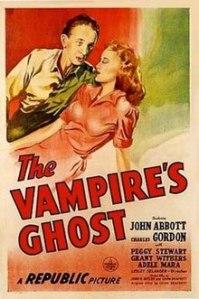
I was going to do a Dragon-by-Dragon today, but instead decided to write about a little B-movie I finished watching last night, the 1945 “classic” The Vampire’s Ghost. While the movie does not involve a vampire’s ghost, it is a better movie than it has a right to be, possibly because it was written by Leigh Brackett. If you don’t know who Leigh Brackett is, well go find out. She was a classic sci-fi author, and did some fine screenwriting on The Big Sleep, Rio Bravo and The Long Goodbye. The film we’re talking about today was her first such effort, and in it she brings more talent to the picture than one would expect of a low-budget Republic film.

She’s joined in this by the the villain in the piece, John Abbott. Just to maintain the Star Trek theme I’ve been on for a while, he played the lead Organian in the episode “Errand of Mercy”. In this picture, he plays the vampire, and I think he’s one of my favorites. In classic Hollywood, the Vampire didn’t usually have much depth, and was often played for shock value. Bela Lugosi’s turn as Dracula is an exception, of course.

It also helps that the movie is based loosely on “The Vampyre” written by John William Polidori in 1816. Between Polidori, Brackett and Abbott, you get a hidden nugget from the studio days of Hollywood.

In The Vampire’s Ghost, Abbott plays Webb Fallon, an English vampire who has “lived” at least since the days of the Spanish Armada. He brings a really rate matter-of-factness to his vampire portrayal – he’s not happy about his condition, but he shows no remorse for his victims, and he mostly uses his ability to hypnotize and control people to get away with it. In the film, he is now running a drinking establishment in the African town of Bakunda. As in Dracula, the movie wastes little time in revealing that the mysterious killer around Bakunda is a vampire, and that Fallon is that vampire. The natives discover it first, and the “hero” of the picture, Roy Hendrick (Charles Gordon) is soon clued in, but is hypnotized by Fallon before he can do anything about it. Strange for many such movies, the supposed hero spends most of the movie unable to do anything against the villain. The vampire really is the protagonist in the film, making all the moves and committing his villainy unrestrained until … well, I won’t give everything away.

The main point here is that, in this largely forgotten B-movie, there’s a really cool vampire depiction thanks largely to two talented people, Leigh Brackett and John Abbott, and despite the low budget and relative apathy of Republic Pictures. To tie this in to roleplaying games, the Webb Fallon vampire should give a good game master some ideas about playing a vampire in a game in a way that might surprise the players.

Check it out, if you have a mind to …