Dark Shadows – My Obligatory October Horror Post

Over the past few months my wife and I have been watching Dark Shadows, the 1960’s gothic horror soap opera that eventually revolved around Barnabas Collins, a vampire from the coast of Maine. My wife and her friend got into Dark Shadows years ago when they were first released on video cassette and then DVD. I’m a newcomer to the saga, and, given my retro proclivities and love of quality cheese, I’m completely hooked.

For the old school RPG enthusiast, Dark Shadows is a pretty good fit. For starters, it has production values that are on par with our beloved LBB’s. Lines are forgotten, mike booms and cameras sometimes get into shots and impenetrable brick walls often shudder when touched. Re-shooting scenes was an expense the producers were not able or willing to incur, but I’m a firm believer that bad special effects do not ruin good stories. Dark Shadows is a cracking good story.

Most DVD collections ignore the early episodes in favor of the episodes that introduced Barnabas, who became the break-out hit of the series. The story begins with Victoria Winters taking a job as a tutor with the Collins family. The Collins family is suitably Gothic and weird.  The grand dame is Elizabeth Collins Stoddard, who hasn’t left the family home in over a decade – and nobody knows why. Well, nobody except one Jason McGuire, who knows precisely why and is blackmailing Elizabeth as a result. McGuire, as played by Dennis Patrick, is so slimy I found myself dreading his arrival as much as the characters – and praying for his violent downfall as much as his victims as well. Elizabeth’s brother is Roger Collins, an alcoholic single father who was apparently married to a phoenix – i.e. his wife left him and then returned and revealed she was really a mythological creature who catches fire and burns. Weird. Roger’s son is David, a precocious boy (they always are in the 1960’s) who claims that the ghost of Josette Collins still haunts the old house on the estate (she does – for a while, at least, until a new ghost shows up). Elizabeth has a swinging daughter named Carolyn who hates Jason McGuire enough to take up with the world’s goofiest hippy biker just to piss off mom. Jason’s comrade in villainy is one Willy Loomis, who thinks he has discovered that the Collins family jewels are sealed in a crypt on Eagle Hill Cemetery, only to find out that something terrible is hidden within (I’m sure plenty of RPG tomb robbers can relate).

Barnabas, when he finally arrives, proves the maxim that you can’t judge a production by its budget. The storylines with him are often very creepy. His big goal, early on, is to be re-united with Josette, the woman he loved back in 1795. I won’t go into the details, but the storyline is well written and often well played and is disturbing even if you ignore the fact that Barnabas is a vampire. This is something for RPG referees to think about. Don’t let your villains be villains because of the special abilities written next to their names. Make them villainous because of what they do, not because of what they can do.

Eventually, Dr. Julia Hoffman arrives on the scene and adds a new dimension in villainy. She sees curing Barnabas of his vampirism as a way to establish herself as a medical genius, and pursues this with an amoral zeal that eventually catches up to her. Another good template for a villain in RPG’s – the amoral enabler whose agenda complicates the lives of the protagonists.

I highly suggest that folks with a Netflix account or some other way to access the series give it a try. Don’t be put off by the production values – as with the LBB’s, there’s some real treasure buried beneath the modest facade.

DCC RPG Beta – Quick Impression

I downloaded a copy of the DCC RPG Beta rules tonight and gave them the once over, and I must say that I’m impressed. The rules look quite fun, though a little more game than I usually like. The art is wonderful, the spirit as old school as it gets (love the cartoons; many homages to older editions) and I sincerely hope it sells like hotcakes. It’s definitely a game I would like to support and maybe even one I’d like to buy – which is saying a lot, since I’m notoriously cheap.

So go download it, for crying out loud!

Also – if anyone out there is running a play-by-post on this baby, let me know. I’d love to participate, especially as a halfling.

Four Day Planet by H Beam Piper

I just finished listening to an audio book of H. Beam Piper’s Four Day Planet on LibriVox. I’d never heard of Piper before, and really just picked the book at random from a list of sci-fi titles that had recently showed up on the site. Of course, that’s the wonderful thing about the internet – churning up all sorts of wonderful (or even mediocre) stuff that you’ve never heard of and serving it up free of charge. Between LibriVox, the Internet Archive and GoogleBooks, I defy you not to stay entertained with a computer and hi speed connection. Anyhow …

Four Day Planet is not fine literature – it’s not even among the better scientifiction that I’ve read (or listened to, in this case). The dialogue is stilted, the plot is okay as it goes – nothing ground breaking, but told competently – and the characters are pretty wooden. So why would I recommend it? Because it strikes me as a wonderful “gazetteer” for games like Traveler – a really well realized and interesting setting for science fiction games.

The “four day planet” of the title is Fenris – inhabitable by humans, but only just. It has a four day year, spending half of it as a boiling hell hole and the other half as a frozen iceball. There is native life, mostly in the oceans, and humanity living in a large bunker-city. The main industry of the planet is the collection and sale of “tallow” – a waxy substance taken from massive sea creatures called “sea monsters”. The tallow is collected by monster hunters, guys who work on “boats” that act as both submarine and aircraft – in essence, futuristic whalers. What Piper lacks in storytelling or characterization, he makes up for in a fantastical-but-believable science fiction world and universe.

If you’re a Traveler player or enjoy semi-realistic sci-fi, I suggest giving this one a listen or read. You can also find it on Project Gutenberg.

Savage Swords of Athanor

Got my copy today of the Savage Swords of Athanor. Brilliant little book! Everything you need to get a campaign started, including a sandbox, races, religion, magic items, monsters, a new class (the rogue, a sort of minor magic-user). The design is excellent – easy to read, well organized, clear and concise. A real inspiration, and well worth the price! My compliments to Doug Easterly for a job well done.

Quick Review – Fantastic Voyage

Before I begin – there are some spoilers in here. Since the basic plot of this book has been imitated so often, though, I don’t expect it will spoil things for too many people. It’s like worrying about ruining the “chicken crossing the road” joke for someone …

This is a tough one. Fantastic Voyage is a classic, and it is written by Asimov, a giant in his field. And, frankly, I didn’t find it all that impressive. Now, this is partly no fault of the author. The fact is, were I reading this when it first came out, the novel concept of shrinking people down and injecting them into a human body might have really floored me. Unfortunately, many years later, I’ve not only seen the movie adaptation, but also many, many rip-offs of the concept, the latest being in an episode of Phineas and Ferb (which I highly recommend).

So, the first problem is certainly no fault of the author. Unfortunately, the first problem is exacerbated by the second problem, which is only due to Asimov – the characters are so wooden and hollow that plodding through half of the book waiting for them to be shrunk is just mind numbingly boring. The characters aren’t just stereotypes, they are stereotypes of stereotypes. And after the stereotypes are finally miniaturized and injected, the book really doesn’t get much better. The description of the human anatomy from the point of view of the miniaturized explorers is sometimes interesting, but occasionally difficult enough for me to picture that any wonder was just lost. But then every step of the story involves entering a new part of the anatomy, introducing the “problem” and then solving said problem, often in obvious ways.

In one important way, Fantastic Voyage was way ahead of its time. Just as many (okay, most) modern movies sacrifice story to special effects, Fantastic Voyage ignores compelling (hell, even mildly interesting) characters and conflicts for the supposed wonder of seeing white blood cells up close. For me, the anatomy lesson and the make-believe physics of the miniaturization process just wasn’t enough. If you haven’t read the book, I recommend sticking with the movie.

JMS

And now I need to finish my Beastmen of Nabu article and then get busy with the illusionist, a low-level adventure set in the catacombs of Ophir, and I need to begin plotting out the next chunk of sandbox …

New from Cumberland Games …

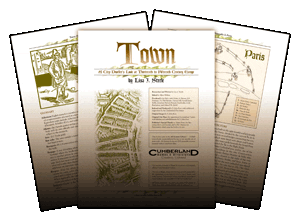
Cumberland Games (the fine people who brought us Encounter Critical and Risus) have a 48-page preview of Town on their free stuff page. Town, by Lisa J. Steele, is a follow-up to Fief, her work on rural life in feudal Europe. I’ve perused the preview, and I must say it is very impressive. It covers the structures of a town, the society, disease and other disturbances and apparently gives some more specific information on Paris and Venice. Definitely one to check out.

Quick Review – Star Trek 2

I finished reading Star Trek 2, adapted by James Blish. Now, this is not a novelization of the Wrath of Khan, but rather an adaptation of several Star Trek episodes (including “Space Seed”, from which we get Khan) originally published in 1968. Apparently, there are multiple volumes of this series. The volume contains the following adaptations: “Arena”, “A Taste of Armageddon”, “Tomorrow is Yesterday”, “Errand of Mercy”, “Court Martial”, “Operation – Annihilate!”, “The City on the Edge of Forever” and “Space Seed”.

I’ve seen all of these episodes of course, so you might wonder the point of reading them. While adaptations of books to film are often lacking, primarily because of all that has to be left behind and the penchant of Hollywood for re-writing the source material, I have often found novelizations of movies to be an improvement. The written word has an unlimited special effects budget for one thing, and the writers of adaptations usually fill in the gaps of characterization in interesting ways.

The fun of this book is that it predates the fan-boy “canon” of modern Star Trek, where everything has been organized, classified and filled in. In 1968, Star Trek was still something of an unknown quantity, much as Star Wars was in the late 1970’s, when we had only seen one film and were still able to fill in the details with our own young imaginations.

Since it predates canon, we discover some interesting details that might be fun to explore in a role-playing game set in a more pulp sci-fi Star Trek setting. A couple that spring to mind are the description of the gorn in “Arena” –

“The first thing he saw was the Gorn. It was a biped, a reptile, a lizard that walked like a man. It stood about six feet four, with tremendous musculature, dully gleaming skin, a ridge of hard plate running down its back, and a strong, thick tail. The tail did not look prehensile; rather, it seemed to be a balancing organ, suggesting that the creature could run very fast indeed if it wished. The head was equipped with two tiny earholes and a wide mouth full of sharp teeth.”

Not terribly different from what we saw on screen, except for the “run very fast indeed”. The adaptation gives you a much better sense for the fact that Kirk was supposed to be completely outmatched physically by the gorn, and that his only hope for winning was to use his brain.

In “Errand of Mercy”, we learn about the Klingons –

“The Klingons were hard-faced, hard-muscled men, originally of Oriental stock.”

Surprise – the Klingons are humans, though obviously separated from the rest of humanity at some point in the past and thus of slightly different stock, larger and more militaristic. In effect, hobgoblins to the Federation’s humans.

Kirk comes off as more of a Flash Gordon-type in the book and Spock is more half-human than Nimoy portrayed him. The book contains other little notions that might make old Trek fans see the series in a new light, and for that reason the book is worth reading. Understand, it is a thin volume (112 pages) and a very quick read, but since I picked it up for $2.80 at a used book store, I would say I got my money’s worth.

Lin Carter’s The Barbarian of World’s End

Ganelon Silvermane, a name to conjure … well, to conjure the imagination of a thirteen year-old boy. Lin Carter’s Gondwane epic, of which The Barbarian of World’s End is fourth book (hey, I started the Lord of Rings with Two Towers, I guess it’s a habit), is a strange thing. Reading the book, I felt like I was reading a bizarre fairy tale meant for children (or children at heart). There is very little dialogue, and the dialogue there is is not the stuff of Shakespeare. The prose is written as though the story is being told to you by an uncle – and from the subject matter, probably a very strange uncle whose had a bit too much to drink.

I am aware that this sounds like I’m trashing the book, but I really rather liked it. It is not great literature, but it is as imaginative as hell. The characters, creatures and city-states of Gondwane would feel right at home in Encounter Critical and any campaign setting that you could imagine would feel at home in Encounter Critical. Mobile cities, flying castles, tiger men, noseless brigands – dozens of things to fire the imagination of any Referee trying to run a retro-stupid world and have a blast doing it. When I started the book, I was not that impressed. When I finished the book, I was determined to find the rest of the epic and see what other bizarre creations Lin Carter had up his sleeve.