Greatest Fantasy Cartoon of All Time?

No. Not really.

But, I will put the last 15 minutes of this old Japanese cartoon about iron age Scandinavians up against any fantasy cartoon on the market for pure, gonzo greatness. You have no idea how much I want to start statting things up for this, but I can’t. I’d ruin it for you. So, go out and find it – I watched it on Netflix as The Little Viking Prince.

Later, if you’re good (and if I find some time in between watching my pride and joy in her latest play and converting “one last file” for Rappan Athuk (note: not the last file, really) and writing NOD 15 and editing Blood & Treasure) I’ll post the rest of Mother Goose & Goblins. If not tonight, then Sunday (’cause Saturday is Dragon by Dragon day).

Oh – and I’ll swear that the person doing Horus/Hols voice in that cartoon also did Rudolf the Red-Nosed Reindeer in the Rankin-Bass production of same.

Dragon by Dragon … March 1977 (5)

I dig this cover – this is what D&D games should look like!

Three months into the new year of a new game! Before I get into this issue, I’d like to direct folks over to White Dwarf Wednesdays at Tim Brannan’s blog.

What did the oldsters come up with for this issue? Let’s take a look …

A fantasy story by Gardner Fox shows up in this issue – it’s amazing how many “real authors” showed up in the pages of what was still a pretty new magazine that represented a very new hobby. Maybe these guys didn’t have many offers in the late 1970’s – the golden age of magazine stories and illustration had passed, but still, it’s pretty cool.

The big deal in this issue is the Witchcraft Supplement for Dungeons & Dragons – a title I’m sure served as ammunition for the anti-D&D crusade back in the day. What’s awesome about this article, right off the bat, is that they didn’t know who wrote it, but published it anyhow! Right under the title is a request that the real author please let them know who the heck he or she was.

The article starts off with a bit on how witches can show up on the wilderness encounter table. I always love this stuff – the idea that there is a single, unifying wilderness encounter table for all of D&D, and if we add witches to D&D we have to shoehorn them into the table. Reading these articles, you can’t help but love this weird, new world of gaming that was being grown back in the day.

The first thing you need to know about witchcraft is that witch spells do not affect djinn, efreet or clerics of any alignment. All witches have saves equal to warlocks (I love when they used level titles in place of the level number). Good (i.e. Lawful) witches can perform 7 spells per day, but there is a 4% chance that she is ancient, and is thus a Priestess who can cast 10 spells per day and 1 of her own special spells once per week. Why 4%? God only knows.

A few of the new Lawful witch spells are calm (which turned into calm emotions), summon elemental (12 HD) – which lasts while she concentrates, rejuvenation (reduces age by 5 years), dissipation (disperses elementals, clouds, mist and magic wall spells) and comfort. Priestesses get several new spells – youth, influence, banish any one creature, enchantment (produces any one magic ring, potion, misc. weapon, misc. magic item) and seek.

Black witchcraft includes pit, fire box, diminish plant/animal/men, plant entrapment, paralyzing pit (!), undead control, aging, circle of blindness, curse, poison touch and curtain wall. Many of these spells have modern versions – I don’t if they originated in this article or if it’s just a coincidence.

Now we get an explanation for the Secret Order witches … they were designed to challenge high level wizards and magic weapon-armed lords when traveling through the wilderness. Necessity is the mother of witches, apparently. They have some additional new spells and several special weapons. Lots of great material here – hornet cape, assassin’s eyes – find this issue and read away.

James M. Ward now chimes in with “Some Ideas Missed in Metamorphosis Alpha” – basically some things that should have been in the rulebook but were not. Kinda taking a mulligan here. He also adds “Tribal Society and Hierarchy on Board the Starship Warden”. Good stuff – apparently the dominant lifeforms on the Warden are the wolfoids and androids.

This issue’s Creature Feature is the ankheg. Again, the statblock is a bit chaotic. Since the ankheg is open content (and old as the hills), I’ll reproduce it below …

Number appearing: 1-6
Description: 10-20 feet long, brown chitin overall, pink underside
Armor class: 2 overall, underside class 4
Movement: 12/6 through ground
Hit die: 3-8 (8 sided die)
% in lair: 25%
Treasure: B2
Squirt acid for 1-6 die of damage according to size
Bite for 3-18 points damage
Magic resistance: none
Alignment: neutral

These babies can sure deal some damage!

Next is the letters section. My favorite bit is a guy describing his campaign world:

“Although it is not our own Earth, it is only about eleven light years from our world, and therefore most of the culture is a parallel of our ancient cultures.”

True scientific realism, indeed!

Gygax now chimes in with How Green Was My Mutant, with random tables on determining the appearance of humanoids in Metamorphosis Alpha. Naturally, I need to roll one up:

Skin/Hair Coloration: Brown
Skin Characteristic: Knobby
Color Pattern: Whorles
Head: Bulbous
Neck: Wattled
Body: Long
Facial Features: No nose
Hands and Feet: Wide
Fingers and Toes: Four of each
Arms: Normal
Legs: Thin

Damn – that’s one good looking fella! Best thing about the tables, to me, is that it’s almost impossible to roll anything like a normal looking human being, which is as it should be.

I won’t cover Fox’s tale Beyond the Wizard Fog, as Jamie Mal has done a fine job of that himself. (Google it, darlings)

Charles Preston Goforth, Jr. (fake name? has to be a fake name) provides new rules for magical research with one year of playtesting (real time) and nine years in game time!

Essentially, they give you 10 levels of spells with a percentage chance of success, time required and the gold piece investment.  The chance of success appears to always be 20% or 100%, depending on how much gold is spent. A 1st level spell, for example, costs you 2,000 gp for a 20% chance of success, or 10,000 gp for a 100% chance of success. 10th level spells (whatever the heck they are) cost 5.12 million gp for a 100% chance of success.

There are some restrictions on spells to permanently increase stats (including spell levels up to 18th). I pity the poor wizard who sunk several million gold pieces into increasing their intelligence when they could have waited a couple decades for 3rd edition and done it for free.

Armor and weapons can be enchanted up to +1 with 2 months of work and 2,000 gp. “Serious enchanting”, as he puts it, requires 10 months and 10,000 gp. I have a weird feeling this system would very quickly get out of hand!

Bill Seligman now gives us one of the classic articles of the old school – Gandalf Was Only a Fifth Level Magic-User. The best point of the article, to me, is to hopefully make people see just how incredible the average 1st level magic-user really would be in the “real world”. Still, Seligman was clearly an early model of Raggi in terms of bringing out the nerd rage.

Garrison Ernst now presents another installment of The Gnome Cache. No – I didn’t read this one either – too dang much writing to get done.

And that rounds up the first issue of 1977. The vitality in the early game, and the presence of so many gamer archetypes that linger to the modern day makes these magazines great fun to read.

Dragon by Dragon – December 1976 (4)

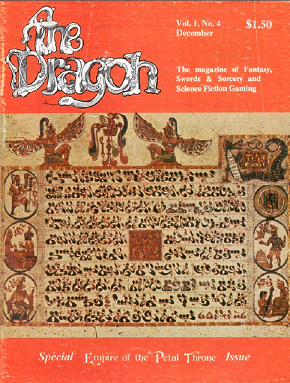
The Dragon closed out 1976 with an issue dedicated to The Empire of the Petal Throne – they even added 4 pages to the magazine to handle all the goodness.

Full disclosure … as long as I’ve been playing D&D and learning about it, I still know relatively little about MAR Barker’s baby. I know the basics and the general history, but it’s always seemed like a setting that required immersion to really grok.

The December issue kicks off with what we would now refer to as a campaign log by the man himself, MAR Barker, updating folks on the going’s-on of Tekumel (really a follow-up to a similar article published in the final issue of “The Strategic Review”. I mostly found this one interesting because it serves as a glimpse into another style of campaign play. Early in the aricle, Barker explains the need (or at least desire) to coordinate the various campaigns in Tekumel to avoid “parallel universe” development. Each DM back in the day really WAS his or her campaign. When you played with a DM, you visited his little universe. I think you’ll find a similar sentiment in the FLAILSNAILs concept.

Next up – James M. Ward provides some notes on Androids on the starship Warden. The androids, it seems, play the role of doppelgangers, taking positions of power among the human tribes and keeping them in conflict with the mutants so that the androids are free to continue their drive for power.  I dig that he refers to them as the “chemical men”. I also dig that the “history” of the androids was supplied by “Emaj the fat mutant philosopher as translated by Yra the Wise.” Honestly, if your not making weird plays on your name and inserting them liberally into your campaign, you just ain’t doin’ it Old School.

Steven Klein provides a random encounter table for the foreign quarter of Jakalla, a city of Tekumel. In essence, this isn’t much different from Gary’s city encounter table in the old DMG. Watch out for the priests of the Goddess of the Pale Bone!

MAR Barker now chimes in again with notes on war gaming in Tekumel. Like Gygax and Arneson, Barker was a war gamer, and here he gives a report on the Battle of the Temple of Chanis: 2020 A.S. as a way of introducing people to the military thinking on Tekumel. He introduces the idea of “Little War” battles that are like duel battles and “Great War” battles that involve hundreds and thousands of troops. The idea of battles that mostly revolve around challenges between individuals in the two forces reminds me of stories from Celtic antiquity, and it’s not a bad way to handle some mass battles in your game without having to deal with actual war games. The length of the invented history of this battle (well, probably play report from his game) suggests how immersed people were in the game … it’s a long article to read just to learn about something that never actually handled.

The Creature Feature presents two creatures from Tekumel, the Mihalli and Vriyagga, both getting some nice color art. In S&W terms, they would have the following stats:

Mihalli: HD 3; AC 1 [18]; Atk1 weapon; Move 15; Save 14; CL/XP 5/240; Special: Magic spells, shape-change, magic items.

The Mihalli were non-humans that had subterranean spy facilities that were wiped out with nuclear fission bombs. Only a few now persist. They are hermaphroditic humanoids with skin that ranges from dull green to coppery brown that signify their class – green for lower, coppery brown for upper. They are shape-changers who are sometimes given away (20%) by their opalescent red eyes. All are magic-users and most have magic items, including the wonderfully named Ball of Immediate Eventuation, which can fire energy bolts, create defense shields against non-magical projectiles (I think we call it shield these days), cause their users to become invisible and produce clouds of poisonous gas. They come in various strengths, indicated by their colors.

Vriyagga, Small: HD 10; AC 1 [19]; Atk 4 tentacles (2d6 + constrict) and bite (1d6 + poison); Move 8; Save 5; CL/XP 12/2000; Special: Tentacles up to 10 feet long.

Vriyagga, Medium: HD 15; AC 1 [19]; Atk 4 tentacles (4d6 + constrict) and bite (1d8 + poison); Move 12; Save 3; CL/XP 17/3500; Special: Tentacles up to 20 feet long.

Vriyagga, Large: HD 25; AC 1 [19]; Atk 4 tentacles (6d6 + constrict) and bite (1d10 + poison); Move 15; Save 3; CL/XP 27/6500; Special: Tentacles up to 40 feet long.

These babies are excellent – two giant wheels with knotted muscles around a central spoke, brain pans hanging from that with weird faces from which extend four tentacles covered in suckers and a mouth lined with poisonous, purple feelers. They have ebon eyes that can see in the dark. The tentacles are very tough (AC 2 [17] to sever). Vriyagga enjoy the taste of juicy humans over the pale shrimp-things who they normally dine on.

Gary Jaquet now gives us “Miscellaneous Treasure, Magic, Weapons, Artifacts and Monsters – Additions, Deletions, Omissions, Corrections, Changes, Variations and Otherwise Confusing Alterations” etc.  This is a comedy bit with things like Creeping Crud (resembles cigarette butts, crushed Fritos, spilled Dr. Pepper, sweat from players’ foreheads and referees’ dice rolling arm, pencil shavings and old character cards), dice lice, etc.

Jerry Westergaard presents some fiction – “Roads from Jakalla”. This, along with the other articles by Barker, do a good job of presenting the setting.

Another side bar presents the old “Generals can do X, Colonels can do Y … Privates can do everything” bit, only starting with 22nd level wizards and working down to Referees.

Wargaming World – no author credit – examines the new miniature lines for EPT and D&D. The reproductions of the miniatures are almost impossible to see, so, not much help really.

Page 29 does have an interesting bit – maybe the first appearance of Appendix N. Titled “Fantasy/Swords & Sorcery: Recommended Reading From Gary Gygax”. It goes from Poul Anderson’s Three Hearts and Three Lions to Roger Zelazny’s Jack of Shadows (etal), Lord of Light and Nine Princes of Amber series.

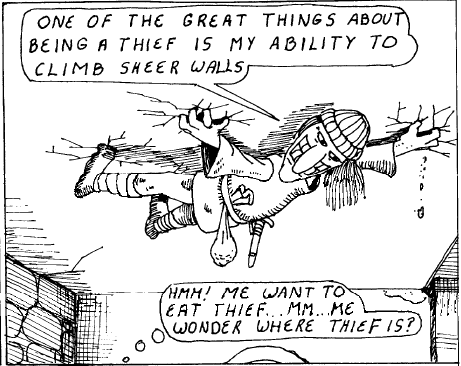
Fineous Fingers gives a nice demonstration of “climbing sheer walls” for thieves.

Page 31 gives the percentile chance for obtaining an “Eye” as treasure in EPT, and the issue then ends with some pictures (boy were they hard to reproduce back in the day) of a scale model of the Temple of Vimuhla.

Not a bad issue if you want to wade into Tekumel and test the waters, and if you can’t find something to do with the Vriyagga, you just aren’t trying.

Dragon by Dragon – October 1976 (3)

Three issues into The Dragon and we have our first sci-fi cover! What lies within? Well – not much sci-fi …

First up we have an editorial by Tim Kask about fantasy. He brings up at least one good point – your ability to imagine something is predicated on your past experience. To my mind, that means get out there and experience as much as possible, even if it is just through art. The more you have seen, the more you will see and can imagine. Tim then goes on to remark that fiction, in future, will be better laid out (people complained), but that The Dragon will still feature fiction.

Next, Gary Gygax asks “Does Anyone Remember War of the Empires?” If he was asking me, the answer would be “I’ve never even heard of War of the Empires, Gary, tell me more.” The game was a very early sci-fi wargame (circa 1966) that seemed geared to postal play, pitting Terran commanders against one another working for either the Greatest Empire or the League of Worlds. He goes on to tell the tale of its demise (twice) and the difficulty in running such a game. These days, it would probably be a snap. Alas.

The next page has a sweet illustration in an advert for Starweb, a PBM sci-fi game.

Dig it!

The next article is one of my favorites, for no other reason than it defies belief these days. Len Lakofka explains how one can play … a female!!!

What can the ladies do in D&D? They can be fighters, magic-users, thieves and clerics. They can do just as well as men in magic and can surpass them as thieves, but they are behind men in all ways in terms of fighting … though they have “attributes their male counterparts do not!” (God, it hurts a little writing this). Elven female clerics can rise to especially high levels. Because, you know … elven females are just really good clerics. I guess.

For attributes, women roll 1d8+1d6 for Strength, 3d6 for Wisdom, Intelligence, Dexterity and Constitution (and any woman with a 13-14 in Strength adds +1 to her Con score) and roll 2d10 to determine Beauty (not Charisma). Beauty is apparently important to thieves, fighters and magic-users if its exceptional (15+), but may not be used by clerics if they are lawful or neutral.

He then goes through all the level titles and XP requirements for women (which are different from men) – and honestly, I do dig the level titles, which feature Battle Maiden, Shield Maiden, Heroine, Valkyrie and War Lady for fighters, Superioress and Matriarch for clerics, Witch (in place of Wizard) for magic-users, and a few cringe-inducing titles for thieves (wench, hag, jade, succubus, adventuress, soothsayer, gypsy and sibyl).

Female adventurers have slightly different stats than their male counterparts – most especially in that high-level thieves and fighters who are particularly beautiful learn to cast some spells – which mostly boil down to charming and seducing men and tarot reading.

Simply put, this is one hell of a sexist article, entertaining only in the context of how far gaming has come since then.

“Garrison Ernst” continues with another part of “The Search for the Gnome Cache”. You know, I did enjoy his Gord the Rogue material – I’ll have to read through these one of these days.

Brad Stock and Brian Lane present some nice birth tables for D&D – 30% chance of commoner, 55% chance of merchant class, 10% gentleman and 10% noble, then you roll for sibling rank and then more rolls to determine you “sub-class” and initial money, monthly allowance from family (a neat idea) for first year of adventuring or until 3rd level, whichever comes first) and starting skills. A very wealthy noble, for example, starts with 400 gp, a monthly allowance of 60 gp and four skills from group 1, three from groups 2 and 3. He might, thus, end up with the following skills: woodsman, miner, jeweler, sailor, mason, normal merchant, scribe, artist, adventurer (3rd level fighter) and Don Juan. Not sure if it really makes sense for nobles to have so many skills.

There are several other tables for nobles and some for rolling one’s race randomly, including “half-goblin/half-orc”, “half-elf” and the infamous and lawsuit-inspiring “hobbit”.

Page 17 has a Fineous Fingers comic strip … I think this might be the first one in The Dragon. We also see the first letters page “Out on a Limb”, which in retrospect really isn’t a play on dragons or fantasy. Garry F. Spiegle writes maybe the best line concerning Gnome Cache – “the writing was so good about a subject so terrible”. Scott Rosenberg was pissed that they wouldn’t let him Xerox tables for GM’s and sell them (at cost). Lewis Pulsipher doesn’t like all the ads and illustrations (waste of space) and writes a critque of that “Three Kindreds of the Eldar” article that’s about two or three times longer than the original article, made even longer by a response from Larry Smith who, believe it or not, disagrees with Lewis. The exchange reminds me of Triumph the Insult Comic Dog’s answer to the question, “What material was Han Solo frozen in?” – A: “Who gives a shit?”

Next: “A Plethora of Obscure Sub-Classes”, including the Healer by C. Hettlestad, the Scribe by David Mumper and the Samurai by Mike Childers (modified by Jeff Kay).

Larry Smith offers a “New View of Dwarves”, with some sweet level titles for dwarf fighters (dwarf – warrior – spearman – dwarf hero – swordbearer – axewielder – champion – dwarf lord – dwarf king) and the revelation that there are only 7 dwarf families 😉 and thus 7 dwarf kings, the tribe of Durin being the most prestigious. They have some rules for dwarf clerics and thieves, and my favorite two lines:

Dwarves as Magicians, Assassins, Monks, Paladins, Illusionists, Rangers or Sages.

The above is not allowed.

We round it out with John Pickens’ Berserker, Gordon Davidson’s Idiot and Charles Carner, William Cannon and Pete Simon’s Jester.

The issue ends with a table of “Combat Modifications for Dexterity” by Steve Cline, with percentile ranges for high dexterity. These include modifiers for melee attacks, ranged attacks, damage and defense.

Dragon by Dragon – August 1976 (2)

August of 1976 – A month after the bicentennial, and Marvelites were grooving to such titles as Planet of the Apes, The Champions and Black Goliath, the Seattle Seahawks were playing their first game, Big Ben breaks down in London, Viking 2 enters orbit around Mars, the Ramones make their first appearance at CBGB, and The Dragon’s second issue hits the stands. So what did the gaming geek of 1976 get for his money?

John M. Seaton devises a procedure for “monkish” promotional combat (i.e. knock off the master to assume his level). I love this kind of thing, and given the recent popularity of FlailSnails Jousting, I wonder if there isn’t a market for FlailSnails Monkish Combat.

The procedure would be similar – write up 6 rounds of combat, denoting your strike, kick, block or other maneuvers, and then we see where it goes.


Lots of fiction in this issue.

The second installment of Gygax’s Gnome Cache is in this issue. I’ll freely admit this here – I almost never read the fiction in Dragon. I probably missed out on something.

Speaking of fiction, Jake Jaquet gives us the conclusion to “Search for the Forbidden Chamber”. Didn’t read this either.

Gardner Fox (you might have heard of him) has a short story in this issue called Shadow of a Demon which is covered very capably at Grognardia.

Another installment of “Mapping the Dungeons”, wherein DM’s of the 1970’s try to hook up with players via The Dragon. St. Louis appears to have had a surplus of DM’s looking for players – 8 of them in this issue.

Some dude named Paul Jaquays was running the Spring Arbor College Dungeoning Society in Spring Arbor MI. Wonder if he ever amounted to anything.

Through the magic of Google, I found the following DM’s online:

Keith Abbott of Muskegon MI

Michael Dutton of Mountain View CA might have done some art for WOTC – could be a different guy

Bill Fawcett of Schofield WI kinda founded Mayfair Games

Karl Jones – could be this guy?

Drew Neumann – maybe a composer of film and television scores – he was at Wylie E. Groves High School in Detroit at the right time (Class of ’77). Could have known Ellen Sandweiss, who was in Evil Dead. Did music for Aeon Flux

Scott Rosenberg of Jamaica NY – has a couple issues of The Pocket Armenian floating around online.

Ed Whitchurch has achieved some level of DM’ing fame

Joe Fischer gives us more tips for D&D Judges. He covers interesting entrances for dungeons (i.e. under stuff you don’t expect them to be under) and “friendly” traps that aren’t necessarily harmful. He also provides a random table for treasure chests that are, 50% of the time, trapped thus …

D% Trap
0-30 – 1d4 spring-loaded daggers fire when chest is opened
31-50 – Same as above, but daggers are poisoned
51-65 – Poisoned gas released when chest is opened
66-75 – When opened, chest acts as mirror of life trapping
76-85 – When opened, chest explodes for 1d6+1 dice of damage (wow!)
86-90 – When opened, an enraged spectre comes out [which can be read a couple ways, either of them endlessly entertaining]
91-95 – All characters within 5 feet lose one level [after the first use of this trap, I guarantee everyone will give the thief plenty of space when opening chests]
96-98 – All characters within 5 feet lose one magic item
99-00 – Intelligent chest with abilities of 2nd – 9th level magic-user [nice!]

He also mentions intelligent gold pieces that scream when removed from a room, or replacing real gold pieces in a dragon’s horde with chocolate coins (though as valuable as chocolate was in the “olden days”, that might actually be a step up). He also brings up the idea of creatures with odd alignments (chaotic dwarves, for example).

A couple more spotlights (Joe Fischer rocks!)

Monster Gems are 500 gp gems that can be commanded to turn into monsters (per rolling a wandering monster) for one week – when the week is up, or they are killed, the gem is destroyed as well. It might be fun to rule that every gem worth 500 gp (exactly) is a monster gem.

Hobbit’s Pipe (by Marc Kurowski) – Clay pipe, when smoked, gives ability to blow multi-colored smoke rings (4 per turn, moving at 4” (40’) per turn – love the specificity). The pipe can be smoked 3/day. He also offers up five magic pipeweeds, a bag of infinite wealth, helm of forgetfulness, and ring of infravision.

Lynn Harpold give a long account of Quetzalcoatl and his cult in Central America.

Creature Features gives us the remorhaz. Love the “stat block”:

Move: 12”
Hit Dice: 6/10/14 (8 sided) dice
% in Lair: 20%
Type Treasure: F
Bite for 3-36 points
Breath for 3, 5, or 7 dice of fire damage
Magical Resistance: 75%
Low Intelligence
Neutral
Number Appearing: 1 (1-4 if in lair)
Description: 30’ long. Blue Hued underneath, wings & head backed with red.
Armor Class: Underside: 4. Back: 0 plus special. Head: 2.

Apparently, the standardization bug had not yet bitten.

Jon Pickens presents the Alchemist, a new D&D class. They don’t label this one as an “NPC Class”, so I guess it is fair game for all you D&D-ers out there. I’ll roll one up quickly for FlailSnails:

Xander Wort, Neutral 1st level Alchemist (Student)
Str: 5; Int: 13; Wis: 16; Dex: 16; Con: 7; Cha: 10
HP: 2; Attack: As Cleric; Save: As Fighter (+2 vs. poison and non-magic paralyzation)

Special:
Max. AC is 5
Can use one-handed weapons (excluding magic swords)
Use poisons and magic items usable by all classes
Psionic ability as fighters (replace Body Weaponry with Molecular Agitation)

Special Abilities:
Detect Poison 20%
Neutralize Poison 10%
Neutralize Paralyzation 15%
Identify Potion 5%
Read Languages 80% (one attempt per week)
Prepare poisons (strength level equal to their level; costs 50 gp and 1 day per level) and drugs (as poisons, but knocks unconscious for 4 hours)
Prepare a potion of delusion

Potions:
None – until 3rd level (Scribe)

His bit on poison is pretty cool. If the HD of the poisoner or level of poison is equal to or greater than the victim’s HD, they must save or die. If at least half their HD, they are slowed until a constitution check is passed, trying once per hour. If less than half, there is no effect, but the poison accumulates in the blood until it’s enough to slow or kill the person. A very nice system!

This is actually a very groovy class. The hit points are low, so I don’t know how long Xander would have to live, but he can wear some decent armor and load up on poisoned darts and a poisoned long sword and might just make it to 2nd level.

Jon Pickens also presents optional weapon damage, allowing fighters and thieves to gain mastery in different weapons, increasing the damage they deal with them (except with dwarf hammers, military picks, pikes, pole arms and arrows). Fighters master one weapon per three levels, thieves one weapon per four (and are limited to sword, dagger and sling). Those with a Dex of 13 or better can gain mastery with a combination of two weapons, gaining the ability to strike with both weapons per round or with one weapon and treat the other as a shield. Sword and sword or flail and morningstar combos require a Dex of 16 or better.

Another good system – very clean and simple to use.

All in all, a pretty good issue. Lots of neat rules ideas and some good pulp literature.

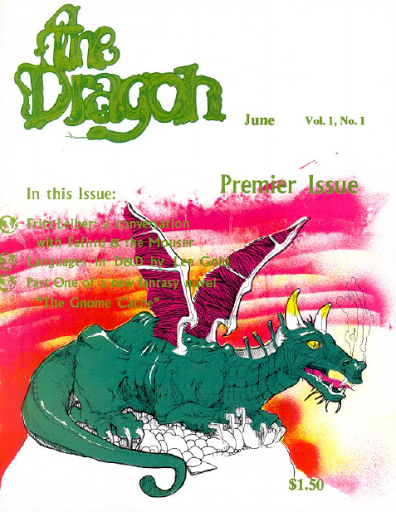
Dragon by Dragon – June 1976 (1)

Who drew it? Couldn’t find it in the issue.

Yeah, everyone else does the whole “review every issue” or “review every page” thing, so why the heck can’t I?

Other than Great Britain and Iceland finally ending their codfish war (such a terrible waste), the first issue of The Dragon (formerly The Strategic Review) was probably the big highlight of June, 1976. So what does this little gem contain?

We have an article by Fritz Leiber, the man himself, talking about his wargame Lankhmar and giving a brief tour of Nehwon. Leiber closes this article with a bit on houris. Here’s an adaptation for Blood & Treasure (you know, the game I haven’t actually released yet).

Every hero (4th level fighter) attracts a houri as one of his followers provided he has a charisma of at least 15. The houri requires upkeep to the tune of 100 gp per month. As Leiber explains, a houri is so “slimly beautiful” that she “make all men their helpless slaves and intoxicate even a Hero to madness”. In play, this works as follows:

– Houris have 1d4 hit points (i.e. they can be killed by a dagger). They wear no armor, and may only wield a dagger themselves.

– All 0 or 1 HD male humans, demi-humans and humanoids within 10 feet of a houri must pass a Will saving throw or move directly toward the houri, rapt with fascination and unable to attack her (unless they are attacked by someone else, in which case the spell is broken).

– All higher level male characters within 10 feet of a houri must pass a Will saving throw or have their effective level cut in half.

Sounds like a useful follower to have, but heed the Mouser’s warning – “Women are ever treacherous and complicate any game to the point of sheerest insanity.”

Larry Smith provides a guide to running the Battle of Five Armies using the Chainmail rules.

Wesley D. Ives provides a task resolution system, as he informs us that a “more standardized system is needed” than DM’s just making it up as they go along. New School and Old School were clashing even back in 1976.

The system works by determining randomly a type of dice (by rolling d% and adding the attribute to be tested), from d4 to d12, rolling it and multiplying it by the attribute to be tested to find the percentage chance of success.

So, let’s say I want to jump across a chasm. This involves strength, and my dude has a strength of 13. I roll d% and get a 35. I add 13 to 35 and get 48, which tells me I need to roll a d8. I roll it, get a 5 and multiply that by 13, giving me a 65% chance of success. See – much easier than saying “roll under your strength” or “roll a save vs. paralyzation” or “roll 1d6 – you succeed on a 1 or 2”. Thank goodness for systems.

James M. Ward asks whether Magic and Science are compatible in D&D. Of course, he thinks it is (else it would be a pretty boring article). He introduces a race of people called the Artificers who use a trio of interesting high-tech items.

Lee Gold delves into languages. She notes that humanoids have a 20% chance of speaking Common, which makes much more sense than 3rd edition allowing dang near every sentient creature in the multiverse speaking Common (and thus negating the point of even having languages).

Jake Jaquet tells the tale of “The Search for the Forbidden Chamber”. Check it out for a picture of the infamous “Greyhawk Construction Co. LTD” and a Recyclesaurus.

Len Lakofka presents some miniature rules that were apparently going to be used in a 64-man elimination tournament at GenCon.

The creature feature presents the ever-loving Bulette (pronounced boo-lay, except not really), with an illustration that is really quite good. The reproduction isn’t perfect, but it’s a nice action shot featuring three armored warriors (God, do I prefer realistic armor to some of the fantasy nonsense that seems to predominate these days). The stats note that its mouth has 4-48 pts and its feet 3-18 points – i.e. 4d12 and 3d6. It took me a minute, but I finally realized this was the damage they dealt.

The description notes that it is a hybrid of armadillo and snapping turtle, and that, when full grown, they can dwarf a Percheron (a draft horse that originated in the Perche Valley of northern France of course – man, don’t you guys know anything?)

Mapping the Dungeons is a neat little feature, presenting the names of active DM’s. The FLAILSNAILs of its day, I suppose.

Joe Fischer gives tips on mapping a wilderness. He uses colors for the terrains and simple symbols for features – triangles for hamlets, squares for towns, circles for cities and crosses for fortresses. Circle any of these for ports. Article has a nice Conanesque barbarian illustration as well.

Peter Aronson adds four more levels onto the illusionist, as well as a few extra spells (1st – ventriloquism, mirror image, detect illusion*, color spray*; 2nd – magic mouth, rope trick, dispel illusion*, blur*; 3rd – suggestion, phantasmal killer*, illusionary script*, dispel exhaustion*; 6th – mass suggestion*, permanent/illusion* (no – the slash doesn’t make sense to me either), shadow/monsters III*, programmed/illusion*, conjure animals, true sight*; 7th – astral spell, prismatic wall, maze, vision*, alter reality*, prismatic spray).

The spells marked with an asterisk are detailed in the article, in case you wondered who invented phantasmal killer. Lots of classic spells here. Alter reality apparently works like a limited wish, but you first create an illusion of what you want to happen, and then the … spell description cuts off.

Lin Carter and Scott Bizar present “Royal Armies of the Hyborean Age”, which reminds you of how important wargaming still was to the hobby then. I think wargaming is pretty basic to the experience, really, which is why I threw some basic rules into Blood & Treasure for mass combat. I’m hoping to test them out this weekend with the daughter. She doesn’t know this yet – so keep it under your hat.

Gary Gygax (you might have heard of him) gives rules for hobbits and thieves in DUNGEON!, a game I so completely regret getting rid of I’d like to punch myself in the face.

“Garrison Ernst” (pseudonyms are as much a part of the history of this hobby as dice and beards) presents a chapter of “The Gnome Cache”, in which he gives an introduction to Oerth and its place in the cosmos. Oerth is a parallel Earth with the same basic geography as Earth, it claims, save Asia is a bit smaller and Europe and North America a trifle larger. It is peopled by folks similar to ours, with similar migrations, but it separates from Earth about 2,500 years ago. He also explains the difference in scientific laws (i.e. magic vs. technology) and that nobody knows what lies in the Terra Incognita of Africa and across the Western Ocean.

It might be fun to draw the nations of Oerth on a map of Europe. We’ve all heard that Gygax’s campaign was originally set in a fantasy North America, but here he says Europe, so perhaps Europe it should be.

Larry Smith now chimes in with the three kindreds of the Eldar – the Silvan (or Wood Elves), the Sindar (or Grey Elves) and the Noldor (or Exiles, the greatest of the elves). Apparently they all have a chance each game year of crossing the sea to the land of Valar – that would be a fun house rule to spring on players of elf characters.

“Say Bob, roll d% please”

“Okay … got a 9”

“Sorry Bob, your 6th level wood elf just went to the land of Valar. Roll up a new character.”

The wood elves can advance as fighters as far as they want, but are limited to 2nd level magic-user spells and may not use wands or staffs and have a 10% chance of going to Valar each year. Sindars are the regular D&D elves (and have a 25% chance of going to Valar each year). Noldor are uber elves with no level restrictions and with a 150% bonus to ranges and effects of spells. They have a 5% chance of going to Valar after performing a great deed.

Which begs the question, why would you ever play a non-Noldor elf?

Note: Totally digging the art in this issue.

Not a bad issue. Lots of goodies. I like the houri bit for fighters, the elves going across the sea is fun, and you get some neat hints about Lankhmar and Oerth from the guys who invented them. Worth the read.

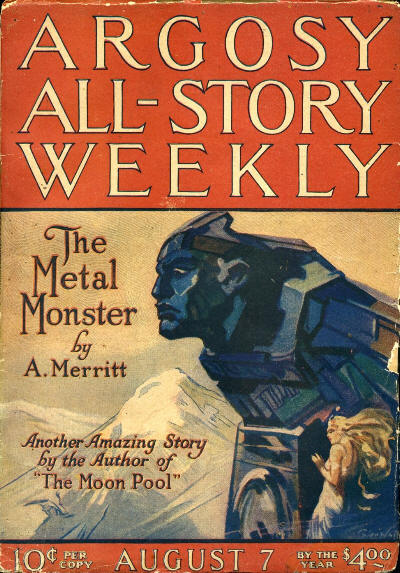
The Metal Monster by Abraham Merritt

Doesn’t come close to capturing the book

I just finished reading The Metal Monster by Abraham Merritt, and I wanted to dash off a quick review. The quick summary – if you haven’t read it, read it. Now. I’ll wait.

Here’s the lowdown – and I’ll throw in SPOILER ALERT just in case I give anything away.

You don’t want to read The Metal Monster for the plot or characters, mainly because the characters are mostly stock, though Norhala, the alien-science-goddess-prophet of the Metal Monsters has a little depth and almost grows as a character, kinda sorta. The human characters are pointless – I even kept getting two of them mixed up because they were blank slates. I couldn’t even form a picture of them in my mind. Worse than having no personalities, really, they only existed as observers with absolutely no impact on what was happening around them. If you don’t believe me, read Lovecraft’s assessment HERE.

We looked upon a vision of loveliness such, I think, as none has beheld since Trojan Helen was a maid. At first all I could note were the eyes, clear as rain-washed April skies, crystal clear as some secret spring sacred to crescented Diana. Their wide gray irises were flecked with golden amber and sapphire—flecks that shone like clusters of little aureate and azure stars.


Then with a strange thrill of wonder I saw that these tiny constellations were not in the irises alone; that they clustered even within the pupils—deep within them, like far-flung stars in the depths of velvety, midnight heavens.


Whence had come those cold fires that had flared from them, I wondered—more menacing, far more menacing, in their cold tranquillity than the hot flames of wrath? These eyes were not perilous—no. Calm they were and still—yet in them a shadow of interest flickered; a ghost of friendliness smiled.


Above them were level, delicately penciled brows of bronze. The lips were coral crimson and—asleep. Sweet were those lips as ever master painter, dreaming his dream of the very soul of woman’s sweetness, saw in vision and limned upon his canvas—and asleep, nor wistful for awakening.


A proud, straight nose; a broad low brow, and over it the masses of the tendriling tresses—tawny, lustrous topaz, cloudy, METALLIC. Like spun silk of ruddy copper; and misty as the wisps of cloud that Soul’tze, Goddess of Sleep, sets in the skies of dawn to catch the wandering dreams of lovers.


Down from the wondrous face melted the rounded column of her throat to merge into exquisite curves of shoulders and breasts, half revealed beneath the swathing veils.


But upon that face, within her eyes, kissing her red lips and clothing her breasts, was something unearthly.


Something that came straight out of the still mysteries of the star-filled spaces; out of the ordered, the untroubled, the illimitable void.

And that’s okay.

Why? Because the book is about the Metal Monsters. And they’re worth it.

Merritt did a very fine job of presenting aliens with an alien point of view that you can grasp, but probably not accept. They aren’t like klingons and vulcans, just adopting one human facet and turning it up to 11. They’re wholly alien in thought and in their goals, and humans are just in the way. In this regard, it reminds me of Lovecraft – humanity getting trod on like a bug, the trodder not even knowing we were there.

Closer … closer …

What every OSR player will want to read the book for are the descriptions (and they go on and on and on, so be prepared) of the lair of the Metal Monsters and of the monsters themselves. The book is a veritable thesaurus of color words and, frankly, is the only book I’ve ever read that made me wish it were turned into a CGI spectacular on film. Except, the deeper you get into it, the more you realize it couldn’t be. Aside from the fact that Hollywood couldn’t get a book right if they had a gun to their heads (yes, Pixar too), the Metal Monsters and their world are just too much to animate. The only way you could turn Merritt’s vision into a film would be if you could project the visions inside the mind of Jack Kirby while reading the book directly onto a big screen. I’m convinced Kirby read this book and was influenced by it – the cosmic grandeur of it all struck me as very Kirbyesque.

A new world? A metal world!


The thought spun through my mazed brain, was gone—and not until long after did I remember it. For suddenly all that clamor died; the lightnings ceased; all the flitting radiances paled and the sea of flaming splendors grew thin as moving mists. The storming shapes dulled with them, seemed to darken into the murk.


Through the fast-waning light and far, far away—miles it seemed on high and many, many miles in length—a broad band of fluorescent amethyst shone. From it dropped curtains, shimmering, nebulous as the marching folds of the aurora; they poured, cascaded, from the amethystine band.


Huge and purple-black against their opalescence bulked what at first I thought a mountain, so like was it to one of those fantastic buttes of our desert Southwest when their castellated tops are silhouetted against the setting sun; knew instantly that this was but subconscious striving to translate into terms of reality the incredible.


It was a City!


A city full five thousand feet high and crowned with countless spires and turrets, titanic arches, stupendous domes! It was as though the man-made cliffs of lower New York were raised scores of times their height, stretched a score of times their length. And weirdly enough it did suggest those same towering masses of masonry when one sees them blacken against the twilight skies.

That’s more like it! Well, almost.

And the Metal Monsters. The fact that these things have never been given D&D stats on par with the modrons, slaad, demons and devils is a crime. They’re fascinating, extremely powerful, and would make wonderful foils for a band of very high level adventurers. Reading the book, one could imagine, with the monsters’ power level turned down a bit, a band of Mentzer D&D characters on the path to immortality tangling with these fellows. A cursory list of the monster entries would be (and yeah, I’m doing these guys – I call dibs):

Tiny Metal Monster (Spheres, Cubes and Pyramids) – Solitary and Swarm

Small Metal Monster (Spheres, Cubes and Pyramids) – Solitary and Swarm

Medium Metal Monster (Spheres, Cubes and Pyramids) – Solitary and Swarm

Large Metal Monster (Spheres, Cubes and Pyramids) – Solitary and Swarm

Advanced Metal Monsters – Discs, Crosses and Stars – maybe large and huge

The Keeper (Unique)

The Metal Emperor (Unique)

Of course, Norhala will need stats as well.

Listen, I couldn’t do justice to his book if I tried. It drags in a few places, and it will absolutely bend your brain in half a few times trying to picture what Merritt is describing, but for folks in fantasy and sci-fi gaming, it is indeed a must-read book.

“I saw a world, a vast world, Goodwin, marching stately through space. It was no globe—it was a world of many facets, of smooth and polished planes; a huge blue jewel world, dimly luminous; a crystal world cut out from Aether. A geometric thought of the Great Cause, of God, if you will, made material. It was airless, waterless, sunless.


“I seemed to draw closer to it. And then I saw that over every facet patterns were traced; gigantic symmetrical designs; mathematical hieroglyphs. In them I read unthinkable calculations, formulas of interwoven universes, arithmetical progressions of armies of stars, pandects of the motions of the suns. In the patterns was an appalling harmony—as though all the laws from those which guide the atom to those which direct the cosmos were there resolved into completeness—totalled.


“The faceted world was like a cosmic abacist, tallying as it marched the errors of the infinite.


“The patterned symbols constantly changed form. I drew nearer—the symbols were alive. They were, in untold numbers—These!”


He pointed to the Thing that bore us.


“I was swept back; looked again upon it from afar. And a fantastic notion came to me—fantasy it was, of course, yet built I know around a nucleus of strange truth. It was”—his tone was half whimsical, half apologetic—”it was that this jeweled world was ridden by some mathematical god, driving it through space, noting occasionally with amused tolerance the very bad arithmetic of another Deity the reverse of mathematical—a more or less haphazard Deity, the god, in fact, of us and the things we call living.

After London, the RPG Campaign Book That Wasn’t

Having recently stuck my toe in the concept of a Victorian post-apocalyptic game (Apocalypse 1898, to be precise), several folks pointed me towards a few 19th century tomes about such a world. One was called After London, by Richard Jeffries. Written in 1885, this is the book that should have been in Appendix N but wasn’t (at least, I don’t think it was there).

The book is set after much of the population of England has, for some reason (it is never explained, though the narrator posits some notion of a comet being involved and then discounts it), moved on. Over the centuries, England (and perhaps the entire world) has fallen back to a level of Medieval technology and society. The first chapters read like a campaign setting – describing how the villages and towns and fields went back to the wilderness, and how the dissolution of London itself created a stinking, deadly morass. The fall of London’s bridges and the build-up of wreckage carried by the Thames has flooded the heart of England, creating a great lake around which much of the English population dwells. They are beset by the warlike Irish (in their ships) and Cymru, fear that the Scots will one day invade, and have to deal with the savage bushmen (descended from the criminal classes) and wandering Gypsy tribes. Jeffries also covers domestic animals going wild. There is no supernatural or paranormal element here – no magic, no mutations, no steampunk – just the world they knew disappearing and a new, more primitive world rising in its place.

After the “campaign setting” is discussed, we get into the story of Felix. For our purposes, Felix is a 1st level fighting-man who hasn’t enough wealth to marry his dream girl, Aurora. Like any other good PC, he decides to go out into the wilderness – in this case out on the Lake in a canoe – and score some treasure (and XP, of course). His journey has a few hang-ups and a few dangers – he gets to see “modern” warfare first hand (and is unimpressed), ventures into the stinking ruins of London, and finally finds some friends in the wilderness. Does he ever return to Aurora? Who knows – Jeffries ended the story in what lots of folks would consider the middle. And maybe, for the old school crowd, this is the best way it could have ended. One adventure over, others on the way.

Should RPG fans read After London? Absolutely. Although it describes a world more akin to Glorantha than Greyhawk, it does a fine job of making that world real and does an equally good job of describing what needs to be described to “run the game”. It also has a score of ideas that can be used when running a medieval campaign, especially the importance of status and the very frightening plight of people without it, who can be seized under any pretense, stripped of their wealth, and made a slave. Felix despises this world, but also knows enough that he cannot change it and has to work within it if he ever wants to wed his lady love.

About the only thing I missed in After London – and possibly only because I was reading a version from Project Gutenberg on a Kindle – was a map of future Britain. I was sorely tempted while reading to produce a hex map of the future isle … and maybe if I get enough goading, I’ll actually do it.

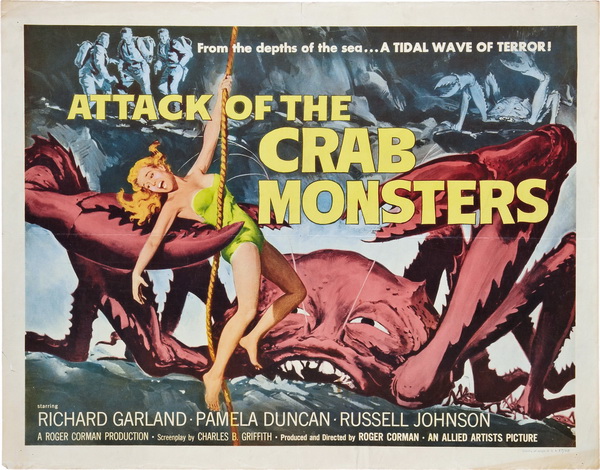
Monster Matinee – Attack of the Crab Monsters

I’m working my way through the public domain sci-fi/horror movies on Pub-D-Hub, and last night I took in Roger Corman’s Attack of the Crab Monsters (1957).

Spoilers are a comin’, so be warned.

The combination of “Corman” and “Crab Monsters” doesn’t fill a person with much hope. The monsters, I assumed, would either be men in rubber suits or green-screened crabs made to look giant harassing a bunch of strangers, etc. I have to say I was pleasantly surprised. It is a movie in the sub-genre of “group of people menaced by monsters, dying one by one”, but had some pretty clever details – oh, and one of the characters is played by Russell Johnson, better known as the Professor on Giligan’s Island!

Still trying to get a transmitter to work, and not a coconut in sight

The “crab monsters” in the title weren’t what I expected. They were giant crabs altered by atomic tests on an island. As it was described in the movie, they weren’t just enlarged crabs. Their atoms had been detached from one another in such a manner that they were in a semi-liquid state – liquid given a permanent shape. Their weird atomic structure has given them additional abilities. When the crabs consume people, their atoms simply join the crab’s atoms, making them a sentient part of the crab. Several people’s minds and memories can exist within the crab simultaneously, and though they retain their memories, their personalities change. They now seek the continued survival of the crab, even if that means killing former friends. The crab’s are also capable of transmitting telepathic messages via bits of metal, these messages being in the voice of the people that have absorbed. The crabs can regenerate body parts and generate significant amounts of heat, but electricity turns them quickly to dust.

The giant crabs, there are two in the film initially, are intent on destroying their island to keep people from discovering their existence. One of them is “with child”, and once the crabs have increased their numbers under the waves, they plan on expanding their dominion. They are destroying the island using dynamite they have captured from the various groups of soldiers and scientists that have come to investigate an aircraft that crashed near the island.

Naturally, a monster this creative needs some game stats!

Crab Monster (Blood & Treasure)
Large Magical Beast, Neutral, Average Intelligence; Cast (1d6)

HD 6; AC 14; Atk 2 claws (2d6 + grapple); Speed 30 (Swim 20); Save F6, R7, W10; XP 600; Special: Immune to fire, generate heat, resistance to physical weapons, vulnerable to electricity, consume memories, telepathy 300-ft. (transmits through metal).

Crab monsters can generate heat in a radius of 30 feet. This can be done three times per day and 10 minutes at a time, and all in the radius suffer 1d4 points of damage per round. Metal in the area of effect is affected as per the heat metal spell.

Crab Monster (Mystery Men!)

Level 6; Physique 5; Mentality 5; DC 16; SPD 2; XP 2800; ATK 2 claws (2d6); POW consume memories*, correspond, energy burst (fire), energy immunity (fire, lasers), energy vulnerability (electricity), half damage from physical attacks

When a crab monster consumes a person, they add their mind to their own. These minds remain independent, but are now part of the crab and work for the crab’s survival and interests, even turning on former allies. The crab can correspond telepathically using the voices of the people it has consumed. Increase the crab’s Mentality score to that of the highest Intelligence it has consumed. Any psychic powers possessed by a person consumed by the crab monster are now possessed by the crab monster.

Crab Monster (Space Princess)

HD 6 | DEF 19 | FIGHT 12 (2d6) | SHOOT 11 | MOVE N | STR 6 | DEX 5 | MEN 4 | KNO 4 | DL 9

Crab monsters are immune to fire and heat, and suffer only half damage from lasers and ray guns and from physical attacks. Electricity attacks inflict double damage on them. Crab monsters absorb the KNO and MEN of people they consume, increasing their values to the highest value they have consumed. They also absorb the psychic powers and knowledge-based skills of people they consume, though they might not be able to use these skills due to physical limitations. Crab monsters communicate telepathically using the voices of the people they have absorbed. This telepathy can only be heard through metal.

Rappan Athuk Memories

Maybe five years ago, I was getting tired of running 3rd edition D-n-D. Lots of work, that one. I was happy to have discovered a new game called Castles and Crusades and was eager to get my players into the new system. To do it, I set up a one-shot excursion into Rappan Athuk, Necromancer Games’ mega-dungeon that promised an encounter with Orcus in its deepest depths.

To introduce the game in the most painless way possible, I set out to make some pre-gen characters for the group. Being a man who loves fantasy art, I started with that. Find a picture, stat it up. Stuck around 6th to 9th level, as I remember and eventually threw in some sci-fi, Popeye, etc. Gonzo.

The play concept was simple. I put about 10 character sheets on the table and let people choose their favorite. I had another 20 or so in reserve. When a character died, they disappeared and were replaced by another, rolled randomly.

Before the group had even made it into the dungeon they had a female thief torn to shreds by gargoyles. Another died in that crypt trap. Deeper in, a psion torched himself and his fellows and sent at least one character to Hades. Another guy got stuck to the … well, I won’t get too much into spoiler territory. Lots of fun, lots of casualties, no tears.

That was Rappan Athuk to me – everything the damned game is supposed to be. And now we’re going to have an expanded version for Swords and Wizardry. Neat!