Dragon by Dragon – February 1978 (12)

The cover of this baby trumpets an exclusive preview of Andre Norton’s D&D novel, Quag Keep! Let’s see what else this issue has to offer …

The first article is Leon Wheeler‘s The More Humorous Side of D&D, which, if I’m honest, is the literary equivalent of “Let me tell you about my character”. My preference was for the little illustration …

Simple but effective line art … something missing from the more modern products, I think. But maybe I’m just an old fart.

Up next is a “D&D Variant” – A New Look at Illusionists by Rafael Ovalle. Rafael’s illusionist has a 7% chance per level of discerning an illusion created by a creature (i.e. rakshasa, succubus, leprechaun) and, if I’m reading this correctly, always can tell another illusionist’s handiwork. Their spells can affect astral and ethereal creatures because they involve light. A few new spells are added as well, including improved displacement, sensory displacement, discord, gaze of umber hulk, create spectres and basilisk gaze.

Jerome Arkenberg now provides us with The Persian Mythos. This is a quick list, and provides an Armor Class, Move, Hit Points, Magic Ability, Fighter Ability and Psionic Ability for each of the deities. Vohu Manah, “Good Mind”, for example, has the following stats:

Armor Class: 2

Move: 18″

Hit Points: 250

Magic Ability: Wizard – 20th

Fighter Ability: Lord – 15th

Psionic Ability: Class 1

Short and sweet, and probably enough to run a combat, if a combat was actually needed.  I’m sure more modern players will scoff at the AC, which would be 17 or 18 in modern games, but with 250 hit points and all that magical and fighting ability, it’s probably sufficient to clean a few old school clocks. More importantly, a combat encounter with this guy in old school rules would last about as long as it would with new school rules, just without a page of stats that will largely turn out to be useless.

It’s actually a pretty thorough list, and includes several heroes and archdemons.

Hey, check out the ad for this game …

Breaking new ground, those fellas.

In the Design Forum, James Ward lends us Some Thoughts on the Speed of a Lightning Bolt. In the article, he sings the praises of the new rule (or variant rule) on melee rounds in Eldritch Wizardry. It’s an odd article that, these days, would just be a post on a forum discussing the new TSR book.

James Endersby and John Carroll now offer another “forum comment” describing a Ship’s Cargo from some game they played involving a voyage to Japan.

James Bruner now has an article about The Druids. Probably a good synopsis of the current knowledge on druids, but much of what people thought of the druids in the 1970’s has turned out to be faulty. Still, some of it appears to be dead on, and I’m sure it was a useful article in its day, if only to veer people away from the “Druid = Fantasy Hippy” syndrome that sadly persists to this day.

Another neat ad …

If the Persian gods weren’t enough for you, Rob Kuntz now presents The Lovecraftian Mythos in Dungeons & Dragons. Apparently, J. Eric Holmes was primarily responsible. So, here’s what you all want to know …

Cthulhu

Armor Class: 2

Move: 12″

Hit Points: 200

Magic Ability: (see below) [when you see below, you see nothing about magical ability]

Fighter Ability: 15th level

Psionic Ability: Class 1

Those who see him must save vs. fear, and if released from his sleep, all within 100 miles must save or go insane. He regenerates 10 hit points per round, can teleport 1/2 mile, is resistant to water, cold and vacuum and can call 10d10 deep ones up from the sea bottom. He retreats from the Elder Sign. He can attack physically and psionically each round – meaning, I suppose, that he can make an attack and use a psionic power each round.

A later issue has stats for Conan. When I come across it, I’ll have to pit Conan vs. Cthulhu and see how it turns out.

Another great ad, this time for All the World’s Monsters vol. 2.

It is followed by a quick, unbiased review for the new AD&D Monster Manual. The review calls it “An absolute must for every D&D enthusiast everywhere”.

The preview of Norton’s Quag Keep is next …

Milo Fagon, swordsman, and Naile Fangtooth, were-boar berserker, have met in an inn in the Thieves’ Quarter of Greyhawk. They have one thing in common, each wears on his wrist a wide copper bracelet in which are set a number of unusually shaped dice. Puzzling over this strange bond, they are also uneasily aware that something momentous is about to happen to them both, though they cannot see that any of the other people in the inn are paying any attention to them. 

Well, not a terrible issue – the pantheons might have come in handy, but much of the rest seems like the equivalent of chit chat. We finish with the following …

Dragon by Dragon – December 1977 (11)

Merry Christmas 1977! I would have been five, having my first Christmas in Las Vegas and opening, well, I have no memory of what I received for Christmas when I was five. I’m sure I was stoked. What were Dragon magazine subscriber’s opening?

First and foremost … best cover yet. A wagon of startled doxies pulled by God-knows-what is accosted by a red-robed dude and his captive troll while the triple-flail-armed driver looks on. Nice! Painted by Elrohir.

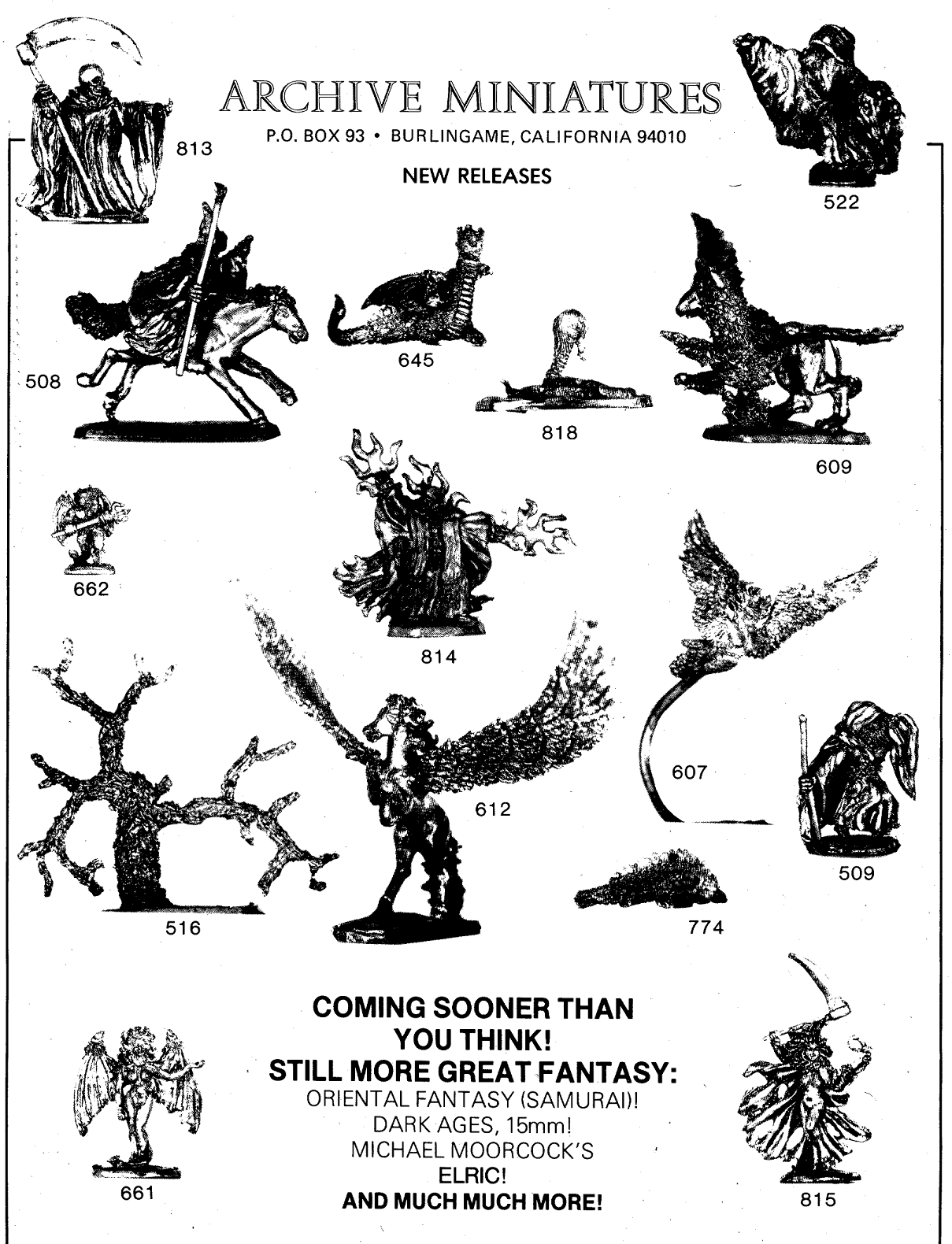
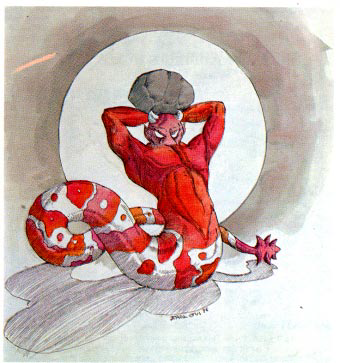
Second … an ad for newly released miniatures of the various demons plus Orcus and Demogorgon. The Type VI looks more like “naked guy with wings” than they are typically portrayed, which I think makes him creepier than the “OMG DEMON!” look.

Big announcement from Tim Kask … Dragon is going monthly! Oh, and they’re finally sending checks out to authors and artists! He also announces coming fiction in The Dragon from L. Sprague DeCamp and Andre Norton, as well as fiction from Fritz Leiber in this issue.

Gygax now chimes in with a defense of TSR defending its intellectual property from cheap and crappy imitations and outright theft in the form of reprints of D&D material. He has some nice words for GDW, but seems to be telling everyone else to piss off. He also mentions the coming release of the AD&D Monster Manual and future release of other AD&D material.

Enough announcements and editorials … let’s get to the gaming.

Rob Kuntz presents a system for Brawling (The Easy Way “Out” in D&D) which, at first glance, is way more system than I need. Brawling and grappling are always a problem, it seems, because they offer the chance of knocking someone out or disabling enough to make them an easy kill, thus tons of extra rules. This one compares ability scores of the fighters to get a modifier, and then a dice roll to score “damage” to one of the ability scores. Grappling, for example, involves averaging the dexterity and strength of both combatants and comparing them on a grapple table, then rolling 2d6 to discover how it works. Punching is similar, but determines the amount of damage.

Tony Watson then explains how to stop good old O.G.R.E. (not the monster, the mega-death machine) – basically tips and tricks for the game. I played it once, O.G.R.E. won, and my yen to play O.G.R.E. was satisfied.

In the Design Forum, Thomas Filmore, who opines on the value of role playing in D&D, as opposed to just wargaming. Pretty common blogpost material here, but perhaps a rather new concept back in the day, when many characters did seem to be more about puns and action than deeply invested backgrounds (i.e. the good old days).

Archive Miniatures has an ad for Star Rovers – 25mm miniatures. I dig the names of the figures, all of whom would be at home in a game of Space Princess: Planetary Scout, Funky Robot, Andromeda Annie, Bianca Snow, Doc Crock, Galactic Centaur, Alien Lizards, Walktapus (pre-Runequest?) and Sassanid War Elephant. Wait, Sassanid War Elephant? Why not.

MAR Barker continues answering reader questions in his Seal of the Imperium article.

Next up are some expansions to the Snits game that was featured last issue. Apparently the snits took the world by storm.

The Sorcerer’s Scroll is a new feature, and this first one is written by Rob Kuntz. Here, he mostly goes into the new Monster Manual (with “stupendous art by David Sutherland, David Trampier and Tom Wham”) and the eventual release of ADVANCED DUNGEONS & DRAGONS (I forgot that it was always written in all caps (“Fighters will now take 10-sided dice to determine their hit points and clerics 8-sided, etc.”). He also mentions Judge’s Guild, who continues to “saturate the D&D market with new variants” (and that TSR has undertaken to “make their new rule variant/additions … much more refined and interesting to the hard core D&D player” – I don’t like the sound of that). He has some kind words for Chivalry & Sorcery, but explains that it falls short due to its “smallish” print.

Fritz Leiber is next with Sea Magic. An excerpt:

“On the world of Nehwon and in the land of Simorgya, six days fast sailing south from Rime Isle, two handsome silvery personages conversed intimately yet tensely in a dimly and irregularly lit hall of pillars open overhead to the darkness. Very strange was that illumination — greenish and yellowish by turns, it seemed to come chiefly from grotesquely shaped rugs patching the Stygian floor and lapping the pillars’ bases and also from slowly moving globes and sinuosities that floated about at head height and wove amongst the pillars, softly dimming and brightening like lethargic and plague-stricken giant fireflies.”

Ral Partha’s new releases would make a nice random encounter list:

2. Gremlin War Party (3d6 winged goblins with spears)
3. Dwarf Lord (6th level dwarf fighter with chainmail and battle axe)
4. Satyr (Pan) (1% chance the encounter is with Pan, otherwise 1d6 satyrs)
5. Centaur Archer (1d8 centaurs armed with shortbows)
6. Land Dragon with Captain (treat land dragon as wyvern without wings, captain is 5th level fighter with splintmail, shield and lance)
7. Land Dragon with Lancer (lancer is 1st level fighter with breastplate, lance and shield)
8. Witch (female magic-user level 1d4+2; males must pass Will save or be fascinated with her breasts)
9. Monk (1d6 first level monks armed with staves)
10. Sprite War Band (3d6 sprites with swords led by 3rd level sprite fighter on fey mount)
11. Imp War Party (2d6 flying monkeys with sword or axe, shield and breastplate)
12. Were Bear (1d4)
13. Wing Lord (winged 3rd level fighter with spear and scale mail)
14. Paladin (dismounted) (5th level paladin with war harness (+2 AC), shield, pole axe and HUGE wings on his helmet)
15. Armored Knight (dismounted) (4th level fighter with platemail, shield and halberd)
16. Roomen War Party* (2d6 roomen with shield and spear)
17. Earth Demon (combo of stone giant and earth elemental)
18. Undead War Band (3d6 skeletons armed with swords, scythes and spears)
19. Woman Plunderer (1d6 levels of female barbarians with swords and chainmail)
20. Roll two times on table

* They’re freaking mutant kangaroo warriors!

Roomen (N Medium Humanoid): HD 1+1; AC 13; Atk 1 weapon (1d8) or kick (1d4+1); Move 40; Save F 13, R 15, W 15; XP 50; Special: Bound 60 ft. as charge attack.

James M. Ward now presents Quarterstaff Fighting Rules. This is like a mini-game that could be integrated into a normal game of D&D – somewhat like the jousting rules from Chainmail.

In Tramp’s Wormy, Wormy asks a bunch of dwarves “What wears chainmail and looks like black pudding?” – any guesses?

In Fineous Fingers, the adventurers discover that the evil wizard Kask has forced the local hobbits to try to conquer the city by capturing their princess.

The issue ends with a withering critique of NBC’s The Hobbit, by Rankin-Bass. I know, not the best adaptation, but I dig the design on the wood elves.

Overall, an issue that leaves me of two minds. I’m a big fan of Leiber, so the short story was cool. The EPT and O.G.R.E. stuff is not really aimed at me, so no complaints there. The brawling and quarterstaff fighting are nice mini-games/sub-systems, but probably not things I would include in my regular D&D game. Strangely enough, it’s often the ads that I’m enjoying the most – little snippets of creativity with no rules/stats attached. There’s the suggestion that in 1977, the creative energy of D&D is slipping away from TSR – they have some pretty good modules left in them, of course, but things are becoming more controlled and professional, and that carries with it a price to pay.

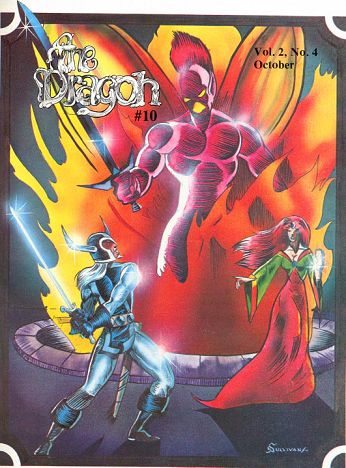
Dragon by Dragon – October 1977 (10)

Can you feel the chill in the air – that crisp chill of Autumn? Well, of course not. It’s July in the here and now, and just reading a magazine from October isn’t going to change that unless you have a rather powerful imagination or have been dipping into the pseudo-pharmaceuticals. Let’s see what Gygax & Co. had in store for us 35 years, when the leaves of Lake Geneva were beginning to change*

October 1977 starts off with a firecracker (mixing my seasons again), as Jon Pickens presents D&D Option: Orgies, Inc. The Mule Abides has already brought this article to prominence in the OSR, but I think it’s worth mulling over again.

The article posits the problem of too much wealth in the game. To this end, Pickens decided that treasure should only be translated into XP when it was spent. Since you can only have so many suits of platemail, 10-ft. poles and weeks of iron rations, players need something else for which to spend their gold. Pickens provides the following avenues of expenditure:

1. Sacrifices: Gold given directly to gods or demons; any character can do this
2. Philanthropy: Lawful’s can give gold to charity – but not to hirelings or fellow PC’s, of course
3. Research: This is for magic-users and alchemists.
4. Clan Hoards: Dwarves and other clannish folk can give their money to their clan.
5. Orgies: Fighters (not paladins or rangers), bards, thieves and all chaotics (except monks) can spend their money on wine, women and song

There are, of course, additional guidelines to these expenditures (i.e. how much can be spent in a night or week, etc.), but I love the idea and the restrictions. Even better, he has two appendices to the article – one on gambling and one on the effects of orgies on psionics (and in my opinion, the mere existence of this appendix should make you want to include both orgies and psionics in your next campaign).

Izzat what a female goblin looks like?

Daniel Clifton has the task of following up on Orgies, Inc., and does so with Designing for Unique Wilderness Encounters. It’s a nice little article, containing random tables for determining what the terrain looks like when a few pesky wandering monsters show up in the wilderness. The tables generate the vegetation, slope, etc., but don’t provide any guidance for how this terrain impacts the battle, which is probably a good thing.

Paul Montgomery Crabaugh presents Random Monsters – by which he means monsters generated randomly, not random wandering monsters. Naturally, I need to generate at least one (which I suppose I really should include in Blood & Treasure):

Intelligence: Highly intelligent (I have a budding genius on my hands here!)
Alignment: Chaos
Type: Mammal (which means it might be a ninja)
Speed: 12
Armor Class: 7 (would have been a 6 if it was a reptile; for B&T it’s a 12)
Hit Dice: Level -2 (level being the level of the dungeon … hmm let’s pretend we’re on the 9th level of our dungeon, so 7 HD)
Hit Dice Modifier: +0 (so, 7 HD … odd that I need to roll for the HD and then roll to modify it)
Damage: 1d8

Now I need to roll for special characteristics, which is an odd percentile table. For a 7 HD monster, I’m going to assume it works as follows:

01-39 – none
40-74 – one
75-89 – two
90-100 – three

I roll a “92” (no, really, I swear it) and thus my monster has three special characteristics. I need to roll d24 for these (if you don’t know how to roll d24, I just feel bad for you) and come up with the following:

1. Hostile to clerics
2. Has anti-magic shell
3. Hostile to magic-users

I have a very hostile monster, apparently. But he doesn’t hate cans … he hates spellcasters. This makes his anti-magic shell make pretty good sense (ah, the wisdom of dice!)

I now roll another D% to see if it has “other characteristics”, and a roll of “61” tells me it does not (otherwise, it could have some insect characteristics).

Last batch of rolls determine the physical description:

Size: Medium (6 feet)
Limbs: 2 legs, 3 arms
Exterior: Feathers
Coloring: Spotted white and grey

So, what do we end up with?

ALMESITH
Medium Magical Beast, Chaotic (CE), High Intelligence; Gang (1d4)

Hit Dice: 7
Armor Class: 12 [7 for Swords & Wizardry]
Attacks: 3 claws (1d8)
Move: 30 [12 for Swords & Wizardry]
Saves: F 10, R 10, W 11 [9 for Swords & Wizardry]
XP: 700 (CL 8)

Almesiths are strange beasts that are spawned from the residual energies of powerful spellcasting, living embodiments of nature’s abhorrence of magic. They are most often encountered in the deeper levels of dungeons, and seek out spellcasters for destruction. Almesiths look something like owlbears, and can be mistaken for those sorcerous creations. They differ in size, being no taller than a man, coloration, being covered in dark grey feathers on their arms, legs and backs and softer, white and grey spotted down on their bellies, and in two additional curiosities: They lack mouths, having instead a stirge-like tubular beak that juts 3 feet from their faces, and in that they have a third arm that juts from their chest. Almesiths attack with their large, hooked claws, and generate a natural anti-magic field (as a 7th level caster) in a 60-ft. radius. In combat, they always focus their attacks on spellcasters (clerics, druids, magic-users and sorcerers first, bards second, assassins, paladins and rangers third), ignoring attacks by non-spellcasters even when it threatens to kill them.

In the Design Forum, Richard Gilbert presents Let There Be Method To Your Madness. This is another in the series of “dungeons should usually make some rational sense” articles; the attempt to bring the retro-stupid branch of the RPG world to heel that persists to this day. I think these two camps can best be described as Phoebe vs. Rachel.

Next up is a mini-game … Snit Smashing, in which a Bolotomus waits to smash the Snits that run from the ocean so they can plant their snotch in a Snandergrab. If the Snit player manages to multiply more rapidly than the Bolotomus player can smash them, he or she wins. For the Bolotomus to win, he or she must destroy all of the Snits.

When you’re through smashing snits, you can proceed to P. M. Crabaugh‘s next article, entitled Weights & Measures, Physical Appearance and Why Males are Stronger than Females; in D&D (weird use of a semicolon). If the feminists in the audience are getting their hackles up, they might want to read the article first, they might want to read the article first. The article posits an additional 3d6 stat – Size – which can translate into bonus hit points and a modifier to carrying capacity. Yeah, males get some extra carrying capacity … and females get a +2 bonus to Con and a +1 bonus to Dex, and men get called “thick-fingered clods with facial hair”. The old “trash men to keep the feminists from calling you insensitive names” ploy. A classic.

Beyond the ability modifiers, the article has a mess of random tables for generating a random appearance (did you know males have a 30% chance of having facial hair). I don’t know that I’d use this for generating a PC, but it could be useful for generating general ethnic physical and cultural characteristics, if you want to get away from “these people look like Vikings, and these people look like East Asians and these people look like …” trend in campaigns.

The next article is Gaining a New Experience Level by Tom Holsinger. He explains that what D&D and EPT really need is some sort of dangerous ritual for characters to undertake when they have enough XP to advance in level. To which I reply, “Huh?” Favorite line in the article:

“The sacrifice of humans is generally forbidden in a populated area because too many people get upset.”

The article is actually pretty tongue-in-cheek, and would make for an interesting campaign. Essentially, it creates a sub-game that involves getting the gods’ attention with sacrifices or sacrilege, then assuming the “proper physical and psychic attitude, i.e. complete exhaustion”, which, Holsinger assures us, can only reliably be done by becoming thoroughly inebriated, during which the Emissaries of the Gods, the Great Pink Elephants, come to the character and imbue them with their new Hit Dice and special abilities. The level limits for elves, dwarves and halflings are, he tells us, because they have a harder time getting drunk. It is also why high level characters move out of town and build castles – with more hit points, they have to get super shit-faced to attract the attention of the gods, and that might mean burning things down and causing other massive disruptions to the lives of the common citizenry. This article actually dovetails nicely with Orgies, Inc. and together they could make for one hell of a fun campaign.

Next up, Edward C. Cooper‘s The Tactics of Diplomacy in Stellar Conquest. Honestly, I don’t know the game and so I’m not going to comment on the article.

In Wormy, the eponymous dragon is contemplating stumping some angry dwarves with a riddle. They’re angry because Wormy stole their bowling balls to use on his pool table. Meanwhile, Fineous Fingers is under attack by a whole guild of murderous hobbits.

And that’s it for October 1977. Good issue, I think. I have to run and set up an inflatable pool now, but I have a couple neat ideas in store for next week. Oh, and I finished writing Blood & Treasure yesterday …

Would they be changing in October? I’ve lived in Las Vegas my entire life – Summer temperatures only finally end around the last week of October, and the leaves may not change here until well into December. Basically, I have no idea how seasons are supposed to work.

Dragon by Dragon – September 1977 (9)

Let’s get right into it, shall we? Because the first page we see past the cover is this …

Let the edition wars begin, I guess. Note the “For 3 or more adult players” [emphasis mine]. TSR would learn a little something about the purchasing power of the younger set in a few years.

The second page is an ad for 25 mm Minifigs D&D miniatures, which such evocative names as “5 Different Hobgoblins” and “10 Kobolds”. You can see some painted versions HERE, HERE (didn’t know hobgoblins were so randy) and HERE.

OK – to the meat of the issue. Our first offering is from Gygax, and is entitled Varied Player Character and Non-Player Character Alignment in the Dungeons & Dragons Campaign. The article is about the problems that alignment presents to DM’s. The line that caught my attention early in the article was:

“The most common problem area seems to lie in established campaigns with a co-operating block of players, all of whom are of like alignment. These higher level player characters force new entrants into the same alignment, and if the newcomers fail to conform they dispatch them.”

Nice to know that DM’s used to have help from the players in terms of managing alignment. It sounds like players with high-level characters could be real dicks back in the day.

Also interesting was this, about Gary’s Greyhawk Campaign:

“The Greyhawk Campaign is built around the precept that “good” is the desired end sought by the majority of humanity and its allied races (gnomes, elves, et al.). I have this preference because the general aim is such that more than self-interest (or mental abberation) motivates the alignment. This is not to say that a war of lawful good against chaotic good is precluded, either or both opponents being allied with evil beings of lawful or chaotic alignment. What is said is that most planned actions which are written into the campaign are based on a threat to the overall good by the forces of evil.”

Probably sounds a bit rail-roady to some of the old schoolers out there. If I’m honest, the article somewhat meanders a bit and didn’t really teach me much on its professed subject, other than to conclude that a variety of alignments is a good thing in a campaign. So that’s settled.

Next up is the continuation of The Finzer Family, the longest damn story I think I ever saw in a Dragon Magazine. I’m going to skip the continuation, just as I skipped the first part, but I will draw notice to this:

The gaming world is taking shape!

I’m going to post this next ad for miniatures because, frankly, they’re pretty dang nice. I tried to find some painted samples online, but came up short.

Almost 20 pages later, we’re finally done with the Finzer Family, and onto an article by MAR Barker entitled Seal of the Imperium. The article is designed to answer reader questions, but the first declaration of Prof. Barker is an interesting one regarding the difference between “real” Tekumel and the “game” Tekumel:

“Just to point up the contrasts, let me cite some differences: (a) “real” Tékumel has a lot less magic and magical paraphernalia lying about than one picks up in the game — with all the Thoroughly Useful Eyes and spells of revivification possible in the game, no citizen of Tsolyánu would ever have to die! — and there would be heaps of treasure and goodies for all”

The eternal problem with D&D. As Prof. Barker explains:

“All of these things, plus the ever-useful Divine Intervention, make it a LOT easier to succeed in the game than in “real” Tsolyánu. The same is true of “Monopoly” or “Alexander the Great”; games abstract, simplify, and simulate only those parts of “reality” which the designer feels are crucial.”

In other words – “Don’t sweat it, it’s just a game”. Good advice, then and now.

Brian Blume now rides in with The Fastest Guns that Never Lived (Part II), a list of actors from old westerns, along with their stats for Boot Hill. You have no idea how much this makes me wish I had the Boot Hill rules, just for the chance to put the Cisco Kid and Poncho on the trail of Lee Van Cleef.

James M. Ward now presents Tombs & Crypts. It’s a neat little graph for randomly generating the contents of a tomb or crypt. The table allows one to roll a d12 to get a set of modifiers for several other tables that determine the treasure in the crypt (gold pieces, gems, jewelry, misc. magic items, special items and artifacts) as well as the guardian and structure of the tomb. I’ll reproduce those last two tables:

Guardian
01-30: None
31-50: Magic spell (wizard lock, curse, etc.)
51-80: Invisible stalkers (1d4)
81-99: Creature from the 6th level monster chart
100: A stronger monster + roll again for another guardian

Tomb Itself
01-40: 1 room/cave/mound of dirt
41-50: Hall with spring trap of some type and a secret door at the end of it
51-60: A 2-6 room/cave complex with many doors leading to other areas trying to lure the robbers away
61-80: 1-10 rooms/caves with a secret door to the tomb and 1-10 traps in the rooms
81-90: 1-10 rooms with 1-20 corridors, with 2-20 traps guarding the rooms and tombs and a secret door
91-99: 1-10 connecting rooms with traps, secret doors, and magical guard spells (wizard locks, symbols, etc.) guarding the way
100: 1-20 rooms with traps, secret doors, and a being guard. It requires a special word to open the final door to the tomb. The word should not be found in the tomb.

Next cool ad:


I found a shot of a painted one HERE.

Almost to the end, and I discover another famous first for Dragon …

When you combine Basic D&D, White Dwarf, Wormy and a long article about alignments, I think you might be able to peg September 1977 as the beginning of the modern era of D&D.

See you next week, when I give the Blood & Treasure mass combat rules a whirl with the Battle of Gaudin’s Ford, pitting a moot of halflings against a rampaging orc tribe.

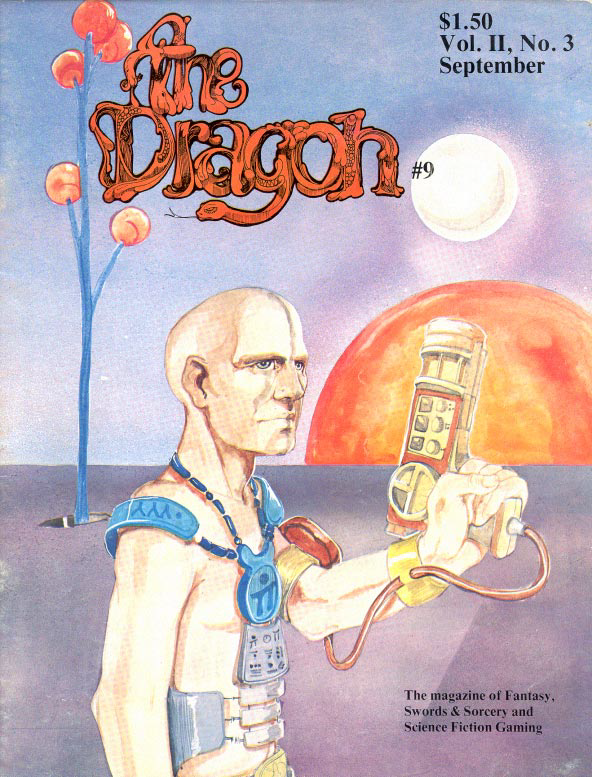
Oh yeah – the cover – no room for it up above, but it is pretty groovy …

New game – stat the cover.

HORST HAMMERFIST, 5th level fighting-man with psionic powers, an amulet of advanced mathematics and a +2 ray gun of lightning.

Dragon by Dragon – July 1977 (8)

Vincent Price?

And so we come to #8, which kicks off with an article on The Planes from Gary Gygax, subtitled “The Concepts of Spatial, Temporal and Physical Relations in D&D”. I guess this has to be considered a pretty important article, as it sets up the famous “Wheel” cosmology that will come to be a basis of AD&D (both editions) and achieve its full flowering in the Planescape setting. I personally don’t use it these days, but I think you have to admit it was a clever way of setting up a cosmos and finding a place for all the various gods and goddesses.

Tony Watson now offers a more practical article: The Development of Towns in D&D. The advice in the article is quite sound, from what I can tell. I like his advice for inns and their patrons, to whit:

Falgrave’s – where non-humans frequent and and stay when in town. Falgrave is a dwarf himself and up on non-human gossip. 3-18 patrons, 2/3 of which shall be non-human and ½ will be warriors; the rest will be townspeople, nonhumans of other classes. 1-4 will be non-human wayfarers or merchants.

Simple and seems like it would work well. For populating the town, he suggests rolling up dozens of characters and then assigning them, based on their ability scores, to different jobs … or you could just fake it. He divides them into Warriors, Magic-Users, Clerics, Townspeople and Specialists (referring to the “myriad of new characters types that have lately appeared”, which I assume means new classes from The Dragon). He suggests rolling 3d4 for the ability scores of the townspeople or 2d6 for women rolling Str and Con (he apologizes to liberated women reading the article) and children rolling scores. Watson then provides a small chart for determining alignment, age, personality, loyalty, initiative and level. Initiative, in this case, does not mean combat initiative order, but how bright and energetic an NPC is.

Up next is a story by Harry O. Fischer: The Finzer Family – A Tale of Modern Magic.

There have also been wicked magicians, but they only last a short time and are soon taken care of by the public or by other magicians. The evil ones are generally weak and unsuccessful people with little powerful magic. This is fortunate for all of us. Once in a while a powerful and good magician may go mad and do considerable damage before he is controlled or eliminated, but these cases are very rare. So any magicians you are likely to meet or to know, or to perhaps discover, are almost sure to be honorable, peaceful, and wise people — like the Finzers . . .

No offense, but this one went on so long I got bored skipping through it.

Next we have a sneak preview of Introduction to: Gamma World. It begins:

Man, from Australopithecus africanus and homo erectus erectus to homo sapiens recens, has existed on earth for hundreds of thousands, perhaps millions of years. During this time, one skill, one particular talent has set him apart from every other creature — his ability to conceive and create tools. Indeed, man has been defined as “the toolmaking animal.”

Next to an ad for Archive Miniatures (that includes pictures of a Wind Child, Dragon Newts and Dracula & Vampire Women) is an article by Rob Kuntz on gems and jewelry that is essentially a collection of useful tables for determining first the carats of the gem, then the value and then the type based on the value. My only disagreement is that it uses gems like “idicolite” and “tanzanite” that just don’t seem very romantic.

Brian Blume asks, So You Want Realism in D&D? It’s a bit of a jab at people that have written to complain about the lack of … well, you know.

The next page shows off several miniatures, including Rhino Riders from Dragontooth Miniatures. I’ve admitted before that I’m a sucker for fantasy characters riding on inappropriate mounts, so this one is right up my alley. I found a picture online …

Given the size of the rider compared to the rhino, it almost has to be a giant of some sort.

Featured Creature this time presents a kick-ass piece of art by Erol Otus and asks people to name it and give it some stats. Let’s do the same thing here in the comments!

James Ward provides Still More Additions to MA, a list of new monsters that includes Jawed Lilly Pads (awesome), radiation vines, poison thorn grass, tigeroids, bulleroids (no hemorrhoids), rabners, gygarants and sotherlan.

And so ends issue #8! Not bad, but the one story was waaaaaay too long (and is only part 1!!!). What relevant stuff was there was pretty decent.

Dragon by Dragon – June 1977 (7)

Happy birthday The Dragon! June 1977 marked the beginning of the second year of the magazine’s publication. Kask starts off by bragging on the improvement in the art and the 300% growth in circulation in a year (which could mean they went from selling 1 copy a month to selling 3 … but I think they were doing better than that). Kask goes on to say that, despite the increase in readership and the magazine now being published 8 times a year (they had NOD beat – 6 is almost more than I can manage), he remains the only staff member. He gives thanks to the help provided by Gary Jaquet, but explains that he can only do so much because he lives 4 HOURS away. Boy, have things changed for the better. The editor for Blood & Treasure lives across the continent from me, and he might as well be in the next room.

The other big announcement from Kask …  PUBLICATION BY THE DRAGON DOES NOT BESTOW ANY SANCTION OR APPROVAL TO ANY VARIANTS, VARIATIONS OR RULES INTERPRETATION.

Anyhow … what has the birthday boy in store for us today?

First up, we see an advert for the Third Annual SC Awards for Creativity in Wargaming. Some of the things that didn’t make the ballot include Bunnies and Burrows (for best game) and Jim Dunnigan (for design of Russian Civil War … you might want to check out his Strategy Page site for information on everything going on in the world of conflict). Lankhmar and Metamorphosis Alpha were up for Outstanding Game of 1976, Gygax’s Swords & Spells was up for Outstanding Miniatures Rules of 1976 and Grenadier’s wonderfully named Wizzards & Warriors was up for Outstanding Miniatures Series of 1976. They also list a Fantasy Gaming Hall of Fame, which includes Lord Dunsanay, C.S. Lewis, A. Merritt, Fletcher Pratt, Clark Ashton Smith, Poul Anderson, M.A.R. Barker, Lin Carter, L. Sprague DeCamp, Gardner Fox, Katherine Kurtz, Fritz Leiber, Michael Moorcock, Andre Norton, Jack Vance and Roger Zelazny – and I just cannot argue with such a list. Spot on for 1977.

Omar Kwalish (didn’t he invent some sort of apparatus?) presents tips on what to do when “… Calamity Befalls You Twenty Minutes Before the Game Club Gets To your Place”. In essence, the article shows how you can generate percentages with two standard D6, and other ways of dealing with being without dice – chits in a jar, random numbers generated on high-tech calculators (such as the TI-SR51-A), cutting cards (roll 1d4 with the suits, etc.), using a watch with a second hand, spinners, coin flips (an obscure study financed by government grant proved that the dime was the ideal coin to flip), phonebook and blindfold, etc.

Gary Gygax uses the Designer’s Forum to tell of the origins of the game, in which he writes, “Although D&D was not Dave’s game system by any form or measure, he was given co-billing as author for his valuable idea kernels.” Let the lawsuits begin.

Lynn Harpold describes Mystery Hill, America’s Stonehenge. A very ’70s article, if you remember that time period, and things like In Search Of.

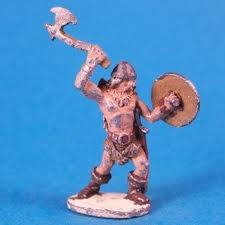
One of Ral Partha’s new releases is “Foregum” Super Hero (Bare-Chested) – no picture, but he is now my favorite miniature of all time. Luckily, I found an image …

And a copy of Ral Partha’s 1981 Catalog. CHECK IT.

Great illustration by Morno on page 11, to go with his story The Journey Most Alone. Again – new rule of Dragon by Dragon is to post a random paragraph from the story, so …

“There he paused in wonder.”

Okay, that was a bit cheap, how about the next paragraph as well …

“Before him he saw the vistas of a wide universe from the height of a splendid cliff. Awaiting him was a massive throne of silver and of tortoiseshell, metalwork twining like vinery around the dark surfaces of the seat. Leaf and stem of silver entwined in ecstatic embrace, and here, upon the highlights, and there, among the shadows, gleamed jet and onyx, lapis and obsidian, nested like gleaming grapes in beds of many other stones. From this pinnacle Visaque beheld the five extremities of his cosmos and the many marvels therein; beheld amber castles and perilous beasts, paradise and power to his world’s edge. At the foot of the throne knelt spirits of the four elements and one awaiting his ascension. Tiny heralds on elven birds trumpeted a fanfare at his coming.”

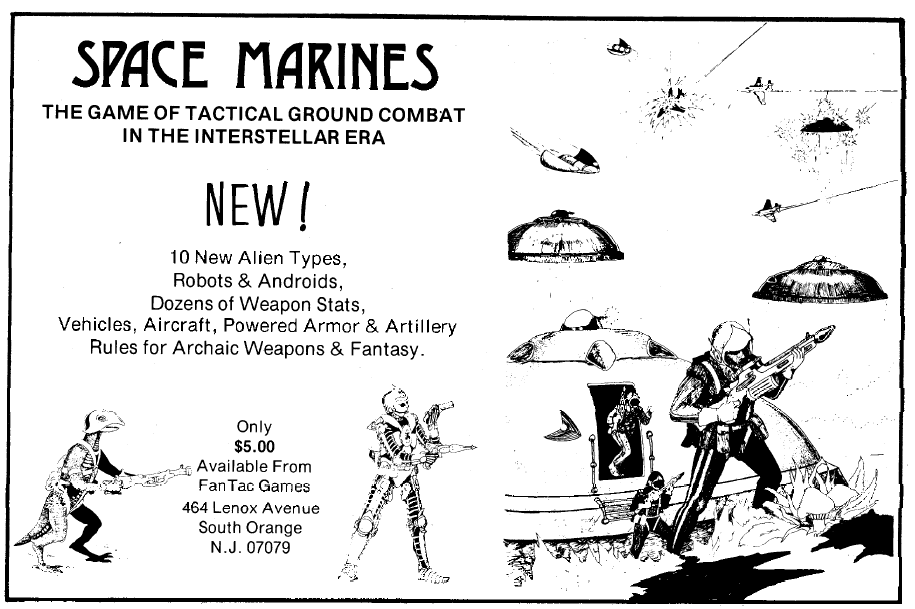
In the middle of the story there is an ad by FanTac Games in South Orange, NJ for a new game called “Space Marines”. Looks like they beat the Brits to the punch.

I wonder what 464 Lenox Avenue looks like now …

M.A.R. Barker has a new article on Military Formations of the Nations of the Universe, recounting military formations of … well, you get the idea. The universe, in this case, is confined to Tekumel.

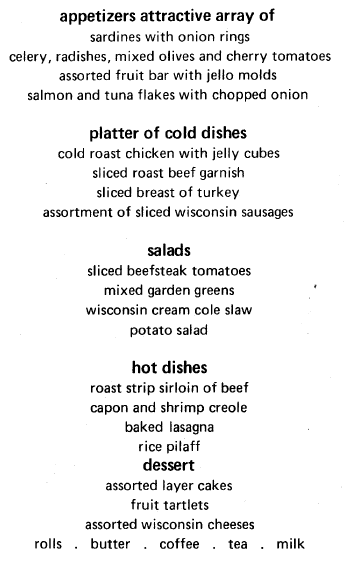
I cannot go further without printing the following menu in an ad for the Third Annual Strategists Club Awards Banquet at Playboy Resort …

Honestly, they had me at sardines and onion rings.

The Featured Creature this month is the Prowler. Its B&T stats would be:

Prowler: HD 14; AC 18; Atk Bite (1d8) and constriction (4d12 per turn); MV 30; SV 10; CL/XP 15/1400; SP – Gaze (save vs. magic or mind blanked and become a zombei [sic] under the prowler’s control; can only be restored by having 3 patriarchs cast dispel magic at the same time), inject eggs (with brown tentacles around mouth, injects into zombeis, eggs hatch in 2d4 days and eat the zombei).

Tough monster, and a nice bit of art to go with it.

Fineous Fingers tries to rob a guy from TSR and ends up skewered, while the kid he was training gets a 1,000 gp reward for tipping off his target.

In the Editor’s Library, Metagaming Concepts (makers of Stellar Quest, the first “good, playable space game”) announce their new micro-game … OGRE! I doubt it went anywhere.

Mcewan Miniatures has a sweet little ad for their new figures …

I’d like to think all of those fellows would fit in nicely in a Space Princess game somewhere. Maybe the Terrellians are a species that has built their culture around the worship of this guy …

But that’s just me. (And yeah, that would probably make them Chaotic).

Mystery author Garrison Ernst (just can’t figure out who this guy could be) presents another installment of the Gnome Cache.

“A column of dark smoke announced that they were approaching the castlewick of Blackmoor. It was the morning of an otherwise bright day not long since the slaughter took place on the narrow road to Weal. The two had traveled fast. Several times they had quickly left the lance for the safety of the surrounding wood as a band of Nehronland foot or a rare body of horse passed northwards laden with plunder and marching with much jesting and laughter. Each time Mellerd would salute their passing with various rude gestures, for he daily came to hate all Nehronlanders more passionately as he missed the Kimbri Vardobothet whose death came at their hands. There was now a particularly thorny problem facing them. They could not, of course, proceed directly through the place ahead, for it was obviously swarming with enemy soldiers. To the east was a jumble of broken terrain stretching away for endless leagues towards the sea. Worse, it was the home of many of the various bands of Nehron, so passage through that place would be nearly as dangerous as going straight along the road through Blackmoor. But to the west was a trackless forest which led to the slopes of the Senescent Hills, most inhospitable and the dwelling place of creatures who did not welcome men intruding upon their domain. The trick would be to swing wide enough to bypass the fortress unseen by any of the numerous warriors thereabouts, and then come back onto a route south again. If they went east they would eventually make the road to Rheyton as they circled back. In the other direction they would strike the passage to the free city of Humpbridge which bent from southwest to south across the base of the Senescent range. Dunstan was faced with making a decision from what he remembered of maps and his experiences on the trek which brought them to these straits originally.”

The emphasis is mine. Humpbridge!

And so ends the seventh issue of The Dragon. If I’m honest, the ads were the best part of this issue – pretty weak on game content, and Barker’s article on military formations seemed endless. What I have learned, though, in reading these is that I need to start using multiple pseudonyms when writing NOD. Fake names, anagrams and bad puns are as much a part of the D&D experience as Armor Class and hit points, and I’ve been missing out!

Dragon by Dragon … April 1977 (6)

Ah – spring of 1977. I’m sure after the big Bucharest earthquake and the discovery of rings around Uranus, people were almost too worn out to delve into another issue of The Dragon, but delve they did!

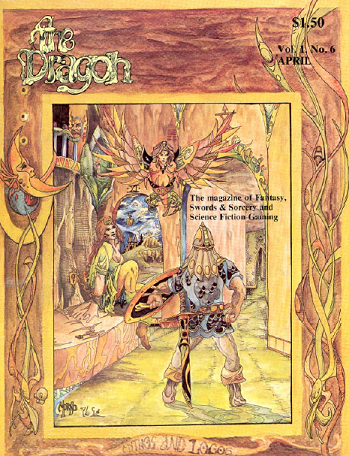
The cover for this issue was by “Morno”, AKA Brad Schenck, who you can find at deviantART. He’s mostly known for his contributions to Arduin and computer gaming, and he has lots of nice retro sci-fi material in his gallery. Check it out.

First article is by Guy W. McLimore, Jr.An Alternate Beginning Sequence For Metamorphosis: Alpha. Article begins with a neat little graphic of old pseudo-computer code … takes me back to programming BASIC on my old Vic-20. Good times. The article takes a while to get to the point, describing a clone bank on the Warden. [Hey – just got it – James Ward – Warden – damn I’m slow]. The meat of the article is a little d% table to determine whether you are human, a latent mutant or a true mutant and how many mutations and defects you have. Do the new versions of WOTC Gamma World delve into defects at all? I dig that defects are just part of character creation back in the day … you play the cards the dice deal you.

The article continues with many more tables, including more detail for latent mutants and the number of programmed ship skills one might have, including some special psychic skills for humans only.

The author would go on to be a part of the Doctor Who RPG, Mekton Empires and a host of products for Star Trek and Starfleet Command.

Ronald C. Spencer, Jr. (another junior … I smell conspiracy) presents Sea Trade in D&D Campaigns. This one springs from a campaign being played on the ballistic missile sub USS Benjamin Franklin … I love the stuff that comes from actual play. In this case, a fighting-man wanted to set up a shipping business on the side – smart guy!

D&D produces two wonderful sorts of rules. On the one hand, you have the super simple, elegant rule – like shields will be splintered – and on the other hand, the baroque set of charts that put a warm glow into the hearts of people like me, even if we never plan on actually using them. This one has a single chart and a few assumptions – one page to cover the whole concept. I like it.

The basics of the system are set up as a number of assumptions. To be brief … (1) Cargo is not specified; (2) small merchant ships can carry a max value of 10,000 gp, large merchants 50,000 gp; (3) ships have to pay a pilot fee of 500 gp for small ships, 2,500 gp for large ships and a 5% import tax based on the value of the cargo; (4) profit/loss is determined with a dice roll (i.e. the neat little chart) and is based on the number of ports the ship bypasses (i.e. the further you go, the more you make, but the more likely you are to lose a ship to storms or pirates).

The ship owner invests in a cargo and then gives sailing orders to hit ship – where to go, which ports to bypass, how much profit/loss to accept (if a port is bypassed to avoid a loss, it counts as a bypassed port – I suppose this involves ignoring a bad roll and trying again). Ultimately, the DM (or D/M as he writes it – love this period when things were not yet settled and official) makes the percentile roll and money is either lost or made.

Ships are delayed 1d4 weeks at ports other than their home port, and when ships are lost at sea the owner is notified 1d6+2 weeks later. Neat system, which I’ll happily use in my Blood & Treasure campaign, assuming anyone goes to the trouble of buying a ship or investing in one.

M.A.R. Barker now chimes in with a painting guide for Legions of the Petal Throne. I can’t imagine how anyone in the hobby back in the day could have resisted buying the Tekumel material … very evocative. Love the art.

Morno (Brad Schenck) now provides some fiction in the form of The Forest of Flame. From now on, I will present one random paragraph from each bit of fiction …

Some obsure glory, had thought Visaque, must belong to one who unlocked the musty secrets of the tome; the dream was even now fresh on him. Weeks, then months of spare hours were spent in the attempt of understanding the mysterious text. By the time its crabbed script was half-deciphered the task became somewhat simpler, and often he read in the small hours its forgotten tales by candlelight. He read of the Elder Days and the Days To Come: of heroes, mages, and of strange devices . . . of Crowyn the Worme’s Bane and of his star-crossed blade; Of the strange curse of Vyckar the Grim; Akor the Valkrian, Nokra Negreth, the Red Branch heroes . . . all the warriors and their impeccable deeds. And then, the mages: Bran-Herla whose soul was lost by the wide waters; Vergil Magus; Garanyr the Heart-Misled; of Myrddin, of Verbius, Therion, and the loremaster Isaac Decapole D’alsace . . . and in an indefinite reference on a faded page, was inscribed the name of Vishre Vishran. When Visaque first read that name it struck an eerie chord within him, as if of a misplaced memory. Even now the name was uncomfortably close to an identity. Yet for contemplation there was, today, no time. That the mage was called an Ipsissimus, he knew, but knew not the rank so named. For all his study (so unclear in the remembering . . .) all Visaque had learned was that Vishran dwelt in the Castle Arestel, atop the mountains eastward. (Arestel . . .)

In the Designer’s Forum (that’s a neat idea … a place where game designers can just add a few bits and pieces and corrections to their games – if any designers out there want to talk about their stuff in NOD, let me know).

This forum is by James Ward, with Further Rules, Modifications and Clarifications for Metamorphosis Alpha. He goes into mutations for taller mutants (roll 1d20 for additional height, add one “striking die” for each four feet above normal height – you can get some tall freaking mutants in MA!), shorter mutants, additional body parts, wings and some psychic powers.

Next, there’s an add for D&D miniatures. They guarantee satisfaction. Fantasy Forge has some neat Tekumel miniatures (I wonder how many are still out there, painted and waiting to be used), followed by an ad for Space Gamer out of Austin, TX.

After the adverts, we get chapter 6 of the Gnome Cache. I quote from the summary …

Unable to resist the wanderlust any longer, Dunstan has robbed his father’s strongbox and set forth on his quest for adventure and glory.

In his naivete, Dunstan casts his lot in with a band of scurrilous cutthroats, believing them to be adventurers sharing his noble pursuits.

Our hero learns the true nature of his erstwhile companions, and his pockets are the poorer for it. Dunstan parts company from the band, narrowly escaping apprehension by the Warders. In the confusion, he ‘liberates’ a horse, and sets off for Huddlefoot, there to spend the night in the stables.

Our would-be knight acquires a would-be squire, and strikes a bargain with Evan to travel with his caravan to Rheyton and Nehron. This arranged, he takes care of the incriminating horse, spinning a tall tale of being on official business. This done, they await departure . . .

David W. Miller presents: D&D Option: Determination of Psionic Abilities, giving some additional ways people could pick up psionics in the game. I kinda dig the baroque nature of psionics in old D&D, though I don’t remember if we ever used them or not. Maybe one or two characters were lucky enough to develop them.

Jim Hayes and Bill Gilbert cover Morale in D&D – an important system when you consider the game’s wargaming roots and the importance of wandering dungeons with large bodies of men-at-arms and torch bearers. This one has a couple charts, lots of modifiers and … honestly, I’d rather just roll 2d6 and be done with it.

In Fineous Fingers, we get a visit from Bored-Flak, the Bolt Lobber, who has a firing sight on his finger. He saves the party’s bacon and then disappears into the dungeon.

The Featured Creature is the Death Angel by John Sullivan. Not the toughest monster in the world – 7 Hit Dice (d8’s, it notes) and AC 4 (or 15, in modern games), but it does a death scythe that forces people to make a save vs. death at -3 (and you lose a point of constitution if you fail). If you can take this sucker on at range, you’re okay … except it can teleport at will. They also have 95% magic resistance. Fortunately, they only attack their intended victim – essentially somebody who has pissed off a god or demi-god. The take away here … leave those gemstone eyes in the idol alone!

Next (and final) add is for the old dungeon geomorphs – only $2.99.

All in all, a decent issue, but not spectacular.

Dragon by Dragon … March 1977 (5)

I dig this cover – this is what D&D games should look like!

Three months into the new year of a new game! Before I get into this issue, I’d like to direct folks over to White Dwarf Wednesdays at Tim Brannan’s blog.

What did the oldsters come up with for this issue? Let’s take a look …

A fantasy story by Gardner Fox shows up in this issue – it’s amazing how many “real authors” showed up in the pages of what was still a pretty new magazine that represented a very new hobby. Maybe these guys didn’t have many offers in the late 1970’s – the golden age of magazine stories and illustration had passed, but still, it’s pretty cool.

The big deal in this issue is the Witchcraft Supplement for Dungeons & Dragons – a title I’m sure served as ammunition for the anti-D&D crusade back in the day. What’s awesome about this article, right off the bat, is that they didn’t know who wrote it, but published it anyhow! Right under the title is a request that the real author please let them know who the heck he or she was.

The article starts off with a bit on how witches can show up on the wilderness encounter table. I always love this stuff – the idea that there is a single, unifying wilderness encounter table for all of D&D, and if we add witches to D&D we have to shoehorn them into the table. Reading these articles, you can’t help but love this weird, new world of gaming that was being grown back in the day.

The first thing you need to know about witchcraft is that witch spells do not affect djinn, efreet or clerics of any alignment. All witches have saves equal to warlocks (I love when they used level titles in place of the level number). Good (i.e. Lawful) witches can perform 7 spells per day, but there is a 4% chance that she is ancient, and is thus a Priestess who can cast 10 spells per day and 1 of her own special spells once per week. Why 4%? God only knows.

A few of the new Lawful witch spells are calm (which turned into calm emotions), summon elemental (12 HD) – which lasts while she concentrates, rejuvenation (reduces age by 5 years), dissipation (disperses elementals, clouds, mist and magic wall spells) and comfort. Priestesses get several new spells – youth, influence, banish any one creature, enchantment (produces any one magic ring, potion, misc. weapon, misc. magic item) and seek.

Black witchcraft includes pit, fire box, diminish plant/animal/men, plant entrapment, paralyzing pit (!), undead control, aging, circle of blindness, curse, poison touch and curtain wall. Many of these spells have modern versions – I don’t if they originated in this article or if it’s just a coincidence.

Now we get an explanation for the Secret Order witches … they were designed to challenge high level wizards and magic weapon-armed lords when traveling through the wilderness. Necessity is the mother of witches, apparently. They have some additional new spells and several special weapons. Lots of great material here – hornet cape, assassin’s eyes – find this issue and read away.

James M. Ward now chimes in with “Some Ideas Missed in Metamorphosis Alpha” – basically some things that should have been in the rulebook but were not. Kinda taking a mulligan here. He also adds “Tribal Society and Hierarchy on Board the Starship Warden”. Good stuff – apparently the dominant lifeforms on the Warden are the wolfoids and androids.

This issue’s Creature Feature is the ankheg. Again, the statblock is a bit chaotic. Since the ankheg is open content (and old as the hills), I’ll reproduce it below …

Number appearing: 1-6
Description: 10-20 feet long, brown chitin overall, pink underside
Armor class: 2 overall, underside class 4
Movement: 12/6 through ground
Hit die: 3-8 (8 sided die)
% in lair: 25%
Treasure: B2
Squirt acid for 1-6 die of damage according to size
Bite for 3-18 points damage
Magic resistance: none
Alignment: neutral

These babies can sure deal some damage!

Next is the letters section. My favorite bit is a guy describing his campaign world:

“Although it is not our own Earth, it is only about eleven light years from our world, and therefore most of the culture is a parallel of our ancient cultures.”

True scientific realism, indeed!

Gygax now chimes in with How Green Was My Mutant, with random tables on determining the appearance of humanoids in Metamorphosis Alpha. Naturally, I need to roll one up:

Skin/Hair Coloration: Brown
Skin Characteristic: Knobby
Color Pattern: Whorles
Head: Bulbous
Neck: Wattled
Body: Long
Facial Features: No nose
Hands and Feet: Wide
Fingers and Toes: Four of each
Arms: Normal
Legs: Thin

Damn – that’s one good looking fella! Best thing about the tables, to me, is that it’s almost impossible to roll anything like a normal looking human being, which is as it should be.

I won’t cover Fox’s tale Beyond the Wizard Fog, as Jamie Mal has done a fine job of that himself. (Google it, darlings)

Charles Preston Goforth, Jr. (fake name? has to be a fake name) provides new rules for magical research with one year of playtesting (real time) and nine years in game time!

Essentially, they give you 10 levels of spells with a percentage chance of success, time required and the gold piece investment.  The chance of success appears to always be 20% or 100%, depending on how much gold is spent. A 1st level spell, for example, costs you 2,000 gp for a 20% chance of success, or 10,000 gp for a 100% chance of success. 10th level spells (whatever the heck they are) cost 5.12 million gp for a 100% chance of success.

There are some restrictions on spells to permanently increase stats (including spell levels up to 18th). I pity the poor wizard who sunk several million gold pieces into increasing their intelligence when they could have waited a couple decades for 3rd edition and done it for free.

Armor and weapons can be enchanted up to +1 with 2 months of work and 2,000 gp. “Serious enchanting”, as he puts it, requires 10 months and 10,000 gp. I have a weird feeling this system would very quickly get out of hand!

Bill Seligman now gives us one of the classic articles of the old school – Gandalf Was Only a Fifth Level Magic-User. The best point of the article, to me, is to hopefully make people see just how incredible the average 1st level magic-user really would be in the “real world”. Still, Seligman was clearly an early model of Raggi in terms of bringing out the nerd rage.

Garrison Ernst now presents another installment of The Gnome Cache. No – I didn’t read this one either – too dang much writing to get done.

And that rounds up the first issue of 1977. The vitality in the early game, and the presence of so many gamer archetypes that linger to the modern day makes these magazines great fun to read.

Dragon by Dragon – December 1976 (4)

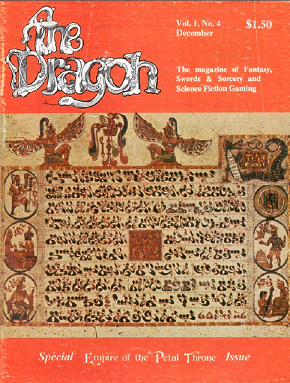
The Dragon closed out 1976 with an issue dedicated to The Empire of the Petal Throne – they even added 4 pages to the magazine to handle all the goodness.

Full disclosure … as long as I’ve been playing D&D and learning about it, I still know relatively little about MAR Barker’s baby. I know the basics and the general history, but it’s always seemed like a setting that required immersion to really grok.

The December issue kicks off with what we would now refer to as a campaign log by the man himself, MAR Barker, updating folks on the going’s-on of Tekumel (really a follow-up to a similar article published in the final issue of “The Strategic Review”. I mostly found this one interesting because it serves as a glimpse into another style of campaign play. Early in the aricle, Barker explains the need (or at least desire) to coordinate the various campaigns in Tekumel to avoid “parallel universe” development. Each DM back in the day really WAS his or her campaign. When you played with a DM, you visited his little universe. I think you’ll find a similar sentiment in the FLAILSNAILs concept.

Next up – James M. Ward provides some notes on Androids on the starship Warden. The androids, it seems, play the role of doppelgangers, taking positions of power among the human tribes and keeping them in conflict with the mutants so that the androids are free to continue their drive for power.  I dig that he refers to them as the “chemical men”. I also dig that the “history” of the androids was supplied by “Emaj the fat mutant philosopher as translated by Yra the Wise.” Honestly, if your not making weird plays on your name and inserting them liberally into your campaign, you just ain’t doin’ it Old School.

Steven Klein provides a random encounter table for the foreign quarter of Jakalla, a city of Tekumel. In essence, this isn’t much different from Gary’s city encounter table in the old DMG. Watch out for the priests of the Goddess of the Pale Bone!

MAR Barker now chimes in again with notes on war gaming in Tekumel. Like Gygax and Arneson, Barker was a war gamer, and here he gives a report on the Battle of the Temple of Chanis: 2020 A.S. as a way of introducing people to the military thinking on Tekumel. He introduces the idea of “Little War” battles that are like duel battles and “Great War” battles that involve hundreds and thousands of troops. The idea of battles that mostly revolve around challenges between individuals in the two forces reminds me of stories from Celtic antiquity, and it’s not a bad way to handle some mass battles in your game without having to deal with actual war games. The length of the invented history of this battle (well, probably play report from his game) suggests how immersed people were in the game … it’s a long article to read just to learn about something that never actually handled.

The Creature Feature presents two creatures from Tekumel, the Mihalli and Vriyagga, both getting some nice color art. In S&W terms, they would have the following stats:

Mihalli: HD 3; AC 1 [18]; Atk1 weapon; Move 15; Save 14; CL/XP 5/240; Special: Magic spells, shape-change, magic items.

The Mihalli were non-humans that had subterranean spy facilities that were wiped out with nuclear fission bombs. Only a few now persist. They are hermaphroditic humanoids with skin that ranges from dull green to coppery brown that signify their class – green for lower, coppery brown for upper. They are shape-changers who are sometimes given away (20%) by their opalescent red eyes. All are magic-users and most have magic items, including the wonderfully named Ball of Immediate Eventuation, which can fire energy bolts, create defense shields against non-magical projectiles (I think we call it shield these days), cause their users to become invisible and produce clouds of poisonous gas. They come in various strengths, indicated by their colors.

Vriyagga, Small: HD 10; AC 1 [19]; Atk 4 tentacles (2d6 + constrict) and bite (1d6 + poison); Move 8; Save 5; CL/XP 12/2000; Special: Tentacles up to 10 feet long.

Vriyagga, Medium: HD 15; AC 1 [19]; Atk 4 tentacles (4d6 + constrict) and bite (1d8 + poison); Move 12; Save 3; CL/XP 17/3500; Special: Tentacles up to 20 feet long.

Vriyagga, Large: HD 25; AC 1 [19]; Atk 4 tentacles (6d6 + constrict) and bite (1d10 + poison); Move 15; Save 3; CL/XP 27/6500; Special: Tentacles up to 40 feet long.

These babies are excellent – two giant wheels with knotted muscles around a central spoke, brain pans hanging from that with weird faces from which extend four tentacles covered in suckers and a mouth lined with poisonous, purple feelers. They have ebon eyes that can see in the dark. The tentacles are very tough (AC 2 [17] to sever). Vriyagga enjoy the taste of juicy humans over the pale shrimp-things who they normally dine on.

Gary Jaquet now gives us “Miscellaneous Treasure, Magic, Weapons, Artifacts and Monsters – Additions, Deletions, Omissions, Corrections, Changes, Variations and Otherwise Confusing Alterations” etc.  This is a comedy bit with things like Creeping Crud (resembles cigarette butts, crushed Fritos, spilled Dr. Pepper, sweat from players’ foreheads and referees’ dice rolling arm, pencil shavings and old character cards), dice lice, etc.

Jerry Westergaard presents some fiction – “Roads from Jakalla”. This, along with the other articles by Barker, do a good job of presenting the setting.

Another side bar presents the old “Generals can do X, Colonels can do Y … Privates can do everything” bit, only starting with 22nd level wizards and working down to Referees.

Wargaming World – no author credit – examines the new miniature lines for EPT and D&D. The reproductions of the miniatures are almost impossible to see, so, not much help really.

Page 29 does have an interesting bit – maybe the first appearance of Appendix N. Titled “Fantasy/Swords & Sorcery: Recommended Reading From Gary Gygax”. It goes from Poul Anderson’s Three Hearts and Three Lions to Roger Zelazny’s Jack of Shadows (etal), Lord of Light and Nine Princes of Amber series.

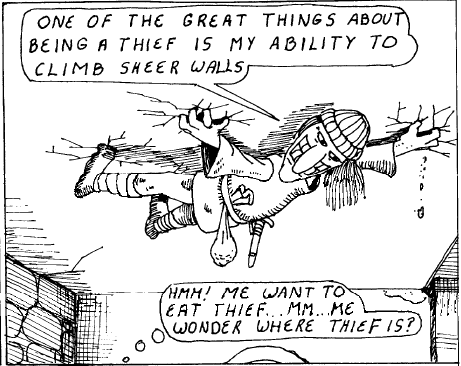
Fineous Fingers gives a nice demonstration of “climbing sheer walls” for thieves.

Page 31 gives the percentile chance for obtaining an “Eye” as treasure in EPT, and the issue then ends with some pictures (boy were they hard to reproduce back in the day) of a scale model of the Temple of Vimuhla.

Not a bad issue if you want to wade into Tekumel and test the waters, and if you can’t find something to do with the Vriyagga, you just aren’t trying.

Dragon by Dragon – October 1976 (3)

Three issues into The Dragon and we have our first sci-fi cover! What lies within? Well – not much sci-fi …

First up we have an editorial by Tim Kask about fantasy. He brings up at least one good point – your ability to imagine something is predicated on your past experience. To my mind, that means get out there and experience as much as possible, even if it is just through art. The more you have seen, the more you will see and can imagine. Tim then goes on to remark that fiction, in future, will be better laid out (people complained), but that The Dragon will still feature fiction.

Next, Gary Gygax asks “Does Anyone Remember War of the Empires?” If he was asking me, the answer would be “I’ve never even heard of War of the Empires, Gary, tell me more.” The game was a very early sci-fi wargame (circa 1966) that seemed geared to postal play, pitting Terran commanders against one another working for either the Greatest Empire or the League of Worlds. He goes on to tell the tale of its demise (twice) and the difficulty in running such a game. These days, it would probably be a snap. Alas.

The next page has a sweet illustration in an advert for Starweb, a PBM sci-fi game.

Dig it!

The next article is one of my favorites, for no other reason than it defies belief these days. Len Lakofka explains how one can play … a female!!!

What can the ladies do in D&D? They can be fighters, magic-users, thieves and clerics. They can do just as well as men in magic and can surpass them as thieves, but they are behind men in all ways in terms of fighting … though they have “attributes their male counterparts do not!” (God, it hurts a little writing this). Elven female clerics can rise to especially high levels. Because, you know … elven females are just really good clerics. I guess.

For attributes, women roll 1d8+1d6 for Strength, 3d6 for Wisdom, Intelligence, Dexterity and Constitution (and any woman with a 13-14 in Strength adds +1 to her Con score) and roll 2d10 to determine Beauty (not Charisma). Beauty is apparently important to thieves, fighters and magic-users if its exceptional (15+), but may not be used by clerics if they are lawful or neutral.

He then goes through all the level titles and XP requirements for women (which are different from men) – and honestly, I do dig the level titles, which feature Battle Maiden, Shield Maiden, Heroine, Valkyrie and War Lady for fighters, Superioress and Matriarch for clerics, Witch (in place of Wizard) for magic-users, and a few cringe-inducing titles for thieves (wench, hag, jade, succubus, adventuress, soothsayer, gypsy and sibyl).

Female adventurers have slightly different stats than their male counterparts – most especially in that high-level thieves and fighters who are particularly beautiful learn to cast some spells – which mostly boil down to charming and seducing men and tarot reading.

Simply put, this is one hell of a sexist article, entertaining only in the context of how far gaming has come since then.

“Garrison Ernst” continues with another part of “The Search for the Gnome Cache”. You know, I did enjoy his Gord the Rogue material – I’ll have to read through these one of these days.

Brad Stock and Brian Lane present some nice birth tables for D&D – 30% chance of commoner, 55% chance of merchant class, 10% gentleman and 10% noble, then you roll for sibling rank and then more rolls to determine you “sub-class” and initial money, monthly allowance from family (a neat idea) for first year of adventuring or until 3rd level, whichever comes first) and starting skills. A very wealthy noble, for example, starts with 400 gp, a monthly allowance of 60 gp and four skills from group 1, three from groups 2 and 3. He might, thus, end up with the following skills: woodsman, miner, jeweler, sailor, mason, normal merchant, scribe, artist, adventurer (3rd level fighter) and Don Juan. Not sure if it really makes sense for nobles to have so many skills.

There are several other tables for nobles and some for rolling one’s race randomly, including “half-goblin/half-orc”, “half-elf” and the infamous and lawsuit-inspiring “hobbit”.

Page 17 has a Fineous Fingers comic strip … I think this might be the first one in The Dragon. We also see the first letters page “Out on a Limb”, which in retrospect really isn’t a play on dragons or fantasy. Garry F. Spiegle writes maybe the best line concerning Gnome Cache – “the writing was so good about a subject so terrible”. Scott Rosenberg was pissed that they wouldn’t let him Xerox tables for GM’s and sell them (at cost). Lewis Pulsipher doesn’t like all the ads and illustrations (waste of space) and writes a critque of that “Three Kindreds of the Eldar” article that’s about two or three times longer than the original article, made even longer by a response from Larry Smith who, believe it or not, disagrees with Lewis. The exchange reminds me of Triumph the Insult Comic Dog’s answer to the question, “What material was Han Solo frozen in?” – A: “Who gives a shit?”

Next: “A Plethora of Obscure Sub-Classes”, including the Healer by C. Hettlestad, the Scribe by David Mumper and the Samurai by Mike Childers (modified by Jeff Kay).

Larry Smith offers a “New View of Dwarves”, with some sweet level titles for dwarf fighters (dwarf – warrior – spearman – dwarf hero – swordbearer – axewielder – champion – dwarf lord – dwarf king) and the revelation that there are only 7 dwarf families 😉 and thus 7 dwarf kings, the tribe of Durin being the most prestigious. They have some rules for dwarf clerics and thieves, and my favorite two lines:

Dwarves as Magicians, Assassins, Monks, Paladins, Illusionists, Rangers or Sages.

The above is not allowed.

We round it out with John Pickens’ Berserker, Gordon Davidson’s Idiot and Charles Carner, William Cannon and Pete Simon’s Jester.

The issue ends with a table of “Combat Modifications for Dexterity” by Steve Cline, with percentile ranges for high dexterity. These include modifiers for melee attacks, ranged attacks, damage and defense.