
Today we move into the Summer of 1982, in which from sheer boredom nerds everywhere looked forward to the new Dragon magazine. After all, it’s not like there were any good movies or shows in ’82 …
Of course I’m joking – Airplane II was released in 1982. It was nice to see Shatner in a movie – he was otherwise pretty quiet that year.
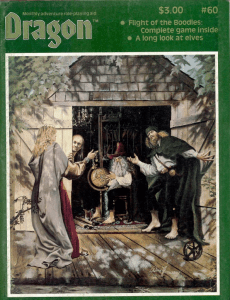
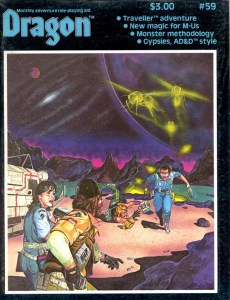
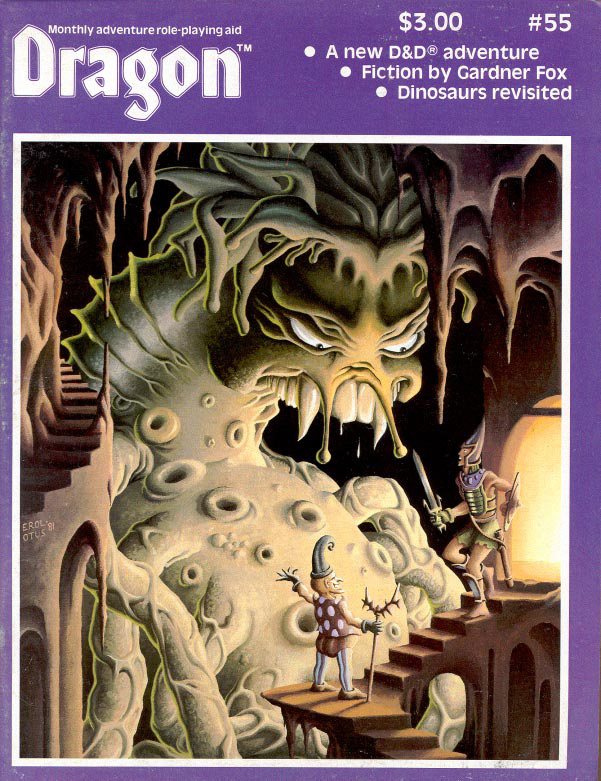
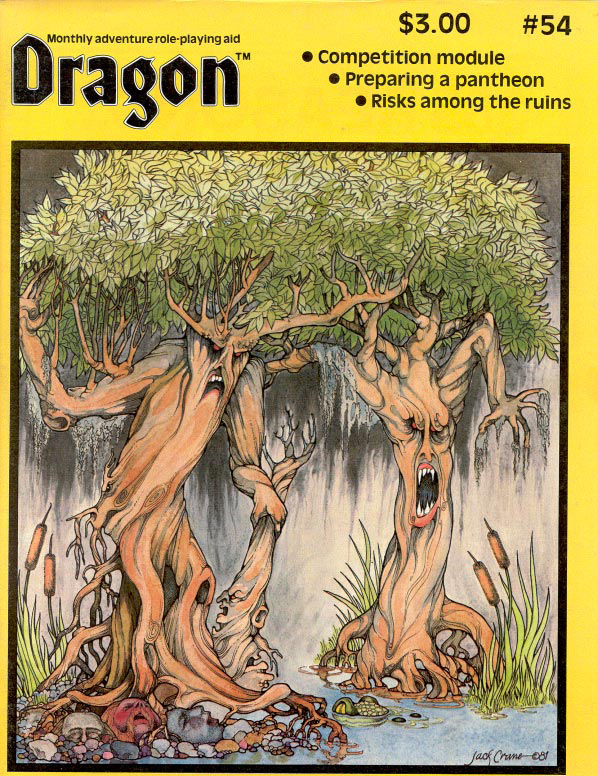
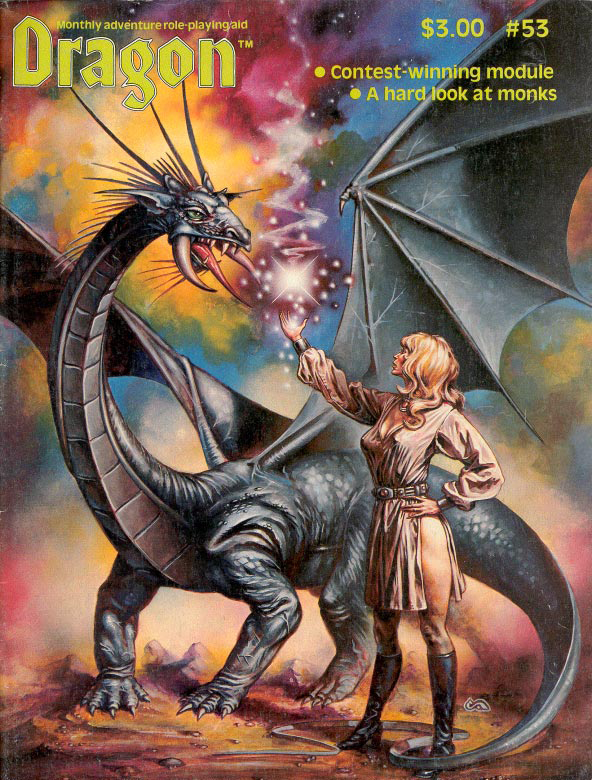
Still – summer is a great time to nestle under the air conditioning and read – what did Dragon have to offer other than a famous and fantastic cover image?
First things first – I just found out something about this ad

Apparently, among those D&D players are Alan Ruck and Jami Gertz. Just found this out from Old School FRP on Tumblr. Gertz was super nerd-cute back in the day, if that makes any sense at all. And Ruck … hey, you know Cameron and Ferris played D&D at some point.
First cool article in this issue is on Faerie Dragons. I don’t know why, but I always loved faerie dragons in D&D – it may have been the illustration in Monster Manual II. I think I owned MM2 before I had the original Monster Manual, and I know I had it before I owned the Fiend Folio, so the monsters there loomed large in my estimation of the game. I also remember an exact copy of the MM2 faerie dragon appeared in a video game that a buddy and I used to play at 7-Eleven. It was a fantasy game, very anime in its feel, and I wish I knew the name of it. Maybe a reader knows?
Anyhow -the faerie dragon was created by Brian Jaeger, and until reading the article, I forgot about how they changed color as they aged. I think its a fantastic monster – well doen Mr. Jaeger.
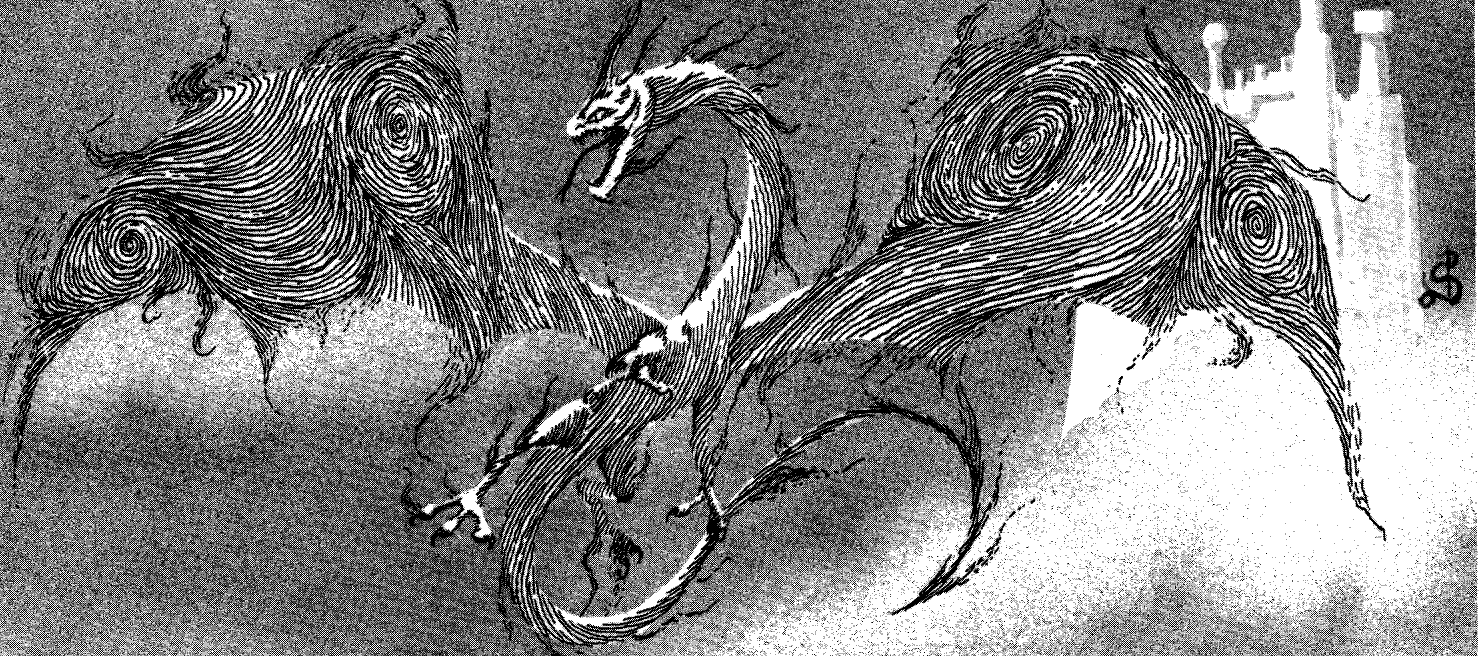
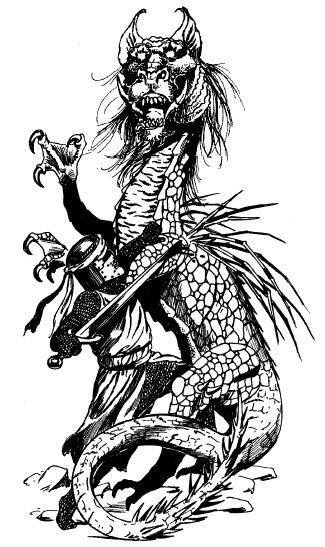
The special dragons section in the mag also presents Steel Dragons by Pat Reinken (with a really cool illustration) and Grey Dragons with another cool illustration. I’m not sure about the artist – I feel like I should know that symbol, but it’s not coming to me.
Roger Moore then presents “Evil Dragon Armors” in the “Bazaar of the Bizarre”. Plate armor made from dragon scales is as D&D as heck, and one of the things the game should highlight more than it does – you know, those things that tap right into the imagination, things that every 12 year old knows is cool whether they’ve heard of D&D or not.
For fans of standardization, Gary Gygax presents some info on spellbooks – the types (standard and traveling, the traveling spellbook containing a fourth of the spells of a standard book), the cost (standard spellbooks cost 1000 gp for materials + 100 gp per spell level of spells contained within, traveling spellbooks are 500 gp + the same), the size (standard are 16″ tall, 12″ wide and 6″ thick, traveling 12″ tall, 6″ wide, 1″ thick) and so on. Great article for those who like the details, completely unnecessary for those who like to keep it light and imaginative.
This is followed up by four long-lost magical manuals in Ed Greenwood’s “Pages from the Mages”. I’ve mentioned this before, but while Forgotten Realms did nothing for me as a setting, Greenwood’s articles about the Realms were massively inspirational for me. They are all worth reading.
But wait – there’s more … the NPC class “The Scribe”, by Ed Greenwood. I was always hooked on NPC classes as a kid, and it killed me that I could see the names of classes in the Dragon indexes they would publish, but had no access to the classes that came along before I was a reader/subscriber. The scribe could actually be a pretty awesome companion to an adventuring party. They can wear any armor and use any weapon, but always attack as a first level fighter. So – not useless in a fight. On top of that, they have some neat special abilities involving writing, and can cast some spells from scrolls.

Roger Moore has another article in this, on the point of view of half-orcs and on the gods of the orcs. Again – great for their inspirational value even if you don’t want to use Moore’s concepts in your particular game. Here’s a neat bit from the article on the gods of the orcs:
“The division of orcs into separate tribes (Evil Eye, Death Moon, Broken Bone, etc.) is usually made along cult lines. The tribal symbol is the holy symbol of the orcish god the tribe holds as its patron. Each patron god seeks to make his followers more powerful than those of the others, since their own power derives from the relative power and might of their worshipers.”
Orc tribes are pawns of their gods, who care little for their followers beyond what they can do for the god. Why are the orcs causing trouble? Their god or goddess told them to – that’s all they need to know.
The magazine contains a full adventure for Top Secret set in Chinatown written by Jerry Epperson. I know little about the game, so I can’t really review it.
Gordon Linzner has a bit of fiction in the issue, “The Feline Phantom”. As is usual for this review series, I present the first paragraph:
“The river of school children flowed past her hips, occasionally rising to her ribs, but Evelyn Slade was exceptionally tall and stood firm against the current. The stream engulfed the monorail she’d just stepped from, then split into a score of individuals motivated by only one thought: Grab the best seat. All viewing locations were, by design, equally good; but try telling that to a nine-year-old New Yorker! Fortunately,
one ride above the Wild Asia exhibit — where Bronx Zoo visitors watched from mobile “cages” as animals roamed in comparative freedom — had proved sufficient.”
Lenard Lakofka presents magic for merchants in “Leomund’s Tiny Hut”. The idea is that members of merchant guilds can gain access to some simple spells, mostly cantrips, but also a few “mysteries” like alarm, appreciate, bell, drowsiness, glue, grab, hound, lapse, lock, pacify, panic and spin. Master guild members can get some 1st and 2nd level magic-user spells. There’s a part of me that likes the idea of lots of spellcasters floating around a campaign world, and another part of me that likes to keep magic more rare. For the former part of me, this is a groovy article.
Phil Meyers and Steve Bill present “Zadron’s Pouch of Wonders”. If you are familiar with AD&D, you’ll get the idea. Reach into the pouch and pull out a randomly determined something. I actually love that kind of stuff – spices up a game and creates wonderful surprises.
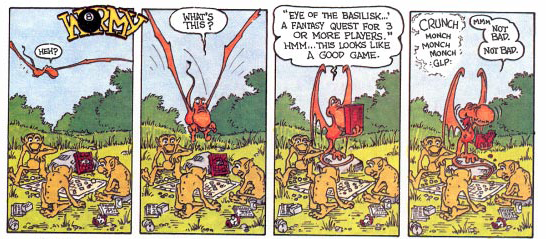
After the reviews, we get some Wormy – the cyclops and his cyclops dog are playing D&D …

… plus some ideas on strength by Phil and Dixie, and a few cartoons in Dragon Mirth.
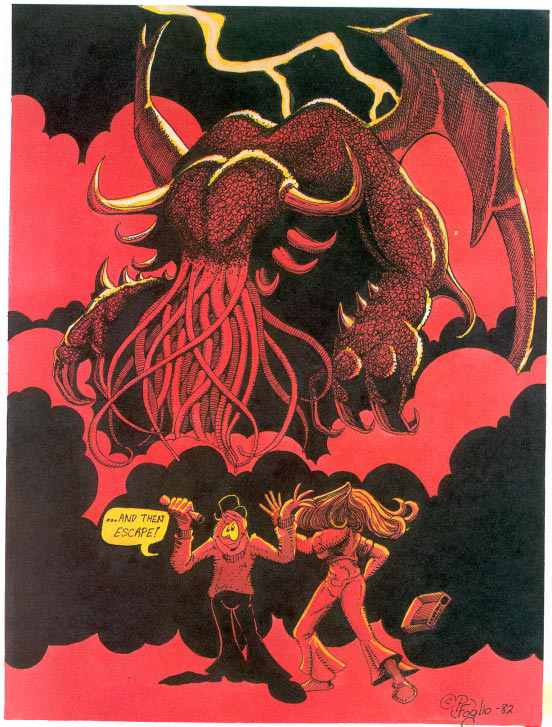
But before we leave – check out this beauty …



 working hard and praying for peace, and trying to relax with old TV shows, old movies and some podcasts about fun things. I will readily admit that my interests tend towards the old – movies from the 30’s and 40’s, TV from the 60’s through 80’s, “bronze age” comics, old games, etc. There’s something about the design and awkward charm that really get me, not to mention nostalgia for places and people I’ll never see again.
 review than a “here’s what I dug about this issue”.
 The first big piece in this issue is “All About Elves”. You get Roger E. Moore’s “The Elven Point of View”, with super cool Erol Otus art – the ultimate elven fighter/mage. I really dig the idea that only elves can be fighter/mages. There are, of course, lots of cool ideas in the article – Roger E. Moore is one of my favorites. Roger and Georgia Moore then present the Elven Gods – these are the additions to the pantheon beyond Corellon Larethian in Deities & Demigods. These days, I’m more apt to make up my own, but as a kid, articles like this were eye-openers to me. Notions I didn’t know that I didn’t know.
 Gygax’s “From the Sorcerer’s Scroll” is a big load of cantrips. AD&D cantrips were 0-level spells before later editions pumped them up and made them more useful. I think it would be cool to make these available to non-magic-users on scrolls. Most of these cantrips require the player to really use their imagination and creativity to make them useful in a dungeon adventure – so naturally, I love them.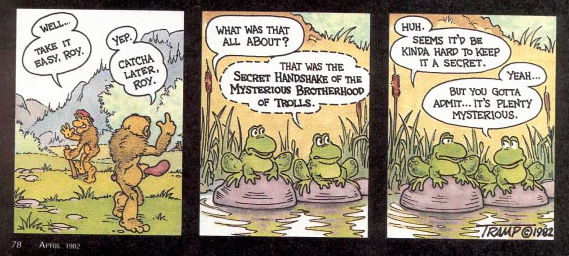
 Well, a day late and a dollar short, but late is better than not at all.
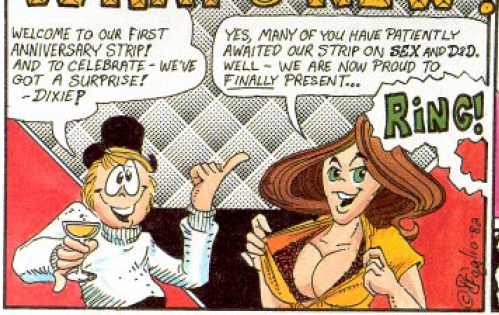
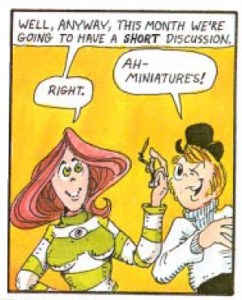 I mentioned Phil Foglio’s contribution to Star Trek fanzines a post or two ago, and now here he is as I was introduced to him, in Dragon. I always like the strip, and appreciated the humor … and yeah, had a total crush on Dixie.
 The Clyde Caldwell cover to the February 1982 Dragon Magazine is chock-full of fantasy tropes. You have the warrior woman in weird, revealing armor and a gnome fighter mounted on a giant lizard. You also get a Clyde Caldwell trope, namely lots of feathers. That said, I adore Caldwell’s work, and consider it fundamental to 80’s D&D.

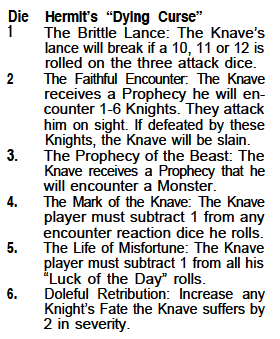

 Wow – 1982. I was ten years old (well, nine in January) and still a couple years away from learning about Dungeons & Dragons. Thirty-six years ago – much as changed, and much has not. I guess all these years later, we can be happy that people are still playing D&D and AD&D and other “old school” games. Let’s start the new year by looking at the new year in 1982 in gaming …
 This issue’s Giants in the Earth covers a couple characters I don’t know – C. J. Cherryh’s Morgaine and Vanye (with art by Jim Holloway) from the books Gate of Ivrel, Well of Shiuan and Fires of Azeroth, Lynn Abbey’s Rifkind from Daughter of the Bright Moon and The Black Flame, and two characters created by Robert E. Howard – Belit and Dark Agnes. Howard. Belit is a Chaotic Evil 10th level fighter in this write-up, though I would probably go Neutral Evil given her devotion to Conan since I conceive of Chaotic Evil as being utterly self-interested.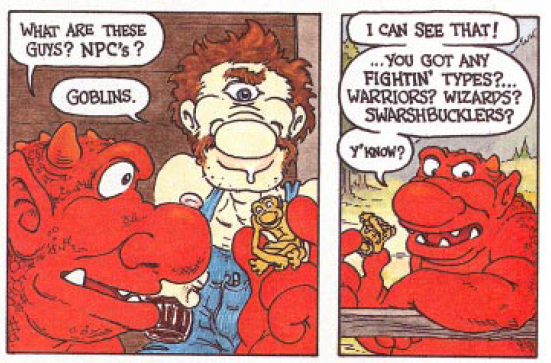
 Ho ho ho – Merry Christmas 1981!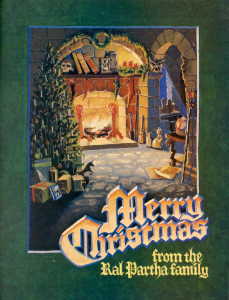













 Land of Nod