An English Vampire in Africa

Hey folks – it’s a three day weekend in these parts, so I’m still on schedule with a post every weekend.

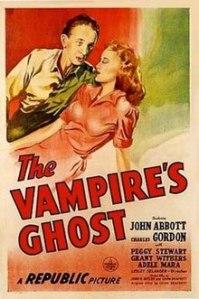
I was going to do a Dragon-by-Dragon today, but instead decided to write about a little B-movie I finished watching last night, the 1945 “classic” The Vampire’s Ghost. While the movie does not involve a vampire’s ghost, it is a better movie than it has a right to be, possibly because it was written by Leigh Brackett. If you don’t know who Leigh Brackett is, well go find out. She was a classic sci-fi author, and did some fine screenwriting on The Big Sleep, Rio Bravo and The Long Goodbye. The film we’re talking about today was her first such effort, and in it she brings more talent to the picture than one would expect of a low-budget Republic film.

She’s joined in this by the the villain in the piece, John Abbott. Just to maintain the Star Trek theme I’ve been on for a while, he played the lead Organian in the episode “Errand of Mercy”. In this picture, he plays the vampire, and I think he’s one of my favorites. In classic Hollywood, the Vampire didn’t usually have much depth, and was often played for shock value. Bela Lugosi’s turn as Dracula is an exception, of course.

It also helps that the movie is based loosely on “The Vampyre” written by John William Polidori in 1816. Between Polidori, Brackett and Abbott, you get a hidden nugget from the studio days of Hollywood.

In The Vampire’s Ghost, Abbott plays Webb Fallon, an English vampire who has “lived” at least since the days of the Spanish Armada. He brings a really rate matter-of-factness to his vampire portrayal – he’s not happy about his condition, but he shows no remorse for his victims, and he mostly uses his ability to hypnotize and control people to get away with it. In the film, he is now running a drinking establishment in the African town of Bakunda. As in Dracula, the movie wastes little time in revealing that the mysterious killer around Bakunda is a vampire, and that Fallon is that vampire. The natives discover it first, and the “hero” of the picture, Roy Hendrick (Charles Gordon) is soon clued in, but is hypnotized by Fallon before he can do anything about it. Strange for many such movies, the supposed hero spends most of the movie unable to do anything against the villain. The vampire really is the protagonist in the film, making all the moves and committing his villainy unrestrained until … well, I won’t give everything away.

The main point here is that, in this largely forgotten B-movie, there’s a really cool vampire depiction thanks largely to two talented people, Leigh Brackett and John Abbott, and despite the low budget and relative apathy of Republic Pictures. To tie this in to roleplaying games, the Webb Fallon vampire should give a good game master some ideas about playing a vampire in a game in a way that might surprise the players.

Check it out, if you have a mind to …

Family Game Night Reviews

Because setting yourself up for failure is fun, I’m going to take a shot at getting a post up each weekend in 2020. They might not all be strictly gaming related … but what the heck – it’s my blog and I suppose I can do what I want with it!

To kick 2020 off, I’ll do some “timely” game reviews. I had some time off this Christmas season, so the family had time for a couple family game nights. We had a few games recently purchased and un-played, so we gave them a twirl.

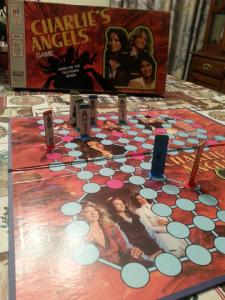
First up is Charlie’s Angels, published in 1977 by Milton Bradley. I’m a total sucker for any board game involving a 1970’s or 1980’s TV property (well, almost all of them), so when we saw this baby priced $20 in an antique shop, it was a shoo-in.

I instantly called Sabrina when we got the game home, but we soon discovered that each player takes control of their own team of Angels for the game, so no fighting over the individual Angels is required. The game concept is kinda cool. You have a board that is a sort of a modified grid. Onto this grid you place the Villain. The Villain moves one space on each player’s turn, the direction of the move chosen by the player in question. The player then rolls two dice and can move one of his or her angels each with each dice. If you can’t move the entire number on the dice with an Angel, you give up your move.

The goal is to trap the Villain – sort of a Charlie’s Angels checkmate. Each Angel that is in on the trapping is worth one point for their player. You play three games, total the points, and determine the winner. There are some cards that can be helpful … or harmful … so you take a risk pulling one. You also have to think a bit about how you want to move the Villain – you don’t want to be left out of the capture, so sometimes you’re really on the Villain’s side in the game. We had a good time with Charlie’s Angels, with the game ending in a three-way tie – not a bad ending for a family game.

One issue – I noted that the rules did not specifically disallow moving back on your path on your turn. They probably should have, because this seemed to make the game too easy, and it just didn’t feel right.

Next up was a funny little dice game – really a packaged version of old dice rules – called Skunk. Simple concept – you have two dice to roll. The dice replace the “1” with a skunk. On their turn, a player takes the dice and can roll them as often as they like, totaling the points rolled. If they roll a skunk, they get no points for this turn and have to pay a penalty (1 chip, or 2 if you rolled a skunk and a “2”). If you roll two skunks, you lose all the points you’ve acquired and pay a 4 chip penalty. To win, a player must get his total above 100 – she can go as high above 100 as she dares. Once a player goes over 100, the other players have to try to beat them on their next turn. The chips in the pot do to the winner of each round.

The game is really all about risk – how daring are you, and how lucky?

In our first game, I managed to zero-out midway through. When my daughter went over 100, I needed something like 60 points to beat her. I started rolling, got hot, and actually won the game. On our third game, I decided to do exactly that each turn, figuring I might eventually get hot again … and wound up rolling a skunk every time on my first or second roll.

We had a fun time with Skunk, and since up to 8 people can play it would probably make a fun party game. To make it more “grown up” you could turn it into a drinking game, with a drink taken on every skunk or double skunk. I suppose you could also play Strip Skunk … but then again, maybe not.

Finally, we have Buffy the Vampire Slayer: The Game, published in 2000, also by Milton Bradley. We bought this one for my daughter for Christmas, and she was raring to play it. It took a while to read the rules, but they weren’t too complicated and we had a good time playing it.

I took control of the bad guys, while my wife had to play Oz and Xander and my daughter got Buffy and Willow. The game is fun, pretty fast paced, and pretty easy to figure out. Evil sure looked like it was going to win this one – in short order, two of the goodies were out of the game and Evil had all the magic items. In the end, though, Buffy and Willow knocked off the evil minions and then teamed up on the Evil vampire and snuffed him out. Fortunately for them, the main villain doesn’t automatically get to move every turn. My guy spent three turns in a row not moving while they beat the crap out of him. C’est la vie.

So there you have it – three fun games for the family. All were purchased in antique stores for low prices and all were well worth it.

Aliens I Have Known

I love lo-tech aliens. I don’t mean aliens who wield sticks and stones, but rather aliens from old TV shows and movies who look goofy (or often look goofy). I love the creative work done by make-up artists and folks working with rubber and shiny polyester on these creatures. I’ve always appreciated old time special effects with technological limitations – nothing has taken the magic out of sci-fi and fantasy for me more than computer graphics. I used to wonder how they did it … now I know, and I wonder why with the ability to do virtually anything, they did what they did.

But let’s get back to those old sci-fi aliens – here’s a little chart of aliens I have known (or “watched” would be more appropriate). I’ll include a link to download it below. This could be used for rolling random alien encounters in a gonzo fantasy game, or just for inspiration when doing your own thing.

Oh – and those aliens from a galaxy far, far away who are too stuck up to come visit the Milky Way Galaxy – I left them out. Enjoy!

CLICK HERE TO DOWNLOAD

Save

Simplicity Himself

I discovered Warhammer in high school. Some friends I met in art class were into the miniatures, and brought a catalog with them to school one day. Needless to say, I was impressed. I’d never been into miniatures before that, and the old Warhammer stuff was pretty cool. That led to me playing Warhammer Fantasy Battle and buying, though never actually playing, WFRP and Rogue Trader. I didn’t keep up with Warhammer, but the old stuff definitely certainly fired my imagination.

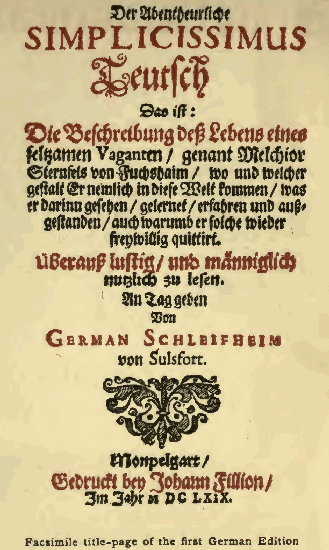
Which brings me to Simplicius Simplicissimus, Warhammer’s great-grandfather (or maybe closer than that). Written in 1668 by Hans Jakob Christoffel von Grimmelshausen, it is a picaresque novel set in Germany during the Thirty Years’ War (1618-1648). It is the story of a simple country boy who gets whisked into the big events of the day, and I would say definitely an influence on the grim world of perilous adventure presented in Warhammer … except I don’t actually know that this is true. I suppose if you’re making a game/setting inspired by the Thirty Years’ War in Germany, you’re going to end up with something akin to a book about those same events.

The main thing that makes me think there’s a link is the progression of Simplicius from career to career over the course of the book. He begins as a simple farm laborer, and then becomes a religious hermit, a fool, an outlaw and sneak thief, a dragoon, a charlatan, etc.

No trollslayers, but still …

The book is a fun read, and the Alfred Thomas Scrope Goodrick translation I read (from Project Gutenberg) was easier going than you might expect for something written a few hundred years ago. I’ll also note that the book moves along at a pretty good pace – old books are sometimes slow (because they didn’t need to compete with TV), but I never had the temptation to skip ahead in Simplicius. The book isn’t entirely “safe for work”, but it doesn’t delve too far into sex and bloody brutality. I definitely give it my recommendation as a book to read on par with most modern adventure fiction.

Literary merits aside, the book presents good fodder for fantasy gaming, Warhammer-style gaming especially. The supernatural shows up a couple times, but isn’t prevalent, so it’s mostly about normal people trying to make their way in a rough time and place. Here are a few passages from the book that I found particularly interesting:

This is the introduction to the hermit who takes him in. This guy is about as Lawful as the book gets:

So I plucked up heart to come out of my hollow tree and to draw nigh to the voice I had heard, where I was ware of a tall man with long greyish hair which fell in confusion over his shoulders: a tangled beard he had shapen like to a Swiss cheese; his face yellow and thin yet kindly enough, and his long gown made up of more than a thousand pieces of cloth of all sorts sewn together one upon another. Round his neck and body he had wound a heavy iron chain like St. William, and in other ways seemed in mine eyes so grisly and terrible that I began to shake like a wet dog.

A description of the soldier’s life. This would apply to most old school fantasy adventurers as well:

For gluttony and drunkenness, hunger and thirst, wenching and dicing and playing, riot and roaring, murdering and being murdered, slaying and being slain, torturing and being tortured, hunting and being hunted, harrying and being harried, robbing and being robbed, frighting and being frighted, causing trouble and suffering trouble, beating and being beaten: in a word, hurting and harming, and in turn being hurt and harmed–this was their whole life.

The goings on of the aristocracy at a party – I thought it might make a good random table for behavior in inns and taverns:

‘Twas indeed a wonderful pantomime to see how they did fool, and yet none wondered but I. One sang: one wept: one laughed: another moaned: one cursed: another prayed: one shouted “Courage!” another could not even speak. One was quiet and peaceable: another would drive the devil out by swaggering: one slept and was silent, another talked so fast that none could stand up against him. One told stories of tender love adventures, another of his dreadful deeds in war. Some talked of church and clergy, some of the constitution, of politics, of the affairs of the empire and of the world. Some ran hither and thither and could not keep still: some lay where they were and could not stir a finger, much less stand up or walk. Some were still eating like ploughmen, and as if they had been a week without food, while others were vomiting up what they had eaten that very day.

A list of hangover cures:

There wormwood, sage wine, elecampane, quince and lemon drinks, with hippocras, were to clear the heads and stomachs of the drinkers;

A strange spell from the book:

And no sooner had the rogue mumbled some words than there sprang out of each man’s breeches, sleeves, boots and pockets, and all other openings in their clothes, one, two, three, or more young puppies. And these sniffed round and round in the tent, and pretty beasts they were, of all manner of colours, and each with some special ornament, so that ’twas a right merry sight.

If you like gore, the book has some gore. This could also work as a description of a fantasy battlefield:

The earth, whose custom it is to cover the dead was there itself covered with them, and those variously distinguished: for here lay heads that had lost their natural owners, and there bodies that lacked their heads: some had their bowels hanging out in most ghastly and pitiful fashion, and others had their heads cleft and their brains scattered: there one could see how lifeless bodies were deprived of their blood while the living were covered with the blood of others; here lay arms shot off, on which the fingers still moved, as if they would yet be fighting; and elsewhere rascals were in full flight that had shed no drop of blood: there lay severed legs, which though delivered from the burden of the body, yet were far heavier than they had been before: there could one see crippled soldiers begging for death, and on the contrary others beseeching quarter and the sparing of their lives. In a word, ’twas naught but a miserable and pitiful sight.

The effect of gunpowder on the world (i.e. look out high level fighters):

But ’twas this cause made me so great a man, that nowadays the veriest horse-boy can shoot the greatest hero in the world; and had not gunpowder been invented I must have put my pride in my pocket.

On the glories of gold (and some supernatural associations with gemstones):

Yea, I could even take upon me to prove that this same money possesses all virtues and powers more than any precious stones; for it can drive away all melancholia like the diamond: it causeth love and inclination to study, like the emerald (for so comes it that commonly students have more money than poor folk’s children): it taketh away fear and maketh man joyful and happy like unto the ruby: ’tis often an hindrance to sleep, like the garnet: on the other hand, it hath great power to produce repose of mind and so sleep, like the jacinth: it strengtheneth the heart and maketh a man jolly and companionable, lively and kind, like the sapphire and amethyst: it driveth away bad dreams, giveth joy, sharpeneth the understanding, and if one have a plaint against another it gaineth him the victory, like the sardius (and in especial if the judge’s palm be first well oiled therewith): it quencheth unchaste desire, for by means of gold one can possess fair women: and in a word, ’tis not to be exprest what gold can do, as I have before set forth in my book intituled “Black and White,” if any man know how rightly to use and employ this information.

Probably not the best name for a game (bolded text):

And though I did no deed evil enough to forfeit my life, yet was I so reckless that, save for sorcerers and sodomites, no worse man could be found.

On random encounters in the Black Forest:

… that I should not escape from the peasants of the Black Forest, which were then famous for the knocking of soldiers on the head.

A melee:

… when we did least expect it, came six musqueteers with a corporal to our hut with their pieces ready and their matches burning, who burst in the door and cried to us to surrender. But Oliver (that, like me, had ever his loaded piece lying by him and his sharp sword also, and then sat behind the table, and I by the stove behind the door) answered them with a couple of musquet-balls, wherewith he brought two to the ground, while I with a like shot slew one and wounded the fourth. Then Oliver whipped out his terrible sword (that could cut hairs asunder and might well be compared to Caliburn, the sword of King Arthur of England) and therewith he clove the fifth man from the shoulder to the belly, so that his bowels gushed out and he himself fell down beside them in gruesome fashion. And meanwhile I knocked the sixth man on the head with the butt-end of my piece, so that he fell lifeless: but Oliver got even such a blow from the seventh, and that with such force that his brains flew out, and I in turn dealt him that did that such a crack that he must needs join his comrades on the dead muster-roll. So when the one that I had shot at and wounded was ware of such cuffs and saw that I made for him with the butt of my piece also, he threw away his gun and began to run as if the devil was at his heels. Yet all this fight lasted no longer than one could say a paternoster, in which brief space seven brave soldiers did bite the dust.

A spell to force thieves to give back their stolen goods, worth 10 sp (or more or less, depending on your system):

And since ’tis as grievous to lose such things as ’tis hard to get them, therefore the said Switzer would move heaven and earth to come by them again, and did even send for the famous devil-driver of the Goatskin, which did so plague the thief by his charms that he must needs restore the stolen goods to their proper place: for which the wizard earned ten rix-dollars.

I hope this motivates you to give the book a read, especially if you’re a WFRP player or game master. Well worth the time!

Shadowlord! – A Timely Review

Once upon a time, a young me and my best friend Josh played a wondrous game of universal conquest. I have no idea where Josh got the game – maybe a gift, maybe stole it from his brother’s room. No idea. But it was awesome. There was this board with all these circles on it, and cards with cool pictures of people, including this one really hot chick that Josh and I both wanted on our team, and you did stuff in it and … stuff.

That was around about 1985, and years later I had no freaking idea what game I had played and enjoyed so much, and a few searches based on my scanty memories yielded nothing.

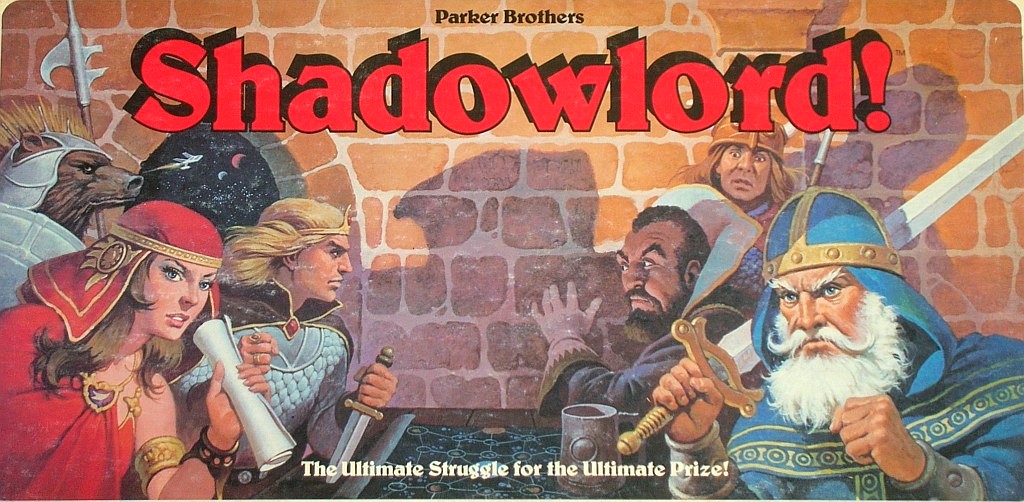
And then, one day in 2017, I was searching games on Etsy for some inspiration and found it. Shadowlord!! There are two exclamation points there because the game has a name ending with an exclamation point. I bought the game on Etsy, it was delivered a couple weeks ago, and last night, I finally played it again, this time with wife and daughter.

So how did it go?

Still awesome. Shadowlord! is a cool strategy game, with some nice random events and a requirement to think things through. This, of course, is why I was out on my second turn after going all in on a silly gambit. I was stupid, and the rules rightfully destroyed me.

The game involves playing one of four factions led by the Fire Lord (actually a lady), Air Lord, Water Lord and Earth Lord. The board is divided into numerous “galaxies”, including the “Lost Fortress” at the center of the board where resides the Shadowlord. The Shadowlord has many minions, who pop up in the galaxies and who can be used to mess with the other players. On your turn, you roll a random event (usually good for you), build spaceships, move around the board finding new allies in the galaxies to add to your faction and maneuvering to fight. I won’t go deep into the mechanics – the rules take a little while to learn, but they seem sound to me and after a few goes the game is pretty easy to play. The art is cool – the game was published in 1983, and the graphics show it in a good way. The game also has a time tracker – eventually, the Shadowlord takes control of the whole universe and beats everyone if the players take too long to win the game.

The game we played ultimately came down to wife vs. daughter, and really to my daughter’s quest to rescue one of her captured merchants, Svein, from one of my wife’s warriors. Svein, you see, is an anthropomorphic pig, and my daughter loves pigs. Yes, it all boiled down to a galactic Pig War, which my daughter ultimately lost. It was getting late, so we didn’t play things out completely to have my wife take on the Shadow Lord for control of the universe, but we had a good time.

Lords of Light? Not Quite

I finished reading Thundar, Man of Two Worlds, last night and this is my promised book report. As always, I will keep it short and try to avoid spoiling it for folks who want to read the book themselves.

First and foremost, the book is an homage to the work of Edgar Rice Burroughs. It was published in 1971, but reads more like something written in the 1930s (for good and ill). The author, John Bloodstone, is really writer Stuart J. Byrne. Byrne wrote pulp sci-fi back in the 1950s and 1960s, wrote a couple episodes of Men into Space (which I love) and a couple movies in the 1970s, and later wrote translations of Perry Rhodan stories.

The book concerns the adventures of Michael Storm, who is a mountain climber and swordsman (all such characters need to have a knowledge of sword fighting before they wind up in a swords and sorcery setting) who winds up in the far future through his reckless daring. Once in the far future, he gets into all sorts of trouble – again, I don’t want to get into specifics, because blabbing about them would ruin all the good (which is little) this book has to offer.

Unfortunately, the book lacks ERB’s creativity, or his pace reminiscent of old movie serials, with each chapter ending with the protagonists in a terrible situation, and the next beginning with how they escaped it … only to fall into another by the chapter’s end. You get a little of this in Thundar, but not enough, and like most fan fiction it doesn’t completely gel. The book was clearly intended to be followed by others which, to my knowledge, did not materialize.

Now, as to whether this book could have influenced the Thundarr the Barbarian cartoon (1980-1982) … maybe, but only in very small ways. If it had any influence, I would guess it was a matter of the creators of the cartoon having a hazy remembrance of the book. Cartoon Thundarr looks a little like the guy on the cover, but the resemblance ends there. There is no Ookla the Mok (and the Mogg in the book can only have influenced the word “mok”, and nothing else about old Ookla), though there is a “dawn man” called Koom (and he’s pretty cool – more Koom would have made for a better book in my opinion). There is no Princess Ariel (though there is a Princess Cylayne, who does help Thundar and mostly serves as a Dejah Thoris stand-in to motivate our hero). There is some super science, but no sorcery. There is no sun sword, though there is a blade of Damascus steel. There was a catastrophic cosmic event that screwed up the Earth, but the story is set a million years in the future, so there are no remnants of the 1980s. In short … very little influence. There is suggestion that this world was the origin of the advanced peoples of South America, but the people we meet in this future earth don’t apparently resemble them at all – I kept expecting this and was disappointed.

Can gamers get any inspiration from the book? Maybe, but I doubt it. The world building is pretty simplistic. You have mountains and a jungle and an inland sea and two rival cities on its shores, and not much else. I would expect that every DM’s first stab at making up a campaign world was as good as anything you would get in this book. There’s almost a cool hook involving technology’s influence over the world, but it remains vague, perhaps to be dealt with in more detail in the later books that didn’t happen. Even if technology had been more fully explained, it mostly shows up as a deus ex machina, which wouldn’t be too handy to a DM writing a campaign world. The way Michael Storm ends up in the far future could be copied for a game – it was pretty fun,  but not revolutionary.

Final grade: C-

Back from Vacation

After a week away from work (the real job), I’m back delving into the wonders of the Las Vegas real estate market. Over the past nine days, I managed to almost finish NOD 29 and got some heavy work done on my World War II supplement to GRIT & VIGOR. I also watched some B-movies, did some yard work, got the hard copy of MYSTERY MEN! Second Edition created and ordered a proof copy (it’s going to be in color), found some cheap old AD&D artifacts at a used record store, watched my daughter in her first Shakespeare play (she played the nurse in Romeo & Juliet) and didn’t shave.

I also didn’t do any blog posts, though I did keep in touch with the gaming community via Google +. For those who didn’t see that, I present two characters for GRIT & VIGOR, one a character from an old movie, the other an actor. For those who did, I’ll throw in a third character – a dangerous lady.

Vince Kane – A Character You Probably Do Not Know

Vince Kane is the main character in an old George Raft picture called A Dangerous Profession (1949). It’s not a great movie, but a movie doesn’t have to be great to inspire usable game material. The beauty of B-movies and simple stories is that they’re usually easier to adapt into modern game scenarios. Much of what makes a movie great – strong characterizations, interesting character relationships, etc. – does not always translate well into a game, or at least should come from the interaction of the players and game master, rather than be programmed and forced on everyone. A good game often revolves around a good plot that is not too hard to follow, since players are usually grasping around in the dark during game play. Vince Kane is also an interesting idea for an detective who isn’t technically a professional detective, much in the way that Matlock and Perry Mason are detectives who are technically lawyers.

Vince Kane is an ex-cop turned bail bondsman. Things heat up when a buddy of his from the police force, Lt. Nick Ferrone (played by Jim Backus) picks up Claude Brackett, who skipped bail a few years back for an embezzlement charge. Checking Brackett’s room, Kane discovers that he’s in town with the woman who broke his heart, who turns out to now be the embezzler’s wife, Lucy Brackett. When Claude Brackett turns up murdered, Kane investigates and discovers a web of lies.

N Private Eye, LVL 8, HP 36, AC 11, MV 40, ATK +5, SV F12 R7 W9

Str 10 Int 12 Wis 15 Dex 14 Con 13 Cha 8

Special: Detect clue (2 in 6), detect lie (4 in 6), get a clue from Venture Master, back stab, note concealed items, +2 save vs. fear

Knacks: Cant*, Influence People

Skills: Cant*, Crack Code, Gather Intelligence, Hide in Shadows, Listen at Doors, Move Silently, Search, Sleight of Hand and Track (humans only)

Feats: Grappler, Iron Will, Lighting Reflexes

* Cant in this context is the tough talk of old Hollywood gangster movies

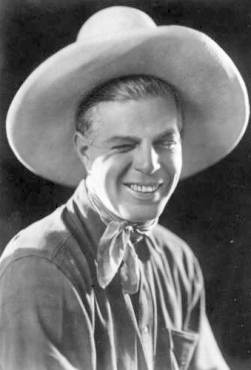
Hoot Gibson, A Man More Interesting than His Characters

Now we shift from a character to a real person who was, himself, quite a character. It’s not too often you come across an actor’s biography which is more interesting than the characters he played. Hoot Gibson is one of those fellows.

Hoot started riding horses as a boy in Nebraska, and after the family moved to California he started working on ranches. He showed a talent for it, and soon started competing in rodeos, winning several honors. It was during his rodeo days that he started acting in silent movies. After a stint as a sergeant in the Tank Corps in World War I, he went back to rodeo and movies, usually as a bit player and stunt rider. In 1922, when demand was high for cowboy pictures, he moved into starring roles and made a whole slew of pictures. Hoot also learned to fly planes and even got injured in a crash while racing planes.

Like I said, he was an interesting fellow.

N Cowboy/Fighter, LVL 7/3, HP 39, AC 12, MV 40, ATK +4, SV F9 R8 W12, Str 13 Int 9 Wis 11 Dex 16 Con 13 Cha 13

Special: +2 save vs. trample attacks, rope (add half horse’s HD to lasso attacks), select exceptional horses, surprised 1 in 8, no penalty when grappling large animals, extra attack against opponents with fewer HD

Knacks: Don Disguise, Handle Animals, Pilot Aircraft

Skills (Cowboy): Appraise value (livestock), endure, gamble, handle animal, jump, ride mount, survive outdoors, track

Skills (Fighter): Bend bars, break down doors, endure, gunnery, jump, lift gates

Feats: Dodge, Knack, Pugilist

Weapons: Colt Single-Action Army (1d6), Winchester M1894 repeating rifle (2d4)

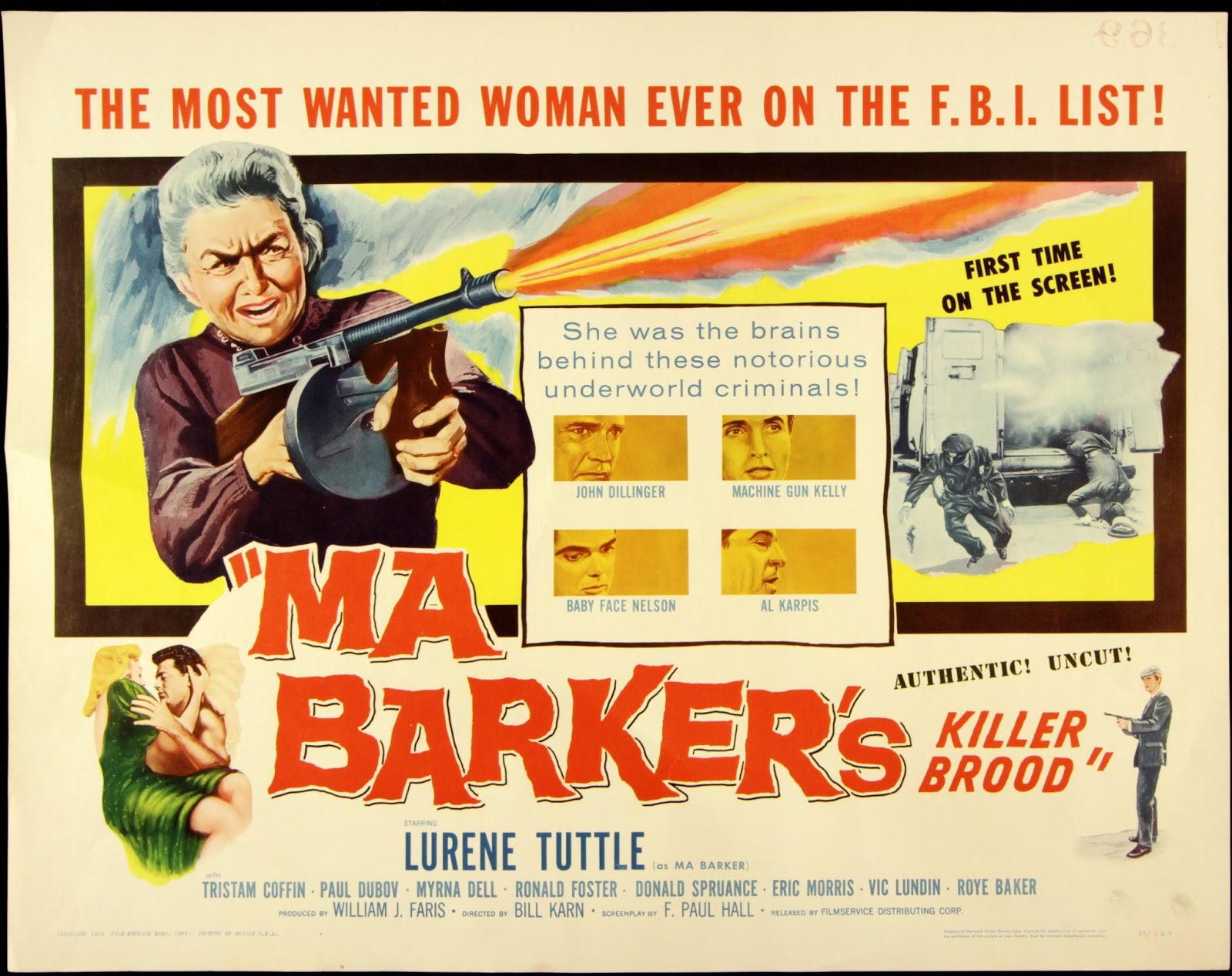
Ma Barker

I don’t know how much cache’ the gangsters of the Depression have these days with the young people, but they once had a standing approaching folk heroes. Bonnie and Clyde, ‘Baby Face’ Nelson, John Dillinger, etc. And then there’s Ma. Ma Barker. Ma Barker had four criminal sons, Herman, Lloyd, Arthur and Fred, and served as their ring leader … or did she?

From the sound of it, Ma Barker as criminal mastermind of her sons’ foul play is the bunk. One gangster, Alvin Karpis, described her as “superstitious, gullible, simple, cantankerous and, well, generally law abiding.” She was clearly an accomplice in the criminal activities of the gang, helping them before and after crimes, but probably was not the gun-totin’ mama of popular culture. When J. Edgar Hoover described her as “the most vicious, dangerous and resourceful criminal brain of the last decade”, he was probably full of shit. I know – J. Edgar Hoover, an agent of the federal government – lying is hard to believe.

But in GRIT & VIGOR, when truth isn’t stranger than fiction, we slap it around a little until it is. Our Ma Barker is the gangster of the movies, engaging in gun play and maybe even chomping on a cigar while her minions rob banks.

NE Rogue, LVL 8, HP 28, AC 10, MV 40, ATK +5, SV F12 R9 W10, Str 8 Int 15 Wis 13 Dex 11 Con 11 Cha 12

Special: Backstab for +2d6 damage, note concealed items

Knacks: Gather Intelligence*, Treat Injury

Skills : Appraise Value, Cant, Don Disguise, Gather Intelligence*, Hide in Shadows, Influence People, Listen at Doors, Move Silently

Feats: Exploit Weakness, Improvise, Iron Will, Leadership

Weapons: Thompson sub-machine gun (1d6)
Release-A-Palooza

I have three new (or recent) releases to bring to your kind attention.
Before I talk about them, though, HERE’S A LINK to those Bloody Basic printable character sheets I mentioned (including Weird Fantasy edition), with background color removed.

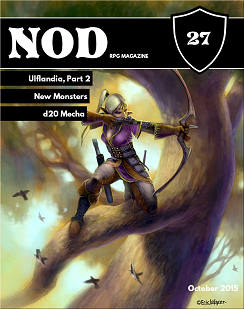
NOD 27

This issue of NOD features:

* Gloriana’s Blessed Isle, Part 2 – The continuation of the Ulflandia hex crawl that started in NOD 26 – this one covers a little of the island, the Bragart Hills, the southern portion of the Klarkash Mountains and a wee bit of the Wyvern Coast … a real cross roads. Features some groovy art by Denis McCarthy

* d20 Mecha I: The Classes – The first part of a three part article on adapting d20-based games for giant robot adventures – by my good friend and mecha-aficionado Luke DeGraw. Part 2 will cover equipment, and in Part 3 we’re going to collaborate on simplified rules for the mecha themselves, using some of the rules I’ve developed for GRIT & VIGOR.

* The Nodian Bestiary – Featuring 10 new monsters

* Strength: A Primer – Exploring the strength ability score

* The Muscleman – A new class that puts strength to the test … yeah, he can bite through chains and throw halflings … nice art by NOD regular Jon Kaufman

* You Pull the Lever and … – Ideas for lever-based traps and tricks … with more from Kaufman

* Racial Variations: Earth – Elemental twists on the classic fantasy races … and a third Kaufman piece

* Plan 9 from Outer Space: The RPG – A Quick & Easy minigame for Halloween … I’m super excited about this silly thing

* The Grey Planet Beckons – The negative-energy planet Pluto for the Nodian cosmos

$4.99 for the e-book … print edition coming soon 

BLOODY BASIC – WEIRD FANTASY EDITION

I know some folks have been waiting for this one. The Weird Fantasy Edition rules are inspired by the wondrous prose and poetry of Clark Ashton Smith and Lord Dunsany and the art of such luminaries as Aubrey Beardsley and Sidney Sime. It include rules for the races, classes, spells and monsters of weird fantasy tales. Ever wanted to play a grotesque puissant? Now’s your chance.

This one was briefly in the Top 10 hottest titles on rpgnow … pretty cool!

$4.99 for the e-book … print edition coming soon

DEVIANT DECADE

Can you survive the mean streets of New York City in the 1970’s? Muggers, psychos, junkies, sewer-gators, street punks, and gangsters! Oh My!

Deviant Decade is a quick and easy game to learn and play. All you need is a few friends, some pencils and paper, a few ordinary dice and this book … leisure suits are optional.

$2.99 for the e-book (no stagflation here) … print edition coming soon

For sale now at both Lulu and Drive Thru / Rpgnow

COMING SOON

Well, I think that’s enough productivity for the moment. I’m working on Black Death (coming along nicely – and a little more meat than past Quick & Easy games – I think Swords & Sandals will need a revision next year) and NOD 28 (exploring the northern Land of Og in this one) now, and I’m determined to get GRIT & VIGOR released by the end of the year.

Then I can focus on the revisions of BLOOD & TREASURE, MYSTERY MEN!, SPACE PRINCESS and PARS FORTUNA. I’ve already commissioned new cover art for B&T!!! Super excited.

Two Cinematic Hex Crawls

Over the last few days, I managed to watch some D&D-ish movies before work – just dumb luck, they just happened to be on.

The first involved a few PC’s and their henchmen taking a dangerous cruise on a quest to break an evil magic-user’s polymorph other spell on a prince, who ended up a baboon. The quest eventually takes them to the arctic and a hidden, pleasant land within the arctic. On the way, they fight monsters, counter spells and eventually break the spell. Alas – no treasure, but they’ll probably be rewarded by the prince.

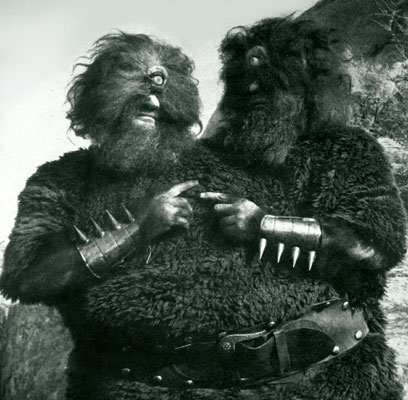
The second involved five people, four men and a woman, dragged from modern times into ancient Greece. The men are made galley slaves, while an evil king tries to romance the woman. The men eventually lead a slave revolt, wash up on shore, do a little hex crawling, and are made slaves again. Luckily, one of the guys ends up with an 18/00 strength (or maybe higher), and in this capacity serve a different king, and wind up fighting Hercules himself to get back to their own time period.

The first film was Sinbad and the Eye of the Tiger, the second The Three Stooges Meet Hercules. Scoff if you will, but the second flick is probably close to most D&D campaigns than the first. Oh, we all dream of Lord of the Rings-caliber gaming, but bumbling insanity is often what we get.

Both films were lots of fun – I’d actually never managed to watch the Sinbad flick, despite being a fan of Harryhausen – so here are a few bits and pieces inspired by these movies:

Giant Walrus

From HERE

Size/Type: Huge Animal
Hit Dice: 11
Armor Class: 16
Attack: 1 bite (2d6)
Movement:15 (Swim 60)
Saves: F5 R8 W13
Alignment: Neutral (N)Intelligence: Animal
No. Appearing: 1
XP: 550 (CL 11)

Giant walruses are much like their smaller counterparts, though they are more aggressive.

Minoton

From HERE

Size/Type: Large Construct
Hit Dice: 6
Armor Class: 18
Attack: 1 gore (1d10) or by weapon (2d6)
Movement: 30
Saves: F11 R12 W12
Resistance: Fire, electricity
Alignment: Neutral (N)
Intelligence: Non-
No. Appearing: 1
XP: 600 (CL 7)

Minotons are bronze automatons made by magic-users for brute labor and basic fighting. Most are armed with spears. They are tireless and immune to all mind effects, and only obey the commands of their creator.

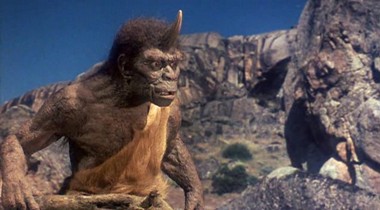
Troglodyte

From HERE

Size/Type: Large Giant
Hit Dice: 4
Armor Class: 14
Attack: 1 gore (1d6) and 1 slam (1d4) or by weapon (2d6)
Movement: 30
Saves: F10 R14 W15
Alignment: Neutral (N)Intelligence: Low to Average
No. Appearing: 1d4
XP: 200 (CL 4)

Troglodytes are large, primitive ancestors of human beings. They speak the language of simple primates, and though fearsome are not particularly aggressive. Female humanoids get a +2 reaction bonus with male troglodytes.

Eye of the Tiger

From HERE

Level: Magic-User 3
Range: Personal
Duration: 10 minutes

When this spell is cast, a magic-user’s eyes become cat-like (giving them darkvision to a range of 60′). Any feline they look upon within 60′ must pass a Will saving throw or the magic-user turns into a vapor and inhabits the cat’s body. The magic-user retains her own intellect, and gains the fighting ability of the cat. The magic-user can leave the cat’s body at any time, but if they are still inside the cat when it is killed, they die along with it.

Two-Headed Cyclops

From HERE

Size/Type: Huge Giant
Hit Dice: 16
Armor Class: 16
Attack: 2 weapons (3d6) or boulder (100’/3d6)
Movement: 40
Saves: F3 R7 W8; +2 save vs. mind effects
Alignment: Chaotic (CE)Intelligence: Low
No. Appearing: 1
XP: 800 (CL 16)

The two-headed cyclops stands about 50′ tall. It is terribly bright, but it really doesn’t need to be to get along.

Sleeping Pills

These magic items are akin to potions. They are made in lots of 4, and each pill packs the punch of a potion of sleep. Saves against them are saves against magic, not poison.

UFO – A Timely Review

Mismatched dice and a space station standing in for a rocket, but GAME ON!

As long-time readers know, I like to keep my reviews at the Land of Nod timely and relevant, which is why today I’m reviewing a game made in 1976 by Avalon Hill.

Once upon a time (because anything that begins with that phrase has to be timely and relevant), when I must have been in elementary school or thereabouts, I was digging through a closet and came across a box that apparently held a game. The title – UFO: Game of Close Encounters.

These were the days of Star Wars, but they weren’t the days of VCR’s / DVD’s / Netflix / YouTube / watch anything you want when you want no matter what. These were the days when the Charlie Brown Christmas Special was on TV once a year, and if you missed it, you missed it. Star Wars was a phenomenon, and since it was in short supply, anything sci-fi was doing pretty well. I didn’t know much about this UFO game, but it looked like it was at least in Star Wars‘ neighborhood, so I was intrigued.

The game belonged to my father, apparently a gift from somebody. My father isn’t much of a game player, and I’m not sure he ever played the game in his life. He sure didn’t play it with me. The game migrated to my closet as a kid, and then moved with me when I left home. And then, one day thirty-something years later …

“What’s this,” asks my daughter, rummaging through the closet in my office.

And I realize it’s time to end the cycle. UFO must be played.

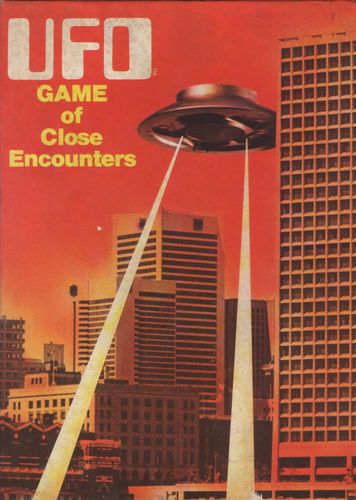
The cover, found at Board Game Geek, of course

I get the game out and check Board Game Geek to see what I’m missing. Apparently, I only managed to lose 2 counters in all the years I messed with the game as a kid. Not too bad, and not really an obstacle to playing the basic version of the game.

The victory conditions in the basic game are pretty simple – the invading UFO player wins by landing five saucers on Earth. The Earth player wins by destroying enough saucers that the UFO player cannot win.

Game play is equally simple. The UFO player places his/her saucers around the outside of the board. The Earth player places his rockets on Earth. Each turn, players roll two dice. Each dice controls the movement of a separate piece. Pieces can move in orbit clockwise. They can move to a different orbit only along four paths, and may not change orbit or move clockwise in the same turn. If a rocket lands on a saucer, the saucer is destroyed. If a saucer lands on a rocket, the rocket is destroyed.

If the Earth player rolls doubles, he loses his turn and the Moon moves in orbit. If the UFO player rolls doubles, she may hyperspace one of her saucers to any empty space on the board.

If the Moon, while orbiting, moves over a piece, it destroys the piece. If the Moon is empty, a piece can be landed on the Moon on its own turn, by exact count. Likewise, Earth can only be landed on by exact count, but either player.

So, them’s the rules. How did the game go?

Pretty fun, actually. The strictures on movement make you think a bit, and the potential for hyperspace makes it tough for the Earth player to cover all his bases. Ultimately, you want to control those orbital paths towards the Earth, but it’s not as easy as you think, because if you just sit there, eventually the UFO player is going to destroy your rocket or hyperspace in behind you. In the game my daughter and I played, it came right down to the wire – four saucers landed on Earth, one saucer left needing a “1” to land. I got the lucky roll the dice  and destroyed the fifth saucer. Earth was saved. All humanity rejoiced.

The advanced game involves space stations and false signals on radar, and we’ll tackle it at some point. The game was pretty fun, actually. Didn’t take long, and didn’t drain the brain, so a nice way to spend a half an hour or so. Afterwards, we played LIFE (the old version with Art Linkletter on the money, of course), and my daughter cleaned my clock.

Of course, there wouldn’t have been an Earth to play the Game of LIFE on if I hadn’t stopped the saucer invasion …