It’s delightful when D&D-isms sometimes converge with ancient wisdom, even accidentally.
I was watching a video from Jonathan Pageau earlier today concerning the concept of Biblical angels having “subtle bodies”. You can see it below:
Pageau generally works on translating ancient ideas, especially (but not exclusively) Biblical ideas, into terms modernists and materialists can better understand.
As I was listening, it got me to thinking about how solars, planetars, devas and the various demons and devils of Dungeons & Dragons are handled in the rules as concerns their vulnerability to different kinds of weapons. D&D has a few hierarchies of monsters, whether it be the evil humanoids (kobold – goblin – orc- hobgoblin – gnoll – bugbear – ogre) or giants (hill – stone – fire – frost – cloud – storm) … I might have reversed fire and frost … in terms of hit dice and, in the case of the giants, some magical abilities.
It also has a hierarchy of weapon vulnerability. Humans, for example, are vulnerable to all sorts of weapons, be the mundane weapons of steel or wood, or weapons made of silver, or magical weapons. Other creatures, like werewolves, can only be harmed by silver or magical weapons. Still others, many demons and devils for example, are only harmed by magic weapons, and some only by magic weapons of a certain potency or higher (i.e. +2 or higher weapons).
On one level, this is just a matter of, well, level. Player characters become more powerful as they advance in level, step by step, and thus the foes they face become more powerful as well. As PC’s attain more hit dice, higher attack bonuses, more spells, more special abilities and more powerful magical items, they can challenge more powerful monsters (who stand in the way of yet more powerful magic items). In time, the PC’s climb the ladder of power until they have earned the right to found strongholds and maybe, in due time and with due effort, kingdoms of their own. One can relate this to the chain of being in Judeo-Christian thought that stretches from lowly peasants, through kings to angels and eventually to God Himself at the very top.
But beyond the simple matter of increasing the difficulty of challenges, the weapon vulnerability question actually relates to the very substance of a suprnatural world. Why doesn’t a normal longsword hurt a werewolf or a demon? Well, it doesn’t harm them because they are not entirely material creatures – they have, as Pageau might say, “subtle bodies”. Does a normal weapon bounce off of them or go through them as though they are ethereal? Well, maybe. I imagine the sword piercing them, coming back out, and simply not harming them because they aren’t made of the same stuff as a longsword. It’s like trying to put a fire out by describing water to it. Words are made of different stuff than fire. Of course, the correct words – magic words – can put out fires and can even harm a devil or demon. These beings are not just bigger and badder than the PC’s, they are more wonderful – as in “full of wonder” – as in fundamentally different – than the PC’s and the material world in which they exist and function.
Learning about how the ancients saw the world – their ideas about reality and cosmology – can be very useful in bringing a fantasy world to life for the players. So many modern attempts at fantasy fall flat because they are rooted in vulgar materialism – base attempts to reconcile fairy tales and ancient epics with the limited materialist understanding of the world in which we live. The ancients saw the wonder in creation, and can lend some wonder to your fantasy game campaign if you’ll let them.



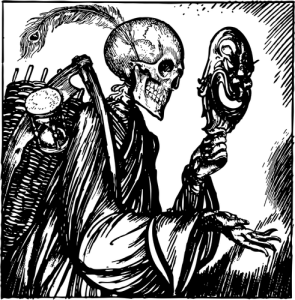 Here’s an idea for a dungeon encounter to frighten, or at least annoy the players.
 Happy Fourth of July folks! Remember, it’s not enough to value your own liberty, you have to love other peoples’ liberty just as much as your own.
 Here’s an idea I had today while walking the dog. It’s about combat with multiple attackers in RPG fights of the B&T variety.
 I was recently thinking about my love of good old-fashioned Godzilla movies, and that led me to thinking about using giant monsters in RPGs.
 Still, a disaster made flesh-and-blood is really what I was writing about at the beginning of this post. Another way of incorporating disaster – be it from tsunami, virus or giant monster – in your game is to use it as a backdrop to the action. Think of it as a dress rehearsal for the post-apocalypse. The disaster sets the stage and creates some new obstacles/challenges to overcome as the PCs attempt to accomplish their goal. The PCs might be on the trail of a murderer in a pulp detective-style game, and have to deal with flooded streets and downed power lines due to a hurricane.
 Of course, the reality is that I was past fairy tales, and also not yet ready for them.
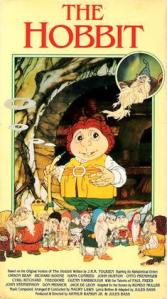 It was after reading the book that I sought out the film. I was working at the Video Park (World’s Largest Video Store – no joke), so getting a copy was no problem. It knocked my socks off. The voice work, by such luminaries as Bean – just the perfect hobbit voice for my money – Otto Preminger (legendary director and my favorite Mr Freeze), Richard Boone (absolute legend from the days of radio, and as Paladin in Have Gun, Will Travel), John Huston (my favorite Gandalf voice), Hans Conried, Paul Frees, Thurl Ravenscroft, Don Messik and Brother Theodore. Just great voices. Voices like that are pretty much unknown in this day and age – I think it was the smoking that gave them that quality, so honestly, it’s better that we don’t have those voices anymore, but they’re really a beloved part of my childhood.
 Now for the game-able pay-off.
 Land of Nod