Mu-Pan – Red Goblins

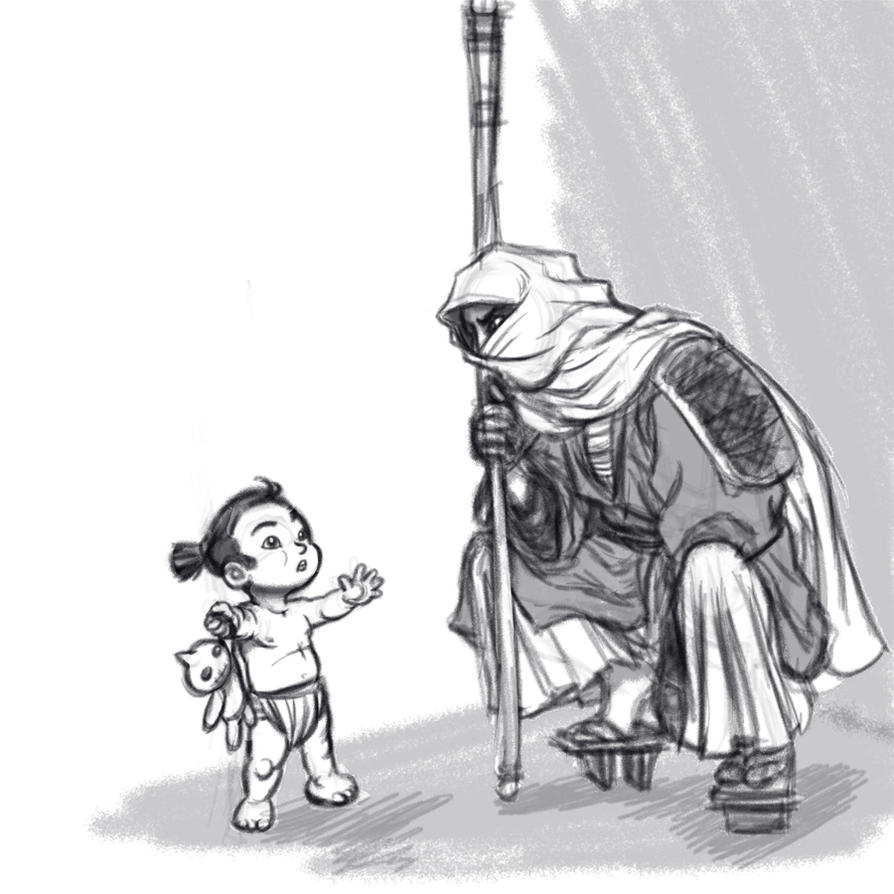
0421. An army of 270 oni-aka (red goblins) raiders has encamped in this hex. The army is preparing to sack the city-state of Pantung [0322]. The raiders are working on behalf of a cabal of villains (an ogre magi, sorcerer ox and evil naga, themselves the puppets of an oni. The raiders are under the command of the hobgoblin marshal Valtrahar. Valtrahar rides atop a palanquin carried by four ogres. He wears a black bronze jingasa with a porcelain mask that bears starched whiskers. He is accompanied by a hired shugenja called Imyneda, a melancholy woman with fulvous skin, gray-green eyes and dark brown hair in braids. Imyneda has a large woman with a round, bland face who complains incessantly as she rides along on her yak. The army has three trebuchet pulled by teams of yaks.

| Valtrahar: HD 6 (34 hp); AC -1 [20]; Atk 1 weapon (1d6+1); Move 9; Save 11; CL/XP 6/400. O-yoroi, no-dachi, tanto.

| Imyneda, Shugenja Lvl 5: HP 13 [20]; AC 9 [10]; Save 11 (9 vs magic); CL/XP 4/120; Special: Spells (3rd). Bo staff, tanto, spellbook.

Picture found HERE.

Mu-Pan – Pantung

The fun of randomizing hex contents is, of course, that I don’t know what’s going to pop up and I have to try to make it fit (or delete it and pretend it didn’t come up). In this case – surprise, there’s a city in the high mountains!

0322. Pantung is an outpost city-state of 12,375 souls constructed between three dormant volcanoes. The clever engineers of Pantung have dug into the volcanoes, constructing large vents from which pour air and water warmed within the volcanoes. This has made the valley of Pantung warm all year around, despite being located at such a high elevation. The borders of the kingdom are protected by walls of ice that slowly melt and are re-built through the year.

The city-state itself is constructed on a radial pattern. The buildings are made of thick, cream-colored stone, much of it excavated from the aforementioned vents. Doors in the city-state are barred at night, for the citizenry fear the hobgoblins and yeti of the mountains. The city’s wall is 30 feet tall and has four large tower keeps protecting it. Each 1,000 foot section of the wall (there are 16 such sections) and the battlements of each tower are patrolled by 1d6+6 handgunners accompanied by a sergeant-at-arms and possibly (10% chance) a low level shugenja. Each tower has a number of war engines that launch flights of iron war rockets. Three paved roads lead from the city state, one into Tsanjan, the other two into Mu-Pan. These roads are lined by asters ranging in color from white to golden yellow to bright purple.

The primary business of Pantung is copper mining (the city-state has small mines up to 3 hexes away) and banditry. During the winter months, dozens of bandit gangs retreat into the mountains to stay in Pantung, bringing rich tributes of coins and slaves to the nu-gong. The bandit chiefs are treated as visiting royalty. The bandits never prey on the citizenry, who appreciate their bawdy tales and ample coin. The fields around Pantung support cherry and plum orchards and grazing for a breed of rugged mountain pony. The primary coin of Pantung is made of bronze (i.e. copper piece), and the average earnings of a commoner is about 2 cp per day.

Pantung is ruled by Nu-Gong Oonichay, a respected shugenja with ties to the black magicians of Tsanjan. She is assisted by a cabal of 4 noble houses, each headed by a master alchemist. Oonichay is a calculating and domineering. She has pale skin, hazel eyes and dark, brown hair that is bobbed short. Oonichay is an accomplished dancer (she was brought into Pantung as a dancing girl for the former gong). She has a small-featured, delicate face that never betrays her thoughts. She wears a cloak of gray and black vulture feathers (from the bearded vulture of the Tsanjan Plateau). Her palace is in the city-state’s center, surrounded by the legendary fruit market. The palace dungeon is a thing of legend.

The city-state’s alchemists are respected (and, to some extent, despised) throughout Mu-Pan. They put most of their efforts into discovering the elixir of life, but also produce copious amounts of black powder (mostly to fuel the iron war rockets and handguns that protect the city from invasion)

Pantung’s patron deity is Roon, the god of going. Roon’s grand temple is overseen by 10 female nsiain (Mu-Panese druids) and 300 lay brothers and sisters, most of them piao-ke (guides, former bandits). The worship of other deities is frowned upon in Pantung, and proselytizing is illegal. The nsiain of Pantung take vows of poverty (though their temple is quite wealthy) and celibacy. The temple’s wealth is used to maintain the roads (and the flowers, the aster is sacred to Roon). Priestesses wear robes of green sackcloth marked by dozens of white hand prints and carry tetsubos. They bleach their palms white. Holy days are observed by the people and priests with pilgrimages to visit shrines (actually noble crypts) in the mountains. The highest virtues preached by Roon’s church are kindness and charity, the most terrible sins blasphemy and envy.

Pantung has a shady tavern located just inside the east gate. The Golden Staff is run by Isekonall, a friendly, optimistic man who hails from the northern steppe and speaks with a thick accent. Most of the crowd in the Golden Staff is shady – bandits and slavers, for the most part. The place is usually crowded and noisy. The plum wine and short beer that Isekonall serves are a bit overpriced for their quality, but the four rooms (actually a loft partitioned with paper screens) are cheap (and mostly occupied, 1 in 6 chance of a room being vacant).

Some of the more interesting folk of Pantung include Newarada, the strinkingly beautiful high priestess of Roon that is really a disguised man (a ninja of the Black Dragon Kingdom who has played the role for over a decade, he is involved in many assassinations), Snomonchond, a flamboyant master alchemist and open heretic (he worships Sol Invictus, whom the Motherlanders call Apollo Helios), Hagravet, the well-connected captain of the guard who keeps company with Snomonchond, Zajinnes, an arrogant master alchemist and rival of Snomonchond who has a family closet full of skeletons and an unhealthy fixation on Hagravet, and Aschansary, a young official implicated in a bribery scandal – she’s had bad luck with former allies and finds it difficult to place her trust in others.

Ruler: Oonichay, Nu-Gong (Duchess), Shugenja Lvl 8
High Priestess: Newarada, Druid Lvl 8
Population: 12,375
Domain: 10 hexes
Size: 1 mile diameter
Arms: Three black dots on a field of white

Mu-Pan – Lord of Arising Smoke

Two more for wondrous Mu-Pan. I have decided to use the Gods of Pegana as the Gods of Mu-Pan. Should be fun. One of those Pegana gods also shows up in Hexcrawl Classics #1.

0232. A sect of lawful sohei dedicated to Kilooloogung, the Lord of Arising Smoke, has been established here in a deep valley rich in iron deposits. The mines are now worked by the lay brothers of the fortress monastery. The monastery is constructed of fired bricks. Each brick is stamped with a holy symbol and glazed red. A slow fire fed by fragrant herbs and woods is maintained at all times in the center of the monastery, the smoke escaping into the sky via three towering bronze chimneys made to look like dragons.

The abbot is called Jeneozen, a charming fanatic with dark yellow-brown skin and blue-gray eyes. Jeneozen is suffering under a curse that forces him to eat almost constantly, but still he loses weight. Once healthy and hale, he has become drawn and weak. The only cure for his condition, he believes, is a bitter, Y-shaped root from the Shadow Hills. Jeneozen commands ten lesser sohei.

Despite the dedication of the ten sohei of Kilooloogung to Law, the lay brothers of the monastery are a shifty lot – smugglers of dangerous narcotics from the high plateau of Tsanjan into the Celestial Hills. The lay brothers of the temple serve a hanu naga called Sebuthop of the Golden Scales (HD 6). She dwells in one of the abandoned iron mines, one that connects to a deep thermal vent, making it steamy and choked with fungal vines.

The monastery treasure horde consists of 19,300 sp, 730 gp.

| Sohei of Kilooloogong, Lvl 2: HP 2d6 [2d6+2]; AC 6 [13]; Save 13 (11 vs death & poisons); CL/XP 3/60; Special: Banish undead, spells (1st). Haramaki-do, sode, tetsubo (1d6), 3 darts, prayer beads.

| Jeneozen, Sohei Lvl 10: HP 8d6+2; AC 5 [14]; Save 5 (3 vs death & poisons); CL/XP 10/1400; Special: Banish undead, spells (5th). Haramaki-do (made of shark skin), sode, suneate, tetsubo (1d6), 3 darts, prayer beads.

0307. The mountains here are lightly forested with black alders. The slopes are home to thousands of locusts. A river of acid spills from a weird cave and down a series of waterfalls into a hole in the earth. Weathered granite pillars rise from the acid river at odd intervals. Above the cave from whence the river flows there is a small, shallow cave. Some ninjas of the Black Dragon Kingdom are trained here. The ninjas must leap from pillar to pillar, making their way up the river to the shallow cave to claim a random object. The object must be returned to the Black Dragon Chan within 3 months of the beginning of the test to pass. Those who fall into the river are either disintegrated by the acid or fall into the bowels of the earth. Those who fail to return to the Black Dragon Chan are hunted down and killed.

The cave and river are always watched by a dozen shadows, the souls of deceased ninja. Intruders into the gorge are attacked by these shadows at dusk or night, but not in the daytime. There is also a 1 in 6 chance that a band of 1d6 ninja are encountered in the gorge. If there is a single ninja, you can assume they are taking the test.

Image from Stravag via DeviantArt.

Mu-Pan – Loutish Hunters

Missed a day, so two Mu-Pan encounters today. Just click on the Mu-Pan tag at the end of the post to find other posts, including a map.

0129. A small village of loutish hunters is located in this hex, surrounded by a stone wall and four stout towers. The hunters are mainly trappers, setting snares in the mountain passes and wooded crevasses in the spring and summer and then retiring into their village to smoke their pipes and chew eat pickled meat. The villagers are skilled gamblers and even more skilled archers. Their greatest treasure is an opal jar that contains the imprisoned soul of an oni. The jar is kept in the crypt of the former ruler, a tsanjani monk that made a habit out of chaining the maidens of the village to the walls of his shrine and watching them slowly starve. The villagers do not miss the man and have done their best to prevent the tsanjani from discovering the death of their reeve.

0213. A large village of tsanjani peasants cultivates edible fungus in the steamy caves that line the walls of the valley. Pungent streams of piping hot water emerge from these caves and spill into medicinal pools, eventually finding their way into a gentle stream that flows into the valley of the qal. The village is surrounded by an ancient, weathered stone wall caked with sulfur. The village is ruled by an overbearing magistrate of the tsanjani named Quatherennee. Quatherennee has pale yellow skin, stubbly gray hair and steel-gray eyes. The village is defended by two companies of men-at-arms (archers and heavy infantry) as well as semi-tamed white babboons. The babboons are chained near the village’s large iron gate and outside the magistrates court. Patrols of warriors always use one or two babboons as scouts. Visitors can hire out Shoolinsth the piao-ke (armed escort) to guide them through the mountains.

| Shoolinsth, Bujin Lvl 5: HP 12 [32]; AC 3 [16]; Move 12; Save 12 (11 vs. death & poison); CL/XP 5/240; Special: Follow through. Hanburi, sode, kota, do-maru, suneate, nodachi (1d6+1), tanto (1d6-1), daikyu (100′, 2 shots per round, 1d6), 10 leaf head arrows, 10 armor-piercing arrows, 3 frog crotch arrows.

| Quatherenee, Aristocrat: HD 3 (8 hp); AC 5 [14]; Atk 1 weapon (1d6); Move 12; Save 14; CL/XP 3/60.

Mu-Pan – High Barbarians

In the past, I have generally grabbed several encounters and posted them on the blog as a preview/freebie of my latest Nod sandbox. This time around, I’m going to use the 1 in 6 rule. Currently, I’m writing a few different supplements – Tome of Horrors Complete, Mu-Pan Hex-Crawl and Mystery Men! To keep up with them, I figure out in advance how many total “encounters” I need to write, figure out when I want to be done and then divide to figure out how many encounters a day I need to write. The key, of course, is to sit down and write every single day, even when you don’t want to.

For example, if I do about 4.5 monster conversions/encounters a day for Tome of Horrors Complete, I can finish the book by the end of March. In fact, I’m doing 6 a day to stay ahead of the game. Likewise, I’m trying to do about 6 encounters a day for Mu-Pan. My plan is to pick one encounter each day (rolled randomly, of course) and post it on the blog. For Mystery Men’s Shore City, I’ve actually been doing next to nothing – still need to draw the official map and figure out how to do a city-crawl. I think I’m going to do it block x block, classify the blocks as “downtown”, “industrial”, “suburban”, “waterfront” and then include some general urbo-morphs for the different types of cityscape. When I do it that process up and running, it will work on the same principle.

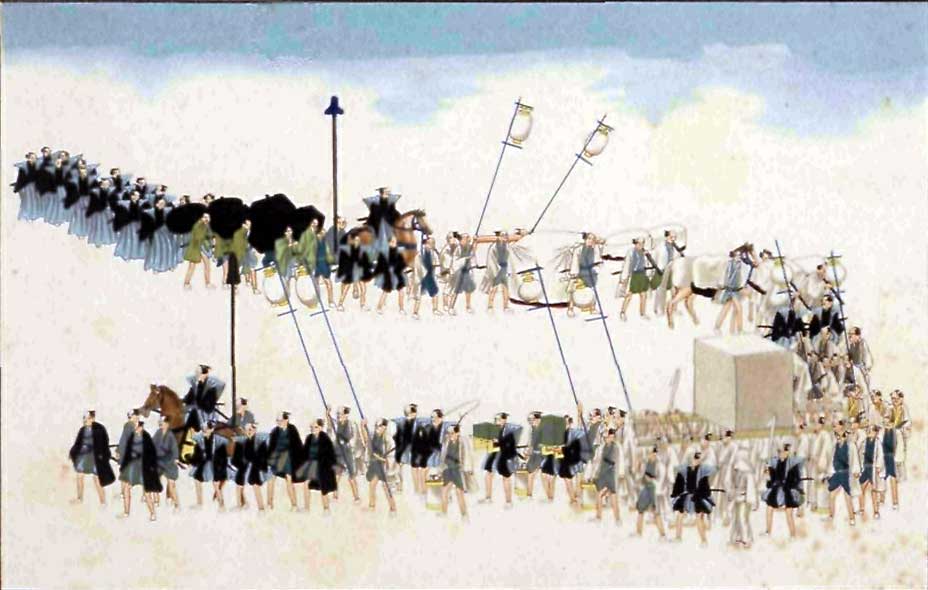
To go along with the Mu-Pan posts, I’ll be highlighting some of the more interesting bits of Asian art I’ve collected. They won’t always have anything to do with the encounter of the day, but c’est la vie. The encounter of the day for Mu-Pan is …

0113. Situated high in the mountains there is a small village of barbaric hunters. The village consists of about 20 wattle-and-daub houses surrounded by a palisade. The village is constructed on a wide shelf of black stone situated beneath a snow-capped peak. Due to the possibility of avalanches, and the necessities of hunting, the people of the village have learned never to raise their voices.

The barbarians of the village dress in shaggy, white coats and wear fur-lined boots. They have buff-colored skin and coarse black hair. The 60 hunters of the tribe paint their faced and knuckles with viridian paint. They are known for their brawn (+1 to hit and damage) and ability to move silently (they surprise in a roll of 1-2 on 1d6). The hunters carry bunches of six javelins and obsidian knives. They are commanded by a powerful chief called Narikit.

In the past month, a captured merchant (taken in a raid on the outskirts of the valley of the qal [XXX]) has captured the heart of the chief’s daughter, Dagusta, much to the chagrin of Hargene, the warrior who captured the merchant.

The tribe’s treasure consists of 900 gp worth of animal pelts.

Again, you’ll notice an “XXX”, this time as a placeholder for the hex number of a qal settlement. [Aside – don’t like the name of the qal – need to work on it].

Oh, and I think I’ve named my rivers:

West 1 = Puar-Sronjj (“String of Pearls”)
West 2 = Tauku (“Jade Tiger”)
West 3 = Maoukun (“Maiden”)
West 4 = Ronj (“King”)
East 1 = Sonossur (“Left Hand”)
East 2 = Ciphur (“Copper”)
East 3 = Jruas (“Great”)

The language is imaginary – actually I use the language mixer at Chaotic Shiny (my favorite random generator site, if it must be known) using “melodic 1” and then altering things as I see fit.

Mu-Pan – Introduction

Okay, let’s get this Mu-Pan thing started.

So far, I’ve finished the base map and the history of the region and I’m working up the regional descriptions. I’m going to put the information down here as I’ve written it so far. Some folks have asked “how do you write your stuff”. You’ll see in what I have so far that, as I start writing a region, I leave a few bits blank. The rivers, for example, have no names yet – I just haven’t decided on them yet. You’ll also find a few XXX’s in the text. When I’m writing and I want to skip something to refer back to later, I use XXX. That way, I can do a quick search in a document for “XXX” to find those things and fix them before publishing.

I also realized as I was writing it that I needed to gather some intelligence on the flora and fauna of China and Japan. Actually, I highly suggest anyone doing a campaign setting hit the encyclopedias (or wikipedia) first – start with a search for a region and then just begin exploring everything. Look for interesting words, strange peoples, strange objects, etc. The idea is to produce something memorable to people who have probably been playing the game for a few years and have already seen the basics. When players talk about where they’ve been and what they’ve seen, a woodland of gigantic maples and purple-green ferns haunted by satyrs with white, wooly fur and crooked horns is more fun than “that forest where we saw the satyr”.

So, without further ado …

Mu-Pan, Land of the Dragon Chans

Mu-Pan is the fabulous land of jade, silk and lotus blossoms that makes princes of Motherlander merchants. The cloth merchants of Lyonesse can tell you the way to Mu-Pan – the so-called Jade Road that runs through the Venatian League, across the dread plain of Kisthenes, through the golden sands of the Cradle of the Sun and finally into the green hills at the center of the Land of the Dragon Chans.

History
Mu-Pan’s history is as older than the history of mankind on Nod. While the Venatian tribes were scratching a living as hunter-gatherers in their woodlands and the priest-kings of Nabu were learning at the feet of visitors from beyond the void and before mighty Iram fell to the endless scheming of demons, Mu-Pan was a land of dragons. In fact, it still is by comparison to the lands that surround it, even though its most famous residents are not nearly as plentiful or public as they once were. When men came into the land of the dragons from the highlands of Tsanjan, they were nothing but primitive savages. Most dragons found them easy prey, but the black wyrms of the southern jungles were more clever than that. They appreciated how adaptable and clever humans could be, and more importantly how quickly they spawned. This was the beginning of the Black Dragon Clan and ultimately of all the dragon clans.

The black dragons used their human army to slay their rivals, and soon brought the southern half of Mu-Pan under their sway, reveling in the rich tribute from lesser wyrms. Dragons, being clever creatures, quickly caught on and founded armies of their own. In time, the land of the dragons was split into four powerful kingdoms, each ruled by a dragon chan – the southern kingdom of the Black Dragons, the northern kingdom of the Gold Dragons, the western kingdom of the Cloud Dragons and the eastern kingdom of the Mist Dragons. The white dragons of the eastern mountains were too stupid to play politics, and contented themselves with dining on any hairless ape that wandered into their territory. The dragon turtles of the eastern seas became objects of reverence for the Nakdani sea tribes, but never founded a kingdom.

For centuries the Four Kingdoms struggled with one another until the Black Kingdom allied itself with the men of the Tsanjan plateau. Renowned demonologists, the Tsanjani gave the soldiers of the Black Kingdom the power and weapons they needed to tip the balance of power in their favor and establish their monarch as the first High Chan of the Mu-Pan Empire. The so-called Glorious Son of Heaven and Earth established a dynasty that lasted over a century before being toppled by the gold dragons, who installed the Supreme Bureaucrat of the Jade Court on the imperial throne, and so on, with each ancient kingdom taking its turn until the incessant wars and intrigues finally ground the empire down to mere shade of its former glory.

Into this rode Kali, the Tiger Empress of the steppe leading a horde of nomads. The Tiger Men, as they were known, conquered not only the Mu-Pan Empire, but the lands beyond. For a time, they even beat their fists on the outer gates of Tsanjan. Under the Tiger Empress, the empire was renewed. Order was re-established, troublesome families exiled or destroyed and a scholarly caste of eunuchs established to manage the new possessions of the Tiger Lords. When the islands of the Nakdani sank beneath the waves in a holocaust of divine fire, the Tiger Empress first defended her coasts from their depredations and then finally allowed them to settle in the lands she had seized from the Gold Dragons, herself taking the title of Shogun.

For thirty years the Tiger Empress reigned supreme. And then came whispered rumors of the birth of the Jade Child. Ancient prophecies told of an infant born from the sea foam, the daughter of the elements who would initiate an epoch of peace and prosperity. All at one chaos descended on Mu-Pan – the Golden Dragons mobilized, the Black Dragons sent their spies into the wilds to locate the prophesied babe and the Tiger Empress sent her warriors into every town and village seeking the girl with the hair like sea foam and the jade-blue eyes. As often happens in Nod, a party of adventurers found itself embroiled in these events, and eventually found themselves the rescuers and protectors of the Jade Maiden. When the armies of the Gold Kingdom and Cloud Kingdom finally descended on the imperial city of Cambulac, the Tiger Empress and her court were nowhere to be found and the Jade Maiden became the Jade Empress.

This is the Mu-Pan into which new adventurers will step, a land of peace on the surface, but with powerful forces surging underneath. A land of looted monasteries and ruined strongholds, ninja spies and Tsanjani cultists, lordless knights and caravans protected by dart bureaus. Mu-Pan, Land of the Dragon Chans.

Geography
The map herein contains the central portion of the great Mu-Pan Empire, with portions of the four ancient dragon kindoms represented. North of this map is the largest portion of the Golden Kingdom of the North and the vast Golden Steppe. To the south of this map are the jungles that have been partially colonized by Mu-Pan and the more southerly, unexplored jungles of Terra Obscura. To the east of this map are the remainder of the Mountains of Dawn, the rocky coasts inhabited by the pale skinned Nakdani and the sunken remnants of their former home islands.

Rivers
WEST1
WEST2
WEST3
WEST4
EAST1
EAST2
EAST3

Celestial Hills
The Celestial Hills are a large collection of limestone mounds covered in sweet, blue-green grasses. The hills are the breadbasket of the empire, supporting thousands of rice paddies in the broad river valleys and terraced fields of mulberries, tea, pepper, XXX and grains in the hills that surround those river valleys.

The Celestial Hills are spanned by two the empire’s three great rivers, the WEST2 and WEST3, as well as much of the Grand Canal that links those rivers. This nexus of rivers and canals also makes the Celestial Hills the most populous portion of the empire and home to several market towns and the great northern port of Artuk.

The Celestial Hills have long been at the center of the armed disputes between the dragon kingdoms, with the northern portion ruled by the Golden Kingdom, the central portion by the Cloud Kingdom and the southern by the Black Kingdom. With the coming of the Tiger Empress, these holdings were greatly reduced, with old families having their ancestral holdings give to newly created noble lines from the nomadic warriors that helped her conquer the empire.

Cities and Towns –

Monsters –

Resources –

Golden Steppe
The Golden Steppe stretches between Mu-Pan, Ultima Thule and the Motherlands and is home to hundreds of nomadic tribes, the southern tribes being golden skinned Ulu-Than people (former allies of the Tiger Empress) and the northern tribes being the red-skinned Luhan people. The steppe is composed of rolling hills covered in grasses and sometimes supporting small copses of trees.

The southern portion of the steppe has long been ruled by the Golden Kingdom of the North, renowned warriors and moralists of the empire. The Golden Dragons were at the forefront of the rebellion against the Tiger Empress, along with her so-called allies among the Nakdani of the Ronin Hills.

Cities and Towns –

Monsters –

Resources –

Great Yamas
The Great Yamas are a collection of mountain ranges that include some of the tallest mountains on Nod. The Great Yamas surround the Tsanjan Plateau, a broken land of forbidding blocks of basalt ruled by a theocracy of mad monks that have made alliances with the moon folk.
Taken in their totality, the Great Yamas touch on the jungles of Terra Obscura and Lemuria, the grasslands of Pwenet, the deserts of Nabu and the Cradle of the Sun and the hills of the Golden Coast. The eastern ranges of the Great Yamas border on the Celestial Hills that lie at the heart of the Mu-Pan Empire. As one travels from the upper slopes to the wooded lower slopes, the mountains change to picturesque limestone mounds separated by misty canyons of junipers, pines and ferns cut by silver streams. All of the empire’s major rivers have their origins in the Great Yamas.

The western dragon kingdom, the so-called Cloud Kingdom, is situated among these wooded limestone mounds and the lower slopes of the Great Yamas.

Cities and Towns –

Monsters –

Resources –

The Hunting Grounds
These grasslands are thick with tigers and serpents and notoriously flat. Trees are almost unseen on the plains (by imperial decree). The WEST3 River cuts across the plain, spilling into the Eastern Sea where an acient port once stood. The port was razed by imperial decree, its citizens moved overland to the newly constructed imperial city of Khatan. Brick roads built precisely five and one-half feet tall radiate from the imperial city’s mammoth gates. These avenues are 40 feet wide, allowing masses of soldiers to quickly make their way to the to the rivers and canals that serve to link the empire.

The grasslands have been nicknamed “the hunting grounds” by the peasantry, owing both to the habit of the imperial court under the Tiger Empress to go on grand hunting expeditions and on the common punishment for folk who displeased the empress – namely being stranded on the grasslands to be stalked and devoured by the blue-furred tigers.

Cities and Towns –

Monsters –

Resources –

Mountains of Dawn
The Mountains of Dawn are a collection of snowcapped peaks. The lower slopes provide fine grazing land for the small mountain cattle, while the upper valleys are home to white dragons, mountain hags, bands of tengu and yamabushi dwelling as hermits.

The rocky coasts surrounding the Mountains of Dawn were settled by the Nakdani after their island homes sunk into the sea, the result of a dispute between the power hungry priests of that land and their sea god. They proved so troublesome to the empire that the Tiger Empress finally settled the most warlike of the Nakdani chieftains in the Ronin Hills.

Cities and Towns –

Monsters –

Resources –

Ronin Hills
The so-called Ronin Hills are the foothills of the Mountains of Dawn. They are lower, more rugged hills than the Celestial Hills to the west and are populated by rebellious, headstrong Nakdani warlords who were granted land in the hills by the Tiger Empress as a hedge against the four ancient kingdoms. The Ronin Hills are known for the frequent skirmishes between the forces of the warlords, the dragonnes that stalk the warmer, southerly portion of the hills, the magnificent cherry blossoms that dot the river valleys in the spring and the icy cold rivers that spill out of the Mountains of Dawn, forming rapids and waterfalls in their headlong rush to the sea. The EAST1 flows into the WEST2, while the EAST2 flows into the WEST3.

Cities and Towns –

Monsters –

Resources –

Shadow Hills
The southern Shadow Hills are the center of the Black Kingdom’s power. They are more thickly wooded than the Celestial Hills and eventually turn into the jungles of Terra Obscura. The lords of the south are known to be unreliable allies of the Tsanjan and disloyal allies of the Tiger Empress. When push came to shove, they supported the Tiger Empress against the other rebellious kingdoms and lost a great deal of prestige, having almost no representation in the new imperial government except as its spy masters, a job at which they excel and, frankly, would have done anyway for the empire’s enemies.

XXX-sub-tropical chinese trees, vegetables, fruit

Cities and Towns –

Monsters –

Resources –

White Crane Marsh
White Crane Marsh is a vast wetland that was long the possession of the XXX family until the Tiger Empress suspected them of disloyalty and had their stronghold destroyed. The entire family was destroyed and their line ended, though one of their former retainers was permitted by the new Jade Empress to rebuild the stronghold and re-establish the line in return for his help in placing her on the throne.

The marshes are exceptionally lovely, the water clear and bright, the reeds tall and a limpid green in color. The marsh is created by the WEST1 flowing from the wooded valley of Qalun where dwell the four-armed, serpentine qal and their decadent princes.

Cities and Towns –

Monsters –

Resources –

Until next time …

Antigoon, City of the Sun – Introduction

Yay – I’m about 90% finished writing my three cities – Antigoon, Lyonesse and Blackpoort. I think I’m going to crank out an article on “Well Dressed Delvers”, make some adjustments to my Noble and Everyman classes (should post them soon enough) and then I’ll be done with NOD 7. I’ve commissioned an illustration of the Cyclopean as well and maybe a short adventure for PARS FORTUNA. I’ll have a full table of contents soon. In the meantime, enjoy some locales in Antigoon …

The Merchant Adventurers: The Merchant Venturers are the most famous merchant company in the Motherlands, and among the wealthiest organizations on Nod. Their headquarters is a four story building of glazed brick, as black as a tinker’s pot and adorned with white marble accents and sculptures of famed venturers and sea nymphs. The interior hall is floored with ebony and decorated with white velvet couches and burnished bronze furniture. A large troll, dressed in ruffled silks and satins and holding an ornate halberd guards the entry hall, terribly aware of the blazing furnace that rests just beneath the floor. A secretary in long, silk robes the color of desert sand and holding a wax tablet directs those with an invitation either to the lounge or upstairs to a meeting room. Those without an invitation are either tossed out by the troll or asked to wait while inquiries are made as to whether they will be seen.

The ground floor of the building houses a lounge wherein members may relax, play cards or backgammon, sip an aperitif and work on a cold piece of roast. There is also a shrine dedicated to St Meingold, patron saint of the company. The upper floors contain secret rooms and vaults, meeting rooms and guest quarters. Each floor is guarded by four swordsmen and a crossbowman wearing the livery of the Company, a blue field emblazoned with a black ship and two gold dolphins.

The current master of the Venturers is Glynnick Melf, a woman of forty summers who looks much younger. Glynnick has tanned skin that shows the effect of many years of sun and spray. She has brunneous hair worn in long curls and keen, beryl eyes accentuated with kohl. Towering and lanky, with a barbaric sense of humor, Glynnick has seen much of the world, from the dragon courts of Mu-Pan to the many-armed fanged idols of Kirkersa to the swaggering pirates of Janus and the reeking swamps of Rogue’s Harbor in Antilia. She has bested vampires and mummies, beaten an ogre mage in a contest of riddles and stolen two hordes from under the noses of wyrms. Glynnick is married to Brabo, twenty years her junior and son of Prince Fortunatus. It is marriage of convenience to both of them, and neither take their vows seriously.

Kirikersan Factory: This 3-story baroque building was once the chief residence of the Stewards of Brabo, and is now home to the merchants of Kirikersa who work and trade in Antigoon. The factor is Shanthet, an effeminate man of great intelligence and a surprisingly deep voice. Capricious and always on the verge of an ill humor, Shanthet has rich, caramel skin, hair the color of moonlight striking a deep mountain lake and eyes of teal and Persian blue. Despite his slight figure and gauzy manner, Shanthet is a deadly warrior. He usually wears +2 armor of leather scales beneath his silk robes and his schooling in Kirkersan wrestling gives him a +2 bonus to grapple opponents or knock them prone. Shanthet is married to Divixa, a haughty woman of royal blood (distantly) from Kirikersa who is ever ready with a sneer and a petulent remark. His children, Seafren and Valdur are both cadets at the Academy.

Cut-Rate Alchemy: This 3-story brick building features a rank cellar laboratory and two frightened families of boaders. Rented from the government by old Caudryk (2 hp), a musty alchemist with greasy bangs and a gimpy leg, it is frequently wracked by explosions and engulfed by plumes of acrid, polychromatic smoke. Cauldryk runs a cut-rate business in minor alchemicals, though he is a master alchemist who is capable of producing astounding things. He knows the recipe for the universal solvent, but lacks the patience to see such an operation through. Cauldryk is a fanatical worshiper of Law, especially in the person of Prometheus.

The House of Brun: This two-story structure is constructed of brick faced with chocolate-brown marble. It features two large windows that face the street and a gilded door. The tables before the windows are reserved for the highest ranking nobles or wealthiest merchants in the chocolate house. Chocolate is served in the establishment mixed with creamy milk for 1 gp per cup, and small tins of powdered chocolate are sold as a medicine for 5 gp per tin. The house has become a meeting place of the elite, and a guard is usually posted at the door to ensure the riffraff stay out. The interior of the place is decorated with exceptionally fine furniture and paintings by some of the most celebrated artists in Antigoon, few of whom are wealthy enough to visit. The place is run by a young man called Garric Brun, a former pirate and “citizen” of Port January. Studious and intellectual, he now dresses in finery and talks politics and philosophy with the upper crust of Antigoon. Garric has swarthy skin that he lightens with powder. He has pumpkin red hair and glandaceous eyes that sparkly whenever a gold coin clinks in his purse.

Theater Sol and Theater Lune: These two theaters are run by twin sisters Herna and Gwelda, daughters of Juand, a famed raconteur and bard who died about a decade ago, leaving the old Theater Lune to his favorite daughter, Gwelda. Herna was incensed, and so used what money she could borrow to open the Theater Sol across the street.

The Theater Lune is a four story building of dressed, amber colored stone with white marble accents around the door and window. A crescent shaped window above the door gives the building its name. The Theater Sol across the street was also four stories tall, but a tall platform supporting a wooden sun painted bright yellow has been constructed to make it taller than its competitor. Both buildings have an antechamber equipped with benches where entrance can be purchased for a silver coin. Beyond the antechamber there is a large room, two-stories tall, with a stage and balconies for wealthy guests (1 gp) – other folks must stand through the performances.

Herna VeoJuand is a young woman, plain of face and standing only 5′ 6” tall. A careless dabbler in Chaos, she has twice lost husbands at sea. Usually calm and forgiving, mention of her sister or father bring out her dark side. Herna has tan skin, flaxen hair and sepia eyes.

Gwelda VeoJuand is a compassionate woman who is married to a the playwrite Horngyrth (another annoyance to Herna, who failed at her own attempts to woo him). Bitter towards her sister, she could easily be her double.

Lyonesse, The Gleaming City – Salter Court

Salter Court
Salter Court is Lyonesse’s equivalent of a central business district – mostly tall buildings, some brick, most timber-frame, used by merchants, factors and guilds. Merchants are common in this area, as are clarks hustling from one place to another. Nobles are notoriously absent from this area, unwelcome by the busy merchants. Most of the buildings on Salter Court are four or five stories tall and have multiple people living in the flats therein.

Feather Merchant: Fionath is a flighty, fancy woman who loves money and showing it off. She is an importer of feathers and down, selling the more common materials to stuff cushions and mattresses for the wealthy and retaining the rarer and more exotic feather that come into her possession – couatl, pegasus, cockatrice – are usually sold to magic-users and alchemists. Fionath has peach-colored eyes and silky, buff brown hair. She is quite compact, with intelligent, quick features and a ready wit. Success has made her lazy, and her connections to the counts of Iver has made her rather cold-blooded.

Gallery of Trades: This narrow building of four stories provides booths for all sorts of tradesmen, who must pay a small fee and turn over 10% of their profits to the mercantile guild. One can find cobblers, ropemakers, etc in this building, which is quite cramped and rife with pick pockets, beggars and trollops, not to mention bakers’ boys with trays of hot buns and small meat pies for sale. The top floor contains the office of Breth, a spice merchant from Antigoon with a closet full of family skeletons.

Flagon and Swan: The Flagon and Swan occupies the ground floor (and its loft) of this building. The tavern is run by Valexine, a fragile looking woman with furtive, willow green eyes, silky, shoulder-length sooty black hair and a bland face. Allied with Guson, Valexine is an agitator for more control in the city-state by the merchant class. The Flagon and Swan serves wines and ales as well as coffee and a selection of snuff and pipe tobacco in addition to revolution. She allows the Princess Juliada and Geris the stable boy to use her backroom as an abditory.

Counting House: This building houses many mercantile offices, functioning much as a counting house. The most prominent tenant is Combanna, a plump woman, fit as a lass, brown as a nut, with long, wavy brown hair. A diffident art patron, she imports spices from Mu-Pan and Kirikersa, and is unhappily married to a sniveling aristocrat named Ysmay, a Kaspar. Combanne dreams of leaving Lyonesse for Antigoon, but is not yet wealthy enough to make the move. The building also houses the offices of Duhir, an obnoxious silk merchant who is suspiciously free with money for a man who has lost several barges to river pirates on the Danu.

Playhouse: Maggi (2 hp), an old woman from Ultima Thule, runs a very popular puppet theater. The theater holds about 30 people, with a small stage. Two women walk through down the aisles selling grapes and claret even after the house lights are down. The players, including Maggi, usually stage historical pageants and stories about the wild gods and goddesses from Maggi’s native Ultima Thule. Maggi is a secretive woman who puts her heart and soul into her work. She does not deal well with criticism, flying into a bit of a rage when challenged. Maggi has skin the color of driven snow, sandy brown hair and eyes the color of winter wheat. A widower, she is devoted to the worship of Law. She wears a platinum ring worth 2,500 gp, a gift from her father who led a band of raiders.

Locksmith: Nevias is the finest locksmith in Lyonesse. He is an old man with tanned skin, chocolate brown hair and eyes like burning embers. Nevias is built close to the ground and he’s shadow thin, the result of a large, psionic tape worm who dwells in his innards and whispers secrets to him in the night. Secretive and aesthetic, he has a weird obsession with vermin, especially snakes. Nevias is a stargazer, and can often be found on the roof of his building. He believes the key to understanding all things lies beyond the stars, and when he has a chance to speak with adventurers will immediately ask if they have ventured into the night.

The Blue Fairy: The Blue Fairy is a social club for the aristocracy. Admittance is by invitation (or membership) only. The Blue Fairy occupies the entirety of this four story building, having smoking rooms, an upscale tavern, guest rooms, a private gambling den and a trophy room. The club is overseen by Sanguria, a hauntingly attractive woman with a luminous pallor, goldenrod hair and misty gray eyes that betray an inner fire. Opinionated and demanding, she works the staff of the Blue Fairy quite hard, but they never seem to complain, probably because they, like she, are vampires. The social club provides a good base of operations as they slowly conquer the catacombs of Lyonesse. The next stage of their conquest involves conquering the city’s nobility.

That Wonderful "Oh Crap" Moment for a Writer

So, I’m writing up Lyonesse and I take a quick look at NOD 6 because I can’t remember a name of one of the powerful noble families – I tend to write in a stream of consciousness style – and then have this wonderful “oh crap” moment when I notice that a paragraph in which I note that the Diamontes overthrew the Mallor dynasty with the help of the Krumms is immediately followed by a paragraph in which I note that the Diamontes overthrew the Brute dynasty with the help of the Krumms. Dang. For the record, it was the Brute dynasty, and also for the record – I have no idea if Bob the high priest was a joke I forgot to excise from the final text or if I was serious – either way, Bob it is!

And to keep this post from being nothing more than me admitting to screwing up, I present another locale from Lyonesse and the story behind it:

Flying Duck: The Flying Duck tavern is a sociable, musical place with a spacious common room filled with numerous tables both large and small, a few private booths and a side room open only to folks who know the password (see below). The place is run by Teine, a plump, ivory-skinned man with chins hung like curtains and blue-black hair worn down to his shoulders (a wig made from the hair of a captured Saracen, an article made in the Venatian League) and dazzling, peacock green eyes. Teine is assisted by a bouncer called Labrach.

Teine is analytical and quirky, and fancies himself a scientist and mathematician. In fact, he does have some skill in these areas, and keeps a workshop in the cellar hidden behind some old barrels and casks. Teine is a music lover of the first order, and offers cheap food and drink to minstrels and musicians who agree to play in the tavern. For this reason, the Flying Duck has music from dawn to dusk.

The side room can only be entered by speaking a password in front of the door, which is only a door in the academic sense of the world, for to be completely accurate it does not exist and therefore cannot be opened by any outside agency. Speaking the world causes the door to fully exist and open, revealing a dusty, dingy room with a floor marked by dozens of footprints leading from the door to an old cupboard. The cupboard is a singularity, existing in several Flying Duck taverns spread across the Cosmos. One enters the otherwise empty cupboard, which can hold up to 10 people, and then closes the door. One then waits for a few moments, opens the door and exits into another side room in another Flying Duck. One determines their destination by intuition and feel, initially having a 5% chance to end up in the correct Flying Duck, increased by 5% for magic-users and those with a Wisdom of 13 or higher. Experienced travelers increase their chances by 5% for every five trips they take through the cupboard, but the chance of success never increases to more than 75%. The cupboard cannot be used more than once per week by a given person, so cupboard travelers get used to spending time in far away, strange places. The password to enter the side room changes daily, and can only be discovered via the contact other plane or wish spells.

About two or three years ago, I was running my players through NOD for the first time, specifically the region known as Thule (it was called Og back then). The group had just picked up a new member, Luke, and thus the party had just picked up a new character, Dakk the ranger. Dakk, we decided, hailed from Azsor, a barbarian city ruled by King Mogg and constructed around a massive waterfall. Once the group entered the city-state, I asked Luke where they should stay, since it was his hometown. Of course, Luke knew nothing about Azsor, but he’s that kind of player a DM loves – rolls with everything. He immediately announced that they should go stay with his parents. The party decides this is a good (and cheap) idea, and off they go. At this point, they (and Luke) discover that Dakk’s parents are dwarves (mom puts her finger to her lips and then whispers “He doesn’t know he’s adopted) and this launches a running gag that Dakk thinks he’s a dwarf – including Luke inventing his famous footy pajamas that his mom made for him that include a fake beard sewn into them. The group also discovers that Dakk’s parents are the Nodian, dwarven equivalent of Frank and Estelle Costanza from Seinfeld, and they soon decide that an inn might be more comfortable. So – where now? Luke pipes up with the Flying Duck – a name that struck us all as so odd that every inn the group visited in every city (including the Asian-style cities of Mu-Pan) became the Flying Duck. As a DM, I then made the decision that the Flying Ducks were all interdimensionally linked.

I bring this up for two reasons – first, to thank Luke DeGraw for being a great player who truly left his mark on my little campaign world, and also to show that the best campaigns are not written on reams and reams of paper, but grown organically at the table. To do this, you have to be willing to cede some control over your world to the players, and they need to be willing to cede some control over their characters to you and to one another, but it makes for things you all remember and laugh about.

Image by NC Wyeth, via Golden Age Comic Book Stories.

Lyonesse, The Gleaming City – The Citadel

[No numbers on this map yet – just place buildings where you’d like for now]

The Citadel
The citadel is a massive fortress, the center of government in Lyonesse and home to its king and many members of his court. The citadel is constructed from brilliant, white lime-stone. Its towers have conical roofs of sapphire blue slates. The walls of the citadel stand 40-feet tall, its towers 60-ft tall, and they are routinely patrolled by crossbowmen.

Within the citadel dwells King Tristram, his wife Queen Lenore and their children, Burgon, Damoun, Juliada and Pontinae. Princess Juliada is in line to take the throne when her father passes, while her brother Burgon has been promised the Duchy of Lutece as his own. Pontinae is slated for education by the church and a prominent place in the priesthood of Ceres, while Damoun will be apprenticed to Master Odumnovice when he comes of age. Other inhabitants of the citadel include the aforementioned court magician Odumnovice, Tristram’s personal chaplain Father Roquelaure, lord high constable Ramee, the commander of the royal guard, the royal surgeon Dr. Menet and Fraien, giant, blue-black beaded master of the hunt. Various ladies-in-waiting and squires drawn from the nobility dwell in the citadel, and visitors from the countryside are common.

The citadel rests upon a fortified mount 20-ft tall. In front of this mount is the large, round bailey. The bailey is actually an open courtyard that is used for military demonstrations. A troupe of seven heavy infantry occupy the bailey at all times and the walls above are manned by fifteen crossbowmen, all elite men-at-arms (HD 2).

The City Wall
The city wall of Lyonesse is constructed from the same limestone as the citadel, and like the citadel is kept immaculate and gleaming. The wall is set upon a massive embankment (colored light gray on the map) that rises 30-ft above the surrounding land and is buttressed by 10-ft thick walls of limestone. The actual city walls are 40-ft tall. The guard towers are 50-ft tall, while the gatehouse stands 60-ft tall. The walls and towers are always staffed by soldiers – assume any 100-ft span of wall is manned by five cross-bowmen, while each tower holds five crossbowman and five heavy infantry with a sergeant-at-arms in command.

Gatehouse: The gatehouse, also called the Bridge Gate sports two steel portcullises and foot-thick doors of oak studded with hundreds of bronze nails in the outline of a lion rampant. The doors and portcullises are left open during the daylight hours, but closed (and never opened, save by direct order of the king) at night.

During daylight hours, two heavy infantry and four crossbowmen guard the entrance to Lyonesse, collecting tolls for an exciseman (1 cp per foot, 1 sp per wheel). The exciseman sits at a wooden desk with an iron strongbox that typically holds 1d10x10 cp and 1d6x10 sp per hour after daylight. The towers are used as barracks for twenty heavy infantry and twenty crossbowmen, who take their turns patrolling the walls and standing guard. The guardsmen are under the direct command of Captain Calie, an aging elven woman in platemail with skin the color of ancient ivory, hair of burnt umber and gentian eyes. Her natural grace and optimistic attitude have made her popular with the men-at-arms. Calie is one of the three famous “Harpies of the Bridge”, along with the female sergeants that command the guard towers that flank the gatehouse.

Mithras’ Grotto: This 20-ft tall building has a peaked roof of stepped stone and bears no decoration other than a bas-relief of a bull’s head over the iron door that serves as its entrance. The building is a temple to Mithras, the patron deity of soldiers. The upper portion of the building is an empty chamber decorated with frescoes depicting Mithras slaying a bull on the east wall and Mithras slaying a dragon on the west wall. In the middle of the room there is a secret trapdoor that can only be activated by simultaneously depressing hidden buttons in the frescoes, one on the bull’s neck, the other on the dragon’s breast, with a spear or sword point. Once opened, the trapdoor reveals a vertical shaft one can traverse using stubby iron bars that jut from the walls. At the bottom of the shaft one must let themselves drop about 8 feet to the floor of a man-made cavern. The cavern holds a shallow pool and behind it a sacrificial altar and idol of Mithras slaying a bull. The idol is made from marble and painted to look real. Here, soldiers gather under the guidance of Guson, the resident priest of Mithras, to sacrifice bulls and pay homage to their patron. The bulls are brought in through a secret tunnel that connects the cavern to the Corn Market.

Guson dwells in his own chambers in the gatehouse. He is a suave, well spoken man with black hair tinged white at the temples and an elegant pointed chin and aquiline nose. Guson always dresses in robes of blue linen over his plate-mail. He carries a shield bearing an image of Mithras and wears a red Phrygian cap in imitation of his deity.

West Tower: The west tower is commanded by Cwenen, young sergeant-at-arms with skin bronzed by many campaigns against Tristram’s enemies, chestnut hair and large, hazel eyes that flit constantly about a room looking for threats. An overbearing disciplinarian, her soldiers also know her to have a heart of gold – many soldiers down on their luck have found a few extra silver coins dropped in their laps as Cwenen walks by. Cwenen nearly became a priestess, but her lack of patience for book learning and love of swordplay sent her into the military life. Cwenen’s blade was taken as a prize when she faced down an orc chieftain many years ago on the field of battle. It is a bastard sword +1 of azure metal that grants its owner a +1 bonus to save against magic and, if it beats an opponent’s AC by more than 6 points transmutes metal armor to leather and leather armor to cloth. The bastard sword was forged for the bard Longorius, aid-de-camp of King Rollo of Lyonesse during his wars to conquer Western Venatia. The sword is aligned to Law and does not permit its user to lie.

East Tower: The east tower is commanded by Sergeant Ursuin, third of the three Harpies of the Bridge. Ursuin is a young woman from Blackpoort who entered Tristram’s service after saving Yarvis Krumm from bandits on one of his travels between Lyonesse and Blackpoort. Ursuin is tall and muscular, with tanned skin, bushy black hair and a heavy frame. Ursuin has a forceful personality, and few care to get in her way, though she is also very forgiving and great fun in a tavern brawl. During combat, she can choose to accept a -1 penalty to hit in exchange for a +1 bonus to inflict damage. Unlike her sister Harpies, she wields a battle-axe, a gift from Yarvis Krumm that is so finely forged it gives her a +1 bonus to hit.

All-Saints StreetAll-Saints Street is a fashionable promenade of sepia tiles and tall, imposing buildings of dark oak and yellow-white plaster. It is usually crowded with strutting students, aristocrats on parade, chattering bourgeois on the hunt for fun, strolling minstrels mingling their voices and lute-songs with the murmuring of the crowds, street performers in gaudy costume, coy prostitutes in their mandated yellow cloaks and partridge feathers tucked into their hair, beggars who look as though they’ve never missed a meal and craft pick pockets. The most impressive displays on the street, however, are made by the nuns of Nunnery of Proserpina. Each Sunday they emerge from their cloisters in vibrant blue robes and black shawls marked with the three golden pomegranate seeds that are the emblem of their order. Four nuns hold aloft a small golden altar of their patron goddess while the others hold sheaves of golden wheat and chant hymns in honor of Proserpina and Ceres. Young members of the order scatter pomegranate seeds while the senior members distribute silver coins bearing the goddess’ likeness to the poor who line the street.

Nunnery of Proserpina: The abbey is a fine building of limestone, two stories tall, with a tall, peaked roof clad in copper. The abbey has an almshouse on Bulwarks Lane, where copper coins and porridge are distributed to the poor, a hospice for those who cannot pay for their care, especially farmers, a chapel, rectory and dormitories. The abbess is Damma (2 hp), a plump woman with short hair the color of dark chocolate (a well known vice of the abbess, who spends rather more of the abbey’s budget on cocoa than she should) and olive skin. Damma is a devious woman, well versed in church politics and opposed to Bishop Bob, a member of the Kaspars, rivals to her own Papelard family. All nuns are technically married to Pluto, but Damma has been known to see men on the side when it was advantageous to her politically.

All-Saints College: All-Saints College was endowed by Queen Yvette-Mimi about 350 years ago. It occupies an ancient building of limestone, four stories tall and housing dormitories for the four sages and their fifteen to twenty students, lecture halls, a dining hall and kitchen and a small library with five tomes, these tomes composing the curriculum of the college. The dean of the college is one Malbot, a willowy man with thin arms and fingers and a face like a tack. Despite his imposing appearance, Malbot is a gregarious, good-natured old gentleman and much beloved by the students. Malbot is a devout worshiper of Ceres, but shares rooms with his good friend Guson, the cleric of Mithras who would like to overturn the old faith in Lyonesse and institute the worship a more robust and virtuous worship geared towards Law. Malbot often lectures his students on matters of divinity while walking through the streets of Lyonesse, sampling the wares of local pedlars and restauranteurs while he talks.

The Hôtel Kaspar: The hôtel of the Kaspars, the dukes of Brioche, is an imposing structure with a large armorial emblazoned on the third story wall. The house has four floors and a peaked roof with a copper roof. Two guards (heavy infantry) stand guard outside the thick oak front door at all times. Entrance can only be gained by getting past the butler. The hôtel is often visited by spies and various cousins and children of the Duke, who rarely enters Lyonesse for fear of assassination by his enemies. The main inhabitant is Tadoc, the Duke’s son and an infamous rake who spends his time drinking, whoring and keeping ill company (including dwarves!).

The Yellow Queen: The Yellow Queen is a restaurant and tavern run by Ywell (3 hp), a halfling chef with a puffy face and nut-brown skin, grey eyes and shoulder-length black hair always kept perfumed and curled. The restaurant derives its name from a marionette of a queen in yellow that hangs from an upper window. Most folk in Lyonesse know the story of how a very drunk Ywell got the marionette hurled at him by an angry Maggi when he got rowdy in her puppet theater some years back. He never gave the marionette back, and the two would be enemies yet had not a basket of warm muffins not appeared on Maggi’s doorstep the next night, and once a week thereafter. Ywell serves plates of trout in generous portions, steaming platters of escamoles in coriander sauce, bread dipped in cream and then fried in dill oil and ginger beer. His staff are all relations, and they are known to help themselves to patrons purses, replacing them after extracting a few gold coins or tiny gems. The restaurant has eight tables and five booths shrouded by curtains of light blue linen. The waiters and waitresses are famous for their copper helmets, essentially little kettles of hard cider worn on the head and in which patrons can dip their copper mugs. The upper floor is reserved for the “nobs”, and no pilfering is allowed there. Ywell can’t personally stand the nobles, so he spends his time on the ground floor with the bourgeois and peasants, smoking his ivory pipe and swapping stories.