Retro-Engineering: Darkness and Dread

In the annals of the old school wave that hit the d20 system in the 2000’s, Darkness & Dread from Fantasy Flight Games is generally, and unfairly, overlooked. Ostensibly, Darkness & Dread was intended as a tool box for running dark fantasy, horror-style games with the d20 rules. In fact, it plays very much like a weird love child of old D&D and Warhammer Fantasy Roleplay, with d20 serving as a surrogate mother.

This is most obvious in the classes – all 24 of them. All of the classes have either five or ten level, and all can be entered into after first level (remember, in d20 you don’t gain levels in a class, you just gain levels, choosing to take that level in whatever class you like) only if one has a requisite number of points in a given skill – a nod to WFRP’s career system. Moreover, they divide the careers into categories (Academic, Expert, Laborer and Orator) and have an optional rule that permits one to randomly determine their profession at 1st level – another nod to WFRP. Like old school D&D, the classes are much lower powered than their d20 equivalents. The spell casting classes (Acolyte, Alchemist, Apprentice and Herbalist), for example, never make it past 4th level spells (the apprentice). The game also suggests that treasure be doled out at 10% the normal level (i.e. fewer magic items – and in d20, you get loaded down with magic items). Most of the classes depend on the skill point system in d20, so don’t necessarily translate well into older editions that tend to hand-wave skills and ignore professional and craft skills. A few make for nice additions to a low-powered game, or interesting variations on the old standbys.

Acolyte (Academic)
Within a religious hierarchy, the acolyte is an administrator, a priest assigned to a small village, or a similar minor underling.

Prime Requisite: Wisdom and Charisma, 13+ earns +15% experience
Hit Dice: 1d6
Armor Permitted: Leather
Weapons Permitted: Club, dagger, staff, light and heavy crossbow
Attack As: Cleric
Starting Gold: 1d4 x 10 gp
Entry Requirements: To take levels in acolyte after 1st level, one must gain the sponsorship of a religious organization and complete training in its basic tenets.

Special Abilities
Acolytes gain access to a small number of divine spells. Acolytes prepare and cast spells as clerics. They can select spells from the following list:

Level 0: Detect magic, detect poison, light, purify food & drink
Level 1: Cause fear*, cure light wounds*, detect evil
Level 2: Bless, find traps, hold person, speak with animals
Level 3: Continual light, cure disease*, darkness, prayer

* Denotes a reversible spell

Ward the Unholy: Acolytes can call on their god to hold supernatural creatures at bay. This divine blessings grants the acolyte and her allies a +1 bonus to AC and a +1 bonus to saving throws against magic and mind effects. To use this ability, the acolyte must have 5 gp worth of incense, holy water, and other religious paraphernalia at hand. These items are consumed when the acolyte uses this ability. The acolyte can do this once per day at 1st level, gaining an additional use at 3rd, 6th and 9th levels.

Tend to the Flock: At 5th level, an acolytes time spent dealing with the people in his parish makes him skilled at managing large crowds and leading mobs of commoners and other folk who adhere to his faith. By chanting prayers and benedictions, the acolyte can calm others and steady their nerves. All allies within 60 feet of the acolyte who are 3 or more levels below the acolyte’s total level gain a +2 bonus to save vs. fear and a +1 bonus to hit in combat. The acolyte can use this ability twice per day, and each use lasts for 5 rounds + the acolyte’s Charisma modifier.

Strength of the Faithful: At 10th level, the acolyte is perhaps one of the most accomplished members of his church hierarchy. His faith is unshakable in the face of the horrors that lurk just beyond the knowledge of mortal men. He gains a +2 bonus to saving throws against fear. In addition, once per day he can choose to automatically succeed at a single save against fear.


        Spells
Level XP HD Save 0 1 2 3
1 0 1 15 1
2 1,000 2 14 1
3 2,000 3 13 1 1
4 4,000 4 12 2 1
5 8,000 5 11 2 1 1
6 16,000 6 10 2 2 1
7 32,000 7 9 3 2 1 1
8 64,000 8 8 3 2 2 1
9 100,000 9 7 3 3 2 1
10 140,000 10 6 4 3 2 2

Prospector (Expert)
Prospectors seek out veins of gold and other precious metals, but many of them also delve into forgotten ruins in search of lost treasures and valuable relics from an earlier era.

Prime Requisite: Dexterity & Intelligence, 13+ earns +15% experience
Hit Dice: 1d8 (or 1d6+1 if you prefer)
Armor Permitted: Leather
Weapons Permitted: Club, dagger, dart, javelin, mace, morningstar, sling, spear, staff, light and heavy crossbow
Attack As: Thief
Starting Gold: 2d4 x 10 gp
Entry Requirements: To take levels in prospector after 1st level, one must already have the ability to search for and disable traps.

Special Abilities

Skills: Prospectors can use the following skills as a thief (using whatever rules you prefer for thieves): Climb Walls, Find & Remove Traps and Open Locks. They are also capable of appraising the value of metals and stones and they can survive in the wilderness.

Trap Mastery: Prospectors are experts at setting traps and concealing pits. Damage from these traps depends on the prospector’s level, with traps doing 1d6 damage at 1st level, 1d8 damage at 2nd level, 2d6 damage at 3rd level, 3d6 damage at 4th level and 4d6 damage at 5th level.

Oiled Reflexes: If a 3rd level prospector is about to set off a trap due to a failed attempt at removing it, he can immediately make a second remove traps attempt to keep it from triggering. If this second attempt fails, the trap is triggered. If it succeeds, the trap is not removed, but does fail to trigger.

Danger Sense: 5th level prospector’s can re-roll failed saving throws against traps once per day, or twice per day if their intelligence score is 13 or greater.


Level XP HD Save
1 0 1 14
2 1,000 2 13
3 2,000 3 12
4 4,000 4 11
5 8,000 5 10

Pit Fighter (Laborer)
Pit fighters are down-and-dirty gladiators who fight for money, fame and glory.

Prime Requisite: Strength & Dexterity, 13+ earns +15% experience
Hit Dice: 1d10 (or 1d6+2 if you prefer)

Armor Permitted: Leather and shield
Weapons Permitted: Any weapon
Attack As: Fighting-Man
Starting Gold: 2d4 x 10 gp
Entry Requirements: To take levels in pit fighter after 1st level, one must already have an attack bonus of at least +1 and must train as a gladiator for 1 month.

Special Abilities

Frenzy: Once per day, a pit fighter can enter a berserk fury for 5 rounds + the pit fighter’s constitution bonus. During the frenzy the pit fighter gains a +1 bonus to hit and damage, +1 hp/level, +2 on all saves against fear and a -2 penalty to AC. When the frenzy ends, the penalty to AC continues until the encounter is over.

Dirty Fighter: Pit fighters do whatever it takes to overcome their enemies. If a pit fighter of 3rd level or higher attacks from the rear or attacks an opponent who is surprised or flanked by an ally, he does double damage.

Fearless Frenzy: At 5th level, pit fighters gain a second use of frenzy each day and are completely immune to fear.

Level XP HD Save
1 0 1 14
2 1,000 2 13
3 2,000 3 12
4 4,000 4 11
5 8,000 5 10

Medium (Orator)
Mediums are those rare, special individuals who have the ability to pierce the psychic veil, using ESP, object reading and other talents.

Prime Requisite: Wisdom & Charisma, 13+ earns +15% experience
Hit Dice: 1d6

Armor Permitted: None

Weapons Permitted: Club, dagger, staff, light and heavy crossbow

Attack As: Magic-User
Starting Gold: 1d6 x 10 gp
Entry Requirements: To take levels in medium after 1st level, one must already have a wisdom score of 13 or higher and must have failed a saving throw vs. fear from some supernatural creature.

Special Abilities

Skills: Mediums can pick pockets as well as a thief of equal level. In addition, they receive a +1 bonus to reaction checks when speaking for their party and collect double the normal number of rumors.

Sense the Unseen: With quiet study and meditation, mediums can read the emotional background of a specific area, such as a room, a forest clearing or a short section of road. By studying the area for a peaceful hour, the medium can learn if a traumatic event took place there by making a successful saving throw with a -2 penalty per year since an event took place. If the medium doesn’t know about a particular event, she can use this method to learn of the last traumatic event that took place there. If the saving throw is successful by more than 3 points, the medium gains a hazy, incomplete mental picture of the event. If she beats the saving throw by 6 or more points, she gains a perfect mental picture of the event, but will suffer any fear effects associated with the event. This power can also be used to read a specific object, like a dagger or article of clothing.

Sixth Sense: At 3rd level, a medium can make a saving throw to detect any supernatural or undead creature that comes within 100 feet of him. If the check succeeds, he senses the creature’s general location. The power of the sensation depends on the Hit Dice of the creature detected: It is faint for creatures with 1-3 HD, disturbing for creatures to 4-8 HD, powerful for creatures with 9-12 HD and overwhelming for creatures with 13+ HD.

Pierce the Veil: A 5th level medium can cast her sight into the land of the dead. She may cast speak with dead once per day.

Level XP HD Save
1 0 1 15
2 1,000 2 14
3 2,000 3 13
4 4,000 4 12
5 8,000 5 11

Other excellent mini-classes include the antiquarian, engineer, physician, sage, artisan, kennelmaster, merchant, thief, tracker, grave robber, sewerjack, veteran, worker, beggar, gambler, grifter and minstrel. One immediately recognizes some old class titles from old D&D.

Darkness & Dread, written by Mike Mearls, has many more excellent ideas that I’ll cover in future editions of Retro-Engineering. In the meantime, if you’re heading into Middenheim or considering sending your players into Hammer Film territory, check Amazon for a copy – the book is pretty easily adapted to older editions of the rules.
Random Thought – Character Survivability & Game Design

Okay – it seems that one of the things modern game designers like is characters that last more than 5 or 10 minutes. The (almost) latest iteration of D&D, for example, seems to start characters out at a much higher power level than the old games. Part of this desire for survivability comes, I assume, from a desire to get young folks into the game. After all, kids don’t enjoy losing and if their first experience with a game is to spend time making an awesome character only to have them slain by the first kobold they see, they might shy away from the game and spend their allowance on penny candy and baseball cards (or whatever kids these days favor) instead of dozens of splat books. So, the thinking goes, the rules need to be changed to make the game more survivable at low levels. Wrong.

I started playing D&D when I was 12. My friends and I would spend lots of time trying to roll up awesome characters. This was AD&D, so I’m talking paladins and rangers here. The scores needed to get these characters were pretty hard to achieve, but we managed to do it more often than not using the age old trick of … cheating! We fudged our rolls to get the characters we wanted, and then we fudged them some more to keep them alive. Scandalous, I know – but there it is. Designing a game to appeal to children (or, God forbid, adults) by making it easier is silly, because children can easily solve the problem of survivability and awesome characters by cheating their little heads off. You don’t need to corrupt your rules and throw the system off by making the cheats official – just make your game and let the chips fall where they may. Heck – the only reason paladins and rangers were ever worth cheating to play was because they were so dang hard to roll up fairly.

Something to think about …

Combat Notions for Pars Fortuna

While PARS FORTUNA started out as an experiment in randomly generated material for an RPG, I soon decided to add in optional rules for Old School games to make it a true tool box. To that end, I have an easy rule for encumbrance, a unique (I think) method of spell casting, a slightly different take on armor and weapons and an easy system for special combat maneuvers. Nothing necessarily ground breaking, but maybe bits and pieces that Referees will find useful for their own games.

Movement & Combat
Today, I’m thinking about movement and the fact that it is virtually useless in most games. My guy has a movement of 12 (or 30′ or whatever your system uses) and you have a movement of 9 and, let’s be honest, how often does this really come up. Maybe if we’re being chased, but usually movement in the dungeon comes down to “we walk down the hall” or “we walk into the room, carefully”. Movement might come into things in outdoor adventures where the spaces are larger, but it’s a rare dungeon chamber indeed in which movement (and missile ranges – more on that later) make much difference. So, what’s to be done?

One idea is to mark off movement on a grid, but in all my years of playing 3rd edition, I don’t think movement rates ever had much effect within the dungeon – again, the rooms are rarely large enough to make a movement of 30′ that much better than a movement of 20′ – and we all know how much grid movement can slow down a combat.

My idea is to link initiative to movement rates, as follows:

Combat Speed
Quick = a movement rate of 15 or higher (note, I’m using Swords and Wizardry’s movement rates here; in 3rd edition think 40′ or higher)

Slow = a movement rate of 9 or below (20′ in 3rd edition)

Everything else is considered “normal speed”

When combat rolls around, I use the following order of events:

1. Missile Fire: Ranged weapons are valuable because they attack first, and thrown weapons are included here. Determine first strike in this phase by casting dice. You can either let every person and monster (or monster group) throw a D6 and go high to low, or have each side throw a D6 to determine which side attacks first. If your character has a higher rate of fire than 1 shot per round, just make the first shot during this round.

2. Quick Creatures: Quick creatures move and attack – again, to determine first strike just throw dice, giving creatures/characters a bonus of +1 to their role if they have a longer weapon or reach than their opponent. You could also break up the movement and the attack – everyone moves, and then anyone within 10′ of an opponent is considered in melee and may attack, rolling to determine who strikes first.

3. Normal Creatures: Normal creatures move and attack – as above

4. Slow Creatures: Slow creatures move and attack – as above

5. Spells: Spells are fired/cast – I’m assuming that chanting a spell takes longer than knocking and firing a bow; also gives the side without a spell caster time to disrupt the spell casting with a well placed attack.

6. More Missiles: For those with high rates of fire (see above).

In essence, creatures with higher movement rate always win initiative, though their counterparts with the same combat speed might beat them to the first strike. This way, movement rates have a very tangible effect on character survival, and those who choose to stay light and mobile get some advantage over those who are burdened with gear, armor, etc. Weight management becomes a tactical decision.

Missiles & Ranges
We all know that in most fantasy games, ranged weapons are given a range or range categories, and these ranges impose penalties on ranged attacks. Much in the same way as movement, though, how often do these ranges come into play when most combats occur in rooms that are 10′ or 20′ or 30′ square. Outdoors, of course, ranges matter. This makes perfect sense, since the game was designed as a war game and then modified to support dungeon delving. My suggested optional rule for PARS FORTUNA is to give each creature an effective range, in feet, based on his Dexterity score. For monsters, you can just assume an effective range of 10′. Within this effective range you suffer no penalties. Outside of this effective range, you suffer a -1 penalty to hit for each increment beyond effective you go. Thus, a fighting-man with an effective range of 10′ would have the following modifications based on range:

0-10 feet: No penalty
11-20 feet: -1 penalty to hit
21-30 feet: -2 penalty to hit
31-40 feet: -3 penalty to hit

For a poor slob with a dexterity of 6, the ranges would be:

0-6 feet: No penalty
7-12 feet: -1 to hit
13-24 feet: -2 to hit
25-36 feet: -3 penalty

This gives the high-dexterity character a nice benefit in missile combat, and makes “short passes” easier than “long bombs” even within the confines of a dungeon.

Mystery Men!

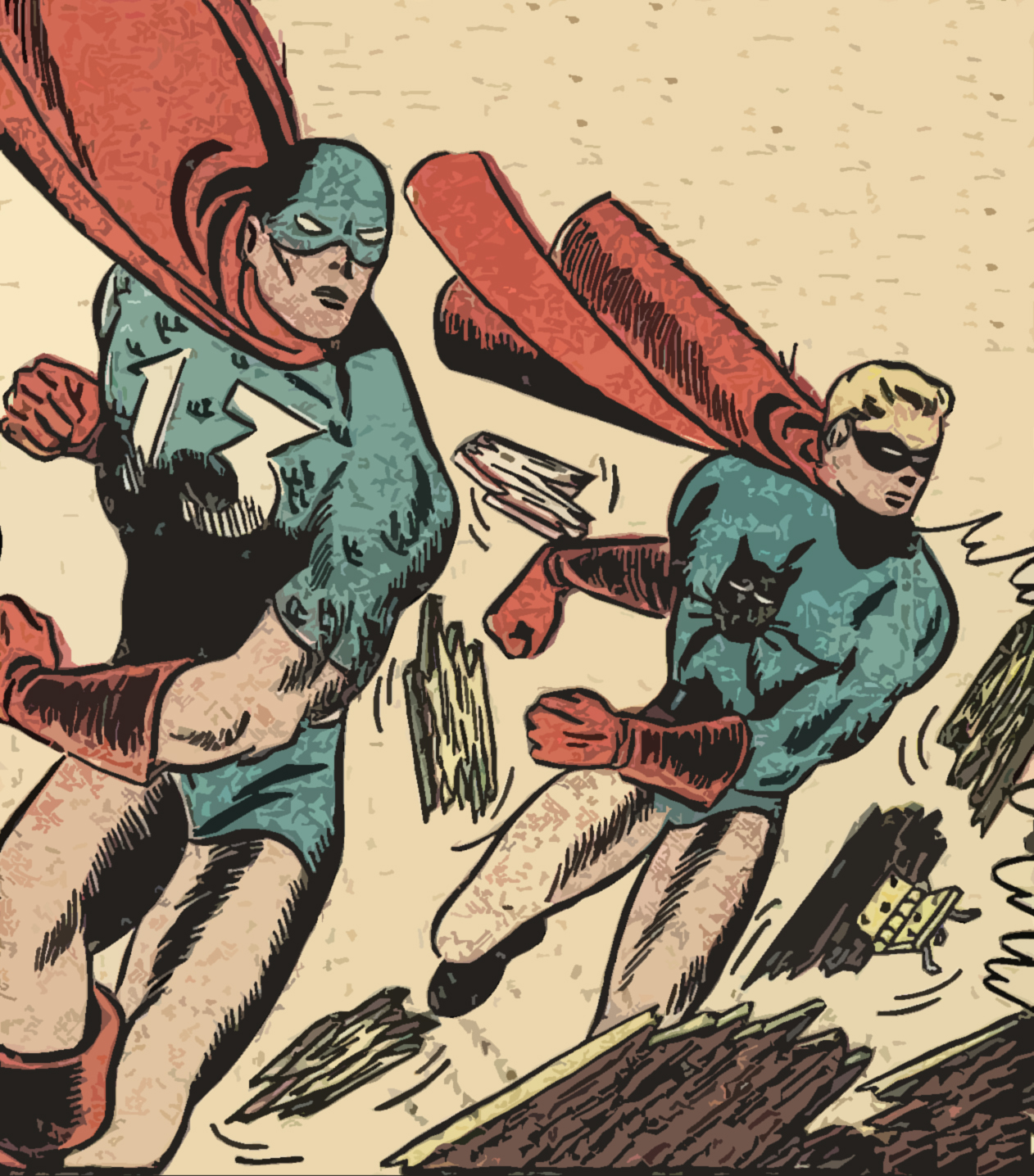
So you’ve spent your hard-earned dollars (or euros or pounds or yen, etc) on your favorite fantasy system and now your gaming group has developed a desire for some two-fisted, capes and cowls, super powered gaming. Option one is to spend some more cash on a new set of rules. Option two – we’ll call it the re-use/recycle option – is to turn your fantasy game into a super-powers game. Thanks to the concept of magic spells, most of what you need to duplicate super-powered crusaders is already present in your fantasy rules. All you really need are a few guidelines and house rules to make it work. The following article aims to fill that bill.

Ability Scores
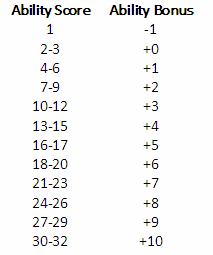
The traditional 3 to 18 range of six ability scores works fine for a super-powered game, provided you adjust a few definitions. Where a score of 9 to 11 is usually represents average for human beings, super-beings need more room to shine. For a super-game, assume that most normal human beings have a score of 1 to 6. Scores of 7 or more represent super-human abilities. Ability score bonuses kick in at a score of 4, and improve every three points thereafter.

You get a pool of 14 dice to roll your hero’s ability scores. For each ability score, you choose how many dice you roll and remove them from the pool, with the stipulation that you have to roll at least one dice for each ability score.

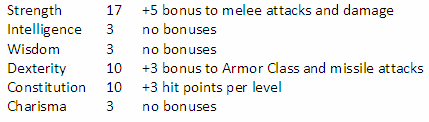
For example, a player could choose to roll 5 dice for strength, 1 dice for intelligence, 1 dice for wisdom, 3 dice for dexterity, 3 dice for constitution and 1 dice for charisma. This would, on average, give him ability scores as follows:

The set of rules you choose to convert into a super-powers game will dictate what kinds of bonuses are attached to each ability score. Since henchmen are usually only used by villains, a Referee might convert henchmen into contacts that are willing to aid a hero – the chief of police, for example, or a reporter.

Heroic Feats
Heroic feats of daring-do are part and parcel of a super-powered game, and are most easily handled by allowing basic ability score checks – i.e. roll 1d20 and aim to roll lower than the most relevant ability score, with penalties applied by the Referee based on the difficulty of the task. A character trying to leap to the top of a five story building, for example, would roll against strength.

Class and Levels
To keep things simple, all heroes in the game are treated as fighters and use the fighter’s Hit Dice, combat matrix / attack bonuses and saving throw charts / saving throw number / saving throw bonuses. If you want to get fancy and run some magic-users, go for it.

Experience Points
Heroes (and villains) are built using experience points. At the beginning of the game, the Referee (or Narrator) decides how many experience points are available to the players to spend on super-powers. Anything not spent on powers goes toward determining the character’s level.

For example, a Referee decides that players in his current game begin with 20,000 XP for character creation. One player spends 15,000 XP on powers, leaving him with 5,000 XP to determine his level. Another player might spend only 5,000 XP on powers, leaving him with 15,000 XP to determine his level.

As experience points are earned, they can be spent to add new powers, upgrade existing powers (see below) or simply applied to the hero’s experience point total, which determined level.

Powers
All of the super-powers in the game are represented by spells. The number of spells, and their level and effects differ from one system to another, so different systems will produce different kinds of heroes.

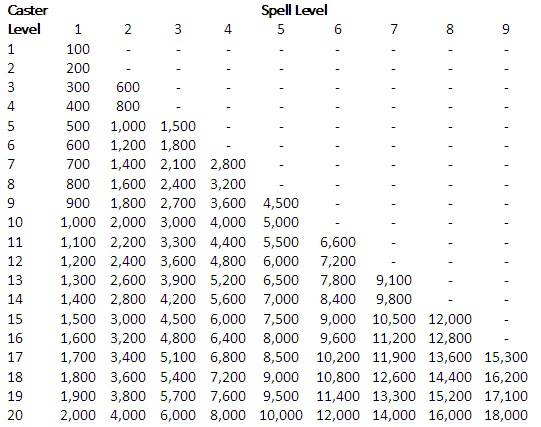
Powers are purchased with experience points using the following formula:

Spell Level x Caster Level x 100 XP

Spell level refers to the level of the spell, be it a 1st level spell, 4th level spell or 9th level spell.

Caster level refers to the effective level of the person casting the spell, since many spells base their variables on the level of the spell caster. Magic Missile, for example, usually determines the number of missiles one can cast on the level of the spell caster. Fireball determines how many damage dice you roll based on the level of the spell caster.

The following table charts out the costs of super-powers.

A spell’s duration translates into the duration of the power for a single fight scene. Outside of a fight, powers are usable at will, and thus have no functional limit to their duration. Spells like Haste are assumed to only work on the hero with the power, rather than being something the hero can “cast” on others. If a player wants such a power to work on others, the experience point cost is doubled.

It is up to a player to describe how his powers operate (i.e. are they magical powers, functions of high-tech battle armor, aspects of alien physiology).

Because low level characters gain levels more quickly than high level characters, it would be possible, using these rules as written, for a new character to load up on super-powers, come in at a low level, and then quickly catch up to players who opted to take more levels and fewer powers. For this reason, a -10% penalty is applied to earned experience points for every 3,000 XP spent on super-powers at character creation.

Sample Character Creation: Minerva
We’ll pretend that Minerva is a new character being created for a game, and that her player’s referee has decided that players may spend 15,000 XP on character creation.

First, Minerva’s player needs to roll ability scores. Out of the pool of 14 dice, Minerva’s player assigns them as follows: Strength 4, Intelligence 1, Wisdom 2, Dexterity 3, Constitution 3 and Charisma 2. After rolling the dice, Minerva has the following ability scores and bonuses:

Strength: 13 / +4
Intelligence: 5 / +1
Wisdom: 10 / +3
Dexterity: 15 / +4
Constitution: 7 / +2
Charisma: 10 / +3

Minerva’s player now looks at super-powers. He decides that Minerva is going to be a pretty standard Golden Age hero, and selects the following powers (using the SRD for reference):

Bull’s Strength allows her to boost her strength by +4 for 3 minutes. Stoneskin will allow her to absorb 100 points of damage before the power stops working.

Minerva’s player now has 5,900 experience points left to figure out her character’s level. For most old school games, this would translate into a 3rd level fighter. Thus, Minerva will have the attack bonuses, Hit Dice and saving throws of a 3rd level fighter, along with the power to fly, move at high speed, bonuses to strength, fighting ability and resistant to most damage. All in all, a pretty powerful woman.

Fatal Flaws and Weaknesses
Every character, hero or villain, should have a specific weakness or flaw that will be their doom if discovered. This is kept secret, even from the Referee, but should be something that can be discovered. Wide latitude is allowed here, and players and the Referee must be able to trust one another to come up with a valid weakness.

Equipment
For simplicity’s sake, translate gold pieces into dollars and don’t worry about the realism of the prices involved. Mystery men don’t spend much time in comic books shopping. The following game stats can be used for modern pieces of equipment.

Pistol: One attack per round, 1d10 damage.

Rifle: One attack per round, 2d6 damage.

Machine Gun: Two attacks per round at 1d10 damage or one attack per round at 2d6 damage.

Laser Weapons: As the firearms above, but +1d6 damage.

Vehicles: Treat vehicles as monsters under the control of their driver.

| Motorcycle: HD 3 (15 hp); AC 5 [14]; Atk 1 ram (2d6); Move 150.

| Car: HD 5 (25 hp); AC 4 [15]; Atk 1 ram (3d6); Move 120.

| Tank: HD 10 (15 hp); AC 1 [18]; Atk 1 cannon (6d6); Move 100.

| Locomotive: HD 15 (15 hp); AC 3 [16]; Atk 1 ram (6d6); Move 400.

| Fighter Jet: HD 20 (100 hp); AC 3 [16]; Atk 1 cannon (4d6) or 1 missile (8d6); Move 3500.

NOD Sandbox Format

I’ve posted about this kind of thing before, but now I’m starting to visualize how I want to format my sandboxes in future issues of NOD and future blog previews. My main concern is making the information 1) useful for a Referee during actual play and 2) flavorful and unique enough to keep players interested or fire the imagination of the Referee so he or she can keep players interested. With that in mind, here’s how I might format future sandbox presentations …

REGION NAME
• Description of the area; where does it fit in with other maps
• History of the area – very basic
o Pandiluvian Period
o Golden Age
o Modern Age
• [Basic map showing the regions and naming them, along with stars for city-states and dots for towns]
• [Smaller map showing where this region fits into the larger world map]
• [Welcome to NOD sidebar – quick description of the campaign world and what has appeared before]

Sub-regions

Sub-region 1
• Description – landscape, flora, fauna, minerals; hex movement in the region
• List city-states, major towns, monster tribes and strongholds and their interactions (if any); include mini armorials

• List major dungeons, along with rumors regarding those dungeons

Sub-region 2
• Description – landscape, flora, fauna, minerals; hex movement in the region
• List city-states, major towns, monster tribes and strongholds and their interactions (if any); include mini armorials

• List major dungeons, along with rumors regarding those dungeons

Dangers
• Random encounter tables for the different regions – one table using 1d12; go from weak to strong, so when the Ref rolls a “12” he knows he should chuckle wickedly
• Discuss No. Appearing formula, when to roll, how often to roll, etc.

Tribes
• Picture (head shot – maybe no picture, see how this one goes) of major humanoid types (including berserkers, men-at-arms typical for the region); for each a brief societal description (mostly as pertains to game play), armor and weapons; show hexes where they appear; give tribal treasure guides – coins, art, livestock, magic – main idea is to help make the goblins of Region X distinct (at least a little bit) from the goblins of Region Y
o Give stats for sub-chiefs/sergeants (+2 HD) and chiefs/captains (+4 HD) along with stats for the basic monster type
• Discuss concept of tribal spell-casters (with a basic statblock for level 3, level 5 and level 7)
• Note – Humanoid leaders and spell-casters that have class levels are described in detail in the text
• Give three map templates for different types of lairs – these will change from issue to issue, but always remain basic; label the chambers rather than number them
o Cave Lairs
o Village/Forts
o Camps

Keyed Encounters
• List all of the keyed encounter areas:
o Set-Up (describe the place, the people, etc)
o Twist (why should anyone care)
o Reward (not just treasure, also information, captives to free, XP for discovering)
• For towns and city-states, do sidebars like I do for official city-state write-ups
o Include a little map, very basic, with maybe 3 locations that are quickly described or maybe just given descriptive names
• For “dungeons”, have a black and white map with chambers that are described on the map (“Orc guards with flame throwers”, “slime lake”, maybe a little drawing for fun) and leave rest to the Referee to flesh out [I might not go with this idea – I need to test it out]

Walled village of 100 cantankerous diamond miners ruled by Bob, a flatulent mayor with red hair and green eyes and five lovely daughters. The village has a popular roadhouse run by Beth, a swarthy beauty with a missing eye, that rents private rooms for 5 gp a night and serves an excellent brandy and robust camel stew. The village is defended by 12 men-at-arms in chainmail carrying leaden clubs and darts. The villagers have 300 gp worth of diamonds and mining tools, and keep trained crysmals that they use to find new veins of diamond.

Cave lair of 200 gnolls with a chief called Gronk and 20 sub-chiefs. The gnolls carry battered shields, barbed spears and short bows. They worship an idol of Demogorgon and have a high priestess called Zima. The gnolls have a cursed crystal ball they stole from a traveling magician and know about the secret entrance to the Dungeon of Doom [Hex No.]. The gnolls are allied with the ogres in [Hex No.].

Monastery of Mercurius, the God of Merchants and Travelers. It houses 20 acolytes and adepts and its abbot is Father Frink. The abbey is constructed of purple stone and has numerous towers topped by conical, silver roofs. Its sits on a hill covered with sunflowers and badger burrows. The monastery has a vault containing the shin-bone of St. Blabus which, if kissed, cures disease about 2 out of 6 times (if it doesn’t work, its assumed you’re a creep and you’re beaten soundly and sent on your way). The monastery’s village consists of blah blah blah.

A magical spear is lodged in a crooked oak tree here. The spear has a red shaft and a bronze head and answers to the name ‘Longfellow’. It hums in the presence of warriors with more skill than its owner, and will do its best to get its owner killed so that the more powerful warrior can claim it.

New Monsters
• List all of the new monsters that appear in the text that aren’t easily found elsewhere.
• [Sidebar of new monsters that appear here that first appeared in another issue of NOD]

Pre-generated Characters
• Six (or more?) pre-gens that can be used as a rival party or whatever; use any new races/humanoids unique to the area and classes that mesh with the area, should reflect the region; no levels so they can be scaled as a Referee needs them to be for his game.

Art by Arthur Rackham, 1921

Animal Movement Rates – the British Way!

I was just reading Al Nofi’s CIC at Strategypage, and he showed some information on animal movement rates from Sir Garnet Wolseley’s The Soldier’s Pocket-book for Field Service. Sir Garnet was apparently the inspiration for Gilbert & Sullivan’s “Modern Major General”. I thought these figures might be useful for RPG’ers, at least as a comparison to the overland rates given in our favorite RPG’s. All of the following is drawn from Nofi’s post …


Animal Speed Pack Load Draught Load Work Day
Ass * 4.0 mph 150-175 pds 900 pds 15-16 miles
Camel 2.5 300-600 1000 20
Dog * 6.5 na 160 60 by sleigh
Elephant 3.5 800-1200 8000 15-20
Horse 4.0 250-400 350 15-16
Human 2.5 40-80 120-150 4-8
Llama * 2.5 65-125 na 12-18
Mule 4.0 150-300 500 15-16
Ox 2.2 160-200 300-500 4-6
Reindeer 18 na 300 50-100 by sleigh

Note: Since Sir Garnet didn’t campaign in places where some types of beasts of burden were in common use, we’ve added a few of these, as indicated by an asterisk. Pack Load includes weight of the pack; Draught Load includes that of the vehicle; na, not applicable for military usage.

Thought I add to this – the work days, in NOD hexes, would work out to …

Ass: 2 to 3
Camel: 3
Dog: 10 (by sleigh – impressive)
Elephant: 3
Horse: 2 or 3
Human: 1
Llama: 2 or 3
Mule: 2 or 3
Ox: 1
Reindeer: 8 to 16 (again, by sleigh wow!)

The sleigh pulling animals are quick – could be a good magic item – a sleigh that makes its own snow. We usually went by the rule of thumb of 1 hex on foot, 2 by mount, which isn’t too far off, though maybe 1 hex on foot, 3 by mount is better.

Mulling Over Monsters

I’ve been mulling over monsters for PARS FORTUNA the last couple of days – creating stats but also trying to figure out where they fit in to the larger scheme of “killing things and taking their stuff”. For most fantasy role-playing games, right back to the first, monsters were drawn from mythology, folklore and fantasy literature – you have the basic concept and you just apply some stats. As monsters are added, they slowly fill in some “ability gaps” – i.e. we have a monster that can hit, but maybe we need one that can hit AND is immune to fire. With PARS FORTUNA, the process is a bit different. The monster concepts come from random generators, but the stats do not, so right from the start I’m trying to figure out where a given monster fits in as far as how powerful it is, how it endangers the PCs and where it lives. And, of course, you want to do this in such a way that the beasties don’t just seem to have been stacked and sorted in a spreadsheet – you want them to live and inspire (probably too lofty a word, but it will work for now) and make the game experience enjoyable (I won’t say “fun” or the heavens may split and the hand of Raggi* may descend to smite me verily).

To my thinking, there are four classes of opponents in most RPGs

Muscle – Your basic creature who kills you with weapons, sometimes a claw or slam, usually roughly humanoid, few (if any) special abilities – in other words (and to use Swords and Wizardry terminology) the Hit Dice and Challenge Level are usually the same. The main different between these creatures is the Hit Dice and maybe Armor Class and Damage – usually all ascending at the same time. This category has the axis of kobold – goblin – orc – hobgoblin – gnoll – bugbear – ogre, but also probably includes the minotaur and the simpler giants.

Magic – The flip side of muscle, these guys have a big gap between Hit Dice and Challenge Level because they are really all about the special powers, which are usually magical. What these creatures lack in hit points they need to make up with difficulty in hitting, or the fights will be too short to be interesting. Here, you can file the dryads, nymphs and pixies, among others.

Monsters – This category is just muscle + special attacks and defenses, physical and magical. The focus here is usually on a physical attack form (constriction, poison, etc) or maybe a magical power (petrification, confusion). They often have multiple attack forms, so unlike the muscle, which challenge with numbers, the monsters can take on a full party by themselves. These things can be humanoid, but usually are not. Things like chimeras, giant spiders and gorgons.

Ubers – The uber category combines Muscle and Magic, and are often used as BBEGs in the game – rakshasas, hags, ogre magi, storm giants, etc.

Of course, no little system, especially one so hastily assembled, can fit everything in, but it seems to me that these are the four bases to cover in monster design – you want a good variety of these kinds of monsters at different power levels to scale with the adventurers as they gain levels and keep each dungeon from being exactly the same – i.e. you would like multiple “monsters” for “mid-level” play, so the mid-levels of every dungeon don’t play quite the same.

So – is there anything I am missing here? Let me know.

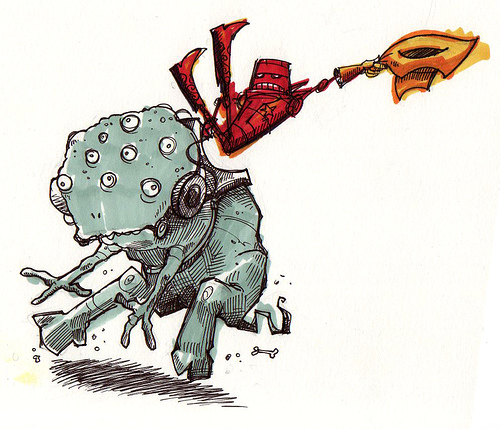
Art from Robots and Monsters, a charity website that produces custom-made drawings to help others. Check it out.

* I think I’m adding a St. Iggar to NOD. Or maybe St. I-Gar.

Organizing My Thoughts on Sandboxes

From issue to issue, I’m trying to improve my sandbox hexcrawl designs. I don’t know if I always succeed, but I’m definitely trying. The first one, the Wyvern Coast, was really just a matter of trying to be original and interesting and, honestly, just seeing if I could put together a product and put it in front of people. With Nabu, I tried to produce some little dungeons to explore – so, less a description of what a place could have, and more an inventory of what the place actually had in it. I see sandboxes as tool-boxes – the writer is supplying readers with ideas that they can use to build fun sessions with their friends. With the next one, I want to take things up a notch, which means spit-balling some ideas.

1. I’ve sketched connections between named NPCs before (X hates Y, Y loves Z), but I think I need to go a bit further on this count. Each named NPC (including the monsters) should have some connection to two or three other NPCs – a history, motivation, emotion, alliance/enmity, relationship, etc – something to drive explorers from one person to the next so that the hex crawl is not only a matter of “what direction do you want to go today” (but, of course, can be exactly “what direction do you want to go today” if that makes the players happy)

2. Some NPCs should hold “pieces to the puzzle” – important rumors, knowledge about a dungeon or another NPC or a lost secret (magic item, spell, way to kill a powerful monster)

3. I should sketch out one big dungeon for each ½ region (i.e. what I publish in a given issue of NOD) and detail the intro level. The big dungeon should probably be well hidden, thus necessitating exploration and interaction for the players to find it. The big dungeon should hold a powerful MacGuffin that ties the region together – maybe an artifact, or a secret, or the catalyst of an important event

4. Each ½ region should also have at least 5 smaller dungeons – a few basic dungeons (for levels 1 to 3), and a few expert dungeons (for levels 4 to 8). What gets turned into a dungeon?

a. A monster lair
b. A tomb or mystic place
c. A stronghold
d. A village
e. A city-state, etc.

One advantage to sticking to this formula is that players will eventually pick up on it, but they won’t necessarily know which stronghold in the region has the dungeon underneath it. This gives them a reason to visit and interact and, hopefully, cause trouble.

5. The dungeons should have connections between them – clues, maps, portals, etc. and should have a connection to the big dungeon

6. I need to do more with the city-states – I’ll always try to detail at least one city-state in each ½ region like I did with Ophir in NOD #2 – Ibis, City of Sorcerers, will be the next. But for the others, I’d like to spread around some interesting, important NPCs that players will probably want to meet, or will want to avoid

a. A master artisan who can craft magical things (nothing too powerful, but useful and maybe vital to the big dungeon)
b. A demon cultist of terrible power
c. A mystic who can tell the future / heal wounds / etc for a price
d. A master rogue/bard/merchant who knows everything and can find anything – again for a price
e. A fierce fighting-man/woman who commands a company of unique mercenaries and can be a great friend or awful rival (or both)
f. A famous inn with important secrets
g. An awesome tavern – the nexus of all adventurers and no-good-niks in the region
h. A monster prince – vampire, ogre mage, etc – something powerful who can drive adventures more than be a simple target for killing and plunder
i. A sage with vital information and his own agenda
j. A valiant noble
k. A villainous noble
l. A monster who is more than it appears and holds a key that cannot easily be claimed with violence (or perhaps a “good” monster that can only provide the key if killed)
m. A demi-god in the flesh – perhaps Hercules is touring the region, or a massive, deified purple worm roosts below a city taking sacrifices from the “innocent” citizens
n. An animal trainer/beast master with wondrous mounts/pets [I’m shaky on this one, but I’m trying to think of the different hirelings that fit into the game and that players might want to visit]
o. A mysterious faction/brotherhood/sisterhood that can be a persistent thorn in the players’ sides

I guess the main thing is that I want to create an environment in which (A) There is a reason to play a game in this region vs. any other region I might invent and (B) the adventurers will have reasons beyond simple wandering to travel hither and yon as they interact with the region. I don’t, however, want to create a narrative that people are bound to follow – rather, I want gentle, passive clues that people can pick up on or ignore, but that nevertheless exist beneath the surface of the sandbox for those who wish to dig into things and occupy the space rather than just visit.

So – any thoughts from the community?

Artwork by Damascus5

Pars Fortuna Preview #5 – Magic!

So, part of my concept for PARS FORTUNA is introducing alternate rules. While the RPG will contain the old tried-and-true Vancian system for those who love it, the assumed magic system for the game is something different.

The Spell Interval System
The Spell Interval system assumes that casting spells involves gathering eldritch energies and then releasing them, with the words, gestures and tools that are involved shaping that “energy” to produce the desired effect. The more powerful a spell, the more energy it takes – i.e. the higher the level of the spell, the longer it takes for the magician’s body (and soul?) to absorb the needed energy to power the spell.

The spell level intervals are as follows: Each hour, you may cast one first level spell; each day you may cast one second level spell; each week you may cast one third level spell; each month one fourth level spell; each year one spell each of the sixth, seventh eighth and ninth levels.

Naturally, the average magician will not be satisfied with these restrictions, and will seek a way around them. Magicians can attempt to cast spells over and beyond what is allowed, but doing so can be dangerous. When a spell-caster wishes to cast additional spells of a level, he must make a saving throw, subtracting the level of the spell he wishes to cast from his roll. If successful, he channels and masters the energies necessary and casts the desired spell. If he fails, he must face the consequences, which include mental and physical deformities and supernatural curses. The more powerful the spell a magicians fails to cast, the more potentially disastrous the consequences!

Magical Tools
I’ve always enjoyed the idea of magicians carrying all sorts of odd objects and materials in order to work their art. Advanced versions of our favorite game have included material components for years, and they are often ignored because they are difficult to track. PARS FORTUNA uses a similar concept, as follows:

Level 1 to 3 spells are classified as “Cantraps” and require a fetish to cast. Each spell requires a different sort of fetish, and the fetish is not consumed in casting the spell – it is merely a cheap tool, composed of ordinary, mundane objects, that the magician must hold in his hand to successfully shape his magical energies into a spell.

Level 4 to 6 spells are classified as “Invocations” and require a tool (or set of tools) to cast. These tools are more expensive than the fetishes required by cantraps, and include arthames (mystic knives), censers and wands.

Level 7 to 9 spells are classified as “Rituals” and require expensive gems to cast. Unlike the fetishes and tools, these gems are consumed during the casting of the spell.

Sample Cantraps

Irritation (Cantrap)
Spell Level: 1
Range: 30 ft.
Duration: 1d4 rounds
Focus: Leaves from poison ivy, oak or sumac tied into a bundle with twine

You cover the target’s body in an itching sensation that lasts 1d4 rounds. For the duration, the target takes a –1 penalty on attack rolls, damage rolls and saving throws, and suffers a –1 penalty to its Armor Class if it fails a saving throw. The creature can scratch, negating the penalties for that round. Creatures that have thick hides are immune to this version of irritation.

Pitch Sight (Cantrap)
Spell Level: 2
Range: 30 ft.
Duration: 1 minute per level
Focus: A small piece of phosphorescent lichen held tightly in right fist

The caster and her allies can see normally through normal and magical darkness.

Curse of Light (Cantrap)
Spell Level: 3
Range: Touch
Duration: 1 hour/level
Focus: A tiny sack of phosphorus

You make the subject extremely sensitive to light. Abrupt exposure to bright light blinds the subject for 1d4 rounds. On subsequent rounds, they suffer a –1 penalty to all attack, damage and saving throw rolls.

Sample Invocations

Exorcise (Invocation)

Spell Level: 4
Range: 10 ft.
Duration: Instantaneous
Tool: Bolline (sickle) swung over the target’s head

You negate possession of a creature or object by any force. When you cast this spell, the possessing force may make a saving throw to resist you. If unsuccessful, the possessing creature is ejected from the host and stunned for one round. A creature affected by this spell cannot attempt to possess the same host for one day.

If cast against disembodied spirits, the spell forces those spirits to make a saving throw or flee away from the magician and keep at least 30 feet away for 1 hour.

Ghost Walk (Invocation)
Spell Level: 5
Range: Personal
Duration: 1 minute/level
Tool: Amulet set with a mirror

You become incorporeal, similar to a ghost. While ethereal, other ethereal creatures can harm you, as well as material creatures that use magic weapons and spells. You are immune to all non-magical attack forms, are not burned by normal fires, and are unaffected by natural cold or harmed by mundane acids.

You can move in any direction (including up or down) at will and with perfect maneuverability. You do not need to walk on the ground. You can pass through solid objects at will, although you cannot see when your eyes are within solid matter.

You are inaudible unless you decide to make noise. You pass through and operate in water as easily as you do in air. You cannot fall or take falling damage. You have no weight and do not set off traps that are triggered by weight. You do not leave footprints, have no scent and make no noise.

Your physical attacks are ineffectual against material creatures. Your spells affect material creatures normally.

Gem Guard (Invocation)
Spell Level: 6
Range: See text
Duration: 1 hour per level
Tool: Athame, used to split the focus gem

You transform a gem into a scrying device. When the spell is cast, the two halves of a corundum worth at least 1,000 gp become linked. When you hold one, you may scry on the other at will. You can see everything within 50 ft. of the other half. Any creature with at least a 12 intelligence has a 1-2 on 1d6 chance of sensing your attention. Spells may be cast freely through the linking gem, and may target any creature within its sensor range. Area effect spells may damage the other half of the focus, which has 30 hit points.

Sample Rituals

Infinite Step (Ritual)
Spell Level: 7
Range: Sight
Duration: Instantaneous
Gem: Jacinth (50 gp)

You (with one other willing party) instantly transfer yourself from your current location to any other spot within sight. At 12th level, the magician may make a second step from the destination.

Edge of Oblivion (Ritual)
Spell Level: 8
Range: 60 ft.
Duration: Instantaneous
Gem: Onyx (100 gp)

This spell assaults the mind and body of the subject. The subject must make two saving throws, one boosted by any wisdom bonus the creature enjoys, the other by any constitution bonus. If the subject fails the wisdom saving throw, the spell deals 1d6 permanent ability damage to the target’s intelligence, wisdom or charisma, determined randomly. If the subject fails the constitution saving throw, the spell deals 1d6 permanent ability damage to the target’s strength, dexterity or constitution, determined randomly. The caster is stunned for one round following the casting of this spell.

Prismatic Helix (Ritual)
Spell Level: 9
Range: 60 ft.
Duration: 10 minutes per level
Gem: Opal (500 gp)

The visible effect of the prismatic helix is a stationary, slowly rotating, seven strand helix, one for each color in the spectrum. This helix is 5 feet in diameter and up to 20 feet high. Any creature of 8 HD or less that looks at the helix from less than 60 feet away is fascinated, unable to do anything but stare at the helix. There is no limit to the number of creatures that can be captivated in this manner.

Once per round, the helix shoots one ray at the nearest creature, using the magician’s attack bonus. Roll randomly on the table below for the effect.

1. Red: 2d6 points of fire damage
2. Orange: 4d6 points of acid damage
3. Yellow: 8d6 points of electricity damage
4. Green: Poison (save or die)
5. Blue: Turned to stone
6. Indigo: Stark, raving mad
7. Violet: Sent to another dimension
8. Struck by two rays, roll twice, ignore any “8”

Individual strands are destroyed by opposite effects (as determined by the Referee). If a particular color has been destroyed, and that color is rolled for a ray attack, re-roll until a valid color is selected.

Thoughts on Suspense

Over the past three days, I’ve been listening to recordings of Francois Truffault’s interviews with Alfred Hitchcock. I read the book based on those interviews a decade ago in college, but it has been enjoyable revisiting them.

Hitchcock, at one point, discusses the concept of suspense in film. He stresses that it is important for the audience to be aware that a momentous or terrible event is going to occur and when it is going to occur, and, of course, for the characters to be unaware. Simply blowing up a bus generates surprise, which fades fairly quickly for the audience. Letting the audience know the bus is going to explode – and that the people on that bus have no idea they’re about to die or be injured – creates a suspenseful situation that can last for several minutes.

In role-playing games, the players are both the audience and the characters. I think Referees mostly use surprise – “Black Dougal gaspsPoison!’ and falls to the floor” – with a bit of mystery thrown in by some of the old stand-bys – will the statue come to life and attack? does the lock contain a spring-loaded poison needle? etc.

My question is: Has anyone ever used suspense as Hitchcock defined it? For example, letting the player’s know that in 5 rounds the ceiling is going to collapse, but reminding them that their characters are unaware of this and must proceed with their fight against a gang of hobgoblins. I’d be interested to know how such a situation worked out.