Over at the aptly named BIG map blog today there is an image of the subterranean world as envisioned by Athanasius Kircher. Who else wants to stock those massive vaults beneath the earth? Good stuff, and I would adopt as the official map of the interior of NOD if he hadn’t left out the various circles of Hell – though maybe those are just obscured by all that fire.
Campaigns
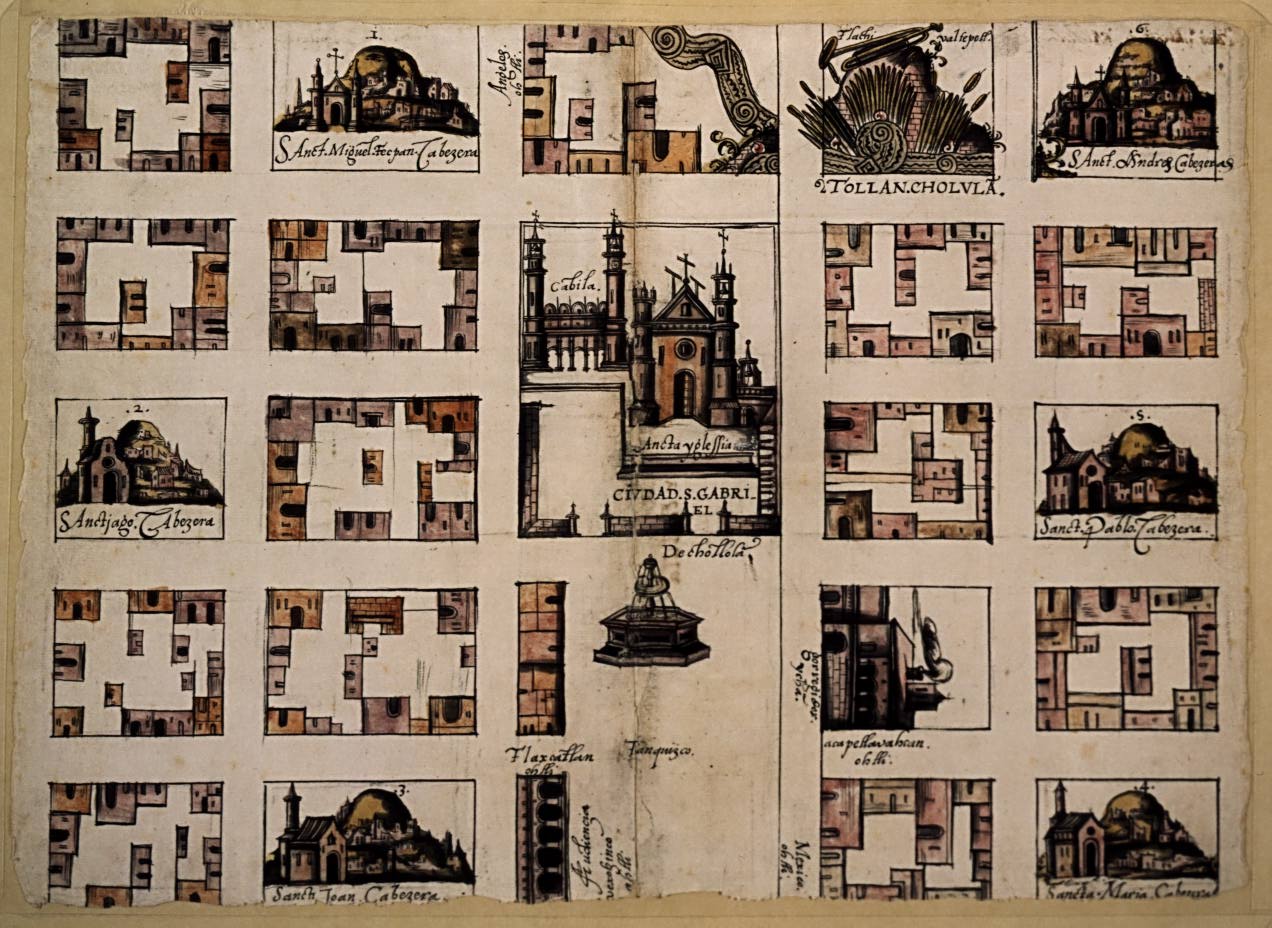
Geomorphs of the 16th century
Came across this neat little map yesterday on my wanderings …
I found the little gem HERE. Apparently, it is a map of Cholula in Mexico drawn in 1581. Not a bad method for generating a fantasy city. The map actually reminds me just a bit of Zak’s Vornheim – or at least of the illustrations of Vornheim that I have seen.
Altered States of America … A Bit More Info
Well, the teaser post yesterday seems to have sparked some interest. Now I want to give a little more information to keep from overselling it – yes, my brilliant marketing plan is to get people interested in something and then quickly douse that interest. Seriously, though, I don’t want people buying NOD 9 and then being disappointed because they though it was going to be something it was not. So …
Altered States of America
This article is part of a loose “series” of articles I’m calling Campaign Sketchbook. They are intended to be just that – an idea for a campaign with a few details sketched in, but overall leaving most of the work to the prospective Referee. ASA is not is a fully fleshed out campaign or game of Napoleonic fantasy with all the trimmings, although maybe it will be at some point. For now, it is an 8 page article with the following:
The campaign concept. In this case, wilderness delving in a Napoleonic milieu set in a North American continent divided between a number of quarrelsome nations – i.e. no United States, but independent nations like the Commonwealth of Massachusetts and the Texas Republic.
The inspiration – well, I’ve always had an interest in this sort of thing. I think the first “wargame” I ever played was one of my own invention, where I took a map in a coloring book that showed the growth of the United States (i.e. Original colonies, Northwest Territories, Louisiana Purchase, Gadsen Purchase, etc), pretended they were all separate countries, and then devised some manner of them fighting battles and expanding their territory. This idea popped back into my head when I watched an episode of How the States Got Their Shapes. I knew that I wanted to do a blog post about the show (which originated from this blog, apparently), because I liked it, but I had other things to do so I put it on the back burner. In planning NOD 9, I realized I needed another article, and so I thought about exploring the idea of a USA with different borders and city names, and tried to find a way to make it relevant to role playing games.
As for alternate history … well – pretty light on that in the article. It’s more of a “we need an excuse to explore the continent and fight battles, so here you go” than a study in what bizarre historical twists were necessary to bring the Altered States of America into existence. Marie Antoinette and other historical figures show up in the descriptions of the nations of North America, but the historical details are left up to the Referee.
The article covers the following ideas:
– A quick sketch of the idea, which is, in a nutshell, “swap dungeon crawling with wilderness crawling. Party of adventurers with followers (max for each character) is financed by a company or government for 6 months to head into the wilderness and explore it, planting their nation’s flag as they do.”
The campaign is ultimately about working towards the end game of building forts. To that end, it makes use of a Leadership score (level + charisma) that allows for a number of henchmen. This creates the likelihood of mass battles (or mass skirmishes). Of course, dungeons might be found in the Mysterious Interior and explored, but they aren’t the focus. The main focus is finding enough “treasure” to keep the exploration going and thus have a hand in drawing the map of North American.
– A small list of Napoleonic-era weapons and cannon.
– A small run down of Napoleonic men-at-arms – grenadiers, voltigeurs, lancers, etc.
– The leadership score table.
– Quick sketches of the nations of North America, with population number, capital, other cities, form of government and ruler. The countries use the original names of cities where possible to give the place an otherworldly feeling. The base start year of the campaign would be a very loose 1800.
– Some ideas of what might be lurking in the Mysterious Interior. Including pilgrims setting out to found a New Zion in the wilderness, monsters, lost cities and tribes and, of course, Native Americans.
The article does not contain a massive hex map of the Mysterious Interior, but I am working on such a map that I’ll post on the blog when it is finished. I might even try to run an ASA play-by-email campaign, though I’m not certain about how well that would work.
Hopefully I’ve given folks a better idea of what the article entails. It’s not earth shattering, but might be useful for folks wishing to wrap their heads around a campaign of exploration in an alternate North America of 1800. If it seems that there’s enough interest, I might expand it into a beer & pretzels game like Space Princess.
Future Campaign Sketchbooks should include a campaign of mutant caravans on the Polyester Road and JD Jarvis’ Mutant Front.
—
Image of Lewis & Clark Expedition by N.C. Wyeth. From HERE.
Google-Sourcing the Planes
Those who know the real me know that I work as a commercial real estate researcher in fabulous Las Vegas. A good portion of my job involves maintaining a database of c. 5000 property records and c. 7000 availability records – and that means hours of data entry. If you’re not familiar with the concept of data entry, allow me to assure you that it can be just as boring as it sounds. So, every hour or so I poke my head above the waves of data and look around – sometimes that means Facebook, sometimes checking email, and sometimes doing a random search in Google. Thus – today’s post …
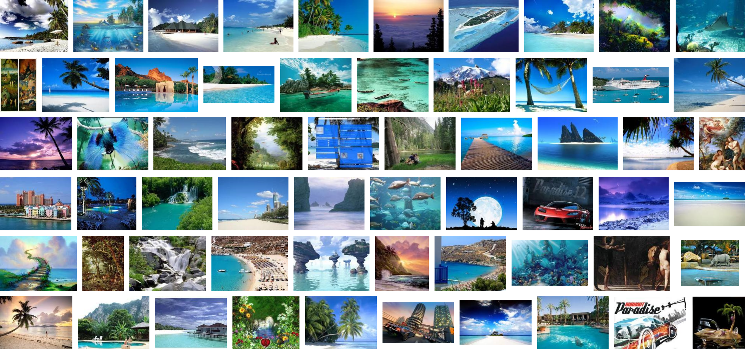
So, I randomly decide to do an image search today for “Paradise”. Well, not entirely randomly – somebody was playing Van Halen in a nearby cubicle. Anyhow – it struck me that it might be fun to see how the planes of the Great Wheel look via Google image searches.
ASTRAL PLANE
We’ll start our tour of the planes on the Astral Plane. Google’s Astral Plane is bluish white it seems – some areas lighter, others darker. I’m picturing symbols floating about, each standing for something of COSMIC IMPORTANCE and thus generally ignored by the folks that actually walk the planes – killers of things and takers of stuff.
TWIN PARADISES
Paradise to modern humans is a tropical island – warm sun, white sands, crystal clear waters. The last thing it needs are adventurers messing everything up. Should therefore be the first place on any chaotic’s itinerary.
ELYSIUM
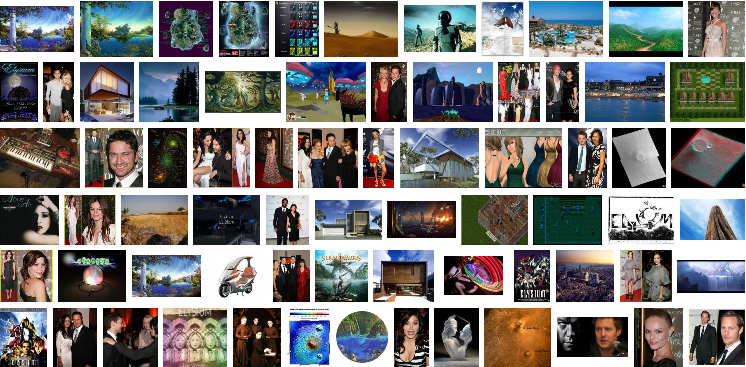
If Google is to be believed, Elysium is a resort for the gods. I’m seeing a virtual paradise surrounded by a desert of red sands patrolled by robots and tanks. In the middle there’s a deific resort hotel where all the beautiful people of the planes come to be seen (and presumably robbed by the likes of Loki and Raven).
HAPPY HUNTING GROUNDS
The Happy Hunting Grounds are enlivened by introducing of race cars, giant see-through hippos and rousing games of cricket. Apparently the HHG is the outer plane’s answer to a sport’s park/recreation center. Buffalo hunting, golf, racing – a place for the gods to stretch their legs and get a little exercise.
OLYMPUS
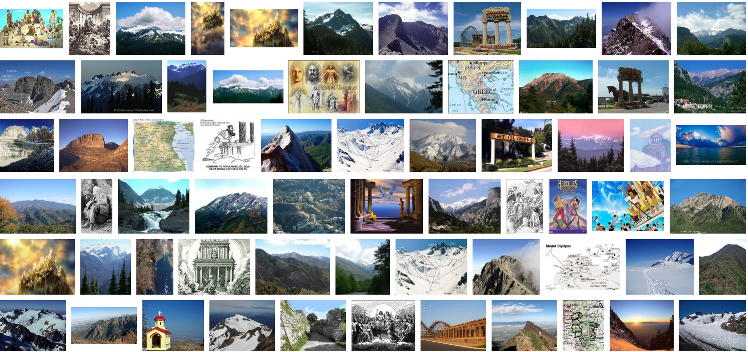
If you want to search for Olympus, search for Mount Olympus – otherwise you get cameras. So we have a lofty peak populated by half naked god-models with very human appetites for sex and power. The gods of Gladsheim will go out and romp with you, while the gods of Olympus will totally use you for their amusement. Adventurers beware – they’re laughing at you, not with you.
GLADSHEIM
Let’s be honest – it’s Asgard. Gladsheim is Asgard. An image search for Asgard gives you Kirby vikings, heroic landscapes and lofty buildings. I see Gladsheim as being the most hexcrawl worthy of the planes – a place for old adventurers to go and hang out with the gods and kick around the godly fjords and mountains and forests looking for godly things to kill that one may acquire their godly stuff. Fewer viking babes in the search results than I would have liked, though.
LIMBO
Limbo is either a plane of people bending over backwards to walk under sticks or Hell’s waiting room. There’s a walled city there surrounding by huge people, two giants doing something that seems deeply inappropriate, weird demons – a real grab bag of horrors.
PANDEMONIUM
Pandemonium is Hell’s downtown – lots of civic buildings and demonic politicians (i.e. politicians). There’s probably a tax for everything and you need a license to walk down the street or pick your nose. Tammany Hall taken to its extreme.
ABYSS
The never-ending plane of demons in D & D becomes a plane of water and pro wrestlers in Google Images. I’m imaging the demons “organized” into a myriad of wrestling federations, all gunning for the belt currently held by Demogorgon. Few suspect that Vince McMahon is the power behind the throne. Okay – everybody suspects it.
TARTERUS
Hell’s prison – a little less exciting than Hell itseld, large guys with mauls, surprised monkeys, half-finished mosaics and cramped titans plotting revenge against the gods of Olympus. If you hate the Olympians, you can make some great contacts in Tartarus. Just don’t bring up the “Tarterus Incident” – still a sore subject in those parts.
HADES
Hades illustrates the problem of doing an image search for anything that has ever appeared in a Disney movie. I had to search for Hades + Underworld, and still got the big blue flamehead. Naturally, the images are all Hades-centric, so I’m picturing a land of the dead ruled by an arch-egotist. Like a Hitler/Mussolini/Kaddafi/Sadam-type, he has statues and images of himself everywhere. The plane also looks pretty adventurous – boiling seas, burning caverns, weird cities – all things an old schooler can get behind.
GEHENNA
Gehenna is a real place – a valley in Israel. In a way, that makes the images of Gehenna the most interesting of the Lower Planes – in place of a heavy metal album cover, we get a lower plane that looks rather mundane. Or would be mundane if Chuck Norris hadn’t shown up to kick some demonic ass. I’m seeing a plane of souls that don’t know they’ve been damned, but do know they aren’t happy and can’t figure out what to do to change things. They’re trapped in their own lack of imagination.
NINE HELLS
Fire, darkness, devils chewing on people’s heads, torment, hags, Hello Kitty, Meatloaf, AC/DC and a rapper with regrettable dental hygiene. Welcome to Hell. I’m guessing Hell makes all the other Lower Planes roll their eyes – how cliched! Come on Lucifer – a billion years of fire and brimstone – how about something new? Lucifer smites the critic, of course, but deep down he knows he’s completely out of ideas. Hell is where the movers and shakers of the Lower Planes congregate, because Hell understands the concept of the D&D end game: Baron – Marquis – Count – Duke – King.
ACHERON
Acheron is the plane of Death Metal. ‘Nuff said. Raggi’s demonic equivalent publishes a ‘zine there.
NIRVANA
I wonder how the enlightened, centered Buddhas are handling the introduction of Kurt Cobain to their ordered paradise. Eh – they probably just ignore him.
ARCADIA
Google Arcadia is a lovely land of crystal clear waters, tall trees and massive war ships that ply sea and sky. Personally, I don’t see how the addition of sky ships can’t improve a plane that is otherwise so boring.
SEVEN HEAVENS
No major surprise to the color scheme here – whites and celestial blues. The giant carrot is a nice touch, and I’d love it if the first thing you saw when you reached Heaven’s astral shores was a “You Are Here” sort of map. A map is organized (i.e. Lawful) and helpful (i.e. Good), so it makes sense. Also notice Shep, Heaven’s answer to Cerebrus. I think I’d like a Heaven of solars, planetars and devas who look like push-over Hallmark card angels – especially when they lay the celestial smack down on the adventurers who – let’s again be honest – are almost certainly up to no good.
Guides Through the Wilderness
Six guides to see your safely through the wilderness (or not!), listed in order of their “skill level” as a guide.
1. Percivius is a haughty, arrogant escaped slave who would like to believe himself a leader of men. He primarily worked as a clerk for his master. When his master expired one night from a heart attack, the manor slaves rose up, killed the guards and torched the manor, leaving Percivius out of a job (so to speak) and in just as much trouble as the others. He struck out into the greenwood and nearly died on more than one occasion, but finally made it over the mountains to a city-state where he was unknown. He now works as a wilderness guide, lecturing his charges and scoffing at every survival mistake they make along the way (and doing his best to explain away his own errors). Percivius is short and, thanks to his new life, well muscled and fit. He is balding (hiding it under a Phrygian cap), but still has a few platinum blond ringlets. He has beady eyes that suggest a life of reading by lamp light.
2. Ghadra is a sergeant in the local guard who works on the side as a guide through the wilderness. She makes patrols with her company of crossbowmen every two weeks, and tailor’s her journey to suit her employers. Ghadra is no woodsman, but she knows enough to get along. She primarily relies on strength of numbers and a knowledge of the terrain (the trails, the pitfalls, etc) to get from point A to B safely. If she perceives weakness on the part of her employers, she isn’t above a little brigandry and knows the best places to hide the bodies.
3. Northstarr is a barbarian who clings painfully to the image of the half-naked savage popularized in copper-dreadfuls throughout the Motherlands. A city boy, he set out to remake himself as a barbarian hero, dressing in a red kilt and mail shirt and carrying a bastard sword (the love of his life!). On his head he wears an ornate dragon helm that imposes a -1 penalty to hit on him in combat, but is suits him so he doesn’t really care. Northstarr is a competent woodsman, possessed of mighty thews and, though he adopts a Thulian accent and plays the strong, silent type, has an active and imaginative mind.
4. Fiona appears to be the ultimate guide – tall, fit, competent and self-confident, beautiful. Pity she’s actually a succubus who leads a party into the wilderness and then abandons them there, stealing away the most powerful warrior they have and leaving that warrior’s withered remains on the trail back to town as a taunt. She never appears in the same town twice – at least not without a couple hundred years in between appearances.
5. Mavewyn in an ex-soldier, a pioneer who fought in three major campaigns before retiring and setting up shop on the newly conquered frontier as a guide. Rugged and quiet, he has a good relationship with the barbarian and humanoid tribes in the area – they may not like the incursion into their homeland, but they know he’s a man of honor and they fear his bow and blade. He balks at taking adventurers into the wilderness who aren’t at least 4th level, for after all, if Gygax had intended 1st to 3rd level characters to explore the wild, wilderness rules would have appears in the Basic Set.
6. St. Eudoxius appears to people as a young man in a woolen tunic and blue cloak and carrying a crooked staff. The patron saint of homesteaders, he often appears to those who are lost or in dire straits in the middle of the night, holding a lantern (illuminates 120-foot diameter area as though it were daylight) in one hand and a brace of conies (or whatever game is most appropriate) in the other. After a quick repast (his water skin never seems to empty), he will head off into the night, beckoning people to follow him. Saint Eudoxius knows the location of all strongholds and freeholds in an area and his presence assures one a night of safety (though if he knows a lord or yeoman to be wicked, he will advise the adventurers to quickly be on their way the next morning). He accepts donations of gold that always appear in the nearest Lawful temple or shrine the next morning.
—
Image from HERE
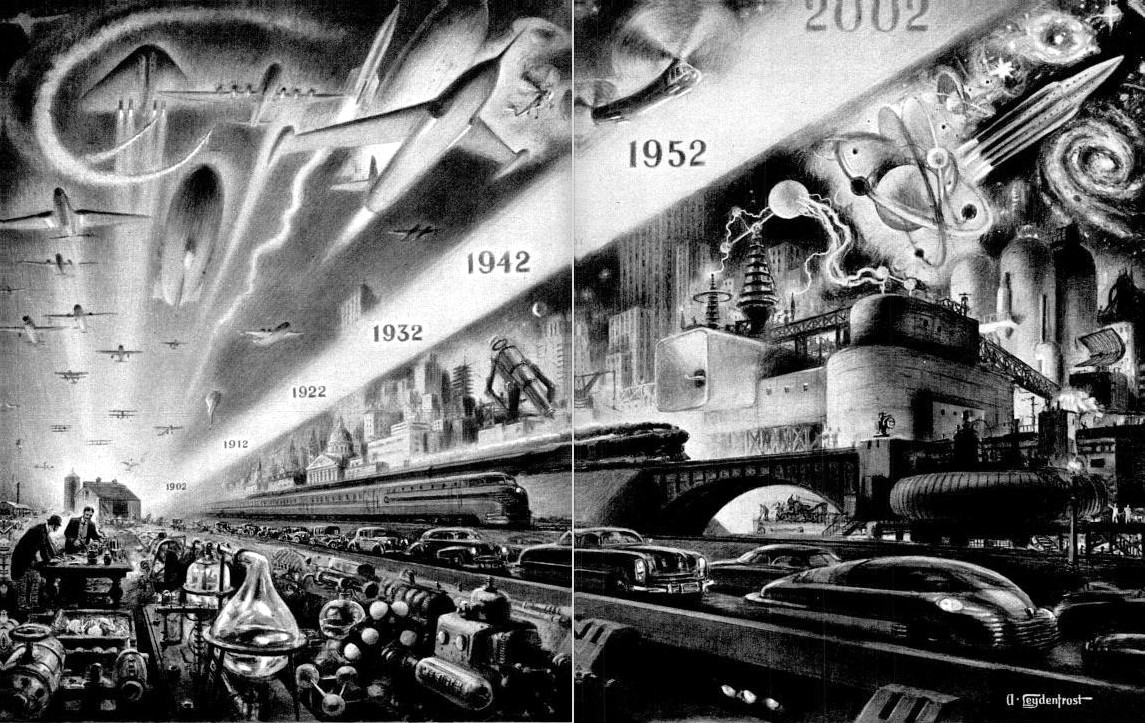
Random Musing – The March of Progress in a Campaign World
This notion just struck me a few moments ago, so I figured I’d put it down on pixel while it was fresh in my mind. I was thinking about the transition of a medieval-style fantasy campaign world, my own in fact, to a Renaissance level of technology and society – nation states, masses of firearm-armed men-at-arms, printing presses – and then to higher levels of advancement – the Victorian Age, etc. Invention in most fantasy game rules, at least in terms of invention by PCs, is relegated to the creation of new spells. Naturally, a Referee’s NPCs can invent anything they want, but if we assume that everybody in the world uses the same spell creation rules, the more high level magic-users there are, the more spells will be invented. In my own world, I have the Scientist class, so the same concept would hold in NOD for pseudo-scientific inventions.
Therefore, while invention in our world has generally relied on the strength of civilizations and their ability to share information and amass resources, the march of progress in a fantasy world would rely on the existence of powerful monsters and hidden treasures – the very things that provide experience points for adventuring magic-users and scientists. Now, again, I know that NPCs aren’t shackled by the same rules as PCs in most old school fantasy, but bear with me – this is just a matter of a guy following an idea around to see where it goes. So, if we take the necessity of powerful monsters as the basis for invention, as a campaign world’s PCs gradually whittle down the powerful adversaries, the pace of new inventions should slow down. As civilization expands in a campaign world, invention slows down – an interesting concept.
It also occurs to me that as all those high level and mid-level monsters – the more unique sorts that don’t multiply like rabbits (or goblins) – are killed off and as large treasures are discovered, the ability of any PC to advance in level becomes restricted. Once you get past the lower levels, not being able to take out mid-level monsters means getting through those mid-levels becomes much harder, and it makes those few powerful monsters that avoided the old high-level PCs more secure. Maybe the natural evolution of a fantasy world would be:
1. Small civilizations, lots of wilderness, many monsters, high potential for high level advancement.
2. Mid-sized civilizations, less wilderness, fewer powerful monsters, less potential for high level advancement.
3. Large civilizations, very little wilderness, very few powerful monsters, almost no potential for high level advancement.
Once you enter stage 3, the likelihood of powerful monsters laying waste to civilization might be pretty high, sending the fantasy world back to stage one and setting the scene for all these old school campaigns where low-tech civilizations always seem to be built on the ruins of ancient high-tech civilizations.
—
Illustration by Alexander Leydenfrost
Dolls of the Apocalypse and Other Things
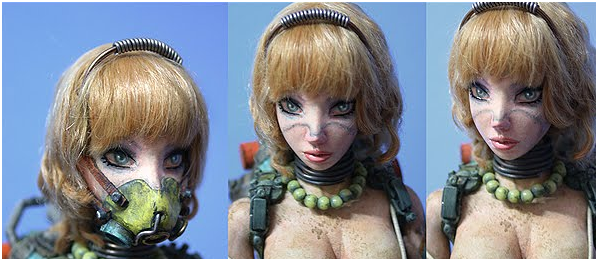
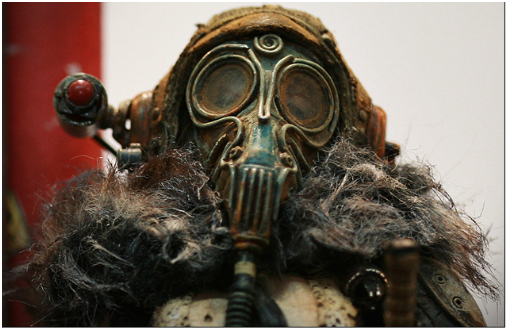
Okay – suitably odd blog post title. Just found some post-apocalyptic dolls designed by Yeon Guun Jeong/BHEAD that I thought might be of interest to the Gamma Inclined. Found via Super Punch, my one stop shop for stuff on the interwebz.
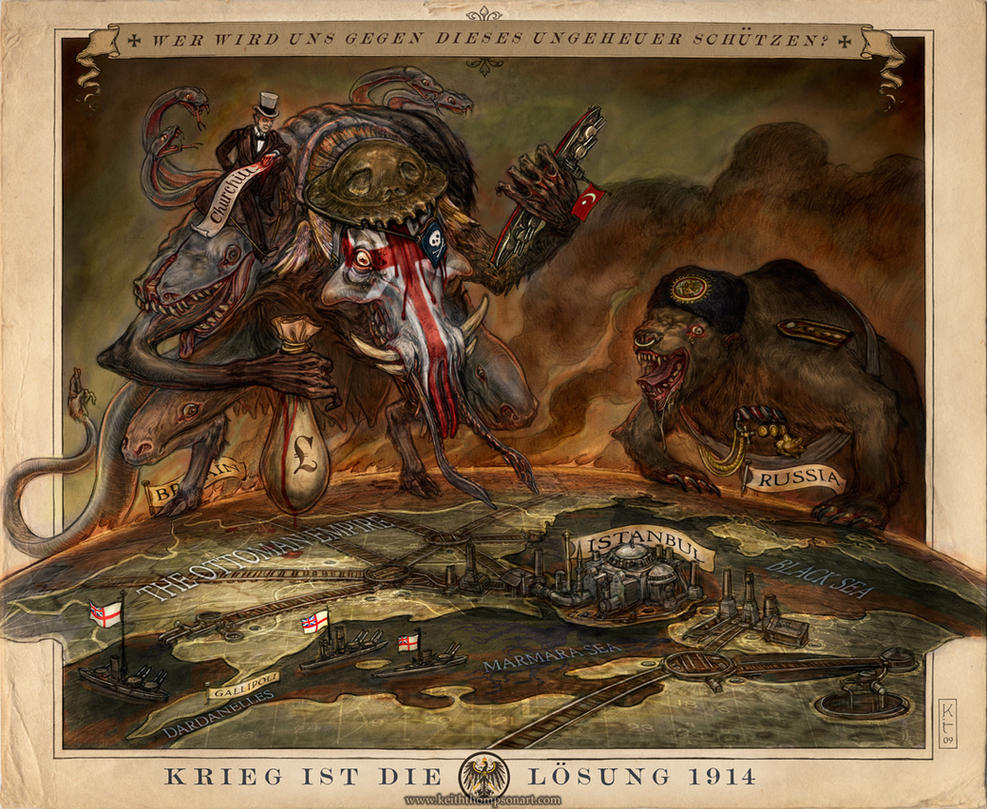
Makes me think a post-apocalyptic early 20th century Europe embroiled in a never-ending Great War could be a very cool setting for Gamma World. Remnants of the Great Powers and their armies, guys in jodhpurs slashing at fleshy-headed mutants with their cavalry sabers, wandering undead produced by the mass slaughter of trench warface and unable to go quietly into the afterlife (and a good excuse for Van Helsing-style clerics in a Gamma World setting), chemical mutants (remember, before the a-bomb most super powers came from accidents involving chemicals – stupid upstart radioactive superheroes) scouring the bleak and broken landscape for sustenance – clearly a good time would be had by all.
In other news – finished writing Hexcrawl #2 last night – huzzah! Now I just need to finish up NOD #6, write my quarterly reports (work related – check them out if you have an interest in commercial real estate in Las Vegas) and then start delving into Mystery Men! and sketching out the three cities that will appear in NOD #7 (Lyonesse, Antigoon and Blackpoort) and Hexcrawl #3, a sort of bleak zombie-land of basalt hills, ashen plains and slow, oozy rivers. But no major deadlines staring me in the face for a few weeks after NOD #6, so time to party!
Oh – and Aeons & Auguries is getting lonely in the Megacrawl – for cryin’ out loud, somebody write a comment.
Oh Oh – and 99 followers – whose going to take the Land of Nod into triple digit territory? The 100th follower will receive a personalized HUZZAH fit for framing.
Edit – 101 followers reached – thanks folks! Also, the setting sketch above is getting some attention, especially from JD Jarvis who has already started mapping HERE. Those who like the idea of such a setting might want to check out artist Keith Wormwood – he’s doing some work lately that would go well with such a setting.
An Early "Gamma World" For Your Perusal
Found this comic book scanned on Golden Age Comic Book Stories (I highly recommend the site).
Makes for an interesting early version of the “Gamma World”. Here, we have an alien invasion instead of nuclear war – even better, an alien invasion after everybody disarmed. The volta men are ragged looking aliens sporting pickelhauben, talking like Yoda and fretting over another group of aliens from Venus – the sponge people (no, not this guy). If I’m being completely honest, I think I prefer this to nuclear apocalypse-land.
Mines and Mining – Part Five
The Finale! Previous posts are as follows:
Part One: Mining and Smelting
Part Two: Alabaster to Corundum
Part Three: Diamond to Lodestone
Part Four: Marble to Rhodochrosite
—
Salt
Natron (5 sp / lb): Art, Preservation
Salt (5 gp / lb): Alchemy, Cooking
Salt occurs as a white, pink or reddish mineral in rock salt form. Rock salt occurs in vast beds of sedimentary minerals resulting from the drying of enclosed lakes and seas. These salt beds may by up to 350 meters thick and cover many square miles. Salt is also extracted from sea water.
Salt can be extracted from rock salt deposits by mining it. This was traditionally a very dangerous profession, and thus left to slaves and convicts. The salt occurs in the form of irregular salt domes, and may be transparent, white, pink, reddish or red in alternating bands. Some salt mines still in operation today are very ancient, including famous mines in the Punjab and Poland. These mines cover many square miles, run up to 10 levels deep, and have hundreds of miles of passages and thousands of chambers. In other words, they would make perfect dungeons.
Salt can also be collected from salt water from the sea or from brine springs. When extracted from water, the salt is either evaporated from the water using salt pans (pots made from a crude ceramic material called briquetage) or by boiling it down over a fire. Even when boiling is used, the brine is usually allowed to evaporate in salterns in order to concentrate it before the boiling occurs.
Salt is a useful material on its own, primarily as a food additive and an alchemical ingredient. At some points in time it was almost as valuable as gold. Alchemists can make spirit of salt, or hydrochloric acid, by mixing salt with vitriol (sulfuric acid). Spirit of salt was mixed with aqua fortis (see Urine) to produce aqua regia, the gold dissolving acid. Alchemists also used salt to produce sal mirabilis, or miraculous salt, a popular laxative.
Another product of dry sea beds is natron. Natron was used as a grease-cutting cleaning agent, a mouthwash, and tooth paste. When blended with olive oil, it made soap. Natron was an ingredient in antiseptics and it was used to dry and preserve fish and meat, kill insects, make leather and bleach clothing. The Egyptians used it in the mummi-fication process because it absorbs water. When added to castor oil, it made a smokeless fuel, allowing artists to pain in tombs without staining them with soot. The Romans combined natron with sand and lime in their glass and ceramic production, and it was used as a flux in soldering precious metals and as an ingredient in blue paint.
Sandstone
Sandstone (8 sp / lb): Architecture
Sandstone is a sedimentary rock composed of sand-sized minerals. Most is comprised of quartz and feldspar, the most common minerals in the Earth’s crust. Sandstone is usually colored tan, brown, yellow, red, gray and white. It is a common building material because it is easy to work and often resistant to weathering.
Serpentine
Serpentine (1 gp / lb): Architecture, Art
Serpentine is a group of many different minerals. The Romans called them “serpent rock”. They come in colors ranging from white to grey, yellow to green, brown to black and they are usually splotchy or veined. Serpentine is plentiful in sea beds. In the soil, it is toxic to plant life, and thus deposits often underlie strips of grassland in wooded areas. Serpentine marble (lizardite) ranges from red to green and weathers very well. Serpentine is a common stone in hardcarving. It can be carved into art objects or used as an architectural facing.
Silver
Silver (100 sp / lb): Art, Coins, Equipment
Silver, or argentum, is a whitish metal that is harder than gold, but still easily worked. This made it an excellent material for making coins, and in fact most coins through history were minted from silver. There are three main sources of silver: Quartz, galena and acanthite. For more information on quartz, see the entry for Gold & Quartz. For information on galena, see the entry for Lead. Acanthite is a blackish-grey mineral with a metallic luster.
Silver is most often used to make coins. Historically, silver coins were far more common than gold and copper (or bronze, brass, billon or potin) coins. In fantasy games, silver is also used on weapons, probably in the form of silver plate, because of its effect on lycanthropes. Silvering a weapon would probably involve the use of mercury, and would be performed by an alchemist rather than a smith.
Lunar Caustic, or lapis infernalis, was made by dissolving silver in aqua fortis and evaporating the substance. Sticks of lunar caustic were used in surgery because of its antiseptic properties. It blackens the hands. Argentum fulminans, or fulminating silver, is a silver compound that explodes readily, though the charge is fairly harmless in small amounts.
In mythology and folklore, silver is associated with the moon, thus lycanthrope’s vulnerability to silver.
Slate
Slate (5 cp / lb): Architecture
Slate is a grey stone formed from shale. The most common use for the stone is roof shingles, though high quality slate can be used for grave markers and other monuments.
Soapstone
Soapstone (1 cp / lb): Art
Soapstone is rock composed of talc and rich in magnesium. Soapstone has been a medium for carving for thousands of years. Native Americans used it to create bowls, cooking slabs and smoking pipes, the Indians for temple carvings and the Chinese for official seals. It is highly heat resistant, making it a good material for cooking slabs, seals that are to be dipped in hot wax and as a mold for soft metals.
Spinel
Spinel: Medium Gem
Spinel is a class of minerals found in gemstone bearing gravel, limestone and marble. Spinels range from blue to mauve or dark green, brown or black in color.
Sulfur
Black Powder (3 gp / lb): Equipment (Guns)
Sulfur (1 sp / lb): Alchemy, Laundry, Medicine
Vitriol (10 gp / vial): Acid
Sulfur is a soft, yellow mineral that can be found near volcanoes and hot springs and in salt domes. It can also be extracted from pyrite (iron + sulfur), cinnabar (mercury + sulfur), galena (lead + sulfur), sphalerite (zinc + sulfur), stibnite (antimony + sulfur) and the sulfates, gypsum, alunite and barite.
Sulfur is extracted by stacking deposits in brick kilns built on sloping hillsides, making sure to leave airspace between them. Powdered sulfur is then placed on top of these piles and ignited. As the elemental sulfur burns, the heat melts the sulfur in the deposits, causing molten sulfur to flow down the hillside. It is then collected in wooden buckets.
Sulfur was used by the Egyptians to treat granular eyelids, and the Greeks used it for fumigation and bleaching cloth. Sulfur was also used, along with phosphorus, by Robert Boyle in a forerunner to modern matches. Sulfur is odorless. The odors associated with it come from hydrogen sulfide in rotten eggs and sulfur dioxide in burnt matches.
Alchemists could turn sulfur into a powerful acid called vitriol. Vitriol was, in fact, sulfuric acid. It was made by burning sulfur into sulfur dioxide, and then converting the sulfur dioxide into pure sulfuric acid.
The colors of Jupiter’s moon Io are from various forms of sulfur. The planet probably smells of brimstone, and could be an excellent haunt for demons and devils.
Terracotta
Clay (5 cp / lb): Art
Terracotta, from the Italian for “baked earth”, is a clay-based ceramic. Terracotta usually has a reddish-orange color. Terracotta could be glazed or unglazed. It could be used to make pottery, figurines, bricks and roof shingles. Perhaps the most famous use of terracotta was in the creation of Chinese Emperor Qin Shi-Huang’s terracotta army. Virtually all cultures made use of terracotta, from China to India to Greece and Western Africa. Terracotta could be dried in the sun or baked in kilns.
Tin
Tin (3 gp / lb): Alloys, Equipment
Tin, or stannum, is a silvery metal that is primarily found in an ore called casserite. Pure tin deposits are sometimes found near river and stream flows. Miners harvest this tin by digging a trench at the bottom of a deposit, loosening the gravel with a pick, and then running water over the gravel to remove unwanted material. This process creates gullies. Casserite occurs in quartz deposits. It is a black to reddish brown to yellow crystalline mineral. It is found with tourmaline, topaz and arsenopyrite (q.v.).
Tin was mostly used in the form of bronze or pewter. Bronze is an alloy of tin and copper (see Copper above). Pewter is an alloy of tin and lead (85:15) that might also contain portions of antimony or copper.
Tin ingot currency (see below), with each ingot weighing one pound, was used in Indo-china and the Malay Peninsula during the 14th and 15th century.
Alchemists created “butter of tin”, or tin chloride, which was used in the dyeing industry to fix colors.
Topaz
Topaz: Medium Gem
Topaz is a gem that occurs with granite or rhyolite lava flows. Pure topaz is colorless, but tinted wine, yellow, pale grey, reddish-orange or blue-brown from impurities. Precious topaz is orange and imperial topaz is yellow, pink or pink-orange. Blue topaz is the rarest. Folklore holds that topaz wards away evil spirits.
Tourmaline
Tourmaline: Medium Gem
Tourmaline is a semi-precious stone found compounded with such elements as aluminum, iron, magnesium, sodium, lithium and potassium. It occurs with granite, marble and schist. There are several varieties of the gem. About 95% of all tourmalines are schorls, and colored bluish to brownish to black schorl. Dravite is a dark yellow to brownish-black, rubellite is rose or pink, indicolite is light blue to bluish-green, verdelite is green and achronite is a colorless tourmaline.
Turquoise
Turquoise: Minor Gem
Turquoise is blue-green mineral. It is a hydrous phosphate of aluminum and copper. Even the best turquoise is only a bit harder than glass. It forms from the action of acidic solutions on pre-existing minerals during weathering, often from such minerals as malachite and feldspar. Turquoise is often a by-product of copper mines. Turquoise has been valued as a precious stone for thousands of years. It was used by the ancient Aztecs, Chinese, Egyptians, Mesopotamians and Persians, for whom it was the national stone. The name derives from the French for a product derived from Persia imported through Turkey. It did not become a common ornamental stone in Europe until the 14th century. Common belief held that the stone had prophylactic qualities, and would change color to indicate the health of its owner. It was also supposed to aid horses.
Urine
Aqua Fortis (50 gp / vial): Acid
Black Powder (3 gp / lb): Equipment (Guns)
Saltpeter (2 gp / lb): Alchemy
Urine is not a mineral, but it contains minerals and it was an important material for Medieval industry. It was used as a source for both phosphorus (q.v.) and saltpeter, or potassium nitrate. Saltpeter is Latin for “stone salt”, and it was a critical ingredient in black powder and slow matches. Saltpeter was obtained by mixing manure with either mortar or wood ashes, common earth and straw into a compost heap 5 feet high by 5 feet wide by 15 feet wide. The heap was covered to protect it from the weather and kept moist with urine. This leached the water from the heap after one year, with the remaining liquid being mixed with wood ashes to produce saltpeter. The saltpeter crystals are added to sulfur and charcoal to produce black powder.
From saltpeter, the alchemist can produce aqua fortis, or strong water. Aqua fortis is nitric acid, a highly corrosive and toxic substance. Aqua fortis was used as a solvent to dissolve silver and most other metals, with the exception of gold and platinum. It was prepared by mixing sand, alum or vitriol with saltpeter and then distilling it by a hot fire. The gas that is produced condenses into aqua fortis. Refiners used this acid to separate silver from gold and copper, to mosaic workers for staining and coloring wood, and to other artists for coloring bone and ivory a fine purple color. Book binders used it to produce a marble effect on leather. Lapidaries use it to separate diamonds from metalline powders and to etch copper and brass. When mixed with oil of vitriol, it was used to stain canes with a tortoise shell effect.
Alchemists mixed aqua fortis with spirit of salt to create aqua regia, the gold dissolving acid and an important step in the creation of the philosopher’s stone.
Zinc
Zinc (7 gp / lb): Alloys
Zinc is a grey metal that is found in deposits of sphalerite. Sphalerite, which is also called zincblende, black-jack, and mock lead, is a yellow, brown or grey mineral.
Zinc is smelted by roasting in an oven. The zinc is placed in a clay retort shaped like a cylinder resting on a funnel. The retort is also packed with dolemite and a fuel like cow dung. The retort is then placed vertically into a furnace, which causes the zinc to become a vapor that condenses in the clay funnel and drips into a collection vessel. Such a furnace can separate 450 pounds of zinc in a day, producing sulfuric acid as a by-product.
Zinc is primarily used as an alloy with copper in brass. Flower of zinc, an alchemical compound also called zinc oxide, was used as a salve for the eyes, skin conditions and open wounds. It is still used in baby powder and creams that prevent or fight rash. The Romans used flower of zinc in paints and to make brass.
Zircon
Hyacinth: Medium Gem
Jacinth: Medium Gem
Jargoon: Medium Gem
Zircon: Medium Gem
Zircons occur in many kinds of rocks, but mostly granite. Zircons can be black, brown, hazel, pink, red, yellow or colorless. Light colored zircons are called jargoons, a corruption of the Persian zargun, or “golden colored”. Red zircons are called jacinths, and yellow zircons hyacinths.
Zircons were believed to decorate the lost city of Iram and the hilt of Excalibur. In the Roland cycles, Ganelon gave his wife Bramimunde two golden necklaces inlaid with jacinths and amethysts. According to the Book of Enoch, there is a mountain of jacinth in Hell. Jacinth was believed to be a good luck stone for travelers. It also wards off plague and protects one from fire.
NOD Sandbox Format
I’ve posted about this kind of thing before, but now I’m starting to visualize how I want to format my sandboxes in future issues of NOD and future blog previews. My main concern is making the information 1) useful for a Referee during actual play and 2) flavorful and unique enough to keep players interested or fire the imagination of the Referee so he or she can keep players interested. With that in mind, here’s how I might format future sandbox presentations …
REGION NAME
• Description of the area; where does it fit in with other maps
• History of the area – very basic
o Pandiluvian Period
o Golden Age
o Modern Age
• [Basic map showing the regions and naming them, along with stars for city-states and dots for towns]
• [Smaller map showing where this region fits into the larger world map]
• [Welcome to NOD sidebar – quick description of the campaign world and what has appeared before]
Sub-regions
Sub-region 1
• Description – landscape, flora, fauna, minerals; hex movement in the region
• List city-states, major towns, monster tribes and strongholds and their interactions (if any); include mini armorials
• List major dungeons, along with rumors regarding those dungeons
Sub-region 2
• Description – landscape, flora, fauna, minerals; hex movement in the region
• List city-states, major towns, monster tribes and strongholds and their interactions (if any); include mini armorials
• List major dungeons, along with rumors regarding those dungeons
Dangers
• Random encounter tables for the different regions – one table using 1d12; go from weak to strong, so when the Ref rolls a “12” he knows he should chuckle wickedly
• Discuss No. Appearing formula, when to roll, how often to roll, etc.
Tribes
• Picture (head shot – maybe no picture, see how this one goes) of major humanoid types (including berserkers, men-at-arms typical for the region); for each a brief societal description (mostly as pertains to game play), armor and weapons; show hexes where they appear; give tribal treasure guides – coins, art, livestock, magic – main idea is to help make the goblins of Region X distinct (at least a little bit) from the goblins of Region Y
o Give stats for sub-chiefs/sergeants (+2 HD) and chiefs/captains (+4 HD) along with stats for the basic monster type
• Discuss concept of tribal spell-casters (with a basic statblock for level 3, level 5 and level 7)
• Note – Humanoid leaders and spell-casters that have class levels are described in detail in the text
• Give three map templates for different types of lairs – these will change from issue to issue, but always remain basic; label the chambers rather than number them
o Cave Lairs
o Village/Forts
o Camps
Keyed Encounters
• List all of the keyed encounter areas:
o Set-Up (describe the place, the people, etc)
o Twist (why should anyone care)
o Reward (not just treasure, also information, captives to free, XP for discovering)
• For towns and city-states, do sidebars like I do for official city-state write-ups
o Include a little map, very basic, with maybe 3 locations that are quickly described or maybe just given descriptive names
• For “dungeons”, have a black and white map with chambers that are described on the map (“Orc guards with flame throwers”, “slime lake”, maybe a little drawing for fun) and leave rest to the Referee to flesh out [I might not go with this idea – I need to test it out]
Walled village of 100 cantankerous diamond miners ruled by Bob, a flatulent mayor with red hair and green eyes and five lovely daughters. The village has a popular roadhouse run by Beth, a swarthy beauty with a missing eye, that rents private rooms for 5 gp a night and serves an excellent brandy and robust camel stew. The village is defended by 12 men-at-arms in chainmail carrying leaden clubs and darts. The villagers have 300 gp worth of diamonds and mining tools, and keep trained crysmals that they use to find new veins of diamond.
Cave lair of 200 gnolls with a chief called Gronk and 20 sub-chiefs. The gnolls carry battered shields, barbed spears and short bows. They worship an idol of Demogorgon and have a high priestess called Zima. The gnolls have a cursed crystal ball they stole from a traveling magician and know about the secret entrance to the Dungeon of Doom [Hex No.]. The gnolls are allied with the ogres in [Hex No.].
Monastery of Mercurius, the God of Merchants and Travelers. It houses 20 acolytes and adepts and its abbot is Father Frink. The abbey is constructed of purple stone and has numerous towers topped by conical, silver roofs. Its sits on a hill covered with sunflowers and badger burrows. The monastery has a vault containing the shin-bone of St. Blabus which, if kissed, cures disease about 2 out of 6 times (if it doesn’t work, its assumed you’re a creep and you’re beaten soundly and sent on your way). The monastery’s village consists of blah blah blah.
A magical spear is lodged in a crooked oak tree here. The spear has a red shaft and a bronze head and answers to the name ‘Longfellow’. It hums in the presence of warriors with more skill than its owner, and will do its best to get its owner killed so that the more powerful warrior can claim it.
New Monsters
• List all of the new monsters that appear in the text that aren’t easily found elsewhere.
• [Sidebar of new monsters that appear here that first appeared in another issue of NOD]
Pre-generated Characters
• Six (or more?) pre-gens that can be used as a rival party or whatever; use any new races/humanoids unique to the area and classes that mesh with the area, should reflect the region; no levels so they can be scaled as a Referee needs them to be for his game.
Art by Arthur Rackham, 1921