A Vintage Blacker than a Necromancer’s Soul

I knocked together a draft for an adventure tonight, inspired by a map made by the inimitable Dyson Logos – support his Patreon if you dig awesome maps.

Quick Note – the patchwork woman and belle dame sans merci monsters are from the Tome of Monsters (for first edition Blood & Treasure) and the forthcoming Monsters II (for second edition Blood & Treasure).

When a war has ravaged a land, a once thriving community can become overgrown and wild. Such was the case with a little village of men in a broad and shadowy woodland. Outside that village there was once a fine temple that was abandoned when its village was abandoned. This became the home of the necromancer Joachim, who slowly broke down the protections on the bodies interred in the catacombs and graveyard and used them for his experiments.

Joachim was an odd necromancer, seeking to understand and thus cheat death, maybe even seduce it (he had a belief that Death was a woman, perhaps due to severe psychological trauma brought on by a cold and abusive mother) rather than wedding it as does a lich – a sensuous immortality rather than a bleak non-existence.

The tortured little necromancer hatched a plan that involved the conjuration of an angel. He then killed this angel with a jagged claw plucked from a demon’s severed hand and used the celestial’s ichor to brew a potion of immortality. The potion, once imbibed, did not work as he had planned, and the crime he committed against nature with the killing of an angel warped the catacombs beneath the temple. The forgotten temple was forgotten yet again, and lay dormant, its riddle waiting patiently to be unraveled.

Enter the adventurers …

The Catacombs

Beneath the aforementioned temple are catacombs, and these catacombs have been dimensionally twisted. The map included was drawn by the great Dyson Logos, and present a very interesting dungeon to explore. The arrows and letters on the map indicate where passages lead, but I’m introducing yet another wrinkle – a wrinkle in time.

Whenever the characters move from along an arrow or through a letter, they also travel in time. For our purposes, there are three time frames – Today, Yesterday and Tomorrow.

D6    Time Frame
1        Yesterday
2-4   Today
5-6   Tomorrow

You see, once the adventurers enter the catacombs, they alert the remnants of Joachim of their presence. The potion turned Joachim into a sort of ooze – a sentient ichor that seeped into the cracks of the floor. It is now bubbling up, appearing to adventurers as jellied tendrils of a deep burgundy color. In the present – Today – these investigations are tentative. In the future – Tomorrow – they will be more fervent, frequent and dangerous. In the past – Yesterday – there are no tendrils, but the catacombs are still dangerous.

Leaving the catacombs snaps people back through space and time. They awaken many hours later scattered around the woods that surround the church (1d6 x 100 yards away, random direction). They suffer complete memory loss about the catacombs if they leave without solving the adventure, but their memories return if they enter the catacombs again.

Random encounters in the catacombs vary based on the time frame. Roll 2d6 whenever somebody turns a corner, opens a door onto a corridor, makes a loud noise or casts a cleric or druid spell.

Encounters for Today

2. Tendrils (1d3)*
3. Giant Rat (1d4)
4-12. No encounter

Encounters for Yesterday

2. Patchwork Woman (1)**
3. Skeleton (1d4)
4. Giant Rat (1d6)
5-12. No encounter

Encounters for Tomorrow

2. Tendrils (2d6)***
3. Patchwork Woman (1)**
4. Jelly Ghoul (1d3)****
5. Skeleton (1d6)
6-12. No encounter

* Tendrils in Today come from the floor or walls. Each is 10 feet long, has AC 12 and dissipates if it suffers 5 points of damage. They attack as 2 HD monsters and deal 1d6 damage.

** The patchwork woman is a unique creature – she is the animated corpse of Joachim’s mother. If she is destroyed as a random encounter she does not appear elsewhere in the dungeon.

*** Tendrils in Tomorrow come from the floors or walls. Each is up to 30 feet long, has AC 15 and dissipates if it suffers 10 points of damage. They attack as 2 HD monsters and deal 1d6 damage. If they grapple an opponent, they suffer 1 point of Constitution damage each round until freed.

**** Normal ghoul stats, but they are composed of thick ooze. They suffer half normal damage from non-magical bludgeoning weapons and must engulf people (with a grapple attack) to paralyze people.

In addition, in Today there is always a 1 in 6 chance of a tendril encounter in each chamber. In Tomorrow, there is a 4 in 6 chance of a tendril encounter in each chamber.

Today Room Descriptions (Kept Simple to Save Space)

1. Nothing much – we start here. Dusty chamber, alcoves hold slabs with bones of dead high priests that remain protected from the evil of the catacombs; the tendrils and undead cannot enter the alcoves.

2. Small necromantic study. Owlbear rug, creaky mahogany chair, shelves with a few books.

3. Joachim’s living quarters. Sparse, bed with feather mattress with a zombie inside, painting of Mother on one wall, wooden chest (poisoned lock) holding three changes of clothes, a silver locket with a picture of Mother inside, a vial of blood and a silver dagger.

4. Empty.

5. Old temple. Dusty, evidence of blood spatters and bloody footprints, remnants of a marble idol – just the sandaled feet left.

6. Twelve casks of old, excellent wine. One cask is poisoned.

7. Workroom – flesh golem here is complete other than head, which is unattached and lying on a table.

8. Library of necromantic tomes.

9. Crypt – holds caskets for Mother and Father. Mother’s casket is empty save for her clothes and a locket holding a lock of Joachim’s hair. Father’s casket holds his cracked and trampled bones. When presented with the locket, the patchwork woman is treated as though affected by the hold monster spell.

10. Empty.

11. Empty.

12. Bones of Saint Hypatia in an iron-bound casket.

13. Bones of the Brother Umphal, a trio of crusader knights.

14. Ossuary of old priestly skulls.

15. A chapel of the Lawful faith turned into a chapel of Chaos. 1d4 ooze tendrils are always encountered here cradling a small wooden bust of Mother’s head.

16. Necromantic supplies such as weird solutions in vials and jars, bandages, embalming tools, hard chunks of wax and fresh smocks.

17. Bodies were once prepared here for internment and was used as a workroom for Joachim.

18. Room holds three vats, sealed. Inside are zombies with swollen heads.

19. Bodies of two women wrapped in leather straps and the patchwork woman – all three are in alcoves.

20. A casket in chains; inside is a vampire that is held in place by a silver sword of salvation. If the sword (+1 longsword, +3 vs. undead) is removed, the vampire can attack. It looks like a corpse until re-animated.

21. A dagger stained with burgundy ichor and a magic circle of silver dust that has been breached (probably by a human foot) and five white candles. The angel’s body has disappeared. 2d4 tendrils will always appear in this room from a crack in the floor.

22. Dancing dead (7 skeletons with iron crowns with a small sapphire that can fire a single blue ray that deals 1d6 points of cold damage) and three large ooze tendrils, one bearing Joachim’s face with crazy eyes. The goblet stained with ichor lies on the floor and radiates intense magic and good.

Tomorrow Room Descriptions (Kept Simple to Save Space)

1. As above plus three skeletons with jagged broken swords (save vs. disease).

2. As above, but trashed beyond all utility.

3. As above.

4. Two sallow zombies vomiting green slime.

5. As above, but swathed in magical darkness and guarded by two jelly ghouls.

6. As above.

7. As above, but the flesh golem’s head is alive and active, and can mess with people’s minds via telepathy; 1d6 tendrils will appear three rounds after people enter the room.

8. As above, but the books scream when opened.

9. As above.

10. Empty.

11. Empty.

12. Bones of Saint Hypatia in an iron-bound casket with two jelly ghouls pounding on it.

13. Bones of the Brother Umphal, a trio of crusader knights now animated as 3 HD skeletons with greatswords and burning eyes that can blind once per day – their chainmail armor is now gleaming black and +1 in enchantment. This enchantment does not last outside the catacombs, where the armor turns rusty and useless.

14. As above, plus the skulls weep with poisonous (Poison III) tears.

15. As above.

16. As above, but three zombies are here.

17. As above, but three skeletons are here.

18. Room holds three zombies with massive heads – so massive they must hold them up with their hands. They only attack by biting, and they can swallow small creatures.

19. Two belle dames sans merci and the patchwork woman.

20. As above.

21. As above, but the angel’s body has disappeared. 3d4 tendrils will always appear in this room from a crack in the floor.

22. As above.

Yesterday Room Descriptions (Kept Simple to Save Space)

1. As above, but four skeleton guards with shields and swords.

2. As above. A small table next to the chair holds a goblet of wine.

3. As above.

4. Empty.

5. As above.

6. As above.

7. Workroom – scraps of human flesh – a flesh golem that has not yet been sewn up. A head is in a jar of chemicals.

8. As above.

9. As above.

10. Empty.

11. Empty.

12. As above, but evil cannot enter this chamber.

13. As above, but evil cannot enter this chamber.

14. As above.

15. A chapel of the Lawful faith turned into a chapel of Chaos with a wooden bust of Mother on the altar with several candles.

16. As above.

17. As above; three corpses are on the slab prepped for animation.

18. Room holds three vats filled with bubbling chemicals that put off a foul-smelling cloud.

19. Two corpses of women who were beautiful in life and are preserved with only minor rotting with dark magic, plus the patchwork woman.

20. As above.

21. A smallish man with curly auburn hair and a pallid complexion is here, holding a +2 dagger and looking at a brilliantly illuminated humanoid with wings who is within a magic circle of silver dust. A golden goblet (200 gp) is on the floor near the magic circle. The angel appears concerned, but resigned to being a sacrifice – it is forgiving the man, who appears to be at least half-mad. If the angel can be saved from the necromancer (8th level), who is guarded by three zombies, the catacombs return to normal and the curse on the place is removed.

22. A simple tomb.
Save

Save

Save

Save

Rainbow Fantasy I – The Butterfly

There are so many kinds of fantasy to choose from. Old D&D was a mish-mash of everything from King Arthur to Hammer films to Elric (which is why I love it), Warhammer does dark and gothic, there are the oiled up barbarians from 80’s movies, fairy and folk tales, weird fantasy and horror … and also what I would have called in my youth “girly fantasy”.


OK – don’t get up in arms over the nickname, but when I was growing up this was the stuff more girls liked than guys. I think most folks know what I’m talking about – rainbows, unicorns, pegasi, fairies, etc. Let’s call it “Rainbow Fantasy”.

While Rainbow Fantasy may have ended up in 80’s TV cartoons and on junior high school folders, it started long before that. Old fairy tales made some use of it, Baum’s OZ, where people cannot die is within this category, and the “hippies” during the psychedelic 60’s who were besotted with flowers and nature and pleasure in all its forms certainly used it. “Lucy in the Sky with Diamonds” is like a hex crawl through this sort of fantasy.

Where Rainbow Fantasy has gotten short shrift, I think, is fantasy role playing games. I remember when a few guys in the neighborhood and me starting playing some D&D back in the 80’s. We invited a neighborhood girl (a close friend of mine, practically a sister) to play. She created a Rainbow Fantasy-style elf character, and we all looked at her like she was insane. He had a cutesy name. D&D just wasn’t for cutesy names.

Well, of course D&D is for cutesy names or whatever else you want to cram into it. It’s a system, not a genre. Jeff Rients said it best when he said, “You play Conan, I play Gandalf. We team up to fight Dracula.” As an adult, I’ve learned to appreciate all sorts of things I didn’t as a kid, especially something as strange and creative as Rainbow Fantasy.

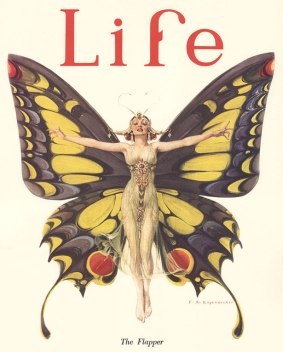
With that in mind, I’m going to write a few articles to bring a little rainbow into the deep, dark dungeon. Up first is a character class called the Butterfly, inspired by an old piece of fantasy art from a magazine that had very little to do with fantasy. I’ll then discuss the ways we can treat alignment and quests in this sort of fantasy to make it work, and I’ll follow up with a discussion of how existing classes and races might work in a rainbow fantasy campaign as well as introduce one more class.

You play She-Ra, I’ll play the Last Unicorn. Dracula will never know what hit him.

The Butterfly Class

Butterflies are a mystic calling of some people. Those with a lust for wandering in wide meadows of cool grass and chatting with hummingbirds, those who wish to escape the bonds of the earth and the boundaries of the mind. They can see the beauty of life and nature despite the ugliness and sorrow, and seek to spread that beauty far and wide. The butterfly is like a light in the darkness.

|Requirements & Restrictions|

Ability Scores: Dex 11, Cha 13

Alignment: Non-chaotic

Armor Permitted: None

Weapons Permitted: Club, dagger, sling, staff

|Butterfly Skills|

Butterflies add their level to the following task checks:

Communication: Butterflies can communicate with creatures that speak languages they do not understand. Much of this is through empathy and hand gestures (but not THAT hand gesture – it’s just so crude).

Fly: Butterflies can perform all manner of aerobatic stunts while flying with their natural wings or while mounted on flying mounts.

Handle Animals: Butterflies can calm frightened and hostile animals, and tame wild animals. They can teach tame animals simple tricks.

Move Silently: Butterflies can walk slowly and lightly without making a sound.

|Butterfly Abilities|

Butterflies can see auras. This includes magic auras generated by spells, magic items and the like, and alignments (Law, Chaos and Neutrality).

A butterfly can speak with all animals and is always considered a friend by non-predatory beasts. These animals will help a butterfly whenever she requests it, as long as it does not put them in direct danger and as long as she treats them with respect and kindness. A butterfly gets a +2 bonus to reaction checks with predators, and might be able to convince them to help her given the right inducements.

A 2nd level butterfly can shrink to tiny size, about 6 inches tall, and grow butterfly wings. She can do this once per day per two levels. At this size, the butterfly can fly at a speed of 60 feet per round. In this form, she can weave magic (see below). The butterfly can remain at this size for as long as she likes, and can return to normal at will.

A 3rd level butterfly can grow butterfly wings while at full size and use them to fly at a speed of 40 feet per round. She can do this once per day per three levels.

At 4th level, a butterfly can take the form of a cloud of butterflies. She can do this once per day per four levels. Treat this as the same as a magic-user taking gaseous form.

Whenever a butterfly is flying, she leaves behind a trail of glitterdust (per the spell) which falls on any creature beneath her flight path.

Butterfly Spell List

1st level – Audible glamer, calm emotions, charm person, color spray, dancing lights, detect secret doors, faerie fire, goodberry, hypnotism, light, reduce person, sleep

2nd level – Continual light, cure light wounds, darkvision, glitterdust, hold animal, invisibility, pyrotechnics, reduce animal, summon swarm (insects only), web

3rd level – Blink, cure moderate wounds, daylight, hold person, invisibility sphere, shrink item, sleep II, speak with plants

4th level – Charm monster, cure serious wounds, false forest, giant vermin, invisibility II, rainbow pattern

Butterfly Class Table

LVL XP HD ATK SV 1 2 3 4
1 0 1d4 +0 15 1
2 1,500 2d4 +0 14 2
3 3,000 3d4 +1 14 3 1
4 6,000 4d4 +1 13 3 2
5 12,000 5d4 +1 13 3 3 1
6 24,000 6d4 +2 12 3 3 2
7 48,000 7d4 +2 12 3 3 3 1
8 100,000 8d4 +3 12 4 3 3 2
9 200,000 9d4 +3 11 4 3 3 3
10 300,000 10d4 +3 11 4 4 3 3
11 400,000 +1 hp +4 10 4 4 3 3
12 500,000 +1 hp +4 10 4 4 4 3
13+ +100,000 +1 hp 5 4 4 3


Save

Save

Save

Save

Save

Save

Save

Save

Save

The Antiquarian

When I forget my phone at home, I usually spend lunch writing in a little notebook rather than reading. Today I had a few ideas for a class, which I present before in “thumbnail sketch” format, rather than fully realized.

This fellow will probably find his way into Esoterica Exhumed in a more fleshed-out form.

The Antiquarian …

– Rolls d4 for hit points

– Fights and saves like a magic-user

– Can read obscure languages

– Collects dusty tomes, books, scrolls – carries them on his back, so he’s hunched over – provides protection from back stabs

– Can call up the ghosts of the past to help him (knowledge, fighting, etc. – “Julius Caesar, I choose you”) – I figure this will work a little like an illusionist’s shadow conjuration spells

– Legend lore, as a bard (or more so)

– Use magic scrolls to cast spells; can always identify potions and scrolls

– Can recall ways to fight monsters (“Egad, I nearly forgot that ogres are allergic to dust mites”) – while fighting a monster, but only if the group doesn’t have what they need – they can use the method in future fights, though, and get a +1 to hit the monster

– Has bad eyesight from all the reading – easier to surprise

– Resistance to magic – 3% per level to divination, enchantment and illusion; 1% per level to necromancy, transmutation, etc.

Save

Magic from the Masters

When I was about 10 years old, Mattel introduced its He-Man toy line. I remember going over to a friend’s house to see the entire original line, which his grandparents had bought him for Hanukah. If I’m honest, they didn’t do much for me. I was a freak for G.I. Joe and military stuff at the time, and really had no interest in swords and sorcery. As a result, I never had an interest in He-Man. I mostly saw it as a cheap Filmation cartoon. It would still be two or three years before a chance meeting with Tolkien’s The Two Towers and Dungeons & Dragons would get me interested in the fantasy genre.

Fast forward to adulthood. What did not interest me as a G.I. Joe-loving kid now does interest me as a weird retro-loving adult. I can now appreciate just how bizarrely creative Mattel’s toy makers were with the MOTU line, and I can even appreciate the cartoon, though more by way of laughing at it (gently and with love) than of thrilling to the adventures of He-Man (who I just now discovered shared his voice with Morris the cat – even weirder).

Over the last couple weeks, I’ve been watching a He-Man cartoon at night before bed to unwind, and in addition to the entertainment value I’ve been inspired to write a few spells that will find their way into Esoterica Exhumed. Here’s a sample:

Battle Beast (Evocation)
Level: Druid 5, Magic-User 6
Range: 30′
Duration: 10 rounds

One animal targeted by this spell becomes a battle beast, doubling its size and Hit Dice, and increasing its damage rolls by +2 points for the duration of the spell. While under the effects of the spell, the animal is treated as a monster rather than animal, and its coloration changes to something weird and unearthly. The animal gains limited sentience and low intelligence in battle beast form.

Blinding Light I (Evocation/Illusion)
Level: Cleric 1, Druid 1, Magic-User 1
Range: 5′
Duration: 1d6+1 rounds

One creature immediate in front of you is dazzled by a sudden intense light that flashes from your eyes. The victim is blinded for 1 rounds, and then dazzled for 1d6 rounds. A dazzled creature suffers a -1 penalty to attack rolls and to all task checks involving sight.

Blinding Light II (Evocation/Illusion)
Level: Cleric 2, Druid 2, Magic-User 2
Range: 20′ cone
Duration: 1d6 rounds

This spell causes those caught in the area of effect who fail a saving throw to be dazzled, suffering a -1 penalty to attack rolls and all task checks involving sight.

Chasm (Conjuration)
Level: Druid 4, Magic-User 5
Range: 60 feet
Duration: 10 minutes

You can cause the ground to suddenly disappear, shifting it briefly into the elemental plane of earth. The resulting chasm has the following dimensions: Width is equal to 5 feet plus 2 feet per level; length is equal to 1 foot per level and depth is equal to 2 feet per level. After 10 minutes, the earth shifts back into position from the elemental plane, burying anything that was in the chasm or displacing gases and liquids (such as water or an obscuring mist spell) that might have been in the chasm to the surface.

Cosmic Comets (Conjuration)
Level: Magic-User 3
Range: Personal
Duration: 1 hour

You conjure three miniature comets which orbit you at a radius of up to 10′. While orbiting, they provide a +1 bonus to Armor Class. Melee attackers that miss their attack roll against you by only 1 point are struck by a comet for 1d6 damage + 1d6 fire damage. You can also send these comets streaking out at a single target, who can avoid it with a saving throw. Targets that are hit suffer 2d6 damage + 1d6 fire damage.

Homing Spell (Divination)
Level: Magic-User 1
Range: Touch
Duration: Permanent

Once a magic-user has placed this spell on a nonliving item, she can, with mild concentration and while rubbing the temples, discern its location relative to her in terms of direction and approximate distance. This homing beacon is permanent, but can be removed with dispel magic or suppressed while in possession of a creature with magic resistance (dice to determine).

Raise Pillar (Evocation)
Level: Druid 3, Magic-User 4
Range: 30 feet
Duration: 1 hour

With the lifting of your arms, a pillar of solid rock rises from the ground. The ground in question must be solid – i.e. there must be rock to form into a pillar. The pillar rises 5 feet plus 1 foot per level, and is roughly 4 feet in diameter. The pillar can be raised under a creature’s feet, in which case they must pass a saving throw to avoid being lifted. If they fail this saving throw, they are carried upwards and could potentially be crushed if the pillar’s height plus their own would force them to violently contact the ceiling of a chamber or cavern. If they are crushed, they suffer 3d6 points of damage. After one hour, the pillar slides back into the ground. This spell can conceivably be used to raise buried treasure to the surface, but the soil in which the treasure was buried forms into solid rock and therefore may make the treasure difficult to access.

Sleeve of Holding (Conjuration)
Level: Magic-User 3
Range: Personal
Duration: 8 hours

The magic-user can stuff 100 pounds per level worth of non-magical, non-living goods up his left sleeve. After 8 hours, the magic-user must dump the goods out of his sleeve or they disappear into dimensions unknown.

Scads of Magic

Imagination!

I’ve long been a fan of Seventh Sanctum, and tonight I decided to play around with the magic item generator. You get names for items that don’t always make sense, but often have in them something you can use … with a little imagination!

So, here’s a scad of magic items in thumbnail sketch form, plus a couple with names I loved that even I wasn’t sure how to flesh out with actual gamable abilities.

+1 Banded Mail of Heat Resistance: Stay comfortable in hot weather (summons cold air from elemental air plane), -1 damage per dice of fire damage

Amazon’s Pill: As heroism spell, females only

Barrel of Monkeys: Can summon 3d4 monkeys, once per week

Beggar’s Sandals: Feel no hunger or thirst if one eats/drinks once per week

Celestial Cube: When subjected to magic light, produces a prismatic/rainbow spell of the same or lower level

Coat of Sludge Repulsion: Cannot be engulfed by oozes

Coat of Slyness: Better pick pocketing, hides stolen goods

Earrings of Dancer’s Grace: +1 to AC, +1 to saves involving movement, gain ability to dance (fascinate as bard) once per day

Elemental Gauntlet: Gauntlet can on command turn into one of the following – an elemental earth gauntlet that smashes stone and +1 save vs. acid; a white hot gauntlet of metal that deals +1d6 fire damage and +1 save vs. fire; a gauntlet of ice that deals +1d6 cold damage and +1 save vs. cold; a sphere of swirling air that grants +2 AC vs. missile attacks and +1 save vs. electricity

Elixir of Blood Control: One can cause their own wounds or others to stop bleeding with a glance

Ethereal Brew: When poured out, it causes a whirlwind on the ethereal plane

Evil Drum: Bonus to hit for goblinoids

Flute of Ooze Alteration: Forces oozes to save vs. dancing; bards can cause them to move as they wish within sound

Fork of Time: When banged against metal, it forces all time displaced creatures within 100 ft. to shift into the present; against adamantine or mithral, it shifts the adventurers ahead 1 hour (do not move in space)

Hand Axe of Wind Shield: Can be swung around to create a wall of wind, when thrown, accompanied by a gust of wind

Hauberk of Revealing: Light reflected from this mail dispels illusions and reveals hidden and secret things

Haunted Tower Shield: Once per day can become a portal into the negative zone, releasing a single incorporeal spirit (HD no higher than users) to attack a foe

Helm of Ritual Fish Seduction: Hmmm … next!

Infernal Sitar: Playing causes people’s shoes to heat up (as heat metal)

Jar of Thought Absorption: One can hold a thought in the jar by putting against the ear and thinking; the thought cannot be accessed by mind reading – mage’s can do this with spells; can put thought back into head in same way – others can try, but may take Int damage

Massive Helm: A large, spherical helm – silly looking, but +3 to AC

Mechanism of Amazon Slaying: I have no idea, but what a great weird name

Pendant of Magma: Allows one to walk across magma and lava with no damage or sinking

Rainstick of Calming: Berserkers and barbarians cannot go nuts in its presence

Ring of Knocking: As knock spell, 3/day

Ruby Draft of Abjuration: Drink liquid to gain abjuration spell – water (1st), wine (2nd), other potion (3rd, and gain abilities of that potion); usable 1/day, spell remains in memory for 1 hour

Salve of Gold: Like fool’s gold spell, enough for ten tiny items

Sapphire Net: Becomes a large web of blue energy that can entrap air elementals and gaseous creatures

Sphere of Ursus: Metal sphere with a copper, silver and gold bear; copper bear summons a black bear, silver brown and gold polar; 1 bear per week, from a ray that fires from the sphere up to 30 feet away; destroying the orb summons a cave bear

Staff of Slime Absorption: Can absorb up to 6 HD of oozes or slimes (1 HD = 5 square feet); when broken or released, they all appear adjacent to staff; can also be ejected as a 30’ cone of acid (damage dice equal to HD absorbed)

Titan’s Wand: Can cast one third level magic-user spell per day, but requires two magic-users to swoosh it

Traveler’s Stick: +5 ft. per round to walking speed, walk twice as long without being fatigued

White Javelin: When it strikes undead, it absorbs their negative energy, up to 6 HD, turning the javelin black – the black javelin then absorbs levels/HD of living creatures until it negates the negative energy, so don’t touch it without a mithral gauntlet

Okay – one more, inspired by watching MST3K’s take on Cave Dwellers

Helm of the Black Swan: Once per day, a roll of “1” can be turned into a “20”, or a roll of “20” can be turned into a “1” within sight of the wearer.


Menace of the Mer-Mongrels

Here’s a quickie dungeon for you, featuring mer-mongrels (essentially aquatic orcs), just in case you need something dark, wet and dangerous for your game.

Overview

This is underground and near the sea. Sea water flows down the entrance corridor. Everything is slimy and the water is about 2 feet deep (so gnomes and halflings might need floaties) throughout.

There are clumps of phosphorescent sea weed here and there, giving a dim glow to the caverns – so dim as to be useless, but enough to create weird, wavering patterns on walls.

Mer-Mongrels

HD 1, AC 13, ATK Claws (1d4) or weapon (1d6) or barbed net (1d3 + entangled), MV 20′ (Swim 40′)

Room Descriptions

1. Corridor is broken here by a waterfall – water leaking in from the ceiling. Just on the other side of the waterfall there is an aquatic assassin vine attached to the ceiling. Just beneath the waterfall, to the extreme left of the corridor, is a pit that leads to the corridor just to the right of [1] on the map (the one that leads to area [14]). That corridor is completely submerged until area [14].

2. Two lacedons are chained to the walls here. The mer-mongrels have a winch in [11] that shortens the chains, but otherwise the lacedons can wander throughout the room.

3. Water swirls around the walls, ceiling and floor of this tunnel, creating a vortex of confusion. Save vs. confusion or become dizzy (-1 to hit, AC and save) for 1 hour.

4. Three mer-mongrel guards are in this room playing a gambling game that involves plunging half a coconut into the water and seeing which player gets splashed. Each has a shagreen pouch holding 1d10 gp. One mer-mongrel has a barbed net, the other two have tridents. All three have daggers.

5. A small natural chimney in this room leads to the surface. The air is fresher here.

6. This is a supply room, containing bits of flesh wrapped in seaweed and stuffed into cubby holes, floating bottles of wine, floating boxes of candles and an odd assortment of tridents and daggers (1d6 of each).

7. Two mer-mongrel acolytes dwell in this room. They have silvery bodies, and each can cast one 1st level anti-cleric spell (chosen by GM). They are armed with footman’s maces with heads shaped like octopi with opal eyes (worth 35 gp each). A curtain of barbed chains blocks the passage to [9].

8. The high priest of the mer-mongrels (3 HD) dwells here. He can cast two 1st level anti-cleric spells and one 2nd level anti-cleric spell, and wields a mace like his acolytes (but with pearl eyes, worth 150 gp). The room is also occupied by three white fish who roam around randomly, but who can be commanded by the high priest to swim in a circle, creating either a magic scrying pool or a magic whirlpool (per a water elemental). A sunken iron chest holds 250 sp, 50 gp, a gold bracer (65 gp) and a potion of healing in an old rum bottle.

9. Mongo, the living clam god (a giant clam) dwells in this chamber, the temple of the mer-mongrels. The clam rests in the alcove in the far portion of the cave, and a coral altar has been set before the clam. A young man in rough shape is chained to the altar as a sacrifice. The altar juts about 1 foot above the water, and there are many candle stumps and a few burning candles on the altar. Right before the altar there is a submerged pit (save vs. falling – no damage from fall, but 5% chance of drowning do to an accidental inhalation of water).

10/11/13. Each of these chambers is inhabited by 1d6 mer-mongrel males armed with daggers and blowpipes from which they shoot poisoned sea urchin darts (save vs. poison or slowed for 3 rounds). Each chamber has a small stone chest containing 1d4 x 50 sp and 1d6 x 100 cp. One of the mer-mongrels has a small topaz (30 gp) hidden under his loin cloth.

12. Several sea urchins are kept in this alcove. The water here is envenomed by their presence (save vs. poison or 1d6 damage).

14. This spawning chamber is home to five female mer-mongrels. They are armed as the males, but also carry two nets. There are three young in the room, and they will fight to the death to defend them (and send them fleeing into [16] at the first sight of trouble. A stone chest here holds 200 gp and three bottles of fine wine. The chest is trapped with a sea urchin spine (save vs. poison or 1d6 damage).

15. I forgot to put this number on the map!

16. This is the lair of Yort, the chief of the mer-mongrels. He is a erudite man (he trained in the humanities at a sea elf university) who returned to his tribe when his father was slain by adventurers. Yort carries a +1 trident that can make the water boil in a straight line up to 20 feet long (1d10 fire damage, save for half damage) three times per day. He also has a silver dagger and a chest containing 500 gp, 1,200 sp, a small sapphire (200 gp) and a bottle of giant octopus ink. Yort will offer to pay adventurers off if they leave he and his people alone, but if a child is harmed will pursue them to the ends of the earth to exact bloody revenge.


Dragon by Dragon – October 1981 (54)

Has it been that long since the last Dragon by Dragon? Time flies and time is tight, but there should always be time to travel down through that great gaming oak to the roots and ferment in the brew of our elders.

What the hell am I talking about? The bourbon is doing its job. Let’s get started on issue 54 of the venerable Dragon and see what inspiration we can pull from this issue. Yeah, this will be less review and more “what’s cool that we can use today”.

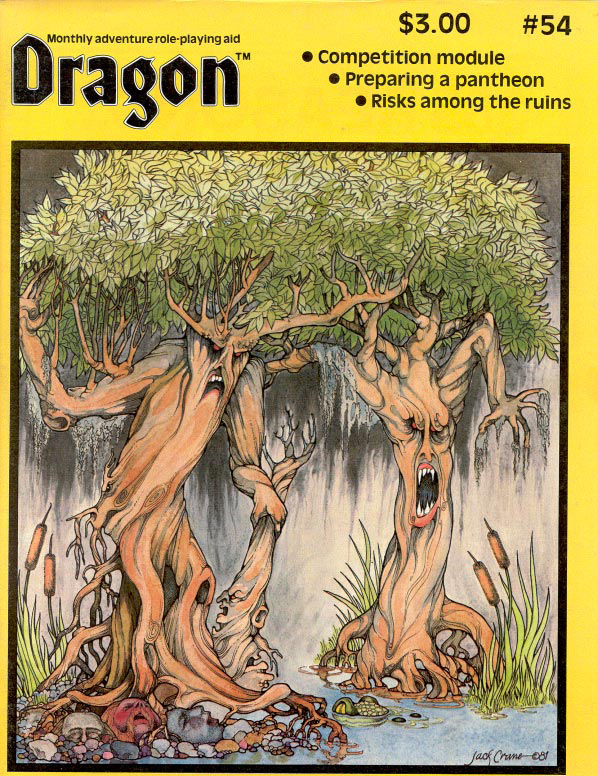
Cool Cover

How about those angry trees on the cover by Jack Crane. How about a high level druid illusion spell:

Maddening Wood
Level: Druid 7
Area of Effect: One 6-mile hex of woodland per druid level
Duration: One season

The druid enchants a woodland with terrible phantasms. When one approaches the woods proper, the trees loom over them and seem to animate, with grotesque faces and bony claws. Creatures with fewer than 3 HD must pass a saving throw vs. fear or be frightened away. Those who are not afraid initially may plunge into the woods, but things grow worse before they get better. With each step, a save is required for creatures one additional HD higher (i.e. one step in and creatures with 4 HD must save, the next requires creatures with 5 HD to save, and so on). If a creature becomes frightened, all creatures with fewer HD must save again. As one moves deeper into the woods, the wind whips up, the owls hoot, the foliage closes in and becomes more noisome … until one has gone 10 paces in, when the illusory magic ceases and the woods become normal once again.

Eternal Complaint Dept.

“My “lack of realism” argument is very well supported in all of the AD&D entries. By taking a close look you will find an incredibly large amount of monsters in a relatively small area, which, in most cases, has not the means to support even a few of the creatures presented.”

Ruins: Rotted and Risky – but Rewarding by Arn Ashleigh Parker (R.I.P.)

Here’s the first article I dug in this issue, covering ruins – the much neglected cousin to dungeons in D&D. The article contains ideas on designing ruined cities (and thus non-ruined cities), and I love the asumptions made in the article. These are fantasy cities from the mind of Mr. Parker, and they’re awesome. Here’s a few thoughts I enjoyed:

1. Give the players a map showing the perimeter of the ruins, with credit going to the party thief. This saves time, and doesn’t give too much away.

2. Go through the map and decide which buildings are monster lairs; don’t determine what the building actually is until the players investigate.

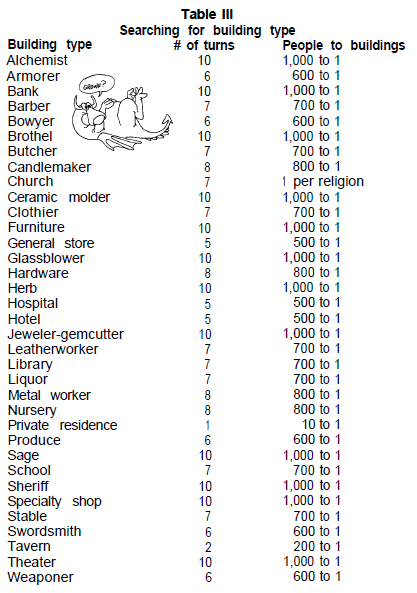
3. The table of buildings that might be in a ruin (and thus also useful for randomly determining building use in a city)

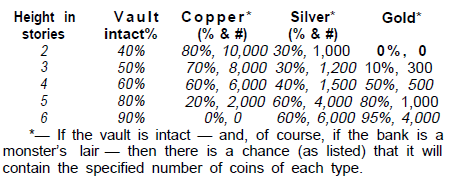
4. Random bank vault contents! (also useful in modern games, I would think)

5. “The chance for a given thief to open the lock on a bank vault is computed by multiplying the height of the vault (in stories) by 20, and subtracting that number from the thief’s normal percentage chance to open a lock. Thus, a 17th level dwarven thief with a dextereity of 17, who would have an adjusted open-locks chance of 119% for normal locks, has only a 49% chance of cracking a third-story vault, and no chance to open a vault on the sixth story, because the adjustment for the vault’s height (6×20=120) is greater than 119.”

This is what made AD&D great.

6. Private residences are 1d4 stories high. 10% are unusual and were owned by …

7. How long does it take to find a particular building:


The Righteous Robbers of Liang Shan P’o by Joseph Ravitts

Cool article with NPC stats for some bad boys of the Water Margin. They include Kung Sun Sheng (“Dragon in the Clouds”), Tai Chung (“The Magic Messenger”), Chang Shun (“White Stripe in the Waves”), Li K’uei (“The Black Whirlwind”) and Shih Hsiu (“The One Who Heeds Not His Life”).

This is followed up by a Giants in the Earth covering E. R. Eddison‘s Four Lords of Demonland.

I Want One of These

Would also be a great game – Wizard Dragon Dwarf Assassin

Beware the Jabberwock by Mark Nuiver

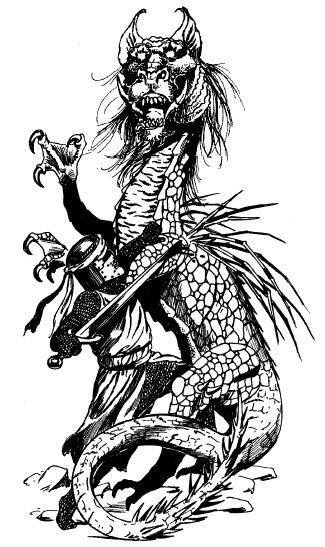
This one presents stats for the Jabberwock, along with a stunning piece of art. The B&T stats are:

Jabberwock

Type: Monster
Size: Huge
Hit Dice: 10 to 12
Armor Class:
Attack: 2 claws (4d4), bite (3d12 + swallow) and tail (2d12)
Movement: 20 ft.
Save: 12
Intelligence: Average
Alignment: Chaotic (NE) or Neutral (N)
No. Appearing: 1
XP/CL:

SQ-Surprised (1 in 6), darkvision 90 feet, detect vorpal blade (1 mile range)

Notes: Jabberwocks mature as do dragons. They have a fearsome gaze (creatures less than 4+1 HD; frightens; frightened creatures must pass a second save or be paralyzed with fear for 2d4 rounds). Tail attacks anyone behind the creature, with a -2 penalty to attack.

Cavern Quest by Bill Fawcett

Worth mentioning this module for AD&D, which is also a sort of quiz with a system for scoring. It’s strange, but probably worth checking out, especially if you want to prove you’re better at AD&D than a friend … or foe! Each room gives you a number of options, usually preparations and actions. Based on your choices, you score points and prove your superiority over other dungeoneers. Cavern Quest could be a fun thing to run on G+ using the polling function, but it is probably too long to make it work.

Cash and Carry for Cowboys by Glenn Rahman

If you need some price lists for an Old West game, this is worth checking out. I wish I’d seen it before writing GRIT & VIGOR.

Bottle of Undead by Bruce Sears

A magic item in the Bazaar of the Bizarre. It is basically an efreet bottle that spews [01-20] a ghost, [21-35] banshee, [36-55] 1d3 spectres, [56-70] 1d2 vampires or [71-00] 1d6 wraiths.

This Makes Me Happy …

As always, I leave you with Tramp …

New Spells and a Way to Use Them

New magic-user spells – fun to create, but hard to get into a game. After all, a magic-user only has so many spells he can cram into a spellbook, and when it comes time to choose, the average magic-user is going to go for the most useful, and thus usually the most standard, spells in the game. Detect evil might be boring, but it sure is useful.

Since I was inventing a bunch of new spells yesterday, I also went to the trouble of inventing a way magic-users can actually use them. It’s a highly complex set of rules …

FIRST, A MESSAGE FROM OUR SPONSOR

NOD magazine begins its fabulous eighth year with a full hex crawl covering the crumbling empire of Nomo, a Romanesque city that has lost its emperor. As the empire slowly falls, opportunity for adventures abound. The hex crawl includes three mini-dungeons and hundreds of places to visit.

Other features include:

Two old school classes, the Centurion and Dervish, as well as ideas for anti-classes designed to foil fighters, magic-users and thieves.

Rules for playing poker in GRIT & VIGOR, as well as a gambler sub-class

A host of new “eye monsters” for Blood & Treasure and other OSR games

Plus some ideas on votive orders and on introducing the most horrific concept into fantasy gaming ever conceived … Taxes!

AND NOW, BACK TO OUR STORIES

… that are actually not complex at all, and very simple. I call it Quasi-Spell Research

With an hour’s meditation, a magic-user can prepare any magic-user spell permitted by the Referee. The magic-user must have an open “spell slot” for the spell to do this. Once a spell has been prepared in this way, it can never be prepared with quasi-spell research again. It can, at some point, be learned and added to the magic-user’s spell book in the normal way, but not using this method. The magic-user also cannot use quasi-spell research to acquire a spell for making a magic item – she cannot use it to scribe a scroll, brew a potion, etc.

Since we have a rules lite way of accessing all sorts of new spells, how about a few new spells?

Black Sun (Necromancy)
Level: Anti-Cleric 3, Magic-User 3
Area of Effect: 120′ radius
Duration: 1 minute per level

Sunlight in the area of effect becomes gray and wan. It does not harm creatures normally harmed by sunlight, such as vampires.

Fantastic Transformation (Transmutation)
Level: Magic-User 9
Range: Touch
Duration: 10 minutes

This spell requires three subjects plus the caster. All four participants must be holding hands. Upon casting the spell, a bolt of cosmic energy erupts from the spell caster’s hands and travels through the subjects. When it ceases, all four participants in the spell are transformed. The subject with the highest strength score gains the benefit of the stoneskin spell. The subject with the highest dexterity score gains the benefit of the fire shield spell. The subject with the highest wisdom gains the benefits of the improved invisibility spell. The subject with the highest intelligence score takes in the properties of an ooze. If one subject qualifies for more than one of these transformations, they choose which one they want, and the runner-up then takes on one of the other transformations. All transformations last for 10 minutes and then cease.

Freak Out (Illusion)
Level: Magic-User 5
Range: 30′
Duration: See text

You may target all creatures within 30 feet of you with waves of psychedelic weirdness. Creature with 0 to 4 HD are confused for 1 minute. Creatures with 5 to 9 HD begin dancing around like crazy beatniks for 4 rounds and are fatigued for 10 minutes. Creatures with 10 or more HD are stunned for 1 round while they ponder the cosmos, man (and engines that run on water, man – water!), and then fatigued for 10 minutes from the heavy thinking.

Light Fantastic (Evocation)
Level: Magic-User 3
Range: See text
Duration: 1 hour

A beam of light departs the magic-user’s fingertip and proceeds in a direction chosen, bouncing off of solid objects as it goes generally in the direction determined by the caster. The light beam extends for a maximum of 90′ and lasts for one hour, suspended in the area cast. Any creature stepping through this beam of light must pass a saving throw or fall prone on the floor, having tripped (over) the light fantastic.

Melt (Transmutation)
Level: Magic-User 8
Range: 90′
Duration: 10 minutes

For ten minutes, the landscape and all inanimate objects around you seem to melt and bend. They become porous and strange. Walls can be walked through with a d20 roll under a character’s Wisdom score, and creatures can walk on walls and ceilings as though they were the floor. Weapons deal only 1 point of damage (plus strength modifier), and rigid objects become flexible. Everything in the landscape changes color into a brilliant, psychedelic pallet, including living creatures. After the spell ends, all sentient creatures must pass a saving throw or be sickened for 1d6 rounds. Creatures who are sickened must also pass a save or suffer 1d6 points of Wisdom damage.

Mystic Fire of Phango (Evocation)
Level: Magic-User 4
Range: 30′
Duration: Instantaneous

The mystic fire reaches out from the spell caster’s fingertips, like hands of liquid white flame, to caress the skull of the target. The spell attempts to erase from the mind of the target their three highest level spells that are also of a level the spell caster can cast. Thus, a 7th level magic-user could erase spells no higher than 4th from a target’s mind.

If the target’s highest vulnerable spells number more than three, then each spell is nominated by the target in turn and the spell caster decides if they wish to target that spell.

For each of the three to be erased, the target can choose to release the spell from their mind, or suffer 1d6 + spell level points of damage to their synapses and retain the spell. Thus, retaining an 8th level spell would inflict 1d6+8 points of damage to the target.

Recharge (Evocation)
Level: Magic-User 3
Range: Touch
Duration: Instantaneous

The magician uses their own body as a battery to recharge a wand or staff. For every point of Constitution damage or every 1d6 points of hit point damage they are willing to accept, they add 1 charge to a wand or staff.

Silky Smooth (Necromancy)
Level: Magic-User 1
Range: Touch
Duration: See below

At the magician’s touch, the victim loses all of their hair or fur, being left with silky smooth skin. Creatures without hair are unaffected.

Sinister Suspicion (Illusion)
Level: Magic-User 2
Range: 120′
Duration: 24 hours

The target of this spell scans as evil (Chaotic) to detect evil spells for 24 hours.

Sun Shower (Evocation)
Level: Cleric 3
Range: 240′
Duration: 1 round

Particles of light shower down on an area 40′ x 40′ x 40′. Creatures harmed by sunlight suffer 3d10 points of damage (no saving throw) in the affected area.

Supercharge (Evocation)
Level: Magic-User 4
Range: Touch
Duration: Instantaneous

The magician supercharges a wand. On its next use (and only its next use), the wand can expend two charges to cast its spell at either double the range, double the duration or increased damage. Damage is increased by +1 point of damage per dice of damage it normally inflicts. Thus, a three dice lightning bolt would do 3d6+3 points of damage if cast from a supercharged wand.

Transmute Skin to Tongue (Necromancy)
Level: Magic-User 7
Range: 30′
Duration: 1 hour

This bizarre curse changes a creature’s skin to the texture and color of a tongue. Their skin now tastes whatever it touches, a highly disconcerting sensation that requires a saving throw each turn to avoid becoming sickened (for sentient creatures) or frightened (for non-sentient creatures). Creatures without a skin (oozes, energy creatures) are unaffected. The affected creature’s appearance is likewise disconcerting to others, who must pass a save to avoid reacting with revulsion.

Transmute Sound to Light (Illusion)
Level: Magic-User 4
Area of Effect: 30′ radius
Duration: 1 minute

This spell converts all sound in the area of effect into light. The form of the light depends on the sound; singing, for example, might produce a lovely light show, while arguing would cast a harsh reddish light on the area.

Battles, in particular, create a vivid, violent strobe effect, with each clash of arms producing a flash of light. The effect is disorienting, and each creature in the area must pass a saving throw to avoid becoming dizzy (-1 to AC, -1 to hit, each miss in combat by 4 or more points resulting in the attacker falling prone). The dizziness ends when one leaves the area, for outside the area one hears the sounds and does not see the lights.

The Coming of the Triphibians

The triphibians have their origin in a delightful Japanese film with numerous titles, the most common in the U.S. of A. being The Monster from a Prehistoric Planet. Another title (Gappa: The Triphibian Monster) refers to the monsters in question being triphibians. I really dig that word, so I decided to make them into more useful monsters for the average fantasy/sci-fi game – i.e. I resized them as humanoids rather than uber-massive kaiju. Here then, are the triphibians, compatible with Blood & Treasure and other OSR games.

Triphibian

Type: Humanoid
Size: Medium
Hit Dice: 2
Armor Class: 15
Attack: Slam (1d4) or by weapon
Movement: 30′ (Fly 90′, Swim 30′)
Save: 16; +3 vs. poison
Intelligence: Average
Alignment: Neutral (N)
No. Appearing: 1d6*
XP/CL: 200/3

SD—Immunity (electricity), resistance (fire)

Triphibians look like beaked humanoids with scaly skin and large wings which they can fold onto their backs, nearly hiding them. They are emotional creatures, and their scales change colors to match their emotions. They are not desirous of contact with other species, and do their best to maintain a wide buffer between their lands and those of other creatures. In their own territory, they are highly aggressive towards intruders, especially when they are protecting their eggs and their young. In battle, they fight with swords, spears, bows and javelins, and sometimes use shields.

Triphibians can fly and they can breath underwater, making them a triple threat. Nations that have gone to war with them find their skies blackened by their warriors dropping heavy stones or bombs, and their boats falling prey to their attacks from underwater. Triphibians do not believe in fair fights, and use their abilities to the fullest to get an advantage.

Triphibians dwell in tribes of 1d6 x 60 warriors and twice as many noncombatants. They usually make their home underwater near thermal vents or in secluded mountain strongholds near lakes. It is not unusual for 1d6 tribes to live within a mile of one another, forming a confederation.

Triphibian tribes are commanded by a 6 HD king or queen who can breath a 10′ cone of electricity (2d6 damage) three times per day. These kings and queens undergo a secret ritual that increases their size to Large and their intelligence to High. The king or queen is attended by a bodyguard of 3d6 warriors with 2+1 Hit Dice. There is a 36% chance that a tribe has a spell caster, usually an adept (roll 1d4 for level). This philosopher, as the triphibians call them, is a spiritual teacher to the people, attends the king or queen on matters of state, conducts public rituals (including coronations) and joins the tribe in battle.

NOTE: These monsters would work very well in a PARS FORTUNA campaign, substituting for the larger humanoids like gnolls and bugbears that appear in traditional fantasy. By adding ray guns and such to their weaponry and putting them in serene bubble architecture above or below the sea, they would also work in a sci-fi setting such as Space Princess.

Bloody Basic (Revised) Stats

Size: Medium
Type: Humanoid
Hit Dice: 2
Armor Class: 16
Movement: 30′ (Fly, Swim)
Attacks: Slam or Weapon
Saving Throw: 16
Alignment: Neutral
CL/XP: 3/300

Spider Mage

I’ve been needing to get back into the nitty gritty of daily blog updates for a while – it’s just hard with all the writing and layout and editing and such that I’ve involved myself in. So, here’s another shot at it, based on tiny inspiration and a bit of “hmm – I guess nobody has done that before”.

The Spider Mage

Not every apprentice magic-user has it in them to be great wizard (see the Laser Mage, for example). This drives some into weird cults, such as that of the Arachno, the Spider God. Whispered about by the apprentices in the corners at wizard gatherings, Arachno is a secretive god who grants great powers upon those mages willing to enter his service. His living idols are said to lurk under most great cities, in some otherwise abandoned cellar or sewer tunnel or whatnot.

An apprentice willing to enter Arachno’s service must first find one of his living idols (a giant spider) and then parlay with it, offering gifts and oaths and the like. If the giant spider finds the apprentice acceptable, he sheds a spiky hair, which the little magi must use to tattoo Arachno’s symbol onto his forearm. This allows the apprentice to enter the spider mage class. Most spider mages will go on to make their tattoo really boss, and they will add others to their body as they advance.

Requirements and Restrictions

As the normal magic-user class

Spider Mage Skills

Climb Walls—As the thief skill of the same name.

Lore—As the magic-user skill of the same name.

Poison Use—As the assassin skill of the same name.

Spider Mage Abilities

Spider mages cast magic-user spells using the same rules as magic-users. To learn advanced spells, spider mages have a percentage chance equal to their intelligence score minus the spell level.

Spider mages enjoy a +2 reaction bonus with spiders and spider-like creatures, and a +2 bonus to save vs. their poison.

Starting at 2nd level, and at every even level thereafter, a spider mage grows an additional arm. This arm is a normal human arm in every respect, and it bears the same tattoo on its forearm that the spider mage gave himself when he became a spider mage.

For every two additional arms a spider mage grows, he can cast one additional spell per round.

Spider mages learn how to prepare their spells with modifications. Attack spells come in the form of touches, rays, lines (like lightning bolt), cones and blasts (like fireball). Spider mages can prepare an attack spell of one type as an attack spell of another. This sometimes changes the level of the spell.

Lines and rays retain their same range. Cones have a length equal to half the length of a ray or line version of the spell; likewise, ray or line versions of a cone spell have a range equal to twice the length of the cone. Blast spells have a range as line and ray spells equal to their blast radius, and a length as cone spells equal to half this.

Turning lines into cones and vice versa does not change a spell’s level. Turning a cone or line into a ray lowers the spell level by one. Turning anything into a blast increases the spell level by 1. Turning a blast into a line, ray or cone lowers the spell level by 1, and into a ray by 2.

At every even level, a spider mage must bring a sacrifice with levels or hid dice equal to the level he wishes to attain to feed his spider patron. This gruesome feast increases the giant spider’s hit dice by +2 and gives it magic use . This magic use starts at first level magic-user spells, and advances by one spell level with each subsequent feast.

Spider Cult
To advance to 12th level, a spider mage must kill his spider patron and bathe in its ichor. When he does this, he starts a spider cult to Arachno, gaining 3d6 adherents (normal humans), 2d6 guardsmen (men-at-arms), 1d6 acolytes (1st level anti-clerics) and a consort (male or female) who is a 3rd level spider mage, as well as a giant spider (large size, 4 HD) to serve as his mount and as the cult’s living idol.

Spider Mage Advancement