More Blood and Treasure Monster Previews – With Art!!!

I thought I’d show a few more of the monster stats from B&T. The project is dangerously close to being finished! It’s also a chance to show off some of the art I’ve commissioned for the project from Jon Kaufman. Check it out, ladies and gents.

BAT MONSTER
Large Monstrous Humanoid, Chaotic (CE), Low Intelligence; Solitary

HD: 8
AC: 13
ATK: 2 claws (1d6), bite (2d8)
MV: 10 (Fly 50)
SV: F 10, R 9, W 10
XP: 800 (CL 9)

These creatures look like large, furry humanoids with bat wings that end in clawed hands and bat heads. They are twice the size of a man, with a 12 to 15 foot wingspan. Fearful peasants might even mistake them for small dragons when they fly by night. They can attack without penalty even when they have been blinded.

Special Qualities: Echolocation, vulnerable to sonic damage

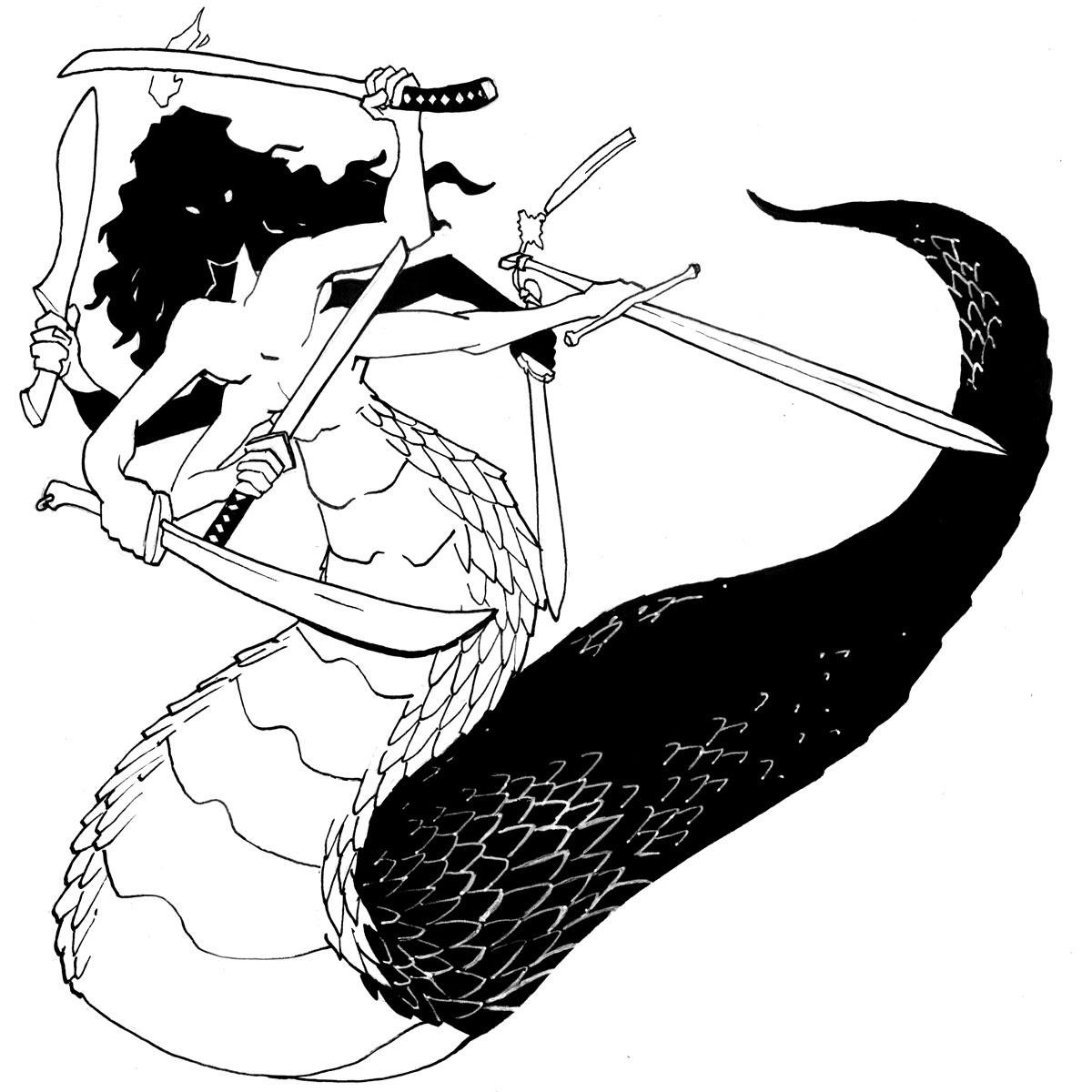
DEMON – MARILITH (CLASS V)
Large Outsider, Chaotic (CE), High Intelligence; Solitary or Pair

HD: 8
AC: 24 [+2]
ATK: 6 swords (2d10), tail (4d6 + constrict)
MV: 40
SV: F 8, R 9, W 8
XP: 2,000 (CL 10)

Mariliths are six armed female demons with the lower body of a snake. In each hand they wield a longsword and they adorn themselves with jewelry. A marilith is 9 feet tall and measures 20 feet from head to tail. They weigh 2 tons.

Though mariliths thrive on the grand strategy of war, they love physical combat and never pass up an opportunity to fight. Each of a marilith’s six arms can wield a weapon. There is a 5% chance per arm that it wields a random magic sword). Mariliths seldom rush headlong into battle, preferring to hang back and size up the situation first. They always seek to gain the best possible advantage from the terrain, obstacles and any weakness in their opponents.
A marilith can attempt to summon another of its kind once per day, with a 20% chance of success.

Special Qualities: Immune to electricity and poison, magic resistance 40%

Spells: At will—blade barrier, detect invisibility, magic weapon, project image, telekinesis, teleport without error (self plus 50 lb), unholy aura

LOCATHAH (FISH MEN)
Medium Humanoid, Neutral (N), Average Intelligence; Patrol (1d20)

HD 2
AC 14
ATK Spear (1d6) or light crossbow (80 ft., 1d8)
MV 10 (Swim 60)
SV F 12, R 15, W 15
XP 100 (CL 2)

Locathah are humanoid in shape, but have the scaled skin of fish and the heads of fish. The average locathah stands 5 feet tall and weighs 175 pounds. Females and males look very much alike, although the former can be recognized by the two ochre stripes marking their egg sacs. Locathahs speak their own language. Locathahs lack teeth, claws, and other natural weapons, so they are not especially dangerous if unarmed.

Locathah gather in tribes of 1d10 x 10 warriors and non-warriors equal to 100% of the warriors. They are ruled by chiefs and sub-chiefs, and typically live a hunter-gatherer existence with supplementary kelp gardening and fish herding. For every ten warrior in a tribe, there is a 3% chance that the tribe has an adept to provide spellcasting.

Locathah units in mass combat are as likely to be defending their tribal lands as they are to be mercenary units. Locathah squadrons are led by sub-chiefs with 3 HD. Locathah tribes are led by chiefs with 1d4+6 HD. If you wish, roll d% to randomly determine the type of locathah units present. Chiefs are always accompanied by a squadron of armored crab-warriors.

D% UNIT
01-10 Squid-Warriors: Dagger (1d4), net (entangle)
11-75 Shark-Warriors: Spear (1d6), light crossbow (1d8), 20 bolts
76-00 Crab-Warriors: Trident (1d8), shellycoat* and shield (+3 AC)

* Shellycoat armor is manufactured by several undersea folks, and consists of a hundreds of shells woven onto a backing of shagreen in the manner of scale mail. Shellycoat increases AC by 1 point.

Dragon by Dragon – June 1977 (7)

Happy birthday The Dragon! June 1977 marked the beginning of the second year of the magazine’s publication. Kask starts off by bragging on the improvement in the art and the 300% growth in circulation in a year (which could mean they went from selling 1 copy a month to selling 3 … but I think they were doing better than that). Kask goes on to say that, despite the increase in readership and the magazine now being published 8 times a year (they had NOD beat – 6 is almost more than I can manage), he remains the only staff member. He gives thanks to the help provided by Gary Jaquet, but explains that he can only do so much because he lives 4 HOURS away. Boy, have things changed for the better. The editor for Blood & Treasure lives across the continent from me, and he might as well be in the next room.

The other big announcement from Kask …  PUBLICATION BY THE DRAGON DOES NOT BESTOW ANY SANCTION OR APPROVAL TO ANY VARIANTS, VARIATIONS OR RULES INTERPRETATION.

Anyhow … what has the birthday boy in store for us today?

First up, we see an advert for the Third Annual SC Awards for Creativity in Wargaming. Some of the things that didn’t make the ballot include Bunnies and Burrows (for best game) and Jim Dunnigan (for design of Russian Civil War … you might want to check out his Strategy Page site for information on everything going on in the world of conflict). Lankhmar and Metamorphosis Alpha were up for Outstanding Game of 1976, Gygax’s Swords & Spells was up for Outstanding Miniatures Rules of 1976 and Grenadier’s wonderfully named Wizzards & Warriors was up for Outstanding Miniatures Series of 1976. They also list a Fantasy Gaming Hall of Fame, which includes Lord Dunsanay, C.S. Lewis, A. Merritt, Fletcher Pratt, Clark Ashton Smith, Poul Anderson, M.A.R. Barker, Lin Carter, L. Sprague DeCamp, Gardner Fox, Katherine Kurtz, Fritz Leiber, Michael Moorcock, Andre Norton, Jack Vance and Roger Zelazny – and I just cannot argue with such a list. Spot on for 1977.

Omar Kwalish (didn’t he invent some sort of apparatus?) presents tips on what to do when “… Calamity Befalls You Twenty Minutes Before the Game Club Gets To your Place”. In essence, the article shows how you can generate percentages with two standard D6, and other ways of dealing with being without dice – chits in a jar, random numbers generated on high-tech calculators (such as the TI-SR51-A), cutting cards (roll 1d4 with the suits, etc.), using a watch with a second hand, spinners, coin flips (an obscure study financed by government grant proved that the dime was the ideal coin to flip), phonebook and blindfold, etc.

Gary Gygax uses the Designer’s Forum to tell of the origins of the game, in which he writes, “Although D&D was not Dave’s game system by any form or measure, he was given co-billing as author for his valuable idea kernels.” Let the lawsuits begin.

Lynn Harpold describes Mystery Hill, America’s Stonehenge. A very ’70s article, if you remember that time period, and things like In Search Of.

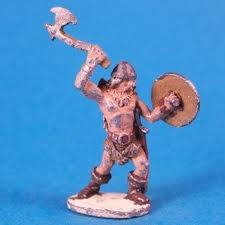
One of Ral Partha’s new releases is “Foregum” Super Hero (Bare-Chested) – no picture, but he is now my favorite miniature of all time. Luckily, I found an image …

And a copy of Ral Partha’s 1981 Catalog. CHECK IT.

Great illustration by Morno on page 11, to go with his story The Journey Most Alone. Again – new rule of Dragon by Dragon is to post a random paragraph from the story, so …

“There he paused in wonder.”

Okay, that was a bit cheap, how about the next paragraph as well …

“Before him he saw the vistas of a wide universe from the height of a splendid cliff. Awaiting him was a massive throne of silver and of tortoiseshell, metalwork twining like vinery around the dark surfaces of the seat. Leaf and stem of silver entwined in ecstatic embrace, and here, upon the highlights, and there, among the shadows, gleamed jet and onyx, lapis and obsidian, nested like gleaming grapes in beds of many other stones. From this pinnacle Visaque beheld the five extremities of his cosmos and the many marvels therein; beheld amber castles and perilous beasts, paradise and power to his world’s edge. At the foot of the throne knelt spirits of the four elements and one awaiting his ascension. Tiny heralds on elven birds trumpeted a fanfare at his coming.”

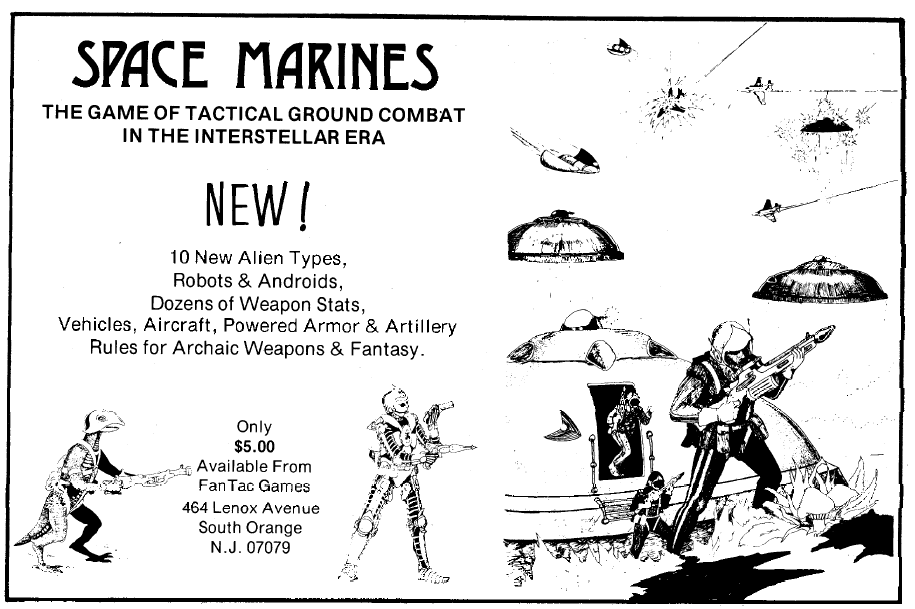
In the middle of the story there is an ad by FanTac Games in South Orange, NJ for a new game called “Space Marines”. Looks like they beat the Brits to the punch.

I wonder what 464 Lenox Avenue looks like now …

M.A.R. Barker has a new article on Military Formations of the Nations of the Universe, recounting military formations of … well, you get the idea. The universe, in this case, is confined to Tekumel.

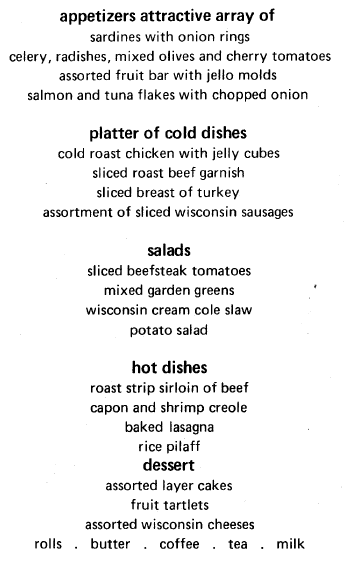
I cannot go further without printing the following menu in an ad for the Third Annual Strategists Club Awards Banquet at Playboy Resort …

Honestly, they had me at sardines and onion rings.

The Featured Creature this month is the Prowler. Its B&T stats would be:

Prowler: HD 14; AC 18; Atk Bite (1d8) and constriction (4d12 per turn); MV 30; SV 10; CL/XP 15/1400; SP – Gaze (save vs. magic or mind blanked and become a zombei [sic] under the prowler’s control; can only be restored by having 3 patriarchs cast dispel magic at the same time), inject eggs (with brown tentacles around mouth, injects into zombeis, eggs hatch in 2d4 days and eat the zombei).

Tough monster, and a nice bit of art to go with it.

Fineous Fingers tries to rob a guy from TSR and ends up skewered, while the kid he was training gets a 1,000 gp reward for tipping off his target.

In the Editor’s Library, Metagaming Concepts (makers of Stellar Quest, the first “good, playable space game”) announce their new micro-game … OGRE! I doubt it went anywhere.

Mcewan Miniatures has a sweet little ad for their new figures …

I’d like to think all of those fellows would fit in nicely in a Space Princess game somewhere. Maybe the Terrellians are a species that has built their culture around the worship of this guy …

But that’s just me. (And yeah, that would probably make them Chaotic).

Mystery author Garrison Ernst (just can’t figure out who this guy could be) presents another installment of the Gnome Cache.

“A column of dark smoke announced that they were approaching the castlewick of Blackmoor. It was the morning of an otherwise bright day not long since the slaughter took place on the narrow road to Weal. The two had traveled fast. Several times they had quickly left the lance for the safety of the surrounding wood as a band of Nehronland foot or a rare body of horse passed northwards laden with plunder and marching with much jesting and laughter. Each time Mellerd would salute their passing with various rude gestures, for he daily came to hate all Nehronlanders more passionately as he missed the Kimbri Vardobothet whose death came at their hands. There was now a particularly thorny problem facing them. They could not, of course, proceed directly through the place ahead, for it was obviously swarming with enemy soldiers. To the east was a jumble of broken terrain stretching away for endless leagues towards the sea. Worse, it was the home of many of the various bands of Nehron, so passage through that place would be nearly as dangerous as going straight along the road through Blackmoor. But to the west was a trackless forest which led to the slopes of the Senescent Hills, most inhospitable and the dwelling place of creatures who did not welcome men intruding upon their domain. The trick would be to swing wide enough to bypass the fortress unseen by any of the numerous warriors thereabouts, and then come back onto a route south again. If they went east they would eventually make the road to Rheyton as they circled back. In the other direction they would strike the passage to the free city of Humpbridge which bent from southwest to south across the base of the Senescent range. Dunstan was faced with making a decision from what he remembered of maps and his experiences on the trek which brought them to these straits originally.”

The emphasis is mine. Humpbridge!

And so ends the seventh issue of The Dragon. If I’m honest, the ads were the best part of this issue – pretty weak on game content, and Barker’s article on military formations seemed endless. What I have learned, though, in reading these is that I need to start using multiple pseudonyms when writing NOD. Fake names, anagrams and bad puns are as much a part of the D&D experience as Armor Class and hit points, and I’ve been missing out!

Three New Undead … Just Because

These critters popped into my head a few days ago, so I decided to give them some stats. Enjoy …

Necromantic Masterpieces

Necromancers are often frustrated artists, and their desire to outdo their brethren is fierce. While the pedestrian necromancer is content with creating zombies, skeletons, ghouls and the like, the true artist labors on a unique creation and creates a manual to hide away for others to one day find.

DAME SANS MERCI
Medium Undead, Chaotic (NE), Average Intelligence; Solitary (1)

Hit Dice: 5
Armor Class: 15 [4]
Attacks: 2 flailing fists (1d6) or gaze (see below)
Move: 30
Saves: Fort 13, Ref 13, Will 11
XP: 500 (CL 6)

A dame sans merci appears as a feminine skeleton wrapped in tight, black leather (sometimes studded with spikes) that has been padded (to create the curvaceous feminine shape) with a rare form of fungus cultivated by some death cults and wicked alchemists. The skeleton has onyx eyes.

The dame sans merci can focus its withering gaze on any one target within 30 feet. They target must pass a Will saving throw (save vs. magic) or be affected per the spell ray of enfeeblement. Once per day, it can breath a cone (15-ft long and 10-ft wide) of necromantic spores that play on a person’s mind. Roll 1d4 and consult the table below:

1 = Fear
2 = Rage
3 = Confusion
4 = Despair

All within the cone must pass a Fortitude saving throw (or save vs. poison) or be affected by a random mind effect for 2d4 rounds.

AMPUTATOR
Large Undead, Chaotic (CE), Low Intelligence; Gang (1d4)

Hit Dice: 8
Armor Class: 14 [5]
Attacks: 2 pincer (2d4)
Move: 30
Saves: Fort 10, Ref 11, Will 10
XP: 800 (CL 9)

Amputators are made by removing the hands from a dead gorilla and replacing them with large, metal pincers. Most of these gorilla corpses are shaved by the necromancer and covered with tattoos of magical glyphs – needless to say, amputators are rather horrifying.

When an amputator’s pincer attack is a natural ’20’, the target suffers double damage and must pass a Fortitude saving throw (save vs. petrification) or have an arm twisted off. If the target is wearing armor, the armor first makes an item saving throw. If successful, the target’s arm remains attached to their body. If the item saving throw fails, the armor is torn off the arm and the arm is now in danger of being torn off.

FULL-THROATED SCREAMER
Small Undead, Chaotic (CE), Average Intelligence; Solitary (1)

Hit Dice: 6
Armor Class: 16 [3]
Attacks: Slam (1d4 + 1d4 cold) or scream (see below)
Move: Fly 30
Saves: Fort 13, Ref 12, Will 10
XP: 600 (CL 7)

Possibly the oddest of created undead, the full-throated screamer appears as three preserved heads encased in crystal spheres. The heads must have belonged to a fishwife, politician and braggart in life. They float within 5 feet of one another, and can slam into people or, once per day each, issue a terrible scream that affects all within 30 feet. Those within range of the scream must pass a Will saving throw (save vs. magic) or their lowest mental ability score (intelligence, wisdom or charisma) suffers 1d4 points of damage. If this score is reduced to half normal, the victim becomes either a mindless berserker (wisdom; per rage), babbling fool (intelligence; per feeblemind) or mad dancer (charisma; per irresistible dance).

Mass Combat in Blood and Treasure


I want to start this off by wishing folks a happy Memorial Day, especially those who are serving in the armed forces, have served, or lose a loved one who served. Though my family doesn’t have a massive history of military service, I can point to my father Rick, who served in the USAF and spent some time overseas in Thailand, my grandfather John (“Pa”) who was a doctor in the US Army and helped take care of folks after the bombing of Hiroshima, and several uncles.

And since I’m thinking of the military and mass combat (and need an easy blog post for the day), why not take a look at the mass combat system for Blood & Treasure. The system is easy to run and essentially works off the games normal combat rules, so don’t expect anything earth shattering. The idea behind Blood & Treasure isn’t to break new ground in gaming, but provide a platform in between the different editions. Anyhow …

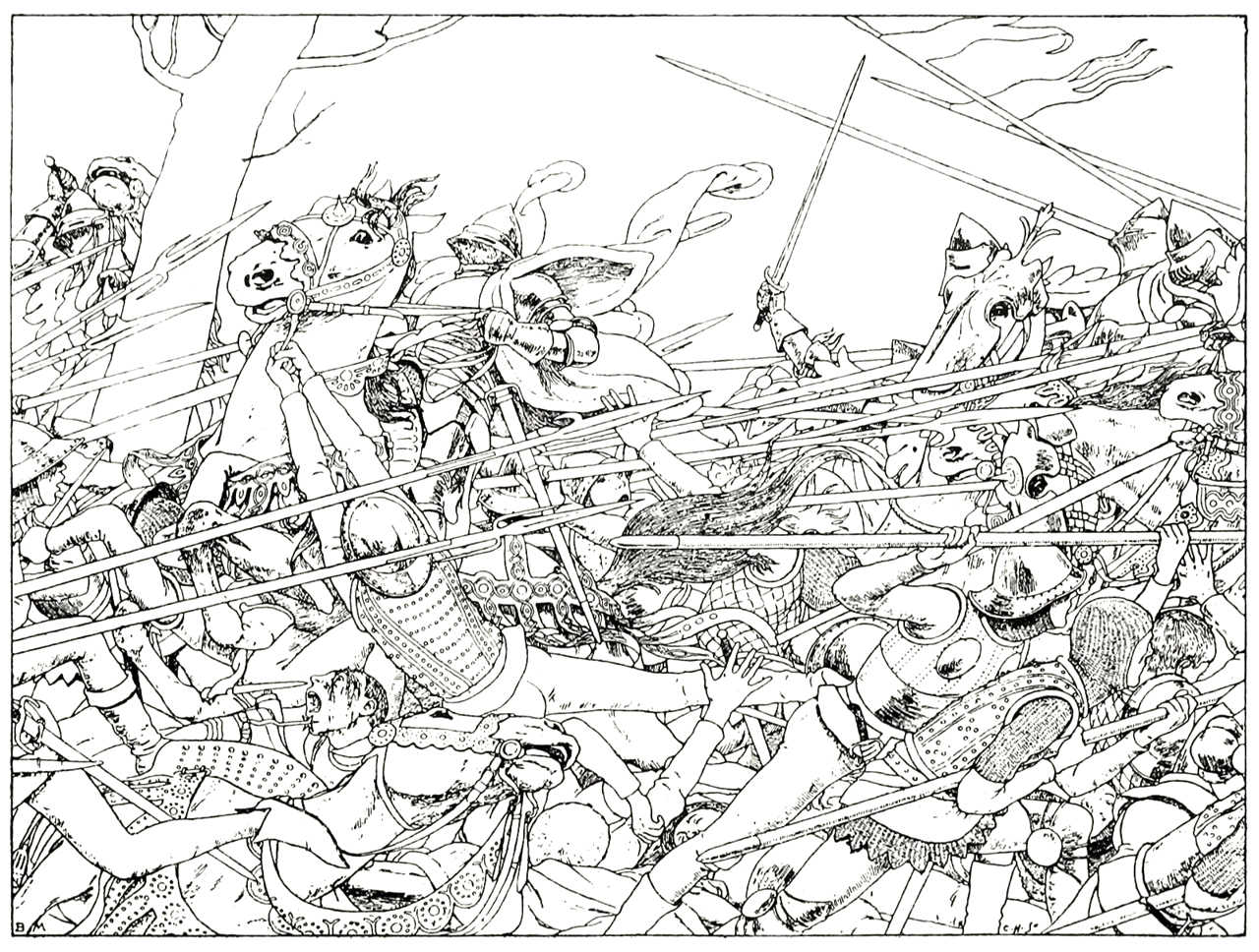
When a lord or lady finds it necessary to place themselves and their followers on the field of battle against another large force, the normal rules for combat may become untenable. For this reason, you can instead use these rules for mass combat. In most respects, they use the same basic rules as normal combat, but adjust those rules to take into account the larger numbers of combatants involved.

SQUADRONS
To keep things simple, groups of combatants are divided into squadrons of 10. The squadron is the basic unit for fighting, and in mass combat a squadron attacks as though it were a single creature. Thus, a squadron of dwarves would make a single weapon attack on its turn, while a squadron of lizardmen could make a weapon and bite attack.

A squadron has as many hit points as its collective members have Hit Dice. Thus, a squadron of 10 dwarves, who have one HD each, has 10 hp. For mass combat, 0 HD troops are counted as ½ HD.

Squadrons of Large creatures (and mounted troops are considered to be the same size as their mounts) have only five members, while huge creatures and siege engines are treated as units in and of themselves.

Squadrons can be grouped into larger units, as follows: A company consists of 2 squadrons (and thus makes double the normal amount of attacks), a battalion consists of four squadrons and a regiment consists of eight squadrons.

Each squadron is assumed to form a single rank of troops on the battlefield. A squadron of men-at-arms would therefore consist of 10 men-at-arms standing in a row. A company of men-at-arms could either consist of 20 men-at-arms standing in a row or two ranks of ten. With each unit, it is necessary to note its number of ranks.

Note that only the front rank of troops can attack unless the troops are armed with pole arms or spears (in which case the second rank can attack), pikes (in which case the second and third ranks can attack), or ranged weapons (in which every rank can attack).

Typical units of soldiers might be as follows (note, the number in parentheses represents the number of squadrons and then the number of creatures):

Squadron of Ogres (1/5): Ranks 1; HD 4; hp 20; AC 16; Atk 1 greatclub (2d8) or javelins (30 ft., 1d8); Move 30; Save Fort 10, Ref 14, Will 15. Leather armor, greatclubs and javelins (1).

Company of Halberdiers (2/20): Ranks 2; HD 1; hp 20; AC 15; Atk 2 halberd (1d10); Move 30; Save Fort 13, Ref 15, Will 15. Chainmail, halberd.

Battalion of Halfling Slingers (4/40): Ranks 1; HD 0; hp 20; AC 15; Atk 4 sling (50 ft., 1d4) or 4 short sword (1d6); Move 20; Save Fort 13, Ref 16, Will 16. Padded armor, sling, short sword; halfling special abilities.

Regiment of Orcs (8/80): Ranks 4; HD 1; hp 80; AC 13; Atk 2 falchion (2d4) or 8 javelin (50 ft., 1d4); Move 30; Save Fort 13, Ref 15, Will 16. Studded leather armor, falchion, javelins (1).

ORDER OF BATTLE
Mass combat uses the following order of play:

1) Orders Phase
2) Missile Phase I
3) Movement Phase
4) Melee Phase
5) Magic Phase
6) Missile Phase II

After the second Missile Phase, play returns to the Orders Phase.

Orders Phase: In the orders phase, each unit is given its orders. Once these orders are given, they cannot be changed, though they can be disrupted by events on the battlefield. In other words, once the command has been given for a company of orcs to march up a hill, they cannot change their mind when a company of knights gets there first. Naturally, orders are given without each commander knowing what commands his opponent is giving to his soldiers.

Missile Phase: There are two missile phases during each round of mass combat. During a missile phase, groups of missile armed troops can cast their missiles if they did not move during the movement phase. The rate of fire of various ranged weapons is very important during mass combat missile phases. Some ranged weapons can attack in both missile phases, others in only one.

Blowguns, bows, javelins, darts and slings can attack in each missile phase.

Crossbows, muskets and pistols can attack in one missile phase.

Siege engines can attack in one missile phase.

Movement Phase: During this phase, units move in the direction and at the speed they have been ordered. Units within 10 yards of an enemy unit cannot move at faster than combat speed (i.e. half normal speed). Movement of troops is simultaneous.

Melee Phase: Enemy units that have come into contact (i.e. within 1 yard of one another) must participate in a round of melee combat.

Magic Phase: During this phase, spellcasters on the field of battle can discharge spells. Remember that rounds in mass combat are one minute long, so spell durations may be altered.

ATTACKS AND DAMAGE
As mentioned above, each squadron in a game can attack as though it were a single creature of the same type using the same attack rules as used in normal combat (see above). Combat rounds in mass combat are measured in minutes, rather than six second intervals. Each successful attack by a squadron, by spell or weapon, rolls normal hit point damage against its target unit.

A unit can sustain no more hit point damage than it exposes in its first rank. Thus, a unit with five normal humans (1 HD each) in its first rank can sustain no more than 5 points of damage. If that unit is being attacked by spears or pole arms, double this total. If it is being attacked by pikes, triple this total. If it is being attacked by ranged weapons, it can suffer as much damage as the attackers can dish out.

Units can also “bull rush” an opposing unit in combat, making a normal attack with a +1 bonus for every additional rank it has over the opposing unit. If successful, it pushes the opposing unit back 10 yards, but scores no damage.

MORALE CHECKS
Three events can force a unit to check morale.

1) When a unit has lost half or more of its hit points, or takes damage when at less than half its normal hit points.
2) When its commander has been killed.
3) When it is subjected to a magic fear effect.

When a unit must make a morale check, it rolls a Will saving throw using either its own Will save value or its leaders.
If a unit succeeds on this save, it keeps on fighting. Otherwise, it flees from enemy troops at running speed. If it was engaged with another unit, that unit gets a free set of attacks against it with a tactical advantage bonus.

Each round, the unit commander, if one remains, can attempt to rally the troops with a new Will saving throw modified by his or her Charisma modifier. If successful, the unit spends one minute reforming itself and can then move and attack on the next round. After two full rounds of fleeing, the unit disintegrates into its constituent parts and effectively ceases to exist.

SIEGE ENGINES
Siege engines are large weapons, temporary structures, or pieces of equipment traditionally used in besieging a castle or fortress.

Catapult, Heavy: A heavy catapult, or trebuchet, is a massive engine capable of throwing rocks or heavy objects with great force. Because the catapult throws its payload in a high arc, it can hit things out of its line of sight.

To fire a heavy catapult, the crew chief makes a ranged attack modified by Intelligence rather than Dexterity. If the attack succeeds, the catapult stone hits the place the catapult was aimed at and deals the indicated damage. Characters that succeed on a Reflex saving throw take half damage. Once a catapult stone hits, subsequent shots hit the same spot unless the catapult is re-aimed or the wind changes direction or speed.

If a catapult stone misses, roll 1d8 to determine where it lands. This determines the misdirection of the throw, with 1 being back toward the catapult and 2 through 8 counting clockwise around the target square. Then, count 3 squares away from the target square for every range increment of the attack.

Loading a catapult requires one minute to reload and another minute to re-aim (if necessary). A heavy catapult takes up a space 15 feet across. It is operated by a crew of no less than 6.

Catapult, Light: This is a smaller, lighter version of the catapult. It functions as the heavy catapult. It takes up a space 10 feet across. Some examples are the onager and mangonel. It is operated by a crew of no less than 3.

Ballista: A ballista is essentially a huge crossbow. It takes a creature smaller than large two rounds to reload the ballista after firing. A ballista takes up a space 5 feet across. It is operated by a crew of no less than 2.

Cannon: Early cannons were cast in bronze and were quite large. They throw the same kind of ammunition as catapults, but do so in the manner of a ballista. A heavy cannon takes up a space 10 feet across and has a crew of no less than 6. A light cannon takes up a space 5 feet across and has a crew of no less than 3. A natural ”1” rolled to hit with a cannon means the engine has exploded, dealing 3d6 points of damage to everyone within 10 feet.

Ram: This heavy pole is sometimes suspended from a movable scaffold that allows the crew to swing it back and forth against objects. The character closest to the front of the ram makes an attack roll against the AC of the construction. In addition to the damage given on Table: Siege Engines, up to nine other characters holding the ram can add their strength modifiers to the ram’s damage. It takes at least one huge creature, two large creatures, four medium creatures, or eight small creatures to swing a ram. Tiny creatures cannot use a ram. A ram is typically 30 feet long.

Siege Tower: This device is a massive wooden tower on wheels or rollers that can be rolled up against a wall to allow attackers to scale the tower and thus to get to the top of the wall with cover. The wooden walls are usually 1 foot thick.

A typical siege tower takes up a space 15 feet across. The creatures inside the tower push it at a speed of 10 feet. The eight creatures pushing on the ground floor have cover against missiles.

Table: Siege Engines

ITEM – COST – DAMAGE – RANGE – CREW
Catapult, heavy – 800 gp – 6d6 – 1,000 ft. (100 ft. min.) – 4
Catapult, light –  550 gp – 4d6 – 500 ft. (100 ft. min.) – 2
Ballista – 500 gp – 3d8 – 200 ft. – 1
Cannon, Light – 1,000 gp – 5d6 – 500 ft. – 3
Cannon, Heavy – 2,000 gp – 10d6 – 1,000 ft. – 5
Ram – 1,000 gp – 3d8 – — – 10
Siege tower –  2,000 gp – — – — – 20

DESTROYING WALLS
10-ft. thick stone walls have an AC of 18 and can withstand 500 points of damage on a 10-ft. x 10-ft. section before crumbling. 5-ft. thick stone walls can withstand 250 points of damage on a 10-ft. x 10-ft. section before crumbling.

[The one thing I’m thinking about changing is the whole siege engine bit. I’m thinking about something that doesn’t involve tracking the hit points of a wall section. Something like …

A wall has a damage threshold based on the material (wood, stone, etc.) and the thickness of the wall. If the siege engine damage roll (no hit roll – the damage roll is considered part of the “does it hit the right spot” thing) passes the threshold, it has a percentage chance of toppling the wall, perhaps equal to the amount the damage exceeds the threshold. Maybe there’s also a roll to determine how high up the wall is struck. The type of weapon would also determine the size of the hole created. So – no damage to track, still takes (most likely) many hits to topple a wall.

Let me think out loud for a moment. We’ll say a stone wall has a damage threshold of 20 + 5 per 10 feet of wall. A 20-ft thick stone wall, then, has a damage threshold of 30.

A ballista has no hope of getting through the wall – which is probably right.

A light catapult does 4d6 – so an average of 14, max of 24. That means a light catapult doesn’t have a chance of breaching the wall either.

A heavy catapult does 6d6 – so an average of 21, max of 36. On a max. damage roll, each heavy crossbow has a 6% chance of breaching a wall.

A light cannon does 5d6 – so an average of 18, max of 30. No chance of breaching that wall.

A heavy cannon does 10d6 – so an average of 35 (5% of wall breach), max of 60 (30% chance of wall breach). Heavy cannon are going to knock down most walls, probably in a relatively short time. That’s also pretty accurate.

In all, I think a system like this can work, but I probably need to adjust the numbers a bit.

Status update, by the way. The only things left to write for the game are some embellishments to the chapter on dungeons, wilderness and cities, and ship combat (which will be a distillation of the ship combat rules I published way back in NOD 2.) The monster chapter is being edited (thanks Tanner), so the end is nigh.

Have some new undead critters coming later today on the blog … see ya then.

Maneuvers and Monsters

The magic section is almost completely edited, leaving just the monsters to go before this baby is (almost) ready for publishing. Last week, I finally figured out how I wanted to handle “encounter levels” – i.e. how tough is a fight? Today I thought of another way to handle special maneuvers in combat. Here’s a sample of each – let me know what you think.

[Oh, more previews from the final three circles of Hell and the B&T monster stats are on the way. As soon as I’m finished with B&T and the Rappan Athuk conversions, I’m going to get into 1800 – American Empires. I’m jonesin’ for some Napoleonic fantasy!]

Encounter Levels
First question from the Old Schoolers is, of course, why? The answer has nothing to do with balance (sorta). The real answer is “treasure”. If you’re not using something akin to “treasure types” for the monsters, and I’m not, you need a guide to how tough killing something is to determine the value of its stuff. It also helps dungeon designers, especially the new ones, to determine just how tough a given encounter is. If you’re designing a game for some 5th level characters and you overload it with impossible encounters, you’ve just designed yourself a shitty game. I know the concept of “balance” has been decried of late, and I agree with the sentiment when balance equals “make sure the players win”, but obviously the old school cared about balance as well, if not then there would be no need for racial level limits, more XP to be a magic-user and paladin or the concept of dungeons getting tougher as one descended into them.

The B&T system, in a nutshell is as follows:

A group of 3 to 5 monsters of a given “challenge level” is a challenging encounter for a party of that same average level. In other words, four ogres is a challenging encounter for a 4th level party of adventurers (assuming most parties contain 4 to 6 characters).

Two monsters of a challenge level equal to the average party level +1 is also a challenging encounter, as is one monster of a CL equal to the average party level +2.

Likewise, if you’re throwing lesser monsters at a party, you throw more at them. It goes something like this …

This, of course, begs the question: How do you calculate a monster’s Challenge Level?

I’m glad you asked. A monster with no special abilities has a CL equal to its HD. Thus, ogres, which have 4 HD and no special powers (big and ugly isn’t a power) have a CL of 4. Monsters with various minor powers (yeah, minor and major powers are defined in the rules) have a CL equal to their HD +1. Monsters with major powers have a CL equal to their HD +2. Pretty simple, and so far it has held true in the play tests.

SPECIAL MANEUVERS
I want special maneuvers in the game to be (1) easy to run and (2) worth while. All too often, I see people giving special maneuvers a try and regretting it later – while they were trying to trip the ogre, the ogre was just beating the crap out of them. As the rules usually go, it makes very little sense to do anything but attack. In reality, this is probably the case. Most of the ARMA fights I’ve seen involve wailing on your opponent with a sword rather than jumping around like a Hollywood stunt man. But B&T is, like most fantasy RPG’s, based not on the real middle ages, but rather on pulp fantasy stories and fairy tales, and Conan liked to get tricky.

The current system involved making an attack against a special AC that you had to calculate based on the maneuver. The new one doesn’t bother with that. Instead, it is modeled on the current combat system, with the two-pronged “attack” and “damage” concept. In essence, D&D combat separates combatants in two ways. You have an attack against a set AC. The attack improves as the attacker gains levels, but the AC, in general (monks don’t count here, dang them) does not, other than high level characters often have better equipment.

The “damage” side works the opposite way. The damager’s level doesn’t matter much (again, please ignore the dang monk) other than high level characters maybe having better equipment, but the hit points being damaged do scale with the defender’s level.

In other words, if you have two guys in padded armor with clubs, and one is a 1st level fighter and the other a 12th level fighter, the 12th level fighter has a much better chance of hitting his opponent, though his damage per round is about the same. He also has a much better chance of absorbing his opponent’s hits, even though his Armor Class is about the same.

So – Special Maneuvers. In essence, the attacker needs to hit a set AC based on the maneuver being attempted (i.e. the AC doesn’t improve just because the defender is higher level or has more HD). If the attacker hits, the defender rolls a saving throw to avoid the special effect of the maneuver, so the defender’s skill/power does make a difference. In addition, if the attacker’s attack would have penetrated the defender’s normal AC, he scores some damage (often unarmed attack damage).

Naturally, there are a few provisos and quid pro quos … mostly involving what weapons you can use for some of these maneuvers (that’s what those numbers in brackets in the table above refer to). Hopefully, this makes attempting a special maneuver more attractive and keeps the process pretty simple.

Oh – also – Captain Kirk!

So – special manuevers.

Three Bad Bishops, You Know So Well

Let’s review, for a moment, the cleric.

The cleric was the original middle child of D&D – stuck square between the magic-user and fighter in terms of spell use and fighting ability – and the first class born from play, rather than the Chainmail rulebook. Legend has it that Sir Fang, a vampire character (yes, monster characters are as D&D as apple pie is American), was proving troublesome, so somebody decided they needed a Van Helsing* to deal with the rapscallion.

* Side Note: If you want to thoroughly understand the undead of D&D, you need to watch the Universal and Hammer horror films. Never understood the whole “vampire energy drain touch” thing? Watch Captain Kronos. You’ll understand. Plus Caroline Munro

So, the cleric, as it was introduced into the rules, became a mix of Van Helsing vampire hunter and medieval bishop-of-war, with the stylistic emphasis on the latter rather than the former. Who were these battling bishops of the Middle Ages, you ask? Read on …

ADHEMAR OF LE PUY, BISHOP OF PUY-EN-VELAY

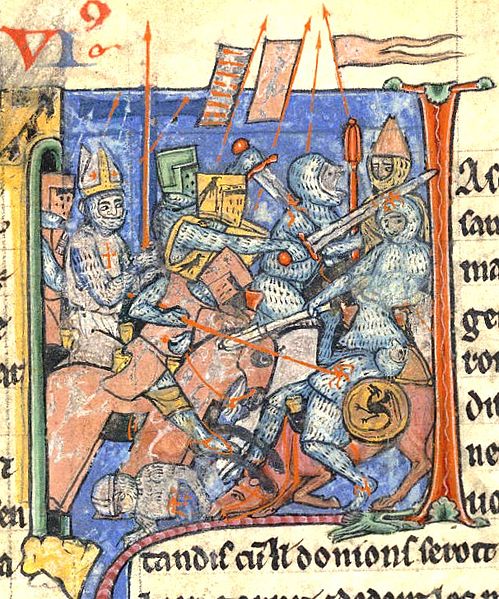
Adhemar (totally made up name, right?) hailed from France, and he plays an important part in the First Crusade. You can see him to the right, wearing the mitre*

* Side Note: If your 9th level cleric doesn’t enter dungeon fully armored and wearing a mitre, he should be stripped of his clerical powers and forever consigned to being a second-rate fighter. No Lawful or Chaotic deity worth his salt should forgive the sin of “awesome headgear aversion” in his followers.

He was paired up on the crusade with a bunch of stupid fighting-men who quarreled all the time over leadership, but managed to keep things focused with his spiritual leadership throughout the ordeal. When he died (probably of disease*), some claimed that he pulled the old Obi Wan trick (remember, Star Wars was a “long time ago”, so it technically occurred before the First Crusade) and returned as a ghost to cheer the foot soldiers on.

BISHOP ADHEMAR, LAWFUL CLERIC 9: HP 24; AC 15; ATK 1 longsword +6 (1d8); MV 30; SV F 10, R 12, W 8; Special: Turn undead, cleric spells (6/5/4/3/2/1); Gear: Chainmail, longsword, mitre, holy symbol, warhorse; Abilities: STR 12; INT 13; WIS 15; DEX 12; CON 8; CHA 14.

* Side Note: Died of disease? Hello! Cure disease – low level spell – what’s the deal? Well, it turns out that many of these bishops, uninformed of the D&D rules, used edged weapons and thus were unable to cast spells. Fortunately, fighting bishops of the future will be forewarned.

ODO, EARL OF KENT, BISHOP OF BAYEUX

Half-brother to William the Conqueror (a 9th or 10th level fighting man in his own right), Odo has one of the great names in the history of names (but far behind this guy). In fact, whenever I’m writing high-level clerics in a medieval milieu, it’s all I can do to avoid naming all of them Odo.

Odo is a little more “traditional D&D cleric” than the others, or at least pretended to be. Apparently, the Bayeux Tapestry (according to that shining light of accuracy Wikipedia) belabors the fact that he did not actually shed blood during the battle, and he is pictured armed with a club rather than an edged weapon urging the soldiers to battle – perhaps with a bless spell.

Odo also, apparently, gained his fortune by killing things (well, people) and taking their stuff, which I think cements him as a true D&D cleric, albeit a chaotic one. He joined the First Crusade (see above), but died before he actually got there, thus robbing the crusaders of some very useful cure (or cause) wounds spells.

BISHOP ODO, CHAOTIC CLERIC 9: HP 35; AC 15; ATK 1 club +7 (1d4+1); MV 30; SV F 9, R 12, W 9; Special: Rebuke undead, cleric spells (6/5/4/3/2/1); Gear: Chainmail, club, holy symbol, warhorse; Abilities: STR 14; INT 12; WIS 9; DEX 9; CON 12; CHA 12.

TURPIN, ARCHBISHOP OF REIMS

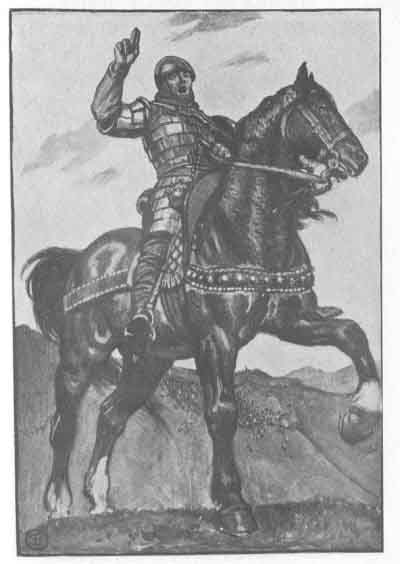
Turpin is no mere bishop. He’s an archbishop (so, 12th level, I guess). Turpin lived a few centuries before the other two in this post, and he was one of the Twelve Peers of Charlemagne and a pal of Roland. Some of the legends of Turpin might be confused with his predecessor, Milo, a “warrior clerk” (i.e. cleric).

In any event, Turpin was a bad-ass, and he wielded a magic sword called Almace (“Almighty”) that may have been forged by Wayland (the god-smith, not the puppeteer). A comparison of the three magic swords of the romances of Roland declared Kurt the least, Almace the second and Durendal the finest, so naturally I’ll assume Kurt is a +1 sword, Almace +2 and Durendal +3 (it’s science, dude).

ARCHBISHOP TURPIN, LAWFUL CLERIC 12: HP 34; AC 16; ATK Almace +11 (1d8+3); MV 20; SV F 7, R 11, W 7; Special: Turn undead, cleric spells (6/6/5/4/3/2/2); Gear: Banded mail, Almace (+2 longsword), holy symbol, warhorse; Abilities: STR 13; INT 11; WIS 16; DEX 9; CON 10; CHA 14.

Amazons, Archons and Azers

I’m now working my through the monster chapter doing a first pass on editing before it goes to Tanner for a more thorough look, and I decided “Why not preview a few monsters on the blog”. (i.e. I needed a quick and easy post for the day because I’m busy as spit).

I figure this can give folks an idea about the format (different than in earlier previews – a format I liked but just became too difficult to layout effectively and make the info easy for the TK to access during play) and maybe preview a few of the new monsters in the game.

AMAZON
Medium Humanoid, Alignment Varies, Average Intelligence; Company (1d20)

HD: 1 + 1
AC: 16 (chainmail and shield)
ATK: Longsword (1d8+1) or longbow (100 ft., 1d8+1)
MV: 30
SV: F 15, R 13, W 15
XP: 100 (CL 2)

Amazons are humanoid females who are expert warriors. All amazons are uncommonly tall and handsome. They come in three varieties, named after the color of their skin; the blue amazons, green amazons and red amazons. All amazons eschew accepting males into their society, but do require them for mating. Male humans are often taken by them in raids, mated with, and then sent on their way. Boys born onto the island are given to mercenary bands composed of the sons of amazons. These men, who lack the special abilities of their mothers, are called myrmidons. They look like their fathers, but their eye color and personality matches their mother.

Blue amazons are Lawful (LG) and worship the goddess of wisdom and war. Their skin is deep azure and they have hair that shines like silver. They are the wisest of the amazons, and enjoy a magic resistance of 10% and immunity to surprise. Blue amazons fight in close-knit ranks with spears and shields and they wear platemail (AC 19). They are usually led by clerics or paladins.

Green amazons are Neutral (N) and worship the goddess of the hunt. Their skin is jade green and their hair dark, forest green. Green amazons dwell in the woodlands, spending their days hunting. They can survive and track as well as rangers and can attack twice per round with their longbows. They are usually led by druids or rangers.

Red amazons are Chaotic (CE) and worship the goddess of black magic. Their skin is vivid crimson and their hair jet black. Red amazons fight as berserkers, attacking twice per round with their long swords, and they are immune to fear. They are usually led by chaos clerics or warlocks.

Organization: Band of 80 warriors plus 50% non-combatants plus leader of 4th to 7th level (1d4+3).

ARCHON
Archons are celestials that are not unlike angels, but of an inferior class. Archons speak Celestial, Infernal, and Draconic, but can speak with almost any creature using tongues.

A righteous aura surrounds archons that fight or get angry. Any hostile creature within a 20-foot radius of an archon must succeed on a Will save to resist its effects. Those who fail take a –2 penalty on attacks, AC, and saves for 24 hours or until they successfully hit the archon.

Spells: Continuous—magic circle against evil, tongues; At will—teleport

HOUND ARCHON
Medium Outsider, Lawful (LG), Average Intelligence; Pack (1d6)

HD: 6
AC: 19 [+1]
ATK: Bite (1d8) and slam (1d4) or +1 greatsword (2d6) and bite (1d8)
MV: 40
SV: F 10, R 10, W 10; +4 save vs. poison
XP: 3,000 (CL 8)

Hound archons look like well-muscled humans with canine heads. Hound archons prefer to attack with their natural weapons but occasionally use +1 greatswords.

A hound archon can assume any canine form of small to large size. While in canine form, the hound archon loses its bite, slam, and greatsword attacks, but gains the bite attack of the form it chooses.

Once per day, a hound archon can attempt to smite a Chaotic creature, doing double damage if it hits.

Special Qualities: Immune to electricity and petrification, magic resistance 15%

Spells: Continuous—magic circle against evil, tongues; At will—aid, continual flame, detect evil, message, teleport

LANTERN ARCHON
Small Outsider, Lawful (LG), Low Intelligence; Gleam (1d6)

HD: 1
AC: 15 [+1]
ATK: 2 light rays (30 ft., 1d6)
MV: Fly 60
SV: F 14, R 12, W 14; +4 save vs. poison
XP: 250 (CL 3)

Lantern archons appear as floating balls of light that glow about as brightly as a torch. Only their destruction can extinguish the glow, though they can try to hide it. A lantern archon has little reason to get within melee range. It usually hovers just close enough to bring the enemy within its aura of menace and then blasts away with its light rays. Lantern archons prefer to concentrate on a single opponent, seeking to reduce enemy numbers quickly.

Special Qualities: Immune to electricity and petrification

Spells: Continuous—magic circle against evil, tongues; At will— aid, detect evil, continual flame

TRUMPET ARCHON
Medium Outsider, Lawful (LG), High Intelligence; Blast (1d6)

HD: 12
AC: 23 [+1]
ATK: +2 greatsword (3d6)
MV: 40 (Fly 90)
SV: F 7, R 7, W 6; +4 save vs. poison
XP: 3,000 (CL 14)

Trumpet archons are angelic humanoids that carry long, silver trumpets. If forced into an extended battle, the archon sounds its trumpet and attacks with a vengeance. An archon’s trumpet produces music of utter clarity, piercing beauty, and, if the trumpet archon wills it, paralyzing awe. All creatures except archons within 100 feet of the blast must succeed on a Fortitude saving throw or be paralyzed for 1d4 rounds. The archon can also command its trumpet to become a +2 greatsword. If a trumpet is stolen, it becomes a chunk of useless metal until the owner can recover it. Woe betides the thief caught with one.

Special Qualities: Immune to electricity and petrification, magic resistance 30%

Spells: Continuous—magic circle against evil, tongues; At will—detect evil, continual flame, message

AZER
Medium Outsider (Fire), Lawful (LN), Average Intelligence; Squad (1d6)

HD: 2
AC: 21 (Scale, shield)
ATK: Battleaxe (1d8 + 1 fire)
MV: 30
SV: F 12, R 12, W 12
XP: 200 (CL 3)

Azers are dwarf-like beings native to the Elemental Plane of Fire. They wear kilts of brass, bronze, or copper and speak Fire Elemental and Dwarf (50% chance). Although unfriendly and taciturn, azers rarely provoke a fight except to relieve a foe of gems, which they love. Azers wield broad-headed spears or well-crafted hammers. An azer’s body is intensely hot, so its unarmed attacks and metal weapons deal extra fire damage.

Special Qualities: Immune to fire, magic resistance 5%, vulnerable to cold

Organization: Clan of 100 azer plus 50% non-combatants plus 7 HD leader

AZERS AS CHARACTERS
Azer characters modify their starting ability scores as follows: Str +1, Int +1, Cha -2. They have darkvision to a range of 60 and retain the special abilities of normal azer. Azer speak Fire Elemental, and may also speak the other elemental tongues and Celestial, Dwarf and Infernal. Azer can multi-class as cleric/fighters, fighter/magic-users and fighter/ thieves. Whatever their class, they can only advance to a max of 6th level.

How to Enchant An Item

Here’s a draft for the whole “creating magic items” bit for Blood & Treasure. Still thinking about this, so feel free to make suggestions and such (unless you think it sucks, in which case keep it to yourself as I have a fragile ego and artistic temperament).

The overall idea is that games are always talking about all the cool ingredients that can be used in making magic items, but this one is going to codify it (in a very vague way, of course). It’s also going to attempt to use the system for making these items as a impetus for adventure – i.e. you need a medusa’s tooth for an item, you have to slay it yourself. The other idea is to make sure that magic items are not being created willy nilly and all the time without using several tons of required gold pieces or XP costs to achieve it.

THE BASICS
The game has two systems for “what level do I have to be?” to make magic items, one based on 3rd edition, where as full spellcasters advance in levels they learn to make different types of magic items, and the other drawn from older versions of the game, that require one to be 9th level to make anything. Treasure Keepers can do as they like.

The overall cost to make an item is equal to have the gp value of the item – which can be divided up by the creator between hiring master craftsmen and alchemists, making the item to be enchanted, etc.

The item to be enchanted must be made by a master craftsman under the watchful eye of the magic item’s creator using the best possible materials

Magic weapons, armor, rings and rods must be forged from meteoric iron, mithral or adamantine or, for rings and rods, precious metals

Leather goods must be made from expensive animal hides

Cloth goods must be made from expensive fabrics (silk, velvet, cloth-of-gold, cloth-of-silver, wool from the exceptionally fine sheep, the hair of virgins, etc.)

Wooden goods (wands, staves, etc.) must be carved from rare and expensive woods

Scrolls must be scribed on vellum prepared by a master or chiseled in an expensive stone (malachite, porphyry) using an adamantine chisel

Potions must be brewed in vats made of precious metals with the assistance of an alchemist

MAGICAL ELEMENTS
All magic items are tied to an “equivalent spell” determined by the Treasure Keeper – i.e. what spell is sorta kinda (or exactly) like the magic item being made here. For each level of that spell, the item requires a “magical element”.

Roll d8 for potions and scrolls, d10 for all other magic items.

MAGICAL ELEMENT (Roll d10)
1-2 Herb (must be harvested from a special place or at a special time)
3-4 Mineral (discovered in a dungeon)
5-8 Monster (slain by the magic-user and his comrades)
9 Place
10 Time

HERBS (may be ground, used to make essential oils, smoked, burned as incense or ingested as a tea)
Angelica: Good and lawful spells, abjurations, summoning
Anise: Abjurations and divinations (esp. clairvoyance)
Basil: Strength, fire, evocations, necromancy, command/domination
Bamboo: Dispel magic
Caraway: Air spells, charm spells, movement
Cinnamon: Holy spells, mind-effects, communication spells, healing spells
Cloves: Negative energy protection, silence, dispel magic, charm person, astral projection, ethereal jaunt and other travel spells (teleport, dimension door)
Coriander: Abjurations
Foxglove: Poison, cause wound spells
Frankincense: ???
Galangal: Luck spells, blessings, remove curse
Garlic: Exorcism, protection from undead, healing, weather spells
Ginger: Fire spells, curses, evocations, spells of travel or movement
Ginseng: Restoration
Hellebore: Exorcism
Henbane: Poison, death spells
Holly: Resistance to electricity, magic circles, protection from evil
Horehound: Plant spells, tree spells, hallow
Lavender: Bless, healing, memory spells, sleep, bull’s strength, bear’s endurance, illusions
Lovage: Eagle’s splendor, charm spells
Mace: Transmutations
Mandrake: Evocations, summoning, visions
Marigold: Illusions
Marjoram: Animal spells, necromancy
Mistletoe: Love, druidic spells
Mugwort: Astral and ethereal travel
Mustard: Enchantments, dispel magic
Myrrh: ???
Myrtle: ???
Nutmeg: Dream, nightmare, divination
Onion: Contact other plane, commune
Oregano: Calm emotions, good hope, abjurations
Parsley: Haste
Peppermint: Animals, energy spells (including protection and resistance), healing, necromancy
Pomegranate: Communication with the dead, necromancy
Poppyseed: Sleep, dream, nightmare, confusion, insanity, binding spells, curses
Rosemary: Fear (including resistance to), exorcism, legend lore, alarm, glyphs and other spells that protect items, fox’s cunning, owl’s wisdom, water spells
Saffron: Sun and light spells, divinations, true seeing, detect invisibility, wind spells
Sage: Healing, longevity, protection from scrying
Savory: Animal spells, fey spells
Star Anise: Lawful spells, mark of justice, detect lie, hallow, aid, bless, prayer
Tarragon: Dragon spells, rage, remove fear
Thyme: Fey spells, divinations, necromancy
Turmeric: War and weapon spells, exorcisms, hold spells, mage armor, shield
Wormwood: Illusion

MINERALS
Agate: Plant spells, physical ability boosts, cure spells, abjurations
Amber: Sun and light spells, detect spells
Amethyst: Mind and emotion spells, clairaudience and other hearing spells, AC-enhancing spells, remove curse, break enchantment
Aventurine: Earth spells, open doors, knock, passwall, remove curse
Bloodstone: Remove fear, enhance physical abilities, heroism, mage’s transformation
Carnelian: Abjurations, fire spells, spells of movement (fly, jump, haste)
Chrysoberyl: Spell turning, reflective spells, locate object, spells of awareness
Copper: Remove fear, neutralize or delay poisons, communication spells
Emerald: Charms and enchantments, exorcism, enhance mental abilities and vision
Fluorite: Chaos spells, cure disease
Garnet: Abjurations, heal
Gold: Spells of purification, positive energy spells
Hematite: Mental and psychic spells, time spells
Jade: Water spells, wisdom spells, healing
Jasper: Abjurations, cure disease
Lapis Lazuli: Psychic spells, remove fear, divinations
Malachite: Plant spells, bear’s endurance, transmutations
Moonstone: Confusion, insanity, wish, neutralize poison, sleep, illusions
Obsidian: Protection from energy, detect evil, true seeing
Onyx: Lawful spells, spells of command and control, abjurations, wall spells
Opal: Emotion spells, memory spells, astral projection, ethereal jaunt, dream, nightmare
Platinum: Anti-transmutation
Quartz: Aid, bless, prayer and other such spells, evocations, cold spells
Rhodochrosite: Fire spells, legend lore, calm emotions
Rose Quartz: Atonement, heal, cure disease, resistance to fire and other energies
Ruby: Command spells, growth spells, haste, resistance to fire and other energies
Sapphire: Wind spells, water spells, planar travel, abjurations, creation spells
Silver: Energy spells, sleep, insanity, magic circles and other protections
Sunstone: Sun, light and fire spells, blessings,strength
Tiger Eye: Animal spells, true seeing, divinations, travel spells
Topaz: Blessings, evocations, mineral detection
Tourmaline: Heal spells, mental spells, plant spells
Turquoise: Earth spells

MONSTER
Requires eye, hair, feather, skin, gland, organ, claw, tooth, etc. of a monster (aberration, dragon, fey, giant, magical beast, monstrous humanoid, outsider, undead) or legendary personage (at least 12th level) associated with the spell or power being woven into the item. Monster must have twice the Hit Dice of the equivalent spell to be used.

PLACE
Ruined temple
Ancient palace
Place associated with birth or death of particular god or demigod
Place associated with magical or historic event
Stone circle sanctified by a 15th or higher level druid
Elemental plane or other plane of existence
Atop highest mountain
Fabled or mythic island
Active volcano
Cloud giant’s castle
Storm giant’s undersea palace
Waters of a magic pool or fountain
Bottom of deepest chasm
Within the pounding surf
Waters of a holy river

TIME
Specific phase of the Moon
Specific solstice or equinox
Specific position of stars
Anniversary of magical or historic event
During a storm, earthquake or other cataclysm (natural)
During a meteor shower

Example: Flaming Longword
The Treasure Keeper rules that fireball is the important spell for a flaming longsword. Fireball is a 3rd level spell, so there will be three rolls on the table above. The TK rolls and gets mineral, monster and time. He decides the “mineral” will be carnelian (3,000 gp worth, powdered), the “monster” a salamander’s blood and the “time” during a meteor shower. The magic user must also provide a sword made of meteoric iron, mithral or adamantine. The magic-user will have to use divinations to discover when and where a meteor shower is to occur, and of course he’ll have to liberate a carnelian from a dungeon and slay a salamander. The services of an alchemist are needed to prepare the carnelian powder. While the flaming sword is forged by a master smith (during the meteor shower and under the open sky, of course), the magic-user mingles in the carnelian powder and salamander blood and casts the fireball spell.

Example: Cape of the Mountebank
The magic-user must provide around 5,000 gp worth of materials for this cape, which must be woven of silk or another expensive material, probably with gold or silver thread embroidered in it. It is associated with the dimension door spell, a 4th level spell of movement and travel. Rolling the dice, the TK decides he needs an herb, two minerals and a place. He decides the place will be the tomb of an infamous illusionist – the enchantment, though not the manufacture of the cloak, must occur there. The “herb” is ginger, which must be brewed into an ale and consumed by the magic-user while creating the item. The “minerals” are sapphire and tiger’s eye, which must be powdered and mixed into a dye for the cloak. The cloak will have silver threads embroidered into it to form symbols of power.

The State of Blood and Treasure

I get a few questions now and then about where Blood & Treasure stands in terms of completion. I’m going to answer them.

First – my plan to include actual poisoned needle traps in the print books has run into some legal problems, so that’s out. Yeah – contact poison is out as well. Still no word on the possibility of working glyphs of warding.

Second – Here’s an outline of the different sections of the game and where they stand. Keep in mind, all of these sections are going through editing and playtesting, so take the “100% complete” tag with a grain of salt.

I. Introduction – 100% complete
– Basic concepts of an RPG, the dice, etc.

II. Characters – 100% written and laid out
Five Seven races (sorry), 13 classes, 13 variant classes, spell lists, feats, equipment, strongholds & domains

III. Rules of Play – 100% written and laid out
– Encumbrance, movement, light, poison, disease, falling, survival, task resolution, combat, mass combat

IV. Magic – 100% written in first draft, now being given a serious edit
– Spells, intro to magic item creation

V. Adventures – 90% written
– Dungeons, wilderness, urban, planes

VI. Monsters – 100% written in first draft, now being given a serious edit
– Monsters, creating and modifying monsters

VII. Treasure – 100% written in first draft, now being given a serious edit
– Money, gems, art, magic items

Appendices – not yet written
– Conversion guides (old school, new school), inspirational reading, useful charts and tables

Once the sections that are “being given a serious edit” are “seriously edited”, they’ll go to the next stage of editing by Tanner Yea, my editing hero.

Also – here are the “final” covers for the Player’s Tome and Treasure Keeper’s Tome.

For the TK’s Tome, I wanted something that suggested the wider world of fantasy, while the Player’s Tome focused on the adventurers. The Complete book (contains Player’s Tome and TK’s Tome in one volume) will look like the Player’s Tome, except it will replace “Player’s Tome” with “Complete Game”.

The Player’s Tome will include the Intro, Characters, Rules of Play and Magic chapters.

The TK’s Tome will include the Intro, Adventures, Monsters and Treasures chapters.

So – now you know. I’m also working on the S&W Rappan Athuk conversions (about 10 more chapters to go – this is going to be one seriously &^#&@ huge adventure – I’m pretty sure I’m going to run it on G+ when it’s finished) and NOD 15 (the final circles of Hell! Hallelujah!!!). When Blood & Treasure is in the can, I start on 1800 – American Empires in earnest. I really want to do something good with that one, and will probably make it compatible with Blood & Treasure.

I’m busy as beard groomer at an OSR convention, and thankful for it!

Thun’da, King of the Conga/Congo

It’s time for another look into the wonders of old jungle comics with a Thunda story posted at The Comic Book Catacombs (for all your old jungle comic needs, one convenient location on the world wide web).

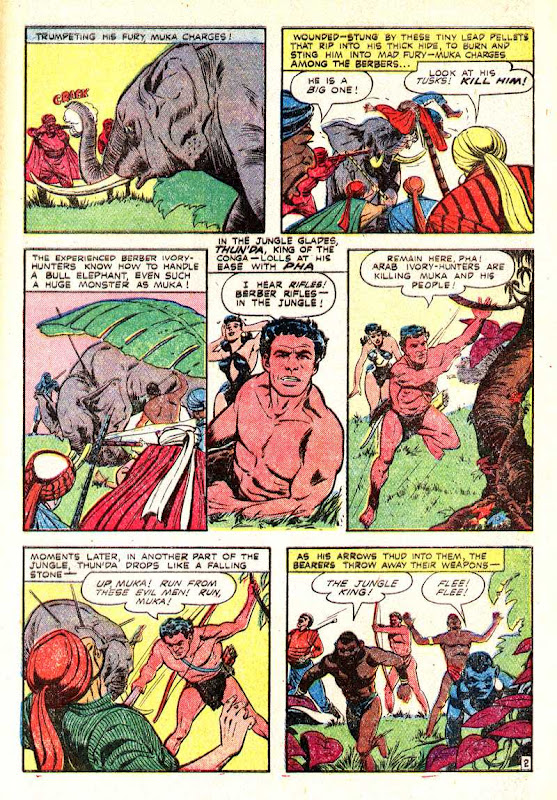
OK, first and foremost, Thun’da is a dude. Name ends with a vowel, immediately I’m thinking a jungle girl, but no, it’s a jungle boy. Naturally, he has a jungle girl (every Tarzan needs a Jane). This episode is about Jungle Killers (i.e. killers in the jungle, as opposed to people who kill jungles).

I wonder what the berber’s “% in Lare” is?

This scene, killing an elephant with one blast of a gun, does bring up a shortcoming of D&D combat, namely that for a single gun shot to take down an 11 HD elephant, it needs to do about 11 dice of damage (or maybe 6, if we’re allowing for double damage on some sort of critical hit). You could make 10d6 damage elephant guns in D&D, but if you let the monsters have them, the players are going to be pissed.

Well, maybe that last elephant just rolled shitty for hit points, because Muka is only annoyed at the little lead pellets, an annoyance he demonstrates by tossing around the Arabs.

What the heck is Pha doing in that middle panel? She’s either distressed at the sound of gunshots or swooning over that dreamy Thun’da, the Frank Sinatra of the Conga.

“Drops like a falling stone” does not really paint Thun’da’s dexterity score in the brightest light.

You know how great it would have been if they misspelled “Flee” in that last panel?

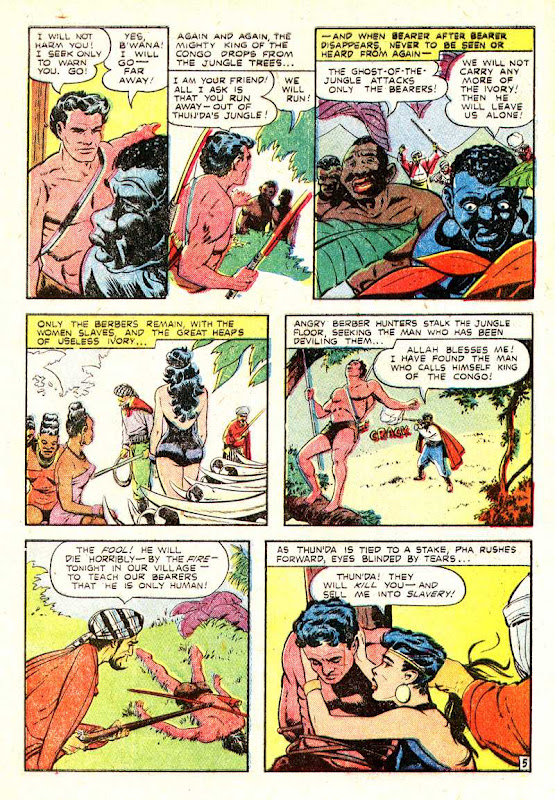
The adventures of Thun’da, Jungle Veterinarian. “That mud will draw out the pain, and introduce a host of bacteria into the wound.”

Meanwhile … Pha Pha Pha Phooom. Thun’da done alright for himself in the jungle. Ain’t it just like a female sidekick, though – you tell them to stay, and they always wander in just in time to be attacked by the one bad guy that got away from you. Sheesh.

Ooo! Ooo! Gold pieces! He said gold pieces! At least we’re dealing with an economy I can understand.

Also … SMATTT? Nice sound effect. Not exactly up to Batman quality.

Hours after days, Thun’da makes his Tracking check and finds the caravan. He then fails his Spot check and is apparently unable to see the guns they’re carrying – those same guns they were carrying on the last page (hours and days ago).

Now Thun’da goes into guerrilla mode – the picture of the impaled dude is actually pretty badass. This brings up a though … how often have your players ever used guerrilla tactics against goblin and orc tribes?

Of course, then Thun’da decides to pick on the African bearers, who are already being whipped and beaten by the Arabs and I lose all respect for the jungle douche.

Oh, I take that back. By jumping on his back from a tree, Thun’da only meant to warn him, not hurt him. It’s like the time a warned a friend about the dangers of bricks by throwing one at his head.

So he gets rid of the bearers, leaving the Arabs with useless ivory (not sure why it’s useless … they may have to carry it themselves, but it will still fetch a pretty penny … er, gold piece … in Djibouti.

Oh, and for those who don’t get the geography involved …

These knuckle heads are traveling 4,300 miles to grab ivory and slaves in the Congo (or Conga, depending on the page) and deliver them to the markets of Djibouti. No, the map’s not perfectly accurate, but close enough for government work. Given the terrain involved, this could be a 2 year trip on foot. Methinks the writer was not acquainted with the immensity of Africa.

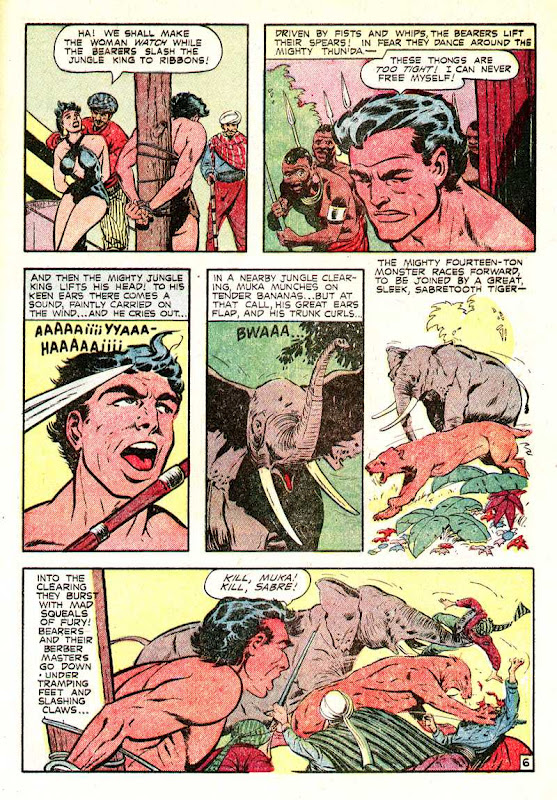
I like the last panel. Just in case being shot in the head and tied to a post had taken Thun’da mind off the problem at hand, Pha provides some helpful exposition.

Just when things look their darkest, Thun’da remembers an old trick he learned watching Tarzan movies, and summons his faithful elephant and sabretooth tiger to kill everyone. Which, of course, begs the question … why not summon those two to begin with?

So after saving Muka from the Berbers, he sends Muka to his death against the Berbers. Nice. But it’s not a total loss, as Thun’da finds an alternate route home. You know, for when the jungle is crowded around rush hour. Interesting that the Elephant Graveyard appears to be within sight of the city of Shareen, and yet its existence was a complete surprise to the King of the Congo.

Oh – and love the look on the one guy’s face in the upper right hand panel. Looks like he has a serious noogie coming.

Time for stats!

Thun’da will use have levels in the beastmaster, a variant druid class in Blood & Treasure (yes, I’ll release it pretty soon – give me a break, one guy working on a 400 page RPG book in his spare time). The beastmaster is a druid who loses the shapechange abilities and armor use of a druid, but gains the unarmored AC bonus and speed bonus of a monk and the favored enemy and tracking ability of a ranger. I’m going to be a bit on the brutal side with this guy, given that he’s kind of an ass.

THUN’DA
9th level Beastmaster
Neutral (cause he just ain’t that good)

STR 16 (+2 bonus)
DEX 10 (would have been higher, but the whole “fell like a stone” thing didn’t help him)
CON 16 (+2 bonus)
INT 7 (-1 bonus)
WIS 13 (+1 bonus, and only because he needs it to qualify)
CHA 9

Hit Points: 36 (9d6+18)
Armor Class: 14 (10 + 4 for unarmored AC bonus)
Saving Throws: Fortitude 7, Reflex 12, Will 8

Skills: Survival [8], Tracking [8]

Special Abilities: Druid spells (6/5/4/3/2/1), move through undergrowth (Lvl 2), leaves no trail (Lvl 3), +2 save vs. spells of the fey (Lvl 4), immune to poison (Lvl 9), establish stronghold (Lvl 9; we’ll say his city of Shareen is his stronghold), armor class bonus (+4 at Lvl 9), speed bonus (+20 ft. at Lvl 9), favored enemy (double damage vs. Berbers)

Gear: Short bow, 20 arrows, spear

Henchmen: Sabre (smilodon), Pha (total babe)