Cunning Men and Wise Women

Statting out some kobold shamans and witchdoctors tonight, I realized I didn’t like the idea of making them clerics or druids. So, I did a quick conversion of the d20 adept NPC class.

The following material is Open Game Content.

Adept (NPC Class)
Adepts are practical spellcasters of rural and barbaric folk, less skilled than the druids and more focused on serving their communities than going on daft adventures into the unknown. Most are skilled in folk remedies and fortune telling, and they are always skilled in another profession.

Hit Dice: 1d6 per level, +1 per level after 9
Weapons Allowed: Club, dagger, dart, mace, short bow, sling, spear, staff.
Armor Allowed: Leather armor, shield.
Attack: As magic-user
Saving Throws: As magic-user

Adepts cast spells from their own list (see below), preparing them in the same way as clerics. Each of an adept’s spells requires them to possess a simple fetish made of bones, feathers, ribbons, etc.

Each adept is also skilled as an alchemist, animal trainer, armorer, fortune teller, guide, healer or sage.

The Adept

Level
HD
Attack
Saving Throw
1
2
3
4
5
1
1d6
+0
15
1
2
2d6
+0
14
1
3
3d6
+1
13
2
4
4d6
+1
12
2
5
5d6
+1
11
2
1
6
6d6
+2
10
2
1
7
7d6
+2
9
3
2
8
8d6
+3
8
3
2
9
9d6
+3
7
3
2
1
10
9d6+1
+3
6
3
2
1
11
9d6+2
+4
5
3
3
2
12
9d6+3
+4
4
3
3
2
13
9d6+4
+5
4
3
3
2
1
14
9d6+5
+5
4
3
3
2
1
15
9d6+6
+5
4
3
3
3
2
16
9d6+7
+6
4
3
3
3
2
17
9d6+8
+6
4
3
3
3
2
1
18
9d6+9
+7
4
3
3
3
2
1
19
9d6+10
+7
4
3
3
3
3
2
20
9d6+11
+7
4
3
3
3
3
2

Adept Spells

Level One: Cause fear, charm person, cure light wounds, detect evil, light, protection from evil, sleep.

Level Two: Bless, darkness 15 ft radius, detect invisibility, invisibility, mirror image, pyrotechnics, snake charm, strength, web.

Level Three: Animate dead, cause disease, curse, continual light, cure disease, cure serious wounds, lightning bolt, neutralize poison, remove curse.

Level Four: Create water, massmorph, polymorph, protection from evil 10 ft radius, sticks to snakes, wall of fire.

Level Five: Commune, create food, raise dead, wall of stone.

Quick Idea on Weapons

Thinking about the “all weapons do 1d6 damage” rules, I thought it might be useful to come up with some other reasons why one might choose one weapon over another and came up with the following. You’ll notice that I didn’t differentiate between long swords and short swords. It seems to me if all weapons are going to do the same damage, you only need to differentiate between forms rather than small differences between weapons with the same basic form.

And just for fun, consider it Open Game Content.

Axe/Curved sword/Pick/War hammer: +1 to damage due to all of the wielder’s force being concentrated on a small cutting edge or piercing point

Bow: -1 to hit (difficult to learn) but attacks twice during a round (on normal initiative and at end), +1 to damage due to all of the wielder’s force being concentrated on a small cutting edge or piercing point

Club/Staff: Nothing special

Crossbow: +1 to damage due to all of the wielder’s force being concentrated on a small cutting edge or piercing point

Dagger: Always lose initiative against longer weapons, but +1 to hit due to the greater versatility that comes with multiple angles of attack

Flail: Ignores shield bonus to AC, +1 to disarm attacks because of the chain

Javelin/Throwing spear: Nothing special

Mace: Nothing special

Sling: Nothing special

Spear/Lance: Always win initiative against shorter weapons

Sword: +1 to hit due to the greater versatility that comes with multiple angles of attack

Two-handed axe/Pole arm: +2 to damage due to all of the wielder’s force being concentrated on a small cutting edge and the heft of the weapon

Two-handed sword: +1 to hit due to the greater versatility that comes with multiple angles of attack, +1 to damage due to the weapon’s heft
__________

Metal weapons (other than dagger) require a strength score of 9 or higher to wield properly, otherwise -1 penalty to hit.

Two-handed weapons (including bows and crossbows) require a strength score of 13 or higher to wield properly, otherwise -2 penalty to hit.

On Barter and Trade

Those of you who use the Swords & Wizardry rules probably know that the guidelines for treasure allocation stipulate that there is a 10% chance (i.e. a roll of 10 on 1d10) that coins will be swapped out for gems, jewelry or magic. In general, I love these rules because magic, gems and jewelry remain fairly rare. However, I do feel as though this system leaves out many alternative forms of wealth, i.e. goods. I’m no stickler for realism in my games, but piles and piles of gold coins do stretch plausibility pretty far, and can become pretty boring. Coins were pretty rare things for most medieval folk. In an inventory of one of Charlemagne’s smaller estates, for example, one comes across a mere 13 shillings and large numbers of livestock, household goods, grain and cheese. For this reason, I began swapping out coinage for trade goods on the roll of “1” on 1d10, using the following guidelines for amounts and values. I went ahead and organized the information so one could randomly determine the goods found. Feel free to change values, especially if a particular item is either rare or exceedingly common in a particular region. When adventurers try to sell these trade goods, you can simulate price fluctuations by rolling 1d6, with a 1-2 meaning half the normal value and a 5-6 meaning double the normal value. Obviously, this can also be used for determining the contents of a caravan or merchant cog.

In Place of 100 gold pieces (roll 1d100)
1-2. 1d10 tons of raw wool (20 gp/ton)
3-4. 2d100 ingots of lead (10 lb ingots, 7 sp/ingot)
5-6. 2d100 ingots of iron (10 lb ingots, 1 gp/ingot)
7-8. 1d8 x 100 pounds of buckwheat (25 cp/lb)
9-10. 1d6 x 100 pounds of millet (3 sp/lb)
11-12. 1d6 x 100 pounds of oats (3 sp/lb)
13-14. 1d6 x 100 pounds of rye (3 sp/lb)
15-16. 1d6 x 100 pounds of walnuts (3 sp/lb)
17-18. 1d6 x 100 pounds of yellow (sulfuric) dye (3 sp/lb)
19-20. 1d100 ingots of tin (5 lb ingots, 4 sp/lb)
21-22. 1d4 x 100 pounds of hazelnuts (200 lb), 5 sp/lb
23-24. 1d4 x 100 pounds Red (iron) dye (200 lb), 5 sp/lb
25-26. 1d8 x 10 ingots of steel (5 lb ingots, 6 sp/lb)
27-28. 1d8 x 10 ingots of zinc (5 lb ingots, 8 sp/lb)
29-30. 2d20 ingots of brass (5 lb ingots, 1 gp/lb)
31-32. 2d20 ingots of bronze (5 lb ingots, 1 gp/lb)
33-34. 2d20 ingots of copper (5 lb ingots, 1 gp/lb)
35-36. 4d8 barrels of ale (barrel holds 30 gal., weighs 250 lb, worth 6 gp)
37-38. 2d10 barrels of wine (barrel holds 30 gal., weighs 250 lb, worth 9 gp)
39-40. 2d10 x 10 pounds of barley (1 gp/lb)
41-42. 2d10 x 10 pounds of blue dye (1 gp/lb)
43-44. 2d10 x 10 pounds of coal (1 gp/lb)
45-46. 2d10 x 10 pounds of green dye (1 gp/lb)
47-48. 2d10 x 10 pounds of gum arabic (1 gp/lb)
49-50. 2d10 x 10 pounds of ocher dye (1 gp/lb)
51-52. 2d10 x 10 pounds of chestnuts (1 gp/lb)
53. 2d10 x 10 pounds of cinnamon (1 gp/lb)
54. 2d10 x 10 goats (1 gp/goat)
55. 2d10 x 10 peacock feathers (1 gp/feather)
56. 1d10 x 10 pounds of ginger (2 gp/lb)
57. 1d10 x 10 pounds of lentils (2 gp/lb)
58. 1d10 x 10 pounds of pepper (2 gp/lb)
59. 1d10 x 10 raccoon skins (2 gp/skin)
60. 1d10 x 10 squirrel skins (2 gp/skin)
61. 1d10 x 10 sheep (2 gp/sheep)
62. 1d8 x 10 pounds of jasmine oil (25 sp/lb)
63. 1d6 x 10 pounds of almonds (3 gp/lb)
64. 1d6 x 10 pounds of ambergris (3 gp/lb)
65. 1d6 x 10 pounds of camphor (3 gp/lb)
66. 1d6 x 10 pounds of indigo dye (3 gp/lb)
67. 1d6 x 10 pounds of purple dye (3 gp/lb)
68. 1d6 x 10 pounds of chick peas (3 gp/lb)
69. 1d6 x 10 pigs (3 gp/pig)
70. 1d6 x 10 square yards of velvet (10 lb per yard, worth 3 gp/sq yd)
71. 1d6 x 10 deer skins (4 gp/skin)
72. 1d6 x 10 gallons of honey (gallon weighs 12 lb gal; 4 gp/gal.)
73. 1d6 x 10 square yards of linen (5 lb per yard, 4 gp/sq yd)
74. 1d6 x 10 pounds of vermilion dye (4 gp/lb)
75. 2d20 bear skins (5 gp/skin)
76. 2d20 square yards of lace (3 lb per yd, 5 gp/sq yd)
77. 2d20 pounds of rice (5 gp/lb)
78. 2d20 pounds of salt (5 gp/lb)
79. 4d8 sheep skins (6 gp/skin)
80. 2d12 pounds of calamus (8 gp/lb)
81. 2d12 marten skins (8 gp/skin)
82. 2d12 pounds of mercury (8 gp/lb)
83. 2d12 wolf skins (8 gp/skin)
84. 2d10 pounds of pine nuts (10 gp/lb)
85. 1d10 ingots of silver (2 lb ingot, worth 20 gp)
86. 2d10 square yards of silk (10 gp/sq yd)
87. 2d10 cattle (10 gp/cattle)
88. 2d10 cigars (10 gp/cigar)
89. 2d10 coconuts (10 gp/coconut)
90. Sable skin (9), 11 gp/skin
91. 2d8 mink skins (12 gp/skin)
92. 2d6 fox skins (14 gp/skin)
93. 2d6 pounds of cardamon (15 gp/lb)
94. 2d6 panther skins (15 gp/skin)
95. 2d6 pounds of pistachios (15 gp/lb)
96. 2d6 pounds of saffron (15 gp/lb)
97. 2d6 shark skins (15 gp/skin)
98. 2d6 pounds of cloves (15 gp/lb)
99. 2d6 oxen (15 gp/ox)
100. 1d8 big cat (jaguar, leopard, lion or tiger) skins (25 gp/skin)

In Place of 1,000 gold pieces (roll 1d2 and 1d20)
1-1. 1d20 casks of molasses (barrel holds 25 gal., weighs 300 lb, 100 gp each)
1-2. 1d4 x 100 pounds of rice (5 gp/lb)
1-3. 1d4 x 100 pounds of salt (5 gp/lb)
1-4. 4d8 casks of olive oil (cask holds 12 gal., weighs 100 lb, 60 gp each)
1-5. 2d12 x 10 marten skins (8 gp/skin)
1-6. 2d12 x 10 wolf skins (8 gp/skin)
1-7. 2d10 x 10 pounds of pine nuts (10 gp/lb)
1-8. 1d100 ingots of silver (2 lb ingot, 20 gp each)
1-9. 2d8 casks of sesame oil (cask holds 12 gal., weighs 100 lb each, 120 gp each)
1-10. 2d10 x 10 square yards of silk (12 lb per yard, 10 gp/sq yd)
1-11. 2d10 x 10 cattle (10 gp/cattle)
1-12. 2d10 x 10 cigars (10 gp/cigar)
1-13. 2d10 x 10 coconuts (10 gp/coconut)
1-14. 2d10 x 10 sable skins (11 gp/skin)
1-15. 2d8 x 10 mink skins (12 gp/skin)
1-16. 2d6 x 10 fox skins (14 gp/skin)
1-17. 2d6 x 10 pounds of cardamon (15 gp/lb)
1-18. 2d6 x 10 panther skins (15 gp/skin)
1-19. 2d6 x 10 pounds of pistachios (15 gp/lb)
1-20. 2d6 x 10 pounds of saffron (15 gp/lb)
2-1. 2d6 x 10 shark skins (15 gp/skin)
2-2. 2d6 x 10 pounds of cloves (15 gp/lb)
2-3. 2d6 x 10 oxen (15 gp/ox)
2-4. 1d10 x 10 pounds of cashews (20 gp/lb)
2-5. 2d8 x 10 big cat (jaguar, leopard, lion or tiger) skins (25 gp/skin)
2-6. 2d8 x 10 pounds of jasmine oil (25 gp/lb)
2-7. 1d6 x 10 pounds of groundnuts (30 gp/lb)
2-8. 1d6 x 10 pounds of jujubes (30 gp/lb)
2-9. 1d6 x 10 pounds of sandalwood oil (40 gp/lb)
2-10. 1d4 x 10 pounds of dried coconut (50 gp/lb)
2-11. 1d4 x 10 pounds of myrobalans (50 gp/lb)
2-12. 1d4 x 10 pounds of tea (50 gp/lb)
2-13. 1d30 pounds of dried lotus fruit (70 gp/lb)
2-14. 1d30 pounds of maple sugar (75 gp/lb)
2-15. 2d10 pounds of galingale (80 gp/lb)
2-16. 2d10 pounds of black walnuts (100 gp/lb)
2-17. 2d10 pounds of cocoa (100 gp/lb)
2-18. 2d10 pounds of fagara (100 gp/lb)
2-19. 1d6 ingots of gold (3 lb ingots, 300 gp each)
2-20. 2d10 pounds of tobacco (100 gp/lb)

In Place of 5,000 gold pieces (roll 1d3 and 1d12)
1-1. 4d8 x 10 pounds of groundnuts (30 gp/lb)
1-2. 4d8 x 10 pounds of jujubes (30 gp/lb)
1-3. 2d10 x 10 pounds of dried coconut (50 gp/lb)
1-4. 2d10 x 10 pounds of myrobalans (50 gp/lb)
1-5. 2d10 x 10 pounds of tea (50 gp/lb)
1-6. 2d6 x 10 pounds of dried lotus fruit (70 gp/lb)
1-7. 2d6 x 10 pounds of maple sugar (75 gp/lb)
1-8. 2d6 x 10 pounds of galingale (80 gp/lb)
1-9. 1d10 x 10 pounds of black walnuts (100 gp/lb)
1-10. 1d10 x 10 pounds of cocoa (100 gp/lb)
1-11. 4d8 ingots of gold (3 lb ingots, 100 gp each)
1-12. 1d10 x 10 pounds of tobacco (100 gp/lb)
2-1. 1d10 x 10 vanilla beans (100 gp/bean)
2-2. 1d6 x 10 pounds of ginger (150 gp/lb)
2-3. 1d6 x 10 pounds of pecans (150 gp/lb)
2-4. 1d6 x 10 pounds of sasparilla (150 gp/lb)
2-5. 1d6 x 10 pounds of frankincense (160 gp/lb)
2-6. 1d6 x 10 pounds of myrrh (160 gp/lb)
2-7. 1d6 x 10 pounds of butternuts (200 gp/lb)
2-8. 1d6 x 10 pounds of hickory nuts (200 gp/lb)
2-9. 1d4 x 10 pounds of cubeb (250 gp/lb)
2-10. 1d4 x 10 pounds of manioc flour (250 gp/lb)
2-11. 1d30 pounds of chili powder (300 gp/lb)
2-12. 1d30 pounds of dried pineapple (300 gp/lb)
3-1. 1d30 pounds of pumpkin seeds (320 gp/lb)
3-2. 1d30 pounds of zedoary (320 gp/lb)
3-3. 1d20 pounds of mace (400 gp/lb)
3-4. 1d20 pounds of turmeric (400 gp/lb)
3-5. 1d20 pounds of nutmeg (500 gp/lb)
3-6. 1d20 pounds of paprika (500 gp/lb)
3-7. 2d8 casks of fine wine (cask holds 12 gal., weighs 100 lb, worth 600 gp)
3-8. 2d8 pounds of pimentos (650 gp/lb)
3-9. 1d4 ingots of platinum (2 lb ingots, 2,000 gp each)
3-10. 1d6 pounds of long peppers (1,500 gp/lb)
3-11. 1d6 pounds of tamarind pulp (1,500 gp/lb)
3-12. 1 ingot of mithral (1 lb ingot, 4,000 gp)

I think the fun of using these items is that they challenge player’s assumptions. Most players are keyed in on the shiny stuff, so they’ll have to think a bit to avoid passing over something valuable like pimentos. Of course, some might see this as a dirty trick, and they might be right, but I figure its no dirtier a trick than a mimic or collapsing staircase. If you want to bypass some of the larger logistical headaches (i.e. several tons of raw wool), then just use the last 20 or 30 items on each list.

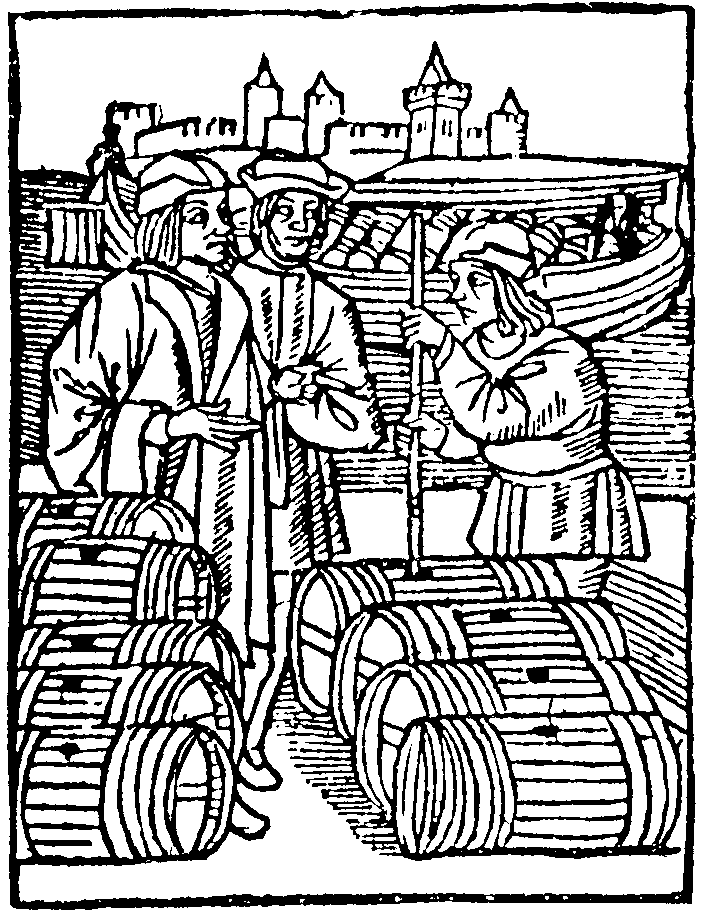
Image of wine merchants from Economic History Blog.

RIP Frazetta

“Holy crap! (holds book sideways, unraveling a fold-out) Look at your costume! What, did Frank Frazetta design it for you?! It’s tiny! I can see your…dirty pillows!” – The Monarch

I’ll join the chorus of voices singing the praises of Frank Frazetta, who just passed on. Few artists have inspired me more. His paintings for Battlestar Gallactica, especially, make me want to play some sci-fi rpg set in his vision of that show. Definitely one of the best, and irreplaceable. He will be missed.

Round-Up!

Man, am I busy lately. Here’s what I’m working on …

Still working on my April compilation – it will cover the Wyvern Coast posts (with about twice as many encounter areas), the village generator, the fighting-man classes and the psychic, the Gods of Ophir (with a few additional deities), the monsters of Africa and the “new” monsters that appear in the Wyvern Coast articles. I should be able to put something out late next week – later than I wanted, but I have to do a 3-day research conference in Chicago next week, and that’s going to slow me down.

Also still working on PARS FORTUNA, my randomized old school rpg (I’m thinking “Something New from the Old School” as a tagline?). It will have twelve race/classes, 126 spells drawn from various OGL sources, but have none of the traditional D&D spells, maybe 100 new monsters, the Boon system for tweaking characters, the spell interval system (maybe optional) and an idea I had for material components with spells, to add the traditional trappings of “magic” into the game. Oh – also all new magic items, designed to (mostly) be unique items. The trick on this one will be artwork, since all of the races and monsters are “never before seen” – if any artists read this, I’m thinking maybe $5 for black and white line art – is that too little?

For the blog – I have an article in the works on “trade items”, meaning valuable stuff that can replace coins in treasure hordes, or be used as inventory on merchant ships or in caravans. I’m going to put out my version of the thief and assassin, and then a few posts on Ophir, the City of Slaves. The Ophir material (like all urban areas) will focus on the part of town most often visited by adventurers, and then give some ideas of other important sites – so, map, encounters, maybe a mini-dungeon or two, etc. After that, I’ll start in on the eastern half of Map J11, which covers an Egyptian-style desert and the Pwenet savanna.

Onward and upward – and expect the “trade items” article later tonight. Thanks to all who have become followers and to everyone who checks out the blog. I’ll try to keep things useful.

Art by Charles Marion Russell, from Illustrateurs blog.

On Urban Adventures – Part Four

Manorial Villages
City-states are surrounded by a patchwork of manorial villages. About 15 percent of a city-state’s manorial villages are held by the prince, 60 percent by aristocrats and 25 percent by the church.

Each manorial village consists of a manor (often a castle) and approximately 4 hamlets. Each village is 1,500 acres in size and supports a lord, his family and retainers and about 1,200 peasants. Each manor is expected to provide one knight, one sergeant and eight men-at-arms for service in the prince’s army. Each manor also contributes 12 peasant militia wearing padded armor and armed with spears. Each manor is considered a parish and is served by a parish priest.

Upon approaching a manor, a party of adventurers should be challenged by the manor’s lord and his sergeant (or by the sergeant and a few men-at-arms). They ask the adventurers their business, do their best to assess whether they pose a threat (and deal with that threat if necessary) and may charge them a toll. Since manors are approximately 1 to 3 miles apart, a party will pay many tolls while traveling through civilization.

Near a settlement, 95% of lords will be human nobles with no class. The remainder will either be low-level heirs of name level (i.e. level 9 and up) adventurers or actual name level adventurers.

Manorial villages do not have inns or taverns. Instead, one might lodge with a yeoman or the lord of the manor. The divine laws of Jove demand such hospitality be shown and the traditions of chivalry dictate that lords show hospitality to fellow knights. In place of taverns, peasants open their homes to customers when they finish brewing a batch of ale, cider or wine.

Events
In some cases, a Referee will want to use the city-state as a place for PCs to relax, heal and purchase supplies. Other times, a Referee will make visiting the city-state more memorable by introducing drama and conflict. In such cases, you might choose one of the following events.

Disaster
The city is going through a drought or flood. Food prices are 5 times higher than normal and people are starving.

Vistas: Citizens wailing in the streets, dead bodies littering the streets, hungry men and women boiling shoe leather and grass, a distinct lack of livestock, rats everywhere, priests in sack-cloth imploring the gods for deliverance

Fire
The city is ablaze. It will burn for several days unless put out by a strong rain or magic.

Vistas: A thick column of smoke rising into the sky, the screams of the injured, the wail of displaced peasants mourning the loss of life and property, fire brigades, lines of men, women and children conveying buckets of water from wells, fountains and the nearest body of water, a fine ash covering everything, homeless folk camped outside the city, clerics attending to the wounded and heartbroken, pick pockets working the crowds

Peasant Revolt
The peasants are rioting and executing nobles and merchants because they’re fed up with their lot in life.

Vistas: Bands of 3d6 angry club-wielding peasants, aristocratic heads on pikes, burning buildings, looted shops that would normally be frequented by peasants, an exodus of carriages, noblemen disguised as women trying to escape, knights putting peasants to the sword, rabble rousers being tortured or burned at the stake.

Plague
The city-state is infected by a plague. PCs must make constitution saves each day to avoid fatigue and 1d6 points of damage. Alternately, the city is dealing with a plague of spawn-creating undead (see random encounters).

Vistas: Hundreds of coughing, retching people, corpses littering the streets, priests doing their best to fight the demonic infection, censor-bearers, masked doctors, carts piled high with dead bodies, mass graves being dug outside the city, nobles fleeing the city-state for their manors

Shortage
The city is going through a shortage of the first thing an adventurer tries to purchase, with the prices ten times higher than normal and then only available from the black market (i.e. den of thieves).

Vistas: Smugglers traveling by night, men shouting offers in the streets, closed shutters and barred doors, mobs of citizens converging on shops

Siege
The city is under siege by a rival city or by the local barbarians. Assume from one to four times as many attackers as defenders. Siege engines are present (or, in the case of some barbarians, siege beasts or giants).

Vistas: Bands of mercenaries raiding the countryside for food, columns of smoke rising to the heavens, loud speeches rallying the troops, the crack of boulders hitting fortifications, displaced peasants begging by the roadside, the colorful pavilions of the besieging captains.

Tournament
The city is in the midst of a tournament. There will be jousting, melee and archery contests as well as feasting and dancing. There may also be athletic competitions and team sports. Clerics of Minerva and Hercules will be on hand to manage the proceedings. A champion for each of the events (level 6 to 12) should be generated.

Vistas: Strolling minstrels and jongleurs, peddlers selling trinkets and bits of roasted meat and vegetables, colorful pavilions and banners, processions of knights in gleaming armor, the crack of lance on shield, the roar of the crowd.

Random Encounters
While monsters are more common in the wilderness than in civilization, they can also be encountered in a myriad of forms. Assume a 1 in 6 chance of a challenging encounter every time the adventurers turn a corner, with that chance doubled at night to 2 in 6. Roll 1d12 to determine the level of NPCs encountered in this manner.

Daytime Encounters
1-1. Assassins (1d6)
1-2. Bards (1d6)
1-3. Clerics (1d6)
1-4. Doppelganger, in human guise
2-1. Giant flies (2d6)
2-2. Giant rats (3d6)
2-3. Illusionist, playing the charlatan
2-4. Magic-users (1d6) or psychics (1d6)
3-1. Men-at-arms (2d6) or fighting-men (1d6)
3-2. Moneylender with 1d6 men-at-arms
3-3. Noble procession* or paladin
3-4. Sailors (2d6) or barbarians (1d6)
4-1. Students (2d6), drunk and disorderly
4-2. Tax Collector and 1d6 men-at-arms
4-3. Thieves (1d6)
4-4. Wererats (2d6), in human guise

Night Encounters
1-1. Assassins (1d6)
1-2. Clerics (1d6), chaotic cultists
1-3. Doppelganger
1-4. Flesh golem, berserk
2-1. Ghouls (2d6)
2-2. Giant flies (2d6)
2-3. Giant rats (3d6)
2-4. Magic-users (1d6) or psychics (1d6)
3-1. Men-at-arms (2d6) or fighting-men (1d6)
3-2. Sailors (2d6) or barbarians (1d6)
3-3. Spectres (1d6)
3-4. Students (2d6), drunk and disorderly
4-1. Succubus
4-2. Thieves (1d6)
4-3. Vampire
4-4. Wererats (2d6), in human guise

* A noble procession consists of a nobleman and his wife in some sort of conveyance, anything from a sedan chair to a carriage. They are accompanied by 1d6+6 heavily armed and armored men-at-arms, a similarly equipped sergeant, and servants as needed.

On Urban Adventures – Part Three

Taxes
Taxes have been the bane of mankind since the dawn of civilization. Taxes can take many forms in a medieval milieu. Taxes that only apply to the citizens of a city-state are not covered here.

Tolls: Tolls are charged on most rural roads by the communities tasked with maintaining said road. These tolls will usually amount to about a single silver piece if traversing the domain of a city-state. Entering a city-state’s walls will cost about 1 gp per foot or 2 gp per wheel. Thus a man riding a horse that is pulling a wagon would have to a toll of 12 gp.

Tithes: The medieval church expected everyone to pay one tenth of their income to the church. For players who draw some or all of their power from the divine, this be more like 10 gp per level per month in sacrifices. For other adventurers, you might require they pay a tithe in order to enjoy the benefits of divine spells (i.e. pay up or no healing).

Money Changing: This is not technically a tax, since it isn’t levied by the government. None-the-less, changing from one metal to another or from metal to gem will usually carry with it a 10% surcharge.

Civic Organizations

Colleges
A college is an association of priests under the leadership of a high priest or pontiff. The college, with the monarch’s blessing, appoints the heads of the city-state’s temples and enforces ecclesiastic law. These concepts may seem more appropriate to a monotheistic faith based on the medieval Christian church than to a fantasy polytheistic system, but they are based on the system used in pagan Rome that was later adopted by the early Christian church.

The Roman college of priests had several responsibilities, including regulation of the divine spell casting, consecration of temples and sacred places, regulation of the calendar, administration of the law relating to burials and adoptions, superintendence of marriages and maintenance of historic archives and keeping a list of judges and recording the minutes of their courts.

Rome had a greater college of 13 priests of local gods and a lesser college of 15 priests of foreign gods.

Towns have one or two temples, each staffed by a priest and 20 to 30 clergy. Cities have from 8 to 12 temples representing the chief deities of the local pantheon. A metropolis has 30 to 40 temples dedicated to major and minor members of the local pantheon and popular deities of foreign pantheons.

The largest temple in a city-state is dedicated to its patron deity. The city’s high priest (a cleric or druid of level 5 to 8 or a sage with the same spell casting ability) is a devotee of the city’s patron deity and a former adventurer elevated to his position by the city-state’s college of priests. Lawful and neutral temples sell holy water, but not potions.

Most city-states also have one or more cults dedicated to demon princes, arch-devils or elder gods. A cult consists of a level 3 to 12 cleric, 1d4 level 1 clerics and several lay members (peasants, artisans, nobles, etc).

Companies
Merchants are organized into chartered companies. They get the right to trade in return for their monarch getting a percentage of their earnings. Merchant companies have many investors that never leave the city-state, as well as merchant-adventurers who venture out on ship or caravan to actually trade (see traders above). Merchant companies consist of 2d6 merchant adventurers of level 3 to 12.

Merchant companies provide their members with a strong box for the storage of valuables for free and to non-members for a fee. They maintain alms-houses, fund vocational schools and support churches dedicated to their patron deity. They are usually granted monopolies by the crown; this may be a monopoly on a particular trade or a particular geographic area. Many colonial companies mint their own coinage. They are usually required to fly their city-state’s flag, use only ships built in their city-state and pay a percentage on each shipment to the crown. Company rules might dictate that members may not belong to other companies, members must pay a fee to join (upwards of 10 gp) and members will not break the rules under which the company is chartered.

Notable merchant companies include the Merchants of the Staple, Mystery and Company of Merchant Adventurers for the Discovery of Regions, Dominions, Islands and Places Unknown, Society of Merchant Venturers, Fellowship of English Merchants for the Discovery of New Trades and the Honorable East India Company.

Guilds
City-states organize their artisans into chartered guilds (also called mysteries or livery companies). Guilds are led by an elected guildmaster and a council of masters. Every profession has its own guild and guild house with an attached chapel dedicated to a deity associated with the guild’s profession. Guildhouses provide a strong box for the storage of valuables to guild members for free and to non-members for a fee.

The chief spokesman of the guilds is the lord mayor of the city-state. The leading delegates of the guilds are the city-state’s aldermen. The other guild members are burghers.

Guilds are ordered in prestige according to the time of their founding and occupy rotating seats on a guild council in this order. A town has a single guild house for all of its guilds, while cities have a single guild house for the smaller guilds and separate houses for the larger guilds. Guildsmen swear oaths to the guild and to the crown. Each guild has the right to display a coat-of-arms.

Mercenary Bands
Mercenary bands often camp outside a city-state’s walls while their captains look for employment. Assume a 1 in 6 chance during spring and summer and a 4 in 6 chance during autumn and winter. Mercenaries are willing to work for adventurers, but they will not enter a dungeon, lair or ruin until it has been cleared of monsters.

A mercenary company is commanded by a captain (1 in 6 chance of being a level 5 to 8 fighting-man). The captain is assisted by a sergeant. The company consists of 1d4+1 units, each consisting of 12 men-at-arms under the command of a sergeant. The type of warrior in each unit can be rolled randomly.

1. Archers: Leather armor and shield, bow, sword
2. Archers, Elf: Leather armor, longbow, longsword
3. Archers, Mounted: Leather armor, bow, sword
4. Crossbowmen: Studded leather, crossbow, sword
5. Crossbowmen, Mounted: Studded leather, crossbow
6. Heavy Infantry: Chainmail and shield, halberd, sword
7. Heavy Infantry, Dwarf: Platemail, shield, warhammer
8. Light Infantry: Studded leather, shield, spear, dagger
9. Heavy Cavalry: Platemail and shield, heavy lance, axe
10. Light Cavalry: Chainmail and shield, light lance, mace
11. Slinger: Padded armor, sling, club
12. Slinger, Halfling: Leather armor, sling, short sword

Mounted archers and crossbowmen ride normal horses and do not fight on horseback. Cavalry ride warhorses.

Historic mercenary band include the Dove Company, Ventura Companies, Company of St. George, Star’s Company, the White Company of John Hawkwood, the Little Hat Company and the Company of the Rose.

Thieves’ Dens
A thieves’ den is led by a thief of level 9 to 12. This makes the master of the den one of the most powerful adventurers in the city-state, which goes a long way to explaining the corrupt nature of most cities. Assassins, bards and illusionists can be in spy rings of similar organization.

The den consists of 2d6 level 1 thieves, 1d6 level 2 thieves, 1d3 level 3 thieves and 1d2 level 4 thieves. The den has a lieutenant of half its leader’s level. Towns have a single den of thieves. Cities may have several competing gangs.

Universities
A university is a guild for sages. Universities need not occupy a physical space. Classes might be taught wherever there is room. Some universities rent space (like the modern University of Phoenix ) and eventually some are granted buildings by generous aristocrats. Universities are found only in big cities.

Universities come in three types, depending on who pays tuition. In the first model the teachers are paid by the students, thus putting the students in control. These universities generally specialize in the study of law.

In the second model, the teachers are paid by the local temple. Naturally, theology is the main course of study in such universities and teachers have complete control over their students. Students in theological universities are afforded legal protection by the clergy, in effect being considered junior clergy and thus immune to secular laws.

In the third model, the teachers are paid by the state and given the protection of the crown.

Students enter university at age fifteen. They live in rented rooms or houses provided by benefactors. These houses are organized on the basis of one’s nationality. It takes six years for students to complete their studies in the faculty of arts (arithmetic, geometry, astronomy, music theory, grammar, logic and rhetoric).

Once a Bachelor of Arts has been obtained, students choose one of four faculties (law, medicine, theology, or science, i.e. lawyer, healer, priest or alchemist) in which to pursue their master’s degree and doctorate degree. Each degree takes six years to complete.

Classes are taught around single books, not subjects. Classes are not elective – all students must complete the same classes. Classes begin at 5:00 AM. Students will make up approximately 1 percent of a city-state’s population. There is one sage for every ten students.

Inns & Taverns
The average town has one inn and six taverns. Cities have 5 inns and 25 taverns. A metropolis has 25 inns and as many as 125 taverns. For the Referee’s purposes only a few of these places need be described.

Rate these places as being poor (1 gp per night), middling (5 gp per night) or good (10 gp per night). The quality of meals and number of services will depend on the quality of the inn. Most guests sleep in the common room downstairs. Individual rooms can be purchased at triple the normal price. These rooms rarely have locks on their doors and the cleanliness is always questionable.

When designing taverns, do not limit yourself to the tried and true alehouse. A tavern might also be an upper class club, a coffee house frequented by wealthy merchants, a tea house or even an opium den.

On Urban Adventures – Part Two

Notable Citizens
The only citizens you really need to develop are those that will be sought out by the adventurers or that will come into conflict with the them. This list includes alchemists for potions, armorers for armor and weapons, barbers for gossip and healing, priests for healing and holy water, sages for information, moneylenders for high interest loans, the captain of the guard after the inevitable tavern fight and the city-state’s aristocrats for high-level missions. It is best to detail only one or two of each, since reoccurring characters are more engaging to the players and less work for you.

Alchemists
Alchemists are proto-scientists specializing in the creation of special items. In reality, the world’s greatest alchemists, the Moslems, invented, discovered or improved acid, flaming oil, perfumes, soap, distilled spirits (i.e. alcohol), distilled water, glue (made from cheese), syrups, sherbet, gunpowder, artificial pearls and gemstones, fire-proof clothing and many medicines. They also advanced the arts of ceramics and glassblowing, including the grinding of lenses and perfection of mirrors. In Nod, alchemists are also the source of lodestones, poisons and antitoxins. Alchemists can be hired by magic-users to help in the creation of magic items. A hired alchemist will cut in half the time it takes a magic-user to craft a magic item.

One alchemist in six (and all gnome alchemists) can manufacturing potions and know one alchemical secret:

1. The manufacture of homonculi and other vat-grown creatures
2. The manufacture of alkahest, the universal solvent
3. The manufacture of sovereign glue.
4. The manufacture of aqua vitae (a potion that heals all damage, neutralizes all poisons, cures all diseases and restores lost ability score points)

One alchemist in twenty is actually a low-level* magic-user. Because they work with dangerous substances, 1 in 100 alchemists is insane. Alchemists carry daggers and 1d4 vials of acid and fight as normal men with 1d4 hit points.

Animal Trainers
Animal trainers are capable of teaching animals one trick each week. One in six animal trainers (and all halfling animal trainers) can train monsters and dragons at the rate of one trick per month (with one month of training before the creature is willing to be taught). One animal trainer in twenty is actually a low-level ranger. Animal trainers carry clubs, whips and sacks of treats favored by their pupils and fight as normal men with 1d6 hit points.

Armorers
Armorers are smiths that specialize in crafting, maintaining and repairing armor and weapons. An armorer can craft 25 gp worth of an item per month or repair 25 gp worth of an item per day. Lords must employ one armorer for every 100 men-at-arms they employ and provide for them a forge and living quarters. One in twenty armorers is a level low-level fighting-man. Armorers carry light hammers and other tools and fight as normal men with 1d6 hit points.

All armorers can make leather, ring, chainmail, shields and all weapons. One armorer in six (and all dwarf armorers) can manufacture platemail and masterwork items. Masterwork weapons and armor cost 300 gp more than normal. Masterwork weapons are +1 to hit (but are not magical) and masterwork armor grants an additional +1 to armor class. Elf armorers know how to make elven chainmail.

Barber
Barbers are the medieval equivalent of dentists, surgeons and hair stylists, all wrapped into one. They tend to be talkative and well informed about their community and its surroundings, knowing 1d6 rumors. Additionally, barber’s can provide medical care (i.e. double natural rate of healing) for wounded characters. One in twenty barbers is a low-level bard. Barbers charge 100 gp for medical care, 5 gp per rumor and 1 gp for a hair cut (or 10 gp for the works). Barbers carry shears, jars of leeches and bandages and fight as normal men with 1d6 hit points.

Beggar
Beggars are peasants who have bought their freedom or been thrown off their lord’s estate and forced to make their living in a town or city. Characters may wish to hire a beggar to do some spying (with a 2 in 6 chance of success) or they may buy rumors from them. Each beggar has 1d3 rumors he is willing to sell at the cost of 1 gp per rumor. A beggar’s rumors may not be true and could be a ruse to lure the unwary into an ambush. One in twenty beggars is actually a low-level thief, and 1 in 100 beggars is insane. Beggars carry begging bowls and crutches and fight as normal humans with 1d6 hit points.

Blacksmith
Blacksmiths make and repair metal goods other than armor, weapons and precious metals. Blacksmiths craft metallic objects at the same rate as armorers. In fact, there are a wide variety of smiths, each specializing in working a different metal, with blacksmiths specializing in iron. For simplicity’s sake, we’ll pretend that blacksmiths work with all metals. One blacksmith in twenty is a low-level fighting-man. Black-smiths fight as normal men with 1d6 hp.

Bowyer
Bowyers are craftsmen that specialize in making bows, crossbows, slings, bolts and arrows. Bowyers can produce 25 gp worth of goods per week. About 1 in 6 bowyers (and all elf bowyers) can make masterwork bows that are +1 to hit. One bowyer in twenty is a low-level fighting-man or ranger. Bowyers carry tools, longbows and 20 arrows and fight as normal men with 1d6 hit points.

Engineer
Engineers are learned in mathematics, carpentry, masonry and mining. They are essential for building or besieging a castle, for they alone understand how to build and operate siege engines (catapults, ballistae, etc). One engineer in 6 can build clocks and clockwork creatures. One engineer in twenty is a low-level magic-user. Engineers have charts, maps, sextants, tools and daggers and fight as normal men with 1d4 hit points.

Fence
A fence can find and dispose of stolen goods, including magic items. They have a 5 in 6 chance to properly appraise the value of an item, and a 2 in 6 chance to identify a magic item (per the spell identify), hide in shadows and move silently. Finding magic items for adventurers is difficult, time-consuming and costly, and costs 100 gp per month of searching with a 1 in 6 chance per month of success. One fence in ten is a low-level thief. Fences have hooded cloaks, daggers and have a 5% chance of carrying a magic item. Fences fight as normal men with 1d6 hp.

Guide
Guides know their way around wilderness areas. For adventure groups without rangers, guides are a must. They know about all set encounter areas within 30 miles (5 hexes) of their home. They always know what sort of gear one needs to survive in their wilderness and can use all ranger skills successfully on a roll of 1-3 on a 1d6. One guide in twenty is a low-level ranger. Guides have padded armor, hand axes, longbows, 20 arrows and survival gear. They fight as men-at-arms.

Healers
Healers are capable of providing care that double’s their patient’s normal healing rate and provides them a +1 bonus on saving throws against poison and disease. One healer in twenty is a low-level cleric of a healing deity such as Apollo Helios. Healers have staffs, silver daggers and surgeon’s tools. They are assisted by apprentices (treat as students). Healers fight as normal men with 1d4 hit points.

Herbalist
Herbalists deal in herbs and herbal concoctions. In Nod, they are equivalent to apothecaries. Besides local herbs and imported herbs, herbalists can prepare herbal remedies for poisons and diseases common to the local are at the cost of 30 gp. Each of these preparations (elixirs, poultices, etc.) grants a +1d4-1 bonus to saves vs. disease or poison. Several types of flora are useful to spell casters as potion ingredients. Most herbalists fight as normal men with 1d4 hit points, but about one in twenty is a low-level druid. Herbalists carry sickles and sacks of herbs.

Innkeepers and Landlords
Innkeepers own and operate inns, while landlords own and operate taverns. For our purposes, we’ll define an inn as a building in which adventurers can sleep, drink and eat, while a tavern is a building in which adventurers can drink and eat. Some medieval inns were as many as four stories tall and offered a variety of services including stables and hot baths. Most innkeepers and landlords fight as normal men with 1d6 hit points, but one in twenty is a low-level fighting-man or thief.

Jewelers
Jewelers are smiths that work with precious metals and stones. They work at the same rate as armorers (25 gp per week). Jewelers are also likely customers for precious metals and stones found by adventurers, and they can appraise such items as well as a fence. Most jewelers fight as normal men with 1d6 hit points, but one in twenty is actually a low-level thief.

Lawyer
Lawyers are a must for adventurers charged with crimes in a city-state (unless one wishes to go the bribery route). They are knowledgeable about the laws of their city-state and the personality and quirks of the local ruler, who presides over court cases. Many cases take 1d6 days to come to trial. A skilled lawyer can cut this time in half and has a 1 in 6 chance of getting the adventurer off without a fine, imprisonment or mutilation. Most lawyers fight as normal men with 1d4 hit points, but one in twenty is a low-level bard. Lawyers carry walking sticks (treat as clubs).

Merchant
Merchants own or finance ships, caravans and voyages of discovery. They are among the wealthiest non-noble members of society and are often resented by craftsmen (from whom they have taken power in most city-states) and nobles (who they are rapidly eclipsing in wealth). Merchants are ostentatious in their display of wealth and worldly in their tastes and habits. A merchant’s silver tongue gives her a +1 bonus to reactions. Most merchants fight as normal men with 1d6 hit points, but one in twenty is a low-level bard. Merchants are usually accompanied by a low-level bodyguard and a scribe. Merchants carry long swords (rapiers) and daggers. Merchants can also play the role of moneylender, providing loans for collateral and at a 10% interest rate (compounded monthly).

Nobles
Nobles are born into positions of wealth and authority. They are loyal (at least outwardly) to the monarch of their city-state and are assigned by him to positions at court. Nobles are knowledgeable about courtesy, singing, dancing, diplomacy and law. Most are educated in history and rhetoric. Nobles are usually accompanied by bodyguards (or rakes) and servants. Most nobles fight as sergeants with 3d8 hit points, but one in twenty is a low-level fighting-man. Nobles have platemail (worn on the battlefield), shields, long swords and daggers. Assume that a city-state has one noble family per one-thousand citizens.

Prostitute
Prostitutes are men and women who provide a night’s comfort and entertainment in exchange for coins. Their charisma should be rolled on a 3d6, with their fee being 10 gp per point of charisma. Most prostitutes fight as normal men with 1d6 hit points, but one in twenty is a low-level thief or assassin. There is a 4 in 6 chance that a prostitute works for and is protected by a rake, and thus charges double her normal fee. Prostitutes carry hidden daggers.

Rake
Rakes are professional duelists, hired by the wealthy to humiliate or kill their enemies. When not on the job, they are drunkards and louts, picking fights to show off and test their skill. Rakes fight with long sword and dagger, gaining a cumulative +1 bonus to hit each round (the Referee may want to set a maximum bonus, or may not). They have a base Armor Class of 4 [15] from their long experience at fighting unarmored. Young nobles often surround themselves with rakes, who demand a wage of 200 gp per month. Most rakes fight as sergeants with 3d8 hit points, but about one in ten is a level 4 to 6 fighting-man. Rakes carry long swords, daggers and bucklers.

Sage
The sage is a polymath scholar, a “renaissance man” who dabbles in all manner of scholastics. He is not a practicing scientist; that role is left to the alchemist. A sage spends his time teaching (to pay the bills) and writing. Sages can be consulted to answer questions. Essentially, this works as a legend lore spell and takes 1d4 weeks to accomplish (there is research to be done, books to borrow from other sages, tests to be made, etc). Sages are often accompanied by students (see below). Elf sages can answer questions in half the normal time, but charge triple the normal wage.

Sages demand a wage of 50 gp per week. Most sages fight as normal men with 1d4 hit points, but about one in twenty is a low-level cleric, druid, illusionist or magic-user. Normal sages have a 5% chance of having a spell book in their library, and a 1% chance of having a magical tome (i.e. tome of gainful exercise) in their library.

Sailor
Sailors are necessary to operate a ship. Sailors have a 3 in 6 chance to climb and they have a natural Armor Class of 6 [13] due to their practice at fighting unarmored. Gangs of sailors encountered at night may be press gangs under the command of a sergeant (mate). Sailors are paid 2 gp per month. Most sailors fight as bandits, but about one in ten is a low-level barbarian. Sailors carry hand axes or clubs.

Scribe
Scribes are literate men and women capable of writing. About 1 in 6 scribes is a master who can read and write in several languages, has a 4 in 6 chance to decipher scripts, and is capable of helping magic-users prepare magic scrolls (see alchemist). Scribes might be hired to read or write a message at a rate of 10 gp per page, or hired as secretaries and clerks. Most scribes fight as normal humans with 1d4 hit points, but one in twenty is a low level bard or cleric. Scribes carry writing kits.

Spy
Spies come in every shape and size. They have a 3 in 6 chance of performing the functions of an assassin. To simulate an information gathering mission, assume a chance in twenty of success equal to fifteen minus the level or hit dice of the target. To simulate an assassination mission, assume a chance in twelve of success equal to twelve minus the level or hit dice of the target. Spies charge 500 gp per mission. Most spies fight as sergeants with 3d8 hit points, but one in twenty is a level 4 to 6 assassin. Spies have padded armor, daggers, vials of poison, invisible ink, disguises and false papers.

Student
Students are the children of wealthy merchants and craftsmen sent to study under one or more sages, usually to acquire basic knowledge in reading, writing, history and arithmetic, but sometimes on their way to becoming alchemists, lawyers, priests or sages. Students have a reputation for boorish, even criminal, behavior, spending more time fencing and carousing than studying. Their masters don’t care, so long as their parents kept paying their tuition. Students fight as normal humans with 1d6 hit points. They have rapiers, daggers and writing kits.

Tax Collector
Employed by lords to collect taxes, tithes and other fees, tax collectors are usually accompanied by a band of men-at-arms. A tax collector’s salary is 10 gp per month and 1% of all taxes collected. Tax collectors have a 4 in 6 chance of discerning lies and an uncanny ability to detect the presence of valuables. One tax collector in twenty is a low-level fighting-man or thief. Tax collectors have ring armor, light maces, daggers and writing kits and fight as normal men with 1d6 hit points.

Torchbearers
These poor folk are desperate enough for money to accompany adventurers into the underworld holding nothing but luggage. If their employers so desire, they can be equipped with padded or leather armor and simple weapons like clubs. Torchbearers fight as normal humans with 1d6 hit points.

Traders
Traders are sellers of foodstuffs, dry goods and used armor and weapons. Used armor has an armor class one point lower than new armor, and used weapons are -1 to hit. They sell for one-tenth the price of new items. There is a 5 in 6 chance that a trader has in stock an item that costs less than 10 gp and a 2 in 6 chance of having in stock more expensive items. Traders never have alchemical items or masterwork armor and weapons. Traders fight as sergeants with 3d8 hit points, but one in twenty is a low-level fighting-man or thief. Traders can be found in souks, bazaars, marketplaces and emporiums.

* Low-level corresponds to levels 1 to 3.

Next post will cover taxes, organizations, inns and taverns and temples.
On Urban Adventures – Part One

Civilization in Nod is composed of settlements called city-states. City-states are defined by their alignment and their size, among other factors. City-states are surrounded by settled lands in a 5 to 15 mile radius, and separated by vast tracts of monster-infested wilderness. The key factors to consider when creating a city-state include its overall alignment,

Alignment
A city-state’s alignment gives the Referee a quick snapshot of the social life of its citizens. In true medieval fashion, the alignment of a society can be seen in the physical character of the settlement and its citizens.

Lawful city-states have a dominant ruling class and a large bureaucratic class. Law enforcement is strict (i.e. bribery is expensive). Adventurers are given more scrutiny in a lawful city-state, and they stand a higher chance of being harassed by guardsmen. Lawful city-states fit easily into the feudal system. Unlike true medieval cities, lawful city-states are neat and tidy. Right angles and straight streets are the norm. Lawful citizens are sober, well-mannered and tidy. They are considered in their speech and cautious in their actions. Once they make a decision, though, they are stubborn and resolute in seeing it through.

Neutral city-states put a high value on personal freedom and initiative. They are as likely as lawful city-states to be ruled by a monarch, but often have a mayor as well (see guilds below), or the monarch may be elected by (and from) noble families. Neutral city-states fit well into the scheme of the mercantile renaissance city-state. They are crowded, manic and vital. The streets and buildings are crooked and jumbled. The citizens are flashy, loud and brash, and are known for their powerful passions.

Chaotic societies put a premium on power and survival. Murdering one’s way to the top is not unknown and ruthlessness in politics and business is expected. A chaotic society may pay lip service to benevolent deities, but in the end acquisition of power trumps all other concerns. Chaotic city-states look dangerous. They are shadowy even in the daytime. Chaotic cities are corrupt and crime-ridden. Their citizens are sharp, suspicious, violent and greedy.

Population
City-states can be categorized as towns, cities or metropoli based on their population. Towns have from 1,000 to 8,000 people, but average 2,500 citizens. Cities have from 8,000 to 12,000 citizens, averaging 10,000. Metropoli have 12,000 to 200,000 citizens, averaging 50,000. Cities of more than one million people existed in medieval times, but were quite rare.

Each city-state is ruled by a monarch or by a lord mayor and his council of aldermen. The city-state is surrounded by manorial villages and a rural population much larger than the urban population (more on the rural population later).

City-states are rarely home to high level adventurers, since those folk prefer the freedom and power of wilderness strongholds they have established. In truth, a monarch has no desire for powerful rivals close to home, preferring to put them on the borderlands where they can fight monsters and extend his rule! Low to mid-level adventurers may settle in city-states, taking jobs with the government, opening taverns or investing in (or leading) merchant companies. In practice, this means that one will rarely find NPC’s higher than level 6 in a city-state. Consequently, arcane and divine spells higher than level 3 are difficult to come by in city-states. If adventurers seek powerful spells or magic items, they must venture into the wilderness.

Theme & Vistas
A city-state’s theme refers to a a quick thumb-nail sketch of the kind of genre into which it best fits. This could be a specific time and place (i.e. renaissance Italian city-state), a literary genre (i.e. gothic romance) or a reference to one or more literary works.

Vistas are a sketch of the sights, sounds and smells of the city-state. One can assume that all city-states will be crowded and stinking, with pigs and chickens roaming the streets, beggars, peddlers and urchins everywhere one turns, nobles in carriages or sedan chairs, etc. But beyond the things common to every city-state, each settlement in the game should have a character and style that makes it distinctive, and thus memorable.

Citizens
City dwellers are usually normal humans without levels in any adventuring class. The only high-level NPC’s common to city-states are its high priest and the leader of its criminal underworld, with high-level bards (if such a class is used in your game) a distinct possibility.

The rest of the citizens are either peasants, burghers (usually artisans) or aristocrats. The artisans that adventurers deal with are masters that own their own shops. A master might be assisted by a journeyman and one or two apprentices. A few artisans are classed as “grand masters” capable of manufacturing items of extraordinary quality. Masters and grand masters always belong to a guild (more on guilds and other organizations later).

It is important for players to understand how a medieval artisan worked. Medieval artisans generally did not produce surpluses (i.e. they didn’t work when they weren’t being paid) and thus did not have shops where goods can be purchased “off the rack”. While the apprentices and journeymen might spend their day making cheap items (less than a gold piece in value), masters make more valuable items to order. Assume that most goods can be completed in 1d20 days. If the players don’t like this, they’d better invent capitalism.

Social Classes
For our purposes, there are three social classes: Aristocrat, burgher and peasant.

Aristocrats are 1 to 2 percent of the population. This class includes royalty, nobility, knights and dames. Maybe 1 in 100 aristocrats have levels in a PC class, typically cleric, fighting-man, magic-user or paladin. Aristocrats earn anywhere from 600 gp to 10,000 gp a year (i.e. d20 gp per day).

Burghers, or townsmen, are the middle class. They make up about 10 to 20 percent of the population and include merchants, guild masters, officials, abbots, priests, lawyers, scholars, explorers, officers, inn and tavern keepers and artisans. Burghers earn about 30 gp to 200 gp per year (i.e. d100 sp per day). Maybe 1 in 100 burghers have levels in a PC class, typically cleric, druid, fighting-man, illusionist or monk.

Peasants represent most of the remainder of a city-state’s population. They include servants, tutors, farmers, herdsmen, fishermen, men-at-arms and apprentices. These folk earn from 10 to 20 gp per year (i.e. 1d6 cp per day). About 1 in 100 peasants has levels in a PC class, typically bard, fighting-man, ranger or thief.

The underclass includes actors, assassins, beggars, gypsies, outlaws, peddlers, prisoners, rebels, runaways, strolling minstrels, thieves, tinkers and vagabonds. They represent about 10 percent of the population and their earnings can vary widely. Typical classes of these people are assassin, barbarian, bard and thief.

Next installment – the notable citizens your players will want to visit.