Raiders of Lost Tombs

I love new classes for games – anyone who reads the blog knows this, but I have to qualify that statement. I love new classes that excite the imagination. Not because they have kickass new powers – though sometimes because somebody finds a clever way to spin an old rule or concept – but because they scratch a certain itch for some archetype – and maybe even an archetype I didn’t know I wanted to play. I’m a big fan of basing a new class on a character, rather than a general occupational concept, much as the AD&D ranger is really just an Aragorn (and I wish they could have called it that – far cooler to say “I’m a chaotic good 8th level Aragorn”).

I’ve done this several times now – the she-devil is Red Sonja, the puritan is Solomon Kane and the beastmaster is Tarzan – using the character as a basis for the class (and throwing in some weird specifics, to me, is fun – i.e. the way rangers can use crystal balls), but going a bit further afield when necessary. With this in mind, I present …

The Tomb Raider
Tomb raiders distinguish themselves from common thieves and plunderers by their mental faculties. In many ways, they are sages who have abandoned the staid and safe halls of learning for the field, venturing out into the wilderness to discover firsthand the secrets of the ancients.

Requirements: Dexterity and Intelligence 13+

Hit Dice: d6 to 10th level, +2 hit points per level thereafter

Armor Permitted: Leather armor, no shields or bucklers

Weapons Permitted: Club, crossbow (hand or light), dagger, dart, light mace, light pick, pistol, quarterstaff, short sword, whip

Skills: Break Down Doors, Decipher Codes, Escape Bonds, Find Secret Doors, Find Traps, Jump, Open Locks, Remove Traps

Tomb raiders are well-educated men and women, and are capable of using the same legend lore ability that bards possess.

Although they are not as practiced as thieves with robbing the living, they do have a great deal of experience at avoiding traps left to guard the dead, and enjoy a +2 bonus to save against the effects of traps, mundane and magical.

Tomb raiders have learned from experience the value of two particular weapon/tools to their chosen profession – the whip and the quarterstaff. When employing these weapons, a tomb raider enjoys not only a +1 bonus to attack, but also a +2 bonus on task checks when using those weapons, such as attempting to vault over a chasm using a quarterstaff or slam a door closed using a whip to grab the handle, and with special maneuvers when using the weapon.

Tomb raiders have to finance their activities, but they shy away from pawning objects of historical value. Such items, they believe, belong in libraries, museums or universities. A tomb raider that allows such an important item to be sold or kept for private use is immediately cursed by a quest spell to retrieve that item and see it placed in the hands of the proper academic authorities.

Note: If you don’t name your tomb raider after one of the nations or city-states in your campaign, i.e. Greyhawk Jones or Waterdeep Smith, you really aren’t getting the full experience this class provides.

A Gaggle of Random Races

First – a commercial message

If you’ve been waiting for a Lulu sale to buy Blood & Treasure, wait no longer

Now then … random races. When I’m stuck for something to write, either for the blog or a hexcrawl, I often venture into one of the many fine random generators floating around the internet. Thus – some random races. All of these races were generated at Abulafia, a site I highly recommend for referees and writers.

In each of these cases, I’ll present the product of the generator, and then some notes on how I would interpret this, along with a race write-up for Blood & Treasure.

WHITE GNOMES

“This culture is made up of Gnomes, they are known for their long, white hair and long beards. They are known for their feistyness, they are usually considered to have minds that are practically non-existent and in battle they are known to untrustful of officers, their favored tactic is destruction by plague. They are organized into towns lead by a king who takes his place by being elected. The race worships the death god, they make weekly sacrifices to their god(s). They are known to possess magic including clerical magic and sorcery.”

Sounds like these gnomes are morons, and a bit on the chaotic side. They are almost like the anti-gnomes – death worshipers, and with some spell casting ability.

White gnomes are abysmal little creatures, members of the unseelie court who resemble their normal kin save that they are hairy little brutes with long white hair and long white beards on the males. White gnomes have very dark, macabre senses of humor, and they seem to take a grim satisfaction in the misfortunes of others.

White gnomes are small creatures with a base speed of 20 feet. They have darkvision to a range of 60 feet and have a knack for listening at doors.

White gnomes are as rugged little folk, but a bit short on brains. They add one point to their starting constitution scores, but lose one point of their starting intelligence score. These ability modifications cannot increase a score above 18 or reduce it below 3.

White gnomes have a natural affinity for death and death magic. A white gnome with a charisma score of 10 or higher can cast the following spells, each once per day: Inflict minor wounds, bane and doom.

White gnomes speak Common and Gnome. They might also speak Dwarf, Goblin, Hill Giant, Orc, Sylvan and the language of nocturnal mammals.

White gnomes can multi-class as cleric/fighters, cleric/magic-users or cleric/thieves.

GULLINBURSTI

“This culture is made up of Half-Orcs, they are known for their long, golden hair and nonexistent beards. They are known for their acceptance, they are usually considered to have minds that are practically non-existent and in battle they are known to mutinous , their favored tactic is a slow artillery supported advance. They are organized into republics lead by a council who takes his place by killing his predecessors. The race worships the gods of war, they make offerings of food on mondays to their god(s). They are known to possess magic including battle magic and wild magic.”

Half-orcs with golden hair. First thing that came to my mind was gullinbursti, the golden boar from Norse mythology.

Gullinbursti are half-orcs with a strong strain of elf blood (so it’s no surprise they are outcasts and loners). They have the faces of orcs with long, golden hair on their heads, and shorter fur on the rest of their body. Gullinsbursti have a more intelligent look in their eyes than most half-orcs.

Gullinbursti are medium-sized creatures with a base speed of 30 feet. Their mix of orc and elf blood grants them a one point bonus to their starting strength score, and though they are more urbane than the average half-orc, their piggish faces leave them with a one point penalty to their starting charisma score. These modifications cannot put a score above 18 or below 3.
Gullinbursti have darkvision to 60 feet. They have a 30% magic resistance to sleep and enchantment spells, and are immune to the paralyzing touch of ghouls.

Gullinbursti speak Common. They might also speak Elf, Orc, Gnoll, Goblin, Hill Giant, Ogre or Dragon.

Gullinbursti can multi-class as cleric/fighters, fighter/magic-user and fighter/thief at fist level. If they choose not to multi-class at first level, they can change careers as humans.

MOGS

“This culture is made up of Catmen, they are known for their short, orange hair and long beards. They are known for their acceptance, they are usually considered to be dumb as a box of rocks and in battle they are known to disciplined, their favored tactic is a head-on charge. They are organized into bands lead by a warleader who takes his place by being chosen by his predecessor. The race worships a pantheon of gods, they make offerings of food on mondays to their god(s). They are known to possess magic including prayer magic and clerical magic.”


There are plenty of what you might call stereo-typical catmen out there – high dexterity, etc. I’m picturing something more akin to Garfield – lazy, stout bastards who enjoy killing things smaller than they.

Mogs are big-boned cat people with long, orange fur and black tabby markings. They have long “beards” on their chins and narrow eyes that never betray their emotions. Mogs have a penchant for cruelty and bullying, and most people have a tough time trusting them.

Mogs are medium-sized humanoids with a movement rate of 30. They are a sluggish folk, and suffer a one point penalty to their starting dexterity score. Although they prefer to save their energy, they are always on the alert, and enjoy a one point bonus on their starting wisdom score. These modifications cannot put a score above 18 or below 3.

Mogs have darkvision to 60 feet. They are only surprised on a roll of 1 on 1d8 and have a knack for finding secret doors and listening at doors. Mogs become excited when they know a foe is on the ropes, getting a +1 bonus to hit and damage against creatures with fewer than half their starting hit points.

Mogs speak Common and their own tongue. They might also speak Dwarf, Elf, Gnoll, Goblin and Halfling.

Mogs cannot multi-class, as they are simply too lazy to be bothered.

HOBORKS

“This culture is made up of Hoborks, they are known for their short, red hair and short beards. They are known for their generosity, they are usually considered genius and in battle they are known to attack at the right moment, their favored tactic is an ambush. They are organized into bands lead by a warleader who takes his place by being elected. The race worships Order Gods, they make offerings of weapons to their god(s). They are known to possess no magic.”

Illustration by the great Tony DiTerlizzi

This one works based on the word “hoborks” alone. It could be interpreted as hobgoblin-orc crossbreeds, but hobbit-orc crossbreeds would be pretty kick ass as well. For this one, I wanted to base it on a halfling made big and stupid with orc blood.

Hoborks look like large, ugly halflings with black, bristly hair on their heads, feet and hands. They have lank legs and arms and big hands (known for their iron grips) and feet. Hoborks are pig-headed, hamfisted bullies who love a good fight (but not a fair fight).

Hoborks are medium-sized creatures with a movement rate of 20 (due to their bow legs) and darkvision to a range of 120 feet. Hoborks are as tough as nails, and loathe to succumb to pain, so they enjoy a one point bonus to starting constitution. This same pig-headed-ness and “full speed ahead” sort of thinking deprives them of one point of their starting wisdom score. These modifications cannot put a score above 18 or below 3.

Hoborks have a knack for moving silently, for they prefer to surprise foes from behind. Their large hands grant them a +1 bonus on grapple attacks – they are born stranglers.

Hoborks speak Common and Halfling. They might also speak Dwarf, Orc, Goblin, Kobold, or Ogre.

Hoborks can multi-class as cleric/thieves, fighter/thieves and magic-user/thieves at fist level.

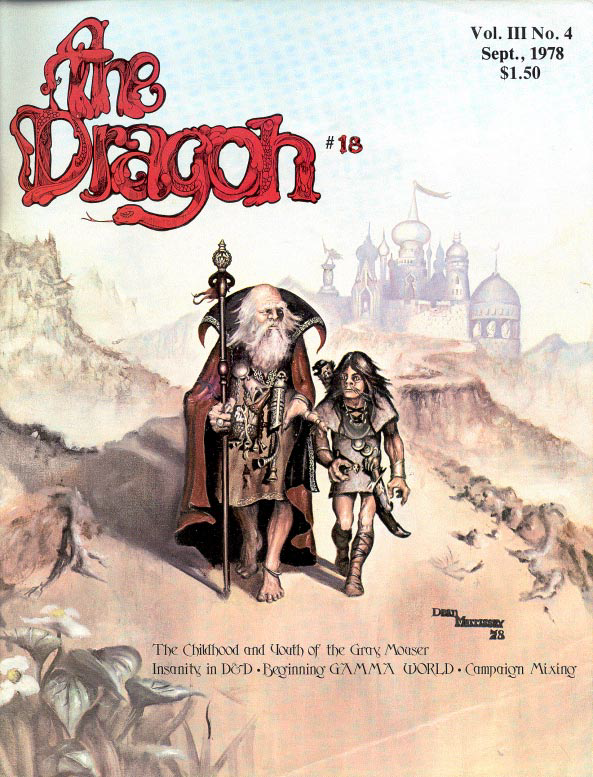
Dragon by Dragon – September 1978 (18)

Another week, another Dragon magazine. The last one was chock-full of stuff, how about this issue.

Traveller: The Strategy of Survival by Edward C. Cooper

As I was thinking, “I don’t remember any Traveller articles showing up before in The Dragon” I hit this line in the article, “I took advantage of the opportunity to observe the TRAVELLER phenomenon first hand” – ah – so this is at the dawn of Traveller.

I’ve never played Traveller, but I did create a character once (I was creating one character for every game I had a PDF of … though I skipped Exalted because after the first few steps I realized I just didn’t care enough to bother with it). This article appears to be about – well – keeping a character alive in Traveller. My favorite bit:

“Several other similar occurrences proved to me then that the success or failure of a character in most cases cannot be traced to “dice or chance” as often as it can to poor handling on the part of a player. I was both surprised and disappointed that some players even blamed a character or given situation for their own bad decisions. But then again, I was extremely excited, awed, by the skill some showed in manipulating their character’s life.”

That hits the spot for an old schooler – though it also shows that there were plenty of people back in the old days who were waiting for the new days with baited breath. Different strokes for different folks!

Reviews – Traveller, The Emerald Tablet, Imperium …

Well, imagine that! The reviewer appreciates that Traveller is not just D&D in space, but rather has its own “unique flavor and style”. The review is quite extensively, and I highly recommend it (yeah, I’m reviewing a review) for folks who don’t really know what Traveller is all about.

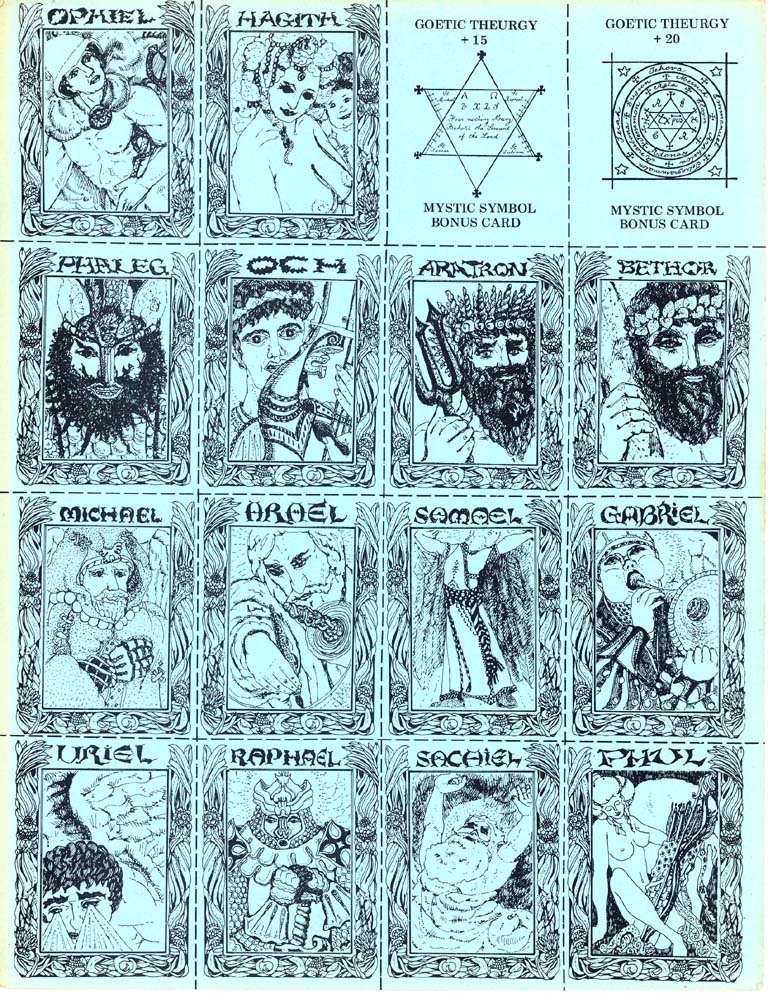
The Emerald Tablet is a set of fantasy wargame rules. The reviewer likes them, but admits he doesn’t know much about wargames. He likes that the magic system is based on ritual magic, which I know some people dig, but I always think it’s overrated. On the other hand – dig this sheet of Astral Force cards (click to enlarge … trust me, click it – click it now) I found at Boardgamegeek.com …

I don’t know what Phul does, but, hmm – anyways.

Imperium is another Game Designer’s Workshop product, a board game written by people who really love sci-fi literature. Apparently, Imperium is a game about the Terrans bumping up against the Imperium and the two sides fighting.

Pellic Quest is a computer moderated RPG (apparently a good thing, because computers are jerks like Dungeon Masters – see, the seeds of the new school were always there). Another sci-fi game, you start controlling a small planet in one of six roles (emperor, crusader, brigand, trader, droyds (robotic destroyers) or the zente (insect alien warriors). Each role needs different “winning points” and then go about making it happen.

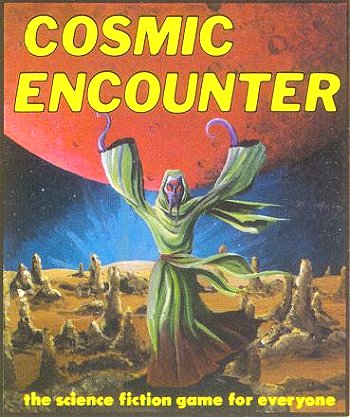
Oh, and those zente …

Pretty sweet.

Cosmic Encounter is a sci-fi variation on draw poker.  Apparently it is simple and easy to learn, and, most importantly, fun, although the hype that one really has to get into the head of the alien race they control is wrong. The game combines several elements of classic, abstract games, and I want people who think they’re game designers to embrace this notion. Don’t begin with setting, begin with rules and get to know all sorts of old card games, board games, etc. Then apply setting to the game rules. This is how D&D was born and manages to remain so popular – it works as a game. Well, it used to, anyways.

INSANITY, or Why is My Character Eating Leaves? by Keven Thompson

A worthwhile article – insanity is tough to handle in games. Kevin Thompson devises first a saving throw vs. insanity (which makes sense given the time period). The saving throw is based on a matrix between Intelligence and Wisdom – find the number, add character level to it, and then try to roll 1d20 beneath that number. Neat idea (and I’ll be using it in a post this week).

If you fail the save, you roll d12 (always nice to see the d12) on an insanity chart.

INSANITY CHART

1. Nutty
2. Kleptomaniac
3. Perverse
4. Psychotic Hatred
5. Childlike Trusting
6. Schizoid
7. Severe Paranoia
8. Acute Paranoia
9. Gibbering
10. Suicidal
11. Violent
12. Catatonic

The good thing about this list is that it is more behavior based than clinical. It’s pretty easy to see how these “insanities” could impact actual play in a game.

New Spells in D&D! by Paul Suliin

(Love the use of the exclamation point)

This article introduces new spells created by an actual play group using the rules for spell research in Dragon #5. The editor chimes in with the admonition that every spell needs to have a loophole via which it can negated somehow.

The new spells include Nature Call, Magic Missile II, Moon Runes, Flamebolt, Mystic Rope, Pit of Flame, Word of Warding, Force Field, Extend I, Shatterray, Wall of Water, Extend II, Beam of Blasting, Conjure Djinn/Efreet, Density Control, Extend III, Combine I, Call Spirit, Rust Monster Touch and more.

Let’s convert a couple to Blood & Treasure

Magic Missile II
Level: Magic-User 2
Range: Medium (150 ft.)
Duration: Instantaneous

As magic missile, but this spell conjures either one +2 arrow or two +1 arrows, with a like amount added for every fifth level advanced beyond 3rd (i.e. two +2 arrows or four +1 arrows at 8th level, three +2 arrows or six +1 arrows at 13th level, etc.)

Density Control (which would also make a great power for Mystery Men!)
Level: Magic-User 6
Range: Personal
Duration: 3 minutes

The spellcaster can alter the density of his body from a gas to steel. Such changes alter the spellcaster’s Armor Class, so that at minimum density he is immune to physical weapons, and at maximum density he is AC 18 and his hands strike as swords (1d6 damage). Density may be altered throughout the duration of the spell, and items in contact with the spellcaster’s body when the spell is cast are altered along with him.

Magic: Governed by Laws of Theory by Thomas A. McCloud

Man, I used to roll my eyes at these when I was a kid – theory? dude, I want a new class, new race, new spells, new adventures, etc. But I’m an adult now, so … naw, I still think the same way.

This one attempts to draw inspiration on the how’s and why’s of magic in D&D by examining such sage tomes as the 1960 Encylcopedia Britannica and Frazer’s The Golden Bough. Dude – it’s a game. Of course magic is treated casually. Real estate is treated pretty casually in Monopoly because it’s also a game – move and countermove, risk taking, a random element. Don’t overthink it!

Let Your Town Have A Purpose, or, How To Design A Town In Boot Hill by Mike Crane

Sometimes I think Jay Ward wrote the titles of these articles (bonus Nod points to anyone who gets that reference). Mike covers the best scale (1″ = 20′) to draw the map, the need to think about why the town is there in terms of who settled it and what they do (dude, it’s there to give gunslingers a place to have gun fights), etc. To be completely honest, articles like this are a waste. A bunch of random tables for generating an Old West town would have been much more helpful, or just a suggestion of watching some old episodes of Bonanza. Sorry – guess I’m in a salty mood at the moment.

Reviews Continued … Alpha Omega

Okay, apparently we’re not done with reviews yet. Alpha Omega was Battleline’s first stab at a sci-fi game. The reviewer thinks it reminds him of Buck Rogers or Star Wars … and that’s not an endorsement, according to the reviewer. After all, if we can’t beat all the fun out of sci-fi and make it boring and cerebral, then what’s the f-ing point? (I am in a mood). Here’s a sample of the review …

Alpha Omega is billed as “A game of tactical combat in space,” a claim supported by the rules.

Okay then. Apparently, the art is superb on the counters, but they’re hard to read, and the scale (one hex equals one light second) and turn time (6 seconds) are weird for space fights. The game is also two-dimensional, rather than three-dimensional, although the reviewer doesn’t think three dimensions would have any bearing on the game, and thus might as well not be there. The game is really just naval combat on a board that looks like space. The weapons are not realistic (just names, really), so the game also lacks believability (a bugaboo that has never bothered me personally) – hell, they named a couple alien ships Akroid and Balushi – the bastards. Uggh – life’s too short for this. Game looks fun to me, and the cover is pretty cool.

The Chamber of the Godgame by Mick McAllister

The what of the what? It’s a short article describing a dungeon chamber based on a scene in John Fowles’ “grand metaphysical dungeon novel” The Magus. I won’t go into it – find the article or find the book.

Gamma World: Fire Report; Setting Up The Campaign by James M. Ward and Gary Jaquet

Neat little behind the scenes look at the why’s and wherefore’s of turning Metamorphosis Alpha into Gamma World.

Birth Tables – Boot Hill by Stephen Blair

This one’s a collection of random tables. Let’s roll on them and see what we get …

Social Class: Ranch Related (didn’t know that was a social class, but okay)

Profession of Father: Homesteader (ah, now I get it)

Birth Order: Bastard (makes sense)

Skills: Facility with numbers (this bastard can multiply!)

Initial Purse: $75

Size of Spread: 5,120 acres

Guidelines for Mixing Campaigns: Androids, Wizards, Several Mutants, and Liberal Doses of Imagination, Well Blended by James M. Ward

This article is a quick guide to converting D&D characters to MA characters. D&D characters get a radiation resistance of 3, and MA creatures get no save vs. magic. Magic armor completely disrupts protein and disruptor blasts (good to know). The shielding, metal and energy fields of the Warden stop crystal balls and helms of teleportation from working (it’s science, dude, deal with it). Good article – reminiscent of the treatment in the old DM’s Guide.

Monkish Weapons and Monk vs. Monk Combat by Garry Eckert

Apparently, Garry read a book about Japanese weapons and decided to apply what he learned to monks (who are drawn from Chinese fact and folklore, not Japanese – oi!). Skip it.

Effective Use of Poison by Bill Coburn

Quick article that defines poison as Class A, B or C.

Type A is in potion form, and includes Arsenic and Hemlock. It kills 80% of the time in 2d4 minutes and if it doesn’t kill, leaves a person stricken for 1 week (meaning half strength, dexterity, constitution and movement).

Type B is in the form of gas, darts, cobras and needles. A neurotoxin, it brings death 50% of the time in 4d4 days and leaves people stricken for 1d3 days after being unconscious 30 minutes after poisoning for 1d4 days.

Type C comes from monsters. A hemotoxin, is has a 10% chance of killing a character in 1d4 days, and leaves people stricken for 1d10 days after being unconscious 1 hour after poisoning for 2d4 days.

Armor in this scheme provides a bonus to save vs. poison (-2 penalty for no armor, no adjustment for leather, +1 for chainmail and +2 for platemail).

Not a bad little system, really.

Comics!

Finieous Fingers and his pals meet the evil wizard, and discover that a good initiative roll and a magic wand go a long way towards evening the score between fighters and magic-users.

In Wormy, the trolls make the mistake of breaking one of Wormy’s pool balls. Jeez I miss this comic. Who has the next Wormy in them?

The Childhood and Youth of the Gray Mouser by Harry O. Fischer

This is Harry’s version of the Gray Mouser’s youth, Harry having been a major help in creating all of the major characters of Nehwon back in the day. It begins …

“Mokker was the Prince of Pimps in the Street of Whores in Lankhmar. He could just as easily have been King. He was tastefully and expensively dressed, with massive gold and jeweled rings one or more to a finger. He was exceedingly complex; calculating, sometimes ruthless, vulnerable to fits of whimsy, possessing an almost perpetual erection (as it behooves a whore-master to have), and more. He was generous, and delighted in both the giving and getting of surprises. His whores loved him for this, in addition to the fact that he felt not the slightest hesitation about correcting or revenging a wrong to one of his, no matter how slight the transgression. Mokker was a thorough and practical rogue given to sudden impulses, possessing large eyes, a sensual mouth and plump cheeks; a merry companion and a deadly enemy. He was clever, aware of it, and arrogant.”

No, D&D wasn’t for kids just yet.

Next we have this …

Okay then.

Non-Player Character Statistics by ???

This is another quickie – random tables for determining NPC stats based on their personality. Kinda cool. I’ll roll one up – we’ll say a madame from Tremayne named Durla …

Pride (Ego): Little – =1-% greed, -1% work quality

Greed: Loans things, sells items for normal* prices

Quality of Work: Normal

Okay, well, now I know. I think I’ll stick to my method in Blood & Treasure (on sale now!)

And there you have it, along with some nice little comic panels from McLean. Lots of stuff packed into 34 pages, and not a bad read overall. The spells were fun, and I like the poison rules. The reviews got me to look up some old games I’d never heard of, and the insanity rules put an idea in my head I’ll explore more this week.

Have fun boys and girls, and don’t be the last geek on your block to get Blood & Treasure

The She-Devil

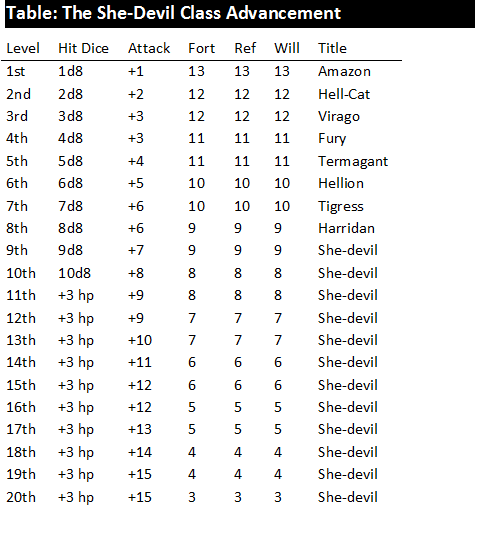
She-devils are females possessed not only of a righteous rage towards oppressors – especially male oppressors – but also the gift of puissance at arms from the goddess Scathach (or whatever war goddess best fits your milieu). Although she-devils often look the part of barbarians for their lack of armor (it is considered cowardly) and lack of covering (they have no shame in showing their feminine strength), they should not be confused for simple berserkers. She-devils are peerless swordswomen who draw their power from their vows of purity and dedication.

She-devils advance using the paladin XP scheme (see Blood & Treasure Players Tome).
Requirements: Strength and wisdom 11+, dexterity and charisma 14+

Hit Dice: d8 to 10th level, +3 hit points per level thereafter

Armor Allowed: Mail shirts (or shirts of leather, scale or ringmail*), shields and bucklers

Weapons Allowed: Any

Skills: Bend bars, break down doors, riding

She-devils must make a vow of chastity that can only be broken for a lover who has first defeated them in combat. If this vow is not upheld, the she-devil loses her special abilities. Her attack bonuses are reduced to that of a thief of the same level. She must atone to regain her abilities and must kill the person for whom she broker her vow. In addition, she-devils may not hire male henchmen, though they may use male hirelings and may adventure with male characters.

A she-devil enjoys a blanket +2 bonus to Armor Class due to her fluid fighting style and the blessings of Scathach. She-devils armed with a medium or larger weapon can deflect missiles, as a monk.

Although they balk at intimate human contact, a she-devil has a particular ability to affect the emotions of men. Once per day per level, a she-devil can exude an aura (30-ft. radius) that affects all men within the aura as either a crushing despair or cause fear spell. They can alternatively use this aura to inspire women as though using either the good hope or rage spell.

A she-devil can fly into a righteous rage under the following conditions: If she sees the weak being threatened or harmed by the powerful, if she sees a female humanoid being threatened or harmed, or if she is reduced to less than half her normal hit point total by a male humanoid (or monstrous humanoid). A raging she-devil enjoys a bonus to all saving throws, Armor Class and attack rolls equal to her charisma modifier. This rage lasts for 6 rounds. When it is over, the she-devil is fatigued (see conditions) for 1 hour. A she-devil can fly into this rage no more than three times per day.

A 6th level she-devil (hellion) may attack twice per round with a melee weapon.

A 9th level she-devil may establish a stronghold. She attracts a sisterhood of 2d6 amazons (of an alignment comparable to her own) and 4d6 commoners, all women and children, seeking shelter and safety.

A 12th level she-devil may invoke her righteous rage against male (or masculine) outsiders. In addition, the she-devil generates an effect equivalent to the protection from evil spell against these outsiders. 

* A shirt of armor grants a bonus to Armor Class one lower than a full suit – thus, a ringmail shirt grants an AC bonus of +2 instead of the +3 granted by a full suit of ringmail.

The Queens of Elemental Air

Readers may remember my Queens of Elemental Earth from a while back. Today, I introduce their rivals (are they rivals? I have no idea), the Queens of Elemental Air. Enjoy …

Among the entities that fill the air, the sylphs and air elementals and minor godlings and disembodied spirits, there are five rarefied entities commonly referred to as the Queens of Elemental Air. There is no kinship between these queens, and though they are not actively at war with one another, they each regard the others as neither here nor there – not with contempt, but with royal disinterest.

The queens dwell in the more refined quarters of the Elemental Plane of Air, in “palaces” of colored gas and variegated temperatures that they regard much as a human would a building of many rooms, each lovely in its own way. They are typically surrounded by their followers, and while each is powerful in her own right, they are also well guarded by their adoring court and by petitioners to their court.

All of the queens are permanently in a gaseous form, and can make themselves any size from tiny to huge. They typically appear as medium-sized humanoids. For each size category smaller, they increase their effective Hit Dice total by 2 and reduce their effective Armor Class by 2 (as they are more solid and thus easier to hit). For each size category larger, they reduce their effective Hit Dice by 2 and increase their effective Armor Class by 2.

All of the queens are immune to acid, electricity and sonic energy and resistance to cold and fire.

HELIA
Medium Elemental, Lawful (NG), Super Intelligence; Unique

HD: 21
AC: 26 [+2]
ATK 2 wind buffets (2d6) or cosmic ray (120′ / 2d6 damage + mutation)
MV Fly 300
SV F 3, R 3, W 3
XP 10,500 (CL 24)

Helia appears as a radiant queen surrounded by a glowing aura (as bright as daylight) with a diameter of 200 feet. Creatures that enter this glowing aura must pass a saving throw each round to avoid a charm monster effect. Helia commands the respect of both air and fire elementals, and they mingle about her in rapid orbit like electrons around a nucleus. Helia is fearsome and arrogant, the “center of the universe” who regards all creatures of less than solar or arch-demon status as beneath her dignity. She employs a series of servants to communicate with her major domo, a deva called Atron.

Special Qualities: Immune to acid, electricity and sonic, resistance to cold and fire, gaseous form, magic resistance 65%

Spells: At will–daylight, minor creation, searing light, shield; 3/day–cone of cold, legend lore, lightning bolt, sunbeam; 1/day–major creation, summon monsters IX (air and fire elemental creatures only), sunburst

NEA
Medium Elemental, Neutral (N), Super Intelligence; Unique

HD: 21
AC: 26 [+2]
ATK 2 wind buffets (2d6) or cosmic ray (120′ / 2d6 damage + mutation)
MV Fly 300
SV F 3, R 3, W 3
XP 10,500 (CL 24)

Nea dwells in a swirl of glowing, colored gases. She appears as a glowing, red female humanoid, airy and slightly indistinct, and surrounded by a devoted and adoring air and lightning elementals (2d6 of each, variable sizes), who create a wondrous clangor and exciting din as they dance and weave about their queen. Nea is a queen who appreciates excitement, though she rarely participates in it. She enjoys fetes and musicians and allows bits of her own gaseous form to enter their lungs and be expelled through their instruments.

Special Qualities: Immune to acid, electricity and sonic, resistance to cold and fire, gaseous form, magic resistance 55%

Spells: At will–color spray, light, protection from normal missiles, shield; 3/day–confusion, crushing despair, daylight, globe of invulnerability, good hope, polymorph other; 1/day–summon monsters VIII (air elemental creatures only)

ARGA
Medium Elemental, Neutral (CN), Super Intelligence; Unique

HD: 21
AC: 26 [+2]
ATK 2 wind buffets (2d4)
MV Fly 300
SV F 3, R 3, W 3
XP 10,500 (CL 24)

Arga dwells on a great chunk of emerald (about 8 feet long and 4 feet wide) that rests upon a windswept plateau of stone that floats in the bustling winds of the Elemental Plane of Air. She lounges on this “fainting couch”, a woman of luminous green gas attended by sylphs wearing hazy perfumes and guarded by two djinn. An equally sonorous court reposes on the plateau.  Arga is unconcerned with anything but herself, but will lend her air to those who promise a great reward. She takes lovers, even mortal lovers, often, and many now make up her court, for though she often tires of them and forgets them, she never drives them away.

Special Qualities: Immune to acid, electricity and sonic, resistance to cold and fire, gaseous form, magic resistance 45%

Spells: At will–chill metal, color spray, light, searing light, shield; 3/day–confusion, prismatic sphere, prismatic spray; 1/day–fusion (self with other), summon monsters VIII (air elemental creatures only)

KRYPTA
Medium Elemental, Neutral (N), Super Intelligence; Unique

HD: 21
AC: 26 [+2]
ATK 2 wind buffets (2d6)
MV Fly 300
SV F 3, R 3, W 3
XP 10,500 (CL 24)

Krypta is the “hidden one”, a shy spirit who prefers solitude to the goings on of court. Her form is transparent and translucent, but surrounded by an aura of white gas that outlines her. She nonetheless travels with two aerial servants, one tinged red, the other blue, who act as her valets and bodyguards. She roams the elemental sky, and for this reason often attracts the attention of dragon horses. Krypta appreciates wit and intellect, but despises the boastful and arrogant, enjoying laying these folk low.

Special Qualities: Immune to acid, electricity and sonic, resistance to cold and fire, gaseous form, magic resistance 55%

Spells: At will–cause fear, light, searing light; 3/day–invisibility, ray of enfeeblement, fear, stoneskin (the stone skin envelops her form and appears as white crystal); 1/day–meteor swarm, summon monsters VII (air elemental creatures only)

XENA
Medium Elemental, Neutral (N), Super Intelligence; Unique

HD: 21
AC: 26 [+2]
ATK 2 wind buffets (2d6)
MV Fly 300
SV F 3, R 3, W 3
XP 10,500 (CL 24)

Xena is a stand-offish woman, slightly paranoid and well guarded by 10 large air elementals. She dwells within a crystal sphere that float  through the Elemental Plane of Air, a sphere that can open and close by her will alone. She appears as a female humanoid of luminous blue gas that sometimes flares with flashes of electricity, especially when she is angry.

Special Qualities: Immune to acid, electricity and sonic, resistance to cold and fire, gaseous form, magic resistance 65%

Spells: At will–sleep, suggestion; 3/day–globe of invulnerability, haste, iron skin (her form is enveloped by a sky blue suit of plate armor), lesser restoration, polymorph other; 1/day–fission, summon monsters VII (air elemental creatures only)

RADA
Medium Elemental, Chaotic (NE), Super Intelligence; Unique

HD: 21
AC: 26 [+2]
ATK 2 wind buffets (2d6)
MV Fly 300
SV F 3, R 3, W 3
XP 10,500 (CL 24)

Rada appears as a female humanoid of translucent air, with a black orb floating in the midst of her head. Her arms are long and her fingers and toes come to talon-like points. Rada’s court is composed of belkers and disgruntled aerial servants, not to mention a few incorporeal undead, like spectres. She is a dire queen who is said to be worshiped by subterranean peoples by sacrificing the weak in caverns filled with poisonous gas.

Special Qualities: Immune to acid, electricity and sonic, resistance to cold and fire, gaseous form, magic resistance 45%

Spells: At will–doom, faerie fire, inflict light wounds, silence; 3/day–cause disease, enervation, gaseous form (other), ray of enfeeblement, rusting grasp; 1/day–energy drain, improved invisibility, summon monsters VII (air elemental creatures only)

Alien Booze

Star Trekkin’ across the universe can build up a mighty thirst, and there’s a good chance that the dive on Rigel-5 you just entered doesn’t have MGD on draft. Here are some other options.

Table I – Where

1. Venusian
2. Martian
3. Jovian
4. Saturnian
5. Mercurian
6. Plutonian
7. Neptunian
8. Denebian
9. Altairan
10. Cygnian
11. Betelgeusian
12. Polarian
13. Andromedan
14. Cetian
15. Algolian
16. Pleiadeian
17. Rigelian
18. Aldebaran
19. Antarean
20. Arcturan

Table II – Descriptor (roll 1d4 / 1d10)

1-1. Acid
1-2. Bitter
1-3. Black
1-4. Blood
1-5. Blue
1-6. Boiled
1-7. Brown
1-8. Bubbling
1-9. Copper
1-10. Crimson
2-1. Dark
2-2. Death
2-3. Dry
2-4. Fire
2-5. Fizzy
2-6. Frost
2-7. Gold
2-8. Green
2-9. Grey
2-10. Heavy
3-1. Jumping
3-2. Lite
3-3. Malt
3-4. Molten
3-5. Orange
3-6. Pale
3-7. Purple
3-8. Red
3-9. Rotting
3-10. Royal
4-1. Salt
4-2. Scarlet
4-3. Silver
4-4. Slime
4-5. Sour
4-6. Spiced
4-7. Spitting
4-8. Sweet
4-9. Viscous
4-10. Yellow

Table III – What

1. Ale
2. Beer
3. Brandy
4. Brew
5. Cider
6. Punch
7. Whiskey
8. Wine

Table IV – Possible Side Effects

01-04. Affected as though by male or female hormones (50-50 chance) – a noticeable change
05-08. Blind for 1d4 days
09-12. ESP for 24 hours
13-16. Fall in love with first person of opposite sex (or a reasonable facsimile thereof) that you see
17-20. Gain 1d10 pounds overnight
21-24. Grow dorsal fin and/or webbing between toes and fingers (or some other DNA snafu)
25-28. Hair falls out
29-32. Hair (green) grows on palms and tongue; falls out in 1d4 weeks
33-36. Hair turns blue or white or some other weird color
37-40. Increased intellect for 1d4 days, then weakened for 1d6 days
41-44. Increased strength for 1d4 days, then weakened for 1d6 days
45-48. Infravision for 1d4 days
49-52. Levitate for 24 hours
53-56. Lose 1d10 pounds overnight
57-60. Lose sense of taste for 1d4 weeks (5% chance this is permanent)
61-64. Memory loss for 1d4 days (per sitcom amnesia)
65-68. Overactive salivary glands for 1d4 days (sound like Daffy Duck)
69-72. Projectile vomiting (1d4+3 feet)
73-76. Put into highly suggestive state for 24 hours
77-80. Sleep for 1 week
81-84. Speak words in reverse order for24 hours
85-88. Temporary insanity for 1d6 days
89-92. Visited by pooka in form of green horse or pink elephant
93-96. You can see dead people
97-100. Emit highly flammable gases from every orifice for 24 hours

Three Villages of Cush

What an insane week!

I’m a day or three away from releasing NOD 16 and B1 – The Tumbled Towers, an intro module for Blood & Treasure with some pre-generated characters. B1 – The Tumbled Towers will be a free download, and probably a pretty cheap print product (cause it’s short!).
Since things are so berserk lately (it’s quarterly report time in my real job), I’m going with another Cush preview today. Enjoy!

15.41 Kaba: Kaba is a large village of 250 people set amidst large groves of butter trees, which produce a fruit favored by both humans and baboons. The village has tall stone walls with locked gates and narrow streets. During the day, people are out and about, tending the groves, hunting in the jungle, cooking their food, repairing tools, etc. As soon as the sun begins to sink, though, they lock the village gates and go inside, locking their doors and not opening them for anything. This is because a band of ghouls has found its way to their village, finding the secret places in the jungle where they have buried their dead and feeding on them. They have made incursions into the village and killed several men and women, turning them into ghouls as well, who are now obsessed with feeding on their relatives and loved ones. The village leader, a sage called Sambwa the Wise (Adept 3; 4 hp), has no idea what to do about the ghouls. The people will not allow him to dig up the bodies of their ancestors and burn them (though the newly died are burnt now, outside the village), and the graveyards are not safe to approach anyways. He has sent a few warriors out to other villages seeking help from monster slayers.

16.26 Nameless Village: On a hill overlooking the lazy Jamba River there is a village (pop. 230) surrounded by a palisade. All of the buildings in the village are narrow towers built of limestone quarried in the middle of town. The people of this nameless village are squat, thick, grey-skinned humanoids with toothless mouths who communicate with sign language and a clicking sound they make with their thick tongues against the roof of the mouth. The people are accomplished sculptors and surprisingly agile for their build.

The village supports several sculptors, a master mason and an inn. The inn has been built into an empty quarry, with people sleeping in deep, narrow alcoves dug into the walls. The innkeeper serves palm wine in crystal decanters and slugs and snails spiced with ground pepper. The town’s main protectors are a quartet of 1st level fighting-men armed with spears and falchions. The village has no apparent leader.

The village’s treasury contains a silver falchion, four golden-brown capes (worth 5 gp each), eleven tiny ivory flutes (worth 20 gp each), a pair of copper gauntlets with only three fingers (worth 100 gp), a brass-capped bone cane (worth 200 gp) and a lead (triple weight, AC 14) cuirass bearing the symbol of Atum.

18.02 Chimpanzees: A tribe of 100 intelligent chimpanzees dwells here in a collection of odd huts reminscent of the mud-nests of the termites, though larger. Each hut ranges in height from 15 to 30 feet, and can only be entered from above. Between the huts there are pens for the chimpanzee’s dogs – some for riding, others kept for food. The warriors of the tribe (there are 40) carry shields and wield long gnarled clubs. The chimpanzees are led by a grizzled male called Bobo, who smokes a long, iron pipe and wears a tattered purple cloak. A diamond stick pin worth 500 gp is hidden in the hem of the cloak.

Dragon by Dragon – August 1978 (17)

No, I didn’t stop doing Dragon by Dragon, just got busy last week. Now that I’m back, let’s see what the August 1978 issue (number 17) has to offer.

First and foremost, we have a cover that reminds me of some of the pinball machines of the era, or perhaps the side of the bitchin’est van to ever ply the byways of Lake Geneva, Wisconsin.

Article #1: Vampires in the Dungeon by Clayton J. Miner

The article seems to work off the notion that vampires are total party killers, which may be true, depending on the level of the party. The article goes on to explain why, taking into account their different abilities and how to use them to best effect – including charming multiple party members and having them wait to be drained of blood later, using the dungeon rodents as a spy network, etc. Some of the article seems to assume things about vampires that I don’t think were addressed in the rules – i.e. the older a vampire is, the more resistant it is to holy symbols (which may be true, if you’re considering the vampire’s Hit Dice correspond with age). It also posits the best ways to destroy a vampire. Not a bad article, but to be frank, the monster description and a little imagination from referees and players would be just as good.

Article #2: Chainmail Revisited – Jousting in D&D by Jon Pickens

Ah – anyone who has tilted in the FLAILSNAILS Jousting Tournaments run by the excellent Mike Davison is already aware of these rules. This article works on addressing a few perceived shortcomings of the rules, i.e. “I’m a Lord, and he’s a lowly Level 1. IT ISN’T FAIR!”

There is also a cartoon from Will McLean, who will go on to be, in my opinion, one of the shining lights of Dragon’s humor department for many years to come.

Article #3: Dragonlord review by Glenn Williams

If I’m honest, I never spent much time reading reviews in Dragon Magazine. Reading reviews to old games is even less interesting to me, but I’m going to do it anyways. Williams finds the art, by Morno, to be top drawer. The game concerns battles between dragon riders. Williams points out that the map, while pretty, is screwed up because it shows everything from the side, when it really should be top-down. In addition, the map sections do not align correctly, and the grid is a set of Cartesian squares – a hex grid would have been better. The rules, Williams says, are also too complex. Still, he likes the concept, and thinks the game can be improved, such as playing it with the Warriors of the Green Planet map.

I couldn’t find the game online for sale, but there are some other Wee Warriors products at EBay.

Article #4: Faceless Men and Clockwork Monsters

Why wasn’t that the name of an actual game? This article presents a Dungeons & Dragons adventure aboard the Starship Warden (from Metamorphosis Alpha). I’m pretty familiar with this story, but if you haven’t read of this genre-bending excursion, you should try to find it.

Next comes a great add from Dragon Tooth Fantasy Figures, proclaiming the war between the Saurian Empire and Amphibian Confederacy. Love the art …

 I think I get more inspiration from the ads of Dragon Magazine than the articles – quick, dynamic ideas with catchy art.

Article #5: A Wizard with a Difference by James M. Ward

Love the editor’s note …

“ED. Note: The following is recommended as a source of bedevilment to be used by DM on their NPC’s. Some of the possibilities here will drive the average group of PC’s wild when trying to deal with running NPC‘s.”

Prepare for a piece of pure opinion by yours truly – D&D is more fun when the DM is trying to kill the characters. I don’t mean by cheating, but by being a clever, inventive bastard.

The article presents the idea of specialist wizards, using the following types: “Wizard of Aggression”, “Wizard of Defense”, “Wizard of All Things Rustic”, “Wizard of Control”, “Wizard of Tenaciousness” (yeah, I’m picturing Jack Black), “Wizard of Detection”, “Wizard of Fire” and “Wizard of Movement”. One can see some overlap with the later specialists – Conjurer, Necromancer, etc., but these do sound more fun.

The concept is that these wizards get two spells of their specialty per level (I think, the rules could be a bit clearer) and have a percentage chance of casting them based on the level of the spell and the level of the magic-user. Ward suggests these wizards are best used as NPC’s, which is a good point. The average NPC has a short lifespan in combat, so doesn’t necessarily need a vast list of spells, many of which are designed for exploration, which the NPC doesn’t need.

There are plenty of new spells or modified spells – a really fun article to read.

Article #6: Sights & Sounds in Dungeons & Dragons

Another one of those darned useful sets of random tables, this one for random sounds and random sights in a dungeon. Both use a d20, though the sounds table actually runs to 21, with 21 being a bit of a joke (rattling dice/dungeon master’s scream of anguish/garbage disposal/etc.)

Article #7: Variant Monster Dept.

This article gathers a few monsters, including the Magic Munchkin by Michael Kolakowski, the Scholar by Patricia LaPointe, and the Crs’tchen by Dennis Chapman. I love the fact that none of them share the same statistical arrangement – heck, the Munchkin has no stats to speak of. Just for fun, I’ll convert the Scholar for Blood & Treasure:

SCHOLAR
Medium humanoid, Neutral (N), High Intelligence; Symposium (1d10+10)

HD: 1 to 3
AC: 10
ATK: By weapon
MV: 30
SV: 1 HD = F15 R15 W12 / 2 HD = F14 R15 W12 / HD 3 = F12 R14 W11
XP: 1 HD = 100 (CL 2) / 2 HD = 200 (CL 3) / 3 HD = 300 (CL 4)

Scholars are short, bearded men in tweed robes with leather patches on the elbows. They smoke foul-smelling pipes than can produce enough smoke to provide an obscuring mist. There are three levels of scholars.

Instrictors (1 HD) know two spells, confusion and read obscure languages. Confusion is cast by answering a simple question, the answer being in an obscure language.

Associate Profussors (2 HD) know three more spells: Fear, time stop and book missiles. Fear takes effect after muttering about term papers being due. Book missiles works as magic missile, save the books inflict 1d8 points of damage.

Fool Profussors (3 HD) have three ultimate spells. The first is power word stun (the incantation being “Surprise Quiz Today”). Academic dust does 3d6 points of damage and can paralyze the mind for 2-4 turns.  The final spell is cause boredom, which works as a sleep spell that affects any level/HD of creature.

One powerful incantation causes scholars to be seized by instant cardiac arrest – “Tenure denied”.

Article #8: The Monk and Bard in ‘DUNGEON!’ by Jon Pickens

Always love Pickens’ stuff. This one introduces the bard and monk into games of DUNGEON!. I love that game – so sorry that I got rid of my copy years ago. I need to find a copy online (and yeah, I know Hasbro is going to do a reprint – I’d rather have an old game – I’m weird that way).

Article #9: Tesseracts by Gary Jordan

These have been covered nicely at Aeons & Auguries. Jordan covers putting cubic tesseracts into a dungeon do drive map makers nuts. A worthy goal!

Article #10: Ogre Piece by Piece by Jerry Epperson

I’ll admit it. I played it years ago, and found it somewhat boring. If you do love the game and want some variations from 1978, find this article.

Article #11: Design Journal – Boredom and the Average D&D Dungeon by James Ward

If you know James Ward, you know “average” probably ain’t happening in any dungeon he’s written. In this article, he described the idea of filling new dungeon levels with “areas of history” – i.e. themed sections based on history, like an Ancient Egypt area with minions of Set, evil high priests of Set, an 11th level grave robber thief, etc. He also covers Ancient India, The Far East and The Future Machine Age. Good advice, of course, especially for fun-house dungeons.

Article #12: A Short History of Adamantite by Charles Sagui

Short indeed. He labels adamantite as an alloy of Mithril, Carbon, Iron and a few secret ingredients – technically known as Mithriferral Carbide. It is 4/5 the weight of steel, and provides a +2 on AC and hit probability for weapons. It is much more expensive to work and much more difficult to enchant. Sagui gives some prices for different armors (plate armor is 20,000 gp, chainmail 14,000 gp, daggers 1,500 gp) as well.

Article #13: Messengers of God: Angels in Dungeons & Dragons by Stephen H. Dorneman

Dorneman introduces the idea (new at the time, of course) of some non-omnipotent Lawful beings to counter all those devils and demons. He describes four types of angels – Type I (Angel of Wrath), Type II (Angel of Healing), Type III (Archangel of Mercy) and Type IV (Seraphim). Honestly, it never occurred to me to use “types” of angels to counter the “types” of demons. Neat article.

Article #14: Natural Armor for Monsters in Monsters, Monsters by Doug Miller

This one is just what it sounds like. If you don’t have Monsters, Monsters, it won’t do much for you.

Comics

Fineous Fingers is saved from the Antipaladin by the evil wizard, because he needs a thief – not a bad way to handle an encounter in your next game, especially if the needed character is a major pain in the ass to the rest of the party.

Wormy plays a nasty trick on some goblins and tree trolls.

Article #15: Warp War review by Tony Watson

Warp War was a mini-game by Metagaming (click here for Warp War on Boardgame Geek).

From the description, it almost sounds like Car Wars in space – you have to build your ships and then use them to fight over star systems. Watson likes it, and I must admit it sounds fun.

And that brings us to the end. This one is pretty packed, with lots of great articles. Definitely one to look out for!

Friday Grab Bag + Chance to Win FREE PDF (OMG)!!!

Haven’t done a grab bag in a while, and I stumbled upon a few things this morning that were worth it …

ITEM: MESSAGE BOARDS

Still looking into setting up message boards. I’m a born penny-pincher, so making the leap into paying for monthly hosting is a tough one for me. Stay tuned. In the meantime, feel free to leave comments on the pages.

ITEM: EMPRESS OF THE OCEAN

If you’re running a game set in this time period, and you don’t make use of this, you might in fact suck. Via Retronaut.

ITEM: HOT KNOWS NO CENTURY

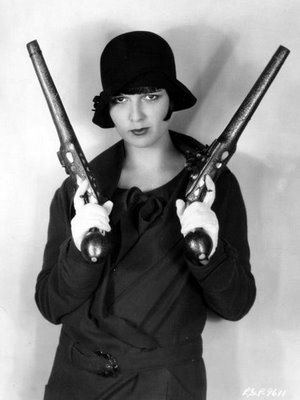
Louise Brooks. Just needed to post this.

Oh, and if they’d done John Carter in the 1920’s, she’s your Deja Thoris.

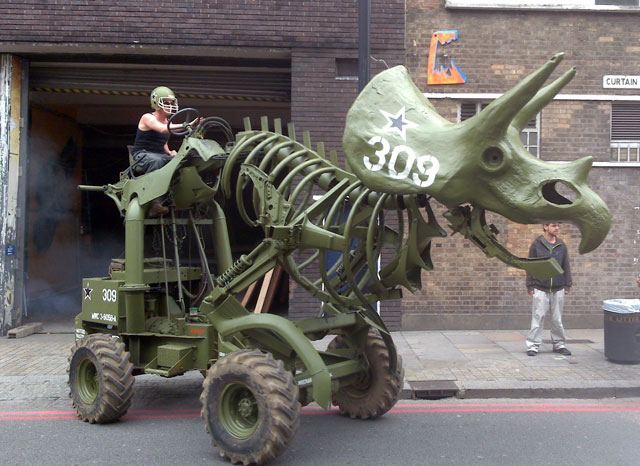
ITEM: THINKING ABOUT BUYING A GREEN VEHICLE

T-tops was always my favorite (and yes, it was to a dinosaur, and they’re called brontosaurus not apatosaurus and Pluto’s a planet and scientists can just bite me). Via LaughingSquid

Here it is in action …

ITEM: REAL ADVENTURERS

They look like this. I know he didn’t, but Fridtjof Nansen looks like he could go toe-to-toe with a remorhaz. Via Retronaut.

ITEM: CoC FODDER

There’s a game here … Cultist who travels in powerful circles decides to build a new tower of Babel in London, SAN checks follow. Via Retronaut.

ITEM: LAND OF NOD GAME TIME

First person to identify all the mistakes in the picture above wins a free PDF of their choice of something I’ve published. Once I identify the winner and call them out, they’ll need to email me so I can email them the link and password. Via Retronaut (oh, and the artist’s inability to draw worth a shit does not count as a mistake)

Thanks for hanging with me this week – have fun on the internet!

Blood & Treasure Complete is … Complete!

OK – last bit of advertising for a while, I promise!

The complete version of Blood & Treasure, which puts the Players Tome and Treasure Keepers Tome together in one package is now on sale as a …

Hard Cover for $35.99

Soft Cover for $22.99

E-Book (PDF) for $11.99

As before – if you buy a hard cover, send me the Lulu receipt (email address over there to the right) and I’ll send you a link to download the e-book for free.

Glad to finally be finished – hopefully no new errors have crept into it. I’m sending this one straight out without seeing the preview copies, as a few people (you know who you are) have been waiting anxiously. If the game pays for itself plus a little extra, I’ll be ecstatic, but if it does no more than give people an enjoyable game to play, I’ll be satisfied.

I’ll try to get a more substantive post up for you to read tomorrow – thanks for your patience.