Wait – you haven’t already seen Wormwood’s stuff? What the … start clicking for God’s sake. Go! Now!
Cobbled Skald

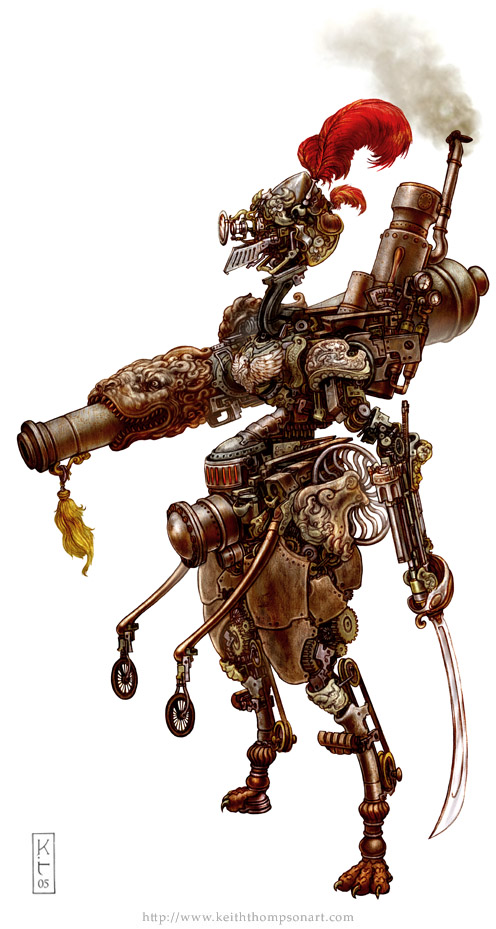
Brass Lion
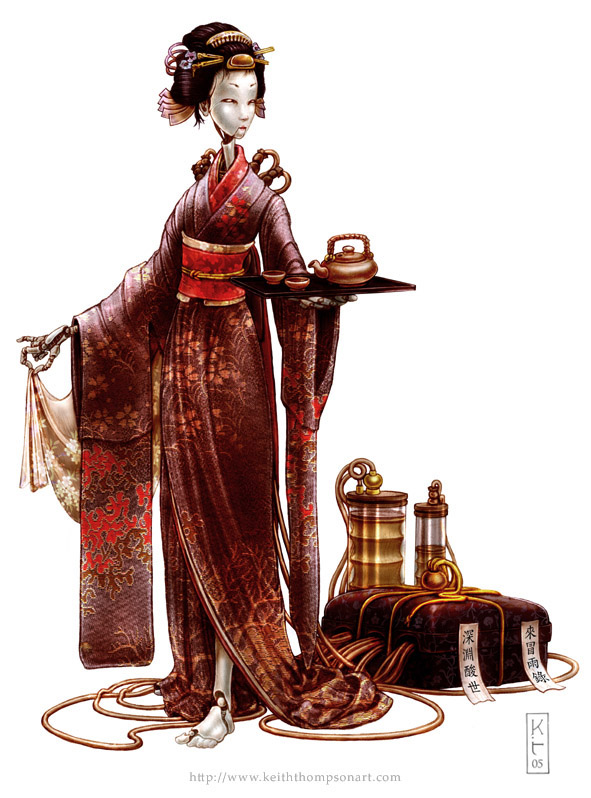
Karakuri
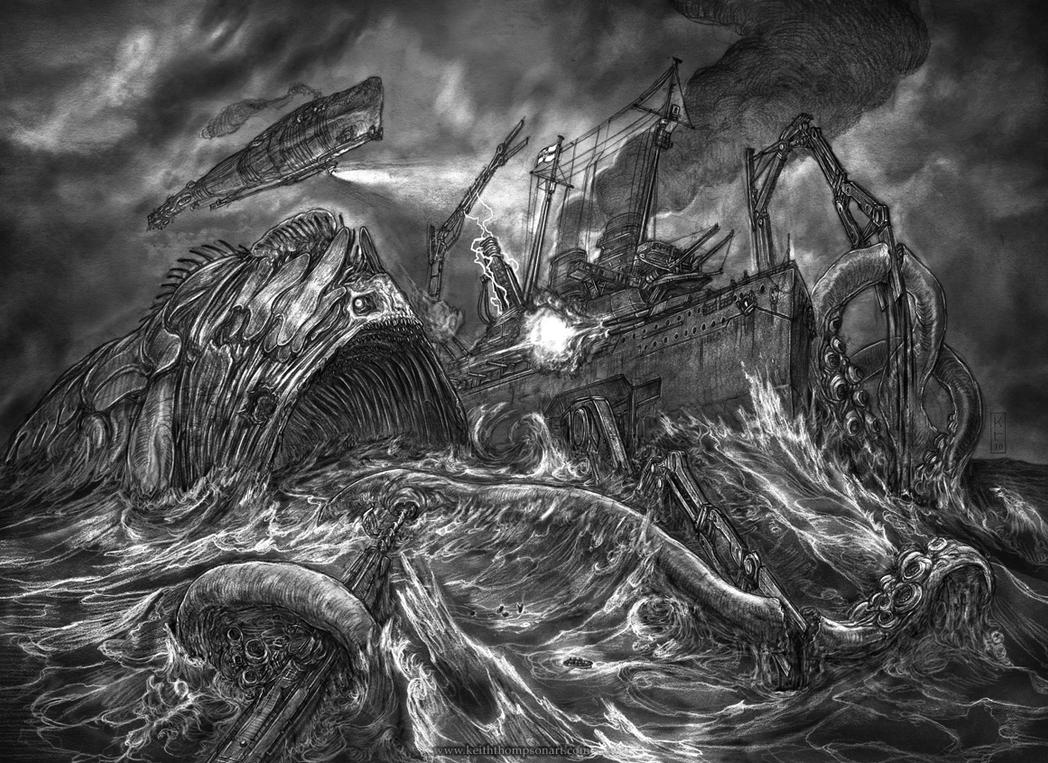
Naval Battle
Pestilential Advent

Merchant
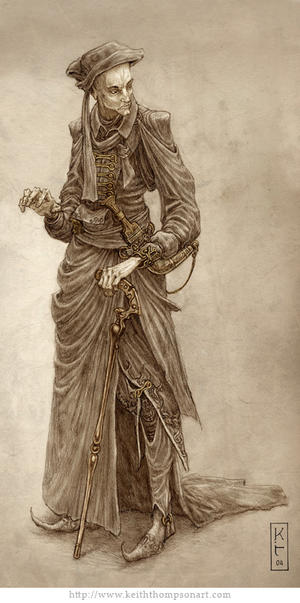
Pit Sylph
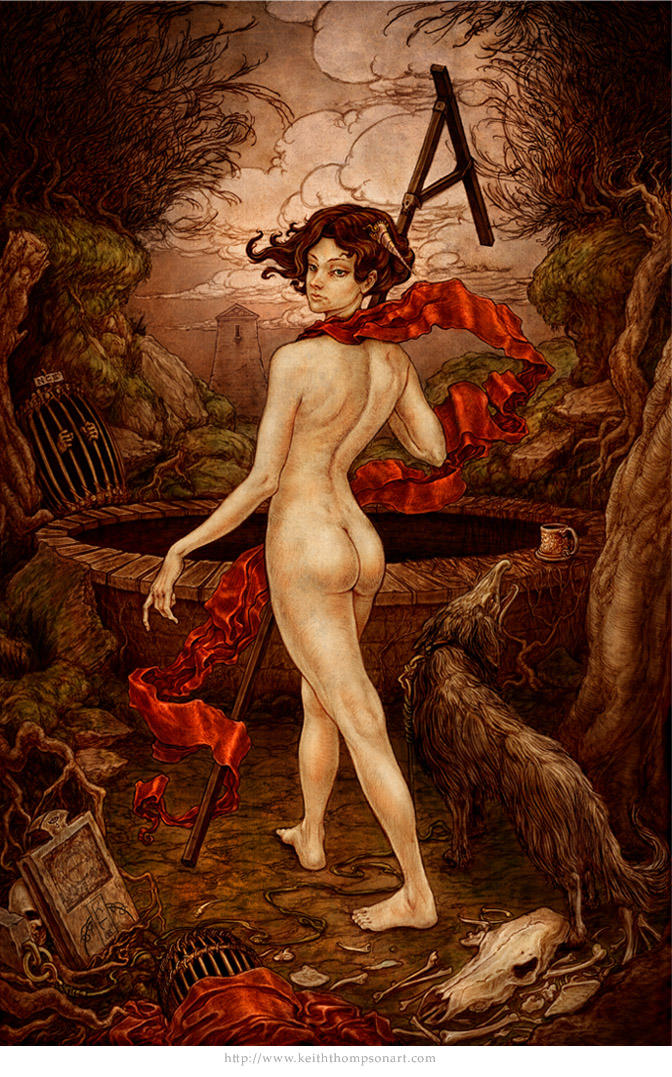
Loper
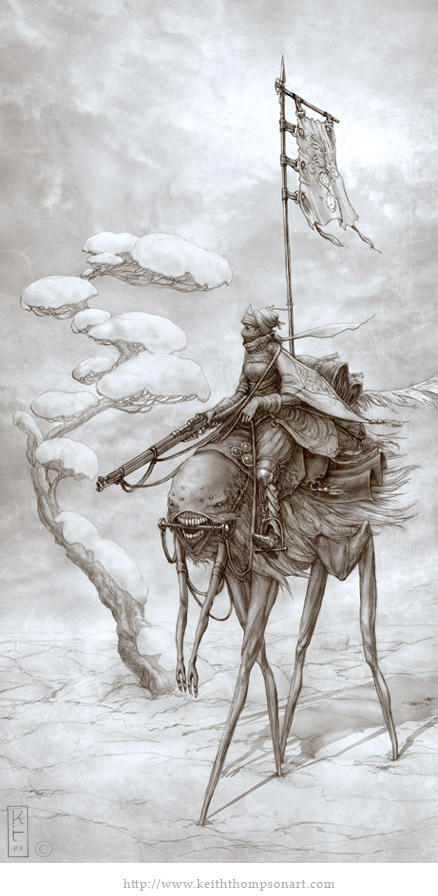
Wait – you haven’t already seen Wormwood’s stuff? What the … start clicking for God’s sake. Go! Now!
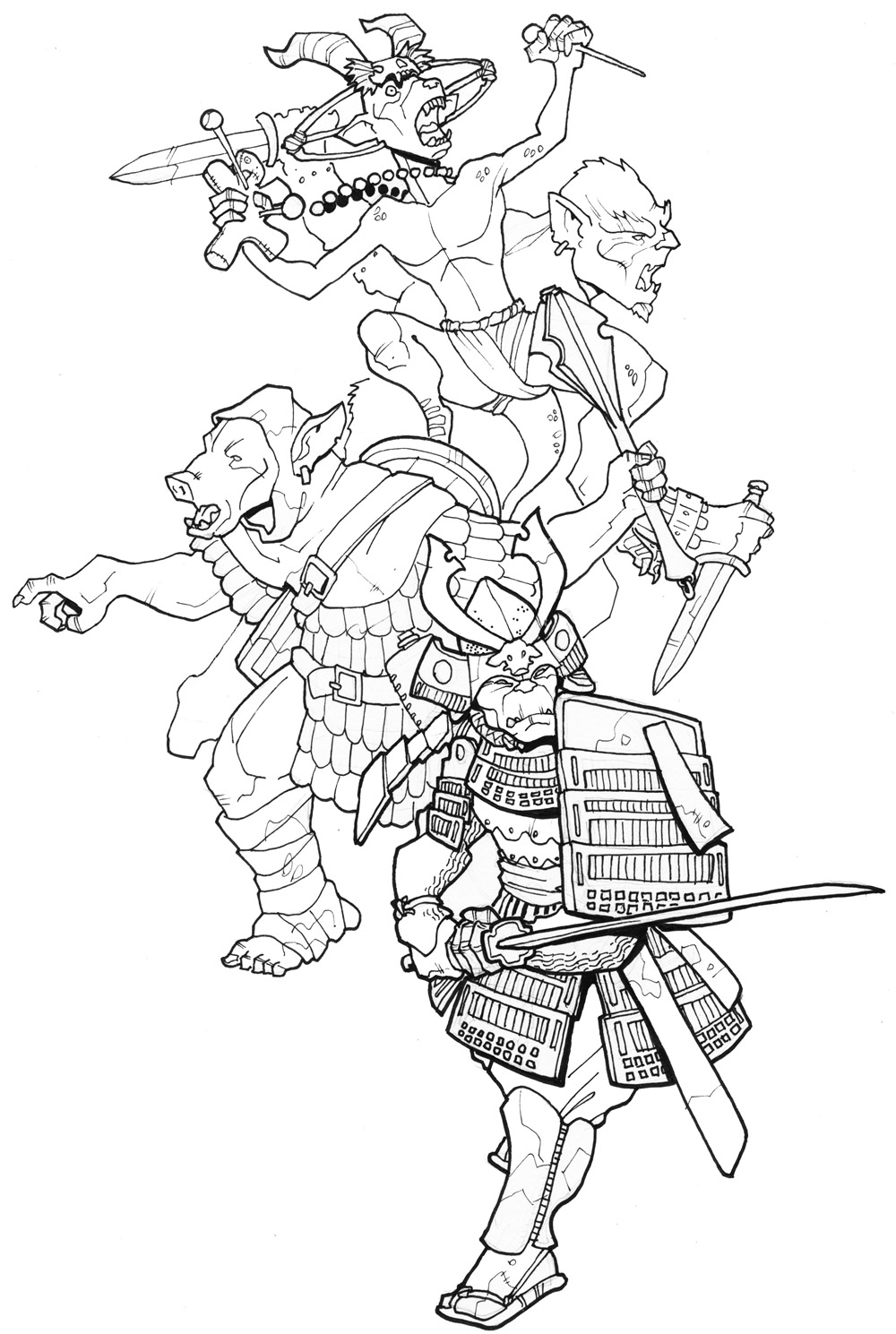
Quick post today – I’m in meetings pretty much all day. I said a couple days ago I was going to work out some rules for using drow, duergar, svirfneblin, hobgoblins, orcs, kobolds and bugbears as PCs – mostly because they make sense in terms of running a campaign in the Hell hex crawl I’m writing. My hope is that I can come up with something unique and flavorful for these folks – some random characteristics, racial stats, race-as-class stuff, etc. I commissioned Jon Kaufman to draw a couple “monster parties” for me and I got the results yesterday. Here’s one of them …
Now that I’ve covered all the various shades of “color dragons”, it’s time to pull one more blog post out of this concept and look at cross-breeds.
Dragons are haughty creatures, so interbreeding between different colors is rare. For one thing, they tend to live in different regions and are quite territorial, hunting in and defending their territory and rarely moving outside of it. But, in the course of draconic events, it does happen that a macho blue dragon will wander into the territory of a sexy green dragon and nature takes its course. The product is a dragrel (mongrel dragon).
Dragrels are not favored by their pure-blooded parents for a variety of reasons. First and foremost, inter-species couplings produce only a single egg. Since dragons are not rapid breeders, sitting on a single egg for several months is an inefficient way to survive. Dragrels are also smaller than pure dragons and wingless, resembling reptilian wolves or greyhounds. They are not as physically powerful as dragons, but make up for it with intelligence and magical ability, and this enhanced magical ability that makes them a threat to their parents. A dragon mother will hatch a dragrel, but then usher it out of her cave and only permit it to dwell in her territory for a few years. Finally, dragrels, like mules, are sterile, making them a genetic dead-end for their parents. Dragrels are always male.
Making A Dragrel
A dragrel has a number of Hit Dice equal to the average of a small dragon of its parents’ color types. In other words, a blue-green dragrel will have hit dice equal to the average of a small blue dragon and a small green dragon.Dragrels have the lower of their parents’ Armor Classes. They attack with two claw attacks for 1d4+1 points of damage and a bite attack for 2d6 points of damage. They have a movement rate of 15 and cannot fly, though their claws allow them to climb at a movement rate of 12.
Dragrels do not have a breath weapon, but they are immune to the breath weapons of their parents. Dragrels always have the power of speech and they always cast spells, combining the spell abilities of their parents’ color types.
Most dragrels live apart from other creatures, avoiding true dragons. Some move close enough to human or humanoid settlements to cultivate a small cult or following, trading their magical abilities and intellect for worship and tribute.
A dragrel’s scales combine the colors of its parents. You can roll on the following table to see how this comes out:
1. Striped, with the father’s color being the dominant color on the dragon.
2. Spotted, with the mother’s color being the dominant color on the dragon.
3. Mottled, with neither color predominating.
4. Blended, as in blue-green or, for the issue of a red and white dragon, pink.
Sample Dragrels
Using the two combinations mentioned above …
River Dragrel (cerulean father and moss mother)
When a gregarious cerulean dragon came across a moss dragon with an inferiority complex, he found her quite easy to charm. The result was Rochtorine, a dragon with cerulean scales covered by a winding pattern of mossy stripes. Rochtorine now dwells in the river county upstream from his mother, annoying travelers with his tall tales, insistence on tribute and need to outdo everybody he meets in everything they do (and tendency to destroy those he cannot best).
Rochtorine: HD 7 (34 hp); AC 2 [17]; Atk 2 claws (1d4+1) and bite (2d6); Move 15 (C12); Save 9; CL/XP 10/1400; Special: Immune to electricity and green slime, spells (4 x first level, 4 x second level).
Pink Dragrel (white father and red mother)
There is an immense volcano that slumbers noisily in the northlands, its base covered in snow most of the year. A red dragoness dwells in a cave near the peak, toasting her scales in the lovely warmth, while an old white dragon, savage and canny, dwells near the base overlooking a creeping glacier. The two once produced an offspring that calls himself Kandovesus. Upon reaching maturity, Kandovesus beat a hasty retreat from the peaks into the wooded valleys below, and now dwells in a moss-covered cave in the shadow of his mother’s and father’s territories. He preys on travelers, selling them “protection” in return for an ox or a few baubles. Kandovesus has scales of a deep, coral hue.
Kandovesus: HD 7 (31 hp); AC 2 [17]; Atk 2 claws (1d4+1) and bite (2d6); Move 15 (C12); Save 9; CL/XP 10/1400; Special: Immune to cold and fire, spells (4 x first level, 1 x second level, 2 x third level).
—
Image from HERE

Three more from the Ante-Hell. Perdition awaits …
110.5. Imp-N-Cage: Somewhere in this hex of magma pools and basalt landforms, hanging from a chain beneath a natural land bridge that spans a flow of magma, there is an imp inside a cage constructed of logical fallacies. The cage is too convoluted for the imp, but perhaps a character with high intelligence could solve it. To simulate this, the Referee can prepare three riddles. If a player can answer all three of them, they succeed in freeing the imp, which will swear eternal loyalty (ha!) to its rescuer and even become their familiar if they are a magic-user. Each riddle that is answer incorrectly, however, costs the character one point of their intelligence score, permanently, as they find themselves trapped in logical fallacies. Of course, as difficult as answering the riddles is, the swarm of adamantine wasps that guards the bridge is even worse.
ADAMANTINE WASP SWARM: HD 15 (76 hp); AC 0 [19]; Atk 1 sting (3d6+poison); Move 5 (F14); Save 4; CL/XP; 16/3200; Special: Poison (harden into ice, 1d6 damage per round, shatter when dead), magic resistance (12%).
IMP: HD 2; AC 2 [17]; Atk 1 sting (1d4 + poison); Move 6 (F16); Save 16; CL/XP 6/400; Special: Poison tail, polymorph, regenerate, immune to fire.
110.29. Forlorn Golem: A stone golem sits on the banks of the Acheron, its feet in the black waters, chin on hands, elbows resting on knees. The golem was created by a mad wizard to besiege Hell, the wizard miscalculating the width and depth of the Acheron. Abandoning the concept, the wizard moved on and left his creation by the river to await new orders. He sits there to this day.
STONE GOLEM: HD 15 (60hp); AC 5 [14]; Atk 1 fist (3d8); Move 6; Save 3; CL/XP 16/3200; Special: +1 or better magic weapon to hit, immune to most magic.
118.51. Natural Amphitheatre: There is a natural amphitheater located in this hex. The amphitheater has been accentuated with seating carved into the reddish-brown rock. Against the back of the amphitheater there is what appears to be a bas-relief (deep relief) of a warrior in Greek armor, spear and shield in hand. He appears to be fighting, with his back against the wall. The statue is actually a warrior who was turned to stone while fighting the guardians of this shrine, for the amphitheater is a shrine dedicated to the Tenebrae, the daughters of Nyx and Eerebus. It is guarded by eight sisters, medusas with black-bronze skin and cool, green eyes. Each of these medusas, as a priestess of the Tenebrae, can cast three cleric spells, one of first, second and third level, each.
The statue is still inhabited by the warrior’s spirit, now an ethereal shade. The shade appears when people walk on the “stage” and attempts to force a female adventurer touch his statue body. Doing this releases him from the curse, in which case the restored warrior can introduce himself as Damali, a crusader from ancient days. Damali is a 10th level paladin.
ETHEREAL SHADE: HD 8; AC 1 [18]; Atk Icy touch (2d6) or special ability; Move 9; Save 8; CL/XP 10/1400; Special: Hard to see, immune to non-magic weapons, befuddlement.
—
Image from HERE.
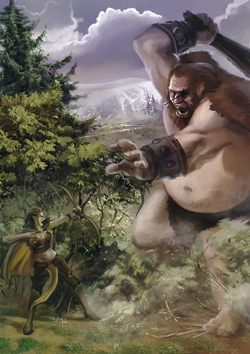
There are now three Hex Crawl Chronicles out and a couple more in the can. I’m about to begin writing the next one, and since I’ve had a couple emails recently asking for some more details about the setting – in particular about the folks wandering around causing trouble in it – I thought I’d share a few of the details (well, as many as I know).
(Oh, and you can find the overall map for the setting HERE)
Bucranian
Appearance: HCC 5
The Bucranians of the great island Bucrania are handsome folk, with chiseled physiques and deep olive skin. Their hair and eyes are as black as night.
Noble Bucranians dress in tunics of expensive fabric, most purchased from the Last Men, and square cloaks. They wear leather sandals on their feet and phetas of silk on their heads. Commoners dress as nobles, only with less expensive fabrics. Warriors carry spear, short sword, javelins and oblong shields emblazoned with black bulls.
In Bucrania, all women are wards of the king and live one of his many palaces until they are wed to a man. The most valued men of the kingdom are athletes, and athletic games are frequent and hotly contested. Champions are adopted by the king and become princes of Bucrania. They are gathered into fraternal trios, and in these trios they battle minotaurs in the arena for the honor of their father and the favor of his “daughters”.
As humans, Bucranians can advance in any class. Bucranian priests are usually druids who worship bulls. Bucranian fighters favor spear and javelin.
Centaur
Appearance: HCC 3, HCC 4
A centaur has the head, arms and torso of a human or elf and the lower body of a pony or ass. Centaurs dwell in meadows and glades surrounded by thick woodlands. They are known for their lack of temper and their fondness for women, war and song.
Centaurs are usually seven to eight feet tall from hoof to head. Even though their equine bodies are smaller than normal horses, they are still quite heavy and find it difficult to scale sheer surfaces without help from others. A centaur’s equine body may have any pattern common to normal horses, and the hair on their heads often follows suit. Centaurs usually have nut brown skin.
Centaurs speak their own language and often (50%) the language of elves. They occasionally speak the common tongue of men. Many centaurs learn the languages of gnomes, goblins, halflings, kobolds and orcs. Because of their size, centaurs have booming voices.
Centaurs cannot have a strength or constitution scores lower than 9, nor can they have a wisdom score higher than 14. Centaurs can become fighting-men, advancing to a maximum of 7th level (8th level if strength is 14 or higher, 9th level if strength is 18). Centaurs can carry 150% more than most characters. In addition, their base movement is increased by 6. Because they are quadrupeds, a centaur’s gets a +2 save to avoid being knocked over or grappled. In combat, centaurs can choose to attack with their weapon or their hooves, which deal 1d4 points of damage. A centaur’s armor (really a combination of human armor and horse barding) costs twice as much as normal human armor.
Dwarves
Appearance: HCC 1, HCC 2, HCC 3, HCC 4
The dwarves of Namera are bandy-legged and wrinkled, with narrow eyes and immense noses, splayed toes, large hands (the better for holding hammers and climbing rocks) and snow white hair. Women are as ugly as the men, but their ugliness is made up for by a reputation as being honest, hard-working, and immense fun at parties.
Dwarves don’t like to stand out in a crowd, so they were muted colors that blend in with their surroundings, including hooded cloaks. They adore pockets and sew as many into their clothes as they can. Long, pointed shoes are also a must, to give the illusion of more height. Dwarf warriors look for as much armor as they can wear, and prefer practical weapons like hammers and axes to flashy swords. They usually carry crossbows or hand gonnes over bows. Dwarves are natural animal lovers, and every dwarf has his pet.
Dwarves follow the normal dwarf rules. Their gods are never named or invoked in public, and their clerics stay home to care for the clan (unless your favorite rules allow dwarf clerics, in which case they replace spoken prayers with noisy ululations.
Dwarves of the Aderumdocs
Appearance: HCC 5
Unlike their bandy-legged cousins of the west, the dwarves of the Aderumdoc Mountains are a bit shorter and much rounder, rosy cheeks, gap-toothed smiles (when they bother to smile) and long, nimble fingers. They have gray skin that becomes covered with moss as they grow older, giving them a natural camouflage in ancient forests.
The Aderumdoc dwarves are deliberate and patient, never given to rash action or thoughtless words. They often sit down cross-legged when it is time to think, puffing on their pipes and considering every angle. This makes them wondrous engineers, but can be quite taxing on their fellow adventurers when every fork in a tunnel must be weighed and considered.
The Aderumdoc dwarves follow the normal rules for dwarves.
Elves of the North
Appearance: HCC 4
These northern elves dwell in towers disguised as massive trees by illusions. They are uglier than the trouping elves to the south, having long legs and arms attached to squat bodies and faces that resemble brownies more than fashion models. These northern elves wear long mail byrnies and winged helmets traced with precious metals. They carry hide shields painted in bright colors and carry longswords and daggers.
Northern elves are gruff and forward than their southern kin, and do not bear so much resentment to others (though they dislike the imperious Northmen and their empire). They believe profoundly in freedom and actively sew chaos where societies seem to rigid and structured. The wood elves have learned how to train giant eagles for use as their mounts, and every wood elf warrior aspires to become an eagle rider.
The northern elves follow the same rules as all other elves. They can become fighter/magic-users (level 4 and 8 respectively), thieves (no limit), rangers (level 3) or fighter/magic-user/thieves (level 4/8/unlimited).
Elves of the Pirate Coast
Appearance: HCC 5
The elves of the Pirate Coast have sun-dappled skin and auburn locks they never cut and warm, gray eyes. The coastal elves stand about 5 feet tall and have wiry frames. The elves wear as little clothing as possible, preferring loose tunics and loincloths. In times of battle they put on ornate, polished armor and wield long swords, dagger and longbows.
The elves are natural horsemen, learning to ride at a very young age and not truly achieving adulthood until they are can perform all manner of acrobatic tricks and feats of mounted warfare. They are a carefree folk who have a tough time realizing that other people’s feelings, needs and desires exist. They are persistent, if not always skilled, singers and dancers.
These elves follow the same rules as other elves. Coast elf thieves are usually horse thieves and rustlers, and take as much joy in stealing as the warriors do in fighting and the magic-users in torching villages with fireballs.
Elves of Valley of the Hawks
Appearance: HCC 1
The elves of the Valley of the Hawks are typical for the elves of Namera. They stand about five feet in height and have lithe physiques, pale skin that gives off a glow of health and vitality. They usually wear their hair long and tie it back or weave it into braids. Their hair and eyes might be any color under the sun.
They follow the tradition of the trouping fairies, with every elf a lord or lady in dazzling raiment of mauve, cyan and soft green, riding fine horses and carrying ornate bows and long swords. Elves take great pains to have the most stylish and expensive clothing they can afford – their appearance is a matter of great pride for them.
All elves of the valley hail from a hidden fort that is disguised by illusions and enchantments to look like a grassy knoll. The elves tend moontrees, whose leaves absorb moonlight that distills into the sap. Dead branches have a core of hardened sap which is melted down and alloyed with aluminum and tin to form elven mail. Their cloaks of elvenkind come from the silk of the faerie dragon, which lives in globes of spun silk that look like colored lanterns hanging from the trees. Their boots of elvenkind come from the hides of harts that are killed and slaughtered ritually to gain the blessing of the forest.
The elves of the Valley are haughty and proud, but also terribly dashing and brave. They adhere to the normal rules for elves (or high elves for “advanced” games). Elf fighters of the Valley favor the use of long sword and long bow, or possibly lance.
Embalmers
Appearance: HCC 3
The Embalmers are a race of bronze skinned men with raven hair and violet eyes. They are short and stocky, the women voluptuous and the men given to wide exaggerations and long melancholies.
Male embalmers dress in woolen tunics and trousers and gray cloaks. They wrap their lower legs in leather thongs and wear leather sandals on their feet and intricately patterned conical wool caps on their heads. Women wear loose gowns, a wide leather belt wrapped just under their breasts, shorter cloaks and put their hair in braids. Warriors arm themselves with spear, shields of wood and leather, short bows and long knives.
The embalmers raise sheep, trading wool and foodstuffs for fragrant oils and herbs used in their embalming ritual, the aspect of their culture which gives it its common name. The embalmers make mummies of their dead philosophers and nobles, walling them into their temples and palaces that they may advise future generations through barred windows. Peasant corpses are burned for heat in the furnaces of their palaces.
Embalmers are humans and might be of any class. Paladins are rare among them and most embalmer clerics worship death gods. Embalmer fighters favor the spear or short bow.
Golden Men
Appearance: HCC 1
The Golden Men of the steppe have golden-brown skin and blazing red hair. They wear buckskins in the winter and loincloths when the weather is warm enough. Warriors wear leather armor and carry stout clubs and leather slings, or metal weapons they have scavenged from their victims.
The Golden Men are descended from the ancients and now dwell in small hunter-gatherer bands in the woodlands or as brutal nomads on the prairie. The ancient ruins that once made up their homes are sometimes haunted by them, as they return to their temples to pay homage to such deities as Alberni, the dog-headed moon goddess, Kishrdis, the obsidian-skinned goddess of mining and Thallos, the seven-eyed god of love.
The Golden Men are humans, and can advance in any class. Clerics are as common among them as druids and magic-users are quite rare since they lack the resources to produce books or scrolls. Most Golden Men magic-users use very ancient tomes from the times of the ancients printed on strange, glossy paper in tiny black letters. Golden Men fighters favor clubs and slings.
Half-Orc
Appearance: HCC 5
Half-orcs are not a race, but rather creatures with a mixture of human and humanoid (usually orc, goblin, gnoll, bugbear or hobgoblin) blood. Half-orcs can almost pass for human. They average from six to seven feet in height and are usually stocky. Their skin often has a pink, grey or green cast to it. Half-orcs often have one of the following facial features: Turned up nose, pointed ears, thick eyebrows, a heavy forehead, vestigial tusks and/or pointed teeth. Half-orc hair is coarse and unruly and usually black, dark brown or dark red. Half-orc eyes are almost always brown, brownish green or greyish green.
Half-orcs usually speak the common tongue of men and often (60%) the language of their other parent race. It is not uncommon for them to learn the language of dwarves, goblins, ogres and giants.
Half-orcs can see up to 60 feet in darkness and their sense of smell is as keen as a wolf’s. Their thick skin gives them a natural Armor Class of 8 [11], which can be enhanced with armor. Half-orcs enjoy a +2 bonus to saving throws against poison and disease.
Half-orcs can advance as fighters (up to 8th level), thieves (no level limit), assassins (up to 6th level) or fighter/thieves (up to 8th level as fighter and 12th level as thief).
Hivernians
Appearance: HCC 2
Hivernians have jaundiced, sallow skin and hair that ranges from dark carnelian to fiery orange. Their eyes are icy blue. Hivernians are short and wiry, with long arms, fingers and toes, pug noses, long teeth and heavy jaws. They wear animal skins and long hoods decorated with bones and teeth. Warriors carry spears and short bows and wear the equivalent of leather armor.
Hivernians are as ancient a people as the Golden Men, and have warred with them for generations. Unlike the Golden Men, who seem to be able to lay claim to an advanced civilization in the past, the Hivernians have ever been savages. They are skilled in stalking and hunting, and have no qualms about killing for the sheer enjoyment of it. Hivernians worship the elk-antlered, doe-eyed goddess Yhoundeh.
Hivernians move as silently as halflings and can track as well as rangers of their class level. Hivernians can take levels as fighters (up to 7th), fighter-thieves (up to 6th level in each) or magic-user/thieves (up to 5th level as magic-users and 6th level as thieves). Hivernian fighters favor the spear or short bow.
Last Men
Appearance: HCC 5
The Last Men have olive skin and blond hair always worn closely cropped. Dealing as they do in fabrics, the Last Men dress in heaps and layers of clothing, all of expensive and luxurious fabrics like damask silk and velour. Soldiers of the Last Men carry Bohemian ear-spoons (pole arms) and hand gonnes (treat as heavy crossbows).
The so-called “Last Men” are a population of men and women who consider themselves the last true humans left in Namera. All other peoples are infected with chaos and thus “sub-men” in the eyes of the Last Men. They are emotionless, bland people, their lives ordered by their master, The Golden God, and by an ingrained herd mentality. The Last Men deal in fabrics, growing cotton and mulberry trees. Their factories contain mechanical looms controlled by a difference engine kept in a great, black citadel in their city-state, located to the south of the Pirate Coast. True xenophobes, they fear corruption by others, but still send out traders in longships to trade fabrics for food and other items.
Last Men are humans, and can take levels in any class, but their lack of independent, creative thought makes magic-users among them rare. Clerics of the Golden God are more common. Last Men fighters favor the use of bohemian ear-spoon or hand gonne.
Necrophage
Appearance: HCC 3
Necrophages are tall and lean, with pallid skin that they paint in grotesque patterns using burgundy paint made from crushed elderberries and columbines. Their warriors wear leather or ring armor and carry shields, leaf-bladed short swords, spears and javelins.
The Necrophages are fierce warriors who roam the rolling steppes of the Land Beyond the Black Water with their herds of cattle, riding in war chariots. The necrophages consume the flesh of their dead and of enemy casualties in war. They are berserkers in combat, and while one might expect berserkers to charge into combat screaming, the necrophages fight in complete silence. Necrophage tribes are ruled by undead kings, wights, with worthy challengers raised by force of will when they die to challenge the existing wight-king. The necrophages worship Emntrix, the petty death who claims the souls of soldiers.
Necrophages are humans, and can take levels in any class. Necrophage clerics worship Emntrix, the petty death of soldiers. Necrophage warriors favor the short sword. They can choose to be berserkers, but lose the ability to wear more than ring armor. Berserkers gain a +1 bonus to attack in combat for a number of rounds equal to their constitution bonus plus their level. After they come out of rage, they suffer 1d6 points of damage from exhaustion.
Northmen
Appearance: HCC 1, HCC 2, HCC 4
The Northmen have ebony or chocolate skin and wavy hair of brown or black, often worn long. Most are stout and plump, but a few villages mingled with the elves in elder times and are noted for their height and the electric sparkle in their eyes. The northmen are known for their baggy trousers and long tunics. They favor axes and curved knives and usually wear chainmail or platemail.
Northmen are the architects of a great kingdom that is now tearing itself apart in a terrible civil war between three princesses who seek to replace their dead father. They are industrious folk, not given to flights of fancy, who regard others as just a tad less civilized than themselves. They have a tendency to roll their eyes at outlandish customs and costumes.
Northmen are humans and can take levels in any class. Their clerics worship such deities as Almerla the goddess of healing, Talaunus the god of civilization, Teros the god of war, Vilmarra the goddess of vengeance and Waith, goddess of the underworld. Northmen fighters always favor axes.
Sea Lords
Appearance: HCC 4, HCC 5
The average Sea Lord has pale skin (or deeply tanned skin for the crews of their lion-prowed longships), blond to auburn hair and eyes ranging from blue to gray. Men and women tend to be exceptionally tall, with a pleasant, rough demeanor. Sea Lords dress in leather tricorne hats, padded doublets and baggy pants tucked into tasseled buskins. Sea Ladies wear long dresses covered by shawls and pile their braided hair atop their heads, holding it with wooden pins. Noble Sea Lords and Ladies wear necklaces of bronzed leaves from their old domains in the White Islands. Warriors carry broadswords and pistols and wear steel breastplates over soft leather armor.
The Sea Lords, or Albians, came from across the Briny Sea to escape the sinking of their homeland, the White Islands. Most of the Sea Lords that escaped this cataclysm were men, the crews of ships. The early settlers suffered a distinct lack of women, giving rise to the taking of slaves among female humanoids of the Pirate Coast. For this reason, there are still a good many Sea Lords with goblin, orc or (if they are lucky) elf blood flowing through their veins (i.e. half-elves and half-orcs). Sea Lords always have a tale to tell, and in taverns they tell these tales to the accompaniment of fiddles, mouth harps and percussion provided by stamping feet and by clanging walking sticks and cudgels on whatever surface is handy.
The Sea Lord clerics always worship Albia, the White Goddess who created them and kept them until the betrayal of her father, the Briny Sea. Albia is a goddess of perfection and purity, the gleam in her father’s eye until he consumed her in a fit of pique. Where some religions produce holy water, the priests of Albia produce holy powders. The first were taken from the chalk cliffs of the White Islands, but modern powders, kept in vials of glass or silver, are drawn from chalk outcroppings on the Pirate Coast.
Swamper
Appearance: HCC 3
The swamp folk are albinos with long, kinky hair that they sculpt into a shape reminiscent of large horns or cones. They have broad faces and large, pink eyes. The Swampers dress in soft leather tunics and the more accomplished hunters wear black cloaks made from the pelts of swamp panthers. Warriors carry sickles and staves.
Swampers encountered outside their villages are hunters or gatherers looking for exotic herbs and insects. The gatherers carry horn-handled sickles, often silver bladed, leather slings, wicker holy symbols, spirit rattles and bags of herbs, including healing poultices and bundles meant to repel the undead. Gatherers are usually accompanied by a breed of large, white swine that are used as mounts, pack animals and to sniff out herbs and funguses.
Swampers can be of any class, but most of them are clerics or magic-users. Clerics worship spirits of the dead and of the earth. Swamper fighters favor the use of the staff, and there are probably more Swamper monks than true fighters.
Tevalar Elves
Appearance: HCC 4
The Tevalar elves are aquatic elves who dwell in fresh water. They have blue-green skin and are completely hairless, with large, black eyes. Their warriors wear coats of silvery scales, onion-domed helms of ground and polished river glass (filled with water and connected via copper tubing to brass water tanks on their backs). They are armed with tridents, crossbow and short swords.
The Tevalar are slightly paranoid expansionists, building dams to flood valleys and bringing nearby human and demi-human tribes under their sway. Tevalar elves know how their surface kin have been dimished by the surface folks, and are determined to escape this feat. This makes them easy to offend and quick to deal with situations decisively and, at times, violently.
Tevalar elves follow the same basic rules as elves, with the exception that they can swim as quickly as they move on land and breathe water rather than air. To be sure, they would make challenging player characters, given how reliant they are on their water tanks.
Witchmen
Appearance: HCC 1
Witchmen have tan or olive skin and a great variety of hair and eye colors. They wear long, straight tunics and woolen leggings. Their shoes are leather and pointed, and they wear tall pointed hats with wide brims; both shoes and hats are decorated with buckles of brass or silver. Warriors carry long swords and daggers, and wear either ring armor or chainmail.
The Witchmen come from southern climes and dwell in the swamps at the mouth of the Great River. They are mystics, steeped in eldritch knowledge and taught the arcane arts from childhood. They dwell under the rule a college of witches and warlocks, with young Witchmen accepted in synods when they reach puberty. They are educated in these synods and treat them something like political factions. They worship such deities as Eosinn, the faun goddess of hunting and Onorix, the goddess of wealth.
Their leaders are skilled in swordsmanship and magic, and should be treated as elves in terms of their class choices, though their maximum levels are 3 levels higher than elves. Witchmen favor long swords and daggers.
Oh – also – just finished my little map for HCC 6 – The Troll Hills. Time to start filling this baby up. We’ll have Witchmen colonists on the Great River, an unspeakable troll god and a lair for every troll that I can legally use and few I’ll probably create. Think of it as Against the Giants but for trolls. Should be fun!

 Land of Nod