Dragon by Dragon – June 1981 (50)

Sometimes it’s hard to believe how long ago, in human terms, 1981 was. Of course, 35 years is a drop in the bucket in cosmic terms, but for a 44-year old man, it’s significant. Having a brain that absorbed the early ’80s one day at a time, it just doesn’t seem old, sometimes like it was just yesterday.

Enough of that. Dragon #50 came out 35 years ago this month, and here’s what the 5th anniversary issue has to offer.

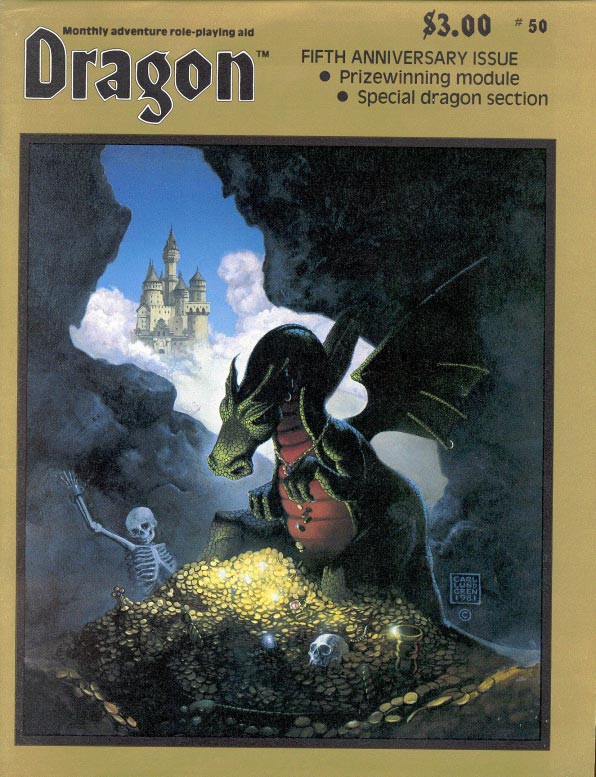
We begin, of course, with the cover by Carl Lundgren. Very nice piece of work, and certainly appropriate for the issue, depicting as it does a dragon hovering over its hoard of treasure (or it it the dragon’s hoard?)

As I so often do, I’ll start with an advertisement for a new “family board game” by TSR …

I’m picturing those old game covers or ads from the 1960’s that show a smiling family playing a board game. Little Susie having to tell mom she’s “The Duke of New York – A-number-one!” I just watched the movie a couple days ago, so it’s fresh in my mind.

It should come as no surprise that they have a page for the game at Boardgamegeek.com.

The game was written by “Zeb” Cook, who also wrote the Expert D&D set.

Now that I’ve dispensed with TSR’s homage to Snake Plissken, let’s get to the first article in this anniversary spectacular – Gregory Rihn‘s “Self defense for dragons”. The article purports to give “everyone’s favorite foe a fighting chance”. The article posits that dragons, as they were written in 1981, were too easy to defeat by a large, well-organized party, especially given the treasure to be gained by defeating them. This would prove to be an important article to later editions of the game, for it expands the dragon’s attacks quite a bit, adding 2 wing buffets, 2 wing claws, a foot stomp and tail lash. In essence, it gives the dragons enough attacks to hit all the attackers likely to be surrounding it in a fight. He goes on to give a couple ideas for good dragon tactics.

This is followed up by Lewis Pulsipher‘s “True Dragons: Revamping the monster from head to claw”. It appears that the theme of this issue is that dragon’s just ain’t good enough. Pulsipher gives a long table with many more age categories and a few additional powers, including shapechanging (I like this one), causing terror and some special powers. One of them – two heads – I’m planning on adding to Blood & Treasure. It also has random tables of spells known, a random table of breath weapons, with the old standards as well as a few new ones – radiation, stoning, windstorm, hallucinogen, negate magic and polymorph. All goodies! Here’s Pulsipher’s take on radiation:

Those failing to roll a d20 lower than their constitution become unconscious and will die of a wasting “disease” in 1-4 days. The “disease” is cured by Cure disease and Remove curse. Effects of the disease are only slowly repaired by the body after the cure. A victim might look ravaged five years after his cure if he was near death, and this may affect his charisma.

Radiation as a curse. I dig it.

Overall, I think I like Pulsipher’s take better, using special powers instead of additional attacks to get the job done. Both would go into beefing up dragons in later editions.

Colleen A. Bishop hits on baby dragons with “Hatching is only the beginning …”, which covers little dragons from egg to birth. It’s a long article, with lots of tables. Maybe worth a look if you’re planning on having a baby dragon in the party for a while.

Robert Plamondon gets us off the dragon train and introduces some folks called the Kzinti. I don’t suppose they need much introduction to the folks who read this blog. They’re tough customers here, with 4+4 HD and two attacks per round. A small group could really bedevil a party, and they’re Lawful Evil to boot. The article covers their arrival on D&D campaign worlds, their religion, social organization, magic, psionics, etc. Very thorough for a monster entry, but no info on them as a playable race.

For those interested in the history of the hobby, David F. Nalle‘s reviews of some old time ‘zines may be of interest. He covers Abyss by Dave Nalle, Alarums & Excursions (such a great name) by Lee Gold, The Beholder by Mike G. Stoner, The Lords of Chaos by Nicolai Shapero, Morningstar by Phillip McGregor, Pandemonium by Robert Sacks, Quick Quincy Gazette by Howard Mahler, The Stormlord by Andreas Sarker, Trollcrusher, The Wild Hunt by Mark Swanson and Zeppelin.

Pulsipher has another article, a very long one with way more math than needed to deal with gaze attacks in D&D. Personally, I let people close their eyes entirely (and open themselves to all sorts of trouble), or try to avoid the monster’s gaze and suffer a penalty to hit, etc.

Larry DiTillio’s article on the glyphs in his campaign world didn’t do much for me.

The Chapel of Silence by Mollie Plants is a prize winning dungeon at IDDC II. It’s a relatively small dungeon, but looks like a good one. It begins with all the adventurers having a strange dream, and goes from there – maybe a well-worn idea now, but clever back in the day.

Back to rules articles, “The Ups and Downs of Riding High” by Roger E. Moore covers flying mounts. Its a pretty thorough look at all the potential flying mounts in AD&D at the time, and covers their diet (most are carnivores), advantages, disadvantages and how much weight they can carry. It’s a useful article to keep in your pocket, in case somebody starts flying around on a dragon and you need some ideas on how to spice up the experience.

This advert caught my eye …

At first, I assumed it was the old computer classic, but it’s something entirely different.

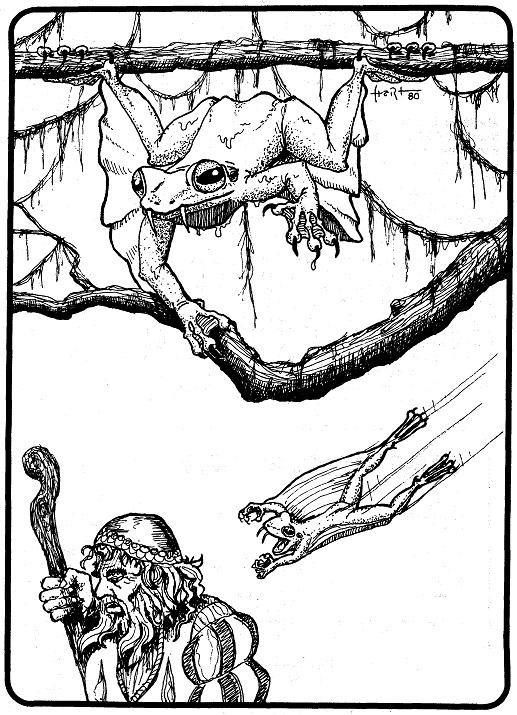
The Dragon’s Bestiary presents the Giant Vampire Frog by Alan Fomorin. How do you not love these guys?

Here’s proof that Mark Herro was nobody’s dummy …

“Home computers may be the most important new consumer appliance to come along in decades. Any device that can control household lights and appliances, edit and type letters and reports, selectively monitor United Press International and the New York Stock Exchange, and play some great games besides, may be almost indispensable in the years to come.”

Word up!

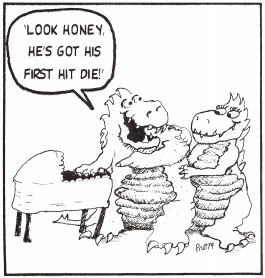
This issue had a couple cartoons of note. First, an argument that persists to this day …

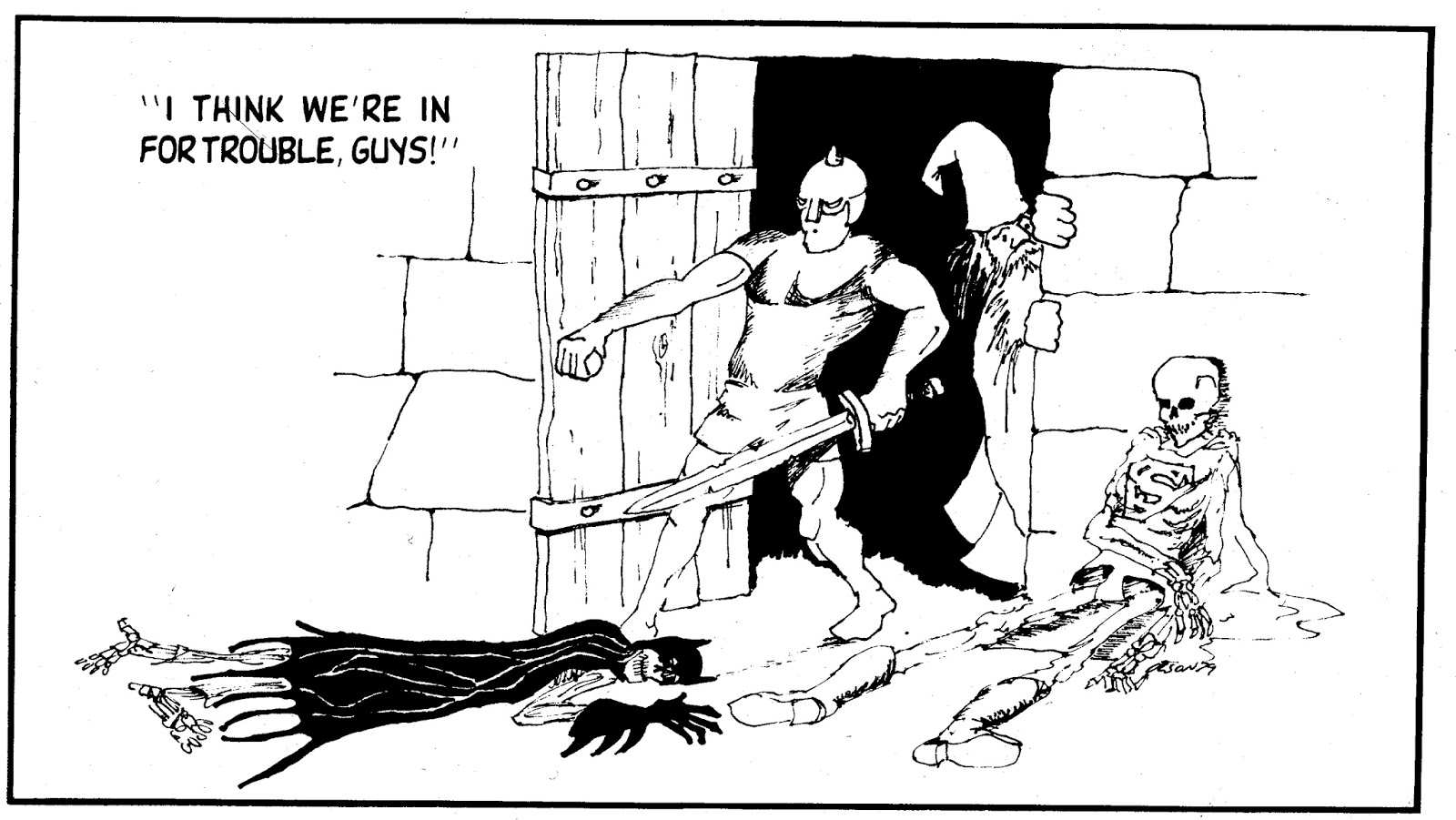
And an old take on Batman vs. Superman … or Batman and Superman vs. something else

And as always, we finish with a bit of Wormy, as we begin to move into the wargaming story line …

Have fun on the internet, and for God’s sake, be kind to one another!

Dragon by Dragon – May 1981 (49)

May of 1981 saw me turn 9. I hadn’t heard of D&D back then (and wouldn’t for another 3 years), but if I had heard of D&D, and subscribed to Dragon Magazine, this is what would have shown up in my mailbox that month.

Pretty cool cover, right? There’s more inside, in a 12-page section dedicated to the work of Tim Hildebrandt.

Of course there’s more than just my Hildebrandt in this issue … let’s check it out.

First up is a new ad by Ral Partha, this time featuring their new line-up of Adventurers miniatures. I got curious this time and decided to look up Ral Partha’s address – 5938 Carthage Ct, Cincinnati OH.

It came up with this impressive edifice:

I’ll show off a few more old RPG addresses in this post if I get a chance.

Now that we’ve looked at Ral Partha’s old digs, let’s get to the fun of complaining readers, in this case William G. Welsh, on the archer class in last issue:

“Second — “Kobolds, goblins, dwarves, gnomes and halflings cannot become archers.” In the last chapter of the third book of the Lord of the Rings trilogy, there are no less than three incidents where the effectiveness of hobbit archers is demonstrated. Also, refer to the AD&D Monster Manual, p. 50, under halflings, under special attacks, note “+3 with bow or sling.”

This stuff kills me. The answer from the editor was:

“None of the ideas presented in articles in DRAGON magazine are official rule changes or additions, unless the article specifically says so (and there haven’t been very many of those). The people who write articles that we publish aren’t trying to get everyone to play the way they do, and we certainly don’t hold that opinion ourselves. As is the case with many of the game rules themselves, the articles in DRAGON magazine are suggestions, ideas and alternatives.”

It amazes me when that has to be said, but if comment sections on the internet have done anything, it’s to prove that things like that still need to be said. Could various school systems around the globe please spend a few minutes explaining to people what “opinion” means?

The meat and drink of this issue, other than the special art section, is about tournaments. No, not knights trying to poke each other with lances and Robin Hood splitting an arrow, but D&D tournaments. If I’m honest … I have no interest at all in them, but I’ll try to give them a quick review.

The first article discusses fairness in scoring tournaments, giving a long list of actions that should go into scoring points, and explaining that DM’s need to make sure players know how they’ll be scored. Sounds logical to me.

The next bit discusses improving on the Slave Pits tournament adventure, followed by Mentzer’s reply that “It isn’t that easy”. I can remember getting the Slave Pits module as a kid (I guess about 4 years after this issue was published) and being confused about the whole tournament concept – how you didn’t use the full map, and scored things. As a kid, I wasn’t sure if I was supposed to care about this stuff or not.

Strangely enough, the article complaining about the adventure is really complaining about the size of the teams in the AD&D Open, specifically that nine-person teams are too large. Mentzer explains the problem – not enough Dungeon Masters at the tournaments. Can’t argue with that.

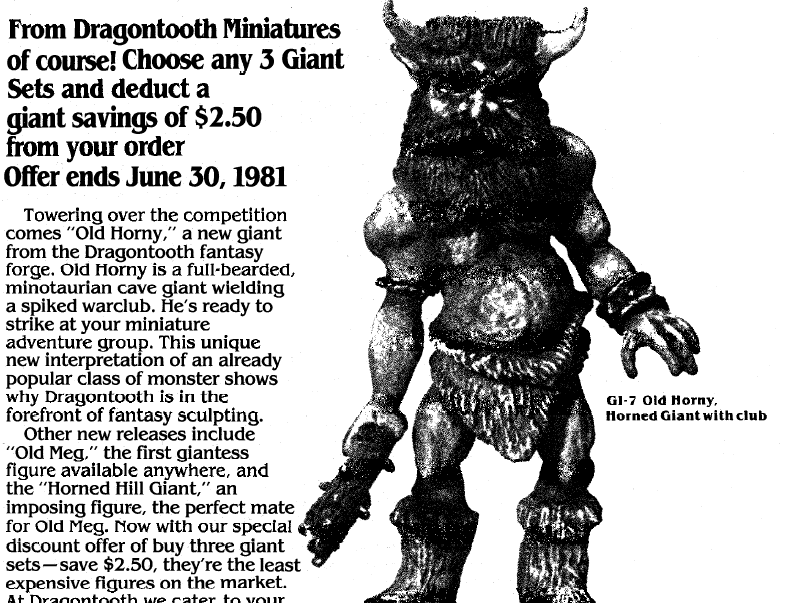
Dig this:

Old Horny indeed. Let’s hope those horns on his head were the source of his nickname. And here, keeping with the theme of this post, is Dragontooth Miniatures old location:

Or is it? A Hilton? I’m thinking perhaps the old building was torn down and replaced. That, or Conrad Hilton had a secret hobby.

The next few articles are a bit too timely to make sense to talk about here – GenCon is growing, , GenCon East fills the Origins ‘hole’ (I’m sure that’s not as filthy as it sounds) and there are nine ways to win the painting contest at GenCon.

Okay, enough of that convention stuff. Next up: Samurai!

This is an interesting take on the character class. The editor’s note mentions that the author, Anthony Salva, holds a first degree black belt in Hapkido. The class that follows is heavily influenced by this, and it’s really a bit more like an alternate monk than the samurai most people would expect.

That said, it’s a pretty groovy class. It’s tough to make it in – you need Str 15, Dex 17 and Int 15 to qualify, but the class is open to gnomes, halflings, elves, half-elves and humans.

This version of the samurai cannot use armor, but his AC improved by 1 per 4 levels. They can use two-handed swords, short swords, bows and staffs, and a samurai of 4th level or higher can obtain his “personal weapons”, which are sacred to him. It mentions the weapons of honor – “Katana, Wakizashi and Nunchakos” are described later in the article.

Apparently Dragon Magazine got there first. Source

The samurai’s special abilities are as follows: Jump front kick (-3 to hit, 2d6 damage), judo throw, ceremony of fealty-weapons of honor (4th level; and here it mentions that katana do 1d12 or 1d10 damage, wakizashi 2d4 or 1d8 and nunchako 1d8 damage), sweep and double chop (5th level), crescent kick/side kick combination, back roundhouse kick, illusionist spell ability (8th level), “360” and downward kick, the slaying hand (10th level), flying side kick (requires movement, -3 to hit, 1d20 damage) and a samurai who becomes a shogun (13th level) has a 25% chance to obtain 30 psionic power points. They go on a bit later to mention they can reduce falling damage, hide in shadows and move silently as a thief, and can dive and roll over obstacles.

This class would probably be a blast to play, especially as a gnome. I’ve often thought that the monk would make a pretty good “cartoon hero” class, and this version of the samurai has me thinking of Samurai Champloo and other anime samurai. If anyone has experience with this class, please drop a note down below and let us know how it went.

Merle Rasmussen now brings us a nice Top Secret article about special ammunition – armor-piercing, dumdum, gyrojet, duplex, etc. Lots of stats (and I mean lots with a capital “L”), but probably useful info for other games as well.

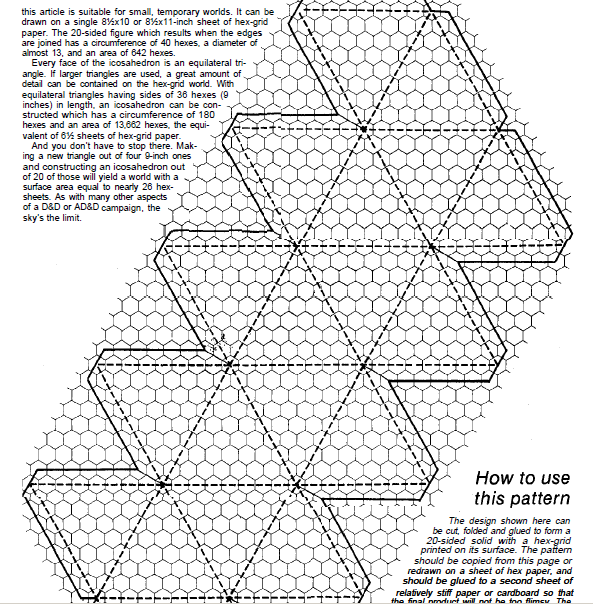
Karl Horak has an article called “Getting a world into shape”, which gets into different shapes for campaign worlds, as in cylinders, polygons, etc.If you want a campaign world in the shape of a 20-sided die, this is the article for you.

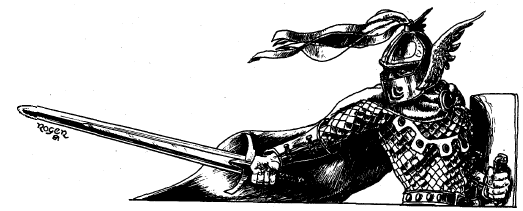
Giants in the Earth in this issue presents some Poul Anderson characters – Holder Carlsen (14th level paladin) and Hugi (5th level gnome fighter). The art by Roger Raupp is great:

He’s always fantastic with knights and warriors. The article also has stats for T. J. Morgan‘s Ellide (6th level fighter)

G. Arthur Rahman has an article on historical names – Anglo-Saxon, Byzantine, etc. Very useful then, less so now with the resources of the internet at one’s disposal.

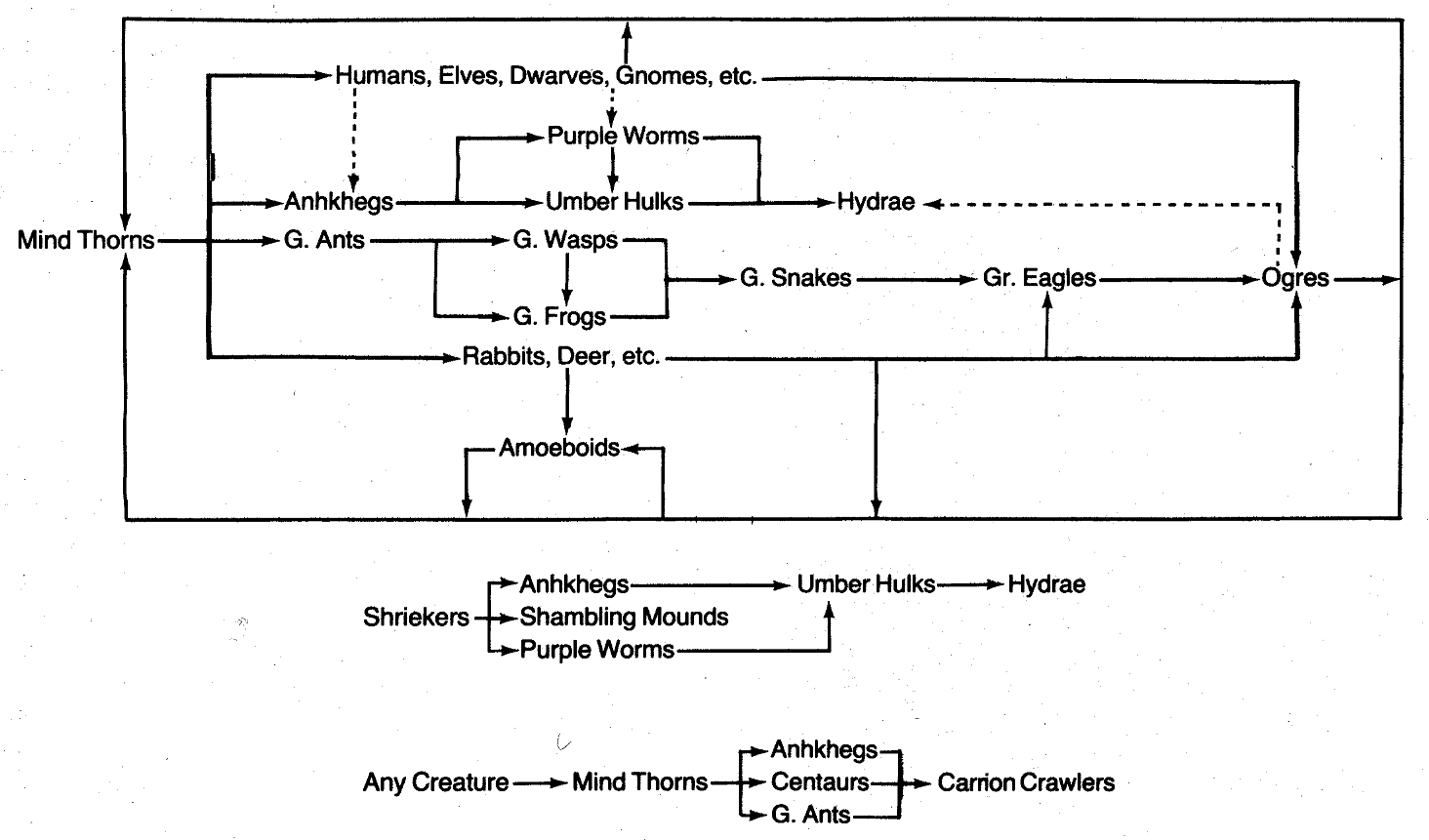
Jon Mattson‘s article “Monster mixing – AD&D creatures adapted to a C&S campaign” show that Dragon was not yet the house organ for TSR that it would become (though it always had more outside content than White Dwarf once it became GW’s house organ). While the article is quite useful for players of Chivalry & Sorcery, it also has an interesting piece at the end – a flowchart of AD&D monster predation:

And now you know.

Up next in the magazine is the section on Tim Hildebrandt‘s art. I’d post some images (aside from the cover above), but a Google search (or clicking on the artist’s name up above) will do you more good these days. Take a look – I think you’ll like what you see. I will post this quote from the interview with the artist:

“One thing leads to another thing leads to another thing and you start growing and growing. Things keep expanding, and the more I do myself, the more I see that there is to learn.”

Lots of wisdom in those words.

The Dragon’s Bestiary in this issue features the Loren Kruse’s Nogra (“a small creature with long, sharp claws which somewhat resembles a hairless lynx”). The basic stats for Blood & Treasure are below:

Nogra, Small Magical Beast: HD 2, AC 15, ATK 1 bite (1d4), MV 20′, SV F12 R11 W15, INT Low, AL Neutral (N), XP 200 (CL 3), Special-Body secretes a substance which absorbs all light (including into the infrared and ultraviolet spectrums), liquid is also a contact poison (save or blinded for 2d4 rounds), light sensitivity

Leonard Lakofka has a new class for this issue (which hopefully doesn’t do halflings wrong) called the Alchemist. Another old Dragon classic. It seems like such an obvious class for D&D, but it’s tricky. My version was essentially Dr. Jekyll, to give it a twist and make more than a guy who isn’t remotely as useful as a magic-user. Lakofka’s is, in fact, not an adventurer.

Lakofka’s alchemist has to have Str 9, Int 10, Wis 6, Dex 9, Con 14 and Cha 16 to qualify, and they must be human, elf or half-elf, with only the humans hitting the highest levels. They only earn XP by “plying their trade”, not adventuring. They can make pottery, blow glass, identify potions, manufacture poisons and manufacture magic potions. It’s a useful class, and could be adjusted to be an adventurer, but as a non-adventuring NPC I’m not sure why one needs to go to the trouble of having levels. It seems like a “novice-veteran-master” approach would work just as well, or even just “the alchemist can do what the DM to needs her do” concept. That being said, Lakofka always puts a lot of work into these things, and his alchemist is no different and thus is worth the read.

Gary Snyder now gets into the weeds on the issue of wishes and how to adjudicate them. This brings up a great point about fantasy gaming and gamers. I’ll often be watching some TV show or movie and think, “That plot element would never work in a game – the players would kill that guy in a heartbeat / or they would never touch that statue, ’cause statues are always trouble in a dungeon.” The idea of wishes probably seemed so simple when the game was first written, and then creative players got hold of the concept and made DM heads explode. Snyder gives ten rules to keep wishes in check which have largely been adopted into the game.

It’s followed up by a short article/story about wishing by Roger E. Moore.

Paul Montgomery Crabaugh has an artcle about travel and clothing in DragonQuest.

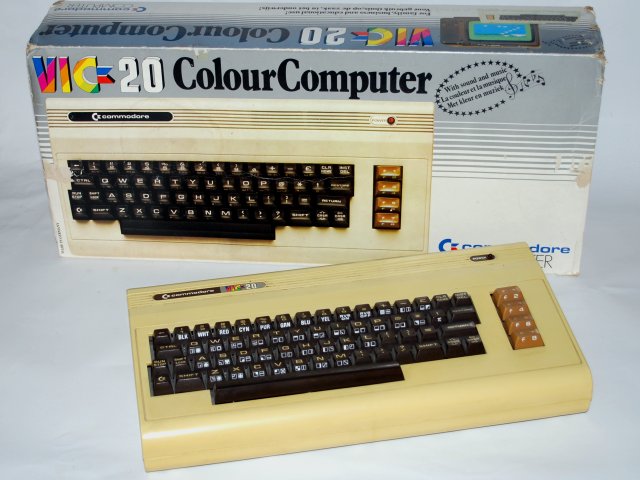
If you need a time keeper program in BASIC, Mark Herro has you covered in this month’s The Electric Eye. Blast from the past to see those IF … THEN statements and GOTO commands. I learned BASIC on a VIC-20, which is actually still sitting in my closet.

Side note – I love this Grenadier miniature …

Great sculpt

Side note II – A bit of Wormy

And now on to White Dwarf 25, the June/July 1981 issue. I’ll keep this one brief, and just cover the bases:

Lewis Pulsipher has the third part of the Introduction to D&D series, covering spellcasters. Great art in this one.

Trevor Graver has Optional Skill Acquisition for Travellers. This one ditches the random tables (which are pretty cool) for a skill point system. Control vs. Chaos, the eternal struggle in game design.

Roger Musson has a nice article on The Interesting Dungeon – worth the read.

Tony Chamberlain & Paul Skidmore have an interesting “clerical AD&D skirmish for a large number of players” called Lower Canon Court. This is another one that would probably be fun to play with a big group on Google+.

This issue has some clever magic items – the bowl of everlasting porridge, the bell of watchfulness – a notion on determining handedness in games by Lew Pulsipher (left-handed males 8%, females 4%), and Roger E. Moore has a bit on fake torture items.

Andy Slack has Vacc Suits in Traveller.

Dream Demon!

The Fiend Factory this issue is themed The Black Manse, and has stats for Dream Demons (which are really cool) by Phil Masters, the Incubus by Roger E. Moore, Brain Suckers by John R. Gordon and the Guardian by Simon Tilbrook. As always, the art is top notch. It’s a shame there was never a Fiend Folio II – so many great monsters were left behind.

Lewis Pulsipher‘s second article this issue is on “What Makes a Good AD&D Character Class”. I would answer – people want to play it and it doesn’t screw up the game. This is pretty much what he says, focusing especially on the class not being overpowering. His example of an overpowering class makes me actually want to create it – The Guardian class he posits can listen at doors, use x-ray vision, become ethereal and has a psionic boomerang defense that kills some mind flayers. I dig it.

And that’s that … Have fun on the internet!

Dragon by Dragon – April 1981 (48)

Happy Mothers Day to all the moms out there in blog land – and happy April Fools Day, since this week we’re looking at an April issue of Dragon – #48, from good old 1981.

Before I hit the magazine, though, I’m going to do a little advertising – NOD 29 is now out as a PDF, at Lulu.com and Rpgnow.com. This one has the second half of the Trollheim hex crawl, the third part of the d20 Mecha series featuring some mecha stats that could be useful for all sorts of sci-fi games, Aaron Siddall‘s very cool Hyperspace campaign notes for GRIT & VIGOR, which combines Lovecraft with good old fashioned rocket-powered sci-fi, Tony Tucker’s take on the luchador class for GRIT & VIGOR, a Quick & Easy mini-game pitting luchadores vs. the Aztec Mummy, a random class generator (along with a couple random classes that came out pretty good), info on using interesting historic coins in treasure hoards, the Laser Mage class and a couple tidbits for SPACE PRINCESS. All sorts of fun for $4.99.

And now, ladies and gents, on to the magazine.

We begin with an Arms Law ad, and a few thoughts on said ad by the writer of the blog:

That first bit is the problem – death being only one blow away with Arms Law. Many would argue that it’s more realistic than D&D combat … and they’re right. That’s precisely the problem. We already live in the real world, where death is one blow away. That’s why most of us live boring lives and indulge in fantasy for our excitement. I’m not sure injecting that kind of realism in fantasy is worth the trouble. A realistic game for the sake of the challenge, on the other hand, can be quite engaging. Just a thought.

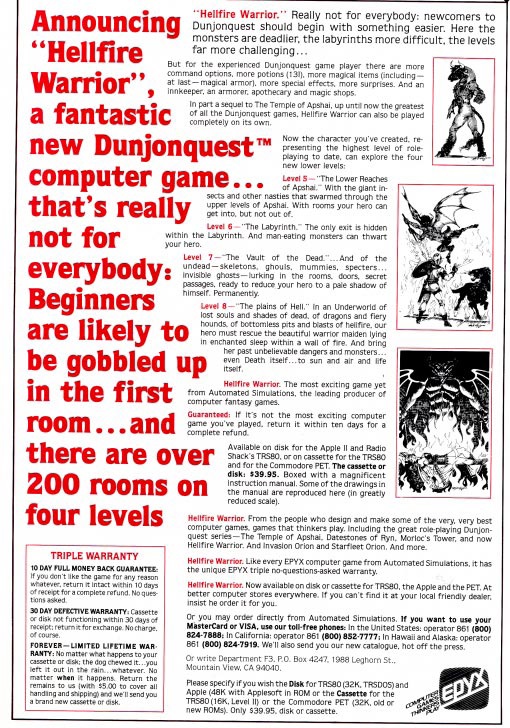
And now, God forgive me, I’m going to show another old ad. I like the tagline – “not for everybody” – clever. Here’s a post about the game.

I might have mused about this before, but is anyone out there making new retro-computer dungeon crawls? For those in the know – would it be hard? I think it might be fun to create some relatively simple games with simple mechanics for those who want to just do some old fashioned dungeon crawling.

The theme for this issue is Underwater Adventuring. I can attest to how hard it is to write underwater adventures – or at least adventure locales for my hex crawls. So much of what we take for granted on the surface doesn’t work underwater. The first article, “Watery Words to the Wise” by Jeff Swycaffer, does a nice job of hitting the highlights of what does and does not work underwater. No rules, just sound advice.

Up next is the “Dragon’s Bestiary”, which features the Water-Horse by Roger E. Moore, Golden Ammorite by Roger E. Moore and Sea Demon by Ernest N. Rowland Jr. Nothing earthshaking here, but solid monsters for an underwater (or close-to-water) game.

The “Bazaar of the Bizarre” is also aquatically inclined, all by Roger E. Moore.

Naturally, Dragon Magazine comes through with its annual April Fools Day supplement, this one with its own cover (for Dragon #48-1/2). Truth be told, I think I like it better than the actual cover.

This month we get a bit on the Accountant character class and a game called Real Life with a nice bit of character generation:

We also get “Saturday Morning Monsters”, with stats for Bugs Bunny (CG 15th level illusionist), Daffy Duck (CN and totally nuts), Popeye (LN 9th or 18th level fighter), Rocky (LG 12th level fighter) and Bullwinkle (LG 13th level fighter) and Dudley Do-Right (LG 18th level paladin).

Back into the real magazine, Tim Lasko has an article on the druid called “The Druid and the DM”. It’s a general overview of the class as presented in AD&D, along with some suggestions for rule changes involving druid spells, many involing the use of “greater mistletoe”, changing the druid’s initial age and how his age works in-game (kind of weird idea – not sure why I should use it, or whether it would be worth the trouble), giving them the sage’s ability to answer questions about flora and fauna (good idea, but doesn’t require rules in my opinion) and a few other bits. It’s a combination of unnecessary complication, rules for things that don’t really require rules and ticky-tack little bonuses. Not bad, per se, but not terribly useful.

Players of Top Secret, which appears to be making a comeback these days, might enjoy “Doctor Yes”, a scenario written by Merle Rasmussen and James Thompson. The scenario is set on a floating island and appears to be engaging and thorough – rules for underwater adventuring in TS, and a large complex with traps and dangers. You also get stats for such personel as Chuck Morris, Bruce Nee and “Sweetbeam” Leotard.

“Giants in the Earth” presents Ursula K. LeGuin’s Sparrowhawk (N 21st level Illusionist/20th level Magic-User) and Andrew Offutt and Richard Lyon’s Tiana Highrider (CG 12th level Fighter/12th level Thief).

Michael Kelly‘s “Instant Adventures” is a neat article with a list of adventure types, along with the materials they require and the time involved in preparation. A few examples:

Assault/Raid (Bodysnatch), requires a small military encampment and takes about 20 minutes to set up.

Feud, Inter-family, requires a brief history of the feud and the feuding families, as well as a reason for the involvement of the characters; takes a couple hours to prepare.

Smuggling, Weapons, requires a war and revolutionaries in need of weapons and supplies, as well as a source for those weapons and supplies; takes about 20 minutes to prepare.

At a minimum, it’s a great source of ideas for games.

Lakofka‘s “Mission Control” article dovetails nicely with it, being a way of detemining how tough the bad guy faced by adventurers should be. In a nutshell, it is based on the total XP of the party, that determining the level of the big bad guy and how much treasure/magic items he should have. The article gets pretty wordy and “in the weeds”, but the basic ideas are solid and useful.

And so ends Dragon #48, as usual, with a frame from Wormy …

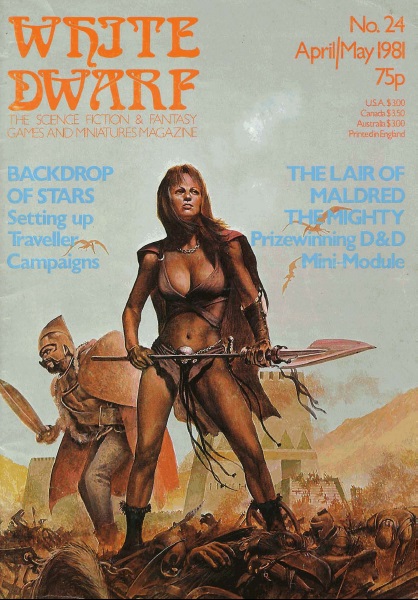
And now begins White Dwarf #24, the April/May 1981 issue. The issue starts off with a great cover – barbarian woman and a sort of Bronze Age warrior-type before a stepped jungle pyramid with dragons or pteranodons buzzing about. Good stuff. I’ve mentioned this before, but I’ll say again that in my opinion the quality of layout and art in White Dwarf was superior to Dragon in this period. Dragon’s layout was never inspired, but the cover art got much better as time went on. Both magazines are a pain in the butt to read for folks without premium peepers, but that’s not their fault, just Father Time’s.

The first highlight for me in this issue of White Dwarf is some a beautiful piece of art by the great Russ Nicholson:

It suggests a great scenario – the adventurers captured and stripped of their toys – that’s hard to implement. Most players don’t dig it, and there’s usually an idea that if you’re putting them through it they’re going to live through the experience. An assumed guarantee of survival takes the fun out of the scenario. Still, if you can find the right kind of players, it makes for a great game.

I found the review for a game called Quirks – the game of unnatural selection interesting. Ian Livingstone gave it a good review and it sounds like an interesting concept, wherein players create weird plants and animals and have to adapt them to survive changing climates and challenges.

WD24 also has a detective class with some interesting abilities (10% chance of noticing disguised assassins), some sage abilities, thief abilities, spells and tracking. I think I’d enjoy playing a Halfling Shamus (4th level detective).

Mark Byng has an AD&D mini-module called “The Lair of Maldred the Mighty” which is, if I’m honest, kind of hard to read for an old fart like myself. Not his fault – a layout issue.

Monster Madness has a few “of the more eccentric monsters to have graced the White Dwarf letter box” – in this case the Bonacon by David Taylor, Llort by Andrew Key, Todal and Marcus Barbor, Tali Monster by Craig Edwards, Dungeon Master by Malory Nye. For fun, the DM is below in B&T format:

Dungeon Master, Medium Humanoid: HD as many as he likes; AC 16 (chainmail and judge’s shield), ATK special, MV 30′, SV varies, AL CE usually, Special: 30% chance he will follow adventurers around a dungeon telling them what they can and cannot do, rolls for wandering monsters when characters make any noise at all, reading of the rules (sleep spell), consults matrices and confuses attackers, not spell affects him unless you can persuade him otherwise, weapons do half damage, susceptible to bribes of 500 gp or more (treat as charm person).

That’s that, boys and girls. Have fun, do something nice for mom and then do something nice for everyone else.

Dragon by Dragon – December 1980 (44)

When Christmas rolled around in 1980, a young me was still four years away from role playing games, though I did get this slick bike:

Found HERE!

A year later, I decided I like the Steelers better, and was stuck with a Cowboys bike – c’est la vie. I grew up in Las Vegas, so I was pretty fluid in my “favorite team” selection – I switched to the Raiders in 1984 when I was the only kid on my bus who picked them to beat the Redskins in the Super Bowl – I only did it to avoid going with the crowd.

Still, if you were already plays RPG’s in 1980, this issue of Dragon, #44, was what you were perusing over a cup of hot chocolate with some Rankin-Bass on in the background. It looks like a dandy – with a mini-game and everything!

As is often the case, the first thing that caught my eye was the ad by Ral Partha. They usually have the first ad in these old Dragon magazines, and this one is for a number of boxed adventure games they did. The games included miniatures, and look pretty cool.

I found a site with some pictures of the miniatures.

And the mannequin in the hooded robe just gave me an idea for a monster – I’ll post that later in the week.

Dig this missive from Mrs. Lori Tartaglio from Mercerville, N.J. She covers bearded female dwarves and Iran hostage crisis all in one letter.

“Dear Editors:

Will this endless quibbling never cease? Who CARES if female dwarves have beards or not? (TD#41) Why not let each DM or player or gaming group decide for themselves, for Ghu’s sake?!

Answer me this: Will the fact of dwarven women having or NOT having beards affect the outcome of the game in any major capacity? In my humble opinion, the answer is “no.” Not, of course, unless the DM has designed a “beard catcher” as one of his nasty little traps, and a female character of the dwarven persuasion (although no one ever had to persuade me to be a Dwarf-lady!) happens to be one of the party who’d sprung the trap and. . .

OY! This is getting out of hand! Now you’ve got me doing it!

C’mon, EGG and the rest of you guys! Grow up! If you’re going to argue, then do it about something worthwhile — like “do we go techno and nuke Iran off the face of the earth or do we send in a party of chaotic neutral fighter-mage mercs to teleport the hostages home and drop the Ayatollah with a black arrow.”

And by the way – I mentioned a few reviews ago that I was going to commission some bearded lady dwarf art, and I did, from Denis McCarthy – this will appear in the second edition of Blood & Treasure.

Just as some older issues of Dragon had stats for fictional western heroes for Boot Hill, this issue does the same for some fictional secret agents for Top Secret. The article is written by the developer and editor of the game, Allen Hammack.

For those keeping score, here’s some stuff you should know …

Strongest secret agent – John Steed, followed by Derek Flint and James Bond

Most charming secret agent – John Steed, followed by James Bond and Derek Flint

Most courageous secret agent – James Bond, followed by Derek Flint and a tie – Jim Phelps and Number 6

The weakest stats belong to Maxwell Smart and Napoleon Solo. I don’t want to criticize, but not making Emma Peel the most charming seems crazy … at least from my perspective. The article has full stats for all the agents, which is pretty damn cool.

Gregory G. H. Rihn presents one of the articles that could only be from the early days of the hobby – “Fantasy Genetics I – Humanoid Races in Review”. The article gives scientific names for the fantasy races. Elves, for example, are homo sapiens sylvanus, while orcs are homo sapiens orc. Those two races have to be homo sapiens able to breed with good old fashioned homo sapiens sapiens. I guess they should also be able to breed with homo sapiens neanderthalensis. An elf neanderthal crossbreed would give strong math skills, great strength and pointed ears – so Vulcans, essentially. He makes the kobolds, goblins, hobgoblins and bugbears part of the genus Australopithecus and ogres Ramapithecus. This is an interesting idea, and points to a time when the look of the fantasy races was not established – yeah, there was art in the Monster Manual, but it wasn’t treated as carved in stone.

This is followed up by “Fantasy Genetics II – Half-Orcs in a Variety of Styles” by Roger Moore. This is a cool little article about the fact that half-orcs are always half-human. So you get some monster stats for orc-kobolds, orc-goblins, orc-ogres, orc-bugbears, orc-hobgoblins and orc-gnolls. Short and sweet, and it would be a nice addition to the half-orc playable race.

But we’re not done yet, because John S. Olson gives us “Fantasy Genetics III – What Do You Get When You Cross?”, which is designed to discourage weird crossbreeds. I wonder if the author is this guy from Rice University?

Which, of course, brings us to the end of this discussion. There could be absolutely no more to write on the subject of fantasy genetics – the topic has been so thoroughly dealt with that to continue would be folly!

To paraphrase Johnny Carson, “Not so fast jelly doughnut breath!”

Paul Montgomery Crabaugh brings us “Fantasy Genetics IV – Half + Half Isn’t Always Full”. Honestly, I cannot see the point of this article. Moving on …

Here’s a little piece from Sage Advice that might quash the whole murder hobo mystique:

“Question: Is it okay for a Monk (Lawful Neutral) to sneak up on an opponent and then backstab? (Is this act chaotic? Is this evil?)

Answer: The act of killing a victim without knowing if he/she is truly an enemy (in other words, killing a complete stranger without knowing if he/she presents a threat) is a chaotic act. The act of killing an opponent with the knowledge that there is some other way to overcome him/her is an evil act. It would seem permissible for the Lawful Neutral Monk (or any other similarly aligned being) to attack a known enemy from the back, when circumstances make it necessary to kill that foe. —J. Ward, W. Niebling”

So, if the orcs don’t attack first, and you attack without trying to talk to them, you’re evil.

When I see ads like this:

I always do a search hoping to stump BoardGameGeek.com – hasn’t happened yet.

I know nothing about the game, but the miniature illustrations are cool, and the name “hellborn” is awesome – also Avenging Angels and Saints and Giant Knights. I found the rules for sale for $12.95 by the Gaming Gang and bought a copy – I’ll review them later this month (probably).

This issue’s “Giant in the Earth” switches authorship from Tom Moldvay to Dave Cook. Dave writes stats for C.S. Lewis’ Reepicheep (LG 7th level fighter) and Conan Doyle’s Professor Challenger (LN 16th level fighter with special sage abilities). Challenger’s Express hunting rifle is given a 300 yard range and 2d6 damage, in case you’re interested.

In 3rd edition, all the monsters got stats. In 1st edition, many of the monsters got stats, here and there, haphazardly. Len Lakofka‘s article this issue, “Monsters: How Strong is Strong” is one of those early efforts to codify these issues, and shows the gradual march of the game from “rulings not rules” to “a rule for everything”.

It’s predicated on the fact that a belt of hill giant strength gives a fighter damage that a hill giant doesn’t get, which, of course, cannot be permitted to persist. I guess. For those interested, bugbear chiefs are as strong as ankhegs, but not as strong as gorillas, who are as strong as black bears, but not as strong as carnivorous apes and brown bears. Kobolds roll 4d4 for strength, while leader types have d4+13 strength. He also gives a bit on “how to calculate the combat ability of a monster”. I was going to put in an excerpt, but dang is it long!

Next up is the aforementioned mini-game – “Food Fight” by Bryce Knorr (this guy?). This is set in a high school and features some early art from Bill Willingham (see to the right – maybe that’s Morgan Ironwolf when she was in high school). Make no mistake – for a mini-game about throwing food, it has pretty exhaustive rules. All of the foods have numerous stats, such as:

Ice cream with attack mode D has Range 1, Hit No. 8, App. Damage of 1d6+2, no ability to stun, but the number to splat is 5, slipperiness is 2 and APE is 5. There are different stats for attack mode F and attack mode T.

Oi! I now have a strange desire to make a rules lite version of the game.

By the way, this piece by Jack Crane from the fiction in this issue is all kinds of groovy …

This issue also has a long article by William Fawcett on the Judge’s Guild (I just noticed a Kickstarter popped up for a JG collection), along with reviews of nine of their products.

Speaking of reviews, Mark Herro offers up some reviews of early computer games (or super modern computer games, by the standards of 1980). You can see one of them, Android Nim, in action below:

He also reviews Dungeon of Death and Time Traveller.

Roger Moore has a new monster in the bestiary this month – the Koodjanuk, a monster from Elysium, and the Cryoserpent. I especially like the cryoserpent art. The B&T stats are below:

Koodjanuk, Large (30′ wingspan) Outsider: HD 8, AC 22 [+2], ATK 1 bite (2d6) or 2 talons (4d4), MV 50′ (Fly 110′), SV F8 R6 W8, AL NG, XP 800 (CL 9), Special-Magic resistance 75%, cast cleric spells as 12th level clerics, use psionics, 15% chance found with other good creatures of the upper planes.

Cryoserpent, Huge (50′ long) Monster: HD 12, AC 19, ATK 1 bite (4d6), MV 20′, SV F4 R7 W8, AL CE, XP 1200 (CL 13), Special-Magic resistance 25%, immune to cold, vulnerable to fire, gaze paralyzes creatures with 4 HD or less (save negates), tongue freezes water (12,000 square feet, 6″ deep, lasts 12 minutes), hollow tongue can fire 120′ freeze ray (48 damage, save negates), tongue may launch a 4″ diameter ball of ice (120′, +4 to hit, explodes when hits target for 4d6 damage in 10′ radius) – can use these last three powers up to a total of 6 times per day.

The bestiary also includes the ice golem by Rich Baldwin.

That’s it for #44. As always, I leave you with Wormy …

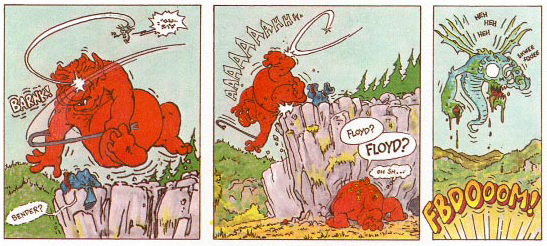
I miss Bender.

But what about White Dwarf?

The Dec 1980/Jan 1981 issue has the usual cool cover, though the color of the lettering could have been a bit better.

This issue includes aristocracy for Traveller by Rick D. Stuart, some cool magic items for AD&D, a very cool NPC class by Lewis Pulsipher called Black Priests. Here are the highlights:

Black priests must have Wis, Dex and Cha of 13 or higher. They roll d6 for hit points, and they must be evil. If they change alignment, they become thieves. They can wear up to leather armor and use shields when not using thief skills.

A black priest’s chance to move silently and hide in shadows is doubled in their own evil temples (neat touch). They are -1 to hit and damage with swords, and +1 to hit and damage with daggers, and -2 to hit with ranged weapons other than throwing knives. Black priests can “backstab” with a strangling cord (1d8 damage, must have Str 7 or higher to use). They rebuke undead and cast spells as evil clerics, and they can call upon the Lords of Evil to summon a monster each battle (lots of rules governing this ability).

They gather followers at high levels, including other black priests, displacer beasts, gorgons, hill giants werewolves, minotaurs, invisible stalkers (summon 1/wk), trolls, undead and nightmares. Great class!

This issue has an adventure (as most did) – “The Search for the Temple of the Golden Spire” by Barney Sloane. It is intended for seven 2nd-4th level characters.

The monster section goes big time, with the Four Horsemen of the Apocalypse by Ian Cooper (one of them, Ky, is a Supra-Lich), Capricorns by Roger Moore, Crystal Golems by Robert Outram, and Ungoliant, Queen of the Spiders by Peter Cockburn.

Ungoliant, Huge Outsider: HD 38 (225 hp), AC 26 (Body) 14 (Belly) 24 (Eyes) [+3], ATK Bite (3d12 + swallow whole for instant death on natural 20) and 2 legs (2d12) or 2 palps (1d12), MV 90′, SV F3 R3 W3, AL CE, XP 38,000 (CL41), Special-Magic resistance 80% (50% of which is from her unlight (see below), and can be dispelled), immune to psionics, body oozes contact poison (Poison IV, -3 to save), breath 30′ x 30′ x 30′ fear gas 3/day, 10 eyes function as beholder, except 7th eye fires a matter agitation ray (as the psionic discipline) – one eye fires at a random target every 2 rounds, summon 3d10 phase spiders to cover her retreat.

Ungoliant is the originator of all spider kind. She is swathed in unlight (awesome concept – it’s equivalent to 5 darkness spells). She swallows gems, gaining 1 hp per 10 gp value. If she is seriously wounded, she rears up, exposing her belly, and attacks with her bite and 6 legs (2d12). If her unlight is dispelled with five continual light spells, then additional magical light deals 3d10 damage or destroys one of her eyes. A magic whip is embedded in one of her legs. In the hands of a chaotic evil creature it is a +5 flaming whip, +8 vs. good that inflicts 6d6 damage, or 12d6 in the hands of someone with a strength higher than 18.

Wow! Lolth is a piker in comparison.

Lewis Pulsipher also contributes a bit on an explanation of character stats in D&D. Here’s the interesting passage:

“Dragon breath, after all, does not burn the skin to a crisp (or freeze it) – a slightly ludicrous notion even if dragons are magical. Rather the superheated (or supercold) air, if it fills the lungs, does the damage. A victim of dragon fire dies because his lungs are destroyed, and it’s clear enough that turning one’s head away and keeping one’s mouth and nose shut will help reduce the damage.”

So save vs. dragon’s breath involves turning one’s head and holding one’s breath. Interesting concept.

That’s it for the White Dwarf, folks – and this post. Have fun!

Dragon by Dragon – November 1980 (43)

It’s time for another review of the grand old Dragon, and this time with a special guest appearance by White Dwarf #21. I figure, why not look at what WD was up to during the same month of Dragon I’m reviewing – see how the gaming communities in the US and UK differed.

First, though, we’ll dip into the Dragon and see what $3 got you back in 1980.

As you might be able to tell from the cover, this issue presents a new version of the Witch as an “NPC” class, written by Bill Mulhausen and revised and edited by Kim Mohan and Tom Moldvay. The first was back in Dragon #20, from November of 1978. I guess November is the month for witches.

This version is much like the one that will appear a few years later, dividing the witch into low (level 1-16) and high (level 17-22) orders. This is reminiscent of the AD&D druid. Here are a few of the essentials of the witch:

Requirements: Intelligence and Wisdom must be 15 or higher, must be human or elf (and elves are limited to 9th level, and can multi-class as witches).

Hit Dice: d4 to 11th level, +1 hit point per level thereafter.

Attack and save as magic-users.

Witches receive bonus spells for high Intelligence, as a cleric does for high Wisdom. Their chance to know each spell and such are as for a magic-user. For younger readers, AD&D magic-users had a percent chance to be able to learn any given spell of a level. This was based on their intelligence. You had to roll for each spell to see if a magic-user could learn it. So yeah, you could conceivably have a magic-user who couldn’t learn magic missile, fireball or lightning bolt.

The witch has rules for followers (gains 1d10x20 at 9th level if she establishes a place of worship), and rules about how many apprentices she can have.) She can apply for membership in the high order at level 10 if her Intelligence and Wisdom are 16 or higher and if she possesses a magic crystal ball, mirror or libram. High order witches can advance to 22nd level, and they receive special high order spells at each level from 16 to 22.

Besides their spells, they can brew poisons and narcotics, which they learn as they advance in level. This includes sleep (3rd level), truth (4th level) and love potions 6th level). She can read druid scrolls with no chance of failure, magic-user and illusionist scrolls with a 10% chance of failure and cleric spells if the spell is also on the witch’s spell list (8th level).

Witches can manufacture one magic candle per month at 9th level. The candles can cause love, offer magical protection, heal damage and other effects. She gets a familiar at 10th level, can brew flying ointment at 13th level, control dolls at 15th level, can fascinate with her gaze at 17th level, use limited wish at 21st level and shape change at 22nd level.

The witch has 8 levels of spells, which involve lots of charming, divination, some healing and a few offensive spells. It’s a cool class, but I can’t help but think you’d be just as well off with a magic-user.

Dave Cook (that one) offers some survival tips for the Slave Pits tournament at GenCon XIII. I only mention it here because those adventures went on to be classics when they were published as modules.

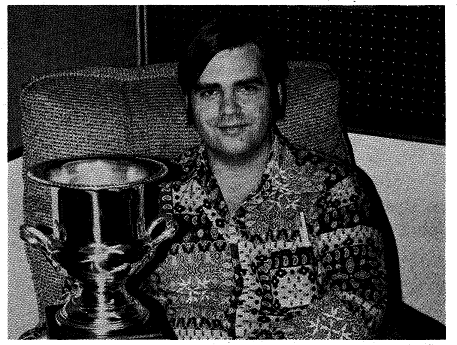
We also learn in this issue that Frank Mentzer won the 4th Invitational AD&D Masters Tournament at GenCon XIII. Dig that crazy shirt …

Speaking of great Dungeon Masters, this issue has a DM Evaluation Form for players to fill out. Here’s a sample …

This runs on for several pages and 43 questions! A couple issues ago, a reader complained that the adventures in the magazine were filler. This, ladies and gentlemen, is filler. I’m guessing GenCon kept them busy.

The Bestiary has some choice bits …

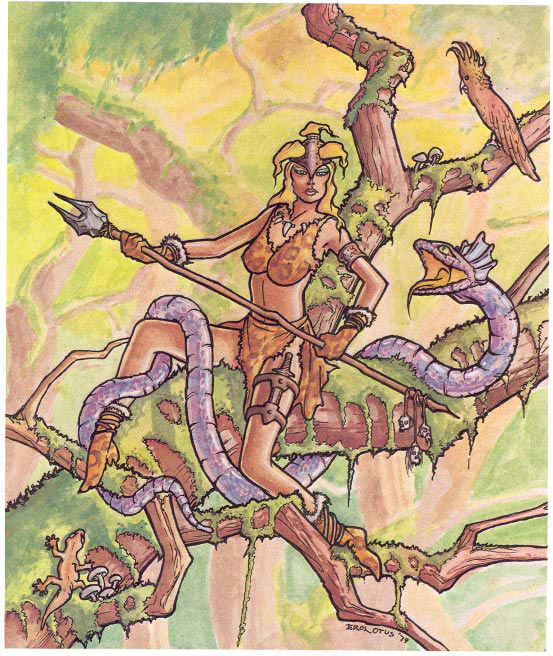
This is an amazon, art by Erol Otus (of course), monster by Roger E. Moore. I’d detail the monster stats here, but frankly, they’re humans and the women do all the “men’s work” and vice versa. Not much to see here – but the art is cool.

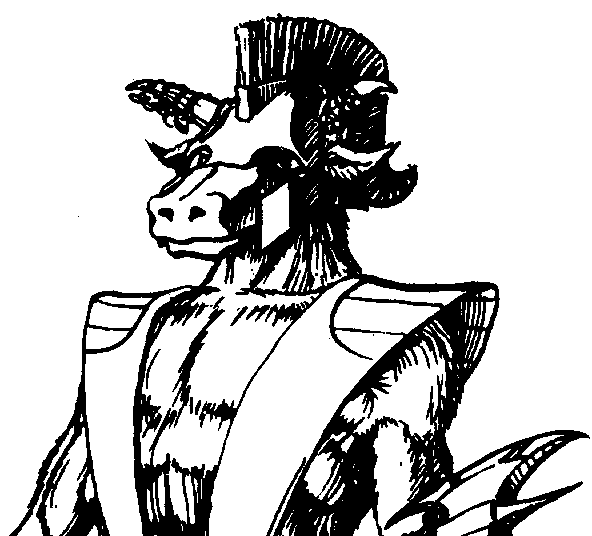
Todd Lockwood has a monster called a Tolwar that is basically a trunkless elephant who can telekinetically throw boulders (2d12 damage). They serve as loyal mounts.

Tolwar, Large Monster: HD 6, AC 15, ATK 1 slam (2d4) or 2 boulders (900’/2d12), MV 40′, SV F10 R11 W17, AL Neutral (N), XP 600 (CL 7), Special-Hurl boulders, only surprised on 1, telekinesis (100 lb), catch boulders with telekinesis (75%).

Ed Greenwood presents the lythlyx, a weird spiral creature that whips, constrict and drain blood from people.

Lythlyx, Large Aberration: HD 6, AC 19, ATK 1 whip (2d6 + constrict 3d6 + blood drain 1d4), MV 15′ (Fly 20′, Swim 20′), SV F13 R14 W11, AL Neutral (N), XP 600 (CL 7), Special-Blood drain can be used to heal monster (heal 1 hp per 4 hp taken), immune to charm, command, fear, hold monster and sleep, psionic attacks (all).

Now, give me a bunch of amazon warriors on tolwars hurling boulders at a band of adventurers who have stolen some amazon gold and are hiding in a half-ruined wizard’s tower, and you’ve got an adventure.

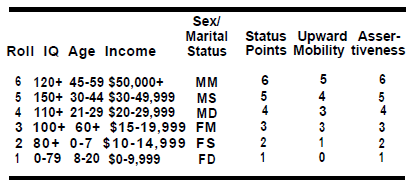
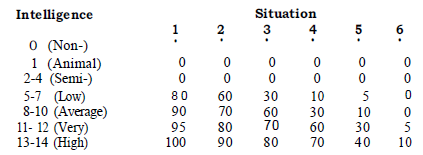
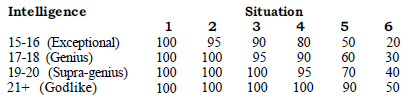
Philip Meyers has an article about disbelieving illusions, or more specifically phantasmal force. He comes up with a little system based on the intelligence of viewer and how suspicious they are about what they’re seeing. In the table below, situation 1 represents a character who has been informed about the illusion, and 6 is where the character expects to see what the illusion is depicting – in other words, 1 is super suspicious, and 6 is not suspicious at all.

The number is the percent chance of disbelief. It is increase by +20% if olfactory or thermal components are expected but not present, +20% if aural components are expected but not present, +10% if victim of illusion is an illusionist, -10% if victim is surprised and +10% if victim’s Wisdom is 15 or higher.

I reckon you can do about the same by giving a bonus to save vs. phantasmal force as opposed to improved phantasmal force or spectral force.

This issue contains a Traveller adventure called Canard. I won’t comment, because I’ve never played Traveller, but if you’re a fan, it’s probably worth checking out.

Two reviews which might be of interest – the first a Game Designers Workshop (not Games Workshop, as I originally posted) offering called Azhanti High Lightning, about fighting aboard a giant starship. The review was positive, but wonders whether or not they should have tried to tie it to Traveller.

They also review SPI’s DragonQuest, their first “serious” foray into Fantasy RPGs. The reviewer likes it – the intentional rather than random character generation, the action points in combat – but does not care for the way experience is handed out. Overall – positive review, and another reminder that Old School gaming was already becoming “Old School” in 1980.

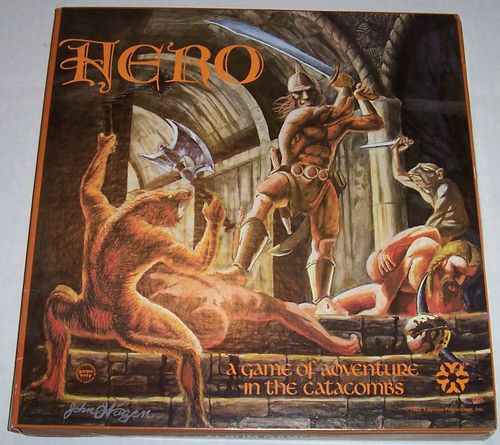
I’ll also note Hero, by Yaquinto Games. It was an “album game” – “The physical layout is like that of a double record album. The components are stored in the pockets, while the playing surface is printed on the two inside faces.”

Very cool idea, and it would be fun to see something similar done these days, especially considering the connection between Old School gaming and bitchin’ Heavy Metal album art.

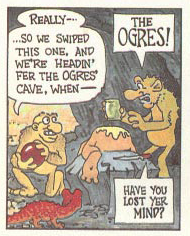
I liked this comic …

A scroll of illiteracy would be a great cursed item in a game.

A fair issue of Dragon, with a couple notable bits.

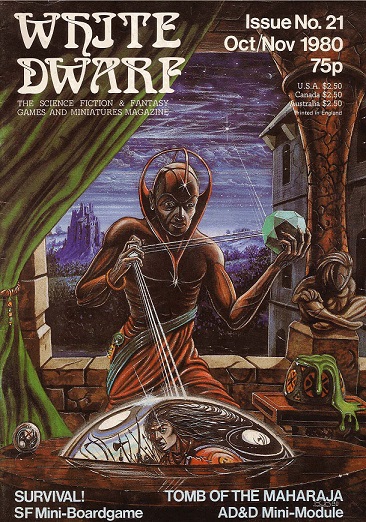
So, what was White Dwarf up to in November (really Oct/Nov) of 1980.

First – cool cover, but there are much better WD covers yet to come. You also notice, right off, that the layout of WD is much more professional than for Dragon at this point. Dragon makes some improvements over the years, but frankly never looked as good, and by the 1990’s and 2000’s looked terrible.

In this issue, Andrew Finch presents some cool material inspired by The Chronicle of Thomas Covenant, Unbeliever. We have a new class, Lore Lords, who combine the spell-casting ability of magic-users and clerics, along with d8 hit dice and studded leather armor. Fortunately, this is balanced by a high XP requirement. Similar classes are the Rhadamaerl, who specialize in the lord of stone, and Hirebrand, who specializes in the lore of wood. There are also Bloodguards, who serve as bodyguards for Lore Lords, songs of summoning and words of power. Having never read the Thomas Convenant books, I cannot rate how accurate these classes are, but for fans they’re probably worth checking out. One bit I liked for Lore Lords was their ability to communicate telepathically with one another. A cool house rule might permit magic-users with intelligence and wisdom of 15 or higher to communicate this way with one another.

Roger E. Moore (yeah, that guy) presents a merchant class. It’s actually pretty close to the Venturer class I did, and I promise I hadn’t seen this write up when I wrote mine. Moore’s merchants can open locks, appraise items and use suggestion and command when speaking with people. These are all percentage skills, like those of the thief. Good class.

Azhanti High Lightning gets a review in this issue – positive as in the Dragon.

The Fiend Factory has several cool monsters, the Brothers of the Pine, Chthon, Enslaver, Micemen, Dragon Warriors, Grey Sqaargs and Cyclops. Here are some quick stats:

Brothers of the Pine, Medium Undead: HD 3, AC 15 [+1], ATK 1 weapon, MV 30′, SV F15 R15 W12, AL Chaotic (LE/NE), XP 1500 (CL 5), Special-Cast one 1st level druid spell per day, shrieking wail (save or flee for 1d8 turns), immune to cold, resistance to electricity, vulnerable to fire, only plant-based spells affect them.

Chthon, Medium Aberration: HD 8, AC 20, ATK nil, MV 0′, SV F13 R- W9, AL Chaotic (LE), XP 800 (CL 10), Special-Mineral intellect that hates all animal and plant life, especially intelligent, control up to 20 plants and animals (save to negate).

Enslaver, Tiny Aberration: HD 2+1, AC 14, ATK special, MV 10′, SV F19 R17 W12, AL Chaotic (CE), XP 200 (CL 3), Special-Blindsight 30′, 90% chance of hiding among rocks, dominate creatures that touch them (save negates), hosts freed from domination must make system shock roll or die, hosts are immune to pain and mind effects.

Micemen (crossbreed of brownie and orc!), Small Humanoid: HD 1-1, AC 13, ATK 1 javelin and dagger, MV 30′, SV F14 R16 W16, AL Chaotic (LE), Special-Infravision 90′, shun bright lights, surprise (4 in 6). Despite the picture, I’d like to see these dudes as evil piglets dressed as Robin Hood.

Dragon Warrior (made from dragon teeth), Medium Construct: HD 5+1, AC special, ATK 1 weapon, MV 20′, SV F14 R14 W14, AL Neutral (N), XP 500 (CL 6), Special-Cannot speak, obey commands, last for a number of turns equal to the dragon’s age category, +1 to hit, +2 to damage, attack as 6th level fighters, immune to parent’s breath weapon type, sleep, charm and hold, clad in scale armor and armed with broadsword, disintegrate when killed or dispelled.

Grey Sqaarg, Medium Construct: HD 6, AC 22, ATK 1 grapple, MV 20′, SV F14 R14 W14, AL Neutral (N), Special-Constructs built by ancient dwarves, never initiate attack, fight with strength bonus to hit and damage equal to combined modifiers of attackers, grapples to incapacitate people, made of solid stone, magic resistance 30%.

Cyclops, Large Giant: HD 6, AC 14, ATK 2 claws (1d6), bite (2d6), MV 30′, SV F10 R14 W14, AL Chaotic (CE), Special-Hypnotic stare, -1 to hit melee, -2 to hit ranged, +2 save vs. illusion, prefer to eat demi-humans to humans, breed with human females.

White Dwarf #21 also contains a sci-fi boardgame called Survival and a dungeon called the Tomb of the Maharaja. It is, I’m afraid, quite short and not terribly interesting.

All-in-all, some pretty cool stuff from the Brits in November 1980 – and of course, lots of art by Russ Nicholson.

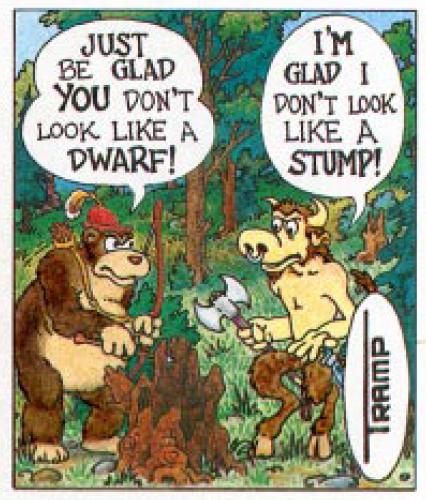
Well, that does it for this edition of Dragon by Dragon. As always, I leave you with Tramp …

Dragon by Dragon – July 1980 (39)

It’s been too long since I did a review of The Dragon. Between work and trying to write/edit a few games, Sundays have been just packed, but today I’m diving back in. This week, we’re examining The Dragon #39, released in July of 1980. I can remember those days. I was 8, and I think the entire country was just about fed up with the 1970’s. Despite what you might have picked up in a revisionist history class, the 1970’s sucked. Hard. In RPG land, though, things were heating up – new companies, new games, and TSR and D&D were about to hit the heights.

So, what did July’s issue have to offer? Let’s check out this edition’s Top 10 cool things.

As we often do, we start with an advertisement. This time from Iron Crown Enterprises. I’m trying to remember if I’d seen an I.C.E. advertisement in The Dragon yet, and I don’t think I have. God knows, we’ll see plenty in the issues ahead.

I must say, there’s a bit of humor in an ad that looks like that and boasts about “fine graphics”.

They also left their state off the address – did everyone know where Charlottesville was back in the day?

Anyhow – they would go on to produce some pretty good material – from tiny acorns do mighty oaks grow.

#1: COMPUTERS

Here’s a sign of the times:

“Snap! Crackle! Zap! THE DRAGON computes! Recently, we’ve acquired a TRS-80 computer here at THE DRAGON (for those of you into home computers, it’s the Level II with 16K memory, a 16K expansion interface, two floppy-disc drives, and a printer). In addition to using it in conjunction with Mark Herro’s ‘Electric Eye’ column, we’ll now be able to look at a few of the plethora of game programs now available on the commercial market, and (hopefully) do some reviewing on our own. Please hold off on sending us your own home-brew programs for a bit yet; we’ll have our hands full with what’s on the market already. But electronic gaming is looming on the gaming horizon, and THE DRAGON is going to be ready for it.”

Personally, I don’t think electronic gaming will ever catch on.

#2: FANTASYSMITH

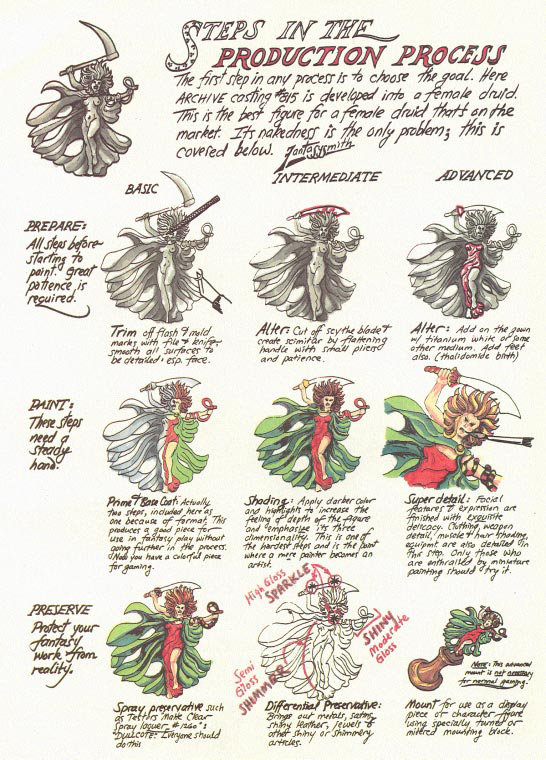
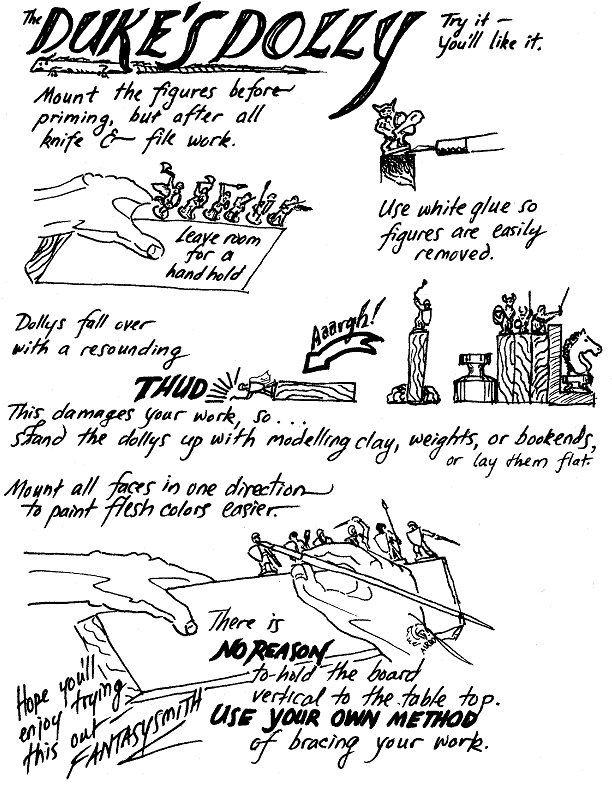
Fantasysmith did some really nice miniatures articles, and the art was always top notch. This one in particular deserves an airing after 35 years:

The one thing left off this guideline: Be good at painting. When I did the miniatures thing, I had no problem choosing the goal  … I was just often less than successful in getting there.

#3: THE ANTI-PALADIN

Really, this should be Cool #1, because this article by George Laking and Tim Mesford introduces a “beloved” element of old school gaming – The Anti-Paladin!

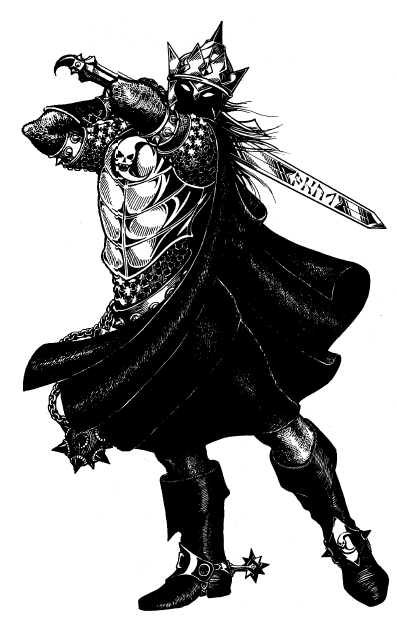
We start with awesome art (not sure who drew it), and then move on to the class itself.

The anti-paladin was an NPC class, meaning it couldn’t be used by players. To that end, it gives a guide on rolling up the anti-paladin’s scores, using 12+1d6 for strength, for example, or 10+1d8 for constitution. Charisma has a special formula that uses 1d4: a “1” equals 3, a “2” 4, a “3” 17 and “4” 18. On a charisma of 18, there’s a 25% chance of having an exceptional charisma. Anti-paladins with very low charisma cause fear, while those with very high charisma will charm humanoids and other monsters.

I bring the above up to show how different the game was in the old days. There was much more willingness to invent new sub-systems to do things.

Anti-paladins roll d10 for hit points, gaining 3 per level after 9th. They get a host of special abilities, including causing disease and wounds, protection from good, backstabbing, poison use, rebuking undead and demons, a special warhorse and cleric spell use at high levels. Their special swords are called unholy reavers, which is, by the way, pretty sweet.

SIDE TREK – ALIGNMENT AND GODWIN’S LAW

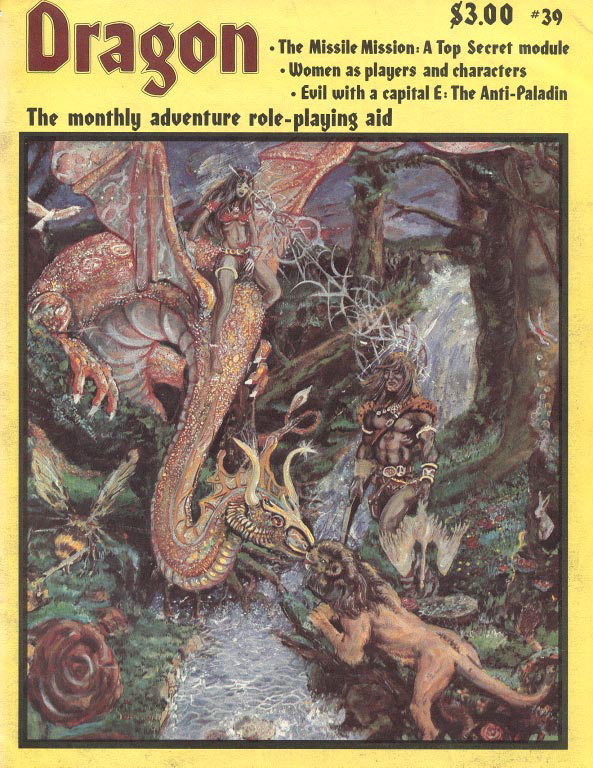
Why was alignment discussed so much back in the old days? Because alignment was a stand-in for philosophy – moral and ethical philosophy anyways. That made it interesting for lots of people, and contentious as well. A good example is the “Up On a Soap Box” in this issue, in which the following question is asked:

“Is something right just because we think it is right? If Hitler feels that it is right for him to kill six million Jews, is that morally acceptable?”


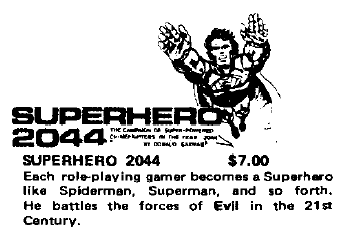
The first superhero rpg. Review here.

Heavy stuff for a game magazine. Alignment has become a throw away in many modern games, or has been rendered down into the faction rules it appears to have grown from. The discussions are still being had, though, in the gaming community and beyond.

Oh, and the answer to the above question is NO.

#4: ERA in RPG

Well, we’ve already mentioned Hitler and the Holocaust in an article about alignment, why not delve into equal rights?

The article is “Women Want Equality and Why Not?” by Jean Wells and Kim Mohan, and there’s a follow-up called “Points to Ponder” by Kyle Gray. I’m not going to delve too much into the contents of the article, but I suggest you find a copy online (it’s there) and read through it. It’s worth comparing and contrasting what was being discussed 35 years ago with what is being discussed today.

#5: LAKOFKA’S RANDOM SPELLS

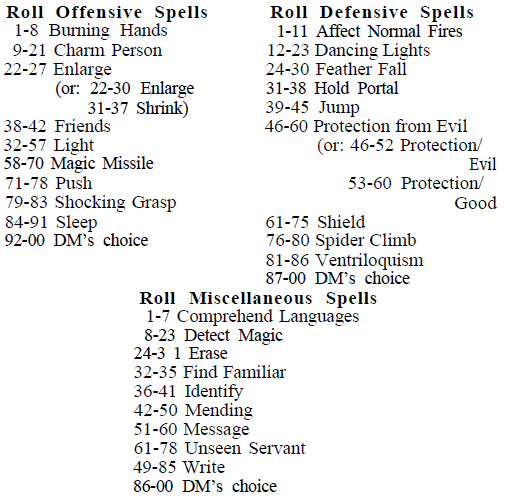
Len Lakofka writes an article called “Starting from Scratch” about starting a new campaign and rolling up a new party. The bit I liked was the random tables for rolling up starting spells. For magic-users it’s pretty straight forward – roll once on each table for a magic-user’s three starting spells:

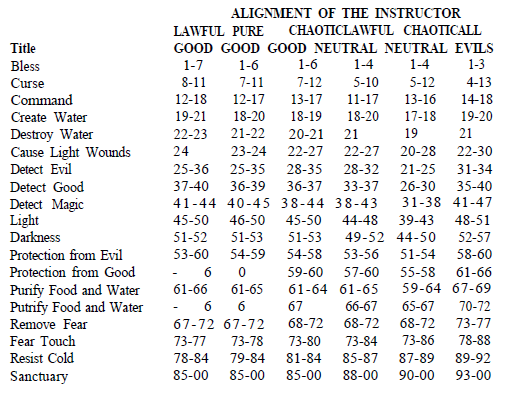
He also suggests a limited number of starting prayers for clerics – 1d4+2 to be exact, with those spells being rolled randomly and modified according to the cleric’s instructor’s alignment.

The article covers much more ground than this, of course, so it’s worth reading.

#6: GIANTS IN THE EARTH

You know I always like these little Moldvay gems. This edition contains two Norse legends.

Bodvar Bjarki (16th level chaotic good fighter), the son of a Norwegian prince who was turned into a bear during the day. Bjarki wields Lovi, a +3 sword, +6 vs. magic-users.

Egil Skallagrimson (14th level chaotic neutral fighter) who became a viking.

The article also contains a small table of runes.

SIDE TREK: FANTASY VS. REALITY

A question to the sage:

“Question: Why can’t human, half-elf and elven Magic-Users wear armor and still cast spells? Elves and half-elves who are Magic-Users and Fighters can, so I don’t believe it is because of the iron in their armor or weapons. If it is because of training, then Magic-Users could be able to learn how to wear armor and cast spells at the same time—and even a human Magic-User/Fighter could train to acquire the ability.”

My answer – it’s a made up rule to keep the game balanced, you knucklehead. Stop rationalizing make-believe!

#7: GOOD HITS AND BAD MISSES

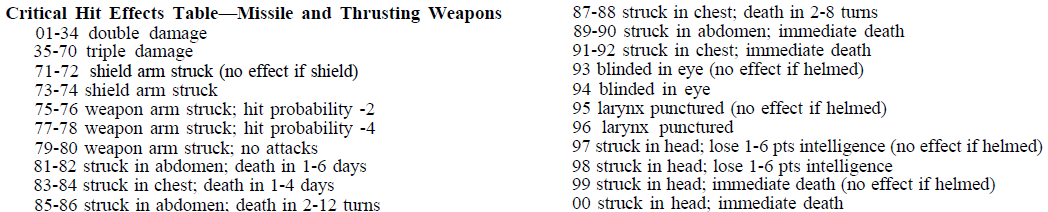
This article by Carl Parlagreco is one of the classics. It covers critical hits and fumbles, which it describes as “two of the most controversial subject areas in D&D”. His system is fine enough, but the random tables for the effects of critical hits and fumbles are what makes it really groovy. A sample – critical hit effects of missile and thrusting weapons – follows:

#8: OLD SCHOOL AIN’T NEW

I loved this piece by Karl Horak:

“Several months ago I came across a member of the minority that hasn’t acknowledged Gary as final arbiter. The campaign he ran was based on the original spirit of Chainmail instead of the latest revisions. To say the least, the game was fresh and unorthodox. His foundation was the 3rd edition of Chainmail and his vague recollections of the three-volume set of Dungeons &Dragons, which he never purchased.”

Testify, brother!

#9: OLD SCHOOL ADVERTS

I dig the image in the ad to the right – makes you wonder what the Hell is going on. I’m going to turn this into a little side trek into comic books.

When I used to collect the things, the covers were a shorthand blurb about the story in the issue – the idea was to get a kid at a news stand to plunk down their money to find out what was going on.

Now comic book covers are mostly pin-ups, I suppose because they’re aimed at an different audience. They’re usually very well drawn, but personally, I prefer those old covers. They fired the imagination, and were pretty fun. In fact – when I find an old issue, those covers still induce me to buy them. The pin-ups – not so much.

#10: TRAMP

Of course …

That’s all for this week. Hopefully the pace will slow down and I can get another one written next Sunday. I will have some updates this week from the next hex crawl in NOD.

Dragon by Dragon – April 1980 (36)

There will come a day when the April edition of The Dragon will be full of jokes. Based on the cover, I’d say that day was not in April of 1980.

The aforementioned cover is by Dean Morrissey, and it is inspired by that issue’s short story by Gardner Fox, “The Cube from Beyond”, a Niall of the Far Travels story. Mr. Morrissey is still a working artist – you can see some of his pieces HERE.

Let’s check out 10 cool things about issue #36 …

1) NIALL OF THE FAR TRAVELS

First and foremost, I’m always a sucker for a good sword & sorcery tale by Gardner Fox. Here’s a sample:

“Now Thavas Tomer was a doomed man. He had fled down the halls and corridors, seeking sanctuary—where no sanctuary was to be found. At his heels had come Niall, his great sword Blood-drinker in his hand, seeking to make an end to this magician-king who had slain and raped and robbed all those against whom he had sent his mercenaries.”

If somebody could figure out a way to make a random idea generator that plucked passages from fantasy stories, I bet it would be a great way to come up with adventures or campaigns. Three different passages from the same book might inspire three very different campaigns.

2) ALIGNMENT STRUGGLES

An interesting “Up on a Soap Box” by Larry DiTillio, regarding him running an adventure he normally ran for adults for some adults and teens at a convention. Here’s an excerpt:

“In the same game another incident occurred, again with that same Paladin player. This one involved a mysterious monk smoking a substance from a hookah which he offered to certain party members. My friends accepted somewhat overeagerly, while the Paladin again asked me that question. Was smoking a drug against his alignment? Now, I’m not a junkie, nor do I think drugs are of any benefit to teen-agers (no high is as good as your own natural openness to things at that age), but I have had a good deal of experience with a whole gamut of consciousness-altering substances and would be hard pressed to declare them categorically evil.”

The first incident involved a dungeon room where sex could be purchased. In both cases, the paladin inquires whether these acts are against his alignment. It’s a tricky question, and does get to a problem with alignment – i.e. the interpretation of what it means. No answers here, but an interesting problem, and an interesting article.

3) CONAN!

In this issue, Gygax chimes in with some stats for Conan. It’s funny, but I was actually searching for this article recently, looking for inspiration for maybe making some revisions to the barbarian class in Blood & Treasure.

In doing so, I found some comments on websites that this article was a mistake, in that the weird rules changes needed to simulate Conan showed the weakness of the D&D system. I disagree – D&D is a game. Conan was a character in stories. No random rolls there, no comparisons of hit rolls and Armor Class. That a game cannot simulate something in a story is not a condemnation of the game (which, in D&D’s case, was not designed specifically to simulate Conan stories in the first place).

So, how does Conan shake out? Well, which Conan. The piece actually presents Conan at different ages – 15, 20, 25, 30, 40, 50, 60 and 70. Neat idea. We also see how his fighter and thief levels change through his ages. His fighter level runs from a low of 4 at age 15 to a high of 24 at age 40 … and then back down to 12 by the time he’s 70.

How does a level drop? Well, there’s really no way to do it in the game, but I thought about using a rule that each year without adventuring might result in a character losing 10% of his earned XP. If you don’t stay in practice, you get rusty and, therefore, lose levels. Just a thought.

So, let’s look at Conan at age 25.

Conan, Human Fighter/Thief: Level 12/8; HP 132; AC 16; ATK attacks 5 times every 2 rounds; Str 18/00, Int 15, Wis 10, Dex 20, Con 18, Cha 15; AL Chaotic Neutral (good tendencies); Psionics–Latent–animal telepathy, detect magic, precognition, mind bar.

Conan gets the following special abilities:

  • When he rolls a total of “21” to hit, he scores double damage.
  • He is 75% undetectable in underbrush and woodlands.
  • He surprises opponents 50% of the time.
  • He is only surprised on a roll of 1 on 1d20.
  • He gets a +4 bonus on all saves.
  • Poison can knock him unconscious, but never kill him.
  • He regains hit points at double the normal rate, and regains hit points at the normal rate even without resting.
  • He has 25% magic resistance if he is aware that magic is being used against him.
  • His psionics are all latent – he does not know he has them, and cannot consciously choose to use them.
  • When wielding an off-hand weapon, he can parry one attack per round with it.
  • He can move at a trot all day without tiring.
  • His trails are 75% undetectable.
  • His vision and hearing are 50% better than normal.
  • When he pummels people, his opponents are treated as slowed; his fists are treated as mailed even when bare.
  • When grappling, his effective height is 7′, and his effective weight is 350 lb.
  • He gets a 15% bonus to overbearing attacks
  • He does unarmed damage as though armed with a club

4) PITY THE HALF-ORC

In “Sage Advice” by Jean Wells …

“Question: Why can’t half-orcs be raised, especially if they are 90% human as the Players Handbook says?

Answer: The Players Handbook does not say that half-orcs are 90% human. It says that 10% of them (from which player characters are drawn) resemble humans enough to pass for one under most circumstances. Genetically, a true half-orc is always 50% human. Half-orcs cannot be raised simply because they do not have souls. I went right to the top for the answer to this one, and according to Gary Gygax himself, ‘Half-orcs cannot be raised-period.'”

It occurs to me that the inability to raise demi-humans was a balancing factor in old D&D for all of their special abilities.

5) IS THAT ULTRA-POWERFUL MONSTER A DEITY?

Len Lakofka tries his hand at setting all those deity-killing PC’s right by setting down some truths about the gods. How many DM’s, I wonder, design their pantheon specifically for one day fighting high-level adventurers?

Here are Lakofka’s definitions for deity-hood:

1. Has 180 or more hit points
2. Can cast a spell or has a power at the 20th level of ability
3. Can fight or perform acts as a 20th level Lord or 20th level Thief

Those who cannot do this are not deities. This includes Jubilex, Ki-rins and Yeenoghu. Baal, Orcus, Tiamat and Bahamut, on the other hand, are deities.

He also states that deities get their special abilities from the Outer Planes, while lesser beings get their powers from the inner planes or from deities.

Much more here, including abilities from ability scores of 19 or higher (or 25+ for strength).

It looks like the blueprint used for the later Deities & Demigods / Legends & Lore books.

AD BREAK

Now that’s a great illustration for selling a monster book. You can pick up the PDF HERE.

6) APRIL FOOLS!!!

Turns out there was a prank hiding inside this issue after all – technically The Dragon #36 1/2.

We have articles about how to make the most out of your pet dragon, some new monsters (see below), keeping your players poor with the tax man, Bazaar of the Ordinary (web of cob), a random table (d30!) of things to say when you accidentally (or maybe not accidentally) summon Demogorgon, Leomund’s in a Rut (expanding character footwear options), this month’s module – a 10×10 room with nothing in it (map provided), and an add that includes Detailed Advanced D&D, the next step in fantasy gaming.

As for one of those new monsters:

The Keebler, Small Fey: HD 0; AC 13; ATK none; MV 40′; XP 50; AL N (good tendencies); Special-Magic resistance 60%, bake cookies (Will save at -4 or charmed); Spells-3/day-create water, purify food & drink, slow poison, create food & water, neutralize poison, locate object (edible substances) – as though by 7th level cleric.

7) The Mongols

Neat article by Michael Kluever on the history, weapons and tactics of the Mongols. Mongols done the way they were are probably pretty underused in fantasy gaming – they were a pretty fascinating group, and a campaign that includes a rapidly expanding Mongol Empire (wherein PC’s leave town, adventure in a dungeon, and come back to find the town razed or absorbed into the empire) would be pretty cool, especially if that expansion ends up being crucial to the game.

How was the typical Mongol warrior equipped:

Armor ranged from none to leather to scale armor, plus conical helms (leather for light cavalry, steel for heavy cavalry) and small, circular shields made of wicker covered with leather; they also wore silk undershirts that apparently helped to minimize damage from arrows when they had to be removed from wounds

Two composite bows, one for short range, one for long range; they used armor-piercing arrows, whistling arrows to signal and incendiary arrows (tipped with small grenades – apparently the Duke boys didn’t invent the idea); each warrior carried two quivers with 60 arrows in each

Heavy cavalry also carried a scimitar, battle axe OR horseman’s mace, a 12′ long lance with a hook for yanking warriors off their horses and a dagger

Light cavalry carried a lighter sword, two to three javelins and a dagger

8) Giants in the Earth

This edition, by Lawrence Schick and Tom Moldvay, includes:

Rafael Sabatini’s Captain Blood (17th level fighter, 10th level thief, 8th level cleric)

Lovecraft’s Richard Upton Pickman (King of the Ghouls, 9th level fighter)

Thomas Burnett Swann’s Silverbells (forest minotaur 15th level ranger, 13th level paladin)

The last one caught my attention, since I’d never heard of the author. The idea is that the original stock of minotaurs, termed forest minotaurs here, were neutral good defenders of the woodlands and the fey creatures who lived therein. You can find his books for sale at Amazon.

9) A New Way to Track XP

Experience points, like alignment, are a perennial sub-system people are trying to improve. In this version, XP are based on actual damage inflicted (modified by the strength of the opponents), and for deeds actually done. To whit:

For non-magical monsters, you get 5 XP per point of damage done, multiplied by the difference between the monster’s AC and 10

For magical monsters, 10 XP per point of damage done, same modifier.

For spellcasting in combat, 10 XP per level of spell

For spellcasting in a hostile situation, 5 XP per level of spell

Thieves get XP for gold stolen, maybe only if they grab a larger share than the other members of their party

Not a bad idea, really.

10) The Fastest Guns that Never Lived

This is a reprint, collection and expansion of articles I remember covering many reviews ago. Designed for Boot Hill, it’s a pretty fun article for fans of westerns, and a great opportunity for fan debates. If you think it’s bunk, you can blame Allen Hammack, Brian Blume, Gary Gygax and Tim Kask.

So, let’s get to the winners in each stat:

Fastest Gun in the West: (1) Clint Eastwood, (2) Bob Steele, (3) Paladin

Slowest: Pancho

Most Accurate Gun in the West: (1) Clint Eastwood, (2) Will Sonnet and Col. Tim McCoy, (3) Lone Ranger, The Rifleman, Paladin and Lee Van Cleef

Least: Hoss and Little Joe Cartwright

Bravest Gun in the West: Charles Bronson

Most Cowardly: Pancho

Strongest Gun in the West: Hoss Cartwright

Weakest: Will Sonnet

Somebody was in love with Clint Eastwood, huh?

11) BONUS COOL – THE KROLLI

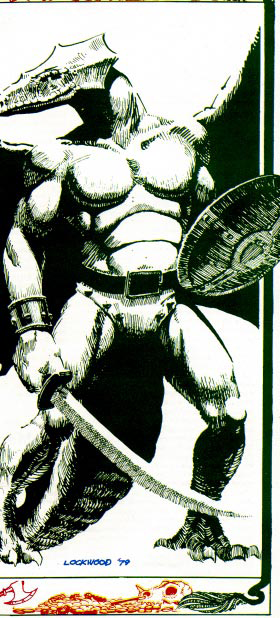
Todd Lockwood (that one?) brings us the monster of the month, a race of warm-blooded flying reptile dudes. Here are the Blood & Treasure stats.

Krolli, Large Monstrous Humanoid: HD 2 to 6; AC 17; ATK 1 bite (1d6+1), rear claw (1d8+1), hand (1d8 or by weapon +4); MV 20′ (fly 40′); AL varies; XP 200 to 600; Special-High dexterity, multiple attacks, acute senses, surprised on 1 on 1d6, 25% magic resistance.

They are encountered in lairs, with 3d20 in lair, 25% females and young, with 2-3 and 1/2 HD each, and 1d8 7+2 HD chieftains. Encountered among men, they are usually mercenaries or slavers, and could be found as body guards or military officers.

They have high natural strength (20) and dexterity (23).

They may be of any class, though 95% are fighters. Of the remainder, 70% are clerics. They cannot wear armor, but often carry shields. They are almost never thieves or assassins.

Side note – I really loved Lockwood’s stuff for 3rd edition D&D – a very worthy artist to carry that torch, I think.

Hope you enjoyed this review … I leave you with Tramp

Dragon by Dragon – February 1980 (34)

One of the fun things for me about doing these reviews, besides just exploring all the great “forgotten” material produced for our favorite games, is the covers. I didn’t get into D&D until around 1984, and didn’t know about Dragon Magazine until maybe a couple years after that, so these are all new to me. This month’s cover is, I think, particularly cool. An army working its way down a defile to face a decidedly chaotic-looking castle. The cover was painted by Ken Rahman, aka Elladan Elrohir.

Well, what are the top ten cool things to be found in The Dragon #34? Let’s see …

I. THIS IS WHY I KEEP IT VAGUE …

From “Out on a Limb”, a letter by Robert T. Willis III

“I would like to correct some numbers that appeared in “How Tall is a Giant?” (TD31). In the article, 3mm figures were equated with 1/500 scale, and the reader was led to expect that his rational guess of 1/600 was blatantly wrong. As a math major at the Massachusetts Institute of Technology, I would like to point out that the article was wrong—3mm figures are actually 1/600 scale (1/609.6 is the exact number).

Since 3mm = 3/25.4 inches = 3/(25.4 x 12) feet = 3/304.8 feet, the scale is (3/304.8)/6 because the figure represents a man 6’ tall. This number is 1/609.6 which can be rounded to 1/600.”

II. MINING IDEAS

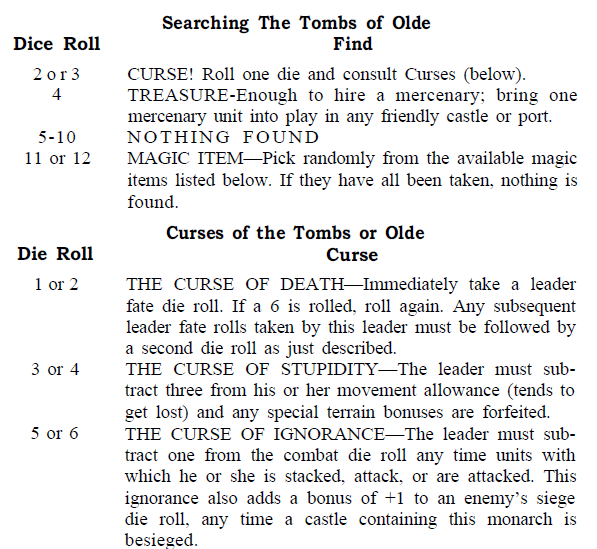
I know next to nothing about Divine Right by TSR, which is unfortunate since this issue devotes a great deal of time and energy to that game. That said, there’s usually something useful to be found in any game, and I thought these two tables might be useful:

Tombs and curses. I can imagine using this when dealing with large armies tromping across hex maps on the way to besiege a stronghold and coming across some mini-dungeon. Roll on the dice, lose the dice roll as a percent of your troops, and use that percentage chance for each named character in your army to die (allow a saving throw if you must – if they save, they do not die, but they may not participate in the battle).

III. WARGAME WHAT-IFS

Samuel Gill, in “Up on a Soap Box” presents a few ideas for wargame campaigns that twist actual history around a bit, such as a Mexican-Texican War in 1842 (which kinda sorta happened, though not on a huge scale), Mediterranean fleet action in WW1, assuming the Italians had not defaulted on their commitments to Germany and Austria-Hungary, and a revival of hostilities between France and Prussia in 1886.

This brings up not only the idea of using similar historical what-ifs for RPG campaigns, modern and medieval, but also twisting the history of your own campaign world. Imagine the characters in a long-standing campaign waking up to find the world they know changed in major ways, and having to figure out how the bad guys (or good guys, if the party is evil) did it, and how to get things back to normal – or maybe they cannot and now have to start from square one!

Sam’s article gives numerous other examples of alternate history, which are well worth the perusal.

IV. OH, I THINK GARY CAN ANSWER THAT …

A question from “Sage Advice”:

“Question: I have just started playing AD&D and I don’t know what the following weapons are: Bardiche, Bec de Corbin, Bill-Guisarme, Fauchard, Fauchard-Fork, Flail, Glaive, Glaive-Guisarme, Guisarme, Guisarme-Voulge, Lucern Hammer, Partisan, Pick, Ransuer, Scimitar, Spetum and Voulge.

Can you tell me what they are?”

Now we would just tell him to Google it.

V. MONSTER TABLES

If you’re playing a 1st edition AD&D game and like to keep it pristine, Blake Ward’s “Familiar Fiends” article might be just for you. It collects all the monsters in the AD&D Monster Manual and puts them into a random table for stocking dungeons. He also has a random table for determining what level of monster to use based on the dungeon level you’re stocking:

Very nice.

AWESOME ADVERT

Dig this ad for Judge’s Guild:

Love the fighter and his horse.

VI. RISKING THERMONUCLEAR WAR

Funny, isn’t it. We went from “Atomic War” to “Nuclear War” to “Thermonuclear War” and then back to “Nuclear War”. Anyhow …

A rare article in The Dragon for good old-fashioned RISK. This one, by George Laking, gives some variants on the old game, including the addition of nuclear weapons. I won’t go into the details, but they would certainly make for an interesting game … or you could just play Supremacy. Boy, we had a lot of fun with that game back in the day, and RISK and Axis & Allies as well.

VII. ONI VS. MINIATURES PAINTERS

Fantasysmith gives a guide to properly carrying your miniatures around without ruining them. What drew my eye was this illo:

When going to play wargames, always beware lurking ogre magi. Especially, one must presume, when in Japan.

VIII. GRIMTOOTH HAS COMPETITION

Look out for Gerard Moshofsky of Eugene, Oregon, Grimtooth, because he’s a devious guy. Check out this dandy trap:

This used to be quite the thing in old dungeon design. I think 3rd edition, by standardizing traps and attaching more rules to them, kind of killed this old creativity. Maybe I’m wrong.

IX. NAME GENERATOR

Love this name generator by Mark Whisler – it would be perfect for the barbarian mini-game I’m going to publish soon (from the “B for Barbarian” article in NOD).

Roll a d10 and d6 and cross-reference them on the table to get the first name element, then do it again for the second.

X. WEIRD OLD D&D

Tom Holsinger and Candy Peterson have a nice article on quirks and curses for magic items. Several tables, all good brain fodder, but I’ll point out these minor curses:

3) Develop highly unpopular sexual perversion (necktie party if you’re caught).

4) Develop socially unacceptable sexual perversion (Charisma reduced to 3 if you are discovered—Hint: It has to do with graveyards).

D&D was once for “weird adults” more than for “nerdy teens”.

AWESOME ADVERT

Broadsword Miniatures operated during the 1980’s out of Georgia USA. I liked the miniatures in the ad, so I did a little searching and found some more, like these goblins.

Man, I love those old miniature illustrations.

XI. DOOMKEEP

Last month’s adventure went well, so The Dragon included Doomkeep in this one, a dungeon by Brian Blume used as the Second Official Invitational AD&D Masters Tournament module. Obviously, I don’t have room in this issue to do a major review, but it has a chessboard room, which I love (see art below), and it includes the hand mirror of hoping, which has the following effects when used:

1. A Death Ray emerges (normal saving throw allowed).
2. A 5-die fireball explodes 32’ away from the mirror.
3. A twin of the object pointed at appears and aids the object pointed at (if possible).
4. 27 Blackbirds fly out of the mirror and confuse (saving throw allowed vs. spell) everyone in the area for 2 melee rounds.
5. The object pointed at is sucked into the mirror, never to return.
6. The object pointed at turns into a Type I Demon which attacks the holder of the mirror.
7. A 6-die lightning bolt shoots out 60’ from the mirror.
8. A Cure Critical Wounds spell is emitted at the thing pointed at.
9. A mist appears which obscures all vision in a 20’ x 20’ area (treat this as a Confusion spell if melee occurs in the mist).
10. Poison gas fills an area 30’ x 30’ (+2 on s.t).))

Also this …

Damn, I love old D&D.

OTHER GOODIES

This issue was actually pretty packed with interesting stuff …

“Minarian Legends” – huge article about the Muetarian Empire. Great art!

“Getting into the Flow of Magic Fountains” – random tables for generating magic fountains. I won’t reproduce the tables, but I will roll up a random fountain:

This fountain contains four drinks (weird, but okay). With each drink, a person gains an extra spell level (if they can cast spells), but also glow in the dark and suffer the effects of reduce person (save allowed).

“Dragon’s Bestiary” – this issue has the Vilkonnar by Charles Carson – a neutral evil underground humanoid race along with their slightly different cousins, the Kailiff.

“Dragon’s Mirth” – a standardized disaster scale by Jeff Swycaffer – fun, if nothing else for the U.S. regionalisms:

As always, I’ll leave you today with a tiny taste of Tramp …


Dragon by Dragon – January 1980 (33)

“This is the ’80s and I’m down with the ladies.” – Tone-Loc

And so we bravely enter the 1980’s (though, again, not technically). The Dragon #33 (we haven’t dropped the “the” yet) welcomes the new decade with “Dragon’s Lair” by John Barnes. The painting won Best of Show and “Best Color Fantasy” awards at the Northwest Annual Science Fiction Festival in Seattle.

What goodies await us inside? Let us find out.

I. Gardner F. Fox

Known best for the Justice Society of America, Fox also wrote fantasy novels later in life, the Kothar the Barbarian series maybe the best known of them, but also Niall of the Far Travels.

Oh, and apparently Guy Gardner was named for him (not sure that was an honor or an insult).

This issue of The Dragon features a short Niall story – the character has appeared in the magazine before. This one is “The Eyes of Mavis Deval”. Here’s the opening:

“It was her eyes that drew his stare as he sat astride the high-peak saddle of his stallion, there on the edge of the huge slave market. They were a brilliant green, those eyes, and it seemed to Niall of the Far Travels as he looked, that there was a tiny flame glowing in each pupil.”

II. Painting Tips

I got into painting Warhammer miniatures back in college, because I had waaaaay too much money and really needed to drain lots of it away on hunks of lead that I don’t look at anymore. So, I know a little (very little) about painting them, and this …

… looks like a darn good idea to me. Presented by Fantasysmith – the person knows his or her stuff!

III. H. R. Lovins, bringin’ the prose

Dig the sprightly prose:

“My friend and I had taken our favorites: a Fighter with rippling muscles, a Cleric of somber colors and mood, a superstitious slinking Thief, and a couple of guardian Magic Users. Unfortunately, someone else was using the back way for a similar evasion. Our leaders turned a corner into a party of a half-dozen well-dressed besworded gents who, not caring to sidle past our group, began to comment acidly on our travel-worn condition, and wonder aloud whether an unpleasant odor was ours, or native to the alley.”

The article is pretty interesting, in the idea of giving NPC’s a Caution (Cau) score. The Caution score is used for two things:

1) The score must be exceeded on a d20 before rolling reaction dice. If not exceeded, the NPC just walks away – no interaction with the players. I kind of dig this – after all, when confronted by a group of murder-hobos, I think most normal folk would get the heck out of there, smiling and making excuses.

2) The Caution score is also used to determine whether an NPC will get involved with a PC – do they throw caution to the wind and take the plunge. Again, you roll d20 and try to exceed CAU. In the case of “woo pitching”, as the kids say, you add the NPC’s Libido score to the roll. Libido score, you say? What’s the Libido score?

IV. Gygax on Magic

“Magic, AD&D magic, is most certainly make-believe. If there are “Black Arts” and “Occult Sciences” which deal with real, working magic spells, I have yet to see them. Mildly put, I do not have any faith in the powers of magic, nor have I ever seen anyone who could perform anything approaching a mere first-level AD&D spell without props.”

Sounds like the religious nuts are already giving him trouble over the “occult” influences on AD&D.

V. Speaking of Magic …

Len Lakofka in this issue is looking at the shortcomings of some of the spells as written, and is making suggestions for improvement. Magic Missile, for example …

“Gary Gygax and I have gone around in a circle on this spell for some period of time. The controversy, in my opinion, lies around the fact that there is NO SAVING THROW and that the missile goes “unerringly” to its target. Why is this so annoying to me? It is unfair because it allows players to foil most opposing spells by putting a Magic Missile into the opposing spell caster, it allows Magic Missiles into melee regardless of the size difference and quantity of ‘friends’ in the melee, and it allows for shots that would amaze Robin Hood with their accuracy!

Gary says that a Magic-User can counter with a simple spell like Shield to prevent this damage. What he overlooks is that the opponent must take a round to cast the Shield and in that time the spell caster is beset by fighters, et al. I find it too unfair to “monsters” that a single FIRST-level spell can be this powerful. Therefore, I have modified the spell in the following ways:

1. There is still no saving throw if the target is surprised, immobile, walking or prone and is at least the size of a Kobold.

2. Figures in melee, figures running (except those running right at the spell caster), figures evading, behind (or moving behind) significant cover, or casting a spell obtain some type of saving throw. This saving throw is their normal one with modification as follows:

A figure casting a spell obtains a s.t., but at -4.

A figure in melee obtains a normal s.t. but adds +1 for every opponent above the first one he/she/it is fighting (unless the size differential is so significant that the opponents do not get in the way—i.e., 6 dwarves against a hill giant would allow the giant a normal s.t. Missiles that MISS their target might hit others in the melee! Select a figure and then give him/her/it a normal s.t. to see if the stray missile hits or misses. In the above example, the dwarves would not be hit. All saving throws are on a missile-by-missile basis. Missiles fire at a rate of 1 every 3 seconds. Thus, a figure moving behind a wall might not be hit by every missile in a barrage of Magic missiles.

A figure with over 50% cover (who then presents a target size of ½ a kobold) always obtains a s.t. of from 16 to 20 depending upon cover and his/her/its actions. This prevents firing through an arrow slit some hundred feet away to hit some poor guard. I have found it necessary to rule in this way to stop Magic-Users from Magic Missiling everything that walks because of the broad language of the spell text. Magic Missile, as written, is too powerful and must be toned down.”

Ladies and gentlemen, I give you rules bloat. The problem, of course, isn’t the DM making the rules he wants for his game. It’s in the opening paragraph:

“I felt that some spells leave a great deal unsaid (or they say too much), and thus individual rulings are often necessary to prevent abuses and to make the game fair and equitable for players and “monsters” alike.”

So what’s wrong with individual rulings?

Well, what was wrong was that the hobby had already grown into two camps. One was playing the game at home, and doing what they wanted with their campaigns. The other was either playing at conventions, and thus needed everybody on the same page, or was playing at home and still believed that everyone needed to be on the same page. I’m a libertarian, so you can guess which side I’m on in this argument.

In Lakofka’s defense, it’s not just about standardization or extra rules. It’s about players being creative with spells, and trying to turn every spell into “instant death”.

VI. No Swords for Clerics

I liked this bit from Lawrence Huss about why clerics may not use edged (or pointy) weapons:

“‘Why, ‘tis as plain as the forbidden pikestaff! The purpose and nature of all edged weapons (and what is a point but a section of an edge?) is to cut, release blood and kill, both in reality and symbolically.

‘The club, mace and flail are but growths of the staff, which stands for guidance and religious authority. Though the end result of the sword stroke and the well-aimed mace blow are the same, the symbolic intent differs. As the High Power judges our acts much from a viewpoint in which symbols supersede particulars, this symbolic difference in intent is of greatest importance, both to the performance of the specifically clerical functions and in the gaining of spiritual eminence.'”

In other words, spare the rod, spoil the bugbear.

Now, some might argue that symbolism is pointless – the enemy is dead. What does it matter that he was slashed or bludgeoned to death?

But we’re talking clerics. Priests. Symbolism is everything!

VII. Old Time Hockey Gaming, Coach!

Did you ever want to see a huge list of Game Masters operating in the U.S. in 1980? Great – this issue is for you. Let’s check out my stomping grounds, Las Vegas NV.

We have Bill Coburn, running D&D, Traveler, Metamorphosis Alpha and general board games, and David Whitney, running D&D, Traveler and general board games.

We’ve seen Bil Coburn in the pages of The Dragon before, writing on the effectiveness of poison back in September 1978. I couldn’t find him online, nor David Whitney. Alas.

VIII. Question of the Month

“QUESTION: There is this character (a Magic-User) being refereed by an inexperienced DM. Because of his lack of knowledge, he let the character advance in levels too quickly. He also has 86 magic items. By the time the character got to 34th level, the DM had learned from his mistakes and proceeded to try to kill the powerful character. He tried a Ring of Transference, and when that didn’t work he hit him with 2000 (100% magic resistant) thieves. Is it within the D&D or AD&D rules for a DM to deliberately try to kill a character?”

Yikes!!!

Runner up:

“QUESTION: Is an invisibility spell cancelled when you fall on your face from tripping either over your own feet or from someone else’s number 13’s?

ANSWER: No.”

IX. The Infancy of Home Computing

This issue has the inaugural article on “The Electrical Eye”, about gaming on computers. I thought the little guide to computer manufacturers was intresting:

Witness Apple corporate HQ just 35 years ago (I think … the actual street number doesn’t show up on GoogleEarth):

Oh, and yeah, they got the address wrong above. It was on Bandley Drive, as confirmed at this article showing the layout.

X. Frosts

The “Dragon’s Bestiary” this month is by Roger Moore – Rogar of Moria. I always like Roger in the pages of the later Dragon’s that I read.

Frosts are “snow pixies” – little buggers that pack a punch. Here’s an adaptation of the stats for Blood & Treasure

Size/Type: Tiny Fey
Hit Dice: 0
Armor Class: 15
Attacks: 1 attack (1d3)
Move: 20′ (Fly 60′)
Saves: F19 R12 W12
Intelligence: High
Alignment: Neutral (with good tendencies)
No. Appearing: 1d6

Frosts can turn invisible at will, but cannot attack while invisible. They can use cone of cold (3 dice) once per day and frost fingers (cold version of burning hands) 2/day – and can use frost fingers while invisible. One frost in six can use freezing sphere once per day. Frosts can also control temperatures within 10 feet.

I’ll leave you this fine Sunday morning with some Tramp

Dragon by Dragon – October 1979 (30)

We’re baking here in Vegas , so perhaps a nice magazine from the fall of 1979 will put me into a cooler mindset.

I know – The Dragon #30! That’s the ticket!

But, of course, October isn’t about being cool. It’s about being horrified. ’79 was a good time for that, and not just because of the Carter administration. ’79 was The Amityville Horror, Alien, Phantasm, The Brood, Nosferatu the Vampyre, Dracula … and I never saw any of them. Frankly, not a horror movie fan. Let’s get to the magazine.

First – the cover. What a great cover. I love covers with lots of little details, lots of things to get the brain ticking.

Dig this from the opening of Kask’s editorial:

“As I am writing this (11 Sep), DUNGEONS & DRAGONS is getting the publicity that we used to just dream about, back when we were freezing in Gary’s basement in the beginning. If we had our ‘druthers’, it would not have happened in such a fashion. By now, as you read this, I hope the mystery surrounding the disappearance of James Egbert has been happily resolved. Whatever the circumstances of the incident, it has been a nightmare for his parents and family, as well as for TSR Hobbies, Inc. It has been speculated that James was involved in some sort of D&D game that went beyond the realm of pencil and paper roleplaying, and may have mutated into something tragic. D&D was seized upon as a possible connection to the disappearance, for a variety of reasons. First, James was an avid player. Indeed, I have met him at past conventions,
and he used to subscribe to TD.”

And so it begins. In case you don’t know, James Dallas Egbert III was a student at … well, you can read about it at Wikipedia. This may have made D&D more famous, but it also started the backlash against it by morons everywhere dedicated to ruining innocent fun. Worst of all, it led to the TV movie Mazes & Monsters, starring a young Tom Hanks. Not all the Money Pit in the world can make up for that.

The Game’s the Thing … and I Used to Think GenCon Stood for General Confusion
by Kim Mohan

You might recognize Mohan’s name. He was a the new kid at TSR when he wrote this review of GenCon XII. In short – he liked it.

Where the Orcs Are
by Steve Brown

This article features a bitchin’ miniature diorama by Steve Brown. He wanted to enter it into the miniatures contest at GenCon XII, but it didn’t fit into any categories. Nevertheless, it was awesome, and had to get some love, so …

I’m going to assume the picture in the article doesn’t do it justice. Actually, there are a dozen photos, and the underground orc castle looks incredible. Brown says it took him a year to do the thing, and it carried a price tag of $4000 at the con (which would be about $13,000 in todays dollars, proving that the geek community has never been all that swift with their time and money … thank God).

Leomund’s Tiny Hut: Good Evening
by Lenard Lakofka

This was the first of the Leomund’s Tiny Hut’s, which were usually interesting articles that covered all sorts of gaming topics. This one, appropriately enough, is about vampires. It digs into the AD&D vampire, going in depth on its abilities and answering questions gamers might have had about the monster. For example:

1) Once the vampire’s hit points are calculated (it has 8+3 HD), they do not vary – i.e. you do not re-roll hit points when it regenerates in its coffin. Back in the day, there was an idea that adventurer’s re-rolled their hit points for each adventure (an idea I actually kind of like – to represent when people are super on their game, and when they aren’t).

2) Vampires don’t want too many lesser vampires under their control – really no more than 4. It sounds like the vampire wants to make sure there are plenty of living people to feed on, so he has to take care. Like a shepherd and his flock. And lesser vampires don’t create more lesser vampires.

3) Here’s one that got me: “The Vampire’s existence on the Negative Material Plane …” Wow – dig the idea. Maybe it was widespread. A negative material plane, duplicate of our own in some ways – but probably a nightmarish version – inhabited by the undead who also have an existence in the positive material plane. Neat. And what a great place to set an epic adventure!

4) It takes 1-4 segments for a vampire to transform (a segment is a second, for those not steeped in the timekeeping of AD&D), but only 4 if the vampire is surprised. After one segment to adjust, it can be mobile. When a combat round was predicated on segment-by-segment actions, this would be valuable information.

5) It still takes a magic weapon to damage a vampire in bat form.

6) A vampire in gaseous form “scattered to the four winds” can reform in 1-100 segments (i.e. less than 2 minutes). Also – DM’s should pre-set a hit point total at which a vampire will go gaseous.

He also gives some ideas about how to properly dispose of vampires, the spells they are immune to, details on regeneration, “lesser” vampires, summoning and charming, etc. It reminds me of the “Ecology of …” articles they used to do.

Observer’s Report: ORIGINS: Chaos With a Happy Ending
by Fantasysmith

To begin with, a note:

“This OBSERVER’S REPORT is written by the same person that does FANTASYSMITH’S NOTEBOOK. He prefers to do both under the pseudonym FANTASYSMITH, for reasons that he has made clear to us, and which we will honor.”

I think I just realized that Fantasysmith was, in actuality, Richard Nixon! I have no proof yet, but I’m launching a new Kickstarter to raise $1 million to help me get to the truth.

And now, I have to quote the first line of the article:

“Fluid sugar draws bees, fluid filth draws flies, and fluid situations attract the chaotic. This last was the case at ORIGINS ’79.”

Sheer poetry.

And now, an advert …

Cool module. Cool art. And remember, “tell them you saw it in The Dragon”.

From the Sorcerer’s Scroll: New Setting for the Adventure
by Gary Gygax

Here, Gygax talks about the relationship between TSR and TSR Periodicals, and his relationship as publisher vs. Tim Kask as editor and … yeah, I know. Who cares?

He then talks about the “Mugger” article from a couple issues back, and how it is both funny and great inspiration to look at different settings for games, in this case, the mean urban streets. Gary also gives us the lowdown on an adventure he’s working on in which adventurers in a city in the World of Greyhawk delve under that city and somehow end up in a subway tunnel in the modern world. He gives these guides for the particulars:

– In the city setting, magic will work, although cleric spells above third level will not. Of course, firearms also work.

– The perils of the place — police, street gangs, muggers, criminals of other sorts, citizens with
karate training or able to box, those with guard dogs, etc. — will be numerous and different.

– Weapons aren’t difficult to rate according to damage. Electricity will be interesting — low-tension AC giving but 1d6 damage (4d6 if the party is well grounded), low-tension DC doing 1d6 each segment until the victim is freed, and high-tension DC doing 1d20 in the same manner.

– Cars will inflict 1d4 damage for each 10 mph of speed. Small trucks will get a d6, large ones a d8, and trains a d10 for each 10 mph.

– Each special character (guard, policeman, street tough, mugger, etc.) will be given a level roughly corresponding to those of AD& characters, although the type of dice used will be non-standard.

– If the adventurers survive and manage to return to their own place in the multiverse, they will have little in the way of treasure — at least in all probability. Firearms will not work in the World of Greyhawk, of course.

He ends by pointing out that Schick and Moldvay make some of the heroes in their Giants in the Earth series too powerful. Now’s a good time for me to preview the way I’m rating fictional and real NPC’s in GRIT & VIGOR – by the number of years they’ve been active:

The New, Improved Ninja
by Sheldon Price

This is a set of rules extensions for the ninja class, which was published at some point in the past – I don’t remember the issue, and they don’t mention it here.

This version of the ninja is based on the book NINJA: The Invisible Assassins by Andrew Adams, published in 1970 by O’Hara Publications, Inc. of Los Angeles, California. Yeah – you can get it at Amazon.com.

The article starts out with weaponry. Here are some highlights:

In the hands of a ninja, the hankyu (short bow) fires at twice the normal rate.

There is a 5% chance per day of searching that a ninja can find 1d6 plants that work as caltrops.

It takes one week, and costs 2 sp, to make metal claws for the hands and feet.

Staves had small missiles attached to one end that could be thrown by flicking the staff.

Poison water guns have a range of 60′, and produce a cone of water 10′ wide at the base and 60′ high. The main use is to blind eyes – it takes 1d12 rounds to clear the eyes.

The weird signs the ninja makes (called kuji-kiri) are not magical, but they restore his morale and entrance non-ninjas (saving throw allowed).

Ninjas have two kinds of sandals – essentially they can replace the soles. One gave better traction, the other a more silent step.

Ninja can wear up to chainmail, and they can pad it so it remains silent without adding encumbrance.

Ninja can foretell the weather in the short term. Which is nice, because when assassination just ain’t paying, they can becomes TV weathermen.

They are also “earth aware” – can find good places for ambushes – and “man aware” – can manipulate people.

There is a huge list of special ninja equipment, from special torches to swimming flippers and rocket arrows.

There is a section on poison (the substance, not the metal band). Gyokuro is a poison that causes slow death – it kills the ill in a few days, and the healthy in 70. Wouldn’t that be a fun way to end a PC’s life. “Sorry Bill, you suddenly collapse dead in the street while haggling over that beaver tail soup. Turns out a ninja poisoned you a couple adventures back.”

Ninjas can make laugh-inducing poisons at level 4, sleep-inducing poisons at level 6, and insanity-inducing poisons at level 8.

Ninjas also have healing abilities, mostly on themselves, but I would think they would work on others.

Basically, ninjas are awesome.

Lankhmar: The Formative Years of “Fafhrd” and “The Mouser”
by Dr. Franklin C. MacKnight

For those not in the know, Lankhmar is not only the setting of Fritz Leiber’s stories of Fafhrd and the Mouser, but also a game. This article is written by a friend of his, and thus witnessed the birth of the Nehwon stories and the game. From the author:

Lankhmar wasn’t just a game, it was an adventure. The pieces were not mere abstractions, but heroes with personalities with which one identified. It provided an esthetic thrill unequaled in my experience in any other game anywhere.”
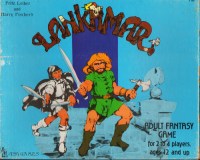
Starring Barry Gibb as Fafhrd

Add Lankhmar to the list of games I want to play. The article goes on to explain how the game was originally played (before it was turned into something more commercially viable in 1976 – see HERE).

We also get this tidbit about Harry Otto Fischer:

“Harry not only looked like Edgar Bergen’s Charlie McCarthy but had a similarly extroverted temperament and wit. The famous puppet could have been copied from him!”

The article is a must read for folks who love the stories. Great background stuff.

Design Forum: Boot Hill? Sure! But What Scale?
by Ralph Wagner

That title is such an artifact of its time. We don’t live in a magazine world anymore, and whenever something passes from now to then to what, so many little things pass with it. I’m only 43 years old, but the then I was born into is rapidly becoming a what. I think my childhood and the childhood of people born in 1900 have more in common than my childhood and people born just 20 years later.

Oh – the article. It’s about what scale miniatures to use with Boot Hill. Personally, I would have gone with these bad boys:
Found at Etsy … already sold. Damn.

Designer’s Notes: Flattop: A Long Game but a Strong Game
by S. Craig Taylor, Jr.

This is a discussion of Flattop, a game that covers the Coral Sea-Solomon Islands geography during 1942, specifically the three carrier-to-carrier battles of that year, Coral Sea, Eastern Solomons and Santa Cruz. Mr. Taylor was the game’s designer and developer, and he has a few insights about it, in particular about victory points and the difficulty in writing a truly original game. Sounds like a pip. And a great cover, by the way.

Up on a Soap Box: Standardization vs. Playability
by Bob Bledsaw

He discusses the value of standardization in a game, but also its limitations. Wow – I’m sure you didn’t see that coming. Mostly, he describes how he does his own campaigns – how he handles the races and technology and religion. Could be some useful stuff to the newbies – after all, at this point almost everyone playing the game was a newbie. By being a basic framework, D&D opened the doors to a whole new world, and everyone was feeling out what they could and couldn’t do in that world.  What a great time.

And look at this little ad that popped up on page 21:

Things are about to get weird. If you are reading this and haven’t heard of Arduin, look it up.

Armies of the Renaissance
by Nick Nascati

This is Part V, and covers the armies of Eastern Europe – Poland, Hungary, Russia and the Ottoman Empire. It’s a good article – one page, two column, and covers the basic very nicely. What if we came up with a big d% table with 100 entries that determined a first level fighter’s starting equipment, based on various historical warriors (and maybe Buck Rogers thrown in just for fun). Might have to do that for the blog.

Tournament Success in Six Steps
by Jon Pickens

Tournaments were such a big deal in the old days. I wasn’t a con-goer then (or now, to be honest), so my only exposure to them at all was in some of the old AD&D modules I owned, which had a section on using the module in a tournament, with the points scores, etc.

Here a quick version of Jon’s rules for success:

1) Get in – i.e. sign up for a game. If you don’t get in the first round, sign up for the second.

2) Use magic to get rid of obstacles that would take too long to overcome the old fashioned way.

3) Have a plan (always a good idea).

4) Pay attention to the DM, and if something seems amiss, question him. He might only give out certain bits of information if the right questions are asked.

5) Don’t waste time.

6) Never quit – avoid combat as much as possible, but if you have to do it, do it with extreme prejudice.

Finally, never argue with the DM. If you think he or she screwed up, bring it up politely.

Out on a Limb

Ah – letters to the editor time. Here’s a dandy:

Q: “Something has been bothering me about the Druid class in DUNGEONS & DRAGONS. That is, I know of a couple of people in Chapel Hill who don’t know each other, but they are both the ‘Great Druid’.

A: “The stricture regarding the number of high level Druids is on a per world basis.”

He kindly didn’t add, “dumbass”.

Geek Rage of the Week:

“En garde, Master Rahman and those of you who defend such shoddy pieces of work such as Bakshi’s. (I’ll refrain from referring to it as the ‘Lord of the Rings’).”

Good Advice of the Week:

“It is my contention that all “good” referees should make it their duty to change large portions of the concepts presented in any given role-playing game.”

Terrible Augury of the Future:

“As you may have noticed last month, Wormy has returned. Wormy’s creator got married and moved to California, but he promises that Wormy is back to stay. As to more of Dave’s art, that is up to him and his job in CA. One can always hope . . .”

Cool ad for Dragon Tooth Fantasy Figures:

I haven’t done a random encounter table based on a mini’s ad in a while, so here goes:

d10

1. Rogue or thief (roll 1d4 for level) in leather doublet with short sword, mounted on light warhorse. Wears cloak and floppy hat. Will do anything to steal your purse.
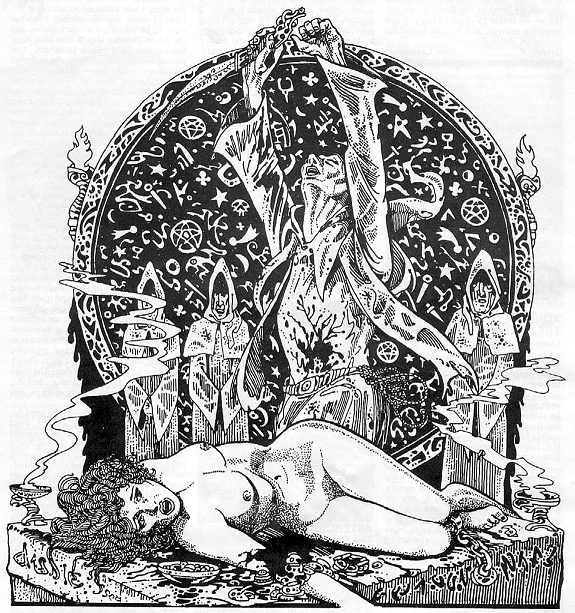
2. Sorcerer (roll 1d5 for level) in the middle of casting one of his highest level spells. Will be extremely cross if you mess it up.

3. Swordsman (roll 1d6 for level) armed with sword and spear.

4. Rictus, the Zombie King; zombie with 12 HD and the strength of a hill giant (+4 damage).

5. Swordsman Kane, a neutral evil 8th level fighter from the terrible north, escaping his love of a good woman who threatened to turn his heart to good. Has +1 scale mail and greatsword.

6. Sorceress (roll 1d8 for level); she holds the mystic Moon Staff of Myrmidor, which can cast all sorts of cool light spells, and confusion and which can cast hold monster, at will, against lycanthropes. She rides a light warhorse.

7. Cleric in mitre with mace. Roll 1d10 for level. He is suffering a crisis of conscience, as he caught mother superior stealing milk and didn’t damn her.

8. Fool or jester, recently released from his master’s service and very hungry. He is a 1st level assassin.

9. Bard or harpist (roll 1d12 for level) in puffy velvet clothes and a great hat. He carries a silver longsword and a golden lyre that charms fey, 4/day. He rides a dapple grey light warhorse. He is arrogant and good-natured.
10. Swordsman Roland (level 9 fighter), with scale mail, +2 shield (axes stick to it on a roll of 1-2 on 1d6) and a major chip on his shoulder towards paladins and rangers (they think they’re so awesome).

Also, found this old issue of Popular Mechanics about painting Dragon Tooth miniatures.

Also, dig this 1978 catalog (which I’ve probably already posted at some point).

Giants in the Earth
by Lawrence Schick and Tom Moldvay

This edition of G in the E features Piers Anthony’s Sol of All Weapons (LN 20th level fighter, 14th level monk), Tanith Lee’s Zorayas (LE 23rd level magic-user) and Clark Ashton Smith’s Maal Dweb (LE 20th level magic-user).

I dug the little advert for Cities, by Stephen Abrams. I did a search and found that he did a few versions of this book, including one for Runequest. I think I’m going to by myself one. I’m intrigued. If I do, I’ll post a review.

The Dragon’s Augury

The games reviewed in this issue are Spellmaker reviewed by Bruce Boegman, Black Hole reviewed by David Cook and Down Styphon reviewed by Kenneth Hulme.

Spellmaker (1978, by Eric Solomon) pits powerful wizards against one another, trying to transport a princess to their castle to win the game. The reviewer calls it a “rare gem”, and I must admit, it sounds pretty cool. The spells are card-based, and I’d love to see a deck of them.

Black Hole (1978, by Robert A Taylor) pits two mining cartels against one another to capture a donut-shaped asteroid with a black hole tethered in the middle. The review is positive, so it might be a good con game for two.

Down Styphon! (1977, by Mike Gilbert) sounds pretty interesting. It is based on the book Lord Kalven of Otherwhen by H. Beam Piper, in which a Penn. State trooper is transported to a parallel earth where the secret of gunpowder is controlled by a bunch of priests. The trooper knows how to make gunpowder, better weapons and he knows something about the “future” of warfare. The game is a miniatures wargame in the musket and pike era. It is apparently a very playable game with only OK layout and some missing stats for artillery (which are provided in the review).

Bazaar of the Bizarre: Orlow’s Inventions Can Liven Up Your Life
by William Fawcett

This article could be a great blog post – a random list of minor magic items that include spoons of stirring, brooms of sweeping, needles of sewing, amulets of caterpillar control, socks of dryness and matches of many lights. This stuff would be so great for putting in a wizard’s tower. Just awesome – if you can find a copy of this issue, find it for this. I’d post the random table, but it’s a little more than I’d be comfortable sharing considering the mag is copyrighted.

So, Different Worlds gaming mag. Never heard of this. I hunted down some descriptions, and apparently some issues you can still buy. I love the art in the ad, and would love to see a sample issue in PDF. There is so much buried treasure out there for gaming!

I also have to share this ad, for on heck of an artist for hire …

… who is still out there working, thankfully.

Dig Tramp’s minotaur in Wormy. So cool.

Dragon’s Bestiary: The Curst
by Ed Greenwood

I’m not sure if this is the first thing in the magazine by Ed Greenwood or not. The curst are still roaming about in the Forgotten Realms setting. Humanoids (98% are human stock) that have been cursed and cannot die, they are chaotic neutral, retain their class abilities except psychic powers and magic, gain infravision 90′ and apparently have no sense of smell. In modern parlance, they would be a “template”.

Finieous Fingers shows us what failing a surprise roll looks like.

And that does it for The Dragon #30. A pretty good issue, overall, with lots of interesting artifacts of the old days of gaming that I love. Seriously – find a copy and check out the minor magic items article – well worth it.