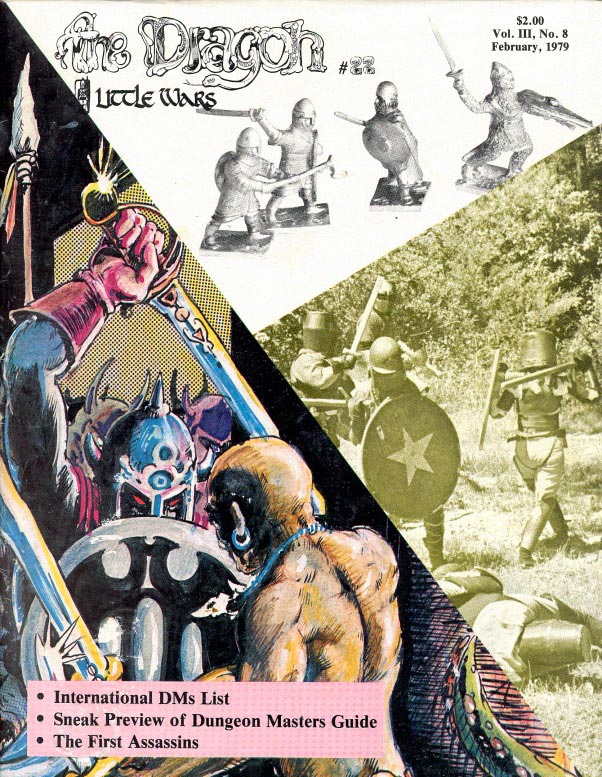
Dragon by Dragon – February 1979 (22)

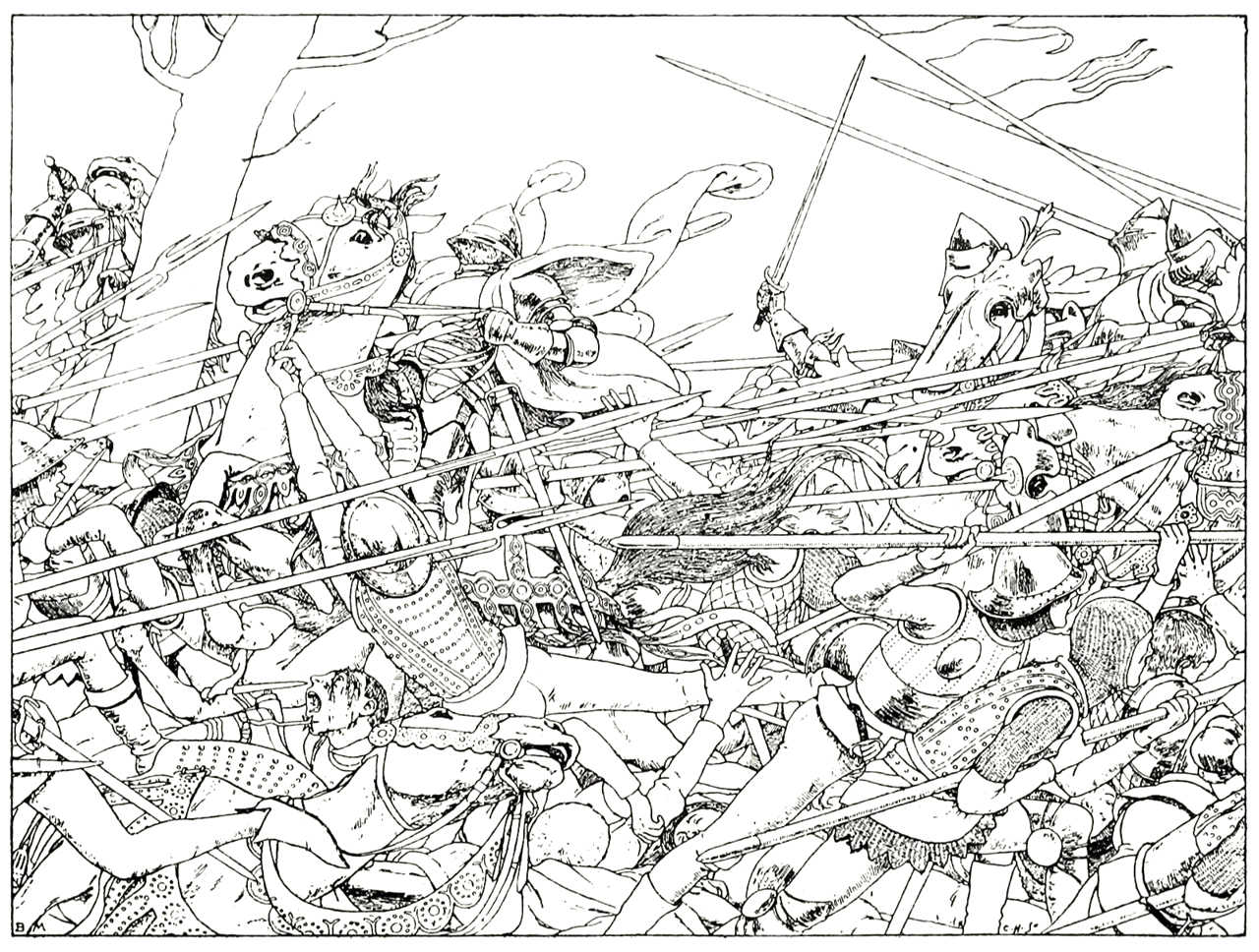
A new year has dawned, and February brings us an interesting cover combining a photo of miniatures, a photo of what I’m guessing are some SCA’ers bludgeoning one another, and an illustration of fantasy swordplay. Given that the byline on the cover is “Little Wars“, one can imagine what lies inside.

As has become a tradition of this series, the first thing I manage to fall in love with is the latest Ral Partha advert. If I’m completely honest, I’m not usually that enthused about their sculptures, but I love the names and notions. In this case, it’s the Army of Mu’ugalavya! I think it would make a good random encounter for any campaign – imagine a plane hopping army of conquerors carving out footholds on a thousand material planes.

When encountered, the army consists of the following:

1d6+1 Heavy Infantry (men-at-arms with platemail and spear)

1d6+2 Medium Infantry (men-at-arms with scale mail, shield and war hammer)

1d6+3 Medium Infantry (men-at-arms with scale mail, shield and barbed spear)

1d6+4 Heavy Infantry (men-at-arms with platemail and battleaxe)

1d6+5 Archers (men-at-arms with leather armor, longbow and dagger)

1d6+6 Slingers (men-at-arms with sling and hand axe)

General – fighter of level 1d6+7 in platemail with shield and longsword

When encountered, roll a reaction check:

Hostile – the army attempts to kill the encountered party to keep them from revealing their presence here

Neutral – the army attempts to capture the party and interrogate them about the surrounding lands

Friendly – the army attempts to recruit the party, promising them a share of any plunder they get

Our first article is The First Assassins by James E. Bruner, a study on the infamous Order of Assassins that once plagued the Middle East. The article gives a history of the organization. It’s really a fascinating story, and if applied to the assassins of AD&D (and its simulacra) would make that class infinitely more interesting. Imagine a world populated not with rangers who were mere fighters of the greenwood and assassins who were mere men-in-black with poisoned knives, but with the Numenoreans of Tolkien and the cultists Hasan Sabbah (or his simulacra) bent on overthrowing the most powerful religious leader in the known world. One should also note that the real assassins had their own level titles: In order from lowest to highest they were Adherents, Companions, Propagandists (remember, they were primarily preachers attempting to undermine the Caliphate that they may replace the Caliph with a member of their own sect), Greater Propagandists and Grand Headmaster of the Order.

The history continues in this issue with Irresistible Force – A Brief Account of the Rise of the Swiss Confederation with Commentary on Their Military Tactics by Gary Gygax (one can imagine from the title how brief the article will end up being). It’s quite an interesting article as well, and contains one of those percentile charts of the Swiss Army that readers of the old Monster Manual will recognize well. An army book like this would have been pretty cool back in the day – sort of a “Monster Manual” of ancient, medieval and renaissance armies. I’d like to produce something similar myself one of these days for Blood & Treasure.

Nick Nascati follows this up with Armies of the Renaissance – Part One. This article gives a brief overview of what is to come, with some history of the period (the great generals of the period, the mercenaries (which seem to be the inspiration for all those bandit troops led by high-level fighters in AD&D) and artillery).

Review time! This issue covers the following games (and I’ll include the concluding paragraph of each review):

Boardgame – Up-Scope!: “Still, you take what you can get. This one isn’t bad. I just wish it were better. Play it, before you buy it, to find whether you’ll love it or hate it. — Dave Minch”

Book – The Face in the Frost: “This well-written novel of strange hauntings, sorcerous conjurations, and outrageous humor can not be recommended too highly! Go out and get a copy right now, but be prepared to spend a long, uninterrupted period of time reading it, for you won’t want to put it away until it is finished once you begin!

(I concur on this one – great book)

Boardgame – Panzerkrieg: “All in all, this is a game which is every bit worth its $12.95 pricetag. Not only is the game colorful and well-done graphically, but it provides excellent play value for the money with its eight scenarios, each one a bit different from the others — and some with the Russians on defense, others with the Russians on the attack. There are some minor flaws, (more playtesting would have helped), but these are far outweighed by the game’s advantages and overall appeal. I recommend this title to anyone who enjoys the Eastern Front, or who simply enjoys a good historical game no matter what the subject. — Mike Carr”

Magazines – Apprentice #2 and Phoenix: “APPRENTICE is certainly bad, but for one dollar it is a value if you appreciate jokes. PHOENIX is worse, and no price is given. If it is free, you might wish to get it. – Gary Gygax”

(Bear in mind, this review came after the magazines in question wrote a bad review of The Dragon)
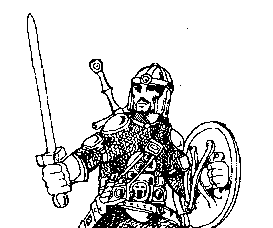
Up next is a big installment of Mapping the Dungeons, which presents DM’s and gaming groups and their addresses from around the U.S. and beyond. Not much of interest here other than the historical record of early players of role playing games, but I did like the little piece of art at the end by McLean. I love his comic pieces, of course, but I would have liked to have seen more of his serious stuff appear in old TSR publications.

Gary Gygax now chimes in with Dungeons & Dragon – What It Is and Where It Is Going. He mentions that perhaps 150,000 people now play D&D, and gives a brief synopsis of its history and the future he envisioned for it. He brings up AD&D, modules and similar material and … computers! One line I did like was this:

“It is my personal opinion that the game form is a classic which is of the same stamp as chess and MONOPOLY® ; time will be the judge.”

I think he got that one right, though the present copyright holders seem to be bent on proving him wrong.

Up next is an examination of a new game from TSR called 4th Dimension – a game that sounds like a mix of chess and Stratego that involves capturing an opposing Time-Lord on a circular board divided into variably sized spaces. Honestly – never heard of this one, though it sounds pretty cool. Here’s a link to Game Board Geek’s page on the game.

This is followed by a multi-page preview of the AD&D DMG – essentially a few pages from the magic items section and the attack matrices and a few more bits.

If anyone doubts that Gary Gygax did not appreciate negative criticism, one need only pick up this issue of The Dragon. He already savaged a couple fanzines, and now he offers a review of a review of AD&D’s Player’s Handbook in SPI’s house mag, Strategy & Tactics. A sample …

“What is worthy of comment, however, is the source of the critical commentary on AD&D being nothing more than a rewrite of D&D. Coming from an officer of SPI, the past masters of the rehash, artisans of the warmed-over WWII battle game, purveyors of the umpteenth version of the same, tired scenario, it is indeed a wonder that Mr. Berg would bring up such a spectre!”

I have a feeling these snipes probably turned more people away from D&D than the bad reviews.

Stalemate at Kassala is a play report of a war game that re-enacted a battle in 1541, when the Portuguese sent 400 infantry with 1000 stand of firearms and some cannon to aid the Ethiopian emperor Galawedos against an army of invading Egyptians and their Nubian allies. As you can tell from the title, it ended in stalemate.

Finieous Fingers then runs into “Grollem” and buys his precious ring of invisibility off him for 1,000 gp (actually turns out to be a fake sold by a hobbit in a Grollem suit), and then wanders into a dragon horde, where he discovers just how fake the ring is.

Ah – a classic article comes up next – Gygax’s Nomenclature of Pole Arms. I’ll say no more, for the truly initiated of the RPG community know all about it.

That’s it for February 1979! Not a bad issue really, especially because it reinforces the importance of history in D&D – it ain’t just fantasy folks.
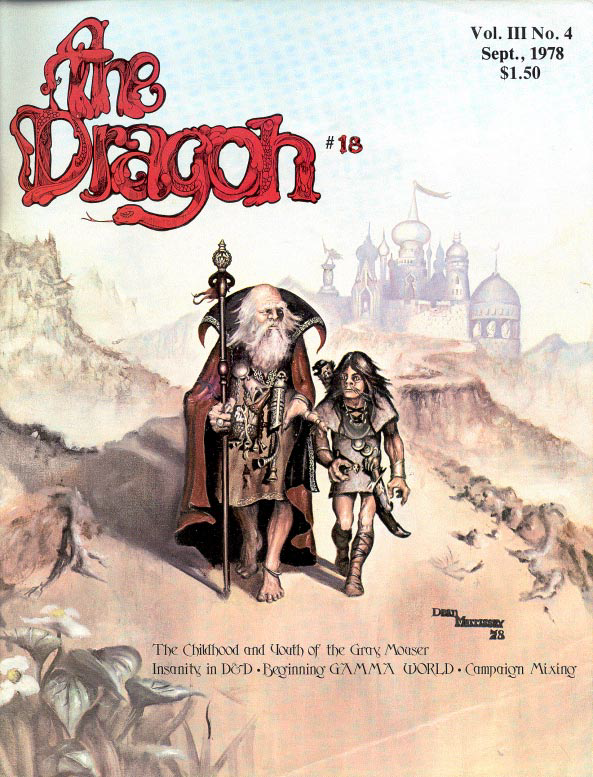
Dragon by Dragon – September 1978 (18)

Another week, another Dragon magazine. The last one was chock-full of stuff, how about this issue.

Traveller: The Strategy of Survival by Edward C. Cooper

As I was thinking, “I don’t remember any Traveller articles showing up before in The Dragon” I hit this line in the article, “I took advantage of the opportunity to observe the TRAVELLER phenomenon first hand” – ah – so this is at the dawn of Traveller.

I’ve never played Traveller, but I did create a character once (I was creating one character for every game I had a PDF of … though I skipped Exalted because after the first few steps I realized I just didn’t care enough to bother with it). This article appears to be about – well – keeping a character alive in Traveller. My favorite bit:

“Several other similar occurrences proved to me then that the success or failure of a character in most cases cannot be traced to “dice or chance” as often as it can to poor handling on the part of a player. I was both surprised and disappointed that some players even blamed a character or given situation for their own bad decisions. But then again, I was extremely excited, awed, by the skill some showed in manipulating their character’s life.”

That hits the spot for an old schooler – though it also shows that there were plenty of people back in the old days who were waiting for the new days with baited breath. Different strokes for different folks!

Reviews – Traveller, The Emerald Tablet, Imperium …

Well, imagine that! The reviewer appreciates that Traveller is not just D&D in space, but rather has its own “unique flavor and style”. The review is quite extensively, and I highly recommend it (yeah, I’m reviewing a review) for folks who don’t really know what Traveller is all about.

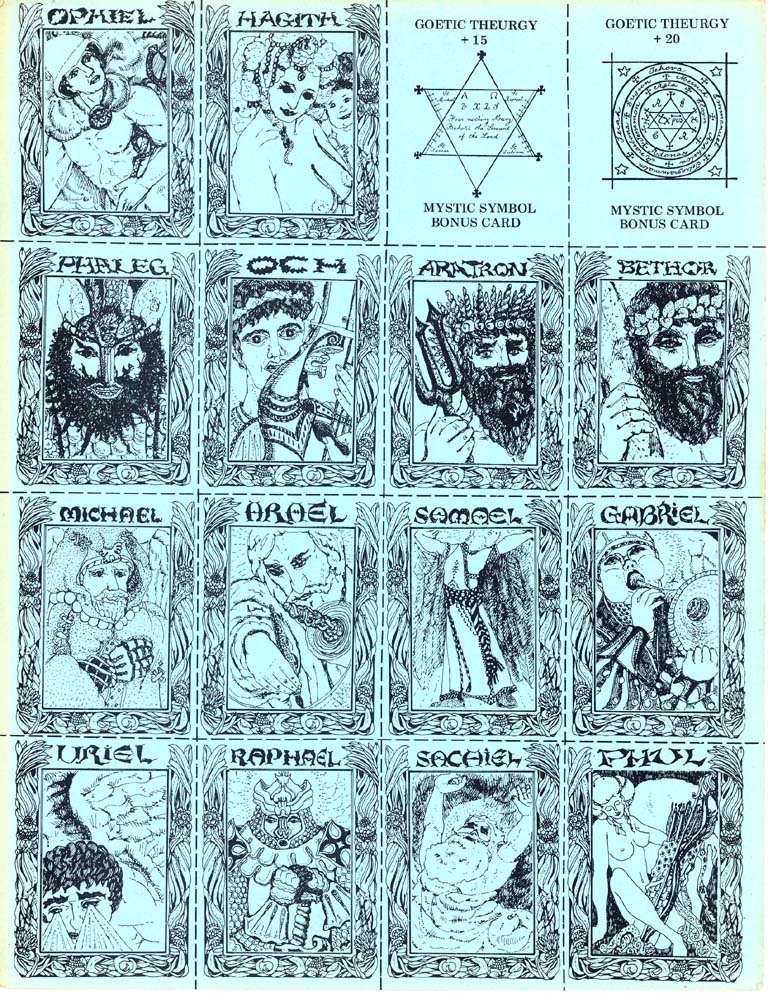
The Emerald Tablet is a set of fantasy wargame rules. The reviewer likes them, but admits he doesn’t know much about wargames. He likes that the magic system is based on ritual magic, which I know some people dig, but I always think it’s overrated. On the other hand – dig this sheet of Astral Force cards (click to enlarge … trust me, click it – click it now) I found at Boardgamegeek.com …

I don’t know what Phul does, but, hmm – anyways.

Imperium is another Game Designer’s Workshop product, a board game written by people who really love sci-fi literature. Apparently, Imperium is a game about the Terrans bumping up against the Imperium and the two sides fighting.

Pellic Quest is a computer moderated RPG (apparently a good thing, because computers are jerks like Dungeon Masters – see, the seeds of the new school were always there). Another sci-fi game, you start controlling a small planet in one of six roles (emperor, crusader, brigand, trader, droyds (robotic destroyers) or the zente (insect alien warriors). Each role needs different “winning points” and then go about making it happen.

Oh, and those zente …

Pretty sweet.

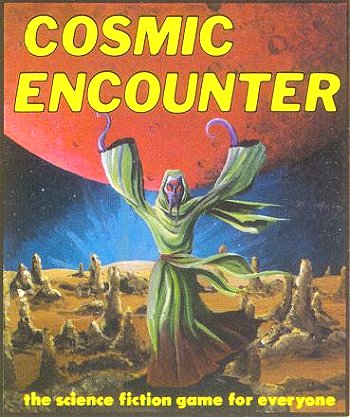
Cosmic Encounter is a sci-fi variation on draw poker.  Apparently it is simple and easy to learn, and, most importantly, fun, although the hype that one really has to get into the head of the alien race they control is wrong. The game combines several elements of classic, abstract games, and I want people who think they’re game designers to embrace this notion. Don’t begin with setting, begin with rules and get to know all sorts of old card games, board games, etc. Then apply setting to the game rules. This is how D&D was born and manages to remain so popular – it works as a game. Well, it used to, anyways.

INSANITY, or Why is My Character Eating Leaves? by Keven Thompson

A worthwhile article – insanity is tough to handle in games. Kevin Thompson devises first a saving throw vs. insanity (which makes sense given the time period). The saving throw is based on a matrix between Intelligence and Wisdom – find the number, add character level to it, and then try to roll 1d20 beneath that number. Neat idea (and I’ll be using it in a post this week).

If you fail the save, you roll d12 (always nice to see the d12) on an insanity chart.

INSANITY CHART

1. Nutty
2. Kleptomaniac
3. Perverse
4. Psychotic Hatred
5. Childlike Trusting
6. Schizoid
7. Severe Paranoia
8. Acute Paranoia
9. Gibbering
10. Suicidal
11. Violent
12. Catatonic

The good thing about this list is that it is more behavior based than clinical. It’s pretty easy to see how these “insanities” could impact actual play in a game.

New Spells in D&D! by Paul Suliin

(Love the use of the exclamation point)

This article introduces new spells created by an actual play group using the rules for spell research in Dragon #5. The editor chimes in with the admonition that every spell needs to have a loophole via which it can negated somehow.

The new spells include Nature Call, Magic Missile II, Moon Runes, Flamebolt, Mystic Rope, Pit of Flame, Word of Warding, Force Field, Extend I, Shatterray, Wall of Water, Extend II, Beam of Blasting, Conjure Djinn/Efreet, Density Control, Extend III, Combine I, Call Spirit, Rust Monster Touch and more.

Let’s convert a couple to Blood & Treasure

Magic Missile II
Level: Magic-User 2
Range: Medium (150 ft.)
Duration: Instantaneous

As magic missile, but this spell conjures either one +2 arrow or two +1 arrows, with a like amount added for every fifth level advanced beyond 3rd (i.e. two +2 arrows or four +1 arrows at 8th level, three +2 arrows or six +1 arrows at 13th level, etc.)

Density Control (which would also make a great power for Mystery Men!)
Level: Magic-User 6
Range: Personal
Duration: 3 minutes

The spellcaster can alter the density of his body from a gas to steel. Such changes alter the spellcaster’s Armor Class, so that at minimum density he is immune to physical weapons, and at maximum density he is AC 18 and his hands strike as swords (1d6 damage). Density may be altered throughout the duration of the spell, and items in contact with the spellcaster’s body when the spell is cast are altered along with him.

Magic: Governed by Laws of Theory by Thomas A. McCloud

Man, I used to roll my eyes at these when I was a kid – theory? dude, I want a new class, new race, new spells, new adventures, etc. But I’m an adult now, so … naw, I still think the same way.

This one attempts to draw inspiration on the how’s and why’s of magic in D&D by examining such sage tomes as the 1960 Encylcopedia Britannica and Frazer’s The Golden Bough. Dude – it’s a game. Of course magic is treated casually. Real estate is treated pretty casually in Monopoly because it’s also a game – move and countermove, risk taking, a random element. Don’t overthink it!

Let Your Town Have A Purpose, or, How To Design A Town In Boot Hill by Mike Crane

Sometimes I think Jay Ward wrote the titles of these articles (bonus Nod points to anyone who gets that reference). Mike covers the best scale (1″ = 20′) to draw the map, the need to think about why the town is there in terms of who settled it and what they do (dude, it’s there to give gunslingers a place to have gun fights), etc. To be completely honest, articles like this are a waste. A bunch of random tables for generating an Old West town would have been much more helpful, or just a suggestion of watching some old episodes of Bonanza. Sorry – guess I’m in a salty mood at the moment.

Reviews Continued … Alpha Omega

Okay, apparently we’re not done with reviews yet. Alpha Omega was Battleline’s first stab at a sci-fi game. The reviewer thinks it reminds him of Buck Rogers or Star Wars … and that’s not an endorsement, according to the reviewer. After all, if we can’t beat all the fun out of sci-fi and make it boring and cerebral, then what’s the f-ing point? (I am in a mood). Here’s a sample of the review …

Alpha Omega is billed as “A game of tactical combat in space,” a claim supported by the rules.

Okay then. Apparently, the art is superb on the counters, but they’re hard to read, and the scale (one hex equals one light second) and turn time (6 seconds) are weird for space fights. The game is also two-dimensional, rather than three-dimensional, although the reviewer doesn’t think three dimensions would have any bearing on the game, and thus might as well not be there. The game is really just naval combat on a board that looks like space. The weapons are not realistic (just names, really), so the game also lacks believability (a bugaboo that has never bothered me personally) – hell, they named a couple alien ships Akroid and Balushi – the bastards. Uggh – life’s too short for this. Game looks fun to me, and the cover is pretty cool.

The Chamber of the Godgame by Mick McAllister

The what of the what? It’s a short article describing a dungeon chamber based on a scene in John Fowles’ “grand metaphysical dungeon novel” The Magus. I won’t go into it – find the article or find the book.

Gamma World: Fire Report; Setting Up The Campaign by James M. Ward and Gary Jaquet

Neat little behind the scenes look at the why’s and wherefore’s of turning Metamorphosis Alpha into Gamma World.

Birth Tables – Boot Hill by Stephen Blair

This one’s a collection of random tables. Let’s roll on them and see what we get …

Social Class: Ranch Related (didn’t know that was a social class, but okay)

Profession of Father: Homesteader (ah, now I get it)

Birth Order: Bastard (makes sense)

Skills: Facility with numbers (this bastard can multiply!)

Initial Purse: $75

Size of Spread: 5,120 acres

Guidelines for Mixing Campaigns: Androids, Wizards, Several Mutants, and Liberal Doses of Imagination, Well Blended by James M. Ward

This article is a quick guide to converting D&D characters to MA characters. D&D characters get a radiation resistance of 3, and MA creatures get no save vs. magic. Magic armor completely disrupts protein and disruptor blasts (good to know). The shielding, metal and energy fields of the Warden stop crystal balls and helms of teleportation from working (it’s science, dude, deal with it). Good article – reminiscent of the treatment in the old DM’s Guide.

Monkish Weapons and Monk vs. Monk Combat by Garry Eckert

Apparently, Garry read a book about Japanese weapons and decided to apply what he learned to monks (who are drawn from Chinese fact and folklore, not Japanese – oi!). Skip it.

Effective Use of Poison by Bill Coburn

Quick article that defines poison as Class A, B or C.

Type A is in potion form, and includes Arsenic and Hemlock. It kills 80% of the time in 2d4 minutes and if it doesn’t kill, leaves a person stricken for 1 week (meaning half strength, dexterity, constitution and movement).

Type B is in the form of gas, darts, cobras and needles. A neurotoxin, it brings death 50% of the time in 4d4 days and leaves people stricken for 1d3 days after being unconscious 30 minutes after poisoning for 1d4 days.

Type C comes from monsters. A hemotoxin, is has a 10% chance of killing a character in 1d4 days, and leaves people stricken for 1d10 days after being unconscious 1 hour after poisoning for 2d4 days.

Armor in this scheme provides a bonus to save vs. poison (-2 penalty for no armor, no adjustment for leather, +1 for chainmail and +2 for platemail).

Not a bad little system, really.

Comics!

Finieous Fingers and his pals meet the evil wizard, and discover that a good initiative roll and a magic wand go a long way towards evening the score between fighters and magic-users.

In Wormy, the trolls make the mistake of breaking one of Wormy’s pool balls. Jeez I miss this comic. Who has the next Wormy in them?

The Childhood and Youth of the Gray Mouser by Harry O. Fischer

This is Harry’s version of the Gray Mouser’s youth, Harry having been a major help in creating all of the major characters of Nehwon back in the day. It begins …

“Mokker was the Prince of Pimps in the Street of Whores in Lankhmar. He could just as easily have been King. He was tastefully and expensively dressed, with massive gold and jeweled rings one or more to a finger. He was exceedingly complex; calculating, sometimes ruthless, vulnerable to fits of whimsy, possessing an almost perpetual erection (as it behooves a whore-master to have), and more. He was generous, and delighted in both the giving and getting of surprises. His whores loved him for this, in addition to the fact that he felt not the slightest hesitation about correcting or revenging a wrong to one of his, no matter how slight the transgression. Mokker was a thorough and practical rogue given to sudden impulses, possessing large eyes, a sensual mouth and plump cheeks; a merry companion and a deadly enemy. He was clever, aware of it, and arrogant.”

No, D&D wasn’t for kids just yet.

Next we have this …

Okay then.

Non-Player Character Statistics by ???

This is another quickie – random tables for determining NPC stats based on their personality. Kinda cool. I’ll roll one up – we’ll say a madame from Tremayne named Durla …

Pride (Ego): Little – =1-% greed, -1% work quality

Greed: Loans things, sells items for normal* prices

Quality of Work: Normal

Okay, well, now I know. I think I’ll stick to my method in Blood & Treasure (on sale now!)

And there you have it, along with some nice little comic panels from McLean. Lots of stuff packed into 34 pages, and not a bad read overall. The spells were fun, and I like the poison rules. The reviews got me to look up some old games I’d never heard of, and the insanity rules put an idea in my head I’ll explore more this week.

Have fun boys and girls, and don’t be the last geek on your block to get Blood & Treasure

Dragon by Dragon – August 1978 (17)

No, I didn’t stop doing Dragon by Dragon, just got busy last week. Now that I’m back, let’s see what the August 1978 issue (number 17) has to offer.

First and foremost, we have a cover that reminds me of some of the pinball machines of the era, or perhaps the side of the bitchin’est van to ever ply the byways of Lake Geneva, Wisconsin.

Article #1: Vampires in the Dungeon by Clayton J. Miner

The article seems to work off the notion that vampires are total party killers, which may be true, depending on the level of the party. The article goes on to explain why, taking into account their different abilities and how to use them to best effect – including charming multiple party members and having them wait to be drained of blood later, using the dungeon rodents as a spy network, etc. Some of the article seems to assume things about vampires that I don’t think were addressed in the rules – i.e. the older a vampire is, the more resistant it is to holy symbols (which may be true, if you’re considering the vampire’s Hit Dice correspond with age). It also posits the best ways to destroy a vampire. Not a bad article, but to be frank, the monster description and a little imagination from referees and players would be just as good.

Article #2: Chainmail Revisited – Jousting in D&D by Jon Pickens

Ah – anyone who has tilted in the FLAILSNAILS Jousting Tournaments run by the excellent Mike Davison is already aware of these rules. This article works on addressing a few perceived shortcomings of the rules, i.e. “I’m a Lord, and he’s a lowly Level 1. IT ISN’T FAIR!”

There is also a cartoon from Will McLean, who will go on to be, in my opinion, one of the shining lights of Dragon’s humor department for many years to come.

Article #3: Dragonlord review by Glenn Williams

If I’m honest, I never spent much time reading reviews in Dragon Magazine. Reading reviews to old games is even less interesting to me, but I’m going to do it anyways. Williams finds the art, by Morno, to be top drawer. The game concerns battles between dragon riders. Williams points out that the map, while pretty, is screwed up because it shows everything from the side, when it really should be top-down. In addition, the map sections do not align correctly, and the grid is a set of Cartesian squares – a hex grid would have been better. The rules, Williams says, are also too complex. Still, he likes the concept, and thinks the game can be improved, such as playing it with the Warriors of the Green Planet map.

I couldn’t find the game online for sale, but there are some other Wee Warriors products at EBay.

Article #4: Faceless Men and Clockwork Monsters

Why wasn’t that the name of an actual game? This article presents a Dungeons & Dragons adventure aboard the Starship Warden (from Metamorphosis Alpha). I’m pretty familiar with this story, but if you haven’t read of this genre-bending excursion, you should try to find it.

Next comes a great add from Dragon Tooth Fantasy Figures, proclaiming the war between the Saurian Empire and Amphibian Confederacy. Love the art …

 I think I get more inspiration from the ads of Dragon Magazine than the articles – quick, dynamic ideas with catchy art.

Article #5: A Wizard with a Difference by James M. Ward

Love the editor’s note …

“ED. Note: The following is recommended as a source of bedevilment to be used by DM on their NPC’s. Some of the possibilities here will drive the average group of PC’s wild when trying to deal with running NPC‘s.”

Prepare for a piece of pure opinion by yours truly – D&D is more fun when the DM is trying to kill the characters. I don’t mean by cheating, but by being a clever, inventive bastard.

The article presents the idea of specialist wizards, using the following types: “Wizard of Aggression”, “Wizard of Defense”, “Wizard of All Things Rustic”, “Wizard of Control”, “Wizard of Tenaciousness” (yeah, I’m picturing Jack Black), “Wizard of Detection”, “Wizard of Fire” and “Wizard of Movement”. One can see some overlap with the later specialists – Conjurer, Necromancer, etc., but these do sound more fun.

The concept is that these wizards get two spells of their specialty per level (I think, the rules could be a bit clearer) and have a percentage chance of casting them based on the level of the spell and the level of the magic-user. Ward suggests these wizards are best used as NPC’s, which is a good point. The average NPC has a short lifespan in combat, so doesn’t necessarily need a vast list of spells, many of which are designed for exploration, which the NPC doesn’t need.

There are plenty of new spells or modified spells – a really fun article to read.

Article #6: Sights & Sounds in Dungeons & Dragons

Another one of those darned useful sets of random tables, this one for random sounds and random sights in a dungeon. Both use a d20, though the sounds table actually runs to 21, with 21 being a bit of a joke (rattling dice/dungeon master’s scream of anguish/garbage disposal/etc.)

Article #7: Variant Monster Dept.

This article gathers a few monsters, including the Magic Munchkin by Michael Kolakowski, the Scholar by Patricia LaPointe, and the Crs’tchen by Dennis Chapman. I love the fact that none of them share the same statistical arrangement – heck, the Munchkin has no stats to speak of. Just for fun, I’ll convert the Scholar for Blood & Treasure:

SCHOLAR
Medium humanoid, Neutral (N), High Intelligence; Symposium (1d10+10)

HD: 1 to 3
AC: 10
ATK: By weapon
MV: 30
SV: 1 HD = F15 R15 W12 / 2 HD = F14 R15 W12 / HD 3 = F12 R14 W11
XP: 1 HD = 100 (CL 2) / 2 HD = 200 (CL 3) / 3 HD = 300 (CL 4)

Scholars are short, bearded men in tweed robes with leather patches on the elbows. They smoke foul-smelling pipes than can produce enough smoke to provide an obscuring mist. There are three levels of scholars.

Instrictors (1 HD) know two spells, confusion and read obscure languages. Confusion is cast by answering a simple question, the answer being in an obscure language.

Associate Profussors (2 HD) know three more spells: Fear, time stop and book missiles. Fear takes effect after muttering about term papers being due. Book missiles works as magic missile, save the books inflict 1d8 points of damage.

Fool Profussors (3 HD) have three ultimate spells. The first is power word stun (the incantation being “Surprise Quiz Today”). Academic dust does 3d6 points of damage and can paralyze the mind for 2-4 turns.  The final spell is cause boredom, which works as a sleep spell that affects any level/HD of creature.

One powerful incantation causes scholars to be seized by instant cardiac arrest – “Tenure denied”.

Article #8: The Monk and Bard in ‘DUNGEON!’ by Jon Pickens

Always love Pickens’ stuff. This one introduces the bard and monk into games of DUNGEON!. I love that game – so sorry that I got rid of my copy years ago. I need to find a copy online (and yeah, I know Hasbro is going to do a reprint – I’d rather have an old game – I’m weird that way).

Article #9: Tesseracts by Gary Jordan

These have been covered nicely at Aeons & Auguries. Jordan covers putting cubic tesseracts into a dungeon do drive map makers nuts. A worthy goal!

Article #10: Ogre Piece by Piece by Jerry Epperson

I’ll admit it. I played it years ago, and found it somewhat boring. If you do love the game and want some variations from 1978, find this article.

Article #11: Design Journal – Boredom and the Average D&D Dungeon by James Ward

If you know James Ward, you know “average” probably ain’t happening in any dungeon he’s written. In this article, he described the idea of filling new dungeon levels with “areas of history” – i.e. themed sections based on history, like an Ancient Egypt area with minions of Set, evil high priests of Set, an 11th level grave robber thief, etc. He also covers Ancient India, The Far East and The Future Machine Age. Good advice, of course, especially for fun-house dungeons.

Article #12: A Short History of Adamantite by Charles Sagui

Short indeed. He labels adamantite as an alloy of Mithril, Carbon, Iron and a few secret ingredients – technically known as Mithriferral Carbide. It is 4/5 the weight of steel, and provides a +2 on AC and hit probability for weapons. It is much more expensive to work and much more difficult to enchant. Sagui gives some prices for different armors (plate armor is 20,000 gp, chainmail 14,000 gp, daggers 1,500 gp) as well.

Article #13: Messengers of God: Angels in Dungeons & Dragons by Stephen H. Dorneman

Dorneman introduces the idea (new at the time, of course) of some non-omnipotent Lawful beings to counter all those devils and demons. He describes four types of angels – Type I (Angel of Wrath), Type II (Angel of Healing), Type III (Archangel of Mercy) and Type IV (Seraphim). Honestly, it never occurred to me to use “types” of angels to counter the “types” of demons. Neat article.

Article #14: Natural Armor for Monsters in Monsters, Monsters by Doug Miller

This one is just what it sounds like. If you don’t have Monsters, Monsters, it won’t do much for you.

Comics

Fineous Fingers is saved from the Antipaladin by the evil wizard, because he needs a thief – not a bad way to handle an encounter in your next game, especially if the needed character is a major pain in the ass to the rest of the party.

Wormy plays a nasty trick on some goblins and tree trolls.

Article #15: Warp War review by Tony Watson

Warp War was a mini-game by Metagaming (click here for Warp War on Boardgame Geek).

From the description, it almost sounds like Car Wars in space – you have to build your ships and then use them to fight over star systems. Watson likes it, and I must admit it sounds fun.

And that brings us to the end. This one is pretty packed, with lots of great articles. Definitely one to look out for!

Battle of Gaudin’s Ford – Final Rounds

You didn’t think I forgot about the battle, did you? Of course, since today is the 4th of July, I wish I’d pitted Red Coats against Yankees, but I’ll have to settle for halflings and orcs.

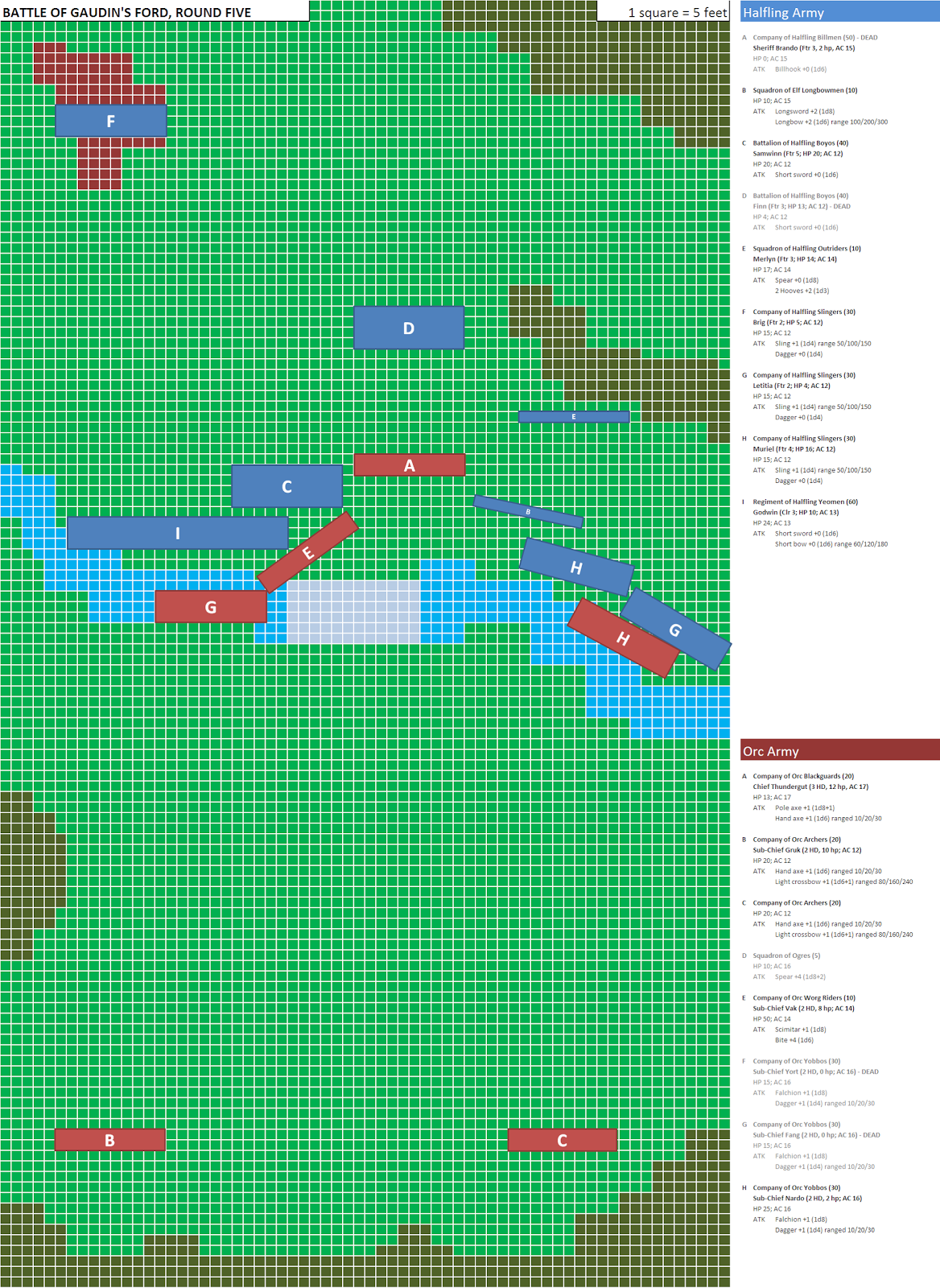
ROUND FIVE

Click to enlarge

The halflings and orcs both find themselves in an interesting predicament with the annihilation of the billmen. The orcs should want to follow it up and charge in … but then they’re surrounded by angry halflings. Likewise, the halflings should want to plug the hole … but then a company of boyos has to take on the orc blackguards all by its lonesome. What to do?

The halflings decide to do the following … the surviving sheriff will retreat back to the safety of Halfling C. Those companies will stay put. The elves would really like to fire their bows at those orcs, but instead they’re going to wheel back a bit. The other halflings are going to hold their ground. All of the halfling’s with missile weapons, except Halfling I and Halfling G, are going to concentrate fire on Orc A. Halfling I is going to fire on Orc G and Halfling G is going to fire on Orc H.

The orcs decide, in true orky fashion, to charge. Orc A is going to charge in to Halfling D – if Halfling B gets in the way, they’ll hack down the elves first. This will, they hope, free up Orc E to slam into the side of Halfling I, along with Orc G. Orc H is going to attack Halfling G. Orc B is going to fire at Halfling F and Orc C at Halfling E.

So, how does it play out?

Missile Phase
Since the last report, I’ve modified the rules a bit to use normal side vs. side initiative which has to be re-rolled for each phase. For this missile phase, the orcs roll a ‘6’ and the halflings a ‘5’.

The orc crossbows let fly their bolts. Orc B scores no damage on Halfling F. Orc C inflicts 7 points of damage on Halfling E, whose leader, Merlyn, rolls his save and suffers no damage.

Orc A suffers 7 points of damage. Thundergut saves and suffers no damage. They’re battered, but they didn’t break! Halfling G scores 2 points of damage on Orc H, and sub-chief Nardo saves, so no damage. Halfling I is pretty ineffective against Orc G, scoring 5 points of damage. On the plus side, this is enough to force a moral check! The orcs, without their leader, fail the check and will begin moving away next round. The worg riders, who have been ordered to attack Halfling I, might be in trouble.

Movement Phase
Orcs roll “1” and Halflings roll “1” – they re-roll initiative and this time the halflings win.
The elves move back, and everyone else holds. The orcs now have two forced moves. The Orc G swims for their own side of the river, while the fleeing ogres in Orc D run off the battlefield. Orc A charges into Halfling D, Orc E wheels into the flank of Halfling I and Orc H rushes up the river bank to attack Halfling G. Plenty of melee combat this round!

Melee Phase
Orcs gain initiative this round, and they’re going to need it with three units already having fled or being in retreat.

Orc E plunges into Halfling I and scores 6 points of damage. Because they’re hitting the far flank, I’m going to rule that Father Godwin doesn’t have to save to avoid damage this round.

Orc A works their magic again … 14 points of damage on Halfling D. Finn, the leader of Halfling D, fails his save and is killed in the onslaught. The halflings now have to roll a morale check – they fail, and turn to flee. Because they’re in melee combat, they expose themselves to pursuit and an extra attack. The orcs score another hit, this one for 2 points of damage, reducing Halfling D’s hit points to 4.

Orc H, scrambling from the river fail to score any damage on Halfling G, who responds by scoring 3 points of damage on the yobbos.

Halfling I now counterattacks Orc E. They fail to score any damage.

No magic this round, so we go to …

Click to enlarge

ROUND SIX
The halflings know they have to destroy Orc A to break the orc army. To that end, Halfling C is going to wheel and attack their flank while Halfling E does the same from the other direction. Halfling B is going to wheel back and wait for an opening. Halfling H is going to join battle with Orc H. Halfling F sling their stones at Orc B. Halfling I is going to maneuver while in melee – essentially, they’re going to change formation this round into a square.

Orc B and C are not going to reload this round, but rather hustle towards the lines. The orc chief needs orcs on the line to hold the bank and claim victory. Orc E and H are going to continue to attack, and Orc A is going to wheel and hit Halfling C in its flank. Clearly, initiative will be important this round.

Missile Phase
No initiative this round, since only the halflings are shooting. Halfling F scores 5 points of damage on Orc B. Sub-chief Gruk fails his save and suffers the same – he’s a tough old bird, though, and keeps on breathing.

Movement Phase
Big initiative roll this round, and the orcs win it! Orc B and C move forward. They might end up being too late to do any good. Orc A wheels and moves into Halfling C’s flank. Orc G makes it out of the water on their way to flee the field.

Meanwhile, Halfling D continues to flee and Halfling E wheels and charges into the rear of Orc A. Halfling B wheels and moves back. Halfling H moves to attack Orc H.

Melee Phase
Orcs lose initiative this time to the halflings. The plucky Halfling C, flanked by the orcs, manages to score 2 points of damage on the blackguards. Halfling E, despite a rear attack and charge, score no damage. The orcs still have 11 hit points, so they don’t have to check morale yet. But the halfling leaders do some damage as well. Samwinn and Merlyn inflicts another 2 hit points of damage on Orc A – now they have to make a morale check and fail badly. This is probably it for the orcs. They immediately flee back for the river ford, and Halfling E pursues (C choose not to), but fails to score any more damage. Thundergut failed his save, and suffered 4 points of damage as well.

Halfling I continues to fight at a disadvantage against Orc E, and scores no damage.
Halfling G and H attack Orc H, combining for 4 points of damage (tough little buggers, those halfling slingers). Sub-chief Nardo fails his save this time, and takes a shiv to the ribs. He’s dead, but I’ve rewritten the rules so that the loss of a leader does not necessitate a morale check.

The orcs (what’s left of them) counterattack. Orc E scores 8 points of damage on Halfling I. They’re one point away from a morale check. Orc H scores 2 points of damage against Halfling G. Muriel fails her save and suffers 2 points of damage. Halfling G is down by at least 50% of their hit points, so they roll a morale check and pass. They stand and fight.

No magic again, so the end of round six!

EPILOGUE
At the end of Round Six, the battlefield is a bit chaotic, but the halflings seem to have the upper hand. Even if Thundergut rallies his blackguards, they’re going to have trouble turning the tide. We’ll give this day to the halflings. I learned quite a bit from this little demonstration, and I’m now ready to apply what I learned to the final mass combat rules in Blood & Treasure.

The Battle of Gaudin’s Ford – Rounds 2 to 4

Today, I continue with the Battle of Gaudin’s Ford. Things begin to get ugly for both sides.

ROUND TWO

The orcs are marching, the halflings are ready … let’s see what happens.

Orders Phase
The halfling commander is now going to order all of his missile troops to concentrate fire on the central company of orc yobbos. Everyone else is going to close ranks (i.e. go into a tight formation) and prepare for the onslaught. The halfling cleric is going to strike, though, this round. If the orcs get close enough, he’s going to unleash his 2nd level spell, sound burst, on them.

The orc commander is going to charge his yobbos at the enemy, even though they’re in a loose formation. He mostly wants them to screen his elite troops. Units G and H are going to plunge into the river and swim for the other side – it will be slow going, but he wants to nail those other halfling units down and keep them from harassing his elite troops. The crossbowmen are going to spend the round reloading their crossbows. The elites are going to march forward and prepare to charge!

Missile Phase
No need for initiative here, as the orcs are reloading this round.

The elves don’t score a hit this round, but the halfling slingers and archers do score some damage – 11 points in all. Yort has to make three saves and fails two, so he’s eliminated as well. That means Unit F has to make a Will save or flee, as they’ve now lost half their original hit points and their commander. The orcs roll a 9 and fail the save, so during the movement phase they will begin fleeing around those elite units.

Movement Phase
Again – no need for initiative, since the orcs are the only one’s moving. Unit F starts off by fleeing.

Melee Phase
No melee yet – next round for sure

Magic Phase
Orc Unit G is close enough, so the halfling cleric throws sound burst. Since it’s an area effect spell, it does normal (i.e. 1d8) damage to that unit, and it must save or be stunned. As it is, the unit suffers 3 points of damage, but is not stunned. Unfortunately, its commander, Fang, fails his save and suffers damage along with the unit – and that kills him. Fortunately for the orcs, the unit does not break (they never like him anyhow).

ROUND THREE

Orders Phase

The halflings are pretty pleased – they’ve eliminated one unit of orcs and a couple orc leaders. Unit I is now going to attack Orc Unit G and try to send them off the board as well. Units H and G are going to attack Orc Unit H. Unit F is going to send their stone sailing over head into Orc Unit D, and the elves are going to make that unit their target as well. With any luck, few halflings will fall this day. The cleric will cast bless on his unit, giving them a +1 bonus to hit and save vs. fear for the remainder of the battle.

The orcs, on the other hand, are having some problems. The orc commander had planned on sending his yobbos against the billmen, to allow his ogres and blackguards to form up in a tight formation before attacking. Now he’s worried that spending a round forming up will cause undo casualties from missile fire. Still, he decides to do it right – Units D, A and E will take a tight formation and charge next round. Meanwhile, Units G and H will begin swimming the river to harass the halflings on the other side. The crossbowmen will pour their shot into Halfling Unit A, to soften them up a bit. Orc Unit F, the one fleeing, has no commander, so they cannot rally – they’re out of the battle.

Missile Phase

Initiative: Halflings (5), Orcs (3)

The halfling player attacks with Unit I first. They score 3 points of damage on the orcs, not enough to cause them to flee. Lousy dice rolls!

The orc commander responds with Unit B, sending his black-fletched bolts into the billmen for 7 points of damage. The halfling commander has to make two saves, and fails one of them. He takes 3 points of damage and has 8 left. Integrating him with a unit might have been a terrible miscalculation in the long run. But the billmen have a bigger problem – they’ve been whittled down to under half their original hit points, which means it’s time for a moral check (i.e. Will save). Fortunately, they ace it with a ‘20’ and will stand and fight – for now.

[Here’s a quick aside. I might remove the moral check when a leader is killed. Leaders improve a unit’s morale checks and enable them to rally if they flee, but a leaderless unit has a weird advantage over them in that they have no leader to lose and force a morale check. I’ll have to think about this.]

The halfling commander is next, so he has Unit B – the elves – send their arrows into the ogres, scoring 4 points of damage. First blood on the ogres!

The second orc crossbow unit now let’s fly at the billmen … and fails to score any damage.
The rest of the halfling units can now go at it. Units G and H have no success against the orcs crossing the river. Unit F, on the hill, scores 1 point of damage against the ogres.

Movement Phase
Again, no need for initiative when the halflings aren’t moving.

The central orc units use the turn to form into a tight formation. They’ll charge next round. The other orc units begin swimming – they can move 10 feet per round swimming. Unit F finally quits the field. No plunder for them.

Melee Phase
Next round, for sure!

Magic Phase
Godwin now casts bless on Unit I.

ROUND FOUR
Time for melee.

Orders Phase

The halflings stick to the script, duplicating their orders from last time. Godwin, the cleric, will cast guidance on himself this round.

The orc crossbowmen are reloading this round. Units G and H are continuing their swim. Unit D, the ogres, is going to crash headlong into the billmen this round. Unit A and E will follow along, charging in the ogres stead if they are eliminated.

Missile Phase
The orcs are reloading again, so it’s all halflings this round.

The elves and hill slingers combine for 5 points of damage, forcing a morale check. The ogres say “screw this!” and are ready to quit the battle. They aren’t getting paid enough for this crap.
Meanwhile, Orc Unit G suffers 2 more points of damage. They’re still standing strong. The halfling slingers fail to do any damage to Orc Unit H.

Movement Phase
First and foremost, the ogres beat it. That leaves it up to the blackguards, who charge into the billmen. The other orcs continue swimming – they’re just about ready to mix it up!

Melee Phase
Finally, we have some melee in this battle.

In melee, both sides exchange blows. Only squadrons within a unit that can attack get to roll the dice. The orcs are using pole axes, so both squadrons (front and back) are able to attack. Likewise for the halflings, who are using bills. Two of the five halfling squadrons can attack. There’s no initiative here – all attacks are treated as simultaneous.

So, the orcs tear into the halflings, and their attack is devastating – 17 points of damage! Chief Thundergut scores 6 points of damage against the halfling sheriff, who makes his saving throws to avoid the rest of the damage – he alone survives, with only 2 hit points. Meanwhile, his troops fail to score any damage on the orcs in return! And Sheriff Brando scores no damage against Thundergut. A devastating blow to the halflings, to be sure.

Magic Phase
Godwin now casts guidance on himself.

ROUND FIVE … This Weekend!

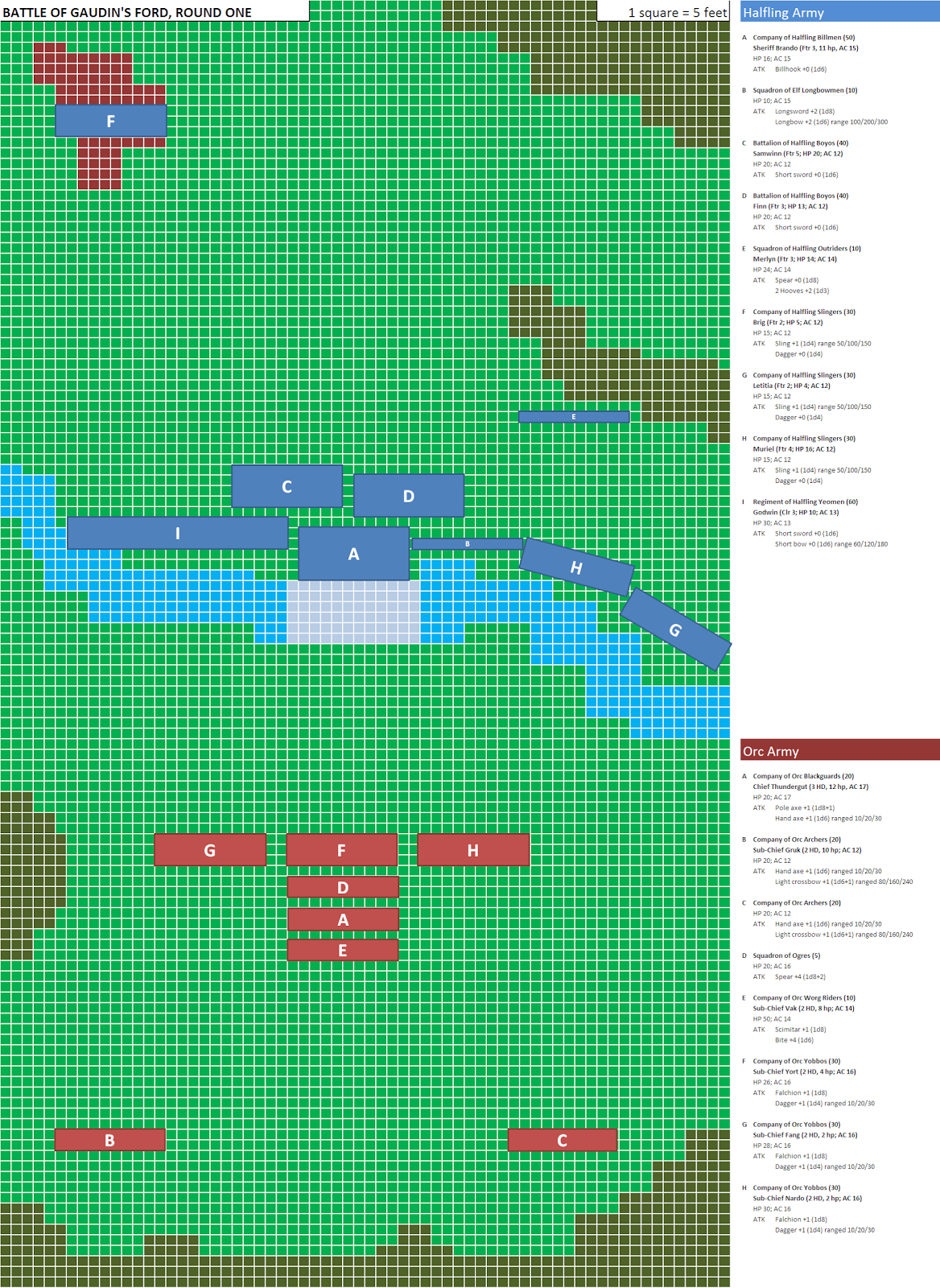
Battle of Gaudin’s Ford – Round One

Time to fight.

(Oh, and I made a mistake on my map yesterday, switching the places of the elf bowmen and halfling cavalry and mislabeling the halfling yeomen – sorry!)

As the rules now stand (yes, covering my @$$), mass combat is handled in the following phases:

1) Orders Phase
2) Missile Phase I
3) Movement Phase
4) Melee Phase
5) Magic Phase

During the orders phase, each commander writes down orders for each unit. These orders cannot be changed because of events on the field.

During each phase, each commander rolls 1d6 to see who moves a unit first, play then proceeding from commander to commander until each unit has moved or attacked during that phase.

So, orders for this phase will be as follows:

Halflings
A, C, D, E – Maintain a loose formation and wait
B – Stand ground and shoot bows at Orc Unit F
F – Stand ground and sling stones at Orc Unit G
G, H – Stand ground and sling stones at Orc Unit H
I – Stand ground and shoot bows at Orc Unit F

Orcs
All orc units are going to maintain a loose formation
All orc units except B and C will move ahead at normal speed, save the worg riders, who will have to match the pace of the units in front of them
Units B and C will target Halfling Unit A with their bows

With orders given, play proceeds with the missile phase

Each commander rolls 1d6 – Thundergut gets a ‘5’, Brando a ‘3’

Each squad of 10 figures makes a single attack, rolling damage if they hit

Thundergut has Unit B fire at Halfling Unit A, rolling a ‘13’ and ‘17’ and scoring 5 points of damage; Brando rolls a ‘18’ for his Reflex save and takes no damage

Brando has Unit B fire at Orc Unit F, rolling a ‘16’ and hitting for 5 points of damage; Sub-chief Yort rolls a 13 for his Reflex save and succeeds, suffering no damage

Thundergut has Unit C fire at Halfling Unit A, rolling an ‘11’ and ‘21’ and scoring 4 points of damage; Brando rolls a ‘25’ for his Reflex save and suffers no damage

Since Thundergut has no more missile attacks planned, it’s all halflings now

Unit F fires at Orc Unit G, rolling an ‘8’, ‘8’ and ‘18’ and scoring 2 points of damage; Sub-chief Fang rolls a ‘12’ on his saving throw and also suffers 2 points of damage

Unit G fires at Orc Unit H, rolling a ‘13’, ‘19’ and ‘17’ and scoring 4 points of damage; Sub-chief Nardo rolls a “1”, “12” and “22” on his Reflex saving throws, failing two and suffering 3 points of damage

Unit H fires at Orc Unit H, rolling a ‘2’, ‘8’ and ‘13’ and scoring no damage

Unit I fires at Orc Unit F, rolling a ’16’, ‘12’, ‘13’, ‘11’, ‘17’ and ‘1’ and scoring 4 points of damage; Sub-chief Yort rolls an ‘18’ and ‘20’ on his Reflex saves and suffers no damage

Movement now commences

Since none of the halfling units are moving this round, the movement all goes to the orcs.

Each square on the map represents 5 feet, and the orcs have a 30 foot movement rate. Thundergut has them move at full running speed towards the enemy, so they move 24 squares forward

No units are in contact, so there is no melee phase. No casters are casting, so there is also no magic phase.

So, at the end of Round One, we’ve seen some minor casualties on the orc side – nothing too dramatic yet, but we’ve only just begun the battle

Click to Enlarge

The Battle of Gaudin’s Ford – Preliminary

Among other things, Blood & Treasure includes some simple rules for mass combat to support the end game of stronghold and army building. While I’ve been playtesting the good old-fashioned dungeoneering and wilderness rules for a while now, I have yet to make sure the mass combat rules actually work. So, to correct this oversight, I’m going to test them LIVE, on this blog. Without further ado …

When spring rolls around, a young orc’s fancy turns to thoughts of plunder. And so it was that the orc chief Thundergut, rousing from a winter’s sleep, decided that it was high time to show those civilized bastards down in the valley what for. To that end, he rallied his troops (it involved lots of screaming and head kicking), convinced a few ogres to join in, and set out for Gaudin’s Ford.

Gaudin’s Ford was a ford across the River Pepp, named for a trapper who once had a trading post in the area. It provided the easiest way for many miles to cross the river and strike into the heart of the civilized area known as the Downs, an area inhabited primarily by a halfling moot called Mottlesby, with elf and human lands beyond.

As the orcs marched, they were spotted by a flock of giant eagles, who sped to the elves to warn them of the impending danger. The elves dispatched immediately a squadron of wayfarers to warn the halflings of Mottlesby and prepare a hasty defense at the ford, while the various elf princes were roused for battle and the humans were given the alarm.

And so it was that the orcs of Chief Thundergut met the halflings of Sheriff Brando at Gaudin’s Ford.

Click to Enlarge

The above is my battle map, whipped up in Excel for ease of use. On the right, you see the display of the forces involved, along with leader types. My plan is to run a few rounds each day and see how things proceed, dropping in a few points about the rules as I go along. Consider today the set-up, with the battle being joined tomorrow.

The orc plan is to push forward, using the yobbos to soak up missile damage and then get out of the way so the ogres and blackguards can attack the lines in waves. The archers will try to engage the enemy missile troops and keep them out of the battle. The worg riders are kept in reserve.

The  halfling plan is to inflict as much damage as possible with missile weapons, and then hope the billmen can whittle the orcs down enough that they won’t overwhelm the yeomen and boyos.

In general, I’m trying to keep this simple and just test the mechanics. The troop types and leaders are drawn from the monster section of B&T and things like hit points were rolled randomly.

Oh – rhe dark green bits are woodlands, the brown blob a hill and the light blue bit is the ford in the river. The rest of the river could be crossed by swimming.

Mass Combat in Blood and Treasure


I want to start this off by wishing folks a happy Memorial Day, especially those who are serving in the armed forces, have served, or lose a loved one who served. Though my family doesn’t have a massive history of military service, I can point to my father Rick, who served in the USAF and spent some time overseas in Thailand, my grandfather John (“Pa”) who was a doctor in the US Army and helped take care of folks after the bombing of Hiroshima, and several uncles.

And since I’m thinking of the military and mass combat (and need an easy blog post for the day), why not take a look at the mass combat system for Blood & Treasure. The system is easy to run and essentially works off the games normal combat rules, so don’t expect anything earth shattering. The idea behind Blood & Treasure isn’t to break new ground in gaming, but provide a platform in between the different editions. Anyhow …

When a lord or lady finds it necessary to place themselves and their followers on the field of battle against another large force, the normal rules for combat may become untenable. For this reason, you can instead use these rules for mass combat. In most respects, they use the same basic rules as normal combat, but adjust those rules to take into account the larger numbers of combatants involved.

SQUADRONS
To keep things simple, groups of combatants are divided into squadrons of 10. The squadron is the basic unit for fighting, and in mass combat a squadron attacks as though it were a single creature. Thus, a squadron of dwarves would make a single weapon attack on its turn, while a squadron of lizardmen could make a weapon and bite attack.

A squadron has as many hit points as its collective members have Hit Dice. Thus, a squadron of 10 dwarves, who have one HD each, has 10 hp. For mass combat, 0 HD troops are counted as ½ HD.

Squadrons of Large creatures (and mounted troops are considered to be the same size as their mounts) have only five members, while huge creatures and siege engines are treated as units in and of themselves.

Squadrons can be grouped into larger units, as follows: A company consists of 2 squadrons (and thus makes double the normal amount of attacks), a battalion consists of four squadrons and a regiment consists of eight squadrons.

Each squadron is assumed to form a single rank of troops on the battlefield. A squadron of men-at-arms would therefore consist of 10 men-at-arms standing in a row. A company of men-at-arms could either consist of 20 men-at-arms standing in a row or two ranks of ten. With each unit, it is necessary to note its number of ranks.

Note that only the front rank of troops can attack unless the troops are armed with pole arms or spears (in which case the second rank can attack), pikes (in which case the second and third ranks can attack), or ranged weapons (in which every rank can attack).

Typical units of soldiers might be as follows (note, the number in parentheses represents the number of squadrons and then the number of creatures):

Squadron of Ogres (1/5): Ranks 1; HD 4; hp 20; AC 16; Atk 1 greatclub (2d8) or javelins (30 ft., 1d8); Move 30; Save Fort 10, Ref 14, Will 15. Leather armor, greatclubs and javelins (1).

Company of Halberdiers (2/20): Ranks 2; HD 1; hp 20; AC 15; Atk 2 halberd (1d10); Move 30; Save Fort 13, Ref 15, Will 15. Chainmail, halberd.

Battalion of Halfling Slingers (4/40): Ranks 1; HD 0; hp 20; AC 15; Atk 4 sling (50 ft., 1d4) or 4 short sword (1d6); Move 20; Save Fort 13, Ref 16, Will 16. Padded armor, sling, short sword; halfling special abilities.

Regiment of Orcs (8/80): Ranks 4; HD 1; hp 80; AC 13; Atk 2 falchion (2d4) or 8 javelin (50 ft., 1d4); Move 30; Save Fort 13, Ref 15, Will 16. Studded leather armor, falchion, javelins (1).

ORDER OF BATTLE
Mass combat uses the following order of play:

1) Orders Phase
2) Missile Phase I
3) Movement Phase
4) Melee Phase
5) Magic Phase
6) Missile Phase II

After the second Missile Phase, play returns to the Orders Phase.

Orders Phase: In the orders phase, each unit is given its orders. Once these orders are given, they cannot be changed, though they can be disrupted by events on the battlefield. In other words, once the command has been given for a company of orcs to march up a hill, they cannot change their mind when a company of knights gets there first. Naturally, orders are given without each commander knowing what commands his opponent is giving to his soldiers.

Missile Phase: There are two missile phases during each round of mass combat. During a missile phase, groups of missile armed troops can cast their missiles if they did not move during the movement phase. The rate of fire of various ranged weapons is very important during mass combat missile phases. Some ranged weapons can attack in both missile phases, others in only one.

Blowguns, bows, javelins, darts and slings can attack in each missile phase.

Crossbows, muskets and pistols can attack in one missile phase.

Siege engines can attack in one missile phase.

Movement Phase: During this phase, units move in the direction and at the speed they have been ordered. Units within 10 yards of an enemy unit cannot move at faster than combat speed (i.e. half normal speed). Movement of troops is simultaneous.

Melee Phase: Enemy units that have come into contact (i.e. within 1 yard of one another) must participate in a round of melee combat.

Magic Phase: During this phase, spellcasters on the field of battle can discharge spells. Remember that rounds in mass combat are one minute long, so spell durations may be altered.

ATTACKS AND DAMAGE
As mentioned above, each squadron in a game can attack as though it were a single creature of the same type using the same attack rules as used in normal combat (see above). Combat rounds in mass combat are measured in minutes, rather than six second intervals. Each successful attack by a squadron, by spell or weapon, rolls normal hit point damage against its target unit.

A unit can sustain no more hit point damage than it exposes in its first rank. Thus, a unit with five normal humans (1 HD each) in its first rank can sustain no more than 5 points of damage. If that unit is being attacked by spears or pole arms, double this total. If it is being attacked by pikes, triple this total. If it is being attacked by ranged weapons, it can suffer as much damage as the attackers can dish out.

Units can also “bull rush” an opposing unit in combat, making a normal attack with a +1 bonus for every additional rank it has over the opposing unit. If successful, it pushes the opposing unit back 10 yards, but scores no damage.

MORALE CHECKS
Three events can force a unit to check morale.

1) When a unit has lost half or more of its hit points, or takes damage when at less than half its normal hit points.
2) When its commander has been killed.
3) When it is subjected to a magic fear effect.

When a unit must make a morale check, it rolls a Will saving throw using either its own Will save value or its leaders.
If a unit succeeds on this save, it keeps on fighting. Otherwise, it flees from enemy troops at running speed. If it was engaged with another unit, that unit gets a free set of attacks against it with a tactical advantage bonus.

Each round, the unit commander, if one remains, can attempt to rally the troops with a new Will saving throw modified by his or her Charisma modifier. If successful, the unit spends one minute reforming itself and can then move and attack on the next round. After two full rounds of fleeing, the unit disintegrates into its constituent parts and effectively ceases to exist.

SIEGE ENGINES
Siege engines are large weapons, temporary structures, or pieces of equipment traditionally used in besieging a castle or fortress.

Catapult, Heavy: A heavy catapult, or trebuchet, is a massive engine capable of throwing rocks or heavy objects with great force. Because the catapult throws its payload in a high arc, it can hit things out of its line of sight.

To fire a heavy catapult, the crew chief makes a ranged attack modified by Intelligence rather than Dexterity. If the attack succeeds, the catapult stone hits the place the catapult was aimed at and deals the indicated damage. Characters that succeed on a Reflex saving throw take half damage. Once a catapult stone hits, subsequent shots hit the same spot unless the catapult is re-aimed or the wind changes direction or speed.

If a catapult stone misses, roll 1d8 to determine where it lands. This determines the misdirection of the throw, with 1 being back toward the catapult and 2 through 8 counting clockwise around the target square. Then, count 3 squares away from the target square for every range increment of the attack.

Loading a catapult requires one minute to reload and another minute to re-aim (if necessary). A heavy catapult takes up a space 15 feet across. It is operated by a crew of no less than 6.

Catapult, Light: This is a smaller, lighter version of the catapult. It functions as the heavy catapult. It takes up a space 10 feet across. Some examples are the onager and mangonel. It is operated by a crew of no less than 3.

Ballista: A ballista is essentially a huge crossbow. It takes a creature smaller than large two rounds to reload the ballista after firing. A ballista takes up a space 5 feet across. It is operated by a crew of no less than 2.

Cannon: Early cannons were cast in bronze and were quite large. They throw the same kind of ammunition as catapults, but do so in the manner of a ballista. A heavy cannon takes up a space 10 feet across and has a crew of no less than 6. A light cannon takes up a space 5 feet across and has a crew of no less than 3. A natural ”1” rolled to hit with a cannon means the engine has exploded, dealing 3d6 points of damage to everyone within 10 feet.

Ram: This heavy pole is sometimes suspended from a movable scaffold that allows the crew to swing it back and forth against objects. The character closest to the front of the ram makes an attack roll against the AC of the construction. In addition to the damage given on Table: Siege Engines, up to nine other characters holding the ram can add their strength modifiers to the ram’s damage. It takes at least one huge creature, two large creatures, four medium creatures, or eight small creatures to swing a ram. Tiny creatures cannot use a ram. A ram is typically 30 feet long.

Siege Tower: This device is a massive wooden tower on wheels or rollers that can be rolled up against a wall to allow attackers to scale the tower and thus to get to the top of the wall with cover. The wooden walls are usually 1 foot thick.

A typical siege tower takes up a space 15 feet across. The creatures inside the tower push it at a speed of 10 feet. The eight creatures pushing on the ground floor have cover against missiles.

Table: Siege Engines

ITEM – COST – DAMAGE – RANGE – CREW
Catapult, heavy – 800 gp – 6d6 – 1,000 ft. (100 ft. min.) – 4
Catapult, light –  550 gp – 4d6 – 500 ft. (100 ft. min.) – 2
Ballista – 500 gp – 3d8 – 200 ft. – 1
Cannon, Light – 1,000 gp – 5d6 – 500 ft. – 3
Cannon, Heavy – 2,000 gp – 10d6 – 1,000 ft. – 5
Ram – 1,000 gp – 3d8 – — – 10
Siege tower –  2,000 gp – — – — – 20

DESTROYING WALLS
10-ft. thick stone walls have an AC of 18 and can withstand 500 points of damage on a 10-ft. x 10-ft. section before crumbling. 5-ft. thick stone walls can withstand 250 points of damage on a 10-ft. x 10-ft. section before crumbling.

[The one thing I’m thinking about changing is the whole siege engine bit. I’m thinking about something that doesn’t involve tracking the hit points of a wall section. Something like …

A wall has a damage threshold based on the material (wood, stone, etc.) and the thickness of the wall. If the siege engine damage roll (no hit roll – the damage roll is considered part of the “does it hit the right spot” thing) passes the threshold, it has a percentage chance of toppling the wall, perhaps equal to the amount the damage exceeds the threshold. Maybe there’s also a roll to determine how high up the wall is struck. The type of weapon would also determine the size of the hole created. So – no damage to track, still takes (most likely) many hits to topple a wall.

Let me think out loud for a moment. We’ll say a stone wall has a damage threshold of 20 + 5 per 10 feet of wall. A 20-ft thick stone wall, then, has a damage threshold of 30.

A ballista has no hope of getting through the wall – which is probably right.

A light catapult does 4d6 – so an average of 14, max of 24. That means a light catapult doesn’t have a chance of breaching the wall either.

A heavy catapult does 6d6 – so an average of 21, max of 36. On a max. damage roll, each heavy crossbow has a 6% chance of breaching a wall.

A light cannon does 5d6 – so an average of 18, max of 30. No chance of breaching that wall.

A heavy cannon does 10d6 – so an average of 35 (5% of wall breach), max of 60 (30% chance of wall breach). Heavy cannon are going to knock down most walls, probably in a relatively short time. That’s also pretty accurate.

In all, I think a system like this can work, but I probably need to adjust the numbers a bit.

Status update, by the way. The only things left to write for the game are some embellishments to the chapter on dungeons, wilderness and cities, and ship combat (which will be a distillation of the ship combat rules I published way back in NOD 2.) The monster chapter is being edited (thanks Tanner), so the end is nigh.

Have some new undead critters coming later today on the blog … see ya then.

Dragon by Dragon – June 1976 (1)

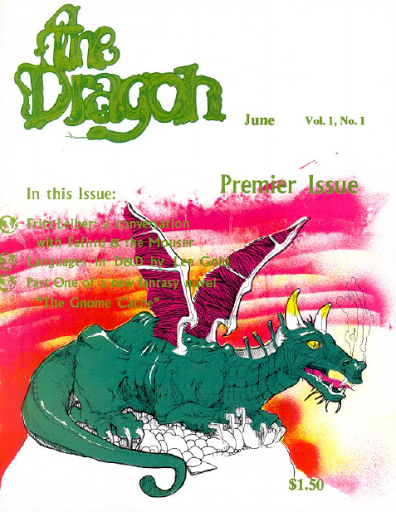
Who drew it? Couldn’t find it in the issue.

Yeah, everyone else does the whole “review every issue” or “review every page” thing, so why the heck can’t I?

Other than Great Britain and Iceland finally ending their codfish war (such a terrible waste), the first issue of The Dragon (formerly The Strategic Review) was probably the big highlight of June, 1976. So what does this little gem contain?

We have an article by Fritz Leiber, the man himself, talking about his wargame Lankhmar and giving a brief tour of Nehwon. Leiber closes this article with a bit on houris. Here’s an adaptation for Blood & Treasure (you know, the game I haven’t actually released yet).

Every hero (4th level fighter) attracts a houri as one of his followers provided he has a charisma of at least 15. The houri requires upkeep to the tune of 100 gp per month. As Leiber explains, a houri is so “slimly beautiful” that she “make all men their helpless slaves and intoxicate even a Hero to madness”. In play, this works as follows:

– Houris have 1d4 hit points (i.e. they can be killed by a dagger). They wear no armor, and may only wield a dagger themselves.

– All 0 or 1 HD male humans, demi-humans and humanoids within 10 feet of a houri must pass a Will saving throw or move directly toward the houri, rapt with fascination and unable to attack her (unless they are attacked by someone else, in which case the spell is broken).

– All higher level male characters within 10 feet of a houri must pass a Will saving throw or have their effective level cut in half.

Sounds like a useful follower to have, but heed the Mouser’s warning – “Women are ever treacherous and complicate any game to the point of sheerest insanity.”

Larry Smith provides a guide to running the Battle of Five Armies using the Chainmail rules.

Wesley D. Ives provides a task resolution system, as he informs us that a “more standardized system is needed” than DM’s just making it up as they go along. New School and Old School were clashing even back in 1976.

The system works by determining randomly a type of dice (by rolling d% and adding the attribute to be tested), from d4 to d12, rolling it and multiplying it by the attribute to be tested to find the percentage chance of success.

So, let’s say I want to jump across a chasm. This involves strength, and my dude has a strength of 13. I roll d% and get a 35. I add 13 to 35 and get 48, which tells me I need to roll a d8. I roll it, get a 5 and multiply that by 13, giving me a 65% chance of success. See – much easier than saying “roll under your strength” or “roll a save vs. paralyzation” or “roll 1d6 – you succeed on a 1 or 2”. Thank goodness for systems.

James M. Ward asks whether Magic and Science are compatible in D&D. Of course, he thinks it is (else it would be a pretty boring article). He introduces a race of people called the Artificers who use a trio of interesting high-tech items.

Lee Gold delves into languages. She notes that humanoids have a 20% chance of speaking Common, which makes much more sense than 3rd edition allowing dang near every sentient creature in the multiverse speaking Common (and thus negating the point of even having languages).

Jake Jaquet tells the tale of “The Search for the Forbidden Chamber”. Check it out for a picture of the infamous “Greyhawk Construction Co. LTD” and a Recyclesaurus.

Len Lakofka presents some miniature rules that were apparently going to be used in a 64-man elimination tournament at GenCon.

The creature feature presents the ever-loving Bulette (pronounced boo-lay, except not really), with an illustration that is really quite good. The reproduction isn’t perfect, but it’s a nice action shot featuring three armored warriors (God, do I prefer realistic armor to some of the fantasy nonsense that seems to predominate these days). The stats note that its mouth has 4-48 pts and its feet 3-18 points – i.e. 4d12 and 3d6. It took me a minute, but I finally realized this was the damage they dealt.

The description notes that it is a hybrid of armadillo and snapping turtle, and that, when full grown, they can dwarf a Percheron (a draft horse that originated in the Perche Valley of northern France of course – man, don’t you guys know anything?)

Mapping the Dungeons is a neat little feature, presenting the names of active DM’s. The FLAILSNAILs of its day, I suppose.

Joe Fischer gives tips on mapping a wilderness. He uses colors for the terrains and simple symbols for features – triangles for hamlets, squares for towns, circles for cities and crosses for fortresses. Circle any of these for ports. Article has a nice Conanesque barbarian illustration as well.

Peter Aronson adds four more levels onto the illusionist, as well as a few extra spells (1st – ventriloquism, mirror image, detect illusion*, color spray*; 2nd – magic mouth, rope trick, dispel illusion*, blur*; 3rd – suggestion, phantasmal killer*, illusionary script*, dispel exhaustion*; 6th – mass suggestion*, permanent/illusion* (no – the slash doesn’t make sense to me either), shadow/monsters III*, programmed/illusion*, conjure animals, true sight*; 7th – astral spell, prismatic wall, maze, vision*, alter reality*, prismatic spray).

The spells marked with an asterisk are detailed in the article, in case you wondered who invented phantasmal killer. Lots of classic spells here. Alter reality apparently works like a limited wish, but you first create an illusion of what you want to happen, and then the … spell description cuts off.

Lin Carter and Scott Bizar present “Royal Armies of the Hyborean Age”, which reminds you of how important wargaming still was to the hobby then. I think wargaming is pretty basic to the experience, really, which is why I threw some basic rules into Blood & Treasure for mass combat. I’m hoping to test them out this weekend with the daughter. She doesn’t know this yet – so keep it under your hat.

Gary Gygax (you might have heard of him) gives rules for hobbits and thieves in DUNGEON!, a game I so completely regret getting rid of I’d like to punch myself in the face.

“Garrison Ernst” (pseudonyms are as much a part of the history of this hobby as dice and beards) presents a chapter of “The Gnome Cache”, in which he gives an introduction to Oerth and its place in the cosmos. Oerth is a parallel Earth with the same basic geography as Earth, it claims, save Asia is a bit smaller and Europe and North America a trifle larger. It is peopled by folks similar to ours, with similar migrations, but it separates from Earth about 2,500 years ago. He also explains the difference in scientific laws (i.e. magic vs. technology) and that nobody knows what lies in the Terra Incognita of Africa and across the Western Ocean.

It might be fun to draw the nations of Oerth on a map of Europe. We’ve all heard that Gygax’s campaign was originally set in a fantasy North America, but here he says Europe, so perhaps Europe it should be.

Larry Smith now chimes in with the three kindreds of the Eldar – the Silvan (or Wood Elves), the Sindar (or Grey Elves) and the Noldor (or Exiles, the greatest of the elves). Apparently they all have a chance each game year of crossing the sea to the land of Valar – that would be a fun house rule to spring on players of elf characters.

“Say Bob, roll d% please”

“Okay … got a 9”

“Sorry Bob, your 6th level wood elf just went to the land of Valar. Roll up a new character.”

The wood elves can advance as fighters as far as they want, but are limited to 2nd level magic-user spells and may not use wands or staffs and have a 10% chance of going to Valar each year. Sindars are the regular D&D elves (and have a 25% chance of going to Valar each year). Noldor are uber elves with no level restrictions and with a 150% bonus to ranges and effects of spells. They have a 5% chance of going to Valar after performing a great deed.

Which begs the question, why would you ever play a non-Noldor elf?

Note: Totally digging the art in this issue.

Not a bad issue. Lots of goodies. I like the houri bit for fighters, the elves going across the sea is fun, and you get some neat hints about Lankhmar and Oerth from the guys who invented them. Worth the read.

Holy Monkey! That’s a Nice Paper Mini

I’ve been thinking about doing something with mass combat in NOD using the Swords & Wizardry rules (because they’re simple and straight forward) or the Swords & Shields rules by ckutalik at Hill Cantons that he recently made available as a free download.

In either event, I tried to make NOD more mass combat friendly in NOD 6, stating combat forces as squadrons (of 10 troops) and companies (of 20 troops) in one of several troop types:

Militia: Peasant Militia, Yeomen Militia and Scouts

Footmen: Archers, Crossbowmen, Handgunners, Slingers, Light Foot, Heavy Foot

Horsemen: Light Horse, Heavy Horse, Knights

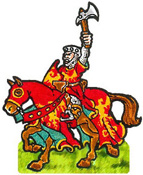
NOD 6 is a free download, so I’m not going to go into the whole thing in detail here – just check the article on Western Venatia for more. Anyhow – last night I was looking for some paper minis. I think the Cardboard Fighters are my favorites (sample below), and I’d love some black and white templates of those figures so I could color them in myself with the blazonry of the different armies in NOD.

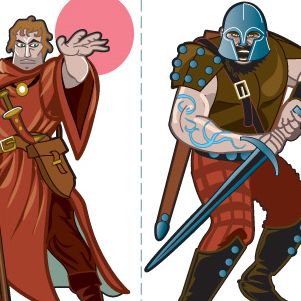
I also discovered the paper minis at The Fantasy Trip and was absolutely blown away! Check them out – you will not be disappointed (sample below) and you can’t beat the price.

Bear in mind – each of these images is a clip of a much larger sheet.