Family Feuds

The other day, I was thinking about fantasy cities and ways to define them. Most of my cities for NOD are done as a small section of the place with interesting personalities to run into, along with a run down on the ruler, high priest or priestess, etc. Just enough to make the place memorable and with a focus on something special that might bring the players hundreds of miles – the finest armorer in the region, a black market for stolen goods, etc.

The idea of a key industry crossed my mind – think of several industries and specialties and generate one specialty in one industry in which a city excels – i.e. if you want the best éclairs, you have to travel to Barnabas, the City of Eclairs. So, Barnabus would have a bunch of master bakers who produce the best éclairs in the universe, and in fact are so skilled they can bake magical effects into their éclairs (i.e. magic potions). Barnabas would have many excellent normal bakers as well, and to support the baking industry would need associated industries like milling, farming, orchards, jelly makers, beet growers, spice merchants, etc. As I played with working this into a system, I realized that it was breaking my #1 rule for NOD – focus on adventuring. This industry stuff was interesting, but how was this forwarding the goal of sending players on adventures? Putting an hour of work into generating some demographics that will never lead to one daring sword fight, swing across a chasm, assassination attempt, kidnapping or plundered treasure horde just doesn’t make sense to me when we’re working at creating an adventure game.

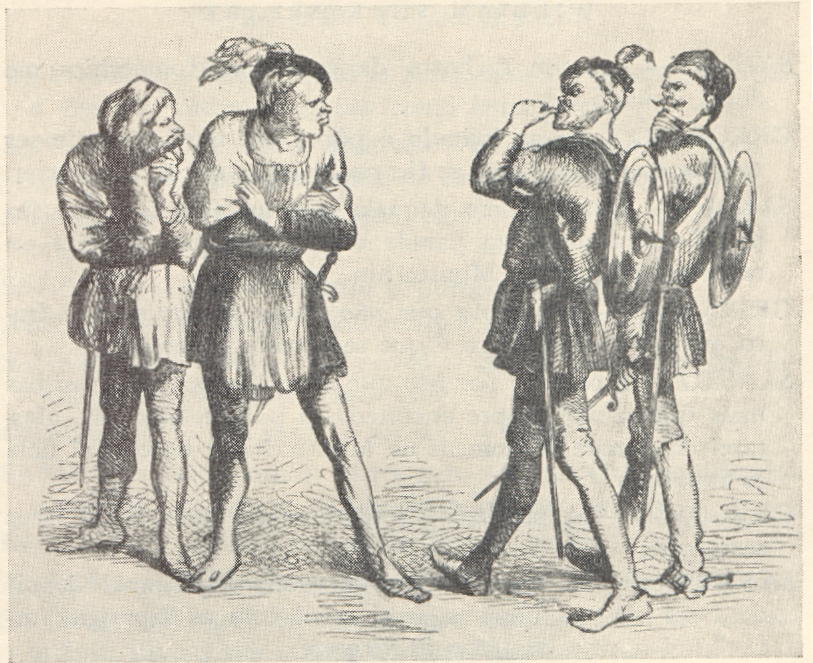
One thing that did come to me, though, was the idea of rival families. You see, when I was thinking about different medieval industries, merchants came to mind. But how does a city specialize in merchants? Well, maybe banking – but every city needs merchants. And then I thought about great merchant families, and the Montagues and Capulets came to mind and I thought – you know what every fantasy city needs – rival families. Three families at least – one the most powerful, the other the bitter rival and the third the up-and-comer playing one off the other. That can lead to adventures, as players get involved with these folks and their endless machinations. With that in mind …

STEP ONE – THE FAMILY

Every family has a head – the man and woman who holds the legal reins. We need to determine how old they are and what they can do. In this case, all of these families are going to be mercantile in nature. All family heads are going to be venturers. Their level depends on their generation: Adult 1d6+1, Mature 1d8+2 and Old 1d10+3.

1-3. Adult (25 to 35 years old)
4-5. Mature (36 to 55 years old)
6. Old (56 + years old)

Now we need to roll 1d6 for the family head’s siblings. Each sibling has a 50/50 chance of being male or female and comes from the same generation as the head of the family. We’ll presume that any older family members are dead, or else they would be in the leadership position.

The siblings are probably nondescript merchant types or venturers, but might be something else. Roll to find out for sure. At the same time, roll a 1d4 to figure out their general personality.

OCCUPATION

1-6. Merchant (0-level)
7-10. Trader (3 HD)
11-13. Venturer
14. Sage
15-16. Artisan
17. Thief or Assassin
18. Magic-User or Illusionist
19. Cleric* or Druid
20. Fighter or Duelist (1% chance of a paladin)

* Clerics worship as follows: 01-70 – Deity of Trade or Wealth; 71-90 – Lawful Deity that might frown on some business practices; 91-100 – Chaotic Deity/Demon/Devil

PERSONALITY
1. Sanguine (impulsive, pleasure-seeking, sociable, emotional, creative, compassionate)
2. Choleric (ambitious, leader-like, aggressive, passionate, energetic, dominating)
3. Melancholy (introverted, thoughtful, pondering, considerate, artistic, perfectionists)
4. Phlegmatic (relaxed and quiet, lazy, content, kind, accepting, affectionate, shy)

For those with class levels, roll them as follows:

Young* – 1d4
Adult – 1d6
Mature – 1d8
Old – 1d10

* For children of adults

75% of males and females are married and have 1d4-1 children. Each siblings mate is (1-4) from the same generation or (5) one generation older or (6) one generation younger. The children are all from one generation younger than the younger partner in the marriage. Roll up the children’s personalities and occupations as well, unless the children are from the generation younger than “Young”, in which case they are too young to have an occupation.

For each person in the family, roll up their Charisma score as well on 3d6.

Adult or older children of the siblings have the same chance as the siblings as being married with children. Young children of the siblings have a 50% chance of being married and have 1d3-1 children.

STEP TWO – ASSETS

Each of these mercantile families has core assets dependent on the number and age of the family members (not including spouses). Each family also has a town house for the head of the family and each sibling, and the necessary servants for each town house (butler/valet, cook, upstairs maid, etc.)

Young – 1d20 x5 gpAdult – 1d20 x 10 gp
Mature – 1d20 x 50 gp
Old – 1d20 x 100 gp

In addition, the family gets 1d4+1 rolls on the following table of special assets.

ASSETS
1. Tied by blood to a noble family – the head of the family is a (1-3) 3rd cousin, (4-5) 2nd cousin or (6) first cousin to a (1-4) baron, (5-6) count or (7) duke or (8) king.
2-3. Tied by marriage to a noble family – replace the head’s spouse or one of the sibling’s spouses with a person of noble blood (as above).
4-9. Owns a caravan of 2d6 wagons or elephants or 4d6 camels to a nearby city
10-15. Owns a merchant galley that travels to a nearby city
16-20. Owns a caravan of 3d6 wagons or elephants or 6d6 camels that travels to a far away city
21-25. Owns a merchant cog that travels to a far away city
26-27. Owns a valuable heirloom that is (1-3) a major piece of jewelry, (4-5) a major gem or (6) a minor magic item
28-30. Owns 2d4 fine horses
31-33. Owns 3d6 fine hounds
34-36. Owns 3d6 fine falcons
37-38. Owns a single magical beast
39-40. Has a hired magic-user (roll 1d4+1 for level); all family members can cast a single non-offensive 1st level magic-user spell per day
41-43. Has a hired assassin (roll 1d4+1 for level); all family members carry vials of mild poison
44-48. Has a hired duelist (roll 1d4+1 for level); all family members +1 to hit and damage with rapiers
49-50. Has a hired gourmand (roll 1d4+1 for level)
51-55. Owns a fine manse in the city (1d6+6 rooms)
56-59. Owns a fine mansion in the city (1d10+10 rooms)
60-62. Owns a fine villa or manor in the country (1d8+8 rooms)
63-66. Owns a fabled wine cellar (total value of 3d10 x 100 gp)
67-70. Owns a fabled art collection (total value of 3d10 x 100 gp)
71-74. Owns a fabled armor and weapon collection (3d6 pieces, all masterwork and legendary)
75-78. Has a seat on the city council
79-80. Has a seat on the king’s privy council
81-83. Has master of the local merchant’s guild
84-85. Has a dark family secret
86-88. 1d4 x 10,000 sp in additional assets
89-90. 1d3 x 1,000 gp in additional assets
91. 1d2 x 100 pp in additional assets
92-95. Has a letter of marquee from the king
96. Suffers under a family curse
97. Enjoys a family blessing (an ancestor was a saint or martyr)
98. Has an infamous (and rumored) torture chamber
99. Has an infamous (and rumored) cabinet of horrors
100. Has an infamous (and rumored) shrine to a demon or devil lord

SAMPLE FAMILY: THE MONTFLEURS

Arnou Montefleur – Sanguine 4th level Venturer, Adult

Arnou has two sisters:

Gallia is a phlegmatic, adult trader (3 HD) married to Merlin, a young merchant. They have three infant sons, Merlin, Arnou and Delmar.

Allyriane is a sanguine, adult duelist (1st level) married to Octave, an adult merchant. They have three young children, Tristan (3 HD trader), Therese (3 HD trader) and Fleurette, a goldsmith.

The families assets are 10,000 sp and 310 gp in cash money, locked away in the family’s town house.

The family also owns a caravan of 5 wagons that travels to a far away city, 8 fine hounds, a merchant galley and, though this is only rumored, a shrine to the devil Mammon in their cellar (it’s really behind a sliding wall in their dining room).

Mu-Pan – Pantung

The fun of randomizing hex contents is, of course, that I don’t know what’s going to pop up and I have to try to make it fit (or delete it and pretend it didn’t come up). In this case – surprise, there’s a city in the high mountains!

0322. Pantung is an outpost city-state of 12,375 souls constructed between three dormant volcanoes. The clever engineers of Pantung have dug into the volcanoes, constructing large vents from which pour air and water warmed within the volcanoes. This has made the valley of Pantung warm all year around, despite being located at such a high elevation. The borders of the kingdom are protected by walls of ice that slowly melt and are re-built through the year.

The city-state itself is constructed on a radial pattern. The buildings are made of thick, cream-colored stone, much of it excavated from the aforementioned vents. Doors in the city-state are barred at night, for the citizenry fear the hobgoblins and yeti of the mountains. The city’s wall is 30 feet tall and has four large tower keeps protecting it. Each 1,000 foot section of the wall (there are 16 such sections) and the battlements of each tower are patrolled by 1d6+6 handgunners accompanied by a sergeant-at-arms and possibly (10% chance) a low level shugenja. Each tower has a number of war engines that launch flights of iron war rockets. Three paved roads lead from the city state, one into Tsanjan, the other two into Mu-Pan. These roads are lined by asters ranging in color from white to golden yellow to bright purple.

The primary business of Pantung is copper mining (the city-state has small mines up to 3 hexes away) and banditry. During the winter months, dozens of bandit gangs retreat into the mountains to stay in Pantung, bringing rich tributes of coins and slaves to the nu-gong. The bandit chiefs are treated as visiting royalty. The bandits never prey on the citizenry, who appreciate their bawdy tales and ample coin. The fields around Pantung support cherry and plum orchards and grazing for a breed of rugged mountain pony. The primary coin of Pantung is made of bronze (i.e. copper piece), and the average earnings of a commoner is about 2 cp per day.

Pantung is ruled by Nu-Gong Oonichay, a respected shugenja with ties to the black magicians of Tsanjan. She is assisted by a cabal of 4 noble houses, each headed by a master alchemist. Oonichay is a calculating and domineering. She has pale skin, hazel eyes and dark, brown hair that is bobbed short. Oonichay is an accomplished dancer (she was brought into Pantung as a dancing girl for the former gong). She has a small-featured, delicate face that never betrays her thoughts. She wears a cloak of gray and black vulture feathers (from the bearded vulture of the Tsanjan Plateau). Her palace is in the city-state’s center, surrounded by the legendary fruit market. The palace dungeon is a thing of legend.

The city-state’s alchemists are respected (and, to some extent, despised) throughout Mu-Pan. They put most of their efforts into discovering the elixir of life, but also produce copious amounts of black powder (mostly to fuel the iron war rockets and handguns that protect the city from invasion)

Pantung’s patron deity is Roon, the god of going. Roon’s grand temple is overseen by 10 female nsiain (Mu-Panese druids) and 300 lay brothers and sisters, most of them piao-ke (guides, former bandits). The worship of other deities is frowned upon in Pantung, and proselytizing is illegal. The nsiain of Pantung take vows of poverty (though their temple is quite wealthy) and celibacy. The temple’s wealth is used to maintain the roads (and the flowers, the aster is sacred to Roon). Priestesses wear robes of green sackcloth marked by dozens of white hand prints and carry tetsubos. They bleach their palms white. Holy days are observed by the people and priests with pilgrimages to visit shrines (actually noble crypts) in the mountains. The highest virtues preached by Roon’s church are kindness and charity, the most terrible sins blasphemy and envy.

Pantung has a shady tavern located just inside the east gate. The Golden Staff is run by Isekonall, a friendly, optimistic man who hails from the northern steppe and speaks with a thick accent. Most of the crowd in the Golden Staff is shady – bandits and slavers, for the most part. The place is usually crowded and noisy. The plum wine and short beer that Isekonall serves are a bit overpriced for their quality, but the four rooms (actually a loft partitioned with paper screens) are cheap (and mostly occupied, 1 in 6 chance of a room being vacant).

Some of the more interesting folk of Pantung include Newarada, the strinkingly beautiful high priestess of Roon that is really a disguised man (a ninja of the Black Dragon Kingdom who has played the role for over a decade, he is involved in many assassinations), Snomonchond, a flamboyant master alchemist and open heretic (he worships Sol Invictus, whom the Motherlanders call Apollo Helios), Hagravet, the well-connected captain of the guard who keeps company with Snomonchond, Zajinnes, an arrogant master alchemist and rival of Snomonchond who has a family closet full of skeletons and an unhealthy fixation on Hagravet, and Aschansary, a young official implicated in a bribery scandal – she’s had bad luck with former allies and finds it difficult to place her trust in others.

Ruler: Oonichay, Nu-Gong (Duchess), Shugenja Lvl 8
High Priestess: Newarada, Druid Lvl 8
Population: 12,375
Domain: 10 hexes
Size: 1 mile diameter
Arms: Three black dots on a field of white

Medieval City

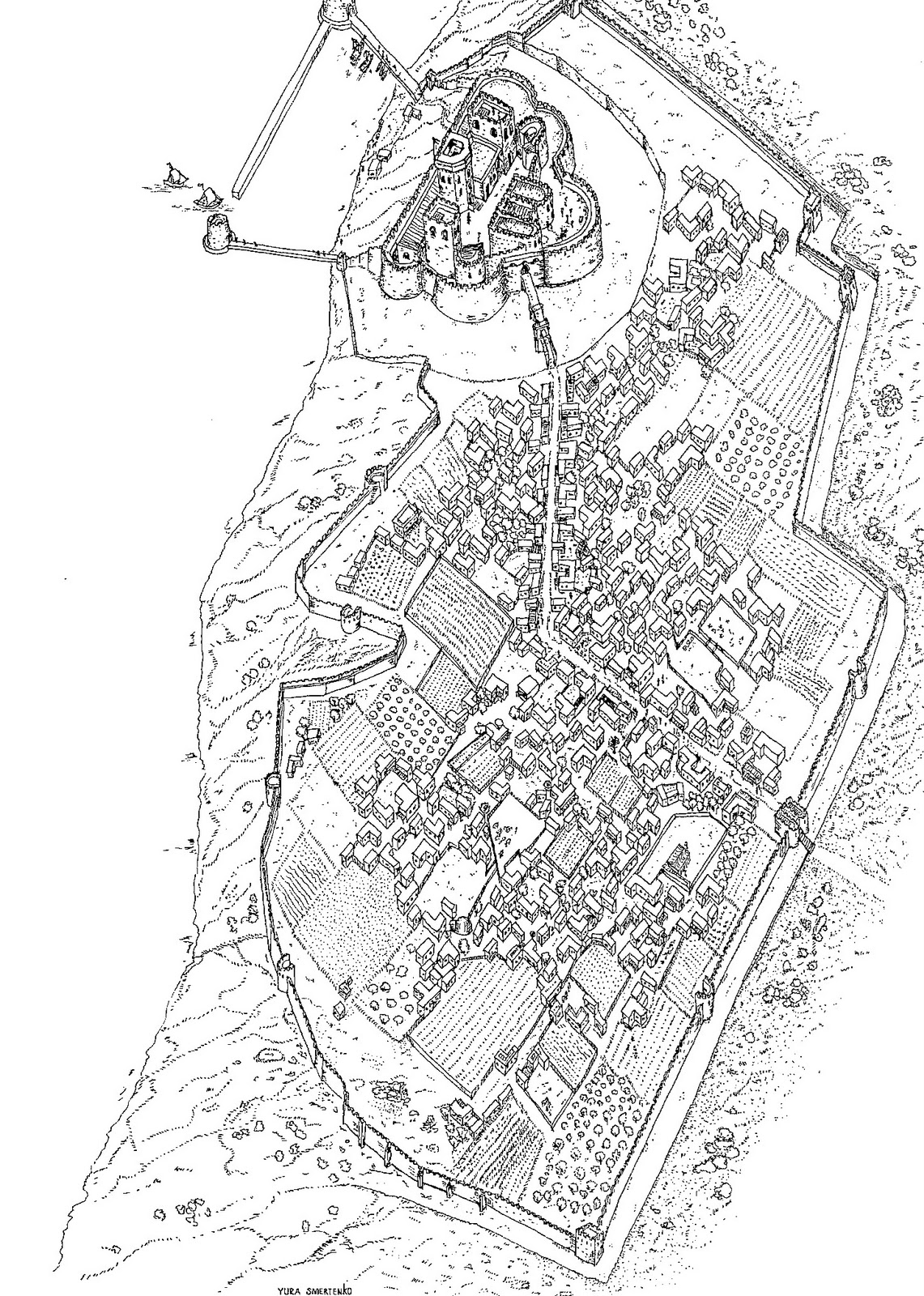
I don’t know whether you would term this a city or a town – probably a town. Either way, I found this map and wanted to share it. Had I more artistic ability (and I might go to the trouble of investing time into learning) the city maps in NOD would look like this – much more evocative than simple line maps.

The image was found at the Apollonia-Arsuf Archaeological Project from Tel Aviv University. It’s a reconstruction of a crusader city, and you can find more descriptive text at the link.

So, enjoy the map – Deviant Friday will follow in a few hours.

Lyonesse, The Gleaming City – Salter Court

Salter Court
Salter Court is Lyonesse’s equivalent of a central business district – mostly tall buildings, some brick, most timber-frame, used by merchants, factors and guilds. Merchants are common in this area, as are clarks hustling from one place to another. Nobles are notoriously absent from this area, unwelcome by the busy merchants. Most of the buildings on Salter Court are four or five stories tall and have multiple people living in the flats therein.

Feather Merchant: Fionath is a flighty, fancy woman who loves money and showing it off. She is an importer of feathers and down, selling the more common materials to stuff cushions and mattresses for the wealthy and retaining the rarer and more exotic feather that come into her possession – couatl, pegasus, cockatrice – are usually sold to magic-users and alchemists. Fionath has peach-colored eyes and silky, buff brown hair. She is quite compact, with intelligent, quick features and a ready wit. Success has made her lazy, and her connections to the counts of Iver has made her rather cold-blooded.

Gallery of Trades: This narrow building of four stories provides booths for all sorts of tradesmen, who must pay a small fee and turn over 10% of their profits to the mercantile guild. One can find cobblers, ropemakers, etc in this building, which is quite cramped and rife with pick pockets, beggars and trollops, not to mention bakers’ boys with trays of hot buns and small meat pies for sale. The top floor contains the office of Breth, a spice merchant from Antigoon with a closet full of family skeletons.

Flagon and Swan: The Flagon and Swan occupies the ground floor (and its loft) of this building. The tavern is run by Valexine, a fragile looking woman with furtive, willow green eyes, silky, shoulder-length sooty black hair and a bland face. Allied with Guson, Valexine is an agitator for more control in the city-state by the merchant class. The Flagon and Swan serves wines and ales as well as coffee and a selection of snuff and pipe tobacco in addition to revolution. She allows the Princess Juliada and Geris the stable boy to use her backroom as an abditory.

Counting House: This building houses many mercantile offices, functioning much as a counting house. The most prominent tenant is Combanna, a plump woman, fit as a lass, brown as a nut, with long, wavy brown hair. A diffident art patron, she imports spices from Mu-Pan and Kirikersa, and is unhappily married to a sniveling aristocrat named Ysmay, a Kaspar. Combanne dreams of leaving Lyonesse for Antigoon, but is not yet wealthy enough to make the move. The building also houses the offices of Duhir, an obnoxious silk merchant who is suspiciously free with money for a man who has lost several barges to river pirates on the Danu.

Playhouse: Maggi (2 hp), an old woman from Ultima Thule, runs a very popular puppet theater. The theater holds about 30 people, with a small stage. Two women walk through down the aisles selling grapes and claret even after the house lights are down. The players, including Maggi, usually stage historical pageants and stories about the wild gods and goddesses from Maggi’s native Ultima Thule. Maggi is a secretive woman who puts her heart and soul into her work. She does not deal well with criticism, flying into a bit of a rage when challenged. Maggi has skin the color of driven snow, sandy brown hair and eyes the color of winter wheat. A widower, she is devoted to the worship of Law. She wears a platinum ring worth 2,500 gp, a gift from her father who led a band of raiders.

Locksmith: Nevias is the finest locksmith in Lyonesse. He is an old man with tanned skin, chocolate brown hair and eyes like burning embers. Nevias is built close to the ground and he’s shadow thin, the result of a large, psionic tape worm who dwells in his innards and whispers secrets to him in the night. Secretive and aesthetic, he has a weird obsession with vermin, especially snakes. Nevias is a stargazer, and can often be found on the roof of his building. He believes the key to understanding all things lies beyond the stars, and when he has a chance to speak with adventurers will immediately ask if they have ventured into the night.

The Blue Fairy: The Blue Fairy is a social club for the aristocracy. Admittance is by invitation (or membership) only. The Blue Fairy occupies the entirety of this four story building, having smoking rooms, an upscale tavern, guest rooms, a private gambling den and a trophy room. The club is overseen by Sanguria, a hauntingly attractive woman with a luminous pallor, goldenrod hair and misty gray eyes that betray an inner fire. Opinionated and demanding, she works the staff of the Blue Fairy quite hard, but they never seem to complain, probably because they, like she, are vampires. The social club provides a good base of operations as they slowly conquer the catacombs of Lyonesse. The next stage of their conquest involves conquering the city’s nobility.

That Wonderful "Oh Crap" Moment for a Writer

So, I’m writing up Lyonesse and I take a quick look at NOD 6 because I can’t remember a name of one of the powerful noble families – I tend to write in a stream of consciousness style – and then have this wonderful “oh crap” moment when I notice that a paragraph in which I note that the Diamontes overthrew the Mallor dynasty with the help of the Krumms is immediately followed by a paragraph in which I note that the Diamontes overthrew the Brute dynasty with the help of the Krumms. Dang. For the record, it was the Brute dynasty, and also for the record – I have no idea if Bob the high priest was a joke I forgot to excise from the final text or if I was serious – either way, Bob it is!

And to keep this post from being nothing more than me admitting to screwing up, I present another locale from Lyonesse and the story behind it:

Flying Duck: The Flying Duck tavern is a sociable, musical place with a spacious common room filled with numerous tables both large and small, a few private booths and a side room open only to folks who know the password (see below). The place is run by Teine, a plump, ivory-skinned man with chins hung like curtains and blue-black hair worn down to his shoulders (a wig made from the hair of a captured Saracen, an article made in the Venatian League) and dazzling, peacock green eyes. Teine is assisted by a bouncer called Labrach.

Teine is analytical and quirky, and fancies himself a scientist and mathematician. In fact, he does have some skill in these areas, and keeps a workshop in the cellar hidden behind some old barrels and casks. Teine is a music lover of the first order, and offers cheap food and drink to minstrels and musicians who agree to play in the tavern. For this reason, the Flying Duck has music from dawn to dusk.

The side room can only be entered by speaking a password in front of the door, which is only a door in the academic sense of the world, for to be completely accurate it does not exist and therefore cannot be opened by any outside agency. Speaking the world causes the door to fully exist and open, revealing a dusty, dingy room with a floor marked by dozens of footprints leading from the door to an old cupboard. The cupboard is a singularity, existing in several Flying Duck taverns spread across the Cosmos. One enters the otherwise empty cupboard, which can hold up to 10 people, and then closes the door. One then waits for a few moments, opens the door and exits into another side room in another Flying Duck. One determines their destination by intuition and feel, initially having a 5% chance to end up in the correct Flying Duck, increased by 5% for magic-users and those with a Wisdom of 13 or higher. Experienced travelers increase their chances by 5% for every five trips they take through the cupboard, but the chance of success never increases to more than 75%. The cupboard cannot be used more than once per week by a given person, so cupboard travelers get used to spending time in far away, strange places. The password to enter the side room changes daily, and can only be discovered via the contact other plane or wish spells.

About two or three years ago, I was running my players through NOD for the first time, specifically the region known as Thule (it was called Og back then). The group had just picked up a new member, Luke, and thus the party had just picked up a new character, Dakk the ranger. Dakk, we decided, hailed from Azsor, a barbarian city ruled by King Mogg and constructed around a massive waterfall. Once the group entered the city-state, I asked Luke where they should stay, since it was his hometown. Of course, Luke knew nothing about Azsor, but he’s that kind of player a DM loves – rolls with everything. He immediately announced that they should go stay with his parents. The party decides this is a good (and cheap) idea, and off they go. At this point, they (and Luke) discover that Dakk’s parents are dwarves (mom puts her finger to her lips and then whispers “He doesn’t know he’s adopted) and this launches a running gag that Dakk thinks he’s a dwarf – including Luke inventing his famous footy pajamas that his mom made for him that include a fake beard sewn into them. The group also discovers that Dakk’s parents are the Nodian, dwarven equivalent of Frank and Estelle Costanza from Seinfeld, and they soon decide that an inn might be more comfortable. So – where now? Luke pipes up with the Flying Duck – a name that struck us all as so odd that every inn the group visited in every city (including the Asian-style cities of Mu-Pan) became the Flying Duck. As a DM, I then made the decision that the Flying Ducks were all interdimensionally linked.

I bring this up for two reasons – first, to thank Luke DeGraw for being a great player who truly left his mark on my little campaign world, and also to show that the best campaigns are not written on reams and reams of paper, but grown organically at the table. To do this, you have to be willing to cede some control over your world to the players, and they need to be willing to cede some control over their characters to you and to one another, but it makes for things you all remember and laugh about.

Image by NC Wyeth, via Golden Age Comic Book Stories.

Lyonesse, The Gleaming City – The Citadel

[No numbers on this map yet – just place buildings where you’d like for now]

The Citadel
The citadel is a massive fortress, the center of government in Lyonesse and home to its king and many members of his court. The citadel is constructed from brilliant, white lime-stone. Its towers have conical roofs of sapphire blue slates. The walls of the citadel stand 40-feet tall, its towers 60-ft tall, and they are routinely patrolled by crossbowmen.

Within the citadel dwells King Tristram, his wife Queen Lenore and their children, Burgon, Damoun, Juliada and Pontinae. Princess Juliada is in line to take the throne when her father passes, while her brother Burgon has been promised the Duchy of Lutece as his own. Pontinae is slated for education by the church and a prominent place in the priesthood of Ceres, while Damoun will be apprenticed to Master Odumnovice when he comes of age. Other inhabitants of the citadel include the aforementioned court magician Odumnovice, Tristram’s personal chaplain Father Roquelaure, lord high constable Ramee, the commander of the royal guard, the royal surgeon Dr. Menet and Fraien, giant, blue-black beaded master of the hunt. Various ladies-in-waiting and squires drawn from the nobility dwell in the citadel, and visitors from the countryside are common.

The citadel rests upon a fortified mount 20-ft tall. In front of this mount is the large, round bailey. The bailey is actually an open courtyard that is used for military demonstrations. A troupe of seven heavy infantry occupy the bailey at all times and the walls above are manned by fifteen crossbowmen, all elite men-at-arms (HD 2).

The City Wall
The city wall of Lyonesse is constructed from the same limestone as the citadel, and like the citadel is kept immaculate and gleaming. The wall is set upon a massive embankment (colored light gray on the map) that rises 30-ft above the surrounding land and is buttressed by 10-ft thick walls of limestone. The actual city walls are 40-ft tall. The guard towers are 50-ft tall, while the gatehouse stands 60-ft tall. The walls and towers are always staffed by soldiers – assume any 100-ft span of wall is manned by five cross-bowmen, while each tower holds five crossbowman and five heavy infantry with a sergeant-at-arms in command.

Gatehouse: The gatehouse, also called the Bridge Gate sports two steel portcullises and foot-thick doors of oak studded with hundreds of bronze nails in the outline of a lion rampant. The doors and portcullises are left open during the daylight hours, but closed (and never opened, save by direct order of the king) at night.

During daylight hours, two heavy infantry and four crossbowmen guard the entrance to Lyonesse, collecting tolls for an exciseman (1 cp per foot, 1 sp per wheel). The exciseman sits at a wooden desk with an iron strongbox that typically holds 1d10x10 cp and 1d6x10 sp per hour after daylight. The towers are used as barracks for twenty heavy infantry and twenty crossbowmen, who take their turns patrolling the walls and standing guard. The guardsmen are under the direct command of Captain Calie, an aging elven woman in platemail with skin the color of ancient ivory, hair of burnt umber and gentian eyes. Her natural grace and optimistic attitude have made her popular with the men-at-arms. Calie is one of the three famous “Harpies of the Bridge”, along with the female sergeants that command the guard towers that flank the gatehouse.

Mithras’ Grotto: This 20-ft tall building has a peaked roof of stepped stone and bears no decoration other than a bas-relief of a bull’s head over the iron door that serves as its entrance. The building is a temple to Mithras, the patron deity of soldiers. The upper portion of the building is an empty chamber decorated with frescoes depicting Mithras slaying a bull on the east wall and Mithras slaying a dragon on the west wall. In the middle of the room there is a secret trapdoor that can only be activated by simultaneously depressing hidden buttons in the frescoes, one on the bull’s neck, the other on the dragon’s breast, with a spear or sword point. Once opened, the trapdoor reveals a vertical shaft one can traverse using stubby iron bars that jut from the walls. At the bottom of the shaft one must let themselves drop about 8 feet to the floor of a man-made cavern. The cavern holds a shallow pool and behind it a sacrificial altar and idol of Mithras slaying a bull. The idol is made from marble and painted to look real. Here, soldiers gather under the guidance of Guson, the resident priest of Mithras, to sacrifice bulls and pay homage to their patron. The bulls are brought in through a secret tunnel that connects the cavern to the Corn Market.

Guson dwells in his own chambers in the gatehouse. He is a suave, well spoken man with black hair tinged white at the temples and an elegant pointed chin and aquiline nose. Guson always dresses in robes of blue linen over his plate-mail. He carries a shield bearing an image of Mithras and wears a red Phrygian cap in imitation of his deity.

West Tower: The west tower is commanded by Cwenen, young sergeant-at-arms with skin bronzed by many campaigns against Tristram’s enemies, chestnut hair and large, hazel eyes that flit constantly about a room looking for threats. An overbearing disciplinarian, her soldiers also know her to have a heart of gold – many soldiers down on their luck have found a few extra silver coins dropped in their laps as Cwenen walks by. Cwenen nearly became a priestess, but her lack of patience for book learning and love of swordplay sent her into the military life. Cwenen’s blade was taken as a prize when she faced down an orc chieftain many years ago on the field of battle. It is a bastard sword +1 of azure metal that grants its owner a +1 bonus to save against magic and, if it beats an opponent’s AC by more than 6 points transmutes metal armor to leather and leather armor to cloth. The bastard sword was forged for the bard Longorius, aid-de-camp of King Rollo of Lyonesse during his wars to conquer Western Venatia. The sword is aligned to Law and does not permit its user to lie.

East Tower: The east tower is commanded by Sergeant Ursuin, third of the three Harpies of the Bridge. Ursuin is a young woman from Blackpoort who entered Tristram’s service after saving Yarvis Krumm from bandits on one of his travels between Lyonesse and Blackpoort. Ursuin is tall and muscular, with tanned skin, bushy black hair and a heavy frame. Ursuin has a forceful personality, and few care to get in her way, though she is also very forgiving and great fun in a tavern brawl. During combat, she can choose to accept a -1 penalty to hit in exchange for a +1 bonus to inflict damage. Unlike her sister Harpies, she wields a battle-axe, a gift from Yarvis Krumm that is so finely forged it gives her a +1 bonus to hit.

All-Saints StreetAll-Saints Street is a fashionable promenade of sepia tiles and tall, imposing buildings of dark oak and yellow-white plaster. It is usually crowded with strutting students, aristocrats on parade, chattering bourgeois on the hunt for fun, strolling minstrels mingling their voices and lute-songs with the murmuring of the crowds, street performers in gaudy costume, coy prostitutes in their mandated yellow cloaks and partridge feathers tucked into their hair, beggars who look as though they’ve never missed a meal and craft pick pockets. The most impressive displays on the street, however, are made by the nuns of Nunnery of Proserpina. Each Sunday they emerge from their cloisters in vibrant blue robes and black shawls marked with the three golden pomegranate seeds that are the emblem of their order. Four nuns hold aloft a small golden altar of their patron goddess while the others hold sheaves of golden wheat and chant hymns in honor of Proserpina and Ceres. Young members of the order scatter pomegranate seeds while the senior members distribute silver coins bearing the goddess’ likeness to the poor who line the street.

Nunnery of Proserpina: The abbey is a fine building of limestone, two stories tall, with a tall, peaked roof clad in copper. The abbey has an almshouse on Bulwarks Lane, where copper coins and porridge are distributed to the poor, a hospice for those who cannot pay for their care, especially farmers, a chapel, rectory and dormitories. The abbess is Damma (2 hp), a plump woman with short hair the color of dark chocolate (a well known vice of the abbess, who spends rather more of the abbey’s budget on cocoa than she should) and olive skin. Damma is a devious woman, well versed in church politics and opposed to Bishop Bob, a member of the Kaspars, rivals to her own Papelard family. All nuns are technically married to Pluto, but Damma has been known to see men on the side when it was advantageous to her politically.

All-Saints College: All-Saints College was endowed by Queen Yvette-Mimi about 350 years ago. It occupies an ancient building of limestone, four stories tall and housing dormitories for the four sages and their fifteen to twenty students, lecture halls, a dining hall and kitchen and a small library with five tomes, these tomes composing the curriculum of the college. The dean of the college is one Malbot, a willowy man with thin arms and fingers and a face like a tack. Despite his imposing appearance, Malbot is a gregarious, good-natured old gentleman and much beloved by the students. Malbot is a devout worshiper of Ceres, but shares rooms with his good friend Guson, the cleric of Mithras who would like to overturn the old faith in Lyonesse and institute the worship a more robust and virtuous worship geared towards Law. Malbot often lectures his students on matters of divinity while walking through the streets of Lyonesse, sampling the wares of local pedlars and restauranteurs while he talks.

The Hôtel Kaspar: The hôtel of the Kaspars, the dukes of Brioche, is an imposing structure with a large armorial emblazoned on the third story wall. The house has four floors and a peaked roof with a copper roof. Two guards (heavy infantry) stand guard outside the thick oak front door at all times. Entrance can only be gained by getting past the butler. The hôtel is often visited by spies and various cousins and children of the Duke, who rarely enters Lyonesse for fear of assassination by his enemies. The main inhabitant is Tadoc, the Duke’s son and an infamous rake who spends his time drinking, whoring and keeping ill company (including dwarves!).

The Yellow Queen: The Yellow Queen is a restaurant and tavern run by Ywell (3 hp), a halfling chef with a puffy face and nut-brown skin, grey eyes and shoulder-length black hair always kept perfumed and curled. The restaurant derives its name from a marionette of a queen in yellow that hangs from an upper window. Most folk in Lyonesse know the story of how a very drunk Ywell got the marionette hurled at him by an angry Maggi when he got rowdy in her puppet theater some years back. He never gave the marionette back, and the two would be enemies yet had not a basket of warm muffins not appeared on Maggi’s doorstep the next night, and once a week thereafter. Ywell serves plates of trout in generous portions, steaming platters of escamoles in coriander sauce, bread dipped in cream and then fried in dill oil and ginger beer. His staff are all relations, and they are known to help themselves to patrons purses, replacing them after extracting a few gold coins or tiny gems. The restaurant has eight tables and five booths shrouded by curtains of light blue linen. The waiters and waitresses are famous for their copper helmets, essentially little kettles of hard cider worn on the head and in which patrons can dip their copper mugs. The upper floor is reserved for the “nobs”, and no pilfering is allowed there. Ywell can’t personally stand the nobles, so he spends his time on the ground floor with the bourgeois and peasants, smoking his ivory pipe and swapping stories.

Blackpoort, City of Thieves – Crooked Street

By gum, I’m busier than a one-armed paper hanger lately. Here’s the Blackpoort post I promised yesterday – I got busy writing Lyonesse and forgot to post. Enjoy.

Crooked Street

Crooked Street (often just called “The Crook”) is a lively street of bustling crowds, where rich and poor mingle. The center of activity on The Crook is the Music Hall [18], of course, and the old street has become a center of the “Bohemian” art set in Blackpoort, drawing jongleurs, prostitutes, street artists, minstrels and clowns at twilight and lasting into the night.

17. Brigtan the Assassin: Brigtan is a young woman of modest means who makes a living as a duelist. Aloof and scheming, she appears to have been educated somewhere, but never speaks of her past. Her home is a single-story brick building with a slate roof and a conservatory in which she raises a number of “medicinal” herbs. Hidden beneath the conservatory, under a removable floor tile, is a small coffer holding 450 pp and a large, leather-bound bestiary. Brigtan is very short, with tanned skin, blond hair that always seems to be falling in her face, and hazel eyes. She is always dressed neatly, in a black doublet (actually a jack of plates) and black breeches, with an ornate longsword on her hip and daggers hidden in her tall boots.

18. Music Hall: Always surrounded by hustle and bustle, the music hall is the center of the Crook’s cultural life. Owned by Leona Tattlewit, a young woman with alabaster skin, dark brown hair cut in a bob and aloof chestnut eyes with a touch of crimson. Tattlewit is tall and thin, graceful and with an airy, sylph-like beauty that belies her very precise and business-like mind. Her former husband, Sceath Tattlewit (RIP) was a well regarded actor, and she inherited the theater when he died. The music hall plays two-penny (well, 2 sp) operas to boisterous, noisy crowds. Halflings work the audience selling greasy viands and fruit and picking pockets (Leona gets 20%). The hall is a building of red bricks painted in bright, garish colors (blue, yellow, purple) and an old copper roof that leaks. Next week, they are putting on a musical production of a new play called The King in Yellow.

19. Foundryman’s Club: This dimly lit social club is frequented by laborers of all stripes in Blackpoort, including poor adventurers. The club consists of a single story brick building with a tall, peaked, slate roof and a long, brick chimney. Inside, there is a common room with three round tables (old oak, varnished by several generations of use), four long tables painted red and a few semi-private booths hidden by lank, greasy curtains. The inn is run by Wolvine, a youthful woman with olive skin, thick, blond hair pulled back in a bun and hazel eyes always cast down in a serious look. Wolvine is a bit heavy-set, and usually wears a peasant dress. She inherited the club from her father, Olvus. The club serves black beer and pungent mead in wooden goblets. Steaming trenchers of eel and white fish are set on the tables every hour, and patrons are expected to drop a few coppers on the trencher after eating their fill. Wolvine, despite her surly exterior, is brave and virtuous. A widower who lost her husband, a man-at-arms, to some damn fool dungeon exploration, treats her patrons like her own children, doing her best to keep them on the straight and narrow and true to their lives and children.

20. The Old Miser: This imposing five story tower is the home of Nevenbak, a wealthy miser. Nevenbak’s home, though once quite grand, has fallen into disrepair. The stone is black with soot and the roof is missing slate tiles. The corners of the roof were once protected by sculptures of eagles, but all but two of them have long since fallen into the overgrown garden. The garden is surrounded by a tall wall with a tarnished bronze gate. Nevenbak lives alone, having long ago driven away friends and family with his over zealous thrift and inhuman lust for money. He maintains a vault beneath his house that has yet to be cracked by the thieves of Blackpoort, though many have tried. Their remains now decorate the vault’s antechamber, where dwells a captive owlbear, possibly Nevenbak’s only remaining friend. Nevenbak spends his days in his counting house in the southern portion of Blackpoort, and his nights in the vault with his owlbear, counting his money (the horde now amounts to XXX and a potion of green dragon control in a dusty wine bottle. One of Nevenbak’s arms is twisted, the hand atrophied into a hook-like claw.

21. Madhouse: Blackpoorters usually hurry past this somber, three-story building. Once a manor belonging to the extinct Usher family, the building is now a madhouse under the supervision of the priests of Mercurius, specifically Brother Candle, a well curtal friar with sun-kissed, happy wrinkles framing his eyes and light brown, tonsured hair. Candle’s own mother went mad, so he has dedicated himself to caring for the insane and using what few powers he has to keeping them healthy. The other priests who work in the madhouse consider it a punishment, which is usually is, and often react accordingly to the needs of the inmates. It is also known to be a place where enemies of high placed men and women end up, often without the knowledge of Brother Candle. The windows of the madhouse have thick curtains of black velvet, used to keep the moonlight and its mind-bending power from worsening the condition of the mooncalves, lunatics and melancholics interred within.

Blackpoort, City of Thieves – Guild Street

Clanker Row and Guild Street
Clanker Row intersects with Guild Street in this portion of the map, but is otherwise hemmed in by the city walls. If Blackpoort is known for its soot and grime, Clanker Row is the reason for it. Clanker Row is the chief industrial corridor of the city-state, being home to dozens of smiths and iron foundries. Most of the traffic on Clanker Row is in the form of apprentices, journeymen and master artisans on their way to and from work or other appointments. Coal wagons and other carts carrying raw materials and supplies make their way up and down the street with distressing regularity, forcing pedestrians to the margins of the narrow, brick-paved path.

6. Grizelda the Smith: Grizelda’s smithy is a single-story brick building with a large forge and well tended tools hanging on the walls. Grizelda is a blacksmith, focusing on tools and other non-violent goods, though she is capable of cleaning and making minor repairs to weapons, and might have a few old weapons and shields for sale, taken in trade from down-on-their luck adventurers. A mature woman, she was widowed many years ago and her son, the apple of her eye, serves in the Blackpoort guard. Grizelda has light olive skin, grey hair and green eyes. Her appearance is usually ragged – she is a hard worker, and can usually be found clanging away well after dark. Pessimistic by nature, she is not given to working on account. She has a large diamond worth 450 gp hidden in a wooden box nailed to the inside bottom of a barrel filled with sand and used for cleaning the rust from armor. She sleeps in a backroom.

7. Morgan the Smith: Morgan is a hot tempered and sadistic young man who hates his job, hates his life and hates everybody around him. He has tan skin and sandy-brown hair and always wears a perpetual scowl on his handsome face. His smithy has two stories, with living quarters for two in the upper story. A widower, he drowned his young bride in the Swiven River, attracting the ire of the nixies living there, who have conspired with other fey to ruin the young man’s life.

8. Tatlana the Stable-Master: These stables, owned by Barno [26] and mostly serving the farrier [9] next door, are managed by Tatlana (5 hp), an expert groom and very attractive young woman underneath the grime and dirt she normally wears. With her olive skin, bright, hazel eyes and infectious smile, she has charmed more than a few travelers out of a meal and several mugs of ale – after a bath, of course. Tatlana is a solitary sort who prefers the company of horses to humans (again, outside of a brief tete-a-tete). Intelligent and inquisitive, she can also be quite violent when threatened.

9. Fridd the Farrier: Fridd is an ex-soldier who now works as a farrier, a sort of combination blacksmith and horse veterinarian. A mature man with deep wrinkles on his broad, expressive face, he has olive skin, thinning grey hair and dark, soulful brown eyes. A tape worm keeps him looking thin and drawn, even when times are good. Fridd carries a torch for Tatlana next door, but his craven and argumentative personality keeps her away. Fridd once took a bribe from the assassins’ guild to mis-shoe a horse, causing it to rear and kill its rider, the son of a minor noble.

Fridd: HD 1 (5 hp); AC 9 [10]; Atk 1 hammer (1d4) or crossbow (1d6); Move 12; Save 17; CL/XP 1/15.

10. Iron Monger’s Guild: This ornate, four-story building is home to the Humble Brotherhood of Iron Mongers. The iron mongers own mines and sell iron to the local smiths and export ingots of iron and steel to merchants and smiths in Antigoon, Lyonesse, Pfeife. The front door is made of iron and covered in bas-relief sculpture of oreads and miners in mines. It is flanked by caryatid columns (non-animated) of miners carved from porphyry. The current master of the guild is Yavvoo, an old man who immigrated from Kirikersa as a youngish man who tired of his life at sea. Yavvoo has swarthy skin, curly black hair and green eyes. He only wears the latest fashions from Antigoon, and generally cuts a fine figure, all 5-ft of him strutting down the avenue with a gold-tipped walking stick and two burly guards in mail. Yavvoo has three wives and many children at home, and thus often sleeps in his room in the guildhall. A sober and honorable man, he indulges in no vice but does have a rather short temper that often leads him into confrontations he regrets.

Honestly, I don’t remember where I found the art above, but there’s about a 90% chance that it came from Golden Age Comic Book Stories.

Blackpoort, City of Thieves – Introduction

And so we begin the new year with another city-state of NOD. My goal is to write a city-state a week over the next three weeks, posting a few sneak previews as I go. Up first is Blackpoort, first mentioned in NOD 6 as a shadowy city of thieves and corruption. So, once more into the breech, my friends …

Cathedral Square
The cathedral of Mercurius is one of the central gathering places for citizens of Blackpoort. From haggling merchants to canny thieves and politicians, anyone who needs to make a deal or garner some spiritual assistance to get ahead eventually finds their way to the cathedral to make a quid pro quo sacrifice of something shiny and expensive.

The square is paved in dark red bricks in a sort of staggered diamond pattern. A band of postulant monks and nuns keeps the square clean with brooms and selling bits of useful junk and found items on the side.

1. Cathedral of Mercurius: Mercurius’ cathedral is a large, weathered construction of dark grey blocks of stone faced with sooty, yellow limestone. The building is covered with beautiful architectural details, including mulitple bas-reliefs depicting the adventures and accomplishments of Mercurius and his many children and consorts, including a large, cherished bas-relief of a voluptuous Venus on the northern face of the cathedral that attracts many offerings from hopeful lovers in the form of kisses from painted lips and garlands of white flowers.

The cathedral is surmounted by a tarnished dome of brass etched with protective glyphs and runes and several towers, each with a pointed roof and containing a large bronze bell. These bells are rung at midnight to call thieves, scoundrels and prostitutes to prayer.

The interior of the cathedral is dominated by a large sanctum containing an idol of Mercurius on the wing carved from white marble and coated with gold leaf. An altar before the idol contains slots through which offerings of coins and small gems are accepted. Vermilion robed priests are always on hand to advise petitioners and guard the locked iron boxes into which the offerings flow.

Surrounding the sanctum are a number of chambers used as storehouses of vestments, candles and other priestly paraphernalia, as well as offices, living chambers and rooms used for exorcisms, congress with departed souls and summonings. Secret doors in these ritual chambers lead into the subterranean levels of the cathedral, where the bodies of Blackpoort’s deceased aristocracy are processed for their journey to the Ethereal Plane. The priests of Mercurius, now robed in sable cloaks and wearing bronze gorgon masks, remove the heads with a silver axe, anoint them with costly, fragrant oils and seal them with beeswax. The heads are then placed in terracotta boxes and placed on shelves in the flooded catacombs under the cathedral. The bodies are then loaded onto barges and poled to one of many grottoes that connect with Blackmere, where they are sold to the strange denizens of the black lake or sorcerers in need of bodies for their explorations into the unknown. The priests do a good business in bodies and funerary rites.

The head of the cathedral is the Archbishop Wontan, a delicately featured man with high cheekbones, creamy skin and curly brown hair usually kept under a skullcap of vermilion silk. Wontan is the eldest of many siblings, all of whom are merchants and tradesmen. He is married to the abbess of St. Autolycus Abbey next door and has a son named Bode, a rapacious little snit who sits on the city council for his father.

2. Domen the Baker: Domen’s bakery is a single-story structure of blackened brick with three large chimneys that burn coal. The bakery has a 15-ft ceiling, a large work area that employs a dozen bakers and apprentices. A narrow strip facing Swindle Street has several tables for patrons to enjoy hot, buttered bread, frothy mugs of black beer (imported from the countryside) that is sometimes spiced with cinnamon and cloves and plum tarts. A private room in the back of the bakery is a favorite meeting place for rivals to make marriage deals beneath a small idol of Priapus, fertility god and son of Mercurius. The master of the establishment, Dolmen, is a self-effacing man with pale skin, beady grey eyes and short-cropped brown hair. Unbeknownst to the good people of Blackpoort, Domen is a maniac who wanders the streets at night murdering people and collecting their thumbs.
3. Fridaz the Barber: Fridaz is a strange man, lovely ivory skin, curly, golden hair and crimson eyes surrounded by a palpable melancholy. He rarely speaks, cutting hair (man of his customers are priests keeping their tonsures well clipped), shaving faces and pulling teeth, all with gentle competence and imparting a strange sense of calm and peace to his customers. Fridaz employs two apprentices, local boys who can only aspire to their master’s skill. He also owns a large, golden cat who lazes about the shop, opening its emerald eyes when people enter the shop and giving them a long, hard look. Fridaz dwells above the shop in a simple room with his cat, gazing out the window late into the night, studying the stars. Fridaz is a fallen angel, come to Nod a decade ago to deliver a message to the Archbishop from Mercurius, and then staying on too long. He developed a taste for the night life and fell in love with a dancing girl.

4. Old Curiosity Shop: This shop is run by an antiquarian called Bodur the Bald, an old man with a crooked spine, thin fingers twisted by rheumatism and a deeply creased face. Bodur has all manner of useful items in his shop, most of them quite old, but sturdy. Bodur knows a story behind most of the items in the shop, from simple lengths of rope to a singular brass lamp lamp with inlaid ivory panthers that he will not part with for less than 1,000 gp, explaining that it was carried by St. Oglethwit in his ancient and well known explorations of catacombs and tunnels that now form the foundation of Blackpoort’s undercity.

5. The Screeching Maiden: The Screeching Maiden is a decent quality coaching inn on the High Street and next to Cathedral Square. The inn is named for its “sign”, an old figure head over the entrance that is connected to a copper pipe that runs from a vat of water next to a hearth. As steam builds in the vat, it finally bursts forth from the maiden’s mouth, giving off a loud whistle.
The entrance to the inn is via a double door in the inn’s courtyard, where a groom awaits to take a horse and/or carriage to a shed just south of the inn, or by a cellar entrance on the High Street.

The Screeching Maiden has three floors, the upper floors given to a dozen private rooms and a large common room. The first floor has quarters for the staff and the owner, Clerren, and his family. There are two taverns, one in the south wing that serves the city-state’s famous dark stouts and a menu of sausages, roast pigeons, sour dough breads and honey cakes for desert. One can usually find Nevin, a baronet, holding court here with his retinue of rakes and doxies. Nevin is a seductive man who spends money much faster than his manorial village can make it.

The more popular tavern for adventurers is in the cellar, where rot-gut liquor and heavily fortified wines and food brought down from the kitchen. The cellar is usually crowded, noisy and fun. A large hearth is shared with a “secret” room that holds a large tub of water available for private stews with the tavern wenches, Dawn (a mousy blond), Thomka (a tall, pasty faced red head with an infectious laugh and sparkling green eyes) and Xalta (a buxom emigre’ from Mu-Pan with a round, pleasing face and a sultry voice). Gorlaf, a baudy jongleur who performs in his pantaloons and with a painted face, entertains most nights in the cellar, reciting dirty limericks and performing juggling tricks with daggers and wooden balls.

The landlord of the inn, Cleren, is a retired soldier who still carries his broadsword on his hip. He is married to Nemaeri, a woman from the countryside with a bit of hobgoblin blood flowing through her veins. She has reddish skin, black hair worn in long braids, and a chiseled, though pretty, face. She stands 7′ tall in her stocking feet and is built like an amazon. Sturdy and voluptuous, she gets plenty of stares from the patrons in the cellar tavern, which she runs, but nobody is stupid enough to whistle. Clerren and Nemaeri have three children and employ ten servants.