Notable Nobles – Part the Fifth

For the sample nobles today, we go into the elven wood.

Anwenod the Rebel Earl of Arddus
Anwenod is a raven-haired elf earl who dwells on the fringe of the kingdom and near the border marches of the humans. Grey of eye and lean of build, he is a masterful swordsman with a deep interest in the politics of both elves and men. He is currently attempting to woo the daughter of a human baron as a hedge against perceived enemies in the royal court. Anwenod’s retinue consists of his champion, Keryd (elf ftr 3/m-u 2), four elf warriors, two elf sergeants and Cedric, son of the human Baron Donal, who is a visiting dignitary attempting to secure the marriage of his sister Yulisa to the Rebel Earl.

ANWENOD: HD 9 (48 hp); AC 2 [17]; Atk 1 longsword or longbow (1d8); Move 9 (12 out of armor); Save 5; CL/XP 9/1100; Special: Double normal number of followers, cast darkness once per day.

Kaith the Quick, Duchess of Beor
Kaith is a tall elf woman (5’9”, very tall for an elf) with ebony skin and a sharp jaw line. Her hair is short, curly and as black as pitch and her eyes emerald green and radiant. Kaith is a cynical woman, bored with the tedium of life inside the great elfwood. The high queen is her cousin and a tepid rival. Kaith’s retinue includes three scribes, three elf warriors, the harpist Lhart (bard 3) and the human rake Lardre, whose devious antics and disruptive presence help relieve the duchess’ melancholy.

KAITH: HD 5 (29 hp); AC 2 [17]; Atk 1 weapon (1d8); Move 9 (12 out of armor); Save 12; CL/XP 5/240; Special: Double normal number of followers, treasure as CL 15, +1 to initiative rolls.

Morgannet the Renowned, the Spider, the High Queen of Elves
Morgannet is the high queen of the elfwood, a gentle woman with nut-brown skin, gray-green eyes and golden brown hair that falls down to her ankles. She is fine-boned, but with flashing, lively eyes and a vivacious, cherubic face. Despite her childlike appearance, Morgannet is an expert politician. Her spies, the elven thieves (level 3 and 4) Blathet and Dumnann are frequent visitors to every court in the land, and little escapes their notice. Her retinue includes three maids-in-waiting (lesser nobles), seven scribes (for the elves believe that every utterance of their queen is prophetic and must be recorded), four elf longbowmen and their sergeant, Pathogius, a human found as a waif and reared by the elves.

MORGANNET: HD 2 (10 hp); AC 2 [17]; Atk 1 weapon (1d8); Move 9 (12 out of armor); Save 16; CL/XP 2/60; Special: Triple normal number of followers, treasure as CL 20, Charisma 14, Wisdom 13.

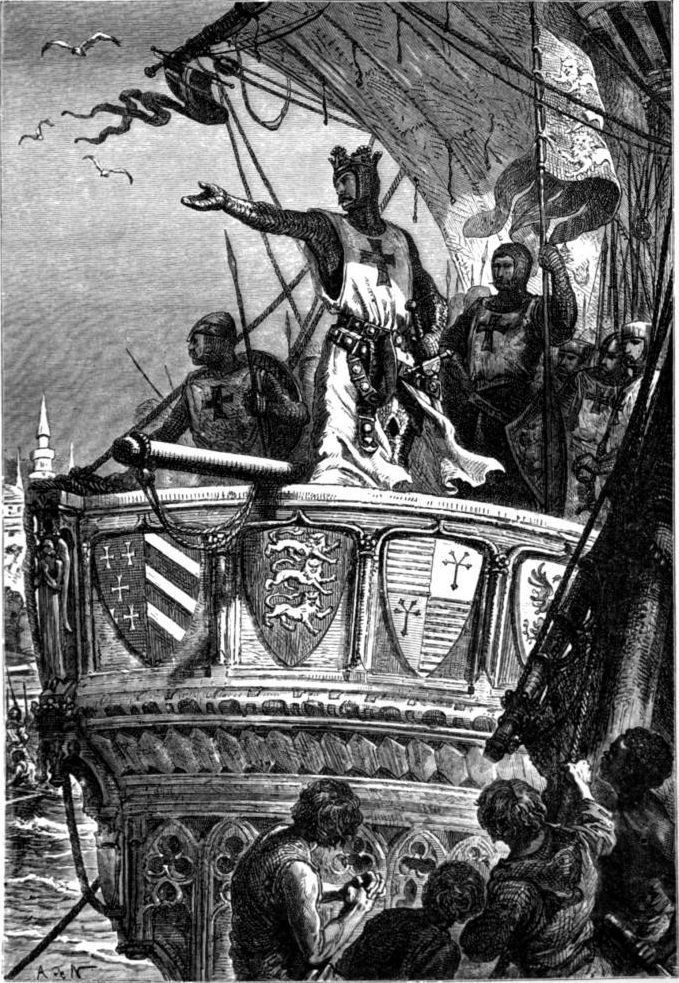
Illustration by Arthur Rackham. Found HERE.

Notable Nobles – Part the Fourth

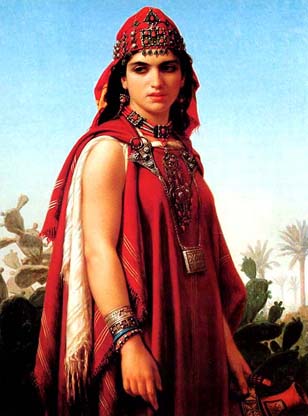
Just to show that these nicknames are good for more than pseudo-European nobility, I offer three pseudo-Arabic nobles (and yeah, I like ’em so much I’m going to use them in NOD eventually).

Mansour the Lion, Bey of Rumm
Mansour the Lion is a handsome man, aging and rugged, who commands a fortress where the desert sands meet the savannah. Caravans of traders and pilgrims move through his land, making him wealthy, and his many wars against the nomads have made him famous throughout the kingdom. He looks upon the Sultana Azzah with hopeful eyes, but her heart lies elsewhere. Mansour’s retinue includes the half-ogre fighter Isaam (F5) and his comrade, the sly Ziyad (F1), four men-at-arms and two scribes.

MANSOUR: HD 9 (45 hp); AC 2 [17]; Atk 2 scimitar (1d8); Move 9 (12 out of armor); Save 5; CL/XP 9/1100; Special: Double normal number of followers.

Shafeeq the Landless, exiled Amir of Pazazabad
Shafeeq the Landless is a the son of Bishr, the former Amir of Pazazabad. That wondrous city-state was overrun by goblins not three years ago, and the young man has wandered ever since with his retinue, seeking support for a reconquest of his land. The retinue includes four scribes, two sergeants-at-arms and his father’s court magician, the cloying Nazihah of the Nine Lamps (M3). He is also accompanied by Intisar, a lesser aristocrat and the rambunctious daughter of Pazazabad’s greatest merchant (and, unknown to others, the traitor who engineered the goblin invasion) Haarith of the Hoary Beard.

SHAFEEQ, FIGHTER LVL 3/THIEF LVL 2: HP 15; AC 2 [17]; Special: Double normal number of followers, treasure as CL 15.

Azzah the Liberal, the Iron Sultana, the Leopardess, Sultana of Keshfar
Azzah is the Great Sultana of all Keshfar. Learned, wise and fierce, she commands the deserts, savannas and sea for hundreds of miles from her domed capital of Nadid. Despite her coteries of handsome petitioners and the adoration of her people, she knows he is not getting any younger and must soon choose a husband that her line may continue. Mansour the Lion seems the logical choice, but her heart burns for Shafeeq the Landless, if only she knew where he was.

Azzah’s retinue includes the rakish sisters Amani and Munirah, the handsome young Izvod, Baron of Esterhafen and his sister, Lady Bezpa, four scribes, three men-at-arms and he sergeant-at-arms, the loyal Tariq.

AZZAH: HD 2 (16 hp); AC 1 [18]; Atk 2 scimitar (1d8); Move 9 (12 out of armor); Save 16; CL/XP 2/60; Special: Triple normal number of followers, treasure as CL 20, +2 reaction from peasants, constitution 14.


Notable Nobles – Part the Third

And we roll on with TABLE III

Baron Aglos the Gatekeeper
Aglos commands a sizable fortress that guards a mountain pass into the archduchy. He and his warriors have faced countless hordes of goblins and hobgoblins attempting to push their way into the green lands of the archduchy from the frozen uplands. These years of combat have allowed him to perfect a defensive stance that makes him more difficult to hit than the normal heavily armored warrior. His retinue includes two scribes, four men-at-arms and his two boon fighting companions, Aaron of the Golden Harp (a 5th level bard) and Schultz (a 5th level fighting-man).

AGLOS: HD 9; AC 2 [17]; Atk 1 weapon (1d8); Move 9 (12 out of armor); Save 5; CL/XP 9/1100; Special: Double normal number of followers, defensive stance (+2 AC, +1 hp/HD).

Kenne the Imp, Count of Owaith
Count Kenne is a devotee of the dark cult of Mammon, as befits one of his greedy nature. His devotion to Mammon has won him the ability to cast cause light wounds once per day. Kenne has a retinue that includes five clarks (money counters, mostly), a man-at-arms two sergeants-at-arms.

KENNE: HD 5; AC 2 [17]; Atk 1 weapon (1d8); Move 9 (12 out of armor); Save 12; CL/XP 5/240; Special: Double normal number of followers, treasure as CL 15, cast cause light wounds 1/day.

Archduke Scaton the Handsome
Scaton the Handsome is everything a fairy tale prince should be, except that he is an archduke, of course. He is handsome, charming, well-mannered and brave. Unlike fairy tale princes, he has rarely been outside the walls of his city, Gondwane, but he has cultivated quite a retinue of followers within those walls. This retinue consists of his court champion, Aloysius (a 4th level fighting man) and his comrade, Black Albrect, a rake, his paramour the Baroness Uda, ten scribes (one of whom, Ignatio, is a 5th level assassin sent to spy on the archduchy), three men-at-arms and two sergeants, Duff and Yoder.

SCATON: HD 2; AC 2 [17]; Atk 1 weapon (1d8); Move 9 (12 out of armor); Save 16; CL/XP 2/60; Special: Triple normal number of followers, treasure as CL 20, charisma 16.


Notable Nobles – Part the Second

Here’s another thought regarding the relative power of nobles. The thinking behind makings kings weaker than border barons is generally sound in terms of “earned experience”, which drives the player characters. On the other hand, not all kings are lay-about weenies. Frederick Barbarossa (you can access a scholarly review of his life HERE) and Henry V come to mind, as do Genghis Khan, Julius Caesar, etc. These are the architects of empire, as opposed to the heirs of empire. So – if you’re doing your king or duke or count as an architect of a great kingdom or empire, by all means, use the Borderer stats for him or her.

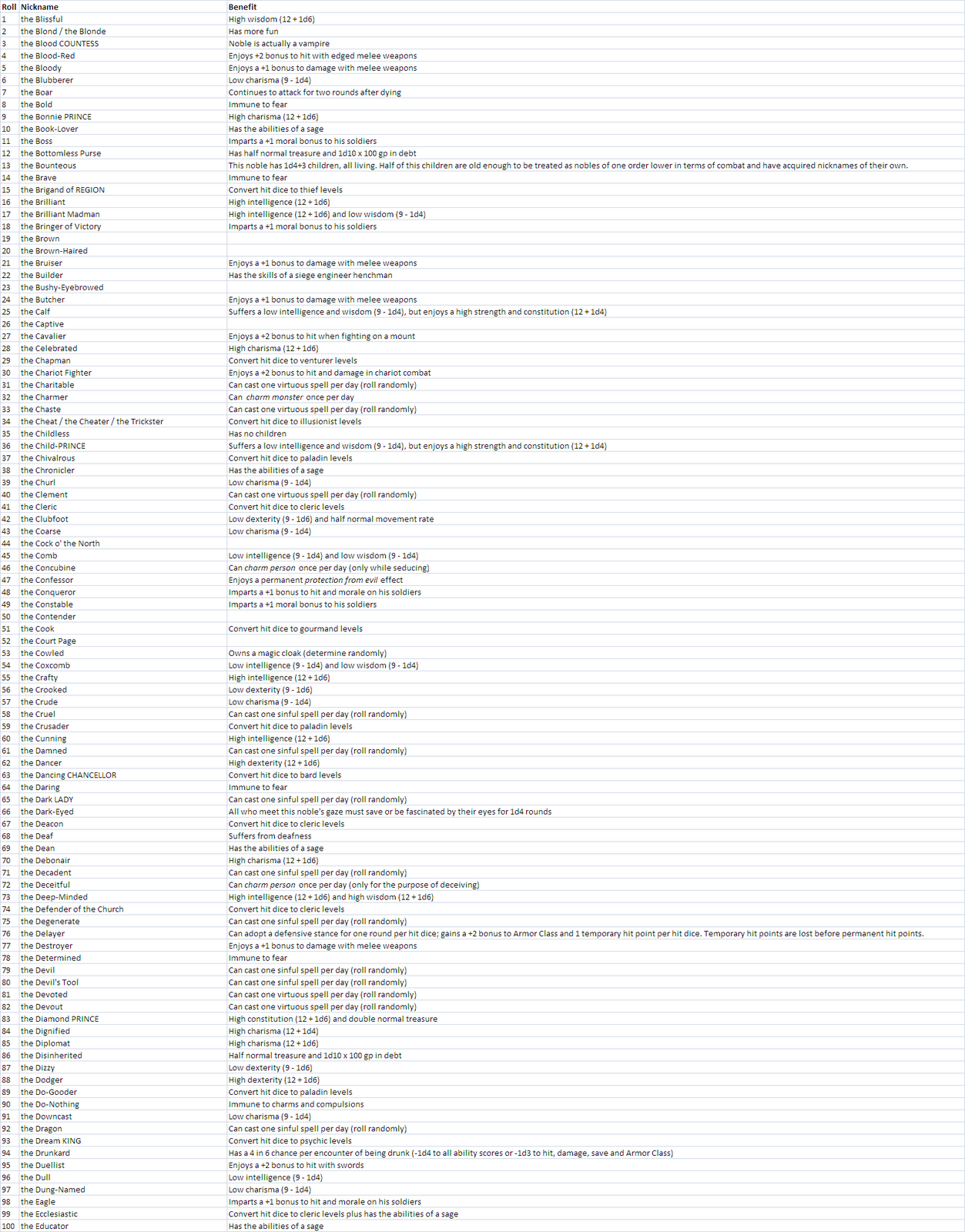
Now for some more samples, using this table as a source for nicknames.

Marquessa Hiertrude the Bounteous, the Blood Marquessa
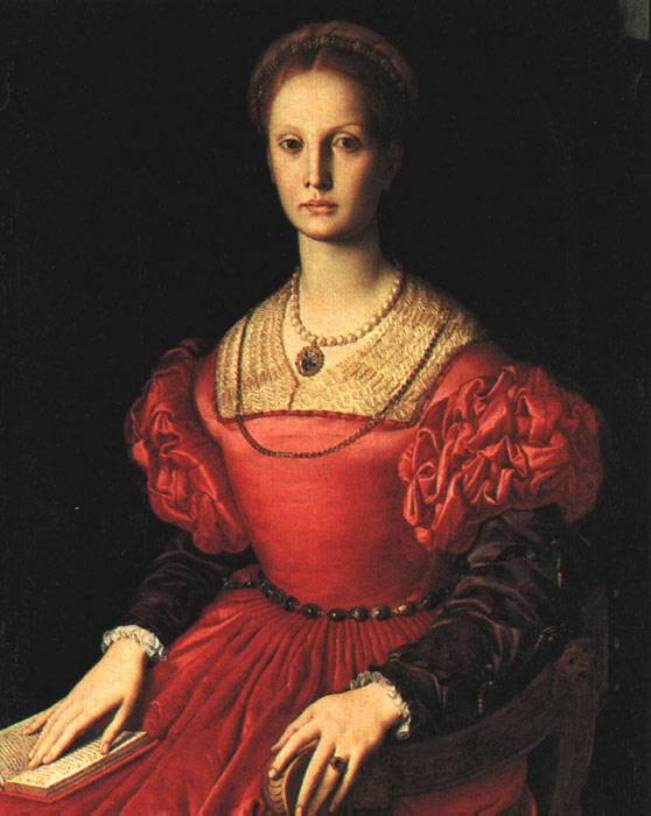
The Marquessa Hiertrude is mostly known for her large, loving family – six children by her late husband, the Marquis. It is less known that she is a vampire, turned by a foe of her husband. She has since turned her children into her spawn (save the eldest, Hormand, who is in hiding) and is even now preparing to rally the humanoids she once fought and lead them into the heart of Azura’s kingdom. Her retinue (also vampire spawn) consists of three men-at-arms, two clarks, her court musician Antonio and two sons of the lesser nobility, Anatole and Freder, who were serving as page boys in her husband’s court before she turned them. They are now eternally eleven years old and thoroughly evil.

HIERTRUDE: HD 9 (42 hp); AC 2 [17]; Atk 1 weapon (1d8) or bite (1d10 + level drain); Move 9 (12 out of armor, F18); Save 6; CL/XP 12/2000; Special: Eight followers, vampire powers.

Count Gudolph the Cunning
Gudolph is a cunning man, though only lightly educated. He knows well that his county lies in the path of the Blood Marquessa, and has been recruiting heavily among the priesthood of the kingdom for the last year, giving generous gifts of land to the church in an attempt to shore up his defenses or, at a minimum, convince Hiertrude to march her armies around his land. His retinue consists of two scribes (lay priests), three men-at-arms and three sergeant-at-arms. All of his bodyguards have been trained and armed to deal with vampires.

GUDOLPH: HD 5 (22 hp); AC 2 [17]; Atk 1 weapon (1d8); Move 9 (12 out of armor); Save 12; CL/XP 5/240; Special: Eight followers, treasure as CL 15, intelligence 14.

Queen Azura I, the Calf
The young Azura has recently assumed the throne after the mysterious death of her mother. She is only 16, but head strong and confident. Faced with signs of rebellion on her borders, she is assembling an army to meet it head on, caring little for the council of her advisers. Her retinue includes four lesser nobles, four sergeants-at-arms (one of them her secret lover) and four scribes doing their best to educate the girl-queen while she scurries about barking orders and managing her new kingdom with gusto.

AZURA: HD 2 (14 hp); AC 2 [17]; Atk 1 weapon (1d8); Move 9 (12 out of armor); Save 16; CL/XP 2/60; Special: Triple normal number of followers, treasure as CL 20 intelligence 8, wisdom 6, strength 16, constitution 16.


The Notable Noble – Nicknames and Their Power

Let’s begin by defining nobles. Any character with a crown and a fief or kingdom can be a noble, but we’re looking at them as antagonists or support staff for the player characters, and putting them in the “monster” or NPC category.

The toughest nobles are the border nobles – the guys and dolls on the fringe of the wilderness fighting against humanoids / barbarians / neighbors day in and day out. We’re going to give these folks 9 Hit Dice, making them roughly equal to the name-level characters who might live next door. These folks probably have titles like baron or margrave / markgraf / marquis.

The next toughest are the lesser nobles dwelling within the kingdom’s borders – far enough from the barbarians to not be fighting every day, but close enough that they have to muster maybe once or twice a year to fight a war for their liege. Because they aren’t the upper nobility, they’re more expendable, and might very well have to form up in ranks and charge into battle. We’ll give them 5 HD to reflect their combat training and experience. These folks can be barons, viscounts, counts and maybe dukes.

Dukes, however, are usually part of the greater nobility, along with grand dukes, archdukes (yeah, all the various varieties of duke) and the royals – princes, kings, etc. The greater nobility are politicians more than anything else. They’re trained to fight, but they don’t have to do much fighting. We’ll give the greater nobility 2 HD to show off their training and better living.

This makes nobles pretty plain, really – just men and women with 2, 5 or 9 HD. What makes them noble? Well, power, of course. Some hold more treasure than somebody with their hit dice should hold. We’ll say the greater nobility have treasure as though they were CL 20 monsters, lesser nobility as CL 15 and borderers as CL 9. They also specialize in retinues. Nobles always get twice the number of followers that their charisma (we’ll assume a charisma of 10, but those nicknames we’re going to roll up can change that) would normally allow. Greater nobles have triple the normal number of followers.

Who follows a noble? Roll on the table below for each follower …

Noble Followers (Roll 3d6)
3. Court jester (thief or bard level 1d4+2; re-roll if a second jester comes up)
4. Court musician (bard level 1d4+2; additional musicians are level 1 associates of the first)
5. Rake (5% chance of being a level 1d4+2 assassin; additional rakes are just plain rakes)
6-7. Lesser noble
8-10. Scribe (1% chance of being a level 1d4+2 assassin spy)
11-13. Man-at-arms (platemail, pole arm, sword, maybe crossbow)
14-15. Sergeant-at-arms (platemail, shield, longsword, maybe crossbow)
16. Champion (fighter level 1d4+2; additional champions are level 1 comrades of the first)
17. Court magician (magic-user level 1d4+2; additional court magicians are level 1 apprentices to the first)
18. Chaplain (cleric level 1d4+2; addition chaplains are level 1 assistants to the first)

So, here are our basic noble stat lines:

BORDERER: HD 9; AC 2 [17]; Atk 1 weapon (1d8); Move 9 (12 out of armor); Save 5; CL/XP 9/1100; Special: Double normal number of followers.

LESSER NOBLE: HD 5; AC 2 [17]; Atk 1 weapon (1d8); Move 9 (12 out of armor); Save 12; CL/XP 5/240; Special: Double normal number of followers, treasure as CL 15.

GREATER NOBLE: HD 2; AC 2 [17]; Atk 1 weapon (1d8); Move 9 (12 out of armor); Save 16; CL/XP 2/60; Special: Triple normal number of followers, treasure as CL 20.

Now, about those nicknames.

We’ve all heard them. Charles the Bold, Richard the Lionheart, Pepin the Small. They can describe the person’s appearance, faults, foibles, personality and deeds. So, why not let them make nobles something more than cookie-cutter monsters or NPCs.

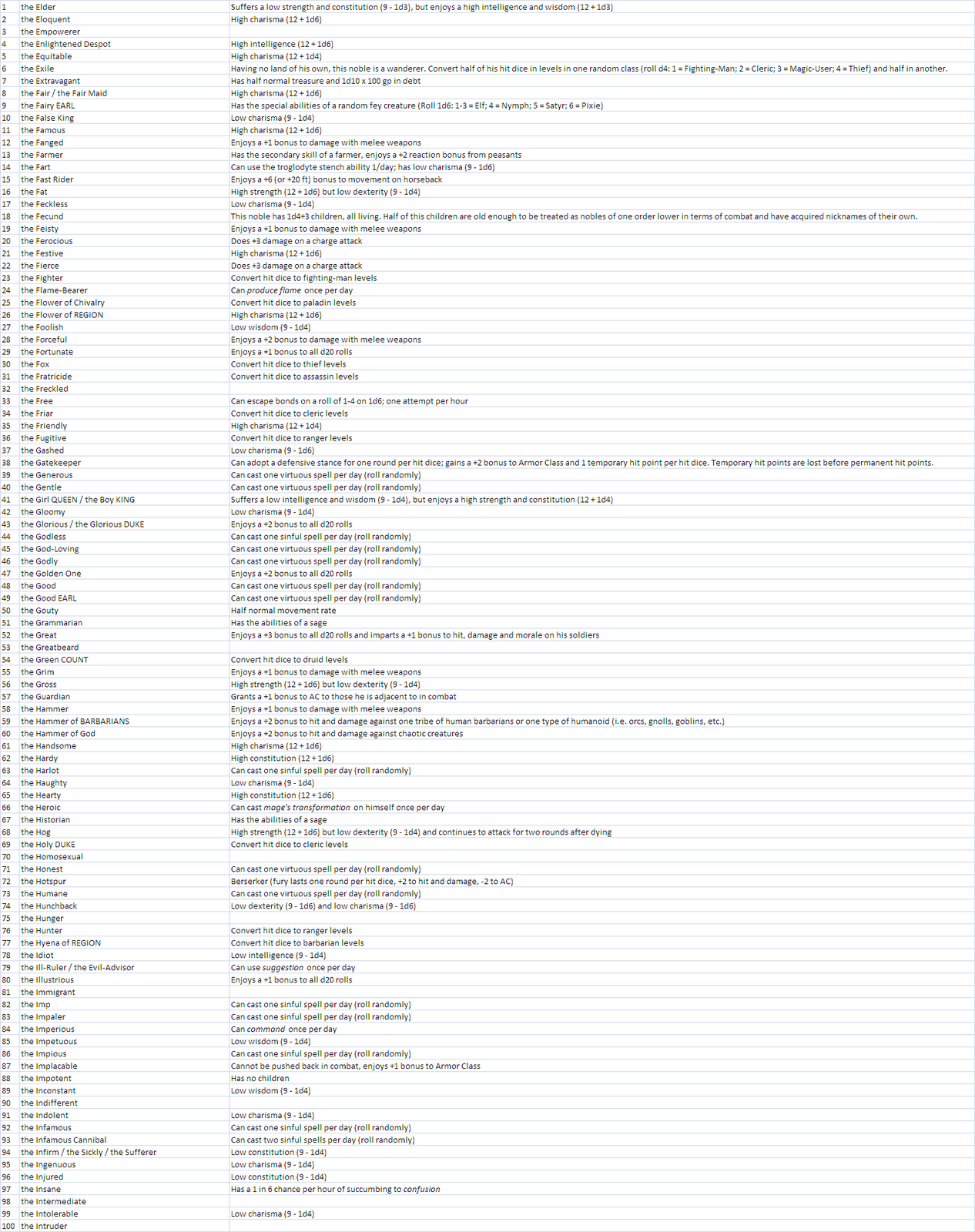
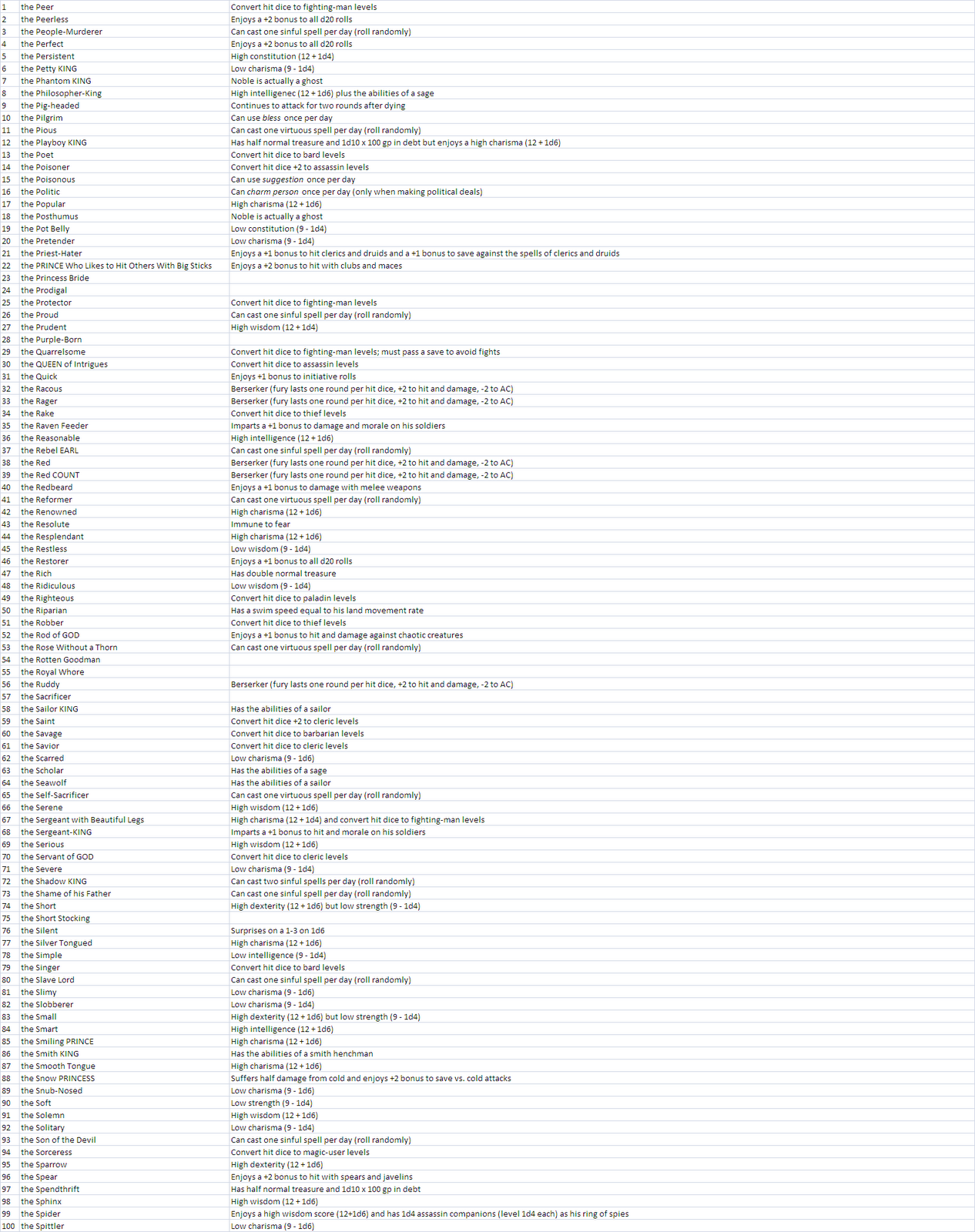
What follows are 600 possible nicknames, 99% of them drawn from history. Yeah – the weirdest ones are all real – I added about 5 to give me a solid 600. Most nobles have a single nickname, a few have more than one (see below).

Number of Noble Nicknames (Roll 1d10)
1-8. Roll for one nickname
9. Roll for two nicknames
10. Roll for three nicknames

Roll 1d6 to determine which list to use and then 1d100 to determine the nickname. This post has the first list – the other five will follow (hey, this took a while – I need to get more than one blog post out of it).

Since I don’t know which set of rules you’re using, I tried to keep things basic. If your rules don’t give a bonus for high dexterity, then nicknames that give high dexterity should just be treated as descriptive. If a noble gets two nicknames that give him character class levels, then either treat he or she as dual-classed, or re-roll if that doesn’t make sense. Of course, anything that doesn’t make sense, ignore.

Where a title is mentioned (in ALL CAPS), insert the title appropriate to your noble. If your noble is a baron and you roll “Iron DUKE”, just change it to Iron Baron. For REGION, insert the name of a region or kingdom in your campaign world. For BARBARIAN insert the name of a human barbarian tribe or a group of humanoids – i.e. Hammer of the Orcs, Judge of the Scots. References to “virtuous spells” and “sinful” spells we’ll be dealt with later, though most of you can probably figure it out.

If a rolled nickname doesn’t make sense to you, re-roll.

Click the Table to make it full sized.

TABLE I (Roll 1d100)

Sample Nobles (using nicknames from Table I)

Baron Usted the Bald
Being bald doesn’t get Usted much, but as a noble he does get double the normal followers, giving him 8. We roll and find he has the following people in his retinue: For men-at-arms, three scribes (one is a 6th level assassin) and Marcus, the son of the Countess Genevieve, Usted’s liege lady.

USTED: HD 9 (41 hp); AC 2 [17]; Atk 1 battle axe (1d8); Move 9 (12 out of armor); Save 5; CL/XP 9/1100; Special: Eight followers.

Countess Genevieve Hairyfoot
The countess has some halfling blood in her; after all, her mother adored pastries and that halfling gourmand who worked at the castle was often called to visit at odd hours. She now rules a prosperous county in the middle of the kingdom. Her eight followers are Wodwick, a sergeant -at-arms, four men-at-arms, a scribe, the Baroness Salamandra, a childhood friend and Sister Sarah, a 5th level cleric.

GENEVIEVE: HD 5; AC 2 [17]; Atk 1 weapon (1d8); Move 9 (12 out of armor); Save 12; CL/XP 5/240; Special: Halfling racial abilities, eight followers, treasure as CL 15.

King Humphrey the Antichrist
King Humphrey was birthed on a moonless night, the midwife a witch and his mother a sacrifice. A bastard, he was presented to the court by his uncle and, within a decade, had seized the throne and instituted a reign of terror. His followers include five scribes, five men-at-arms and their sergeant-at-arms, Zabbo, and the wicked Viscomte de Gris.

HUMPHREY: HD 2; AC 2 [17]; Atk 1 weapon (1d8); Move 9 (12 out of armor); Save 16; CL/XP 2/60; Special: Twelve followers, treasure as CL 20, spells (1/day – bestow curse, inflict light wounds, protection from good).

FIND PART TWO HERE

Handy Dandy Mini-Dungeon Chamber Generator

I’m finishing up the first chunk of my Hell hex crawl now, and that means mini-dungeons. I save most of them for last and have about four or five more to go [dude, just counted – there are 13 of them – how appropriate]. To that end, I scribbled down some ideas for generating chambers that I thought others might find useful.’

Contents
1. Empty
2. Trap
3. Monster
4. Monster with treasure
5. Trap with treasure
6. Monster, trap and treasure

Since this is for mini-dungeons, I want fewer empty rooms so I get more bang for the buck. If you’re only dealing with six or seven rooms, making three or four of the empty doesn’t work for me.

Shape
1-3. Square or rectangular
4. Circle
5. Other shape (pentagon, hexagon, octagon)
6. Cross or L-shape

Levels
1-4. One level (i.e. normal, flat room)
5-6. Multi-level – levels connected by
1. Ramps
2. Stairs
3. Balconies (i.e. no connection)
4. Beams (i.e. no connection)
5. Pit (i.e. no connection)
6. Ropes or chains
7. Magic (levitation discs, air currents, teleporters)
8. Roll twice, maybe adding a third level to the room

Monster Is …
1. Alone (CR = party level +3)
2. Duo (CR = party level +2)
3. Trio (CR = party level +1)
4-5. Mob (CR = party level)
6. Monster and mob (CR for monster = party level, CR for mob = party level -1)

Exits
1. No additional exit – dead end
2-3. One exit
4-5. Two exits
6. Three exits

Special Room
1. Fire / ash / smoke / torches / fire pits / burning walls / obsidian / red
2. Water / sludge / fountains / pools / well / reservoir / damp / rain / geysers / blue
3. Ice / freezing / snow / cold winds / white
4. Gas / sleeping / poison / acidic / fog / clouds / yellow / green
5. Light / multi-colored / bright / dark / twilight / candles / lamps / witch lights
6. Crystal / reflections / mirrors / glass / gem encrusted / facets / vibrations
7. Bone / blood / flesh / mold / rot / unholy / quivering / breathing / secretions / heaving
8. Noise / screaming / breathing / moaning / sighing / music / song / chanting
9-20. Nothing special

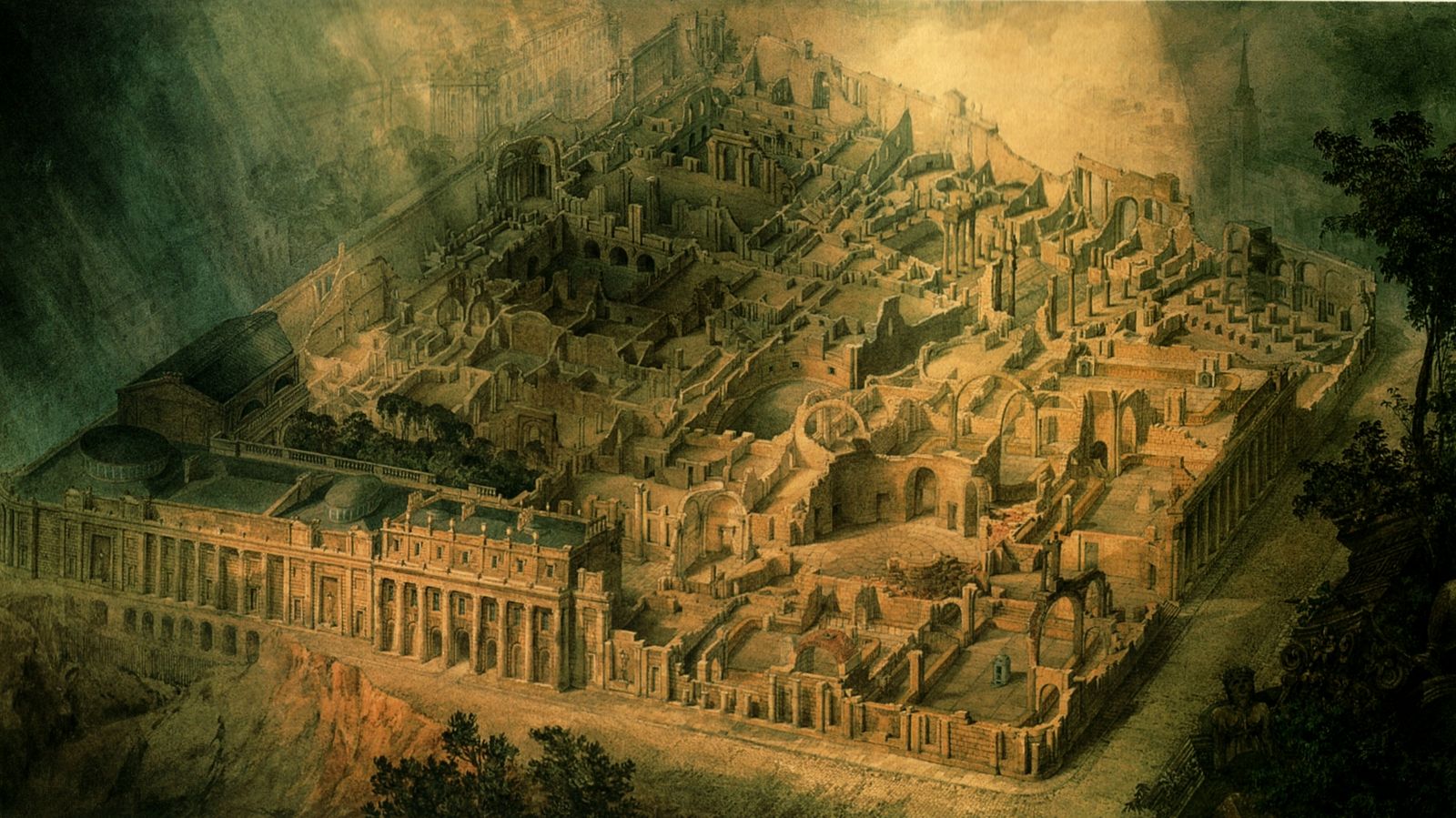
Image by Joseph Gandy

==

Addendum – Just got this from Lulu.com. My shop link is up in the corner. You know what to do, if you have a mind to.


Silver Age Shenanigans

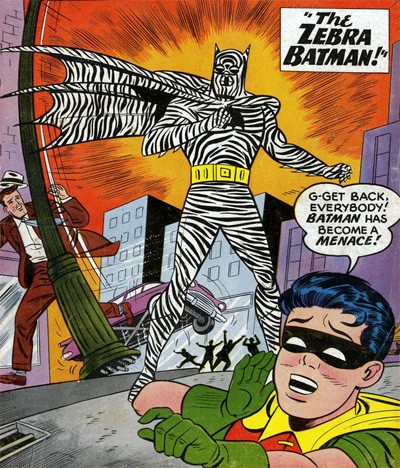
Is your superhero campaign getting a little staid – a little routine – maybe boring. Would you consider bringing the insanity of DC’s Silver Age into it? Can your players handle the challenge, or are they a bunch of mopey, modern age cry babies who think getting turned into a gorilla is some kind of punishment? If you answered yes and/or no to the questions in the appropriate order … oh Hell – here’s a chart. Roll a dice.

I think my next MM! Google + campaign will draw heavily on the imaginary stories from DC’s Silver Age, though I have no idea how as yet.

Edited to correct an error.

Titans: What Are They Good For?

Orcus and Demogorgon, solars and planetars, but whence the titans? These big guys and gals seem to be on a pretty even footing with the demon lords and archangels (depending on which version of the game you adhere to), but they don’t get much love or use. I think this is a shame. To my way of thinking, titans represent a third way when it comes to the solars and the demon princes and dukes of Hell – neutral powers that can stand with the powers of Law and Chaos.

Perhaps the titans are the children of minor gods and goddesses. I’m talking Alala and Eleos, here, not Zeus and Aphrodite. Their parentage is divine and immortal, but they’re not. Well, maybe they are immortal in terms of aging, but they are creatures of the Material Plane and thus mortal in terms of “can be killed”. Where demon lords and solars hang out in the outer planes, titans live in the Material Plane, lording it over lesser beings as kings and queens by dent of their divine birth and tremendous power. How much more interesting to discover that the city-state you just wandered into is ruled by King Criomenos, the son of Moros, demi-god of impending doom and Eunomia, demi-goddess of law and legislation. You walk into this court to announce yourselves as great heroes, and find not a little man with a long, white beard, but a titan, head wreathed in gold, hand resting atop a golden sceptre as tall as your paladin and eyes that have seen centuries.

With that in mind, I decided that any titan that shows up in Nod is going to have a name, a heritage and powers commensurate with that heritage. According to S-n-W, the primary power of titans is spells – two spells of first to seventh level from both the magic-user and cleric lists, for a total of 28 spells. I decided to alter that a bit. Drawing on the old d20 SRD, I decided to instead give them all the spells (level 1 to 9) from the two cleric domains that most befit their parents. Since that gives them only 18 spells (still probably plenty), I decided to make up for it with a special defense (see below) and with the ability to commune with mommy and daddy once per day.

To determine the titan’s parentage, I decided to just make a random table of the cleric domains, rolling once for mom and once for dad. I listed some potential parents from Greek mythology behind each domain.

Roll D30 – Parent

1. Air – Aello (F), Aeolus (M), Aura (F)
2. Animal – Britomartis (F), Ichnaea (F), Krotos (M), Priapus (M)
3. Artifice – Acmon (M), Aristaeus (M), Hecaterus (M), Philomelus (M), Rhapso (F)
4. Chaos/Evil – Adikia (F), Eris (F), Dysnomia (F), Kakia (F), Kydoimos (M)
5. Charm – Eros (M), Hedone (F), Iynx (F), Peitho (F)
6. Community – Eunomia (F), Harmonia (F), Hymenaios (M), Nomos (M), Praxidike (F)
7. Creation – Euporie (F), Othorsie (F), Porus (M)
8. Darkness – Charon (M), Erebos (M), Nyx (F), Tartarus (M)
9. Death – Macaria (F), Melinoe (F), Thanatos (M)
10. Destruction – Alecto (F), Enyo (F), Moros (M), Nemesis (F)
11. Earth – Chrysus (M), Plutus (M)
12. Fire – Phlegethon (M)
13. Glory – Agon (M) , Eucleia (F), Kalokagathia (F), Nike (F), Pheme (F)
14. Good/Law – Arete (F), Astraea (F), Dike (F), Eunomia (F), Nomos (M), Peitharch (F)
15. Healing – Aceso (F), Eirene (F), Eleos (M), Eupraxia (F), Panacea (F), Philophrosyne (F)
16. Knowledge – Polymatheia (F)
17. Liberation – Momus (M)
18. Luck – Tyeche (F)
19. Madness – Deimos (M), Lyssa (F), Epiales (M)
20. Magic – Astraios (M), Circe (F), Despoina (F), Telete (F), Zagreus (M)
21. Nobility – Kalokagathia (F)
22. Plant – Amphictyonis (F), Carmanor (M), Chloris (F), Karpo (F), Silenus (M), Thallo (F)
23. Protection – Soter (M)
24. Strength – Bia (F), Kratos (M), Ponos (M)
25. Sun – Alectrona (F), Eos (F), Helios (M), Hemera (F)
26. Travel – Angelia (F), Arke (M), Ioke (F), Iris (F)
27. Trickery – Apate (F), Ate (F), Dolos (M)
28. War – Alala (F), Enyalius (M), Homandos (M), Polemos (M)
29. Water – Amphitrite (F), Galene (F), Glaucus (M), Proteus (M), Thetis (F), Thalassa (F)
30. Weather – Briareus (M), Chione (F), Tethys (F), Typhon (M)

A few of the categories are pretty sparse when it comes to divine representation, but what can you do.

You can find the various domains HERE and HERE. The spells that don’t show up in your favorite version of the game are easy enough to convert. If you don’t like conversions, use another spell that fits. Personally, I like the idea of a titan throwing down a spell the party clerics and magic-users have never heard of – maybe if they make a good impression and grovel a bit, the titan will teach them the secret!

Special Defenses
Special defenses should relate to the parentage, and the Ref might want to give them more than one special defense. Defenses for the titan might include:

+5 to save vs. poison or disease
Cannot be attacked by different kinds of creatures like reptiles, birds or plant creatures
Cannot be surprised
Immune to energy drain or falling damage
Immune to a class of spells – i.e. illusions, death spells or mind control
Magic resistance (maybe 15% for the least titans, with a 5% bump per additional hit dice)
Only harmed by +1 weapons
Resistance (half damage) from iron weapons or missile weapons, etc.
Resistance (half damage) to cold, fire, electricity, acid, etc.

You can probably think of others.

Using the example above, King Criomenos might have the following stats:

KING CRIOMENOS, Titan: HD 20 (109 hp); AC –1 [20]; Atk 1 sceptre (2d8) or javelin (2d6); Move 21; Save 3; CL/XP 22/5100; Special: Immune to death spells, spells (bless, cause disease, cause critical wounds, cause light wounds, disintegrate, earthquake, greater status, harm, heroes’ feast, implosion, mass cause light wounds, mass heal, prayer, refuge, shatter, status, sympathy, telepathic bond), commune with Eunomia and Moros.

Alien Critter Generator

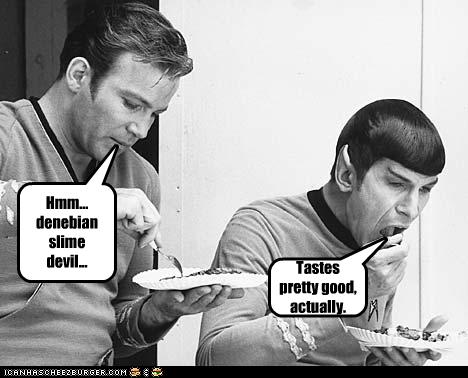
Any viewer of mainstream sci-fi has heard a few alien animal names that consist, usually of three elements. First, is their place of origin. Perhaps a planet orbiting the star Deneb. Then a descriptor – maybe this creature is slimy or dwells in slime. Finally, a noun – perhaps this irascible creature can best be described, like the well-known critter from Tasmania, as a devil. Hence Denebian slime devil. Okay, so how about a random table to do the same and stat the critter out.

Place
1. Venusian
2. Martian
3. Jovian
4. Saturnian
5. Mercurian
6. Plutonian
7. Neptunian
8. Denebian
9. Altairan
10. Cygnian
11. Betelgeusian
12. Polarian
13. Andromedan
14. Cetian
15. Algolian
16. Pleiadeian
17. Rigelian
18. Aldebaran
19. Antarean
20. Arcturan

* Note, if you prefer your beasties to be from distant stars rather than planets, just re-roll if Martian or Venusian, etc comes up. Or make your own table you lazy bugger – what do you want for free? You might also want to alter the critter’s stats based on the conditions of the planet (i.e. high gravity, etc.)

Descriptor
1. OOZE/SLIME: Creature may be covered in slime, granting it DEFENSE +3 vs. grabbing or wrestling attempts. Otherwise, just lives in a slimy environment.
2. ROCK/STONE: Creature may have DEFENSE +2. Otherwise, simply lives in a rocky environment.
3. DEATH: Creature either has a deadly poison bite or +2 hit dice.
4. SHADOW: Creature surprises opponents on a roll of 1-3 on 1d6 in darkness.
5. DUST/DESERT: Creature dwells in the desert, enjoys STRENGTH +1.
6. TREE/FOREST: Creature dwells in woodlands, enjoys DEXTERITY +1.
7. GIANT/GREAT: Creature has double hit dice.
8. CRYSTALLINE: Creature has DEFENSE +2 against all attacks except those from bludgeoning weapons and DEFENSE +5 against ray guns.
9. ICE: Creature suffers half damage from cold attacks.
10. LAUGHING/HISSING: Creature makes a laughing or hissing noise when threatened.
11. SCALED/FEATHERED: Creature is DEFENSE +1.
12. SPECKLED/SPOTTED: Creature has speckled or spotted hide. Heck, you could do stripes as well.
13. ACID: Creature has an acidic bite that inflicts +2 damage.
14. FIRE/STAR: Creature suffers half damage from fire and ray attacks or has ray attacks from eyes (weapon rating +5).
15. FANGED/HORNED: Creature has +1 weapon rating to bite or horn attack and +1 to bite or horn damage.
16. VAPOR/MIST: Creature either surrounded by a weird fog (opponents -1 to hit with SHOOT attacks) or creature dwells in misty area.
17. STINK/MUSK: Opponents must pass a Strength test or suffer -2 penalty to hit this creature in combat.
18. SEA/RIVER: Creature dwells in the sea or rivers and is equipped to swim at its normal speed.
19. CLOUD/SKY: Creature has a flying speed one category faster than its land movement.
20. LEAPING/HOPPING: Creature’s land movement is one category faster.

* Other special abilities could include spitting (poisonous spit, like cobra), long-necked, long-legged (faster movement), dwarf (half normal hit dice – probably meaningless for animals with only one hit dice to begin with), burrowing (gains slow burrow speed) and hypno- (can paralyze with eyes)

Noun
Stats are for Space Princess – you can no doubt find stats for Swords and Wizardry or Dungeons and Dragons if you just snoop around a bit.

1. DEVIL/BADGER: HD 1; DEFENSE 9; FIGHT 5 (claws and bite +0); SHOOT 8; MOVE N; Burrow S; STR 10; DEX 17; MEN 6; KNO 2; DL 2; Special: Flies into rage when damaged (+1 to hit and damage).
2. CRAWLER/CREEPER: HD 1; DEFENSE 8; FIGHT 5 (bite +1); SHOOT 7; MOVE F / Climb F; STR 10; DEX 15; MEN 2; KNO N/A; DL 2; Special: Poisonous bite (1d6 damage).
3. BAT: HD 1; DEFENSE 7; FIGHT 1 (bite +0); SHOOT 7; MOVE S / Fly F; STR 3; DEX 15; MEN 4; KNO 2; DL 1; Special: See in dark with echolocation.
4. DOG: HD 2; DEFENSE 8; FIGHT 7 (bite +1); SHOOT 8; MOVE F; STR 14; DEX 15; MEN 6; KNO 2; DL 2; Special: None.
5. CAT: HD 1; DEFENSE 7; FIGHT 3 (claws and bite +0); SHOOT 7; MOVE N; STR 6; DEX 15; MEN 7; KNO 2; DL 1; Special: None.
6. BIRD: HD 1; DEFENSE 7; FIGHT 3 (talons and bite +0); SHOOT 7; MOVE S / Fly F; STR 6; DEX 15; MEN 6; KNO 2; DL 1; Special: None.
7. HOG/PIG: HD 3; DEFENSE 8; FIGHT 9 (tusks +1); SHOOT 7; MOVE F; STR 16; DEX 10; MEN 4; KNO 2; DL 3; Special: +2 to strength tests to ignore pain.
8. BEETLE: HD 1; DEFENSE 7; FIGHT 5 (bite +2); SHOOT 5; MOVE N; STR 10; DEX 11; MEN 7; KNO N/A; DL 1; Special: None.
9. LION/TIGER: HD 6; DEFENSE 13; FIGHT 16 (claws and bite +2); SHOOT 12; MOVE F; STR 20; DEX 15; MEN 6; KNO 2; DL 7; Special: Pounce (two attacks when it wins initiative).
10. BEAST/ELEPHANT: HD 11; DEFENSE 17; FIGHT 26 (tusks +7 or stomp +5); SHOOT 15; MOVE N; STR 25; DEX 10; MEN 5; KNO 2; DL 12; Special: Trample (all in melee combat must make a dexterity test or suffer 1d6 damage).
11. BEAR: HD 6; DEFENSE 12; FIGHT 19 (claws and bite +3); SHOOT 11; MOVE F; STR 23; DEX 13; MEN 6; KNO 2; DL 7; Special: Creatures hit must make a strength test or be hugged for automatic damage each round until a successful strength test is made.
12. PINCHER/CRAB: HD 1; DEFENSE 7; FIGHT 5 (bite +2); SHOOT 5; MOVE N; STR 10; DEX 11; MEN 7; KNO N/A; DL 1; Special: None.
13. MOLE/RAT: HD 1; DEFENSE 7; FIGHT 2 (bite +0); SHOOT 7; MOVE S / Climb S; STR 4; DEX 15; MEN 2; KNO 2; DL 1; Special: Bite may cause disease.
14. APE: HD 4; DEFENSE 10; FIGHT 12 (claws and bite +2); SHOOT 10; MOVE N; STR 18; DEX 15; MEN 7; KNO 2; DL 4; Special: None.
15. LIZARD/SNAKE: HD 3; DEFENSE 10; FIGHT 10 (bite +1); SHOOT 9; MOVE M; STR 17; DEX 15; MEN 2; KNO 1; DL 3; Special: May be poisonous.
16. ANTELOPE/DEER: HD 2; DEFENSE 10; FIGHT 6 (antlers or horns +1); SHOOT 9; MOVE F; STR 12; DEX 17; MEN 4; KNO 2; DL 2; Special: None.
17. SPIDER: HD 1; DEFENSE 9; FIGHT 4 (bite +0); SHOOT 8; MOVE N / Climb N; STR 8; DEX 17; MEN 2; KNO N/A; DL 2; Special: Poison (2d6 damage).
18. BRUTE/RHINOCEROS: HD 8; DEFENSE 14; FIGHT 22 (horn +5); SHOOT 12; MOVE N; STR 24; DEX 10; MEN 2; KNO 2; DL 9; Special: Charge for double damage.
19. SNAIL/SLUG: HD 2; DEFENSE 4; FIGHT 4 (bite +0); SHOOT 4; MOVE S; STR 6; DEX 6; MEN 2; KNO N/A; DL 2; Special: None.
20. FISH/SHARK: HD 3; DEFENSE 10; FIGHT 8 (bite +1); SHOOT 9; MOVE F; STR 13; DEX 15; MEN 2; KNO 1; DL 4; Special: Blood frenzy (+1 to hit and damage when blood is in the water).

* You might want to swap out toad/frog for fish/shark, maybe throw turtles in somewhere.

Some Examples …

ANTAREAN ICE CREEPER: HD 1; DEFENSE 8; FIGHT 5 (bite +1); SHOOT 7; MOVE F / Climb F; STR 10; DEX 15; MEN 2; KNO N/A; DL 2; Special: Poisonous bite (1d6 damage), half damage from cold attacks. I’m picturing a stark white centipede of great size that hides beneath the snow. It has pockets on it in which it stores bodily fluids sucked from victims. It draws sustenance and heat from the decay of these fluids.

POLARIAN SEA BIRD: HD 1; DEFENSE 7; FIGHT 3 (talons and bite +0); SHOOT 7; MOVE S / Fly F / Swim S; STR 6; DEX 15; MEN 6; KNO 2; DL 1; Special: None. Polarian sea birds resemble Earth penguins except they are as large as dolphins and have coloration and habits reminiscent of killer whales. They have horn-like crests on their heads that allow them to make a low-frequency rumbling that can be heard by other sea birds miles away.

CETIAN HORNED SLUG: HD 2; DEFENSE 4; FIGHT 4 (bite +0, horn +1); SHOOT 4; MOVE S; STR 6; DEX 6; MEN 2; KNO N/A; DL 2; Special: None, horn does +1 damage. These slugs are the size of lions and are covered by a shiny, pink segmented shell. The forward-most shell piece has curved horns that the beast can use to attack.

Image from HERE.

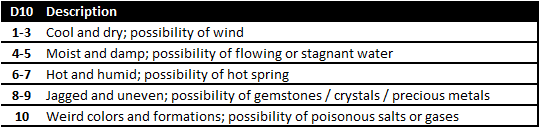
Handy Dandy Mystery Men Subterranean World Generator!

Check every 50 yards (i.e. Speed 1). Roll 1d6. On a 1-2 roll on the chart below.

What Does the Cavern/Tunnel Feature?

What Creature Is Encountered?

How many? Divide the total XP value of the heroes (100 XP per level + 10% XP value of powers) by the XP value of the monster. This number is the max roll on a dice. In other words, if the value is 5, then there are 1d5 monsters (or 1d10 divided by 2). For a really challenging encounter, double the number of monsters rolled on the dice.

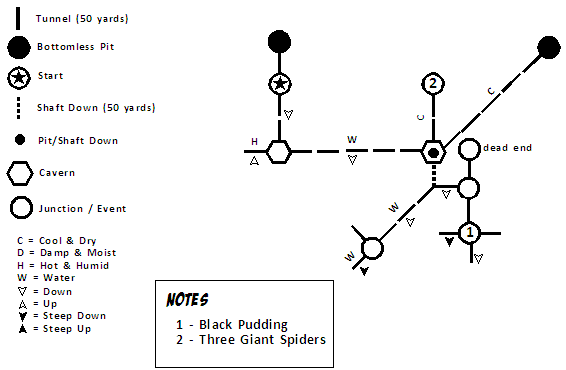
And for an example …