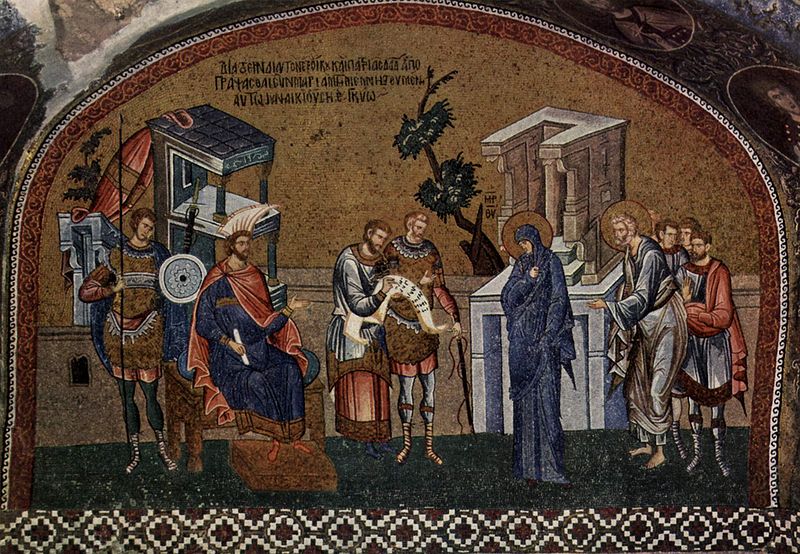
Intrigue at Court with Random Factions

Adventurers, at least those in the mid- to high levels, are probably no stranger to royal courts. What better patron to foot the bills and look the other way when people start getting fried by stray fireballs than a king or queen?

King, queens and their courts are centers of power, though, and power breeds a certain sort of paranoid hunger. After all, working for a living is for suckers. Getting paid to do nothing other than figure out a way to keep out of a field or factory for another day is pretty sweet gig, but also pretty competitive. This makes royal courts hotbeds of intrigue. Courtiers compete in the most civilized way (well, if you consider poisoning people civilized … Conan probably would, hence his hatred of civilization) for power, and in monarchical terms, that means the favor of the king and/or queen.

When adventurers wander into court, they often enter wealthy (from all that plundering), and romantic (from all that murder and mayhem). They’re like fantasy rock stars, and that means there’s a good chance they’ll receive the favor of the king or queen. That makes them a target. But a target for who?

RANDOM FACTIONS
The following is really just a collection of notions about court factions disguised as random tables. They involve determining five things about potential factions:

Cause: This is the cause or notion that ties the faction together. Power is the real tie, of course, but every faction has a few idealists who actually believe what their leader says.

Size: This is the overall size of the faction at court. It is given as a percentage of the members of court, which would include minor nobles, royal ministers, ladies in waiting, pages and folks like jesters, court magicians, court chaplains and heralds. The total size of a royal court is up to you, the GM.

Symbol: This is the overt or covert symbol of the faction.

Leader: This is the leader, again secret or public, of the faction.

Allies: This is a powerful ally of the faction.

CAUSE
Causes might be straight-forward political desires, philosophical notions, religious beliefs or rather silly fashion trends. Note – if a faction desires a particular course of action, there is likely a faction in court opposed by them.

D20
1 Attack the nearby humanoids – the faction wants an aggressive policy in the borderlands
2 Attack a nearby city-state/nation
3 Raise taxes, especially on adventurers and merchants
4 Ban adventuring – nothing but upstarts and pirates
5 Seize property from high-level adventurers – too much money on the borderlands, not enough loyalty
6 Encourage more settlements in the borderlands (i.e. subsidize stronghold construction)
7 Desire a ban on the use of magic-user style magic – witch hunters who claim magicians are secretly controlling the country
8 Cynics – support a lifestyle that rejects a desire for wealth, power, sex and fame (for others, of course, not the folks in court!)
9 Epicureans – pleasure is good (Epicurus meant knowledge, his followers probably don’t), superstition and divine intervention (i.e. clerics) are bunk
10 Stoics – emotions are bad; essentially fantasy Vulcans who primarily exist to drive chaotic players nuts
11 Skeptics – want everything investigated to within an inch of its life before a decision can be made
12 Chaos – worshippers of chaotic/evil deities – probably a secretive faction
13 Neutrality – seek a middle way between Chaos and Law; resist those alignments and their adherents
14 Law – worshippers of lawful/good deities – demand virtuous, honest behavior from government and the adventurers who work for it
15 Fashion – a faction of fashionable men and women, seemingly non-political but generally in favor of more power and wealth for aristocrats and more obedience from everyone else
16 Regional – a faction of humans from a particular region of the kingdom
17 Racial – a faction of demi-humans and their human supporters from within the kingdom
18 Peasants – not peasants at court, but aristocrats who want to champion “the people” – want all that adventurer and noble wealth spread around (except their own; oh, and they’ll be happy to take a cut of the distributed wealth as well, thanks)
19 Moralists – more than just the “government should be honest” Lawfuls, these folks want to see morality pushed from the top down – no sex, no booze, no … well, anything adventurers are going to want to buy with their ill-gotten gains
20 Traitors – a secret faction who wants to undermine the existing political structure – either getting rid of the monarchy in favor of something else, or replacing the current monarchs with one’s of their choosing

SIZE OF FACTION
Roll 1d4 and multiply by 10; this gives you the percent of the court that supports this faction and actively works for its goals

HEAD OF FACTION
You can go 50/50 on whether the head of the faction is male or female. Alignment could be determined by the faction itself, or just make it up. The leader’s race should match that of the king and queen or the ruling elite of the kingdom unless the faction’s cause is racial or the leader is monster (see below). When leader is determined, roll for the chance they are a court officer first. If they are not, then roll to see if they are a minister.

D8
1 Aristocrat (1d4 Hit Dice) – member of a wealthy family; probably not of the nobility; 10% chance the leader is a court officer; 1% chance the leader is a court minister
2 Knight (1d4 Hit Dice) – member of a minor noble family (Knight or Dame); 25% chance the leader is a court officer; 10% chance the leader is a court minister
3 Noble (1d4 Hit Dice) – member of a more powerful noble family (Baron, Count, Duke, etc.); 50% chance the leader is a court officer; 25% chance the leader is a court minister
4 Minor NPC (1d3 for level) – member of a class; if the faction is political, the leader is probably a fighter; if philosophical, leader is probably a magic-user; if religious, leader is probably a cleric; otherwise, use whatever you like; 25% chance the leader is a court officer; 10% chance the leader is a court minister
5 Medium NPC (1d4+3 for level) – see above; 50% chance the leader is a court officer; 25% chance the leader is a court minister
6 Major NPC (1d4+7 for level) – see above; 75% chance the leader is a court officer; 50% chance the leader is a court minister
7 Spy – leader is an assassin working for a foreign power or a powerful monster; whatever the faction appears to be, it is really working towards the furtherance of that foreign power or monster; faction includes 1d4+2 additional low-level assassins; other members are unaware of the faction’s true purpose; 50% chance the leader is a court officer; 10% chance the leader is a court minister
8 Monster – the faction is led by a monster that can masquerade as a human being (doppelganger, shapeshifter, vampire, etc.); 50% chance the leader is a court officer; 25% chance the leader is a court minister

SYMBOL OF FACTION
Note that a secret faction will likely just use option 5 or 6.

D6
1 Members wear a small shape cut from paper and plastered on the face
2 Members wear a particular color or pattern of colors (stripes, checks, etc.)
3 Members wear a particular item of clothing – a sash, feathers, hat, boots of a particular height
4 Members carry a particular type or style of weapon (silver daggers, etc.)
5 Members communicate with a secret language (code words, alignment language, hand signals)
6 Members have a symbol tattooed on their bodies, probably in a place usually concealed by clothing, but which can be displayed if necessary

ALLIES OF FACTION
Allies might be secret backers or controllers of the faction, or simply powerful people that are not officially members but show favoritism for the faction and its cause.

D8
1 None – the faction has no powerful ally
2 Officer of Court
3 Minister of Court
4 Member of royal family other than king or queen
5 Queen (if applicable, otherwise no ally)
6 Queen Mother (if applicable, otherwise no ally)
7 King (the faction is currently in favor at court)
8 Powerful monster (demon, angel, devil, vampire, lich, aboleth, mind flayer, etc.)

Beware the Used Armor Salesman

Image from Wikipedia

The difference between life and death for a low level warrior can turn out to be the difference between chainmail and platemail. The problem for the novice adventurer, of course, is a lack of funds. Platemail is expensive. In order to earn enough coin to buy it, a warrior has to stick his neck out enough that he might lose it.

Another option might be used, cut-rate armor. Plenty of warriors kick the bucket every year, and plenty of suits of old armor are dragged out of dungeons every day (well, presumably), so clearly used armor is widely available, and just as presumably, that armor is going to be cheaper than a new suit.

Any purchaser of a used car, though, knows well the dangers. Maybe that suit of platemail you just bought cheap is a lemon – maybe it is way more trouble than it is worth.

The following tables are a way to determine just what is wrong with that cheap suit of armor a character just bought.

Every used suit of armor comes with 1d4-1 defects. In this system, a used suit of armor sells for a base 10% discount, +10% per defect. This represents the lowest price the salesman will accept. Naturally, they’re going to try to get more than that. I’ll let you handle the haggling yourself.

Leather-Based Armors (leather, studded leather, ring mail, scale mail)
1. Loose studs – studs, bolts or scales on the armor are loose; every hit you suffer in combat has a 1 in 6 chance of reducing the armor bonus by 1 as several pieces fall off.
2. Loose fit – the armor rides down with wear, imposing a -1 penalty to Reflex saves (or saves vs. rays and dragon breath) and reducing movement by 5 feet
3. Poor workmanship – armor bonus is one lower than normal
4. Squeaky – armor squeaks in a cool environment (like most dungeons), imposing a -2 penalty to move silently checks (or a -10% penalty, depending on the system you use)
5. Stench – the armor just don’t smell right, especially once it’s been on for a while and warmed up – imposes a 1 point penalty to surprise foes (or a 2 point penalty if those foes have sensitive noses)
6. Tight fit – the more you wear it, the more is chafes, imposing a -1 penalty to hit in combat and reducing movement by 5 feet
7. Weak buckle – every time you’re in a fight there is a 1 in 6 chance per round that it snaps or falls apart, imposing a -1 penalty to the armor’s armor class bonus and a -1 penalty to hit
8. Cursed – suit is -1 cursed armor

Mail Armors (mail shirt, chainmail)
1. Jingle – armor jingles and rattles, imposing a -2 penalty to move silently checks (or a -10% penalty, depending on the system you use)
2. Loose fit – the armor rides down with wear, imposing a -1 penalty to Reflex saves (or saves vs. rays and dragon breath) and reducing movement by 5 feet
3. Loose rivets – every hit you suffer in combat has a 1 in 6 chance of reducing the armor bonus by 1 as several links fall off.
4. Poor workmanship – armor bonus is one lower than normal
5. Tight fit – the armor just doesn’t let you breath, imposing a -1 penalty to hit in combat and reducing movement by 5 feet
6. Weak backing – any hit with a weapon that deals more than 3 points of damage causes links to break and stick in your flesh
7. Weak buckle – every time you’re in a fight there is a 1 in 6 chance per round that it snaps or falls apart, imposing a -1 penalty to the armor’s armor class bonus and a -1 penalty to hit
8. Cursed – suit is -1 cursed armor

Plate Armors (banded mail, splint mail, platemail, plate armor)
1. Creaks – armor creaks and groans, imposing a -2 penalty to move silently checks (or a -10% penalty, depending on the system you use)
2. Loose fit – the armor rides down with wear, imposing a -1 penalty to Reflex saves (or saves vs. rays and dragon breath) and reducing movement by 5 feet
3. Loose rivets – every hit you suffer in combat has a 1 in 6 chance of reducing the armor bonus by 1 as several links fall off.
4. Poor workmanship – armor bonus is one lower than normal
5. Tight fit – the armor just doesn’t let you breath, imposing a -1 penalty to hit in combat and reducing movement by 5 feet
6. Weak buckle – every time you’re in a fight there is a 1 in 6 chance per round that it snaps or falls apart, imposing a -1 penalty to the armor’s armor class bonus and a -1 penalty to hit
7. Visor – the visor on the helm has a tendency to slam shut; whenever you attempt a task check or saving throw outside of combat there is a 1 in 6 chance that this happens, imposing a -1 penalty to the roll
8. Cursed – suit is -1 cursed armor

Dragon by Dragon – May 1979 (25)

May 1979 – the author of this post was 7 and about 5 years away from discovering Dungeons & Dragon. Let’s see what I was missing …

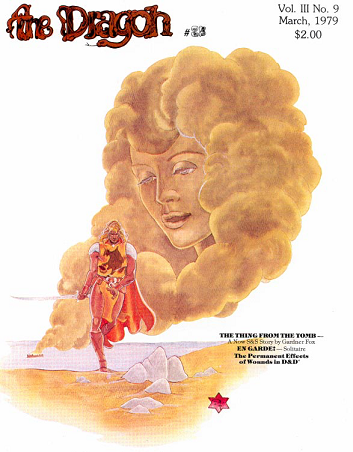
First and foremost – awesome cover. Well done!

A Part of Gamma World Revisited by James M. Ward

Not exactly a title one can conjure with, but the article itself is probably useful to most Gamma Worlders. It covers the history behind the Cryptic Alliances, and might be helpful for campaign play. What I found interesting was the geography of the alliances:

Brotherhood of Thought – started at the University of California, but spread up and down the west coast and into the Rockies.

Seekers – The Seekers are Texans

The Knights of Genetic Purity – don’t say

Friends of Entropy – headquartered in Lincoln, Nebraska

The Iron Society – they’re found in all bombed out areas – seems like Pittsburgh would have been a great headquarters

The Zoopremists – started in the mountain range near Torreon, Mexico

The Healers – Duluth, Minnesota

Restorationists – Boston and Providence

Followers of the Voice – their most successful group is in an underground base in the Appalachians south of Charleston and west of Raleigh – they’re led by a bunny-girl (i.e. female hoop)

Ranks of the Fit – began near Memphis, Tennessee by a circus bear who had its mental faculties increased a thousand fold; their civilization has spread as far north as Cincinnati and as far south as Baton Rouge, presumably along the Mississippi River and its tributaries.

The Archivists – mountains between Butte, MT and Billings, SD and Idaho Falls, MT

Radioactivists – based below Atlanta in the flattened peninsula that was Florida

The Created – have surrounded St. Louis with warbots

Judging and You! by James M. Ward

This is a collection of tricks of the game judging trade, especially for Gamma World and Dungeons & Dragons.

The Tug of the Machine by Allen Evans

A bit of fiction. One column’s worth. And I can’t copy paste it. Sorry.

The Armada Disasters

This is a nice history of naval operations and the clash of nations in the 16th century, and most particularly about the Spanish Armada and its disastrous clash with the English.

From the Sorcerer’s Scroll: The Proper Place of Character Social Class in D&D by Gary Gygax

This covers the introduction of social classes to characters in D&D. It mentions that the initial idea came from MAR Barker’s Empire of the Petal Throne. Gygax points out that Tekumel has a well-thought out culture and social structure, and the lack (or possible lack) of such a structure in D&D makes using social class problematic. He suggests a very simple table for determining social class:

01-75 – Common background
76-95 – Aristocratic background
96-00 – Upper class background

He then goes on to question the use of birth tables and social class, and I have to agree. I suppose if a campaign focuses on social class and the interaction within classes and between classes – something like you’d get in Flashing Blades – it makes sense. If you’re doing the whole Conan thing – plundering tombs and such – I don’t see much point to it.

Armies of the Renaissance by Nick Nascati

Part III of this series, this one covers the Condotierre and The Papacy. Great introduction:

“If Woody Allen would ever decide to turn his comedic talents to writing history, the result would very probably read like a history of Italy in the Age of the Condotierre. Few periods in history could possibly be as full of petty squabbles and pointless maneuvering, as this age when greedy, mercenary captains controlled the destiny of the Italian City-States. Warfare was formalized to the point where it almost became a life-size chess match, with few fatalities. However, their military system does assume a certain importance in our study of the period.”

Well worth the read for wargamers doing this period.

Would the Real Orc Please Step Forward? by Lance Harrop

Here’s an interesting article subtitled “Dealing with the Proliferation of Orcish Miniatures”. Interesting for two reasons.

One is that it covers “orc genealogy and taxonomy” – always fun to see somebody dissect make-believe like that. Lance draws a family tree of evil humanoids, putting orcs, ogres, kobolds, hobgoblins and goblins all on branches of that tree, with hobgoblins and goblins forking off from the same branch. Pretty standard idea these days, maybe kinda new in those days. He then lays out some ideas on how to take this system and use it when selecting miniatures, since back in the day miniatures were a bit more generic – i.e. an ugly humanoid miniature could just as easily be used as a kobold as it could for a goblin.

The other interesting thing about this article is that there was a need to deal with the proliferation of orcish miniatures. I’m guessing that nerds in the Middle Ages were worried about similarly silly things – it runs deep in our breed.

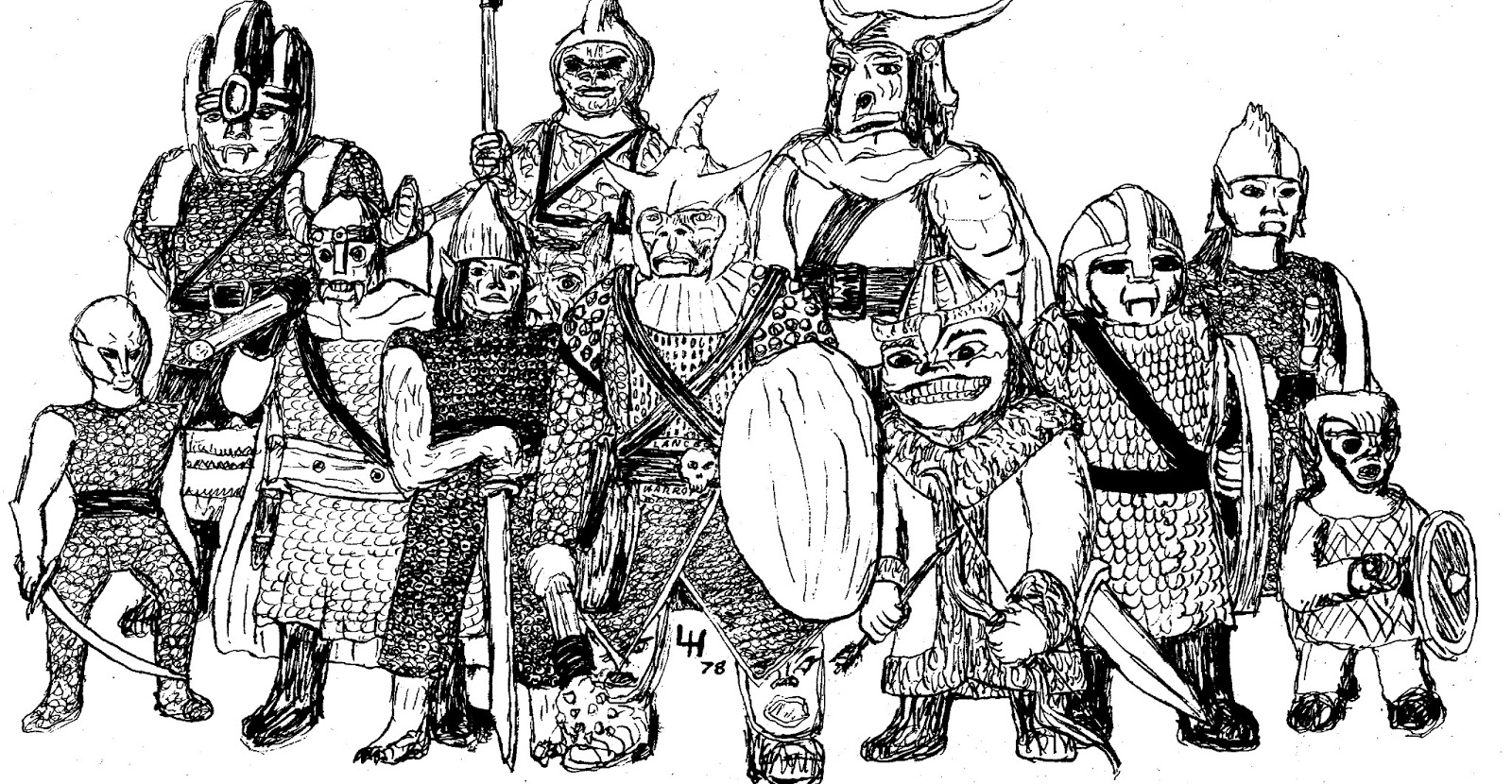
He also provides a picture of several of the miniatures of the day …

Finally, he provides this guide to wargaming with orcs:

1. All goblin races dislike the sunlight, so lower their morale in the daytime.

2. Kobolds and Gnomes will almost instantly attack each other, so have them make obedience checks when they are in charging distance. The same with goblins and dwarves and lesser orcs and elves. Great orcs, man orcs, ogres and hobgoblins will not generally disobey.

3. Orcs of different tribes will also attack each other, as will all goblin races, but powerful leaders can keep them in check, so adjust the die roll against the level of the leader.

4. Usually only great orcs and man orcs will fight in formations, the others will fight en masse.

The Traveller Navy Wants to Join You by R. D. Stuart

An article that covers new career opportunities in Traveller. I don’t play Traveller, so I don’t know that I can comment on how well these are written, but I bet it would come in handy if you were doing a Star Trek-esque Traveller campaign.

Gamma World Artifact Use Chart by Gay Jaquet

This article swaps out the artifact use charts in Gamma World for a more complex and abstract system. Personally – I’ll stick with the charts. I think they’re fun.

An Alien in a Strange Land by James M. Ward

Ward wrote quite a bit for this issue, huh?

This is a bit of Gamma World fiction that seems to be taken from actual play:

“Blern had left those mutated fools of Entropy with an organization that should last until the time it decided to return and take over again. Riding off, on a very reluctant Brutorz, had carried with the act a certain satisfaction in a finished job that was well done. The miles were quickly eaten up under the hooves of the Brutorz and soon Blern was in territory that it had never visited or heard about before. Days passed into a sort of boredom that was unusual for the mutant. It got so that it was wishing for an attack by anything, just to break the monotony, and almost with that thought, Blern spotted the group.”

Excerpt from an Interview with an Iron Golem by Michael McCrery

Interview with a Vampire was written in 1976 – I’m wondering if this article was a play on that. Either way, this one reminds me of the skits that appear in the last 15 minutes of Saturday Night Live. Essentially, another piece of fiction drawn (I’m guessing) from actual play.

War of Flowers by William B. Fawcett

Another nice wargaming article, this one on the Aztecs. I like this bit …

“The Aztec “empire” was in fact a conglomeration of city states that formed rather fluid coalitions which were normally centered on the most powerful cities found in the area of present day Mexico City. In these coalitions there were normally one or two major powers who, by their size and military strength, were able to compel the lesser cities to join in their efforts. When a city was ‘conquered’ the result was the imposition of tribute and economic sanctions rather than social or political absorption, as occurred in Europe or China. This tribute was reluctantly paid to the victorious city only until some way to avoid it was found (such as an alliance to an even more powerful city). Any political or military alliance was then ruled entirely by expedience, and quickly and easily dissolved.”

This is pretty much how I envision all the city-states in NOD. Why? Better for game play in my opinion.

Xochiyaoyotl by Neal M. Dorst

This is a concise set of rules for Pre-Hispanic Mexican wargaming.

Varieties of Vampires by R. P. Smith

This article tackles all the various vampire legends from around the world. It suggests using the same basic game stats for all vampires, but then adds different move rates and environments for the different vampire legends, along with descriptions:

Asanbosam (Africa): Men (9 hit dice), women (8 hit dice), or children (7 hit dice) who look normal except for a pair of books instead of feet. They can charm at minus 3, (except against clerics, whom they avoid) and can throw a single sleep spell per night. They can call 3-18 leopards or 2-12 tigers. Only a cleric can kill the asanbosam.

Burcolakas (Greece): It has a swollen, tense, hard skin. It can scream once per night which deafens all in hearing range for 24 hours, no saving throw. It can also kill, not only by draining life levels, but by naming its victim by name and commanding the victim into a fatal action. It can imitate any voice it hears, with as much of a chance of being detected as an assassin has of being discovered in disguise. It controls 10-100 rats, but no wolves. To defeat: cut off and burn its head.

Great idea – wish I’d thought of it. My favorite bit from the article … “Hence, any body left unguarded without a Bless spell from a cleric will become a vampire within seven days.” Use that rule, and I promise the cleric will hold onto those bless spells. Nobody needs that stupid henchmen you used for cannon fodder coming back to haunt you as a vampire.

To Select a Mythos by Bob Bledsaw

This article covers creating a mythos for one’s campaign. I like that he pushes a “screw reality” concept and chooses fun over strict realism.

Arms and Armor of the Conquistadores by Michael H. Kluever

Another article about fighting on Old Mexico. This one gives a history of the Spanish conquest and then describes the weapons and armor of the different troops.

Not a bad issue. Like the vampire article quite a bit, could have done without so much fiction. The “helpful tips” stuff is helpful for folks new to gaming – not so much for an old fart like myself. If I was doing some Aztec vs. Spanish wargaming, this issue would have really been a boon.

Okay folks – see you tomorrow when I have a new goofy character class you might enjoy.

3d6 All the Way Revisited – A Random Excel Generator!

Illustration of leech by Jon Kaufman from the NOD Companion (still in progress)

From the brilliant mind of Arjen Lissenberg, who gave us the excel document to generate random classes with that last hare-brained scheme of mine, comes a new Excel doc to do the same with the 3d6 for everything method.

Download it HERE!

Thanks again to Arjen – I love being able to supply things like this to the wider gaming community!

Random Classes – The Download

Image copyright WotC, used w/o permission

Hey folks – quick post today. I wanted to share the link to the groovy little Excel document that Arjen Lissenberg created based on my random class creator idea. Thanks to Arjen for the hard work!

Click HERE for the document. Assuming you have the random value generator thingy operational, you just press F9 to generate class after class (or NPC after NPC, as the case may be).

To prove its immense value, I present three unique NPC’s generated with the sheet.

Sabre LeClerq
Sabre’s base class is rogue. He can wear up to studded leather armor and wield a buckler, and use medium and light melee weapons, light crossbows, short bows and thrown weapons. He has decipher codes and swimming as a class skill, can cast spells as a magic-user up to 3rd level and can turn elementals as a cleric turns undead.

Jasmine X
Jasmine is a scholar who knows how to operate in armor up to a breastplate, and can use bucklers. She can use the same weapons as Sabre, can cast spells as a druid up to 3rd level, can cast spells as a sorcerer, can speak with all living creatures and she has a psychic power.

Rugor the Red
Rugor is also a rogue who can wear up to ring mail. He can use shield and buckler and fight with light melee weapons, light crossbows, short bows and thrown weapons. Rugor has the Great Fortitude feat, has escape bonds as a class skill and knows how to cast a single 1st level ranger spell each day and a single 0-level cleric spell per day.

I can imagine each of these three making for an interesting henchman for a PC.

It Had to Happen: Random Classes

Image found here

How could a game built on a foundation of platonic solids not have random classes? It’s inconceivable (and yes, the word does mean what I think it means).

Now, a completely random class is, on the face of it stupid. I know this. But, let’s think about this. Some people set out in life with a goal, and they stick to it and eventually become what they set out to become. A young Merlin (well, old Merlin I guess – it’s confusing with that guy) decides he wants to be a magic-user, he works hard, gets a few lucky breaks, and eventually makes it to 1st level and heads off into a dungeon.

But some folks play it by ear. They don’t know where their going, and on their way to 1st level, maybe they pick up a wide array of skills. You know, somebody like … Conan the Freaking Barbarian. How many jobs did that kid have? Started out a barbarian in Cimmeria, became a thief, then later a pirate, etc. Guy was all over the place. Thus – random classes.

Here’s the way it works. First roll puts you into a broad category of fighting skills and saving throws – warrior, mage or rogue. This role impacts your additional rolls, which will determine what weapons and armor you can use, and what special abilities and/or skills you managed to pick up. Some of those special skills introduce ability score requirements. If you don’t have a high enough ability score, you have to roll again.

One note: These tables assume you’re using Blood & Treasure. You can probably adapt them to your favorite system.

On to the random nonsense …

ROLL ONE – KNOW YOUR ROLE

Roll D6

1-2. Warrior – advances as Fighter

3-4. Rogue – advances as Thief; rogues add +15% to all future percentile rolls.

5-6. Scholar – advances as Magic-User; scholars add +30% to all future percentile rolls.

ROLL TWO – GIRD YOUR LOINS

Roll D%

ARMOR PERMITTED
01-5. All
6-10. Platemail, banded mail, splint mail, breastplate, chainmail, scale mail, chainmail shirt, studded leather, ring mail, leather armor, padded armor
11-20. Banded mail, splint mail, breastplate, chainmail, scale mail, chainmail shirt, studded leather, ring mail, leather armor, padded armor
21-30. Splint mail, breastplate, chainmail, scale mail, chainmail shirt, studded leather, ring mail, leather armor, padded armor
31-40. Breastplate, chainmail, scale mail, chainmail shirt, studded leather, ring mail, leather armor, padded armor
41-50. Chainmail, scale mail, chainmail shirt, studded leather, ring mail, leather armor, padded armor
51-60. Scale mail, chainmail shirt, studded leather, ring mail, leather armor, padded armor
61-70. Chainmail shirt, studded leather, ring mail, leather armor, padded armor
71-80. Studded leather, ring mail, leather armor, padded armor
81-90. Ring mail, leather armor, padded armor
91-100. Leather armor, padded armor
101-115. Padded armor
116-130. No armor permitted

SHIELD PERMITTED
01-30. All shields
31-50. Shield and buckler
51-80. Buckler
81-130. No shields

ROLL THREE – GRAB A POINTY STICK

Roll D%

01-30. All weapons, melee and ranged
31-80. Medium and light melee weapons, light crossbows, short bows and thrown ranged weapons
81-130. Light melee weapons, light crossbows, short bows and thrown ranged weapons

ROLL FOUR + – GET SPECIAL!

Characters are permitted 1d3+2 rolls on the special abilities table. Abilities that are “as” a character class use the rules for that class’s ability and gain that ability or enhancements to that ability at the same levels as that class does.

Roll D%

1. Smite Chaos (Lawful, Wis 13+)
2. Favored enemy as ranger (Wis 13+)
3. Whirling Frenzy (Dex 13+)
4. Rage as barbarian (Con 13+)
5. Sixth sense as barbarian
6. Weapon specialization as duelist, though you may choose any weapon
7. Add Intelligence bonus to AC (Dex 13+)
8. Spring into combat as duelist (Dex 13+)
9. Riposte as duelist (Dex 13+)
10. Roll with lethal blow as duelist (Dex 13+)
11. Dominate foes as fighter
12. Multiple attacks as fighter
13. Steadfast as defender [fighter variant] (Con 9+)
14. Alertness feat as a class ability
15. Bull Rush feat as a class ability
16. Cleave feat as a class ability
17. Disarm feat as a class ability
18. Dodge feat as a class ability
19. Expertise feat as a class ability
20. Grapple feat as a class ability
21. Great Fortitude feat as a class ability
22. Iron Will feat as a class ability
23. Lightning Reflexes feat as a class ability
24. Power attack feat as a class ability
25. Sunder feat as a class ability
26. Two Weapon Defense feat as a class ability
27. Two Weapon Fighting feat as a class ability
28. Weapon Finesse feat as a class ability
29. Bend Bars as class skill
30. Break Down Doors as class skill
31. Find Secret Doors as class skill
32. Jump as class skill
33. Riding as class skill
34. Survival as class skill
35. Tracking as class skill
36. Swimming as class skill
37. Trickery as class skill
38. Balance as class skill
39. Climb Sheer Surfaces as class skill
40. Escape Bonds as class skill
41. Find Traps as class skill
42. Hide in Shadows as class skill
43. Listen at Doors as class skill
44. Move Silently as class skill
45. Open Locks as class skill
46. Pick Pockets as class skill
47. Remove Traps as class skill
48. Decipher Codes as class skill
49. Legend Lore as bard (Int or Cha 13+)
50. Haggle as a venturer (Cha 13+)
51. Add +1 to reaction rolls (Cha 13+)
52. Get 15 gp per point of Charisma at character creation instead of 10 gp per point of Charisma (Cha 13+)
53. Backstab as thief
54. Use poison as assassin
55. Concoct explosives as anarchist (Int 13+)
56. Paralyze foes as assassin (Dex 13+)
57. Improve AC as monk (Dex 13+)
58. Increased attacks as monk (Dex 13+)
59. Increased unarmed damage as monk (Wis 13+)
60. Increased speed as monk (Con 13+)
61. Deflect arrows as monk (Dex 13+)
62. Damage creatures only harmed by magic as monk (Wis 13+)
63. Slow fall as monk (Dex 13+)
64. Immune to disease (Con 13+)
65. Feign death as monk (Wis 13+)
66. Heal own wounds as monk (Con 13+)
67. Immune to poison (Con 13+)
68. Quivering palm attack as monk (Con 13+, Dex 13+, Wis 13+)
69. Speak with all creatures (Wis 13+)
70. Fascinate as bard (Cha 11+)
71. Suggestion as bard (Cha 13+)
72. Break enchantment as bard (Cha 13+)
73. Detect evil at will as paladin (Wis 13+)
74. Lay on hands as paladin (Wis 13+)
75. Immune to fear (Cha 13+)
76. Summon warhorse as paladin (Cha 13+)
77. Cure disease as paladin (Wis 13+)
78. Resistance to acid (Con 13+)
79. Resistance to cold (Con 13+)
80. Resistance to electricity (Con 13+)
81. Resistance to fire (Con 13+)
82. Resistance to sonic and +2 vs. song-based abilities (Con 11+)
83. Vampire slayer – +2 save vs. undead abilities
84. Dragon slayer – +2 save vs. dragon abilities
85. Turn or rebuke undead as cleric (Lawful or Chaotic, Wis 9+)
86. Turn elementals (Wis 9+)
87. Turn oozes (Wis 9+)
88. Turn dragons (Wis 9+)
89. Rebuke animals (Cha 13+)
90. Move through undergrowth as druid or ranger (Wis 13+)
91. Leave no trail as druid (Wis 13+)
92. +2 save vs. all energy attacks (Con 9+)
93. Change shape as druid (Con 13+, Wis 13+)
94. Protection from evil effect as paladin (Lawful, Wis 13+)
95. Darkvision to a range of 60 feet
96. Gain a psychic power as a psychic (player’s choice)
97. Cast a single 0-level spell 1/day (roll list and actual spell randomly)
98. Cast a single 0-level spell 3/day (roll list and actual spell randomly)
99. Cast a single 1st level spell 1/day (roll list and actual spell randomly)
100. Cast a single 1st level spell 3/day (roll list and actual spell randomly)
101-120. Cast spells, up to level 3*
121-125. Cast spells, up to level 6*
126. Cast spells, up to level 9*
127-129. Cast spells as sorcerer
130. Roll twice on this table, ignoring this roll

* The first time you gain spellcasting abilities, roll randomly to decide which list you use. If you gain the ability to cast higher level spells, use the same list.

1. Assassin (only up to 3rd level)
2-3. Bard (only up to 6th level)
4-9. Cleric
10-12. Druid
13-18. Magic-User
19. Paladin (only up to 3rd level)
20. Ranger (only up to 3rd level)

And there you have it. It could be a fun way to roll up NPC’s – though the short hand of the existing classes is pretty convenient, or a way to throw together a really interesting party for a one night delve into a classic dungeon. Just remember to roll your dice responsibly.

JMS

Dragon by Dragon – March 1979 (23)

I haven’t delved into an old Dragon for a while, so I thought tonight was as good a night as any to do a new “Dragon by Dragon”. What does March 1979 have in store for us?

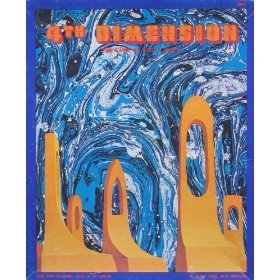
I often like to start with an ad, and this one has a dandy for Fourth Dimension, the game of Time and Space. You get to play a Time Lord in this one, with an army of Guardians, Rangers and Warriors. No dice in this game – all about the strategy.

In terms of articles, the first one up is about playing EN GARDE! (love the days of capitalized game names) as a solitaire game. Folks might find a use in the Critical Hits table.

Die Roll. Result (Damage Points)
1-10. Light Leg Wound (Base 20 + 16-sided die roll)
11-20. Light Left Arm Wound (Base 20 + 16-sided die roll)
21-30. Light Right Arm Wound (Base 20 + 16-sided die roll)
31-40. Light Head Wound (Base 20 + 16-sided die roll)
41-50. Light Body Wound (Base 25 + 16-sided die roll)
51-60. Serious Leg Wound (Base 50 + 120-sided die roll)
61-70. Serious Left Arm Wound (Base 50 + 120-sided die roll)
71-80. Serious Right Arm Wound (Base 50 + 120-sided die roll)
81-90. Serious Head Wound (Base 50 + 120-sided die roll)
91-99. Serious Body Wound (Base 100 + 120-sided die roll)
00. DEAD

Love the 16-sided dice and 120-sided dice – not sure how that was accomplished, though I’m sure a dice whiz can inform us in the comments. If modifying for use in “traditional fantasy games”, you could maybe replace “Base 20 + 16-sided die roll” with 6 + 1d6 or something like that.

Next is some fantasy fiction by Gardner F. Fox – “The Thing from the Tomb”. The first paragraph goes thus …

“Niall of the Far Travels reined in his big grey stallion, lifting his right hand to halt the long column of riders who followed him across this corner of the Baklakanian Desert. In front of him, and far away, he could make out a dark blotch on the golden sands toward which he was
moving.”

Jeff P. Swycaffer presents “Mind Wrestling”, a variation on psionic combat. To be honest, I still regret not throwing in a psionics appendix into Blood & Treasure. The idea here is that two people are attempting to push a cloud of power suspended between them into their opponent’s mind. The system uses a double track to represent the “field” of combat. Attackers secretly declare an outside or center attack, defenders secretly divide their Psionic Strength between outside and center defense, and then the attacker’s Psionic Strength (+40 or doubled, whichever is less) is compared to the defender’s strength. If a ratio of 2:1 is achieved, the marker is moved one space. If a ratio of 3:1 is achieved, it is moved two spaces. The attacker then has his psionic strength returned to normal and loses 3 points, and the defender loses twice as many points as his marker was pushed back. Simple system, and would probably be a fun game-within-a-game, especially for psionics-heavy campaigns.

Carl Hursh has rules and guidelines for water adventures on the Starship Warden. Lots of monster stats, including craboids and gupoids.

Michael Mornard presents notes on armor for fantasy games, maybe the first article to talk about how D&D armor and weapons is heavier than real armor and weapons.

Gygax’s Sorcerer’s Scroll presents the random generation of creatures from the lower planes – always a fun one, and I highly suggest people use it when sicing demons of various types on their players. You can either use it to generate additional “types” of demons, or use it to alter the appearance of existing types.

James M. Ward presents an article I’m excited about – Damage Permanency (or How Hrothgar One-Ear Got His Name). This system is used when a person is reduced to 1 or 2 hit points. When this happens, there is a 50% chance of no permanent damage, a 20% chance of needing magical healing to heal properly, and a 10% chance of being maimed unless wish or a 5th level or better clerical healing spell or device is used.

What follows are a number of tables – one to determine the area of the body damaged, and tables for each body location to determine what happens. Head damage, for example, is as follows:

1-12 Hearing Loss
13-24 Sight Loss
25-36 Speech Impaired
37-48 Charisma Impaired
49-60 Intelligence Impaired
61-72 Wisdom Impaired
73-88 Fighting Ability Impaired
89-100 Spell Ability Impaired

Of course, more detail follows. “Spell Ability Impaired” mean that the person loses one level of spell ability – i.e. a 3rd level magic-user would have the spells of a 2nd level magic-user.

The Design Forum features “Dungeons and Prisons” by Mark S. Day. Essentially, it covers the idea that dungeons should have some prison cells, and gives a few notions about how one might use them.

And that does it for Dragon in March 1979 – a useful little issue. One parting shot …

Ah – the good old days were just getting started in 1979!

Soon, I’ll review the latest adventure offering from Tim Shorts – Knowledge Illuminates!

What’s In Santa’s Sack – Halfling Edition

Image from here

Christmas is maybe the most halfling holiday of the year … well, except for Thanksgiving. Either way, you have to imagine that old St. Nick has a few packages in his sack for those little Lawfuls of the Shire …

1. Cheese – and lot’s of it.

2. Mithril mixing bowl – nothing sticks to mithril except dire molasses

3. Jar of dire molasses

4. Rose-colored glasses (+1 to save vs. sadness and fear)

5. Lederhosen – pre-worn in by the elves at the North Pole and thus smelling of peppermint

6. Toe hair combing kit in a fancy leather case

7. Scented foot oil

8. Pennywhistle, mouth-harp and set of musical spoons – to pass the time on long trips

9. Brand new slingshot with a compass and a thing that tells the time in the stock

10. Crushed velvet bag containing 10 silver sling bullets

11. A set of hand-carved bird calls – includes one’s for giant eagles, rocs and giant owls (1 in 6 chance of attracting an owlbear)

12. “Get Out of Gaol Free” card signed by St. Cuthbert himself

13. Stickum – useful for halfling thieves (bonus to climb and pick pocket checks)

14. Autographed copy of There and Back Again

15. Set of three nosegays (+1 save vs. poison gas)

16. Daisy chains, enchanted to never wilt

17. Elven cloak (ever since that book came out, every halfling wants one)

18. New hurling stick (can be used as a club or to hurl things like flaming oil or holy water)

19. A prize pig of surprising intelligence, large enough to be used as a mount

20. Sack of walnuts

21. Shire Army Knife (fork, spoon, knife, toothpick and corkscrew)

22. Silver locket containing a curly auburn lock – find the owner and get a free kiss

23. Embroidered shirt or dress – hand stitching

24. Gnarly, wooden walking stick

25. Sack of jelly babies

26. Glass bottle of bay rum

27. Seat cane with silver top (counts as a silver club for attacking incorporeals and lycanthropes)

28. Dragon-nip – throws dragons off your scent when sneaking into their hordes

29. Silver dagger

30. Book of Riddles – useful for stumping gollums

What’s In Santa’s Sack? – Elf Edition

Of course, Santa Claus isn’t going to forget about those Chaotic Good demi-humans, close kin to his helpers at the North Pole. Grab a d30 and roll up some loot for your favorite fairy.

1. Bejewelled ear-wax cleaner
2. Pointy hat in glorious velvet
3. New silver bells for one’s formal pointy shoes
4. Magical easy bake oven in the shape of a tree
5. Autographed tapestry of Santa Claus
6. Stereoscope cards of Freyr in all her divine glory
7. A shiny new sword with silver engraving in the shape of acanthus leaves
8. Magical coat of leaves – they match the woodland environment and season and act as camouflage
9. Licorice drops – elves can’t get enough of licorice drops, and each is embossed with an elf-cross
10. Nymphs and Dryads I Have Known, a memoir by Högni Half-Elven
11. Drizz’t plushie and a collection of silver pins (worth 5 gp)
12. A box of flower petals crystalized in sugar
13. A trick flask with two sides to allow one to hide potions or trick enemies into drinking poison!
14. New woolen tights
15. Harp engraved with prancing unicorns
16. False mustache and beard
17. “Brownie-whistle” – a silver whistle only the fey can hear
18. A silver comb
19. An Italian greyhound puppy, since they’re effectively the elves of the dog world
20. 1001 Things to Say to Piss Off a Dwarf – popular old joke book
21. Magical chemise – one can pull an endless number of red roses from the sleeves
22. Silver dagger
23. A sword cane – come on, you know elves would love those things
24. Kerchief of Elvenkind – admittedly, not as useful as the cloak or boots, but a dapper touch nonetheless
25. Quiver of handmade elfshot
26. Wooden sculpture of a feminine leg with a continual light spell cast on it’
27. New longbow
28. Set of three bowstrings woven from the tail hairs of a unicorn (+1 damage, worth 10 gp each, each lasts for 1d20 shots)
29. Flagon of sweet, clear wine
30. Shirt of elven mail

What’s In Santa’s Sack? – Dwarf Edition

Are you eye-ballin’ me boy?

Let’s kick the holiday season off right with a nice gift guide for the dwarf in your life. If your players have a lawful dwarf in their midst, roll a D30 and give the little bugger something nice from old Kris Kringle …

1. Beard extensions
2. Spiked boots of tooled purple worm leather
3. Jeweled eye patch (or two, if the poor dear is blind)
4. Treacle surprise!
5. Rock candy shaped like little earth elementals
6. New undergarments with a fresh pine scent
7. Monogramed leather apron – smith in style!
8. Blue dragon leather grip for the warhammer
9. Illustrated copy of The Amorous Adventures of Freya Grunsdottir
10. Basket Weaving Made Easy – much of it is applicable to beards
11. Woolen stockings – 3 pairs!
12. Bag of novelty pipe cleaners
13. Subscription to the Mead of the Month club
14. A real treasure map!
15. Balrog-B-Gon (1% chance of actually working)
16. Pair of gold-sniffing ferrets
17. Aurumvorax-fur coat
18. Helm with handy-dandy candle holder
19. Nose wax (to keep the old neb nice and shiny!)
20. Monogram lace hanky, ‘cause even dwarves need a good cry sometimes
21. Leather bodice studded with rhinestones (for the dwarfettes … or maybe not …)
22. Adamantine pick-axe autographed by Bjorn “the Badger” Bjornholm
23. Lead miniature collection, “The Great Dwarves of History”
24. Official Junior Vulcan Metallurgy Set
25. Bar of lye soap, nose tweezers and ivory mustache comb in a tasteful gift bag
26. Box of assorted candied beetles
27. 50’ of silk rope
28. Cave bear rug
29. Ale mug engraved with the dwarf’s name
30. Collection of Norðri, Suðri, Austri and Vestri commemorative plates