Medieval City

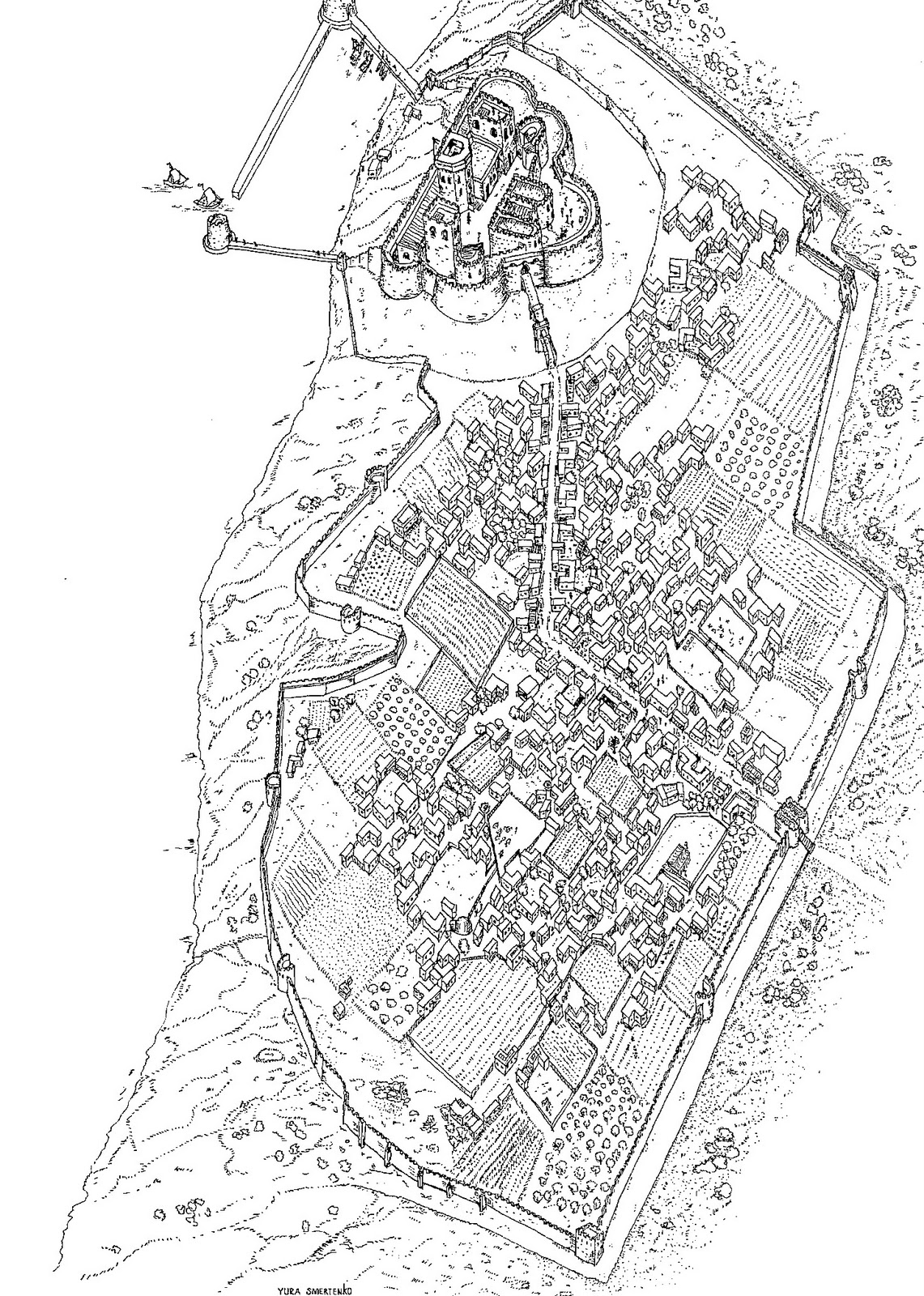
I don’t know whether you would term this a city or a town – probably a town. Either way, I found this map and wanted to share it. Had I more artistic ability (and I might go to the trouble of investing time into learning) the city maps in NOD would look like this – much more evocative than simple line maps.

The image was found at the Apollonia-Arsuf Archaeological Project from Tel Aviv University. It’s a reconstruction of a crusader city, and you can find more descriptive text at the link.

So, enjoy the map – Deviant Friday will follow in a few hours.

Antigoon, City of the Sun – Introduction

Yay – I’m about 90% finished writing my three cities – Antigoon, Lyonesse and Blackpoort. I think I’m going to crank out an article on “Well Dressed Delvers”, make some adjustments to my Noble and Everyman classes (should post them soon enough) and then I’ll be done with NOD 7. I’ve commissioned an illustration of the Cyclopean as well and maybe a short adventure for PARS FORTUNA. I’ll have a full table of contents soon. In the meantime, enjoy some locales in Antigoon …

The Merchant Adventurers: The Merchant Venturers are the most famous merchant company in the Motherlands, and among the wealthiest organizations on Nod. Their headquarters is a four story building of glazed brick, as black as a tinker’s pot and adorned with white marble accents and sculptures of famed venturers and sea nymphs. The interior hall is floored with ebony and decorated with white velvet couches and burnished bronze furniture. A large troll, dressed in ruffled silks and satins and holding an ornate halberd guards the entry hall, terribly aware of the blazing furnace that rests just beneath the floor. A secretary in long, silk robes the color of desert sand and holding a wax tablet directs those with an invitation either to the lounge or upstairs to a meeting room. Those without an invitation are either tossed out by the troll or asked to wait while inquiries are made as to whether they will be seen.

The ground floor of the building houses a lounge wherein members may relax, play cards or backgammon, sip an aperitif and work on a cold piece of roast. There is also a shrine dedicated to St Meingold, patron saint of the company. The upper floors contain secret rooms and vaults, meeting rooms and guest quarters. Each floor is guarded by four swordsmen and a crossbowman wearing the livery of the Company, a blue field emblazoned with a black ship and two gold dolphins.

The current master of the Venturers is Glynnick Melf, a woman of forty summers who looks much younger. Glynnick has tanned skin that shows the effect of many years of sun and spray. She has brunneous hair worn in long curls and keen, beryl eyes accentuated with kohl. Towering and lanky, with a barbaric sense of humor, Glynnick has seen much of the world, from the dragon courts of Mu-Pan to the many-armed fanged idols of Kirkersa to the swaggering pirates of Janus and the reeking swamps of Rogue’s Harbor in Antilia. She has bested vampires and mummies, beaten an ogre mage in a contest of riddles and stolen two hordes from under the noses of wyrms. Glynnick is married to Brabo, twenty years her junior and son of Prince Fortunatus. It is marriage of convenience to both of them, and neither take their vows seriously.

Kirikersan Factory: This 3-story baroque building was once the chief residence of the Stewards of Brabo, and is now home to the merchants of Kirikersa who work and trade in Antigoon. The factor is Shanthet, an effeminate man of great intelligence and a surprisingly deep voice. Capricious and always on the verge of an ill humor, Shanthet has rich, caramel skin, hair the color of moonlight striking a deep mountain lake and eyes of teal and Persian blue. Despite his slight figure and gauzy manner, Shanthet is a deadly warrior. He usually wears +2 armor of leather scales beneath his silk robes and his schooling in Kirkersan wrestling gives him a +2 bonus to grapple opponents or knock them prone. Shanthet is married to Divixa, a haughty woman of royal blood (distantly) from Kirikersa who is ever ready with a sneer and a petulent remark. His children, Seafren and Valdur are both cadets at the Academy.

Cut-Rate Alchemy: This 3-story brick building features a rank cellar laboratory and two frightened families of boaders. Rented from the government by old Caudryk (2 hp), a musty alchemist with greasy bangs and a gimpy leg, it is frequently wracked by explosions and engulfed by plumes of acrid, polychromatic smoke. Cauldryk runs a cut-rate business in minor alchemicals, though he is a master alchemist who is capable of producing astounding things. He knows the recipe for the universal solvent, but lacks the patience to see such an operation through. Cauldryk is a fanatical worshiper of Law, especially in the person of Prometheus.

The House of Brun: This two-story structure is constructed of brick faced with chocolate-brown marble. It features two large windows that face the street and a gilded door. The tables before the windows are reserved for the highest ranking nobles or wealthiest merchants in the chocolate house. Chocolate is served in the establishment mixed with creamy milk for 1 gp per cup, and small tins of powdered chocolate are sold as a medicine for 5 gp per tin. The house has become a meeting place of the elite, and a guard is usually posted at the door to ensure the riffraff stay out. The interior of the place is decorated with exceptionally fine furniture and paintings by some of the most celebrated artists in Antigoon, few of whom are wealthy enough to visit. The place is run by a young man called Garric Brun, a former pirate and “citizen” of Port January. Studious and intellectual, he now dresses in finery and talks politics and philosophy with the upper crust of Antigoon. Garric has swarthy skin that he lightens with powder. He has pumpkin red hair and glandaceous eyes that sparkly whenever a gold coin clinks in his purse.

Theater Sol and Theater Lune: These two theaters are run by twin sisters Herna and Gwelda, daughters of Juand, a famed raconteur and bard who died about a decade ago, leaving the old Theater Lune to his favorite daughter, Gwelda. Herna was incensed, and so used what money she could borrow to open the Theater Sol across the street.

The Theater Lune is a four story building of dressed, amber colored stone with white marble accents around the door and window. A crescent shaped window above the door gives the building its name. The Theater Sol across the street was also four stories tall, but a tall platform supporting a wooden sun painted bright yellow has been constructed to make it taller than its competitor. Both buildings have an antechamber equipped with benches where entrance can be purchased for a silver coin. Beyond the antechamber there is a large room, two-stories tall, with a stage and balconies for wealthy guests (1 gp) – other folks must stand through the performances.

Herna VeoJuand is a young woman, plain of face and standing only 5′ 6” tall. A careless dabbler in Chaos, she has twice lost husbands at sea. Usually calm and forgiving, mention of her sister or father bring out her dark side. Herna has tan skin, flaxen hair and sepia eyes.

Gwelda VeoJuand is a compassionate woman who is married to a the playwrite Horngyrth (another annoyance to Herna, who failed at her own attempts to woo him). Bitter towards her sister, she could easily be her double.

Lyonesse, The Gleaming City – The Citadel

[No numbers on this map yet – just place buildings where you’d like for now]

The Citadel
The citadel is a massive fortress, the center of government in Lyonesse and home to its king and many members of his court. The citadel is constructed from brilliant, white lime-stone. Its towers have conical roofs of sapphire blue slates. The walls of the citadel stand 40-feet tall, its towers 60-ft tall, and they are routinely patrolled by crossbowmen.

Within the citadel dwells King Tristram, his wife Queen Lenore and their children, Burgon, Damoun, Juliada and Pontinae. Princess Juliada is in line to take the throne when her father passes, while her brother Burgon has been promised the Duchy of Lutece as his own. Pontinae is slated for education by the church and a prominent place in the priesthood of Ceres, while Damoun will be apprenticed to Master Odumnovice when he comes of age. Other inhabitants of the citadel include the aforementioned court magician Odumnovice, Tristram’s personal chaplain Father Roquelaure, lord high constable Ramee, the commander of the royal guard, the royal surgeon Dr. Menet and Fraien, giant, blue-black beaded master of the hunt. Various ladies-in-waiting and squires drawn from the nobility dwell in the citadel, and visitors from the countryside are common.

The citadel rests upon a fortified mount 20-ft tall. In front of this mount is the large, round bailey. The bailey is actually an open courtyard that is used for military demonstrations. A troupe of seven heavy infantry occupy the bailey at all times and the walls above are manned by fifteen crossbowmen, all elite men-at-arms (HD 2).

The City Wall
The city wall of Lyonesse is constructed from the same limestone as the citadel, and like the citadel is kept immaculate and gleaming. The wall is set upon a massive embankment (colored light gray on the map) that rises 30-ft above the surrounding land and is buttressed by 10-ft thick walls of limestone. The actual city walls are 40-ft tall. The guard towers are 50-ft tall, while the gatehouse stands 60-ft tall. The walls and towers are always staffed by soldiers – assume any 100-ft span of wall is manned by five cross-bowmen, while each tower holds five crossbowman and five heavy infantry with a sergeant-at-arms in command.

Gatehouse: The gatehouse, also called the Bridge Gate sports two steel portcullises and foot-thick doors of oak studded with hundreds of bronze nails in the outline of a lion rampant. The doors and portcullises are left open during the daylight hours, but closed (and never opened, save by direct order of the king) at night.

During daylight hours, two heavy infantry and four crossbowmen guard the entrance to Lyonesse, collecting tolls for an exciseman (1 cp per foot, 1 sp per wheel). The exciseman sits at a wooden desk with an iron strongbox that typically holds 1d10x10 cp and 1d6x10 sp per hour after daylight. The towers are used as barracks for twenty heavy infantry and twenty crossbowmen, who take their turns patrolling the walls and standing guard. The guardsmen are under the direct command of Captain Calie, an aging elven woman in platemail with skin the color of ancient ivory, hair of burnt umber and gentian eyes. Her natural grace and optimistic attitude have made her popular with the men-at-arms. Calie is one of the three famous “Harpies of the Bridge”, along with the female sergeants that command the guard towers that flank the gatehouse.

Mithras’ Grotto: This 20-ft tall building has a peaked roof of stepped stone and bears no decoration other than a bas-relief of a bull’s head over the iron door that serves as its entrance. The building is a temple to Mithras, the patron deity of soldiers. The upper portion of the building is an empty chamber decorated with frescoes depicting Mithras slaying a bull on the east wall and Mithras slaying a dragon on the west wall. In the middle of the room there is a secret trapdoor that can only be activated by simultaneously depressing hidden buttons in the frescoes, one on the bull’s neck, the other on the dragon’s breast, with a spear or sword point. Once opened, the trapdoor reveals a vertical shaft one can traverse using stubby iron bars that jut from the walls. At the bottom of the shaft one must let themselves drop about 8 feet to the floor of a man-made cavern. The cavern holds a shallow pool and behind it a sacrificial altar and idol of Mithras slaying a bull. The idol is made from marble and painted to look real. Here, soldiers gather under the guidance of Guson, the resident priest of Mithras, to sacrifice bulls and pay homage to their patron. The bulls are brought in through a secret tunnel that connects the cavern to the Corn Market.

Guson dwells in his own chambers in the gatehouse. He is a suave, well spoken man with black hair tinged white at the temples and an elegant pointed chin and aquiline nose. Guson always dresses in robes of blue linen over his plate-mail. He carries a shield bearing an image of Mithras and wears a red Phrygian cap in imitation of his deity.

West Tower: The west tower is commanded by Cwenen, young sergeant-at-arms with skin bronzed by many campaigns against Tristram’s enemies, chestnut hair and large, hazel eyes that flit constantly about a room looking for threats. An overbearing disciplinarian, her soldiers also know her to have a heart of gold – many soldiers down on their luck have found a few extra silver coins dropped in their laps as Cwenen walks by. Cwenen nearly became a priestess, but her lack of patience for book learning and love of swordplay sent her into the military life. Cwenen’s blade was taken as a prize when she faced down an orc chieftain many years ago on the field of battle. It is a bastard sword +1 of azure metal that grants its owner a +1 bonus to save against magic and, if it beats an opponent’s AC by more than 6 points transmutes metal armor to leather and leather armor to cloth. The bastard sword was forged for the bard Longorius, aid-de-camp of King Rollo of Lyonesse during his wars to conquer Western Venatia. The sword is aligned to Law and does not permit its user to lie.

East Tower: The east tower is commanded by Sergeant Ursuin, third of the three Harpies of the Bridge. Ursuin is a young woman from Blackpoort who entered Tristram’s service after saving Yarvis Krumm from bandits on one of his travels between Lyonesse and Blackpoort. Ursuin is tall and muscular, with tanned skin, bushy black hair and a heavy frame. Ursuin has a forceful personality, and few care to get in her way, though she is also very forgiving and great fun in a tavern brawl. During combat, she can choose to accept a -1 penalty to hit in exchange for a +1 bonus to inflict damage. Unlike her sister Harpies, she wields a battle-axe, a gift from Yarvis Krumm that is so finely forged it gives her a +1 bonus to hit.

All-Saints StreetAll-Saints Street is a fashionable promenade of sepia tiles and tall, imposing buildings of dark oak and yellow-white plaster. It is usually crowded with strutting students, aristocrats on parade, chattering bourgeois on the hunt for fun, strolling minstrels mingling their voices and lute-songs with the murmuring of the crowds, street performers in gaudy costume, coy prostitutes in their mandated yellow cloaks and partridge feathers tucked into their hair, beggars who look as though they’ve never missed a meal and craft pick pockets. The most impressive displays on the street, however, are made by the nuns of Nunnery of Proserpina. Each Sunday they emerge from their cloisters in vibrant blue robes and black shawls marked with the three golden pomegranate seeds that are the emblem of their order. Four nuns hold aloft a small golden altar of their patron goddess while the others hold sheaves of golden wheat and chant hymns in honor of Proserpina and Ceres. Young members of the order scatter pomegranate seeds while the senior members distribute silver coins bearing the goddess’ likeness to the poor who line the street.

Nunnery of Proserpina: The abbey is a fine building of limestone, two stories tall, with a tall, peaked roof clad in copper. The abbey has an almshouse on Bulwarks Lane, where copper coins and porridge are distributed to the poor, a hospice for those who cannot pay for their care, especially farmers, a chapel, rectory and dormitories. The abbess is Damma (2 hp), a plump woman with short hair the color of dark chocolate (a well known vice of the abbess, who spends rather more of the abbey’s budget on cocoa than she should) and olive skin. Damma is a devious woman, well versed in church politics and opposed to Bishop Bob, a member of the Kaspars, rivals to her own Papelard family. All nuns are technically married to Pluto, but Damma has been known to see men on the side when it was advantageous to her politically.

All-Saints College: All-Saints College was endowed by Queen Yvette-Mimi about 350 years ago. It occupies an ancient building of limestone, four stories tall and housing dormitories for the four sages and their fifteen to twenty students, lecture halls, a dining hall and kitchen and a small library with five tomes, these tomes composing the curriculum of the college. The dean of the college is one Malbot, a willowy man with thin arms and fingers and a face like a tack. Despite his imposing appearance, Malbot is a gregarious, good-natured old gentleman and much beloved by the students. Malbot is a devout worshiper of Ceres, but shares rooms with his good friend Guson, the cleric of Mithras who would like to overturn the old faith in Lyonesse and institute the worship a more robust and virtuous worship geared towards Law. Malbot often lectures his students on matters of divinity while walking through the streets of Lyonesse, sampling the wares of local pedlars and restauranteurs while he talks.

The Hôtel Kaspar: The hôtel of the Kaspars, the dukes of Brioche, is an imposing structure with a large armorial emblazoned on the third story wall. The house has four floors and a peaked roof with a copper roof. Two guards (heavy infantry) stand guard outside the thick oak front door at all times. Entrance can only be gained by getting past the butler. The hôtel is often visited by spies and various cousins and children of the Duke, who rarely enters Lyonesse for fear of assassination by his enemies. The main inhabitant is Tadoc, the Duke’s son and an infamous rake who spends his time drinking, whoring and keeping ill company (including dwarves!).

The Yellow Queen: The Yellow Queen is a restaurant and tavern run by Ywell (3 hp), a halfling chef with a puffy face and nut-brown skin, grey eyes and shoulder-length black hair always kept perfumed and curled. The restaurant derives its name from a marionette of a queen in yellow that hangs from an upper window. Most folk in Lyonesse know the story of how a very drunk Ywell got the marionette hurled at him by an angry Maggi when he got rowdy in her puppet theater some years back. He never gave the marionette back, and the two would be enemies yet had not a basket of warm muffins not appeared on Maggi’s doorstep the next night, and once a week thereafter. Ywell serves plates of trout in generous portions, steaming platters of escamoles in coriander sauce, bread dipped in cream and then fried in dill oil and ginger beer. His staff are all relations, and they are known to help themselves to patrons purses, replacing them after extracting a few gold coins or tiny gems. The restaurant has eight tables and five booths shrouded by curtains of light blue linen. The waiters and waitresses are famous for their copper helmets, essentially little kettles of hard cider worn on the head and in which patrons can dip their copper mugs. The upper floor is reserved for the “nobs”, and no pilfering is allowed there. Ywell can’t personally stand the nobles, so he spends his time on the ground floor with the bourgeois and peasants, smoking his ivory pipe and swapping stories.
Update from the Land of Nod

Just a quick update from the merry old Land of Nod.

1 – Finished maps for Antigoon and Blackpoort today, for NOD #7 to be published in Feb 2011. Haven’t numbered Antigoon yet, but will soon. I’m going to work on Lyonesse tomorrow and then get working on writing those city-states up.

2 – My Hawkeyes won the Insight Bowl having lost their top receiver (drug charges) and first and second string running backs to transfers before the game. How ’bout them Hawks?!

3 – Finished writing up the powers for the alpha release of Mystery Men! Should finish up the rules this week or next, at which point I (and anyone else) can do some playtesting. I should begin showing off some of the art in January – can’t wait. I have a good feeling about this one.

4 – Watched Mystery Science Theatre 3000 yesterday with the kid – Hercules Unchained. It (the MST3K show) was made 20 years ago – damn I feel old.

5 – Starting work on Hexcrawl Classics #3. I’ve seen some of the art for the first two, and when I get permission will show some of it off on the blog.

The Legend of NOD!

Or rather, the legend for the maps of NOD. Long delayed, but here it is …

I think that covers the bases.

In other news …

The descriptions of the Hexcrawl Classics I’m writing for Frog God Games are up on their site. The first one is actually Valley of the Hawks. I just saw a sketch of the cover and it looked pretty sweet – I’ll share it here when it’s finished (and I get permission).

Speaking of sweet art, the illustration of the goddess I submitted to James Maliszewski’s Petty Gods project was just posted on his site (and to the right). If it’s any indication, the art for this project should be quite nice indeed!

I received the final piece of art for PARS FORTUNA today – I should get the complete rules up on Lulu today or tomorrow. Very excited about that! I’ll also be starting a series of blog posts on “The Making of …” to give you an idea for my process if you want to make a PARS of your own. In fact – maybe I can compile some fan made material for a free companion PDF to PARS FORTUNA.

With PARS out of the way and work proceeding nicely on Hexcrawl and NOD, I’ll be able to devote more time to the Mystery Men! rules. Joel should begin working on the illustrations soon, so hopefully I’ll have some sketches to show off in the near future.

Got a few ideas for blog posts bopping around in my brain. I’ll announce one tomorrow – think dungeon crawl.

Stay tuned!

Excellent Castle Resource

This is a site I found years ago that I just re-googled today because its existence popped into my brain. Essentially, Bob Carney builds castles out of Lego and posts photos of his creations and – best of all for RPGers – floor plans! The plans are often drawn by Bob specifically for Lego construction, meaning they are a bit squared off and therefore easier to transcribe to graph paper*.

Bob has an impressive collection of castles from throughout Europe, including most of the standard castle plans (tower keep, concentric, etc). The image to the right is Neuschwanstein.

If you need a castle floor plan, take a look.

Bob Carney – The Land of Nod salutes you!

* Man, I love graph paper.

Ibis, City of Sorcerers Map

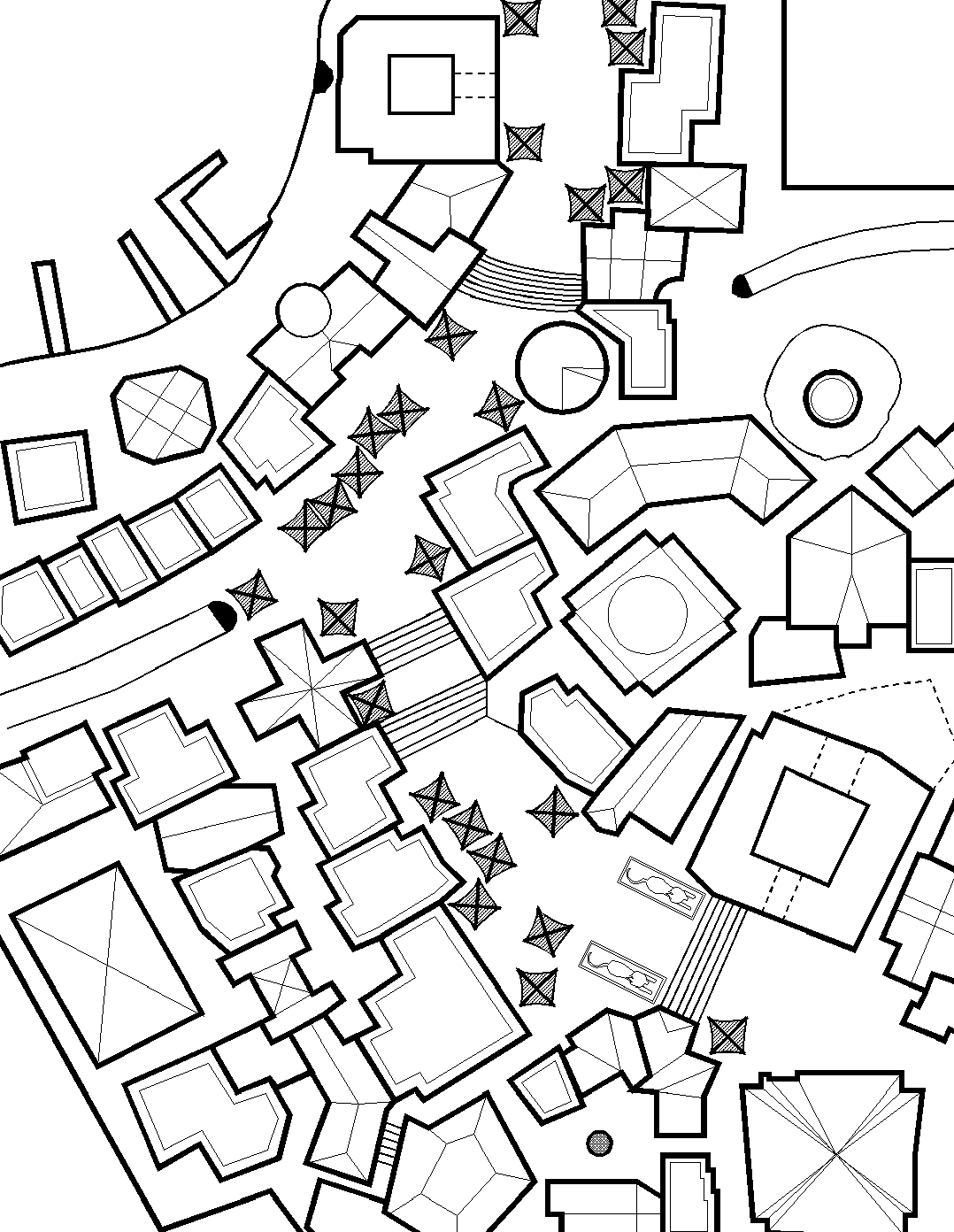
Here’s my draft map for Ibis, City of Sorcerers, showing the university area (its the collection of large buildings roughly in the center of the map). The upper right-hand corner is a corner of the Nomarch’s estate – the kind of gardens that a brash rogue from Cimmeria might stalk through on his way to liberate a tower from jewels. The lower left-hand corner is occupied by a bit of the grounds of the grand temple of Thoth, the patron deity of Ibis. The upper left-hand corner is taken up by curve in the River of Death and some quays, as well as a little cave that leads to … something.

Wilderness Adventures in Literature

I’ve been listening to H. R. Haggard’s King Solomon’s Mines the last couple days while processing data at work. I highly recommend it to Referees whose players are about to embark on a wilderness trek. You can also read it here.

After we get some introductions out of the way, you get to see the process of hiring a wagon, team of oxen and henchmen, and choosing what arms to take along – not to mention an old map that came from a dying Portuguese adventurer.

Once they get moving, you have random encounters with lions and elephants and the problems of food and water while traveling through the desert and mountains.

All good stuff – check it out.

Eulion, the Wandering City

I made mention in my “On the Drawing Board” in the sidebar that I’m working on making a free, completely open content (probably one of the creative commons licenses) fantasy city. I plan on keeping it either system neutral, or throwing in multiple sets of stats (thus – the wandering city, as it can wander from one setting to another – at least theoretically). The idea came about when I was playing with some of the random generators at Chaotic Shiny. Anyhow, I hope to have it include a brief description of the place, a map, descriptions of the inhabitants and a low-level “dungeon” linking a ruined monastery and a large graveyard – making the product useful for starting a new campaign. Naturally, Eulion is on the back burner while I work on PARS FORTUNA and NOD, so it probably won’t show up until late 2010 or 2011. Anyhow – a preview of the rough draft for the map is below …

Eulion