Magic Keys

From the Graphics Fairy

A few idea for magic keys you can drop into your campaign. All of them work in essentially the same way – a small, simple key of an interesting material that can open doors that are not there in different materials. To work, the holder of the key must close their eyes, hold their breath, stick the key out slowly, and then turn it slowly. The door then opens. The keys have a 1 in 6 chance of working, so they’re not a sure thing.

Where do these doors lead? The key opens a door onto one of the following (D10):

1-3) An ornate room with furnishings and decorations dependent on the material in which the door was situated, and attended by like creatures. Thus, a black key opening a room into shadows will open into a room of black marble with gauzy black curtains and thicker, black velvet curtains and dark wood furniture with cushions in shades of grey attended by shadows. The room is safe, and can be stayed in for 1 hour before it fades back into the plan of which it is composed and sends the occupants back from whence they came.

4-7) A long tunnel that leads to a second door which opens back into the material world. This second door will appear in the same material as the first, so a door opened through fire can only lead to a second door situated in fire.

8) A long stair leading deep down into the plane (or a demi-plane) appropriate to the key that opened the door, thus opening a door in stone will lead to the elemental earth plane.

9) The door leads to the key-holder’s childhood home, wherever it was (even if it is now a ruin, or just an open field).

10) A tunnel that leads back to the same door, but 1d6 hours later or 1d6 hours earlier. If it leads back in time, all that the characters had done in the world over that time has been undone, though the effects they suffered through remain evident on their minds, bodies and souls.

The material of the key governs what they key will work on, as follows:

Gold –> Natural stone

Amber –> Trees, hedge rows, brambles, thickets

Meteoric Iron –> Shadows and the night air

Copper –> Fire

Smoky glass –> Smoke

Silver –> Water, fog and mist

Green wood –> Spring Breezes

Bone –> Mausoleums and tombstones

Tin –> Laughter and thunderous applause (must “fill the air”)

Porcelain –> Weeping and wailing (as above)

Folded paper –> Riotous anger and yelling (as above)

Tarnished brass and tied with a fairy lock –> Hillsides

Dessicated and twisted wood –> Sand dunes

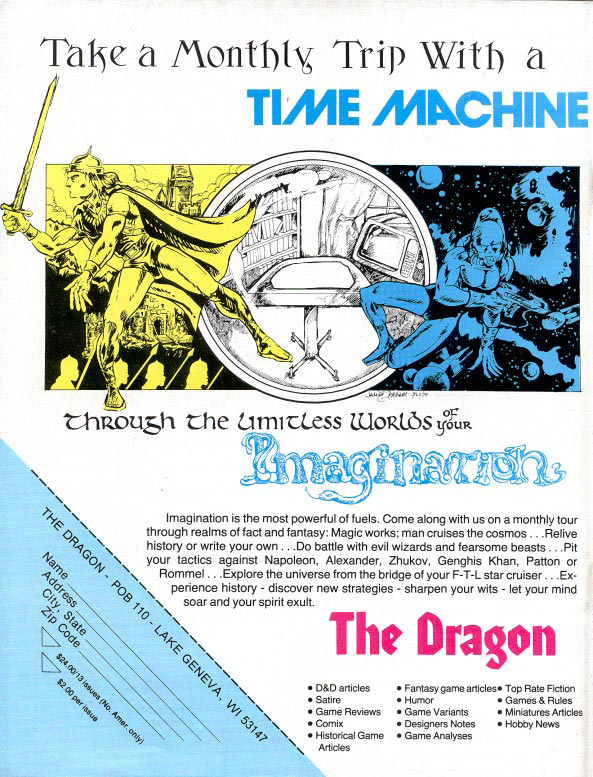
Dragon by Dragon – September 1979 (29)

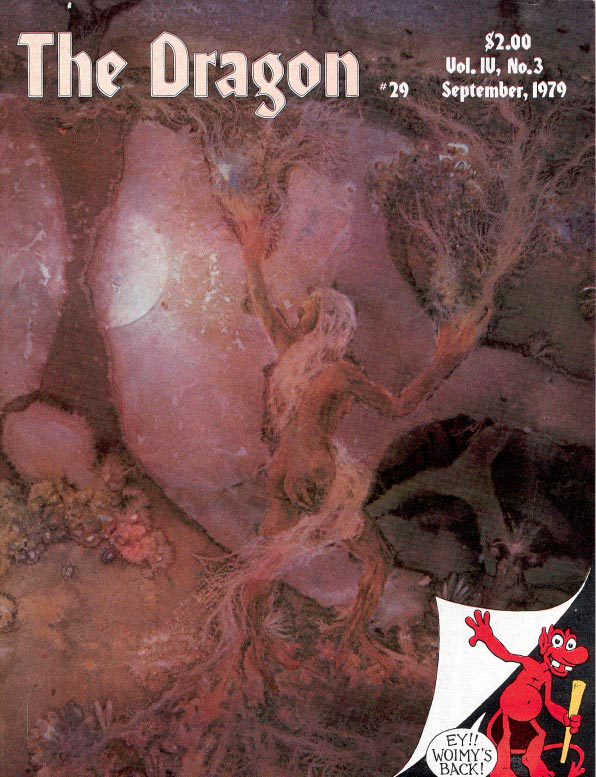
September of 1979, and lots of kids were getting ready to go back to school (and lots of parents were thanking God the kids were going back to school). Maybe the mail brought a few of those kids one last bit of fun before the learning began – Dragon #29.

Note on the cover – not terribly impressive to me, except for that little bit in the lower right-hand corner. Woimy’s back!

What does the “premier magazine of games and gaming” have for us this month?

Kask has a few things about subscriptions to discuss in the opening. First, make sure you address things to TSR Periodicals to get things moving fast. Second, let them know when you’re moving. Finally, when you resubcribe, do it before your subscription ends to make sure you don’t miss an issue. All of these things – almost completely moot in the modern world.

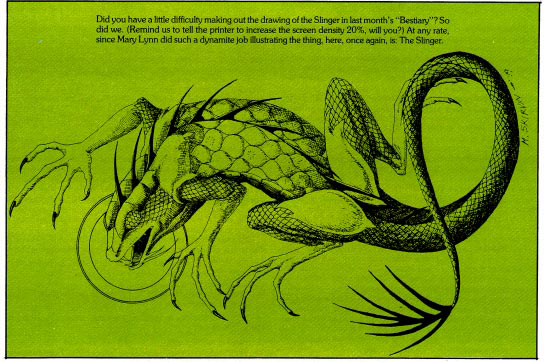
Apparently, this was an issue for clarifications – they had to reprint the image of the Slinger from last month’s Bestiary – they apparently should have told the printer to increase the screen density by 20%. Here’s Mary Lynn’s little masterpiece:

The first article is missing a title, but the TOC calls it “Of the Gods”. Whatever it’s called, its by Craig Bakey and concerns the idea of “campaign gods”. The argument by Bakey is that every campaign should have its own gods and goddesses, rather than just using the mythos in “Gods, Demi-gods and Heroes”. What follows are some guidelines on how to create an original pantheon for your game. A couple points:

1. The power of the gods runs in cycles, so different pantheons can hold sway over the Prime Material Plane at different times, though the other gods are by no means powerless. This is actually a cool idea – different gangs of gods rising and falling in power.

2. Beyond the gods are forces of immeasurable power who have long since lost interest in the universe – i.e. The Old Gods. According to Bakey, there are 24 hyper-physical padrones which manifest themselves as colored jewels of six different disciplines. The concepts of Law and Chaos, and the gods themselves, originated in these jewels.

Note – I love how in the old days, an article that seemed like it was going to be campaign neutral suddenly decides on pretty campaign specific stuff that everyone should use. It’s as though there was still an idea that all D&D campaigns really should be linked with each other, and therefore needed to have a solid foundation underpinning them.

The aforementioned disciplines are:

I – blue gems – abstract religion

II – purple gems – space, dimensions, form, motion

III – green gems – matter

IV – yellow gems – intellect

V – orange gems – individual and intersocial volitions

VI – red gems – affections, personal, moral, religious, etc.

He goes on to describe the basic characteristics all deities should have, and other statistics to define them. Then come the random tables for generating deities – this I like. The main table has a weird entry on it that might come from the digitizing of the magazines, but it covers the basic power level of the deity – from demi-god to “gods of the inner circle” to banished gods and rogue gods. There are tables for determining Armor Class and Hit Points, relations between the gods, alignment, gender, their portfolio, and extraordinary abilities and fantastic possessions. He goes on to present some sample pantheons, which appear to have an alignment factor to them (makes the whole rotating pantheons in power make more sense).

I dig that he includes “Dormamnu” as the god of paradoxes and energy. Ardnha, the “presence of swords and machines” and Quasiman, the goddess of black sorcerers sounds pretty cool as well.

Next is a variant on the Source of the Nile game by the authors, Dave Weseley and Ross Maker (I think). It’s a collection of flow charts that are pretty meaningless without the game rules. Or maybe not – here’s a sample:

Now that I look at them, they might be useful to somebody running a wilderness adventure. In fact, designing some flow charts of my own might be useful.

In the “Fantasy Smith’s Notebook” we have “An Ounce of Preparation is Worth a Ton of Paint”. I always found this to be true when I painted minitures (Warhammer, mostly). A nice primer coat was a must, especially since I sucked at painting a good black undercoat really helped make my minis look way better than they would have otherwise. The article is a good guide to prepping miniatures, using dowels to hold them (wish I’d thought of that), filing them to correct problems with the casting, etc.

An interesting thing that was either an advertisement or a tiny article comes at the end of the previous article, for the Order of the Indian Wars (PO Box 7401, AC 501-225-3996, Little Rock, Arkansas 72217), a group dedicated to studying the American Indian Wars.

The coolest thing – still around! OIW’s website is HERE.

Gary Gygax is up next with “From the Sorcerer’s Scroll”. Here, he introduces “The Half-Ogre, Smiting Him Hip and Thigh”. Here, EGG mentions that he has seen many treatments of the idea, and now he’s wading in with something official – and a warning.

“The character races in AD&D were selected with care. They give variety of approach, but any player selecting a non-human (part- or demi-human) character does not have any real advantage.”

“Consider the various factors which must be taken into account when designing a race for game purposes. Remember that last part, game purposes; AD&D is, first and foremost, a game. Races, just as with classes, must be in relative balance with each other, as well as with the game as a whole.”

Dear old dad

He actually gives some nice design advice on creating character races, and also on why he made the rules he made in AD&D to keep things balanced.

Time to roll up a half-ogre. Half-ogres have the following ability scores: Str 14-18 (use d6, with 5 and 5 equaling 18), Int 3-12 (3d4), Wis 2-12 (2d6), Dex 3-12 (3d4), Con 14-18 (as Str above) and Cha 2-8 (2d4).

Note – I suddenly love the idea of each race rolling different dice for its ability scores, instead of just using bonuses and penalties.

I roll up the following: Str 16, Int 7, Wis 7, Dex 7, Con 17, Cha 3 (or 6 with ogres and half-ogres … so even my own people find me distasteful).

Half-ogres can be fighters (unlimited advancement) or clerics. I don’t qualify as a cleric, so I guess my half-ogre, Zapp Smashigan, will be a fighter. As a half-ogre, I get infravision to 60′, speak ogre, orc and troll (if raised by my ogre parent), a swarthy and dull complexion, dark and lank hair, an average height of 7.5 feet, roll two Hit Dice at 1st level, and then regular progression thereafter. So, as a first level fighter, I roll 15 hit points, plus 3 per hit dice for my high Con, so 21 hit points at first level. Not too shabby, actually. If the others chip in and get me a decent weapon and armor, I can really kick some tail and let the clerics focus on healing the other fighters in the group.

Next, Harold Pitt gives us “Curses: Never Get Even – Get Ahead”. From the second paragraph:

“The curses spoken of here are the ones that the Dungeon Master may lay onto his players as a matter of the course of play, a penalty for acting out of character (alignment), or just as an equalizer for someone who has been exceptionally successful. Or for that character that has just succeeded in demolishing the trap you spent hours agonizing over (frustrating, isn’t it?) and feel that perhaps, somehow, he shouldn’t get away scot free. Remember: never get even—get ahead!”

Harold sounds like a fun DM to play with. “Hmm, Pete’s thief has done pretty well this adventure, even got past that killer trap I set up. Guess it’s time to curse him.”

The advice in the article is sound and common sense – I use it when designing curses in my hex crawls. Basically – figure out what will really challenge a character, and use it. Curses really should be about challenging the players and making the game more interesting. As Harold puts it:

“In conclusion, cursing can be fun. It can become a battle of wits and resources between DM and player.”

Still, I can’t endorse the idea that the DM needs revenge on successful players. No good will come from that attitude.

Time for “Out on a Limb” and some thoughtful letters to the editor. I actually liked this bit in a letter from Marc Jacobs of Allentown, PA:

“Obviously, the feudal class structure of Europe will not work for D&D the way it is usually played. First, ruined castles and dungeons would probably be the property of someone, and adventuring in them would be akin to poaching in the king’s forest. In a magic-intensive world, it would be hard to hide the origins of your wealth.”

Maybe it’s just me, but I don’t see this as a bug, but rather as a feature.

Dig this from the editor:

“To my knowledge, and I’ve been here since there has been a TSR Hobbies, Inc., there has never been an “enemies list” or black list. Not that we don’t take note of who the most vociferous critics are, naturally we do.

I don’t have a bad side; my answers are very much the product of the mood I’m in or how the particular letter struck me at the time. There are dozens of different ways to humiliate people in print that I would never stoop to using.”

Good times. Good times.

Lawrence Schick and Tom Moldvay now come waltzing in with another “Giants in the Earth”. This month, we get Roger Zelazny’s Shadowjack, a 25th level thief, 9th (18th) level fighter and 9th (18th) level magic-user. Also, Jack Vance’s Iucounu, the Laughing Magician, a 20th level magic-user. Along with Iucounu, you get a bevy of Vancian spells: The Charm of Forlorn Encystment, The Charm of Untiring Nourishment, The Excellent Prismatic Spray, Felojun’s Second Hypnotic Spell, etc. I’ll reproduce one of these spells:

Thasdrubel’s Laganetic Transfer or the Agency of Far Despatch: when this spell is uttered, the recipient is bound as if by a hold person spell. A nycadaemon appears (i.e., is gated in), grasps the held recipient and flies him or her either to a point designated by the caster or 10-100 miles in a random direction. Range: 3”. Area of effect: 1 creature. Casting time: 1 round. Saving throw: none.

Idea – everybody picks a character from “GitE” and we hold a Google+ fight club using AD&D rules.

In the “Design Forum”, Doug Green presents “Rewarding Heroism in D&D”. It comes down like so: If a player or a couple players want to act for the entire group in situations where the life or freedom of the entire party is on the line, they attack as though twice their normal level (or apply spell rules as though double level, though they don’t get additional spells), and take half-damage from attacks. All other abilities are +20%.

As Doug puts it, “This rule simulates the effect of adrenalin on a person in a life or death situation and the natural law present in most fantasy stories that good will triumph over evil.”

Doug also gives the point man in the party +20% XP, and anyone praying after sacrificing himself has a percent chance equal to his level of getting a reaction from the gods. Also, heroic acts are worth 1,000 to 5,000 XP.

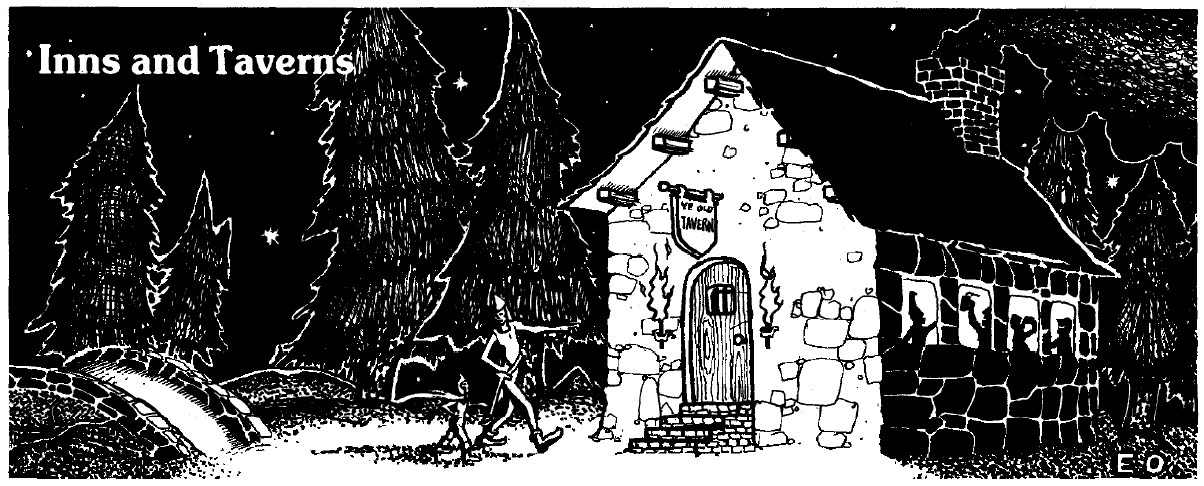
Not sure who wrote this next one, but it’s called Inns and Taverns, and the art is groovy:

The article gives a nice guide to what inns and taverns are (or were), along with percent chance to find on in different sized communities (75% chance in a community with 150 people or less) and what to do without one (beg for lodgings). He notes that in 1453, Paris consisted of three square miles, within which lived 150,000 people and 5,000 inns and taverns.

He also covers prices (5 cp to 5 gp per night – quite a spread), what you get for your money, etc. Good, solid article. I have to reproduce the food prices:

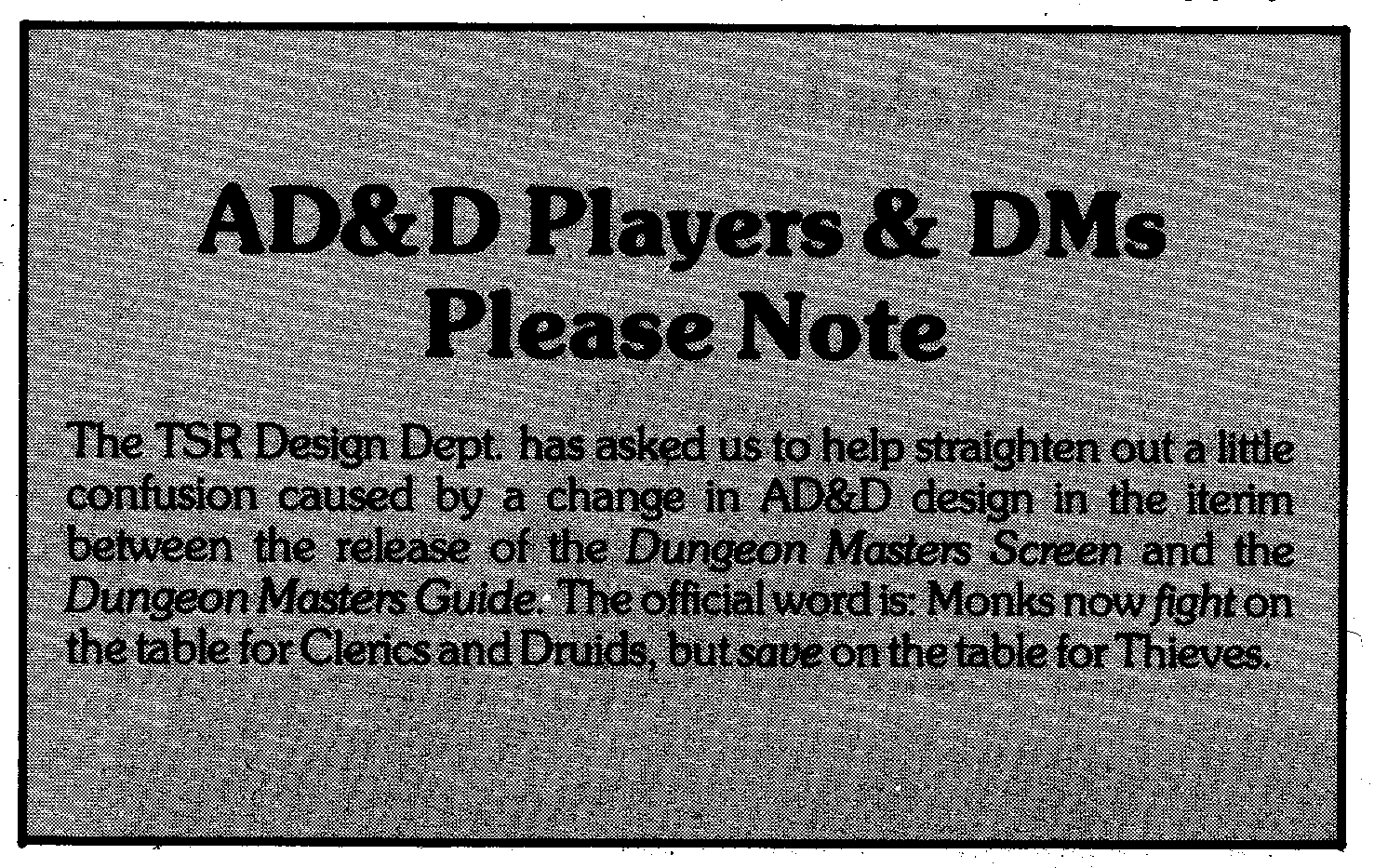
Check out this little inclusion:

So now you know.

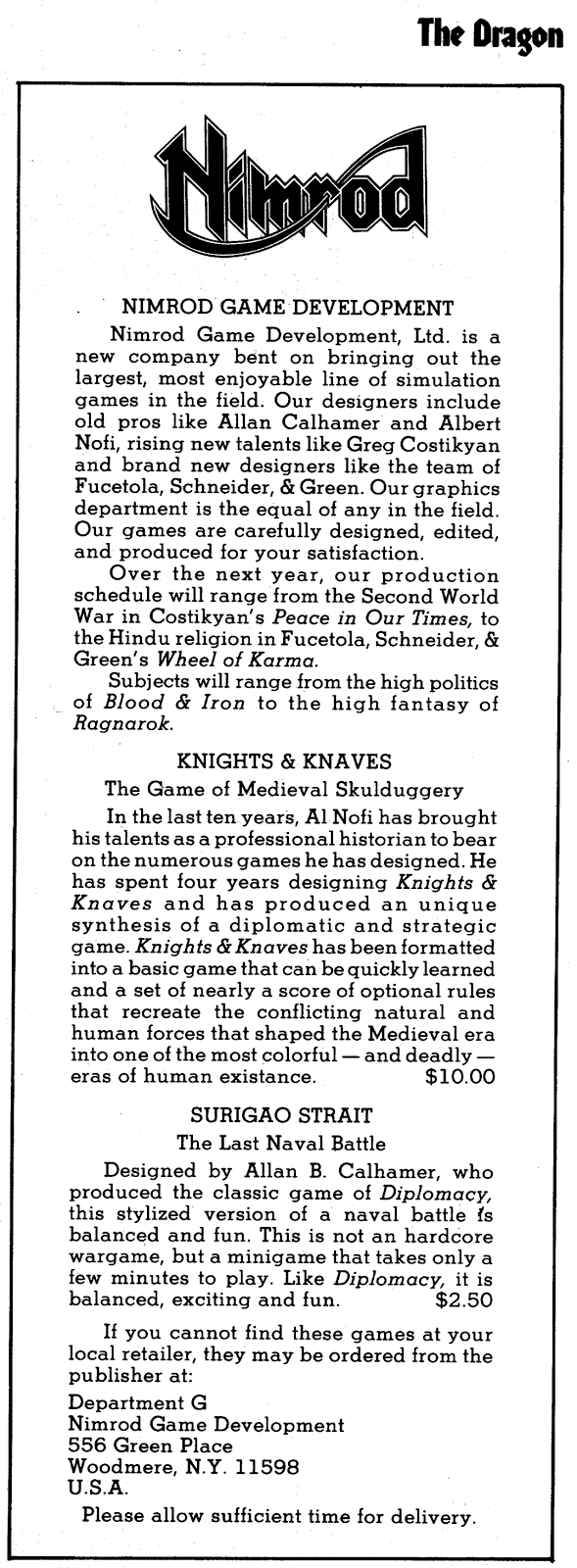
I also enjoyed this ad from Nimrod Games:

A couple links for you – Knights & Knaves and Surigao Strait.

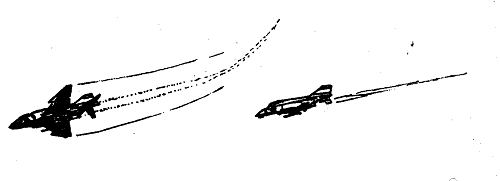
J. D. Webster now gives us a variant – “Air War North Vietnam”. It presents some new scenarios for the game, which I know little about. I do know that my favorite fighter plane when I was a kid was the F-4 Phantom II.

Thomas Holsinger now gives us “Smaller Than Man-Sized Weapons Table”. Simple little article showing weapon damage for weapons as used by gnomes or goblins. Useful table back in the day, probably not as much now.

For those who like costumes and hitting people with sticks, Allen Hammack writes “Anatomy of an S.C.A. Battle – The Sleep War”. This article introduces the ways and means of the Society for Creative Anachronism in terms of their battles.

Paul Karlsson Johnstone now tells us of the “Origins of the Norse Pantheon”. Nice article about where it came from, what it meant, the cults. A good introduction to the topic.

Jerome Arkenberg gives us “The Mythos of Oceania in Dungeons & Dragons”, with sections for Micronesia and Melanesia. I dig the Porpoise Girls (AC 2, HP 50, fight as 1st level fighters). Their ogres can also shapechange into giants, crocodiles, snakes, ospreys, fish, hawks and bears. That’s actually a nice little variation.

How good were these miniatures? FIND OUT HERE!

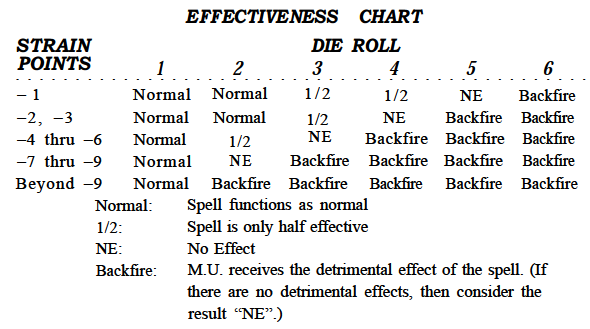
“Strain and Spell Casting” is a nice article by Kevin Thompson. The editor notes that this is the first “spell point” system he has ever liked, possibly because it makes magic-users weaker. It is based on the idea that each spell cast causes strain on the magic-user. The magic-user’s Constitution score determines their “strain multiplier”.

You multiply this by his level to get his total strain points for the game. So, a 5th level magic-user with a 8 constitution has 2 strain points. When a spell is cast, the spell level is deducted from the strain points. Spells from magical implements cause half-strain, while potions cause no strain.

The magic-user can go over his normal daily strain total by consulting the Effectiveness Chart and roll D6.

You also have to roll on the Overstrain Chart:

I dig the system for the most part. It’s pretty similar to what I did in Pars Fortuna. It does seem a bit severe, though, for mid-level magic-users who don’t have great Constitutions.
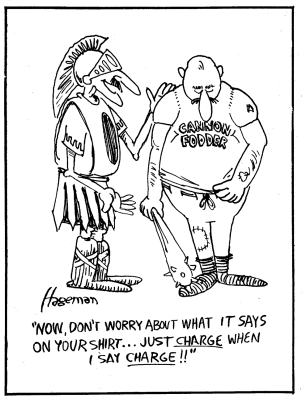
I have a feeling this is my new half-ogre character

Now we get a few quick, short articles (often the best kind) –

“Trained Animals in Dungeons & Dragons” by Robert Greayer. It deals with using wild dogs, war dogs, wolves, dire wolves, winter wolves, worgs, pigeons, ravens, hawks, falcons, golden eagles and bald eagles as henchmen. I would give Zapp Smashigan a bald eagle for a pet, but I think his Charisma is too low. Poor Zapp.

Mike Crane gives us “Aging in D&D”. He has a neat little chart of the percentile chance, at different ages, that a character keeps his Str, Dex or Con as-is, instead of losing a point or two. Simple and clean – I like it.

“Adventures in the Improbable” by Richard Dienst is a weird little story about using the thieves’ guild charts in Greyhawk. I really don’t know what to do with it.

Rick Krebs tells us “Non-Player Characters Have Feelings Too”, a set of random tables to generate personalities for NPC’s.

“Bazaar of the Bizarre” this month is the “Ring of the Necromancer” by Bill Howell and “A Working Design for Heward’s Mystical Organ” by Steven Widerhoft.

The Dragon’s Augury reviews dice by The Armory in Baltimore, new water-based paints (also by The Armory), Reich: The Iron Dream of German Unification by Chaosium, Raiders and Traders by Chaosium, a couple books on tanks and The Tolkien Quiz Book by Bart Andrews (love the cover).

The Dragon’s Bestiary presents “Whiz-Bang Beetles (Coleoptera Conflagratio Amotensia) by John Hageman. These are tiny beetles that are like living bullets. They attack fire sources, and in their hives there is a 75% chance of finding 1d6 ounces of “whiz-bang honey” that might give people heightened speed (like a potion). I like these guys – they would make a good swarm creature in modern versions of the game.

In Wormy by Tramp, we get a nice summing up of what has happened up to this point, including Wormy stomping on dwarves, the arrival of the blue demon from the 8-ball, etc. I would super love to play a game set in the Wormy world – anyone out there game?

And this ends #29! Lots of interesting little articles in this one, and noticeably less war game-oriented than some of the recent issues. Hope you enjoyed it – have a groovy Sunday and an efficient week ahead.
Dragon by Dragon – July 1979 (27)

I just drove in from Cedar City, and boy is my car tired.

Vaughn and Pfundstein – Go watch their play – it is excellent

I use that by way of an explanation for why this post is showing up now, rather than this morning. My daughter and I traveled to the Utah Shakespeare Festival to watch The Taming of the Shrew, starring Brian Vaughn as Petruchio and Melinda Pfundstein as Katherine. It was fabulous. If you get the chance, visit the festival. Now I want to do a Shakespeare edition of Bloody Basic in iambic pentameter. I’m not sure that’s possible, but boy would it be a fun challenge.

And now that I’ve given some love to the USF, it’s time for a review of The Dragon #27, published 36 years ago this month – time for a baby to be born, grow up, and begin yelling at kids born when 4th edition was published to get off his lawn. As he should, the grubby little beggars.

The ads the issue opens up with aren’t new, but I did notice this bit:

Great artifact of the size of the hobby 36 years ago.

The first article in this issue is “Agincourt: The Destruction of French Chivalry”, a game review by Tim Kask. As he writes, “Ah yes, that’s a Dunnigan game.” As in James Dunnigan. As an avid reader of his excellent books How to Make War and The Quick and Dirty Guide to War, this piqued my interest in the game review (I also note that Al Nofi did the historical research – I love his CIC articles at Strategy Page). Kask praises how he makes the game feel like the period, reflecting the fact that the French mostly defeated themselves at Agincourt. He finds it both a very complex game, and a very playable game.

To my delight, the review was followed by an article from Dunnigan himself – “Agincourt: Designer’s Notes”. One extract:

“I would say the single most difficult aspect that I had to incorporate into the design of Agincourt, were the combined arms and doctrine factors that were critical to the outcome of the battle, This is best shown by looking at the rules covering crowding and fugitives and their effect upon morale.”

I note this, because it’s similar to what I try to do with Bloody Basic and articles on fantasy campaigns in NOD (and not always successfully) – how do you interject the feel of the subject you’re covering without making the game needlessly complicated. It brings to my mind the idea of first principals.

Keeping the theme alive, Steve Alvin now writes “The Political and Military Effects of Agincourt on the Hundred Years War”. I love history – majored in it in college – and I know most war game buffs have at least some regard for it, but I wonder how popular articles like this were back in the day. I hope very. I wonder how they would play now?

Get your scissors out, because Jeff Swycaffer‘s article “Elementals and the Philosopher’s Stone” has a full-color cutout. In the article he mentions the four elements of Greek philosophy and the elementals they inspired … and then remarks on the twelve new types of elementals discovered by “a mad philosopher”. These would be the quasi-elementals and/or para-elementals. I can never keep them straight. Swycaffer visualizes the placement of the elementals thus:

“To visualize the placement of the elementals in the scheme of reality, imagine a globe. The equator is divided into eight segments: air, cold, water, moisture, earth, heat, fire, and dry. Thus the circle is complete, with dryness adjacent to air. This is reasonable, as the alchemists of the 1200s depicted the elements in this fashion. Here water is both cold and moist, and both air and fire are dry.

This is merely the plane of the equator, however. At the south pole, evil. Good and evil are the poles of the physical world, and no one element is more evil than good, or vice versa.”

He then goes on to explain how the elements interact with good and evil – these are the qualities, which include pleasure, fertility, beginning, light, ending, darkness, pain and barren. He explains that the “elementals of good and evil” are the demons of Eldritch Wizardry, D&D Supplement III and the angels of Stephen H. Domeman that appears in The Dragon #17. He then goes on to describe, in basic terms, the elementals of qualities. For example:

“ENDING: Appears as a normal human. Closes doors (as a wizard lock), dispels good magic, and curses as an Evil High Priest.”

For those who need to know, the Ending Elemental has 2 HD, movement of 9, does 1d6 damage per hit, has AC 9 (remember, this is old “lower is better” AC), and is friends with air, water and cold elementals.

“From the Sorcerer’s Scroll” this month is by a guest writer – Bob Bledsaw. He created a little something called Judge’s Guild, which produced some of the great little gems of the OD&D era. He covers all the things JG had done at that time for D&D – a nice little bit of horn blowing, but well deserved I think. I liked this quote:

“Ya don’t tug on Superman’s cape, and ya don’t mess around with the play balance …”

Truer words were never spoken.

Next up is an “Out on a Limb”. God, this is classic geek-fight material, and it should surprise nobody that these are the folks that invented the internet. An example, from an extremely long letter to the editor by Ray Rahman of Minnesota. The first paragraph of his letter:

“Upon reading Mark Cummings’ review of Ralph Bakshi’s film THE LORD OF THE RINGS, I became as concerned about Mr. Cummings’ ethics as he was of Mr. Bakshi’s morals. His review of the film begins dramatically with the statement: “Your film is a ripoff! Yes, rip off! I know that the expression has moral connotations, and that you haven’t done anything wrong legally; but I happen to believe that moral obligations often make demands that go beyond the demands of laws. So stay with me for a few paragraphs, and I’ll explain why your film is immoral … Let me start by saying that I’M not an outraged purist.”

Wonderful!

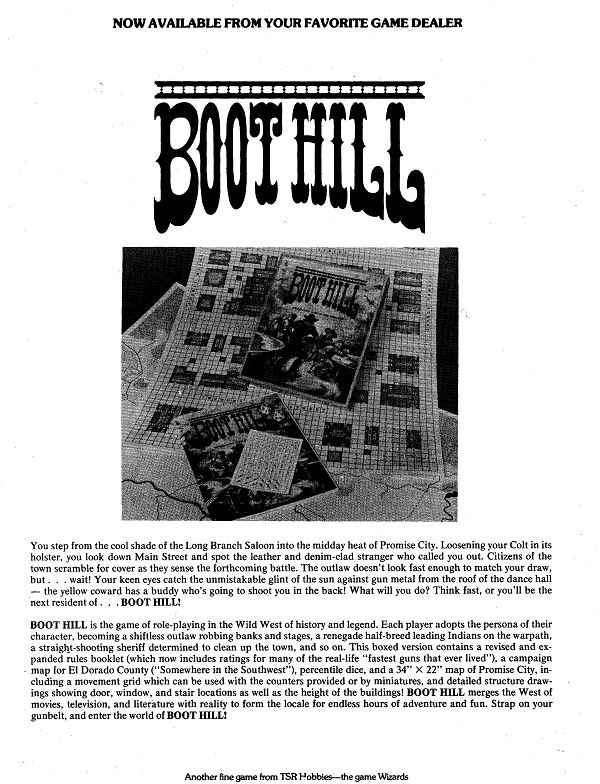
Next up is an ad for Boot Hill, a game I know little about but would love to explore. I’ve been hankering to do a sort of Old West Bloody Basic, but I’m waiting until Grit & Vigor is finished so I can base it on those rules.

Gary Jordan now presents a variant that might delight fans of the recent Marvel movies, “Tesseracts: A Traveller Artifact”. The idea is using these not as a way to confuse mappers (as they had previously been presented to DM’s), but as a boon to the players of Traveller. Really, it comes down to using matter transmitters to move folks around a ship.

Up next is a new cartoon to The Dragon called “The Voyages of Exploration Ship Znutar, A Starship on a Mission of Empire”. I don’t remember this from the era of Dragon magazines I grew up in, so I wonder how long it survived.

Gary Jordan now chimes in with another Traveller article on Star System Generation. This is a scheme for filling hex maps, filling in the presence of planets, star ports, etc.

In the Designer’s Forum, “Divine Right” is covered again (it was TSR’s newest game), by Glenn and Kenneth Rahman (there’s that name again – can’t be a coincidence, can it?).

Lance Harrop now presents “A Quick Look at Dwarves”. This is a long article on how dwarf armies are organized, with an accompanying chart.

Wow – they got into it in the old days, didn’t they. Still, there are lots of great ideas – the dwarven engineers, miners, masons, etc. forming divisions of the army. He adds the following at the end of the article:

On Painting Dwarves: Elite units of dwarves should have white beards (reminds me of the Graybeards units in Warhammer), dwarf armor should be shiny and a mix of metals, dwarves don’t seem to have national colors (“don’t seem” – well, they aren’t real, so I suppose they don’t) but use colors to designate individuals, and whatever you do, don’t make your dwarves too gaudy.

On Dwarvish Tactics: Vanguards always drive towards the dwarf commander, dwarves love to tear into orcs, dwarf morale is very slow to break and dwarves are known to leave the field of battle after their leader is killed, but they do not rout – they just walk off slowly, carrying his body.

The Design Forum continues now with Jay Facciolo writing about “The Emerald Tablet”. This is a miniatures war game published by Creative Wargames Workshop (side note – imagine how many games there are out there that have never been cloned, for good or ill). I love the name. The game was an attempt to make something that was neither too specific or vague, and which incorporated magic into the rules, rather than just overlaying magic atop ancient or medieval warfare. If nothing else, you have to appreciate the cover I found at BoardGameGeek.

It sounds like an interesting take, with each unit in the game begin given one of four orders before the game begins – attack, skirmish, hold or support (another unit). These orders can only be changed during the game by one of the figures representing the players. Interesting idea, and requires a great deal of thought before the game starts. The magic segment of the game requires quite a lot of explanation, and appears to be, if not complicated, then at least engrossing. It even comes with a bibiolography (and a bit of cheesecake)

“Giants in the Earth”, one of my favorite features, comes next. I really need to do something like this myself in NOD – maybe I should let people vote on G+.

This edition includes the following literary giants:

Alan Garner’s DURATHROR (13th level fighter/Dwarvish paladin)

Fritz Leiber’s FAFHRD (20th level fighter/8th level thief) and THE GRAY MOUSER (18th level fighter-thief)

Edgar Rice Burrough’s JOHN CARTER OF MARS (30th level fighter)

Eh – never heard of ’em.

Robert Camino writes “Go Boldly Where No Man Has Gone Before: Expanding Imperium. This is a variant which requires two sets of the game, the boards being connected by eight jump routes which are always charted by the players (whatever that refers to). Love the art!

Great advert comes next, for Tome of Treasures, published by GRP Enterprises of Arlington, VA. The tagline got me “Plumb the depths of the Cube of Time and the Bow of Precognition. Explore the effects on hapless orcs of the Sword of Rout. Gems, jewelry, and 172 brand new, quality magic items are described …”

Jerome Arkenberg now presents “The Mythos of Africa in Dungeons & Dragons. This is one heck of a tricky subject, as treating Africa as though it a single culture is ridiculous. The article presents many gods. For creatures, we get:

“In this category fall: witches, ghosts, were-lions, were-hyenas, and fairies. These are all the same as in the D&D Monster Manual.”

Turns out, we had all the African monsters we ever needed. I have a feeling that either the article was too long and something had to be cut, or the research was just too difficult back in the 1970’s. The article also includes many heroes.

The “Dragon’s Bestiary” presents the Horast, created by Mary Lynn Skirvin. Also known as a “whipper beast”, a very rare creature with a whip-like tail that deals 4d6 damage. This one didn’t make it into the MM, but fear not, for the article ends with this:

“By gracious arrangement with the author of AD&D, Gary Gygax, monsters appearing in this column are to be considered OFFICIAL AD&D MONSTERS.”

So, if you need a monster with a whip tail, D&D has you covered. Officially.

Comic strip time. We have Finieous Fingers (their spelling, not mine), which again includes some nudity of the female variety – D&D was a game for grown-ups, after all.

No, I’m not going to show it this time. Finieous’ butt from the last post will have to suffice.

In “Bazaar of the Bizarre” (the elements are all coming together, aren’t they), Gygax presents the Bag of Wind. Write your own jokes, folks.

Dig the back cover, kids:

Looks like I need to up my game with NOD.

Fun issue, with plenty for D&D’ers and war gamers. Check it out if you can find a copy.

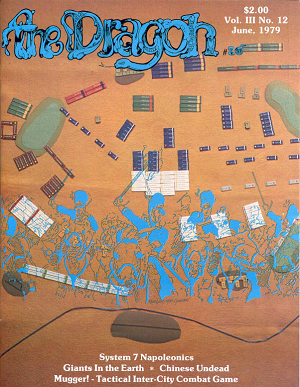
Dragon by Dragon – June 1979 (26)

Two years ago, I was writing a series of weekly blog posts on the old issues of Dragon magazine – something like reviews with a bit of crunch mixed in. And then I stopped. And I don’t remember why.

Well, now I’m starting again. So … journey back in time with me to June of 1979, when the Bee Gees were dominating the charts with Love You Inside Out

Oh – that’s Wanda Nevada. Brooke Shields. Groovy.

Anyhow – into this golden age of entertainment comes Dragon Magazine, Volume III, No. 12 with a kickin’ cover depicting some Napoleonic war game action, and of course much more. Let’s dive right in.

The first thing we’re greeted with is a great full-page Ral Partha advert, noting that “The Little Things Make a Noticeable Difference”. If you’re in my generation of gamers, Ral Partha is just branded into your brain. They were so prevalent in the pages of magazines, and had some great adverts. Honestly, I never messed with miniatures back in the day. I got into the Citadel stuff in late high school and through college, and bought a few Ral Partha minis then, but I really missed the companies hey day. Alas.

On the contents page, we are made aware that this issue marks the beginning of Gay Jaquet’s reign as assistant editor, assisting T. J. Kask, that is. I note this only to point out that TSR appears to be growing.

Another ad now, for the Origins! 79 convention in Chester, Pennsylvania. Do you think the geeks that now trod those halls know the gaming history of the place? Probably not.

https://www.google.com/maps/embed?pb=!1m0!3m2!1sen!2sus!4v1436714251332!6m8!1m7!1scz6zKvyptBHn3Dg5DGMjQA!2m2!1d39.860951!2d-75.353605!3f295!4f0!5f0.7820865974627469

Looks like a cool college – love the brick work. I’m from Las Vegas – we live in a world of stucco and sandstone, so the brick stuff always impresses me. What can I say – I’m a cheap date.

Next, we have a status update on Gencon XII, and a notice that they’re looking for judges and events for the con. We also get a full con schedule, some prices on back issues of The Dragon (back issues are $2.10 a pop, or $6.88 in today’s dollars. Not a bad price).

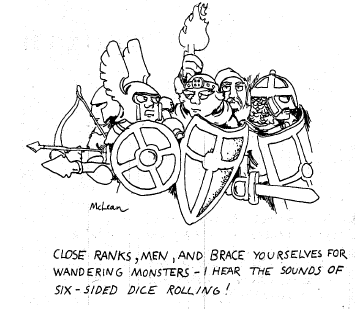
Oh yeah – and a McLean cartoon involving the confusion between rocs and rocks. I love watching his art style grow in these early issues. There was some solid young talent in gaming back in the day. I wonder what they paid him per cartoon?

Now we reach the first article – “System 7 Napoleonics: Miniatures Meet Boards”, by Kask. I’m not going to delve too deeply into the article itself, which reviews the game System 7 Napoleonics by GDW, which uses cardboard counters in place of miniatures, and is thus cheap compared to using the lead, but I will point this out:

“The problem with establishing a campaign in a college club, whether it be D&D; TRAVELER, or a Napoleonics, is one of continuity. Each semester, some of the stalwarts say goodbye and depart for “the real world.” This can be especially traumatic if one of those departing owns the French Army, or what passed for it in terms of collective club figures.”

Funny to think how wrapped up the game used to be with issues like this. I suppose it still goes on to this day – maybe some college kids could chime in in the comments below and let us know if they still deal with this. Personally, I’m an old fart, and I do my gaming on G+ these days.

This article is followed up by another article on System 7, by Rich Banner (the designer), called “Necessity is the Mother of Innovation”. If you were into this new game, this was your lucky month, because this article is followed up by a Q&A with Banner.

Speaking of GDW (or Game Designers’ Workshop), we are now treated to a full page ad for their new expansion for Traveler, Imperium – Empires in Conflict: Worlds in the Balance. Great title.

From the Dungeon Hobby Shop in Lake Geneva (no longer there, I’m afraid), we have an ad for 4th Dimension, the Game of Time & Space, produced by TSR (sort of – click here for more). Apparently, you play a Time-Lord (does the hyphen grant immunity from BBC law suits?) commanding an army of Guardians, Rangers and Warriors in some sort of board game battle.

Next we get back into some D&D goodness, with “Giants in the Earth”. Great series of articles, giving game stats to literary characters (why don’t I do that in NOD?). This is a particular goody, because we get Jack Vance’s Cugel the Clever (14th level thief, Str 15, Int 18 (56%), Wis 13, Dex 18 (93%), Con 15, Cha 16 – sounds like Vance was cheating on his dice rolls when he rolled up Cugel, and what’s with the percentiles – I thought they only did that with Strength scores in AD&D?), Karl Edward Wagner’s Kane (30th level fighter, 20th level magic-user, 14th level assassin – how many XP would that take?) and Talbot Mundy’s Tros of Samothrace (15th level paladin). I love Cugel, I’ve heard of Kane (but never read him), but Tros was new to me.

Ah – this is included:

Note: For the game purposes of these heroes: Dexterity 18 (00) gives +4 on Reaction/Attacking, -5 Defensive adjustment and three attacks per round for high level fighters. Constitution 18 (00) gives fighters +4.5 per hit die bonus

Oh, and Judge’s Guild (hallowed be their name) was hawking the Treasury of Archaic Names by Bill Owen. Struggle no longer for heroic character names!

Up next, “What of the Skinnies?” by James W. S. Marvin, a Starship Troopers variant. Not going to lie – caught a bit of the movie, never read the book, have never laid eyes on the game they’re referencing here. This might be the greatest article on the topic ever, and I’ll never know it. Moving on.

Edward C. Cooper gives some tips on “The Placement of Castles” in Lord and Wizard. Article aside, L&W sounds like a pretty cool game: “Mighty, magical holocausts, awe-inspiring Dragons, weird and terrible monsters, military battles on a grand scale. Which of the combatants, Order or Chaos, shall win? And can the forces of Neutrality maintain the precarious balance of power . . . An exciting, fast moving game of movement and combat in a fantastic world, where skill and strategy will decide the winner.” Another board game – the RPG’s are still in their infancy, after all, and at this point most RPG’ers have probably come to the game from board games and miniature war gaming. Makes sense.

Joe Curreri writes “35th Anniversary of D-Day Remembered”. There were lots more veterans of that day alive at the time, and their kids were the ones playing all these silly games. The page also has an ad for Lyle’s Hobby & Craft Center in Westmont, Illinois. Sadly, also no longer there.

In the Design Forum, James McMillan writes about “The Solo Berserker for William the Conqueror-1066. This article presents solitaire rules for the aforementioned game, with a little history on the berserkers. He includes the note that Eystein Orre, one of Harald Hadrada’s men, was called “the Gorcock”. If you’re reading this and play a barbarian or berserker in some game, please consider renaming your character “the Gorcock”. For me. For Eystein. For America.

Next up, David Sweet presents game stats for “Chinese Undead”. We have stats for Lower Souls, Lost Souls, Vampire-Spectres, Sea Bonze, Celestial Stags and Goat Demons. Boy, stats were simple in those days:

Also this:

Look out!

Fantasy 15s has a full page ad for 15mm miniatures allowing you to “re-create the mass battles of Middle Earth – at prices you can afford!” I wonder if there’s a source for cheap men-at-arms so fighter lords can do the same thing. The reproduction ain’t great, but the art in the ad is pretty cool …

The next article includes Boot Hill additions, revisions, and triva (!) by Michael Crane. The have a great “Fast Exact Hit Location Chart” that could be useful for duels, but also just combat in general (especially missile combat):

And, because it wouldn’t be a real D&D mag from the old days … “Another View of the Nine-Point Alignment Scheme” by Carl Parlagreco. This article tries to lay out what you can and cannot do with each alignment. Helping people is something Good characters do, apparently, while trusting in organizations is something for Lawfuls. Here are a couple samples:

Chaotic Good … will keep their word to other of good alignment, will not attack an unarmed foe, will not use poison, will help those in need, prefers to work alone, responds poorly to higher authority, and is distrustful of organizations

Neutral Evil … will not necessarily keep their word, would attack an unarmed foe, will use poison, will not help those in need, may work with others, is indifferent to higher authority, and is indifferent to organizations.

I think this is actually a much more useful way to look at alignment that getting philosophical with it, especially for people new to the game. Of course, you need a reward/penalty mechanism with alignment to make these strictures matter.

Next is Kevin Hendryx’s “Deck of Fate”, with illustrations by Grey Newberry. This is a great magical tarot card deck. Characters draw cards, and get magic results based on what they draw. For example:

II – Junon – The Goddess: No effect for non-clerics. For clerics, permanently boosts their Wisdom score to 18 and gains use of one spell of the next higher level.

In other words – it’s a pretty powerful magic item – an artifact really. You could probably make one heck of a quest into a band of adventurers having to retrieve all of these magic cards.

Rick Krebs now provides “D&D Meets the Electronic Age”. Boy, they had no idea. Dig it:

Over the years access to photocopiers and mimeograph machines have aided many Dungeon Masters in copying maps, charts and even publishing their own zines, all to the expansion of their campaign. But, the recent electronics explosion has now brought another tool to those DMs fortunate to have access to them: the micro-computer. We were one of those fortunate groups to gain the use of a 4K (4,000 bit) memory, BASIC speaking microcomputer.

Charles Sagui now writes “Hirelings Have Feelings Too”. It’s a short article that provides some guidelines for paying hirelings to keep them around. According to Charles, hirelings should be payed two years salary in advance, plus a share of the spoils – either an equal share, or a percentage. Non-humans, he says, will not hire on for salary alone – except orcs – but will also demand to be supplied with equipment and weapons to go into the dungeon. Elves, he says, don’t like to go into dungeons as hirelings – they like fresh air and trees too much. They don’t care much for gold, but they will demand a fine cut gem or magic item + 15% of treasure. Dwarves can be greedy at times – they want four years salary and 15% of treasure. And if you try to give a +3 returning warhammer to somebody else, there’s a 65% chance the dwarf will try to steal it. Orcs will go in for one year salary and 2-5% of treasure, and will only work for chaotics. They are prone to run away when confronted with a difficult fight and have a bad habit of killing their employer in his sleep and stealing all his stuff. I guess turn-about it fair play in a dungeon.

Charles also says that hireling NPCs will only go into the dungeon once – after that, they retire to blow their hard-earned gold on “strong drink and their favorite vice.” Once their money is gone, they might go back in with the PC’s – and if the PC’s paid well last time, they’ll be more loyal. Loyalty ratings for hirelings aren’t used much these days, but they were an important system in a time when hirelings and henchmen were the norm for D&D.

Michael Crane also contributes “Notes from a Very Successful D&D Moderator”. This is a chance, he says, for the moderators (i.e. game masters) to share their tips and tricks after many players have shared ideas for beating dungeons. The article is pretty much about one-upmanship between the DM and the players. A nice historical piece, from when the game was (and was supposed to be) a competition between the DM and the players.

Gary Gygax now chimes in with his “From the Sorcerer’s Scroll” with “D&D, AD&D and Gaming”. The article discusses the origins of role-playing games, of fantasy war gaming, and of role-playing within fantasy war gaming. It’s a nice retrospective, and Dave Arneson’s innovation of giving players individual roles to play is mentioned. Gygax also takes pains to explain that AD&D is a different game than D&D – not an expansion or revision. As Gygax explains:

“Where D&D is a very loose, open framework around which highly imaginative Dungeon Masters can construct what amounts to a set of rules and game of their own choosing, AD&D is a much tighter and more structured game system.”

Which also explains why I like D&D better than AD&D. I like my games loose and imaginative. The article lays out the future of AD&D. And then this towards the end:

“For those of you who wondered why I took certain amateur publishing efforts to task, it was because they were highly insulting to TSR, D&D, this magazine, and myself.”

Nerd fights. They never end.

Kevin Hendryx now presents a variant game for D&D in the modern era called “Mugger!”. Welcome to the 1970’s. Technically, it is Mugger! The Game of Tactical Inter-City Combat, 1979. Each player plays a mugger, gaining experience for each successful mugging and gathering loot. The goal is to “… amass as large a horde of experience points as possible while carrying out one’s crimes and eventually gain a seat in the U.S. Congress …” The times, they ain’t a changin’ all that much, are they?

Random encounters include 1d2 cops on their beat, 1d3 roving squad cars, 1d6 tougher muggers, 1d8 street gangs, 1d20 Hare Krishna fanatics and 4d6 stray dogs.

Oh, and you pick up 1,000 XP for stealing 10 kg of plutonium.

Here’s the level chart:

It’s actually a pretty long article, and though tongue-in-cheek would probably be fun to play one night with some friends. It strikes me that the old city map from Marvel Super-Heroes would come in handy on this one.

Lots of articles in this issue. Next is “Birth Tables and Social Status” for Empire of the Petal Throne, by G. Arthur Rahman. EPT was still a major component in gaming in this period, and its generally featured in every issue of The Dragon. It provides a very long table for generating birth and social status, and this translates into skills, spells and the like for the character. Looks good to me.

Apparently, Grenadier was pushing their new line of licensed Gamma World miniatures with a full page ad. You can see some unpainted models HERE and some painted ones HERE.

Len Lakofka’s “Bazaar of the Bizarre” is “Blueprint for a Lich” in this issue. This is an in-depth article on how high level magic-users and clerics become liches, including a recipe that involves 2 pinches of pure arsenic and 1 measure of fresh wyvern venom (under 60 days old). Don’t mix this one up at home, kiddies.

The would-be lich then drinks the concoction and rolls the D%

1-10: No effect whatsoever, other than all body hair falling out
11-40: Come for 2-7 days – the potion works!
41-70: Feebleminded until dispelled by dispel magic. Each attempt to remove the feeblemind has a 10% chance to kill the drinker if it fails. The potion works!
71-90: Paralyzed for 4-14 days. 30% chance of permanent loss of 1d6 dexterity points. The potion works!
91-96: Permanently deaf, dumb or blind. Only a full wish can regain the sense. The potion works!
97-00: DEAD – star over … if you can be resurrected.

First – I can actually use this in the online game I’m running.

Second – awesome random table for generating liches – they’re either a bit paralyzed, could be blind or deaf, or maybe are completely normal. Side-effects are a good idea for major potions.

Gary Gygax now provides tables for “Putting Together a Party on the Spur of the Moment”. This generates a PC party quickly, with tables and rules for generating quick ability scores, level, armor, weapons and magic items. I think this made it into the DM’s Guide. Which DMG you ask – come on, there’s really only one.

Thomas Holsinger provides a “Strength Comparison Table”. He provides a strength table from 0 to 18/00, with monster equivalents, hit bonuses and damage bonuses. It’s inspired by Dave Hargrave’s Arduin Grimoire II. FYI – Leprechauns are stronger than Brownies, and Pixies are stronger than Leprechauns, just in case you were going to run an all-fey remake of Over the Top. (Google it!)

Jeff Neufeld now provides a review of a play-by-mail game called Tribes of Crane (which is mis-written as Tribes of Tome in the first sentence). We also have reviews of Ice War. (Soviet/US confrontation), Mercenary (a Traveller book), The Battle of Monmouth and Grenadier Figure Packs and a very long review of Battle Sphere with lots of cool illustrations.

The Dragon’s Bestiary (formerly Featured Creature) presents the barghest, so you now know which decade to blame for those little bastards.

Next comes “The Adventures of Fineous Fingers, Fred & Charly”.

Who says old school fantasy is all about scantily clad females?

Great article title by Rod Stephens – “The Thief: A Deadly Annoyance”. Amen to that. He laments the misuse of thieves in dungeons, because they’re really meant for urban environments, where they can steal from high-level NPC’s and other players – because PC’s have more money than just about anybody in the game. He isn’t wrong.

We finish up with some full page ads for GenCon XII, TSR’s new game Divine Right (notes that T.M. Reg. has been applied for – so don’t try anything funny) and Space Gamer (subscribe to get a free game – Ogre, Chitin I, Melee, WarpWar or Rivets).

A packed issue, and a reminder that The Dragon was a full-bodied gaming magazine at the time, and not just TSR’s house organ.

Hope you enjoyed the review – have a happy Sunday and a great week ahead.
Notions on Potions

Potions are one-use magic items that need to make contact with the skin in order to deliver their effect, which is usually based on a magic spell. Simple, right?

By and large, potions show up in treasure hordes in the form of edible concoctions (referred to as potions) and oil. In either case, they are presumably kept in little bottles that hold maybe a fluid ounce of liquid. I wouldn’t be surprised if more than a few referees even come right out and tell their players that they’ve found a potion.

Potions do not have to take the form of little bottles of liquid magic, though. And even when they do, they do not need to be distinctive from other common liquids. Keep your players guessing with a few of these alternate or variant forms for magic potions and oils:

Acid – something must be burned to release the magic

Beer – magical beers work well with rustic folk, like halflings – naturally one can use magical ales, stouts, etc.

Blade – a small blade, it must be run across the palm and draw blood – the mixture of blood and steel releases the magic worked into the blade

Brackish water – just because it’s disgusting, doesn’t mean it isn’t also magical; it will force players to check out those seemingly useless puddles on dungeon floors

Candies

Candle – this could be a delayed release version of a potion, or a potion that affects a group of people (say a potion of invisibility sphere, for example); could also require a person to burn themselves to release the magic or perhaps the candle must be snuffed to release the magic

Cheese – or any dairy – “From enchanted cows …”

Chicken – gruesome, perhaps, but the chicken or other small animal must be snuffed out to release the magic – perhaps appropriate for the temples of evil cultists

Cord – perhaps it must be cut, or maybe it must be tied into a bow to release the magic

Cosmetics – lipstick, rouge, eye shadow – could be embarrassing for rugged adventurers; with lipstick, one person might have to put it on, but another might have to kiss them to release the spell, which then affects them both

Cracker – not the biscuit, but the Christmas favor; several crackers that must be pulled simultaneously by a group could be even better

Dye – the dye must be spilled on an item or one’s skin to release the magic, and the stain remains long after

Eggs – they must be cracked open, releasing a poof of foul-smelling gas that is sniffed to gain the benefit

Elixir – just a variant term for potion

False mustache – the mustache must be applied, and lingers thereafter until shaved off

Firecracker – see the cracker above; especially good for an Asian-themed campaign or dungeon

Flower – pluck a petal to release the magic; this could also work for a multi-charge (but not rechargeable) magic item

Fortune Cookie – the magic is released by cracking the cookie, and if the spell released is a divination, maybe the knowledge to be delivered is on the slip of paper inside

Glass sphere – not unlike the egg above, though perhaps not as disagreeable to the nose; could also just be a stone ball that is struck against something
Grease – a variation on oil, but might have the effect of making a person slippery

Horn – one blast from the horn releases the magic; the horn thereafter is either inert, or it disappears; the same could be done with a trill of a flute or by striking a tuning fork

Image – not a treasure item, but a magical image could be imprinted on a person’s eye and hidden beneath an eye patch – when the patch is risen, the image appears before the person and the magic is released

Lamp oil – like the candle above

Liqueur – Brandy of Invisibility, Scotch of Heroism; carries with it a chance of becoming intoxicated

Locket – the magic is hidden inside, and released when opened

Match – must be struck to release the magic

Mud – another variation on oil; remember when you twisted your ankle and your coach told you to rub some dirt on it and walk around? Same principal

Needle – a finger must be pricked, and perhaps the magic only works on a particular finger

Nosegays and asphidity bags – one strong sniff is all it takes – maybe the scent ends when the duration of the magic ends, or maybe it lingers

Paint – maybe applied to the body, or maybe to a surface (for a dimension door effect, for example)

Perfume – in this case, not all that different from oils – make the barbarian smell like lilacs if he wants the potion of healing!

Pies – after all, you’ve seen how quickly a Hostess fruit pie can take down a super villain

Pills – the higher the level of spell, the bigger the pill

Plaster – in Elizabethan times (and I think beyond), small plasters in the shapes of stars, crescent moons, etc. were applied to the face as beauty marks; perhaps these must be applied, or perhaps they must be ripped off to release the magic

Powders – inhale them, swallow them or powder your face with them

Riddle – when it is solved, the answer releases the magic

Salve – apply generously; brings to my mind the Three Stooges bit with limburger cheese; also unguents, creams and lotions

Secret – not a treasure item, but a magic-user could write a secret message on a person’s back with magical inks that releases the spell when another person reads it

Soap – you must bathe with the stuff to get the effect; this conjures up granny women and their lye soap to me

Stick – the stick must be snapped in two to release the magic

String – could be for a bow or for a musical instrument – must be strung and then plucked, at which point the magic is released and the sting snaps

Syrup – perhaps it must be mixed with carbonated water and then consumed

Tinctures – an alcoholic extract of some plant or animal, not terribly different from a potion, though maybe the tincture is applied to the eye as a drop

Tobacco – or other potent weeds, of course; must be smoked to release the magic

Tune – a slip of paper with a seemingly harmless tune, singing or whistling or humming it releases the magic; unlike a scroll, anyone could release this magic and it cannot be transferred into a spellbook, but like a scroll it only works once

Tonic – just a variant term for potion

Wafers – and cookies, biscuits, breads, etc.

Wine – many wines were spiced in the old days, and one could imagine such a preparation having arcane applications as well; or perhaps the grapes are enchanted while on the vine

Boxes and Chains

A couple magic items that popped into my head this weekend …

Bento’s Beneficient Box
Bento’s Beneficient Box appears as a simple wooden box, about 6 inches long, 4 inches wide and 3 inches tall. Each time it is opened, it is filled with one meal’s worth of food, the exact contents being random.

1 – Human meal – Tard tack and salt pork
2 – Dwarf meal – Thick gruel that tastes of dark, bitter ale, salty crackers
3 -Elf meal – Thin wafers (taste of vanilla and daisies) and a light salad
4 – Halfling meal – Meat pie and honey cakes
5 – Gnome meal – Mushroom stew and nutty cheese balls
6 – Orc mean – Grubs (still alive) soaked in bacon grease, something akin to pork rinds

The food is healthful and free of disease, but those who partake of it must pass a Fortitude saving throw (save vs. poison) or suffer the following side effects:

Human meal – +1 bonus to saving throws, inability to run away from a challenge for 24 hours

Dwarf meals – Knack for noticing stonework, become irascible and ill-tempered for 24 hours

Elf meals – Knack for noticing secret doors, become intolerably arrogant and snobby for 24 hours

Halfling meals – Knack for moving silently, become obsessed with food (consume double rations) for 24 hours

Gnome meals – Ability to speak with burrowing mammals, become an annoying practical joker and punnster for 24 hours

Orc meals – Knack for survival, become incredibly reckless and stubborn for 24 hours

Daisy’s Devious Chain
This item appears as a simple daisy chain that has been magically preserved. It is impossible to unravel the chain, and saves vs. damage as an adamantine item. The wearer of the daisy chain (helmets must be removed) gains magic resistance 5%, can discern creatures that have changed shape or that are capable of changing shape (such as lycanthropes or doppelgangers) and leaves no tracks in the wilderness. If the wearer of the daisy chain engages in battle with animals (not magical beasts), plant monsters or fey, the daisy chain animates and attacks the wearer. If fighting animals, the daisy chain becomes a constrictor snake; if fighting plants it becomes three assassin vines, and if fighting fey it becomes animated chains (per medium animated object). In all cases, the monster gains a free attack due to surprise (unless this has happened before, of course) and attacks with a +2 bonus to hit in the first round of combat. After the monster has been defeated, or after it has killed its wearer, it turns back into a daisy chain.

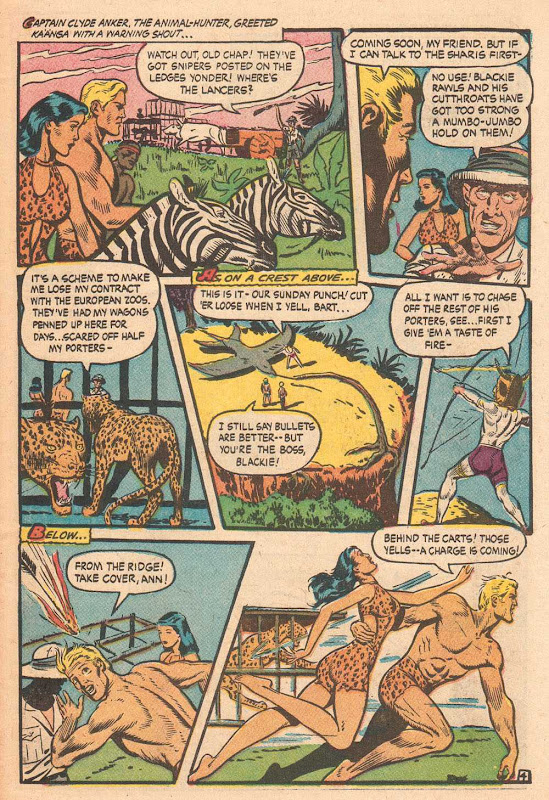
Will Kaanga Rue the Day He Met Bwana Black-Jaw?

See what I did there? Kaanga. Rue. Yeah – spent more time on the title than the rest of the post. As always, a hearty thanks to the Comic Book Catacombs for posting this story. Away we go …

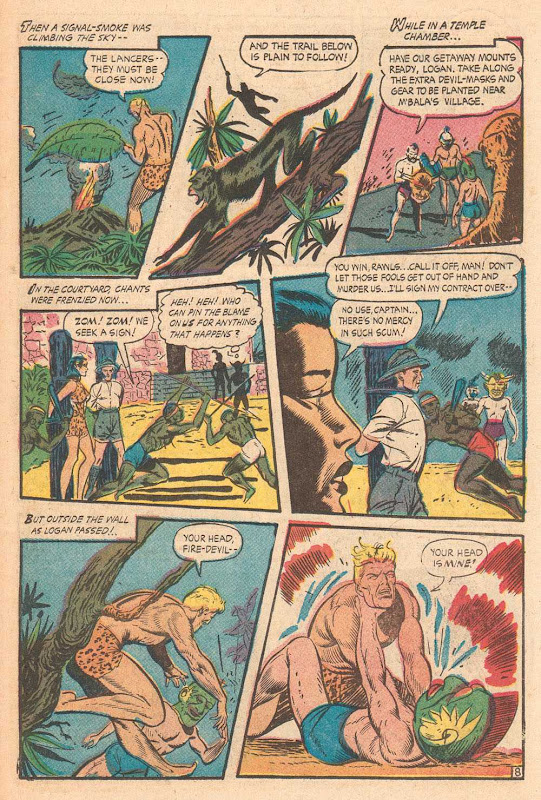
Right off the bat, I defy you to figure out what the @#$#%$ is going on. The story reads like they removed every other panel. We start off with the finest jungle comic book poetry ever written (“Devil-Devil Wind”, because the benighted love using the same word twice in a row to provide emphasis).

First, Ann watches Kaanga spear a panther in the chest. Fair enough – the predator might have had is coming. Next, she asks why they are stopping while Kaanga seemingly glues his canoe back together. Stopping when … why … where are they … what? Finally, Kaanga smells a guy in the forest, gets pissed and picks up his bola. [Note, Kaanga has a bola, so he’s officially playing by the Companion rules].

The story doesn’t get much clearer here. Because a man riding an antelope* doesn’t see Kaanga hiding behind a plant, his guilt is proven. In response, Kaanga does the only responsible thing – he throws a bola at him and then threatens him. M’bala now mutters something incoherent about white men, fire-eaters and demons (could be the blow to the skull he just received from those rocks) and Kaanga responds that, yes, he knew it all along. Knew what all along?

* Yeah, even my favorite thing – people riding animals that God and nature have deemed un-ride-able doesn’t rescue this stinker. Alas!

Kaanga and Ann now mount their zebras (awesome, but, no, still not enough) and head to the village, where the villagers send them to the Valley of Leopards (probably because they don’t want the Aryan with the itchy finger and doped eyes anywhere near their kids).

We close with a very lost toucan – perhaps on his own search for colorful, fruity breakfast cereal.

“Bones of a lost temple” is good, I’ll admit that. Might use it myself one of these days. As a long-time fan of Jonny Quest, I have to nod approvingly at “AI-EEE!” being used not once, but twice on the same page.

Ah, the plot thickens. Blackie Rawls wants to screw up Capt. Clyde Ankers contract with European zoos! The fiend! In the last panel, Kaanga’s hurry to save Ann from the arrow causes him to inadvertently snap her neck. Oh well – time to find a new henchwoman!

See – tribesmen mounted on antelopes and zebras killing in the name of Flame God. This really should be something wonderful. Pity. One thing does inspire me though …

Drum of Command: This item looks like a large bongo. When struck, all who can hear the drum must pass a (Will) saving throw or be whipped into a frenzy (per the barbarian’s rage) and attack whomever the drummer indicates for 1d6 rounds. Fear effects counter the effect of the magic drum.

The giant flaming bird-glider is a nice touch. Those contracts are as good as broken! Oh Blackie, you scoundrel!

See “Then the flame-kite crashing as M’bala’s treachery saw a chance –” is not a sentence. Damn close, but not a sentence.

Nevertheless, Kaanga takes one to the dome and out he goes. The kite explodes, the panther escapes back into the jungle (plot point, I’m thinking) and Ann and Capt. Clyde are taken prisoner.

So, is Blackie freeing the animals out of a sense of kindness?

So, Blackie has given his minions a false sense of confidence in themselves while ruining zoo contracts. I just don’t know …

“A savage surge of bull-ape’s might …” is another fantastic line. We now finally know what the heck was happening in the first panel (it was a preview!). We also now know that Kaanga’s war cry is “Haa-Ree!”. Please work that one into your next game for me. Thanks!

Kaanga uses a signal-smoke (or, if you’re 99% of English speakers, a smoke signal) to signal the lancers and heads off on the trail of the bad guys. Spider-Man shows up in panel two, chasing a monkey, and then we’re looking at the lost temple of the fire gods, one of whom must be called Zom. Again, I really should be enjoying this more than I am.

Blackie brags about the fact that his plan is so intricate and clever that they’ll never pin it on him. Pin what on him? Who the $%@#$% hell knows, though it is worth mentioning that everyone involved in the story is already 100% aware that he’s behind it all. I guess the lack of evidence will be important in the Superior Court of Jungle Law.

And then we find out just what Blackie Rawls is after. He wants Capt. Clyde’s contract. That’s it. That’s the whole dang caper. Tribal war, murder, etc. for a zoo contract. No diamonds, no King Solomon’s Mines. A zoo contract. The stuff legends are made of.

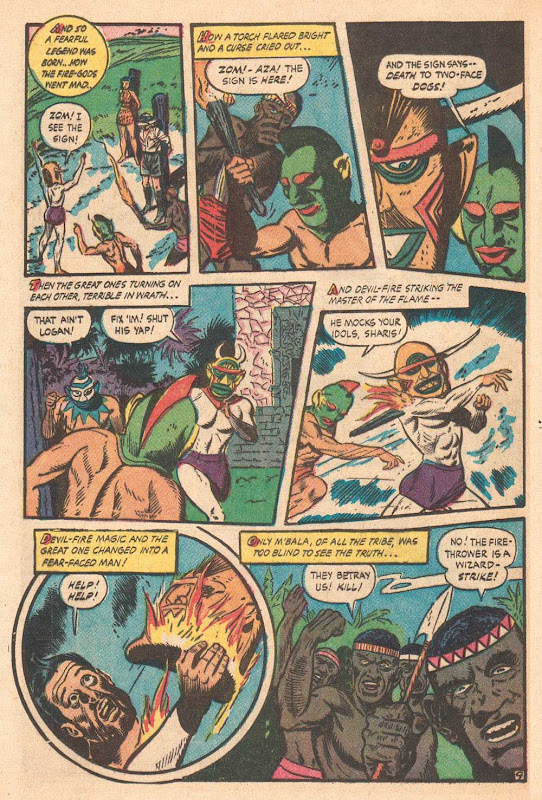
“Your head is mine!” Really sums it all up, doesn’t it. I take it back. Forget the war cry. In your next game (this week, this weekend, whenever), please make sure you yell “Your head is mine!” while attacking at least once. Maybe twice.

I like the last panel.

Angry Dude: “They betray us! KILL!”

M’bala: “No! The fire-thrower is a wizard – strike!”

Apparently M’bala is still aiming for better working conditions and a pension plan.

And so we come to the end of our tale. Kaanga punches M’bala in the face, the fire gods ride off on zebras, only to be killed by the lancers (who ride bog-standard horses – how boring), Ann is released from her bonds (say what you will about the comic, Riddell could draw one heck of an Ann), and Kaanga throws a patronizing parting shot to the natives. We can only pray they’ll kill him in his sleep one night.

And what did we learn from all this? Absolutely nothing! Thanks boys and girls … more inanity from the Land of Nod tomorrow.

Dragon by Dragon – August 1976 (2)

August of 1976 – A month after the bicentennial, and Marvelites were grooving to such titles as Planet of the Apes, The Champions and Black Goliath, the Seattle Seahawks were playing their first game, Big Ben breaks down in London, Viking 2 enters orbit around Mars, the Ramones make their first appearance at CBGB, and The Dragon’s second issue hits the stands. So what did the gaming geek of 1976 get for his money?

John M. Seaton devises a procedure for “monkish” promotional combat (i.e. knock off the master to assume his level). I love this kind of thing, and given the recent popularity of FlailSnails Jousting, I wonder if there isn’t a market for FlailSnails Monkish Combat.

The procedure would be similar – write up 6 rounds of combat, denoting your strike, kick, block or other maneuvers, and then we see where it goes.


Lots of fiction in this issue.

The second installment of Gygax’s Gnome Cache is in this issue. I’ll freely admit this here – I almost never read the fiction in Dragon. I probably missed out on something.

Speaking of fiction, Jake Jaquet gives us the conclusion to “Search for the Forbidden Chamber”. Didn’t read this either.

Gardner Fox (you might have heard of him) has a short story in this issue called Shadow of a Demon which is covered very capably at Grognardia.

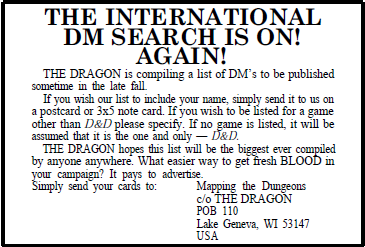
Another installment of “Mapping the Dungeons”, wherein DM’s of the 1970’s try to hook up with players via The Dragon. St. Louis appears to have had a surplus of DM’s looking for players – 8 of them in this issue.

Some dude named Paul Jaquays was running the Spring Arbor College Dungeoning Society in Spring Arbor MI. Wonder if he ever amounted to anything.

Through the magic of Google, I found the following DM’s online:

Keith Abbott of Muskegon MI

Michael Dutton of Mountain View CA might have done some art for WOTC – could be a different guy

Bill Fawcett of Schofield WI kinda founded Mayfair Games

Karl Jones – could be this guy?

Drew Neumann – maybe a composer of film and television scores – he was at Wylie E. Groves High School in Detroit at the right time (Class of ’77). Could have known Ellen Sandweiss, who was in Evil Dead. Did music for Aeon Flux

Scott Rosenberg of Jamaica NY – has a couple issues of The Pocket Armenian floating around online.

Ed Whitchurch has achieved some level of DM’ing fame

Joe Fischer gives us more tips for D&D Judges. He covers interesting entrances for dungeons (i.e. under stuff you don’t expect them to be under) and “friendly” traps that aren’t necessarily harmful. He also provides a random table for treasure chests that are, 50% of the time, trapped thus …

D% Trap
0-30 – 1d4 spring-loaded daggers fire when chest is opened
31-50 – Same as above, but daggers are poisoned
51-65 – Poisoned gas released when chest is opened
66-75 – When opened, chest acts as mirror of life trapping
76-85 – When opened, chest explodes for 1d6+1 dice of damage (wow!)
86-90 – When opened, an enraged spectre comes out [which can be read a couple ways, either of them endlessly entertaining]
91-95 – All characters within 5 feet lose one level [after the first use of this trap, I guarantee everyone will give the thief plenty of space when opening chests]
96-98 – All characters within 5 feet lose one magic item
99-00 – Intelligent chest with abilities of 2nd – 9th level magic-user [nice!]

He also mentions intelligent gold pieces that scream when removed from a room, or replacing real gold pieces in a dragon’s horde with chocolate coins (though as valuable as chocolate was in the “olden days”, that might actually be a step up). He also brings up the idea of creatures with odd alignments (chaotic dwarves, for example).

A couple more spotlights (Joe Fischer rocks!)

Monster Gems are 500 gp gems that can be commanded to turn into monsters (per rolling a wandering monster) for one week – when the week is up, or they are killed, the gem is destroyed as well. It might be fun to rule that every gem worth 500 gp (exactly) is a monster gem.

Hobbit’s Pipe (by Marc Kurowski) – Clay pipe, when smoked, gives ability to blow multi-colored smoke rings (4 per turn, moving at 4” (40’) per turn – love the specificity). The pipe can be smoked 3/day. He also offers up five magic pipeweeds, a bag of infinite wealth, helm of forgetfulness, and ring of infravision.

Lynn Harpold give a long account of Quetzalcoatl and his cult in Central America.

Creature Features gives us the remorhaz. Love the “stat block”:

Move: 12”
Hit Dice: 6/10/14 (8 sided) dice
% in Lair: 20%
Type Treasure: F
Bite for 3-36 points
Breath for 3, 5, or 7 dice of fire damage
Magical Resistance: 75%
Low Intelligence
Neutral
Number Appearing: 1 (1-4 if in lair)
Description: 30’ long. Blue Hued underneath, wings & head backed with red.
Armor Class: Underside: 4. Back: 0 plus special. Head: 2.

Apparently, the standardization bug had not yet bitten.

Jon Pickens presents the Alchemist, a new D&D class. They don’t label this one as an “NPC Class”, so I guess it is fair game for all you D&D-ers out there. I’ll roll one up quickly for FlailSnails:

Xander Wort, Neutral 1st level Alchemist (Student)
Str: 5; Int: 13; Wis: 16; Dex: 16; Con: 7; Cha: 10
HP: 2; Attack: As Cleric; Save: As Fighter (+2 vs. poison and non-magic paralyzation)

Special:
Max. AC is 5
Can use one-handed weapons (excluding magic swords)
Use poisons and magic items usable by all classes
Psionic ability as fighters (replace Body Weaponry with Molecular Agitation)

Special Abilities:
Detect Poison 20%
Neutralize Poison 10%
Neutralize Paralyzation 15%
Identify Potion 5%
Read Languages 80% (one attempt per week)
Prepare poisons (strength level equal to their level; costs 50 gp and 1 day per level) and drugs (as poisons, but knocks unconscious for 4 hours)
Prepare a potion of delusion

Potions:
None – until 3rd level (Scribe)

His bit on poison is pretty cool. If the HD of the poisoner or level of poison is equal to or greater than the victim’s HD, they must save or die. If at least half their HD, they are slowed until a constitution check is passed, trying once per hour. If less than half, there is no effect, but the poison accumulates in the blood until it’s enough to slow or kill the person. A very nice system!

This is actually a very groovy class. The hit points are low, so I don’t know how long Xander would have to live, but he can wear some decent armor and load up on poisoned darts and a poisoned long sword and might just make it to 2nd level.

Jon Pickens also presents optional weapon damage, allowing fighters and thieves to gain mastery in different weapons, increasing the damage they deal with them (except with dwarf hammers, military picks, pikes, pole arms and arrows). Fighters master one weapon per three levels, thieves one weapon per four (and are limited to sword, dagger and sling). Those with a Dex of 13 or better can gain mastery with a combination of two weapons, gaining the ability to strike with both weapons per round or with one weapon and treat the other as a shield. Sword and sword or flail and morningstar combos require a Dex of 16 or better.

Another good system – very clean and simple to use.

All in all, a pretty good issue. Lots of neat rules ideas and some good pulp literature.

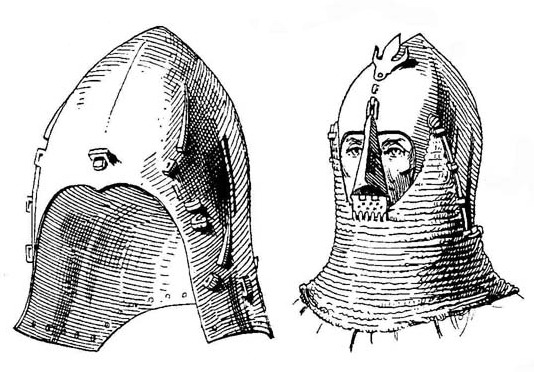
Three (or Six) Dual Helms

Dual helms are constructed in pairs and are connected to one another through subtle strings of being that float through the ether.

Gemini Helms
When little used, Gemini helms allow the two wearers to swap abilities. One category of ability can be swapped at a time for up to 1 hour in a 24 hour period. These categories are as follows: fighting ability (i.e. attack bonus), strength, intelligence, wisdom, constitution, dexterity, charisma, hit points (damage stays with the person damaged, though, so a person who normally has but 20 hit points and swaps it with his comrades 50 hit points will die when the switch it over if he’s taken more than 19 points of damage), saving throws (all categories, if applicable), prepared/memorized spells and spell casting ability and special abilities (i.e. a thief could swap his special thief abilities for a ranger’s special ranger abilities).

Each time a pair of people use the helms, there is a cumulative 1% chance of a feedback, up to a maximum chance of 12%. If a feedback occurs, consult the following table:

ROLL D10
1-6. Memory Swap: Particular memories swamp between the people – perhaps memories of their parents.

7-9. Personality Swap: This could also count as an alignment swap.

10. Combination: The pair average all of their ability scores and lose half of their class levels (-1), gaining half of their comrade’s class levels +1. In other words, a 6th level fighter and 8th level combined would turn into two 4th/5th level fighter/thieves.

Puppet Helms
Each of these helms acts as a helm of telepathy. It also gives its wearer the ability to impose his will on the wearer of the other puppet helm. When this battle of wills occurs, both players should roll 1d20. Whichever rolls the furthest under their charisma score wins the battle and can force their companion to do or say one thing that takes no more than 1 turn (10 minutes). The winner of this contest of wills suffers 1d3 points of charisma damage, the charisma damage disappearing after 8 hours of sleep.

Helms of Summoning
The wearer of one of these helms can remove it, strike it with a small platinum rod and say “Come Hither!” and their comrade appears beneath the helm (and no, not if you’re holding it over the edge of a cliff or under water – don’t be a pain in the ass). The other helm appears on the summoner’s head when his comrade appears. These helms can be used once per day, but with each use there is a cumulative 1% chance that the summoned comrade will actually be their double from another reality. This chance re-sets at the next full moon. If an alternate comrade appears, use the following table to determine what shows up:

ROLL D6
1. Zombie: Retains a feral intellect, thoroughly chaotic. Fights with as many Hit Dice as the person had levels, but loses any special abilities. Those who lose more than half their hit points to the zombie’s attacks must pass a saving throw or become a zombie themselves. Remove disease cures them, but only inflicts 1d6 points of damage per caster level to the summoned zombie.

2. Demonic: Has the abilities of the person summoned (or the reverse, if they were a cleric or paladin), but with a demonic cast and a chaotic alignment. The summoned demon is immune to fire and mind reading and has bat wings that give it a flight speed of 12.

3. Hulk: Summoned person is much larger than normal, with double the strength (or strength bonus, to keep it simple) and an intellect of 1d4+2. Might start calling the summoner “George” and develop a strange fascination with small, furry mammals.

4. Reverse Gender: Summoned person is of the opposite gender. All abilities stay the same, but personality might be slightly altered.

5. Evil Twin: Appears to be the person summoned, but is secretly chaotic and smart enough to realize the situation and use it to their advantage. If the summoned person was chaotic, the evil twin will attempt to kill and replace his or her double. If male, will eventually grow a goatee.

6. Lycanthrope: Summoned person is a lycanthrope (Ref’s choice).

Hat Tricks – 9 Magic Chapeaus

Because you demanded it (not really) – a collection of magic hats for your game …

1. Swallow-Tail Cap: This long cap of silk has two 3-ft long tails – each conical in shape. The right cone is colored a deep maroon while the other is a happy beige. Embroidery around the seems to writhe and dance if one stares at it for a few moments (save or suffer from minor headache and the feeling of spiders running up and down your spine). The wearer of the cap can use it, by concentrating, to jump between dimensions. Alone, he can use the equivalent of the dimension door spell a number of times per day equal to his charisma bonus (minimum once per day). With one person holding onto the cap, he can teleport once per day. With two people holding onto the tails of the cap, he can plane shift once per day.

2. Feathered Cap: This tricorne of weathered blue-black velvet is elegant despite its age, but lacking a feather. When a feather is inserted into the cap, it gives the wearer powers corresponding to the bird. An ostrich feather might increase one’s running speed and kicking damage, a cockatrice feather might grant them the ability to turn people to stone with their bite, and a roc feather – well, that would probably just give them lots of shade and a stiff neck.

3. Scarlet Capotain: This scarlet capotain (i.e. pilgrim’s hat) with a gold buckle makes you look like whomever you are facing, assuming you are facing a human, demi-human or humanoid of roughly the same size. In addition to gaining the person’s appearance, you gain some aspect of their knowledge (i.e. a random skill, class ability, spell or memory), retaining it for 1 hour afterward.

4. Inky Baladava: This black baladava, when wrapped around the face, causes one’s skin to take on an inky appearance, giving them a +15% (or +3) chance to hide in shadows. Each turn spent this way drains the person of 1 point of constitution. These lost points of constitution can be restored only by eating, with one day’s worth of rations or food required to restore one point of constitution. The lost constitution corresponds to lost body weight (i.e. losing 50% of one’s constitution would correspond to losing 50% of one’s body weight). A person who loses all their constitution rises as a ghoul.

5. Master’s Hat: This top hat of felted beaver fur with a red satin lining gives the wearer the ability to speak with animals. Three times per day, the wearer can control one of the following animals – elephant, lion, gorilla, black bear or dog. Once per day, he or she can polymorph a person into one of the aforementioned animals.

6. Bodacious Bowler: This bowler, when set atop the head, casts an illusion over the wearer, making them look like everything they have ever wanted to be. In return, the person loses their voice as long as they wear the hat.

7. Porkpie of Pratfalls: While wearing this little hat, a person enjoys a +4 bonus to saving throws made against taking damage from falls.

8. Sugegasa of Fujin: This wide, conical straw hat creates cool, refreshing breezes for the person who wears it – essentially, allowing them to ignore heat up to 130-degrees Fahrenheit. If the wearer grasps the hat with both hands and whistles, the hat will lift off, giving them the ability to fly clumsily (as the spell) for 1 hour per day.

9. Hat of Many Surprises: This hat changes shape once per turn. The person wearing it does not realize this and will not be made to believe it, even if presented with a mirror, assuming instead that it takes the shape of their favorite style of hat. When removed, the hat assumes that form and keeps it until worn by someone else. Aside from this quirk, the hat grants the wearer a protection from evil effect. Roll on the following table to determine the hat’s current shape. The Referee should make these rolls and everybody but the wearer of the hat should be informed of the result.

1 – Horned helm (i.e. viking helmet) – wearer goes berserk in combat
2 – Bicorne – bonus on finding direction using the stars and immune to sea sickness
3 – Phrygian cap – freedom of movement
4 – Busby – +2 damage on charge
5 – Propeller beanie – intelligence cut in half
6 – Stovepipe hat – cannot lie, can discern lies, +2 damage from back attacks
7 – Bascinet – +1 to Armor Class, double normal range of surprise
8 – Scottish bonnet – must save or begin dancing in the presence of drawn swords
9 – Wool cap – head stays warm in cold weather
10 – Dunce cap – struck with confusion whenever asked a question
11 – Wizard’s hat – cast spells as 1st level magic-user (roll known spell randomly)
12 – Jingasa – language changes to Japanese
13 – Bearskin – immune to fear
14 – Beret – personality becomes acerbic, strong desire for a cigarette
15 – Cowboy hat – +1 bonus to missile attacks
16 – Cordobes – +1 bonus to attack with sword
17 – Custodian helmet (i.e. British constable’s hat) – can summon a gang of club-armed bobbies as a horn of valhalla summons barbarians
18 – Deerstalker – find secret doors as an elf, notice stonework as a dwarf
19 – Fedora – darkvision 60 ft
20 – Fez – dude, you get to wear a fez – what more do you want?
21 – Ghutrah – immune to the effects of heat and flame
22 – Montera (matador hat) – +1 dodge bonus to AC, +1 to hit and damage bulls, stench kows and gorgons
23 – Mortarboard – cast legend lore once during the turn
24 – Panama hat –
25 – Pith helmet – can cast locate object once during the turn
26 – Santa hat – can command gnomes and elves (per a rod of rulership)
27 – Sombrero – cast sleep once during the turn, but must also save vs. sleep as well
28 – Toque (i.e. chef’s hat) – immune to poison
29 – Trucker hat – +1 to hit and damage with unarmed attacks
30 – Turban – can charm snakes