Venatia – Raldo’s Head and Terribles Visages

Six more wilderness encounters for you to enjoy. Also – if you’ll peruse the Sept 30 news at Frog God Games, you will see that yours truly has been tasked with writing some hexcrawl modules. The modules are not set in Nod, and are meant to be usable in just about any fantasy campaign. The first module is written, and is now in the process of illumination and editing.

Part One | Part Two | Part Three | Part Four

0603. Here lies the head of Raldo. Raldo’s head measures 8 feet in diameter. It lies in a gully thick with ferns and rotting vegetation and itself is in a state of advanced decay. Despite the presence of dozens of giant centipedes consuming the head and crawling through it, Raldo thinks and speaks and can be consulted as though a sage. Raldo does seem to feel pain, but it doesn’t appear to consume him.

0620. A pack of four dragonnes roams these valleys, preying on the pale, gibbering things that scurry from boulder to boulder and cave to cave. Encounters with them occur on a roll of 1-3 on 1d6.

0628. A terrible image is carved into a mountain here. It depicts a squatting, vaguely humanoid shape. The thing’s head is a mass of tentacles that spread out over the mountain side and its stunted arms end in taloned hands. From beneath the squatting horror, which is at least 100-ft in height, a stream of water rushes out of the side of the mountain to fall into a deep, dark pool. The water has an oily sheen, and smells foul, but is otherwise safe enough to drink. The ground around the pool is often visited, and at night, random encounters with hags occur on a roll of 1-3.

0638. On a pleasant hill overlooking the river valley the gnomes of the hills have constructed a small, stone chapel dedicated to the goddess Minerva in her aspect as the goddess of crafts. The chapel is overseen by a lone priestess, a woman named Kothilda. Kothilda is a woman deformed by disease and abandoned as a child on the coast. Discovered by gnomes, she was raised among them and showed an astounding capacity at their crafts. As she grew to womanhood, they constructed this chapel and dedicated it to the human goddess they believed had blessed the child with her skill at woodworking. She now lives here along, often entertaining the good folk of the forest. The chapel has a single room furnished with an ornate kneeling bench and idol of Minerva that were carved by Kothilda’s own hands, and a simple wooden bowl for donations (she prefers items rather than coins, and people who leave items they have crafted themselves are Blessed by Minerva for 24 hours. Behind the chapel is a gnome-style burrow built on a human scale. This is where Kothilda lives her simple life. It is equipped with a hearth, woven rugs, comfortable chairs and has a small bedroom and a root cellar.

| Kothilda, Cleric Lvl 10: HP 47; AC 9 [10]; Save 6 (4 vs. paralysis and poison); CL/XP 13/2300; Special: Cleric spells (5th), turn undead.

0707. This hex is notable for its large, rolling meadow of tender grass and fragrant blooms. A large fairy circle is evident on the meadow, and it is visited on each full moon by a gaggle (4d6) dancing, fiddling grigs and other fey creatures. In the daytime, it is thick with game and the occasional hunting party of centaurs.

0809. A retired trader from Pfeife has repaired and rebuilt an old stone fort here and turned it into a coaching inn. The inn has a 15-ft tall curtain wall surrounding an oval courtyard with a well. Blending into the wall is a three-story tall round tower topped with crenelations and a tall, conical bell tower. The trader, Androse, lives with his wife and three children on the top floor, beneath the belfry. The second level is a common room for sleeping and the ground floor is a taproom in the day and common room at night. The taproom has two curtained booths which turn into semi-private sleeping berths at night. Androse and his goodwife put out a bountiful spread for their customers, with steaming trays of spiced meats (mutton and game mostly), crocks of soft cheese, wheels of sharp cheddar, round loaves of black bread and fruit cake and leather mugs of pale, sweet ale. Expensive wines are available on request. All of the food is stored in the cellar, which used to hold instruments of torture but now has cages full of wine casks and barrels of flour.

Illustration by Sidney Sime

Venatia – Seaxel, Nimroth and Walgirth

Six more encounters from Western Venatia.

Part One | Part Two | Part Three

0432. The river here meets strong, ancient rocks and divides into hundreds of little waterfalls, playful streams and pleasant pools before re-combining into the river that flows into [0333]. Ample evidence around these pools suggests that the area was once visited often by the ancient elves and gnomes – wooden gazebos so delicately carved that they could only have come from a fey hand, discarded goblets, tattered scarves of spider silk, etc. The area is now infested by giant water wasps, who perhaps caused the olden folk to quit the area in the first place. Encounters with water wasps occur with groups of 1d6 insects on a roll of 1-4 on 1d6.

| Giant Wasp: HD 4; AC 4 [15]; Atk 1 sting (1d4 + poison), bite (1d6); Move 1 (Swim 12, Fly 20); Save 13; CL/XP 6/400; Special: Paralyzing poison, larvae.

0433. Seaxel is a small farming village on the banks of the river. Its sister village and rival, Nimroth, is on the other bank in [0434]. The Seaxels and Nimroths are descended from the serfs who served the elven families of the same names, families that despised one another and competed in all things for the attention of the Emperor Finrix. Whether hunting, racing, poetry or war, the Seaxels and Nimroths were always out to best one another. The lords of the manors, who only took residence in them when the Emperor was summering in Amvianda, accompanied Finrix to his war in the west and were never heard from again. With the emperor gone and the great families gradually dispossessed, the serfs eventually came to rule them-selves, putting decisions to a vote or following the wise counsel of one or another elder. But even though they were rid of their masters, the old enmity has gone on unabated. The Seaxels raise gourds, grapes and fields of barley. The 15 soldiers of the village dress in old-fashioned mail hauberks and carry the tall, Norman-style shields of the old elven legions. They arm themselves with spears and thick daggers.

0439. Nimroth is a small village of woodsmen, lusty rascals with a mean streak when gold and silver are up for grabs. They loath the people of Seaxel (see 0433 above). Nimroth’s warriors wear leather armor and carry long bows and battle axes. They have the services of a healing woman called Hallya, a freckled woman of thirty-three summers.

0502. A misplaced foot might send a character (1 in 6 chance) through a 20-ft deep hole into ancient elfen catacombs. The catacombs are crudely fashioned, and in fact any dwarf will declare them to be the work of goblins, the usage by elfs coming sometime after they were first dug. Within the maze-like catacombs are dozens of bricked up alcoves containing the remains of elf and human legionnaires from Nomo. While three of the alcoves contain but a single elf corpse, the others are stacked high with human skulls. Apparently, the catacombs were a goblin redoubt taken with much loss of life. The three elf burials are as follows:

Walgirth, an elf baronet interred with his family armor (mail hauberk, winged nasal helm, Norman-style shield) and his long sword (+1 weapon, growls in the presence of goblins and forces the owner to pass a saving throw in the presence of goblins, hobgoblins and bugbears or attack until he or the goblins all lie dead). Walgirth’s alcove is trapped with a flurry of darts (2d6 damage, save for half).

Inidubrid, a warrior-maiden (possibly a paladin) interred in her gleaming plate armor (un-rusted) and her crescent shield bearing intertwined doves. Her spear is a +2 weapon and is lodged through her rib cage and can only be drawn from the stone by a chivalrous character. The spear is haunted by her spirit, and will scold the bearer of the spear with electrical shocks (1d6 damage) when they behave un-chivalrously. Despoilers of this tomb will be marked for destruction by servants of Law until they make penance at the temple of a high priest of Law.

Galaddus, captain of archers. Galaddus was a drinking man in life, and in death he still holds court with a dozen shades of his former comrades. Galaddus’ mouldering corpse, still wearing the remains of his ring armor, his yew longbow close at hand, sits atop a barrel of spirits, shadows flitting about him, their umbral goblets raised to receive a splash of “the wine of ages” from a dusty bottle. Visitors are invited to have a drink, or chased away if troublesome.

0531. The burnt remnants of a stockade lie here, about one mile east of the river. Broken hobgoblin arrows are plentiful, but not a single body remains in the place. The walls of the stockade are in good enough shape that, if the gate is repaired, it can provide a fairly safe camp.

0539. A tiny cave overlooking the river serves as the sepulcher of a small gnome child, perhaps a prince. The cave is natural save for a single circle on one wall that has been ground smooth and painted with loving portrait of the large-eyed child. A small, soapstone altar rests beneath this portrait, covered by the stubs of candles and dried flowers. There is no treasure here, and the body is well buried, but the sepulcher remains a holy spot and a refuge from evil. Characters of a wicked bent find themselves unwilling to enter into the place without first throwing themselves to their knees and shedding a tear of remorse.

Venatia – Ubues and Allips

Six more encounters from Western Venatia.

Part One | Part Two

0303. A clan of fourteen ubue dwell here herding ill-tempered sheep with onyx horns. The ubue dwell in a large, dry cavern, trapping the entrance with falling stones (save or 3d6 damage). The ubue sleep with their sheep in the main cavern, with a smaller, higher cavern serving as the lair of their chief, a robust figure of abject savagery called Kin-Toka-Rok. The ubue have visited the Gallery of Bones in [0308], losing two of their number there and re-sealing the cave.

Treasure: 1,600 sp, 1,350 gp, a brass locket worth 100 gp (hold a rolled up piece of paper with the word “ZAMAX” written in elven) and 2 casks of olive oil (12 gal., 100 lb each, worth 60 gp each).

| Ubue: HD 3; AC 6 [13]; Atk 3 slams (1d6); Move 9; Save 14; CL/XP 3/60; Special: Argue.

| Kin-Toka-Rok: HD 5; AC 5 [14]; Atk 3 slams (1d8); Move 9; Save 12; CL/XP 5/240; Special: Argue.

0308. The Gallery of Bones is a large, low-ceilinged cavern sealed by massive boulders. Centuries ago, when the legions of Nomo were marching into the Rooky Wood, they encountered a plague that there physics and priests could not counter. As company after company of men succumbed, their commander, Valbestos, made a decision. He gathered the afflicted in this cavern and sealed it with a landslide as he listened to the dying men screaming for mercy. The cavern is now filled with bones, old military equipment (shorts swords, darts, spears, shields, chainmail and leather armor) and four allips, the tormented, undead souls of the lead legionnaires.

| Allip: HD 4 (20, 20, 18, 16 hp); AC 5 [14]; Atk 1 strike (no damage, 1d4 points of wisdom lost); Move Fly 6; Save 13; CL/XP 7/600; Special: Drains wisdom, hypnosis.

0313. Ystam is a tiny village of trappers constructed atop a granite dun at the intersection of two rushing streams flanked by wolfberry bushes. The trappers have carved a rugged little stair from their village to the canyons below. The village is surrounded by a little stone wall patrolled by a garrison of elves from the tower of Elbernulph [0113]. The garrison numbers 20 elf warriors in chainmail and armed with claymores. The village is ruled by Elbernulph’s reeve Cirioch. The villagers are supported by a blue eyed armorer named Arthaa. Cirioch dwells in a short, stone tower attached to a more traditional wattle-and-daub, two-story cottage. His house is protected by ten skeletons that he controls using a gold medallion. The villagers live in little huts and are often visited by a druid called Talotam, who leads them in secret worship of Diana. The Chimereans demand the worship of Vulcanus of the Mailed Fist, the patron deity of Galardis. A work gang of Azer are presently constructing a fortified chapel of Vulcanus. The villagers resent the elves and the arrival of their “foreign” deity.

| Cirioch, Elf Lvl 2: HP 12/7; AC 4 [15]; Save 13/14; CL/XP 3/60; Special: Elven chainmail, two-handed sword, dagger, spellbook, medallion allows him to command undead.

0326. A carcolh dwells in a lofty cave in this hex, sending its tendrils far into the countryside in search of prey. The carcohl is described in more detail in NOD #4 or on the Land of Nod blog. Treasure is pushed to the fringes of the cave, the refuse of past meals.

Treasure: 310 ep, 430 gp, a little limestone idol of the arch-demon Furfur worth 165 gp, a brass urn worth 1,000 gp and dust of sneezing and choking in a leather pouch.

| Carcolh: HD 9 (49 hp); AC 4 [15]; Atk 1 or more tentacles (1d4 + grapple) or 1 bite (2d6); Move 9; Save 6; CL/XP 11/1700; Special: Tentacles, swallow whole.

0335. A waterfall of reddish water pours from a cliff into a wide, shallow pool. The pool is inhabited by a fossergrim, the spirit of the waterfall. Behind the waterfall is a large, conical cave that leads into a damp, slimy tunnel (saving throw to avoid falling and sliding down the tunnel). This tunnel empties into a muddy cave with two exits. The left-hand exit leads upward to a series of caverns that eventually open to the top of the cliff above, and show signs of having once been well traveled by animal caravans. The right-hand exit leads to a winding tunnel and the cavern of Harzh, a youngish green dragon just beginning to build her horde and roosting on three large, beryl eggs. Harzh can neither speak or cast spells.

Treasure: 2,820 gp, a large rock crystal worth 900 gp and 3 pounds of zedoary in a wooden box (worth 320 gp per pound).

| Harzh: HD 8 (32 hp); AC 2 [17]; Atk 2 claws (1d6), bite (2d10); Move 9 (Fly 24); Save 8; CL/XP 10/1400; Special: Breathes poison.

0346. A cove here holds a pool of water. A rusty iron door blocks access to another cavern holding the remains of Grindir, a pirate lord from Tremayne who passed away almost 80 years ago. The door is trapped but not locked, and is cold to the touch. If opened, three spears in a triangular formation springing up from the ground to skewer thieves. The skeleton of a thief lies before the door. The actual tomb holds the body of Grindir in a black, silk coat and still adorned with jewelry. The corpse and most of the cavern are covered in yellow mold. A moonstone worth 35 gp is lodged in the corpse’s eye socket.

Treasure: 2,000 sp, 640 ep, 640 gp and a turquoise worth 155 gp.

| Yellow Mold: HD n/a; AC n/a; Atk 1d6 damage + spore cloud; Move 0; Save n/a; CL/XP 3/60; Special: Poisonous spore cloud, killed by fire.

Venatia – Cavemen and Blink Dogs

Here are six encounters for Western Venatia – hot off the presses – and the accompanying map.

0110. A crooked little stream flows from a high cave, forming a noisy little waterfall. The banks of the stream are bare of life because the stream is quite poisonous. The stream flows from a grotto, the walls and ceilings of which drip with poison. Well worn steps in the living stone protected by a large cave eel lead from the grotto to a little cavern, wherein dwells Eiois. Eiois is a bitter elven woman with eyes that stare like death and a once-pretty mouth whose corners have become down-turned. Eiois is a priestess of Eris, goddess of discord. Eiois worships at a jade altar that holds a crystal ball, through which she randomly curses powerful men in the region. She recently became infatuated with Fortunato, the Prince of Antigoon, and her fascination has caused her to plot against his enemies. She is now in a rage since the ball was stolen by a sneak thief (now deceased), who dropped his treasure in [0122].

Treasure: 2,000 sp, 230 gp, banded agate worth 900 gp and jasper worth 800 gp.

| Eiois, Cleric Lvl 6. HP 21; AC 9 [10]; Save 10 (8); CL/XP 8/800; Special: Spells (4th), rebuke undead. Threadbare silk gown, silver dagger, crooked wand that poisons with a touch. Eiois has an aquiline nose and noble bearing, deepy bitter.

0138. Vhalla is a small village of common farmers living in wattle & daub cottages surrounded by a bulwark of packed earth. Four wooden watch towers overlook the fields as far as the woods. The farmers are thickset, with nut-brown skin and aquiline noses. The men of Vhalla keep nimble forest cattle and grow cabbages and chanterelle mushrooms. They are an athletic people, holding games each summer to honor the gods, and are fine archers. Vhalla is ruled by the Lady Reana, who traces her line back to the elfs of old. Vhalla has the services of Ancho the Bowyer. The villages militia are armed with farm implements, and Reana employs four ogres from the mountains as her personal guard. In their off hours, the ogres challenge all comers to fights in a deep, brick pit near the village square and in sight of the gallows.
| Reana: HD 5 (19 hp); AC 3 [16] armored; Atk 1 sword (1d8); Move 12; Save 12; CL/XP 5/240. Elven chainmail, shield, longsword. Sharp featured but less so due to her girth, pallid skin, black hair and amber eyes. Precise mind, but a tad eccentric. Fancies herself a natural philosopher.

0147. A herd of 20 hippocampi graze the seaweed here. The leader of the herd is a stallion that once served as a paladin’s steed. Though his master is dead, the stallion still serves the cause of chivalry.

0233. One might find an ancient plaza here, now overgrown with saplings and ferns. In the center if the plaza is a large, malachite fountain decorated with tarnished brass hinds. The fountain is cracked and dry, and all that remains of the ruined town surrounding the fountain and plaza are crumbling foundations, a few shards of pottery and rusted utensils and tools. Should someone polish the brass sculptures and whisper a prayer to Diana, the fountain will come alive and a large falcon will soon appear in the sky, spiraling down until it lands on the edge of the fountain. This wise bird will answer a three questions (per Contact Other Plane) for the person who prayed.

0301. Cavemen of the lion clan live here in a large complex of caves. The 70 cavemen and their families are exceedingly primitive, arming themselves with clubs. Their lair contains a crude idol of a cave lion adorned with a cave lion pelt worth 150 gp. The cavemen are led by a boisterous man called Yok and his four brothers, Pudo, Kord, Gontor and Joro.

| Yok, Barbarian Lvl 5: HP 30; AC 7 [12]; Save 11; CL/XP 5/240; Wears a gold ring worth 1,000 gp given to him by Cadfani to seal a pact of friendship.

| Yok’s Brothers: HD 3 (17, 12, 8, 5); AC 7 [12]; Atk 1 club (1d6); Move 12; Save 14; CL/XP 3/60.

0339. A pack of 10 blink dogs hunts these woods. They detect the presence of intruders into their territory on a roll of 1-4 on 1d6, and will track intruders to make sure they mean no harm.

Venatia – Introduction

I’m juggling four projects right now, but I finally finished the intro to Western Venatia, the sandbox slated for NOD #6 in December.

I. Overview
Venatia is a region of woodlands and hills nestled between the Klarkash Mountains in the west and the Great Yamas in the east. Once dominated by the Nomo Empire, it is now home to several competing city-states, the largest being Lyonesse of the Gleaming Towers, heir apparent to Nomo. Other city-states in the region include Antigoon, heart of a mercantile network that stretches across NOD, and Blackpoort, a city of ne’er-do-wells on the shores of Blackmere.

Pandiluvian Age
During the Pandiluvian Age, Blackmere was connected to the Tepid Sea via a narrow, rocky channel. The Klarkash Mountains constituted the major landmass of the region and supported dozens of ophidian citadels, while the remainder of Western Venatia consisted of swampy, mosquito-ridden islands. The elder races constructed cities beneath the Tepid Sea while one tribe of aboleth constructed a maze-like fortress in the depths of Blackmere.

When the waters receded from the landscape, Western Venatia took on its modern appearance. The aboleth were trapped in Blackmere and very few still survive, while the heights of many a submerged city in the Tepid Sea were exposed. Lizard men moved into the swampy valleys and canyons and constructed cliff cities and magnificent ziggurats to Tiamat, the Mother of Monsters. Unlike the eastern lizard men, who formed the kingdom of Karzak, the western lizard men maintained small, feudal towns that warred incessantly. The ophidians were forced to seek shelter deep beneath the earth near volcanic vents as the Klarkash Mountains cooled.

Golden Age
As in Eastern Venatia (see NOD #4), the human slaves of the lizard men rose up and destroyed their masters, founding a number of farming and fishing villages. Where the lizard men preferred the valleys, the humans constructed their lairs on hilltops and worshiped the sky (i.e. Jove) rather than the sea. Many humans lived in the woodlands as hunter-gatherers, and persist to this day as wild men of the woods.

The human villages never amounted to much, and thus dozens of humanoid tribes (orcs, gnolls, goblins and hobgoblins) were able to establish themselves in Western Venatia.

Modern Age
The Modern Age was initiated with the coming of the legions of Nomo. Legion XXXI descended into the Rooky Wood from Chimeria in the Klarkash Mountains and established the forts that would become Morrow and Pfeife. Legion XXXI became bogged down fighting the goblins and spiders of the woods, and went no further. In the meantime, Legion XIV arrived from the south (after securing Brigandy’s tribute via a marriage between the son of Corundus, legion commander and the niece of Queen Gloriana, who reigns to this day), constructing the old fort at Antigoon and then moving up the Swiven River. Legion XIV would found Blackpoort and Lyonesse on their way to carving out what become known as the Westerling Empire, subservient to Nomo but always threatening revolt.

With the fall of Nomo, the city-states of Western Venatia enjoy independence. Tristram, the king of Lyonesse, fancies himself a contender for the imperial crown, and would very much like his agents to find the lost relic that he may claim the title. Antigoon and Blackpoort, meanwhile, arm themselves for the eventual struggle with Lyonesse, for they wish to remain independent.

II. Regions

Blackmere
Blackmere is a large, fresh water lake that empties into the Tepid Sea via the Swiven River. Blackmere is a shallow lake with crystal clear water; passing ships have no trouble spotting the ruins that lie beneath the water, though the predators of the lake have adapted camouflage in the form of black skin or scales. The eastern shore of Blackmere is treeless and interrupted by rocky gullies the pour in frothing, freezing water that originates in the Klarkash Mountains and rushes through the wooded canyons of the Rooky Wood. The western shore is choked with massive, black oaks and willows. The bottom of the lake is covered in smooth, black stones and large forests of bright, green kelp that hide the stone houses of the lake goblins.

Dreadful Forest
The Dreadful Forest is thick and dark, consisting mostly of evergreens (spruce, pine) and brambles. More information on the Dreadful Forest can be found in NOD #4.

Forest Perilous
The Forest Perilous is an ancient woodland of oaks, hawthorns, and willows. The trees here are gnarled and twisted and prove very difficult to traverse. Many small, quick streams flow through the woodland. Forest paths are almost always twisted and useless; most end in traps set by ogres or pixies. Light in the woodland is never better than twilight.

The Forest Perlous surrounds the city-state of Lyonesse. Some suggest that only the devotion of the Lyones to Ceres keeps the forest monsters at bay.

Gaestly Hills
The Gaestly Hills are an expanse of rough highlands studded with ancient barrows and burial chambers. Most of these burial sites were cleared by adventurers over the last 100 years, their treasures plundered and their secrets revealed, but a few remain untouched. The Gaestly Hills are rich with iron and silver deposits. They also support a good deal of game, and make adequate pasture for sheep and goats.

The hills are dominated (if anything can be said to dominate the bleak, mossy landscape) by the city-state of Blackpoort. Blackpoort is the main southern port on Blackmere, and handles goods coming from exotic Mu-Pan by the Jade Road via the Venatian League in the north.

Grete Myre
The Grete Myre is a thick, wooded swamp stalked by reptilian savages. A few bold human renegades dwell in the swamp, often hiding from the authorities of Antigoon. These “myrefolk” supply the alchemists of Antigoon with rare herbs and animal specimens.

The myre is bordered to the north by the Gaestly Hills, to the east by the Dreadful Forest, to the west by the Nybling Hills and the the south by Biscotti Bay, an arm of the Tepid Sea. The principal settlement of the Grete Myre is Antigoon, which dominated the moors that rise on the border between the myre and the hills.

Klarkash Mountains
Ancient and wicked, the Klarkash Mountains separate Venatia from Umbriago, the cradle of Nomo. The mountains are tall and have molded by the wind into great lumps of limestone divided by deep, lightless canyons. These canyons are home to fungal horrors and depraved fairy folk, as well as a few rugged clans of wild men and several hordes of hobgoblins.

The western mountains that border Venatia are a bit less severe than the eastern reaches, and even support stands of silvery beeches and coppery grass on their ledges.

Nybling Hills
The Nyblings are wooded hills that extend from the Tepid Sea to the Klarkash Mts. They have a pleasant climate and are mostly covered with oak trees. The local “barbarians” include gnomes, kobolds, svarts and bugbears. The northern portion of the hills is settled by Antigooners and has many trails connecting manors and strongholds. The remainder of the woodland is quite wild, with the southern reaches dominated by trolls.

The hills were once the hunting preserve of the Nomo’s Emperor and his clan. He constructed his summer palace, Amvianda, in the hills and each year hosted a glorious bardic college. Amvianda is now a lonely beacon of civilization in the midst of the wilds. Patrols of rangers do their best to keep the town safe and maintain communication with the outside world, but they are hard pressed. Since the fall of the Emperor, the chamberlain of the palace has been the defacto ruler of Amvianda, and he has proven to be less than capable in the role.

Rooky Wood
The Rooky Wood was the last portion of Venatia brought under (loose) control by the legions of Nomo. It consists of a number of narrow, winding canyons shot through by fast, icy streams that empty into Blackmere. The badlands support hardy, evergreen trees and brambles and are haunted by arachnids and goblins. The forest was once home to demon worshipers, who summoned many fiends in the days of old. Shrines to demon princes can be found in the woods, and often they bear signs of recent use.

Tepid SeaThe Tepid Sea is thoroughly described in NOD #1. We will note here that it is a shallow, blue-green sea and home to mermaids, sahuagin, tritons and undines. A good deal of commerce goes through the Tepid Sea to Mother Ocean, much of it to or from the city-state of Antigoon. The two other major ports on the Tepid Sea are Tremayne and Ophir (which appears in NOD #2).

III. Random EncountersRandom encounters should be diced for twice each day, once in the daytime and once at night, with dangerous encounters occurring on the roll of 1 on 1d6 and traveler encounters on the roll of a 6 (see below).

Travelers
1-2 Men-at-Arms (6d6)
3 Pilgrims (3d6)
4 Refugees (9d6)
5-6 Traders (2d6)

Blackmere
1 Aquatic Hobgoblins (6d6)
2 Aboleth Thralls (6d6)
3 Nixie (6d6)
4 Privateer (6d6)
5 Raven, Giant (3d6)
6 Kelpie (2d6)
7 Cathbad (1d8)
8 Scrag (1d8)
9 Ghost (1d4)
10 Afanc (1)

Dreadful Forest
1 Carnivorous Flying Squirrel (6d6)
2 Wild Man (6d6)
3 Lizardman (5d6)
4 Giant Lizard (4d6)
5 Black Bear (3d6)
6 Noroob (3d6)
7 Ogre (3d6)
8 Baccae (2d6)
9 Firedrake (2d6)
10 Pseudo-Dragon (2d6)
11 Woodwose (1d8)
12 Hill Giant (1d6)

Forest Perilous
1 Brownie (6d6)
2 Elf (6d6)
3 Wolf (5d6)
4 Ogre (3d6)
5 Dryad (2d6) or Nymph (2d6)
6 Satyr (2d6)
7 Wraith (2d6)
8 Actaeon (1d8)
9 Treant – 7 HD (1d8)
10 Dragon – Green, Adult, 7 HD (1d6)
11 Leopard (1d6, attack with surprise)
12 Unicorn (1d6)

Gaestly Hills
1 Bandit (6d6)
2 Orc (6d6)
3 Wolf (5d6)
4 Ghoul (4d6) or Ghast (2d6) or Ghost (1d6)
5 Falcon, Giant (3d6)
6 Lycanthrope – Were-rat (3d6)
7 Ogre (3d6)
8 Vierd (3d6) or Wight (2d6)
9 Bat, Giant (2d6)
10 Owlbear (2d6)
11 Cockatrice (1d8)
12 Hill Giant (1d6)

Grete Myre
1 Giant Leech (5d6)
2 Lizardman (5d6)
3 Thugtoad (5d6)
4 Crocodile (4d6)
5 Zombie, Leper (4d6)
6 Giant Frog – Large (3d6)
7 Harpy (3d6)
8 Noroob (3d6)
9 Giant Dragonfly (1d6)
10 Hydra (1d4; roll heads randomly for each)
11 Shambling Mound – 9 HD (1d3)
12 Froghemoth (1)

Nybling Hills
1 Badger – Giant (4d6)
2 Black Bear (3d6)
3 Bugbear (4d6)
4 Bulette (1d4)
5 Giant Owl (2d6)
6 Giant Weasel (2d6) or Wereweasel (2d6)
7 Gnome (6d6)
8 Highwayman (3d6)
9 Kill-Bunny (5d6)
10 Kobold (6d6)
11 Troll (1d8)
12 Wolf (5d6)

Rooky Wood
1 Aranea (1d8)
2 Bugbear (4d6)
3 Cave Bear (1d8)
4 Drider (1d6)
5 Ettercap (2d6)
6 Forlarren (2d6)
7 Forester’s Bane (2d6)
8 Giant Spider – 4 ft (2d6) or Phase Spider (2d6)
9 Goblin (6d6)
10 Hobgoblin (6d6)
11 Imp (1d8) or Quasit (1d8)
12 Quickling (1d8)

Tepid Sea
1 Locathah (6d6)
2 Pirate (6d6)
3 Mermaid (3d6)
4 Scrag (2d6)
5 Harpy (1d6)
6 Sea Serpent – Gilded (1d6)
7 Shark, Large (1d6)
8 Sea Serpent – Fanged (1d4)
9 Giant Octopus (1d3)
10 Roc (1d3)
11 Sea Serpent – Briny (1d3) or Spitting (1d3)
12 Aspidochelone (1)

Ibis, City of Sorcerers – Books and Buns

Ah – the final preview of Ibis. I have about 30 more locations to write and a few maps to draw to finish the city-state for inclusion in NOD #5, along with the second level of the dungeon that appears in NOD #4, Mines & Mining, Mystery Men!, the Illusionist class and whatever else I come up with. I’m including the map so you don’t have to go looking for it in post #1.

47. Narmer’s Bakery: Narmer’s bakery is, on average, the busiest spot in the Souk from dawn to dusk. The first round loaves appear at the crack of dawn, and Narmer (5 hp) and his little legion of assistants work through the day producing bread and pastries. The building is a single-story number and constructed of adobe bricks. It has a small portico and a striped shade, under which loaves are displayed in wooden boxes. One of Narmer’s sons, a teenager named Minkah (5 hp), sells this bread to pedestrians. Inside the building the heat can be intense. Narmer has three large ovens and almost two dozen assistants. Along the northern edge of the building, by arched, barred windows, a number of tables and chairs are set up for customers. Narmer’s eldest daughter, a fifteen-year old beauty named Jenday (6 hp) who wants more than anything to study magic at the university, waits tables, servng pastries and sweet tea and searching for get-rich-quick schemes.

49. Scriptorium: Aten (3 hp), an intense academic with tanned skin, red hait and dark, brown eyes, oversees seven scribes, mostly students working their way through university or former students not capable enough to find a job in the queen’s bureaucracy. Aten is irreverent and well-spoken and is devoutly lawful. He has a wife named Tabia (4 hp) who came to Ibis after being rescued from slavery by a band of qamouli.

51. Edfu the Carver: Edfu is an aging romantic who dreams of daring adventurse in faraway lands. Unfortunately, he’s unfit, near-sighted and has just a touch of arthritis, so he settles for tales brought to him by magic-users who hire him to carve their staves and wands. Edfu is a master at his craft, and though he takes a bit longer than others, his products are always of the highest quality. On more than one occaision he has produced a wand or staff to be enchanted by a wizard, and in fact he has multiple powerful wizards in his clientele. The wizards, lawful or chaotic, like Edfu (it’s hard not to), so thieves’, assassins and even bureaucrats leave him alone.

53. The Mortuarium: This building is both a mortuary and a shrine dedicated to Anubis. It is overseen by Yafeu, a priest of Anubis, who has several embalmers under his command. The process of mummification is expensive, costing anywhere from 500 gp to 5,000 gp, and is mostly used by aristocrats and merchants.

Yafeu is also responsible for overseeing the burial of poor citizens in communal tombs outside the city-state. These structures are built of adobe brick and consist of a long tomb building atop a 6-ft tall platform. The bodies to be interred within are salted to preserve them and then place in long hollows in the floor with a few grave items. These holes are covered with heavy stone tiles, and then a new layer is added. The tombs usually top out at 20-ft in height and are hallowed to keep the ghouls at bay.

Yafeu has pale skin, blond hair pulled back in a tail and brown eyes. He has a “dusty” appearance, like an old bottle of wine, though his exact age is indeterminate.

| Yafeu: HP 13; AC 7 [12]; Save 13; Special: Spells (1st), turn undead. Sable robes over leather armor, silver headband, silver holy symbol, silver-tipped mace.

55. Shashi the Leatherworker: Shashi is a young woman who hails from Kirikersa, the great port city of Lemuria. She has ebony skin, black hair worn in beads, bright and green eyes. Shashi is tall and fat, and keeps five husbands and six children in her home in the suburbs of Ibis. This building is her workshop, where she employs an apprentice (her daughter Sumati) and a local journeyman named Hamut. Shashi is a quick-witted prankster who specializes in crafting fine leather armor and saddles, leaving lesser items to her helpers. She is lawful and gives potential customers a good looking over to make sure they are not thieves.

Ibis, City of Sorcerers – The Golden Princess

The penultimate preview of Ibis – one more to go and then I get into Mystery Men, The Gods of the Motherlands and Western Venatia, a land of blue-blooded knights, black-hearted robbers and silver-tongued merchants.

37. Three Cockles: This restaurant, owned by an émigré from Nomo named Malvina (3 hp), is under a bright blue sign decorated with three large cockle shells. The restaurant caters to expatriates from Nomo and the other city-states of Umbriago. They are an unruly and dangerous bunch, but the restaurant is usually full of laughter and singing with only the occasional duel. Duels in Malvina’s are done in a painted ring. Combatants are tied left wrist to right wrist, and engage in pummeling and wrestling until one person submits or is unconscious. Wagers fly all about the room during these bouts, and both winner and loser are treated to a steaming plate of food and a mug of wheat bock.

When one enters the Three Cockles, their eyes are immediately drawn to a number of large, steaming cauldrons in the center of the room. These cauldrons contain all the fruits of the sea – cockles, salty sea slugs, clams, oysters, fish (in a stew with saffron, scallions and dark wine), crayfish, squid and octopus tentacles, etc. A pot of garum is on every table.

The owner of the establishment, Malvina, is a youthful woman with a hard face and eyes that look right into a person’s soul. She has tawny blond hair, usually pulled back in a bun, dark brown eyes and is quite tall for an Umbriagan woman. Malvina is a divorcee, having once been married to a minor magus of Ibis; she now carries a chip on her shoulder toward all magicians, students and intellectuals.

Besides her waiters and cooks, Malvina also “employs” a band of pikeys (gypsy halflings) who skulk about the room picking pockets and doing odd jobs. The halflings live in the cellar in squalid conditions, and have been forced to serve Malvina because she holds their grandmother, a fortune teller, captive in her chambers above the restaurant. They are always under Malvina’s watchful eye, and she also has a bull mastiff on guard in her room. The halflings are beaten savagely by Malvina if they are caught plying their trade, but always wind up back in the restaurant when things cool off a bit.

39. Goldsmithy: Svalgault (gnome, 1 hp) runs a very successful shop of jewelers and goldsmiths, all of whom are gnomes. The ground floor of Svalgault’s is a workshop of tiny tables and shelves and a locked, freestanding vault containing anywhere from 20 to 80 pounds of gold and silver, and maybe 1 to 10 pounds of platinum. The floor above has been extensively altered from its former state. It has been bricked in to create a system of artificial burrows for the gnomes and their little families. The top floor contains Svalgault’s palatial residence, a seraglio of clockwork doxies, expensive rugs from Ishkabibel and beaded curtains from Ophir.

The gnome jewelers specialize in astrolabes and amulets. Like svalgault, they have light brown skin, salt-and-pepper hair and blue eyes. Svalgault is possessed of an impetuous curiosity and loves to play a good prank (though he never mixes pranks with business). When challenged or contradicted, he flies into a terrible rage, and can fight as a berserker. He is a frequent guest at Malvina’s [37], and she knows well that he and his people must not be targeted by her little band of captive thieves.

41. Exotic Redsmith: Xihuitl (4 hp) is a tall, thin woman with cinnamon skin, dark brown hair, brown eyes. She is immaculate in her appearance, wearing a white tunic, leather sandals, copper jewelry (including a nose stud) and she has three black lines tattooed on her chin, running from her lips to her neck. She is an immigrant from far-away Hybresail, brought to Ibis (via Ianus and Ophir) by her husband, a roughneck sailor from Tremayne who spends most of his time at sea. Xihuitl is a kindly but jealous woman who makes a living as a redsmith (i.e. she works in copper and bronze), specializing with vats and cauldrons (she made the cauldrons in Malvina’s Three Cockles restaurant [37]).

Xihuitl has a young son, Coyotl, who is always by her side and learning her craft. He is possessed of a wondrous intellect and frightening psychic powers (treat as a level 5 psychic). Coyotl has wicked eyes, and his piercing stares have been known to unnerve even the most stouthearted barbarian.

Xihuitl’s shop is cluttered with keepsakes from her husband’s travels and with wooden idols from her native land. A seemingly harmless iron trunk in one corner is large enough to hold a person, and the interior is lined with long spikes. Xihuitl uses it for sacrifices, a handy spout siphoning the blood into a ritual bowl of jade (worth 35 gp). She makes these sacrifices infrequently, and maybe tellingly, she usually chooses sailors who remind her of her errant husband.

43. Masoleum of the Golden Princess: This building is a tall, narrow pyramid of limestone clad in white marble and topped with beaten brass (the original gold was stolen many times). Entrance is via the ghoul tunnels under the city or through a secret entrance on the southern wall that leads to a short tunnel and a sudden fall (10-ft).

The pyramid is home to a mummified princess called Hashminepsis and nicknamed the Golden Princess from her habit of bedecking herself in a ridiculous amount of gold jewelry. Her wickedness carried her into the afterlife as an avaricious, undead monster, now attended by scorpions, the ghouls of Ibis and ladies-in-waiting (wights), as well as an ill-tempered and sarcastic idol of the scorpion goddess Selchis.

Treasures: 1,300 gp, two sunstones worth 1,200 gp each, a jade mask worth 95 gp, a necklace of gold discs worth 9,000 gp, a brass ankle chain worth 100 gp and a jaw of dust of appearance sealed with wax.

| Hashminepsis: HD 6+4 (37 hp); AC 3 [16]; Atk 1 fist (1d12); Move 6; Save 11; CL/XP 7/600; Special: Rot, hit only by magical weapons.

| Lady-in-Waiting: HD 3; AC 5 [14]; Atk 1 claw (1 hp + level drain); Move 9; Save 14; CL/XP 5/240; Special: Drain 1 level with hit, hit only by magical or silver weapons.

| Ghoul: HD 2; AC 6 [13]; Atk 2 claws (1d3), 1 bite (1d4); Move 9; Save 16; CL/XP 3/60; Special: Immunities, paralyzing touch.

45. The Lamb and Scallion: This low building is actually constructed about half above ground and half below. One enters by descending wooden stairs, and wide ledges around the exterior of the room hold low tables and woven mats for seats. The room is always stalked by the owner, Hasani (2 hp), the owner, a large, red-faced man with a bushy black beard and sunken eyes. He always wears rich clothes and a large, white turban and carries a ciphering stick (for recording one’s bill) and a large knife that he enjoys flashing in people’s faces. Naturally, Hasani is a coward at heart, and quickly backs down when challenged.
He employs several cooks who prepare rich dishes of antelope steaks, legs of mutton and goat stew, spiced with pepper, saffron and other exotic products of the far south. Pantries connected to the main room contain barrels of sweet ale, spiced wine, bottles of rum and brandy and wheels of cheese.

Hasani has five wives, all of whom work as waitresses in the restaurant and make a game of stoking their husband’s jealous disposition. He has but a single son belonging to his third wife and adopted as his own. Adom is a layabout and a wastrel who is always working a scheme to get rich. He is a fair swordsman, but shys away from adventuring.

| Adom, Fighting-Man Lvl 2: HP 13; AC 9 [10]; Save 15. Short sword, dagger.

Thanks to Tony Dowler at Year of the Dungeon for his dungeon maps, the format of which inspired my little mausoleum.

Ibis, City of Sorcerers – Coffee House

Six more locations for Ibis (use the keywords below for the other posts – they’re becoming too numerous to link).

25. Coffee House: The broad, single-story building sits between the University and the Souk, and attracts a higher class of person than the Spotted Sphinx. The interior walls of the coffee house are lined with velvet couches, with a number of small, circular tables placed so that patrons have ready access to their drinks and the delicate, exotic viands served by the host. A back room serves as a kitchen and pantry, and it is here, in locked iron chests, that the precious coffee beans (worth 100 gp/lb) are kept and later ground. In the center of the main room there is a gilt, marble table holding several charcoal braziers. Bronze flagons of water are set on grates over these braziers to be heated, with the host and a number of serving boys in silk tunics pouring the water through the ground beans into silver carafes, which are then served to the customers, along with porcelain cups.

The host is named Baruuf, and he is a spindly, supplicating old gentleman of 40 winters, usually wearing an embroidered robe of damask and brocade and a neat turban pinned with a silver brooch. Baruuf works for Panth, a retired warrior and trader who established a well armed caravan to traverse the eastern Nabu to the highlands beyond, where the finest coffee is grown. Panth, nicknamed thus for his dusky skin and fighting prowess, is in the coffee house most days, conversing with clients and making deals. Although no longer the juggernaut of his youth, he is still tall and broad shouldered. He wears expensive silk robes and adorns himself with multiple pieces of gold jewelry (600 gp worth, at minimum), and always keeps his falchion (treat as battle axe) under his robes. He keeps his pet fox on a chain nearby.

A carafe of coffee costs 10 gp, and one can order light fare of an exotic nature to go with their coffee – a typical bill runs 50 gp.

| Pantha, Fighting-Man Lvl 6: HP 31; AC 8 [11]; Save 11.

27. Temple of Isis: This four-story structure has a commanding view of the Souk and the Road of Kings. The building is constructed of marble-clad limestone, and is topped with a brazen dome and a spire in the shape of an angel. One enters the building through a door of white wood hammered with golden nails. Inside the door is the main hall of the goddess. The main hall is 35-ft from marble floor to ceiling and contains a chryselephantine idol of Isis and numerous columns covered in the strange pictoglyphs of ancient Nabu. The northern wall of the main hall contains an entrance to the inner temple and three balconies overlooking the hall. These balconies are each a series of arches and can be accessed by a locked door.
Beyond the main hall are a number of vestibules and concealed staircases that lead into four floors of living quarters for priestesses, storage rooms, meditation areas, a hospital floor and offices. Amazon guards are posted inside the entry door and at the top of each staircase, and males are not permitted into these areas unless they are accompanied by a priestess, for the temple is overseen by a sisterhood of devout nuns.

Beyond the living quarters lies the inner sanctum of the temple, with a smaller idol of Isis enthroned and holding the infant Harpocrates. This statue is carved from marble and clad in gold leaf (worth 5,000 gp). Beneath the inner sanctum, accessible via secret trapdoor, are two levels of catacombs and tombs in which are interred former nuns and priestesses, as well as a former princess of the old royal house in a secret vault. Another secret vault in the catacombs holds the temple’s treasure: 2,100 cp, 730 ep, 1,100 gp, a brass coronet worth 175 gp and a chalcedony worth 1,250 gp.

The high priestess of the temple is Manesha, an older woman with olive skin, silver hair and soft, hazel eyes. Manesha is very short and thin, and wears silk gowns of the ancient style underneath more conservative blue robes of office. She is usually adorned in a wide necklace of gold and sapphires (500 gp) and ivory bangles on both arms (100 gp total). Twenty nuns dwell in the temple and tend to sick and infirm women and children. Some wander the streets collecting alms for the poor and sick.

| Manesha, Adept Lvl 7: HP 24; AC 9 [10]; Save 9; Special: Spells (2nd), healer.

| Priestess (5), Adept Lvl 1: HP 1d6; AC 9 [10]; Save 15; Special: Spells (1st), healer.

| Sister (15): HP 1d4; AC 9 [10]; Atk 1 weapon (1d4); Move 12; Save 18; CL/XP A/5; Special: None.

29. Lecture Hall: The main lecture hall of the University is a three-story structure, with each level ringed by an arched portico. Within the portico are dozens of plain rooms containing a dias for a speaker and benches or chairs for students. The uppermost level contains rooms for the ten scholars on the faculty and a large room, library and laboratory for the headmaster, the archimage Randac (a notorious libertine in his youth made honorable by age and infirmity). The faculty and their specialties are as follows: Anioth (law), Haluim (arithmetic), Minia (geometry), Falanes (medicine), Shakir (astronomy), Amsi (music theory), Thema (grammar), Nekhbet (logic), Zalika (theology) and Astarte (rhetoric). Most of the scholars are level 3 adepts (sages), but Nekhbet is an elementalist (and a playful rival of Randac).
| Randac, Magic-User Lvl 11: HP 32; AC 9 [10]; Save 5; Special: Spells (6th). Sable robes of office, a golden amulet bearing the all-seeing eye (symbol of the university), a slim wand of cherrywood tipped in gold and a silver dagger.

| Nekhbet, Elementalist Lvl 5: HP 10; AC 9 [10]; Save 11; Special: Command elementals (see NOD #3 or treat her as a magic-user with many elemental spells). Black robes, a silver amulet bearing the all-seeing eye, the tools of an elementalist (usually carries an athame and goblet).

31. The Bearded Beauty: The Bearded Beauty is a social club of magic-users, illusionists and elementalists. The exterior walls (mud brick) are painted with the picto-glyphs of ancient Nabu, with the most prominent image being a beautiful queen wearing a false beard.
The club is two-stories tall, with the upper story containing the infamous “chamber of doors” and living quarters for the club’s landlord, Butros, and his staff. The ground floor contains a spacious common room, numerous small tables, four large tables and five semi-private booths obscured by thick, velvet curtains. The room is kept fairly dark and is lit by tallow candles. The walls and ceiling are decorated with stars and crescents of sparkling, polished tin.

Butros is a young man, a former student of Randac [29] with a young, pretty wife named Tabia who has recently been replaced by a succubus. Butros has bronze skin, sandy brown hair. He is a nervous chap, but very courteous and does his best to keep his clientelle happy. Besides three serving wenches, Butros employs a man named Karmaz-Kan. Karmaz wears a simple leather harness and loincloth and has deep, crimson skin and a mane of shining black hair. He came through one of the doors in the “chamber of doors” and found work here as a bouncer after he adjusted to the heavier gravity.

The aforementioned chamber of doors is located on the second floor in the center of the building. It can be accessed by a single door of golden wood that moves around a bit. Inside the room there are a dozen doors, incuding two flanking the entry door but not apparent from outside the room. Each of these doors leads to another place or dimension based upon the position of the stars. The ceiling of the room is glass, and there is a broze astrolabe in the center of the room to make last minute observations possible.

| Karmaz-Kan, Fighting-Man Lvl 4: HP 24; AC 8 [11]; Save 13; Leather harness, long sword, dagger.

33. Akiiki the Bricklayer: Akiiki is a mature man, short and wiry with skin baked into a deep, leathery brown. Akiiki has a fear of beautiful women and married a plain woman named Jendayi (an excellent weaver) and has four children. He shares his 4-story home with boarders and his aging parents. Akiiki is an excellent bricklayer and owns two brick-making operations located just outside Ibis. Despite his success and his family, whom he loves dearly, he remains a bitter man who dreamed of grand adventures in his youth.

35. The Academy: The academy is a fighting school run by Bovis, a young-looking man with alabaster skin, pale blond hair and blue-green eyes. Bovis is a swords-man of considerable skill, and considers himself an artist. As such, he is rather bohemian – unkempt, broody and chaotic. He is a frequent visitor to the coffee house [25]. The academy is a two-story building with a training hall on the bottom floor and living quarters above.

| Bovis, Fighting-Man Lvl 4: HP 29; AC 7 [12]; Save 13; Leather jack, long sword, dagger.

Art by Edmund Dulac, via Golden Age Comic Book Stories

Ibis, City of Sorcerers – House of Three Leopards

Six building descriptions for Ibis.

Part One (Map)
Part Two
Part Three
Part Four

1. House of Three Leopards: A wayfarer’s inn (map above), popular with traders, caravan guards and sailors. The inn is constructed of adobe bricks and painted with a coat of yellow paint. The sloped roof is clad in red tiles. The inn has a shaded courtyard decorated with potted palms and a long taproom that serves an excellent short beer and other simple fare. There are five dormitories (6 sp a night), six shared rooms (3 gp; single bed, don’t always choose your roommate) and four private rooms (7 gp a night).

A stairwell in the taproom leads down to the cellar, where the innkeeper store kegs of beer, bread, vegetables and expensive bottles of wine. A secret door behind the wine rack leads into a smuggler’s den. A door in the den opens to a subterranean dock and a flooded tunnel to the River of Death [A]. The den currently holds twelven marten skins worth 8 gp each, 25 ingots of zinc (5 lb, worth 8 sp each) and an olivine worth 155 gp.

The landlord of the House of Three Leopards is Hermess, a spare man with stringy white hair, piggy brown eyes and a pleasant smile. Hermess (4 hp) is paid by the smugglers, but is not one of their number and will claim he knows nothing about their hideout. His wife, Ucheb, and three children live on the ground floor in two connected rooms.

The smugglers are led by a fence named Aylana, a short woman with salt-and-pepper hair, alabaster skin and brown hair. Aylana is a former sailor who turned to crime when she lost a foot to a sahuagin attack. Aylana wears wooden hoop earrings inlaid with silver that are worth 100 gp and speaks goblin.

| Aylana, Thief Lvl 3: HP 10; AC 6 [13]; Save 13; Special: Back stab for double damage, thievery, decipher script. Leather armor, dagger, keys, brown hooded cloak. Sharp mind, contrarian.

| 1d6 Smugglers: HD 1d6; AC 7 [12]; Atk 1 weapon (1d6); Move 12; Save 18; CL/XP B/10; Special: Surprise on 1-3 on 1d6.

3. Zacoran the Chymist: Zacoran (3 hp) sells alchemical ingredients and concoctions, magical spell components (5% chance to have what you are looking for, charges 1d6x100 gp for each rare component) and there is a 1% chance he is trying to shift a magic potion or spell scroll (1d6 x 500 gp). Zacoran is a cynical man, and loud and obnoxious. He carries a wicked-looking dagger and is not shy about brandishing it if he feels he is being cheated. Zacoran is a member in good standing with the merchant’s guild [34]. His shop is guarded by an animated carpet. See “Urban Adventures” in NOD #2 for information on alchemists.

| Animated Carpet: HD 1 (7 hp); AC 9 [10]; Atk 1 (no damage); Move 6; Save 17; CL/XP 1/15; Special: Grab and hold.

5. Ramord the Wig-Maker: Ramord (5 hp) is a maker of wigs from human, goat and horse hair. He is well regarded in the neighborhood and is an outspoken advocate for the poor (though stingy in his own right). Ramord’s specialty is beards, specifically the false beards employed since Nabu times by nobles and merchants to make themselves appear more stately and elegant. Wearing such a beard, which requires the use of spirit gum, gives one a +1 bonus to reaction checks in Ibis. Ramord is a paunchy little man with pudgy but nimble fingers. Naturally, he wears a fine beard (not overly long), but his head is bald.

7. Ismid the Lapidary: Ismid (1 hp) is a scrawny young man with olive skin, thick, black hair and large, dark brown eyes. He cultivates a professional appearance, a powerful lense always hanging around his neck from a brass chain (worth 45 gp) and his clothes always neat. Ismid is single, but shares the room above his shop with his elderly and ailing father, an old soldier who was cashiered with a miniscule pension by the queen. This has stoked a burning resentment for the ruling class in Ismid, who now hosts secret meetings with agitators in his attic. The group wishes to throw down the old ruling caste and install a republic in imitation of the city-state of Antigoon. Ismid is capable of identifying the value of gems and fancy stones, and usually has a collection of minor stones (100 gp value in total) on hand for sale or trade.

9. Sudica the Chandler: This four story building houses three apartments and a chandler’s shop on the ground floor. The chandler, Sudica, is a tall, skinny woman with olive skin, dark brown hair and eyes. She has a foul personality and leads a solitary life, dipping her candles and preparing her scented soaps. She shares a room with her grandmother Nathe, who despises and fears her, for Sudica has an obsession with ghouls.

11. Granary: This two story building of thick stone is a granary that is half full of emmer wheat. It is guarded by a mature woman named Melig. Melig has alabaster skin, sandy brown hair and dark, burning eyes. She is quite short and stout, looking much like a dwarf but with finer features. Melig is a retired fighting-woman who is married to a papyrus collector named Kaval. She carries a short sword of blue-steel and wears boots of elvenkind. She is bored with her job as a guard and uninspired by her marriage, and if a better offer comes along, she will probably take it.

| Melig, Fighter Lvl 3: HP 17; AC 3 [16]; Save 14; Chainmail, shield, short sword, boots of elvenkind.

Tomorrow – final part of Mines & Mining.

Sunday – six more building previews.

Ibis, City of Sorcerers – Court of Spirits

A few more streets today, and then in a few days I’ll preview about half of the building locations.

Part One (Map)
Part Two
Part Three

D. Court of Spirits
This open yard is filled with patches of slender white mushrooms about 9-inches in height. The courtyard is not paved. In the middle there is an old, dry well (that might lead down to a dungeon, if a Referee is so inclined). The buildings that surround the yard back up to it and have any windows that might look over it boarded up or painted, except for the hostel [40].

On moonlit nights, the mushrooms awaken and become mushroom fairies that look like crude little dolls of white clay wearing mushroom caps and glowing as brightly as the moon above. These fairies will form circles and perform a very slow dance. Standing in the midst of one of these circles has a random effect:

Effect
1. In the blink of an eye, 10 years have passed. To observers, you simply blink away, but you will return to this spot 10 years of game time later unaware that you have been away.
2. You are teleported to Fairyland for 1 year and replaced by a wicked changeling. Observers will not see the switch, but may discover the change later.
3. As above, but instead of being replaced by a changeling your trip to Fairyland lasts for 10 years to you, but occurs in the blink of an eye to observers. You reappear aged a decade and with one level of druid or magic-user (or one extra level if you are already a druid or magic-user). Alternatively, a Referee may wish to play out your time in Fairyland.
4. Hypnotic patterns drive you mad unless you pass a saving throw.
5. You gain fairy sight (i.e. permanent detect invisibility), but you also see people as their inner (and often horrible) selves and lose 2 points of charisma as you find people unpleasant to deal with.
6. You are transformed into a werewolf. This will not become obvious, even to you, until the next full moon.
7. You are transformed into a mushroom-man.
8. You grow the ears and tail of an ass, effectively lowering your charisma by 1.
9. You are split into three separate beings, each with a portion of your personality and a third of your class levels.
10. You now bear an invisible fairy mark. Fairies are more friendly toward you (by fairy terms) from now on (i.e. +2 reaction adjustment).
11. You spontaneously learn a 1st level magic-user spell, but forget it and one other spell within 1d6 days. While you know the new spell you can cast it once per day. Once it and the old spell are forgotten, you will not remember ever knowing them and they will be replaced in your spell book with an unflattering sketch of your mother.
12. You think you’ve been transformed into a werewolf, and will act the part at each full moon until someone gives you a proper slap upside the head and calms you down. Nonetheless, you will go through the motions again at the next full moon.

E. Silver Lane
This narrow, noisy lane is named not only for the commerce that occurs in its confines, but also for the quartz paving stones that are streaked with silver. The bakery at the end of the street was once a noble villa, hence the higher class of paving. The buildings here rise a minimum of 10-ft and thus provide shade for most of the day. Many of them have rooftop gardens.

Crowds: The streets here are always crowded with customers, apprentices running errands and masters coming or going from lunch or home.

Random Encounters
1. Cart loaded with bread headed for a temple; pushed by two apprentices and guided by a third waving a stick
2. Disgruntled mercenaries (2d6)
3. Gaggle of 2d6 students visiting the scriptorium
4. Guardsmen (1d6 + sergeant)
5. Sly man begging alms and picking pockets (Thief Lvl 5)
6. Thugs (1d4+1) sent by the thieves’ den to collect protection money (Fighting-Men Lvl 3)

F. Court of Purple Dreams
The Court of Purple Dreams is dominated by a tall, pyramidal mausoleum of Princess Hashminepsis, who passed from NOD over 400 years ago (or should have). The buildings surrounding the court back onto it, and thus the court is very private and quiet. Running under its purple pavers are tunnels connecting to the sewers and allowing easy access for the ghouls of the under-city to their mistress’s tomb.

Crowds: There are no crowds in the Court of Purple Dreams, ever. Random encounters only occur here at night, and are usually with unpleasant things.

Random Encounters
1. Ghost, seeking to warn you away from certain doom
2. Ghouls, seeking fresh meat
3. Imps, seeking distraction
4. Midnight Peddler, seeking customers
5. Necromancer (Lvl 1d6+2) seeking counsel
6. Vampire and 1d3 spawn, seeking a warm drink

G. The University
The old University dominates the central portion of the map. Paved with aged limestone stained yellow with time, and walked with sages similarly aged, it boasts the finest library known to mankind (at least in the Motherlands and their environs).

Crowds: The University is always crowded with sages, students and apprentice magicians, as well as their servants and tradesmen who have been called on to provide some service. At night, it is more quiet due to curfews, but is still prowled by rakes, harlots and the more cunning students.

Random Encounters
1. A dozen young students trailing behind a harried scholar
2. 1d6 upper class-men and their valets
3. A magic-user and his apprentice
4. A rake coming to collect a debt owed by a student
5. Adventurers seeking a sage
6. A monster escaped from the subterranean vats

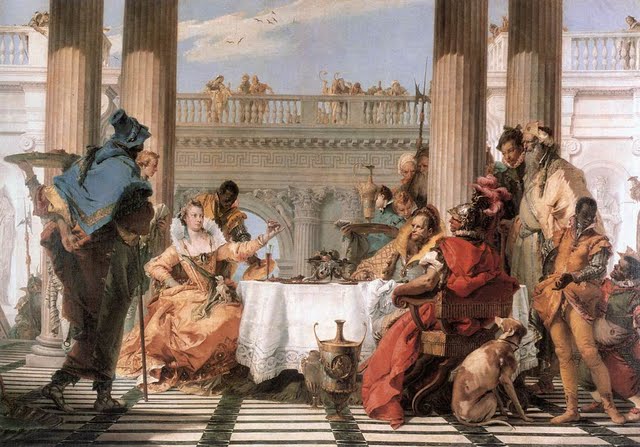
Art by Giovanni Batista Tiepolo: Banquet of Cleopatra (1743)