Here Comes the Bogeyman – Part 4 – Killing Rituals

The point of a bogeyman is to create a campaign (or mini campaign or side trek) around figuring out how to kill the damned thing. That means researching the killing ritual. Here, horror movies aren’t quite as helpful as they’ve been before, because most horror movies that involve a bogeyman become series that NEVER FREAKING END. The only killing ritual that can put Jason, Michael Myers or Freddie down permanently is low ticket sales … and even then only until Hollywood thinks it can pull off a “re-boot”. For our purposes, though, we need to have an end to these campaigns of terror.

The how of killing might have something to do with the bogeyman’s origin, and then again, it might not. It could also just be some weird ritual that must be taught by the reclusive monks in those far-away mountains you’d like to introduce to your players.

The killing ritual should involve one or more element or step. The more experienced the players (not the characters), the more elements you can get away with, but more than three is probably going to get tedious. There might be a teacher or dusty old tome that can reveal the entire killing ritual, or perhaps the adventurers must track down each element separately. In such a case, it might be a good idea to weave the killing ritual in with the monster’s history (an example to follow), so that as players learn about the bogeyman’s history, they gain clues on how to destroy him.

Some elements you might consider for your killing ritual:

Hit Location – much like a vampire needing a stake to the heart to keep it down, Achilles’ infamous heel or Smaug’s missing scale, the monster can only be killed if struck at a certain point on its body. Unless the monster is stunned/paralyzed/subdued/etc., this brings a combat element into the game and might please the more combat-oriented players who otherwise couldn’t give a copper for solving the monster’s riddle.

Substance – the idea of needing special substances to kill monsters is not new to D&D – silver for lycanthropes, cold iron for some fey, wooden stakes for vampires, magic weapons to harm demons, etc. For a bogeyman, think outside these narrow bounds – Loki using mistletoe to kill Baldr comes to mind, or how about a silver spearhead anointed with a virgin’s tears? It might also be a particular weapon – the sword of Sir Magnus the Moldy, for example – that necessitates a brief quest to find the weapon (a quest which, incidentally, might help to keep the dungeon crawlers in the party happy).

Actor – the monster might require a specific kind of actor to kill it. This can get a bit dicey, as it might take the adventurers of the game just a little bit. Sure, they have to work hard to find the seventh son of a seventh son and convince him to accompany them to kill some monster he’s never heard of, but then the final stroke of the campaign comes from an NPC and that might lessen the satisfaction of the victory for the players. An “actor” requirement could also be something like, “a person who has kissed the Blarney Stone” or “a person who has lost a loved one to the monster” – something that can qualify one or more characters. Even using a PC as the final actor can create trouble – what if the killing blow falls on the shoulders of the halfling thief and two or three other PC’s buy the farm while that player suffers through some lousy hit rolls? An actor is definitely an appropriate element to the killing ritual, but just use it with your eyes wide open to the potential problems it can create.

Time – The time element involves something like: Can only be killed under a new/full/crescent moon; can only be killed at sunrise; can only be killed on a holy day; etc.. The value of a time element is to create a sense of urgency. Whatever the time element, it should be soon, so the adventurers must race to meet the deadline or suffer through another day or week of attacks that might claim new victims. You probably want to keep the interval between potential killings short, else the bogeyman side trek might outstay its welcome at the game table.

Place – A special place to kill a bogeyman might be fun as well, as it means the players have to figure out a way to lure the bogeyman to its undoing. Now, obviously, an intelligent bogeyman should not willingly let itself be lured to the one place it can be destroyed, so try to remember you’re working with an archetypal story here – just roll with it. It doesn’t have to be easy to lure the monster, but don’t make it ridiculously difficult. Good places might be the site of the bogeyman’s creation, an abandoned temple in a lonely wilderness, a holy site, the crater left over from a meteor impact, an active (or soon to be active) volcano, etc.

Here’s an example of a killing ritual tied to a particular bogeyman …

A maiden desperately in love with a wicked man was lured by promises of marriage into a lonely wood, where she was murdered. Now, on nights when the moon is new, a bogeyman composed of the psychic residue of the unfortunate woman (i.e. she isn’t undead) might appear to travelers (the locals know better than to travel during a new moon, but they don’t know why – just an old superstition) as a beautiful maiden with red-rimmed eyes who is accompanied by an audible heart beat – it throbs in people’s ears and causes fear (especially in henchmen and animals).

The murdered maiden will be drawn to killing any men in the party, and will also begin attacking descendants of her murderer, who still live in the nearby village. Assume the murder happened 50 years ago, so there probably are a few elders who remember what happened and can clue people in to the event. The murderer was probably a high placed person in the village, or perhaps was a cat’s paw for somebody else. Maybe the maiden’s stepmother wanted her out of the way?

In this case, the killing ritual involves plunging a gold ring (it was promised to her, and she might howl about it while attacking) into the bogeyman’s (bogeywoman’s?) heart. The most likely way is to slip the ring onto a blade or arrow. This must be done during the night of a full moon. Her destroyer must also deliver a heartfelt apology or must shed a tear while delivering the killing blow or the bogeyman will only disappear for a year and then will return to plague the adventurers.

Here Comes the Bogeyman – Part 2

So you’ve decided to freak your players out and really test their mettle (and I mean their mettle, not their characters’ imaginary mettle). You need to know what your bogeyman looks like – here are some ideas.

Body-wise, you have three categories you might work in:

HUMANOID: This is probably the bogeyman most often used in horror movies, be it Jason, Freddie, etc. The humanoid bogeyman can look like virtually anything, and be as drab and mundane or hellish and frightening as you like. Bogeymen without faces (again, Jason comes to mind). The bogeyman can be completely silent (often unnerving) or can bark out a few words and taunts.

A humanoid bogeyman can be particularly effective because the form gives the players a shot of false confidence right from the get-go – it looks human, so we should be able to chop it (or fireball it) like a human.

A few ideas for medieval fantasy bogeymen:

A traditional black knight sort, maybe with a horse, maybe without

The less traditional “white knight” – perhaps in the tattered garb of a crusader

The little girl – throw in a red riding hood or even a twin to set people on edge

A peasant who’s face is hidden in shadows beneath a wide-brimmed hat or a hooded cloak

A man or woman shrouded in the tattered robes of a leper

A man or woman who looks like somebody the players have encountered before

MONSTROUS: A monstrous bogeyman probably looks challenging (or even unbeatable) as soon as it is encountered. It is usually big – the size difference between it and its victims being a key aspect in the fear is causes them – and might be scaled, hairy, etc. It’s natural weapons are probably impressive, or perhaps it holds a large sword or axe. The monstrous bogeyman might look like an undead, but it should not technically be “undead” – you don’t want a cleric spoiling the encounter with a lucky turn undead roll. Maybe the monstrous bogeyman looks like it belongs to the wilderness in which it is encountered, something akin to Swamp Thing or Man-Thing or the Heap. To be most effective, the monstrous bogeyman should probably attack without warning – the adventurers are walking through the woods and BOOM, it’s there and charging. The humanoid bogeyman might be more effective if first seen from far away, as though waiting for the adventurers to approach. The monstrous bogeyman, on the other hand, should be about the noise and confusion – Jaws might be the best way to describe it.

FORMLESS: When I think about the “formless” bogeyman, my mind first goes to the cloud monster in “Obsession”, a second season episode of Star Trek. The formless bogeyman lack of form presents a particular challenge to adventurers, as it renders physical weapons obviously ineffective – it is also harder to wrap one’s head around – no face to read (well, that applies to many humanoid bogeymen as well) – nothing physical to get a grip on. Formless bogeymen can also be shimmering curtains of energy or invisible psychic vampires – perhaps only a sound or smell announces their presence.

Whatever the form the bogeyman takes, its motives should, at first, be inscrutable. Like the trucker in Duel, it simply appears and presents itself as implacably hostile to the adventurers. It is an obstacle they cannot avoid and must deal with, and to deal with it, they’re going to have to be creative.

Next, I’ll get into the specifics of the bogeyman’s powers and vulnerabilities.

Dragon by Dragon – November 1978 (20)

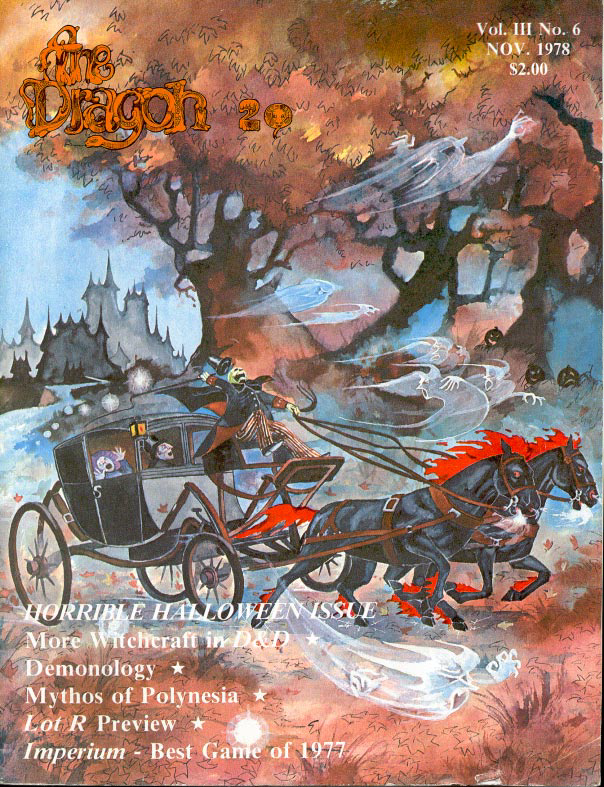
And so we come to November of 1978, which is notable … for nothing that I’m aware of, other than this magazine. This appears to be their Halloween issue (why November? Kask explains it’s because November is the dreariest month of the year – what with all the football and Thanksgiving? – and thus a good month for horror stories).

Whatever the reason, let’s see what Dragon #20 has to offer.

Designer’s Forum – The Making of a Winner: Imperium – Outstanding Game of 1977 by Marc Miller

Yeah, that Marc Miller. In this article, Miller describes the origins of Imperium. Apparently it began as two games, Imperium being a giant sci-fi game of economics and conquest, and StarFleet, which was on a smaller scale. Ultimately, StarFleet was put on the back burner while Traveler was made. When Lou Zocchi mentioned that the name could get them in trouble with the Star Trek folks, and when they decided Imperium was too big to publish, they decided to take what they had learned making Traveler and apply to StarFleet, which would now be renamed Imperium.

Anywho – the article goes on to describe the design process behind Imperium, and to also provide some rules clarifications and addenda.

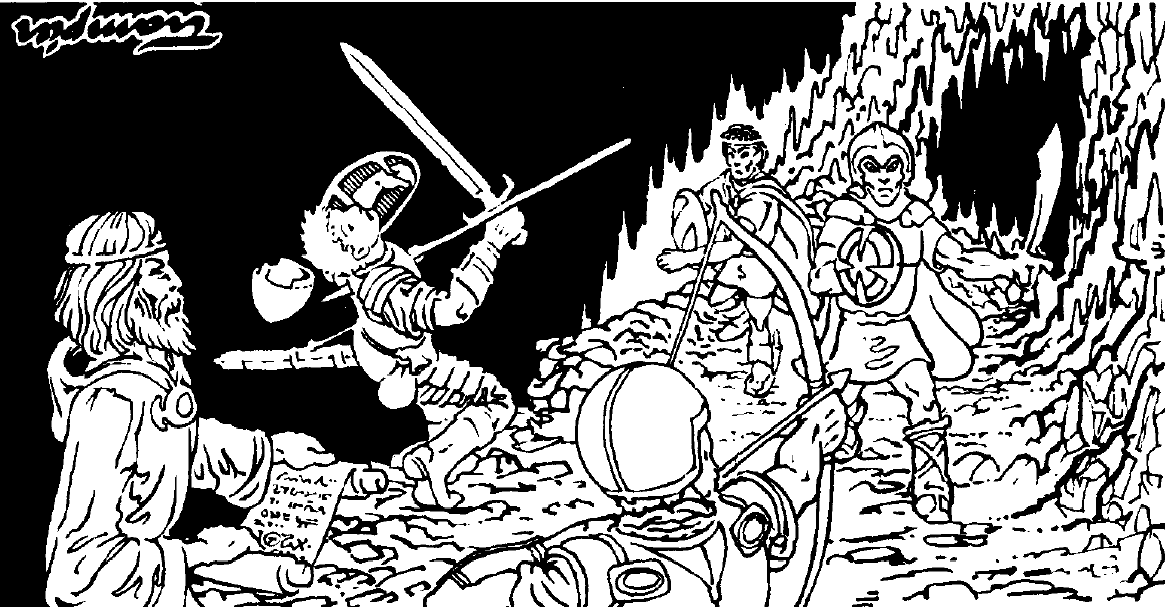
I enjoyed this bit …

Whatever happened to that guy?

Distributing Eyes & Amulets in EPT by Mike Crane

One of those great articles that makes perfect sense to people who play the game. The article is just a series of random tables that makes sure “rare” eyes and amulets show up less often than “common” eyes and amulets.

The Mythos of Polynesia in Dungeons & Dragons by Jerome Arkenberg

This article covers everyone from Tangoroa, God of the Ocean, to Pele the Destroyer, to Miru, God of the Underworld. The heroes seem more interesting …

The Polynesian Heroes were born in non-human form, and were brought up by their maternal grandparents, from whom they derived their magic. When in human form, they could transform, stretch, or shrink themselves, fly, take giant strides, and perform great feats of strength.

Maui is, of course, the badass of the crew (and he happens to look like a buffoon with eight heads) – here are some stats for Blood & Treasure.

Maui, Challenger of the Gods: Magic-User 18 and Fighter 15; HP 140; AC 12; ATK 4 slams +7 (1d3+5); MV 30 (Fly 40); F 6 R 9 W 4; XP 4500; Special: Dominate foes with 0 HD or less, 4 attacks per round, spells per day (4/4/4/4/4/4/4/3/3/2); Str 20, Int 18, Wis 18, Con 18, Dex 17, Cha 3.

Wormy

In this episode, Frank and Dudley abscond with one of the demon eggs to spring them on the ogres. It’s amazing how engaging this strip was right from the beginning.

D&D Variant: Another Look at Witches and Witchcraft in D&D by Ronald Pehr

Love the editor’s note:

Editor’s Note: This seems to be a well thought out class-variant. At the very least, it makes an excellent NPC or hireling/acquaintance. For those DM’s bold enough to try it, it provides a very viable character for ladies; be they sisters, girlfriends, lady gamer or others. D&D was one of the first games to appeal to females, and I for one, find it a better game because of that fact.

It manages to be both inclusive and a bit sexist at the same time.

So, what do the ladies get with this witch? It’s actually a nice class, and, I believe, the origin of the later witch class that showed up in Dragon in the 80’s. Witches here are not Satanists, but more nature lovers who use magic to charm and control – I guess what you would call an enchanter in more modern versions of the game – and who can brew potions, narcotics, hallucinogens, etc. Witches get eight levels of spells, many of them new, and they appear to straddle the normal magic-user/cleric divide.

D&D Variant: Demonology Made Easy by Gregory Rihn

This article is all about conjuring demons (and devils). The key here is learning a demon’s name, and the process is simple and clever: You research a demon or devil’s true name the same way you research a spell:

Demon prince, arch-devil = 9th level spell
Type VI, pit fiend = 8th level spell
Type V, ice devil, succubus = 7th level spell
Type IV, horned devil, night hag = 6th level spell
Type III, bone devil = 5th level spell
Type II, barbed devil = 4th level spell
Type I, erinyes, misc. = 3rd level spell

Definitely one of those, “Why the heck didn’t I think of that” moments.

Once you get down to the conjuration, you roll some percentile dice to see if what you call is what you get. Calling a demon prince, for example, has the following chances:

01-50 = Type V demon
51-75 = Type VI demon
76-00 = Demon Prince

High level conjurations require assistants and sacrifices, and there are additional chances for failure for characters below 20th level. Very good article.

GenCon XI Photo Album

Greg Costikyan of SPI … I believe I recognize the woman as Gygax’s daughter
That Gygax fellow
J Eric Holmes and his son Chris
Jeff Perren
Lou Zocchi and Woody … proving that GenCon’s best days are clearly behind it
Marc Miller
Mike Carr
Tim Kask
Tom Shaw of Avalon Hill

Review: See Africa and Die! or, Mr. Stanley, Meet Dr. Livingstone by Gary Gygax

Gygax reviews Source of the Nile here. Apparently, this is a super long play game. It is pretty extensive review, and it looks like a pretty cool game. Best line of the review:

Be certain to read and KNOW the rules before you attempt to play. The rules are not well organized, nor are they very complete. In fact, in many ways they remind me of those originally written for D&D®.

Gygax also gives some additional ideas for the game.

The Asimov Cluster by William B. Fawcett

This article discusses the problems inherent in recreating scenes from sci-fi novels in games of Traveler. It also provides stats for the planets of the Asimov Cluster from the Foundation Trilogy.

Advert for the drow modules. The drow are going to change quite a bit over the next 30 years.

Preview: The Lord of the Rings by Allen Hammack

This preview is for the Bakshi animated version (which I’ll admit I like, sue me). It mostly gathers together some stills from the movie and a few production notes from Bakshi.

It’s a Good Day to Die by Lyle Fitzgerald

This article compiles death statistics of a D&D campaign in Saskatoon. In two to three years, this campaign racked up 600 deaths of PCs and their advance-able hirelings. Wow! I know the old game was deadly (I’ve played it), but this does seem excessive. The top killers are Miscellaneous Causes (14.6 percent) and goblin races (10.1 percent). Dragons were responsible for 7.5 percent of the kills and giants 5.7 percent – respectable numbers for the big guys. War only caused 6 deaths – I guess one of the four horsemen needs to be replaced by a goblin.

War of the Ring Variant by Allen Hammack

Simple rule change – hide the movement of the fellowship so the bad guys don’t have to pretend they don’t know where they are. Honestly – can’t believe the designers didn’t think of this.

Fineous Fingers

A dragon throws a stupid paladin off a cliff. Nice tactic – fake a subdual.

Demonic Possession in the Dungeon by Chas. Sagui

This article takes the rules to task on the inability of demons to possess victims. In Chas’ rules, only demons of Type IV or higher can possess mortals. Interesting line:

The rule of the thumb is that only those demons that are immune to all but magical weapons and therefore exist upon two planes at once may possess.

One of those, “wait – is that really why, or did he just make that up?” lines.

The basic idea is that the DM let’s the players all know they might be possessed. Everyone rolls a saving throw, but only one character is really the victim. The victim is chosen “randomly” – i.e. first person into a room, last person, etc. A save vs. magic is allowed to avoid the possession.

The possessed dude has his normal AC, but attacks as the possessing demon. They cannot use lawful-aligned magic weapons. The demon can use its normal powers, provided its new body doesn’t preclude it. All damage is taken by the body, not the demon.

There’s more, but you’ll need to read the article.

Not a bad issue, really. The witch and the demon conjuration articles are my favorites. I’d recommend hunting it down.

Happy Halloween from the Mystery Men

‘Tis the season, and all that. Thought I’d write up a few heroes who seem appropriate for the holiday.

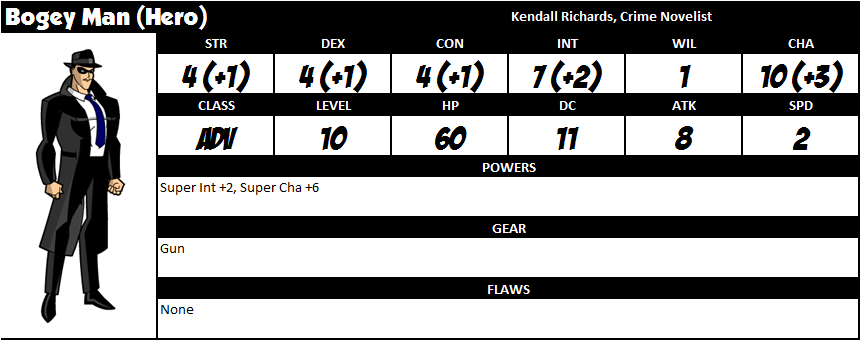
Bogey Man
Bogey Man is author Kendall Richards, a famous crime novelist who is forced to go undercover when a gangster called Blade steals his latest book, in which he has concocted the perfect crime. Once he gets his book back, he continues fighting crime as the Bogey Man.

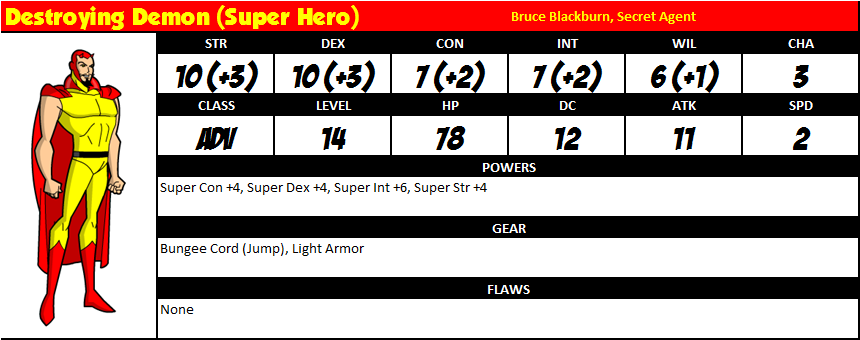
Destroying Demon
Secret agent Bruce Blackburn is forced to go undercover as a traitor to break an un-American spy ring (no, that’s not political – they actually called themselves the Un-American Group). Most folks think he is dead, but he actually fights crime and spies as the Destroying Demon. His main weapon – a bungee cord that allows him to jump from building to building.

Fantomah
Fantomah is a jungle goddess who deals out grim punishment to evil-doers in Africa. She can either take the form of a beautiful blonde jungle girl or a blue-skinned, skull-faced hellion.

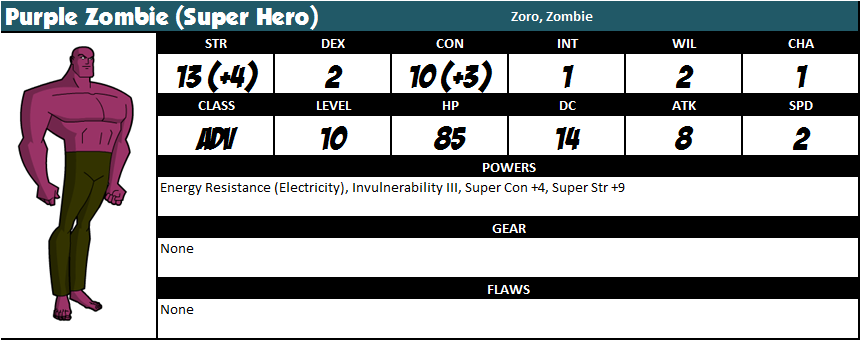
Purple Zombie
Zoro – if that’s his real name – was a corpse that was revitalized by a ray invented by Dr. Hale and Dr. Malinsky. Malinsky wants to create an army of zombies to take over the world, and when Dr. Hale opposes him he shoots Hale. The zombie, in return, strangles the evil scientist and then goes on a rampage. He is finally captured, but it turns out that Dr. Hale is still alive and is able to control him. The court releases Zoro to the doctor and embark on a life of adventure.

Happy Halloween Folks!

Sunday Grab Bag

Just a few random images harvested from a grand tour of the internet.

Dang It’s a Great Day Department

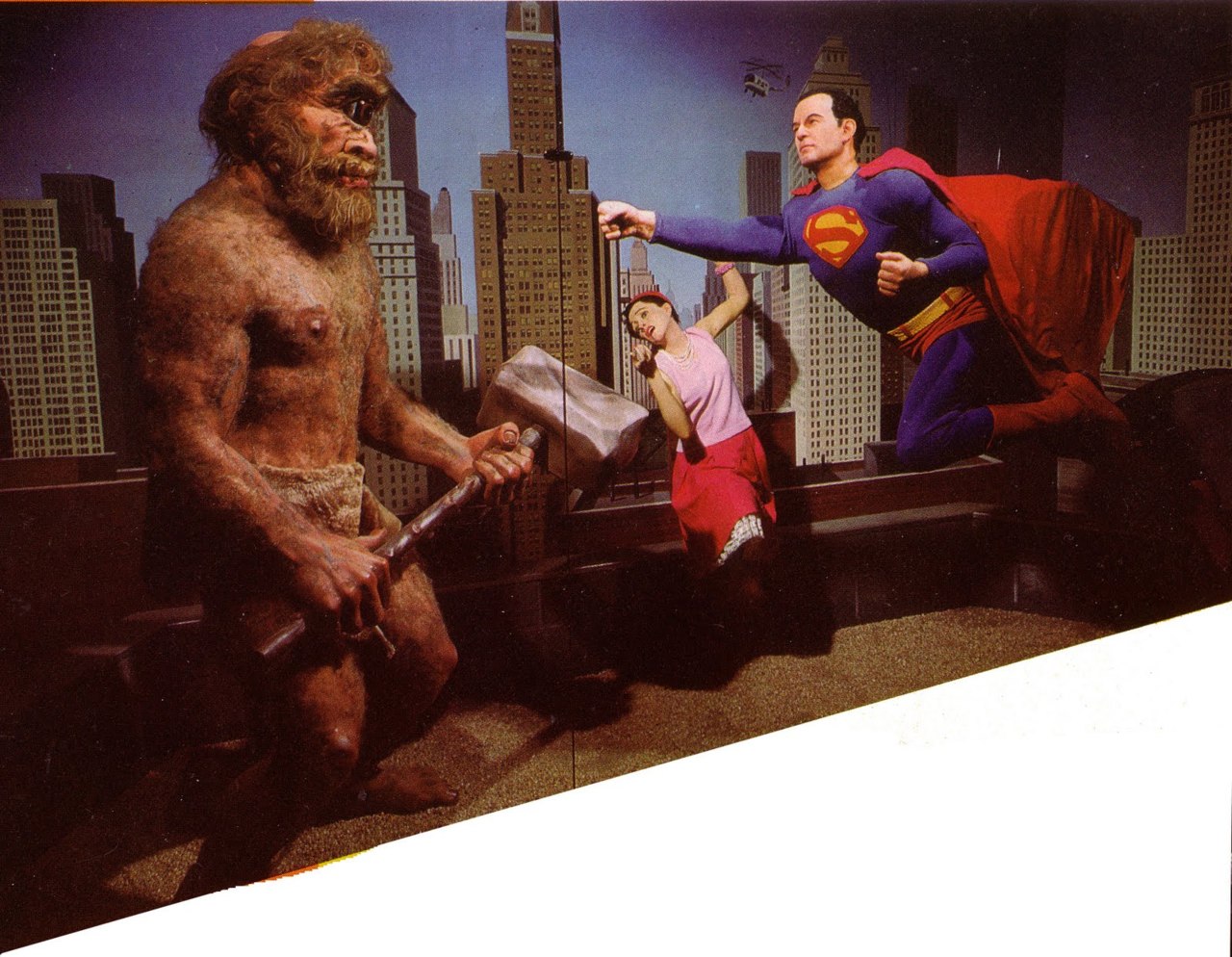
Did Superman Ever Star in a Diorama Fighting a Cyclops? Department

Yes. Yes he did. At the World’s Fair, in fact.

Geeks Come Out of Your Shell Department

Handy guide to the popular dances of the day. Don’t miss a chance to shake your geek thing.

G.I. Jump the Shark Department

This is the point when your toy line has take one step to many. See also – William “The Refrigerator” Perry with a football flail action figure.

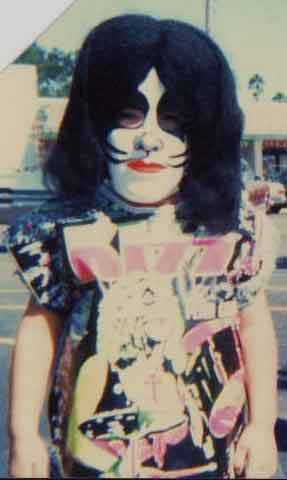
Halloween Peaked in the 1970’s Deparment

Let’s just be honest about it and move on with our lives.

Theo Ortner Kicks Ass Department

Those teeth are going to leave a mark.

Keep it Clean Department

Yeah, ending it with the bowel gnomes.

Tome of Horrors Converted + Establishing My LARPer Street Cred

Just finished writing my bit for Tome of Horrors Complete. I honestly have no idea how many monsters it was – 400 maybe – but they’re all converted and each one has a lair or encounter to go with it. It was a big project to tackle in two months, but I’m pleased as punch to have been involved with it. Now that ToH-C is done (I’m going to do a bit of tinkering with it tomorrow), I’ll have more time to devote to Mystery Men! and NOD 8.

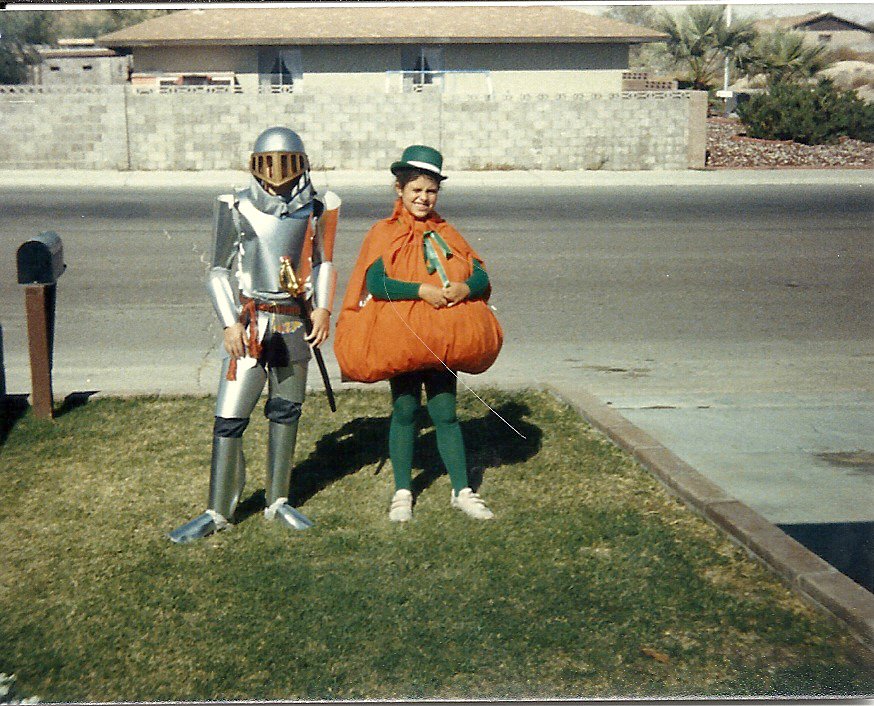
To celebrate, I present a photo of my sister and I in our Halloween costumes a few decades ago.

I’m the knight, in case you couldn’t figure it out. The armor was made by my father (thanks Dad!) from poster board spray painted silver. The helmet was purchased from Toys ‘R’ Us – it was part of the official Dungeons and Dragons toy line – Strongheart the Paladin’s helm. All of my original first edition and Moldvay-Cook gear came from Toys ‘R’ Us – I remember how excited I was when they finally opened one on our side of town (and it’s still there – I wonder for how long). Good times!

Well, back to work. Just finished a Charlie Chan movie, now watching Robotech while tapping away at some more Mu-Pan encounters. Have fun and stay safe!