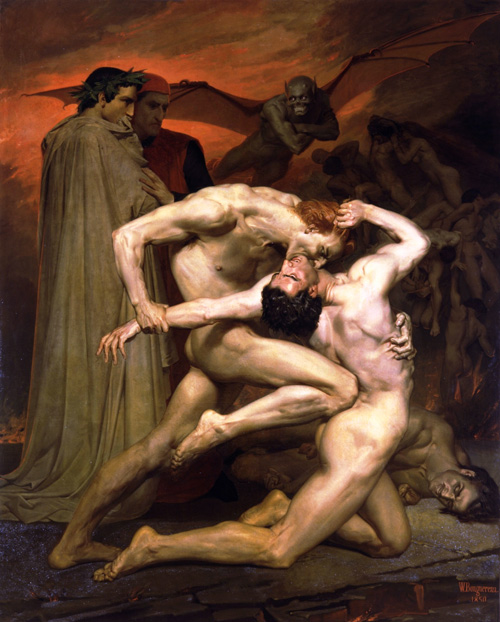
Into Stygia … Preview 1 Again!

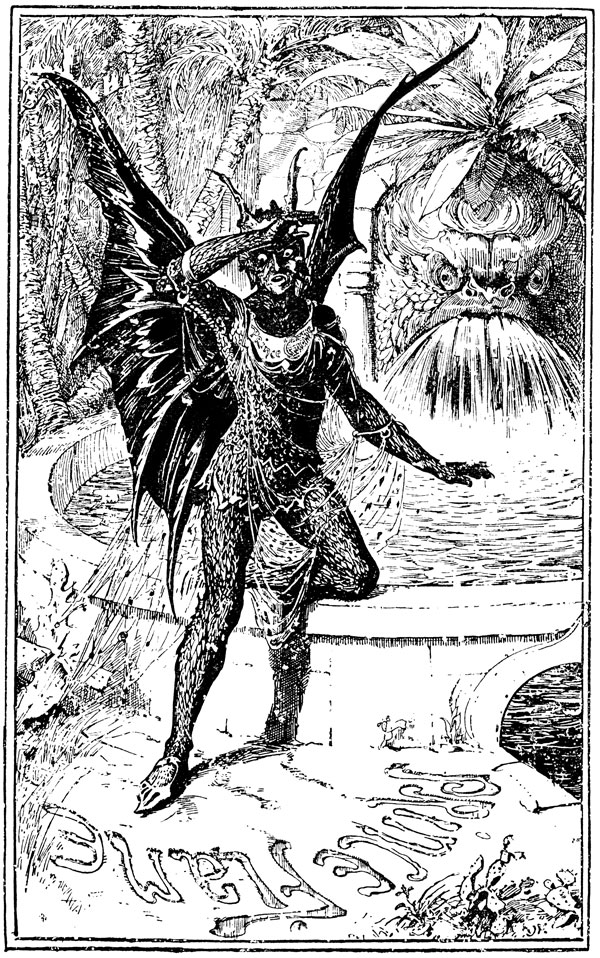
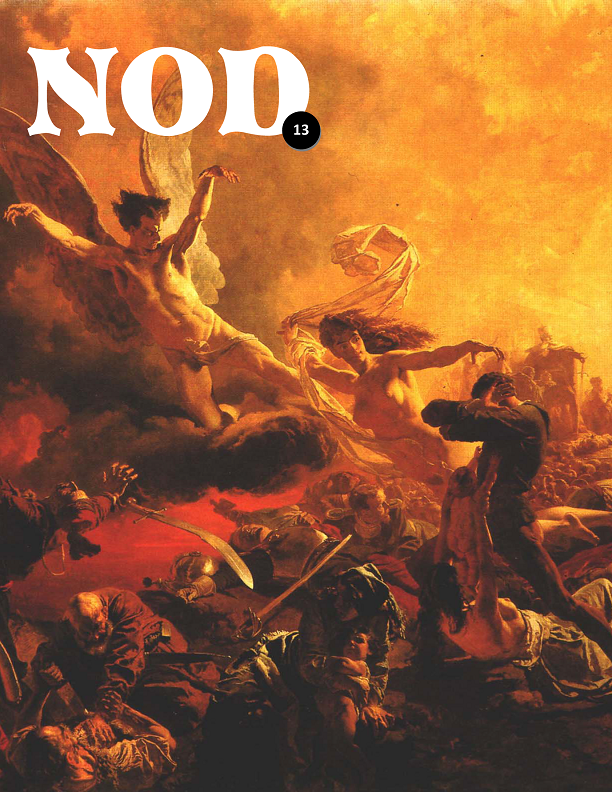
Is it me, or is that demon photo-bombing those fighting naked dudes?

Well, you’ve seen the sketch of Stygia a bit earlier … now the finished product.

STYGIA
As one passes from hot, dry Gehenna into cool, damp Stygia, the metallic sands beneath their feet harden and become a plain of swirling metals. This plain abruptly ends in a metal cliff, perfectly smooth and angular, as though cut by a die. One mile below the top of this cliff lies the murky swamp of Stygia, a land of mangrove swamps (though such mangrove trees one has never seen on the surface, with trees so twisted and black that even a druid would be compelled to grab and axe and fell the lot of them) mud flats, rocky, vine-choked promontories and always the thick, reddish water, so much like blood, that sucks and laps at the swampy shores. Eventually, the islands in the swamp become less and less, and finally one enters the sluggish, crimson River Styx. Beyond the Styx, of course, lie the battered walls of Dis, the great metropolis of Hell in which lies Pandaemonium, their parliament, and the manors and manses of the lords of Hell.

Stygia is the fifth circle of Hell, given over to the souls of the wrathful and forlorn. It is swathed in darkness both physical and spiritual, and sits upon a base of black mud. Wallowing in this mud, incapable of escape, are the souls of the wrathful, who look much as they did in life, but with faces twisted with unending ire. Beneath their feet are trampled the souls of the sullen and forlorn, who choke eternally on the mud and seek to pull others into it.

Stygia is an eternal battleground between two great princes of Hell, Bael and Dagon. Ancient enemies, they launch their forces against one another in an unending farce, for Bael rules the land and has no use for the waters of the Styx, while Dagon rules the Styx and has no use for the land above. One cannot use what the other possesses, but desires it just the same.

Dangers of Stygia

Crossing Stygia: Stygia is a difficult terrain to move through, for it requires a boat, skiff or raft of some sort, and such an item is not readily available when one first enters the swamp. One might wait for Phlegyas, the boatman of the Styx, to arrive, but his price is a heavy one – a portion of one’s soul (and impossible gift for those of lawful alignment) and a service to be granted at some point in the future. We’ll discuss Phlegyas more below.

Wrathful and Sullen: Assuming one is not ferried across Stygia, one must pole themselves across the landscape. The channels of Stygia are treacherous and ever-shifting. When one seeks passage from one hex into another, one must roll a die to see what passage they find:

ROLL PASSAGE
1-2 No passage by water – one must walk and leave their craft behind
3-5 A narrow channel (see below)
6 A wide channel (see below)

Wide channels are also deep and the safest routes for travel (though random encounters may occur there as well as anywhere else). Narrow, shallow channels, on the other hand, are clogged with the souls of the wrathful and sullen.

Those who travel a narrow channel have a 1 in 6 chance per mile (roll 1d4 to determine the length of the channel) of being beset by these creatures. Each person so attacked must pass a saving throw or be grappled by 1d4 wrathful. They are incredible powerful, making grapple attacks with a bonus of +3. If they get a hold, they then attempt (also with grapple attacks) to pull a person into the water. Each successful attack deals 1d4 points of damage. A successful grapple attack on a person already grappled drags them into the water and muck.

Each round, 1d4 more wrathful will attempt to grab a person not already dragged into the water (and each of their companions, so delayed, must make another saving throw to avoid the same fate). No more than six wrathful can grapple a person at one time.
If a person is dragged into the water and mud, they are then grappled by 1d6 of the sullen, who lie beneath the mud (and who also attack with a +3 bonus), with the purpose of drowning them.

Waters of the Styx: A dip in the Styx has the same effect as oil of invulnerability (i.e. per the spell stoneskin). This effect lasts for 24 hours. The invulnerable is also affected as per the spell rage whenever they are challenged in any way.

Finding Phlegyas
Phlegyas dwells in a stone tower bathed in blinding light. This tower’s position in Stygia is quite variable, moving every 1d6 days. Its position can be rolled as follows:

ROLL POSITION
1-2 Opposite side of Stygia from the adventurers
3-4 Quarter of the way around Stygia from the adventurers
5 2d4 hexes away from the adventurers
6 In the same hex as the adventurers

Races of Stygia
Stygia, like most of the other circles of Hell, is not only inhabited by pitchfork-carrying devils and their victims. Five races known to people of the surface world dwell in Stygia, though these races have been changed in many ways by their habitation in Hell.

In particular, the race of Stygia, living so long near or in the River Styx, are nearly invulnerable to normal weapons (i.e. those of less than adamant construction), taking only half damage from such weapons. They are also all berserkers, gaining double their normal attacks in combat, but suffering a -2 penalty to their Armor Class.

Frog Men: The frog men have long, thin legs and great, wide mouths filled with needle thin teeth. They have glossy black skin and warm, amber eyes that produce a dim glow. Their tongues are long and barbed, and those struck by them must pass a saving throw or be infected by disease (lose 1d3 points of wisdom per day). Just as frogs straddle land and water, the frog men straddle the lines between Bael and Dagon, attempting to play one side off the other for their own benefit.

Hobgoblins: Hobgoblins, as mentioned in NOD 11, are “the wrathful”, so it is only right that they dwell in Stygia as the foot soldiers of Bael. Stygian hobgoblins have crimson skin so dark it is almost black, with beady eyes of a sulfurous yellow. They dress in light or medium armors, like ring armor or lamellar, for the danger of being sucked into the mud is ever present in Stygia. Stygian hobgoblins arm themselves with sabres and scimitars, hacking falchions, barbed spears, throwing axes, brazen muskets and pistols. Some protect stone fortresses hidden in the swamp, while others patrol the swamps in shallow draft, iron-clad galleys armed with rows of ornate bronze cannon.

Mermaids: The mermaids of Stygia have pallid skin and overly large, deep green eyes that can allow them to charm person. Their lower bodies are those of eels and their hands are tipped with deep, green claws. They are utterly without mercy and quite carnivorous.

Ogres: The ogres of Stygia are the armorers of Bael, forging the weapons, armor and ordnance of his armies. They have greenish-black skin and lank, green hair that grows to their ankles. This hair is matted, sometimes braided, and the ogres weave iron knobs into the ends so that their hair becomes a weapon while they are fighting. Any creature in melee contact with them must save each round or suffer 1d4 points of damage from these knobs. The ogres of Stygia are berserkers (two attacks per round).

Sahuagin: The sahuagin of Hell are not terribly different from the sahuagin of any other world – a testament of sorts to their innate wickedness and ferocity. The Stygian sahuagin have dull black scales that aid them in surprising their prey in the black waters of the swamp and river.

Lords of Stygia
Stygia is divided between two princes, Bael and Dagon.

Prince Bael is a fallen solar, and one of the principal kings of Hell. He is one of Lucifer’s lieutenants, and thus also one of his greatest rivals. Bael can take the form of a crimson-skinned man with a face twisted with rage (even when he is calm is appears this way) and bull’s horns jutting from his head, as a brazen bull with a man’s face, or as a strange creature with the body of a spider and three heads, those of a crowned man, a cat and a toad. This last form is his true form since his fall from grace.

Dagon is the prince of the waters of Stygia, i.e. the River Styx. Also known as Lotan, the patron deity of Ophir, he dwells in a grand palace beneath the Styx with his wife, Ishara, a demi-goddess of the oaths and magical bindings, who inflicts bodily penalties on oath breakers. Both appear as demonic merfolk. Ishara is known for her milky white skin. She can also take the form of a white scorpion.

Vepar is the lieutenant of Dagon and a great duke of Hell in his own right. He governs the waters and on Nod is invoked to guide armed vessels to safety or to sink such vessels beneath the waves. He takes the form of a fetching mermaid clad in armor of coral and gold.

Furfur, a great earl of Hell, is the chief of the perytons, and he commands 29 companies of demons and devils. He appears as either a winged deer or an angel and is the patron of furcifers (i.e. scoundrels). Furfur believes the skies of Stygia to be his domain, and he counts himself neutral between Bael and Dagon, though the raids of his servants on the land forces of Bael have disposed the former quite badly toward him.

Aguares, who was covered in NOD 9, is a duke of Hell and an unsteady servant of Bael. He appears as a pale, old man mounted on a crocodile, with a hawk on his fist. He is served by 31 companies.

Scox is a marquis of Hell and the chief of the eblis, and he attempts to take no part in the battles between Bael and Dagon. He is faithful to Lucifer, and acts as his chief factor in Stygia, despite the fact that Bael is supposedly Lucifer’s right-hand-man.

Nickar, chief of the kelpies and pirates, is a servant (unwilling to some extent) of Dagon. He commands the shallower channels and appears as a demonic nixie playing a harp and attended by kelpies and nixies who comb his hair and whisper sweet nothings in his ears.

Finally, we come to Styx herself, daughter of Oceanus and Tethys, a titan and nereid who bore to the titan Pallas the children Zelus, Nike, Kratos and Bia. She remains above the fray, but lends some support to both sides to keep them locked eternally in battle and thus out of her hair. Styx is fairly neutral in alignment, and the most approachable of the lords of Stygia, though she is rarely inclined to lend aid.

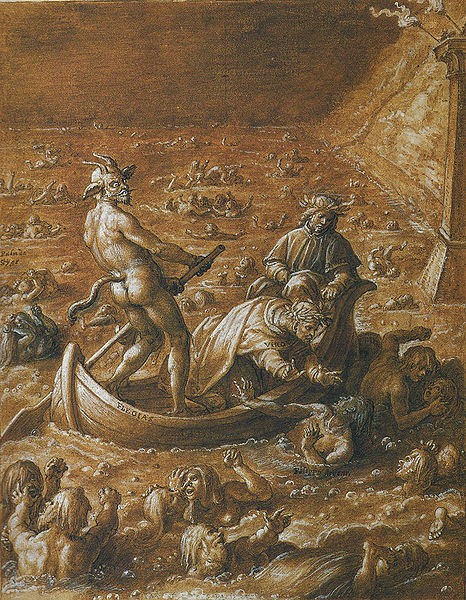
Into Stygia … Preview 1

I’m just beginning the process of writing the Stygia portion of my Hellcrawl – the fifth circle of Hell, to be precise, wherein dwell the wrathful and the sullen. What follows is my initial sketch of the overview. Some parts are in a finished state, most are just bits and pieces of notes. I thought it might be interesting to people – like an illustrator showing a sketch before the finished drawing.

WHAT – swamp, mangroves, weird plants, amphibians, deeper lakes, river

WHO (WRATHFUL)

Stygian darkness

Wrathful souls in the mud, biting and attacking

Berserkers

Souls of the sullen beneath the waters, grasping and pulling people down

Inability to control anger and rage

Tower wreathed in flame and boatman Phlegyas taking people across the Styx proper

Blue bayou pirates

Terrains – mud flats, rocky islands, wooded islands, clumps of mangrove, Spanish forts, Spanish moss, vines

“Shooting the Rapids”
You have to do a check to find a channel to the hex you want to enter – if successful, you find a deep channel. If not, you find a shallow channel filled with the souls of the wrathful, who are stuck in the mud but no less dangerous for it.

Reflex saving throws – once per mile

If failed, you are grappled by first one wrathful, then 1d4 more per round, all trying to damage you and pull you into the mud, where then the sullen grab from below and suck you in to drown

Dipping in the Styx can make people invulnerable for a time (1d8 days) (bonus to armor and saves), but also makes them intemperate (save or go berserk)

Races of Stygia
Stygia, like most of the other circles of Hell, is not only inhabited by pitchfork-carrying devils and their victims. ??? races known to people of the surface world dwell in Stygia, though these races have been changed in many ways by their habitation in Hell.

Sahuagin: The sahuagin of Hell are not terribly different from the sahuagin of any other world – a testament of sorts to their innate wickedness and ferocity. The Stygian sahuagin have dull black scales that aid them in surprising their prey in the black waters of the swamp and river.

Frog Men: The frog men have long, thin legs and great, wide mouths filled with needle thin teeth. They have glossy black skin and warm, amber eyes that produce a dim glow. Their tongues are long and barbed, and those struck by them must pass a saving throw or be infected by disease (lose 1d3 points of wisdom per day).

Ogres: The ogres of Stygia are the devoted servants of Bael. They have greenish-black skin and lank, green hair that grows to their ankles. This hair is matted, sometimes braided, and the ogres weave iron knobs into the ends so that their hair becomes a weapon while they are fighting. Any creature in melee contact with them must save each round or suffer 1d4 points of damage from these knobs. The ogres of Stygia are berserkers (two attacks per round).

Mermaids: The mermaids of Stygia have pallid skin and overly large, deep green eyes that can allow them to charm person. Their lower bodies are those of eels and their hands are tipped with deep, green claws. They are utterly without mercy and quite carnivorous.

Lords of Stygia

Prince Baal of the Land – sometimes Bael, Baell – associated with Ashtaroth – principal king of Hell – 66 legions of demons, main assistant of Satan – can make people invisible or wise, speaks hoarsely, carries ashes in his pocket, appear in forms of man, cat and toad or as a man or bull

Prince Dagon of the Water – also called Lotan, patron of Ophir – has a chain gang of drowned kings – Anat is his sister, cooked kings on a fisherman’s spit – wife is Ishara or Shala – patron of Hammurabi – weapon of the god was used to slay Arman and Ibla by Naram-Sin – Joppa (Jaffa, famous for Jonah) is the land of Dagon – possesses the head of Saul – also called Marnas – Saint Porphyry destroyed his temples

Ishara – goddess of the oath, “binding promise”, “magical charming”, “white ghost” – inflicts bodily penalties to oathbreakers, in particular breakers of military oaths and a goddess of medicine, mother of the seven stars, associated with Scorpio, also love goddess and associated with underworld

Vepar – strong Great Duke of Hell, 29 legions of demons, governs waters and guides armored ships laden with ammunition and weapons; can bring storms and rough seas, can make men die in three days by putrefying sores and wounds, causing worms to breed in them, depicted as a mermaid

Furfur- great earl, chief of perytons – 29 legions of demons, liar unless compelled to enter magic triangle – causes love between man and woman, creates storms and tempests, thunder, lightning and blasts, teaches on secret and divine things, can appear as winged deer or angel – corruption of Furcifer, Latin for scoundrel

Aguares – duke of the eastern zone of upper Hells – duke served by 31 legions – see NOD 9 – can make runaways come back, and those who run stand still, cause earthquakes and teaches languages, finds pleasure in teaching immoral expressions, destroy dignities (temporal and supernatural) – pale old man riding crocodile with hawk on his fist

Scox – chief of the eblis – Marquis – also Shax, Chax, Shass, Shaz – 1000 legions of demons on evil horses, takes away the sight, hearing and understanding, steals money from kings’ houses, steals anything, discover hidden things, faithful and obedient, but a great liar, stork who speaks with a subtle and hoarse voice, but voice becomes beautiful when forced into magical triangle and made to speak the truth

Nickar – chief of the kelpies and pirates – green hair and plays harp – mermaid creature

Styx – daughter of Oceanus and Tethys – a titan/neried, wife to Pallas, bore him Zelus, Nike, Kratos and Bia (Eos) – supported Zeus in the titanomachy

Phlegyas – the boatman of the Styx (according to Dante)

Random Encounters
Demons – Lemures, Dretches, Imps, Achaierai, Rutterkin, Vrock, Chasme, Hydrodaemon, Greruor, Shrroth

Dhezik
Wight
Eblis
Kelpie
Spriggan
Peryton
Devil Wasp
Brykolakas
Ghoul Stirge
Ogre Mage
Grey Nisp
Undead Raven Swarm
Aberrant
Witch Tree
Bog Mummy
Cerebral Stalker
Fen Witch
Entropic Ooze
Tenebrous Worm
Groaning Spirit
Demiurge
Hydra
Widowshark
Giant frog
Giant crocodile
Froghemoth
Death head moths

Blood & Treasure: An Idea and a Problem

Before I begin this post … The NOD 13 E-Book is back up for sale. I had forgotten to credit an artist, so I needed to bring it down until I could fix the PDF this morning. So – back up for sale, $3.50. Buy it HERE if you’ve a mind to.

Now back to our regularly scheduled post …

How many readers do yard work or putter around in the garden? If not, I highly suggest it, because it gives you time to think and create.

THE IDEA

B&T Ranger by Jon Kaufman

Today I was putting in a veggie garden and while I toiled a thought popped into my head. I want Blood & Treasure to be inclusive of all the editions that fed into the SRD – but that means a Referee who wants to run the game without some material from one or another edition has to put together a list for his players of what material is forbidden. That’s a pain in the butt.

So, working off of ideas I’ve seen floated around by Zak Smith and Jeff Rients and possibly others, I thought I might help those Referees out. Obviously, if a Referee is exluding material based on the theme of his or her campaign, I can’t read their minds and help with that. But, if they want to exclude things based on the edition it showed up in, that I can handle.

The idea is simple. I’m using three categories of material:

Classic: For me, this is the material that showed up in the three original books and material from the “basic” game written by Holmes and expanded by Moldvay, Cook and Mentzer. So, the four basic classes (yes, of course you don’t have to use the thief), the human, elf, dwarf and halfling, the old stand-by spells and the old stand-by monsters.

Advanced: This is the stuff from the original supplements as well as the first edition of AD&D. Material (i.e. classes, races, spells and monsters) that is “advanced” will be marked with a little black diamond next to the name.

Expanded: This is the stuff that showed up in the 2nd and 3rd editions of the game, from feats to sorcerers to tieflings to grey renders. Expanded material will be marked with a little black circle.

So, if a Referee just wants to run a “classic” campaign, he can tell the players to avoid any race, class or spell marked with a diamond or circle.  Likewise, those who want an “advanced” campaign can caution players not to attempt to use materials marked with a circle. Simple and, I think, not too intrusive. Let me know what you think …

THE PROBLEM
Inclusivity is nice, but it poses some problems. For all intents and purposes, I am finished writing Blood & Treasure and it looks like it’s coming in around 300 big fat pages. That’s a sizable book, and not to some peoples’ taste. So …

How about I produce three books?

One will be a 300 page monster with everything in it. This should run in the $30 range.

The other two will be divided into a Player’s Guide with the classes, races, spells and basic rules (combat, skills, saving throws, etc.) and a Referee’s Guide with monsters, treasure and info on creating and running adventures and campaign worlds. These would probably sell in the $15 range.

My only worry here is that somebody could accidentally buy all three and waste some of their hard earned money.

Again, let me know what you think.

B&T Lost Classes: The Dragon Disciple

I love classes. Since I picked up my first Dragon ages ago and discovered the concept of the “NPC class” (like we weren’t going to try to play them), I’ve loved classes. I’ve posted quite a few on this blog. When it came to Blood & Treasure, I wanted to stick to the classes in the SRD – i.e. the classic classes of AD&D plus the sorcerer. I decided, to make Blood & Treasure a little different, I would throw in one more, in this case converting the Duelist prestige class into a class of its own. That gave me 13 classes, which I somewhat doubled by giving examples of variant classes one could create with a little reassembly of existing parts.

All along, though, there were a few other classes I wanted to throw in. The psychic (my version) was one of them, but I decided with four dedicated spell casters in the game already (cleric, druid, magic-user and sorcerer), one more was overkill. From the SRD, three other classes caught my eye. The first was the soulknife, and it nearly made it in. The other two, both prestige classes, were the shadowdancer and dragon disciple. I’m calling these three the “lost classes” of Blood & Treasure, and I’m posting them here, starting with the dragon disciple.

And yeah, I know, I’m posting “lost classes” from a book that hasn’t been published yet. So sue me.

DRAGON DISCIPLE
Dragon disciples are men and women who enter into secret dragon societies with the object of harnessing the powers of dragons and eventually transforming themselves into dragons. All of them have the mystic blood of dragons flowing through their veins, and by energizing their chakras, they can become dragons themselves.

Requirements: Dragon disciples must have intelligence, constitution and charisma scores of 13 or higher.

Hit Dice: d10 (+3 hit points per level from 10th to 20th).

Armor: None.

Shield: No.

Weapons: Club, crossbow (any), dagger, hand axe, javelin, kama, nunchaku, punching dagger, quarterstaff, sai, shuriken, siangham, sling and spear.

Skills: Escape, find secret doors and listen at doors (see Heroic Tasks below).

CLASS FEATURES
Dragon disciples are scholars as much as they are warriors, and have the abilities of a sage (see Henchmen).

At 1st, 4th, and 7th level, a dragon disciple gains a +1 bonus to their existing natural armor. As his skin thickens, a dragon disciple takes on more and more of his progenitor’s physical aspect.

At 2nd level, a dragon disciple gains claw and bite attacks if he does not already have them. Medium-sized dragon disciples deal 1d6 points of damage with bite attacks and 1d4 points of damage with claw attacks. Smaller dragon disciples reduce these values by one dice size, while larger dragon disciples increase these values by one dice size.

As a dragon disciple gains levels, his ability scores increase as follows:

Level | Boost
2nd | Str +1
4th | Str +1
6th | Con +1
8th | Int +1

At 3rd level, a dragon disciple gains a minor breath weapon. The type and shape depend on the dragon variety whose heritage he enjoys (see below). Regardless of the ancestor, the breath weapon deals 2d6 points of damage of the appropriate energy type.

Dragon Variety |  Breath Weapon
Black |  Line of acid
Blue |  Line of lightning
Green | Cone of corrosive gas (acid)
Red |  Cone of fire
White | Cone of cold
Brass |  Line of fire
Bronze | Line of lightning
Copper |  Line of acid
Gold |  Cone of fire
Silver |  Cone of cold

At 7th level, the damage of the breath weapon increases to 4d6, and when a disciple attains dragon apotheosis at 10th level it reaches its full power at 6d6. Regardless of its strength, the breath weapon can be used only once per day. A line-shaped breath weapon is 5 feet high, 5 feet wide, and 60 feet long. A cone-shaped breath weapon is 30 feet long.

At 5th level, the dragon disciple can use nonvisual senses to notice things it cannot see. He usually does not need to make checks to notice and pinpoint the location of creatures within 60 feet, provided that he has line of effect to that creature.

Any opponent the dragon disciple cannot see still has a tactical advantage against him.

At 9th level, a dragon disciple grows a set of draconic wings. He may now fly at a speed equal to his normal land speed.

At 12th level, a dragon disciple takes on the half-dragon template. His breath weapon reaches full strength (as noted above), and he gains +2 to strength and +1 to charisma. His natural armor bonus increases to +4, and he acquires the low-light vision of elves, darkvision to a range of 60-ft, immunity to sleep and paralysis effects and immunity to the energy type used by his breath weapon.

NOD 13 Lives!

Finally finished NOD 13 and got the e-book uploaded at Lulu.com. NOD enters its third year of existence with this issue, and it’s received a minor facelift. This issue contains …

The Evolutionary PC class – with some simple stats for using the future men as alien races in Space Princess

Abaddon and Gehenna – the third and fourth circles of Hell dedicated to gluttony and avarice respectively

Hero vs. Villain – this one featuring Zanzibar the magician and Greymalkin, the speed demon

Dual Helms – magical helms for two

Greatsword – rules to my card game of medieval one-on-one combat

Pandaemonium VI – featuring Amon, Demoriel, Mammon, Mulciber and Paymon

Shades of Red – variant red dragons

112 pages of content for $3.50

When I’ve received my copy of the hard copy I’ll put it up for sale – probably will cost $10.00

Atom Age Tech for Space Princess

A couple devices from Atomic Annihilation for the Space Princess adventurer.

AEROCYCLE (DC 30)
If you need a super science vehicle to move you through the air while still leaving you vulnerable to ray guns, bullets and rocks, you can’t do better than the aerocycle. I mean, sometimes it’s about looking good, right?

The aerocycle can get you about 20 feet above the ground, max. and can lift two people at a time – for example a primitive swordsman and his space princess holding him tight.

Aerocycle: HD 3 | DEF 12 | SPEED Normal

RAD-SUIT (DC 15)
The rad-suit provides a +1 DEF and a +3 bonus on STR tests against radiation. It is a must for adventurers plumbing the depths of ancient fortresses that were once powered by primitive atomic piles.

After London, the RPG Campaign Book That Wasn’t

Having recently stuck my toe in the concept of a Victorian post-apocalyptic game (Apocalypse 1898, to be precise), several folks pointed me towards a few 19th century tomes about such a world. One was called After London, by Richard Jeffries. Written in 1885, this is the book that should have been in Appendix N but wasn’t (at least, I don’t think it was there).

The book is set after much of the population of England has, for some reason (it is never explained, though the narrator posits some notion of a comet being involved and then discounts it), moved on. Over the centuries, England (and perhaps the entire world) has fallen back to a level of Medieval technology and society. The first chapters read like a campaign setting – describing how the villages and towns and fields went back to the wilderness, and how the dissolution of London itself created a stinking, deadly morass. The fall of London’s bridges and the build-up of wreckage carried by the Thames has flooded the heart of England, creating a great lake around which much of the English population dwells. They are beset by the warlike Irish (in their ships) and Cymru, fear that the Scots will one day invade, and have to deal with the savage bushmen (descended from the criminal classes) and wandering Gypsy tribes. Jeffries also covers domestic animals going wild. There is no supernatural or paranormal element here – no magic, no mutations, no steampunk – just the world they knew disappearing and a new, more primitive world rising in its place.

After the “campaign setting” is discussed, we get into the story of Felix. For our purposes, Felix is a 1st level fighting-man who hasn’t enough wealth to marry his dream girl, Aurora. Like any other good PC, he decides to go out into the wilderness – in this case out on the Lake in a canoe – and score some treasure (and XP, of course). His journey has a few hang-ups and a few dangers – he gets to see “modern” warfare first hand (and is unimpressed), ventures into the stinking ruins of London, and finally finds some friends in the wilderness. Does he ever return to Aurora? Who knows – Jeffries ended the story in what lots of folks would consider the middle. And maybe, for the old school crowd, this is the best way it could have ended. One adventure over, others on the way.

Should RPG fans read After London? Absolutely. Although it describes a world more akin to Glorantha than Greyhawk, it does a fine job of making that world real and does an equally good job of describing what needs to be described to “run the game”. It also has a score of ideas that can be used when running a medieval campaign, especially the importance of status and the very frightening plight of people without it, who can be seized under any pretense, stripped of their wealth, and made a slave. Felix despises this world, but also knows enough that he cannot change it and has to work within it if he ever wants to wed his lady love.

About the only thing I missed in After London – and possibly only because I was reading a version from Project Gutenberg on a Kindle – was a map of future Britain. I was sorely tempted while reading to produce a hex map of the future isle … and maybe if I get enough goading, I’ll actually do it.

Blogger Appreciation Day & Lulu Sale

Apparently, it is Blogger Appreciation Day. So, just wanted to say thanks to all the various bloggers I read and enjoy, from old school (and sometimes new school) RPGs to economics to art and design. We live in an age of wonders when people from all over the world can come together in real time and argue about crap like ascending vs. descending AC, ability limits based on gender, the wisdom of level limits and whether or not alignment languages are stupid.

Also – in case you are interested – Lulu is doing a 29% off Leap Day sale. If you’ve been thinking about a purchase from me or any of the other fine folks who sell their wares on Lulu, today is probably a good day to take the leap!

You see what I did there? “take the leap” – Leap Year. That’s a joke, son. A funny. I keep pitchin’ ’em, but you ain’t catchin’ ’em. You must have a hole in your glove …

Or if you prefer the original …

Nomes – New Race

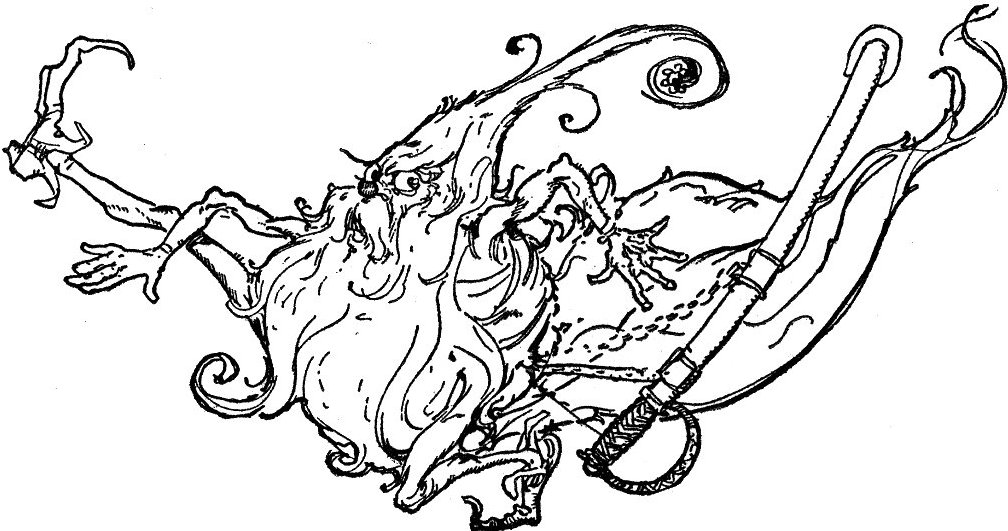
Illustration by John R. Neil, 1921

The nomes are akin to the fey oumphs, and dwell underground with them, sometimes cooperatively, but just as often in opposition. They are natural miners, with eyes that can pierce the blackness of the underworld as easily as human eyes can pierce the daylight; however, in light they are just as blind as a human is in the dark, and must shroud their eyes or use spells of darkness to see even dimly.

Nomes are short, standing only 2 to 4 feet in height (1d3+1). They have spindly arms and legs and skin that ranges from flinty grey to rust brown in color. Their eyes, like little black beads, sparkle in light or dark, and give them a look of conspiracy. Nomes are easily agitated and can fly into a rant or a rage at the drop of a hat, though the more adventurous of the race are moderately better at controlling their temper. They cover themselves with tattoos (really more akin to engravings), and from these tattoos they draw mystic powers.

Nomes adventure in search of “the mother lode” that will make them wealthy and powerful. They adventure with a mind to one day constructing a grand fortified mine, settling down, having children and amassing an army of nomes to do their bidding. They call this “the plan”, and most things they encounter are either “all part of the plan” or “not part of the plan”. When a nome is happy, they’ll muse that, “oh yes, the plan is coming along nicely”. The fact that most folk do not know what “the plan” is, paired with the conspiratorial look in their eyes, makes most people suspicious of nomes.

NOME ADVANCEMENT
.nobrtable br { display: none }

Level Experience Hit Dice Hit Bonus Save
1 0 1 +0 14
2 2,000 2 +0 13
3 4,000 3 +1 12
4 8,000 4 +2 11
5 16,000 5 +2 10
6 32,000 6 +3 9
7 64,000 7 +4 8
8 128,000 8 +5 7
9 256,000 9 +6 6
10 350,000 9 +2 hp +7 5
11 450,000 9 +4 hp +7 4
12 550,000 9 +6 hp +8 4

RACIAL ABILITIES
As mentioned above, the nomes can see without light, but do not see well with light. In bright light, they must fight blind unless they have their eyes well shaded, and even then suffer a -1 penalty to hit. Their skin is tough and thick, and provides them a +2 bonus to AC. Nomes have a knack for noticing odd stonework and construction, as well as a knack for finding more cunning traps, picking locks, and sniffing out deposits of copper, silver and gold. Their small size prevents them from using large weapons. Finally, nomes can sense vibrations in the stone, and thus can only be surprised on a roll of 1 on 1d10 while underground.

CLASS ABILITIES

Prime Requisite: Constitution, 13+ (5% experience bonus). Nomes are tough little buggers.

Hit Dice: 1d6+1 (2 hp per level after 9th level). Nomes live a rugged lifestyle, and often come into conflict with other species underground (due to the need for living space as much as their irascible personalities). They are not as militant and well-trained, though, as the Oraenca.

Armor Restrictions: Nomes can use any type of armor, though they prefer to avoid heavy armor because it makes movement through the underworld more difficult.

Weapon Restrictions: Nomes can wield clubs, daggers, flails, maces and swords without trouble. Axes and spears require the use of two hands, and two-handed swords and pole arms are just too large for them. They can use any ranged weapon, but prefer crossbows and slings.

Special Abilities: Nomes are magical folk, though not as skilled as the Caledjula or Nif in the working of spells.

Nomes can use cantraps (level 1 to 3 spells) without any difficulty and using the normal magic rules.

Nomes can cast invocations (level 4 to 6 spells) only by engraving sigils into their skin. These spells can only be spells that affect the nome personally, and once engraved, they can be invoked at any time using the normal spell check mechanism but with a +2bonus to their spell check.

Personal Invocations: Armor of Deflection, Ghost Walk, Touch of the Mystic, Viper Strike

Nomes can likewise work rituals (level 7 to 9 spells) into their skin, powdering the necessary gemstone into their engravings. They must re-apply the crushed gemstone once per month to keep the sigil active and energized, but while it is energized, they receive the same +2 bonus to their spell checks.

Personal Rituals: Body of Fire, Change Form, Consume Soul, Mindshriek, Temporal Abstraction

Nomes are doughty men and women, and their irascible personalities are not inclined towards fear. Whenever a nome must save against fear, there is a 3 in 6 chance that they ignore the fear effect and instead fly into a raging fit. While throwing this fit, the nomes focus their attacks (and are unable to use spells) on the source of the fear. They gain a +2 bonus to hit and damage for 1d6 rounds plus their constitution bonus. At the end of their fit, they are exhausted and must now roll their saving throw against fear.

Needless to say, folk who know nomes well take great pains to avoid startling them.