Dragon by Dragon – February 1978 (12)

The cover of this baby trumpets an exclusive preview of Andre Norton’s D&D novel, Quag Keep! Let’s see what else this issue has to offer …

The first article is Leon Wheeler‘s The More Humorous Side of D&D, which, if I’m honest, is the literary equivalent of “Let me tell you about my character”. My preference was for the little illustration …

Simple but effective line art … something missing from the more modern products, I think. But maybe I’m just an old fart.

Up next is a “D&D Variant” – A New Look at Illusionists by Rafael Ovalle. Rafael’s illusionist has a 7% chance per level of discerning an illusion created by a creature (i.e. rakshasa, succubus, leprechaun) and, if I’m reading this correctly, always can tell another illusionist’s handiwork. Their spells can affect astral and ethereal creatures because they involve light. A few new spells are added as well, including improved displacement, sensory displacement, discord, gaze of umber hulk, create spectres and basilisk gaze.

Jerome Arkenberg now provides us with The Persian Mythos. This is a quick list, and provides an Armor Class, Move, Hit Points, Magic Ability, Fighter Ability and Psionic Ability for each of the deities. Vohu Manah, “Good Mind”, for example, has the following stats:

Armor Class: 2

Move: 18″

Hit Points: 250

Magic Ability: Wizard – 20th

Fighter Ability: Lord – 15th

Psionic Ability: Class 1

Short and sweet, and probably enough to run a combat, if a combat was actually needed.  I’m sure more modern players will scoff at the AC, which would be 17 or 18 in modern games, but with 250 hit points and all that magical and fighting ability, it’s probably sufficient to clean a few old school clocks. More importantly, a combat encounter with this guy in old school rules would last about as long as it would with new school rules, just without a page of stats that will largely turn out to be useless.

It’s actually a pretty thorough list, and includes several heroes and archdemons.

Hey, check out the ad for this game …

Breaking new ground, those fellas.

In the Design Forum, James Ward lends us Some Thoughts on the Speed of a Lightning Bolt. In the article, he sings the praises of the new rule (or variant rule) on melee rounds in Eldritch Wizardry. It’s an odd article that, these days, would just be a post on a forum discussing the new TSR book.

James Endersby and John Carroll now offer another “forum comment” describing a Ship’s Cargo from some game they played involving a voyage to Japan.

James Bruner now has an article about The Druids. Probably a good synopsis of the current knowledge on druids, but much of what people thought of the druids in the 1970’s has turned out to be faulty. Still, some of it appears to be dead on, and I’m sure it was a useful article in its day, if only to veer people away from the “Druid = Fantasy Hippy” syndrome that sadly persists to this day.

Another neat ad …

If the Persian gods weren’t enough for you, Rob Kuntz now presents The Lovecraftian Mythos in Dungeons & Dragons. Apparently, J. Eric Holmes was primarily responsible. So, here’s what you all want to know …

Cthulhu

Armor Class: 2

Move: 12″

Hit Points: 200

Magic Ability: (see below) [when you see below, you see nothing about magical ability]

Fighter Ability: 15th level

Psionic Ability: Class 1

Those who see him must save vs. fear, and if released from his sleep, all within 100 miles must save or go insane. He regenerates 10 hit points per round, can teleport 1/2 mile, is resistant to water, cold and vacuum and can call 10d10 deep ones up from the sea bottom. He retreats from the Elder Sign. He can attack physically and psionically each round – meaning, I suppose, that he can make an attack and use a psionic power each round.

A later issue has stats for Conan. When I come across it, I’ll have to pit Conan vs. Cthulhu and see how it turns out.

Another great ad, this time for All the World’s Monsters vol. 2.

It is followed by a quick, unbiased review for the new AD&D Monster Manual. The review calls it “An absolute must for every D&D enthusiast everywhere”.

The preview of Norton’s Quag Keep is next …

Milo Fagon, swordsman, and Naile Fangtooth, were-boar berserker, have met in an inn in the Thieves’ Quarter of Greyhawk. They have one thing in common, each wears on his wrist a wide copper bracelet in which are set a number of unusually shaped dice. Puzzling over this strange bond, they are also uneasily aware that something momentous is about to happen to them both, though they cannot see that any of the other people in the inn are paying any attention to them. 

Well, not a terrible issue – the pantheons might have come in handy, but much of the rest seems like the equivalent of chit chat. We finish with the following …

NOD 15 – Finally Ready to Download

I don’t know why, but this one was like pulling teeth for me …

This issue features the final three Hellcrawls – Phlegethon, Malebolge and Cocytus, and the astonishing thing heroes must do to escape Hell! Also a Handy Dandy Cavern Generator, a gaggle of arch-devils and demon lords, magical bracelets, variations on the blue dragon and some random Silver Age nonsense for your Mystery Men! game. 70 pages.


The PDF is available now for $3.50.

The book will be available in a week or so after I get my review copy and make sure all is well.

Later today … Dragon by Dragon

Tomorrow … Some Thoughts on Angels

Next Week … Who knows?

300!

Okay folks – 300 followers – enough to hold off a Persian invasion!

Assuming our body oil holds out.

Thanks to Gonzalo Barreda, #300, and to the other 299 of you honorary Nodians for making me feel appreciated day in and day out. Now, back to editing NOD 15 and Blood & Treasure and writing NOD 16 – idle hands are the devil’s playthings.

Overcomplicating Coins (You’re Welcome!)

Are you one of those guys or gals that likes it … complicated?

If you answered “yes”, then read on. If not … read on anyways, you’re already here.

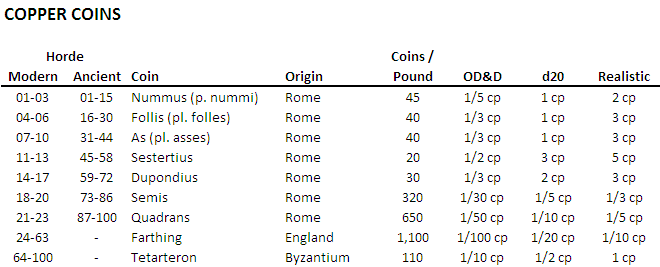
What follows are some tables showing a variety of historical coinage that might appear in the next treasure horde you generate, if you’re of the mind to permit them. Of course, you might want to attach some imaginary, fantasy kingdom name to them to make them campaign specific (“Ah! You’ve found 300 Cromarkian Groats and a small sack of gold doubloons from the Fraznak Empire!). You can use the table in two ways (and one of them might just piss off the players, so I know which one I’d use.)

1) Calculate the total value of the horde’s coins, roll a random coin type for each metal (or two or three, whatever you like), and translate the value into the number of coins. I included three values, one for OD&D (10 coins per pound), one for d20 (50 coins to the pound) and one for a more realistic 100 coins to the pound.

Example: You generate 1,000 cp and you’re playing OD&D (i.e. 10 coins to the pound). You roll up the Roman Sesertius as your historic copper coinage, which are worth 1/3 a copper piece each, thus the horde consists of 3,000 copper sesterius.

2) You roll up the number of coins, and then roll randomly to determine what kind of coin was found.

Example: You roll up 300 gold coins (gp) and then roll randomly to determine they are Italian ducats. You’re playing d20, so 300 ducats is actually worth 1,200 sp, or 120 gp. See – your players will be pissed. On the other hand, if you’d rolled up Spanish escudos, the horde would be worth 1,500 gp.

Without further ado … the tables.


If you want to annoy the players a bit more, you can roll to see how debased the coinage is … but I wouldn’t suggest it.

Of course, if you’re using the notion that your fantasy world is built on the ruins of a “modern” world, then the ancient coinage would be made up of krugerrands, yen and buffalo nickels.

Cush – Six-Armed Villagers, Glowing Tubes, Evil Shrines and Galmim

Here are a few early previews of Cush, starting in the west where the trees are as thick as thieves …

01.29: You see a small village (population 90) surrounded by a ditch and wooden palisade by a lazy stream. Within the palisade there are ten buildings constructed from woven branches and thatch. The oviparous humanoids of Obaala are tall, statuesque and have white skin, fair hair, dark eyes and six arms placed evenly around their bodies. Each of their bee-hive shaped houses contains a nest tended by the male of the species. The obaala are matriarchical, with the most aggressive females leading the others. They are known for their sense of humor and their skill at assassination (surprise on a 1-2 on 1d6, double damage from surprise attacks).

The obaala enjoy the services of Zemmu the blacksmith and Yazur the healer. The largest building in the village is a temple dedicated to Gwardaja, their goddess of knowledge. She is served by the priestess Kasbaba who dresses in pale yellow robes that at once clutch at her body desperately and mingle with the breeze.

Gwardaja appears as a tall, obaala female with eyes the clor of roe and a serene expression. She is dressed in a yellow toga hung with amber beards and carries palm fronds in three of her hands and clay pitchers in the others.

OBAALA: N Medium Humanoid; HD 1+1; AC 13; Atk 2 weapons; Move 30; Save F13 R15 W15; XP 100/CL 2; Special: None. Gear: Hand axes (2), beaded armor (+2 AC), shield.

02.14: Lord Galmim is a Zinji adventurer who established a small, walled castle here 12 years ago and instantly set about annoying his neighbors. The castle is built of adobe brick and the walls are topped with sharp wooden spikes. Galmim employs a 50 archers (padded armor, shortbow, short sword) and rules over 44 peasant families who dwell in thatched huts within a log wall about 15 feet all. Galmim’s arms are a yellow doe rampant on a field of purple.

GALMIM: CE Fighter 12; HP 87; AC 19; Atk 3 weapon attacks; Move 30; Save F7 R11 W11; XP 600/CL 12; Special: +1 to hit with spear; Gear: Spear (cold iron tip, painted with spirals of charcoal and red; 1d6+3), light mace (head shaped like a spiked cylinder, haft wrapped in blue crocodile hide; 1d4+4), chainmail, shield, potion of extra healing (thick, ruby colored); Abilities: Str 18, Int 12, Wis 10, Dex 16, Con 16, Cha 15.

03.22: A small shrine of ancient Kolos stands here, choked with jungle vines. Inside there is an idol of Charon, the Stygian boatman. The idol looks like a gaunt figure in black robes. Where the idol’s face should be there is a merely an empty socket that probably once held a large gemstone. The shrine is now inhabited by a family of five pot-bellied ghouls, the largest having been the shrines keeper hundreds of years ago. The ghouls have 3 pp and 70 gp (in the ancient coinage of Kolos) lodged in clear view in the gaps between the stones.

04.20: A tube of metal 4 ft. in diameter sticks 12 ft. out of the ground at a slant. It is rusted and empty. The jungle around the tube is blighted. People touching the tube or spending the night near it must save vs. disease or develop painful blisters on the skin, losing 1 point of dexterity and constitution and glowing for 1d4 days. Glowing adventurers attract monster encounters on a roll of 1-2 on 1d6.

Blood and Treasure Pregens

I received an email a week or so ago asking whether there would be an intro adventure for Blood & Treasure as well as some pre-generated characters. Short answer … yes.

I was initially unsure about producing adventures for B&T. My intention was to make a game that could handle most adventures produced for everything from the original edition to Pathfinder (with more GM work on converting 3rd edition and Pathfinder than the classic D&D products). So, if just about every adventure ever written works, more or less, with B&T, why produce more outside of short adventures in issues of NOD? Well, honestly, because someone asked, and because it seemed like a decent freebie download for the game.

That being said, I’m now working on an intro adventure that will play off of the “sample play” bit in the rulebook. Kobolds, exiled bugbears, goblins, fungus, necromancers, etc. Your typical fare.

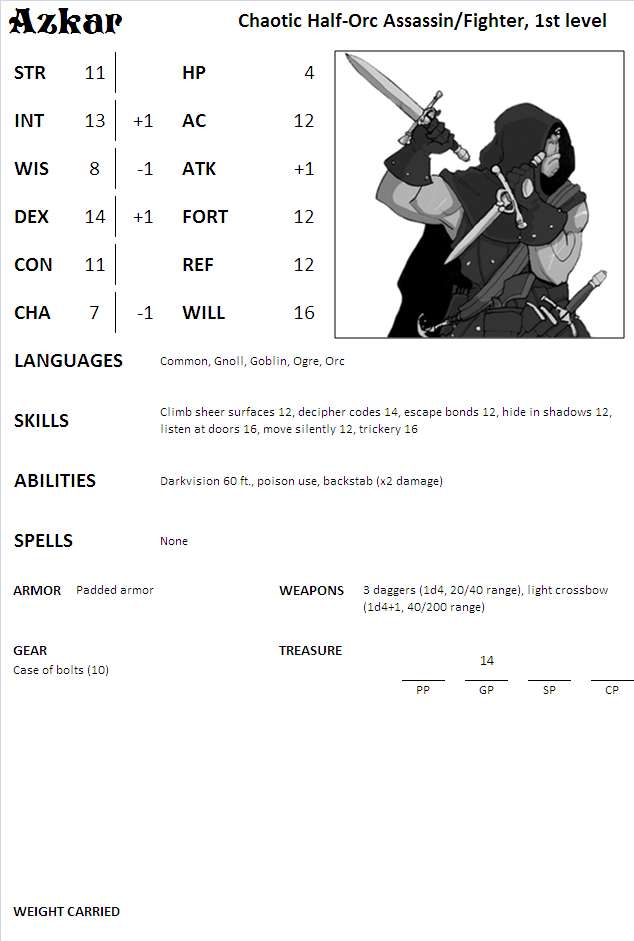
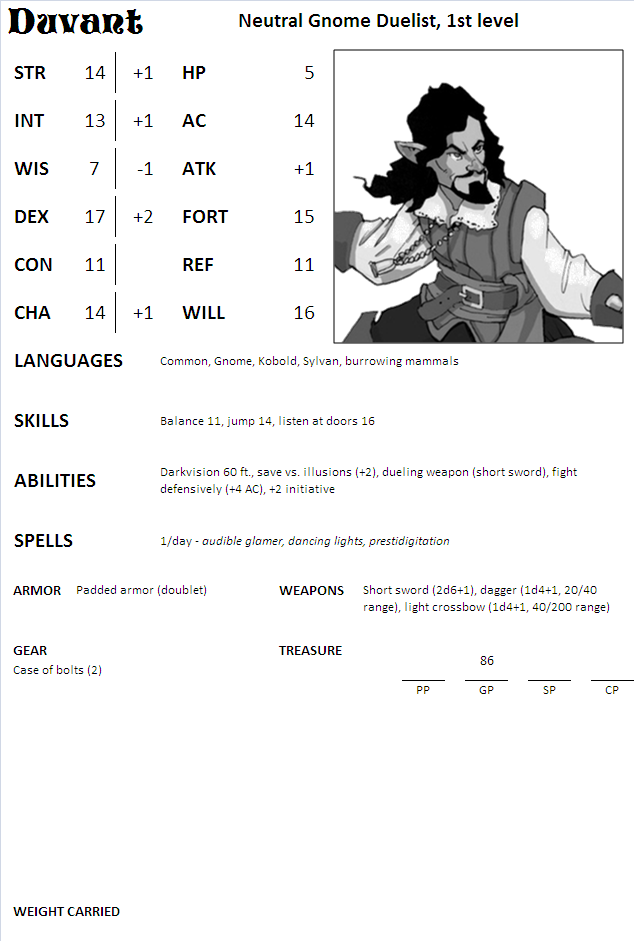
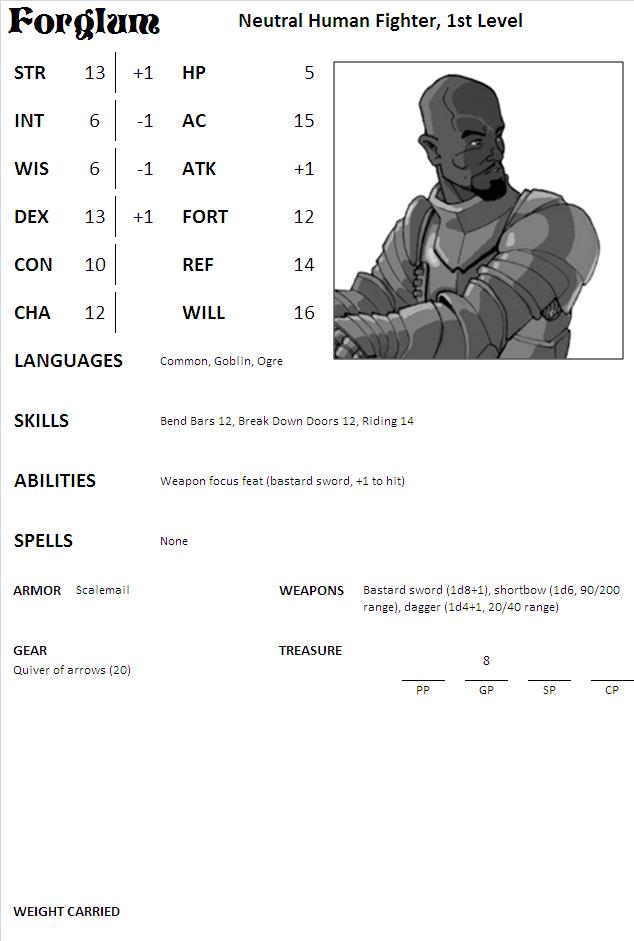
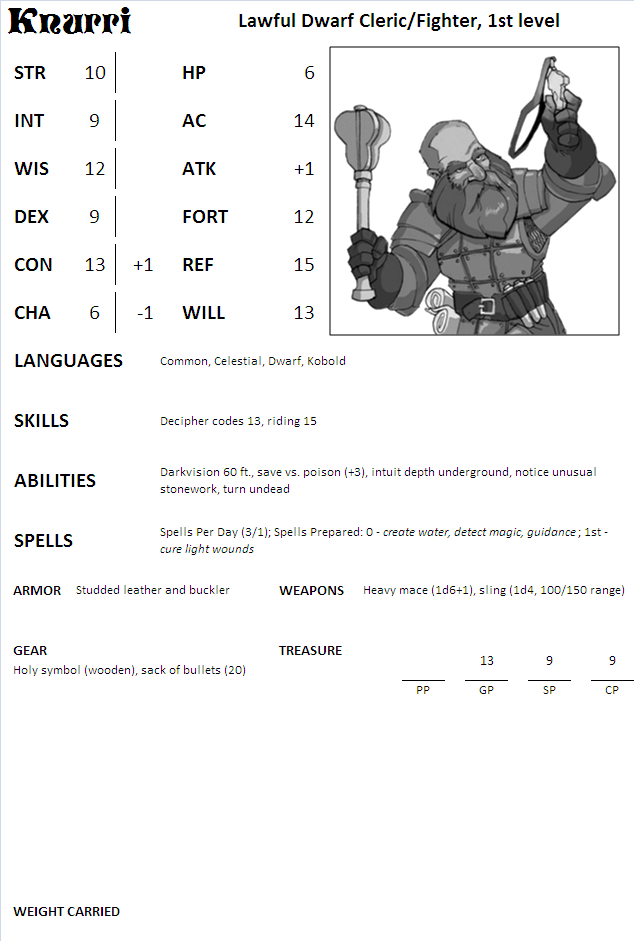
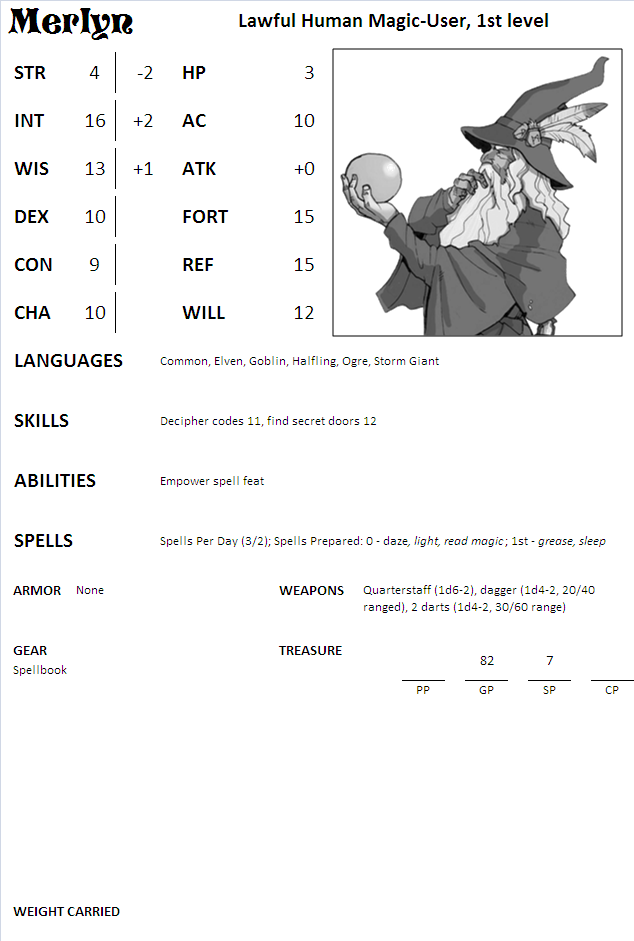
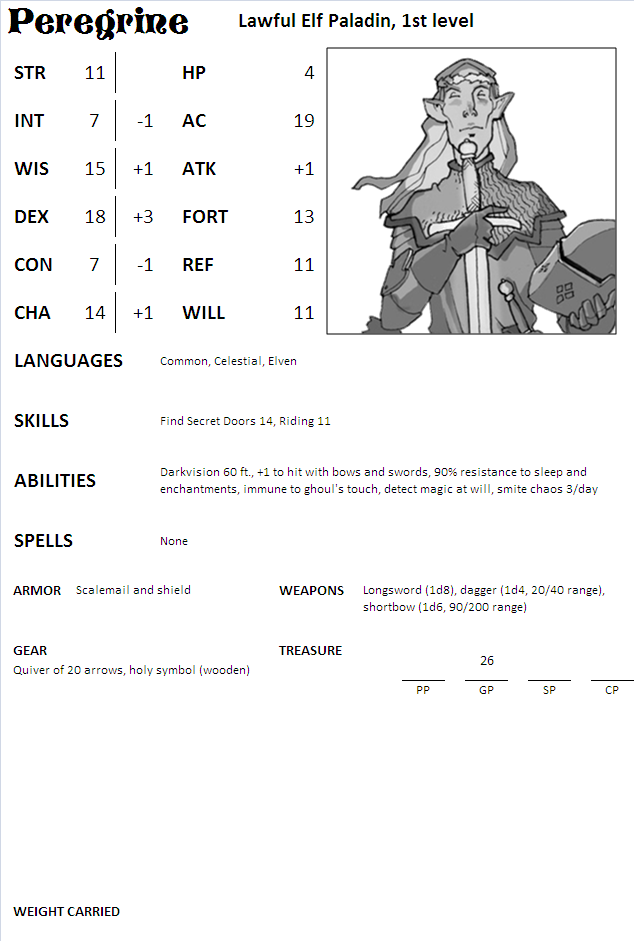
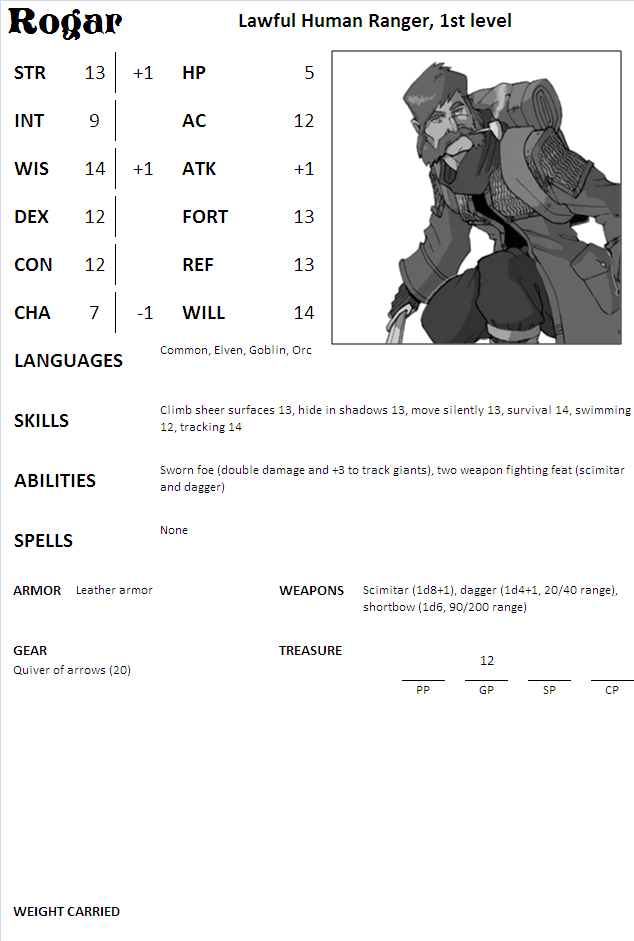
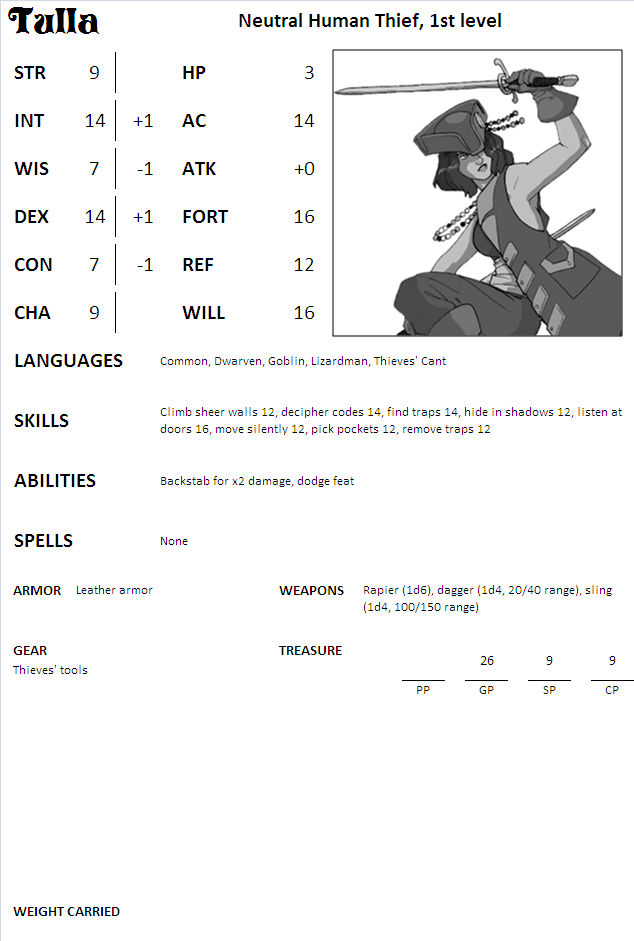
I’m also working on some pre-gen characters (see below) – I know, the equipment doesn’t always match the art … c’est la vie. I only bought weapons, armor and equipment required by the class – the players could spend the rest of the money on adventure supplies (a good time to learn about the importance of logistics!)


Dragon by Dragon – December 1977 (11)

Merry Christmas 1977! I would have been five, having my first Christmas in Las Vegas and opening, well, I have no memory of what I received for Christmas when I was five. I’m sure I was stoked. What were Dragon magazine subscriber’s opening?

First and foremost … best cover yet. A wagon of startled doxies pulled by God-knows-what is accosted by a red-robed dude and his captive troll while the triple-flail-armed driver looks on. Nice! Painted by Elrohir.

Second … an ad for newly released miniatures of the various demons plus Orcus and Demogorgon. The Type VI looks more like “naked guy with wings” than they are typically portrayed, which I think makes him creepier than the “OMG DEMON!” look.

Big announcement from Tim Kask … Dragon is going monthly! Oh, and they’re finally sending checks out to authors and artists! He also announces coming fiction in The Dragon from L. Sprague DeCamp and Andre Norton, as well as fiction from Fritz Leiber in this issue.

Gygax now chimes in with a defense of TSR defending its intellectual property from cheap and crappy imitations and outright theft in the form of reprints of D&D material. He has some nice words for GDW, but seems to be telling everyone else to piss off. He also mentions the coming release of the AD&D Monster Manual and future release of other AD&D material.

Enough announcements and editorials … let’s get to the gaming.

Rob Kuntz presents a system for Brawling (The Easy Way “Out” in D&D) which, at first glance, is way more system than I need. Brawling and grappling are always a problem, it seems, because they offer the chance of knocking someone out or disabling enough to make them an easy kill, thus tons of extra rules. This one compares ability scores of the fighters to get a modifier, and then a dice roll to score “damage” to one of the ability scores. Grappling, for example, involves averaging the dexterity and strength of both combatants and comparing them on a grapple table, then rolling 2d6 to discover how it works. Punching is similar, but determines the amount of damage.

Tony Watson then explains how to stop good old O.G.R.E. (not the monster, the mega-death machine) – basically tips and tricks for the game. I played it once, O.G.R.E. won, and my yen to play O.G.R.E. was satisfied.

In the Design Forum, Thomas Filmore, who opines on the value of role playing in D&D, as opposed to just wargaming. Pretty common blogpost material here, but perhaps a rather new concept back in the day, when many characters did seem to be more about puns and action than deeply invested backgrounds (i.e. the good old days).

Archive Miniatures has an ad for Star Rovers – 25mm miniatures. I dig the names of the figures, all of whom would be at home in a game of Space Princess: Planetary Scout, Funky Robot, Andromeda Annie, Bianca Snow, Doc Crock, Galactic Centaur, Alien Lizards, Walktapus (pre-Runequest?) and Sassanid War Elephant. Wait, Sassanid War Elephant? Why not.

MAR Barker continues answering reader questions in his Seal of the Imperium article.

Next up are some expansions to the Snits game that was featured last issue. Apparently the snits took the world by storm.

The Sorcerer’s Scroll is a new feature, and this first one is written by Rob Kuntz. Here, he mostly goes into the new Monster Manual (with “stupendous art by David Sutherland, David Trampier and Tom Wham”) and the eventual release of ADVANCED DUNGEONS & DRAGONS (I forgot that it was always written in all caps (“Fighters will now take 10-sided dice to determine their hit points and clerics 8-sided, etc.”). He also mentions Judge’s Guild, who continues to “saturate the D&D market with new variants” (and that TSR has undertaken to “make their new rule variant/additions … much more refined and interesting to the hard core D&D player” – I don’t like the sound of that). He has some kind words for Chivalry & Sorcery, but explains that it falls short due to its “smallish” print.

Fritz Leiber is next with Sea Magic. An excerpt:

“On the world of Nehwon and in the land of Simorgya, six days fast sailing south from Rime Isle, two handsome silvery personages conversed intimately yet tensely in a dimly and irregularly lit hall of pillars open overhead to the darkness. Very strange was that illumination — greenish and yellowish by turns, it seemed to come chiefly from grotesquely shaped rugs patching the Stygian floor and lapping the pillars’ bases and also from slowly moving globes and sinuosities that floated about at head height and wove amongst the pillars, softly dimming and brightening like lethargic and plague-stricken giant fireflies.”

Ral Partha’s new releases would make a nice random encounter list:

2. Gremlin War Party (3d6 winged goblins with spears)
3. Dwarf Lord (6th level dwarf fighter with chainmail and battle axe)
4. Satyr (Pan) (1% chance the encounter is with Pan, otherwise 1d6 satyrs)
5. Centaur Archer (1d8 centaurs armed with shortbows)
6. Land Dragon with Captain (treat land dragon as wyvern without wings, captain is 5th level fighter with splintmail, shield and lance)
7. Land Dragon with Lancer (lancer is 1st level fighter with breastplate, lance and shield)
8. Witch (female magic-user level 1d4+2; males must pass Will save or be fascinated with her breasts)
9. Monk (1d6 first level monks armed with staves)
10. Sprite War Band (3d6 sprites with swords led by 3rd level sprite fighter on fey mount)
11. Imp War Party (2d6 flying monkeys with sword or axe, shield and breastplate)
12. Were Bear (1d4)
13. Wing Lord (winged 3rd level fighter with spear and scale mail)
14. Paladin (dismounted) (5th level paladin with war harness (+2 AC), shield, pole axe and HUGE wings on his helmet)
15. Armored Knight (dismounted) (4th level fighter with platemail, shield and halberd)
16. Roomen War Party* (2d6 roomen with shield and spear)
17. Earth Demon (combo of stone giant and earth elemental)
18. Undead War Band (3d6 skeletons armed with swords, scythes and spears)
19. Woman Plunderer (1d6 levels of female barbarians with swords and chainmail)
20. Roll two times on table

* They’re freaking mutant kangaroo warriors!

Roomen (N Medium Humanoid): HD 1+1; AC 13; Atk 1 weapon (1d8) or kick (1d4+1); Move 40; Save F 13, R 15, W 15; XP 50; Special: Bound 60 ft. as charge attack.

James M. Ward now presents Quarterstaff Fighting Rules. This is like a mini-game that could be integrated into a normal game of D&D – somewhat like the jousting rules from Chainmail.

In Tramp’s Wormy, Wormy asks a bunch of dwarves “What wears chainmail and looks like black pudding?” – any guesses?

In Fineous Fingers, the adventurers discover that the evil wizard Kask has forced the local hobbits to try to conquer the city by capturing their princess.

The issue ends with a withering critique of NBC’s The Hobbit, by Rankin-Bass. I know, not the best adaptation, but I dig the design on the wood elves.

Overall, an issue that leaves me of two minds. I’m a big fan of Leiber, so the short story was cool. The EPT and O.G.R.E. stuff is not really aimed at me, so no complaints there. The brawling and quarterstaff fighting are nice mini-games/sub-systems, but probably not things I would include in my regular D&D game. Strangely enough, it’s often the ads that I’m enjoying the most – little snippets of creativity with no rules/stats attached. There’s the suggestion that in 1977, the creative energy of D&D is slipping away from TSR – they have some pretty good modules left in them, of course, but things are becoming more controlled and professional, and that carries with it a price to pay.

Inspiration from Old Cartoons

The beauty of public domain cartoons is that they come from a time when pop culture was bat-shit insane – and I don’t mean the calculated, “trying to damn hard”, imitation insane we get so much of these days.

BALLOON LAND (1935)

Here’s a great demi-plane to introduce your characters to, especially if they need something from the inhabitants that they cannot get by means of violence. And wouldn’t you love to pit them against the Pincushion Man.

CANDY TOWN (1931 or 1933)


Another odd demi-plane to hide behind the next magic mirror in your camapaign.

BIMBO’S INITIATION


This is one of the great weird cartoons ever made. Talk about your mythic underworld!

SUMMERTIME (1935)

I’ve always thought a campaign world where this sort of thing determined the season would be a fun one to challenge players.

THE SUNSHINE MAKERS (1935)

The distilled sunlight potions are excellent, especially if you have a stereotypically dour dwarf in the party.

TO SPRING (1936)

Another in the vein of Summertime, this one with subterranean elves who color the flowers in the springtime.