Noah’s Ark – Dictionary Monster Special Abilities

As promised – here are those special abilities associated with the letters.

What powers does our documentarian have?

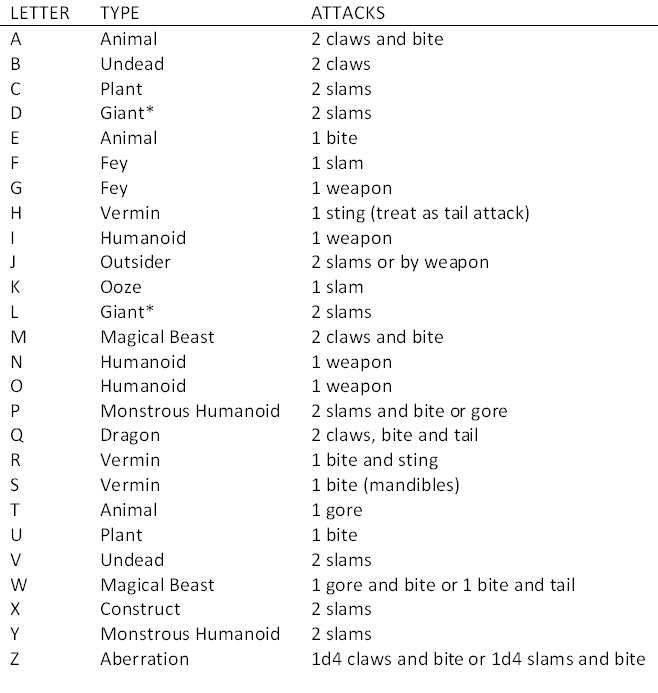
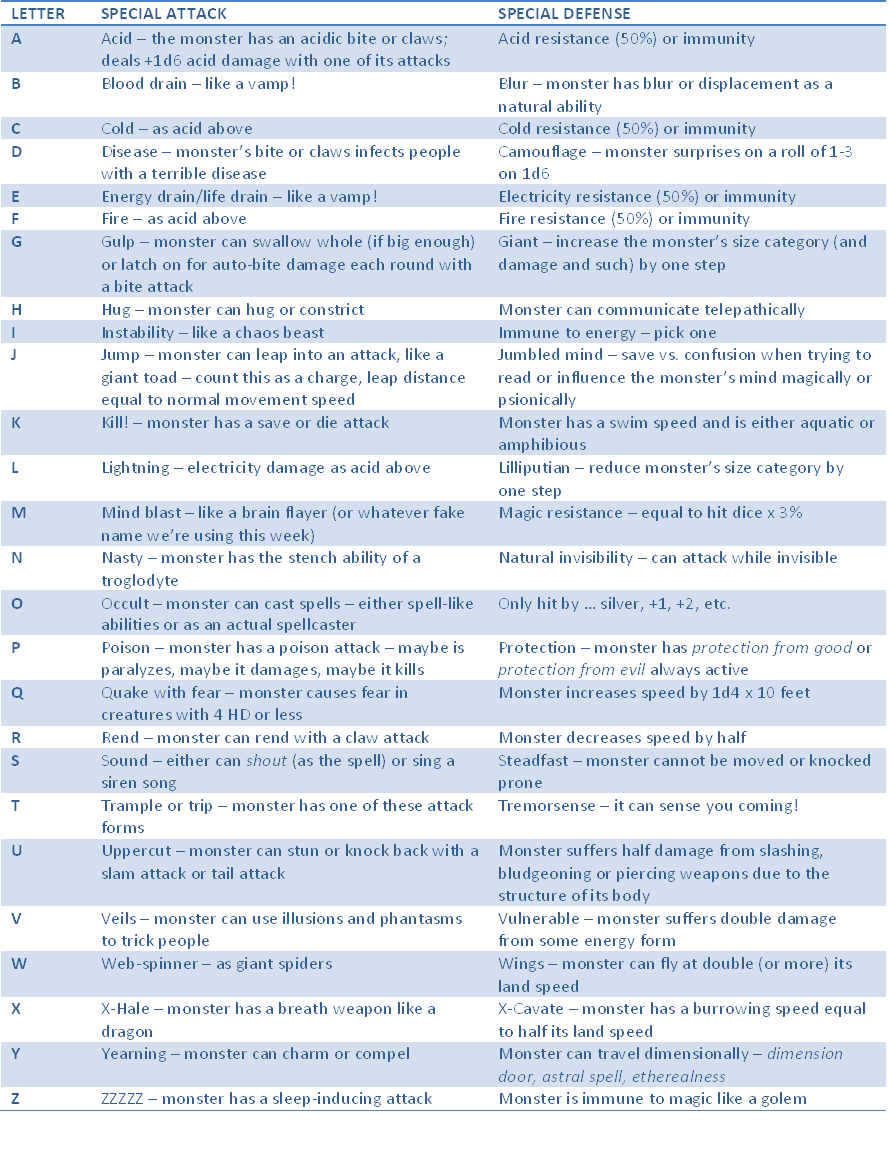
Special attacks – Occult (it can cast spells), uppercut (it’s slam attacks knock people down) and energy drain!

Special qualities – Cold resistance 50%, magic resistance 21% and natural invisibility

Not bad – I might modify the energy drain and natural invisibility, though.

Tomorrow I’ll post the finished documentarian, maybe with horrible art by myself!

Noah’s Ark – Generating Monsters With a Dictionary

So you’re writing up an adventure, and you want some original monsters to throw at the players – something they haven’t seen before. Unfortunately, you’re a bit short on time. Well, with a random word plucked from your head or generated at dictionary.com, and with this ridiculously goofy system below, you’ve got it covered.

STEP ONE – GET SOME WORDS
As mentioned above, dictionary.com has a random word generator. What you’re looking for is a noun – this is the most important word – and maybe one or two modifiers. Adjectives are the obvious modifiers for nouns, but verbs can work as well, so long as you pop an -ing on the end (i.e. bite becomes biting, claw becomes clawing, sleep becomes sleeping).

STEP TWO – THE BASICS
Now we need to generate some basic stats for our monster. We’re going to use the noun to determine the monster type (even if you don’t use type in your system, this is still good for figuring out what the monster looks like and how it attacks), size (important – determines speed and damage), hit dice and armor class.

HIT DICE: Count the number of consonants in the word. This is the monster’s total hit dice.

ARMOR CLASS: Count the number of vowels in the word. Multiply this number by two and add to 10 for the monster’s (ascending) AC. For descending, just subtract the number from 11.

TYPE: The monster’s type is based on the first letter of the word:

* If the monster’s size is tiny to medium, feel free to change the giant into a humanoid or monstrous humanoid; in any event, increase the giant’s damage output by one size level

SIZE: The monster’s size is based on the last letter of the word:

STEP THREE – SPECIAL ABILITIES
There are two classes of special abilities for our purposes: Special Attacks and Special Qualities (which includes special defenses).

The monster’s special attacks are determined by the third, fifth and seventh letters in the word – if a monster doesn’t have a seventh or fifth letter, then they don’t have special abilities for those slots. In other words, the more letters (and more hit dice), the more special abilities.

I’ll present those tables tomorrow.

SAMPLE MONSTER
In the mean time, let’s look at a sample noun. Using dictionary.com, I generated the word “documentarian” and the modifier “mottled”. What the heck is a mottled documentarian?

Hit Dice: Documentarian has seven consonants, so our monster has 7 HD
Armor Class: Documentarian has six consonants, so our monster has an AC 22 (or AC -1)
Type: Documentarian starts with “D”, so our monster is a Giant with 2 slams
Size: The documentarian’s size should be Medium. A medium giant seems stupid, but in this case we’ll say the monster has giant girth – bulging muscles – rather than giant height

So far, we have:

MOTTLED DOCUMENTARIAN
Medium Giant

HD: 7
AC: 22
ATK: 2 slams (1d6)
MV: 30

The Centurion Class – Go Into Battle With Friends!

Wow – been very busy lately. Sorry for the lack of posts of late, but I’m currently trying to finish writing the NOD Companion, Action X, I’m doing some more freelance stuff for Frog God Games (Tome of Horrors IV!) and I’m putting the finishing touches (editing and layout) to Tanner Yea’s new supplement for Blood & Treasure, Psionics of Lore. It looks like a winner folks.

That being said, I needed to get something posted this week, so …

THE CENTURION

Image from HERE

Fighters might come from many backgrounds, but most adventuring fighters avoid the chaos of the battlefield for the relative simplicity of bashing heads in a dungeon. Centurions, on the other hand, are born and bred for mass combat in the name of king or emperor. They glory in wading into an enemy host with their comrades. When they delve into the lightless depths, they bring friends and know how to make the most of them.

ROLL D8 FOR HIT POINTS (+3 HP PER LEVEL AFTER LEVEL 10)

REQUIREMENTS
Centurions must have a Strength and Charisma of at least 13. They cannot be Chaotic in alignment

ARMOR PERMITTED
Padded, Leather, Studded Leather, Ring, Scale, Chainmail Shirt, Chainmail; All Shields

WEAPONS PERMITTED
Crossbows (All), Dagger, Hand Axe, Javelin, Long Sword, Spear, Short Sword

SKILLS
Bend Bars, Break Down Doors

ADVANCE AS
Fighter

ATTACK AS
Fighter

SAVE AS
Fighter

SPECIAL ABILITIES
Centurions can command double the normal henchmen usually permitted by their Charisma scores, provided those henchmen are men-at-arms armed and armored in the same way as the centurion. Men-at-arms under the command of a centurion gain a +1 bonus to attack, to saving throws and to morale checks. The bonus to morale checks increases to +2 at 4th level, and +3 at 8th level.

When in battle, centurions can lock shields with other centurions, fighter-types and their own men-at-arms. This increases the AC of all involved by +2. While locked, the warriors can still attack with spears, but do so at a -1 penalty to hit. The warriors also gain a +2 bonus to save vs. special maneuvers while in a shield wall.

Centurions are trained as sentries, and thus are only surprised on a roll of 1 on 1d8.

A 3rd level centurion can bestow their shield bonus to AC to any ally within 5 feet, and still attack as normal.

A 6th level centurion learns the skills of an engineer in relation to operating siege weapons.

A 9th level centurion (legatus) can built a fort and design a standard to be flown over his fort and over his person when he is engaged in battle. When he does so, he attracts 1d6 men-at-arms per level, 1d6 first level centurions that wish to train with him and make up his personal guard, and a third level centurion to act as his lieutenant. The centurion’s bonus to his men-at-arms extends to all of his new followers when they share the battlefield with him and they can see his standard.

LVL / TITLE
1 Miles
2 Duplicarius
3 Decanus
4 Cornicularius
5 Optio
6 Centurion
7 Praefectus
8 Tribunus
9+ Legatus

3d6 All the Way Revisited – A Random Excel Generator!

Illustration of leech by Jon Kaufman from the NOD Companion (still in progress)

From the brilliant mind of Arjen Lissenberg, who gave us the excel document to generate random classes with that last hare-brained scheme of mine, comes a new Excel doc to do the same with the 3d6 for everything method.

Download it HERE!

Thanks again to Arjen – I love being able to supply things like this to the wider gaming community!

Hippity-Hop Into the Dungeon – The Easter Bunny Class!

Easter bunnies are fey creatures who are the heralds and servants of Ys, the goddess of spring and fertility (substitute your own campaign’s spring goddess if you please). When not performing their Easter functions for children all over Nod, they are adventurers bold and daring.
[Okay – this was a brainstorm Easter morning, so this is a bit scanty – please forgive and, most importantly, have a Happy Easter, even if you’re not a Christian. A happy day and a chocolate bunny are fundamentally good things, regardless of your beliefs!]

Hit Dice: d6 / +2 hit points per level after 10th level

Advance as: Thief

Attack as: Thief

Save as: Bard

Armor: Padded and leather

Weapons: Any weapon that does not involve metal; they can use flint-tipped spears and arrows, which deal one dice size less damage than their metal counterparts

Skills: Find Secret Doors, Hide in Shadows, Jump, Listen at Doors, Move Silently, Trickery

Special Abilities
Easter bunnies can charge into combat with a mighty leap that carries them up to 15 feet forward.

Easter bunnies can speak with animals and plants at will. They also have “faerie fire vision”, which they can invoke for up to 2 rounds per level each day.

Easter bunnies cannot use iron or steel weapons, and in fact suffer +1 damage per hit from such weapons.

Easter bunnies can lay magic eggs. An Easter bunny can lay one egg per day, each one imbued with a magic ability of the Easter bunny’s choice as limited by their level. A first level Easter bunny starts with three magic eggs.

For a magic egg to affect a person (willingly or not), it must be cracked over them or it must strike them. To affect an area, it need only be thrown into that area. To summon nature’s ally, it is cracked and the creature sort of magically pours out of it.

Magic eggs can have the following effects – one effect per egg – based on the Easter bunny’s level:

Level 1 – bless, charm person, cure light wounds, entangle, grease, hold person, light, obscuring mist, phantasmal force, sleep, summon nature’s ally I, explosive (1d6 damage in 10’ radius)

Level 3 – animal messenger, blindness, calm emotions, cure moderate wounds, darkness, fog cloud, glitterdust, gust of wind, hypnotic pattern, improved phantasmal force, mirror image, reduce animal, silence, sound burst, summon nature’s ally II, summon swarm

Level 6 – charm monster, confusion, cure disease, cure serious wounds, daylight, deep slumber, diminish plants, dispel magic, fear, good hope, phantom steed, plant growth, remove curse, slow, spectral force, spike growth, summon nature’s ally III, wind wall

Level 9 – command plants, cure critical wounds, dimension door, dominate person, hallucinatory terrain, hold monster, rainbow pattern, spike stones, summon nature’s ally IV, zone of silence

Get Yourself Some NOD 19, Fool!

Yes, true believers (sorry Stan, needed a quick catchphrase)! NOD 19 is now available in digital form, paperback to follow when I see a review copy. What does this time hold? Dig some descriptive text:

“Spring has sprung, and so has NOD 19 (okay, that was lame, but this descriptive text gets tricky after a while). Anyhow – NOD 19 features the first half of the Virgin Woode hex crawl, a bunch of monsters, the puritan class, four new classes for Space Princess, a new race/class for Pars Fortuna and a bunch of other cool junk! 68 pages of excellence!”

There you have it, lads and lasses. Check out some NOD 19 and rock your brain-stem with fantasy goodness for $2.99 (cheap).

Check it out HERE!

And the MAP can be found HERE 

or just look below …

So far, only the western portion is filled in – the eastern portion will be detailed in NOD 21, while NOD 20 will focus on the colonial city-state of Dweomer Baye.

A Dungeon Where Apes Evolved from Men?

If one were to draw a Venn diagram of people into fantasy RPG’s and people into Planet of the Apes, I think there would be a pretty good overlap. Likewise, I think there is a pretty good overlap between the Planet of the Apes concept and fantasy gaming – i.e. the ape campaign.

First, let’s get our stuff straight here. Planet of the Apes, the movie franchise, and Planet of the Apes, the book, are two very different animals. There are similarities to be sure, but the differences are pretty major.

The movies were part of the bleak sci-fi period that included such gems as Omega Man, Logan’s Run, Soylent Green and Herbie Goes Bananas (a controversial stand on the last one, but I’m standing behind it). Here, we have mankind destroying itself with nuclear weapons, creating what one might call a “Gamma World” to coin a phrase, this being preceded by presumably genetically-modified apes staging race riots.

The book, written by Pierre Boulle, is quite different. First – it’s fairly boring. One can think of it as a book in the style of Gulliver’s Travels, as it’s mostly a matter of social critique. In this scenario, man grew decadent, using trained apes to do his work. As the apes learned more and more, they grew dissatisfied and eventually threw man out of his own home. Apes didn’t need us anymore. And humans … they didn’t fight back. They wandered into the woods, seemingly content to live as animals. Apes just took up where we left off, the difference being that while they understood our technology, they weren’t very creative.

Applying either scenario to a fantasy world – some magical apocalypse or the flow fall of man into decadence and the rise of a new order – works. You have ancient ruins (a place to adventure), some semblance of civilization (a place to rest between adventures) and, most importantly for fantasy gaming, you have multiple “races” to adventure with. Imagine porting into the world of Greyhawk to discover that Ape Law has been imposed there. Sounds pretty fun.

A few notes before I begin. I’m writing these ape “races” as though they are still physically indistinguishable from normal apes – i.e. I’m not making them people in masks as in the movie franchise. Second – apes are strong. Really strong. I’m not shying away from this, so expect high strength bonuses. If you were running nothing but apes in a game, you can adjust for this higher damage output and let them advance as far as they want in various classes. If you’re running these apes with other races, you’ll need to limit their class advancement to some extent. I’ve included these class level limits below in italics.

Gorillas
Gorillas are the warriors of the apes; burly and brash and easily annoyed. Gorillas add +6 to their starting strength (max. 24). They modify their starting constitution by +1 and reduce their starting intelligence by 1 (max. 18, min. 3). When not using a weapon, a gorilla can make a claw or bite attack each round, scoring 1d4 points of damage. They are capable of launching into a menacing display of power that forces creatures with 0 HD or less than half the gorilla’s hit dice to pass a Will saving throw or be frightened for 1d4 rounds. Gorillas are limited to 7th level, except as fighters, at which they can advance to 9th level.

Chimpanzees
The chimps are the scholars of the ape people, always curious and often chattering. Chimps add +2 to their starting strength (max. 20). They modify their starting intelligence by +1 and reduce their starting wisdom by 1 (max. 18, min. 3). Chimps have a knack for climbing sheer surfaces. In place of a weapon attack, a chimp can make a claw or bite attack that deals 1d3 points of damage. Chimps are limited to 9th level, except as magic-users, at which they can advance to 11th level.

Orangutans
Orangutans are the “wise old men” of the ape community, bureaucrats, clergy and leaders. Orangutans add +4 to their starting strength (max. 22). They modify their starting wisdom by +1 and reduce their starting charisma by 1 (max. 18, min. 3) due their stodginess and superior attitudes. Orangutans have a knack for climbing sheer surfaces. In place of a weapon attack, an orangutan can make a claw or bite attack that deals 1d4 points of damage. Orangutans are limited to 8th level, except as clerics, at which they can advance to 10th level.

Dragon by Dragon – April 1979 (24)

April of 1979 – those heady days of stuff that was happening and things and stuff. Okay, I’m too lazy at the moment to look up what was happening back then, but hey – who cares, right? We know the Dragon was happening, so let’s focus on that.

What did the Dragon have to offer in 1979? More importantly, can we use any of this stuff now?

Lost Civilizations (A Fantasy Supplement for Source of the Nile) by J. Eric Holmes

When you see Dr. Holmes as the author, you know you’ve got some quality material in your hands. Hell, I’ve never even played Source of the Nile and I know this article has to have something useful in it. The article is all about adding some fantasy to the more realistic game of African exploration, specifically of the sort you might get in an H. Rider Haggard or E. R. Burroughs novel.

First up, I love the list of explorer types used in Source of the Nile: Missionaries, Doctors, Zoologists, Geologists and Adventurers. If you were doing an RPG of Victorian exploration, you have your class list right there.

His idea is that when you enter a completely uninhabited hex, there is a chance of it containing a lost city (a roll of 2-3 on 2d6). If in a desert, the city is uninhabited. Otherwise, it is inhabited by survivors of lost Atlantis. The people use bronze weapons and wear ornaments of gold and gemstones, and then you roll dice to determine the city’s organization. Roll 1d6; on a 1-3 the city is ruled by a warrior-king with 1d6 x 1d6 x 1d6 + 10 warriors; if the roll is 4-6 it is ruled by an evil high priest and a white goddess who command 1d6 x 1d6 x 1d6 + 5 warriors. I include this bit because it could be adapted to almost any hex exploration style fantasy game.

When exploring an uninhabited desert city for treasure, you roll 1d6: 1-2 he discovers that the ancient gods still live, his expedition is destroyed and he escapes completely mad; 3-4 traps kill half his askaris and bearers, but he escapes with a bag of diamonds and rubies worth $500 and the secret passages are closed off forever; 5-6 he loots the city for $1000 worth of gems and $200 worth of gold.

This brings to mind something I once did for a game. I was starting with characters above 1st level, and they were from various places in my campaign world (Nod – you might have heard of it). For each character, I came up with one past adventure for each level, each adventure leading them from where they were born to where the adventure was to start. In this way, I gave each player a bit of knowledge about the campaign world and some cool tidbits about their characters. Something to consider.

Keeping the Magic-User In His Place by Ronald Pehr

A classic of old Dragon (hell, a classic of modern articles as well, in as much as it addresses the idea of “balance” between characters). Ronald includes a few ideas of controlling these damn wizards so they don’t mess up the game. Interesting, because it introduces the idea of forced fairness to the game – i.e. I want the game to go one way, but the rules aren’t allowing that to happen. Think of the article previous – the explorer explores a lost city and you roll a dice and that determines what happens – amazing wealth or complete insanity. That’s it. Why? It’s a game, and those are the rules, and playing the game is more important than winning. Or, to state it another way, winning or losing should be a product of the game experience, not a preconceived idea that the game play must support. Why not have wizards who “ruin” the game with fireballs and charm spells? Let everybody have their time to shine, and play it smart. A fireball is a tricky thing, and over reliance on them might be a wizard’s undoing.

Chinese Dragons by David Sweet

One day, these fine monsters will appear in the Fiend Folio, and they were always pretty cool. In fact, it might be fun to do something similar with occidental dragons, replacing the red-blue-green-etc. dragons with ones based on the famous dragons of European myth.

Another Look at LYCANTHROPY by Jon Mattson

This article throws in the idea of different types of lycanthropes that a bitten character might turn into. They are as follows (in summary):

A. Turns completely into the lycanthrope that bit him; i.e. new alignment, etc.
B. Remains in human form, but takes on the mentality of the lycanthrope.
C. Character takes lycanthrope form, but retains his own mentality.
D. As A, but only changes under a full moon or great stress.
E. As B, but only changes under a full moon or great stress.
F. As C, but only … well, you know.
G. Under full moon or great stress, changes into a hybrid of beast and man.

Under option G, he actually writes, “This may sound something like the “Incredible Hulk,” but that is the general idea.” Love it.

There is also a percentage chance for figuring out the character’s new alignment. The new lycanthrope has half the character’s spells and abilities while in lycanthrope form and some modifiers to his ability scores.

Another great quote:

Note: To many people it may seem strange that a wolfs constitution would be better than that of say a bear, but remember that wolves often survive through incredible hardships such as hunger and cold, and I’ve yet to see a bear do as well.

What the?

Ultimately, this is a pretty cool article as it allows the chance that a PC can remain a PC and an interesting party member even after succumbing to lycanthropy.

Roman Military Organization, A Classic Warfare Update by Gary Gygax

An interesting article on the organization of the Roman army.

A Viking Campaign in the Caspian Sea by James E. Brunner

This is a nice history of an actual (well, I assume actual) Viking foray into the Caspian Sea for plunder. A sample:

“In the tenth century the Caspian Sea lay like a great pearl in an ocean of endless steppes and towering mountains. The prows that cut its placid waters belonged to poor fishermen and merchants from every land. Unlike the Black Sea that lay to the west, no northern pirate fleets had ravaged its shores and carried off its great wealth. To the north and the east lay the powerful Khazar Khanate whose capital, Itil, on the Volga Delta, controlled the major trade route to the north. Any merchant or pirate that sought wealth in the Muslim lands to the south had first to deal with the Khazar Khan, whose greed was legendary.”

Primarily interesting to me as it reminds me of Howard’s Vilayet Sea and the adventures had in and around it. When you find fantasy that interests you, take the time to find the reality that underlies it. You might find it even more inspirational.

The article also includes rules for fighting the Battle of Barda’a using Classic Warfare.

The Melee in D&D by Gary Gygax

Here, Mr. Gygax offers up some thoughts on how melee combat is supposed to work in D&D, specifically it seems to answer the complaints of folks who would like more realism in the system. A few important points:

– The game is mostly about creating fantasy personas and their adventures, and that means more than just fighting

– Hack and slash shouldn’t be the first resort of characters

– The system isn’t too unrealistic – it’s built to ensure relative speed of resolution without bogging the ref down in paperwork or creating a high probability of character death

Here’s a bit I found interesting:

“Don Turnbull stated that he envisioned that three sorts of attacks were continually taking place during melee:

1) attacks which had no chance of hitting, including feints, parries, and the like;

2) attacks which had a chance of doing damage but which missed as indicated by the die roll; and

3) attacks which were telling as indicated by the dice roll and subsequent damage determination.

This is a correct summation of what the D&D melee procedure subsumes. Note that the skill factor of higher level of higher level fighters — as well as natural abilities and/or speed of some monsters — allows more than one opportunity per melee round of scoring a telling attack as they are more able to take advantage of openings left by adversaries during the course of sparring. Similarly, zero level men, and monsters under one full hit die, are considered as being less able to defend; thus, opponents of two of more levels of hit dice are able to get in one telling blow for each such level or hit die.”

An article well worth the read.

DUNGEON – More Variations on the Theme by George Laking

This is a collection of extra rules for the DUNGEON game. Since it’s being published again, this might be a good article for folks who love it.

Armies of the Renaissance by Nick Nascati

This is the second part of an article from last issue (I think – too lazy to look at the moment). It covers The Swiss. I’ve long thought the Swiss would be an excellent folk on which to model dwarf armies.

Narcisstics by Darrel Plant and Jon Pitchford

Some monster humor of the disgruntled geek variety, statting up jocks and their female groupies as monsters. I’d convert them to B&T format, but the format in the article is hard to make out, and frankly they’re not just worth it.

Psionics Revisited by Ronald Pehr

This variant takes some of the random chance out of the powers psychic characters receive, tying them more closely to their professions (or so the article says). It appears to divide the powers into two categories: Cognitive Powers and Kinetic Powers, adding a few new powers to the game.

Disease by Lenny Buettuer

This is a set of tables for determining how long it takes a disease to kill a person, and what symptoms are suffered in the meantime. The fatality interval goes from immediate to 10 months, based on a percentile dice roll. Another table determines how many symptoms are suffered and a third what those symptoms are. Honestly – a great idea and one I wish I’d thought of. After all, why do I care what the disease is called? All I want to know is how long the adventurer has to live (more on this below) and what happens to him until he can receive healing.

The other thing I got from this article is the point of diseases in the game. There are many ways to die in D&D, and each should offer up different challenges to the players. Disease in this case becomes a race to be cured.

Bergenhome ’77: the CAT’s Test of American Armor by Stanley Schriefer

If nothing else, this article presents an interesting moment in the history of the magazine. The article is about how well American armor (as in tanks) did in a NATO competition. No stats here. None. Not tied to any game. Just military news that might be interesting to wargamers.

The Return of Conan Maol by Paul Karlsson Johnstone

Weird little article about bagpipers and such.

Choir Practice at the First Church of Lawful Evil (Orthodox): The Ramifications of Alignment by Lawrence Schick

Another interesting article about the three-tier alignment system and their relationship to gods and the powers of those gods. It also divides the three alignments into several “sects” or versions of each alignment. Lawful, for example, is divided into the following:

(A) Absolute Order (High Law)
(B) Harmony/Goodness
(C) Justice/Vengeance
(D) Knowledge
(E) Evolution (Social Darwinism )
(F) War

It then gives information on each of these versions of alignment – its tenets, its practitioners, it’s prime deity. Here’s one example:

Law: JUSTICE/VENGEANCE (Monks, Paladins, Assassins)

Tenets: Good (Law) must be rewarded and Evil (Chaos) must be punished. All creatures are judged impartially by weighing their “good’ and “evil” deeds. Transgressors will be punished according to the depth of their depravity. Criminals must be diligently pursued until brought to justice. (Examples of this alignment’s enforcers might include Solomon Kane, The Shadow, Mr. A., and Javert.)

Prime Deity: MARLY
AC: -4 HP: 300 MOVE:24”
MAGIC: Standard plus See Past plus Detect Truth/Lie.

Honestly – one of the most usable alignment articles I’ve yet read. A great take on the subject, and quite usable. Bonus: Nice piece of art!

Naming People, Places and Things in Petal Throne by G. Arthur Rahman

This article provides a random table for generating the rather non-European names common to MAR Barker’s campaign world.

Monty Haul and the Best of Freddie by James M. Ward

Another adventure in the annals of Monty Haul. A sample:

“The Bronze Dragon was of tremendous size for its breed, measuring over 80 hands long and able to rear to a height of more than half that. The creature had gleaming claws as sharp and damaging as scimitars; buffed with gold dust. Its fanged jaws were kept sharp by biting heavy platemail vests that were a part of its horde. Its massive scaled body rested regally on an altar made of its own gold and silver. Chalices of platinum and coffers of gems and jewels were all about, arranged to please the delicate sensibilities of the dragon. Its giant eyes, that had been but a moment before closed in dragonslumber, opened, aware of the tread of footsteps down the echoing marble corridor, designed for just that echoing effect.”

In Defense of Extraordinary Characters by Rodford E. Smith

A very quick bit about why high level characters make sense, giving as examples from literature Odysseus, Daedalus, Hercules, John Carter, Conan and “everyone’s favorite Kryptonian.” So there you go.

The Society for Creative Anachronism by Allen Hammack

An overview of the society and their doings. These days, this would be what we term a “web page”.

And there you have the April 1979 issue of The Dragon. Not a bad issue all told, with at least two or three articles that I think most folks would find useful.
Random Classes – The Download

Image copyright WotC, used w/o permission

Hey folks – quick post today. I wanted to share the link to the groovy little Excel document that Arjen Lissenberg created based on my random class creator idea. Thanks to Arjen for the hard work!

Click HERE for the document. Assuming you have the random value generator thingy operational, you just press F9 to generate class after class (or NPC after NPC, as the case may be).

To prove its immense value, I present three unique NPC’s generated with the sheet.

Sabre LeClerq
Sabre’s base class is rogue. He can wear up to studded leather armor and wield a buckler, and use medium and light melee weapons, light crossbows, short bows and thrown weapons. He has decipher codes and swimming as a class skill, can cast spells as a magic-user up to 3rd level and can turn elementals as a cleric turns undead.

Jasmine X
Jasmine is a scholar who knows how to operate in armor up to a breastplate, and can use bucklers. She can use the same weapons as Sabre, can cast spells as a druid up to 3rd level, can cast spells as a sorcerer, can speak with all living creatures and she has a psychic power.

Rugor the Red
Rugor is also a rogue who can wear up to ring mail. He can use shield and buckler and fight with light melee weapons, light crossbows, short bows and thrown weapons. Rugor has the Great Fortitude feat, has escape bonds as a class skill and knows how to cast a single 1st level ranger spell each day and a single 0-level cleric spell per day.

I can imagine each of these three making for an interesting henchman for a PC.

3d6 All the Way – A New Way to Make Characters

Had a notion about character generation today. Using the old rules, you roll 3d6 for each ability score, pick a race, pick a class, etc. Nice and simple.

Some people, however, like the idea of ditching classes. Now, I think classes (and monsters) are a brilliant short hand for referees – way easier to use 6th level fighters and owlbears than completely individual, unique enemies. Players, though, might feel constrained with classes.

Well, what’s a class? Essentially a collection of bonuses and special abilities. Let’s say, though, that you want to run a game without much in the way of special abilities – some pulp fantasy or swashbuckling stuff that’s mostly about combat and skills.

Here’s my plan. It leaves out experience points and levels, so it should work pretty well for one-shot dungeons or if you just want to assume every character is a competent adventurer and then run through all dungeons without worrying about advancement.

STEP ONE – Roll 3d6 for each ability score. Make a note of the ability bonus. Use whatever system you like, one possible system follows:

0 = -6
1 = -5
2 = -4
3 = -3
4-5 = -2
6-8 = -1
9-12 = 0
13-15 = +1
16-17 = +2
18 = +3
19 = +4
20 = +5
21 = +6

STEP TWO – Roll 3d6 for skills and combat abilities. Each skill and combat ability is tied to an ability score, and the 3d6 roll is modified by that ability’s modifier. The exact skills you use are up to you – and example follows:

Strength: Melee attacks, breaking down doors, bending bars, jumping, swimming, climbing

Dexterity: Ranged attacks, reflex saving throws, acrobatics, pick pockets, open locks, hide in shadows, move silently, riding, move without leaving tracks

Constitution: Fortitude saving throws

Intelligence: Legend lore, decipher codes, find and remove traps, appraise value, cast magic-user spells (i.e. invoke)

Wisdom: Hear noises, will saving throws, tracking, avoid surprise, wilderness survival, cast cleric spells (i.e. pray), solve riddle

Charisma: Gather rumors, fascinate crowd, reaction checks, haggle over prices

Essentially, you’ll keep tracks of the bonus associated with each of these scores. So, if you roll a 15 for strength (+1 bonus) and then a 16 for melee attacks, the strength modifier bounces that to a 17, giving you a +2 melee attack bonus.

STEP THREE – Roll 3d6 for hit points, modified by the constitution modifier.

Now, how do we use these bonuses? You should be able to run combat just as you always did – roll d20, modify with melee attack bonus and strength modifier, beat AC.

For skill use and saving throws, roll d20 and try to roll beneath the score itself, using whatever modifiers you think make sense. In the case of spells, you’d want to use the spell level as a modifier, probably with some sort of consequence of failing a roll (i.e. cannot attempt that spell again that day, three failures and no more spells for the day).

Here’s a sample character, Rodrik the Bold

Strength 16 (+2)
Melee attacks 10 (+0), breaking down doors 6, bending bars 16, jumping 17, swimming 16, climbing 11

Dexterity 13 (+1)
  Ranged attacks 12 (+0), reflex saving throws 12, acrobatics 16, pick pockets 10, open locks 10, hide in shadows 13, move silently 14, riding 11, move without leaving tracks 7

Constitution 6 (-1)
  Fortitude saving throws 8

Intelligence 14 (+1)
  Legend lore 8, decipher codes 8, find and remove traps 13, appraise value 15, invoke magic-user spells 13

Wisdom 10 (+0)
  Hear noises 5, will saving throws 12, tracking, avoid surprise 8, wilderness survival 10, pray for cleric spells 7, solve riddle 14

Charisma 11 (+0)
  Gather rumors 8, fascinate crowd 10, reaction checks 12, haggle over prices 10

Hit Points 12