Dragon by Dragon – August 1976 (2)

August of 1976 – A month after the bicentennial, and Marvelites were grooving to such titles as Planet of the Apes, The Champions and Black Goliath, the Seattle Seahawks were playing their first game, Big Ben breaks down in London, Viking 2 enters orbit around Mars, the Ramones make their first appearance at CBGB, and The Dragon’s second issue hits the stands. So what did the gaming geek of 1976 get for his money?

John M. Seaton devises a procedure for “monkish” promotional combat (i.e. knock off the master to assume his level). I love this kind of thing, and given the recent popularity of FlailSnails Jousting, I wonder if there isn’t a market for FlailSnails Monkish Combat.

The procedure would be similar – write up 6 rounds of combat, denoting your strike, kick, block or other maneuvers, and then we see where it goes.


Lots of fiction in this issue.

The second installment of Gygax’s Gnome Cache is in this issue. I’ll freely admit this here – I almost never read the fiction in Dragon. I probably missed out on something.

Speaking of fiction, Jake Jaquet gives us the conclusion to “Search for the Forbidden Chamber”. Didn’t read this either.

Gardner Fox (you might have heard of him) has a short story in this issue called Shadow of a Demon which is covered very capably at Grognardia.

Another installment of “Mapping the Dungeons”, wherein DM’s of the 1970’s try to hook up with players via The Dragon. St. Louis appears to have had a surplus of DM’s looking for players – 8 of them in this issue.

Some dude named Paul Jaquays was running the Spring Arbor College Dungeoning Society in Spring Arbor MI. Wonder if he ever amounted to anything.

Through the magic of Google, I found the following DM’s online:

Keith Abbott of Muskegon MI

Michael Dutton of Mountain View CA might have done some art for WOTC – could be a different guy

Bill Fawcett of Schofield WI kinda founded Mayfair Games

Karl Jones – could be this guy?

Drew Neumann – maybe a composer of film and television scores – he was at Wylie E. Groves High School in Detroit at the right time (Class of ’77). Could have known Ellen Sandweiss, who was in Evil Dead. Did music for Aeon Flux

Scott Rosenberg of Jamaica NY – has a couple issues of The Pocket Armenian floating around online.

Ed Whitchurch has achieved some level of DM’ing fame

Joe Fischer gives us more tips for D&D Judges. He covers interesting entrances for dungeons (i.e. under stuff you don’t expect them to be under) and “friendly” traps that aren’t necessarily harmful. He also provides a random table for treasure chests that are, 50% of the time, trapped thus …

D% Trap
0-30 – 1d4 spring-loaded daggers fire when chest is opened
31-50 – Same as above, but daggers are poisoned
51-65 – Poisoned gas released when chest is opened
66-75 – When opened, chest acts as mirror of life trapping
76-85 – When opened, chest explodes for 1d6+1 dice of damage (wow!)
86-90 – When opened, an enraged spectre comes out [which can be read a couple ways, either of them endlessly entertaining]
91-95 – All characters within 5 feet lose one level [after the first use of this trap, I guarantee everyone will give the thief plenty of space when opening chests]
96-98 – All characters within 5 feet lose one magic item
99-00 – Intelligent chest with abilities of 2nd – 9th level magic-user [nice!]

He also mentions intelligent gold pieces that scream when removed from a room, or replacing real gold pieces in a dragon’s horde with chocolate coins (though as valuable as chocolate was in the “olden days”, that might actually be a step up). He also brings up the idea of creatures with odd alignments (chaotic dwarves, for example).

A couple more spotlights (Joe Fischer rocks!)

Monster Gems are 500 gp gems that can be commanded to turn into monsters (per rolling a wandering monster) for one week – when the week is up, or they are killed, the gem is destroyed as well. It might be fun to rule that every gem worth 500 gp (exactly) is a monster gem.

Hobbit’s Pipe (by Marc Kurowski) – Clay pipe, when smoked, gives ability to blow multi-colored smoke rings (4 per turn, moving at 4” (40’) per turn – love the specificity). The pipe can be smoked 3/day. He also offers up five magic pipeweeds, a bag of infinite wealth, helm of forgetfulness, and ring of infravision.

Lynn Harpold give a long account of Quetzalcoatl and his cult in Central America.

Creature Features gives us the remorhaz. Love the “stat block”:

Move: 12”
Hit Dice: 6/10/14 (8 sided) dice
% in Lair: 20%
Type Treasure: F
Bite for 3-36 points
Breath for 3, 5, or 7 dice of fire damage
Magical Resistance: 75%
Low Intelligence
Neutral
Number Appearing: 1 (1-4 if in lair)
Description: 30’ long. Blue Hued underneath, wings & head backed with red.
Armor Class: Underside: 4. Back: 0 plus special. Head: 2.

Apparently, the standardization bug had not yet bitten.

Jon Pickens presents the Alchemist, a new D&D class. They don’t label this one as an “NPC Class”, so I guess it is fair game for all you D&D-ers out there. I’ll roll one up quickly for FlailSnails:

Xander Wort, Neutral 1st level Alchemist (Student)
Str: 5; Int: 13; Wis: 16; Dex: 16; Con: 7; Cha: 10
HP: 2; Attack: As Cleric; Save: As Fighter (+2 vs. poison and non-magic paralyzation)

Special:
Max. AC is 5
Can use one-handed weapons (excluding magic swords)
Use poisons and magic items usable by all classes
Psionic ability as fighters (replace Body Weaponry with Molecular Agitation)

Special Abilities:
Detect Poison 20%
Neutralize Poison 10%
Neutralize Paralyzation 15%
Identify Potion 5%
Read Languages 80% (one attempt per week)
Prepare poisons (strength level equal to their level; costs 50 gp and 1 day per level) and drugs (as poisons, but knocks unconscious for 4 hours)
Prepare a potion of delusion

Potions:
None – until 3rd level (Scribe)

His bit on poison is pretty cool. If the HD of the poisoner or level of poison is equal to or greater than the victim’s HD, they must save or die. If at least half their HD, they are slowed until a constitution check is passed, trying once per hour. If less than half, there is no effect, but the poison accumulates in the blood until it’s enough to slow or kill the person. A very nice system!

This is actually a very groovy class. The hit points are low, so I don’t know how long Xander would have to live, but he can wear some decent armor and load up on poisoned darts and a poisoned long sword and might just make it to 2nd level.

Jon Pickens also presents optional weapon damage, allowing fighters and thieves to gain mastery in different weapons, increasing the damage they deal with them (except with dwarf hammers, military picks, pikes, pole arms and arrows). Fighters master one weapon per three levels, thieves one weapon per four (and are limited to sword, dagger and sling). Those with a Dex of 13 or better can gain mastery with a combination of two weapons, gaining the ability to strike with both weapons per round or with one weapon and treat the other as a shield. Sword and sword or flail and morningstar combos require a Dex of 16 or better.

Another good system – very clean and simple to use.

All in all, a pretty good issue. Lots of neat rules ideas and some good pulp literature.
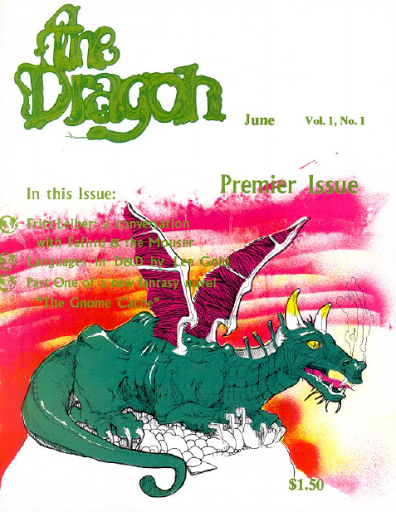
Dragon by Dragon – June 1976 (1)

Who drew it? Couldn’t find it in the issue.

Yeah, everyone else does the whole “review every issue” or “review every page” thing, so why the heck can’t I?

Other than Great Britain and Iceland finally ending their codfish war (such a terrible waste), the first issue of The Dragon (formerly The Strategic Review) was probably the big highlight of June, 1976. So what does this little gem contain?

We have an article by Fritz Leiber, the man himself, talking about his wargame Lankhmar and giving a brief tour of Nehwon. Leiber closes this article with a bit on houris. Here’s an adaptation for Blood & Treasure (you know, the game I haven’t actually released yet).

Every hero (4th level fighter) attracts a houri as one of his followers provided he has a charisma of at least 15. The houri requires upkeep to the tune of 100 gp per month. As Leiber explains, a houri is so “slimly beautiful” that she “make all men their helpless slaves and intoxicate even a Hero to madness”. In play, this works as follows:

– Houris have 1d4 hit points (i.e. they can be killed by a dagger). They wear no armor, and may only wield a dagger themselves.

– All 0 or 1 HD male humans, demi-humans and humanoids within 10 feet of a houri must pass a Will saving throw or move directly toward the houri, rapt with fascination and unable to attack her (unless they are attacked by someone else, in which case the spell is broken).

– All higher level male characters within 10 feet of a houri must pass a Will saving throw or have their effective level cut in half.

Sounds like a useful follower to have, but heed the Mouser’s warning – “Women are ever treacherous and complicate any game to the point of sheerest insanity.”

Larry Smith provides a guide to running the Battle of Five Armies using the Chainmail rules.

Wesley D. Ives provides a task resolution system, as he informs us that a “more standardized system is needed” than DM’s just making it up as they go along. New School and Old School were clashing even back in 1976.

The system works by determining randomly a type of dice (by rolling d% and adding the attribute to be tested), from d4 to d12, rolling it and multiplying it by the attribute to be tested to find the percentage chance of success.

So, let’s say I want to jump across a chasm. This involves strength, and my dude has a strength of 13. I roll d% and get a 35. I add 13 to 35 and get 48, which tells me I need to roll a d8. I roll it, get a 5 and multiply that by 13, giving me a 65% chance of success. See – much easier than saying “roll under your strength” or “roll a save vs. paralyzation” or “roll 1d6 – you succeed on a 1 or 2”. Thank goodness for systems.

James M. Ward asks whether Magic and Science are compatible in D&D. Of course, he thinks it is (else it would be a pretty boring article). He introduces a race of people called the Artificers who use a trio of interesting high-tech items.

Lee Gold delves into languages. She notes that humanoids have a 20% chance of speaking Common, which makes much more sense than 3rd edition allowing dang near every sentient creature in the multiverse speaking Common (and thus negating the point of even having languages).

Jake Jaquet tells the tale of “The Search for the Forbidden Chamber”. Check it out for a picture of the infamous “Greyhawk Construction Co. LTD” and a Recyclesaurus.

Len Lakofka presents some miniature rules that were apparently going to be used in a 64-man elimination tournament at GenCon.

The creature feature presents the ever-loving Bulette (pronounced boo-lay, except not really), with an illustration that is really quite good. The reproduction isn’t perfect, but it’s a nice action shot featuring three armored warriors (God, do I prefer realistic armor to some of the fantasy nonsense that seems to predominate these days). The stats note that its mouth has 4-48 pts and its feet 3-18 points – i.e. 4d12 and 3d6. It took me a minute, but I finally realized this was the damage they dealt.

The description notes that it is a hybrid of armadillo and snapping turtle, and that, when full grown, they can dwarf a Percheron (a draft horse that originated in the Perche Valley of northern France of course – man, don’t you guys know anything?)

Mapping the Dungeons is a neat little feature, presenting the names of active DM’s. The FLAILSNAILs of its day, I suppose.

Joe Fischer gives tips on mapping a wilderness. He uses colors for the terrains and simple symbols for features – triangles for hamlets, squares for towns, circles for cities and crosses for fortresses. Circle any of these for ports. Article has a nice Conanesque barbarian illustration as well.

Peter Aronson adds four more levels onto the illusionist, as well as a few extra spells (1st – ventriloquism, mirror image, detect illusion*, color spray*; 2nd – magic mouth, rope trick, dispel illusion*, blur*; 3rd – suggestion, phantasmal killer*, illusionary script*, dispel exhaustion*; 6th – mass suggestion*, permanent/illusion* (no – the slash doesn’t make sense to me either), shadow/monsters III*, programmed/illusion*, conjure animals, true sight*; 7th – astral spell, prismatic wall, maze, vision*, alter reality*, prismatic spray).

The spells marked with an asterisk are detailed in the article, in case you wondered who invented phantasmal killer. Lots of classic spells here. Alter reality apparently works like a limited wish, but you first create an illusion of what you want to happen, and then the … spell description cuts off.

Lin Carter and Scott Bizar present “Royal Armies of the Hyborean Age”, which reminds you of how important wargaming still was to the hobby then. I think wargaming is pretty basic to the experience, really, which is why I threw some basic rules into Blood & Treasure for mass combat. I’m hoping to test them out this weekend with the daughter. She doesn’t know this yet – so keep it under your hat.

Gary Gygax (you might have heard of him) gives rules for hobbits and thieves in DUNGEON!, a game I so completely regret getting rid of I’d like to punch myself in the face.

“Garrison Ernst” (pseudonyms are as much a part of the history of this hobby as dice and beards) presents a chapter of “The Gnome Cache”, in which he gives an introduction to Oerth and its place in the cosmos. Oerth is a parallel Earth with the same basic geography as Earth, it claims, save Asia is a bit smaller and Europe and North America a trifle larger. It is peopled by folks similar to ours, with similar migrations, but it separates from Earth about 2,500 years ago. He also explains the difference in scientific laws (i.e. magic vs. technology) and that nobody knows what lies in the Terra Incognita of Africa and across the Western Ocean.

It might be fun to draw the nations of Oerth on a map of Europe. We’ve all heard that Gygax’s campaign was originally set in a fantasy North America, but here he says Europe, so perhaps Europe it should be.

Larry Smith now chimes in with the three kindreds of the Eldar – the Silvan (or Wood Elves), the Sindar (or Grey Elves) and the Noldor (or Exiles, the greatest of the elves). Apparently they all have a chance each game year of crossing the sea to the land of Valar – that would be a fun house rule to spring on players of elf characters.

“Say Bob, roll d% please”

“Okay … got a 9”

“Sorry Bob, your 6th level wood elf just went to the land of Valar. Roll up a new character.”

The wood elves can advance as fighters as far as they want, but are limited to 2nd level magic-user spells and may not use wands or staffs and have a 10% chance of going to Valar each year. Sindars are the regular D&D elves (and have a 25% chance of going to Valar each year). Noldor are uber elves with no level restrictions and with a 150% bonus to ranges and effects of spells. They have a 5% chance of going to Valar after performing a great deed.

Which begs the question, why would you ever play a non-Noldor elf?

Note: Totally digging the art in this issue.

Not a bad issue. Lots of goodies. I like the houri bit for fighters, the elves going across the sea is fun, and you get some neat hints about Lankhmar and Oerth from the guys who invented them. Worth the read.