Dragon by Dragon – February 1979 (22)

A new year has dawned, and February brings us an interesting cover combining a photo of miniatures, a photo of what I’m guessing are some SCA’ers bludgeoning one another, and an illustration of fantasy swordplay. Given that the byline on the cover is “Little Wars“, one can imagine what lies inside.

As has become a tradition of this series, the first thing I manage to fall in love with is the latest Ral Partha advert. If I’m completely honest, I’m not usually that enthused about their sculptures, but I love the names and notions. In this case, it’s the Army of Mu’ugalavya! I think it would make a good random encounter for any campaign – imagine a plane hopping army of conquerors carving out footholds on a thousand material planes.

When encountered, the army consists of the following:

1d6+1 Heavy Infantry (men-at-arms with platemail and spear)

1d6+2 Medium Infantry (men-at-arms with scale mail, shield and war hammer)

1d6+3 Medium Infantry (men-at-arms with scale mail, shield and barbed spear)

1d6+4 Heavy Infantry (men-at-arms with platemail and battleaxe)

1d6+5 Archers (men-at-arms with leather armor, longbow and dagger)

1d6+6 Slingers (men-at-arms with sling and hand axe)

General – fighter of level 1d6+7 in platemail with shield and longsword

When encountered, roll a reaction check:

Hostile – the army attempts to kill the encountered party to keep them from revealing their presence here

Neutral – the army attempts to capture the party and interrogate them about the surrounding lands

Friendly – the army attempts to recruit the party, promising them a share of any plunder they get

Our first article is The First Assassins by James E. Bruner, a study on the infamous Order of Assassins that once plagued the Middle East. The article gives a history of the organization. It’s really a fascinating story, and if applied to the assassins of AD&D (and its simulacra) would make that class infinitely more interesting. Imagine a world populated not with rangers who were mere fighters of the greenwood and assassins who were mere men-in-black with poisoned knives, but with the Numenoreans of Tolkien and the cultists Hasan Sabbah (or his simulacra) bent on overthrowing the most powerful religious leader in the known world. One should also note that the real assassins had their own level titles: In order from lowest to highest they were Adherents, Companions, Propagandists (remember, they were primarily preachers attempting to undermine the Caliphate that they may replace the Caliph with a member of their own sect), Greater Propagandists and Grand Headmaster of the Order.

The history continues in this issue with Irresistible Force – A Brief Account of the Rise of the Swiss Confederation with Commentary on Their Military Tactics by Gary Gygax (one can imagine from the title how brief the article will end up being). It’s quite an interesting article as well, and contains one of those percentile charts of the Swiss Army that readers of the old Monster Manual will recognize well. An army book like this would have been pretty cool back in the day – sort of a “Monster Manual” of ancient, medieval and renaissance armies. I’d like to produce something similar myself one of these days for Blood & Treasure.

Nick Nascati follows this up with Armies of the Renaissance – Part One. This article gives a brief overview of what is to come, with some history of the period (the great generals of the period, the mercenaries (which seem to be the inspiration for all those bandit troops led by high-level fighters in AD&D) and artillery).

Review time! This issue covers the following games (and I’ll include the concluding paragraph of each review):

Boardgame – Up-Scope!: “Still, you take what you can get. This one isn’t bad. I just wish it were better. Play it, before you buy it, to find whether you’ll love it or hate it. — Dave Minch”

Book – The Face in the Frost: “This well-written novel of strange hauntings, sorcerous conjurations, and outrageous humor can not be recommended too highly! Go out and get a copy right now, but be prepared to spend a long, uninterrupted period of time reading it, for you won’t want to put it away until it is finished once you begin!

(I concur on this one – great book)

Boardgame – Panzerkrieg: “All in all, this is a game which is every bit worth its $12.95 pricetag. Not only is the game colorful and well-done graphically, but it provides excellent play value for the money with its eight scenarios, each one a bit different from the others — and some with the Russians on defense, others with the Russians on the attack. There are some minor flaws, (more playtesting would have helped), but these are far outweighed by the game’s advantages and overall appeal. I recommend this title to anyone who enjoys the Eastern Front, or who simply enjoys a good historical game no matter what the subject. — Mike Carr”

Magazines – Apprentice #2 and Phoenix: “APPRENTICE is certainly bad, but for one dollar it is a value if you appreciate jokes. PHOENIX is worse, and no price is given. If it is free, you might wish to get it. – Gary Gygax”

(Bear in mind, this review came after the magazines in question wrote a bad review of The Dragon)
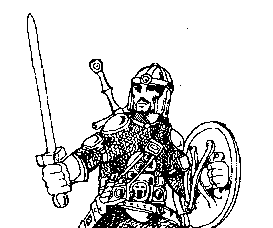
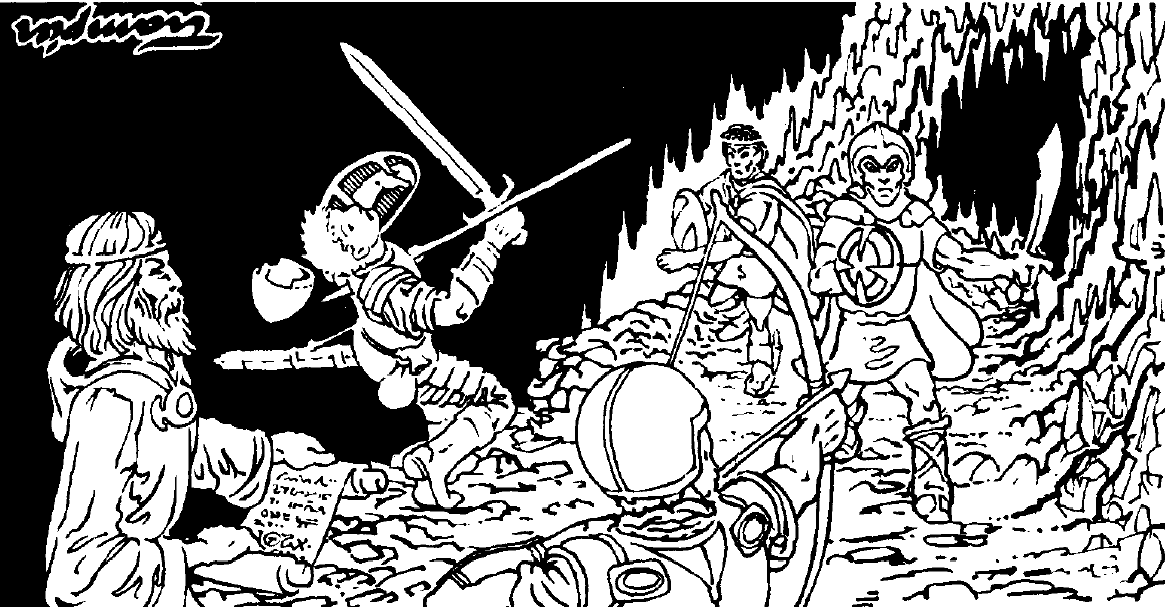
Up next is a big installment of Mapping the Dungeons, which presents DM’s and gaming groups and their addresses from around the U.S. and beyond. Not much of interest here other than the historical record of early players of role playing games, but I did like the little piece of art at the end by McLean. I love his comic pieces, of course, but I would have liked to have seen more of his serious stuff appear in old TSR publications.

Gary Gygax now chimes in with Dungeons & Dragon – What It Is and Where It Is Going. He mentions that perhaps 150,000 people now play D&D, and gives a brief synopsis of its history and the future he envisioned for it. He brings up AD&D, modules and similar material and … computers! One line I did like was this:

“It is my personal opinion that the game form is a classic which is of the same stamp as chess and MONOPOLY® ; time will be the judge.”

I think he got that one right, though the present copyright holders seem to be bent on proving him wrong.

Up next is an examination of a new game from TSR called 4th Dimension – a game that sounds like a mix of chess and Stratego that involves capturing an opposing Time-Lord on a circular board divided into variably sized spaces. Honestly – never heard of this one, though it sounds pretty cool. Here’s a link to Game Board Geek’s page on the game.

This is followed by a multi-page preview of the AD&D DMG – essentially a few pages from the magic items section and the attack matrices and a few more bits.

If anyone doubts that Gary Gygax did not appreciate negative criticism, one need only pick up this issue of The Dragon. He already savaged a couple fanzines, and now he offers a review of a review of AD&D’s Player’s Handbook in SPI’s house mag, Strategy & Tactics. A sample …

“What is worthy of comment, however, is the source of the critical commentary on AD&D being nothing more than a rewrite of D&D. Coming from an officer of SPI, the past masters of the rehash, artisans of the warmed-over WWII battle game, purveyors of the umpteenth version of the same, tired scenario, it is indeed a wonder that Mr. Berg would bring up such a spectre!”

I have a feeling these snipes probably turned more people away from D&D than the bad reviews.

Stalemate at Kassala is a play report of a war game that re-enacted a battle in 1541, when the Portuguese sent 400 infantry with 1000 stand of firearms and some cannon to aid the Ethiopian emperor Galawedos against an army of invading Egyptians and their Nubian allies. As you can tell from the title, it ended in stalemate.

Finieous Fingers then runs into “Grollem” and buys his precious ring of invisibility off him for 1,000 gp (actually turns out to be a fake sold by a hobbit in a Grollem suit), and then wanders into a dragon horde, where he discovers just how fake the ring is.

Ah – a classic article comes up next – Gygax’s Nomenclature of Pole Arms. I’ll say no more, for the truly initiated of the RPG community know all about it.

That’s it for February 1979! Not a bad issue really, especially because it reinforces the importance of history in D&D – it ain’t just fantasy folks.

Dragon by Dragon – December 1978 (21)

Just imagine all the spiffy Ronco products people were unwrapping on Christmas day in 1978! A few folks might have also been perusing the December 1978 Dragon magazine while they were waiting for Christmas lunch or dinner. Let’s see what it included …

First up, we have a groovy little advert from Ral Partha that would make a good elven army list or encounter list. Let’s make it random …

01-05. Wood Elf Archers (Longbow and Shortsword)
06-25. Wood Elf Infantry (Longbow and Longsword)
26-30. Woof Elf Cavalry (Lance)
31-50. Sea Elf Pikeman
51-60. High Elf Swordsmen
61-75. High Elf Spearmen
76-95. High Elf Cavalry (Two-Handed Swords)
96-100. Elfin Command Group – Elf Commander (5th level fighter/magic-user), Elf Lieutenant (3rd level fighter/magic-user)

First article this issue is a revisit of the Search for the Nile game. This is basically a response to the article in the last issue of The Dragon by the games creator.

Okay – have to share this next ad with everybody …

Next up, we have a neat little table of titles for powerful NPCs by Brian Blume. This one works like the old menus at Chinese restaurants – choose one bit from column 1, one from column 2, etc. Here are a couple examples:

The Lord Protector, His Most Distinguished Illustriousness, The Crown Prince Bob, the Incomparable Slaughterer of Dragons

The Guildmaster, Her All Triumphant Laduyship, Lady Cassandra, The Terrible Scythe of Honor

Kinda groovy – worth checking out. I’ll probably turn it into a random table and use it for Nod now and again.

Willie Callison now presents a Cure for the “Same-Old-Monster” Blues. Every long-time DM has gone through this. Mr. Callison’s suggestion is to look at the world around you and draw inspiration from nature. The giant snake, for example, can be described as any real species of snake – different types of attacks, different color patterns, etc. You get the idea.

Callison also provides the next article – Inflation in D&D. In 1978, inflation would have been foremost on people’s minds, and Willie complains about the lack of realism inherent in the D&D economy – i.e. too many gold pieces floating around. Unfortunately, he doesn’t really give any solutions to the problem. So, kind of a pointless article.

Prophet Proofing (or how to counter foretelling spells) by David Schroeder attempts to throw a monkey wrench into spells like clairvoyance, clairaudience, wizard eye, ESP and x-ray vision. I’m generally not a fan of ideas on how to screw up powers that players should rightly be able to exercise with the characters. I mean, a fighter with a high strength and two-handed sword sure does kill lots of orcs – shouldn’t there be a way to screw that up? Sneaky tricks are a good thing in D&D – keeps the players on their toes – but at the same time, the clever use of spells to overcome obstacles is one of the points of the game.

Sensible Sorcery is an article by Ronald Pehr that explores ways to make researching spells more difficult for magic-users. I think I’m detecting a theme in this article.

Robert Wagner (no, probably not him) now delivers a Boot Hill Encounter Chart. The chart is for town encounters, and is divided into two parts – Town till 8 p.m. and Town after 8 p.m. The early chart gives a 1 in 6 chance of an encounter, while the late chart gives a 2 in 6 chance. Early encounters include pickpockets, various job offers (a very good idea!), being shot at by 1 or 2 people, being mugged by 1 or 2 people, being falsely arrested or have 1 or 2 deputies after you. The late encounters include jealous husbands, being challenged to a gun fight, seeing a bank robbery, more job offers and being arrested by a U. S. Marshall (maybe this guy!). It’s a very good chart, and easily adaptable to a fantasy game or one set later than the Old West period.

Rod Stevens delivers Encounters with Personality. Here, he provides a few ideas on giving monsters and NPCs a bit of history and personality for encounters. Did DM’s actually not do this back in the day? Perhaps – old D&D had a few elements of wargame/boardgame to it back in the day, but articles like this show the progression to a more story-based game. A couple examples:

1. BLARG: Ftr. Cha/Evil. Hobgoblin. Blarg hates everything but ogres. These he emulates but they hate him.
 

3rd 20 5 16 7 7 6 8 6 +1 +1 shrt. sd.

8. CLARENCE LINDIR: Ftr. Law/Good. Human. He is a constable who is always accompanied by 11 other constables. He will do anything to make an arrest including arresting jaywalkers, people with water in wine skins, or anything else he can think of. He often makes up absurd charges. When in court he will then charge resisting arrest if the party didn’t come peacefully. Of the hundreds of arrests he has made, he has only gotten 2 convictions. The townspeople pointedly ignore him and call him “Clarence the Clown” behind his back.
 

1st 9 7 1 7 9 1 0 9 7 8 + 2 + 2 mace & spear

Next come the game reviews. Olympica is set in 2206, where a human colony on Mars is being conquered by a group mind called “The Web” (prescient in a way, huh?). One player controls the assault group being sent by the U. N., while the other player defends the Web generator from the assault.

Don Turnbull of Cambridge, England presents a section of his Greenlands Dungeon – The Hall of Mystery. It’s quite a long description, but it involves riddles (sort of), mirrors (one a mirror of opposition, the other of life trapping containing a succubus) and a host of monsters in rooms. I will share the map …

Gary Gygax pops in next with a strategy guide for Rail Baron. I’ve heard good things about this game (one wonders if it could have been used in concert with Boot Hill), but I’ve never played it. Since I haven’t played it, I won’t chime in on how good a guide it is, but it does look as though it’s quite thorough. In fact, I think it might be the longest article in the magazine.

A couple more game reviews follow. King Arthur’s Knights, which reviewer S. List describes as being similar to TSR’s DUNGEON. Players choose to be a knight errant, knight at arms or great knight, which increasing levels of power and obligations, as well as tougher victory conditions. The map was apparently gorgeous, the rules book 16 pages long and there were 11 decks of small cards. There are several Magic Places on the board, and on each one places a magic treasure and magic guardian.

Timothy Jones now presents some optional rules for DUNGEON. There are new characters (halfling, dwarf, cleric, thief and paladin), new prizes (including a bag of dung!) and new monsters (red dragons, blue or white dragons, witches, evil wizards and evil priests).

T. Watson then has a review of Tolkien’s Silmarillon. Watson describes it as the bible of Middle Earth, with the Valar as the angels, Melkor/Morgoth as Lucifer and the elves as the chosen people. Watson seems to like it, despite it being long and dry, but also seems to indicate that it’s for folks who really want to know more about the imaginary Middle Earth.

In James Ward’s Monty Strikes Back, we get another installment of gonzo dungeoneering done right. Here’s a sample:

“The three ancient white dragons guarding the door were no problem. It was just a matter of running in the chamber hasted and invisible and throwing three hold monsters at things. They didn’t have any treasure, they were just there to slow us down a bit. As we walked through the door ‘Monty gave his “evil” chuckle (which always meant we were in big trouble) and we were told that we were sliding down a sheet of glare ice. We wound up pinioned against a mass of ice spears and everybody but Freddie had taken damage. He then thought it would be a great idea to use his flaming power to melt the spears away. Ernie and I, knowing the horrors Monty could think up, tried to stop him but it was too late. We were hit from above by partially melted ice stalactites and again Freddie was the only one unhurt.”

This was my point about D&D once being something like a wargame/boardgame. The fun was in moving around the pieces, not telling their life stories.

And that’s it for December. The reviews were interesting, a few of the articles useful, but honestly not among the best issues I’ve read.

Enjoy your Saturday gang!

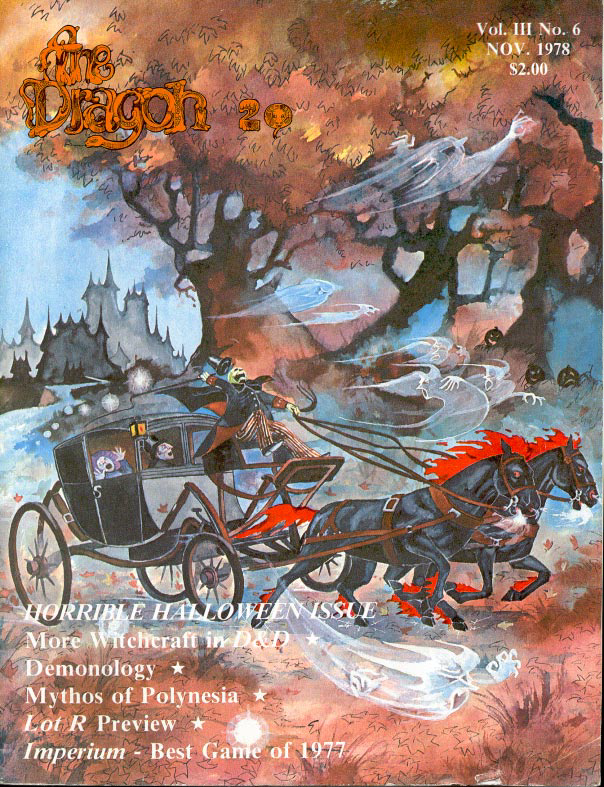
Dragon by Dragon – November 1978 (20)

And so we come to November of 1978, which is notable … for nothing that I’m aware of, other than this magazine. This appears to be their Halloween issue (why November? Kask explains it’s because November is the dreariest month of the year – what with all the football and Thanksgiving? – and thus a good month for horror stories).

Whatever the reason, let’s see what Dragon #20 has to offer.

Designer’s Forum – The Making of a Winner: Imperium – Outstanding Game of 1977 by Marc Miller

Yeah, that Marc Miller. In this article, Miller describes the origins of Imperium. Apparently it began as two games, Imperium being a giant sci-fi game of economics and conquest, and StarFleet, which was on a smaller scale. Ultimately, StarFleet was put on the back burner while Traveler was made. When Lou Zocchi mentioned that the name could get them in trouble with the Star Trek folks, and when they decided Imperium was too big to publish, they decided to take what they had learned making Traveler and apply to StarFleet, which would now be renamed Imperium.

Anywho – the article goes on to describe the design process behind Imperium, and to also provide some rules clarifications and addenda.

I enjoyed this bit …

Whatever happened to that guy?

Distributing Eyes & Amulets in EPT by Mike Crane

One of those great articles that makes perfect sense to people who play the game. The article is just a series of random tables that makes sure “rare” eyes and amulets show up less often than “common” eyes and amulets.

The Mythos of Polynesia in Dungeons & Dragons by Jerome Arkenberg

This article covers everyone from Tangoroa, God of the Ocean, to Pele the Destroyer, to Miru, God of the Underworld. The heroes seem more interesting …

The Polynesian Heroes were born in non-human form, and were brought up by their maternal grandparents, from whom they derived their magic. When in human form, they could transform, stretch, or shrink themselves, fly, take giant strides, and perform great feats of strength.

Maui is, of course, the badass of the crew (and he happens to look like a buffoon with eight heads) – here are some stats for Blood & Treasure.

Maui, Challenger of the Gods: Magic-User 18 and Fighter 15; HP 140; AC 12; ATK 4 slams +7 (1d3+5); MV 30 (Fly 40); F 6 R 9 W 4; XP 4500; Special: Dominate foes with 0 HD or less, 4 attacks per round, spells per day (4/4/4/4/4/4/4/3/3/2); Str 20, Int 18, Wis 18, Con 18, Dex 17, Cha 3.

Wormy

In this episode, Frank and Dudley abscond with one of the demon eggs to spring them on the ogres. It’s amazing how engaging this strip was right from the beginning.

D&D Variant: Another Look at Witches and Witchcraft in D&D by Ronald Pehr

Love the editor’s note:

Editor’s Note: This seems to be a well thought out class-variant. At the very least, it makes an excellent NPC or hireling/acquaintance. For those DM’s bold enough to try it, it provides a very viable character for ladies; be they sisters, girlfriends, lady gamer or others. D&D was one of the first games to appeal to females, and I for one, find it a better game because of that fact.

It manages to be both inclusive and a bit sexist at the same time.

So, what do the ladies get with this witch? It’s actually a nice class, and, I believe, the origin of the later witch class that showed up in Dragon in the 80’s. Witches here are not Satanists, but more nature lovers who use magic to charm and control – I guess what you would call an enchanter in more modern versions of the game – and who can brew potions, narcotics, hallucinogens, etc. Witches get eight levels of spells, many of them new, and they appear to straddle the normal magic-user/cleric divide.

D&D Variant: Demonology Made Easy by Gregory Rihn

This article is all about conjuring demons (and devils). The key here is learning a demon’s name, and the process is simple and clever: You research a demon or devil’s true name the same way you research a spell:

Demon prince, arch-devil = 9th level spell
Type VI, pit fiend = 8th level spell
Type V, ice devil, succubus = 7th level spell
Type IV, horned devil, night hag = 6th level spell
Type III, bone devil = 5th level spell
Type II, barbed devil = 4th level spell
Type I, erinyes, misc. = 3rd level spell

Definitely one of those, “Why the heck didn’t I think of that” moments.

Once you get down to the conjuration, you roll some percentile dice to see if what you call is what you get. Calling a demon prince, for example, has the following chances:

01-50 = Type V demon
51-75 = Type VI demon
76-00 = Demon Prince

High level conjurations require assistants and sacrifices, and there are additional chances for failure for characters below 20th level. Very good article.

GenCon XI Photo Album

Greg Costikyan of SPI … I believe I recognize the woman as Gygax’s daughter
That Gygax fellow
J Eric Holmes and his son Chris
Jeff Perren
Lou Zocchi and Woody … proving that GenCon’s best days are clearly behind it
Marc Miller
Mike Carr
Tim Kask
Tom Shaw of Avalon Hill

Review: See Africa and Die! or, Mr. Stanley, Meet Dr. Livingstone by Gary Gygax

Gygax reviews Source of the Nile here. Apparently, this is a super long play game. It is pretty extensive review, and it looks like a pretty cool game. Best line of the review:

Be certain to read and KNOW the rules before you attempt to play. The rules are not well organized, nor are they very complete. In fact, in many ways they remind me of those originally written for D&D®.

Gygax also gives some additional ideas for the game.

The Asimov Cluster by William B. Fawcett

This article discusses the problems inherent in recreating scenes from sci-fi novels in games of Traveler. It also provides stats for the planets of the Asimov Cluster from the Foundation Trilogy.

Advert for the drow modules. The drow are going to change quite a bit over the next 30 years.

Preview: The Lord of the Rings by Allen Hammack

This preview is for the Bakshi animated version (which I’ll admit I like, sue me). It mostly gathers together some stills from the movie and a few production notes from Bakshi.

It’s a Good Day to Die by Lyle Fitzgerald

This article compiles death statistics of a D&D campaign in Saskatoon. In two to three years, this campaign racked up 600 deaths of PCs and their advance-able hirelings. Wow! I know the old game was deadly (I’ve played it), but this does seem excessive. The top killers are Miscellaneous Causes (14.6 percent) and goblin races (10.1 percent). Dragons were responsible for 7.5 percent of the kills and giants 5.7 percent – respectable numbers for the big guys. War only caused 6 deaths – I guess one of the four horsemen needs to be replaced by a goblin.

War of the Ring Variant by Allen Hammack

Simple rule change – hide the movement of the fellowship so the bad guys don’t have to pretend they don’t know where they are. Honestly – can’t believe the designers didn’t think of this.

Fineous Fingers

A dragon throws a stupid paladin off a cliff. Nice tactic – fake a subdual.

Demonic Possession in the Dungeon by Chas. Sagui

This article takes the rules to task on the inability of demons to possess victims. In Chas’ rules, only demons of Type IV or higher can possess mortals. Interesting line:

The rule of the thumb is that only those demons that are immune to all but magical weapons and therefore exist upon two planes at once may possess.

One of those, “wait – is that really why, or did he just make that up?” lines.

The basic idea is that the DM let’s the players all know they might be possessed. Everyone rolls a saving throw, but only one character is really the victim. The victim is chosen “randomly” – i.e. first person into a room, last person, etc. A save vs. magic is allowed to avoid the possession.

The possessed dude has his normal AC, but attacks as the possessing demon. They cannot use lawful-aligned magic weapons. The demon can use its normal powers, provided its new body doesn’t preclude it. All damage is taken by the body, not the demon.

There’s more, but you’ll need to read the article.

Not a bad issue, really. The witch and the demon conjuration articles are my favorites. I’d recommend hunting it down.

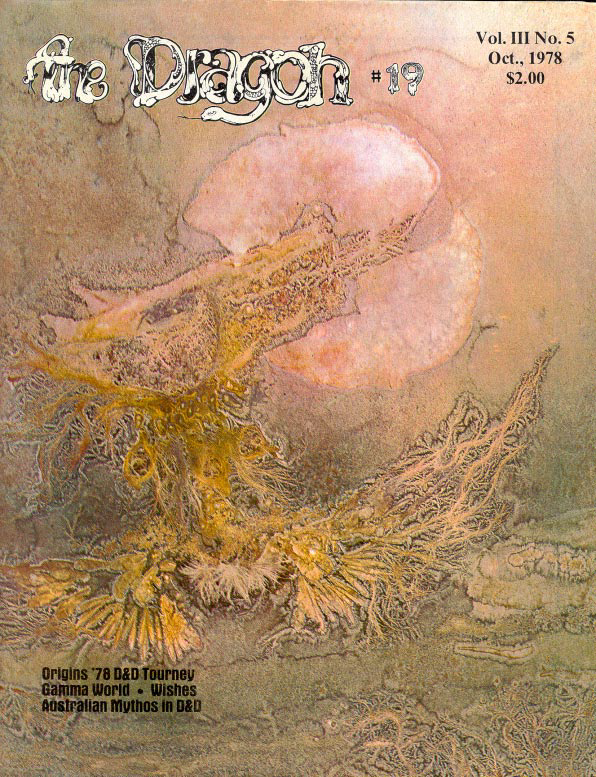
Dragon by Dragon – October 1978 (19)

Hey – almost have my months synced here! October 1978 and Dragon blows in with what appears to be a pretty full issue. Let’s begin …

First thing I see this issue, other than the editorial, is “The Battle for Snurre’s Hall”, the tournament for the Origins ’78 D&D Tournament. Good recap of the winning team’s tactics, and reminds you of the game aspect that I think sometimes gets buried under the “role play” aspect.

How Many Ettins Is a Fire Giant Worth: Competitive D&D by Bob Blake

And then this article reminds me of the importance of role play in the game. Basically, this is an article about scoring competitive modules. Given my intense interest in such things …

A Compendium of Diverse D&D Player Personalities by Mike Crane

Hmmm … maybe the next article holds something interesting …

Gamma World – A New List of Treasures To Be Found by Gary Gygax

Thanks EGG! A nice random table (1-100) of relics for Gamma World. We have a home donut maker, wire cutters in fair condition (an amazing find), a plastic box of 50-100 assorted screws (you know these are going to be used to stud a club, right), a leather bag of dice, etc.

Gamma World – More Excerpts from the Journals of Hald Sevrin by Gary Jaquet

This one covers the history of Gamma World in the Black Years. Apparently, it was hard, but people adapted.

Wormy

Or “Wormy 8 Ball” to my 12-year old brain.

Wormy swoops in (thank God) and provides some light entertainment – if you consider a tree troll being ripped apart light entertainment. Beware blue demons!

The thing that always made me wonder about Wormy was the trolls. Trolls were supposed to be complete bastards, right? But these guys were pretty cool. As a kid, the Monster Manual was as canon as it came, and this was the first introduction I had to “it’s my world, I can do whatever I want”. Good training for a young DM.

The Lowdown on Wishes by Kevin Thompson

The thing is, wishes have absolutely no place in a game. In a story, they’re fine. But in a game, nothing but trouble. Great line …

“Most DM’s want to be fair about wishes but don’t want Player characters to take undue advantage. So they kill them.”

The article tries to get into the science behind wishes. Mildly interesting, but very “campaign world” specific in a way. The idea is that wish spells are empowered into devices by wizards to allow non-wizards to use magic. They may vary in strength, and might have alignment restrictions as well (i.e. a lawful wish cannot be used for something chaotic). Thompson divides wishes into four classes:

CLASS I: Creates purely physical (mundane) objects or occurrences

CLASS II: Creates living, non-magical beings, weak magical equipment and duplicates magic-user spells up to 5th level

CLASS III: Creates living, magical beings (but only the weakest type), moderately strong magic items and can duplicate any magic-user spell and cleric spells up to 4th

CLASS IV: Can do almost anything except granting more wishes in any way, shape or form.

Not a bad schema, really.

Planning Creative Treasurers by Dave Schroeder

Dave gets into thinking more about treasures – why is that orc carrying a bunch of gems, for example, or using a theme with a treasure horde. He refers to these as toolkits, for example …

“A thief’s toolkit could contain a +1 dagger, a gem that glows in the presence of traps, a set of Gauntlets of Dexterity, a skeleton key that would raise its user’s chances of opening locks, or a pair of “waldos”, that would allow him to open trapped chests from a distance. Don’t forget a periscope for peeking around corners, or perhaps a bag of holding for the loot. Disappearance Dust would be useful, as would a Gauntlet of Etherealness that would let pouches and pockets be picked tracelessly.”

The Mythos of Australia by Jerome Arkenberg

Another in the line of mythos articles, and if you’ve ever dipped your toes into the Australian myths, you know they are quite interesting and tough to adapt to D&D. The beauty of the Greek and Norse myths is that so many of them read like comic books.

Systematic Magic by Robin W. Rhodes

I love it when geeks begin “rationally” explaining why it makes no sense that a magic-user with charm person in his book could ever earn enough gold/experience to figure out hypnotic pattern, since charm person is clearly a control spell and hypnotic pattern a mental spell.

Spells here are divided into these different categories, which have different prime requisites. Control spells, for example, have charisma as a prime requisite, while nature spells have constitution as their prime. Holy spells only have the lawful alignment as their prime requisite.
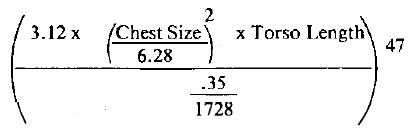
Lawful characters begin with two holy spells. Neutrals get one 1st level spell from (I guess, the language is confusing) the category that matches their highest ability score. Chaotics aren’t mentioned, and a character can never have more than two new spells at any one time.

The chance to miscast a spell is equal to the level of the spell divided by the prime requisite. So, dispel magic, a 3rd level defense spell, would have a 3/15 chance of miscast if the caster had a constitution of 15, i.e. 20% chance of miscast. DM determines the side effects of a miscast spell.

Casting a spell costs one point of its prime requisite per spell level – so that dispel magic spell would cost 3 points of constitution. One point is recovered for every turn (minute or 10 minutes, depending on the version of the game) not spent in melee.

A new spell must be successfully cast once per spell level before the caster can learn another spell of that level.

Only two fields of magic can be learned at a time.

A bit fiddly, but a neat idea. Wonder how it works in real play. Again, though, you can see the future divides of gaming even at this early stage – more rules vs. fewer rules, “logic” vs. gonzo, etc.

The Fastest Guns That Never Lived, Part III by Allen Hammack

This third in a series examines several more characters from western shows and gives them Boot Hill stats, including Bret, Bart and Beau Maverick, Will and Jeff Sonnet, Eli Wallach, Charles Bronson, James Coburn (fuck, I want to play James Coburn in a game of Boot Hill), Robert Vaughn, Tim Straum, Kid Shelleen and Jason McCord. I love that the article mashes up characters and actors.

A Mixture of Magic and Technology: Gamma World Review by Robert Barger

When people say magic and technology don’t mix, it really burns the author. Hallmark of a geek – being annoyed at differing opinions. He mostly covers the ease with which one can combine Gamma World and D&D, which is something I like as well. Moving on …

Spell Determination for Hostile Magic-Users by Steve Miller

This is a quick article to randomly determine what spells an NPC magic-user might have, inspired by a bunch of players bitching when a randomly encountered enchanter threw and ice storm and fireball at them and wiped out their PCs. My response to this problem …

Honestly, it is good to vary the spells a bit, but on the other hand, do players ever apologize for destroying the kick-ass villain you designed in some dungeon you worked all month to stock? No, they don’t. You shouldn’t either.

Charts for Determining the Location of Treasure by Ronald Guritzky

Nice random table of treasure locations – very helpful when you write a lot of this stuff.

1) The location of the treasure
1-6 Chest
7-9 Urn
10-12 Bag
13-13 Pot
16-17 Loose
18 Carried
19 Hidden (Wall, Floor, Secret Compartment, etc.)
20 Ref’s Choice

2) There is a one in four chance that a treasure has a trap in it.

3) Traps
01-20 1-8 Daggers (1 in 6 poison)
21-36 1-6 Arrows
37-46 1-3 Spears (1 in 6 poison)
47-62 Gas
63-78 Poison Lock
79-88 Monster in Chest (Pay attention to monster’s size)
89-92 Exploding Chest (2-7 dice of damage)
93-95 Chest Does a Spell At Person
96 Chest Acts as Mirror of Life Trapping
97 Intelligent Chest (2nd -7th Level Magic User)
98 Lose One Level of Experience
99 Lose One Magic Item
00 Roll Twice

4) Gasses (Roll 6 sided die for first digit and 4 sided die for second digit)
11-12 Obscures Vision (Players run into each other, miss treasure, etc.)
13-14 Blinds Player 01-100 Hours
21-22 Fear During Next 2-9 Fights
23-24 Sleep 6-36 Rounds
31 + 1-4 Points to Random Ability (8 hours) (1 in 10 permanent)
32-33 Sick: Return to Surface (1 in 6 in coma)
34 Paralyzation
41 Stone
42 Death!!
43 Polymorph to Monster or Animal 10’R.
44 Amnesia (1-20 days, 1 in 6 permanent)
51-52 Change Alignment
53-54 Slow (As slow spell)
61-62 Haste (As haste spell)
63 Cloud Kill
64 Go Berserk! Attack Friends!

I dig this ad for Star Trek miniatures. Even though Star Wars gets more notice, I think Trek, being born of episodic TV, might be a better fit for RPG’s

Footsteps in the Sky by ???

Fiction …

“All he could do was walk on the air as normals could walk on land and his four older brothers repeatedly told him that it was the most useless of all mental mutations. After Reveral’s long training sessions for manhood, he was finally beginning to believe his brothers’ taunts. His oldest brother Fer-in and his next oldest, Serpt, both could teleport themselves vast distances and had easily passed their tests of manhood. Karn, the brother closest to him in age, could read minds and, with great effort, control them, given time. He was even now on his test of manhood, but no one doubted that soft spoken Karn would do anything but succeed. Reveral was starting to be concerned with his own chances at surviving the test.”

Wormy Again …

He’s back, and that blue demon just bit a giant pool cue hard.

And that does it for October 1978. A few nice articles, a few that did nothing for me at all. Have fun this weekend!

Dragon by Dragon – September 1978 (18)

Another week, another Dragon magazine. The last one was chock-full of stuff, how about this issue.

Traveller: The Strategy of Survival by Edward C. Cooper

As I was thinking, “I don’t remember any Traveller articles showing up before in The Dragon” I hit this line in the article, “I took advantage of the opportunity to observe the TRAVELLER phenomenon first hand” – ah – so this is at the dawn of Traveller.

I’ve never played Traveller, but I did create a character once (I was creating one character for every game I had a PDF of … though I skipped Exalted because after the first few steps I realized I just didn’t care enough to bother with it). This article appears to be about – well – keeping a character alive in Traveller. My favorite bit:

“Several other similar occurrences proved to me then that the success or failure of a character in most cases cannot be traced to “dice or chance” as often as it can to poor handling on the part of a player. I was both surprised and disappointed that some players even blamed a character or given situation for their own bad decisions. But then again, I was extremely excited, awed, by the skill some showed in manipulating their character’s life.”

That hits the spot for an old schooler – though it also shows that there were plenty of people back in the old days who were waiting for the new days with baited breath. Different strokes for different folks!

Reviews – Traveller, The Emerald Tablet, Imperium …

Well, imagine that! The reviewer appreciates that Traveller is not just D&D in space, but rather has its own “unique flavor and style”. The review is quite extensively, and I highly recommend it (yeah, I’m reviewing a review) for folks who don’t really know what Traveller is all about.

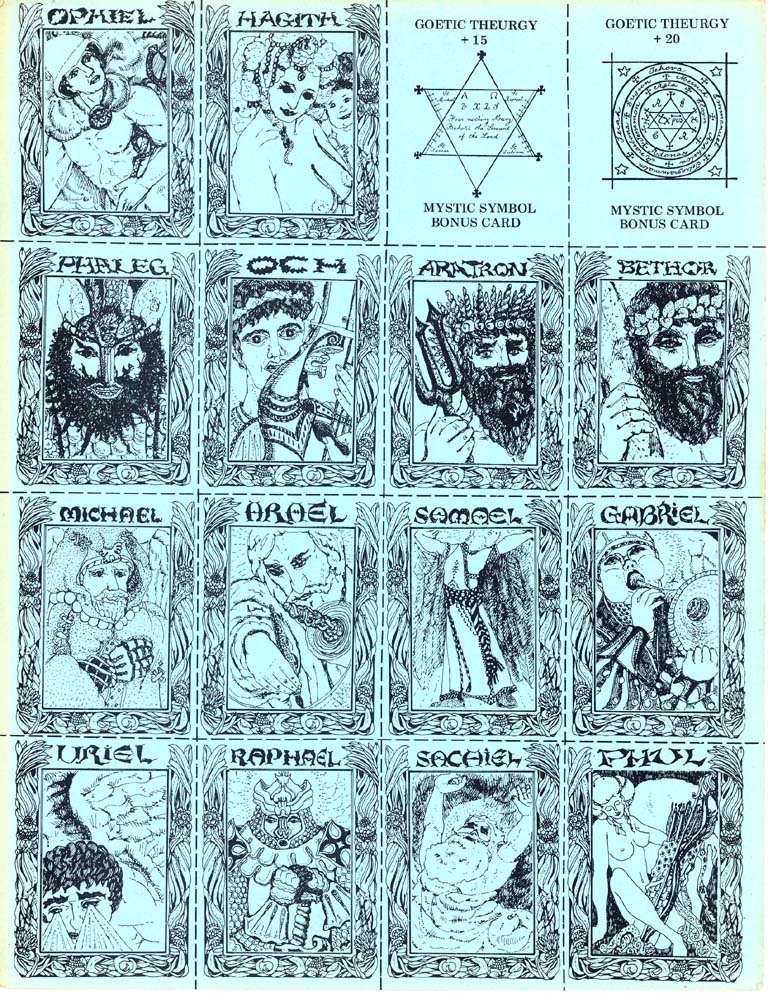
The Emerald Tablet is a set of fantasy wargame rules. The reviewer likes them, but admits he doesn’t know much about wargames. He likes that the magic system is based on ritual magic, which I know some people dig, but I always think it’s overrated. On the other hand – dig this sheet of Astral Force cards (click to enlarge … trust me, click it – click it now) I found at Boardgamegeek.com …

I don’t know what Phul does, but, hmm – anyways.

Imperium is another Game Designer’s Workshop product, a board game written by people who really love sci-fi literature. Apparently, Imperium is a game about the Terrans bumping up against the Imperium and the two sides fighting.

Pellic Quest is a computer moderated RPG (apparently a good thing, because computers are jerks like Dungeon Masters – see, the seeds of the new school were always there). Another sci-fi game, you start controlling a small planet in one of six roles (emperor, crusader, brigand, trader, droyds (robotic destroyers) or the zente (insect alien warriors). Each role needs different “winning points” and then go about making it happen.

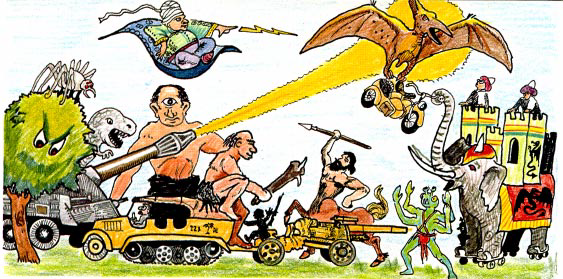
Oh, and those zente …

Pretty sweet.

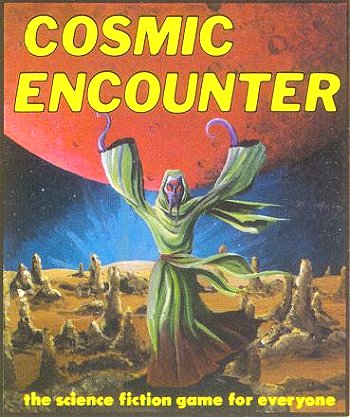
Cosmic Encounter is a sci-fi variation on draw poker.  Apparently it is simple and easy to learn, and, most importantly, fun, although the hype that one really has to get into the head of the alien race they control is wrong. The game combines several elements of classic, abstract games, and I want people who think they’re game designers to embrace this notion. Don’t begin with setting, begin with rules and get to know all sorts of old card games, board games, etc. Then apply setting to the game rules. This is how D&D was born and manages to remain so popular – it works as a game. Well, it used to, anyways.

INSANITY, or Why is My Character Eating Leaves? by Keven Thompson

A worthwhile article – insanity is tough to handle in games. Kevin Thompson devises first a saving throw vs. insanity (which makes sense given the time period). The saving throw is based on a matrix between Intelligence and Wisdom – find the number, add character level to it, and then try to roll 1d20 beneath that number. Neat idea (and I’ll be using it in a post this week).

If you fail the save, you roll d12 (always nice to see the d12) on an insanity chart.

INSANITY CHART

1. Nutty
2. Kleptomaniac
3. Perverse
4. Psychotic Hatred
5. Childlike Trusting
6. Schizoid
7. Severe Paranoia
8. Acute Paranoia
9. Gibbering
10. Suicidal
11. Violent
12. Catatonic

The good thing about this list is that it is more behavior based than clinical. It’s pretty easy to see how these “insanities” could impact actual play in a game.

New Spells in D&D! by Paul Suliin

(Love the use of the exclamation point)

This article introduces new spells created by an actual play group using the rules for spell research in Dragon #5. The editor chimes in with the admonition that every spell needs to have a loophole via which it can negated somehow.

The new spells include Nature Call, Magic Missile II, Moon Runes, Flamebolt, Mystic Rope, Pit of Flame, Word of Warding, Force Field, Extend I, Shatterray, Wall of Water, Extend II, Beam of Blasting, Conjure Djinn/Efreet, Density Control, Extend III, Combine I, Call Spirit, Rust Monster Touch and more.

Let’s convert a couple to Blood & Treasure

Magic Missile II
Level: Magic-User 2
Range: Medium (150 ft.)
Duration: Instantaneous

As magic missile, but this spell conjures either one +2 arrow or two +1 arrows, with a like amount added for every fifth level advanced beyond 3rd (i.e. two +2 arrows or four +1 arrows at 8th level, three +2 arrows or six +1 arrows at 13th level, etc.)

Density Control (which would also make a great power for Mystery Men!)
Level: Magic-User 6
Range: Personal
Duration: 3 minutes

The spellcaster can alter the density of his body from a gas to steel. Such changes alter the spellcaster’s Armor Class, so that at minimum density he is immune to physical weapons, and at maximum density he is AC 18 and his hands strike as swords (1d6 damage). Density may be altered throughout the duration of the spell, and items in contact with the spellcaster’s body when the spell is cast are altered along with him.

Magic: Governed by Laws of Theory by Thomas A. McCloud

Man, I used to roll my eyes at these when I was a kid – theory? dude, I want a new class, new race, new spells, new adventures, etc. But I’m an adult now, so … naw, I still think the same way.

This one attempts to draw inspiration on the how’s and why’s of magic in D&D by examining such sage tomes as the 1960 Encylcopedia Britannica and Frazer’s The Golden Bough. Dude – it’s a game. Of course magic is treated casually. Real estate is treated pretty casually in Monopoly because it’s also a game – move and countermove, risk taking, a random element. Don’t overthink it!

Let Your Town Have A Purpose, or, How To Design A Town In Boot Hill by Mike Crane

Sometimes I think Jay Ward wrote the titles of these articles (bonus Nod points to anyone who gets that reference). Mike covers the best scale (1″ = 20′) to draw the map, the need to think about why the town is there in terms of who settled it and what they do (dude, it’s there to give gunslingers a place to have gun fights), etc. To be completely honest, articles like this are a waste. A bunch of random tables for generating an Old West town would have been much more helpful, or just a suggestion of watching some old episodes of Bonanza. Sorry – guess I’m in a salty mood at the moment.

Reviews Continued … Alpha Omega

Okay, apparently we’re not done with reviews yet. Alpha Omega was Battleline’s first stab at a sci-fi game. The reviewer thinks it reminds him of Buck Rogers or Star Wars … and that’s not an endorsement, according to the reviewer. After all, if we can’t beat all the fun out of sci-fi and make it boring and cerebral, then what’s the f-ing point? (I am in a mood). Here’s a sample of the review …

Alpha Omega is billed as “A game of tactical combat in space,” a claim supported by the rules.

Okay then. Apparently, the art is superb on the counters, but they’re hard to read, and the scale (one hex equals one light second) and turn time (6 seconds) are weird for space fights. The game is also two-dimensional, rather than three-dimensional, although the reviewer doesn’t think three dimensions would have any bearing on the game, and thus might as well not be there. The game is really just naval combat on a board that looks like space. The weapons are not realistic (just names, really), so the game also lacks believability (a bugaboo that has never bothered me personally) – hell, they named a couple alien ships Akroid and Balushi – the bastards. Uggh – life’s too short for this. Game looks fun to me, and the cover is pretty cool.

The Chamber of the Godgame by Mick McAllister

The what of the what? It’s a short article describing a dungeon chamber based on a scene in John Fowles’ “grand metaphysical dungeon novel” The Magus. I won’t go into it – find the article or find the book.

Gamma World: Fire Report; Setting Up The Campaign by James M. Ward and Gary Jaquet

Neat little behind the scenes look at the why’s and wherefore’s of turning Metamorphosis Alpha into Gamma World.

Birth Tables – Boot Hill by Stephen Blair

This one’s a collection of random tables. Let’s roll on them and see what we get …

Social Class: Ranch Related (didn’t know that was a social class, but okay)

Profession of Father: Homesteader (ah, now I get it)

Birth Order: Bastard (makes sense)

Skills: Facility with numbers (this bastard can multiply!)

Initial Purse: $75

Size of Spread: 5,120 acres

Guidelines for Mixing Campaigns: Androids, Wizards, Several Mutants, and Liberal Doses of Imagination, Well Blended by James M. Ward

This article is a quick guide to converting D&D characters to MA characters. D&D characters get a radiation resistance of 3, and MA creatures get no save vs. magic. Magic armor completely disrupts protein and disruptor blasts (good to know). The shielding, metal and energy fields of the Warden stop crystal balls and helms of teleportation from working (it’s science, dude, deal with it). Good article – reminiscent of the treatment in the old DM’s Guide.

Monkish Weapons and Monk vs. Monk Combat by Garry Eckert

Apparently, Garry read a book about Japanese weapons and decided to apply what he learned to monks (who are drawn from Chinese fact and folklore, not Japanese – oi!). Skip it.

Effective Use of Poison by Bill Coburn

Quick article that defines poison as Class A, B or C.

Type A is in potion form, and includes Arsenic and Hemlock. It kills 80% of the time in 2d4 minutes and if it doesn’t kill, leaves a person stricken for 1 week (meaning half strength, dexterity, constitution and movement).

Type B is in the form of gas, darts, cobras and needles. A neurotoxin, it brings death 50% of the time in 4d4 days and leaves people stricken for 1d3 days after being unconscious 30 minutes after poisoning for 1d4 days.

Type C comes from monsters. A hemotoxin, is has a 10% chance of killing a character in 1d4 days, and leaves people stricken for 1d10 days after being unconscious 1 hour after poisoning for 2d4 days.

Armor in this scheme provides a bonus to save vs. poison (-2 penalty for no armor, no adjustment for leather, +1 for chainmail and +2 for platemail).

Not a bad little system, really.

Comics!

Finieous Fingers and his pals meet the evil wizard, and discover that a good initiative roll and a magic wand go a long way towards evening the score between fighters and magic-users.

In Wormy, the trolls make the mistake of breaking one of Wormy’s pool balls. Jeez I miss this comic. Who has the next Wormy in them?

The Childhood and Youth of the Gray Mouser by Harry O. Fischer

This is Harry’s version of the Gray Mouser’s youth, Harry having been a major help in creating all of the major characters of Nehwon back in the day. It begins …

“Mokker was the Prince of Pimps in the Street of Whores in Lankhmar. He could just as easily have been King. He was tastefully and expensively dressed, with massive gold and jeweled rings one or more to a finger. He was exceedingly complex; calculating, sometimes ruthless, vulnerable to fits of whimsy, possessing an almost perpetual erection (as it behooves a whore-master to have), and more. He was generous, and delighted in both the giving and getting of surprises. His whores loved him for this, in addition to the fact that he felt not the slightest hesitation about correcting or revenging a wrong to one of his, no matter how slight the transgression. Mokker was a thorough and practical rogue given to sudden impulses, possessing large eyes, a sensual mouth and plump cheeks; a merry companion and a deadly enemy. He was clever, aware of it, and arrogant.”

No, D&D wasn’t for kids just yet.

Next we have this …

Okay then.

Non-Player Character Statistics by ???

This is another quickie – random tables for determining NPC stats based on their personality. Kinda cool. I’ll roll one up – we’ll say a madame from Tremayne named Durla …

Pride (Ego): Little – =1-% greed, -1% work quality

Greed: Loans things, sells items for normal* prices

Quality of Work: Normal

Okay, well, now I know. I think I’ll stick to my method in Blood & Treasure (on sale now!)

And there you have it, along with some nice little comic panels from McLean. Lots of stuff packed into 34 pages, and not a bad read overall. The spells were fun, and I like the poison rules. The reviews got me to look up some old games I’d never heard of, and the insanity rules put an idea in my head I’ll explore more this week.

Have fun boys and girls, and don’t be the last geek on your block to get Blood & Treasure

Dragon by Dragon – August 1978 (17)

No, I didn’t stop doing Dragon by Dragon, just got busy last week. Now that I’m back, let’s see what the August 1978 issue (number 17) has to offer.

First and foremost, we have a cover that reminds me of some of the pinball machines of the era, or perhaps the side of the bitchin’est van to ever ply the byways of Lake Geneva, Wisconsin.

Article #1: Vampires in the Dungeon by Clayton J. Miner

The article seems to work off the notion that vampires are total party killers, which may be true, depending on the level of the party. The article goes on to explain why, taking into account their different abilities and how to use them to best effect – including charming multiple party members and having them wait to be drained of blood later, using the dungeon rodents as a spy network, etc. Some of the article seems to assume things about vampires that I don’t think were addressed in the rules – i.e. the older a vampire is, the more resistant it is to holy symbols (which may be true, if you’re considering the vampire’s Hit Dice correspond with age). It also posits the best ways to destroy a vampire. Not a bad article, but to be frank, the monster description and a little imagination from referees and players would be just as good.

Article #2: Chainmail Revisited – Jousting in D&D by Jon Pickens

Ah – anyone who has tilted in the FLAILSNAILS Jousting Tournaments run by the excellent Mike Davison is already aware of these rules. This article works on addressing a few perceived shortcomings of the rules, i.e. “I’m a Lord, and he’s a lowly Level 1. IT ISN’T FAIR!”

There is also a cartoon from Will McLean, who will go on to be, in my opinion, one of the shining lights of Dragon’s humor department for many years to come.

Article #3: Dragonlord review by Glenn Williams

If I’m honest, I never spent much time reading reviews in Dragon Magazine. Reading reviews to old games is even less interesting to me, but I’m going to do it anyways. Williams finds the art, by Morno, to be top drawer. The game concerns battles between dragon riders. Williams points out that the map, while pretty, is screwed up because it shows everything from the side, when it really should be top-down. In addition, the map sections do not align correctly, and the grid is a set of Cartesian squares – a hex grid would have been better. The rules, Williams says, are also too complex. Still, he likes the concept, and thinks the game can be improved, such as playing it with the Warriors of the Green Planet map.

I couldn’t find the game online for sale, but there are some other Wee Warriors products at EBay.

Article #4: Faceless Men and Clockwork Monsters

Why wasn’t that the name of an actual game? This article presents a Dungeons & Dragons adventure aboard the Starship Warden (from Metamorphosis Alpha). I’m pretty familiar with this story, but if you haven’t read of this genre-bending excursion, you should try to find it.

Next comes a great add from Dragon Tooth Fantasy Figures, proclaiming the war between the Saurian Empire and Amphibian Confederacy. Love the art …

 I think I get more inspiration from the ads of Dragon Magazine than the articles – quick, dynamic ideas with catchy art.

Article #5: A Wizard with a Difference by James M. Ward

Love the editor’s note …

“ED. Note: The following is recommended as a source of bedevilment to be used by DM on their NPC’s. Some of the possibilities here will drive the average group of PC’s wild when trying to deal with running NPC‘s.”

Prepare for a piece of pure opinion by yours truly – D&D is more fun when the DM is trying to kill the characters. I don’t mean by cheating, but by being a clever, inventive bastard.

The article presents the idea of specialist wizards, using the following types: “Wizard of Aggression”, “Wizard of Defense”, “Wizard of All Things Rustic”, “Wizard of Control”, “Wizard of Tenaciousness” (yeah, I’m picturing Jack Black), “Wizard of Detection”, “Wizard of Fire” and “Wizard of Movement”. One can see some overlap with the later specialists – Conjurer, Necromancer, etc., but these do sound more fun.

The concept is that these wizards get two spells of their specialty per level (I think, the rules could be a bit clearer) and have a percentage chance of casting them based on the level of the spell and the level of the magic-user. Ward suggests these wizards are best used as NPC’s, which is a good point. The average NPC has a short lifespan in combat, so doesn’t necessarily need a vast list of spells, many of which are designed for exploration, which the NPC doesn’t need.

There are plenty of new spells or modified spells – a really fun article to read.

Article #6: Sights & Sounds in Dungeons & Dragons

Another one of those darned useful sets of random tables, this one for random sounds and random sights in a dungeon. Both use a d20, though the sounds table actually runs to 21, with 21 being a bit of a joke (rattling dice/dungeon master’s scream of anguish/garbage disposal/etc.)

Article #7: Variant Monster Dept.

This article gathers a few monsters, including the Magic Munchkin by Michael Kolakowski, the Scholar by Patricia LaPointe, and the Crs’tchen by Dennis Chapman. I love the fact that none of them share the same statistical arrangement – heck, the Munchkin has no stats to speak of. Just for fun, I’ll convert the Scholar for Blood & Treasure:

SCHOLAR
Medium humanoid, Neutral (N), High Intelligence; Symposium (1d10+10)

HD: 1 to 3
AC: 10
ATK: By weapon
MV: 30
SV: 1 HD = F15 R15 W12 / 2 HD = F14 R15 W12 / HD 3 = F12 R14 W11
XP: 1 HD = 100 (CL 2) / 2 HD = 200 (CL 3) / 3 HD = 300 (CL 4)

Scholars are short, bearded men in tweed robes with leather patches on the elbows. They smoke foul-smelling pipes than can produce enough smoke to provide an obscuring mist. There are three levels of scholars.

Instrictors (1 HD) know two spells, confusion and read obscure languages. Confusion is cast by answering a simple question, the answer being in an obscure language.

Associate Profussors (2 HD) know three more spells: Fear, time stop and book missiles. Fear takes effect after muttering about term papers being due. Book missiles works as magic missile, save the books inflict 1d8 points of damage.

Fool Profussors (3 HD) have three ultimate spells. The first is power word stun (the incantation being “Surprise Quiz Today”). Academic dust does 3d6 points of damage and can paralyze the mind for 2-4 turns.  The final spell is cause boredom, which works as a sleep spell that affects any level/HD of creature.

One powerful incantation causes scholars to be seized by instant cardiac arrest – “Tenure denied”.

Article #8: The Monk and Bard in ‘DUNGEON!’ by Jon Pickens

Always love Pickens’ stuff. This one introduces the bard and monk into games of DUNGEON!. I love that game – so sorry that I got rid of my copy years ago. I need to find a copy online (and yeah, I know Hasbro is going to do a reprint – I’d rather have an old game – I’m weird that way).

Article #9: Tesseracts by Gary Jordan

These have been covered nicely at Aeons & Auguries. Jordan covers putting cubic tesseracts into a dungeon do drive map makers nuts. A worthy goal!

Article #10: Ogre Piece by Piece by Jerry Epperson

I’ll admit it. I played it years ago, and found it somewhat boring. If you do love the game and want some variations from 1978, find this article.

Article #11: Design Journal – Boredom and the Average D&D Dungeon by James Ward

If you know James Ward, you know “average” probably ain’t happening in any dungeon he’s written. In this article, he described the idea of filling new dungeon levels with “areas of history” – i.e. themed sections based on history, like an Ancient Egypt area with minions of Set, evil high priests of Set, an 11th level grave robber thief, etc. He also covers Ancient India, The Far East and The Future Machine Age. Good advice, of course, especially for fun-house dungeons.

Article #12: A Short History of Adamantite by Charles Sagui

Short indeed. He labels adamantite as an alloy of Mithril, Carbon, Iron and a few secret ingredients – technically known as Mithriferral Carbide. It is 4/5 the weight of steel, and provides a +2 on AC and hit probability for weapons. It is much more expensive to work and much more difficult to enchant. Sagui gives some prices for different armors (plate armor is 20,000 gp, chainmail 14,000 gp, daggers 1,500 gp) as well.

Article #13: Messengers of God: Angels in Dungeons & Dragons by Stephen H. Dorneman

Dorneman introduces the idea (new at the time, of course) of some non-omnipotent Lawful beings to counter all those devils and demons. He describes four types of angels – Type I (Angel of Wrath), Type II (Angel of Healing), Type III (Archangel of Mercy) and Type IV (Seraphim). Honestly, it never occurred to me to use “types” of angels to counter the “types” of demons. Neat article.

Article #14: Natural Armor for Monsters in Monsters, Monsters by Doug Miller

This one is just what it sounds like. If you don’t have Monsters, Monsters, it won’t do much for you.

Comics

Fineous Fingers is saved from the Antipaladin by the evil wizard, because he needs a thief – not a bad way to handle an encounter in your next game, especially if the needed character is a major pain in the ass to the rest of the party.

Wormy plays a nasty trick on some goblins and tree trolls.

Article #15: Warp War review by Tony Watson

Warp War was a mini-game by Metagaming (click here for Warp War on Boardgame Geek).

From the description, it almost sounds like Car Wars in space – you have to build your ships and then use them to fight over star systems. Watson likes it, and I must admit it sounds fun.

And that brings us to the end. This one is pretty packed, with lots of great articles. Definitely one to look out for!

Dragon by Dragon – July 1978 (16)

Dragon #16 holds great promise based on the cover alone – a bad-ass barbarian and the word “ninja” …

To begin with, a gentle commentary from Kask regarding the amount of fiction in the magazine:

“Due to the length of the conclusion of THE GREEN MAGICIAN, we found it necessary to add an additional four pages this issue. Contrary to what some Philistines might think, this is not a fiction magazine. The Philistines I refer to are the ones that don’t want to see any fiction at all in these pages. To forestall the howls, the extra four pages were added to compensate, not that the story NEEDS compensating for.”

Gerald Guinn kicks this issue off with a rebuttal to a letter criticizing The Cthulhu Mythos Revisited. An entertaining exchange one would now expect to see … well, on every message board and blog frequented by geeks.

Jerome Arkenberg brings us the Near Eastern Mythos. Like the other articles in this series, it keeps it short and sweet and covers quite a bit of ground – everyone from An(s) to Ziusudra(s). The heroes in this article would be especially useful for swords and sandals campaigns – heck, this article, a map of the Near East and a few dungeon maps would be all you need to run a great campaign. The scorpion men are worth a look …

Scorpion Man: HP 240 (holy crap!), AC 1, MV 20″, Magic as 15th level wizard, fighter ability as 15th level lord and Class I psionic ability.

Okay, gonzo stats, but a sweet piece of art. I also love the fact that the “artifacts” presented would, in modern D&D circles, be considered fairly weak magic items.

After the Near Eastern mythos, we have the big article of the issue – The Ultimate NPC: Ninja – The DM’s Hit Man by Sheldon Price. I can hear the audible gasps of the “dick DM” crowd and the clicking of their teeth. To be honest, they have a point, but I think the article also needs to be seen in the context of the time. With characters bouncing around from game to game, there was the real danger of a ridiculously powerful character (probably played by a cheater) showing up to ruin everyone’s fun.

Here’s the rundown – Ninjas are limited to 16th level and must be neutral; they cannot use psionics. Their special abilities include seeing in the dark, tracking (as ranger with 20% penalty), simulate death, poison use (lots of rules here), far travel (2nd to 5th level 50 miles a day, 6th to 9th level 75 miles per day, 10th level or higher 100 miles per day – a unique ability), they prefer no armor but will wear leather or chainmail and they have a special shield called a neru-kuwa, they attack as a fighter, can attack open-handed as a monk and use judo as a samurai (originally in … uh, some other issue), they get a save vs. all damage, save as magic-users of one level higher against spells and can attack with any weapon at a -3 penalty, save ninja weapons they have mastered and weapons associated with a disguise class they have learned. Otherwise they save as a fighter. Their disguises are learned randomly. The article goes on a bit … go read it. It’s actually not too shabby in terms of being overpowered, especially since it’s assumed that one or two ninjas will be taking on an entire party and their retinues.

James Ward does another The Adventures of Monty Haul #3. This involves Freddie and his love of the weird. A sample:

“We appeared on a frosty plain of ice and snow with four Storm Giants swinging their weapons and Monty chuckling something about “minor guards”. We heard the sound of three clubs and a magic sword going smash, smash, smash, and chop. Mike’s gargoyle was a grease smear on one of the clubs, Tom’s Monk was down to one hit point, Dave’s cleric was really hurting, and Jake’s golem had one of its arms cut off by the vorpal sword. Robert clove one in two with his sword while Ernie’s and my cold rays took care of two more (and the sword, we found out a bit later). The last one was missed by the rest of the group, but it didn’t miss me for thirty-six points of bruises and nicks. With the next round, we were able to finish the giants off before the last one did any more damage. They didn’t have a copper coin’s worth of treasure on them, and we weren’t pleased. After a bunch of cure spells and a raise dead on the gargoyle, we still hadn’t figured out what to do about the golem’s arm. We just let it go and traveled on. Tim and Brian put on some of the dead guard’s clothes (which everyone thought was a good idea) and we were on our way towards a batch of caves.”

E. Gary Gygax covers a bit of ground in the Sorcerer’s Scroll with Role-Playing: Realism vs. Game Logic; Spell Points, Vanity Press and Rip-offs.  The essence is – some people are morons when they propose fixes to D&D, and they are an irritation to Gygax not because of vanity, but because they don’t understand game logic. Two quotes:

“The uniform element amongst these individuals is a complete failure to grasp the simple fact that D&D is a game. Its rules are designed and published so as to assure a balanced and cohesive whole.”

“D&D encourages inventiveness and originality within the framework of its rules. Those who insist on altering the framework should design their own game. Who can say that such an effort might not produce a product superior to D&D? Certainly not I.”

The bit about Weapon Expertise being stupid considering that any fighting-man worth his salt would practice with all arms all the time is funny, considering he had just published the AD&D Player’s Handbook with the weapon proficiency rules.

In a Design Variant article, Charles Sagui explains Why Magic Users & Clerics Cannot Use Swords. In essence: For balance in the game, and Tolkien didn’t write D&D, so I don’t care if Gandalf could use a sword. Sagui works out a system where clerics can use edged weapons, but whatever damage they score with those weapons must be paid with by losing spells or, if they’re out of spells, losing their own hit points. Weird, but kinda fun.

A. Mark Ratner presents Metamorphosis Alpha Modifications. This one covers the lack of mutants having a leadership potential, and thus being unable to use devices and weapons they find. I’m not sure that wasn’t the intention in the rules, but Ratner proposes a mechanical aptitude ability for mutants. More importantly, he presents a great big chart of mutated animals, including pigmy elephants, so you know it’s legit.

Next up is the second part of The Green Magician by L. Sprague deCamp.

“Shea’s intention was to jerk the blade loose with a twist to one side to avoid the downcoming slash. But the point stuck between his enemy’s ribs, and, in the instant it failed to yield, Nera’s blade, weakened and wavering, came down on Shea’s left shoulder. He felt the sting of steel and in the same moment the sword came loose as Nera folded up wordlessly.”

Hard not to fall in love with Belphebe.

Wormy involves Irving the imp selling dwarf burgers to a hungry crowd that includes a wereboar. Frank the tree troll takes him out with a club. Almost forgot Dudly and Frank – excellent characters. The gaming world really lost out when Wormy ceased.

Fineous Fingers, meanwhile, turns back to help his pals against the evil knight.

We finish up with a Design Forum article by James Ward on Game Balance. This involves the rate at which magic item treasure is given out – Gygax, Kask and Kuntz all want it restricted – Ward, on the other hand, loves it. He introduces the idea of Game Equilibrium. In this concept, the DM doesn’t care how much magic the players have. He uses plenty of it in his hordes … but he lets the defenders of those hordes use the magic items. In essence, Ward embraces the DM vs. players concept wholeheartedly, like a great big game of Spy vs. Spy. Not a bad style of play, in my opinion, if everybody involved is a good sport.

Well – I got steaks to grill. Have fun on the internet folks, and make sure you buy a copy of Blood & Treasure!

Dragon by Dragon – June 1978 (15)

First page of the magazine … Fantasy Air Cavalry from Ral Partha. It’s a good start, let’s see how they finish.

Best line in Kask’s editorial this time …

“In the past year, we have met and overcome all obstacles in our path save one: the U.S. Post Offal.”

The more things change …

First article is Dragon Magic by Michael Benveniste. This is in the D&D Variant series (God, I love seeing that in an official TSR publication).

“The magic used by dragons is tempered by their nature. Dragons
are creatures of rock and wind, having little use for plants and water.
They feel little need for offensive spells, believing that their own body
and deadly breath fulfill this need.”

What follows is a spell list for dragons, and this idea: All dragons have a secret name they will reveal to nobody, under no circumstances. A legend lore or wish reveals a clue, but not the name, nor does commune or similar spells. A limited wish just confirms or denies a guess. Speaking the dragon’s name dispels all of his spells, and allows the speaker to demand one – just one – service from that dragon. Nice concept for driving a game: “We can’t get to the top of the Godmountain without the help of the Dragon of Peaks, and to do that we need to learn its true name.”

The spell list has all sorts of new dragon spells, including 1st level – Breath Charm, Charm Avians, Evaluate Item, Locate Lair, Magic Pointer, Werelight; 2nd level – See Other Planes, Wall of Gloom, Weave Barrier, Weight Control (boy, could you make money selling this one, as long as no phen phen is involved); 3rd level – Binding Spell, Hold Mammal, Mesh, Negate Enchantment I, Revelation, Servant Summoning I, Water to Wine, Wood to Sand; 4th level – Attack Other Planes, Rock to Sand, Seek, Turn Magic, Work Weather. There are some great, evocative names in there, and the more I read, the more I liked the idea. One sample …

“Water to Wine: A dragon loves good wine. This spell allows the dragon to convert any water (including salt or tainted) to wine valued even by Elves. Amount: 20 gallons per age class.”

Up next are a couple more D&D Variants. First, we have Pits by Richard Morenoff. It’s a pretty neat set of random tables to determine the contents or type of a pit. One possibility is a “citizen”, which consists of the following: Pipeweed grower, shipbuilder, hatmaker, beer merchant, sculptor, fisherman, locksmith, tool merchant, weapon merchant, teacher, loan shark and trapper. Old D&D means that 1 in 1000 pits found in a dungeon holds a pipeweed grower.

N. Robin Crossby of Australia next presents Random Events Table for Settlements and/or Settled Areas. This one is based on the current season (word to the wise, Spring and Winter are safer than Summer and Autumn). There can never be enough tables like this.

James Ward is up next with Monty and the German High Command, another expose of the gaming goings-on within TSR in 1978. The accompanying illustration brings me joy …

This one involves some WW2 Germans facing off against orcs, storm giants, manticores, an EHP (if you don’t know, you need to study your D&D history a little more closely), a warlock, heroes and superheroes, and trolls, all in an attempt to take a castle.

Jim Ward also presents some thoughts on Wandering Monsters, providing a list of Fourth Level wandering monsters. Takes me back to the game’s origin as a, well, game.

Jeff Swycaffer now presents Notes From Another Barely Successful D&D Player, a follow-up to Ward’s article in issue II/7. He tells of playing a “Maladroit”, who can’t cast spells, fight for a damn, pick locks or lead men. Instead, he lies like a rug. Some good ideas here – worth a read.

Jerome Arkenberg writes The Gospel of Benwa (is he referring to … hmmm) in Dragon Mirth, in which he extoles the Benwanite Heresy, that holds that all the problems in the world are due to the struggle between the Gods of Law and Chaos, and that only victory by the Gods of Neutrality can end misery on earth.

Gygax‘s From the Sorcerer’s Scroll covers D&D Ground Area and Spell Area Scale. Herein, he claims the confusion of 1″ = 10 feet indoors and 1″ = 10 yards outdoors will be cleared up in ADVANCED DUNGEON & DRAGONS. He explains how this originally came to pass – namely that the original scale was 1″ = 10 yards in CHAINMAIL, and that the 1/3 scale was devised by Arneson when he turned the tunneling and mining rules of CHAINMAIL into the dungeon rules of what would become DUNGEONS & DRAGONS. He also explains here that one turn = one scale minute in CHAINMAIL, but that for dungeon movement it was altered to one turn = ten minutes, since mapping and and exploring in an underground dungeon is slow work. The key here is that area of effect is always 1″ = 10 feet, even outdoors. So, there you go.

David Tillery is next with Weather in the Wilderness. This always seems to be such an obvious thing to do, but it has rarely paid off for me in a game. I usually just roll for inclement weather conditions when there’s to be an outdoor fight, to make the fight more interesting. Tillery has a pretty solid system, it seems – reminds me of the World of Greyhawk system.

Next, we have an ad announcing “TWO IMPORTANT NEW RELEASES FROM TSR”, those releases being GAMMA WORLD (love the original font) and the AD&D Player’s Handbook.

Next, we have Stellar Conquest: Examining Movement Tactics by Edward C. Cooper. Since I don’t know the game, I won’t go into it much, but I did enjoy the art:

Not enough space ships have giant pincers, in my opinion.

Next we have some fiction by L. Sprague deCampThe Green Magician.

“In that suspended gray mists began to whirl around them, Harold moment when the Shea realized that, although the pattern was perfectly clear, the details often didn’t work out right.

It was all very well to realize that, as Doc Chalmers once said, “The world we live in is composed of impressions received through the senses, and if the senses can be attuned to receive a different series of impressions, we should infallibly find ourselves living in another of the infinite number of possible worlds.” It was a scientific and personal triumph to have proved that, by the use of the sorites of symbolic logic, the gap to one of those possible worlds could be bridged.”

Funny – I just read this bit recently.

Next up … Fineous Fingers runs away from Grond the Anti-Paladin.

After that, a full page pic of Wormy counting his gold over a backgammon board.

The next article is Random Encounters for BOOT HILL, by Michael E. Crane. This should be useful for folks who play Old West games. It includes such things as mounted bandits, homesteaders in wagons, unarmed clergy, soldiers, indians, etc.

And so ends the June 1978 issue of The Dragon!

Dragon by Dragon – May 1978 (14)

I would have been 6 years old for this one, and 6 years away from discovery D&D. Let’s see what it has to offer …

First up, winners on that “Name the Monster” contest. Conrad Froelich of Wyoming, OH was the winner with “The Creature Some Call Jarnkung”. Runner’s up were Cursed Crimson Crawler by Thomas & Edward McCloud and The Ulik by Ann Corlon (who sez women didn’t play D&D back in the day). The winning stats were as follows:

Jarnkung, Large Magical Beast, Chaotic (NE), High Intelligent: HD 5; AC 3; Atk 1 tail (2d6) and 1 or 2 weapons; Move 20 (or 9 for S&W); Save F10 R11 W12 (or 12 for S&W); XP 500 (CL 6); Special: +1 or better weapon to hit, magic resistance 20%, detect thoughts (ESP) at will, may have psionic powers.

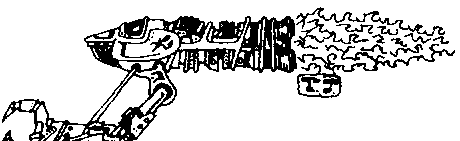
A. Mark Ratner now gives a review of Space Marines (not the later effort by Games Workshop), a game which he designed. Apparently it is a modified Tractics which owes something to Starguard. I wish that meant something to me. What did I learn about Space Marines from this article? Well, it has things like Nuclear Damper Fields, Mekpurrs (inspired by the killer herbivores from Satan’s World by Anderson), canineoid, rauwoofs, hissss*st (based on The Time Mercenaries by Philip High) and Klackons. The article has many rules ideas and additions for the game – mostly involving air combat and underwater combat. Makes it sound like a cool game.

J. Ward offers up a review of Nomad Gods. Unfortunately, this is another game I haven’t played or read, so I can’t comment much about it. Likewise with Tony Watson’s review of Cosmic Encounter.

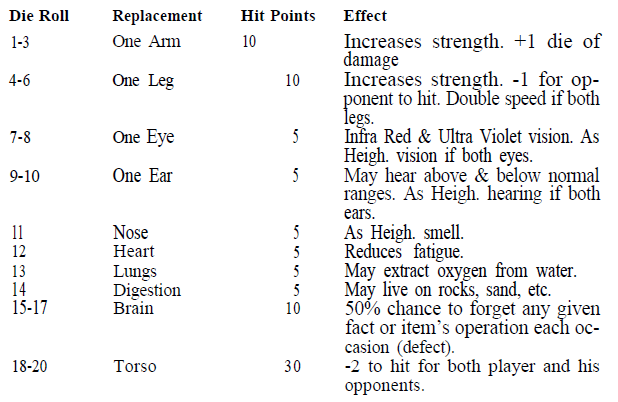
Barton Stano and Jim Ward present Robots as Players in Metamorphosis Alpha. This one gets down into it, giving players structure points (115) and power points (100) to spend on propulsion, computer units, armor and various physical devices like quills, lead shielding and grasping claws. While this seems like a logical way to handle robots, it also stands as a preview of where RPG’s were going in terms of character building.

Michael McCrery now presents Excerpt From an Interview With a Rust Monster. Apparently this hinges on an NPC who was polymorphed into a rust monster, and now sometimes shows up as a wandering monster in McCrery’s dungeon.

Cool miniatures ad for spaceships …

Five sizes for each, which brings to my mind the ship sizes I used in Space Princess – starfighter, shuttle, corvette, star cruiser and dreadnaught. For their part, the ships are Galactic Dreadnaughts, Galactic Attack Carriers, Galactic Battlecruisers, Stellar Cruisers and Stellar Destroyers. OK – their names are better – I’ll give them that.

Gygax writes From the Sorcerer’s Scroll on D&D Relationships, the Parts and the Whole. This one gets into the edition mess that was forthcoming for TSR – i.e. what is the “Basic Set”, will the Original game be around much longer and what is Advanced D&D.

James Ward pops in now with Monty Haul and His Friends at Play. This appears to be a satirical piece about the folks at TSR. I dug the accompanying art:

And now, a peeved letter to the editor about the Cthulhu Mythos from the February issue. This is classic geek one-ups-manship at its finest, for example:

“First, the Elder Gods, after they defeated the Great Old Ones, stripped Azathoth of a lot of his power, so his hits should be lowered to 200 to 225.”

“If you’re wondering who is number one — YOG-SHOTHOTH his hits should be raised to 400. You can say that is rather powerful; you’re damn right. The Great Old Ones are so powerful, that the total power of the Elder Gods could not destroy them; only imprison them.”

“These may seem trivial, but if Howard Phillips Lovecraft, Augest Derleth, or Robert Howard saw your use, they’d roll over in their graves not once but at least ten times.”

Another one from James WardThe Total Person in Metamorphosis Alpha. This is a set of random tables for determining a character’s background. I always think these are most useful for Referees working out NPC’s.

Next we have an ogre fight in Wormy and Fineous Fingers being offered up as a sacrifice for a dark knight.

Gregory Rihn writes Lycanthropy – The Progress of the Disease. You can tell D&D is getting more advanced now and a little less free-wheeling for some folks in 1978. I dig this paragraph:

“A low-level werebear who takes six rounds to change fully would fight as follows: round one, normal level; round two, level minus two; round three, level minus four; round four, bear minus four; (claws and teeth have reached minimal offensive effectiveness) round five, bear minus two; round six, normal bear ability. Of course somewhere in here he has to shed his clothes.”

I like the idea of a lycanthrope changing during the course of a battle. The article includes a level table, which I would think was for adjudicating lycanthropes with class levels in the game – it has columns for “Changes Per Day”, “Chance of Involuntary Changes”, “Time Required for Change” and such – except it also has XP for each level. I guess it makes sense – XP determine one’s “lycanthrope level” separately from one’s normal class level.

And that’s it for #14. A few good bits in this one, but not my favorite issue. Even though I don’t always get much use for the articles in these issues, I still find the environment of gaming inspiration in these magazines. Well worth reading, especially for folks who have no grounding in the history of the game.

Dragon by Dragon – April 1978 (13)

Niall armors up like a barbarian!

Dragon #13 is a mixed bag. Mostly good, a little wasted space (in my opinion of course, one man’s waste is another man’s … hmmm, that’s not going to sound right … skip it). Let’s take a look, shall we …

Tim Kask starts off with his editorial spiel, noting that this is the first of the monthly Dragons. It is also the April Fool’s edition, which we’ll regret a little later on. Gencon moves this year from the Playboy Resort in Lake Geneva (the what in where?) to the campus of the University of Wisconsin-Parkside in Kenosha – they needed more room. TSR Periodicals is also planning a move to a bigger building.

Shlump Da Orc (I’m guessing that’s a nom de plume) produces a surprisingly long article on figuring out how heavy giants are and how much they can lift. In fact, it is multiple efforts to answer this pressing question (one of the ones that suggests to me D&D was already beginning the process of moving from practice to theory with some folks). One formula explains that a 30-ft. tall giant should weigh 11.75 tons, have a 16′ 9″ chest and an 8′ long torso. Would you care for the semi-official weight formula?

Anyhow … the bit on how much a giant could pick up is a bit more interesting, if for no other reason than because of the following assumptions they use about the average human:

The average person can:

1) Carry his full weight on his back
2) Hold in his arms 3/4 of his weight – dead weight that is balanceable
3) With difficulty pick up half his body weight in dead weight
4) With difficulty pick up half his body weight in a struggling animal
5) With mild difficulty pick up 1/4 of his body weight a struggling animal with two hands
6) Fairly easily pick up 1/4 of his body weight in one hand of dead weight, balanced and somewhat symmetrical

Maybe these guidelines will prove useful to you one day.

The other useful bit is the weight (pounds per cubic foot) of various substances, such as:

Aluminum: 170 pounds
Brass, Forging: 525 pounds
Copper: 560 pounds
Iron, Malleable: 450 pounds
Gold: 1,205 pounds
Platinum: 1,340 pounds
Silver: 655 pounds
Steel, Cold Rolled: 500 pounds

Agate: 160 pounds
Beeswax: 60 pounds
Bone: 110 pounds
Diamond: 200 pounds

etc.

This one actually came in quite handy for something I was just writing for NOD, and definitely will be transcribed into an Excel document for future use in my writing. Thanks 30-year old Dragon!

Rob Kuntz now treads into dangerous territory with Tolkien in Dungeons & Dragons. I’m not sure if this was pre- or post-lawsuit. This one is an official pronouncement on the “position on D&D in conjunction with other worlds of fantasy which influenced it conception and specifically to clear up the fallacious beliefs regarding Tolkien’s fantasy as the only fantasy which inspired D&D”

The article mostly boils down to “D&D does not simulate Middle Earth, nor is it intended to, so please stop your nerd-whining”. This continues to be a problem in gaming, primarily in that many people forget that these are games, which by design are about allocating scarce resources to achieve victory (which, actually, is also what life is about), and not make-believe sessions in which whatever you want to happen does.

More interesting than this article is the inset by Brian Blume The Bionic Supplement for Metamorphosis Alpha. Bonzer! Random dice roll to replace your parts with bionic bits, and what those bits do. Totally worth reproducing in its entirety:

Jon Pickens is in next with an equally awesome article – D&D Option: Demon Generation. We begin with a kick-ass piece of art …

The article gives a way to generate additional “Types” of demons, with the following assumptions – all demons have Hit Dice and Gate ability appropriate to their level, all of Level III or less are vulnerable to normal weapons, the rest being vulnerable only to magical weapons, Magic Resistance 50% at Level I, increasing by 5% per level thereafter and special abilities based on the demon’s level. The powers are divided into 6 levels, and frankly, this looks like a blueprint for a demon class. I won’t reproduce it all, but worth checking out.

Jerome Arkenberg now presents the Japanese Mythos for D&D – again, very extensive article on the gods, goddesses, monsters and heroes of Japanese myth and legend, though the info on each god/demon/hero is pretty light. If you want a super rules-lite version of D&D, imagine if all you knew about a character was his Armor Class, Hit Points, Movement Rate, Magic Ability (i.e. level of magic-user or cleric), Fighter Ability and Psionic Ability.

Up next is the April Fool’s bit – a couple pages of song parodies. The less said the better.

Tim Kask now presents WARLORD: Correcting a Few Flaws. Since I know nothing about the game, I won’t comment on the article. Sounds like a fun game, though.

Gardner F. Fox now presents The Stolen Sacrifice, another adventure of Niall of the Far Travels (not to be confused with Niall of the Just Running to the Corner for Ice).

“The man moved silently through the shadows, keeping always to the darkest places. He moved as an animal might, his body poised for instant action, a big hand on the hilt of the longsword by his side. His eyes darted from a doorway to the far corner, where the wind blew a length of scarlet silk hanging from the wall. Caution was in his great body, for he knew that should he be seen this night, death would be his reward.”

Fineous Fingers finds out that just walking up to an evil wizard’s stronghold is stupid …

Yeah, you hate him, but DM’s love him. Meanwhile, Wormy introduces barbecued dwarf burgers.

We round it out with James Ward explaining a few tricks for adventurers – the kind of things that remind you that, at least back in the day, it really was a game, meant to be played and the rules exploited.

That’s it for #13. All in all a pretty useful issue, and especially good if you enjoy Gardner Fox.