Here are my latest attempts at making something I don’t hate …

Here are my latest attempts at making something I don’t hate …

I’m currently working on the monsters for my Pars Fortuna project. Here’s a quick preview of the monsters (by challenge rating) I’ve statted up.
BEASTS
1 – Hraeth: Giant ravens.
1 – Hrogo: Leaping lampreys.
1 – Moggie: Giant cats.
2 – Giant Snail: Main meat animal of Fortuna’s Wheel.
3 – Arakhun: Raccoons the size of black bears.
3 – Dol: Pack dogs the size of mules.
3 – Haloot: Large, quadrupedal, wingless owls.
3 – Maimun: Giant monkeys.
3 – Olph: Carnivorous, predatory sheep.
3 – Topi: Cross between and octopus and spider; live on land and in the sea.
3 – Woin: Bat-winged wolverines.
3 – Xerg: Foxes the size of leopards.
4 – Armadillox: Giant armadillos used like oxen by the natives of Fortuna’s Wheel.
4 – Gangarou: Giant, carnivorous kangaroos that hunt the savanna.
4 – Hhai: Winged cougars.
4 – Jumart: Like a cross between a horse and bull.
4 – Peca: Like feline baboons.
5 – Onkeyn: Swift, horse-sized rhinos with long legs.
6 – Bebb: Giant herbivorous bears with massive heads and long beards.
6 – Orpo: Giant swine who live in rivers and lakes.
6 – Urleel: Cross between a moray eel and sea turtle.
7 – Giant Gulper Eel: Google them.
8 – Giant Mantis: Stalk the jungles.
8 – Mursa: Cross between a walrus and polar bear.
9 – Opur: Penguins the size of killer whales.
9 – Rho: Giant lynx with a large horn jutting from its forehead.
11 – Tragelph: Giant, elephantine goats, kept for their wool but hard to control.
12 – Criniger: Sleek, fur-bearing whales with massive tusks.
12 – Lhee: Beetles the size of elephants, and used by the natives of Fortuna’s Wheel in much the same way.
12 – Snee: Giant terrestrial eels that constrict and send out electrical shocks.
17 – Singawale: Stingrays the size of whales.
20 – Aiwhah: Catfish the size of whales.
CONSTRUCTS
B – Mercurial: Rats composed of mercury with poisonous bites.
2 – Moonmaid: Tiny figurines carved from moonstone, powers reminiscent of Circe.
2 – Revenant: Animated corpses.
3 – Retriever: Clockwork dogs.
3 – Skeloid, Lesser: Skeletons bound in silver wire with wooden raven head. Absorbs spells.
4 – Ningyo: Guardian puppets with gaze attacks.
5 – Abominid: Spider creatures stitched together from amputated limbs.
5-10 – Imposter: Statues sent to kill their living doubles.
6 – Deruu: Tree women.
6 – Iconogryph: Alabaster vultures created as temple guardians.
6 – Skeloid, Greater: Skeletons bound in gold wire with wooden hawk head. Absorbs spells.
7 – Gongthrottle: Bronze gorillas animated by wrath.
8 – Fulminator: Lightning men.
14 – Sanctus: Images of saints carved in green stone.
FOLK
A – Nizzertit: Slimy, stunted goblins.
B – Nurg: Short, stout savages
1 – Cakrol: Pangolin warriors.
1 – Ilel: Cloned warriors.
1 – Nif: Wasp women.
1 – Nine: Quick, furry humanoids who live in swamps.
1 – Oraenca: Stout warriors with iron bones.
1 – Skathra: Antelope centaurs.
1 – Tachi: Ape warrior.
1 – Vindlu: Scaled lion.
2 – Caledjula: Flying tricksters.
2 – Jae: Mounds of tricky kelp.
2 – Kyssai: Ethereal scouts.
2 – Olvugai: Tentacled warriors.
3 – Bo’al: Tall, burly humanoids.
3 – Hamazak: Amazon warriors.
3 – Qward: Stocky feline nomads.
3 – Zimbad: Reptilian flyers.
MAGICAL FOLK
B – Tomb Robber: Grey men who burrow into graveyards.
1 – Osk: Golden skinned smiths with pointy teeth.
1 – Ouph, Black: Subterranean fairies who consume hallucinatory mushrooms.
2 – Meagle: Stunted pixies who summon demons.
2 – Zwunker: Swarthy dwarfs with golden hair, negate magic by their presence.
4 – Ouph, White: Pious sculptors.
6 – Ingala: Amazonian nymphs of the rain forest.
8 – Ouph, Blue: Berserk zealots.
MONSTERS
B – Jeyah: Like furry, giant geckos who produce psychic static.
B – Sand Rat: Scaled rats the color of sand.
1 – Dreak: Voracious giant polliwogs.
1 – Vazin: Sinuous lizards who give off electric shocks.
2 – Byn: Siren lizards.
4 – Frosseleth: Woodland carnosaurs.
4 – Palasm: Victims of a disease that become faceless baboons that blend with shadows.
5 – Meerskin: Giant weasels with emerald eyes; surrounded by a miasmic yellow cloud.
5 – Nanc: Copper-furred capybaras with scorpion tails.
5 – Tharp: Swarms of steel-gray wasps; their stings cause hemorrhaging.
6 – Isaelen: Titanic beasts who simply shift from the ethereal plane to capture creatures in its stomach.
6 – Rhuup: Portly, furred humanoid tigers; swallow people whole.
7 – Aeloll: Arachnid horrors with legs that end in noose-like loops.
7 – Kruk: Four-armed ogres who trade in flesh.
8 – Idekel: Cross between an alligator and boa constrictor; uses illusions to look like dead wood.
SPIRITS
X – Demonic Beast: Template for altering beasts.
X – Elemental: Templates for altering beasts.
X – Tabib: People possessed by feral spirits.
7 – Volp: Crystalline wolves who spread rage, cause misfortune.
8 – Nokt: Green, five-headed crows who spread misery and desperation.
6 – Fiend: Lesser demons with variable abilities.
9 – Haunt: Ghostly creatures with a touch of death.
9 – Nature Spirit: Humanoid spirits composed of natural materials.
10 – Greater Fiend: More powerful demons with more abilities.
10 – Lunarch: Amorphous, silvery bears with spider eyes; serve the Moon Goddess, cause madness.
15-18 – Archfiend: Most powerful demons.

Basic sets are a well-regarded bit of nostalgia in fantasy gaming and apparently are making a comeback in the modern iteration of Dungeons and Dragons. They also happen to be an excellent way to introduce a game to new players!
It occurred to me that I could create a “basic rulebook” for my little game experiment, Pars Fortuna that would cover levels 1 through 4, four of the twelve playable races, a nice assortment of monsters (low level and mid-level) and magic items, all the cantraps (level 1 to 3 spells), all the basic rules needed for play, a dungeon adventure and all the bits of advice I can muster. My goal would be to present this item as a free download and for sale “at cost” on Lulu.com, to be followed by the full game at normal prices (I don’t know how long it is going to be, so I don’t know how much it will cost yet). The full “Expert Rules” will include all 12 playable races, spells and monsters, and would include a sandbox along with deeper levels of the dungeon in the basic rules.
I’d love some feedback to whether this seems to be a good idea or just a silly gimmick. Let me know what you think!
So, part of my concept for PARS FORTUNA is introducing alternate rules. While the RPG will contain the old tried-and-true Vancian system for those who love it, the assumed magic system for the game is something different.
The Spell Interval System
The Spell Interval system assumes that casting spells involves gathering eldritch energies and then releasing them, with the words, gestures and tools that are involved shaping that “energy” to produce the desired effect. The more powerful a spell, the more energy it takes – i.e. the higher the level of the spell, the longer it takes for the magician’s body (and soul?) to absorb the needed energy to power the spell.
The spell level intervals are as follows: Each hour, you may cast one first level spell; each day you may cast one second level spell; each week you may cast one third level spell; each month one fourth level spell; each year one spell each of the sixth, seventh eighth and ninth levels.
Naturally, the average magician will not be satisfied with these restrictions, and will seek a way around them. Magicians can attempt to cast spells over and beyond what is allowed, but doing so can be dangerous. When a spell-caster wishes to cast additional spells of a level, he must make a saving throw, subtracting the level of the spell he wishes to cast from his roll. If successful, he channels and masters the energies necessary and casts the desired spell. If he fails, he must face the consequences, which include mental and physical deformities and supernatural curses. The more powerful the spell a magicians fails to cast, the more potentially disastrous the consequences!
Magical Tools
I’ve always enjoyed the idea of magicians carrying all sorts of odd objects and materials in order to work their art. Advanced versions of our favorite game have included material components for years, and they are often ignored because they are difficult to track. PARS FORTUNA uses a similar concept, as follows:
Level 1 to 3 spells are classified as “Cantraps” and require a fetish to cast. Each spell requires a different sort of fetish, and the fetish is not consumed in casting the spell – it is merely a cheap tool, composed of ordinary, mundane objects, that the magician must hold in his hand to successfully shape his magical energies into a spell.
Level 4 to 6 spells are classified as “Invocations” and require a tool (or set of tools) to cast. These tools are more expensive than the fetishes required by cantraps, and include arthames (mystic knives), censers and wands.
Level 7 to 9 spells are classified as “Rituals” and require expensive gems to cast. Unlike the fetishes and tools, these gems are consumed during the casting of the spell.
Sample Cantraps
Irritation (Cantrap)
Spell Level: 1
Range: 30 ft.
Duration: 1d4 rounds
Focus: Leaves from poison ivy, oak or sumac tied into a bundle with twine
You cover the target’s body in an itching sensation that lasts 1d4 rounds. For the duration, the target takes a –1 penalty on attack rolls, damage rolls and saving throws, and suffers a –1 penalty to its Armor Class if it fails a saving throw. The creature can scratch, negating the penalties for that round. Creatures that have thick hides are immune to this version of irritation.
Pitch Sight (Cantrap)
Spell Level: 2
Range: 30 ft.
Duration: 1 minute per level
Focus: A small piece of phosphorescent lichen held tightly in right fist
The caster and her allies can see normally through normal and magical darkness.
Curse of Light (Cantrap)
Spell Level: 3
Range: Touch
Duration: 1 hour/level
Focus: A tiny sack of phosphorus
You make the subject extremely sensitive to light. Abrupt exposure to bright light blinds the subject for 1d4 rounds. On subsequent rounds, they suffer a –1 penalty to all attack, damage and saving throw rolls.
Sample Invocations
Exorcise (Invocation)
Spell Level: 4
Range: 10 ft.
Duration: Instantaneous
Tool: Bolline (sickle) swung over the target’s head
You negate possession of a creature or object by any force. When you cast this spell, the possessing force may make a saving throw to resist you. If unsuccessful, the possessing creature is ejected from the host and stunned for one round. A creature affected by this spell cannot attempt to possess the same host for one day.
If cast against disembodied spirits, the spell forces those spirits to make a saving throw or flee away from the magician and keep at least 30 feet away for 1 hour.
Ghost Walk (Invocation)
Spell Level: 5
Range: Personal
Duration: 1 minute/level
Tool: Amulet set with a mirror
You become incorporeal, similar to a ghost. While ethereal, other ethereal creatures can harm you, as well as material creatures that use magic weapons and spells. You are immune to all non-magical attack forms, are not burned by normal fires, and are unaffected by natural cold or harmed by mundane acids.
You can move in any direction (including up or down) at will and with perfect maneuverability. You do not need to walk on the ground. You can pass through solid objects at will, although you cannot see when your eyes are within solid matter.
You are inaudible unless you decide to make noise. You pass through and operate in water as easily as you do in air. You cannot fall or take falling damage. You have no weight and do not set off traps that are triggered by weight. You do not leave footprints, have no scent and make no noise.
Your physical attacks are ineffectual against material creatures. Your spells affect material creatures normally.
Gem Guard (Invocation)
Spell Level: 6
Range: See text
Duration: 1 hour per level
Tool: Athame, used to split the focus gem
You transform a gem into a scrying device. When the spell is cast, the two halves of a corundum worth at least 1,000 gp become linked. When you hold one, you may scry on the other at will. You can see everything within 50 ft. of the other half. Any creature with at least a 12 intelligence has a 1-2 on 1d6 chance of sensing your attention. Spells may be cast freely through the linking gem, and may target any creature within its sensor range. Area effect spells may damage the other half of the focus, which has 30 hit points.
Sample Rituals
Infinite Step (Ritual)
Spell Level: 7
Range: Sight
Duration: Instantaneous
Gem: Jacinth (50 gp)
You (with one other willing party) instantly transfer yourself from your current location to any other spot within sight. At 12th level, the magician may make a second step from the destination.
Edge of Oblivion (Ritual)
Spell Level: 8
Range: 60 ft.
Duration: Instantaneous
Gem: Onyx (100 gp)
This spell assaults the mind and body of the subject. The subject must make two saving throws, one boosted by any wisdom bonus the creature enjoys, the other by any constitution bonus. If the subject fails the wisdom saving throw, the spell deals 1d6 permanent ability damage to the target’s intelligence, wisdom or charisma, determined randomly. If the subject fails the constitution saving throw, the spell deals 1d6 permanent ability damage to the target’s strength, dexterity or constitution, determined randomly. The caster is stunned for one round following the casting of this spell.
Prismatic Helix (Ritual)
Spell Level: 9
Range: 60 ft.
Duration: 10 minutes per level
Gem: Opal (500 gp)
The visible effect of the prismatic helix is a stationary, slowly rotating, seven strand helix, one for each color in the spectrum. This helix is 5 feet in diameter and up to 20 feet high. Any creature of 8 HD or less that looks at the helix from less than 60 feet away is fascinated, unable to do anything but stare at the helix. There is no limit to the number of creatures that can be captivated in this manner.
Once per round, the helix shoots one ray at the nearest creature, using the magician’s attack bonus. Roll randomly on the table below for the effect.
1. Red: 2d6 points of fire damage
2. Orange: 4d6 points of acid damage
3. Yellow: 8d6 points of electricity damage
4. Green: Poison (save or die)
5. Blue: Turned to stone
6. Indigo: Stark, raving mad
7. Violet: Sent to another dimension
8. Struck by two rays, roll twice, ignore any “8”
Individual strands are destroyed by opposite effects (as determined by the Referee). If a particular color has been destroyed, and that color is rolled for a ray attack, re-roll until a valid color is selected.
These are the final four playable races populating the world of PARS FORTUNA. My next task will be to preview some aspects of magic and a few of the spells.

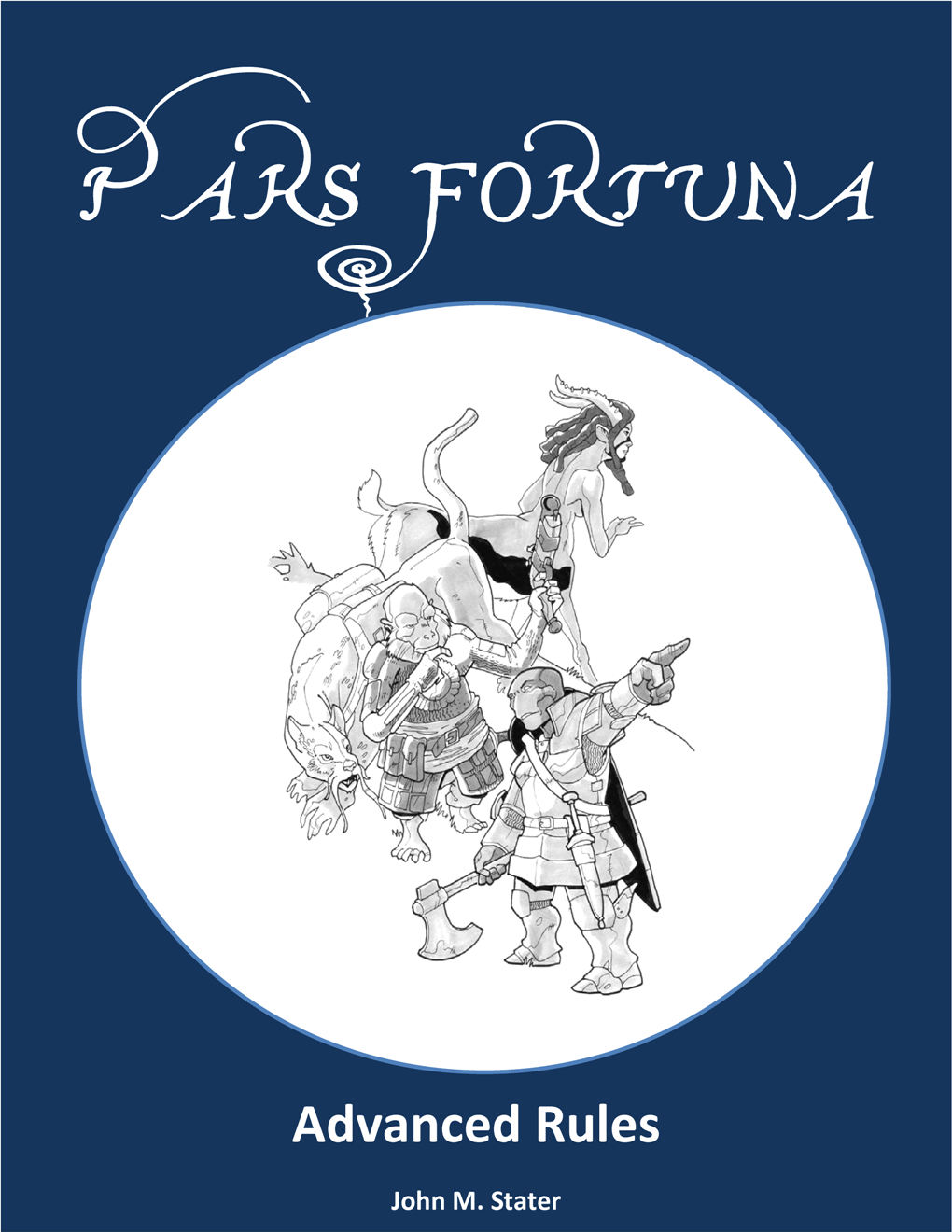
The attractive quadruped on the crest of the hill is a Skathra. The Skathra look like centaurs with the lower bodies of antelopes and spiral horns atop their heads. They have light brown skin and darker, auburn fur with black markings on their faces and sides. A skathra stands about 5 feet tall from hooves to head. They are wise, though sometimes confounding, creatures who dwell in the wild, green hills. Skathra have a natural wanderlust, and a desire to see everything there is to see before they die.
In game terms, Skathra are one of our magic-using classes. They combine their magical abilities with a talent for archery, lightning quick reflexes, survival skills and a knack for divinatory magic.
Slinking down the hill next to the Skathra is a Vindlu. Vindlu resemble long, thin lions covered in scales of silver tipped with aquamarine. They have long “whiskers” like those of a carp. These whiskers are extremely sensitive, making vindlu difficult to surprise and allowing them some insights into the emotions of others. Their four legs end in clawed hands. Outside their home city, they live in tight-knit family bands, hiring themselves out as “problem solvers”.
In game terms, Vindlu are one of our skill classes. Vindlu are stalkers and pouncers, and have a talent for avoiding traps and getting into places they are not wanted.
In the middle of the group is a Tachi. The Tachi are intelligent macaques who live in lattice-work cities on the thickly forested southern coasts, west of the lands of the Cakrol (and often in competition with them). The Tachi are merchants, moneylenders and bankers extraordinaire, and are always looking for a new path to riches.
Tachi are another skill class. They can literally smell gold and silver, and couple their natural proclivity for finding treasure with a head for business and a silver tongue. Tachi make natural spokespersons for adventuring parties in PARS FORTUNA.
And so we come to the last of the races of PARS FORTUNA – the Oraenca. The Oraenca are a race of stout, heavy warriors with skin like scarlet sandpaper and bones of iron. They measure four to five feet in height and are broad and muscular. Oraenca have flat faces, golden eyes, nose holes set high in their faces and broad mouths filled with chisel-like teeth. They are egg-layers and amphibious, having evolved in a shallow sea that is now a dry, salty wasteland. Exiled from their homeland, they found a home in the Empire of Vex, and have served as the foot soldiers for that empire and its Ilel rulers, for generations.
Oraenca are the heavy warriors of the game – they can use any kind of weapon and armor, and their fighting skills are primarily defensive – they gain an increased bonus with shields and can apply that bonus to a nearby comrade. Unfortunately, they are natural followers, and suffer a penalty when saving against mind-control effects.
And there you have it, the race of PARS FORTUNA – from slightly different to what-the-heck!
I was thinking yesterday about the PARS FORTUNA stuff – mostly developing the race/classes and the idea of knacks and skills hit me. Nothing ground breaking, but they go like this …
TASKS, KNACKS & SKILLS
When playing a game of PARS FORTUNA, there is no limit to what your character can try to do. Please note that trying to do something and actually doing it are two different things. Many tasks a character attempts are easily accomplished and do not require you to dice for the results. In simple terms, if the average person could do it, your character can do it.
However, some tasks require above-average physical or mental abilities, or years of training to have a chance of succeeding – breaking down a bolted door, deciphering a lost language or climbing a sheer wall, for example. When a player wishes his character to attempt a task such as this, this game assumes that they have a 1 in 6 chance of success – in other words, the player throws 1d6 and, if they roll a “1”, they succeed. This translates into a slim (17%) chance of success, so Referee’s should only use this mechanic if the task the character wishes to undertake has a high probability of failure.
A high ability score (15+) in a relevant ability can extend this chance by +1 (to 1-2 on 1d6) if the Referee permits it. Referees might want to give other bonuses based on the situation and any clever ideas a player might have for improving his chances.
Some races have a knack for certain tasks, usually because of their physical or mental make-up. If a racial description notes a “knack”, for something, that race accomplishes it on a roll of 1-2 on 1d6. Oraenca, for example, are stout and solidly built, and have a knack for busting down doors.
Some classes put a portion of their training into mastering certain tasks – the Kyssai, for example, train to move about silently. When presented with a task encompassed by one of their skills, a character’s success or failure is determined by rolling a saving throw. In this way, the character becomes more likely to succeed at that task as he rises in levels. For example, to successfully sneak past some tower guards, a 1st level Kyssai must roll a 15-20 on 1d20 (i.e. a 30% chance of success), while a 10th level Kyssai would have to roll a 6-20 (a 75% chance of success).
To sum up, any character has a 1 in 6 chance of succeeding at a difficult task. Characters with a knack for something have a 2 in 6 chance of success. Characters who are skilled at a task roll a saving throw to determine success or failure.
—
I’d love to know what people think of this basic system for non-combat task resolution.
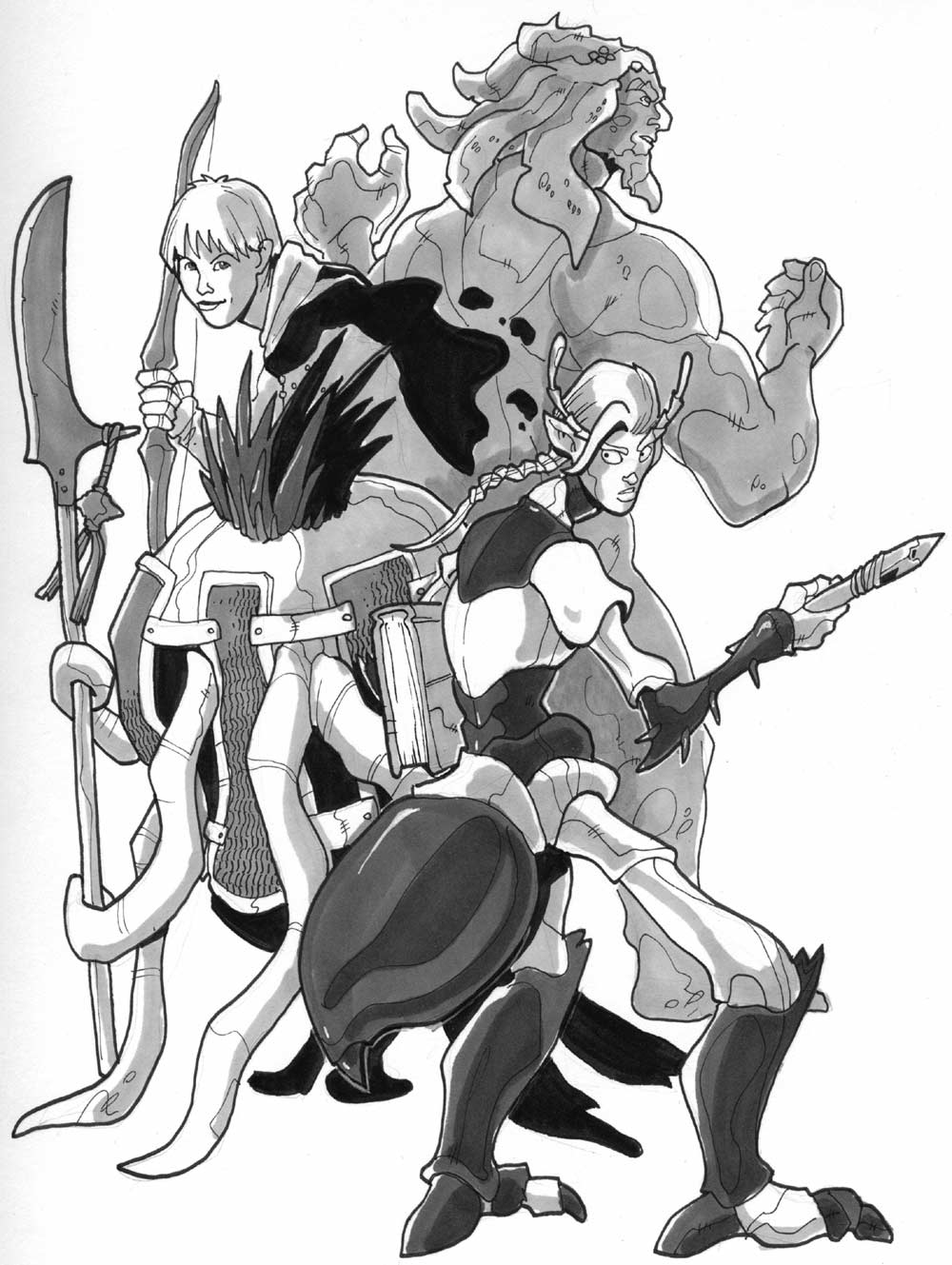
Four more of the strange races in the PARS FORTUNA setting …
In the back of the pack we have a JAE. The Jae are clumps of walking vegetation that can assume a humanoid form by wrapping themselves around a skeleton of wood or metal. They use their morphic form and a little magic to make themselves appear to be members of other races – or even a person’s close friends or family. In their real form, the so-called kelpies can detach from their skeletons and move about almost like oozes – fitting into tight spaces and such. They are natural charlatans.
Jae are another spell casting race, with the added abilities of impersonating people and crawling around like an ooze when it suits them. They can communicate with plants.
Next to the Jae is a KYSSAI, also known as a ghost. The Kyssai are happy anarchists who view bodies of solid matter as prisons. Kyssai are capable of becoming ethereal for short periods, and are generally sneaky sorts. In the game setting, they are wanderers who pick up all sorts of useful information that a Referee might wish to introduce into game. They are the only race besides the Oraenca (see next preview) who can tolerate the Ilel – mostly for the spectacle.
Kyssai are another skill class, this time working as spies and scouts. They are good at sneaking about and surprising others and their power to become ethereal helps them infiltrate areas and escape with their lives. They are, alas, a bit emotionally stunted and have difficulty forming close relationships.
The bizarre creature that looks like a tentacled potato is an OLVUGAI. The Olvugai are nicknamed the visitors by the other races. They are, in fact, alien visitors to the setting, stranded on the strange world (dimension?) of PARS FORTUNA and dedicated to unraveling its mysteries.
Olvugai are a race of scholarly warriors. They are capable of attacking opponent in front and behind at the same time, and they are capable of becoming invisible for short periods of time. Olvugai have a knack for logical thinking and are skilled as sages.
In the foreground, we have a NIF, or wasp-woman. The Nif are the female counterparts to a mindless race of drones called the Nef. They dwell in hive-cities in the Cinnabar Flats, a desert of poisonous mineral springs. Each Nif belongs to a brood of sisters. The broods serve their queen mother and dote on their over-protective (and sentient) fathers until they get the call to strike out on their own. Nif have honey-colored carapaces marked with black patterns that they share with their brood-sisters.
The Nif are our third magic-using class. Their carapaces make them slightly more durable than the Caledjula and their talents run to elemental spells rather than illusions. Nif are resistant to poisons and acids, have thick carapaces and a knack for chemistry.
—
Our last preview of the races of PARS FORTUNA will appear next week, and include fire-loving lions, mercantile monkeys, wise antelope-centaurs and creatures with bones of steel.

A month back I hired Jon Ascher, a gentleman known on DeviantArt as Pachycrocuta, to draw the odd, randomly generated races that populate the world of PARS FORTUNA, and boy did he knock it out of the park. I had him draw the races in groups of 4 (there are 12 total) and have now received the inked drawings and want to share them with everyone, along with some brief descriptions of the races, how they will be presented in the game and where they fit into the rules and setting.
The tall “gentleman” is a BO’AL. The bo’al are a race of hermaphrodites with bluish-green to deep green waxy skin reminiscent of the skin of a dolphin. In the setting, they dwell on a wide prairie bisected by a great river and crisscrossed with hundreds of canals, locks and irrigated fields. Nicknamed the engineers, they are taught from a young age the disciplines of mathematics, physics and architecture. Bo’al respect hard work and personal liberty – they’re happy to come together for a cause, but dislike the concept of kings. They are usually jovial sorts, and intensely curious about how things work.
In game terms, bo’al are one of the “skill” classes – and by this, I mean you tend to have three sorts of classes in class-based games – the fighting classes (good attack bonus, best hit dice, worst saving throws), the magic classes (spells, low attack bonus, low hit points, good saving throws) and the skill classes, which muddle about in the middle. The bo’al get a bonus to detect sloping passages, sliding walls, secret doors and large, room-sized traps (most folk do it on a 1 in 6, they do it on a 2 in 6), as befits their skill in engineering. They also have some skill at disabling traps, setting traps and repairing damaged items. Adding to their usefulness, they can withstand a pretty good amount of damage – they get an extra hit dice at 1st level and can regenerate some damage after each battle. So, the bo’al is a skill class with a nod towards combat.
At the center of the group is an ILEL, nicknamed the imperials. The ilel are a race of clones – copies of a former marshal of the Empire of Vex grown in vats to form a personal guard for the emperor. They have skin the color of burnished gold, hair as black as night, solid black eyes and a well developed sense of megalomania – probably why they now run the empire they were hired to protect. Ilel are accomplished swordsmen, specializing in fighting with broadsword and a wavy-bladed dagger called a kris. They are haughty and arrogant, often treating their comrades as henchmen, and if not for their ability to cut a path of red ruin through their enemies, they wouldn’t be tolerated.
The ilel is a fighting class. They are mobile fighters, so less armor but a boost in initiative. They also have some bonuses when fighting with two weapons (higher bonus to hit and the ability to trade their bonus to hit for a bonus to AC round by round). Because of their commanding attitude (and admitted skill at command) they improve the fighting-ability of their henchmen (no, not the other player characters, even if the ilel treats them like henchmen) and can have one henchman more than their charisma score would normally allow.
Next to the ilel is a CALEDJULA. The caledjula’s claim to fame is their ability to fly without the need of wings. Caledjula have tawny to reddish fur, pupil less white eyes, huge ears and six fingers on each hand. Caledjula are natural tricksters, having an inborn ability to generate illusions. In the game setting, they dwell in the tall mountains that surround Fortuna’s Spire (the literal “tent-pole” dungeon of the setting) in cliff dwellings. They are nicknamed the aeolians.
Caledjula are one of the magic race/classes in the setting, filling the role of a trickster class. All of the spell casters in PARS FORTUNA use the same spell list (126 spells, level 1 to 9), but each magical race gets a small list of spells open only to them – illusions in the case of the caledjula. The caledjula can also work on people’s emotions with their deep, melodic voices (i.e. a bonus to reaction checks) and they have a bat-like radar sense that lets them operate in complete darkness.
Finally, the little scaly bugger is a CAKROL. The cakrol resemble humanoid pangolins. Nicknamed zealots, cakrol are devoutly religious folk who live in little villages on a lush peninsula covered by rain forest. They make their way harvesting tropical crops, carving wooden idols, trading in beautifully crafted sailing barques and doing their best to protect themselves from the evil spirits that infest their homeland. They are a clannish people, and possessed of a fearful anger when they feel their adopted clan / guild / adventuring band is being threatened.
Cakrol are primarily a fighting class – they have the good attack bonuses, the hit points and the ability to use any weapon. They come with their own armor, which can be supplemented. Adding to this, they have some ability to detect and repel evil spirits (not unlike a cleric’s turn undead ability) and the ability to go berserk in combat.
All of the races in PARS FORTUNA will be presented as races separate from classes, and as racial classes (the default for the setting). My hope is that even people not interested in playing a “PARS FORTUNA” are able to find something useful in the book for their own game.
Next Preview – A ghostly adventuress, a walking heap of kelp, something from beyond the stars and a waspy woman …
As I’ve mentioned before, I’m working on creating a set of rules based on Swords & Wizardry called PARS FORTUNATM. The gimmick is that the races, monsters and magic items are all based on things generated using a variety of online random generators. I’m also including a host of alternate rules – a different magic system, loads of spells adapted from non-traditional sources, etc. The idea is that the game will be playable as is, or could serve as a toolkit for those wishing to spice up their existing old school games. In the end, it may come to nothing, but its a fun experiment for me.
Here then is the first preview, a race/class called the Caledjula. This race has shown up on the LAND OF NOD blog before, but here has been turned into a class and refined somewhat. Of course, the most obvious take away from this preview is that I need to hire an actual artist to illustrate the game.
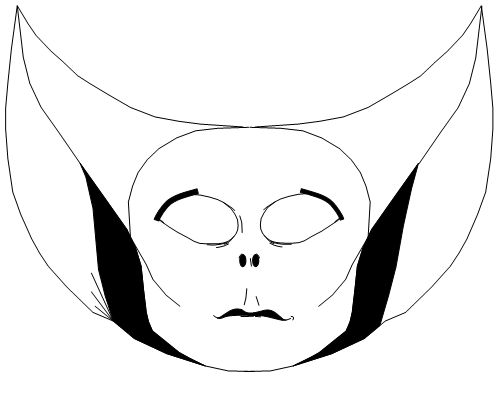
Caledjula (The Sky People)
Caledjula are tall, statuesque humanoids with angular bodies, reddish-orange skin and black hair. Their heads are shaped like sidewise crescents, the peaks being their over-sized ears. Their eyes are large and brightly colored. Their long arms end in hands with seven thin fingers.
Caledjula have a radar-like sense reminiscent of bats. They are capable of imitating all sorts of speech, and their pleasant, deep voices and calm demeanor make them excellent diplomats. Caledjula are natural illusionists, with an inborn talent for creating minor figments and phantasms. Most importantly, the caledjula can fly thanks to a strange and little understood gland in their brains.
The caledjula dwell in the mountains. They hire themselves out as heralds, orators and cryers, and often serve in the retinues of merchants and nobles. They indulge in multi-colored garments, always close-fitting and flamboyant.
Prime Attribute: Intelligence, 13+ (5% experience.)
Hit Dice: 1d6-1/level (Gains 1 hp/level after 9th.)
Armor/Shield Permitted: Shields.
Weapons Permitted: Club, dagger, dart.
Healing: The caledjula excel at the healing arts. Any creature given over to their long-term care heals an additional hit point each day and enjoys a +1 bonus to saving throws made to fight off disease. In addition, a caledjula with a healer’s kit has a 2 in 6 chance of neutralizing poisons and a 2 in 6 chance of restoring 1d4 hit points after a battle by applying first aid.
Magic: Caledjula can cast magic spells. See the section on Magic for more information about this powerful ability. In addition to the spells a caledjula can learn as a magician, all caledjula begin the game knowing one illusion that they can cast once per day. This spell is chosen from the following:
• Dazzling Lights: This spell creates a pattern of lights that dazzles all creatures of 1 HD or less within 10 feet, causing them to suffer a -1 penalty to hit in combat. Each creature is allowed a saving throw to avoid this.
• Ghost Sound: Ghost sound allows you to create a volume of sound that rises, recedes, approaches, or remains at a fixed place. You choose what type of sound ghost sound creates when casting it and cannot thereafter change the sound’s basic character.
• Prestidigitation: Once cast, this spell enables you to perform simple magical effects for 1 hour. A prestidigitation can slowly lift 1 pound of material. It can color, clean, or soil small items. It can chill, warm, or flavor 1 pound of nonliving matter. It can create small, crude, fragile objects that cannot be used as tools, weapons, or spell components.
• Smoke Image: This spell shapes existing smoke into any shape, creature or object the spellcaster can visualize. The image is composed entirely of smoke and if disturbed dissipates back into smoke.
• Ventriloquism: You can make your voice seem to issue from someplace else. Anyone who hears the sound and rolls a successful save recognizes it as illusory.
Radar: A caledjula’s radar sense allows them to fight without penalty in complete darkness. They cannot see in the dark, but they can navigate through pitch black halls and caverns without running into things.
Voices: Caledjula are natural mimics, and have a 3 in 6 chance of successfully imitating voices and sounds. The gregarious personalities and sonorous tenors of the caledjula make them natural public speakers. Caledjula enjoy a +1 reaction check bonus when parlaying with monsters and other folk.

Replaces the artwork – maybe a slight improvement?
After spending some time with a host of random generators, I’ve made a few decisions about Pars Fortuna …
First, the random classes were too random. I might go with race as class and use boons to let people tweak their characters in interesting ways. If I go race as class, I’ll probably aim for nine to twelve races.
I found a random kaiju generator and might use them as “god-beasts” – challenges for high-level characters.
Magic item categories are also taking shape. I might replace potions with herbals (the most common magic items found), then have Weapons, Armor, Weird Science, Staves, Jewelry and Clothing.
I’ll definitely introduce a random setting – at least a starting setting. I’m not sure how far I’ll go with it (since Nod gives me plenty of setting to write), but it might be a multi-cultural town surrounded by a variety of wilderness, some random encounter tables and maybe some simple adventure seeds or suggestions.
 Land of Nod