Dragon by Dragon – June 1981 (50)

Sometimes it’s hard to believe how long ago, in human terms, 1981 was. Of course, 35 years is a drop in the bucket in cosmic terms, but for a 44-year old man, it’s significant. Having a brain that absorbed the early ’80s one day at a time, it just doesn’t seem old, sometimes like it was just yesterday.

Enough of that. Dragon #50 came out 35 years ago this month, and here’s what the 5th anniversary issue has to offer.

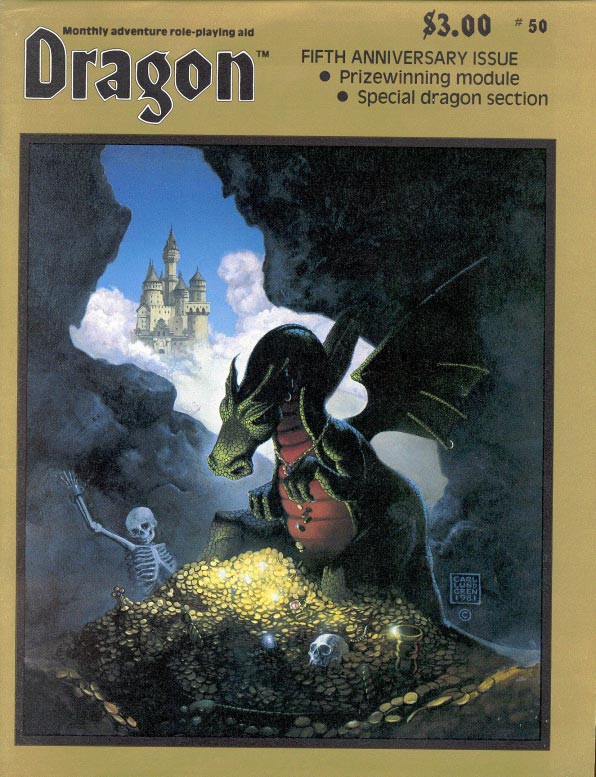
We begin, of course, with the cover by Carl Lundgren. Very nice piece of work, and certainly appropriate for the issue, depicting as it does a dragon hovering over its hoard of treasure (or it it the dragon’s hoard?)

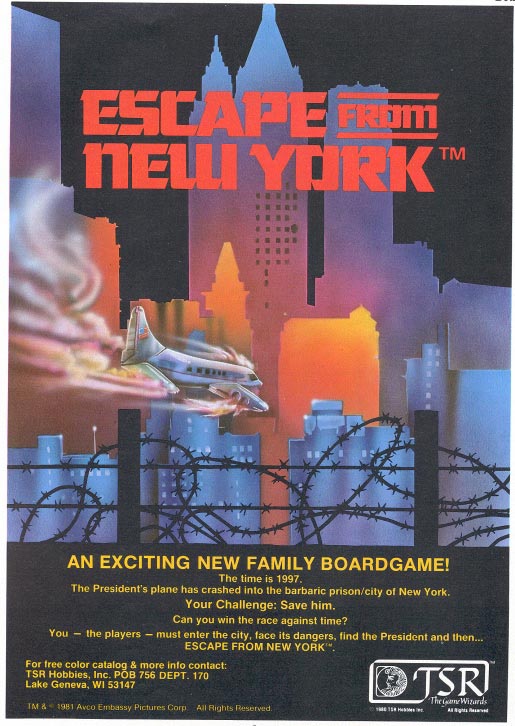
As I so often do, I’ll start with an advertisement for a new “family board game” by TSR …

I’m picturing those old game covers or ads from the 1960’s that show a smiling family playing a board game. Little Susie having to tell mom she’s “The Duke of New York – A-number-one!” I just watched the movie a couple days ago, so it’s fresh in my mind.

It should come as no surprise that they have a page for the game at Boardgamegeek.com.

The game was written by “Zeb” Cook, who also wrote the Expert D&D set.

Now that I’ve dispensed with TSR’s homage to Snake Plissken, let’s get to the first article in this anniversary spectacular – Gregory Rihn‘s “Self defense for dragons”. The article purports to give “everyone’s favorite foe a fighting chance”. The article posits that dragons, as they were written in 1981, were too easy to defeat by a large, well-organized party, especially given the treasure to be gained by defeating them. This would prove to be an important article to later editions of the game, for it expands the dragon’s attacks quite a bit, adding 2 wing buffets, 2 wing claws, a foot stomp and tail lash. In essence, it gives the dragons enough attacks to hit all the attackers likely to be surrounding it in a fight. He goes on to give a couple ideas for good dragon tactics.

This is followed up by Lewis Pulsipher‘s “True Dragons: Revamping the monster from head to claw”. It appears that the theme of this issue is that dragon’s just ain’t good enough. Pulsipher gives a long table with many more age categories and a few additional powers, including shapechanging (I like this one), causing terror and some special powers. One of them – two heads – I’m planning on adding to Blood & Treasure. It also has random tables of spells known, a random table of breath weapons, with the old standards as well as a few new ones – radiation, stoning, windstorm, hallucinogen, negate magic and polymorph. All goodies! Here’s Pulsipher’s take on radiation:

Those failing to roll a d20 lower than their constitution become unconscious and will die of a wasting “disease” in 1-4 days. The “disease” is cured by Cure disease and Remove curse. Effects of the disease are only slowly repaired by the body after the cure. A victim might look ravaged five years after his cure if he was near death, and this may affect his charisma.

Radiation as a curse. I dig it.

Overall, I think I like Pulsipher’s take better, using special powers instead of additional attacks to get the job done. Both would go into beefing up dragons in later editions.

Colleen A. Bishop hits on baby dragons with “Hatching is only the beginning …”, which covers little dragons from egg to birth. It’s a long article, with lots of tables. Maybe worth a look if you’re planning on having a baby dragon in the party for a while.

Robert Plamondon gets us off the dragon train and introduces some folks called the Kzinti. I don’t suppose they need much introduction to the folks who read this blog. They’re tough customers here, with 4+4 HD and two attacks per round. A small group could really bedevil a party, and they’re Lawful Evil to boot. The article covers their arrival on D&D campaign worlds, their religion, social organization, magic, psionics, etc. Very thorough for a monster entry, but no info on them as a playable race.

For those interested in the history of the hobby, David F. Nalle‘s reviews of some old time ‘zines may be of interest. He covers Abyss by Dave Nalle, Alarums & Excursions (such a great name) by Lee Gold, The Beholder by Mike G. Stoner, The Lords of Chaos by Nicolai Shapero, Morningstar by Phillip McGregor, Pandemonium by Robert Sacks, Quick Quincy Gazette by Howard Mahler, The Stormlord by Andreas Sarker, Trollcrusher, The Wild Hunt by Mark Swanson and Zeppelin.

Pulsipher has another article, a very long one with way more math than needed to deal with gaze attacks in D&D. Personally, I let people close their eyes entirely (and open themselves to all sorts of trouble), or try to avoid the monster’s gaze and suffer a penalty to hit, etc.

Larry DiTillio’s article on the glyphs in his campaign world didn’t do much for me.

The Chapel of Silence by Mollie Plants is a prize winning dungeon at IDDC II. It’s a relatively small dungeon, but looks like a good one. It begins with all the adventurers having a strange dream, and goes from there – maybe a well-worn idea now, but clever back in the day.

Back to rules articles, “The Ups and Downs of Riding High” by Roger E. Moore covers flying mounts. Its a pretty thorough look at all the potential flying mounts in AD&D at the time, and covers their diet (most are carnivores), advantages, disadvantages and how much weight they can carry. It’s a useful article to keep in your pocket, in case somebody starts flying around on a dragon and you need some ideas on how to spice up the experience.

This advert caught my eye …

At first, I assumed it was the old computer classic, but it’s something entirely different.

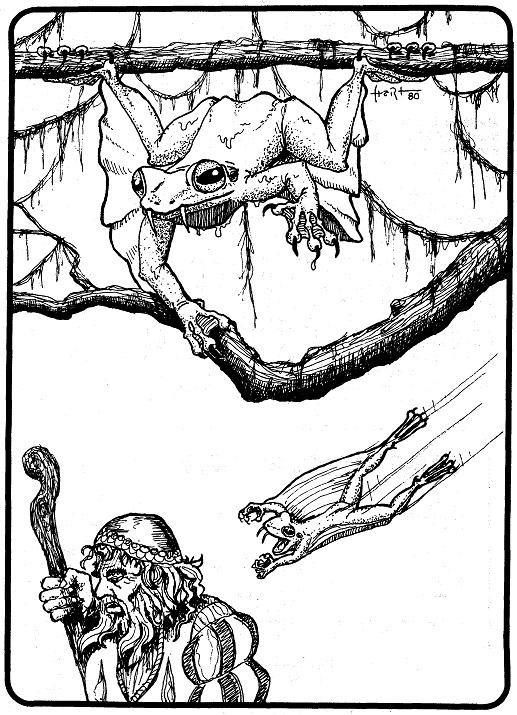
The Dragon’s Bestiary presents the Giant Vampire Frog by Alan Fomorin. How do you not love these guys?

Here’s proof that Mark Herro was nobody’s dummy …

“Home computers may be the most important new consumer appliance to come along in decades. Any device that can control household lights and appliances, edit and type letters and reports, selectively monitor United Press International and the New York Stock Exchange, and play some great games besides, may be almost indispensable in the years to come.”

Word up!

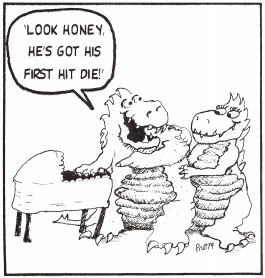
This issue had a couple cartoons of note. First, an argument that persists to this day …

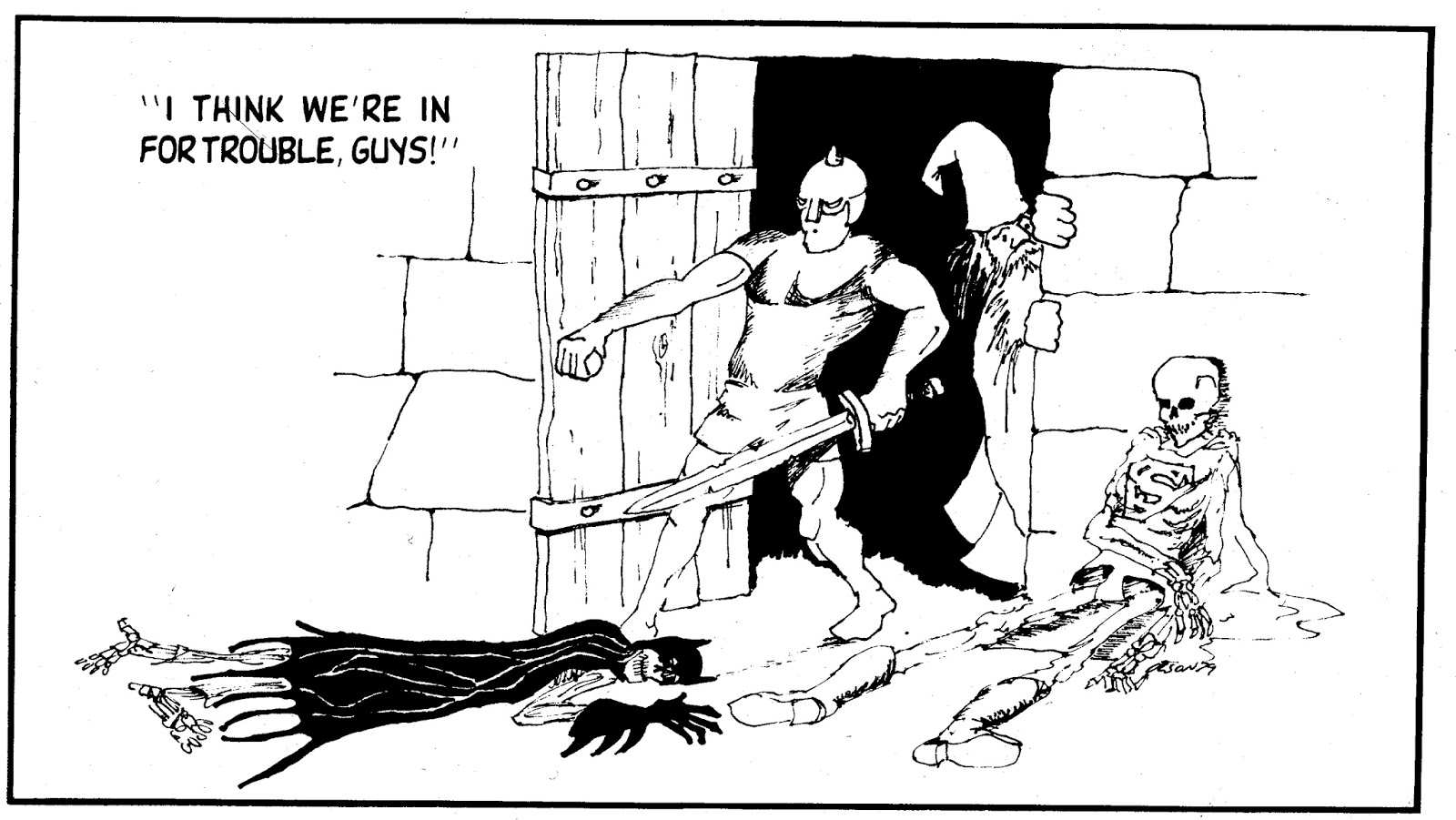
And an old take on Batman vs. Superman … or Batman and Superman vs. something else

And as always, we finish with a bit of Wormy, as we begin to move into the wargaming story line …

Have fun on the internet, and for God’s sake, be kind to one another!

The Wages of Fame

William Tell

I’ve seen a few systems in games for measuring the reputation or fame of adventurers. They make sense, to some extent – folks spending their kind of money and killing monsters the way they do should be pretty well known in a campaign area. But should they? And how? And what do they get from it? And why am I asking so many questions? Huh?

Here’s an idea for handling fame without adding too much in the way of rules or complications. It might suck, but here it is anyways.

Accumulating Fame

How do people become famous in a medieval milieu? For the purposes of D&D and similar games, it makes sense to tie fame to deeds. Hey, if Bob jumps over a cow at the local faire, people in the village will know that Bob is famous for jumping. They’ll tell others, and maybe for several villages around Bob will be known as “the jumper”. So it goes with adventurers.

Since fame is tied to deeds, it also makes sense that fame is tied to XP. XP are handed out for deeds, therefore XP equals fame.

Or does it?

In our example above, everyone saw Bob jump over the cow. If Bob had done it without witnesses, and just claimed to have jumped over a cow, he might have become known as Bob the Liar rather than Bob the Jumper. So, in this system, XP only turn into fame when the deeds that generated the XP are either witnessed by the public at large, or can be proved. If you want to use this system, you’ll need to put a second XP number in parentheses after the normal XP number.

You accumulate these “fame XP” by doing things in front of people, or you need to spend or display the treasure you looted, and you need to bring back trophies (at least one really good one, the gorier the better) to show that you defeated monsters or black knights or wizards. If you do these things, you count those XP towards your fame level.

Since we have a separate “fame XP”, we also have a separate “fame level”. For simplicity’s sake, use the Fighter’s XP progression in your game as the Fame XP progression.

Fame levels are as follows:

The Upside of Fame

So, what do these fame levels get you?

First level fame is worth nothing.

From 2nd level onward, they enjoy the following benefits:

1) They have a percent chance of drinking for free and picking up interesting rumors in taverns

2) They have a percent chance of getting an invite to dine with notables equal to their fame level, the chance depending on the size of the settlement

3) You can employ an extra number of henchmen equal to your fame level, and their base loyalty is increased by a number of percentage points equal to your fame level

4) You can request audiences with princes, kings, emperors, high priests, etc. You have half this chance of requesting a boon in exchange for a favor, and a percent chance equal to your fame level of requesting a boon in exchange for nothing

The Downside of Fame

Fame has a downside as well. When you enter an area, your fame might proceed you. You can cut the chances of being recognized by wearing a disguise and using a different name, but lose the benefits of fame (see above) if you do so. Here’s a twist – if you are moving in a group and not everyone in the group is disguised, your chances of being noticed are increased by 5% per undisguised person.

If you are recognized, one of the following happens:

Challenges: You will be challenged to a duel (magical or martial) or test of skill by other notables in the area. This will be public. Losing these challenges actually reduces your fame XP level by as much as it would have increased if you had won.

Quests: If you are neutral or lawful (good), and there’s trouble afoot, you will be asked to handle it. If people have been kidnapped or there are monster’s raiding the area, you are expected to solve it. If you refuse, you lose enough XP to take you down a fame level. You suffer the same consequences if you fail at the quest.

Justice: If you are chaotic (evil), you are set upon by the authorities in the area, or bounty hunters or people you wronged in the past. In other words, being famous and evil means being hunted.

For this reason, characters might discover that fame is a double-edged sword.

Death

Nobody wants to die, but dying famous is probably better than dying unknown for an adventurer. When a character dies, the following happens:

6% chance per fame level of a folk song being composed in their honor

4% chance per fame level of a biography being written about them

2% chance per fame level of a monument being erected where they died or a civilized place nearby

For clerics, druids and paladins, there is a 1% chance of them being canonized

Now, total these honors received. This is the percent chance (thus, maximum 4%) that upon death they are received by “the gods” into their company as a quasi-deity. They can still be used as PC’s, with powers deemed suitable by the DM, but only in the company of other quasi-deities or demi-deities and the like. Congratulations!

Alignment as Religion

This is something that has been kicking around in my head for a while, so read this as nothing more than me tossing around a few ideas.

When alignment first reared its soon-to-be controversial head, it was in the form of factions for war gaming. There was Law and Chaos – they opposed one another – and then Neutrality. The neutrals would fight for either side, and thus neither favored Law or Chaos. The terms “Law” and “Chaos” came from either Michael Moorcock or Poul Anderson – I’ve heard both get credit, and haven’t researched it enough to have my own opinion on the matter. They may have already had the good vs. evil vibe, but I think the main point was in building fantasy army lists, not modeling ethics and morality in a fantasy game.

With the addition of the Lawful cleric (and later paladin), and the Chaotic anti-cleric,  alignment seemed to become a stand-in for religion. Instead of treading on the dangerous ground of Christians vs. Satan, they used Law vs. Chaos.

Eventually, alignment was expanded from the original three factions (or two factions plus neutrals) to five alignments and then to nine. Once you get to nine alignments, with sometimes vague divisions between them, the alignment as religion scheme starts to fall apart. Is Chaotic Good more aligned with Chaos or Good? Is it player’s choice, or does one override the other?

The Notion

What if you stick to three main religious/philosophical factions – Law, Chaos, Neutrality (or Good, Evil, Neutrality to be more precise) – and use the smaller divisions as sects within those three great factions.

For example, Lawful Good and Chaotic Good may argue and fuss with one another – they might even come to blows on rare occasions – but they’re still ostensibly on the same side, and will always rally to one another when Chaos comes marching over the hill. Both are part of the Good faith, they just differ on the details.

So, how might we characterize these alignment sects?

First and foremost, let’s assume that the main divide is Good vs. Evil. Why focus on the good/evil divide? Because I think it’s more pronounced and contentious than the law/chaos divide. Oscar and Felix managed to live together without killing one another. Superman and Lex Luthor … just not going to see eye to eye (you don’t believe me? Click HERE. You just can’t trust the guy).

I’m pretty sure they inspired Moorcock’s Law vs. Chaos

Good supports virtuous action, self-discipline (i.e. telling yourself “no”), kindness, justice and law – not tyranny, but rather the idea of “natural law” or God’s law – no murder, no theft, etc. The basics without which people cannot live in relative peace and tranquility.

Evil, on the other hand, scoffs at these ideas. It is interested in power for the sake of power. It might work within a system of law, but will always seek to distort and manipulate the system for its own benefit. Evil loves technicalities. Evil doesn’t think of itself as “good” – it knows it is not, and it doesn’t care, but it also doesn’t see itself as wrong. Evil is okay, because the universe rewards it. Everyone is evil at heart. Good is naive. Good is nonsense. Good is a chicken waiting to be plucked. You good guys can deny yourselves pleasure and wealth and all the rest if you want to, but don’t try to force me to deny those pleasures and power.

Simplify, man!

Neutrality is somewhere in between. Maybe pragmatic, maybe a dogmatic resistance to pick sides, maybe it just doesn’t think much about it. For druids who actually need a functioning philosophy, perhaps it is something akin to Taoism. We probably need to separate True Neutral (the philosophy) from Neutral (a cow chewing cud in a field). On the other hand, maybe druid’s just serve the immediate, practical needs of their parishioners OR nature without worrying about whether what they do is good or evil. Perhaps they have an ideal held higher than moral and ethical concerns.

You can play with those definitions, but I think they make enough sense to inform the way a character behaves in a fantasy game environment.

Now, let’s examine how the alignment sects might work.

Within the Good alignment faction, we have Lawful Good, Neutral Good and Chaotic Good. I can see Lawful Good as being something like the Catholic Church or similar religious organizations. It believes in virtue and civilization, and believes that the only way to preserve virtue and civilization is through hierarchical organizations and institutions. Its members also believe that the institutions are only legitimate, be they religious or political, if they uphold virtue. They hold their institutions to a high standard, and though they will rarely destroy an institution outright, they will work against its leadership to put a more virtuous person in charge when the institution appears to have lost its way. They believe in reformation rather than rebellion.

Chaotic Good is not so big on institutions. Human freedom and liberty are the key to maintaining virtue and civilization. Institutions are about power, and power corrupts. Give a Lawful Good institution enough time, and it will become Lawful Neutral or even Lawful Evil. The individual must not be run over by the institutions. They would probably prefer a republic over a monarchy, and would be loathe to join with others except on a temporary basis.

Neutral Good

Neutral Good can, like most neutrals, see both sides of the argument. There is value in institutions – they can do things individuals cannot, things that must be done. On the other hand, they can also lose their way, and thus must not be depended on overmuch. A thriving civilization needs institutions, but it also needs freedom and dynamism. Neutral Good also makes me think about some of the Christian sects that wanted to go back to a more “primitive” faith. They were often nudists, trying to recreate Eden, and not entirely unlike the original hippies. Neutral Good hippies could be fun in a campaign, annoying Lawful Good and Chaotic Good alike.

The divisions might be similar on the Evil side. The Lawful Evils worship the devils and imitate their evil hierarchy. The Chaotic Evils worship demons and believe that no creature in the cosmos is more important than themselves – you might call them psychopaths. Neutral Evil seeks to forward itself on the backs of Lawful and Chaotic Evil – maybe they see themselves as the true faith, the puppet masters of the other sects, using and abusing them as events merit.

Neutrality is a little tougher. I would think Lawful Neutrality is conservative, while Chaotic Neutrality is radical. Both favor a balance – either locally among personalities or cosmically between factions – but Lawful Neutral thinks that change might throw things out of balance, so one should be wary of change. Chaotic Neutrality likes change for the sake of change. It rushes here and there, always looking for something new. By spinning the top, it balances. If the top is left at rest, it does not. Neither Lawful Neutral nor Chaotic Neutral want to be enmeshed in a wider struggle between Good and Evil. One faction is too preachy, the other is too scary, and why don’t they just leave us the heck alone?

Yes, Evil can work together … for a while

To recap – Europe’s Catholics and Protestants were at odds, often at war, but would have likely joined forces against the Ottoman Turks had they launched a major invasion. Likewise, the Joker, Penguin, Riddler and Catwoman hate one another, but they’ll form the United Underworld if they think they can get rid of Batman and Robin.

One More Lame Alignment Idea Before I’m Done

I also thought about characterizing alignments in a string, rather than a square. One is permitted a certain number of vices at each alignment “level”. The good alignments are permitted vices that hurt themselves but not others, while the other alignments permit more active vices.

The breakout could be something like:

Lawful Good: 0 vices (the toughest alignment to adhere to)
Neutral Good: 1 vice
Chaotic Good: 2 vices

Lawful Neutral: 3 vices (but only personal vices, as with the good alignments)
True Neutral: 3 vices
Chaotic Neutral: 4 vices

Lawful Evil: 5 vices
Neutral Evil: 6 vices
Chaotic Evil: 7 vices

So Chaotic Evil is permitted to glory in all seven deadly sins, while Lawful Good has to be perfect all the time. If a Lawful Good character sins, but only hurts herself, she becomes Neutral Good. If she does something sinful that hurts another, she drops all the way down to True Neutral (at best), and can feel free to dabble in a couple other sins as well. Reformation might come one level at a time, as the character swears off of different vices and proves their virtue by keeping away from that vice for some period of time set by the GM or through some other meaningful way.

This is what the planes should look like, right?

Freeform Fantasy Races

Before I started writing this blog or publishing, I did a fair amount of writing for myself and the people with whom I gamed. I recently came across some files I’d stashed away, including the “original” NOD RPG, which was really just a mash-up of Swords & Wizardry and Castles & Crusades, with art from Wayne Reynolds, and this little ditty about racial archetypes.

The idea was to swap out the common fantasy races for these archetypes, with options chosen by the players so that they could, in essence, build their own “race” for their character. I used some of these idea later in Space Princess for those races, and a few ideas have probably filtered into Blood & Treasure, but I thought people might enjoy seeing the original, with only a little editing for spelling. Again – assume these were for some unholy mash-up of S&W, C&C and 3rd edition.

These rules are designed to let you model races not found in the Player’s Handbook.

Attribute Modifiers
All of the archetypes in this document except Aliens, Dynamics, and Natives are allowed one attribute modifier from the following list.

• +1 Cha, -1 Wis.
• +1 Dex, -1 Con.
• +1 Int, -1 Str.
• +1 Str, -1 Int and -1 penalty to one ability score of your choice.
• +1 Con, -1 Dex.
• +1 Wis, -1 Cha.

Dynamic Characters
Dynamics are the most common form of adventurer. They rely on training and luck to win the day, not innate powers.

Senses: Normal.

Prime Attributes: Dynamic characters may choose three prime attributes instead of the usual two.

Alien Characters
Aliens are defined by strange physical and mental powers. They are probably the most versatile type of hero, after the dynamic. Virtually any kind of “super powered” hero can be realized with the alien type.

Senses: Normal – but see below.

Powers: Aliens can choose three powers from the following list.

Mental Powers
All mental powers that are derived from Jason Vey’s psionics rules follow those rules normally. The alien should be treated as a 1st level psionicist for the purpose of using the ability. If an alien takes a psionic mental power multiple times, he increases his effective level for using that power by 1. Thus, an alien that took metabolic control three times would use the power as a 3rd level psionicist.

  • Alien Mind: Creatures that try to read or control your mind must make an Intelligence save or be confused for 1 round.
  • Clairaudience: See psionics rules.
  • Clairvoyance: See psionics rules.
  • Dual-Mind: You are capable of engaging in two mental tasks at once, making an attribute check for each at -2. You cannot cast two spells or use to psionic powers simultaneously with this power. In addition, you also get to make two saving throws against mental effects. As long as one mind makes it save, you can ignore the effect, though you suffer a -2 penalty to all actions.
  • Empathy: See psionics rules.
  • Heightened Mentality: Increase one of your mental attributes (Int, Wis, or Cha) by +1. This can be taken more than once, but no attribute can be increased beyond a score of 20.
  • Metabolic Control: See psionics rules.
  • Obfuscation: See psionics rules.
  • Psionically Gifted: You gain a +1 bonus to all psionic power checks.
  • Psychic Defense: See psionics rules.
  • Spell Resistance: You gain spell resistance 1. Each additional time you take this ability you increase your spell resistance by +1.
  • Telepathic Communication (Wisdom): See psionics rules.

Physical Powers

  • Chameleon: This is the ability to change the body’s colors (though not the color of items worn or carried) to match the environment. Generally it should give a bonus of +1 to +5 on hide checks.
  • Energy Resistance: You gain resistance to one energy type (acid, cold, electricity, fire, or sonic). This can be power can taken more than once, but it applies to a different energy form each time you take it.
  • Extra Arms: When using two-weapon fighting, you may make two off-hand attacks instead of one. Alternatively, you may wield an additional shield in combat.
  • Extra Legs: You are a quadruped – you gain a +4 bonus to avoid being knocked over. In addition, your carrying capacity is increased by 10%.
  • Heightened Physique: Increase one of your physical attributes (Str, Con, or Dex) by +1. This can be taken more than once, but no attribute can be increased beyond a score of 20.
  • Heightened Senses: You gain twilight vision, an enhanced sense of smell, and a +2 bonus to all listen checks.
  • Improved Speed: Your base land movement is increased by +5 ft. This can be taken more than once, and its benefits stack.
  • Natural Armor: You have scales, thick fur, or thick skin of some kind that give you a natural AC 12. Each additional time that you take this power you increase your natural armor by +2.
  • Natural Weapons: You either gain a bite, claw, gore, slam, slap, sting, talon, or tentacle attack that deals 1d4 damage. This attack can be used in addition to weapon attacks at no penalty. Each additional time you take this power you can either gain an additional attack form, or increase the damage of an existing attack form by one dice size.
  • Poison: You are poisonous – either through bite, skin contact, or writhing snakes on your head. Opponents who are stricken must succeed at a Constitution save or suffer 1d6 points of damage.
  • Quills/Spikes: Your outer arms, back, head, legs, etc are covered in quills or spikes. You gain a +1 bonus to AC, and can inflict 1d4 points of bonus damage when grappling or grappled. Opponents that strike you without using weapons suffer this damage automatically.
  • Regeneration: Gains fast healing 1.
  • Spider Climb: You can use spider climb, as the spell, at will.
  • Stretch: You can increase your reach by 5 ft (at the cost of 2 points of strength), and squeeze into small spaces with a dexterity check.
  • Tentacles: Tentacles emerge from some portion of your body – they may replace your arms or legs, or jut out from your chin. They grant you a slam attack that deals 1d4 damage, and grant you a +2 bonus to grappling attacks and climbing.

Sample Alien: Githyanki

The githyanki are descended from human slaves kept by the mind flayers. Ages ago they rebelled and escaped to the Astral Plane, where they now dwell. Githyankis have three mental powers: Alien mind, heightened mentality (+1 Int), and psionically gifted.

Beaste Characters
A concept drawn from folklore, beastes are shape shifting magical animals.

Senses: Twilight vision, enhanced sense of smell.

Alternate Form: Beastes can alternate their form between that of an animal, a humanoid, and a hybrid form. Changing form requires one complete round during which the character can do nothing else. Armor and equipment do not change form along with the beaste. In each form the character’s level and attribute scores are unchanged.

Animal Form: When in animal form the beaste is virtually undetectable from a normal animal. Beastes gain the ability to speak with normal animals when in their animal form. While in animal form, a beaste cannot use any weapons, armor, or equipment, nor can they cast spells. They can understand any language they know, but may not be able to reply.

Humanoid Form: When in humanoid form, beastes looks like a normal humanoid of a type chosen during character creation (i.e. elf, dwarf, human, orc, etc). Whatever their chosen humanoid guise, they always retain some distinctive feature of their beaste form. The choice is up to the player. In humanoid form, the beaste loses its twilight vision and enhanced sense of smell.

Hybrid Form: A beaste in hybrid form appears as a combination of animal and humanoid – their exact appearance is up to the player. In this form, they retain the special attacks and qualities of their animal form, but also have working humanoid hands, and can speak humanoid languages.

Speak To Animals: In all forms, a beaste can speak to animals at will.

Sample Beaste: Kitsune

Kitsune are fox beastes of Japanese folklore. They are capable of taking the form of a human, fox, or human-fox hybrid. They gain a +1 bonus to charisma and a -1 penalty to wisdom.

Elemental Characters
Elementals carry the blood of elementals in their veins. All elementals show this heritage in their physical appearance.

Senses: Twilight vision.

Energy Resistance: All elementals have 50% resistance to one energy type based on their elemental heritage:

Air 50% resistance to electricity
Earth 50% resistance to acid
Fire 50% resistance to fire
Water 50% resistance to cold

Elemental Power: Elementals have special abilities based on their elemental heritage.

Air: Reduce falling damage by 50%, double jump distance.
Earth: +2 AC vs. overbearing attacks, +1 natural AC
Fire: Deal 1 point of fire damage with all melee attacks.
Water: Breathe underwater, gain swim speed equal to land speed.

Sample Elemental: Fire Gnome
The fire gnomes are gnomes that dwell near volcanoes. They have 50% resistance to fire and can deal 1 extra point of damage with their melee attacks. In addition, they have the small subtype, giving them a +2 bonus to dexterity and a -2 penalty to strength. They have a +1 bonus to intelligence and a -1 penalty to strength (making a total -3 penalty to strength).

Macabre Characters
Macabres are either born from the undead (i.e. their parents were made undead while they were in the womb, or they were sired by a vampire, or there was a strange ritual involved), the result of botched resurrections on their pregnant mothers, or maybe they are actually sentient undead. Macabres can choose to be intangibles (like ghosts, shadows, or wraiths) or corporeals (like zombies, ghouls or vampires). They can be small, medium, or large.

Senses: Twilight vision.

Resistance: Macabres are damaged by positive energy and healed by negative energy. Thus cure light wounds will inflict 1d8 points of damage on a macabre, while inflict light wounds will cure 1d8 points of damage.

Stunning Touch: Macabres have a touch attack that stuns living creatures for 1d4 rounds if they fail a constitution saving throw. They can use this once per day.

Intangibles: Intangible macabres can use ethereal jaunt once per day.

Corporeals: Corporeal macabres have a 50% chance to ignore extra damage from sneak attacks, back attacks, and critical hits.

Sample Macabre: True Ghoul
The true ghouls are a race of undead that haunts the deepest reaches of the Underworld. Unlike normal ghouls ,they are intelligent and more-or-less civilized. A true ghoul has the normal resistance to positive and negative energy and stunning touch of a macabre. As corporeal macabres, they have a 50% chance to ignore extra damage from sneak attacks, back attacks, and critical hits. They have a +1 bonus to constitution and a -1 penalty to dexterity.

Magical Characters
Magical characters have magical power flowing through their veins. This is usually due to a fey, planar, or draconic heritage.

Senses: Twilight vision.

Resistance: Magicals can choose to have 25% resistance to any three energy types of their choice, 90% resistance to sleep and charm effects, or a flat magic resistance of 10%.

Spells: Magicals can choose four 0-level spells, two 1st level spells, or one 2nd level spell to cast as spell-like abilities once per day. The magical character has a caster level of 1 with his spell-like abilities.

The list a magical character chooses his spell-like abilities from often corresponds to his heritage: wizard for draconics, illusionist or druid for feys, and cleric for planars.

The spells chosen must be approved by the CK.

Sample Magical: Tiefling
Tieflings have fiendish blood in their veins. They have 25% resistance to cold, fire and poison damage, and can cast darkness once per day. They have a +1 bonus to dexterity and a -1 penalty to constitution.

Native Characters
The native is tied to where he has grown to adulthood, whether he is a barbarian of the forests or a city slicker.

Senses: Normal.

Native Environment: Natives must designate one “environment” as their native environment. A native can choose from the following environments: Aquatic, Arctic, Desert, Forest, Jungle, Hills, Marsh, Mountains, Plains, Underground, and Urban. Man-made dungeons do not count as an urban or underground environment.

All natives receive a +1 bonus to initiative, attribute checks that would benefit from familiarity with an area, and +10 ft to movement when in their native environment.

In addition, natives can choose to get either a +1 bonus to hit three traditional enemies of their people (chosen with CK’s approval), or a +1 bonus to hit with a traditional weapon of their people.

Finally, natives get a +2 bonus to AC when fighting large creatures native to their native environment.

Sample Native: Cimmerian
The Cimmerians of Robert E. Howard’s Hyborian tales are native to a land of steep, rugged hills. In such environments they gain a +1 bonus to initiative and attribute checks, a +10’ to their movement. Their traditional enemies are the Picts, Vanir, and Hyperboreans, against whom they are +1 to hit. Against large creatures native to Cimmeria they have a +2 bonus to AC.

Promethean Characters

Monkbot, from HERE

Note: I think I snagged this from somewhere else – maybe Jason Vey – if anyone knows, let me know

Prometheans are creatures that are manufactured by other creatures. They are sentient, and as capable of emotion as their player wishes them to be. Prometheans can be built from a variety of materials, including wood, metal, stone, clay, porcelain, or even unliving flesh.

Constructed: Prometheans are immune to any effect that requires a constitution save that doesn’t normally affect objects. They do not need to eat, sleep, or breath, although they can benefit from imbibing a magical potion.

Outer Shell: Prometheans gains special abilities based on the composition of their outer shell. Choose one.

Ceramic: +2 to charisma checks
Cloth: +2 to dexterity checks
Metal: Natural AC 12
Wax: Change self once per day, vulnerable to fire
Wood: Natural AC 11, swim speed equal to half their land speed

Innards: Prometheans gain special abilities based on their innards. Choose one.

Clockwork: +2 to grapple attacks and to disarm AC due to the ability to lock their grasp
Cotton: Cold resistance equal to 25%
Hollow: Conceal objects one size category smaller within its body
Sand: Fire resistance equal to 25%
Sawdust: Acid resistance equal to 25%
Solid: 25% chance to negate extra damage from sneak attacks, back attacks, and critical hits

Sample Promethean: Karakuri
In real life, karakuri are primitive Japanese clockwork automatons. In a fantasy game they can be prometheans of ceramic composition and clockwork innards. This gives them a +2 to charisma checks, a +2 bonus to grapple attacks, and a +2 bonus to AC vs. disarming attacks. Since they are constructs, they need not eat, sleep, or breath. They have a +1 bonus to dexterity and a -1 penalty to constitution.

Racial Subtypes
The following subtypes can be added to any racial type.

Aquatic: Aquatic creatures can breath underwater and gain a swim speed equal to their land speed. They must immerse their bodies in water at least once per day or lose 1 point of Constitution to dehydration.

Avian: Avian creatures have working wings; they gain a fly speed equal to their land speed, but suffer a -2 penalty to Constitution due to their hollow bones.

Insectoid: An insectoid’s antenna give it the ability to fight without the benefit of sight. They suffer half the normal penalty when fighting blind.

Subterranean: Subterranean creatures have darkvision to 60 feet, but are -1 to hit in bright light. Alternatively, they can have deepvision to 120 feet, but suffer a -3 penalty to hit in bright light.

Size: A creature’s size is assumed to be Medium, i.e. between 5 and 7 feet in height. Optionally, it can be Tiny, Small, or Large.

  • Tiny (1-2 ft): +4 Dex, -4 Str, 50% reduced carrying capacity
  • Small (3-4 ft): +2 Dex, -2 Str, 25% reduced carrying capacity
  • Large (8-12 ft): +2 Str, -2 Dex, 25% increased carrying capacity
How to Herc – An Illustrated Guide to Demigodery

Every day, hundreds of people (or none) email me asking how they can be more like Hercules. They also ask for my social security number, so it may be an elaborate internet scam, but in case it isn’t, I present this guide.

If your fighter or barbarian character checks off everything on this list, when they die they will ascend to Mount Olympus and become a god. Any player at the table who plays a cleric will have to convert to your new religion, which obviously means they have to adopt your dead character’s alignment and they lose access to spells if they don’t fetch drinks and chips for you.

Kirk Morris as Hercules and Illoosh Khoshabe as Samson

Throw a Mega-Punch

At least once in his life, a real Hercules must throw a mega-punch. Here’s how:

1. When making an attack, declare it’s a mega-punch

2. Roll a d20, d12 and d10, adding your Str bonus and attack bonus to each dice

If all three rolls best your opponent’s AC, you reduce the target to 1d6 hit points and knock them out for an hour – yep, even if its Gandalf or Cthulhu

If two hit, you score normal punching damage, and are banned from mega-punching again until you gain a new level. We’re all a little disappointed in you.

If one hits, you swing wildly and miss. Any ally within fist range, though, must pass a saving throw or get clocked by you, suffering normal damage. If this occurs in a bar, your friend now has to get up and punch a stranger, and so on.

If none hit, you lose one level due to embarrassment and divine punishment. This lost level returns after you defeat something awesome in battle – without help Poindexter!

Reg Park as Hercules

Swear an Oath to the Gods

When bad shit happens to good people, look to the heavens and cry, “By the power of Zeus I will avenge you!”

Then do it.

Earn double XP, and operate under a bless spell during your next adventure.

Dear God, It’s Me, Hercules

A variation on the above. Whenever you screw up something you shouldn’t have, look to the sky and ask “Why have you forsaken me?”

There is a 1% chance, +1% per person at the table who laughed or snickered at your failure, that the head of the pantheon appears and tells you, and then gives you a quest to fulfill.

What’s the upside? There is none. But being Hercules ain’t all cheese and crackers, you know.

Gordon Scott as Hercules

Wrestle With Something Way Out of Your Class

If you’re medium, it should be huge. You can warm up on something large, but eventually you need to step it up to huge. And I mean wrestle – not attack with sword. Grab it. Pin it. Choke it out.

Dan Vadis as Hercules

Ruin Architecture

If the world provides you with two pillars within arms reach of one another, you damn well better knock them down.

“But wait,” you cry, “I can’t do that with even an 18/00 strength!”

Then I guess you can’t be a god.

Steve Reeves as Hercules

Kill Someone with Chains

And not just any chains. The chains with which they bound you. Break out of the chains, then pick them up, and then start cutting down bastards like you’re harvesting grain.

Heavy chains do 1d6 damage and add 5′ to your reach. When attacking anyone who was involved in binding you, you score double damage.

Mark Forest as Hercules

Lead and Army in Skirts

No armor, just grim determination and skirts so short they would make a nun blush. Bonus if the army is Inca. You know, because of mythology and such.

Smack Around Some Moon Men

They may look like earth elementals, but trust me, they’re Moon Men and they have it coming.

Note – unless you’re lucky and they’re on Earth plotting to resurrect their queen by draining the life from a human woman, you’ll have to go to the Moon to fight them.

Mark Forest as Hercules

Choke a Thick Snake

Proudly, and announce that you’re choking a thick snake. Repeatedly. And talk about how your hands are tired afterward.

Don’t worry – each person at the table that snickers only adds to your glory. It’s called confidence, and there’s nothing manlier than that.

Sylvia Lopez as Omphale

Dally with an Evil Queen

She needs to be scary-hot. And evil.

Doing it while under a spell counts.

Changing her alignment counts for more.

Nigel Green as Hercules (one of my favorites)

Endanger The Party with Your Antics
Like, maybe by awakening Talos by stealing treasure you were specifically told not to steal.
Of course, you also have to save the day, or die trying.

Reg Park as Ursus

Two For One

Kill two men-at-arms by throwing one at the other. Extra points for a trick shot.

Fight Moloch

Or a guy dressed up as Moloch.

Okay – I just included this one because I thought the guy looked cool.

Steve Reeves as Hercules

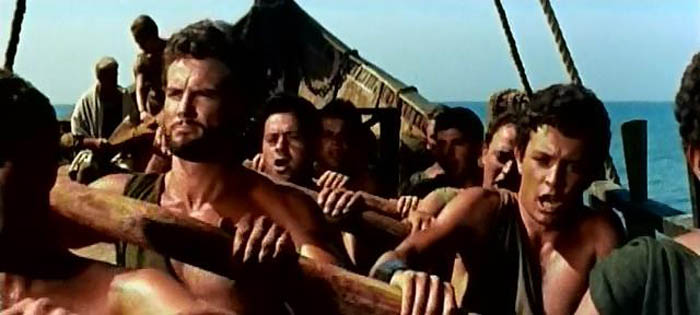
Row a Galley

Bonus points if the captain can water ski behind it.

AND FINALLY …

Learn to laugh at life!

Easy Peasy Wracked with Diseasy

Illustration by Jon Kaufman

For the second edition of Blood & Treasure, I had a few goals in mind: 1) Better layout. 2) Incorporate errata and edit like crazy. 3) A little more gonzo, a little less standardized. 4) Streamline anything you can streamline.

That brings me to disease. The rules I used before were relatively easy, but I wasn’t really satisfied with them. I hit on this point in a post a while back, and developed a disease system that I published in NOD 28 that focuses on symptoms rather than on named diseases. For Blood & Treasure, I decided to use a simplified version of this. While somewhat random, it takes into account the monster or dungeon level delivering the disease, and hopefully sets up a race against time aspect that will add to rather than diminish the drama of an adventure.

DISEASE

When a character is injured by a contaminated attack, touches an item smeared with diseased matter or consumes disease-tainted food or drink, he must make an immediate Fortitude save. If he succeeds, his immune system fights off the disease and he suffers no ill effect.

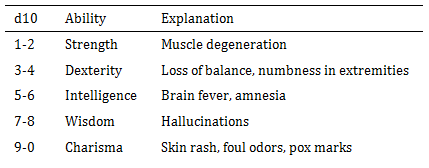
If he fails the saving throw, the TK rolls 1d6 and adds the Hit Dice of the monster that infected him, or the level of the dungeon on which he was infected. Consult the table below. The infected creature will suffer all of the effects on the table up to the number rolled. The effects start at the times indicated on the table.

For example, a character who is both fatigued and sickened with feel the effects of fatigue in one round, and the effects of being sickened in 1 turn.

If an ability score is indicated, roll 1d10 to determine which score is affected:

Each day, the creature can attempt a new Fortitude save against the disease. If the roll is a failure, he continues suffering the ill effects as indicated on the table. If he succeeds, those ill effects are reduced by one level. When the character suffers no further ill effects, the disease has run its course.

While the character is diseased, they do not benefit from natural healing, although magical healing works on them. A cure disease spell will, of course, completely eradicate the disease, ending all ill effects.

Of course, once “cure disease” shows up, it just doesn’t matter, which is why the system is short.

I MIGHT CHANGE SAVING THROWS

This brings up the other part of the game I might streamline. I say might, because I haven’t made the change yet.

Saving throws in the game currently use three categories – Fortitude, Reflex and Will. As categories, they make sense and players can generally figure out what save they should be making when a situation comes up.

A post over at Delta’s D&D Hotspot got me thinking of another way that is more “gamist”, but which I think might be an improvement.

Delta was showing how the OD&D fighter’s saving throws went in an order from easiest to hardest, with the easiest saves being the one’s against the most dire circumstances. I like this idea. Why should it be easiest to save vs. petrification? Because failing that save means your character is dead, unless you have a high enough level magic-user who can turn you back. It treats saving throws more as “get out of jail free” cards than as simulating something real. I know this will bug the heck out of some folks, but I like it. It keeps the game a game.

This got me thinking about using a single saving throw number for each level – so only one number on the sheet, which fits into streamlining – with a blanket +3 bonus against instant effects that are (almost) unalterable – things that really screw up your precious character like instant death, polymorph, paralysis, petrification and the like. The classes would then have their own little +1 to save vs. something – fighters vs. dragon breath, spellcasters vs. spells – that sort of thing.

If I’m honest … it also saves lots of room in the books and makes monsters a bit easier to run.

Again, I haven’t made this change yet, but I think I’m going to.

I’m like 90% certain I’m going to.

Probably.

I think.

Weapons Increase Armor Class?

I had a little notion this morning about a different way to run combat in d20-esque games. This is a departure from normal combat, but can be done pretty easily.

Here’s the plan:

Damage is not based on the weapon, but on the success at the attack roll. There are a variety of ways you can do this. The most simple would be something like:

Roll < AC = no damage (obviously)

Roll = AC = 1d3 damage (’tis but a scratch)

Roll = AC +1 = 1d4 damage

Roll = AC +2 to +3 = 1d6 damage

Roll = AC +4 to +5 = 1d8 damage

Roll = AC +6 to +7 = 1d10 damage

Roll = AC +8 to +9 = 2d6 damage

And so on, adding +1d6 to damage each time. You can adjust the ranges and damages to suit yourself, of course.

So what good is a weapon in this system?

Weapons in this system would add to AC based on their length. If your weapon is longer than your opponent’s weapon, it is harder for the opponent to get close and strike. We could say for every foot difference in the length of the weapons, you get a +1 to AC, up to a max. of +3. We don’t want the weapon’s length to completely overshadow actual armor in the AC calculation. We might also want to factor in the size of the combatants, with maybe every 2′ of height (or length) equaling a +1 bump to AC, up to +3. The combination of height and weapon length, therefore, would give a max. bump to AC of +6.

Weapons also add to damage based on their stated damage in the rule books, as follows:

1 to 1d3 damage = +0 to damage
1d4 damage = +1 to damage
1d4+1 and 1d6 damage = +2 to damage
1d6+1, 1d8 and 2d4 damage = +3 to damage
1d10 damage = +4 to damage
1d12 and 2d6 damage = +5 to damage

Strength also adds to damage, as normal, and dexterity adds to AC.

Example Combat: Halfling Fighter vs. Ogre
We’ll pit two combatants against one another.

The first is a 5th level halfling fighter with a +1 Dex bonus and platemail and a short sword. The halfling (using Blood & Treasure rules) has a total bonus to hit of +5 (for level, no strength bonus). Her armor class is 18 (+7 armor, +1 Dex). She has 28 hit points.

The second is a 4 HD ogre with no armor and a spear. The ogre has a +4 bonus to hit (based on his HD) and AC 16. He has 17 hit points.

We’ll impose the following adjustments, based on the above rules:

The ogre is 8 feet tall, vs. the halfling’s 3 feet of height. This is a 4′ difference, so the ogre gets a +2 bonus to AC. The ogre is also using a 6-foot long spear, vs. the halfling’s 3-foot long short sword, which gives the ogre another +3 bonus to AC. This gives the ogre a total AC of 21 in this fight.

The halfling’s short sword gives her a +2 bonus to damage. The ogre’s spear gives him the same.

We’ll give the halfling initiative … her first attack roll is a 17, +5 for her attack bonus, equals 22. This beats the ogre’s AC by 1 point, and thus scores 1d4+2 damage. In this case, 4 points of damage. This reduces the ogre to 13 hit points.

The ogre rolls a 19+4 = 23. This beats the halfling’s AC by 5, which translates into 1d8+2 damage. The ogre rolls 5 points of damage, reducing the halfling to 23 hit points.

In the next round, the halfling rolls a 23, beating the ogre’s AC by 2, and scoring 1d6+2 damage. The halfling rolls another 4 points of damage, reducing the ogre to 9 hit points.

The ogre responds with an attack roll of 5, missing the halfling.

And so on … it is likely that the halfling will win the fight, though the ogre has a slightly better chance to score more damage, and he is slightly harder to hit.

Final Thoughts
I don’t think this is a better way to run combat, just different. If it has any advantage, it is that it takes into account the reach of a creature and weapon in a way that normal combat rules do not. Further development of the idea might lead to a better system, or might suggest alterations to the existing combat system that might make it better.

Dragon by Dragon – January 1980 (33)

“This is the ’80s and I’m down with the ladies.” – Tone-Loc

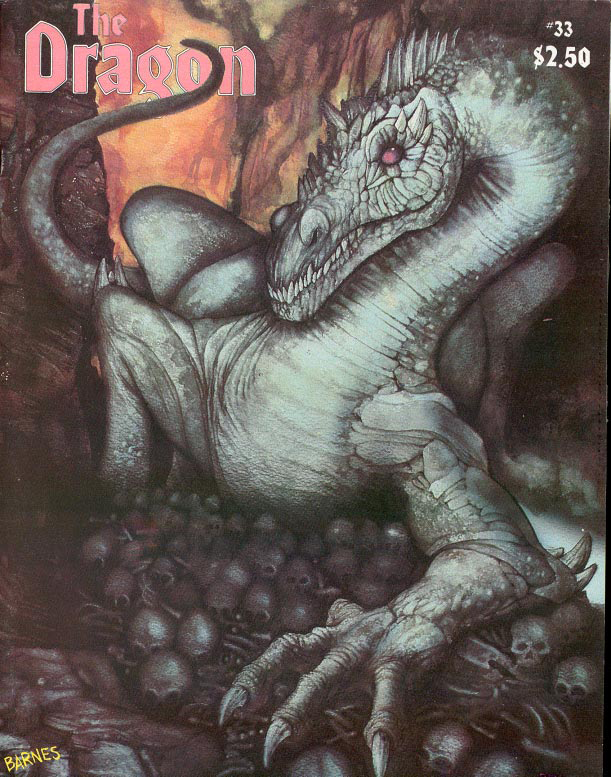
And so we bravely enter the 1980’s (though, again, not technically). The Dragon #33 (we haven’t dropped the “the” yet) welcomes the new decade with “Dragon’s Lair” by John Barnes. The painting won Best of Show and “Best Color Fantasy” awards at the Northwest Annual Science Fiction Festival in Seattle.

What goodies await us inside? Let us find out.

I. Gardner F. Fox

Known best for the Justice Society of America, Fox also wrote fantasy novels later in life, the Kothar the Barbarian series maybe the best known of them, but also Niall of the Far Travels.

Oh, and apparently Guy Gardner was named for him (not sure that was an honor or an insult).

This issue of The Dragon features a short Niall story – the character has appeared in the magazine before. This one is “The Eyes of Mavis Deval”. Here’s the opening:

“It was her eyes that drew his stare as he sat astride the high-peak saddle of his stallion, there on the edge of the huge slave market. They were a brilliant green, those eyes, and it seemed to Niall of the Far Travels as he looked, that there was a tiny flame glowing in each pupil.”

II. Painting Tips

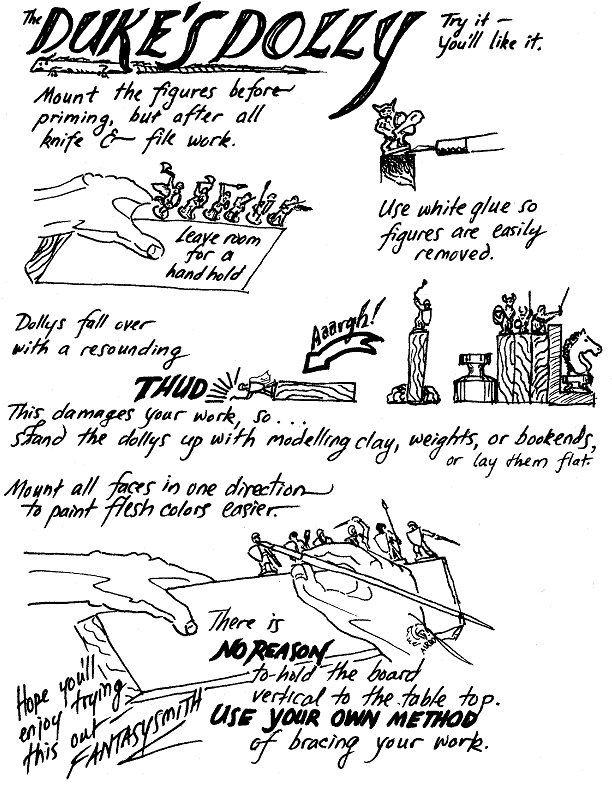
I got into painting Warhammer miniatures back in college, because I had waaaaay too much money and really needed to drain lots of it away on hunks of lead that I don’t look at anymore. So, I know a little (very little) about painting them, and this …

… looks like a darn good idea to me. Presented by Fantasysmith – the person knows his or her stuff!

III. H. R. Lovins, bringin’ the prose

Dig the sprightly prose:

“My friend and I had taken our favorites: a Fighter with rippling muscles, a Cleric of somber colors and mood, a superstitious slinking Thief, and a couple of guardian Magic Users. Unfortunately, someone else was using the back way for a similar evasion. Our leaders turned a corner into a party of a half-dozen well-dressed besworded gents who, not caring to sidle past our group, began to comment acidly on our travel-worn condition, and wonder aloud whether an unpleasant odor was ours, or native to the alley.”

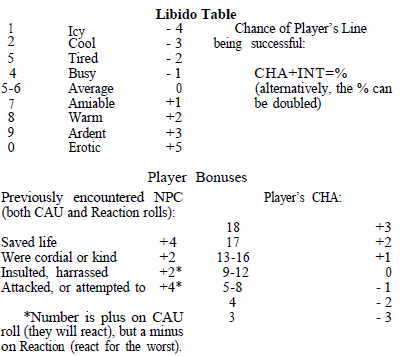
The article is pretty interesting, in the idea of giving NPC’s a Caution (Cau) score. The Caution score is used for two things:

1) The score must be exceeded on a d20 before rolling reaction dice. If not exceeded, the NPC just walks away – no interaction with the players. I kind of dig this – after all, when confronted by a group of murder-hobos, I think most normal folk would get the heck out of there, smiling and making excuses.

2) The Caution score is also used to determine whether an NPC will get involved with a PC – do they throw caution to the wind and take the plunge. Again, you roll d20 and try to exceed CAU. In the case of “woo pitching”, as the kids say, you add the NPC’s Libido score to the roll. Libido score, you say? What’s the Libido score?

IV. Gygax on Magic

“Magic, AD&D magic, is most certainly make-believe. If there are “Black Arts” and “Occult Sciences” which deal with real, working magic spells, I have yet to see them. Mildly put, I do not have any faith in the powers of magic, nor have I ever seen anyone who could perform anything approaching a mere first-level AD&D spell without props.”

Sounds like the religious nuts are already giving him trouble over the “occult” influences on AD&D.

V. Speaking of Magic …

Len Lakofka in this issue is looking at the shortcomings of some of the spells as written, and is making suggestions for improvement. Magic Missile, for example …

“Gary Gygax and I have gone around in a circle on this spell for some period of time. The controversy, in my opinion, lies around the fact that there is NO SAVING THROW and that the missile goes “unerringly” to its target. Why is this so annoying to me? It is unfair because it allows players to foil most opposing spells by putting a Magic Missile into the opposing spell caster, it allows Magic Missiles into melee regardless of the size difference and quantity of ‘friends’ in the melee, and it allows for shots that would amaze Robin Hood with their accuracy!

Gary says that a Magic-User can counter with a simple spell like Shield to prevent this damage. What he overlooks is that the opponent must take a round to cast the Shield and in that time the spell caster is beset by fighters, et al. I find it too unfair to “monsters” that a single FIRST-level spell can be this powerful. Therefore, I have modified the spell in the following ways:

1. There is still no saving throw if the target is surprised, immobile, walking or prone and is at least the size of a Kobold.

2. Figures in melee, figures running (except those running right at the spell caster), figures evading, behind (or moving behind) significant cover, or casting a spell obtain some type of saving throw. This saving throw is their normal one with modification as follows:

A figure casting a spell obtains a s.t., but at -4.

A figure in melee obtains a normal s.t. but adds +1 for every opponent above the first one he/she/it is fighting (unless the size differential is so significant that the opponents do not get in the way—i.e., 6 dwarves against a hill giant would allow the giant a normal s.t. Missiles that MISS their target might hit others in the melee! Select a figure and then give him/her/it a normal s.t. to see if the stray missile hits or misses. In the above example, the dwarves would not be hit. All saving throws are on a missile-by-missile basis. Missiles fire at a rate of 1 every 3 seconds. Thus, a figure moving behind a wall might not be hit by every missile in a barrage of Magic missiles.

A figure with over 50% cover (who then presents a target size of ½ a kobold) always obtains a s.t. of from 16 to 20 depending upon cover and his/her/its actions. This prevents firing through an arrow slit some hundred feet away to hit some poor guard. I have found it necessary to rule in this way to stop Magic-Users from Magic Missiling everything that walks because of the broad language of the spell text. Magic Missile, as written, is too powerful and must be toned down.”

Ladies and gentlemen, I give you rules bloat. The problem, of course, isn’t the DM making the rules he wants for his game. It’s in the opening paragraph:

“I felt that some spells leave a great deal unsaid (or they say too much), and thus individual rulings are often necessary to prevent abuses and to make the game fair and equitable for players and “monsters” alike.”

So what’s wrong with individual rulings?

Well, what was wrong was that the hobby had already grown into two camps. One was playing the game at home, and doing what they wanted with their campaigns. The other was either playing at conventions, and thus needed everybody on the same page, or was playing at home and still believed that everyone needed to be on the same page. I’m a libertarian, so you can guess which side I’m on in this argument.

In Lakofka’s defense, it’s not just about standardization or extra rules. It’s about players being creative with spells, and trying to turn every spell into “instant death”.

VI. No Swords for Clerics

I liked this bit from Lawrence Huss about why clerics may not use edged (or pointy) weapons:

“‘Why, ‘tis as plain as the forbidden pikestaff! The purpose and nature of all edged weapons (and what is a point but a section of an edge?) is to cut, release blood and kill, both in reality and symbolically.

‘The club, mace and flail are but growths of the staff, which stands for guidance and religious authority. Though the end result of the sword stroke and the well-aimed mace blow are the same, the symbolic intent differs. As the High Power judges our acts much from a viewpoint in which symbols supersede particulars, this symbolic difference in intent is of greatest importance, both to the performance of the specifically clerical functions and in the gaining of spiritual eminence.'”

In other words, spare the rod, spoil the bugbear.

Now, some might argue that symbolism is pointless – the enemy is dead. What does it matter that he was slashed or bludgeoned to death?

But we’re talking clerics. Priests. Symbolism is everything!

VII. Old Time Hockey Gaming, Coach!

Did you ever want to see a huge list of Game Masters operating in the U.S. in 1980? Great – this issue is for you. Let’s check out my stomping grounds, Las Vegas NV.

We have Bill Coburn, running D&D, Traveler, Metamorphosis Alpha and general board games, and David Whitney, running D&D, Traveler and general board games.

We’ve seen Bil Coburn in the pages of The Dragon before, writing on the effectiveness of poison back in September 1978. I couldn’t find him online, nor David Whitney. Alas.

VIII. Question of the Month

“QUESTION: There is this character (a Magic-User) being refereed by an inexperienced DM. Because of his lack of knowledge, he let the character advance in levels too quickly. He also has 86 magic items. By the time the character got to 34th level, the DM had learned from his mistakes and proceeded to try to kill the powerful character. He tried a Ring of Transference, and when that didn’t work he hit him with 2000 (100% magic resistant) thieves. Is it within the D&D or AD&D rules for a DM to deliberately try to kill a character?”

Yikes!!!

Runner up:

“QUESTION: Is an invisibility spell cancelled when you fall on your face from tripping either over your own feet or from someone else’s number 13’s?

ANSWER: No.”

IX. The Infancy of Home Computing

This issue has the inaugural article on “The Electrical Eye”, about gaming on computers. I thought the little guide to computer manufacturers was intresting:

Witness Apple corporate HQ just 35 years ago (I think … the actual street number doesn’t show up on GoogleEarth):

Oh, and yeah, they got the address wrong above. It was on Bandley Drive, as confirmed at this article showing the layout.

X. Frosts

The “Dragon’s Bestiary” this month is by Roger Moore – Rogar of Moria. I always like Roger in the pages of the later Dragon’s that I read.

Frosts are “snow pixies” – little buggers that pack a punch. Here’s an adaptation of the stats for Blood & Treasure

Size/Type: Tiny Fey
Hit Dice: 0
Armor Class: 15
Attacks: 1 attack (1d3)
Move: 20′ (Fly 60′)
Saves: F19 R12 W12
Intelligence: High
Alignment: Neutral (with good tendencies)
No. Appearing: 1d6

Frosts can turn invisible at will, but cannot attack while invisible. They can use cone of cold (3 dice) once per day and frost fingers (cold version of burning hands) 2/day – and can use frost fingers while invisible. One frost in six can use freezing sphere once per day. Frosts can also control temperatures within 10 feet.

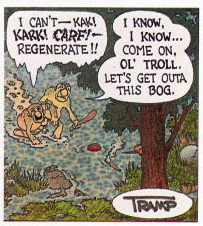
I’ll leave you this fine Sunday morning with some Tramp

Freaky Friday Campaign Idea – The Trees

I’m going to start trying to produce off-the-top-of-my-head, not-well-thought-out campaign ideas on Fridays, from now until eternity (or until I stop, whichever comes first). Today …

THE TREES!

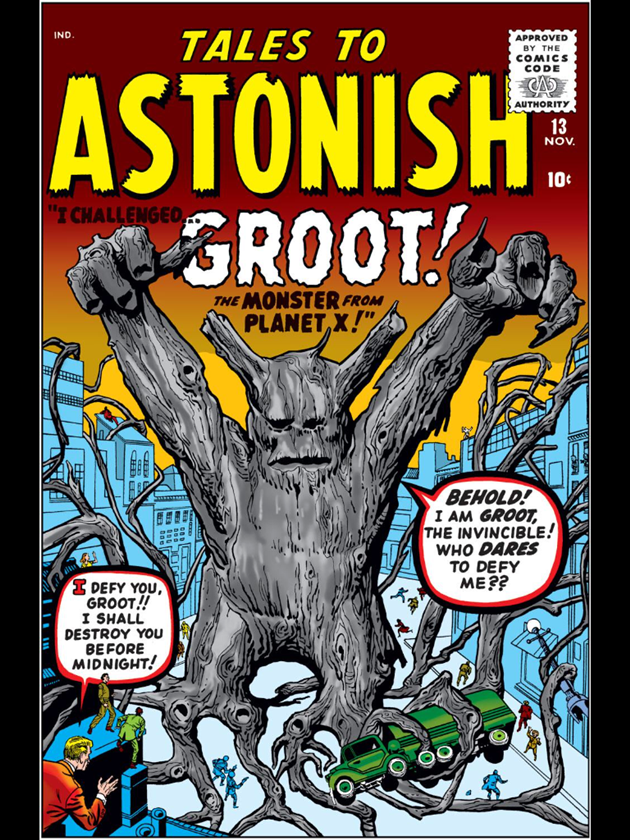
A strange meteor falls from the sky (or a archmage screws up a spell, or Zeus has a fever dream), releasing a bizarre monster (basically Groot, but not the lovable version we saw in our movie houses, but more like the monster from the old comic books … which I never read, and which may also have been lovable) and strange radiations and gases and electricities and vibrations and such. The trees awaken! Everywhere! Billions of them!

All of these trees are treants, and they’re under Groot’s command. Groot is using them to conquer the world. Obviously, wooded areas and elves are hardest hit. The great elven kingdoms perish quickly under a storm of knobby fists and splinters. A few escape the slaughter and attempt to rally the other fantasy races.

The dwarves are besieged in their mountain hideouts.  They’ll try to sit it out … unless the fungi monsters are on Groot’s side as well. Eventually they’ll get hungry, though, and have to grab their father’s axes and get down to business.

The halflings are attacked by their own orchards (“Are you insinuating my apples aren’t everything they’re supposed to be?”). Humans deploy crack squads of lumberjacks (and the Spanish Inquisition, because, obviously trees expect them least of all), but they’re outmatched by all those damn treants and people are forced into deserts … unless they are the kinds of deserts with cacti ! They’re also trees! Spiked treants who are super good at retaining water! Ye Gods!

Do the treants have allies – heck yeah! Assassin vines, those other vines that make people into zombies, various animated shrubbery … well, plant monsters in general. Maybe dryads chuck in with their new mobile homes as well (damn tree-huggers). Nymphs have always struck me as a bit shifty. They become the Mata Haris of the Arboreal Invasion.

Obviously, the key to survival is to get to Groot and destroy him, and that means … a party of oddball murder hobos. Help us, player characters, you’re our only hope!

Dimensional String Theory

Via Wikipedia

Long-time fantasy gamers get the idea of “planes”. Each plane is its own reality, and it connects in some fashion with other planes, and they’re mostly just where high level characters go to kill things and steal their stuff. Simple enough.

How about we swap out planes for strings.

[Disclaimer – I don’t know anything about actual string theory. I’m just stealing a term because it sounds cool and kind of fits this conception of planes and dimensions in fantasy games]

No, the elemental plane of fire won’t look like a tightrope – it will still be an endless reality of fire and efreet. But it will functionally be a string, as will all the other planes. Dozens of planes, as strings, crisscrossing the multiverse and, at certain points, touching.

At a planar nexus, the reality of two planes (or more) are combined, forming a little pocket dimension (perhaps a planet) that combines the aspects of the planes that are connected. So you might have a plane that combines Elemental Fire with Chaotic Good, or a plane that combines Shadow with Water. Maybe the Astral Plane is where all these strings are located – and maybe when traversing that plane you can accidentally hit a string and find yourself in another plane. The Ethereal is just the blurry edges of the vibrating Material Plane, and can be a passage to these “nexus points” that interact with the Material Plane.

Maybe the Material Plane is just a nexus point between all the different planes of reality?