Hellcrawl! – Abaddon Preview 3

One month. Thirty days. I’ve spent thirty days trudging through the third circle of Hell, the circle of gluttons that is, by Dante’s description, a giant sewer in which the damned souls lie on their backs in the raw sewage, mouths open, catching new sewage as it falls like snow from the sky. Yuck. Glad to be done with it!

Over the weekend, I not only finished Abaddon (well, 90% finished, still need to add monster stats and edit), but converted another chapter of Rappan Athuk (this baby is going to be big – and very cool) for the Frog God, edited Space Princess (I’m starting to really dig this one – it’s all falling into place nicely), did some more work on Blood & Treasure (primarily the re-laying out the monster chapter and adding bits of art) and got in a few updates to my Google + play-by-post games. One party in the Nod hex crawl has ventured outside Ophir, the other is looking for a wizard to check out their magical frog; meanwhile, in the Mystery Men! Dark Renaissance campaign, three heroes are preparing to join battle in a cellar in the hills of Mexidor while the others have discovered Nazi flying saucers hidden in a subterranean base in Greenland.

On to the preview …

29.40 Silk Pavilions: Hundreds of tattered silk pavilions flap in the breeze here. The ground is solid here, and about six feet above the surface of the sludge, and is littered with broken arrows and bolts. Each pavilion is inhabited by a single female shade, their grey skin painted with mauve and white paint and their bodies clad in skimpy costumes composed of copper coins (100 cp each). These shades (there are 100 in all) are completely silent, and when they discover intruders they approach warily and begin dancing and cavorting about, trying to lure them into their pavilions. Those who enter the pavilions discover a warm, comfortable space, dimly lit, with velvet pillows and silver platters of dumplings, croquets and other foods. There are flagons of wine and the sound of silver chimes. Any person that disbelieves this feast will “see through it”, seeing nothing but wooden platters of rotten food, soiled pillows, etc. In fact, the food and comfort is real, but only lasts a single night. In the morning, the pavilions and their weird inhabitants have disappeared.

30.80 Cloaca: A low, flat plain of mud covered with rotting vegetation and shed scales and teeth is punctuated by a large fort of mud ramparts topped by a picket of rotting timbers. The fort is occupied by 400 stout, black ratlings with long snouts and wearing tattered loincloths.

The ratlings hate and fear everything that isn’t a black ratling wearing a tattered loincloth. They survive on the rotting vegetation and by hunting. Their village is collection of shanties constructed of driftwood and bits of stone, brick and metal. The village is dominated by a large, round tower of chipped red brick. The tower has no roof and contains a deep pit in which lived the slumbering form of Cloaca, a titan of sewage who acts as a patron of rats, ratlings and otyughs.

The ratlings are currently gathered before their “temple”, their high priest Urdish is leading in them in wild chanting while a feast of captured adventurers is being prepared over open fires. One of the adventures, a magician named Gonda has been saved, for she is sought by Cloaca. Cloaca has long dallied with both Beelzelbuth and Jubilex, playing one off the other. Gonda has caught her intention because she is currently carrying the cambion son of Jubilex in her belly, on her way to deliver him to a waiting cult.

35.26 Bone Market: A village of 100 painfully thin goblins with turned up noses and rheumy, dripping eyes run a bone market here. Their village is constructed of bits and pieces dragged out of the sludge. It rests on a muddy flat punctuated by noxious herbage. In the middle of the village there is a square in which dozens of little tents and booths have been erected selling every kind of bone imaginable – assume a gold piece cost equal to a tenth of the original owner’s XP value. In the center of the square the goblins keep a large kettle ever on the boil, making a thin, greasy soup using some of their precious bones.

Each of the goblin houses has a trapdoor in it that leads to a stark chamber with spiked walls located well beneath their village. Here, they keep instruments of torture and yet another kettle for stripping the flesh from bones. Beware an invitation to enter one of those homes and share some tea and biscuits.

37.86 Cursed Causway: When folk enter this hex, they see a brick causeway 10-ft. wide rising from the sludge and pointed in whatever direction the party is traveling. The causeway rises at a gentle slope, but after 3 miles it is about 60 feet high. At the mid-point of the hex, the causeway stops. When people turn back, they discover that what was behind them has faded away, leaving them with no more than 40 feet worth of causeway. It is at this point that the flock of twelve erinyes attack, trying to grasp people and carry them to the dungeons of Mammon in the fiendish city of Dis (see NOD 14).

41.28 Forest of Rusty Poles: This hex is devoid of large islands of debris, but it filled with hundreds of long, rusty poles. One of the poles in sight of the adventurers has a red scarf tied to it. There is another about 50 feet away, and so on, leading those who follow them on a pointless journey through the hex. There is a 1 in 6 chance per hour that the adventurers come across a strange woman balanced atop one of the poles on one knobby-kneed leg.

The woman is called Geirl, and she is a rather strange entity. She beckons people to climb her pole and speak with her in hushed tones, promising them one wish – anything, including escape from Hell – in return for killing one of their companions and delivering their heart to her.

Image from Wikipedia

Hell Hexcrawl – Abaddon Preview 2: Death Temples, Diggers and Wailing Infants

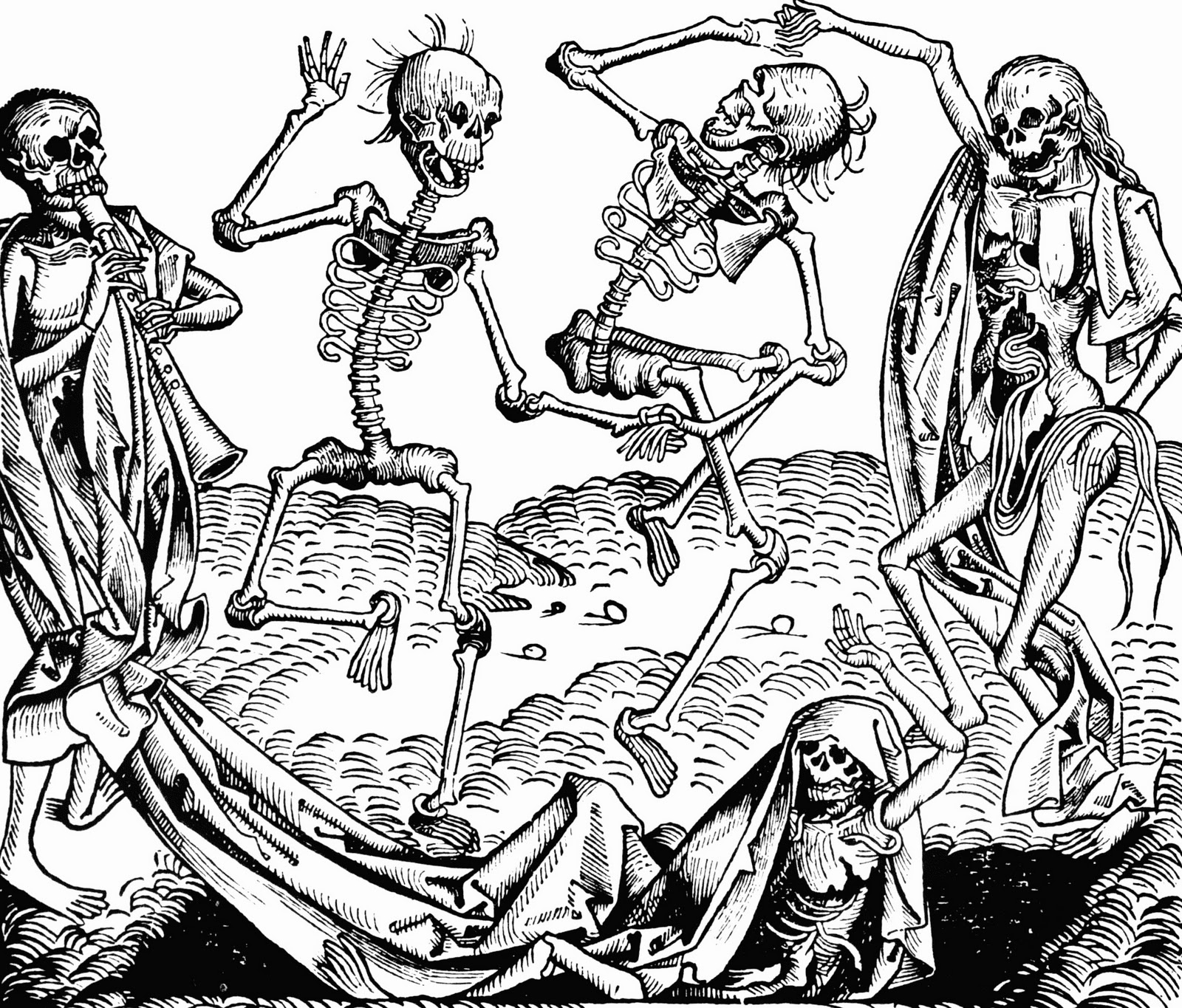
20.59 Death Temple: A low, round hill rising from the muck here is covered by giant mushrooms. The mush-rooms grow around and through dozens of humanoid corpses, rotting timbers and rubble. Rising above these mushrooms there is an ancient temple of cracked and stained stone dedicated to Death itself.

The temple consists of an antechamber filled with murky water to a depth of three feet. This water is home to a sewage water weird. Beyond the fetid pool there are tarnished bronze doors decorated with hundreds of tiny skulls that appear to have been embedded in the door and then covered with a layer of bronze. Opening these doors without removing a trap causes the floor under the pool to collapse, sending the water and the characters into a deep pit that connects to the secret sanctum of Death below.

Beyond the doors lies the inner sanctum, where stands the great bronze idol of Death, covered in verdigris, eyes downcast, hands gripping a scythe. The idol is surrounded by several large hepatizon bowls holding rotting fruit and tarnished copper and silver coins (about 300 cp and 100 sp) and twenty grimy jars filled with greenish liquid (50% chance of a strong liquor, 50% chance of acid). A secret door in the inner sanctum leads to stairs that descend 50 feet into the earth, to a subterranean abbey.

The abbey is home to twelve priestesses (Clr3) and their mother superior, Mergsta (Clr10; 31 hp; potion of healing). All of them women have had the skin flayed from their backs (each carries a bloody scourge), and wears nothing but a long, black loincloth and a string of pearls wound into their hair (worth 50 gp each for the priestesses, 300 gp for Mergsta). Besides their scourge, they are armed with heavy maces. Their abbey consists of several living chambers, a pantry of unpalatable, rotting food, a large dining chamber decorated with soiled tapestries and bunches of sickly purple mushrooms growing from the walls and a secret sanctum.

The secret sanctum holds a smaller idol of Death carved from black marble and garbed in the same manner as the priestesses. The back of this idol is hollow and contains the Codex of Saint Death, which permits anti-clerics who read it daily to cast one additional evil or reversed spell of each level open to them per day, and a single large ruby worth 15,000 gp. Mother Superior Mergsta reads from the codex daily.

Those who touch the idol without first supplicating themselves to it have their backs break out in painful welts that soon burst open (per a cause serious wounds spell). Removing the ruby from the secret sanctum causes a swarm of biting flies (i.e. insect plague) to be summoned to defend the idol.

21.56 Diggers: Ten skeletal trolls scrape at the sides of a rocky hill with little progress. Inside the hill, behind a cave-in, there is an evil +3 longsword called Himon. Himon has a reddish blade and the pommel is set with a cluster of tiny rubies. The sword sheds darkness in a 10-ft. radius but allows the wielder to see through it. The sword can also animate up to 20 HD of creatures it has killed – the troll skeletons are its servants, and they are attempting to unbury it. Its former owner, the reaver Vigon, lies dead underneath all of the rocks. He entered the cave to avoid a pack of demon dogs.

22.62 Pitted Statue: The remains of a giant iron statue – humanoid, but unrecognizable – stands here, overlooking a vast miasma of waste in which float hundreds of wicker baskets containing wailing infants (glamered madragoras). A tribe of winged kobolds flit around the statue, gnawing at the metal (for metal is their only source of nutrition). The kobolds prefer precious metals, and can devour up to one pound of the stuff before they are sated. For every pound of precious metal brought into the hex, there is a 5% chance of an encounter with 3d6 of the kobolds.

Hell – Abaddon Preview 1: Overview

The wind and rain swept circle of Erebus gradually gives way to Abaddon. Unlike the mile high clffs that separate Asphodel and Erebus, the border between Erebus and Abaddon is a more gradual, though slippery, slope.

In Abaddon, the constant rain of Erebus becomes slowly falling flakes of snow. This snow, unfortunately, is not pristine and white, but rather raw sewage in snow form. These putrid flakes fall from the sky and collect between great hills in the form of slush. The slush is rarely more than a foot or two deep, though sometimes it hides deeper pits that are home to otyughs. In places, these slowly moving rivers of sludge are clogged by bulrushes.

Mulling through this sludge are the damned souls of Abaddon. No longer shades, they have been transformed into great, bloated humanoids with faces suggesting swine. These swine-things roam through the muck, rooting in it for bits of more solid waste, which they devour as though it were truffles or some other fabulous viand. The swine-things are slow moving and pay little attention to folk unless they catch the scent of food or drink. They mostly serve as prey for the devil dogs that roam Abaddon.

The hills of Abaddon are not much better. They are slick and slimy in some places and covered with growths of stinkweed, stinking wattle, black horehound, poison hemlock, thorn-apples, devil’s dung, stink grass, skunk cabbage, wild mandrake, chokecherry and poisonous sumac. Amidst the mud and the plants there are great heaps of broken crockery and glass and rusted tools and weapons – all irreparable and long forgotten. Most of these hills are inhabited by the Abaddonites.

Miasma of Entropy
Abaddon is not just disgusting, it is catching. A miasma of entropy covers this circle, affecting everything unfortunate enough to have entered it.

Each living being traveling in Abaddon must pass a saving throw each day or succumb to a disease (see below). This save must be made each day, with a new disease being added to the victim’s repertoire each time they fail.

Objects must likewise save each day or fall into disrepair, as if by magic. Each time armor fails a save, it’s armor value is reduced by one. Armor with a value of +0 simply falls apart. Weapons have their damage dice reduced by one size (i.e. 1d10 to 1d8, 1d8 to 1d6, 1d6 to 1d4, 1d4 to 1d3, 1d3 to 1d2, 1d2 to 1, 1 to 0), with the weapon falling apart when its’ damage potential falls to 0. Glass and stone items become dirty and grimy, cloth items become frayed, then tattered, then useless, metal items become tarnished or rusted, then pitted and then useless, etc.

Characters that dawdle too long in Abaddon may soon be naked, weaponless and wracked with disease.

Races of Abaddon
Abaddon, like most of the other circles of Hell, is not only inhabited by pitchfork-carrying devils and their victims. Three races known to people of the surface world dwell in Abaddon, though these races have been changed in many ways by their habitation in Hell.

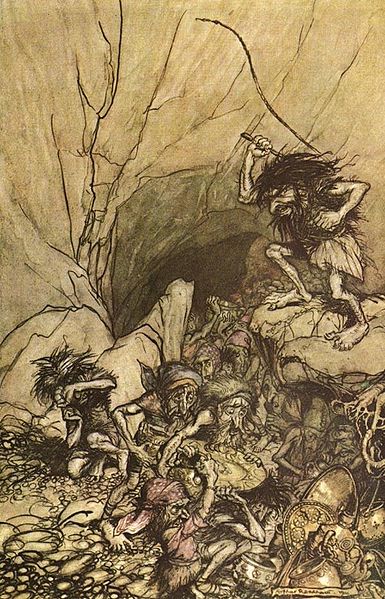
Goblins: The goblins of Abaddon are scurrilous little squabs with fat, red faces and gleaming white eyes. They are junk collectors who carry large packs filled with all manner of useful and useless items. Any tool they have that is in working order is bound to carry some manner of curse. Abaddonite goblins have acidic saliva and, once per day, can summon and command 1d12 giant rats.

Orcs: Orcs, being creatures of gluttony, are eminently suitable for Abaddon. The orcs of Abaddon have piggy faces and grotesque, bloated bodies. Their skin is pale and blotchy and their eyes are pink. Abaddonite orcs are immune to disease and poison and have the paralyzing touch of ghouls (save at +3 to negate). When they paralyze or fell a foe, they usually fall to devouring them.

Troglodytes: Like the troglodytes of Nod, the troglodytes of Hell dwell underground, burrowing into the muddy hills and the bedrock beneath them. They have bilious green scales and fan-like crests that run from head to tail. The odor of the troglodytes of Abaddon is so foul that those within 10 feet of them not only suffer the normal penalty but also fall to vomiting until they pass an additional save, which they may attempt once per round.

Lords of Abaddon
Abaddon is ruled by Beelzebuth, who takes the form of a great fly. He sits at the center of all the intrigues of Abaddon and many of the intrigues of Hell as Lucifer’s chief rival and most bitter enemy. Under his dominion are the lords Demoriel and Behemoth (who is usually away from his domain in Abaddon serving as butler in the palace of Lucifer in Dis). The primal demon lord Jubilex also dwells on Abaddon, though he pays no tribute to Beelzebuth. The terrible three-headed hound Cerberus also roams Abaddon.

Blood and Treasure Playtest + Google+ = NOD CAMPAIGN

A couple posts ago I mentioned the idea of doing a Google + campaign set in Nod using all those hex crawls I’ve written. I’ve also been thinking about the eventual need for Blood and Treasure playtesting. So … it took me this long to realize I could be doing both at the same time. If enough people are interested, I’d love to stage the hex crawling with multiple parties at different skill levels. So – let the call go out far and wide that the recruitment has officially begun. If you would like to be involved, you need to meet the following requirements:

1) Be on Google +

2) Email me (my address is next to my picture in the column to the right) or leave a comment here stating you would like to play. If you leave a comment and I can’t find your email address or find you on Google +, you’re officially out of luck.

Character generation will be as follows …

1) You contact me letting me know you want to play. I’ll send you a streamlined version of the character creation chapter – all the basics on races, classes, buying equipment, etc. You will have the following races and classes open to you:

Races: Human, dwarf, elf, gnome, halfling, half-elf, half-orc

Classes: Assassin, Barbarian, Bard, Cleric, Druid, Duelist, Fighter, Magic-User, Monk, Paladin, Ranger, Sorcerer, Thief.

As the game proceeds and characters are killed, I’ll open up some of the monster races to play – aasimar, centaurs, tieflings … that sort of thing … so they can be tested as well.

2) I hook up with you on Google + and send you a randomly generated set of ability scores using the 3d6 method. You can arrange them as you like and let me know the class and race you want to play, what equipment you want, etc. I’ll review and make sure everything is correct.

Once we have a crop of characters, I’ll organize them into parties (or party, depending on how many people are interested). I’ll also randomly assign people a number of XP and thus a level – this allows me the opportunity to test different levels and the overall deadliness of the system.

Once the parties are organized, I will start them out in a city-state with two or three random rumors and then you’re free to do whatever you want. The game will be a picaresque – no major earth shattering quest and storytime, just a bunch of ne’er-do-wells roaming about the countryside getting into trouble and trying to make a name for themselves.

Play will be “play-by-post”  like the Mystery Men! game I’m currently running, so you don’t need to set aside a particular time to play. I wish I could do some face-to-face video chat stuff, but my schedule makes that difficult.

If you’re interested, let me know!

Image from Thomas Haller Buchanon’s blog The Pictorial Arts. Check it, Nodsters.

Hell South – Final Preview – Palace of Minos

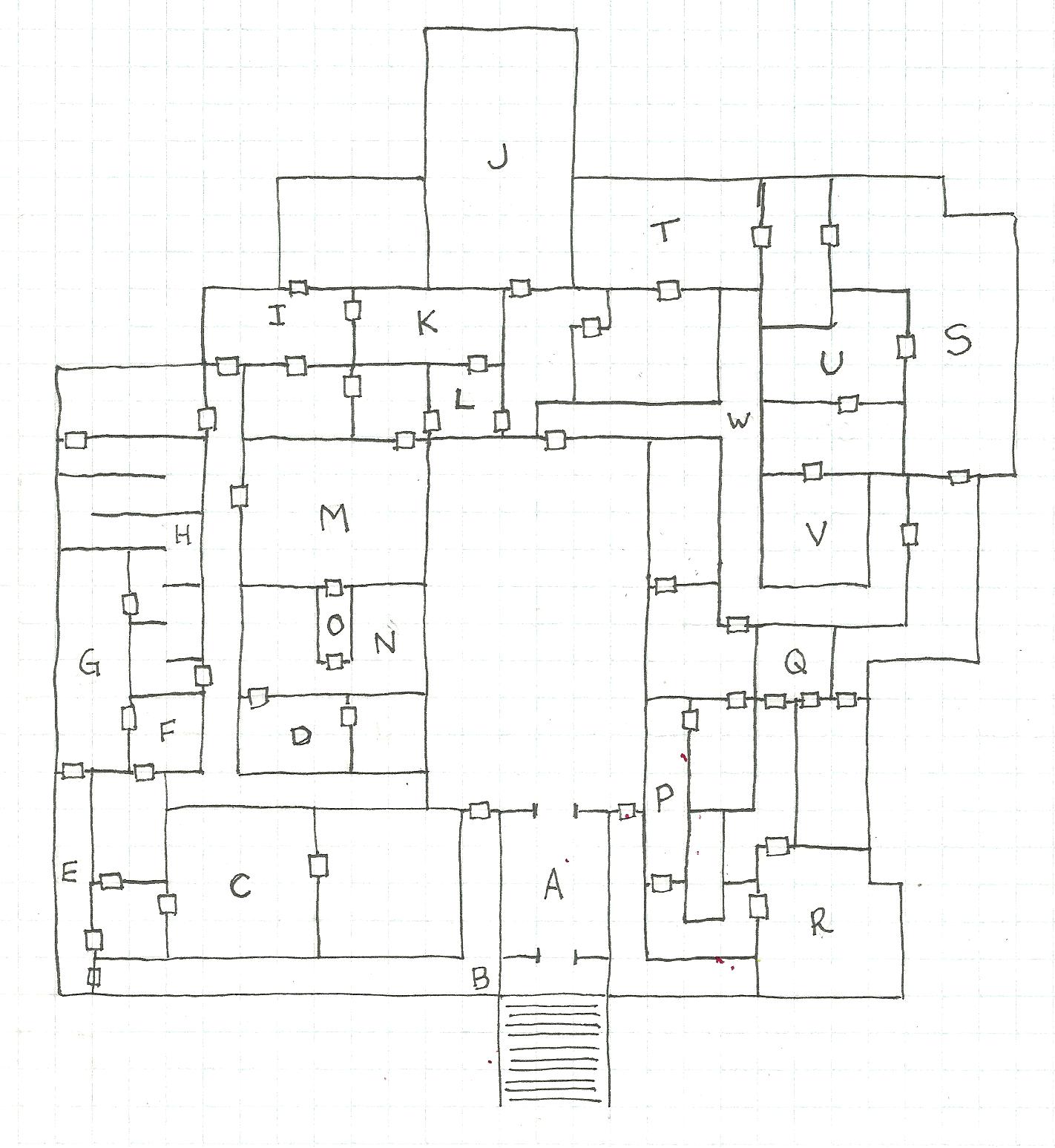
For those not up on their lore of Hell (or Dante’s Inferno, as the case may be), Minos (former King of Crete, had a bull-headed stepson) is the judge of damned souls in Hell. His brothers show up sometimes as well, but Dante just uses Minos and I went that route as well. Minos is an interesting character – son of Zeus and Europa (remember – that’s the one where Zeus masqueraded as a white bull to carry her away – bulls are a running theme for Minos), marries Pasiphae, the daughter of the titan Helios and an Oceanid named Perses. This means that Minos and Pasiphae are both, in Nod reckoning, titans. That was fun to play with.

Anyhow – Minos judges damned souls and decides which ring of Hell they should spend eternity being punished on. He also guards the narrow stairs that lead from Asphodel (ring #1 in Nod’s Hell cosmology) to Erebus (ring #2), so PCs adventuring in Hell will probably have to go through Minos if they ever want to escape. Presented below is a map of his palace, a mini-dungeon in the game that is based very loosely on Minos’ actual palace on Crete. Enjoy!

It was meant to be maze-like without really being a maze. The un-drawn dungeons below hold a labyrinth, of course, inhabited by Asterion, the original Minotaur – a rough customer to be sure. Oh – and the cover for NOD 12, which will be published a bit later today …

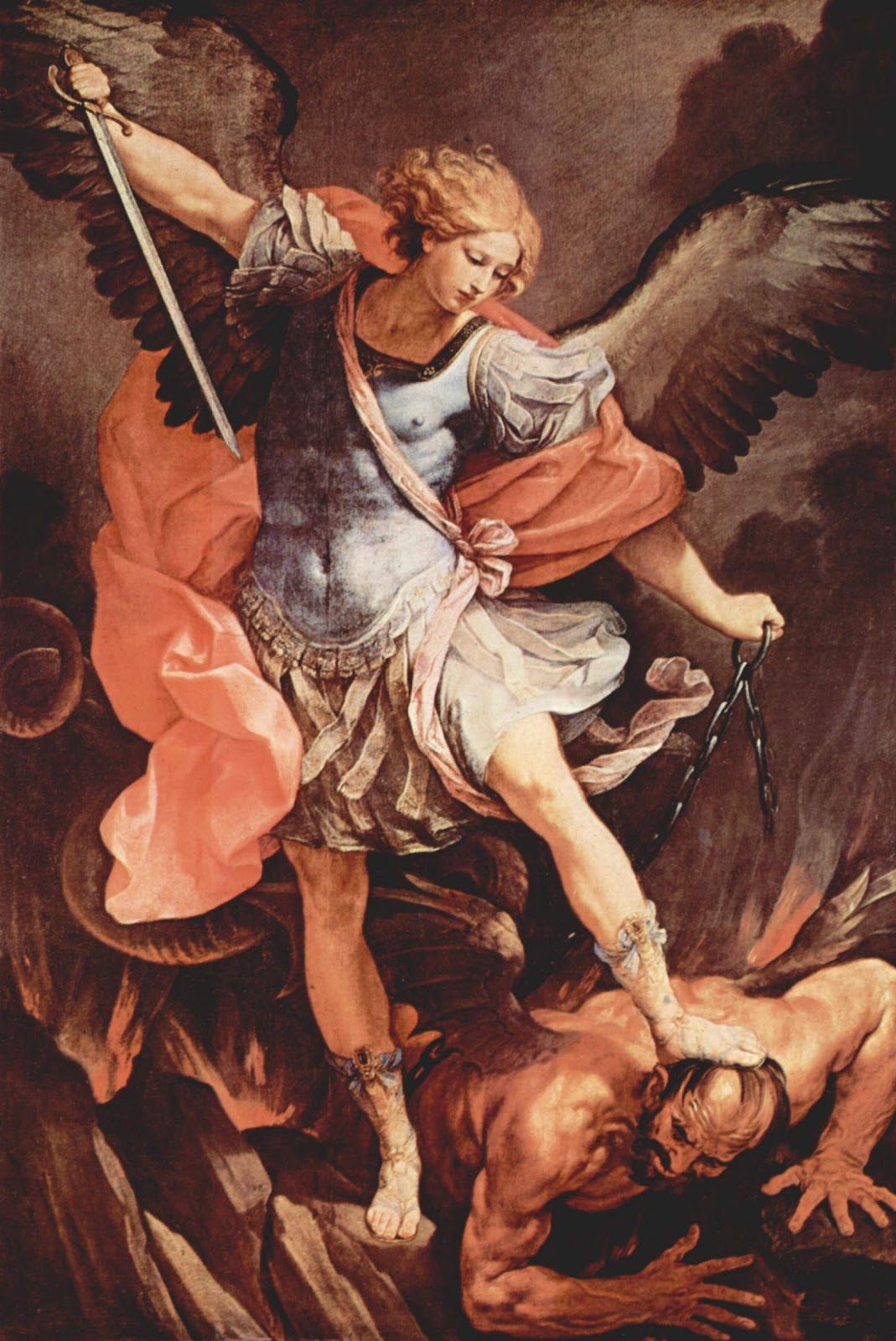
The Archangel Michael in action by Guido Reni (1575-1642).

Hell South – Preview 10 – Breezy Books and Sheva’s Chariot

Finishing up NOD 12 – just a bit more work to be done on the hex crawl, then writing the OGL page – always takes a while due to all the critters from the Tome of Horrors that show up. Anyhow – a few more locales for you to preview …

40.97 Breezy Book: A skeleton lies in the grass here. The skeleton has a crushed skull and ribs and is wearing a robe of damask silk and a tasseled hat. The skeleton has two gold teeth (fangs, actually), a silver dagger on his belt and a leather pouch that holds his spellbook.

The spellbook has a wind walker trapped within it. The wind walker’s presence makes it impossible to read the spellbook, for the pages are whipped around violently, as though in a high wind. Attempting to handle the book carries with it a 2 in 6 chance per minute of ripping some pages and ruining one of the spells contained within. Naturally, the highest level spells are ruined first.

Spells: 1st – Detect magic, hold portal, magic missile, read magic, sleep; 2nd – darkness 15-ft. radius, ESP, knock, magic mouth, strength; 3rd – darkvision, haste, protection from normal missiles, rope trick, slow; 4th – extension I, ice storm, plant growth, wizard eye; 5th – cloudkill, magic jar, passwall, wall of stone; 6th – enchant item, invisible stalker, repulsion; 7th – monster summoning V.

51.101 Chariot: Having been driven from his lair on a deeper level of Hell, the lich Sheva of the Silver Hair has wandered Asphodel on a chariot pulled by two giant hyena. She has ever sought to build a network of alliances based on favors and threats that might return her to her lair, currently inhabited by the efreet Nabeel in the metallic desert of Gehenna. Many secrets are held in her lair, secrets she must reclaim to advance her grander schemes. Sheva’s phylactery is hidden within the tombs that circle the pit of Tiamat [57.99].

67.105 Skeletal Harpies: Nine skeletal harpies are roosting in a grove of trees here, nibbling at the sour fruits that hang there. The fruit look like human hearts, and have a pulpy, acidic flesh. The harpies really hunger for human flesh. Each time they score 5 or more points of damage with a bite attack on a humanoid, a layer of musculature covers their bones. When they have scored a total of 35 points of damage, they reform as true harpies, with all the powers and abilities of such creatures.

86.96 Lake of Sorrow: A long, narrow lake sits here on the savannah, surrounded by a thick tangle of briars that bear fragrant black roses. Bubbles rise and pop on the surface, bringing with them the sounds of sighs, moans and cries that hang over the still waters. The water of the lake is intoxicating, leaving people in a deep melancholy and unable to summon the will to do anything for 24 hours other than defend themselves. At the end of the 24 hours, they must pass a will save to keep from drinking again.

97.91 Double Trouble: The land descends into a series of interlocking canyons here. The canyons are barren of life, with grey, rigid, angular sides. Once per day, a chill wind begins to blow, tussling hair and tugging at clothes. It grows stronger, and soon forms small whirlwinds that combine to form larger whirlwinds that glow with a pale, cheerless light. Assume each character has a 1 in 6 chance per turn of being touched by one of these whirlwinds. The whirlwinds only last about for one hour (6 turns).

Any person enveloped by a whirlwind emerges unscathed, but with a double intent on murdering his “comrades”. The player has a 50-50 chance of playing either his own character or the double, and only he will know which character he now plays. The character and his double cannot harm one another – any attempt to do so meets with failure and crushing pain (6d6 points of damage) for the instigator of the violence.

Image found HERE 

The Queens of Elemental Earth

This idea popped into my head today, so I explored it a bit.

The primal earth has produced many wonders, but none so lovely (and few so powerful) as the so-called Queens of Elemental Earth. These five sisters are worshipped as goddesses by many of the folk who dwell beneath the earth and are honored by all elemental earth creatures.

The queens look like astoundingly beautiful statues of women in their natural state. They are translucent and gleam with an inner light that produces a magical aura. Within their eyes dance shimmering motes of light that affect all upon which they train their gaze. They dwell in luxurious palaces beneath the ground, served by lesser elementals and fey creatures.

While the queens are ground in neutrality, with some preference for order (i.e. Law), they are, as one might expect, possessed of a very keen appreciation for the wonder that is them. They do not like to be disobeyed or their intentions and desires frustrated, and they have no qualms about destroying lesser creatures that get in their way.

All of the queens can move through rock, stone and soil as easily as a human moves through the air. They suffer half damage from all attacks from manufactured and natural weapons.

Adamantia
Adamantia is Queen Diamond. She has a smooth body of translucent crystal with inner reflections of pink. Adamantia is the strongest and most durable of the five sisters, and she is unforgiving in her disdain of imperfection and muddled thinking. She is always under the effect of a true seeing spell and a zone of truth. She is worshipped as a goddess of clarity, truth and perfection. Her stronghold is a fortress of gleaming adamant, with every surface stark white and lit by a soft, pinkish-white glow. Her court includes elemental earth creatures as well as entities of Law and a host of human paladins that have declared her the focus of their courtly, chaste love.

Adamantia produces an aura of truth (see zone of truth above) that also acts a protection aura against chaotic creatures (per protection from evil, 10-ft. radius). Her gaze acts as a hold monster spell.

Adamantia can cast the following spells as innate abilities: At will – charm person; 3/day – break enchantment, charm monster, cure disease, dispel magic, haste (self), invisibility; 1/day – dimension door, ray of enfeeblement, strength, suggestion, wave of exhaustion. She can also cast spells as a 10th level cleric.

Adamantia: HD 21; AC -7 [26]; Atk 2 strikes (4d6); Move 36; Save 3; CL/XP 30/7400; Special: +2 or better weapon to hit, aura, gaze, earth glide, half damage from all weapons, suffers double damage from sonic attacks, immune to fire, resistance to cold (50%), magic resistance (65%), regenerate 3 hp/round.

Rubinia
Queen Ruby, Rubinia, is composed of a translucent red substance. Her hair (though it is merely sculpted on her head) appears wild and unkempt and her eyes gleam with power. She is worshipped as a goddess of fire and passion and strength. Her court includes elemental earth creatures as well as exiled or rebellious elemental fire creatures. Her stronghold is enclosed in a ruby sphere with spherical chambers that look like bubbles within the sphere and connected by curving tunnels that radiate out from her central court. Gravity is completely relative within the sphere, with people able to walk on all surfaces.

Rubinia produces an aura of weakness (10-ft. radius) that forces people to pass a saving throw or be affected per a ray of enfeeblement. Her gaze forces people to pass a saving throw or be enraged (per the emotion or rage spell, depending on which version of the grand old game you play). Enraged folk never turn their anger upon Rubinia or her servants. Her touch ages people as the touch of a ghost.

Rubinia can cast the following spells as innate abilities: At will – augury; 3/day – charm person, divination, dispel magic, haste (self), invisibility; 1/day – dimension door, flame strike, heal, heat metal. She can also cast spells as a 10th level magic-user.

Rubinia: HD 21; AC -6 [25]; Atk 2 strikes (4d6); Move 36; Save 3; CL/XP 30/7400; Special: +2 or better weapon to hit, aura, gaze, earth glide, half damage from all weapons, suffers double damage from sonic attacks, immune to fire, resistance to cold (50%), magic resistance (55%), regenerate 3 hp/round.

Esmeraude
Esmeraude, Queen Emerald, is the most sensuous and beautiful of the sisters, possessed of a green, healthy glow and a warm, though unyielding, touch. Her stronghold is a paen to love and romance, being a series of limestone caverns with jade pools, rushing streams, laughing waterfalls and gardens of flowering trees, ferns and flowers. Her court consists of elemental earth creatures, nymphs and dryads.

Esmeraude radiates an aura of blinding beauty (per a nymph) and her gaze stuns creatures for 2d4 rounds. Her kiss can grant magic-user’s the effects of a mnemonic enhancement for 24 hours, but also imbues upon them a geas that they must visit her once per year and serve her faithfully for one week.

Esmeraude can cast the following spells as innate abilities: At will – cause blindness; 3/day – cure blindness, cause fear, dispel magic, haste (self), invisibility; 1/day – charm monster, dimension door, entangle, plant growth, suggestion. She can also cast spells as a 12th level druid.

Esmeraude: HD 21; AC -5 [24]; Atk 2 strikes (4d6); Move 36; Save 3; CL/XP 30/7400; Special: +2 or better weapon to hit, aura, gaze, earth glide, half damage from all weapons, suffers double damage from sonic attacks, resistance to cold and fire (50%), magic resistance (55%), regenerate 3 hp/round.

Amethysta
Queen Amethyst appears as a woman of translucent purple crystal accompanied always by three legendary panthers with purple-black fur. She is a queen of dreams who commands a court of elemental earth creatures, succubi and illusionists. Her court is held in a palace of mottled purple walls set in a maze-like layout, with many secret chambers where visitors can rest themselves on comfortable beds stuffed with celestial goose down and sleep under silk and satin, perhaps never to wake again.

Amethysta produces a purple aura of slumber (as the daze spell) and her gaze causes confusion. Those struck by her, even lightly, must pass a saving throw or fall into a deep sleep. She can deliver a kiss that drains levels per a succubus.

Amethysta can cast the following spells as innate abilities: At will – sleep; 3/day – cause fear, dispel magic, haste (self), invisibility; 1/day – dimension door, dream, nightmare, phantasmal killer, poison. She also casts spells as a 10th level illusionist.

Amethysta: HD 21; AC -5 [24]; Atk 2 strikes (4d6); Move 36; Save 3; CL/XP 31/7700; Special: +2 or better weapon to hit, aura, gaze, earth glide, half damage from all weapons, suffers double damage from sonic attacks, resistance to cold and fire (50%), magic resistance (45%), regenerate 3 hp/round, life drain.

Zaffira
Zaffira is a bubbly, almost giddy queen of sapphires. She appears as a beautiful, young woman with translucent blue skin, her eyes like star sapphires and her hair tumbling like cascades of water down her back to her ankles. She dwells in a floating palace of sapphire walls and misty, damp halls occupied by elemental earth creatures as well as sylphs and other exiled air creatures and giant eagles. Zaffira is worshipped as a goddess of innocence, truth and courage.

Zaffira produces an aura of euphoria. Folk who enter it must pass a saving throw or be calmed, losing all desire to commit violence or even engage in argument. Her gaze causes people to break into uncontrollable laughter (per the spell).

Zaffira can cast the following spells as innate abilities: At will – hold person; 3/day – cause fear, discern lies, dispel magic, haste (self), invisibility; 1/day – globe of invulnerability, mark of justice, ray of enfeeblement, resilient sphere, strength. She also casts spells as a 12th level cleric.

Zaffira: HD 21; AC -6 [25]; Atk 2 strikes (4d6); Move 36; Save 3; CL/XP 23/5300; Special: +2 or better weapon to hit, aura, gaze, earth glide, half damage from all weapons, suffers double damage from sonic attacks, resistance to fire and cold (50%), magic resistance (65%), regenerate 3 hp/round.

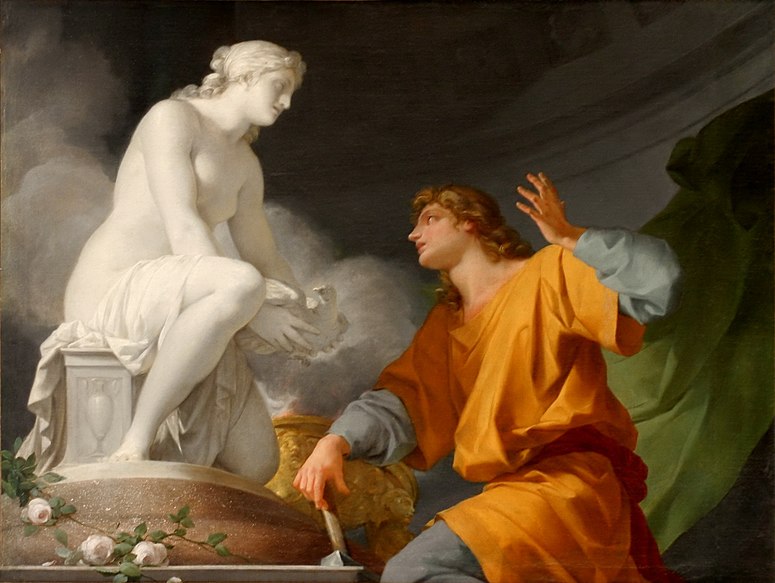
Image found HERE. Painted by Jean-Baptiste Regnault (1786).

Hell South Preview 9 – Oedipal Shrines and Anesthetic Jellies

15.70 Overturned Wagon: A wagon with chipped and faded anatomical drawings on the bulging sides and large, solid, round wheels has overturned here. There doesn’t appear to be anyone present. Jars of preserved organs and hands fill the wagon. The jars are uncommonly thick and sealed with wax, and none of them are broken. The jars contain about 15 hearts, 20 livers, 5 gallbladders, 3 spleens and 30 hands – determine the source randomly. The body parts are preserved in a weird, anesthetic jelly that, when the jars are opened, turns out to be alive. These oozes feed on warmth, draining heat from their victims.

ANESTHETIC JELLY: HD 3; AC 9; Atk 1 touch (1d6 cold + numbness); Move 9; Save 14; CL/XP 4/120; Special: Body parts touched become numb and useless if save is failed, if deals 6 points of damage, it doubles in size.

19.78 Rebellious Garrison: There is a fortress of dark gray stone, stained with bird droppings and shaped like a cube with only a faint arched line on the bottom of one side indicating a portal, overlooking the gray-green grasses here. The fortress is 40 feet tall, wide and deep, and thorny vine (assassin vines) cling to the corners of the cube, some of them reaching as high as 30 feet. A company of vulchlings stand atop the fortress, cackling and throwing spear ineffectively at the fortress’s mistress, the malacarna Thienhela, who stands on the ground below, shaking her fist and demanding they relent and open the portal to her.

Thienhela found herself cast out of the fortress while she snoozed, her former garrison acting under the orders of a recent arrival, the incubus Daznishu. Daznishu is acting under the advisement of Kerothuar and Hanoarnah, two very ambitious imps.

Thienhela is anxious to get back inside. For one thing, she was cast out in the all-together and knows that even a malacarna cannot long survive on the Asphodelian savannah without armor and weapons. She will agree do just about anything to sway adventurers to her side, though collecting after she has regained her throne might be tricky.

22.84 Hunters: A large village of mud huts covered with thorny branches sits here. It is home to 300 gnolls and their wives and cubs. The gnolls, though normally loyal to Barbatos, now serve Flavros. Each has had one of its arms hacked off at the shoulder and replaced with a scaled, demonic looking limb that can act independently of it. In essence, a disloyal gnoll can strangle itself while it sleeps. The gnolls are miserable wretches, and especially mean spirited because of their humiliation. They have six giant hyenas in their village.

23.85 Axe Beaks: A flock of 500 demonic axe beaks (no feathers, bilious green skin, black, jagged beaks) roam this hex. Encounters with 1d6 of the birds occur on a roll of 1-2 on 1d6 made each day. If one fights 1d6 of the birds, they discover that another 1d6 birds are attracted by the noise every 10 rounds on a roll of 1 on 1d6.

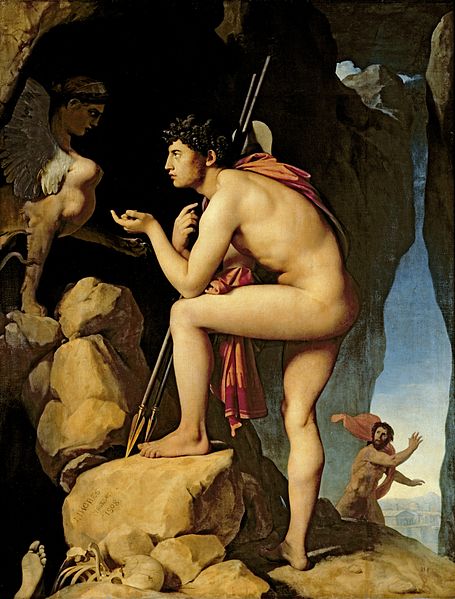
30.95 Shrine of Oedipus: There is a temple here that looks like six black cubes, each 30 feet long, wide and tall. Five are laid out in a cross-formation, the sixth stacked atop the middle cube. The place is constructed of basalt blocks and the floors, clad in white tiles, are covered in about four inches of ash. Columns of black and gold swirled marble hold up the ceiling except in the inner sanctum, which has a 60-ft. high roof. The inner sanctum holds a 40-ft tall statue of Oedipus, unclad and holding a staff. The statue has empty pits for eyes. On one of the upper walls of the inner sanctum there is a large brass gong.

If two precious stones are placed in the eye pits of the idol and the gong is struck, it flashes with an image of the death of the person who strikes the gong. Determine this fate randomly:

ROLL D10 TO DISCOVER FATE
1. Dragon Breath
2. Death Ray
3. Fall
4. Fireball
5. Lightning Bolt
6. Mummy Rot
7. Poison
8. Spear Trap
9. Swallowed Whole
10. Trampled

When next the character encounters this attack, he suffers a -5 penalty to saving throws against it. If he survives, the prophecy is proved false and he suffers no further saving throw penalties against that attack form.

If the gong is struck without putting gemstones in the idol’s eyes, it acts as a monster summoning VII spell.

Image from Wikipedia

The Glooms – Evil Pumpkins and Dwarf Kings

I’m about three days away from finishing the main writing on the Hell South hex crawl for NOD 12. Then I have a few articles to finish up and should be able to publish before Christmas – or maybe after Christmas. We’ll see.

10.72 Anemone Shelf: Hundreds of brightly colored giant sea anemones are attached to a wide shelf along the bank of the Acheron, about 70 feet below the surface. Equally colorful nixies dwell within these anemone, sometimes falling prey to them, but more often tending them. The nixies are led by the druid Anwyla, whose sea cave lair is hidden by the anemones. Deep within this sea cave there is a bubbling fountain of air. Bathing in this air, which carries a damp, green smell, one becomes a creature of living water. While in this form, the person can swim at a speed of 30 and is immune to cold and resistant to fire. This state lasts for a number of hours equal to the person’s constitution score.

35.99 Bothaaa: This hex holds the lair of Bothaaa, a giant, fiendish octopus spawned by Dagon himself. Bothaaa is usually in his sea cave, studying his greatest treasure, a jar that holds the preserved head of the Rivana, youngest daughter of the lich lord Piran. This head wears a crystal diadem (worth 1,000 gp). It is still alive, the body resting in Guelph in an ornate crypt. The head is sought by Dudge, the chaotic knight currently trapped in the stomach of the dragon whale Oraguldurn [7.63].

9.66 Grimserne: Grimserne is the dark city of Alberich, the king of the nyblings, a race of sorcerous, demonic dwarves. The nyblings are sore put upon by Alberich, and the shade slaves of Grimserne even more so.

Grimserne is home to 5,000 shades and 3,500 nyblings. The city is built into the sides of a massive and ever deepening pit mine from which the slaves extract copious amounts of coal, enough to fire the furnaces of Dis. The nymblings direct the slaves in their mining and then form them into great caravans who march towards the palace of Minos and the narrow stairs that lead down to the third ring of Hell. Each shade holds 300 pounds of coal in its back in canvas and leather sacks, and by the end of the journey to Dis are so spent that they often melt into the landscape, only to emerge back in their pit a few days later.

Alberich is a mighty sorcerer among dwarves. He and his people possess an unheard of skill at forging magical items, making them as easily as most craftsman make normal items, but expecting cruel payments for their handiwork and cursing the items to make sure they are not betrayed.

11.70 Prison Farm: The damned souls of 450 greedy halfling farmers toil here on a vast field, farming and tending animals under the poisonous whip of the balor Enkepis and his manes. The halflings grow bitter kale, lima beans, Brussels sprouts and pumpkins that grow to about four feet in diameter and bear tormented faces on their pale orange skins. They also tend sheep that they turn into spicy meat pies that are valued throughout Hell.

Each of the pumpkins, if one should carve a hole into it and crawl inside (gnomes and halflings can manage this) is a portal to the surface world.

13.57 Peat Fields: This hex was once a great swamp of tsetse flies and stinging nettles. It has since been drained and is now a great expanse of peat fields. Miserable shades now roam the fields, cutting the peat under the watchful eyes of gnoll overseers. The peat is destined for the lodge of Barbatos, who disdains the use of coal and thornwood. The peat moss is rank with worms, each one with the face of a damned, miserable soul.

Image by Rackham; found at Wikipedia.

Dueling with a Deck of Cards

Toying with a mini-game involving sword duels and a deck of cards. I’ll fill you all in as I get further with it, but at the moment it involves playing black cards for offense, red cards for defense, sometimes wanting to go higher than your opponent, sometimes lower, may include some bluffing elements for feints, damage would involve losing cards in your hand and it would take into account the benefits of using a shield. Sound good? We’ll see.

In the meantime, enjoy a small glimpse into HELL!

9.57 Amber Tower: Three hundred cowardly shades dwell here in a village of packed mud houses surrounded by a dry moat filled with pongee sticks coated with a black, tar-like poison that causes people to slip into a comatose sleep for 1d4 days. When they awake, they find themselves changed, their skin scaled and colored deep purple on their extremities and their minds possessed of an animal cunning, though their intelligence score drops to 2.

The shades of the village have ashen skin that is cracked and dry. They are lean and quiet and move stiffly, almost as though they were zombies.

The village is overseen by Leralol, a nalfeshnee minion of Barbatos who dwells in a tower of amber glass that gives off waves of heat. Standing within 100 feet of the tower is uncomfortable. Moving to within 10 feet causes 1d4 point of damage per turn. This damage persists within the tower, which is about 50 feet tall and 20 feet in diameter. Each floor of the tower is circular in shape, with an arched roof and a spiral stair in the center leading to the next floor. All of the glass surfaces in the tower are hot to the touch, causing 1d6 points of damage.

In the lower chambers, Leralol has dozens of newly arrived shades chained to the ceiling, drying like prosciutto. The third level holds changed victims of the black tar poison in cages. These poor souls serve as Leralol’s primary form of entertainment – hunting. The fourth level holds his kennel of nerizo demons, which he uses on his hunts. The fifth level holds his own quarters, a room about twice as big as it should be, given the size of the tower. This room is decorated with all manner of grisly hunting trophies, most of them humanoid, but also many wild, demonic animals as well, a row of seven succubus heads posed most scandalously and the head of a hellephant that has been turned into a headboard on Leralol’s bed. Five servant succubi are chained to this bed, but have enough room to move through the chamber, which connects to a small pantry, kitchen and armory.

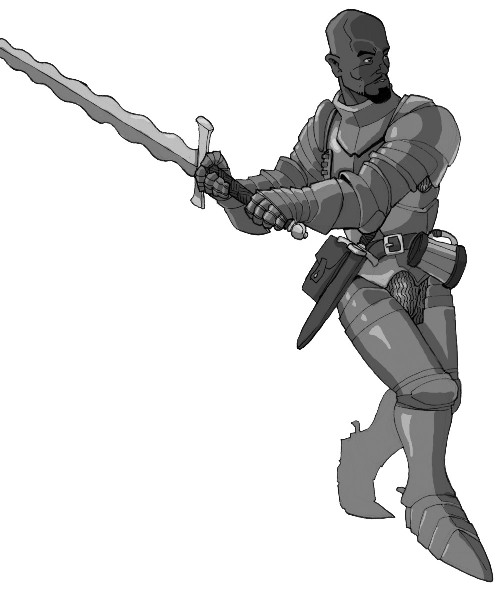
Image is the iconic fighter from Blood & Treasure, by Jon Kaufman (natch)