Cush and Pwenet – Crimson Fish and Seas of Blood

48.44 Crimson Fish: A small, enchanted stream runs through the jungle here. Whichever direction adventurers are traveling, the stream will present itself as an obstacle. The stream is clear and fresh, and filled with small, darting fish of a deep crimson hue. The watercourse looks about 4 feet across, but people who attempt to leap it will discover it is actually about 6 feet across. Folk who touch the water in the river will find themselves stuck fast in the water (a bend bars check is required to extricate oneself from the river) – attempting to pull a leg or hand out of the water is almost like trying to pull it out of a solid block of ice. When a person is stuck in the water, the crimson fish begin congregating and swimming in a counter-clockwise manner. In mere moments, they emerge as a single, large fish-thing, which moves toward the captured person to attack. The fish thing has razor sharp claws and teeth, and every drop of blood spilled in the river (a hit from the monster’s claws that deals more than 4 points of damage causes blood to flow) becomes one of the small crimson fish, which quickly merges into the fish-thing, healing it of 1 point of damage. If the fish-thing is killed, it collapses into its constituent fish, which rapidly dart away as the stream dries away into nothingness, leaving nothing but a patch of thick, sticky mud behind.

Fish-Thing, Large Magical Beast, Low Intelligence: HD 5; AC 17; Atk 1 bite (1d4) and 2 claws (1d6); Move 30 (Swim 60); F10 R11 W14; AL Neutral (N); XP 500; Special – Healing (see above), 10% magic resistance.

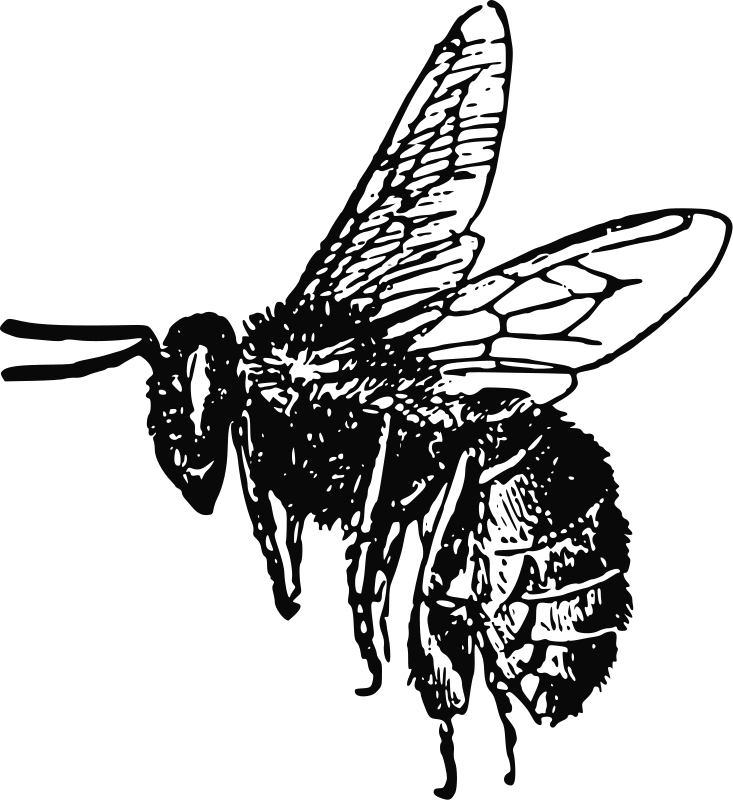
50.12 Land of Giants: The landscape here is dominated by massive hibiscus plants, with flower trumpets as long as two feet. Giant bees buzz around the flowers (1 in 6 chance per hour of encountering 2d4 giant bees), carrying nectar back to their massive hive near the center of the hex, which partially obscures a giant stone slab. The hive is only partially above ground, the remainder filling a number of tunnels. It is inhabited by 36 giant bumblebees, including their queen.

The stone slab that is partially obscured by the above ground portion of the hive measures about 25 feet tall and 10 feet wide. It is actually the top of a massive sarcophagus that has been dug into the ground. If one could remove the slab (they would have to first remove the hive) they would find the remains of an avatar of the goddess Oshun. The avatar has shown no decay, but it is quite dead and cannot be resurrected or raised (or turned into an undead). It is the size of a stone giant, and wears robes of silvery silk and turquoise beads (worth 7500 gp), a headress of silver, electrum and gold beads (worth 3,500 gp) and a gold and ruby ring on one finger (worth 800 gp). If any of these treasures are removed or other-wise molested, a deva will appear to punish the thieves.

52.09 Caravan Remains: This hex holds the remains of a camel caravan. Amid the smoldering corpses, one might find one intact pack that contains a small green bottle of garlic powder, a jar of sweet paste, a small chest containing chunks of dried beef, and several toasted strips of flatbread. In all, they have three days of rations.

52.33. Sea of Blood: The dry hills here become streaked with light grey granite, becoming more and more rugged until they finally become cliffs overlooking a vast, red lake. The people of Pwenet refer to this as the “sea of blood”, though it is actually just normal water tainted by vast iron deposits. The lake is sacred to Ogun. In the midst of the lake, about 500 yards from the shore, there is a granite stronghold on a small island. The stronghold looks as though it is precariously perched there, and might topple into the waters at any moment – though in truth it is quite sound. It consists of a medium-sized tower with a single entrance – an iron door – and a few windows on the upper stories.

The tower is deserted. Within, one finds the rooms filled with sculptures. The highest room, a sort of solarium, holds a half-finished statue of Oshun, the love goddess. Even in its rough state it is quite beautiful, and perhaps too good a likeness, for the sculptor, who now roams the place as a ghost, had his eyes burned out as punishment for daring to capture her likeness to perfectly in stone. The ghost, Lumbabo, generally avoids people, but does use its powers to create impressions in peoples’ minds of the sounds of hammers on chisels, or to make it appear that statues are moving and shifting behind them.

Males who gaze upon the statue of the love goddess must pass a Will save or fall under her spell. They will covet the statue above all things, and desire most of all to have it completed by a master scupltor. If more than one man becomes obsessed over it, it is likely they will fight to the death to possess it unless somehow restrained. Lawful and neutral characters can make a second will save (Lawful characters at a +2 bonus) to avoid killing a friend.

Cush and Pwenet – Strange Bordellos and Stone Giants

Yeah, still sick. Enjoy some more African screams!

45.15 Stone Giants: A tribe of stone giants is in the process of constructing a giant-sized motte-and-bailey castle. The giants carry large axes, with which they fell the tallest, thickest trees in the forest. So far, they have completed the moat and mound and the palisaded bailey (or courtyard). The bailey contains a barn for their elephants, a lodge, smithy, storehouse, stable and chapel. The higher stronghold is about one third complete.

The giants keep two elephants for pack animals and three cave bears for guard animals and pets. The giants include three brothers, four women and two children. The men have grey skin and long faces with chiseled features. The women, like all female giants, are strikingly beautiful. They are capable of altering their size at will to the size of a human, and can cast spells as 4th level druids.

The stone giant’s treasure is 700 gp and a red-brown spinel the size of a human fist (1,000 gp)

46.36 Strange Bordello: Travelers through these wooded highlands might come across an odd building constructed of pale blonde wood. The building has a domed roof and double doors composed of a lattice. Within, one finds a central chamber with a great hearth and roaring fire surrounded by silk pillows. Chimes hang from the ceiling and produce discordant tones that make people prone to suggestion (-2 to save).

There are three doors in this central chamber. From one of these doors, a succubus will emerge in human form, in a guise particularly enticing to one of the male members of the party. She will offer the adventurers rest for the night in her roadhouse, leading them to one of the three chambers where they will find clean clothes (in their size), enticing victuals and flagons of spiced wine. Once within one of these chambers, the adventurers will find themselves unable to escape until the dawn.

The character that has been singled out by the succubus will, of course, be invited to remain in the main chamber, where she will attempt to seduce them and steal away at least one of their levels.

The next morning, adventurers will awake to find them-selves in the same building, but the door to the outside opens onto a hellish labyrinth of red, burning stone, where the lucky adventurer who slept with the succubus is now hunted by her in the form of a hellcat. The succubus, Zamira, is a strange sort of lycanthrope who prefers to eat her mates. If killed, the succubus fades away and is replaced by a locked bronze chest containing [oh, wouldn’t you like to know!]

48.02 Leather Sack: A trampled leather sack marks the location of a buried treasure. About three feet beneath the earth there is a wooden box containing 45 coins of blackened iron fashioned by dwarfs. They bear the likeness of Djorval, an ancient king of the western dwarfs, on one side and the likeness of a constrictor snake on the other. The coins are worth about 7 sp on the open market, but might draw as much as 500 gp from a dwarf collector.

Cush and Pwenet – Spanish Castles and Phantom Tombs

I’m now ensconced in writing the second half of the Cush/Pwenet hex crawl and, since I’m also fighting off a cold, thought a few previews would make for an easy blog post today!

41.43 Kimbedwe: Kimbedwe is a sizable city-state situated atop a high, dusty plateau that overlooks the rain forest. The plateau is rich in mineral wealth, and highly defensible, and thus has persisted for hundreds of years. By and large, the people of the plateau keep to themselves. They permit no entry into this hex by outsiders, having established trading posts on the edges of the hex to trade their minerals for manufactured goods (especially glass – the sands of the plateau make a very poor quality of glass). The city is constructed of stone, most of it dug up from the depths of the plateau, which is honeycombed with tunnels and mines, and even hides a small subterranean lake from which the people of the plateau pull blind crustaceans that they turn into a delicious stew.

Kimbedwe’s main problem is its isolation and xenophobia, which has led to stagnation. These problems are made worse by (or maybe caused by) the waters of the subterranean lake, which are enchanted. The waters keep people from aging, but also makes them infertile. There have been no children in Kimbedwe for many centuries. The water’s enchantment stems from a strange black stone hidden in its black depths, a stone that attracts the shades of the dead, who haunt the lake and demand tribute from their descendants in the form of palm wine. The lake is surrounded by hundreds of small (and not-so-small) shrines dedicated to these ancestral spirits. The spirits are worshipped by a cult of death priests and assassins, who do their best to keep change out of Kimbedwe.

Kimbedwe’s king, Singado, has ruled for 200 years, having relieved his father of the crown with poisoned wine. He and his warriors oppose (subtly) the death cult. They maintain a large temple to Kokou, the god of war, and keep a flock of arrowhawks which they use to patrol the surrounding jungle. When possible, they kidnap likely mates for themselves and their king, sneaking them back to the plateau in defiance of the assassins.

43.20 Spanish Prison: Traveling through the woods you come upon a narrow dirt path that runs roughly north to south. The foliage on either side has recently been trimmed. Following the path to the north eventually leads to a clearing that contains a stone circle reminiscent of Stonehenge.

Following the path to the south leads to a small valley that contains a lake. Overlooking the lake there is a castle built of pale, grey stone. The castle consists of two long, narrow wards and a central keep. The keep is surmounted by a 115-ft. tall tower with barred windows.

The castle is the home of Don Xavier de Penafiel, a duke who hails from the Kingdom of Spain on our own world. Don Xavier is a melancholy man, and deeply religious. His castle, despite its large size, is staffed by a small band of unseen servants that are enhanced by unspeaking illusions. In times of trouble, the castle is defended by 100 animated suits of armor. The only other inhabitant of the castle is its prisoner, one Francis Bacon. Bacon’s tower prison has had a permanent anti-magic shell cast upon it.

Don Xavier leads a lonely life, his primary companion being his memories of lost love and lost honor. Every few weeks he is visited by a small band of friars who bring the duke sustenance and brief companionship. The oldest of the friars, Brother Garza, is an excellent swordsman and accomplished player of at chess and taroka.

[Note – I actually ran a group through this one. Getting into the tower involved solving three alchemical riddles. I might have lost them when my old external drive went down, but if not I’ll publish it in a future issue of NOD]

44.25 Tome of the Phantom: A high cave here, dry and cool, holds a tome wrapped in ashen sackcloth. The tome is covered in blue leather, and contains the life story of the adventuring wizard Zaxon. Zaxon visited many of the lands surrounding Cush; he made many conquests and bested many dangers before finally passing away 200 years ago. This tome is possessed by his spirit, and this spirit slowly possesses any person who reads the book. For each hour spent reading the tome, one must make a Will save or be effected as per a magic jar spell.

Three Villages of Cush

What an insane week!

I’m a day or three away from releasing NOD 16 and B1 – The Tumbled Towers, an intro module for Blood & Treasure with some pre-generated characters. B1 – The Tumbled Towers will be a free download, and probably a pretty cheap print product (cause it’s short!).

Since things are so berserk lately (it’s quarterly report time in my real job), I’m going with another Cush preview today. Enjoy!

15.41 Kaba: Kaba is a large village of 250 people set amidst large groves of butter trees, which produce a fruit favored by both humans and baboons. The village has tall stone walls with locked gates and narrow streets. During the day, people are out and about, tending the groves, hunting in the jungle, cooking their food, repairing tools, etc. As soon as the sun begins to sink, though, they lock the village gates and go inside, locking their doors and not opening them for anything. This is because a band of ghouls has found its way to their village, finding the secret places in the jungle where they have buried their dead and feeding on them. They have made incursions into the village and killed several men and women, turning them into ghouls as well, who are now obsessed with feeding on their relatives and loved ones. The village leader, a sage called Sambwa the Wise (Adept 3; 4 hp), has no idea what to do about the ghouls. The people will not allow him to dig up the bodies of their ancestors and burn them (though the newly died are burnt now, outside the village), and the graveyards are not safe to approach anyways. He has sent a few warriors out to other villages seeking help from monster slayers.

16.26 Nameless Village: On a hill overlooking the lazy Jamba River there is a village (pop. 230) surrounded by a palisade. All of the buildings in the village are narrow towers built of limestone quarried in the middle of town. The people of this nameless village are squat, thick, grey-skinned humanoids with toothless mouths who communicate with sign language and a clicking sound they make with their thick tongues against the roof of the mouth. The people are accomplished sculptors and surprisingly agile for their build.

The village supports several sculptors, a master mason and an inn. The inn has been built into an empty quarry, with people sleeping in deep, narrow alcoves dug into the walls. The innkeeper serves palm wine in crystal decanters and slugs and snails spiced with ground pepper. The town’s main protectors are a quartet of 1st level fighting-men armed with spears and falchions. The village has no apparent leader.

The village’s treasury contains a silver falchion, four golden-brown capes (worth 5 gp each), eleven tiny ivory flutes (worth 20 gp each), a pair of copper gauntlets with only three fingers (worth 100 gp), a brass-capped bone cane (worth 200 gp) and a lead (triple weight, AC 14) cuirass bearing the symbol of Atum.

18.02 Chimpanzees: A tribe of 100 intelligent chimpanzees dwells here in a collection of odd huts reminscent of the mud-nests of the termites, though larger. Each hut ranges in height from 15 to 30 feet, and can only be entered from above. Between the huts there are pens for the chimpanzee’s dogs – some for riding, others kept for food. The warriors of the tribe (there are 40) carry shields and wield long gnarled clubs. The chimpanzees are led by a grizzled male called Bobo, who smokes a long, iron pipe and wears a tattered purple cloak. A diamond stick pin worth 500 gp is hidden in the hem of the cloak.

Cush – Soggy Goddesses, Mighty Baobabs and Ghostly Apes

A few more previews from Cush – I’ve been remiss about posting these lately. NOD 16 should be out by the end of the month – I’m just putting on the finishing touches now.

09.21 Goddess: A 20 ft. tall statue of a Hindi-style goddess lies belly-up in the river here. The statue is tilted, so that its face peers out at the north bank of the river. 1d8 crocodiles sun themselves on the statue, which is missing its arms and legs and looks to be very ancient. A secret door in the statue’s navel can be unscrewed, leading to a crawlspace that ends in the statues head. Inside the head there is a golden orb studded with gems (5,000 gp). The statue is all that remains of a stone golem destroyed a milennia ago during a war between Kolos and distant city-states of Ende.

11.04 Mufo: Mufo is a large town (pop. 4500) that receives some caravan traffic between Ophir and the Carnelian Coast, and also acts as a trade center for the local region. The city is surrounded by walls of reddish stone that are studded with bronze spikes. The front gates are thick, dark oak, heavily glazed, that are bound in bronze. The walls are anchored by five stout towers, about 30 feet tall. The walls and towers are patrolled by the town’s 45 guardsmen (men-at-arms; leather armor, shield, spear, light crossbow). The town is known for its green tile roofs, that sparkle like emeralds in the sun and help to camouflage the town from above, hemmed in as it is by the surrounding jungle.

Mufo is governed by a council of wealthy men and women, the head of which is Kanda, a rather famous merchant who once adventured throughout Cush, Pwenet and the Carnelian Coast and who now commands several caravans who ply the same area. Other members of the council are the monster trainer Mbando and the infamous duelist Muamba the Snake, who runs a a fencing academy.

Mufo has two ghettos, one of Ophirian traders, craftsmen (especially weavers) and adventurers who traveled down with the caravans from Ophir, the other of gnomes who have quit their traditional forest home and now make a living as wood-carvers and fortune tellers. The Ophirians of Mufu number about 250, the gnomes about 180. Both are treated reasonably well, though the gnomes are considered dishonest schemers by the locals, and the Ophirians are considered to be greedy.

11.27 Baobab the Mighty: A baobab tree that covers much of this hex has lived long enough that it has achieved sentience and a sort of godhood among plants. The forest creatures of bow to it as they pass along their way, and the beasts that dwell within its branches serve as a sort of priesthood. Key among them are a tribe of 30 monkeys who gather the sap (which can apparently neutralize poison, who knew?) and allow it to ferment, making a crude spirit that grants them low intelligence for the period of 1 month, before they must drink of the sap once again. The tree desires nothing but peace and tranquility in its domain, and a complete absence of fire.

12.36 Nettles: This hex is filled with many large patches of grass topped with tiny, stinging nettles. There is a 4 in 6 chance of any given adventurer being painfully stung and suffering a -1 penalty to all rolls for 1d4 days or until the bathing in urine.

14.30 Ghost Apes: Ghostly white apes crawl through the trees of this hex, leaving icy finger and foot prints whereever they go. The apes are true ghosts (treat as spectres), and their haunting howls and calls put people at ill ease and force animals to pass a saving throw each hour or flee in fear. The ghost apes only rarely attack travelers, having a 20% chance of attacking (in a group of 1d6+1), the chance increasing to 35% if there are spell casters present, and 55% if they are divine spell casters.

Cush – Quicksand, Evil Gnomes and Pearl Trees

03.31 Quicksand: Adventurers moving through this hex have a 2 in 6 chance of stepping into a pit filled with quicksand. The trees surrounding the quicksand are inhabited by a race of talking monkeys, who will cast bets (using cowrie shells) on whether the unfortunates will live or die. They will not render aid unless they are somehow tricked into it. If attacked, they flee into the forest; from that point on, random monster encounters occur on the roll of 1-2 on 1d6.

[Because a jungle without quicksand is just bogus]

05.13 Gingi Tribe: The Gingi are a tribe of lizardmen (pop. 331) descended from the lizard kings of old. They have faces that resemble the gallimimus and green scales with yellow stripes. The tribe has 200 spear-armed warriors. Their village is surrounded by a ditch and palisade. The ditch is filled with humanoid and animal bones, and skulls are attached to the tops of the walls by leather thongs. The wall is guarded by 8 elite warriors (3 HD) armed with blowguns and poisoned (sleep) darts. Water for the village is drawn from a deep well.

The village consists of huts made of woven vines covered in dried mud and a large, octagonal wooden house. The house is occupied by the tribe’s chief Jumbaba, his harem of six females and his fifteen hatchlings. The tribe’s treasure consists of 4,000 gp taken from an exhausted (and heavily laden) party of adventurers two months ago.

06.34 Pearl Tree: A large tree resembling a baobab grows here. In the late summer the tree will be filled with large, prickly, yellow fruits with delicious pink flesh. There is a 1% chance that those someone eating a fruit (roll once for the entire party) will find a perfect, pinkish pearl (100 gp) at the center instead of a pit. Fruit that is opened up but not consumed will cause the person wasting it to be cursed by the tree’s guardian spirit. The pits can be used to make fire seeds (as the druid spell) by knowledgable wise women.

08.03 Gingdaja Village: The small village of Gingdaja (pop. 300) is inhabited by a clan of wicked gnomes led by a council of elders that consists of Zangdok, Pukulga and Jajujh. The village is surrounded by a short picket of sharpened stakes, all of them meticulously carved into whimsical animal shapes. The people live in clusters of huts surrounding a wooden shrine.

The gnomes of Gingdaja were created by Azba, their patron deity. They are lithe and agile, and their scholars are well versed in elemental magic. In place of a normal gnome’s innate spells, the Gingdajans can cast create water, endure elements and magic stone each once per day.

Gingdaja has a small tavern run by Momwi, a retired slinger. The tavern is a long, narrow lean-to that serves a light, frothy ale made from roots and a powerful liquor made from tree fungus, as well as a hearty mushroom stew. The village also has a blacksmith named Pukdaja, a healer named Zuljujh and a monkey-trainer named Keshu. The village’s temple is a one-room, wooden structure surrounded by a yard edged by white stones. The shrine is tended by Zagu, a priest of Azba.

Azba is a goddess of chance and gambling. She appears as a tall crone with lemon-yellow skin and large, round, red eyes. She carries a simple hammer that randomly blesses or curses those it strikes in combat. The gnomes believe that Azba embodies the vital forces of the universe (i.e. chaos). They also believe that she dwells in the cave in [0802]. They throw their old and infirm in the cave as sacrifices to Azba.

08.27 Ape Boy: A cave system here is inhabited by a clan of thirty carnivorous apes and an adopted human boy they call Gargan. The apes are led by a massive male called Jorak (30 hp). In the deepest cavern of their lair, secreted there by an unknown party, there is a treasure. It consists of 80,000 cp in a dozen small chests, a golden yellow topaz (700 gp), a white pearl that has been delicately carved to hold the silhouette of a woman (80 gp) a cylindrical chunk of polished coral (60 gp) and a vial of phosphorescent liquid in a pewter flask. The liquid removes paralysis but causes intense hunger (double ration consumption for 1d6 days; -1 penalty to all rolls on less than double rations due to hunger pangs).

Cush – Six-Armed Villagers, Glowing Tubes, Evil Shrines and Galmim

Here are a few early previews of Cush, starting in the west where the trees are as thick as thieves …

01.29: You see a small village (population 90) surrounded by a ditch and wooden palisade by a lazy stream. Within the palisade there are ten buildings constructed from woven branches and thatch. The oviparous humanoids of Obaala are tall, statuesque and have white skin, fair hair, dark eyes and six arms placed evenly around their bodies. Each of their bee-hive shaped houses contains a nest tended by the male of the species. The obaala are matriarchical, with the most aggressive females leading the others. They are known for their sense of humor and their skill at assassination (surprise on a 1-2 on 1d6, double damage from surprise attacks).

The obaala enjoy the services of Zemmu the blacksmith and Yazur the healer. The largest building in the village is a temple dedicated to Gwardaja, their goddess of knowledge. She is served by the priestess Kasbaba who dresses in pale yellow robes that at once clutch at her body desperately and mingle with the breeze.

Gwardaja appears as a tall, obaala female with eyes the clor of roe and a serene expression. She is dressed in a yellow toga hung with amber beards and carries palm fronds in three of her hands and clay pitchers in the others.

OBAALA: N Medium Humanoid; HD 1+1; AC 13; Atk 2 weapons; Move 30; Save F13 R15 W15; XP 100/CL 2; Special: None. Gear: Hand axes (2), beaded armor (+2 AC), shield.

02.14: Lord Galmim is a Zinji adventurer who established a small, walled castle here 12 years ago and instantly set about annoying his neighbors. The castle is built of adobe brick and the walls are topped with sharp wooden spikes. Galmim employs a 50 archers (padded armor, shortbow, short sword) and rules over 44 peasant families who dwell in thatched huts within a log wall about 15 feet all. Galmim’s arms are a yellow doe rampant on a field of purple.

GALMIM: CE Fighter 12; HP 87; AC 19; Atk 3 weapon attacks; Move 30; Save F7 R11 W11; XP 600/CL 12; Special: +1 to hit with spear; Gear: Spear (cold iron tip, painted with spirals of charcoal and red; 1d6+3), light mace (head shaped like a spiked cylinder, haft wrapped in blue crocodile hide; 1d4+4), chainmail, shield, potion of extra healing (thick, ruby colored); Abilities: Str 18, Int 12, Wis 10, Dex 16, Con 16, Cha 15.

03.22: A small shrine of ancient Kolos stands here, choked with jungle vines. Inside there is an idol of Charon, the Stygian boatman. The idol looks like a gaunt figure in black robes. Where the idol’s face should be there is a merely an empty socket that probably once held a large gemstone. The shrine is now inhabited by a family of five pot-bellied ghouls, the largest having been the shrines keeper hundreds of years ago. The ghouls have 3 pp and 70 gp (in the ancient coinage of Kolos) lodged in clear view in the gaps between the stones.

04.20: A tube of metal 4 ft. in diameter sticks 12 ft. out of the ground at a slant. It is rusted and empty. The jungle around the tube is blighted. People touching the tube or spending the night near it must save vs. disease or develop painful blisters on the skin, losing 1 point of dexterity and constitution and glowing for 1d4 days. Glowing adventurers attract monster encounters on a roll of 1-2 on 1d6.

Cush – Introduction

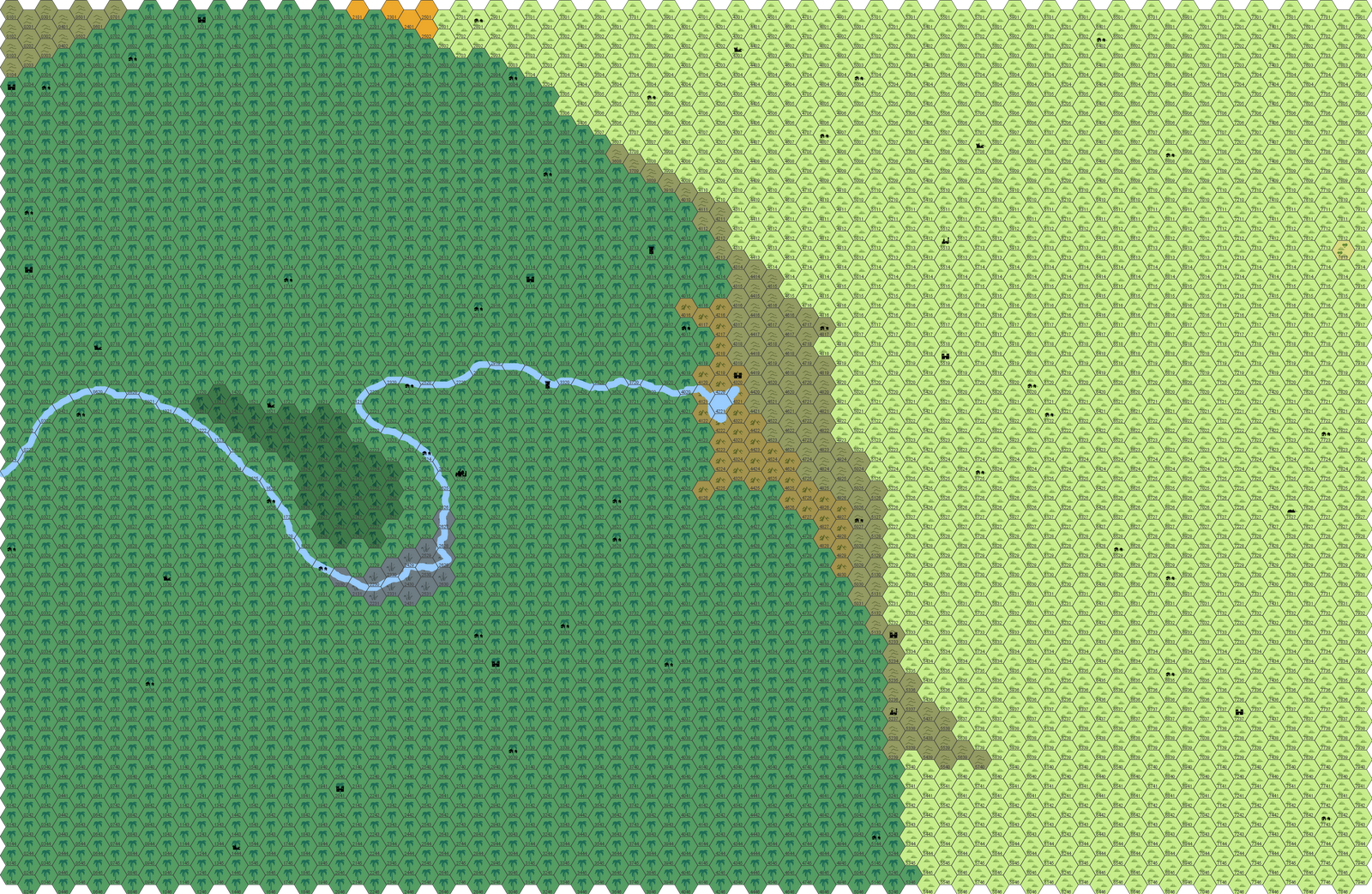
Okay, I haven’t officially published the last piece of the Hellcrawl (about 1 more week and it’s live), but I’ve already moved on to … Cush! The next hexcrawl project is Cush and Pwenet, pieces of an Africa-themed chunk of Nod. I’m quite excited about this one – probably a good bit of art to commission (which means I’m losing money on this baby), but there isn’t much Africa-themed RPG stuff out there, and it’s a pretty rich vein to mine for adventure. Anyhow – what follows is a quick look at the different geographical regions to be covered and the full Map J12 – the eastern half will be covered in NOD 16, the western half in NOD 18, and NOD 17 will cover the city-state of Ixum. Enjoy!

Click to enlarge – or don’t, it’s up to you

HISTORY
During the Pandiluvian Age, the jungle portions of Map J12 were under water, while the Jamba Highlands constituted a chain of islands the connected to the large archipelago of the modern Wyvern Coast. The savanna of Pwenet was a land of salt marshes and grassland. The so-called elder things built small fortresses in these shallow waters to protect their larger cities in the depths. These fortresses were built with a cyclopean, luminous green stones that were fitted without mortar. Although they were hunted for sport, some mermaids established themselves in sea caves and placid island lagoons.

When the waters receeded, the swampy grasslands became a savanna and the Cush basin became a dismal, tropical swamp. It was here that the lizard men, former servants of the elder things, established themselves in walled city-states, often surrounding the citadels of their former masters. Humans from the highlands were enslaved and put to work building defenses, for the lizard kings were constantly at war with one another, their society on its inevitable march to savagery.

As the waters continued to recede and Cush became a rain forest. The savage lizard men were eventually defeated by the more numerous and clever humans and driven into the coastal swamps or into the underworld. Freed from slavery, the humans established themselves in the homes of their former masters and took up where they left off. But unlike the lizard kings, who spent centuries locked in a stalemate, one human city-state, Kolos, soon brought the others to ruin.

Kolos was ruled by an exiled Atlantean who became fascinated with the alien gods of the lizard men, especially the one they called Mictlantecuhtli. Mictlantecuhtli called out to the Atlantean from the Abyss and bound him to his service with dark, unspeakable pacts. In time, the Atlantean, now known as Kolos, would destroy his city-state in a bid for godhood.

With Kolos fallen and soon swallowed by the jungles, its tributary port, Zinj, assumed the mantle of leadership in the region. But Zinj was tiny compared to the Kolos, and its interest lied in sea trade, not the fetid jungles. Except for a brief period as a subject of the zebra-striped people of the Zebrides, Zinj has remained an independent kingdom for centuries, even briefly lording it over the purple kings of Ophir after they lost their key trade partner in the invoked destruction of the Nabu.

The tribesmen of the savanna land called Pwenet also flourished during the Silver Age. They built villages and towns of adobe and kept massive herds of cattle. They even swept over the Nabu empire and held it for a few decades before decadence and in-fighting aided the Nabu in reclaiming their sovereignty.

GEOGRAPHY
Map J12 is dominated by a hot, steamy jungle in the west and the rolling grasslands of Pwenet in the east. These two regions are divided by the Jamba Highlands, a small mountain range that feeds the Jamba River. The Adze Marsh runs for many miles along the Jamba River.

A powerful necromantic kingdom called Kolos once dominated Cush and made war with the Nabu Empire to the north. While the fall of the Nabu Empire is well documented, the disappearance of Kolos is far more mysterious, and many adventurers have entered the jungles intent on finding that lost city-state and plundering its vaults. To date, none have succeeded in returning to civilization with their lives, let alone any riches.

Map J12 has no city-states of its own. The nearest city-states are Zinj (Map I12) and Ophir (Map J11), both coastal ports. It does have a multitude of villages and supports many sentient cultures, including human tribesmen, pygmys, lizardmen and gnolls.

Adze Marsh & Jamba River
The Adze Marsh, named for one of its more dangerous inhabitants is a vast wetland composed of flat lands, lagoons and copses of trees. The area floods in the Spring, hiding much of the flat land and making the entire swamp a virtual lake.

Cush
The jungle of Cush consists of a gently sloping plain between the Tonaduhna and Jamba Rivers. It is a traditional rain forest. The trees are thick and grow close enough together to blot out the sun. Beneath the canopy live a myriad of insects and reptilian carnivores as well as pygmy deer, elephant, and the dreaded leopard. Cush is valued for its exotic hardwoods (teak, mahogany, ebony and darkwood), orchids and fauna.

AMAZONS: The amazons of Cush are related to their more northern cousins. Like their cousins, they live in a matriarchical society. Unlike their cousins, they allow their menfolk to live in their villages and work as craftsmen, farmers and fishermen. Men and amazons live in separate halves of the village.

The amazons of Cush wear little or no armor, with the heaviest armored warriors (the nobility and their elites) wearing leather armor cured from the hides of mystical beasts (5% chance of dragonhide leather armor). Cushite amazon warriors carry spears, throwing irons and shields.

BERSERKERS: The berserkers of the jungle are cannibals. They appear as normal humans, but with teeth sharpened to points and hungry, feral looks in their eyes. The cannibals of Cush live in small hunting groups of 10 to 20 warriors led by a 3rd to 6th level chief and two 2nd level sub-chiefs. They wear no armor, but 50% of the berserkers carry a shield. Cannibals are armed with nets, battle axes, hand axes or short swords.

GHOULS: The ancient city-state of Kolos fell in a cataclysm of dark sorcery, tainting the surrounding land with necromantic energies. Over the next few months the peasants and knights of Kolos, deprived of their city-state, perished. Those who survived did so on the flesh of their fallen neighbors, and thus became ghouls. These ghouls, known for their dull black skin and pot bellies, still haunt the ruins of the jungle basin. They are extremely aggressive (as they’ve been starving for centuries) and are quite resistant to turning (turn as 4 HD undead). About 1% of ruins contain a ghoul able to summon a vrock demon (25% chance of success).

TRIBESMEN: The tribesmen of Cush know the secret of working iron and mine and smelt surface deposits from sacred out-croppings guarded by traps and summoned cacodaemons. Their witchdoctors are expert brewers of poison, so most warriors go into combat with poisoned darts (poison I) fired from blowguns.

The tribesmen are also privy, it is said, to the location of ancient gold mines secreted deep in the jungle and guarded by forgotten curses and fell magical beasts.

Each tribe consists of 3d10 x 10 warriors and additional non-combatants equal to 5 times the number of warriors. For every ten warriors in the tribe there is one “Big Man” with 1d4 character levels, usually in the fighter class. The tribe is ruled by a 6th to 10th level chief and witchdoctor (usually an adept, but 10% chance of being a 4th to 7th level druid or cleric). The chief is accompanied by 1d6+6 2nd level fighter bodyguards.

All tribesmen have a very fluid fighting style, giving them a base AC of 11. Tribesmen typically wield spears and blowguns, but might also carry hand axes, short swords, daggers and short bows. Leader types might carry battle axes or long swords.

VEGEPYGMIES: These strange plant beings are approximately 3 feet in height with rust-colored skin. They are primitive in nature with a chittering language incompre-hensible to non-plant men. Vegepygmies are usually encountered in small hunting bands. Vegepygmy tribes number from 1d4 x 30.
Vegepygmy warriors usually carry spears and throwing darts covered with a rust-colored mold. The mold deals no extra damage, but does begin to grow on the flesh of those hit by the darts who fail a saving throw. After the first day, the mold begins dealing 1 point of constitution damage each day as it produces enzymes which begin liquifying the host’s body. When the host is reduced to 0 constitution, he is little more than a pile of mush, upon which several “infant” mold men begin to grow. Once the mold begins to grow, it can only be destroyed with fire or a remove disease spell.

Jamba Highlands
The Jamba Highlands are a group of snow-capped mountains and their foothills that rise above the jungle of Cush and the grasslands of Pwenet. The tribesmen believe they are the abode of their gods. This belief is bolstered by the strange, white gorillas that seem to guard the passes that lead through the mountains.

The highlands feature a plethora of simians and avians. Old stories claim that the mountains are rich in precious stones and metals, but they are far enough away from civilization that nobody has made a serious attempt to mine them.

Pwenet Grasslands
Pwenet is a land of rolling hills with scattered copses of aromatic trees and a few rocky outcroppings. Large herds of ruminants travel from watering hole to watering hole while being stalked by giant centaurs, lions and even more fantastic predators. Pwenet is said to hold both a fountain of youth and the source of the River Ish, thus making it a popular destination for explorers.

A few merchant-adventurers from Ibis travel to Pwenet once a year to trade manufactured goods for aromatic resins, ivory, darkwood and wild animals. Otherwise, the region is untouched by the people of Lemuria and the Motherlands.

Though not the most numerous, the giant centaurs of Pwenet are the region’s most prominent folk of the hills. Pwenet is also home to many tribes of gnolls and humans. The largest tribes, human and gnoll both, provide most of the region’s drama as chiefs and witch-doctors jockey for power and recognition.

Oft told tales tell of when the tribes of Pwenet united under Jobo the Great and conquered the cities of Nabu. The people of Pwenet believe that history is a cycle and that they will once again conquer the outside world when a great leader united them.

CENTAURS: The centaurs of Pwenet look like a cross between humans and giraffes rather than humans and horses. Pwenet’s centaurs are larger and stronger than normal centaurs, but also more calm and level-headed. They carry large shields and pikes.

DWARFS: The dwarfs of Pwenet are only distantly related to the dwarfs of Antilia and Thule. They have pitch-black skin and eyes and small beards of wiry, black hair. Like other dwarfs, they dwell under-ground in burrows protected by all manner of traps. The natives of Pwenet call them the utu.

The utu have different abilities than other dwarves. Their eyes allow them to see in the brightest light and blackest darkness, including magical darkness. Their skin is as hard as granite and provides them a natural armor class of 14. Utu characters have a +1 bonus to constitution and a -1 penalty to intelligence. The utu carry shields and swords made of darkwood studded with shards of jade.

Utu dwarves worship Khnum, the divine potter, creator of the universe. Khnum’s clerics are curious about the universe and spend most of their time recording their observations on clay tablets. Where other dwarfs are expert at the forge, the utu are experts working with wood and clay. Their pottery is valued by the people of Ibis.

The utu are learned in the art of conjuring spirits, from whom they obtain most of their knowledge. All non-player character utu clerics can use the spell contact other plane once per month, when the stars are aligned.

Once every century a lucky cleric is able to make contact with Khnum himself to deliver a great prophecy to all the peoples of Pwenet. On these occaisions the dwarves sound their drums and blow long horns made from hollowed darkwood trees to call all the tribes to hear the prophecy. All the great chiefs of Pwenet heed this call and travel to the appointed place with their retinues, sworn by tradition to observe a full week of peace while the ceremonial dances are performed, lineages are recited and finally the prophecy is pronounced. The coming of the current princess of the Quiet Folk, avatar of the great earth mother, was pronounced at the last convocation, and the next prophecy is due to come in the very near future.
The Gods of the Future! [Quickie]

Found a few images today that serve well as gods of the future that might travel back to hassle pseudo-medieval adventurers …

God of Telephonics

and thus also god of telemarketers and family

His priests wear rotary dials as amulets and wear armor woven from copper wire (equivalent to chainmail), and are capable of casting message by sacrificing a silver piece.

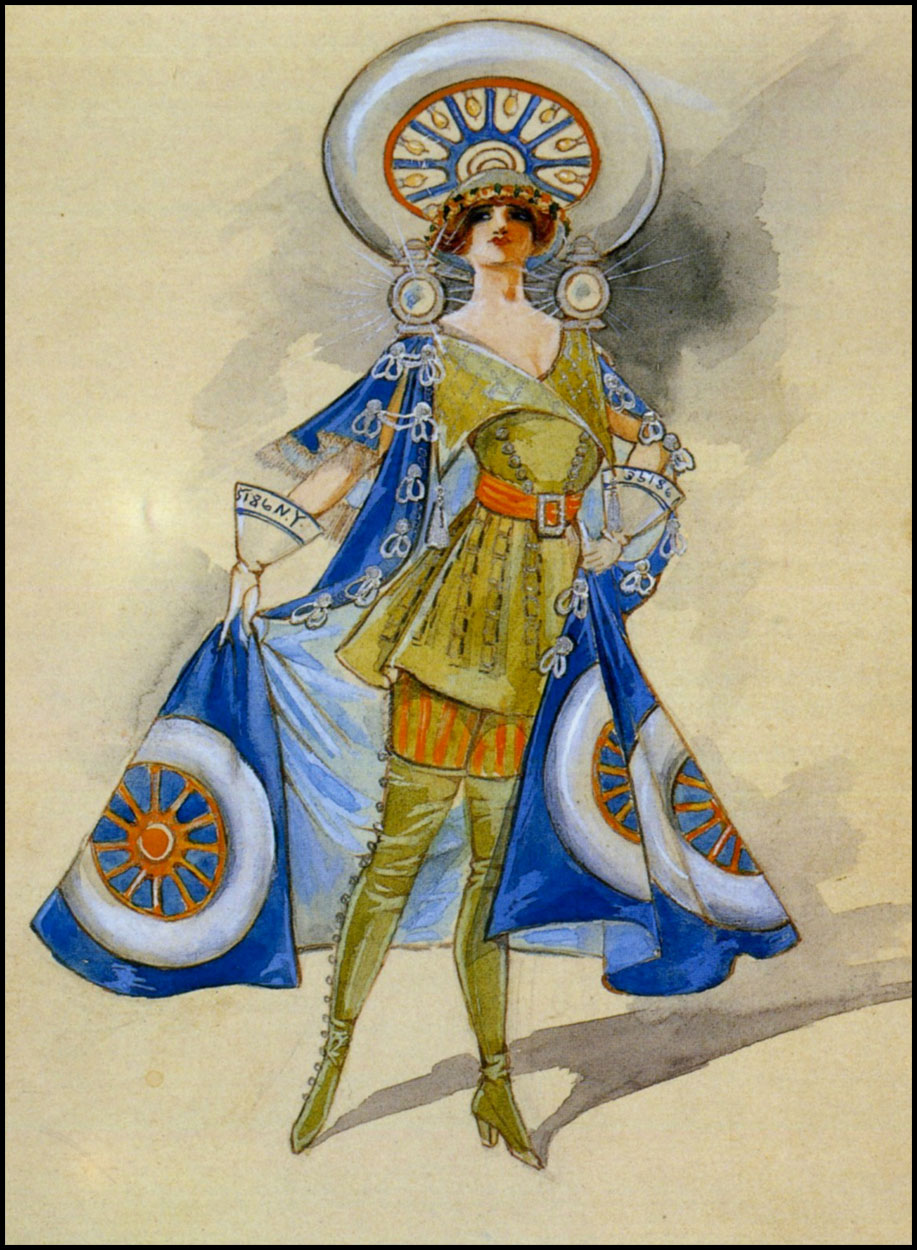
Goddess of Automobiles

and thus also goddess of freedom, getting laid and blood on the asphalt

Her priests wear gloves, buff coats and goggles over their armor, and the men are expected to cultivate glorious full mustaches; they bear the holy spoked wheel on their round shields and can cast stinking cloud once per day

Goddess of Aeroplanes

and thus also goddess of travel, air sickness and tiny bags of peanuts

Her priests and priestesses wear golden wing pins on their blue tunics and can cast fly once per day, but must be sitting in a cart or wagon to do so – they spell effects the cart rather than the priest or priestess; in addition, the priestesses can cast create peanuts and coffee or tea (a variation of create food and water) once per day, but only while in flight

The first image is from Love Truth Beauty

Law vs. Chaos, the William Blake Way

The internet is wonderful for stream of consciousness discovery. Last night, I was writing a bit about orcs for Blood & Treasure – specifically creating a table of military units – and in the process found a reference to the very interesting mythology created by William Blake in the last decades of the 18th century. Just like that, I had the perfect pantheon for Dweomer Bay, Nod’s nod to Colonial America.

If you don’t know about this little gem of creativity (I’m not going to pass judgment on is validity), I’ll do my best to present the basics, which, frankly, is all you really need for a fantasy RPG that has warrior-priests who mostly concern  themselves with exploring dungeons. If you’re looking for a stand-in for Christianity, it should work rather well.

In essence, Blake’s mythology would be one in which Chaos (or Chaotic Good, in 9-fold alignment terms) is “good”, and Law (or Lawful Neutral) is “not good”. It has a central figure, the giant/man/land of Albion, who is divided into four Zoas:

Tharmas: Tharmas is the primordial man, who represents instinct and strength. If I had to choose an alignment, I’d go Neutral.

Urizen: Urizen is reason and tradition; a cruel god of Law. Probably Lawful Neutral. He was the primeval priest, who separated from the other Eternals to build his own alienating and enslaving realm of religious dogma – a fallen universe – in which Los and Enitharmon enter to give birth to their son, Luvah/Orc, the spirit of revolution and freedom.

Luvah (Orc): Luvah represents love, passion and emotive faculties. He is known as Orc in his most amorous and rebellious form. Luvah is probably Chaotic Neutral. He is the embodiment of the American Colonies, which Blake apparently imagined would be a new utopia. Orc provokes the Angel of Boston to rebellion against the Angel of Albion, who considers Orc the anti-Christ. Orc considers the Angel of Albion to be the anti-Christ.

Urthona (Los): Urthona is also known as Los, and represents inspiration and imagination. This guy is Chaotic Good. He is commonly depicted with a hammer, and is the father of Luvah/Orc. Urthona is the redeemer of the fallen universe created by the rebel Urizen. Los himself fell and took on human form, and then went to work binding Urizen to a human form, a “Human illusion, in darkness and deep clouds involvd”.

Urthona (Los), Enitharmon and Luvah (Orc)

Each of these four Zoas has a feminine “emanation”:

Enion: Enion is maternal, and is paired with Tharmas.

Ahania: Ahania is celestial, and is paired with Urizen. She is discarded by Urizen.

Vala: Vala is seductive and shadowy, and is paired with Lovah/Orc. Her daughters are death and love human sacrifice, and must be confronted and defeated by Jerusalem to bring the Zoas back together as a single divine body.

Enitharmon: Enitharmon is musical, and is paired with Urthona/Los.

There are other “divinities” as well:

Rintrah represents “revolutionary wrath” (the fact that the American Revolution has an impact on Blake’s mythology makes it perfect for Dweomer Bay). His brothers are Palamabron (pity), Bromion (scientific thought – also the passionate man) and Theotormon (desire/jealousy – also the chaste man). They are the sons of Los. Bromion is loud and lustful, and eventually rapes Oothoon (the soft spirit of America, or female sexuality), symbolizing an America trapped by the the science of Newton and the philosophy of Locke.

Bromion, Oothoon and Theotormon

Urizen’s sons are Thiriel (Air), Utha (Water), Grodna (Earth) and Fuzon (Fire). Fuzon rebels against Urizen, attacking him with fire and then declaring himself God. This leads to Urizen accidentally creating the tree of mystery and nailing Fuzon’s body to it.

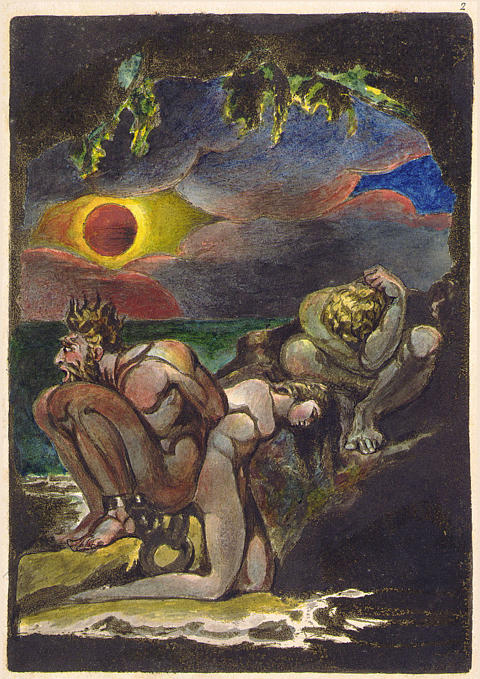
Los entering the grave